At Tech4Gamers, I work as a guides expert. My role involves writing about solving different gaming and tech-related topics that pique my interest and that I believe more people should know about. This position allows me to share my insights and discoveries with a broader audience, enriching their gaming experiences with the unique perspectives I bring.
Story Highlights
Tyler1 is a famous streamer known for his aggressive personality and exceptional gaming skills.
Despite a lack of formal training, Tyler has become a top chess player within a year, surprising the chess community.
Some admire him as a prodigy while others criticize his arrogant attitude.
Tyler Steinkamp, better known by his online alias Tyler1, has carved a unique path in the online streaming world. Fans and first-time viewers alike are intrigued by his overly aggressive personality. Tyler is a very passionate person, somehow managing to stream 10 hours a day while still having time for powerlifting. Tyler is a caricature of the loud, dumb musclehead trope that is an actual super genius in pattern recognition.
The Origin Story
Tyler’s origin story comes in two parts, and both start in spite. Some say the trigger was his loss to his brother, while others say it was his loss against XQC. Regardless of which one it was, PogChamps 5 set Tyler down a road for vengeance against all that laughed at him. With Tyler’s crude attitude, most people didn’t think he had it in him to get much better at the game. Today, not only is he among the top-rated Chess streamers, but he’s also in the top 0.5% of all Chess players in the world.
A Genuine Prodigy
When you first see a powerlifter who rages, screams, and hits his head on the wall at any minor inconvenience, a genius is not the first thing that comes to mind. Still, no matter how you deny it, Tyler is an authentic prodigy. He’s extremely good at League, getting Challenger in all 5 roles while playing solo. His pattern recognition skills are insane, and so is his drive to grind. When he sets his mind on something, it’s like this machine that won’t cease functioning until the goal is achieved.
Tyler1’s Pogchamps card had him rated 199
This genius is not exclusive to League, however. Just 11 months ago, he was rated 199 and barely knew how the pieces moved. Today, he’s almost at 2k. This improvement unironically rivals Magnus Carlsen’s first foray into chess. Magnus took about a year to go from 900 ELO to 1900. Tyler took 11 months to go from 199 to 1900. Obviously, comparing a grown adult to a 9-year-old Magnus isn’t entirely fair, but Magnus is considered an alien by human standards.
Simply Built Different
His physique is unusual for a streamer, let alone a Chess master
“If you start out playing as an adult, you can’t get beyond a certain point. It’s impossible.”
The above was said by Grandmaster Hikaru Nakamura about Tyler1 when he reached a 1400 rating. As we’ve seen in the past month, he now sits comfortably at almost 2000. This limitation has some scientific basis, with neuroplasticity severely limiting the changes an adult brain can go through compared to that of a child. Whether Tyler1 is some extreme prodigy or if it’s just an effect of playing tens of hours every single day for a year, it seems he’s beaten biology.
One other impressive thing is that Tyler doesn’t know any openings. He also doesn’t have a coach, nor does he study traps and counters. Tyler’s brute-forcing Chess with a single opening, his trusted Cow opening. A study shows that the most important part in Chess expertise is experience and practice (Charness et al., 2005), and Tyler1 is a living example of this.
The Chess Community’s Reaction
With Tyler’s personality, it’s no wonder most of the chess community wasn’t fond of him. A lot of the hate was justified by Tyler’s arrogant remarks about Chess masters. However, much of the hate might also come from a sort of elitism mindset.
The first match Hikaru saw of Tyler was when he was rated 199; he said that watching Tyler play made him lose brain cells. Granted, Tyler did hang his Queen, so this was perhaps worth it. His next reaction to Tyler was when someone in his chat told him to watch Tyler play, to which Hikaru said:
“Is he still playing? Oh god, I hope he isn’t. He’s hit a wall, he can’t improve anymore.”
Keep in mind that this was when Tyler had already climbed to 1.4k ELO in just 6 months, an achievement not many can replicate. In contrast, Gothamchess or Levy calls him a prodigy unlike any other. His input matters because prior to Tyler getting into Chess, Levy was the biggest Chess streamer. Levy and Hikaru are among the people who revolutionized chess by promoting it to a larger audience, so these differing views represent the wider chess community.
At Tech4gamers, I cover all sorts of gaming news. Whether it’s a leak of any upcoming game or an update, an announcement, or a rumour, I like to write about it all. Over the weekend, I sit and write features where I talk about games that I miss or want to see return.
Story Highlights
The browser games are easily accessible on any browser and can be played on any device even if it has low specs, making them attract more players.
They offer quick gaming sessions, are mostly free-to-play, and are fun to play with friends – making them easier to reach for most users.
These games are promoted by YouTubers and Streamers due to which more people want to play these games.
Remember playing FRIV or Miniclip on your browser? Those were one of the highlights of every gamer’s childhood. But, do you know that browser games are still relevant today? Let’s see what makes them relevant in an era of downloadable games.
Origin & Popularity
A decade after the arrival of the internet, Neopets (1998) was released which was a virtual pet website. Then, Shockwave.com made its way which included many flash-based games. Finally, in the early 2000s, sites like Miniclip and Newgrounds came into being.
Even though browser games had their beginnings in the early 1990s, they became popular in the Facebook era where games like 8-ball pool, Farm Frenzy, and Restaurant Story were attached to Facebook, and people used to play them endlessly.
Easy Accessibility
Believe it or not, the accessibility of the browser games makes them all the more appealing to play. The ability to go on any browser open a particular website and play the game instantly is very easy.
For downloadable games, people have to search for the right games which requires a chunk of time. Then, they need to keep the size of the game in their minds and allocate space for it if users don’t have it on their PCs. Then, they need to wait for the game to download.
FRIV
This process is tedious, especially for users who have storage issues or slow internet. Browser games, on the other hand, skip this hassle and get directly to the game. Additionally, you can play the same game from any device, be it a mobile or a laptop/PC.
Free-to-Play
Browser games come with a perk that most of them are free to play. This low barrier of entry allows for more users to hop on the game, which in return spikes the player base of these games, making them relevant to the users of this era as well.
Quick Sessions
Games on the browser provide a casual gaming experience for people who want shorter and quicker gaming sessions. This means you can have a quick match without worrying about wasting any extra time on loading screens, cutscenes, or lengthy pauses.
Nostalgic Appeal
People who played browser games their entire childhood have a sense of attachment to these games which draws them back. Revising these games evokes nostalgia in them and they continue to play these games even today.
Old Miniclips Website
Multiplayer & Social Features
Browser games also provide multiplayer features which are essentially quick as well. Games like Krunker.io and ShellShockers.io offer seamless multiplayer games, making them users’ go-to games to play when they’re in high school, university, and office.
Games like 8-ball Pool and Chess are so simple yet so engaging for many users. Their simple nature paired with their availability on browsers make them very accessible for people who want quick sessions with their friends or other players from around the world.
Treat For Low-End PC Users
Games like Krunker.io offer Call Of Duty-type experiences where many people can play and enjoy an action-packed, first-person shooter with the comfort of their browser and get very stable FPS even on lower-end PCs.
There are even 2D battle royale games known as Zombs Royale on browsers. Additionally, for people who want to have the same fun as they would in Fortnite, there is a 3D building & shooting game (1v1.lol) so that people with low-end PCs don’t miss out on the fun.
YouTube & Streams
Games like Scribble.io and Pinturillo 2 allow many friends to join in a room and play together to guess from the drawing what the word is. These games have been made popular by YouTubers and streamers who had a blast playing these games.
Even watching their gameplay is fun because of how numerous interactions take place regarding each word. Previously, games like Agar.io, Slither.io, and Diep.io became popular since many YouTubers were playing them.
Now, games like GeoGuessr have been made popular by YouTubers and Streamers who showcase their expertise in geography through this game. After watching insanely accurate points scored by Youtubers, people flocked to the website to test their own skills.
The latest game that YouTubers hyped is Infinite Craft, which requires users to create magical things by blending two options.
At Tech4Gamers, I take on the role of Hardware Reviewer with pride. My responsibilities involve a thorough examination of essential hardware components like motherboards, graphics cards, processors, PC cases, and CPU coolers, among others, focusing on their complexities and functionalities.
Sameed Hussain
As a Hardware Expert at Tech4Gamers, I blend my Computer Science expertise with a love for technology. Through comprehensive reviews and comparisons, I guide our audience in making informed tech decisions.
In this article, I am taking a look at our first kit from Netac. It is a Netac Z RGB DDR5 32GB kit. It has 1x XMP profile and 1x EXPO profile. This kit is a 2x16GB configuration with 7200MHz CL34 maximum transfer rate and latency. The part number of this kit is NTZED5P72DP-32S.
We could not get the retail price of this kit. It is expected to retail at around USD 140 mark.
Why Trust Tech4Gamers
Sameed Hussain is our hardware expert who has been testing graphics cards, processors, RAM, and motherboards for years.
70+ RAM tested and reviewed by our team of hardware experts (Tech4Gamers Team).
200+ hours spent testing different RAM for our reviews.
At Tech4Gamers, ensuring you get reliable information is our priority. That’s why every hardware round-up undergoes a meticulous review process by our team of experts and editors. Each review is carefully examined against our strict editorial guidelines, guaranteeing you trustworthy insights you can depend on.
Key Takeaways
The Netac Z RGB DDR5-7200 CL34is high-performance with Intel XMP and AMD EXPO profiles programmed in it. Plus, its glass finish is too good-looking.
You should buy the Netac Z RGB DDR5-7200 CL34 if you want RAM with both XMP and EXPO profiles and a chrome reflective design.
You should not buy the Netac Z RGB DDR5-7200 CL34 if you want good OC potential, have RAM clearance concerns, or want the most value for your money.
Netac Z RGB DDR5 has its own signature series. It is glass-finished on both sides of each module, which is reflective. This is further augmented by the tubular-looking design on the top, which has subtle A-RGB lighting effects. On top of that, this kit has performed well considering other 32GB DDR5 kits that we have tested. The only thing holding this kit back is its slightly high price tag.
Packing Box
The kit is shipped inside a hard container placed inside a paper-board box. The presentation is on the mark. The following are provided:
2x16GB Modules
1x DRAM Module Instruction
1x Microfiber Cloth
Since the chrome finish is a fingerprint magnet, Netac should consider providing a pair of gloves.
Design
Let’s start by stating the salient features of the kit:
The kit is finished in highly reflective chrome
Subtle A-RGB Lighting Effects
Same Bank Refresh
Leverages on-board PMIC for a Stable and Quick Power Supply
The Z RGB from Netac is a flagship memory kit from the manufacturer that is also available at other speeds, including 6000MHz, 6200MHz, 6600MHz, 7200MHz, 7600MHz, and 8000MHz. This kit conforms to JEDEC 4800MHZ base frequency.
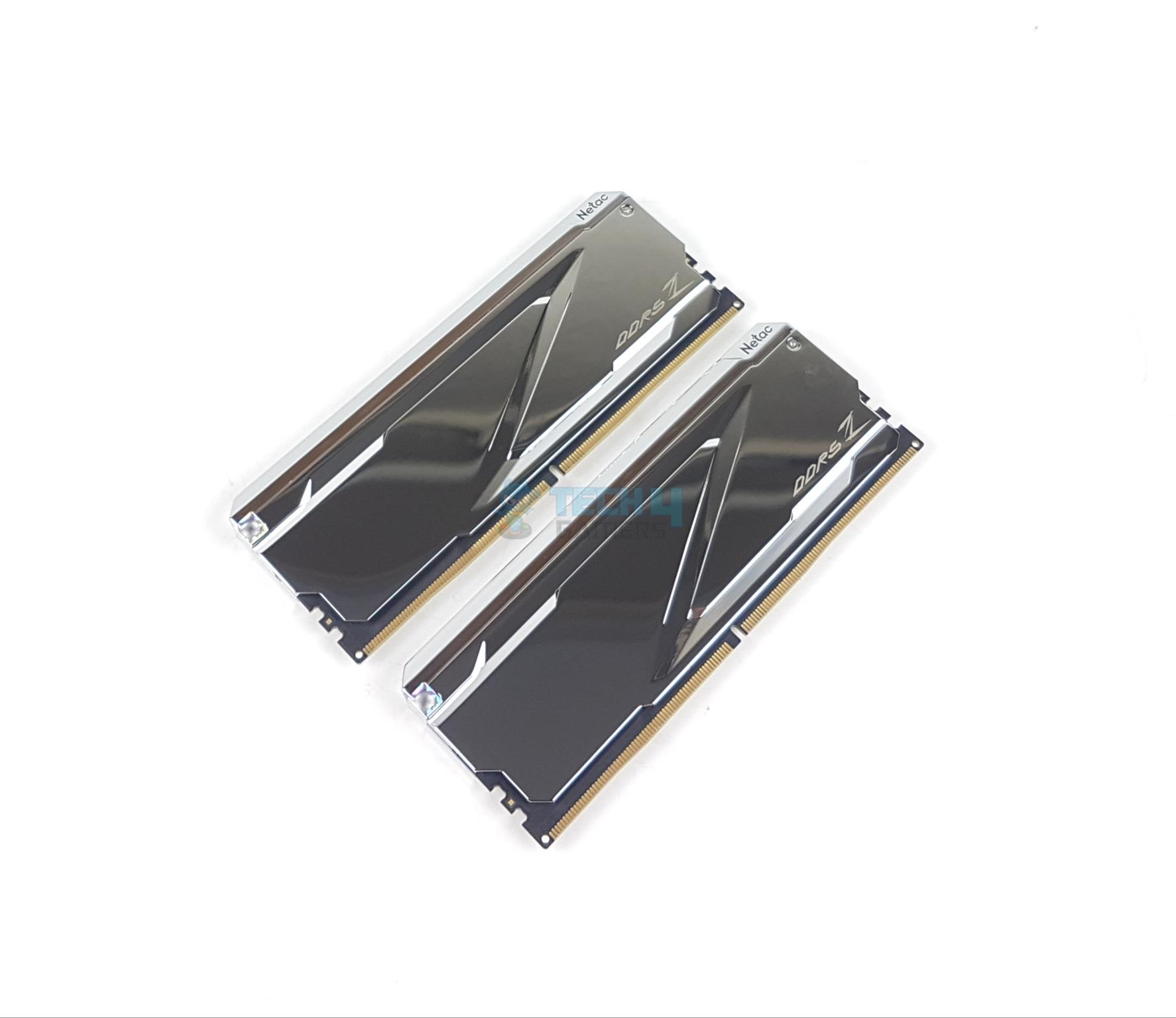
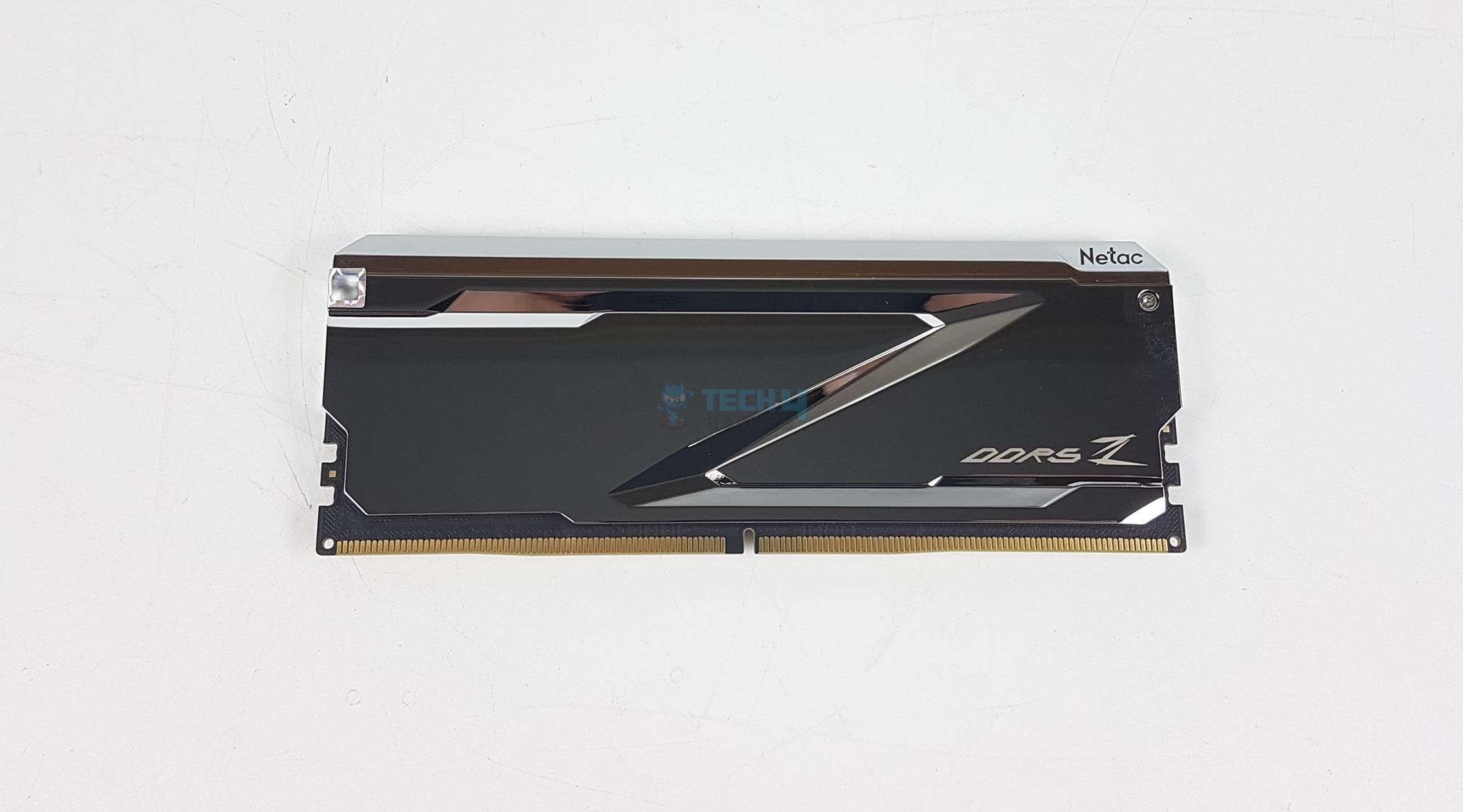
The Netac Z RGB DDR5 kit has a dimension of 133.5×50.9×8.3mmm. This thickness is a tad less than the ASGARD BRAGI ROG STRIX kit. It was hard to capture the reflective surface of the module. You can see a stylish Z-letter texture on the aluminum plate. This kit has an on-die ECC, which comes in handy for real-time data correction. It is an unbuffered DIMM with a 288-pin layout. Unlike ASGARD DDR5 kits, this kit does not have a protective cover on the connector on each module.
WARNING: At 50.9mm tall, it may not fit under some large CPU air coolers, so verify clearance before purchasing.
The backside resembles the front view. There is a sticker on this side showing the model number, part number, speed, timing, and other parameters. Removing this sticker would void the warranty. The heat spreader is made of aluminum material. The CNC machining work is precise. Each module has 1Rx8, meaning a single rank design using 8 modules. This kit is made in China.
Top of the kit (Image By Tech4Gamers)
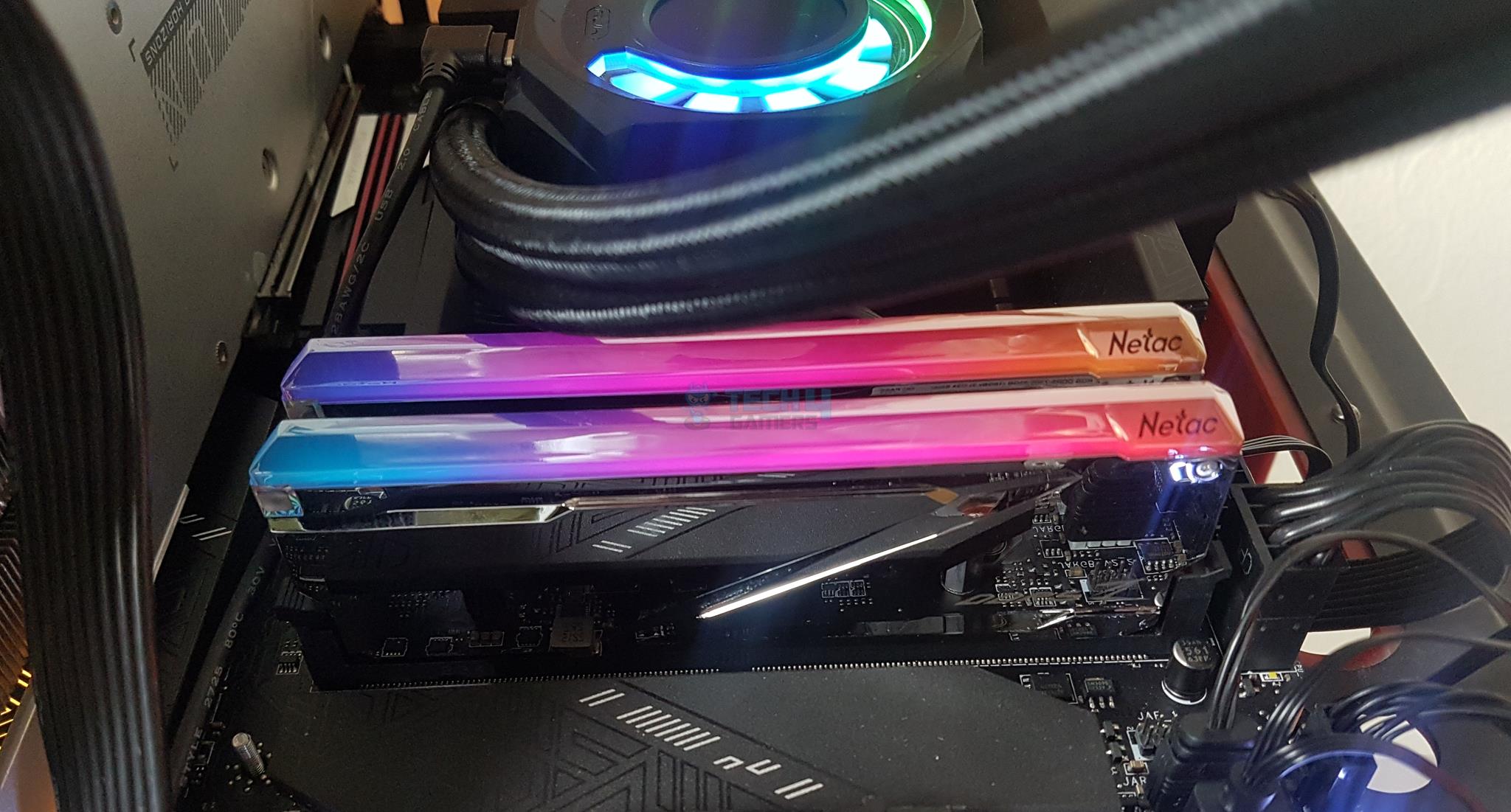
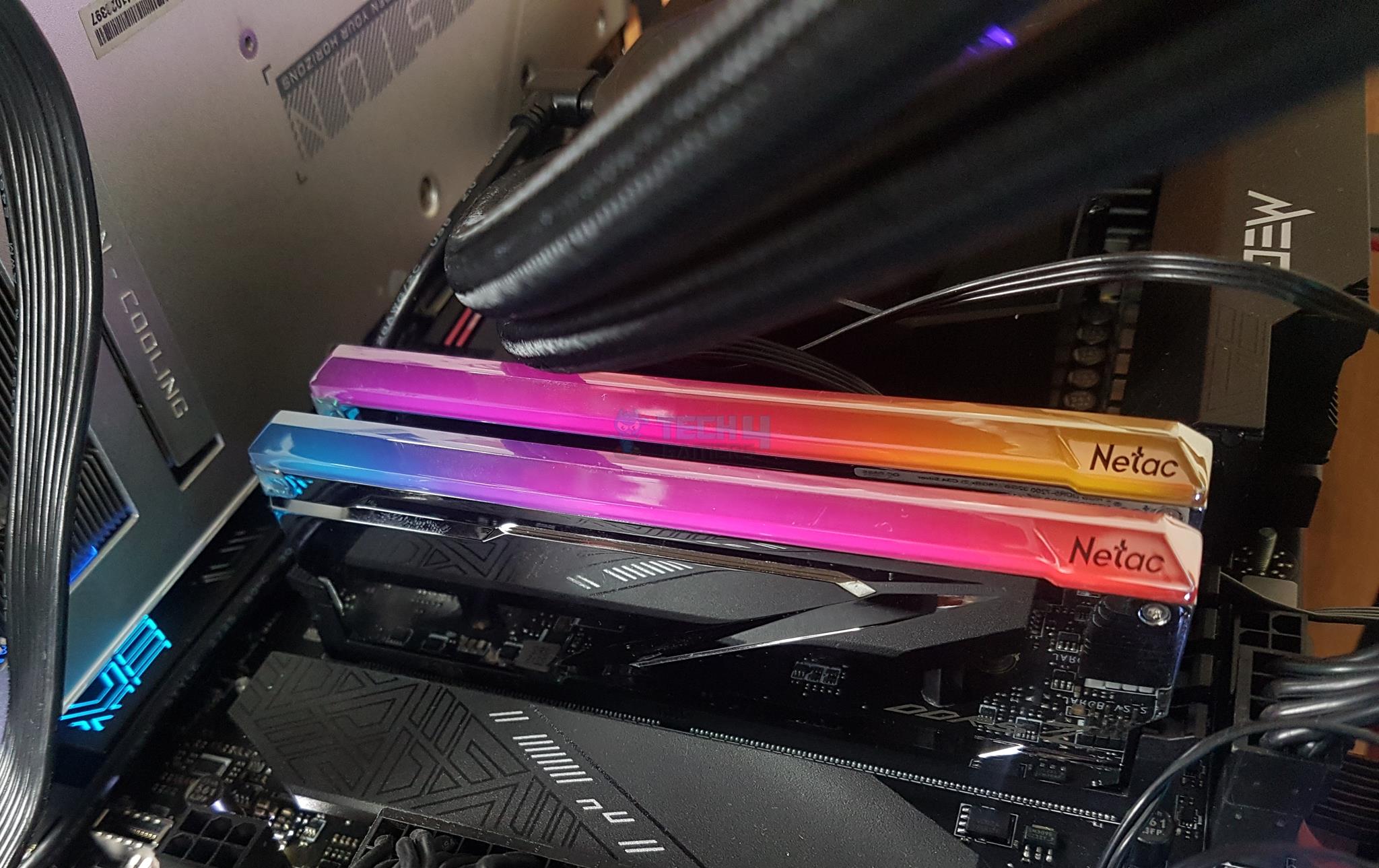
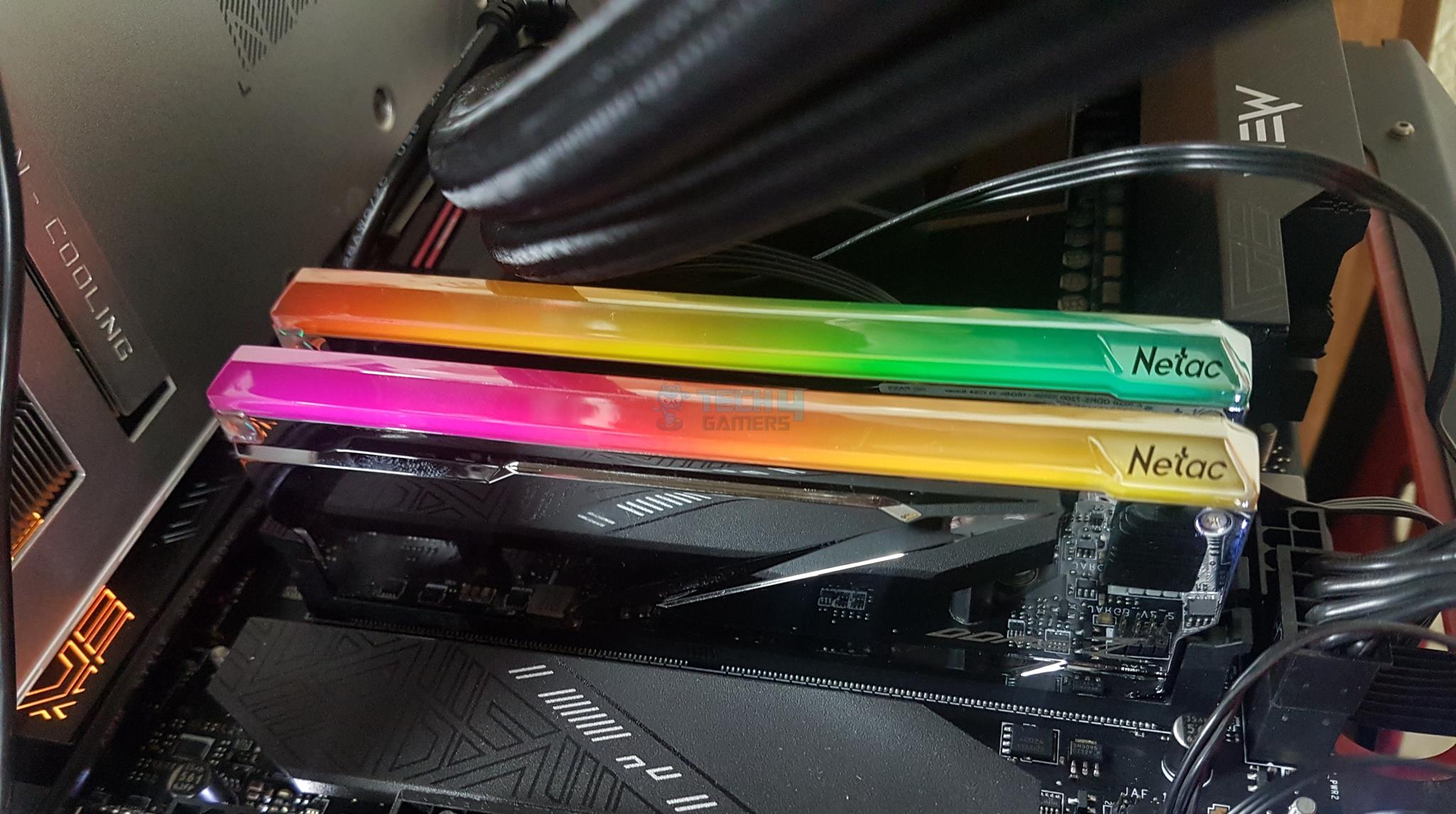
There is a stepped diffuser above the PCB. NETAC branding is written on the sides, and the diffuser with cover resembles a tubular design. This makes the A-RGB lighting quite subtle to my liking. I like how Netac has kept it to a minimal level.
The overall design is stylish, attractive, and bold. You just need to be careful while handling the modules as fingerprints are easily captured on the aluminum surface.
Thermal Padding (Image By Tech4Gamers)
Netac uses black PCB. This is a single-rank design. There is a black thick pad on the non-populated side of the PCB running on the entire length. Its width makes up for the width equalization on the opposite side.
The populated side of the PCB has a PMIC chip in the center. This PMIC chip has 4x memory chips on both sides. This gives a 32GB capacity overall in 1Rx8 using a 2G x 64-bit design. Netac has used a thermal pad over the memory chips.
Thaiphoon Burner (Image By Tech4Gamers)
This kit is probably manufactured in China by Netac in the 34th week of 2023. Netac has used Hynix chips that have part number H5CG48?EBDX018. The PMIC controller is from Richtek and has part number RTQ5132GQWF.
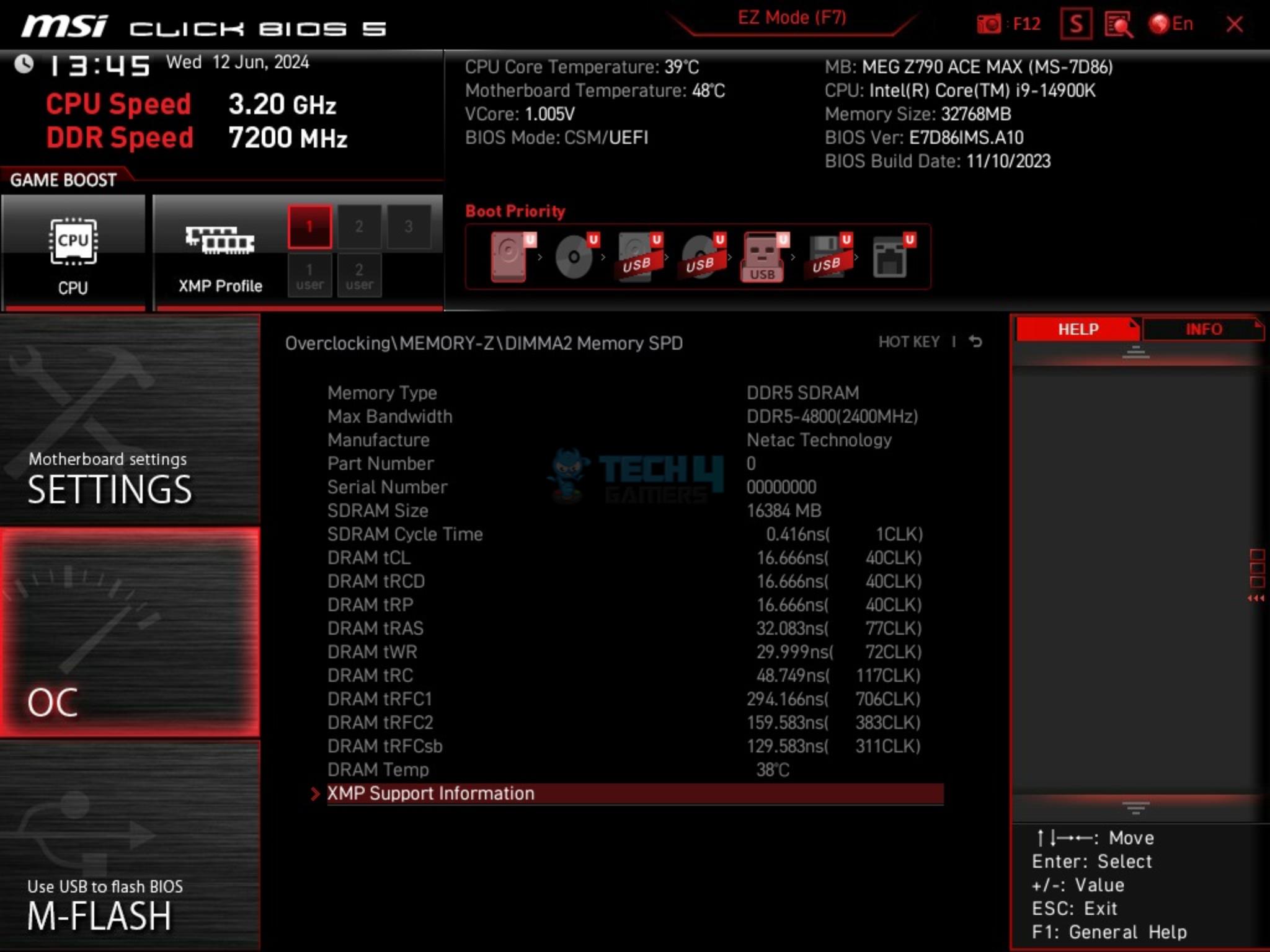
This kit has Intel XMP Revision 3.0 and AMD EXPO 0.9 profiles programmed. This kit has an SPD device having a model M88SPD5118A5-T. This tells me it is from Rambus Tech.
Reflective Chrome Surface (Image By Tech4Gamers)
A glance at how reflective the chrome surface is on this kit. This reminds me of the ASGARD BRAGA kit having same reflective finish.
RGB Lighting
RGB Effects
1 of 3
RGB Lighting (Image By Tech4Gamers)
RGB Lighting (Image By Tech4Gamers)
RGB Lighting (Image By Tech4Gamers)
This kit was tested on MSI Z790 MAX ACE WiFi, and RGB lighting was controlled using the MSI Mystic Sync app. The lighting was responding to the changes in the app. There is an even diffusion of the lights across the diffuser, and I appreciate the sublime lighting in this kit.
Testing
We are using the mentioned configuration for RAM testing:
We are thankful to our sponsors for this test bench. The following software has been used for the testing:
AIDA64 Engineer
SiSoftware Sandra Suite
Performance Test
3DMark Time Spy
Super Pi
BIOS Run
BIOS Walkthrough
1 of 4
BIOS (Image By Tech4Gamers)
BIOS (Image By Tech4Gamers)
BIOS (Image By Tech4Gamers)
BIOS (Image By Tech4Gamers)
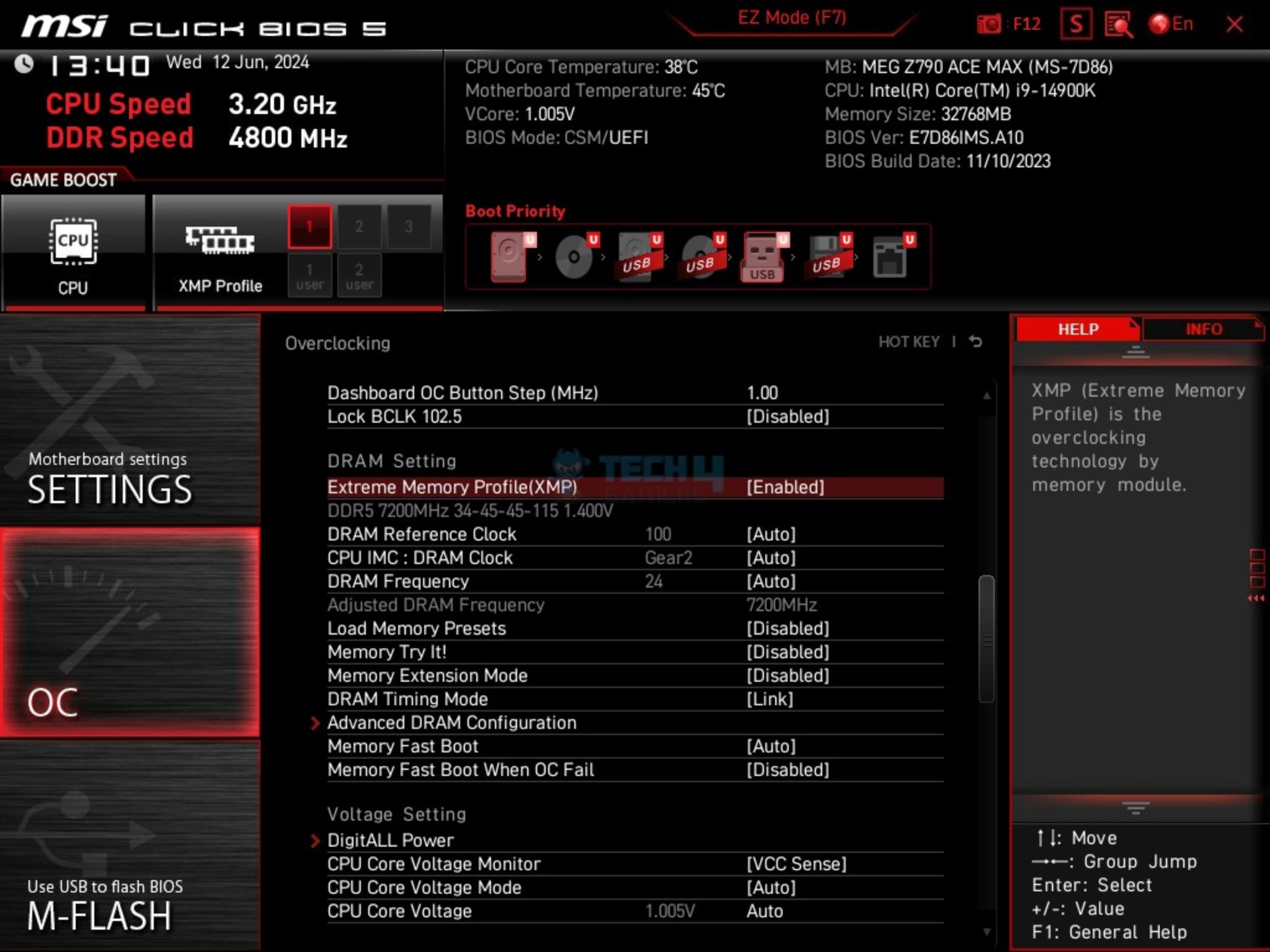
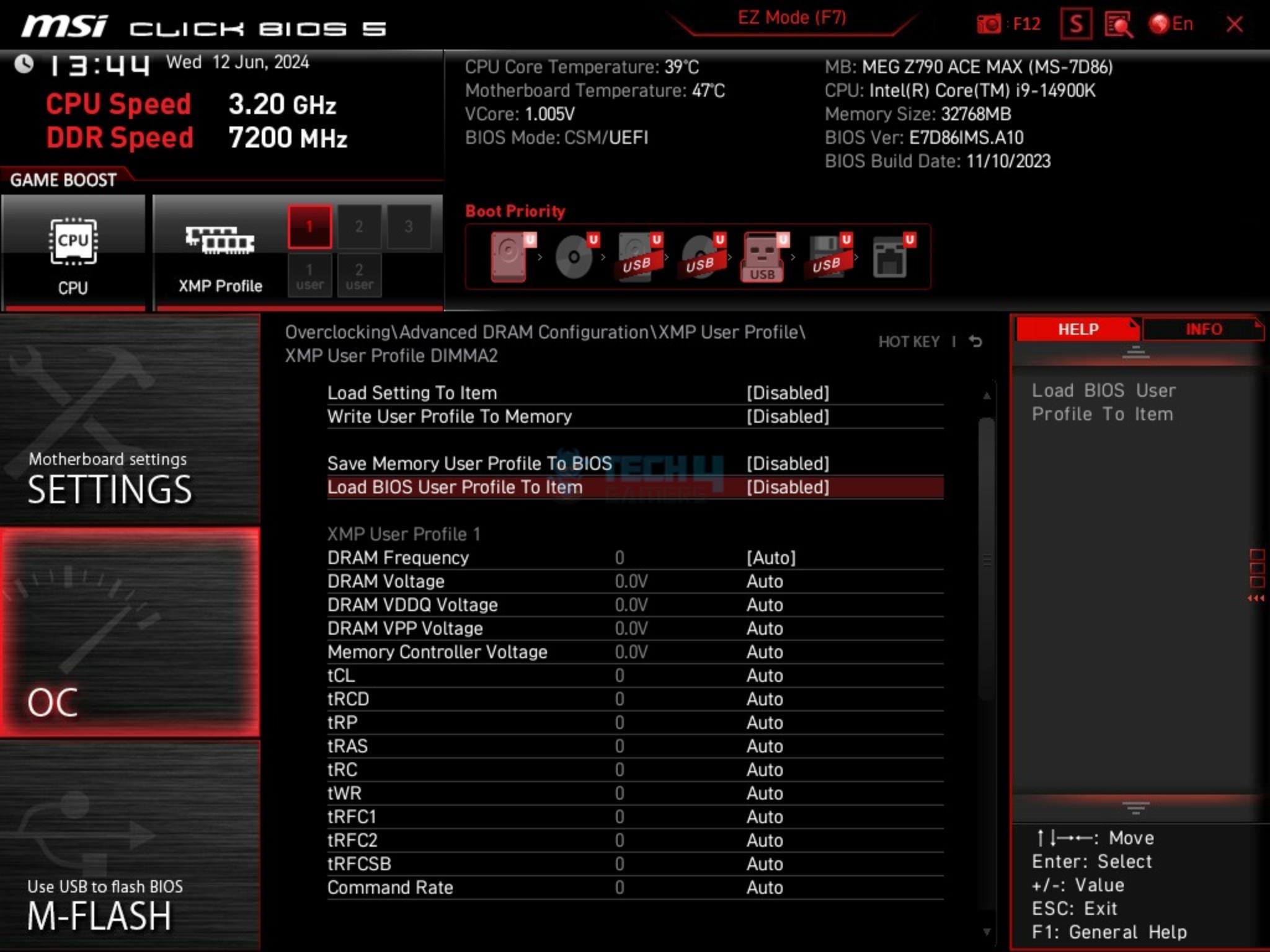
I have checked, and there are a total of 2x profiles under XMP/EXPO. The profile data is:
Intel XMP: 7200MHz, 34-45-45-115, 1.400V
AMD EXPO: 4800MHz, 30-40-30-76, 1.100V
The JEDEC profile is 4800MHz, 42-40-40-77 at 1.10V.
PRO TIP: Use the Intel XMP profile for the best performance at 7200MHz, but also test the AMD EXPO profile if you’re using an AMD system.
CPU-Z and AIDA64 SPD Readouts
CPU-Z (Image By Tech4Gamers)
The above is a CPU-Z screenshot. You can see that the software reports the kit to be in a quad-channel configuration. The reason for that is there are two 32-bit wide channels per module in DDR5 kits.
AIDA64 SPD (Image By Tech4Gamers)
The above is an SPD readout from the AIDA64 Engineer edition.
Results
It is time to take a look at the results and see where this kit falls in the graphs. I am starting with the AIDA64 Engineer edition result. Technically, we would want to see this kit offering a competitive performance compared to other 7200MHz kits in the graphs.
AIDA64 Engineer
AIDA64 Engineer
1 of 4
AIDA64 Memory Benchmark - Copy
AIDA64 Memory Benchmark - Latency
AIDA64 Memory Benchmark - Read
AIDA64 Memory Benchmark - Write
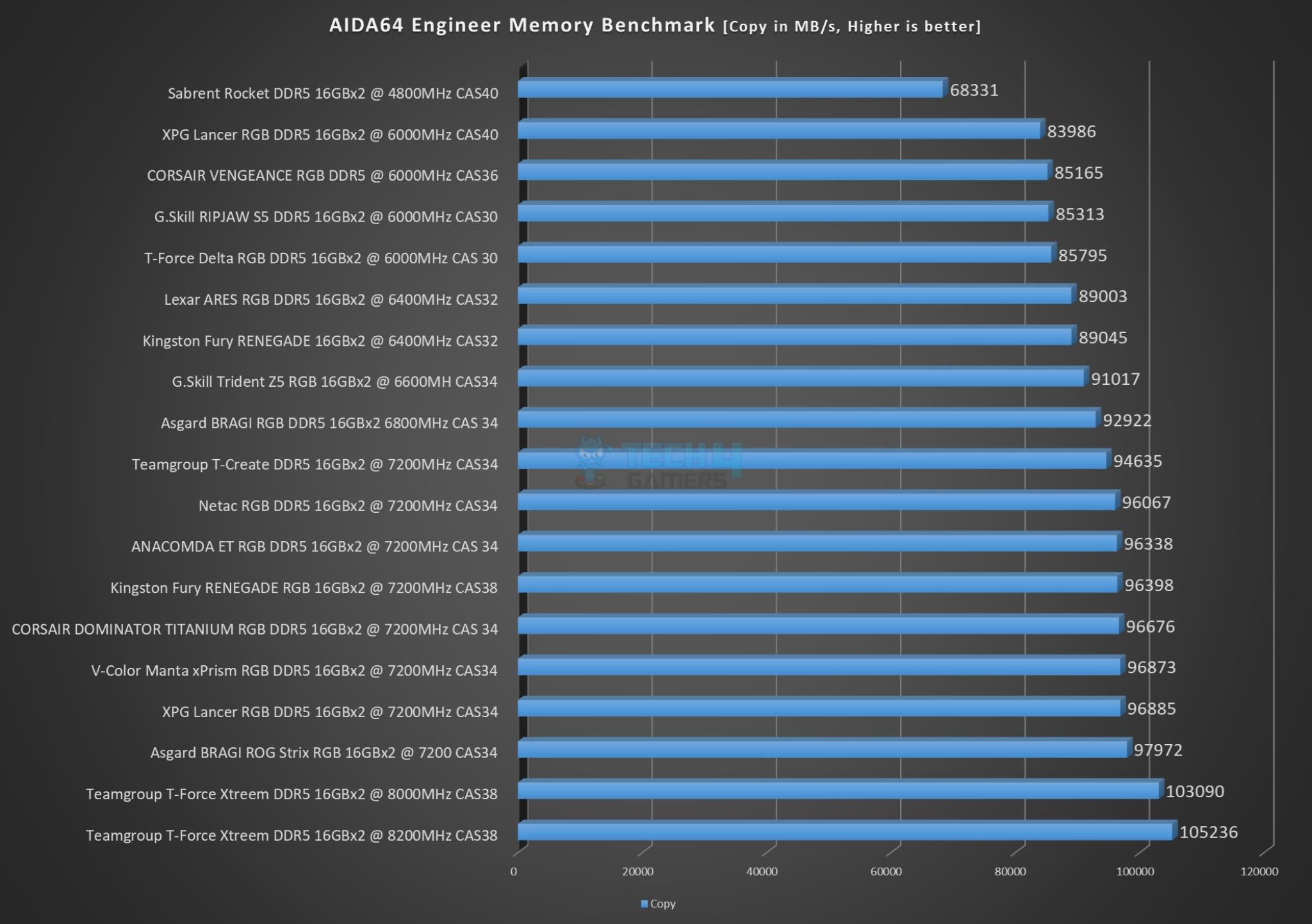
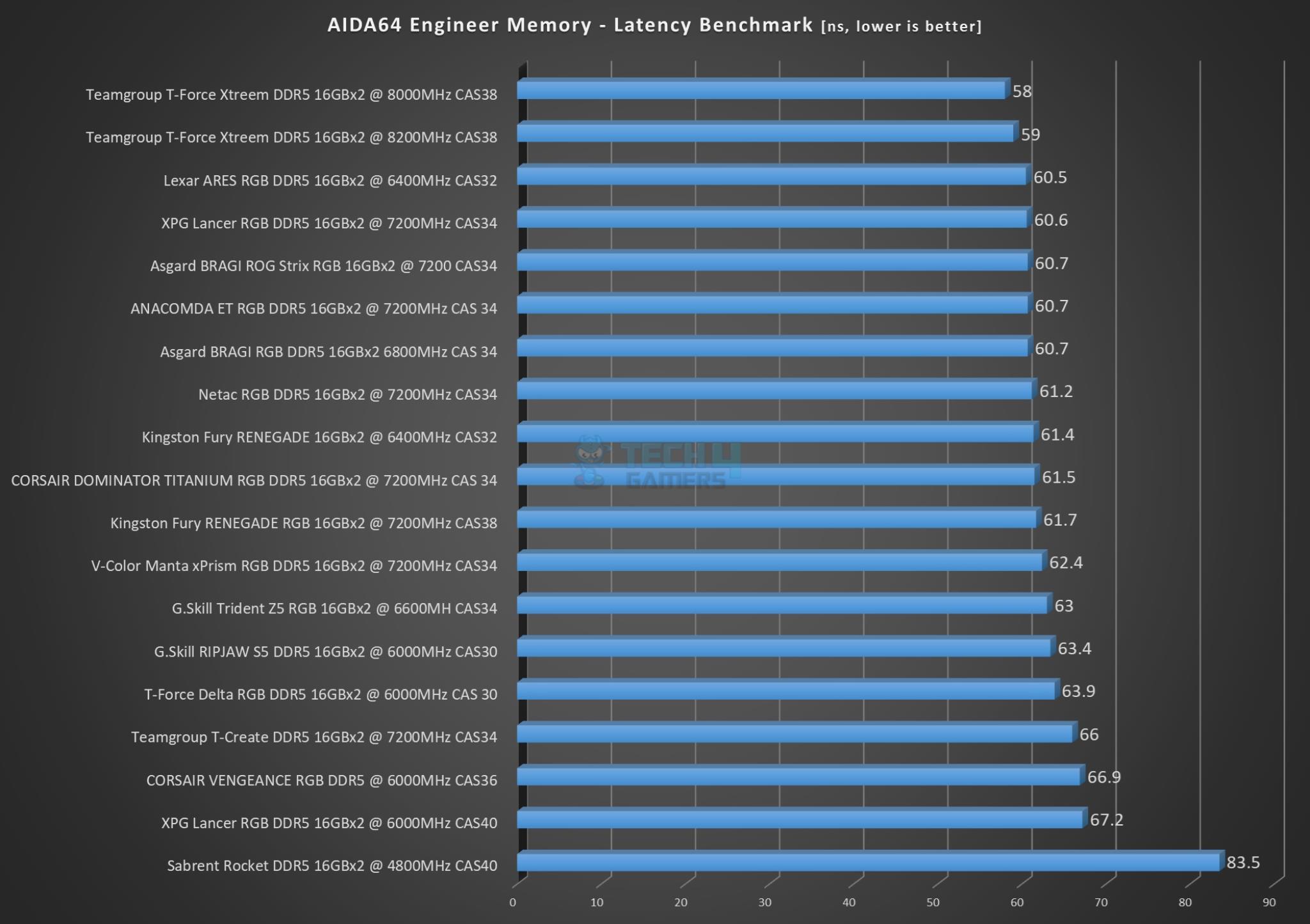
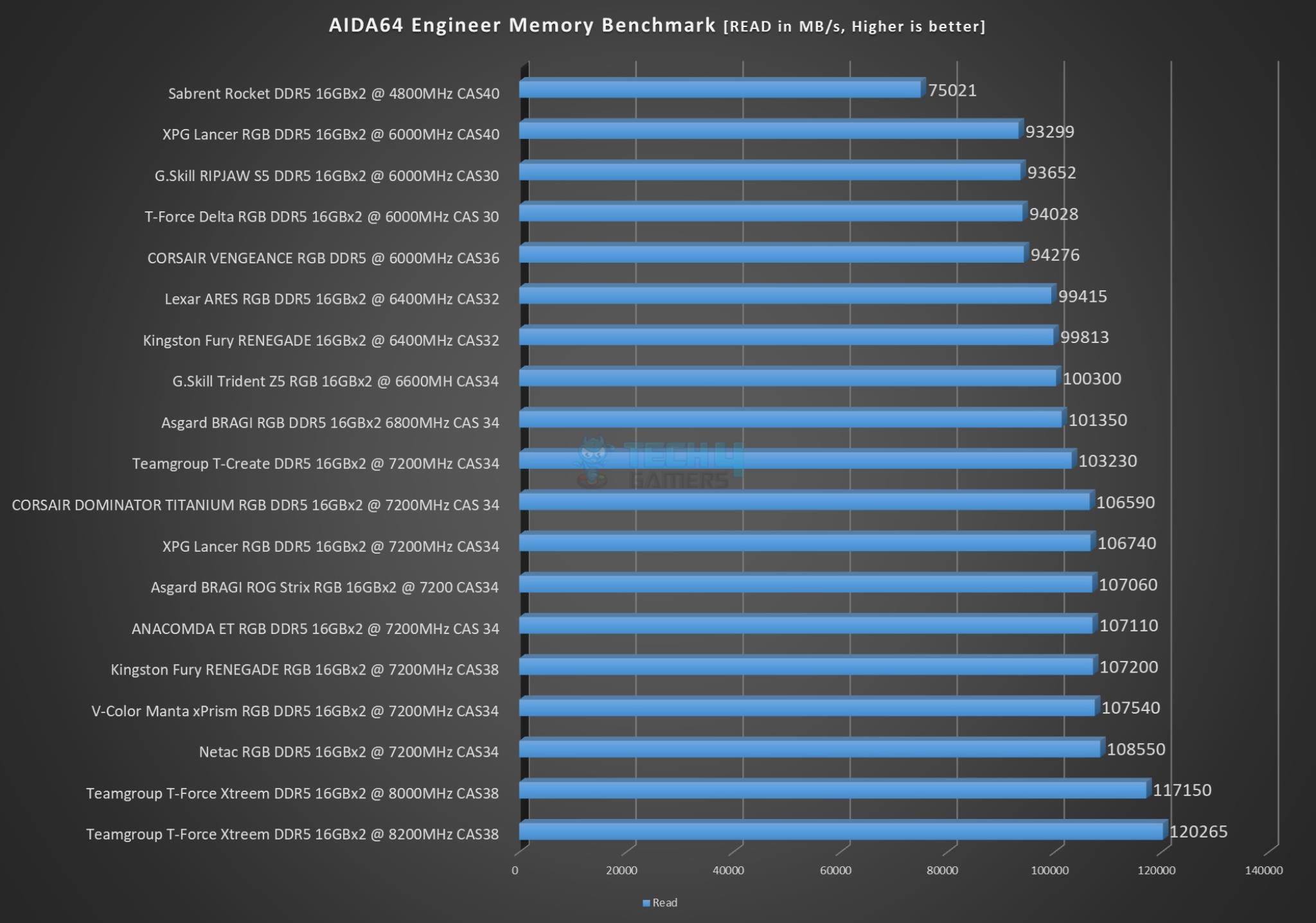
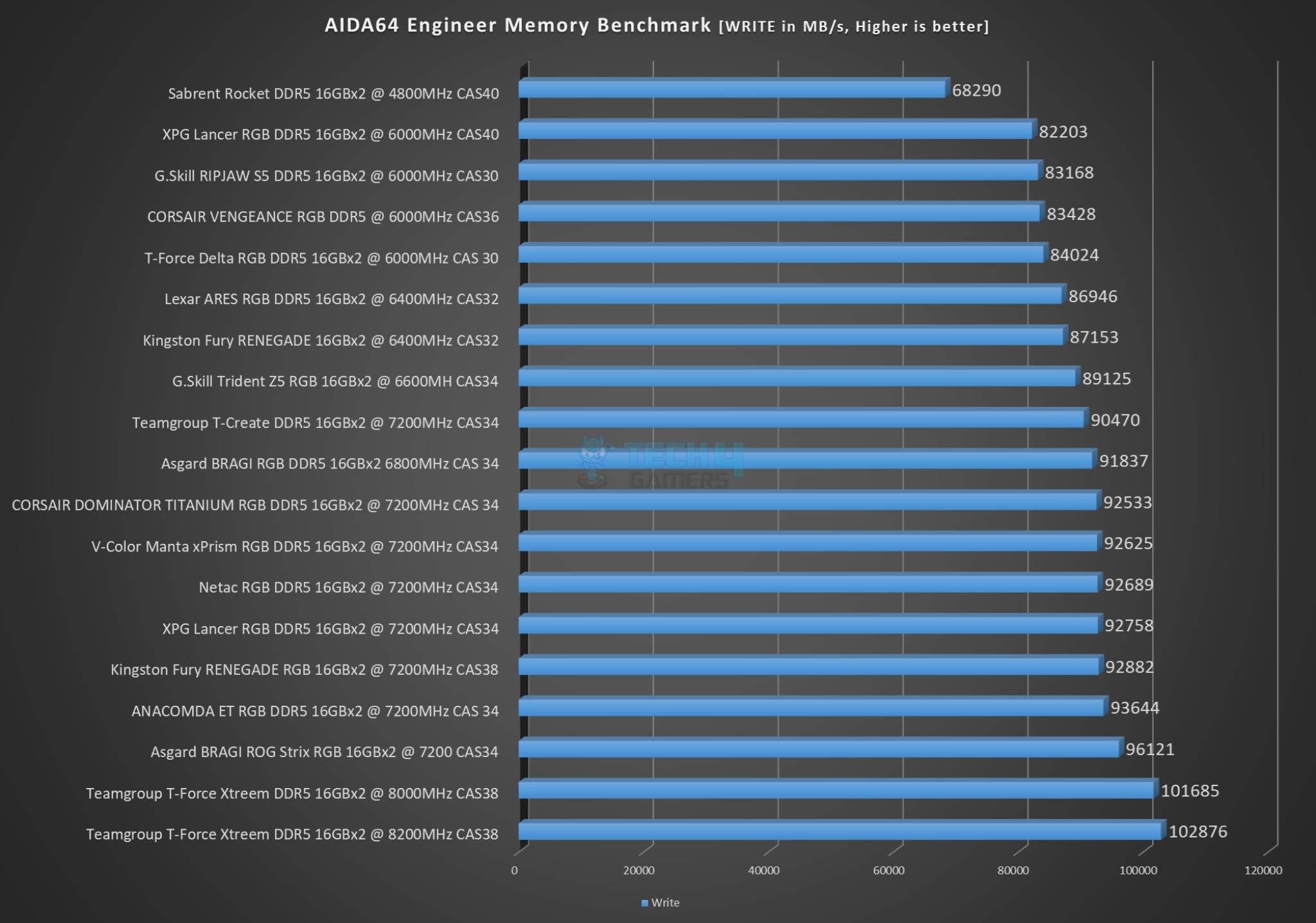
You can see competitive performance from the Netac Z RGB DDR5 32GB kit in Memory Read, Memory Write, and Memory Copy benchmarks. The latency performance on XMP is slightly less competitive. However, keep in mind that the software was updated so this could have impacted the scores somewhat.
Other Benchmark Software Results
More Benchmarks
1 of 4
Time Spy - CPU Score
Super PI
SiSoft Sandra Aggregate Memory Score
Performance Test - Memory Benchmark
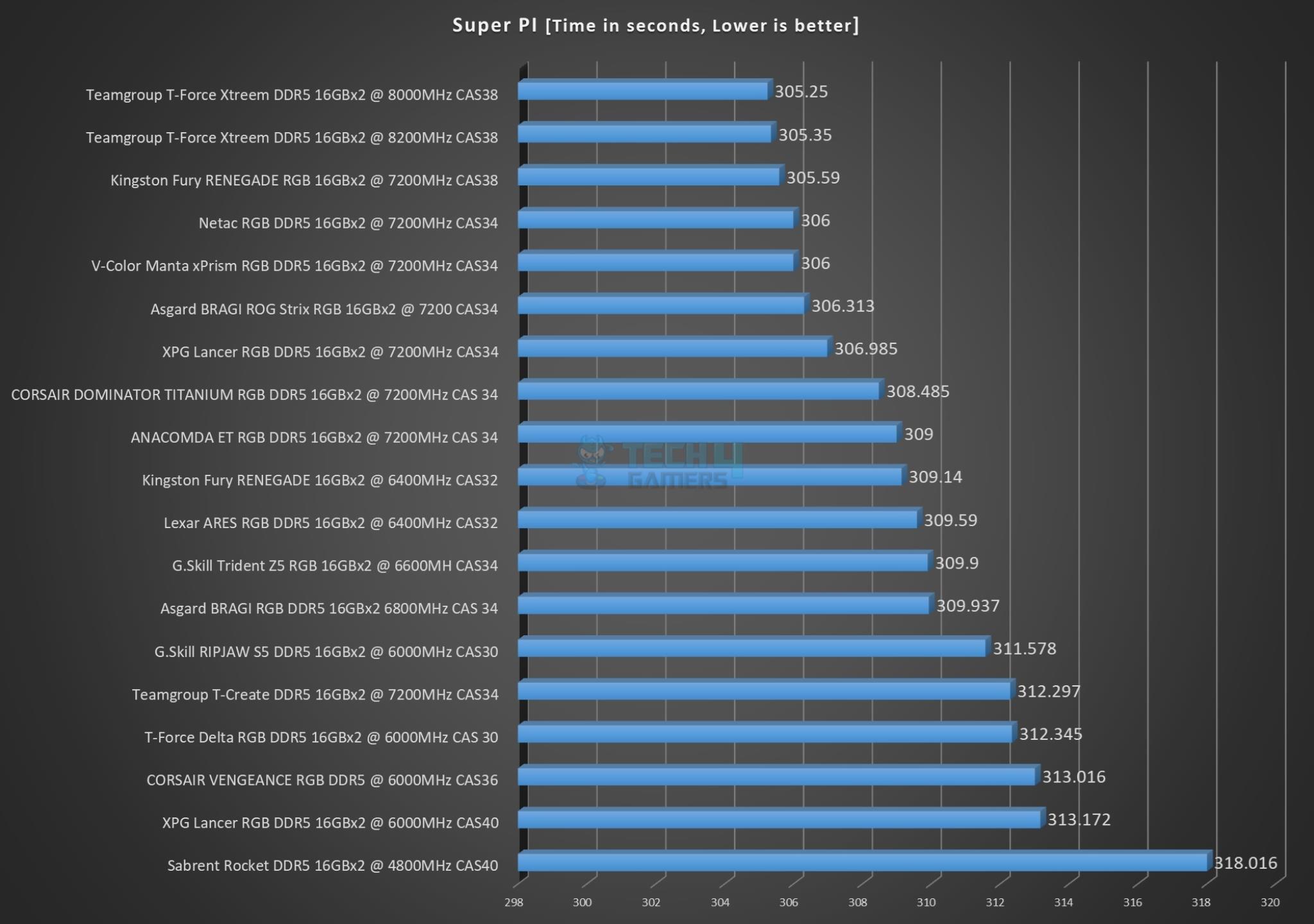
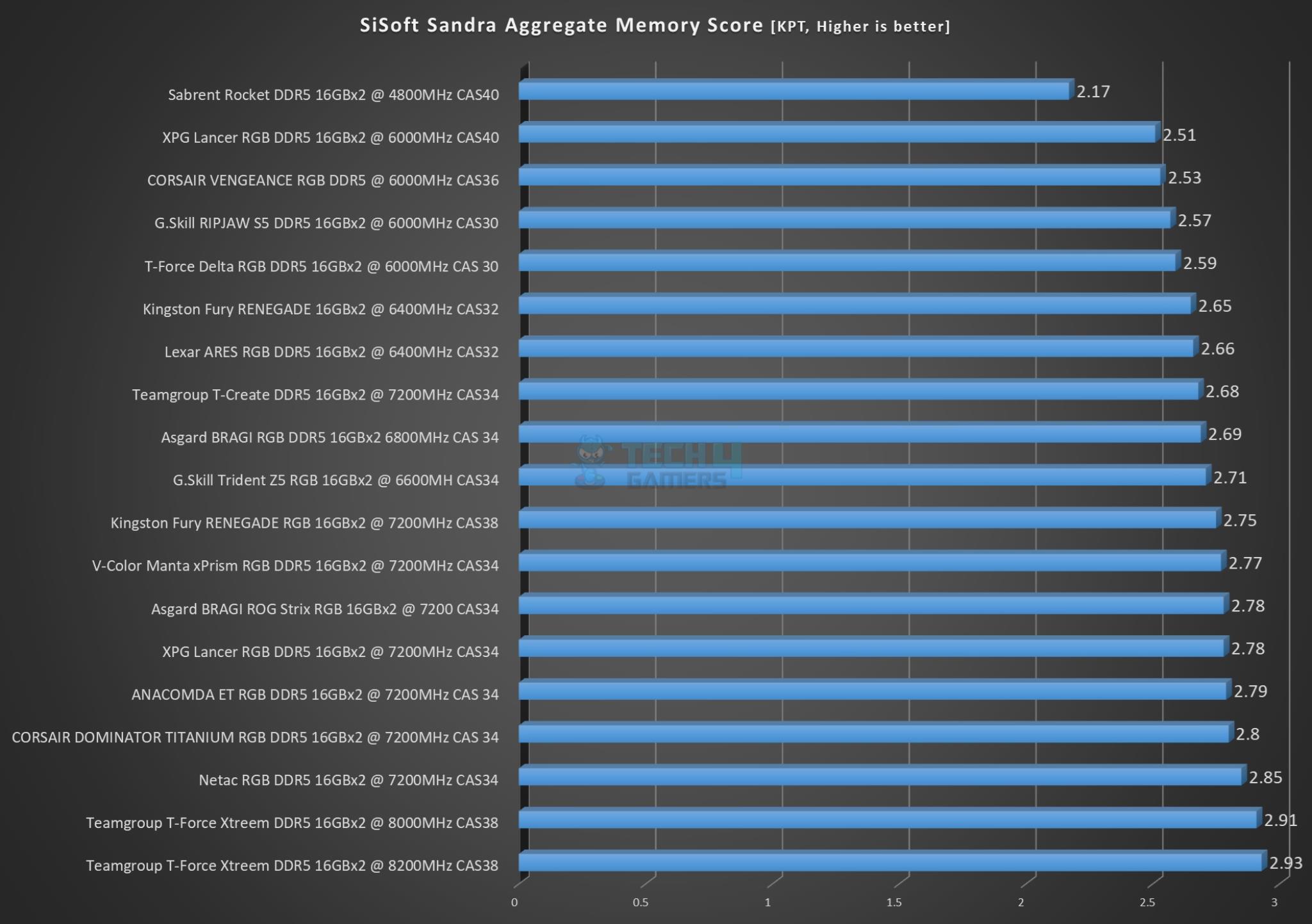
Now, let’s take a look at the other benchmark results, starting with the SiSoft Sandra Software. This kit scored 2.85 KPT, beating all other kits operating at 7200MHz. In Super PI, this kit has got 306 seconds to complete the 32M PI computations.
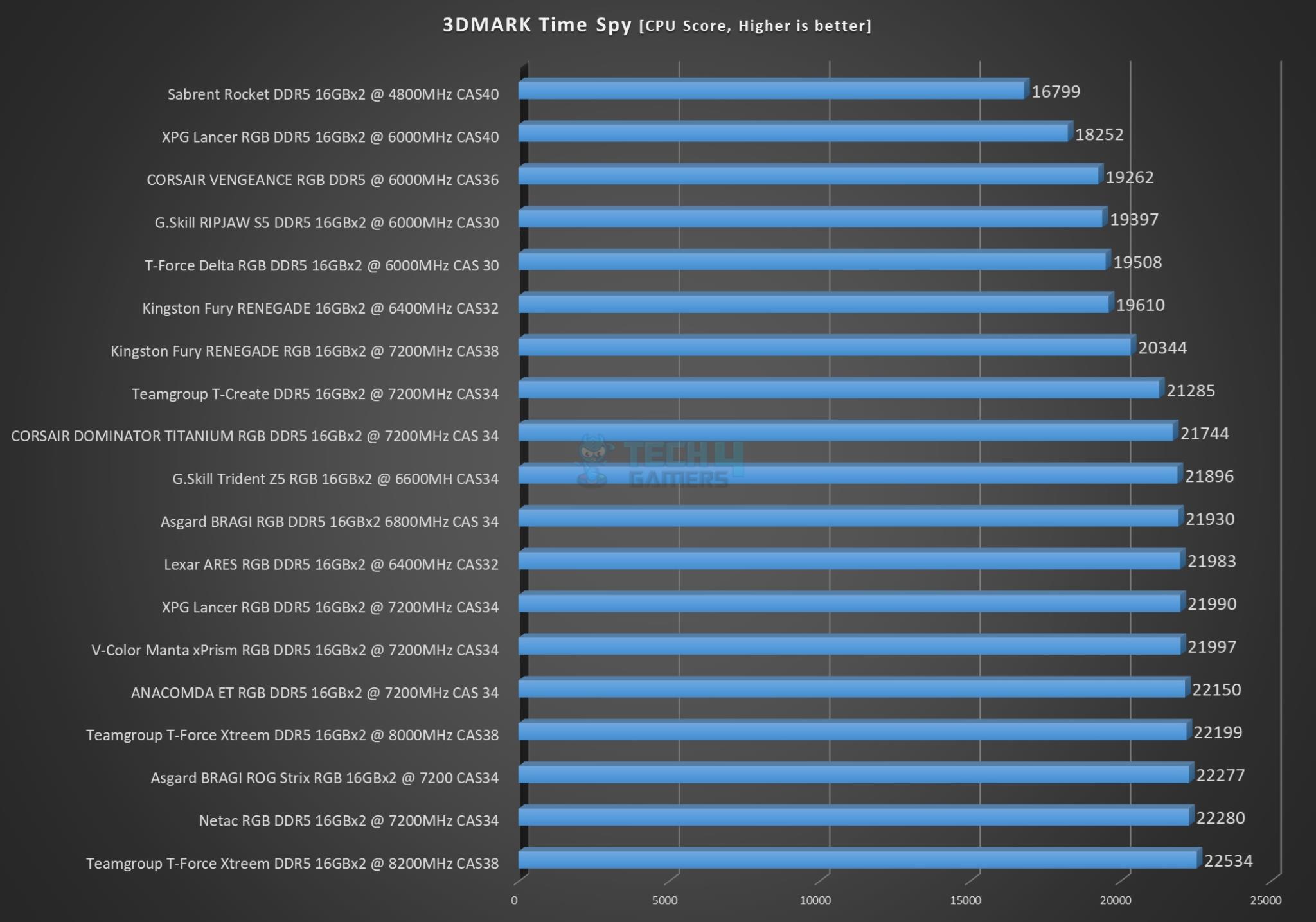
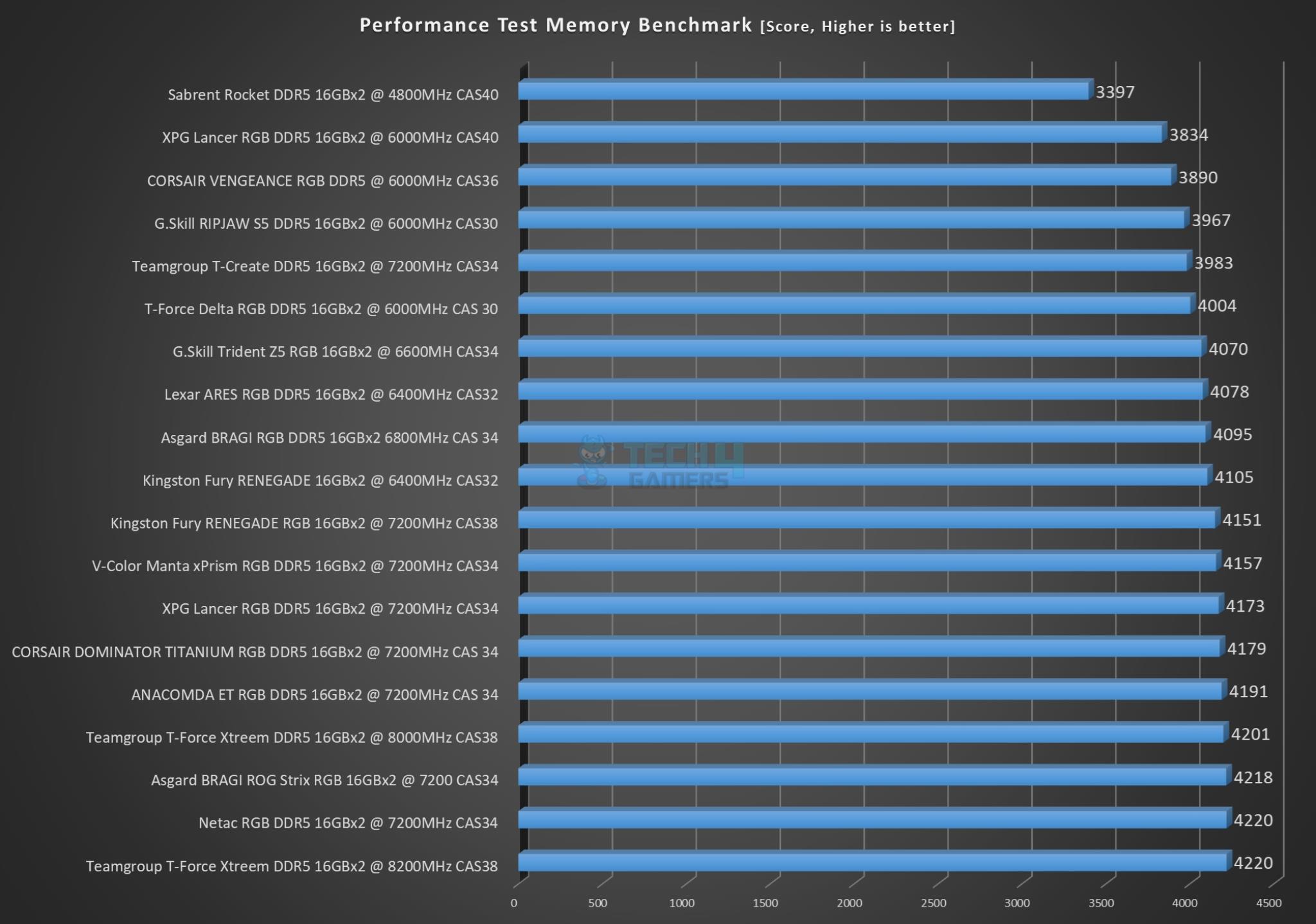
This kit performed exceptionally well in the Performance Test, scoring 4220. We are seeing a similar performance in the 3DMARK Time Spy CPU Score result.
Overclocking
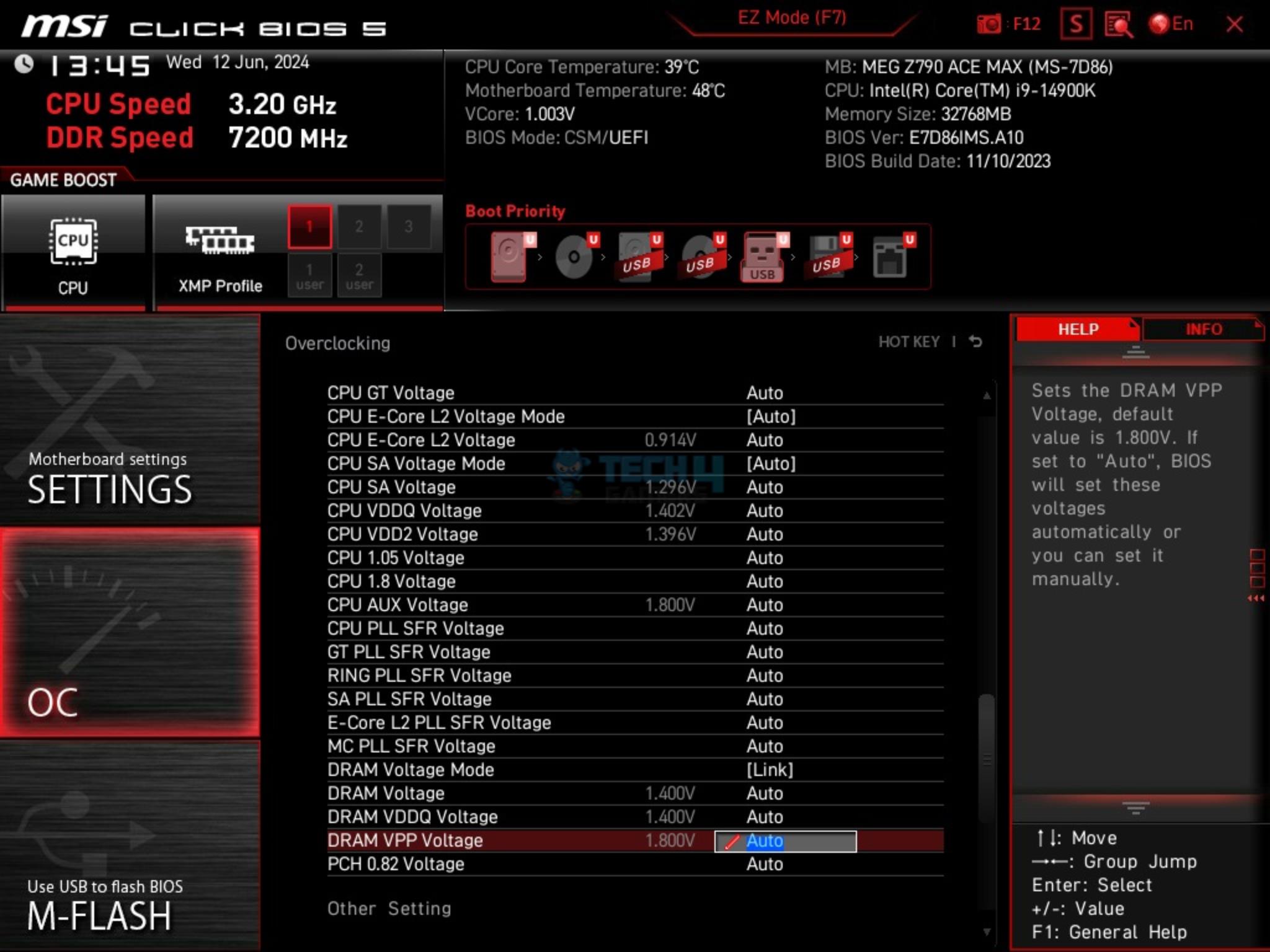
When it comes to overclocking, the Netac Z RGB DDR5 32GB kit has a mediocre performance. This kit was pushed to 7600MHz, which is a mere 400MHz higher than the tested frequency. It needed above 1.52V for 7800MHz and still was not stable. Everyone’s mileage would be different; hence it is important to know the configuration on which the overclocking is done. Here are the settings for this overclock:
Memory Frequency Multiplier
7600MHz
Timings
34-46-46-116
Gear Mode
Auto
VDD A0
1.50V
VDDQ
1.50V
VPP
1.80V
VCCSA
1.280V
VDDQ CPU
1.350V
VDD2 CPU
1.350V
Results
Below are some results with the overclocking.
OC Results
1 of 3
AIDA64 Memory Benchmark - Overclocking Result
AIDA64 Memory Benchmark - Latency Overclocking Result
Time Spy - Overclocking Result
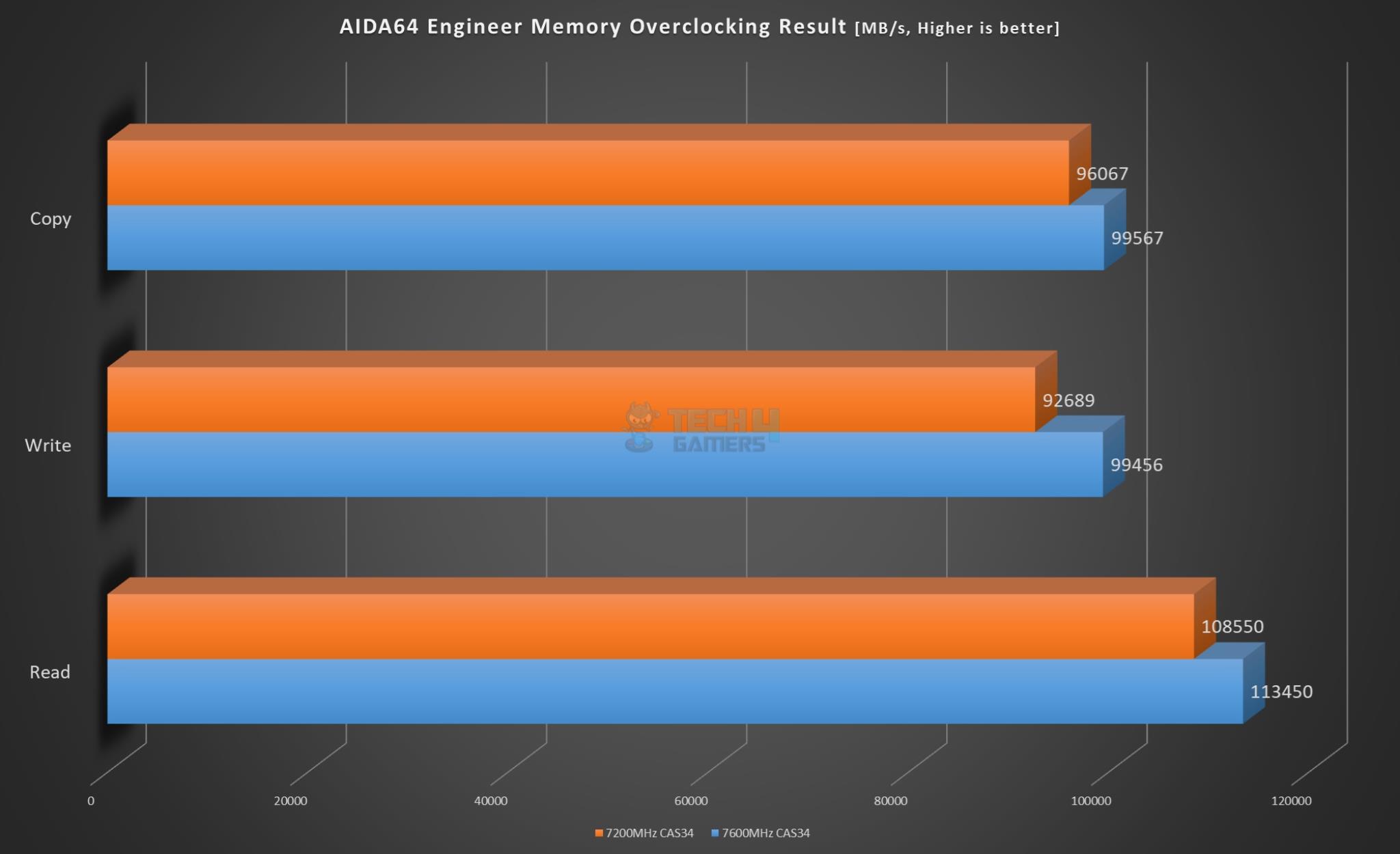
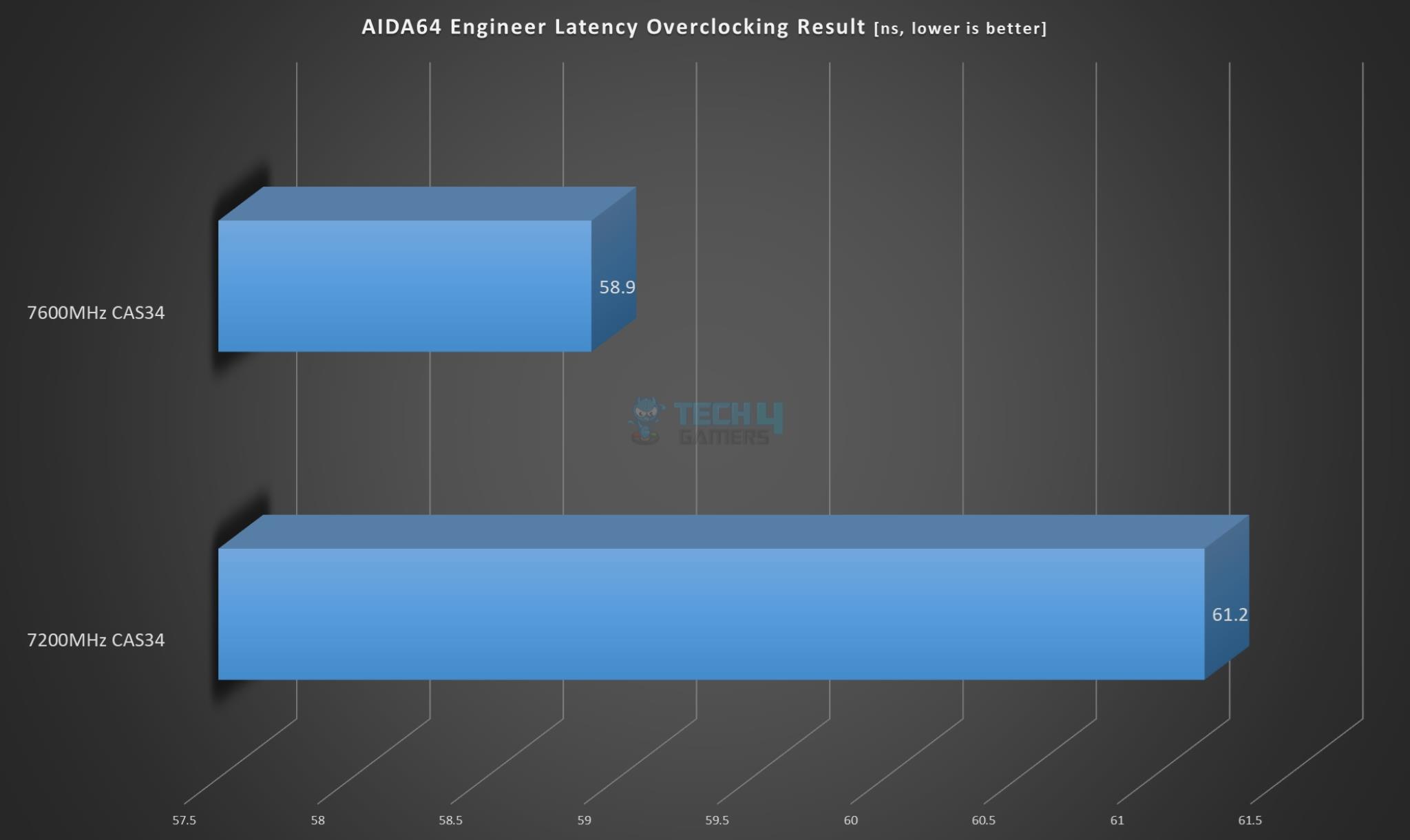
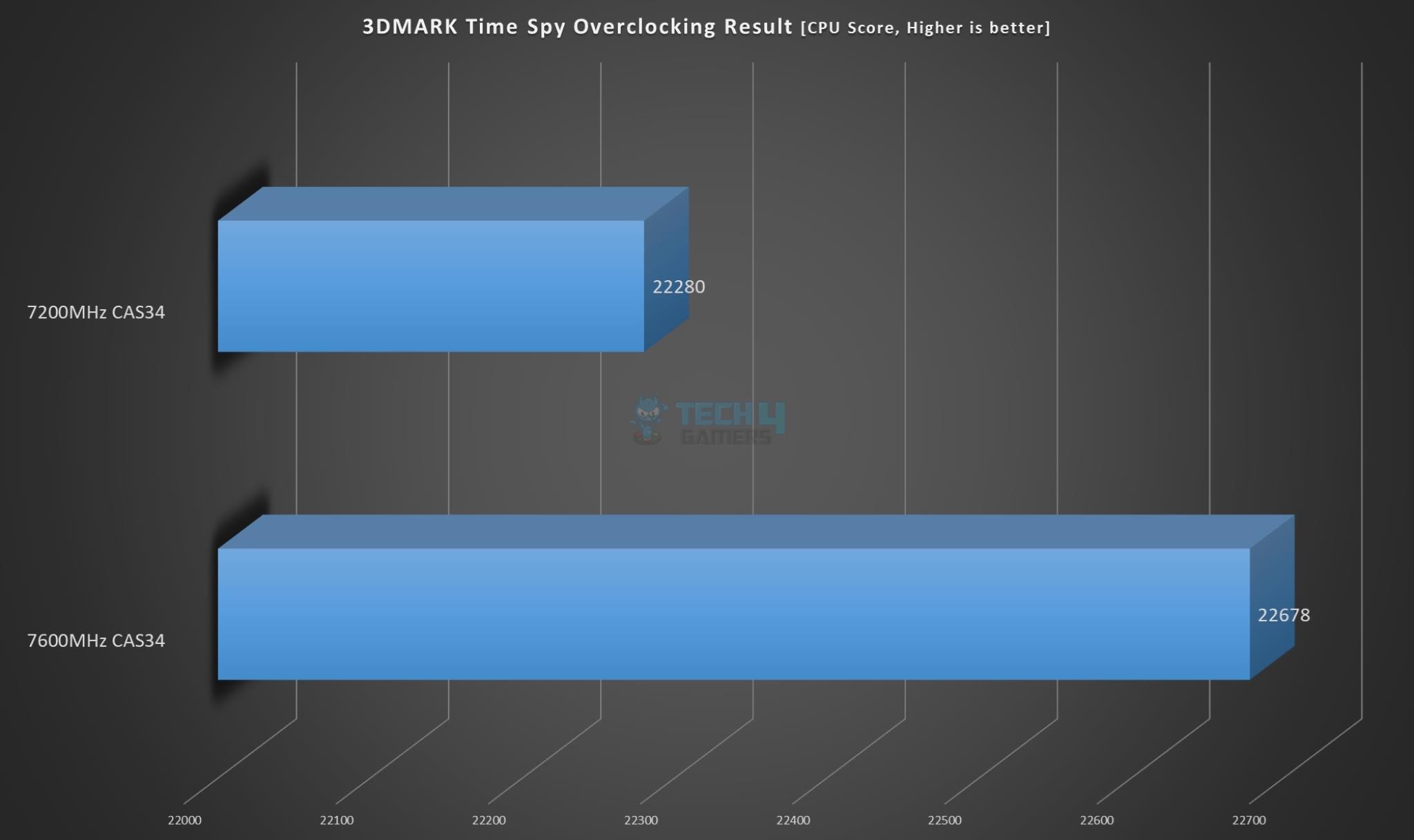
In the AIDA64 Memory benchmark, we are seeing a good boost in scores compared to the stock run. There is a performance boost of 3.64% in the Copy benchmark. There is a performance boost of 7.30% in the Write benchmark. There is a performance boost of 4.51% in the Read benchmark. The latency was further improved with this overclock. It came down to 58.9ns from 61.2ns. We have seen marginal gains in the Time Spy and Performance Test as well.
Should You Buy It?
Buy It If
✅Looking for a kit that offers XMP and EXPO profiles: If you want a kit that offers Intel XMP and AMD EXPO profiles under the hood, then the Netac Z RGB 32GB DDR5 7200MHz kit is a candidate.
✅If you are looking for a chrome/silver finish and color: This kit is finished in a highly reflective chrome (aluminum material). This adds quite some style and form to this kit.
Don’t Buy It If
❌If you are looking for a better overclocking DDR5 kit: This kit has a limited or mediocre overclocking headroom, so skip it if this is your main domain.
❌You have RAM clearance concerns: This is a high-profile RAM standing at 50.9mm height. This could be considered for CPU air coolers.
❌If you are looking for a better value kit: This kit is likely to retail at USD 140, which is a tad high price tag, considering that other same-speed/timing kits cost less.
Final Verdict
The Netac Z RGB DDR5 7200MHz CAS34 is a high-performance memory that would suit users looking for a silver color finish for their themed build.
The Z series of DDR5 kits are flagship offers from Netac and are available from 6000MHz to 8000MHz speeds.
The kit has a tested speed of 7200MHz with CL34 at 1.400V. It has an Intel XMP profile and an AMD EXPO profile. The XMP has 7200MHz, 34-45-45-115, 1.400V settings whereas the EXPO has 4800MHz, 30-40-30-76, 1.100V settings. The kit conforms to JEDEC 4800MHz.
I am not sure why Netac used 4800MHz speed on the EXPO profile, which could have provided more aggressive speed and timing on this kit, as AMD now supports high-speed kits.
This kit has an aluminum heat spreader and a reflective glass finish. This surface is more of a fingerprint magnet, and Netac has not provided gloves. The build quality is top-notch. The RGB Lighting effects are quite subtle and produce a good vibrance.
Speaking of performance, the Netac Z RGB DDR5 kit operating at 7200MHz CL34 is highly competitive and even managed to beat the other same-speed kits in some benchmarks. Netac offers a limited lifetime warranty.
At Tech4Gamers, I take on the role of Hardware Reviewer with pride. My responsibilities involve a thorough examination of essential hardware components like motherboards, graphics cards, processors, PC cases, and CPU coolers, among others, focusing on their complexities and functionalities.
Dr. Usman Saleem
At Tech4Gamers, I’m the PC Hardware Specialist, primarily contributing to the “Best-Ofs” section. I provide thoughtful buying advice based on thorough testing and personal expertise. I also review hardware products and games to keep things fresh.
In this review, I am taking a look at Netac’s NV7000 2TB SSD. This is a PCIe Gen4 x4 NVMe SSD rated for up to 7200MB/s sequential read and 6800 MB/s sequential write speeds. These SSDs are available in 1TB, 2TB, and 4TB capacities.
These SSDs are driven by Phison E18, which seems to be a solid choice, though we now have more efficient controllers in the market. Speaking of NAND Flash, these SSDs have Micron 176-layer 3D TLC NAND.
The 2TB variant is listed at USD 165, and it comes with a five-year warranty.
Why Trust Tech4Gamers
Usman Saleem is our hardware tester who loves to put all the latest GPUs, CPUs, RAM, SSDs, and motherboards for a spin.
20+ SSDs tested and reviewed by our team of hardware experts (Tech4Gamers Team).
150+ hours spent testing different SSDs for our reviews.
Objective testing criteria.
At Tech4Gamers, ensuring you get reliable information is our priority. That’s why every hardware round-up undergoes a meticulous review process by our team of experts and editors. Each review is carefully examined against our strict editorial guidelines, guaranteeing you trustworthy insights you can depend on.
Key Takeaways
Netac NV7000 2TB NVMe SSD offers up to 7200MB/s sequential read and up to 6800MB/s sequential write. Plus, it comes with a heatsink.
You should buy the Netac NV7000 2TB NVMe SSD if you want a good performance drive that is a jack of all trades and works well with PS5.
You should avoid the Netac NV7000 2TB NVMe SSD if you want the most value out of your money, as there are better options out there.
The Netac NV7000 2TB is a complete package that comes with a Gen4 NVMe SSD in 2TB capacity bundled with a heatsink. When compared to other drives like XPG Gammix S70 and Sabrent Rocket 4 Plus, this drive has a mixed performance that mostly lacks sustained numbers.
Packaging And Unboxing
The drive is shipped inside a paperboard packing box that has a black color theme. Inside, there is a transparent container that holds the drive. The following are provided:
1x SSD
1x Installation Manual
2x Screws
Design
Top View
Back View
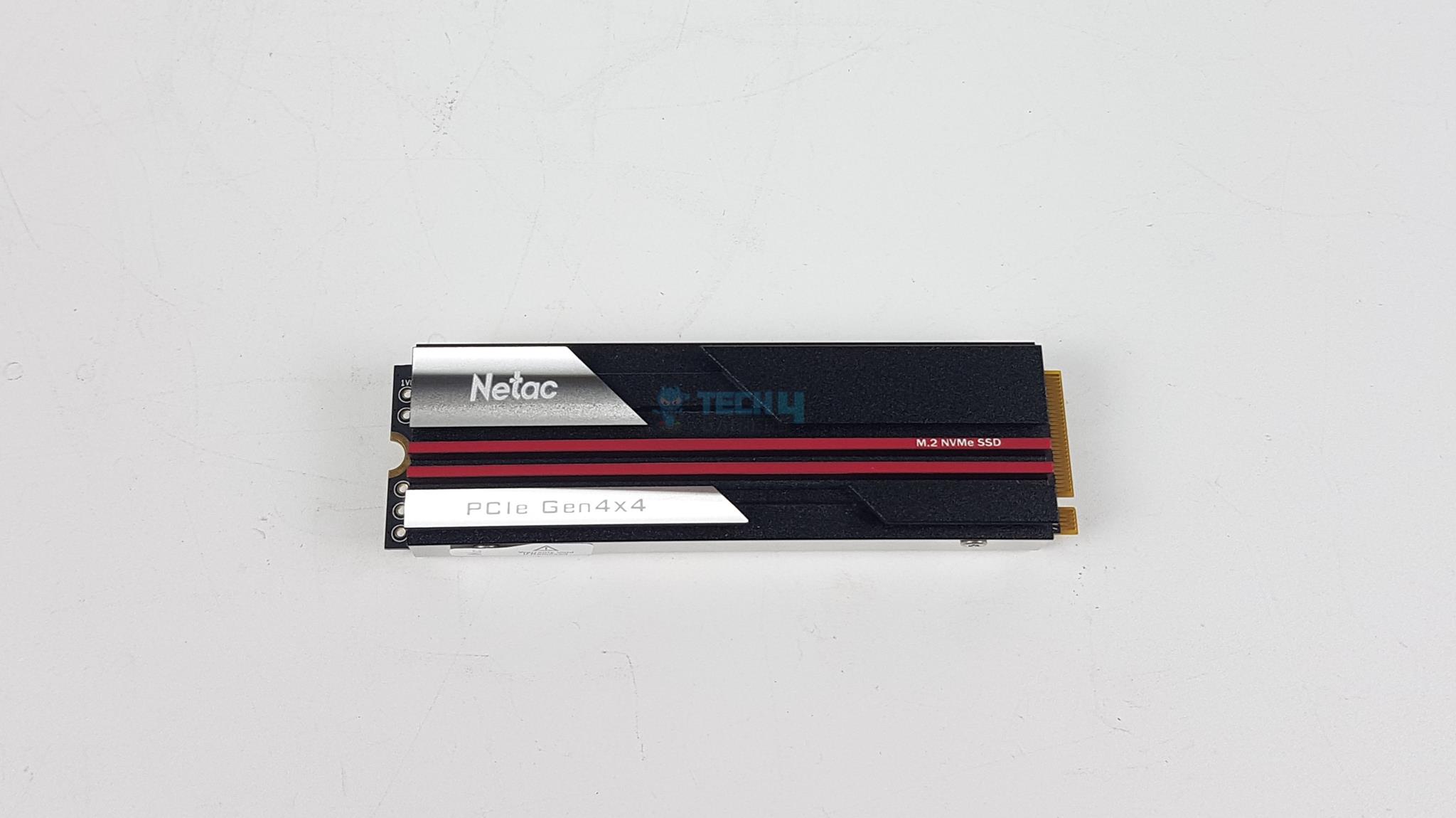
I am testing a heatsink version of the Netac NV7000 2TB SSD. The aluminum heatsink has a nice black, silver, and red color theme. The package has a dimension of 23.5x80x11.25mm (WxLxH). The height of 11.25mm is the exact and maximum height permissible in Sony Play Station 5.
The branding tells the users that this is a PCIe Gen 4×4 drive. The drive has an M.2 2280 form factor using M Key Type.
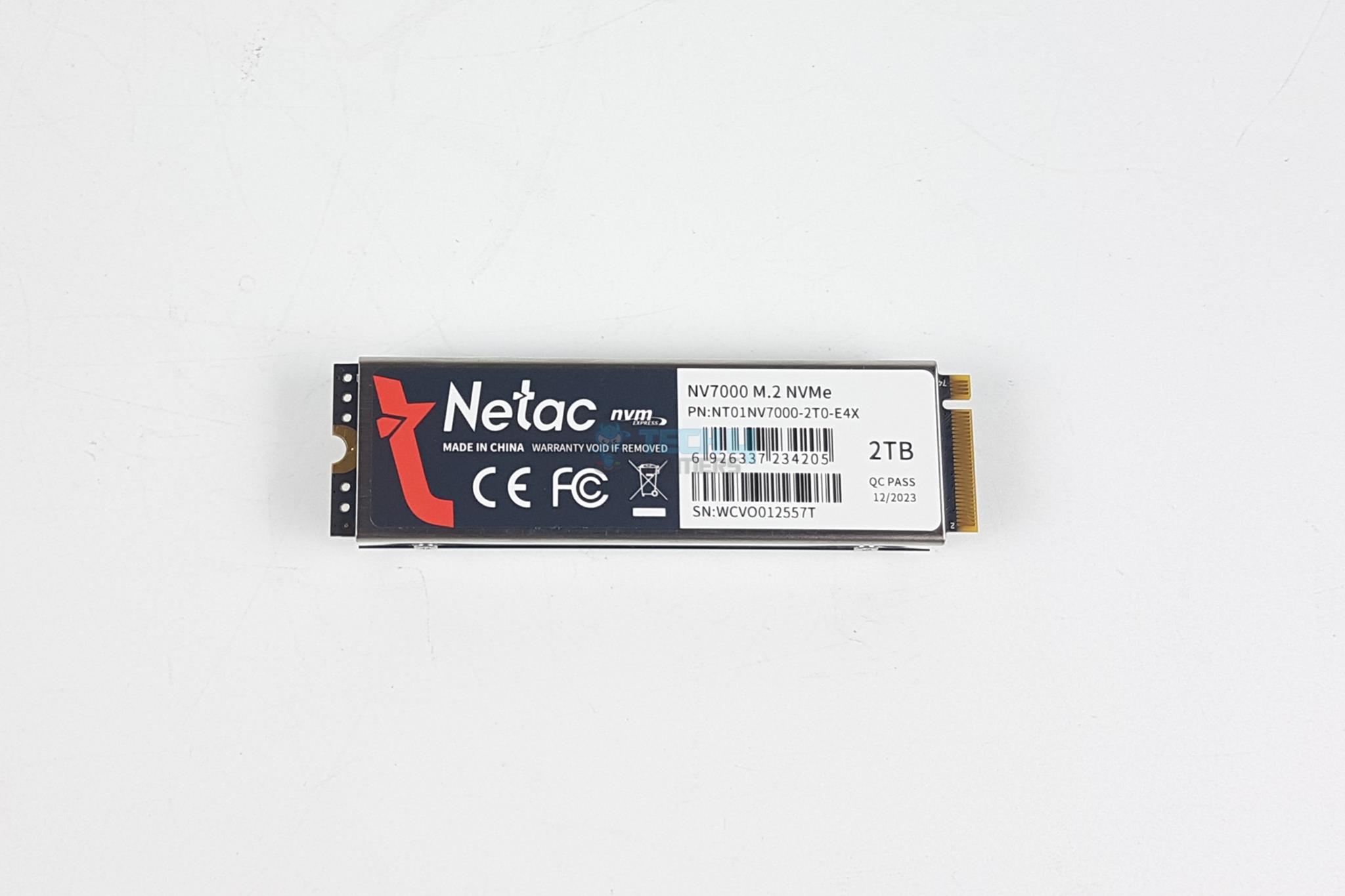
The backside of the package has a sticker that shows the part number and serial number of the drive along with its capacity which is 2TB (2000GB). The drive is made in China. Removing this sticker will void the warranty. The drive conforms to NVMe 1.4 protocol.
The drive supports S.M.A.R.T, TRIM, and NCQ features. It seems like this drive does not provide AES encryption feature. Storage temperature rating is -40ᵒC to 85ᵒC whereas the operating temperature rating is 0ᵒC to 70ᵒC. Shock resistance is 1500gm/0.5ms.
Aluminum Base (Image By Tech4Gamers)
The base container is made of aluminum material. Netac has used Torque screws. One of the screws has a warranty void sticker over it. Netac seems to be overly cautious when it comes to handling this SSD since it has two warranty void stickers.
Multi-layered Heatsink (Image By Tech4Gamers)
Netac has used a multi-layered heatsink for effective heat dissipation. There is no data on the thermal pads’ thickness and heat transfer rate. The heat sink is black.
What about components?
Netac has employed a powerful Phison PS5018-E18-41 controller. This controller has 8 channels conforming to PCIe 4.0 and uses Arm Cortex R5. This SSD has eight 3D TLC NAND Flash chips from Micron. These are Micron 176-layered 3D TLC NAND with each chip having 256GB size. Netac has used two Hynix DDR4 2666MHz DRAM. Each has a capacity of 1GB making a total count to 2GB. This SSD also supports SLC caching.
Microsoft Windows 11 22H2 is used for the testing.
CrystalDiskInfo (Image By Tech4Gamers)
I ran CrystalDiskInfo after installing the disk. The firmware version is 3.S.J.CU. The interface is listed as NVM Express using 1.4 as standard. It also confirmed that the drive is operating at PCIe 4.0 at an x4 speed link. The supported features are S.M.A.R.T, TRIM, and VolatileWriteCache.
Test Results
CrystalDiskMark
CrystalDiskMark
1 of 4
CrystalDiskMark
CrystalDiskMark Real World Performance
CrystalDiskMark Peak Performance
CrystalDiskMark IOPS
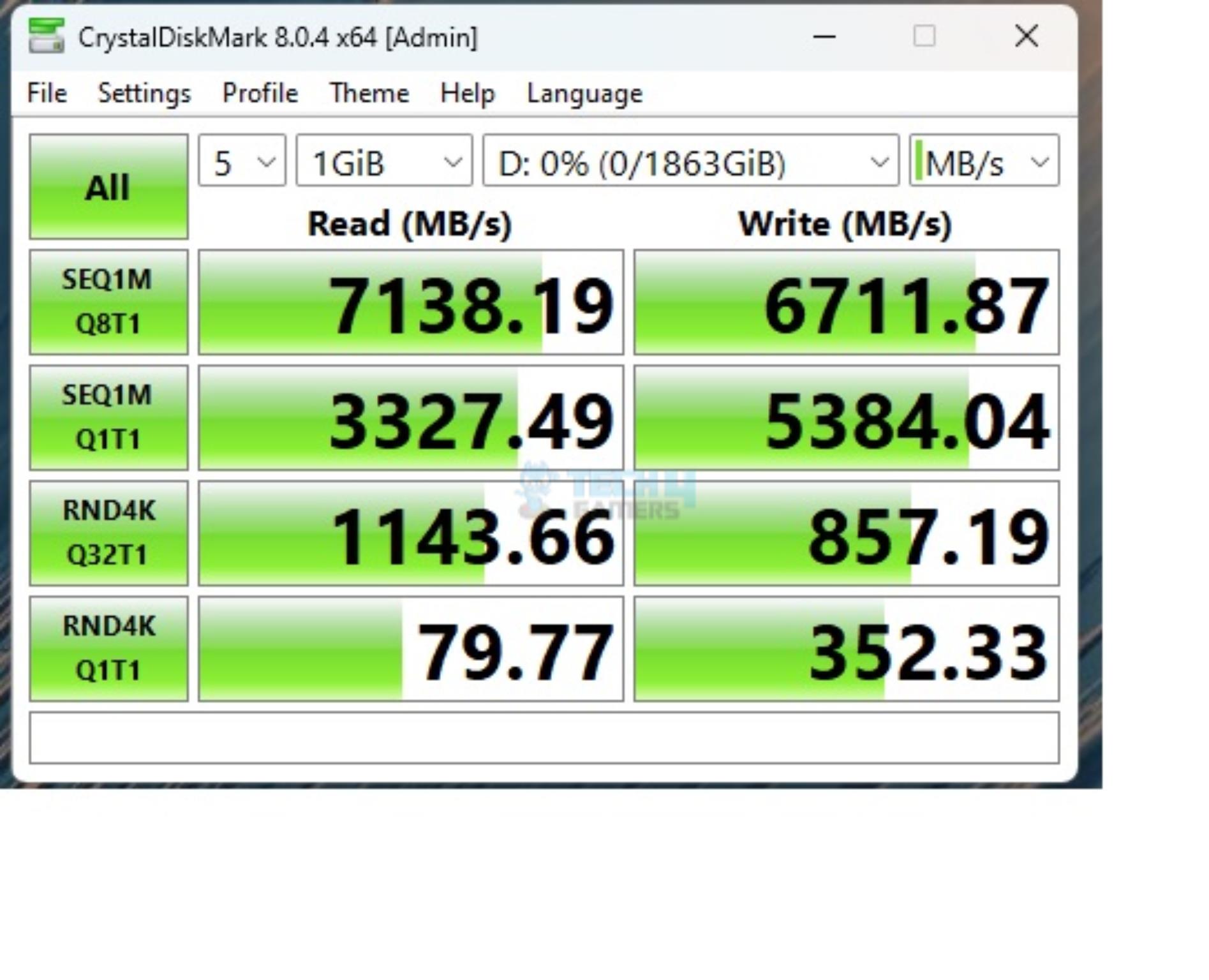
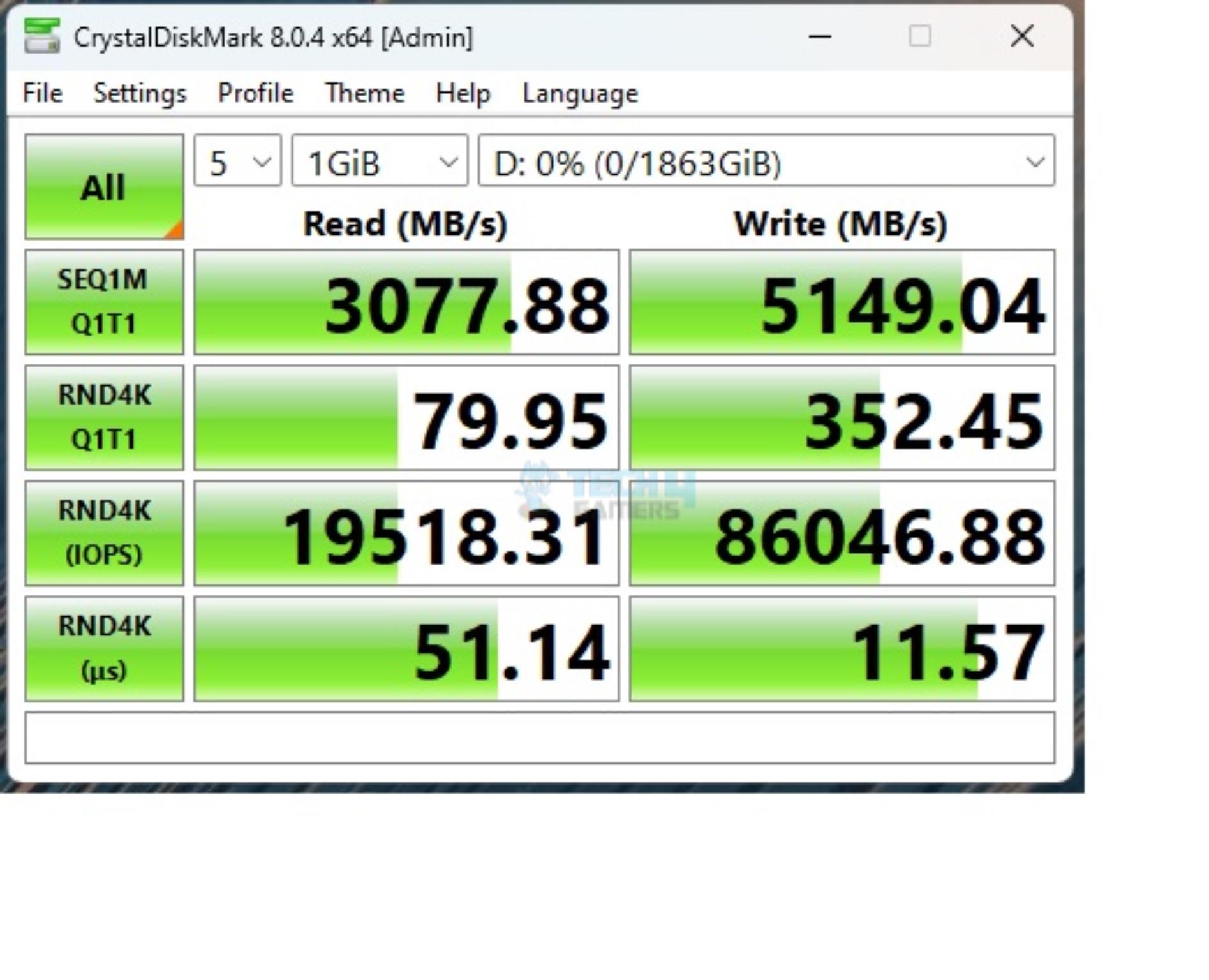
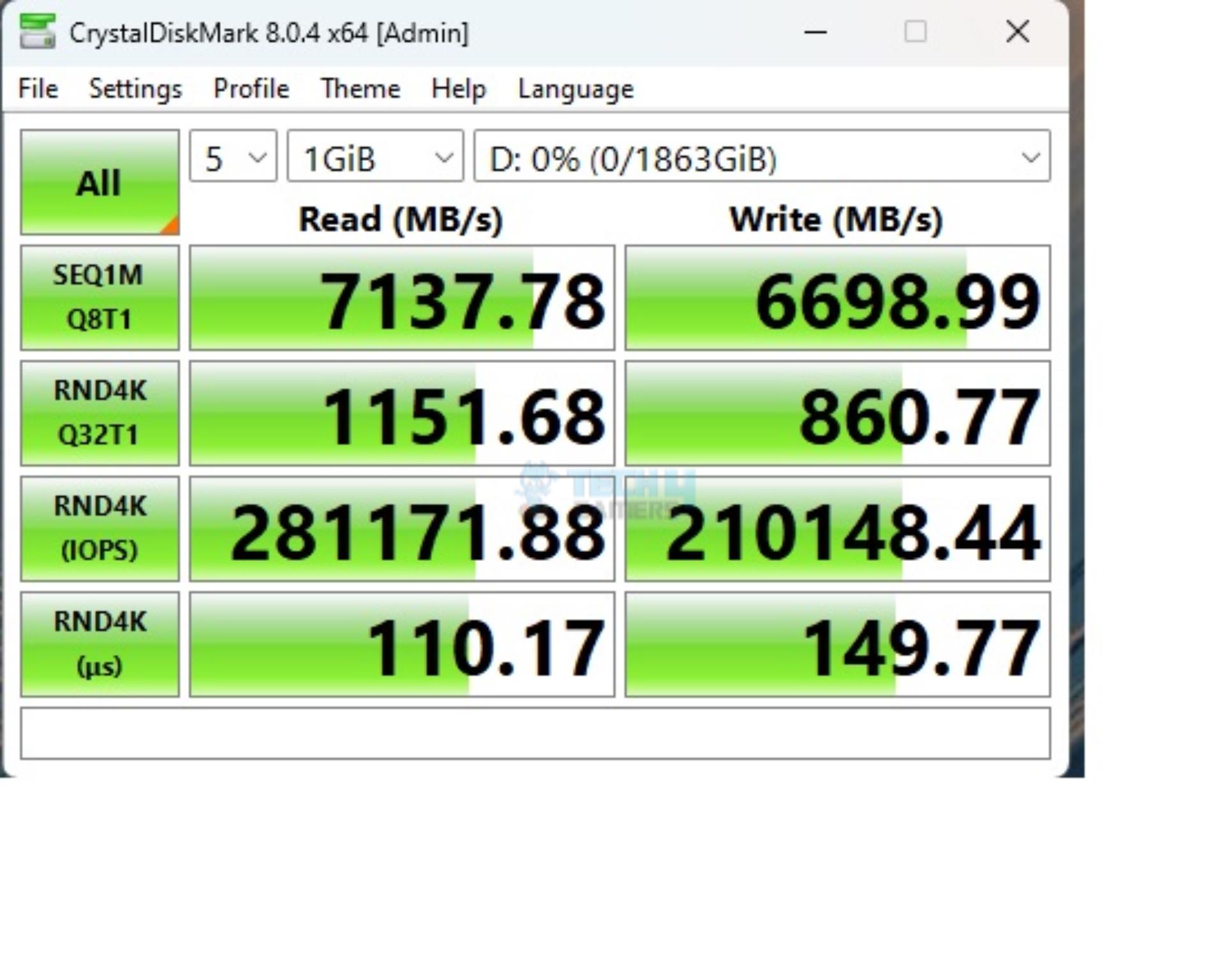
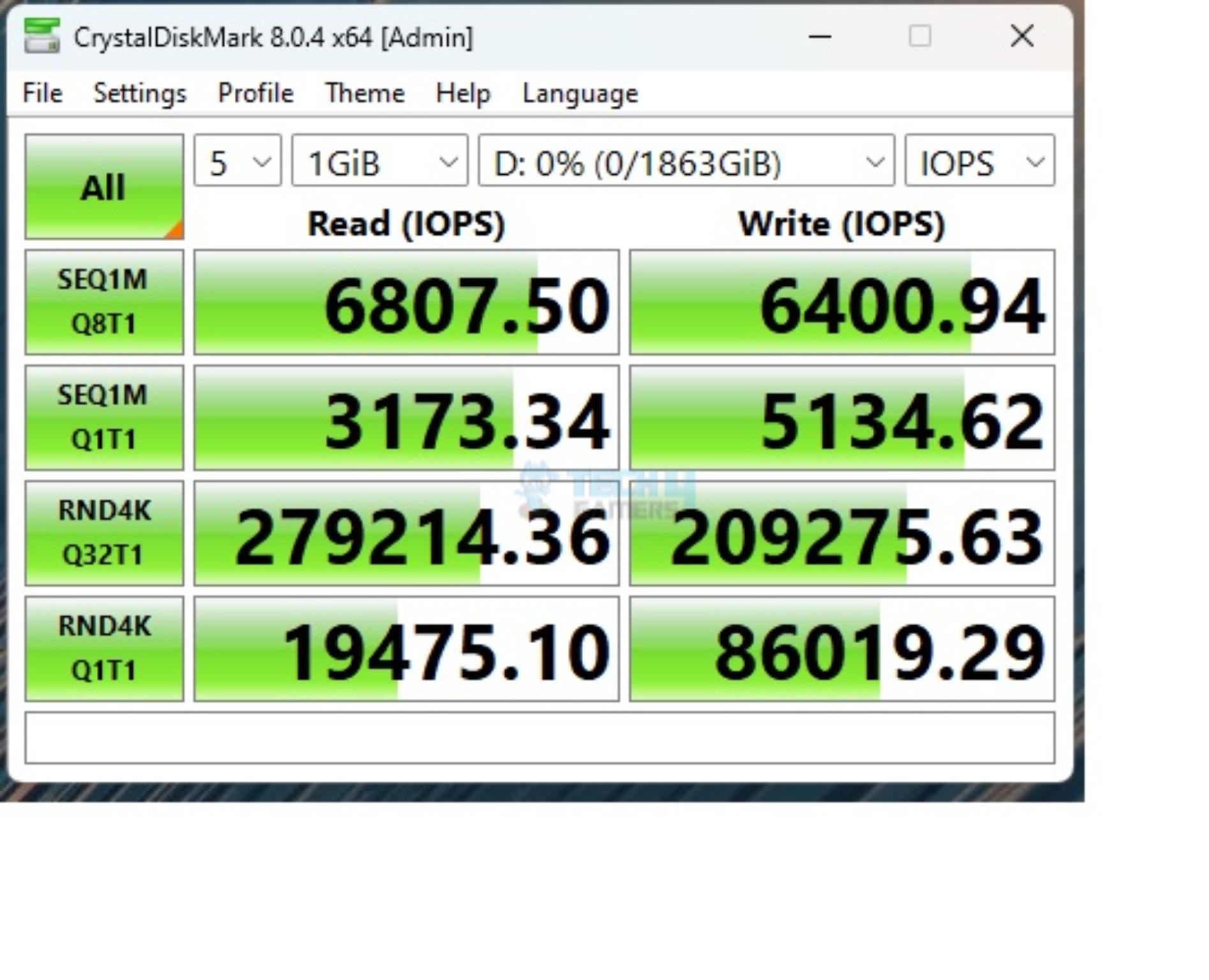
Let’s start with four different runs of CrystalDiskMark. This is a good performance from the Netac SSD. The sequential read speed was 7138.19MB/s, and it was 6711.87MB/s sequential write. The 4K Random performance in the Q1T1 quadrant is fine as well. The overall performance in CrystalDiskMark is satisfactory.
CrystalDiskMark Sequential (Image By Tech4Gamers)
Netac has outclassed all other listed SSDs in the CrystalDiskMark graph in the sequential reads. However, this is just a start. Let’s move on.
ATTO Disk Benchmark
1 of 2
ATTO Disk Benchmark
ATTO Disk Benchmark Graph
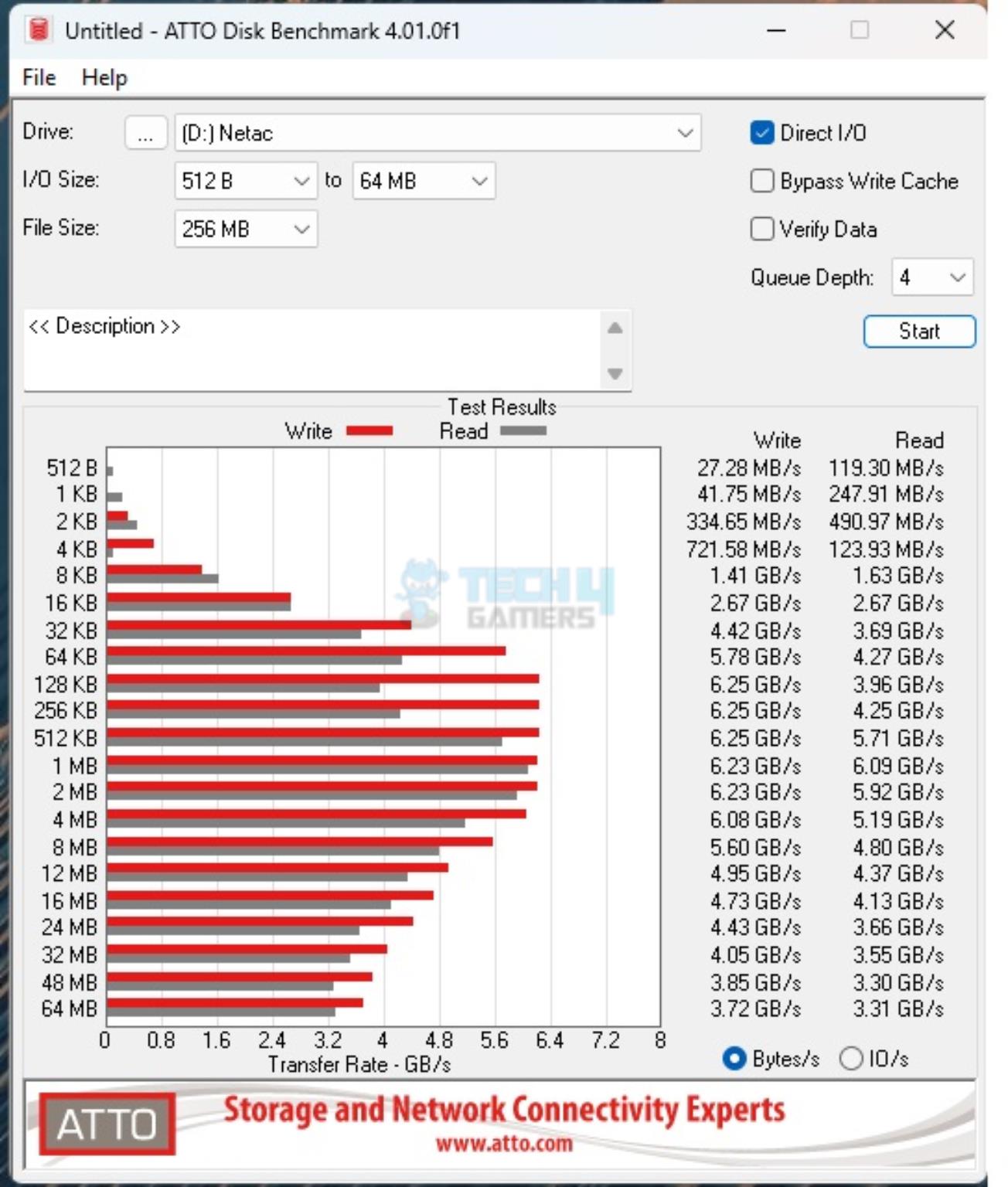
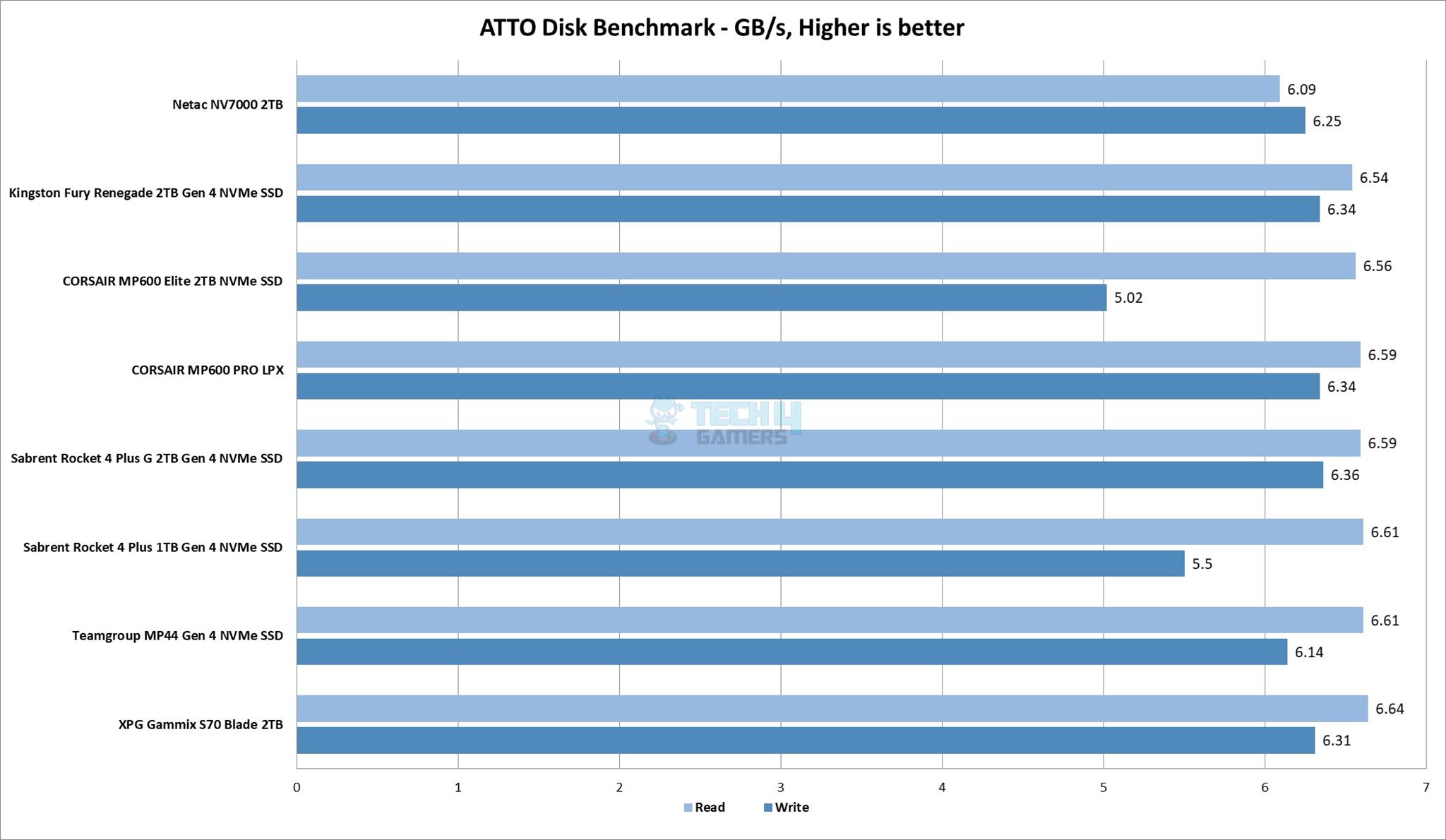
You can see that this drive has inconsistent performance throughout the run of the ATTO Disk Benchmark. This is not an impressive performance feat as we would have consistent or sustained speeds. Don’t be misled by the graphs, as we only show the maximum attained speeds in the graph.
Anvil Storage Utilities benchmark (Image By Tech4Gamers)
Next, I ran the Anvil Storage Utilities benchmark to test the performance of the drive. Again, this drive is showing inconsistent performance. In fact, this performance hit has made it the slowest NVMe SSD on our graph.
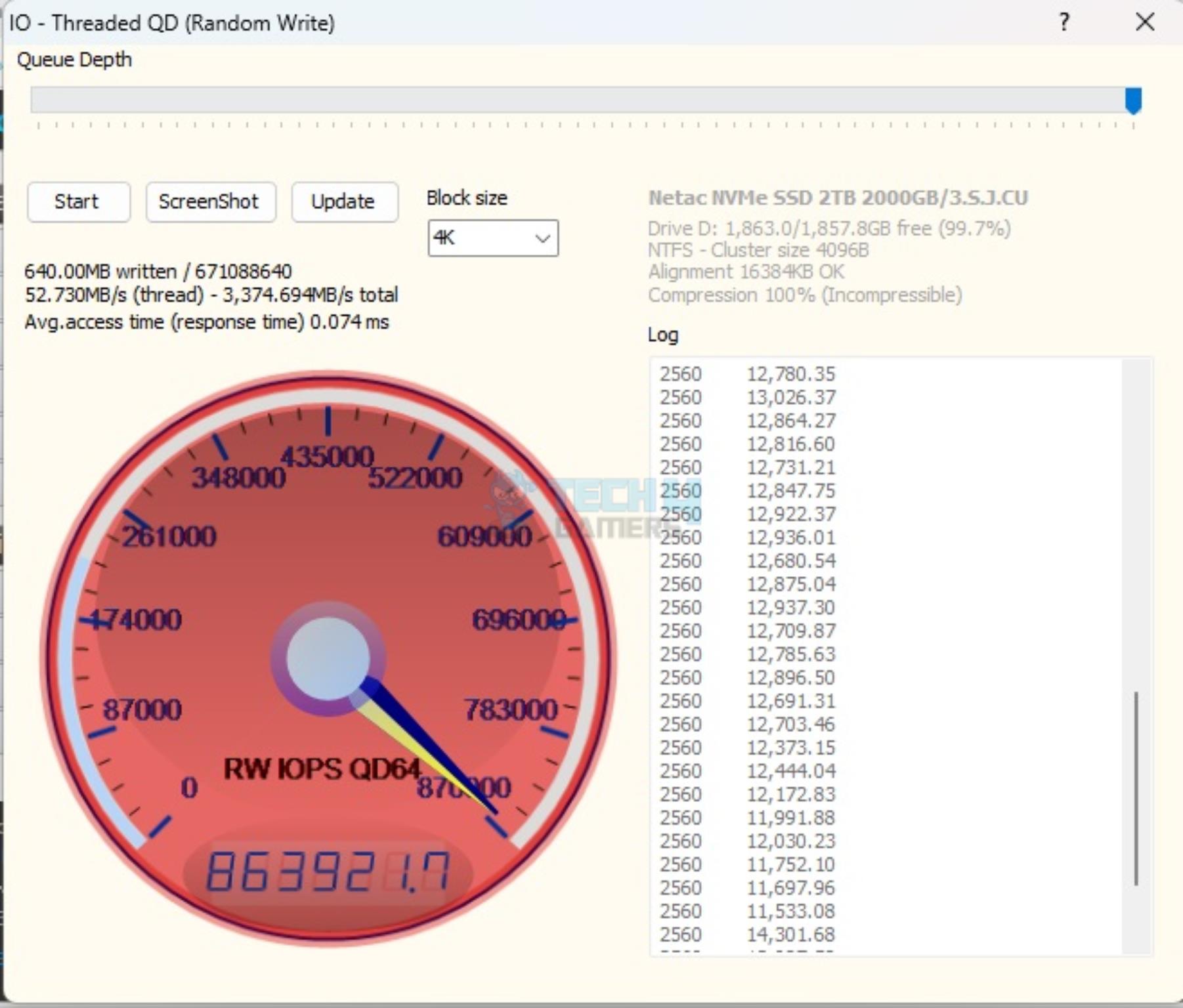
Threaded IO Write QD64
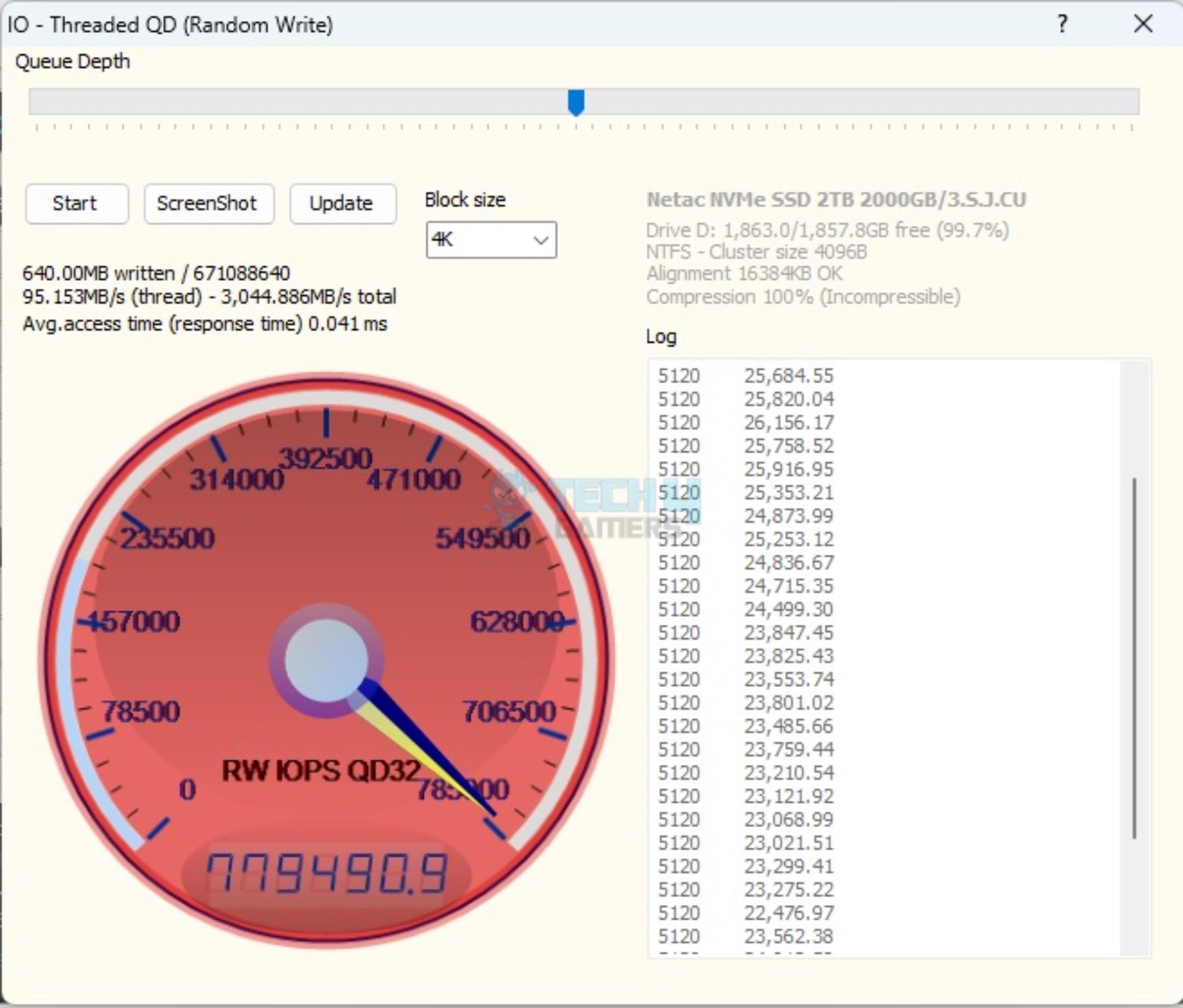
Threaded IO Write QD32
I also ran Threaded Writes in queue depth of 32 and 64. The SSD falls short of rated 900k IOPS in write department.
Threaded Reads
1 of 3
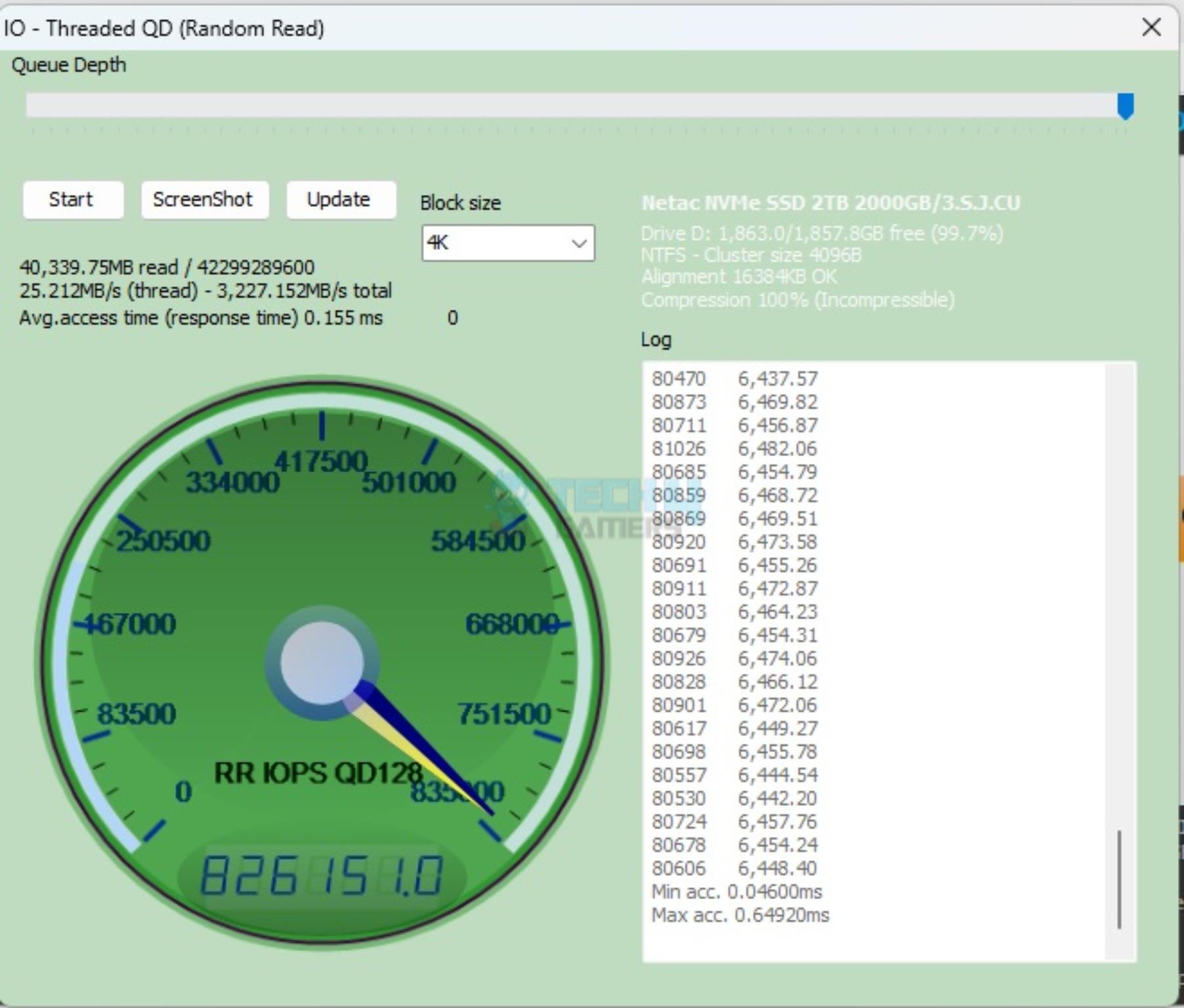
Threaded IO Read QD128
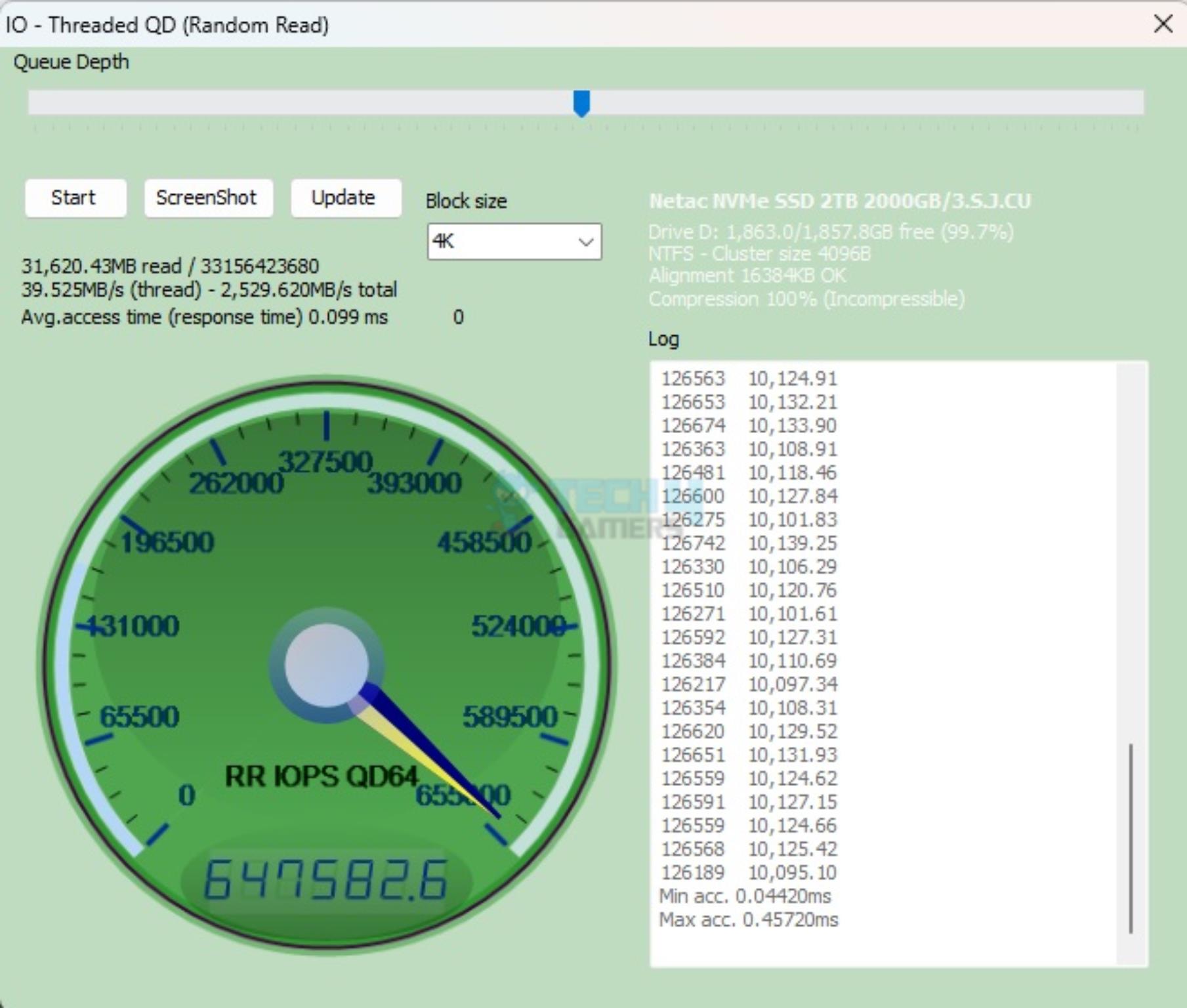
Threaded IO Read QD64
Threaded IO Read QD32
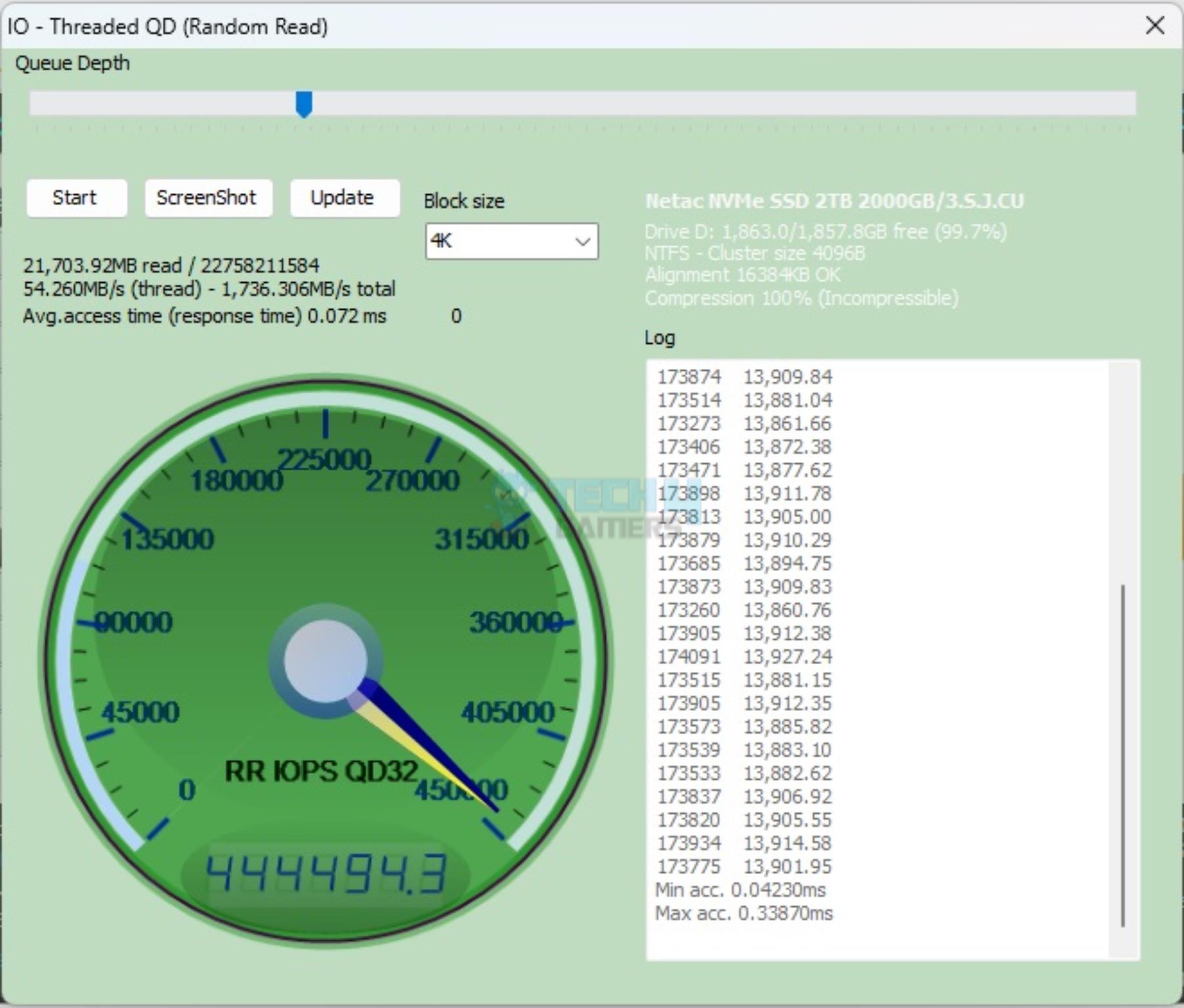
Next, I ran the Threaded Reads in queue depths of 32, 64, and 128 threads. The drive crossed the rated 620K in 64 threaded test. Usually, these ratings are based on 32 threads or queue depths. In that sense, this SSD falls short of the rated speed. However, 64 and 128 threads have shown a good performance.
3DMark Storage Test
3DMark Storage test is a relatively new test bench measuring the gaming-only performance of the given drive using three games. It measures the load time of the games, records the gameplay, saves the game, and moves the game. The overall score is given based on bandwidth and access time.
3DMARK Storage Benchmark (Image By Tech4Gamers)
This is yet another benchmark where the performance of this SSD is not up to the mark.
PCMARK10
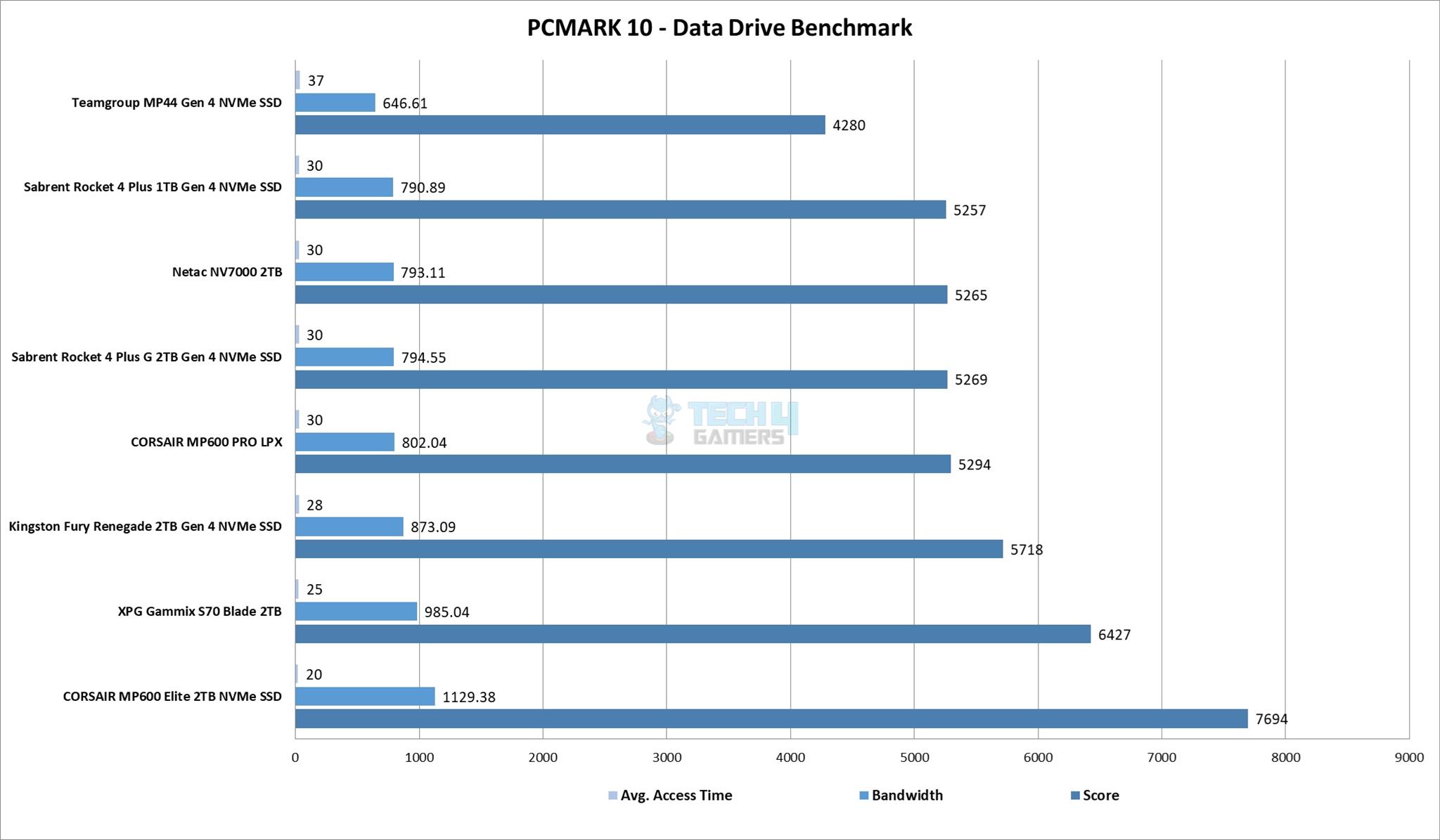
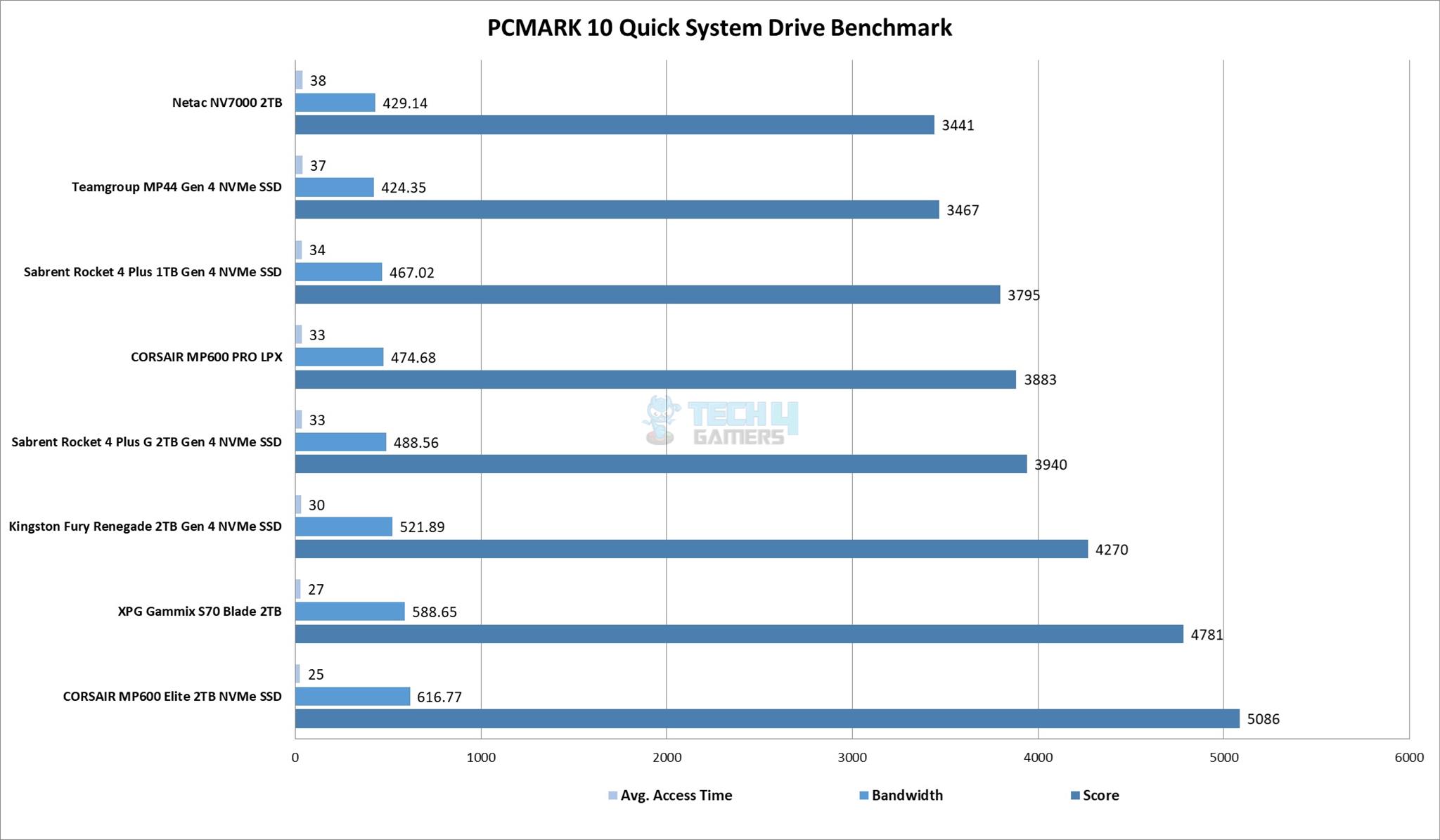
We ran two tests from Storage benchmarks in this suite. These are Data Drive Benchmark and Quick System Drive Benchmark.
PCMARK10
1 of 2
PCMARK10 Data Drive Benchmark
PCMARK10 Quick System Drive Benchmark
The Netac NV7000 2TB is closer to a powerful Sabrent Rocket 4 Plus 2TB NVMe SSD in Data Drive Benchmark. However, this drive was the slowest of all SSDs in the Quick System Drive benchmark. Keep in mind that Teampgroup MP44 is a DRAM-less SSD.
Blackmagic Disk Benchmark
Blackmagic Disk Benchmark (Image By Tech4Gamers)
We have used Blackmagic disk benchmark as well. This is a critical benchmark from the point of view that it monitors the three video compression coders against multiple formats and checks if the drive in hand supports that format, and if it does, then at what speed.
Real World Testing
Now, it is time for a real-world use. For that, we have used DiskBench in multiple scenarios to check the real-world data transfer rates. We prepared a data set of mixed files and folders, including compressed files.
Disk Bench
1 of 3
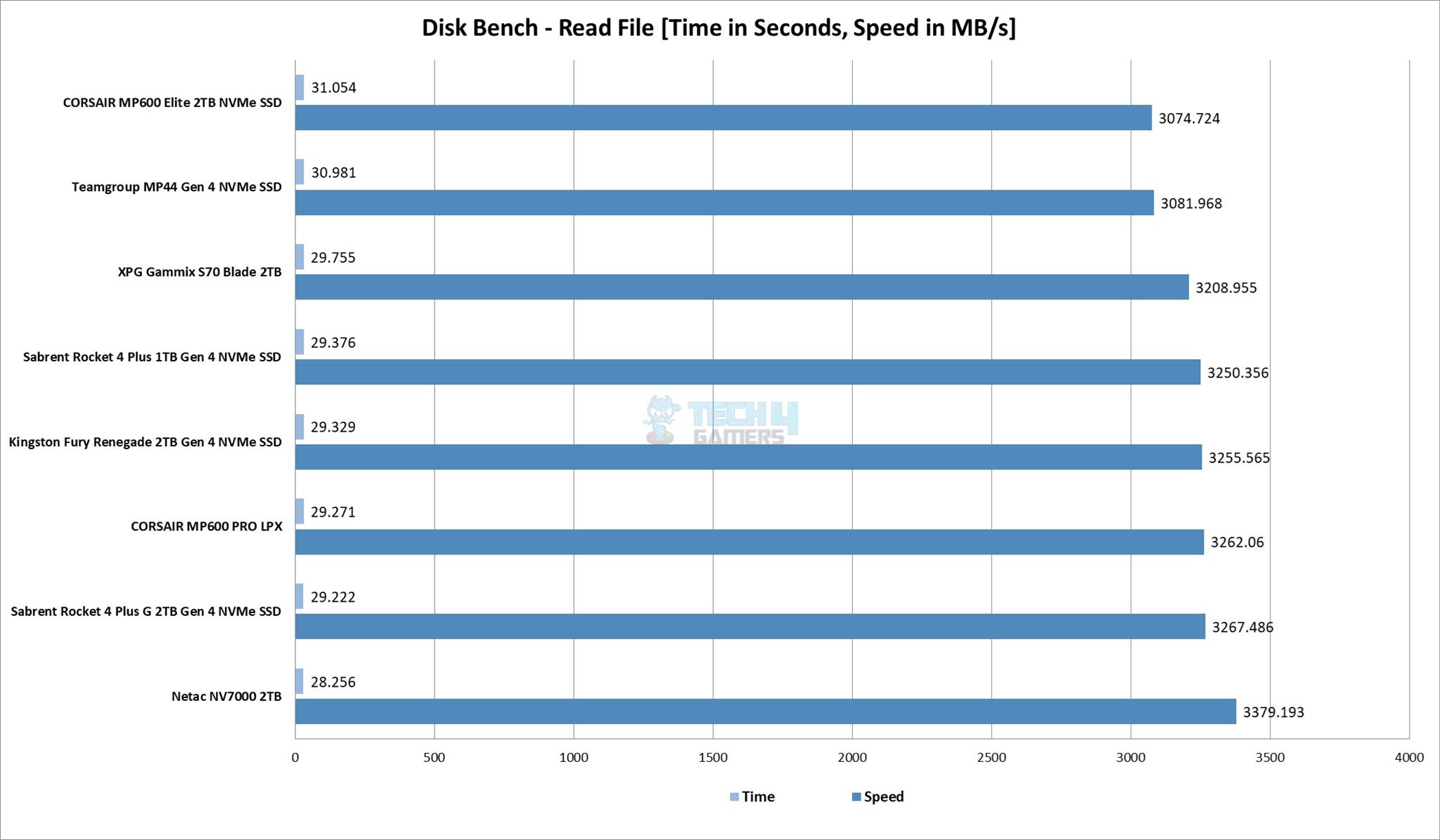
A 97GB-sized compressed file was copied to the Netac NV7000 2TB NVMe SSD. The file was then read from the DiskBench. Netac SSD has come on top by doing 3379.193MB/s taking 28.256 seconds.
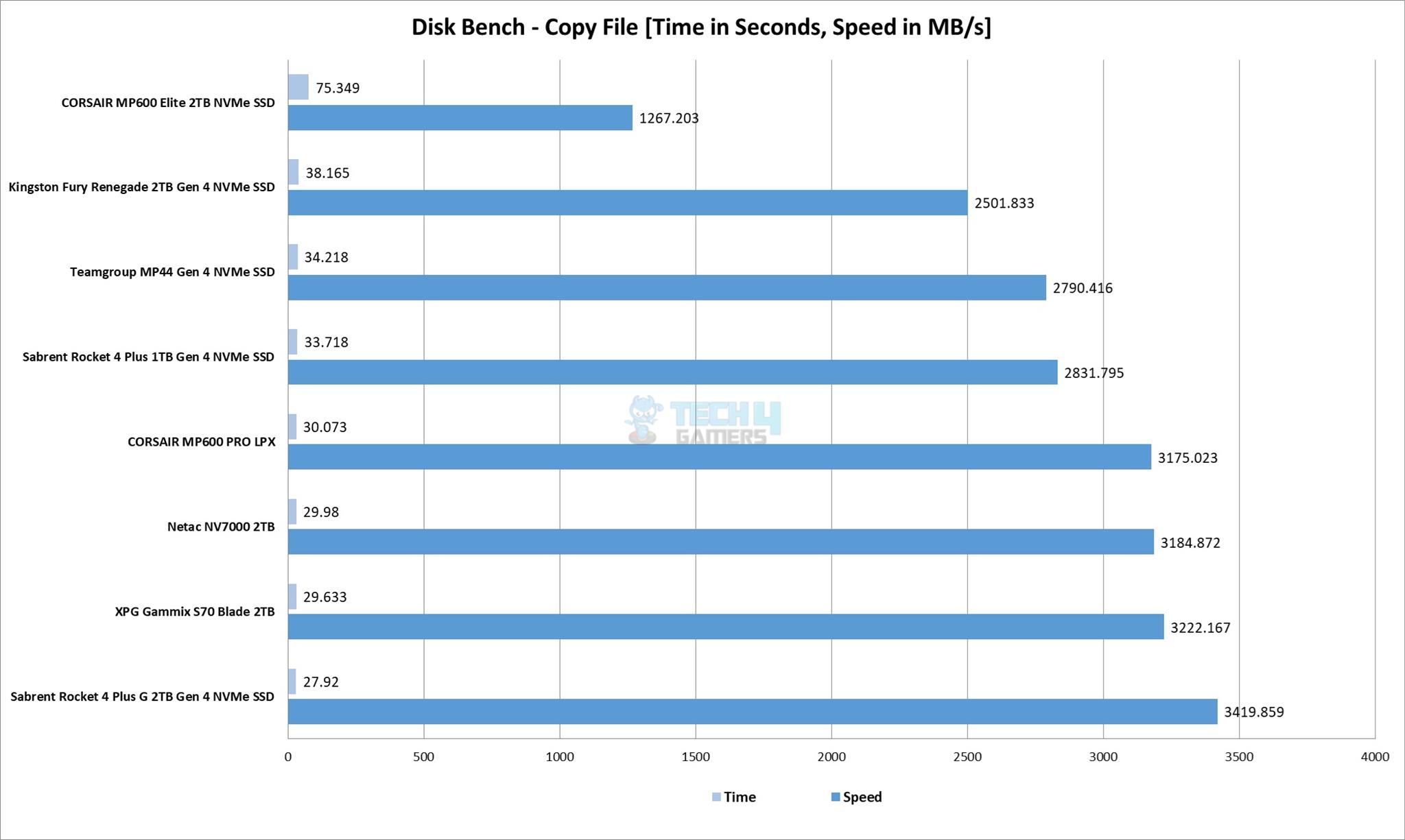
Next, I copied the same compressed file from one folder to another on the same drive. The transfer rate 3184.872MB/s and it took 29.98 seconds to complete this operation. This SSD has secured a third slot on the graph.
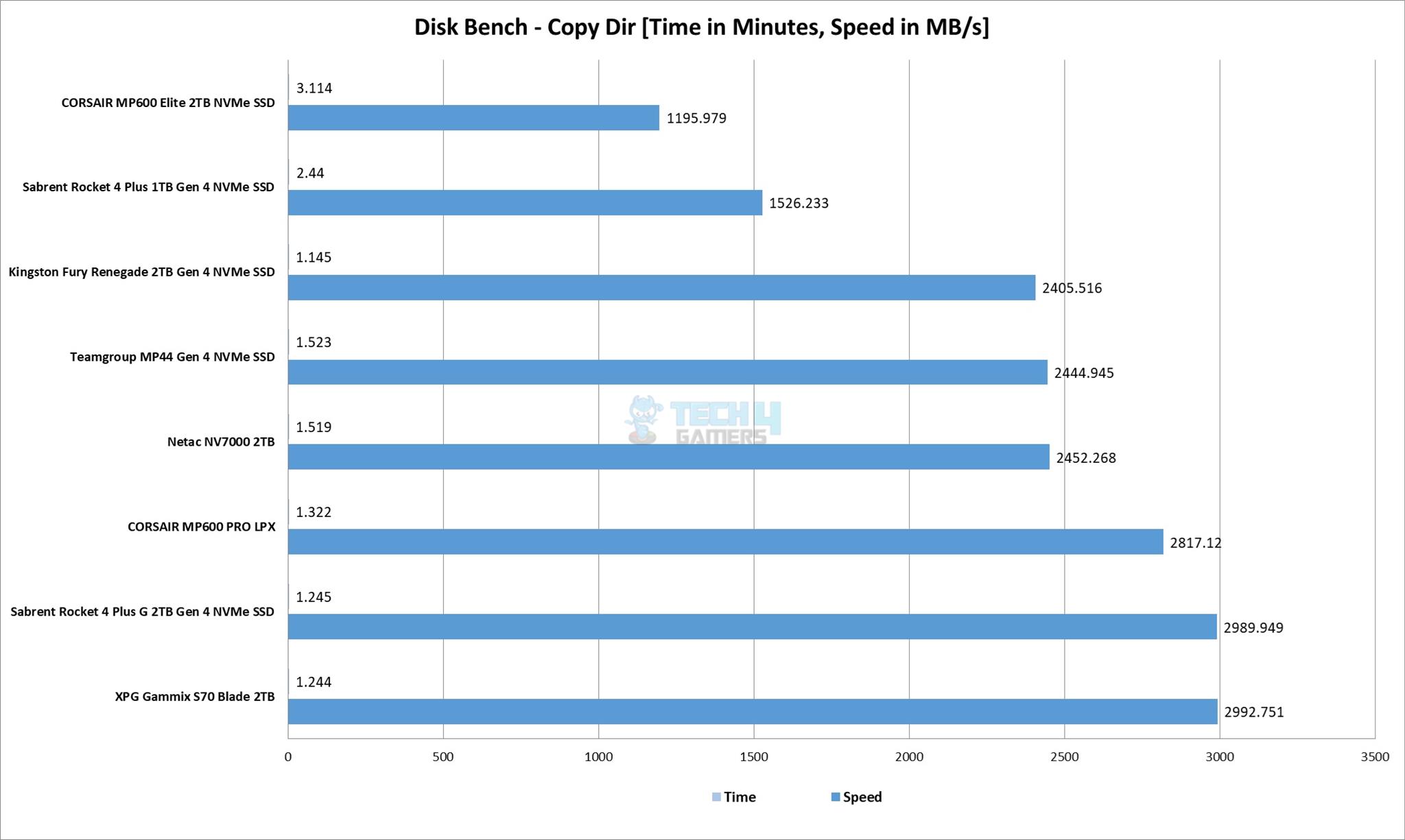
Next, we copied a folder of 220GB size containing multiple compressed files, sub-folders, and mixed files. The main folder was copied from the same drive to a destination drive on the same drive. The transfer rate 2425.268 MB/s and it took 1.519 minutes to complete this operation. This is a decent performance
Ultimate Performance Test
Next, I prepared heavy data of 530GB and repeated the copy operation. This is my torture test and my evaluation is based on this real-world test. I also used HWInfo64 to record the drive’s sensor to see how it performed over time.
Disk bench – Copy Dir (Image By Tech4Gamers)
This operation was completed in 19.858 minutes at a rate of 455.291 MB/s. The lowest this drive had in read department was 26.933 MB/s. The lowest in read department was 33.07 MB/s. The data copy rate varied inconsistently throughout the operation.
Gaming Load Time
This is the time when gamers are using NVMe SSDs for their games for faster loading. This is why we also test the game load times. This is done using the Final Fantasy XIV: Shadowbringers Benchmark using High settings.
Final Fantasy XIV: Shadowbringers Benchmark (Image By Tech4Gamers)
It took 6.549 seconds in total to load the game. This is a competitive performance.
Thermals
Thermals (Image By Tech4Gamers)
79ᵒC was the maximum temperature recorded when the simultaneous read and write operation of 530GB data was done on this drive. The ambient was 30ᵒC.
Should You Buy It?
Buy It If
✅You want a high-speed drive: The Netac NV7000 2TB NVMe drive is rated for 7200MB/s and 6800MB/s sequential read and write, respectively.
✅You are looking for a complete package: The Netac NV7000 2TB NVMe SSD comes with a pre-installed heatsink for effective heat transfer.
✅You want more storage for PS5: The Netac NV7000 2TB SSD has a height of 11.25mm which makes it compatible with the Sony PlayStation 5.
Don’t Buy It If
❌You are after a cost effective storage solution: You can get better-performing NVMe drives in the same capacity at a better price than the USD 165 price tag of Netac NV7000 2TB.
❌You need a drive with consistent performance: This drive has inconsistent performance on our test bench, particularly when handling a large-size data.
Final Words
NV7000 is a flagship NVMe SSD from Netac. These are available in 1TB, 2TB, and 4TB capacities. These SSDs come with a pre-installed heatsink, which is one of the reasons for the high price tag.
The main driving force behind these drives is the Phison PS5018-E18-41 controller. This is the same controller that we saw in the Sabrent and many other high-performance SSDs. Netac has employed 176-layered 3D TLC NAND flash from Micron. There are eight NAND chips or packages, each 256GB in size. There are two DRAM chips from Hynix operating at 2666MHz (DDR4) each of 1GB.
The drive has a dimension of 23.5x80x11.25mm. This is inclusive of the heatsink. This SSD is compatible with Sony Play Station 5. This drive features TRIM, S.M.A.R.T and Garbage Collection. This drive is using NVMe 1.4 standard over the PCIe 4 x4 link speed.
This drive is rated for 7200MB/s sequential read and 6800MB/s sequential write. It is rated for 620K IOPS in 4K Random Read and 900K in 4K Random Write. It has 1400 TBW and an MTBF of 2.0 Million hours.
When it comes to the performance, I have observed the inconsistent performance in many synthetic benchmarks. This drive excelled only in a couple of benchmark tests. In real-world tests, this drive was able to handle the File read and copying operation at a good speed. However, this SSD has struggled to handle large-size data with dips in read and write speeds across the operation.
At Tech4Gamers, I contribute as a Senior News Reporter, combining my skills and gaming enthusiasm to keep our audience updated on the latest developments.
Story Highlight
An insider has corroborated recent reports of PS3 backward compatibility for the PS5.
He states that Sony has been working on the feature for quite a while.
The leaker expects an announcement to be made quite soon.
PS3 backward compatibility was one of the most highly requested features for the PS5. While Sony’s latest console supports nearly every PS4 game out in the wild, it can’t run PS3 games that weren’t remastered natively.
However, the PS3 backward compatibility dream might become a reality soon. Recently, a reliable leaker pointed to emulation for the console. Following the update, another leaker corroborated the information, stating that Sony isworking on this feature.
Why it matters: Various PlayStation IPs have been ignored for too long because of the PS3’s limited support. Many newcomers to the PS4 can familiarize themselves with such games once backward compatibility is introduced for the PS5.
The latest update comes from Jeff Grubb, who is typically on point with his information on PlayStation.
Interestingly, Jeff Grubb had already stated that PS3 backward compatibility was being worked on a while ago. During the latest Game Mess Mornings episode, he reiterated that Sony has been working on the feature for a while.
It’s something that I’ve heard has been in the works for quite some time.
-Jeff Grubb
He clarified that an announcement was expected sometime this year. While Jeff Grubb could not provide further details, it is speculated that Sony may have saved the announcement for the PlayStation Showcase, rumored for September this year.
With two major sources discussing PS3 emulation, something is almost certainly in development.
The Original PS3 Offered Hardware Backward Compatibility For PS1 And PS2
Since the PS3 is notoriously challenging to work with, PlayStation may have run into hurdles with this feature. The Cell architecture has always been difficult, even for the most experienced developers, and emulating it will likely be even harder.
Currently, PlayStation offers streaming compatibility for PS3 games. However, these games are run on actual PS3 server blades. With this hardware quickly becoming obsolete, Sony has likely found it necessary to work on some form of backward compatibility.
It is also important to note that this feature is said to mimic Xbox’s implementation. Therefore, PlayStation will likely go for case-by-case emulation over full hardware backward compatibility.
At Tech4Gamers, I take on the role of Hardware Reviewer with pride. My responsibilities involve a thorough examination of essential hardware components like motherboards, graphics cards, processors, PC cases, and CPU coolers, among others, focusing on their complexities and functionalities.
Arsalan Shakil
As a Hardware Expert at Tech4Gamers, I bring my decade-long expertise in electronics design, embedded solutions, and prototyping. My knack for exposing misconceptions in the tech world finds a perfect outlet here.
XPG is one of the brands that take the meaning of its own name (Xtreme Performance Gear) very seriously!
Ever since XPG got themselves into the PSU market, they have been creating some of the best-performing PSUs with little to no compromises, even in their budget-oriented PSU lineup.
With the arrival of extremely power demanding GPUs and CPUs recently, came the latest Intel ATX 3.X specifications which eventually challenged all the OEMs to finally upgrade their age old platforms as per the new requirements. If that was not enough, AI and Machine Learning being the buzzwords of today’s era, still keeping the use of “multi-GPU” support alive, making it even more cumbersome for those OEMs to allow support for multiple 12VHPWR (600W rated) GPUs.
I still wish to see a fully digital PSU, and I strongly believe XPG is among the very few manufacturers that can achieve this engineering marvel in the near future. So I am hoping for the best.
Well, well, well…the day has finally arrived when we get to see a PSU so advanced, innovative, superbly engineered (or if I daresay overly-engineered) that it looks nothing like any PSU we have seen before from the inside, and that’s why I (being an absolute electronics nerd) had to bravely ask my girlfriend (imaginary of course) to give me some “alone-time” with XPG Fusion 1600 Titanium so that I could properly understand its ins and outs for describing it later in the teardown section.
Why Trust Tech4Gamers
Arsalan Shakil is our power supplies expert who loves to put the latest PSUs through their paces and even take them apart.
20+ PSUs tested and reviewed by our team of hardware experts (Tech4Gamers Team).
180+ hours spent testing different power supplies for our reviews.
At Tech4Gamers, ensuring you get reliable information is our priority. That’s why every hardware round-up undergoes a meticulous review process by our team of experts and editors. Each review is carefully examined against our strict editorial guidelines, guaranteeing you trustworthy insights you can depend on.
Key Takeaways
The XPG Fusion 1600W Titanium PSU is a high-end power supplyunit designed for enthusiast gamers and overclockers. It is very efficient, powerful, and packed with innovative features like GaN MODFETs and full software control.
You should buy the XPG Fusion 1600W Titanium if you want a high-performance power supply that will last you for several years to come.
The only reason to skip the XPG Fusion 1600W Titanium if you’re not ready to spend $700 on a PSU.
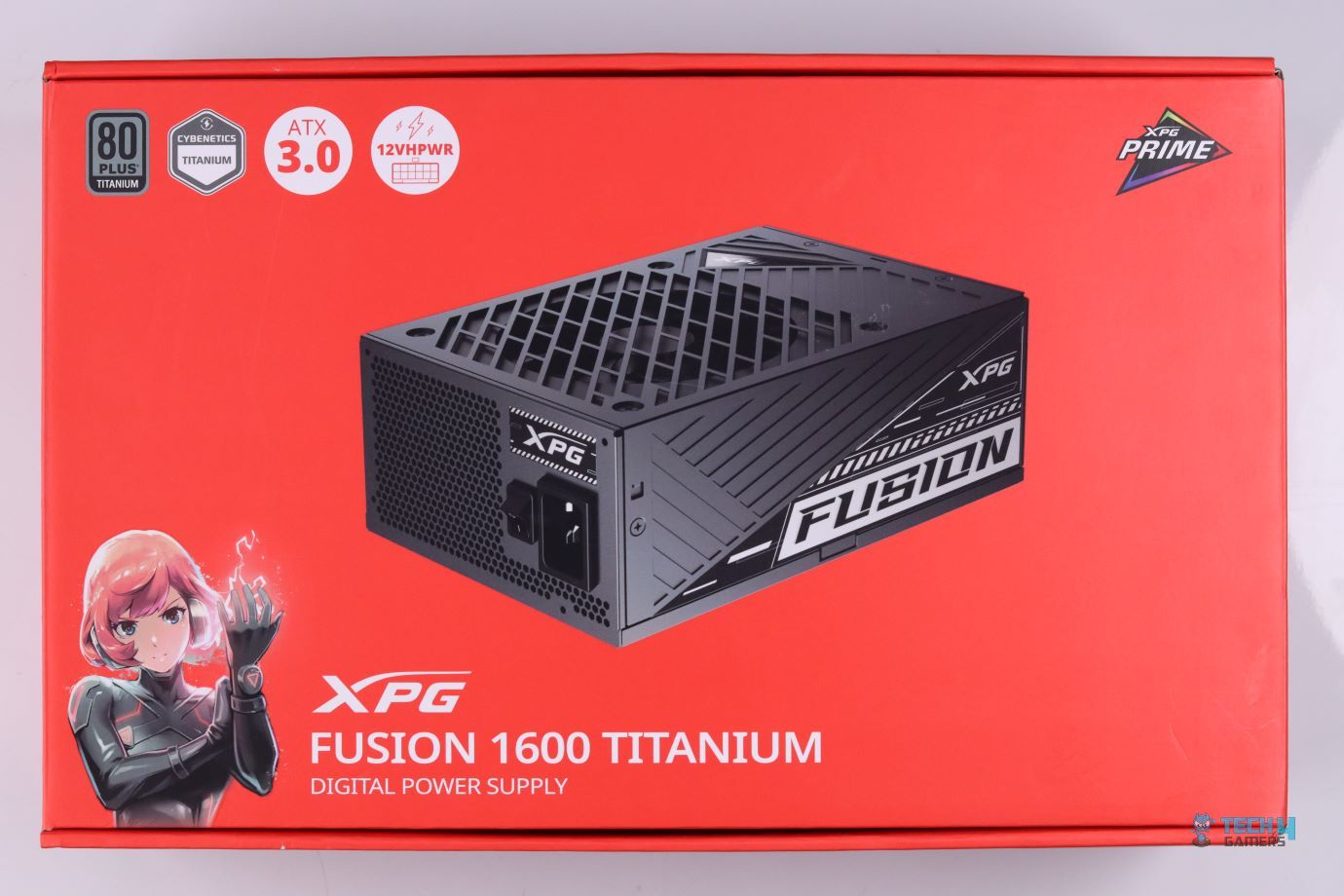
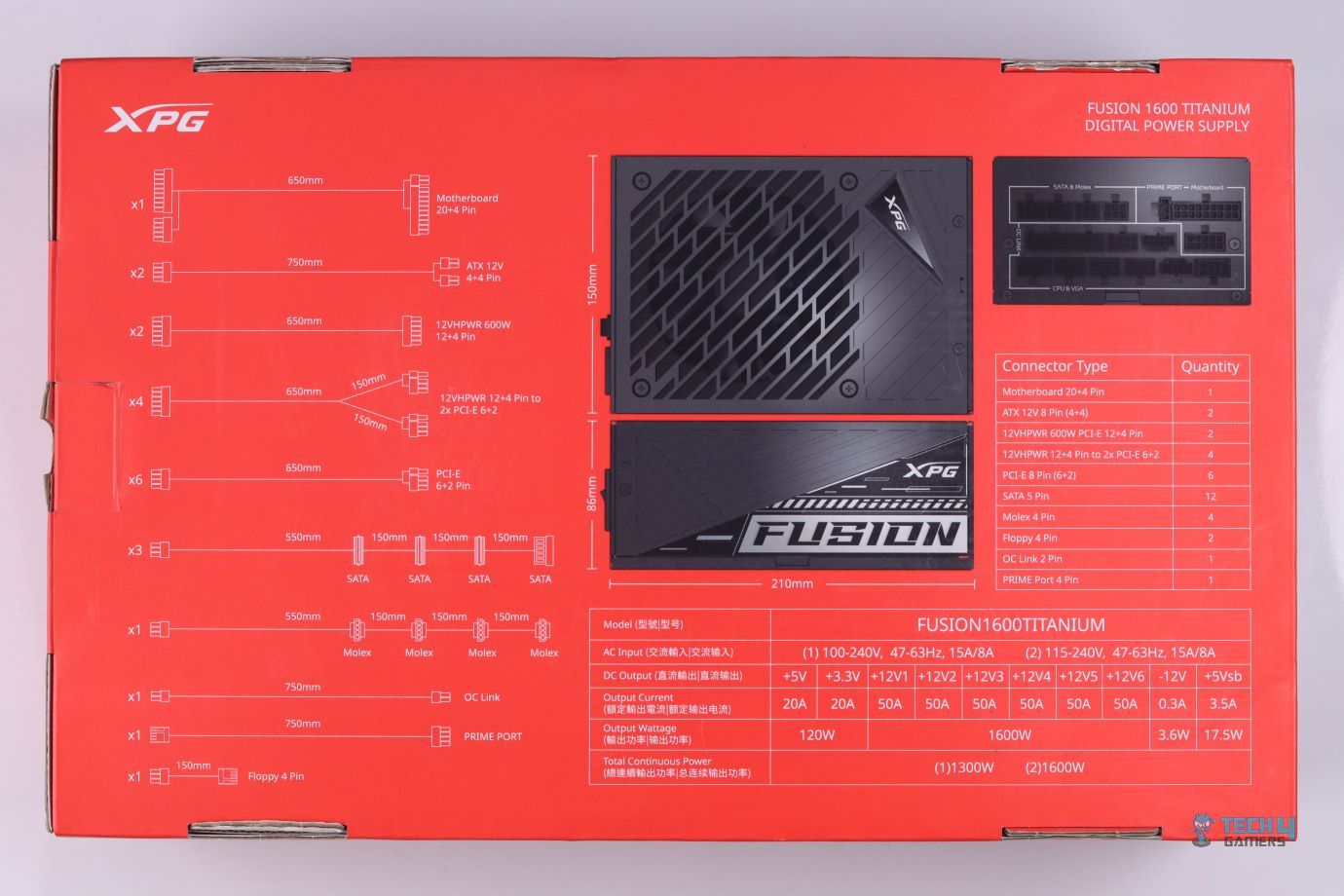
The front of the box is pretty typical of other XPG PSUs I have seen. We got an image of the power supply, an anime girl, the 80+ and Cybenetics Titanium branding alongside ATX 3.0 and 12VHPWR logos. At the back, you’ll find all the key specifications regarding the PSU itself, including cables and connectors (I will discuss them later).
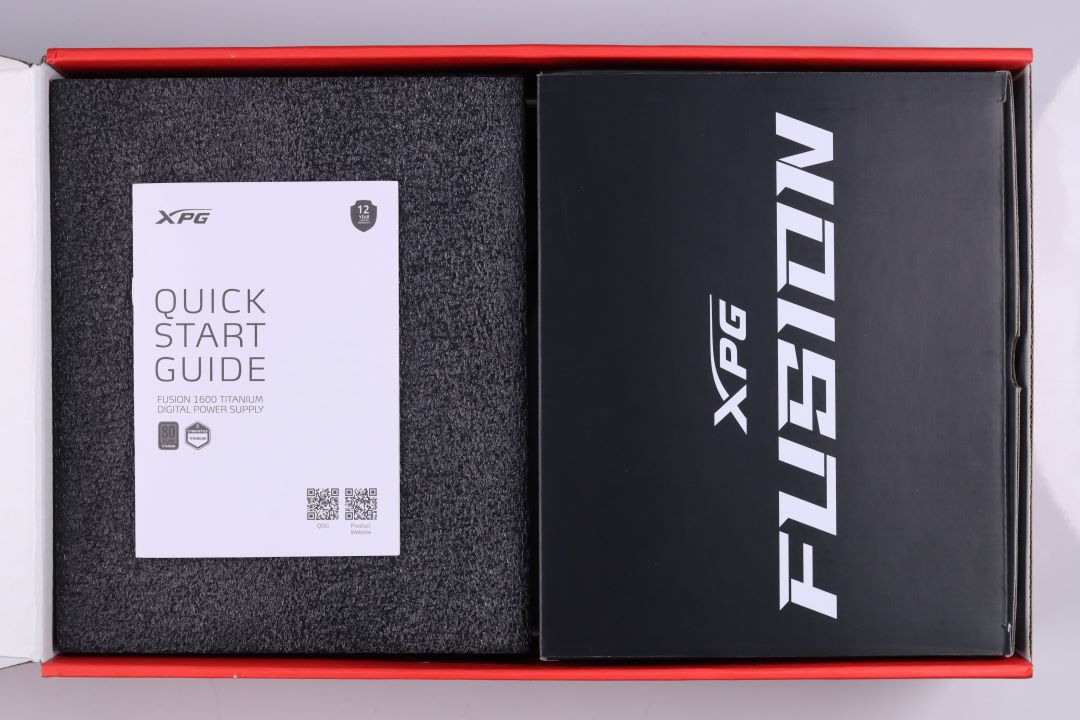
Unboxing the XPG Fusion 1600 Titanium
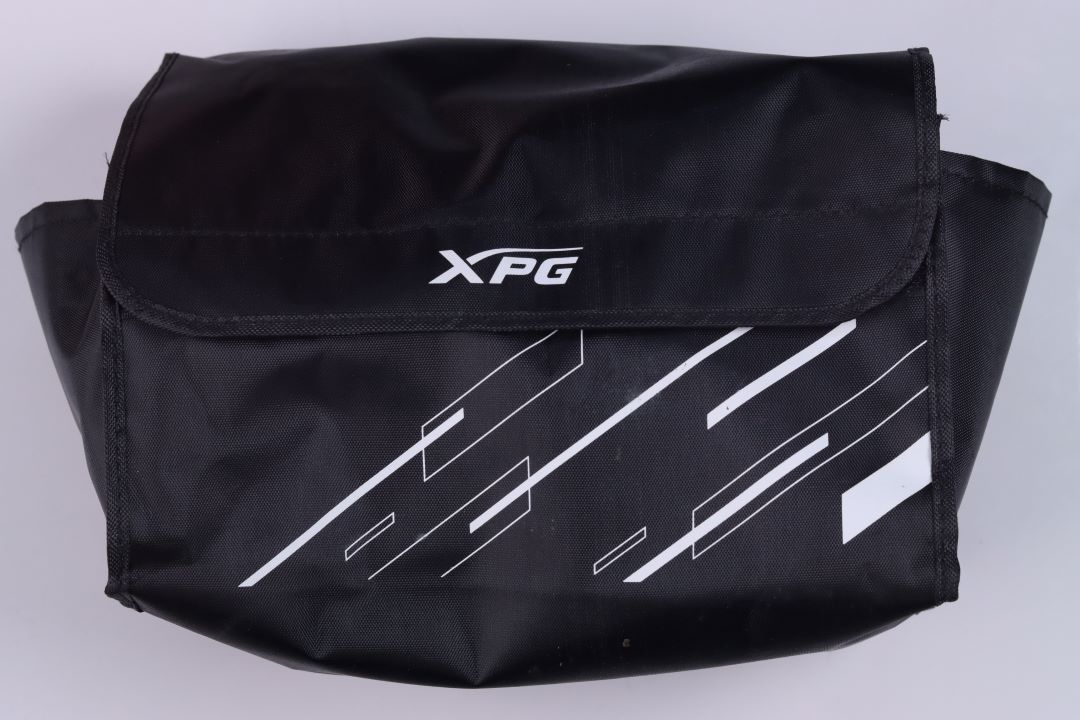
XPG Fusion 1600W Titanium Extra Cables Pouch
The main PSU is protected with foam packing, and the extra cables come in a rather cool pouch. I really like the overall feel and handling of the packaging. It serves its purpose in terms of protection while also adding some good flair.
Design
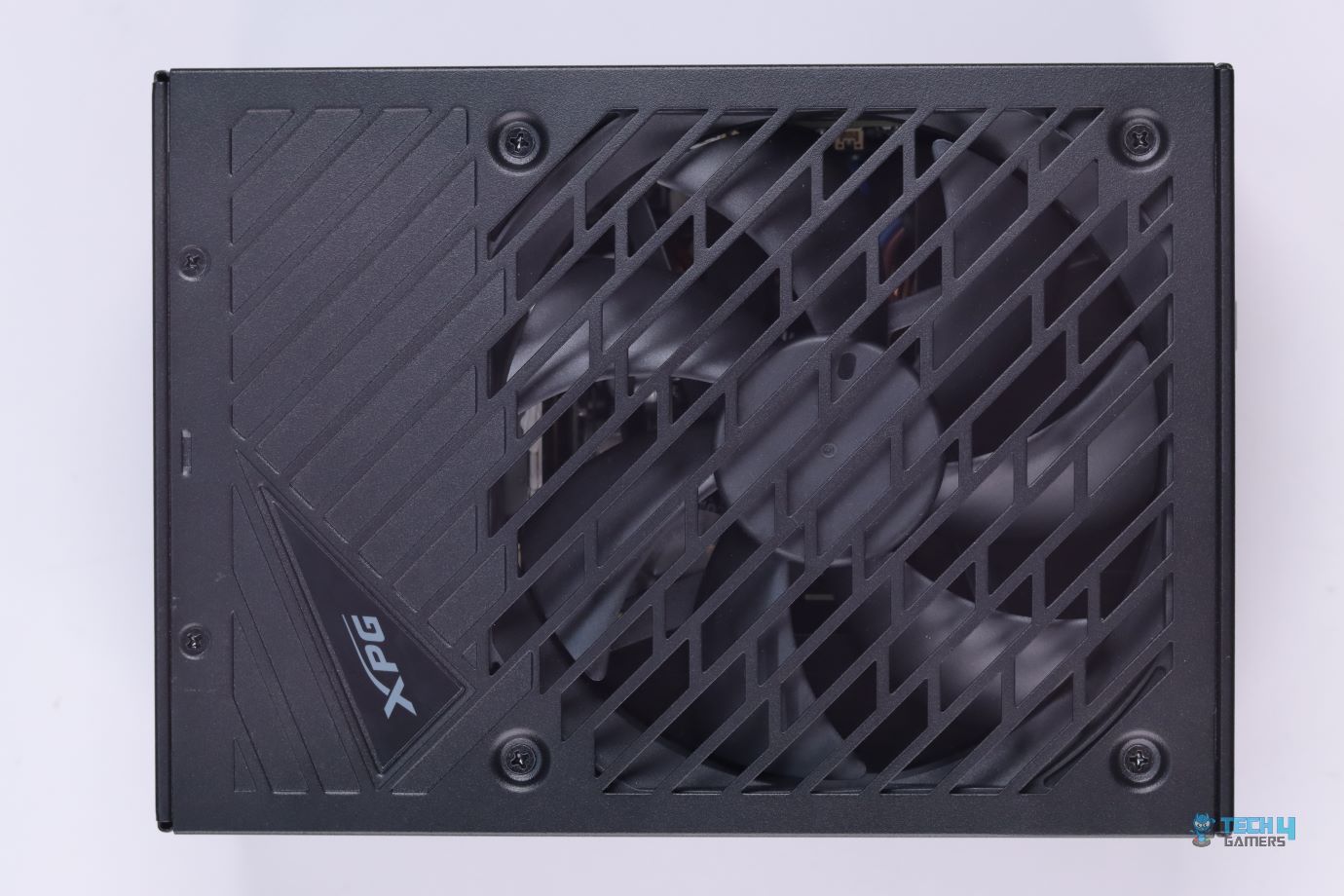
Fan Side
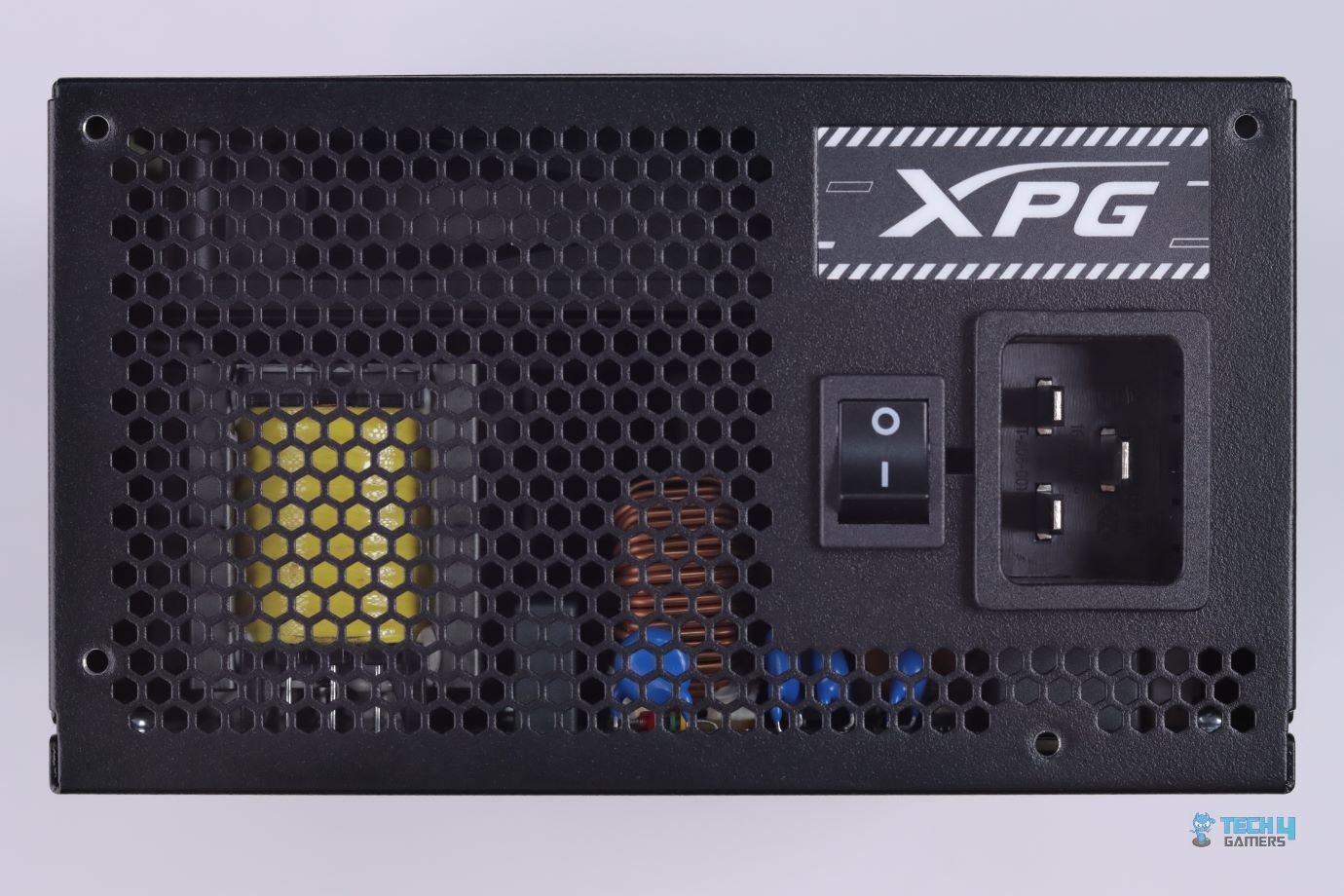
Power Outlet
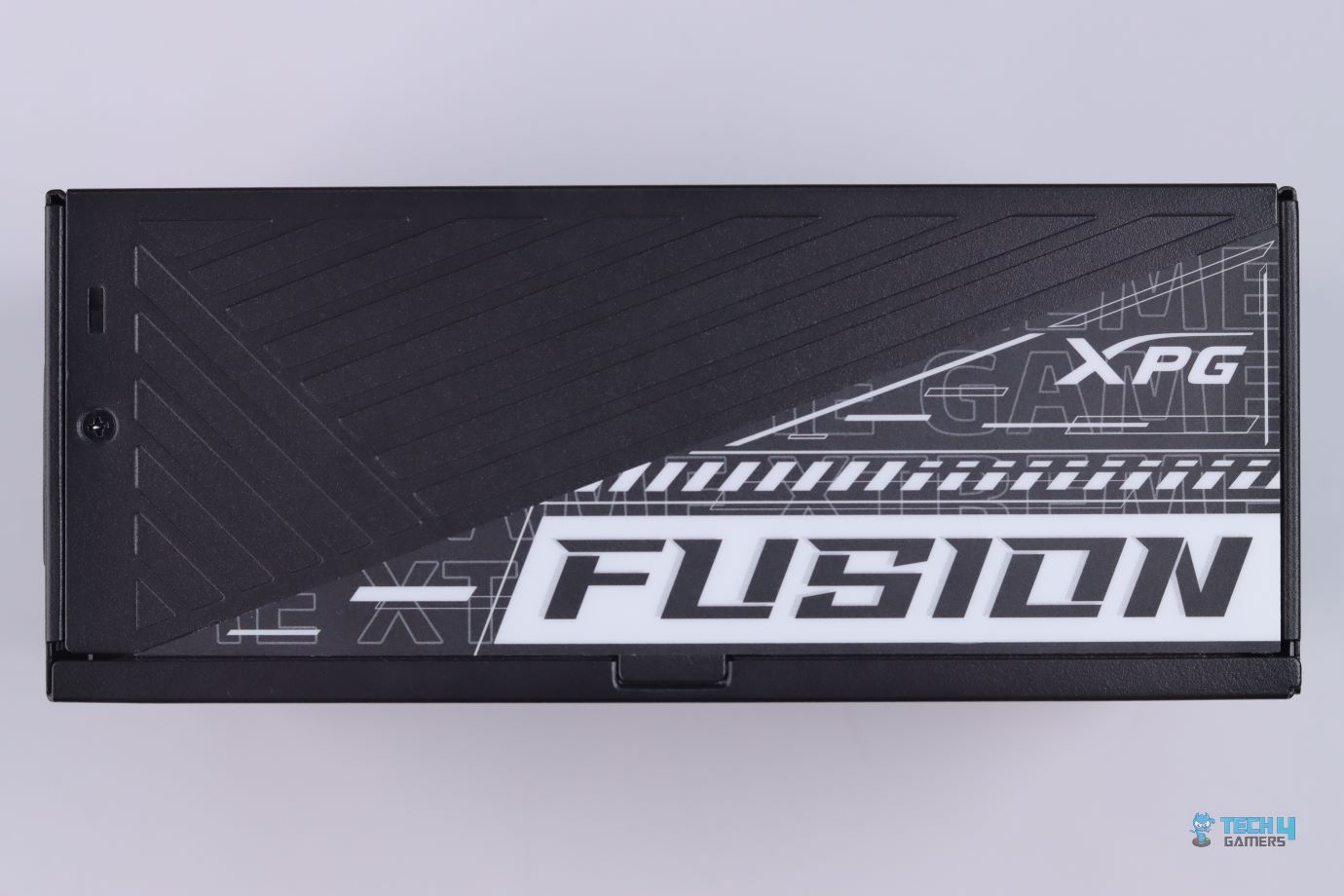
The unit measures 210 x 150 x 86mm (L x W x H). The entire shell is painted in a satin black paint. Combined with the aggressive geometric shapes and stickers, the PSU gives off a gamer vibe without any RGB effects.
It’s good to see that XPG has given plenty of room for airflow with the perforated panel at the back. Plus, one underrated quirk is that the fan guard is a single piece, so there are no seams. However, I would have loved to see some covers over the four screws.
Design
Power Output Specifications
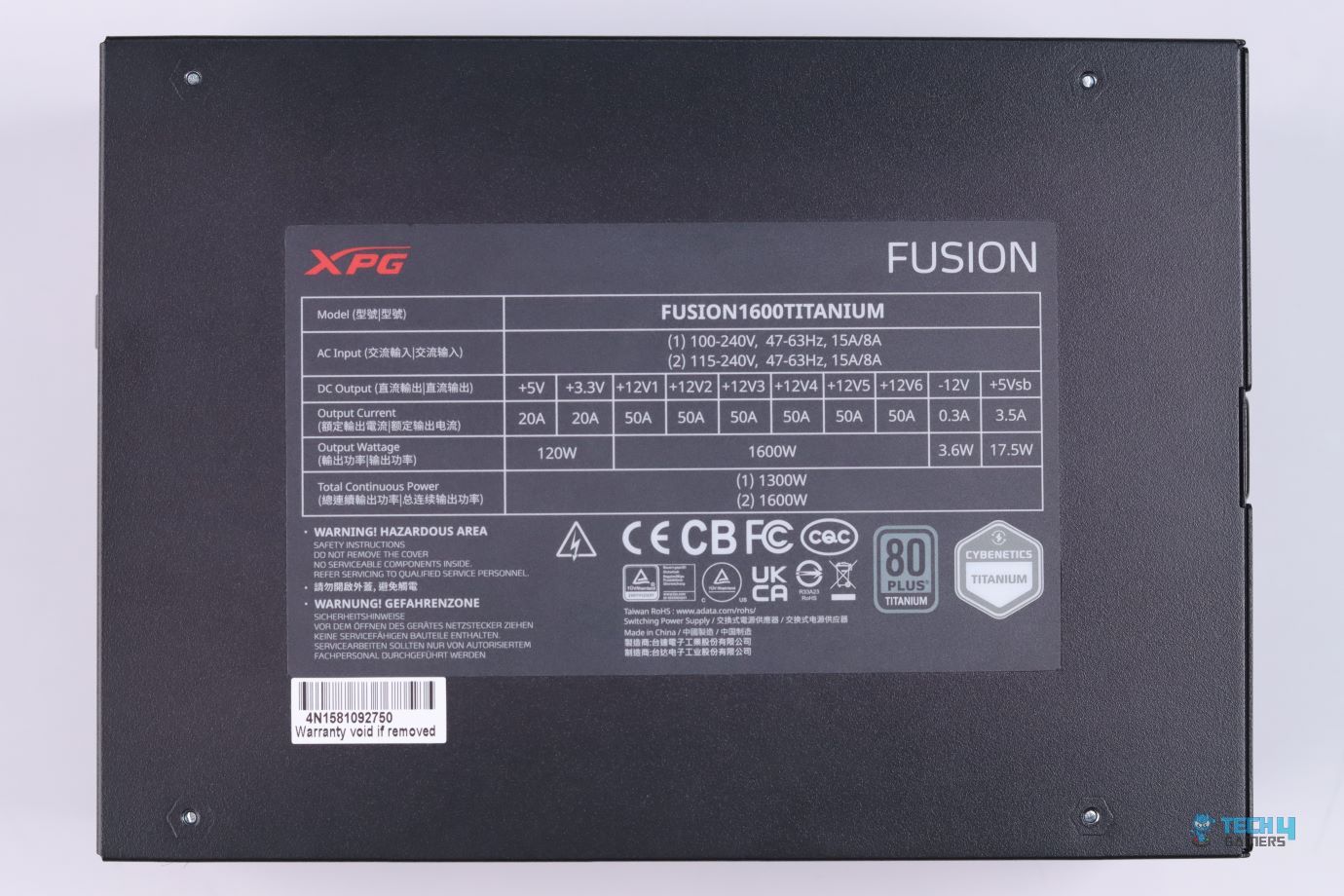
Following the sharp, angular theme of geometric shapes, both sides have a big sticker pasted with XPG and FUSION branding. You’ll also find all the important power output specifications at the bottom.
WARNING: Verify compatibility with your PC case due to its larger dimensions (210 x 150 x 86mm) and ensure ample space for installation.
Cable & Connectors
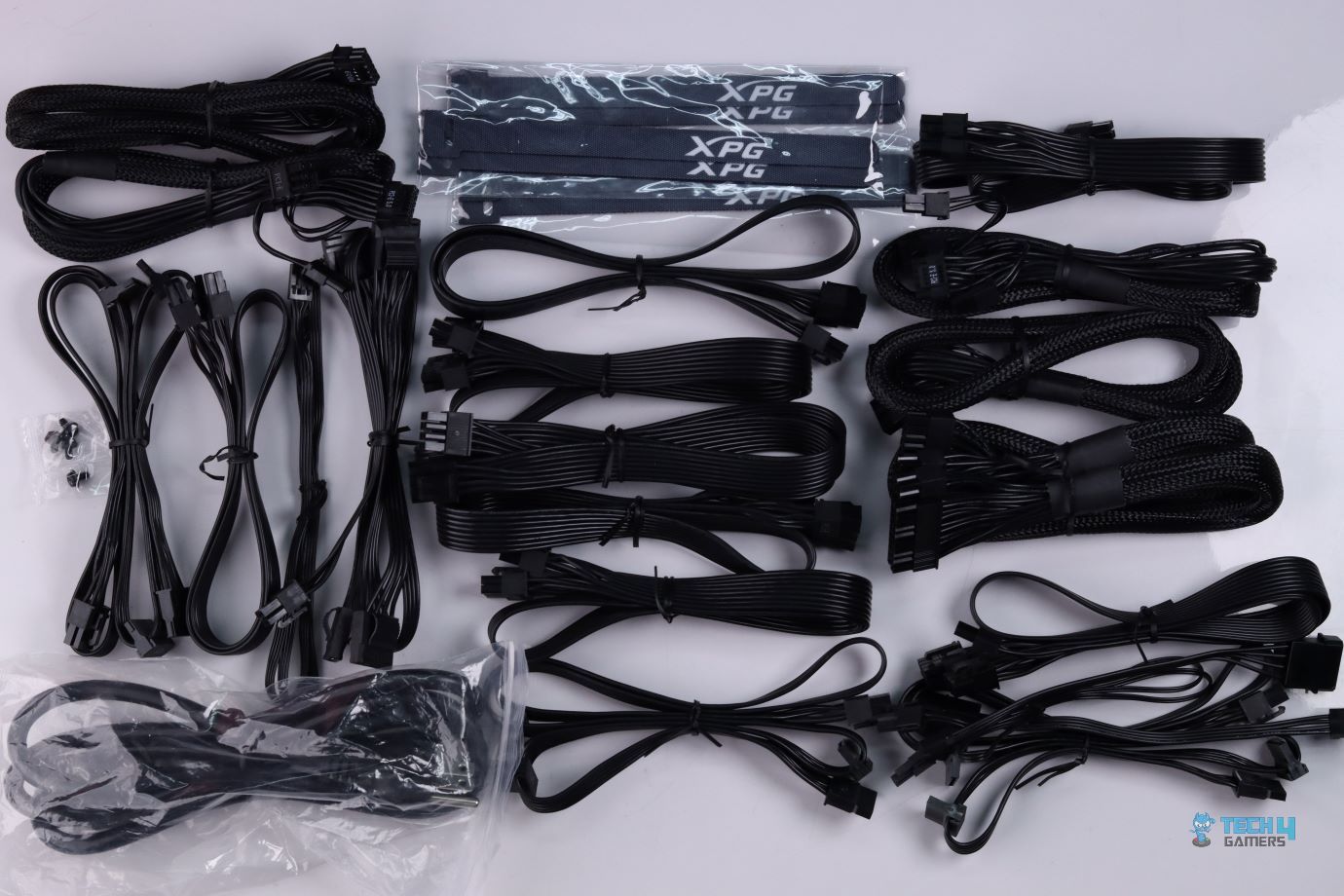
Cables
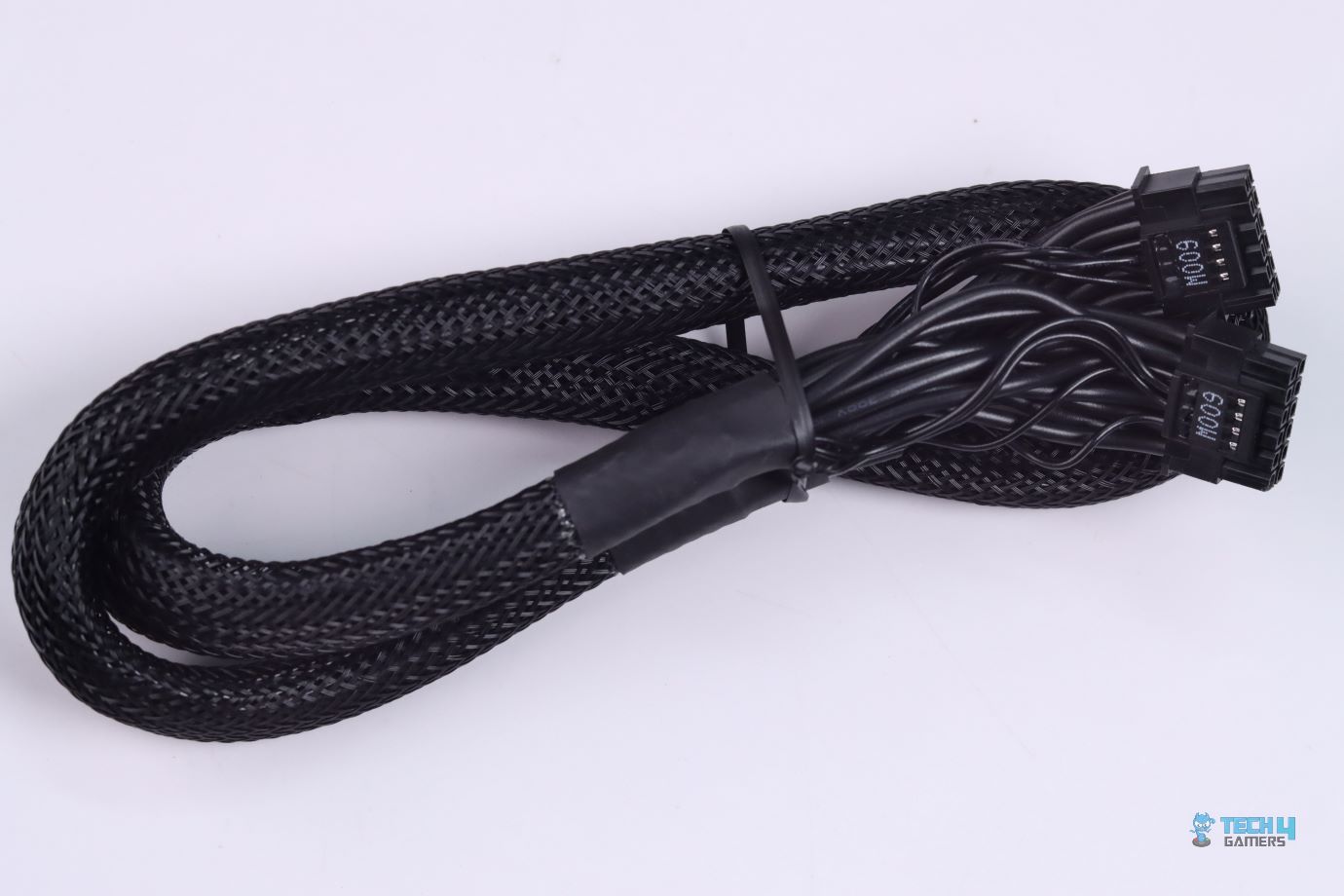
12VHPWR Cable
All the cables have adequate length for an ATX build and good configuration to handle any high-end PC (as expected). It’s good to see that the 20+4 ATX cable and the 12VHPWR cable are also sleeved.
The PSU also comes with an OC Link cable, which you can use to connect to XPG FUSION PSUs together for extreme overclocking.
Here is the list of all connectors:
Cable Type
Quantity
Motherboard 20+4 Pin
1
ATX 12V 4+4 Pin (CPU)
2
PCI-E 12V-2×6 12+4 Pin
2
PCI-E 6+2 Pin
10
SATA
12
Molex
4
Modular Bay
The modular bay is clearly labeled for quick connections.
Software Software
XPG Fusion 1600W Titanium, being a fully digital PSU, also allows its users full control over every electrical monitoring aspect ranging from monitoring mains Voltage, Current, and Wattage to giving you controls for individual voltage rails if you really are concerned about utmost safe operation for your beloved hardware connected to this PSU.
XPG Prime Walkthrough
1 of 4
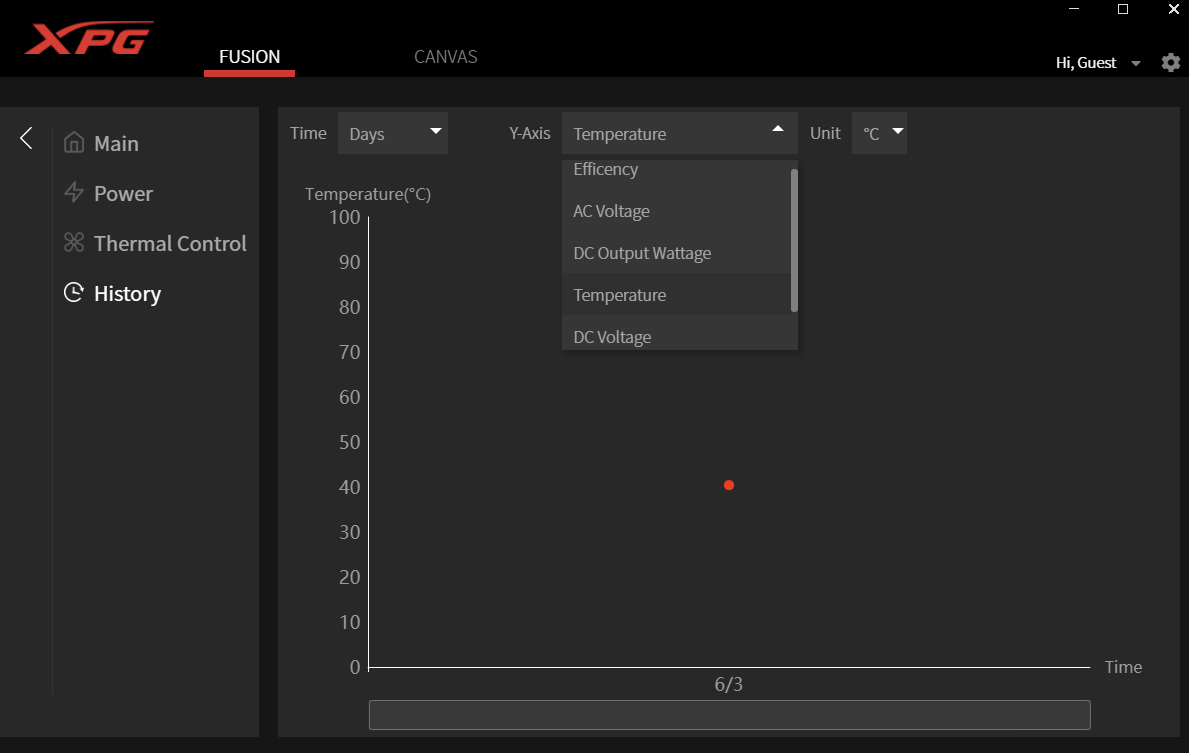
App View Data Logging (Image By Tech4Gamers)
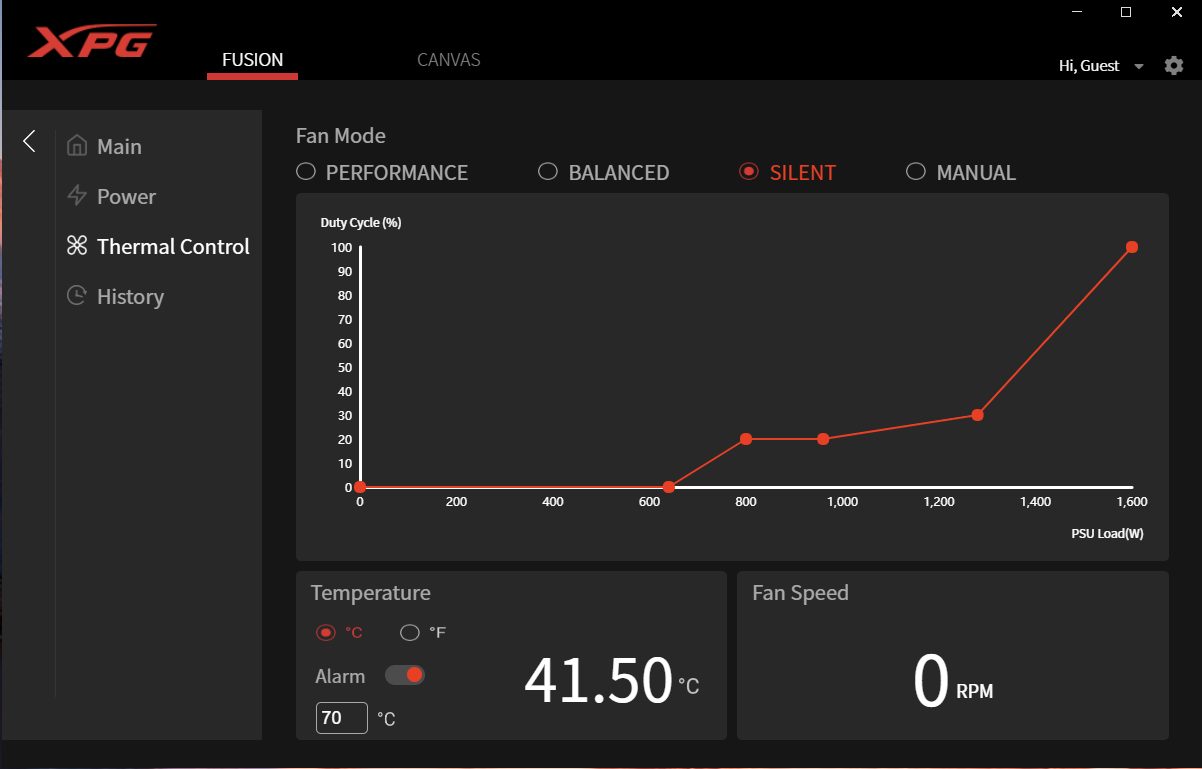
App View Fan Curve Adjustment (Image By Tech4Gamers)
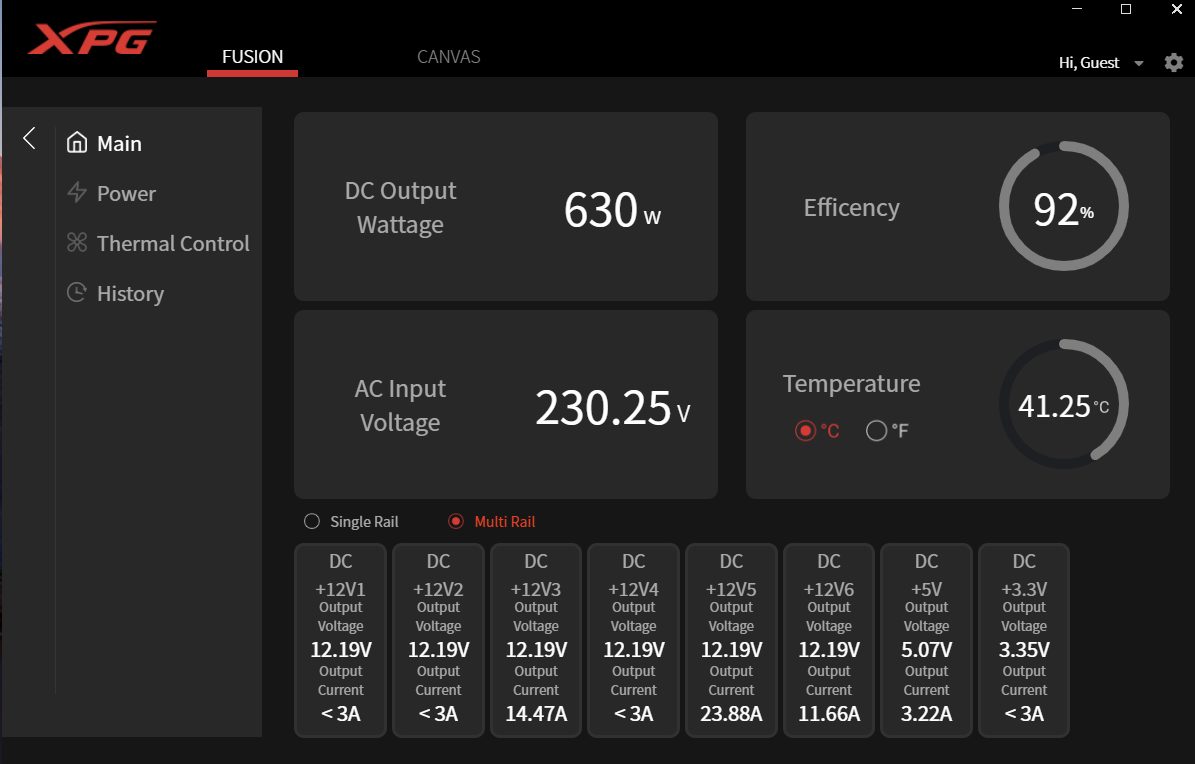
App View Input Output Power Parameters (Image By Tech4Gamers)
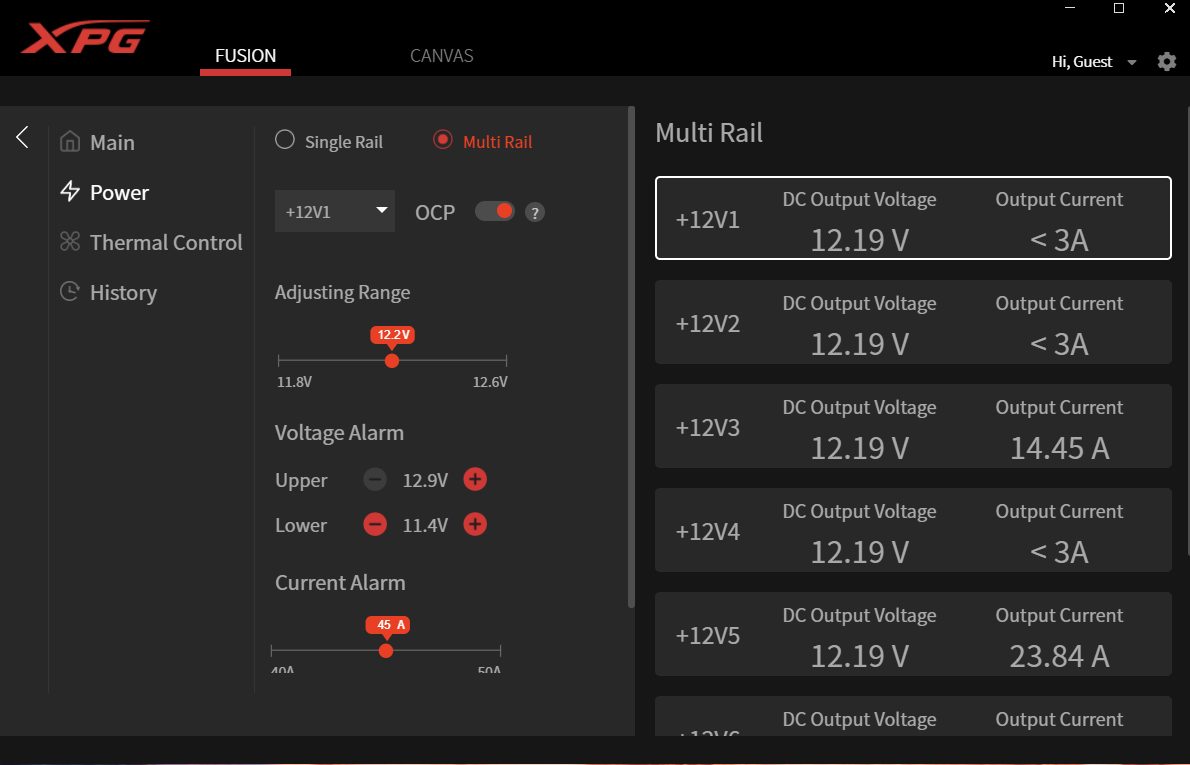
App View Voltage Rail Control (Image By Tech4Gamers)
XPG Prime is a very easy-to-use software that allows real-time monitoring and alarm functionality.
PRO TIP: Use the XPG Prime software for real-time monitoring, fan curve adjustments, and control over individual voltage rails.
Teardown & Component Analysis
This is surely going to be a fun part, at least for a nerd like me, but because here at Tech4Gamers, we have always made things easier for our readers, the same will happen this time.
Higher power density, reliable & extremely efficient PSUs are the attributes that can easily be associated with server PSUs because they have bigger dimensions than ATX PSUs and only require 12V output, hence why achieving better efficiency levels (one of the reasons Intel is now pushing ATX 12VO “12V Only” specs)
Delta Server PSUs (Delta)
In an effort to achieve high levels of efficiency, we have seen Primary side topology in PSUs transitioning from APFC Boost + LLC (found in Gold) to Interleaved PFC + LLC (found in Platinum) for 92% & 94% max efficiency numbers, respectively. Going beyond such numbers requires ingenuity that will be able to suck in all the energy from a massive R&D budget.
APFC Boost + LLC Topology
Interleaved PFC + LLC Topology. (Image By Tech4Gamers)
XPG had absolutely zero options (and trust) for an OEM that could have fulfilled their insanely high demanding requirements because almost every OEM has been utilizing the same old design approach, which offers nothing new and unique. This is exactly why XPG partnered with Delta Electronics, which is already among the top industry leaders for Server PSUs & Power Adapters.
This is the first time Delta Electronics has entered the ATX PSU market, and it looks like they have performed all of their best combos at once with XPG Fusion 1600W Titanium.
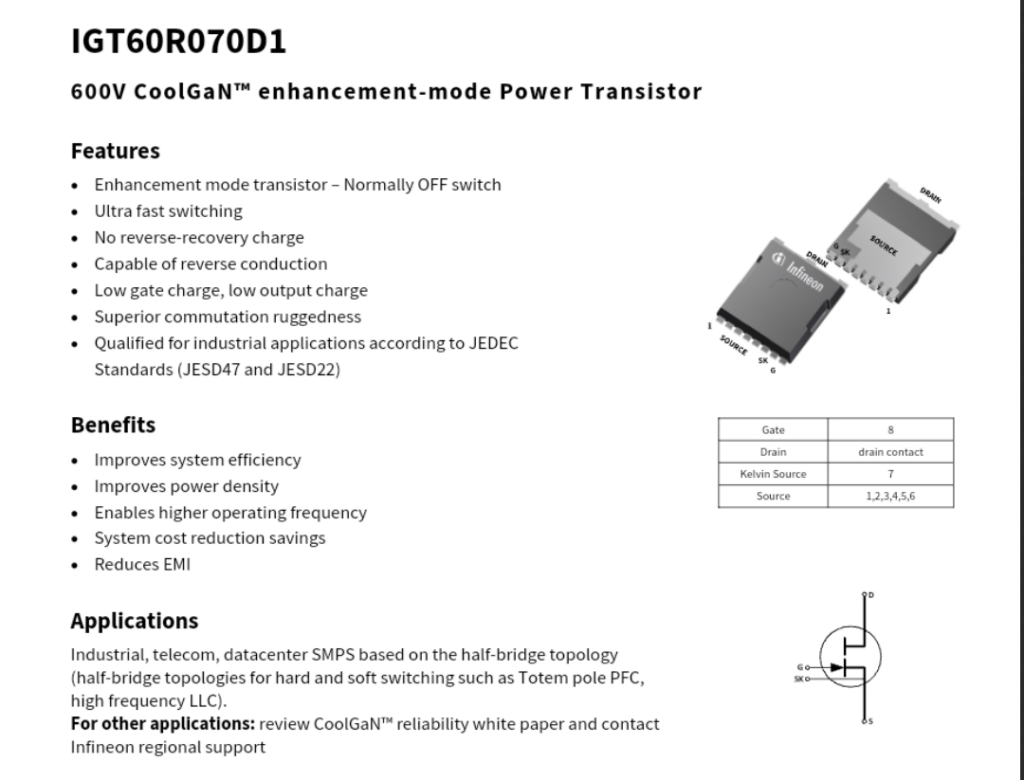
Their major design improvement is due to the implementation of GaN MODFETs instead of using traditional switching components like Bridge Rectifiers & MOSFETs, which seem to be creating a huge bottleneck for high-power density efficiency PSUs.
GAN MODFET
GaN MODFET in electronics is similar to what AI in today’s computing field: extremely fast & superbly efficient! With faster switching and high power density of GaN MODFETs it is even possible to achieve not only 99% efficiency levels but with much fewer components, making the size of an actual PSU much more compact.
Still with me here? Hey, we haven’t even gone to the actual teardown details yet! You guys have yet to witness half of my excitement 😀
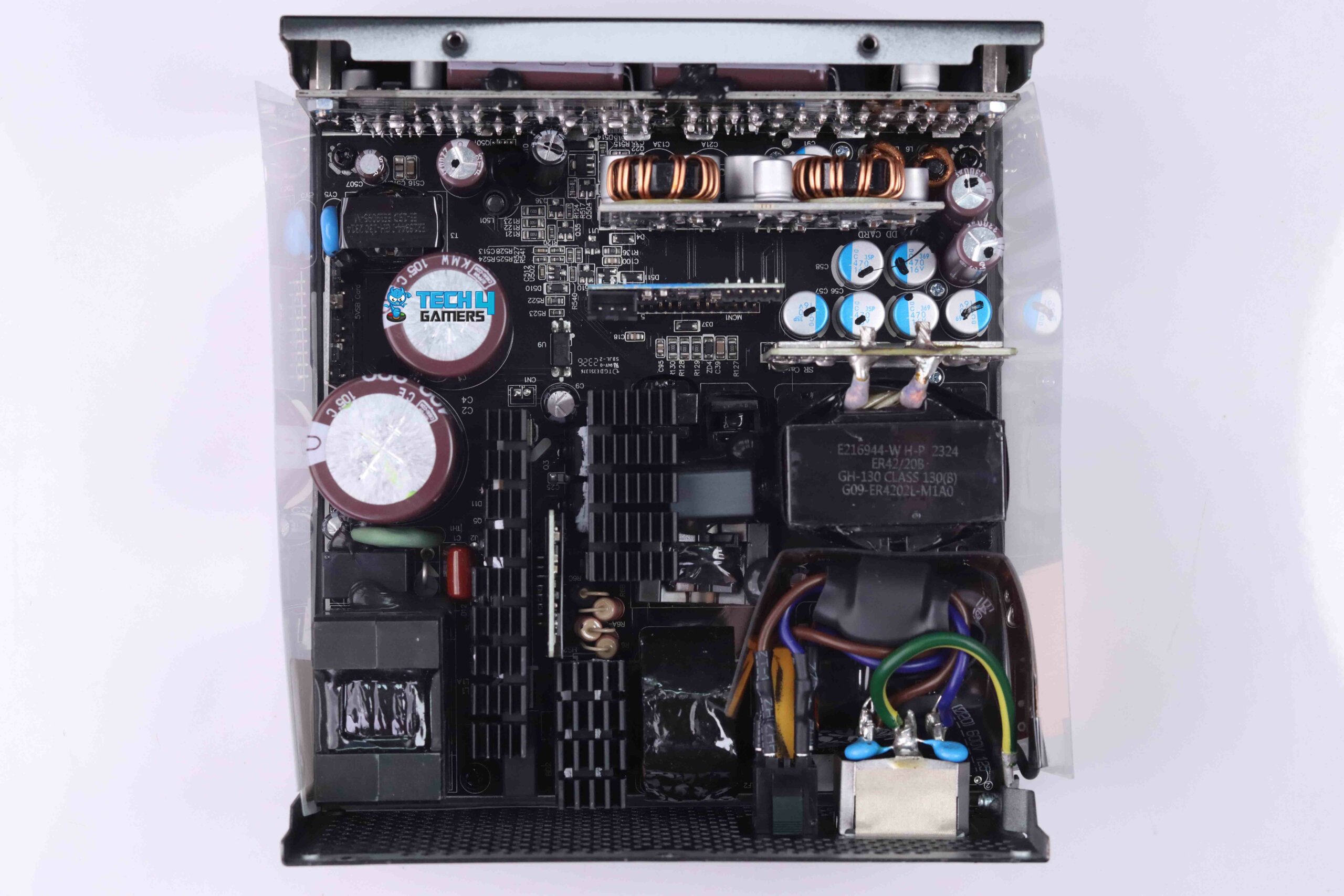
Top Teardown (Image By Tech4Gamers)
Delta Electronics is using the highest efficiency topology there is for an ATX PSU, Digital Totem-Pole Bridgeless PFC + Full Bridge LLC on the primary side, making it a fully Digital PSU. We haven’t had any major luck in seeing that many fully Digital PSUs in the past, only Corsair’s AXi series ages ago that’s long been discontinued. Several OEMs have tried to achieve this engineering marvel but have failed miserably. XPG & Delta Electronics have really done a tremendous job here!
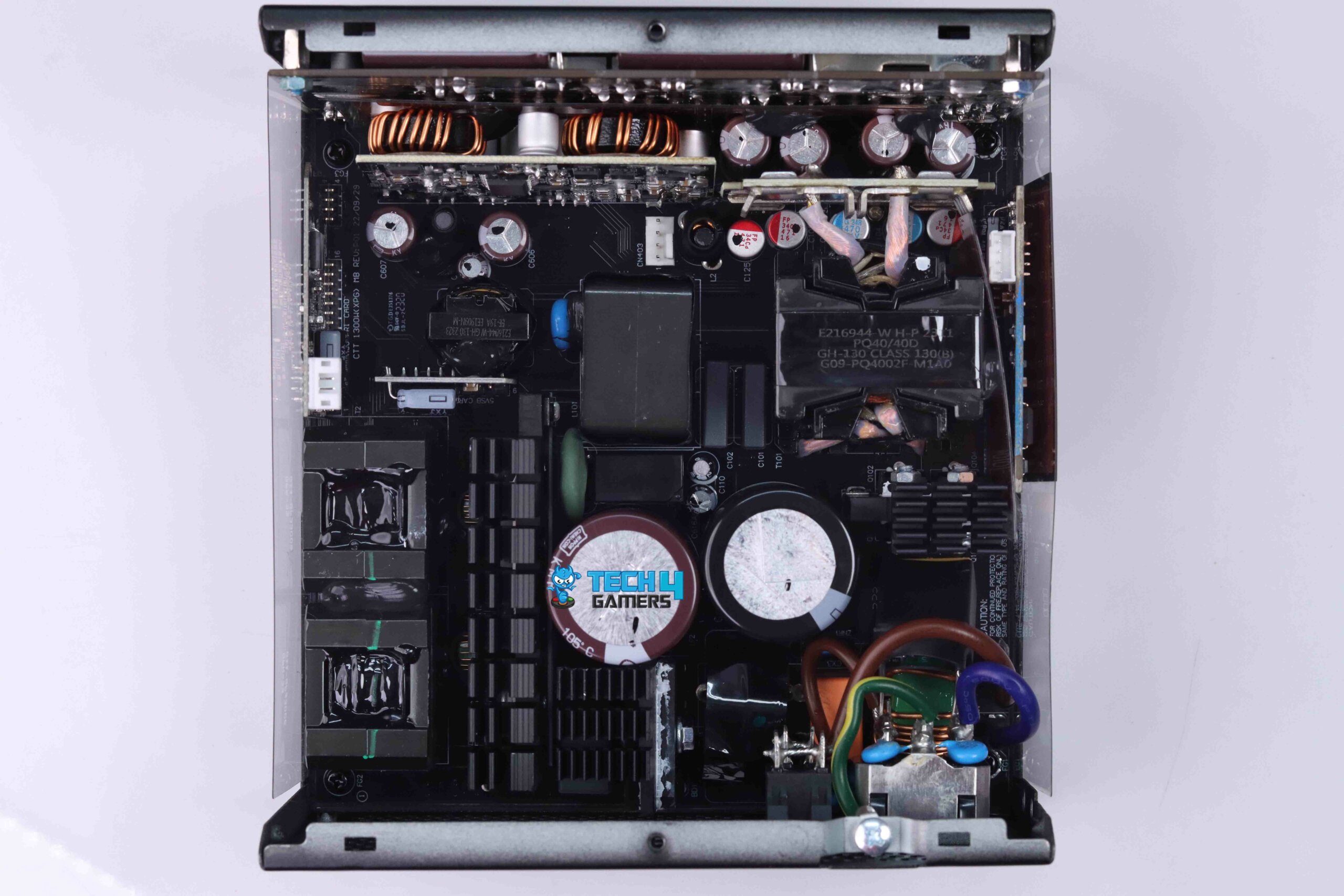
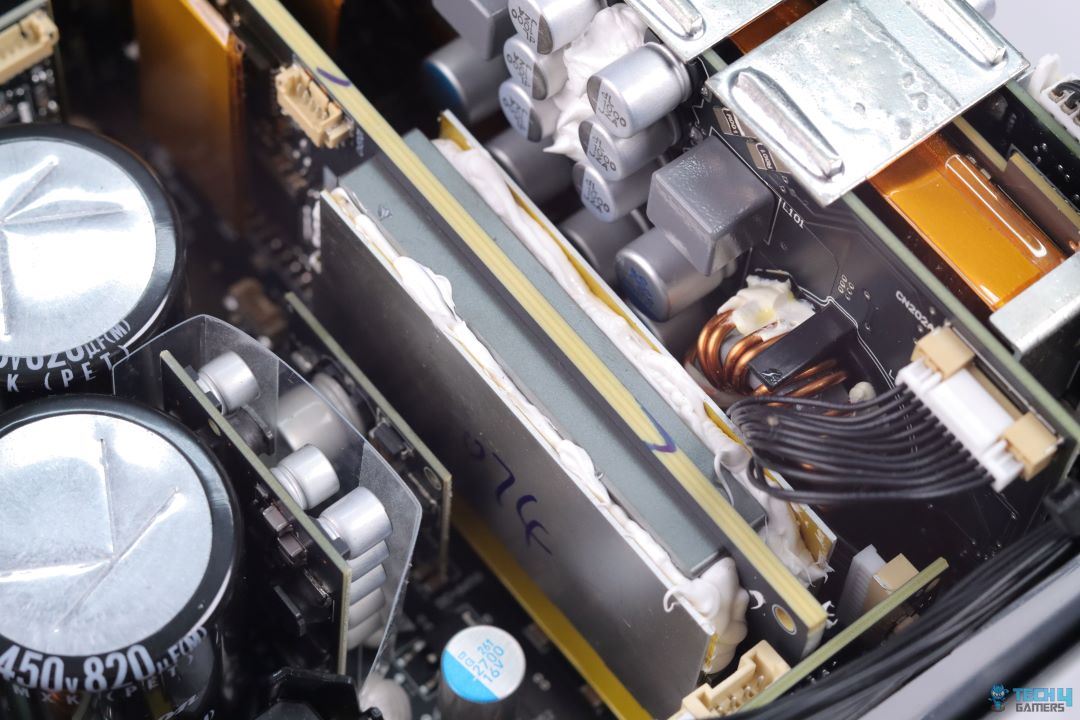
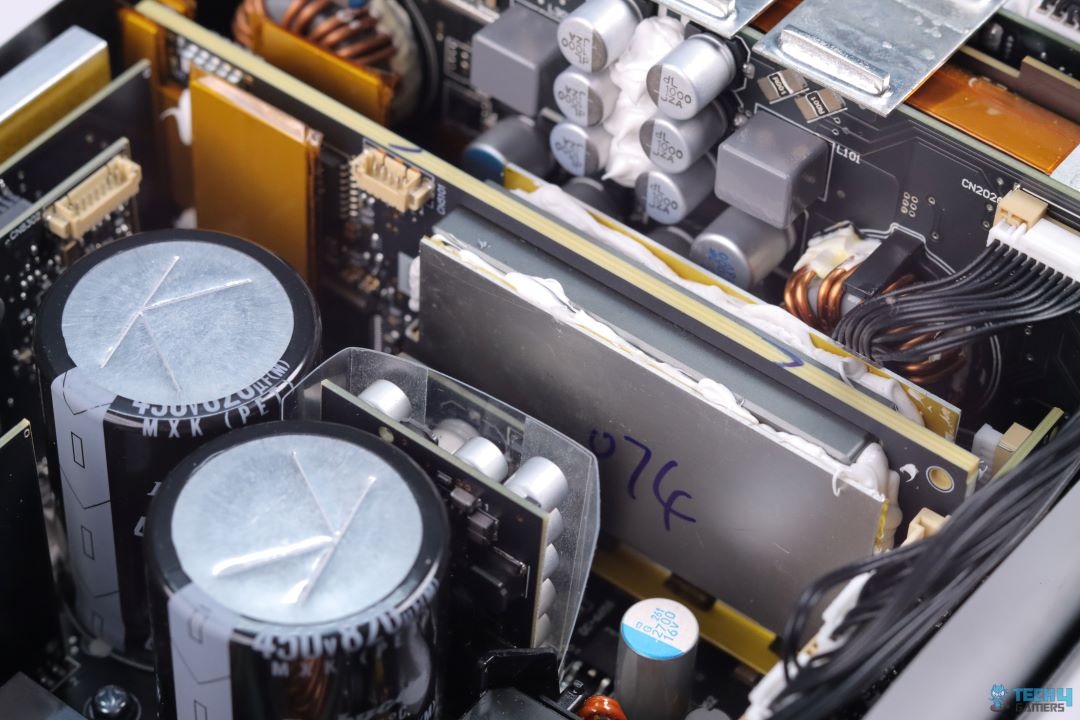
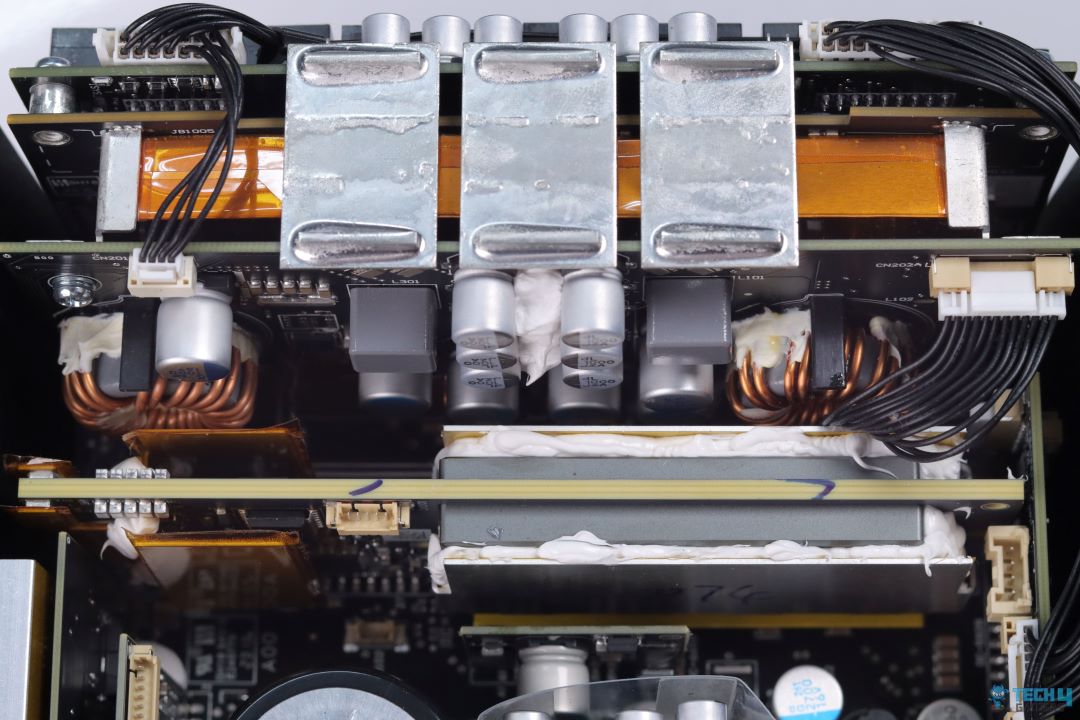
The internal board layout is clean, and several vertical daughter boards are used. This is the first time you may be seeing a whopping 1600W power-handling brick without any big block of heatsink. This is all thanks to XPG Fusion’s Titanium efficiency and the use of GaN MODFETs that don’t produce much wasted heat.
Planar Transformer 1
Planar Transformer 2
At the beginning of this article, we mentioned that XPG Fusion is nothing like any PSU we have seen before, right? If you have been into PSU reviews or have read our other PSU reviews, then you must be confused at this point that in XPG Fusion 1600W, there’s actually no Transformer! How is the primary 12V rail generated then?
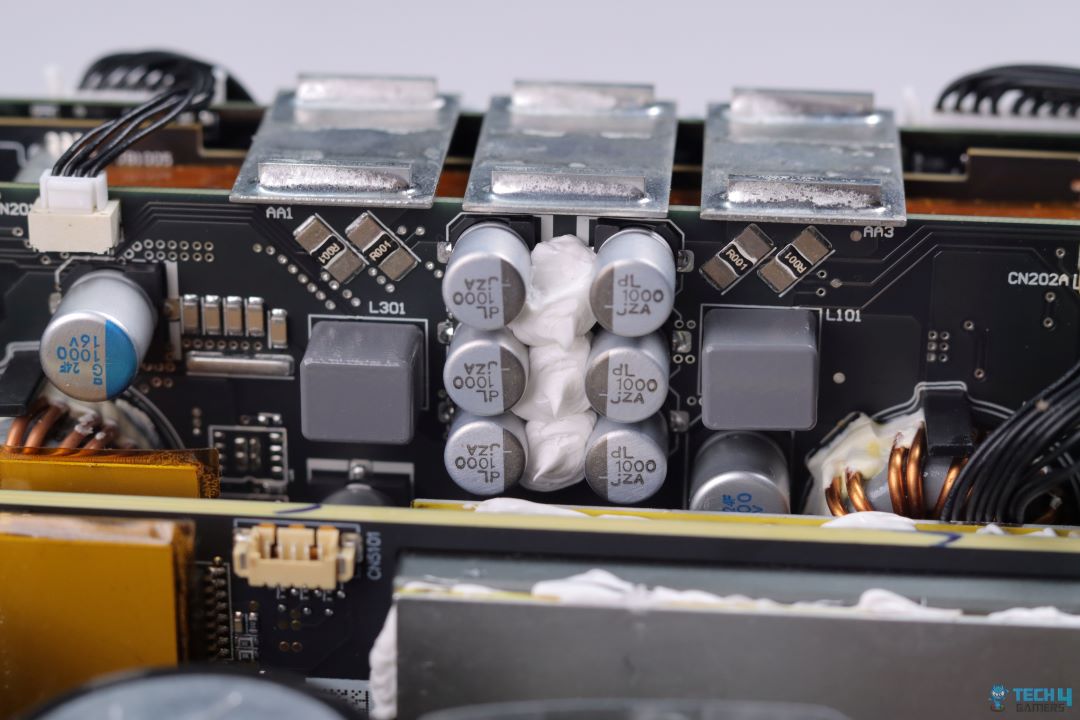
Well, here’s another engineering marvel from Delta Electronics, the very first time in ATX PSUs, it’s patented Planar Transformer technology (you gotta be showing off at this point, Delta!) that allows the Transformer to be mounted on a vertical PCB, saving the space and managing the heat dissipation. The entire 12V rail and its MOSFETs are all housed on the same PCB along with the Planar Transformer.
Bulk Electrolytic Capacitors from Rubycon (Image By Tech4Gamers)
All the electrolytic capacitors are from well-known Japanese manufacturers such as Rubycon (main bulk capacitors) and Nippon Chemi-Con. Bulk electrolytic capacitors have a capacitance large enough to handle hold-up time even at a full 1600W load.
There are many polymer capacitors for ripple filtering from both Japanese and high-end Taiwanese brands.
DC-DC Converter board for 3.3V & 5V
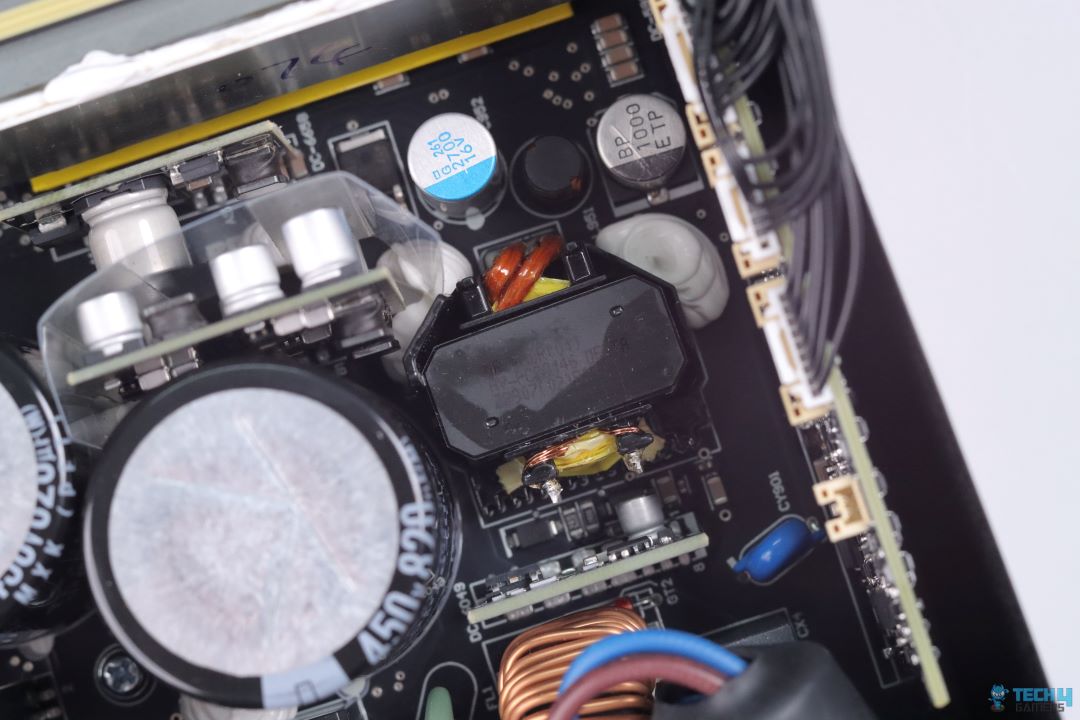
5VSB Transformer
3.3V & 5V are generated via DC-DC converters, all digitally controlled. Only the 5VSB rail is generated via the old traditional way of getting AC-DC conversion from its own dedicated bridge rectifier.
Teardown
1 of 3
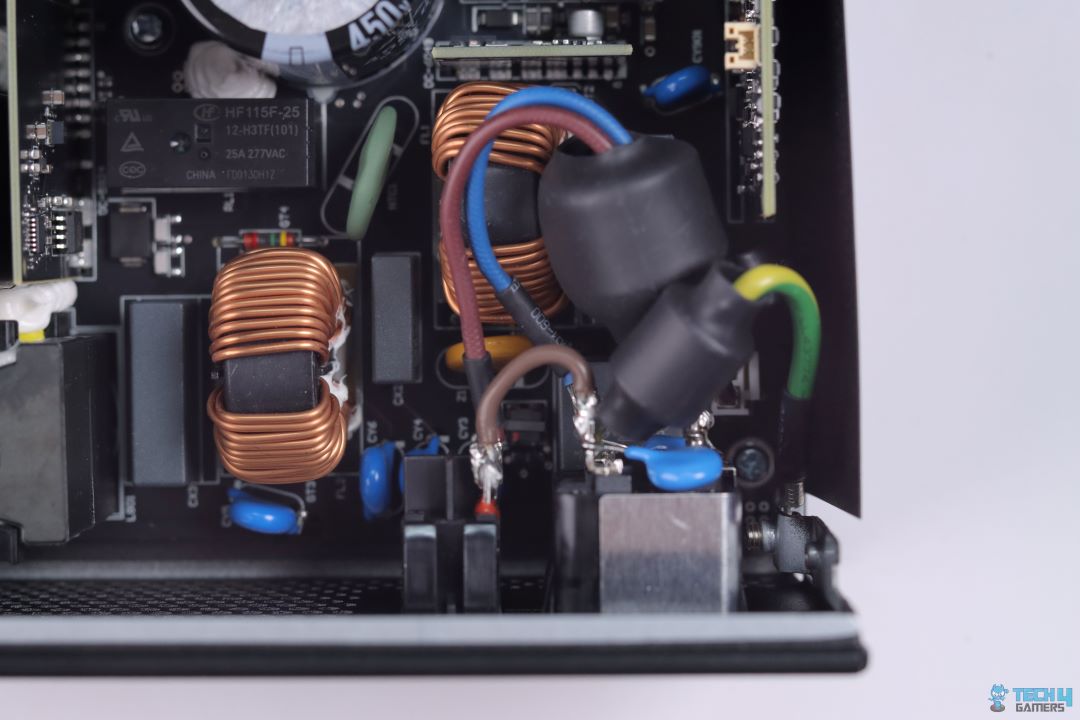
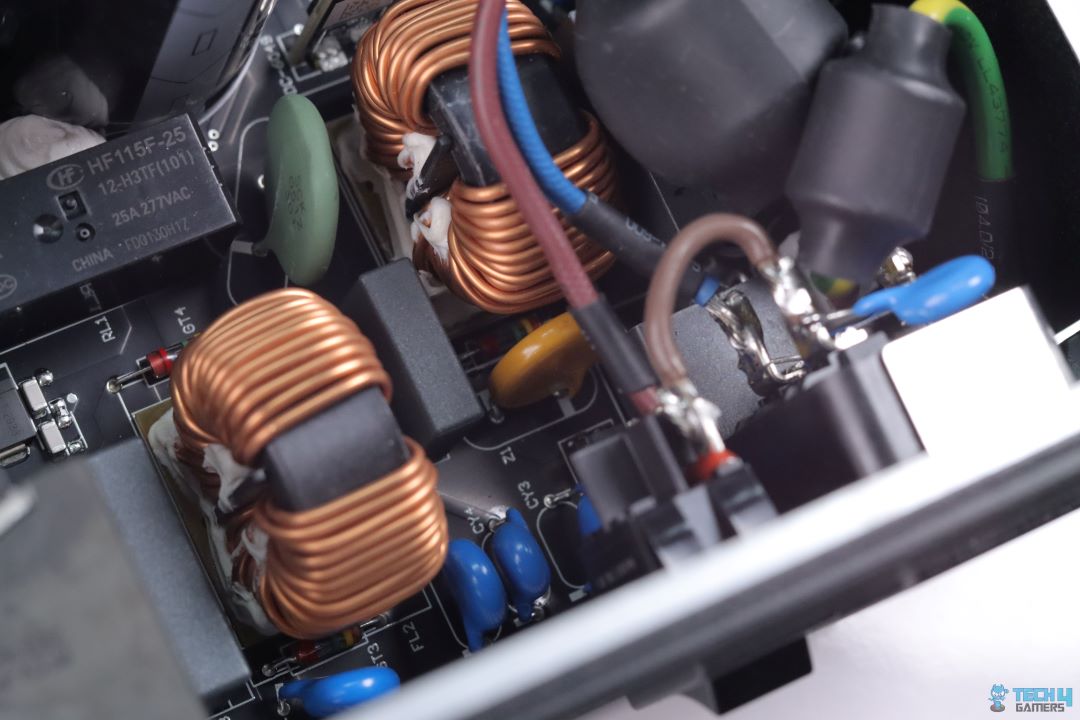
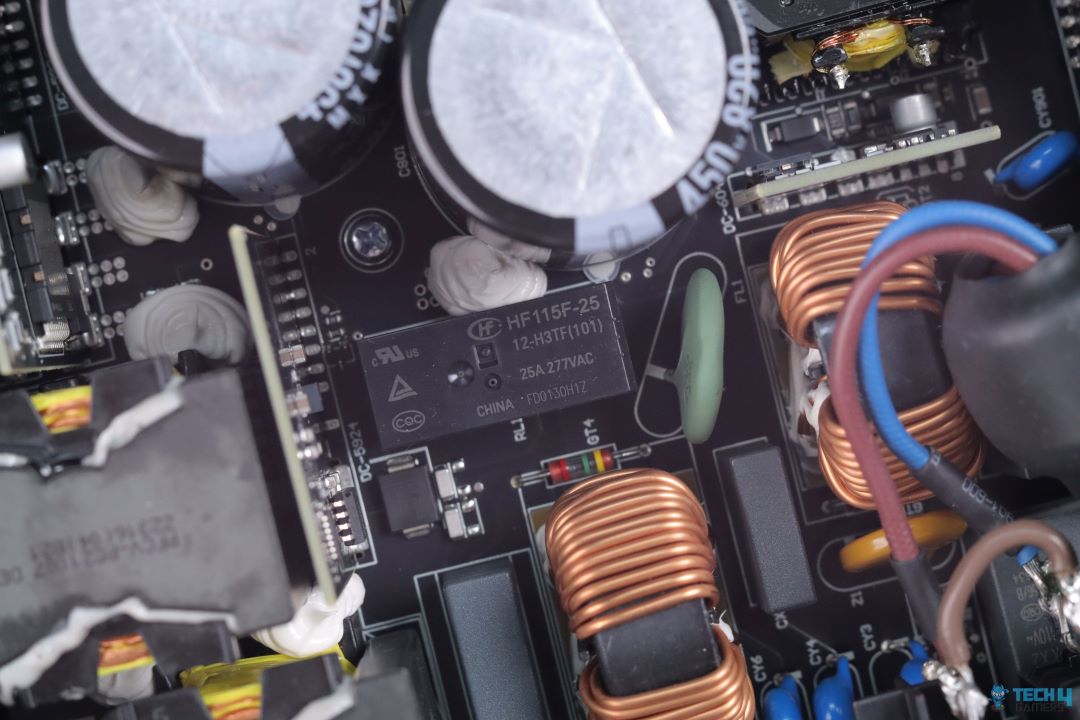
AC Filtering Section (Image By Tech4Gamers)
MOV for voltage surge protection (Image By Tech4Gamers)
NTC Thermistor & its bypass Relay (Image By Tech4Gamers)
Some more insides!
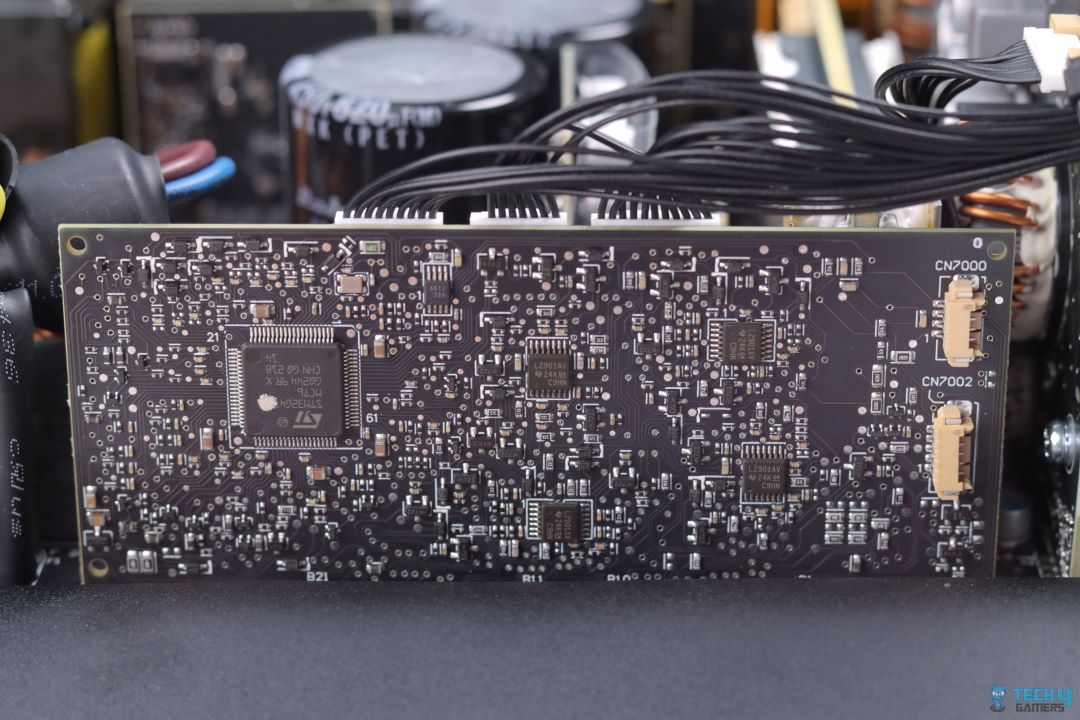
STM32 Microcontroller along with 4 separate voltage comparators
Metal Tabs
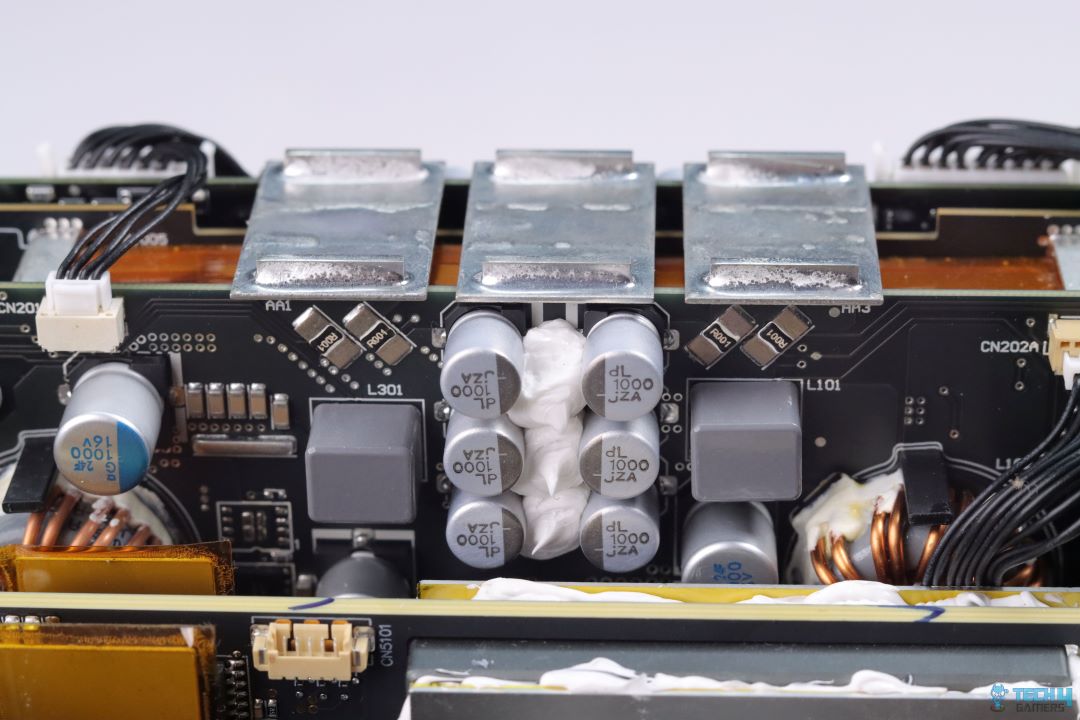
One of the reasons this PSU costs around $700 (oh, you thought all this innovation would come for free?) is the use of several microcontrollers that control all the vital functionality of this PSU. There are also huge metal tabs linking minor voltage rails (3.3V & 5V) to the output connectors’ section.
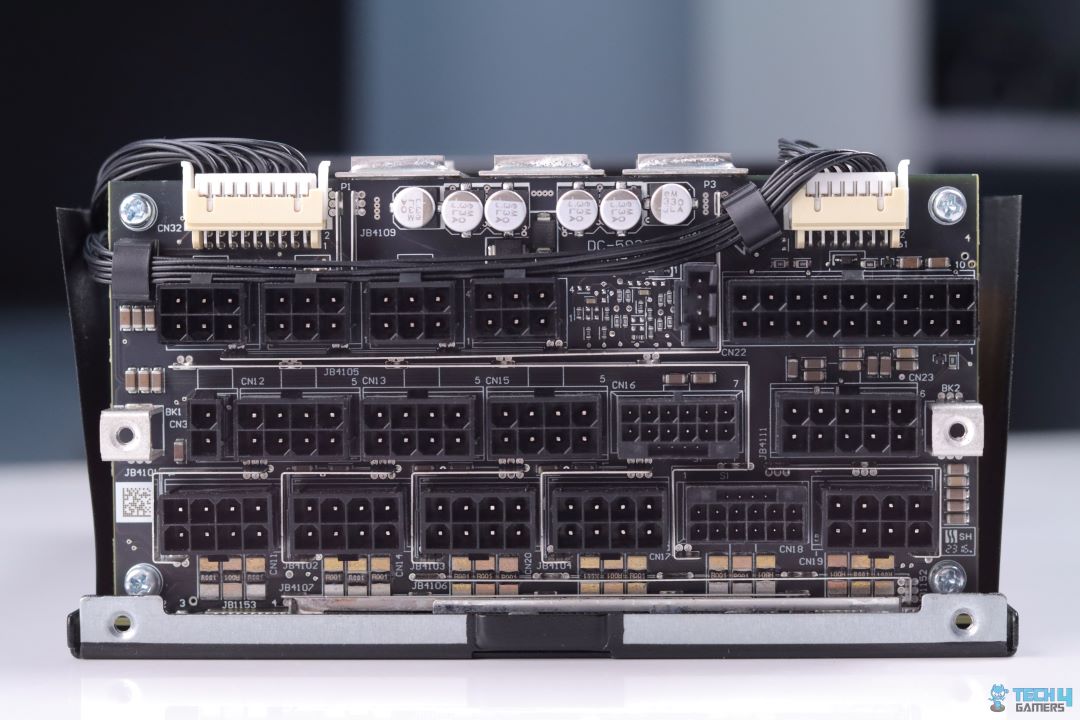
Insides Of The Modular Bay
Current Shunt Resistors
Here, you can see the output connectors panel where you plug in all of your required power connectors. XPG Fusion offers software-level control of individual voltage rails, which is why we get to see so many current shunt resistors here on the board.
Fan
It’s a double-ball-bearing fan from Hong Hua, unlike XPG’s CyberCore series, which uses super expensive and premium fans from Nidec. This is to keep the cost slightly down.
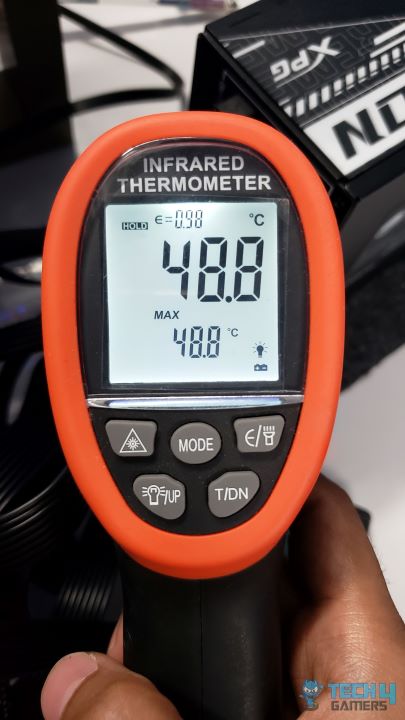
Thanks to its extreme efficiency, the fan only gets to kick in when the load reaches around 775W! Users can also adjust fan curves using XPG Prime software.
PSU Load Testing
Testing The XPG Fusion 1600W Titanium
12V & Minor Voltage Rails Regulation
Percentage Difference In 12V Rail Regulation (Image By Tech4Gamers)
Load in %
12V
5V
3.3V
20%
12.18V
5.10V
3.35V
50%
12.13V
5.09V
3.34V
70%
12.15V
5.10V
3.35V
90%
12.15V
5.09V
3.34V
100%
12.14V
5.09V
3.34V
Voltage regulation is kept very tight even at the maximum load. Surely, this is well-built to handle multiple GPUs without breaking a sweat.
PSU Efficiency
Average Efficiency (Image By Tech4Gamers)
Load in %
Power Factor
Efficiency
20%
0.973
93.53%
50%
0.993
95.60%
70%
0.996
95.32%
90%
0.998
94.86%
100%
0.999
94.53%
Overall efficiency is superb but we surely were expecting to see even more exceptional results. Moreover, electric/power companies will be really happy with this PSU as this wastes almost no reactive power and efficiently converts it into actual used wattage, thanks to its very high Power Factor readings (PF 0.999) that I don’t think we have seen here at Tech4Gamers before.
The performance in this test is really good, but being a fully digital PSU with this much innovation on board, we would have loved seeing this PSU breaking some records, especially in this test with at least ~10mV of voltage ripple.
We gotta give it to Delta Electronics & XPG for designing their very first PSU with this impressive performance. We are raising our hopes once again for the XPG Fusion II, wink wink 😉
Temperatures
Our Thermal Test Results
1 of 3
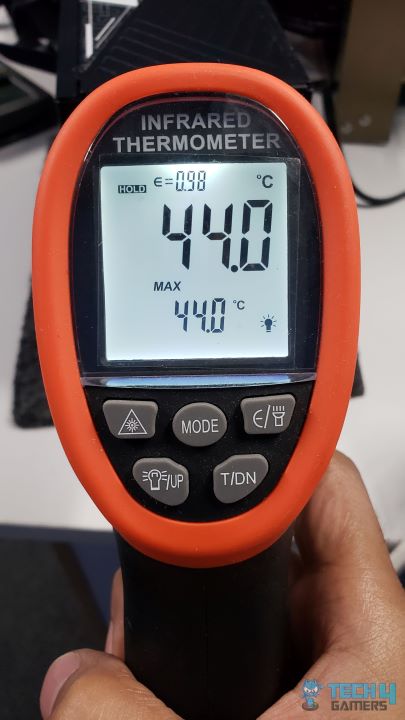
Exhaust temp (Image By Tech4Gamers)
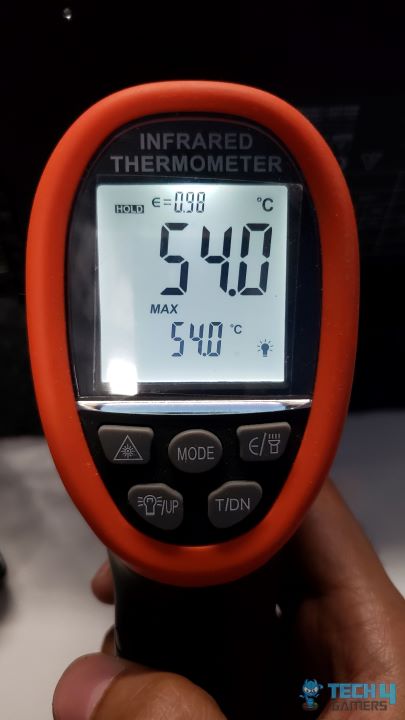
Hottest Point on the back (Image By Tech4Gamers)
Connector Side Temp (Image By Tech4Gamers)
XPG Fusion 1600W Titanium sailed smoothly even on max 1600W of constant load for hours, hitting only 54 C max temperature on its back.
Should You Buy it?
Buy It If
✅You want top performance with peace of mind: Given the sheer performance, this PSU can last you for several upcoming generations with a whopping 12 years of warranty. Plus, if you’re into AI & Machine Learning and want to use multiple 12VHPWR 600W GPUs then XPG Fusion is a no-brainer.
✅You are an overclocking enthusiast: Setting up current/power limits for individual 12V rail does come quite handy when you’re into extreme OCing.
Don’t Buy it if
❌A 700$ price tag is a huge number for you: In case your only requirement is to power any modern & high-end Gaming system without much appreciation of what’s under the hood. Most PC builders will be better off with high-quality gold/platinum-rated PSUs.
Final Verdict
XPG has once again shown what “X” stands for in their naming scheme by partnering up with the prestigious and most experienced OEM in the server market, Delta Electronics. Together, they have created the most sophisticated and innovative PSU in the ATX market, an engineering marvel that several others have tried in the past but failed.
At Tech4Gamers, I hold the role of a News Reporter, where I merge my passion for gaming with my knack for storytelling. This unique blend allows me to bring you the latest updates, reviews, previews, and features from the gaming world.
Story Highlight
The gaming industry is beginning to favor digital distribution over physical games.
Xbox seems to be leading the charge, with an analyst stating that it could be fully digital by the next generation.
The analyst also expects PlayStation and Nintendo to follow in a few generations.
As the gaming industry continues to innovate and push forward, a transition from physical to digital distribution is evident. Massive games like Hellblade 2 and Alan Wake 2 recently skipped a physical release, but demand for physical games still exists.
This is why Alan Wake 2 now has physical copies, but there’s no denying that an all-digital age is inevitable for gaming. According to an analyst, Xbox will likely be the first to make this jump, and the transition could come as early as the next generation.
Why it matters: Not too long ago, Microsoft laid off a chunk of its physical games department. This sparked similar speculations.
Xbox Relies On Physical Games Less Than The Competition
Mat Piscatella, a renowned industry analyst, recently commented on the state of Xbox games.
Responding to a tweet about the Tomb Raider 1-3 Remastered Collector’s Edition skipping a physical launch on Xbox, he noted that people should get used to this happening more often.
Folks should get used to this across the market sooner rather than later.
-Mat Piscatella
He also elaborated that PlayStation would follow suit in one more generation, while Nintendo would likely support physical games for two additional generations.
Since Microsoft’s ecosystem relies on digital gaming the most, Xbox seems to be the first to make this move. Because of Game Pass, much of the user base is already conditioned to rely on digital purchases.
Previously, Phil Spencer denied such reports. However, this would not be the first time Microsoft said something that was contradicted later on. The future seems to be all-digital, and Xbox is typically the first to prepare for the future.
Hellblade 2 Skipped A Physical Release
Digital versions of games offer the advantage of not being damaged or lost, but people argue that they don’t provide a sense of ownership. An argument can also be made for hacking or other security issues that can lead to the loss of game libraries.
While physical and digital libraries have their ups and downs, we believe in more options for everyone. The current approach seems ideal, but the day is not far when digital eventually takes over physical distribution.
At Tech4Gamers, I hold the role of a News Reporter, where I merge my passion for gaming with my knack for storytelling. This unique blend allows me to bring you the latest updates, reviews, previews, and features from the gaming world.
Story Highlight
According to reports, Xbox seems to be gearing up for another publisher acquisition.
The gaming giant may consider studios like Konami and Warner Bros for a buyout.
Microsoft previously purchased Bethesda Softworks and Activision Blizzard.
Xbox’s first-party lineup is bigger than ever because of the acquisition of major studios like Bethesda, Activision, and more. Following these buyouts, the company has a strong lineup and seems ready for the future.
However, Microsoft is motivated to grow further. If recent reports are to be believed, even more acquisitions are being planned at the company, with one possibly being announced before the end of the year.
Why it matters: Following the Activision Blizzard buyout, Microsoft was expected to lay low for a while and stop its acquisition spree. It seems that this may not necessarily be the case.
Xbox Bought Activision Blizzard For Nearly $70 Billion Last Year
Following an exciting showcase, Xbox’s first-party powers were on full display.
According to reports from famous podcast host King David, the gaming giant is preparing to expand this lineup with another merger. One major publisher could be bought by the end of the year.
The report lists studios like Sega, Konami, and Warner Bros as potential acquisition targets, though nothing seems set in stone for now. Such targets would align with Phil Spencer’s past goals, which hinted at acquisitions as big as Nintendo.
Since Microsoft has already carried out such a huge acquisition in the past, it may be worth taking this information with a grain of salt. Microsoft is currently facing a difficult financial situation, so adding more first-party studios would not be ideal.
The Team Behind Redfall Was Recently Shut Down
However, it has recently shut down teams like Arkane Austin, so perhaps the gaming giant could be looking to add a few studios to compensate for recent losses.
With Microsoft positioned as a third-party publisher today, big acquisitions make more sense than they did in the past. Still, with regulators barely agreeing to clear the Activision merger, they may no longer be willing to accept huge deals in the future.
At Tech4Gamers, I hold the role of a News Reporter, where I merge my passion for gaming with my knack for storytelling. This unique blend allows me to bring you the latest updates, reviews, previews, and features from the gaming world.
Story Highlight
Avowed belongs to the single-player genre but was initially developed with a multiplayer focus.
The team explained that it was looking for a publisher, and multiplayer gaming was highly popular at the time.
With Xbox now owning Obsidian Entertainment, the developers are no longer under any pressure and can make a proper single-player RPG.
Xbox has a massive pipeline for first-party games like South of Midnight, Gears of War E-Day, Indiana Jones, and more. Among these games, Avowed and Indiana Jones are slated to launch within the next six months.
Created by the developers at Obsidian Entertainment, Avowed promises an RPG adventure reminiscent of classic franchises. It blends medieval and fantasy elements, though the game initially started with a very different premise.
According to the founder of Obsidian Entertainment, the RPG began as a multiplayer project. However, it was Xbox’s acquisition that allowed the team to pivot to a single-player focus.
Why it matters: Redfall made the same mistake since multiplayer gameplay was a poor fit for the developers at Arkane Austin. This eventually led to grave consequences and resulted in the studio’s closure.
Avowed is a single-player RPG through and through, focusing on traditional elements like an open-world experience, dialogue trees, and more.
However, it could have ended up very differently. During the last part of Obsidian Entertainment’s 20th-anniversary documentary, the studio founder explained how the team planned to secure publishing for Avowed.
Since multiplayer has been all the rage recently, the developers hoped that this element would be enough to sell the concept. Fortunately, Microsoft bought the studio in 2018, and this was no longer a problem.
Avowed was going to be multiplayer. When we were still independent, it was a more interesting game to publishers.
-Feargus Urquhart
Needless to say, Xbox’s acquisition was a huge blessing for the team.
Avowed Launches In Fall 2024
Avowed has received various new details recently. The developers have confirmed that players should expect about 30 hours of playtime, making it one of the shorter RPGs. However, this could also lead to a more densely packed experience.
The game has recently made the jump to Unreal Engine 5.4, and the team is moving full steam ahead without fear of failure. This should allow the developers to realize their vision without any pressure to perform on day one.
At Tech4Gamers, I mainly cover new gaming news, leaks, and rumours. Aside from that, I love to write features about my favourite games while inserting my opinion about their different aspects.
Story Highlight
Shadow of the Erdtree has been criticized for being much harder than the base game.
Following the outrage, modders have made an easy mode for the game to please such players.
It reduces enemy damage significantly, while another mod offers passive health regeneration.
Elden Ring DLC, Shadow of the Erdtree, has proven to be way harder than the base game. While it was a source of excitement for some, others found it unfair, which led to a mixed reception for the expansion on Steam.
The DLC is quite hard, as it consists of the most difficult boss lineup FromSoftware has ever created. The studio won’t lower the game’s difficulty for mass appeal, but modders have taken matters into their own hands.
They have now come up with an easy mode for Shadow of the Erdtree.
Why it matters: Many players couldn’t beat Mohg and are new to the game, leading to their crushing defeat in the DLC and negative reviews.
Shadow of the Erdtree Has Received So Many Negative Reviews Recently
Easy Shadow of the Erdtree is available at Nexus Mods. As the name suggests, it’s designed to make the DLC easier for the fandom that has trouble with the bosses.
You can also use this mod to learn boss patterns without dying so many times.
– Mod Creator
This mod’s main purpose is for fans to be able to enjoy the game and learn the boss patterns without having to restart constantly. This is a practice session for you, not an easy way out.
The enemy damage has been toned down by 35%, which is a tremendous decrease. Moreover, another mod mimics Wolverine’s ability, giving players passive health regeneration while they take 50% less damage.
Since the mods are limited to PC, console players can’t do anything about DLC’s difficulty for now. However, we believe everyone should rely on Scadutree Fragments, as the DLC revolves around this mechanic.
If you are finding Shadow of the Erdtree way too hard, we recommend downloading the mod and practicing with it. Make sure to use this mod while offline, as you are always at risk of getting banned.
Once you beat the game via this mod, you should try to beat it normally, too. Between the many defensive spells, incantations, and talismans, there are plenty of ways to tackle the challenges presented by this DLC.
At Tech4Gamers, I contribute as a Senior News Reporter, combining my skills and gaming enthusiasm to keep our audience updated on the latest developments.
Story Highlight
The recent closures of Tango Gameworks, Pieces Interactive, and Arkane Austin outline a major problem in the industry.
Executives are too profit-driven, shutting down studios without giving them room for failure and growth.
This leads to an industry without creativity where teams stick to a tried-and-true formula for success.
The gaming industry has evolved in multiple ways since its inception. Whether it be a focus on more engaging narratives, lifelike visuals, or the scope of this entertainment form itself, a lot has changed over the years.
However, not every change has been positive. In 2024, gaming is all about profits and finances, at least for the higher-ups at massive publishers. Layoffs plague the industry, and developers are constantly under pressure.
The looming threat of layoffs and studio closures means developers are reluctant to experiment with new concepts. Very recently, the team behind Alone in the Dark was shut down after dealing with layoffs.
This title wasn’t the biggest success, but it was far from the worst game of 2024. This brings me to the question: are studios no longer allowed to fail in this industry?
Why it matters: Several franchises show developers often need multiple attempts to succeed. However, publishers are no longer willing to allow such liberty today.
Hi-Fi Rush Could Have Grown Into A Full Franchise, But Tango Gameworks Was Never Given The Chance
The Industry Demands Experimentation
Reflecting on the biggest games out today, it’s easy to see how homogenized the industry feels today.
Everyone wants to capitalize on the biggest trends and follow what’s already successful. Moving away from these trends puts game developers at risk, and nobody is interested in taking risks at a time when one wrong move could mean the death of an entire studio.
However, this approach goes against everything the industry stands for. Much like the film or television industry, games thrive when developers are let loose, their talents expressed in every facet of their work.
Consider a title like Hi-Fi Rush and how fresh it felt last year. What did Tango Gameworks get in return for its creative excellence? Little else, apart from a sudden studio closure announcement from Xbox.
At its current pace, the industry will continue pushing out the same types of games, albeit with greater polish and detail. Overall, the industry seems hell-bent on taking as few risks as possible.
This is also why remakes and remasters are prevalent today, as this is the safest move possible. Ironically enough, Alone in the Dark dipped its toes in this trend to a certain extent, even though it was a reimagining.
There’s A Reason We Rarely Get Revolutionary New Releases Like Demon’s Souls Today
Not Everything Needs To Be A Hit
In my opinion, the biggest issue with this trend is that it sets a bad precedent. Every developer strives for critical acclaim, but creating something that may not be the biggest hit as long as it meets the team’s vision is okay.
Nobody serves as a better example of this trend than FromSoftware. This developer has spawned a whole new sub-genre, but it came from humble beginnings. Demon’s Souls was initially described as a train wreck before Hidetaka Miyazaki stepped in.
Sony even refused to publish the game in the West, and it wasn’t until the title developed a cult-like following that FromSoftware’s potential began to shine. This kind of project would probably never see the light of day today.
However, the team’s work eventually gained more recognition, propelling FromSoftware to unprecedented heights. Had it not been for this shaky first step, games like Lies of P, Elden Ring, and more would probably not have existed.
Redfall Was Enough For Microsoft To Forget Everything Arkane Austin Had Accomplished
Failure Has Become A Death Sentence
Think of recent failures, and two releases immediately come to mind. Both Saints Row and Redfall failed miserably, but these releases came from developers with an impressive history behind them.
Volition Games closed down last year, and Arkane Austin followed in 2024. Had both these teams been given a chance, perhaps their next titles could have been a major improvement.
Unfortunately, the current state of this industry leaves no room for studios to learn from their mistakes and grow.
Rocksteady Studios is suspected to be headed in a similar direction after Suicide Squad bombed. I wasn’t the biggest fan of this release, but seeing the team behind Batman Arkham going out like this would be a massive shame. Suffice it to say, this is not how developers should be treated.
At Tech4Gamers.com, I cover the latest news and rumours in the gaming industry, from new game releases to hidden gems and video game leaks. Furthermore, I occasionally write tech articles about video game consoles, providing insights into the hardware and software that powers our gaming experiences.
Story Highlight
Sly Cooper and the Thievius Raccoonus is now the most successful PlayStation Plus Classic game.
Sony’s Days of Play promotion provided the perfect platform for the re-release to get attention from both new and old fans.
The addition of trophies also encouraged players to revisit the game.
Sucker Punch Productions is hard at work on Ghost of Tsushima 2, but another one of its games has become the talk of the town recently. Sly Cooper and the Thievius Raccoonus has become the biggest release in PlayStation Plus Classic history.
Originally launched on the PlayStation 2 in 2002, it returned on June 11, 2024, for PS5 as part of the PS Plus Premium Classics collection. The game has seen remarkable success, attracting longtime fans and a new wave of players.
Sony brought back Sly Cooper as part of its plan to refresh its collection of classic games.
Why it matters: This achievement highlights the love for timeless games upgraded for today’s players and shows how beloved the Sly Cooper series remains.
The enduring appeal of Sly Cooper’s classic gameplay persists.
Sly Cooper’s re-release has been a huge success, as reported by TrueTrophies. Based on data from over 3.1 million active PSN accounts, it became the top launch in the PlayStation Plus Classic games catalog.
The previous record holder was The Legend of Dragoon, added in 2023. During its debut week, Sly Cooper attracted 2.5 percent more players on PS5 and PS4, highlighting the franchise’s popularity.
Sly Cooper’s success is largely due to its blend of modern upgrades and nostalgic charm. The PS Plus version offers features like save states, multiple rendering options, and PlayStation trophies, enhancing the game with extra challenges and achievements for players.
Sony’s decision to release the game during the Days of Play promotion was smart as it significantly boosted its popularity. With its discounts and special deals, the event provided the ideal opportunity for Sly Cooper to attract returning fans and new PS Plus subscribers.
Sly Cooper’s success bodes well for the future of the PS Plus Premium Classics lineup.
The inclusion of trophies has given players new goals to explore or rediscover the game.
Although PlayStation Plus Premium users represent a smaller part of the PSN community, Sly Cooper’s strong performance may prompt discussions about the IP’s future at Sony.
However, it’s crucial to note that these figures might not be significant in Sony’s larger business considerations.
In 2022, Sucker Punch confirmed that they were not working on a new game in the series. However, an insider recently revealed that a Sly Cooper revival could be imminent following delays in Ghost of Tsushima 2 development.