
Home Blog Page 374

Assassin’s Creed Shadows Previews Suggests Biggest Shake-Up Of The Series In Years

Story Highlight
  • The first previews for AC Shadows are earning praise for its storytelling, visuals, and improved gameplay.
  • The game reintroduces classic stealth elements with Naoe, a ninja protagonist, along with fresh features like a visibility system and enhanced environmental interactions.
  • Designed for next-gen consoles, Feudal Japan comes alive with interactive NPCs, stunning scenery, and a more streamlined, focused map.

Despite against all odds, Ubisoft is seemingly coming out with a victory over Assassin’s Creed Shadows. The delays are now worth it after the game’s first previews go live, suggesting a strong comeback to one of the biggest open-world franchises.

Against all odds, Assassin’s Creed Shadows is shaping up to be an excellent title for 2025, as the previews suggest. Everything from the game’s narrative, graphics, and gameplay to the open world is now being hailed as outstanding, a considerable improvement from the game’s early previews.

Why it matters: Assassin’s Creed Shadows was initially controversial due to its historical inaccuracy. However, Ubisoft’s commitment to the game has won over critics and changed many people’s opinions.

AC Shadows
Feudal Japan Looks Beautiful Than Ever In AC Shadows Preview.

The first previews suggest a massive overhaul in the RPG formula, which has been previously polarizing for most AC fans.

While stealth was one of the most neglected aspects of the newer Assassin’s Creed games, AC Shadows completely revitalizes that department. The franchise returns to its roots with Naoe, a skilled ninja who fully embraces the creed’s older ways.

Borrowing elements from Splinter Cell and having a dedicated visibility meter completely changes the stealth gameplay. Players can now extinguish candles to create shadows, prone, and use the environment more than ever to their advantage. 

AC Shadows truly benefits from hardware capabilities. Feudal Japan comes to life with vibrant landscapes, interactive characters, stunning landmarks, and diverse wildlife, creating a richer and more immersive world.

The comparatively shorter open world of AC Shadows compared to predecessors such as AC Valhalla also helps, as Ubisoft aims to remove any clutter. Spoiler-free, AC Shadows seemingly features one of the best storylines and story-building elements in the franchise in years.

Previews suggest that AC Shadows will be a mix of old and new AC games, all while introducing tons of new gameplay elements. From what it seems like, AC Shadows will give open-world titles this year a run for their money.

What do you think of AC Shadows’ first previews? Will you buy the game when it releases on March 20th? Let us know in the comments or head towards the Tech4Gamers Forums.

Ninja Gaiden 4 Officially Announced; Coming Fall 2025

Story Highlight
  • A new Ninja Gaiden entry has been announced at the Xbox Developer Direct.
  • Team Ninja is collaborating with Platinum Games for this title.
  • The game is dubbed Ninja Gaiden 4 and launches later this Fall.

Following rumors of an unexpected announcement at the Xbox Developer Direct, the show has kicked off with a huge new title. Team Ninja opened the show, confirming the return of one of its most beloved and iconic IPs.

Nobody saw it coming, but Ninja Gaiden is returning with a brand-new title in Fall 2025.

Why it matters: Character action game fans have been starved for new content, so it seems Team Ninja has brought back this franchise at the perfect time.

According to Team Ninja, the upcoming entry is a direct sequel to the Ninja Gaiden trilogy that began with the original Xbox. The new entry is dubbed Ninja Gaiden 4 and sees the return of the iconic protagonist, Ryu Hayabusa.

Interestingly, Team Ninja is not the sole developer of the project. The studio is combining its expertise with Platinum Games‘ action game experience to deliver a worthy sequel that lives up to nearly two decades of excitement.

For context, this studio has delivered classics like Metal Gear Rising Revengeance and Bayonetta, creating excitement among action game fans. As one would expect, the first trailer already shows plenty of fast-paced combat.

Classic manoeuvres like wall running are also highlighted, showcasing an authentic Ninja Gaiden experience for longtime fans.

Ninja Gaiden 4
The Upcoming Entry Is A Direct Sequel

It should be noted that Ninja Gaiden 4 is being published by Xbox and will be released on day one on Game Pass. This is quite a fitting partnership since Ninja Gaiden Black, the title many consider to be one of action gaming’s best offerings, was associated with the Xbox brand many years ago.

What are your thoughts on the announcement? Let’s discuss in the comments and on the Tech4Gamers Forums.

RTX 5090 Reviews Reveal 27% Performance Boost Over RTX 4090 At 4K Native Gameplay

Story Highlight
  • GeForce RTX 5090 reviews reveal a nearly 30% raw performance uplift at 4K over the GeForce RTX 4090.
  • The results are much less impressive at 1440p, with the improvement under 15%.
  • Nvidia’s flagship GPU fared much better against its predecessor last generation.

The GeForce RTX 5090 has been the subject of global attention since its announcement due to features like DLSS 4 and its massive $2000 MSRP. Nvidia’s raw performance uplift has also led to many debates, with leaks suggesting improvements in rasterization being limited to around 20%.

With the graphics card nearly ready for release, the media has finally published the long-awaited benchmarks that show how the GeForce RTX 5090 stacks up against the last generation flagship. As per these numbers, Nvidia offers a 27% raw performance uplift at 4K.

Why it matters: The GeForce RTX 4090 comfortably eclipsed its predecessor a few years ago, setting a high bar for its successor. It seems the latest flagship has not brought similar improvements.

Hardware Unboxed has tested various games across 1440p and 4K to compare the latest Nvidia flagship with the competition.

The benchmarks include games like Cyberpunk 2077, Warhammer 40K: Space Marine 2, The Last of Us Part 1, and more. Across all these benchmarks, the GeForce RTX 5090 ended up being 27% faster on average when running at 4K.

At 1440p resolution, the latest GPU was about 12% faster on average. Quire surprisingly, it ended up being slower than the GeForce RTX 4090 in a few games at this resolution.

It should be noted that these benchmarks did not include any ray-traced settings; those tests were shown later in the video.

Nvidia GeForce RTX 5090 4K Benchmark
The GPU Achieved 137FPS On Average Across Various Games At 4K Resolution

Anyhow, the nearly 30% improvement is far from disappointing, but its benefits are certainly limited, considering it comes at a 25% price premium over the already expensive GeForce RTX 4090.

What are your thoughts on these figures? Do you think the flagship GPU is worth buying this generation? Let’s discuss this in the comments and on the Tech4Gamers Forums.

Featured Image Credit: Hardware Unboxed

Insomniac Likely To Miss Marvel’s Wolverine 2025 Release Window

Story Highlight
  • Marvel’s Wolverine was rumoured to be targeting the 2025 release window. 
  • However, ever since 2021 the developer has not revealed any more footage and has refused to comment on the game’s release this year. 
  • This indicates that the title will most likely not be released this year and will target a 2026 release window. 

Insomniac revealed Marvel’s Wolverine to the world in September 2021. Ever since there hasn’t been much official information regarding the game, but Insomniac suffered a massive data breach

Due to that its plans a lot of Wolverine’s gameplay was leaked. However, the leaked footage was nowhere close to the final product. 

Despite that, Insomniac has refused to share gameplay. Previously, leakers revealed that the game is targeting the 2025 release window, but we still haven’t seen anything official since 2021. Now, the developer has refused to comment on the game’s release window, which indicates Marvel’s Wolverine won’t be released in 2025.

Why it matters: A reliable insider previously claimed that Sony has planned more games for 2025 than it has revealed. So, fans started speculating that one of them could be Wolverine, but the current situation implies that isn’t the case. 

How long ago was Wolverine revealed (Image by Insomniac Games)
Insomniac Revealed Marvel’s Wolverine Over Three Years Ago And Still Isn’t Ready To Talk About Its Release Window 

In an interview with Variety, Chad Dezern, who will become one of the three co-studio heads after Ted Price steps down, didn’t confirm or deny that the game is set to release this year

We’ve announced Wolverine, and we’d love to talk more about Wolverine, but we have to be like Logan today, and remain very stoic until it’s time to pop the claws down the road.

-Chad Dezern

Dezren says that even though they are excited to talk about the game, they have to hold all the pent-up excitement. He further states, “That’s about as much as we could say about our upcoming projects today.”

Marvels Wolverine
Fans’s Expectation For The Game Is Pretty High

Insomniac is still being secretive with the game, so it is fair to assume that a 2025 release window is out of the window. The developer may have planned to reveal the highly anticipated gameplay this year and release Marvel’s Wolverine in 2026.

Even though not much official information was revealed, the leaks did reveal a 15-hour playtime, real-time battle damage & healing, parkour, traversal, and stealth gameplay.

What do you think about the developer still not confirming the title’s release window? When do you think it will be released? Share your thoughts with us in the comments section below or join the official Tech4Gamers forums for discussion.

Phantom Blade Zero To Offer Generational Leap For Action Games, Says Dev

Story Highlight
  • S-Game says Phantom Blade Zero will offer a true generational leap for action gaming.
  • The title is based on Unreal Engine 5 and promises martial arts-inspired gameplay unlike anything else.
  • S-Game has also received a much bigger budget following Black Myth: Wukong’s success.

The excitement for Phantom Blade Zero is at an all-time high following yesterday’s trailer. Developer S-Game’s martial arts focus shines through in the latest footage, highlighting well-choreographed action with plenty of finesse and style to boot.

The studio appears more confident than ever in its work and has recently made a bold claim. According to S-Game, Phantom Blade Zero will offer a generational leap for action games.

Why it matters: The action games genre has remained relatively stagnant over the past few years, with most developers pivoting to Souls-like gameplay instead of fast-paced combat pioneered by the likes of Devil May Cry and Bayonetta.

Following the latest trailer, S-Game shared new information about Phantom Blade Zero, revealing various smaller details about the title.

In particular, the studio has dubbed its work a “generational leap in action gaming,” signifying a highly ambitious attempt at breaking into the genre and revolutionizing it for good.

Toward this end, the studio is working with Unreal Engine 5 and promises to meet next-generation standards. One instance of this generational leap was already shown in the new footage, which showcased multiple coordinated attacks from the enemy boss, leading to a seamless flow and combat rhythm rarely seen in other games.

Elsewhere, the studio has also promised smooth and stable frame rates as well as PS5 Pro enhancements to bring its Hong Kong martial arts inspirations to life. 

Phantom Blade Zero Release
Phantom Blade Zero Is The Next Big Title From China

Recent action games like Stellar Blade and Black Myth: Wukong have led to renewed interest in the genre. While these titles stray further from pure character action titles like Devil May Cry, Phantom Blade Zero will certainly benefit from the buzz surrounding the 2024 releases mentioned above.

More details about the game are on the way, and fans are certainly excited to learn more. What are your thoughts on these details? Let’s discuss this in the comments and on the Tech4Gamers Forums.

Final Fantasy 7 Rebirth Becomes #1 Steam Top Seller Ahead of Release

Story Highlight
  • Final Fantasy 7 Rebirth is crushing the competition on Steam.
  • The JRPG is currently outselling every premium and free-to-play title, including Marvel Rivals.
  • Final Fantasy 7 Remake Intergrade has also joined the top 10 best-sellers list ahead of today’s release.

Final Fantasy 7 Rebirth was announced for PC not too long ago, creating anticipation for Square Enix’s latest JRPG on the platform. One month later, the title is nearly here, and thousands of fans are ready to pick up where they left off with the first remake.

The title is also showing potential in terms of commercial performance, becoming Steam’s top-selling game ahead of the release.

Why it matters: Final Fantasy 16, the last major PC release for this series, failed to live up to its potential on the platform.

Final Fantasy 7 Rebirth
Final Fantasy 7 Rebirth Is Dominating The Best-Sellers List | Image via Steam

Looking at Steam, the game sits at the very top of the best-sellers list, beating out various premium and free-to-play titles.

The JRPG is even beating the Steam Deck and the massively popular Marvel Rivals. Reviews for the PC version were also released yesterday, receiving praise similar to the original PS5 version.

These reviews may have been one of the many reasons the title is doing so well on Steam for the time being. The system requirements aren’t too demanding either, opening the game up to a wider audience than last year’s Final Fantasy 16.

Interestingly, Final Fantasy 7 Remake Intergrade is also found quite high on the best-sellers list. Currently sitting within the top 10, this title seems to have received a boost from Final Fantasy 7 Rebirth’s buzz, suggesting that many newcomers are picking up both JRPGs at the same time.

Final Fantasy 7 Rebirth
The PC Port Unlocks In Just A Few Hours

In any case, Square Enix will be glad to see the game’s current progress. Major success for the PC launch would help the publisher bounce back from shaky financial results last year and might even pave the path for a PC port at release for the final entry in this trilogy.

Do you plan on playing Final Fantasy 7 Rebirth on PC? Let us know in the comments, and join the discussion on the Tech4Gamers Forums.

RTX 5090 & 5080 Custom Variants Prices Leaked; Reaching $2799 And $1899

Story Highlight
  • Prices for custom RTX 5090 and 5080 graphics cards have been leaked.
  • The former will have variants that cost nearly $3000, while the latter will have variants priced close to $2000.
  • More information on official pricing should be available in just a few days.

Nvidia’s latest flagship gaming graphics cards are nearly upon us, promising a new generation of gaming with features like improvements to DLSS and multi-frame generation.

However, these upgrades come at a cost, and these costs are all the more noticeable when considering the prices of AIB graphics cards. In fact, a leak shows that custom RTX 5090 models will cost nearly $3000.

Why it matters: Nvidia marketed the RTX 5090 as a $2000 GPU, but this leak hints that it will rarely, if ever, be found close to this price on the real market.

GeForce RTX 5090 AIB Price
GeForce RTX 5090 AIB Price via PCparkpicker

The leak comes from the popular PC-building website PCpartpicker, which has been able to identify prices from retailed B&H Photo. As per the listings, the Asus ROG Astral OC RTX 5090 costs a whopping $2799, while the same model of the RTX 5080 is priced at $1899.

The cheapest RTX 5090, the MSI Ventus 3X OC, is listed for about $2199, and a similar model from MSI is available for the RTX 5080 at a price of $1199, but it remains to be seen how well these particular variants will hold up.

Other models like the Asus TUF Gaming RTX 5090 and 5080 are listed for $2449 and $1699, respectively. It is important to note that the RTX 4090, which debuted at an MSRP of $1600 at release, was rarely found close to this price from board partners.

Therefore, its successor seems to be headed toward a similar fate.

RTX 5090 Is Only 20% Faster Than RTX 4090
The Flagship Blackwell GPU Arrives In Just A Few Days

This could be a deal breaker for some, especially considering the jump in performance offered by the RTX 5090 and its inability to run ray-traced games flawlessly without upscaling solutions like DLSS.

Following this leak, official pricing information will also be available soon, in addition to reviews and benchmarks of the RTX 5090 and 5080. Both GPUs certainly look impressive, but it remains to be seen if the market will take a liking to Nvidia’s latest gaming products.

What are your thoughts on the AIB prices? Do you plan on buying a custom model or the Founders Edition? Let’s discuss this in the comments and on the Tech4Gamers Forums.

ARC B580 Vs ARC A770: What We Think

Intel ARC A770 

Rated: 7/10

Intel ARC B580

Rated: 8/10


Pros And Cons

GPUProsCons
ARC B580✅ 5nm process size
✅ Lower price tag
❌ Issues with lower-end processors
ARC A770✅ 60% more shading units
✅ More tried and tested
❌ Higher price tag
❌ Worse performance

Key Takeaways

  • The newer card performed around 15% better overall in the gaming tests, and it also outpaced the competition in productivity.
  • The ARC A770 took about 24% more power than the ARC B580. This difference is significant, and you might want to consider different power supplies for each card.
  • There is only a $30 difference in the price of these cards, with the ARC A770 being a bit more expensive. 
  • We would recommend the ARC B580 between these two because of its superior performance and aggresive pricing.


Comparison Table

FeatureARC B580ARC A770
PurposeGamingGaming
SegmentMid-rangeMid-range
ArchitectureGeneration 12.7Generation 12.7
GPU CodenameBMG-G21DG2-512
Shading Units25604096
Texture Mapping Units (TMUs)160256
Render Output Units (ROPs)80128
Tensor Cores160512
Ray-tracing Cores2032
GPU ReviewIntel ARC B580 Review-

Architectural Differences

  1. Process NodesThe ARC B580 has a 5nm manufacturing process, whereas the ARC A770 has a slightly older 6nm manufacturing process.
  2. Clock Speeds: The base clock speed of the ARC A770 is 2100MHz, and it boosts up to 2400MHz. The ARC B580, however, has a fixed clock speed of 2670MHz.
  3. VRAM: The A770 has a VRAM buffer of 16 gigabytes, which is significantly larger than the 12 gigabytes of the ARC B580. The A770 also has a wider memory bus.
  4. TDP: The TDP of the ARC A770 is 225 watts, whereas the ARC B580 has a TDP of 190 watts.
  5. Supported Technologies: Both the ARC A770 and the ARC B580 share the same feature set, with goodies like AI upscaling and a low latency mode.

With the release of Intel’s new cards, the B580 is all the rage right now. Gamers have praised it for its excellent performance and very low price tier. How does it compare to the last generation of Intel cards? Keep reading to find out!


Gaming Benchmarks – 1440p

Now that we’ve gone over the technical specifications of these cards, the next parts of this comparison will focus on the gaming performance of the ARC A770 and B580. These cards will be tested with a measured test bench, the specifications of which are written below:

Test Bench

Star Wars Jedi: Survivor

Star Wars Jedi Survivor
Star Wars Jedi: Survivor @1440p (Image By Tech4Gamers)
  • In the first game we tested, the newer card was about 13% faster, with an average framerate of 51 FPS, whereas the ARC A770 hovered around 45 FPS.
  • The minimum framerates stood at only 5% apart, with the B580 being in the win, rendering 39 FPS at the lowest, whereas the A770 hovered closer to about 37 FPS.

 A Plague Tale: Requiem

A Plague Tale Requiem
A Plague Tale: Requiem @1440p (Image By Tech4Gamers)
  • There was a larger difference in our test of this game, where the B580 got an output of 56 FPS, which was about 22% faster than the 45 FPS of the A770.
  • The A770 went down to 37 FPS in the hard-to-render scenes, which was about 25% lower than the 45 FPS of the ARC B580.

Cyberpunk 2077

Cyberpunk 2077
Cyberpunk 2077 @1440p (Image By Tech4Gamers)
  • Testing Cyberpunk on the B580 gave an average of around 63 FPS, whereas the ARC A770 was about 17% behind with a performance of 54 FPS.
  • The B580 buckled to around 51 FPS in our testing in Night City, whereas the ARC A770 got a framerate closer to 45 FPS, accounting for a difference of about 13 FPS.

 Dying Light 2

Dying Light 2
Dying Light 2 @1440p (Image By Tech4Gamers)
  • There was a small difference in our testing of Dying Light 2, where the ARC A770 had a framerate of 52 FPS, while the B580 was about 5% faster with an average of 55 FPS.
  • The 1% lows had a delta of about 10%, with the A770 getting a framerate of around 41 FPS, whereas the ARC B580 got down to around 45 FPS.

Dragon Age: The Veilguard

Dragon Age The Veilguard
Dragon Age: The Veilguard @1440p (Image By Tech4Gamers)
  • The Battlemage card had a performance of 43 FPS, which was around 23% higher than the 35 FPS of the ARC A770. Both cards gave a lackluster performance in Dragon Age: The Veilguard.
  • 1% lows were around 34 FPS on the B580, which was only 13% higher than the 30 FPS minimums of the ARC A770.

Marvel’s Spider-Man Remastered

Marvel Spider-Man Remastered
Marvel Spider-Man Remastered @1440p (Image By Tech4Gamers)
  • The B580 knocked it out of the park in this game with a framerate of 106 FPS, which was almost 25% higher than the 85 FPS of the ARC A770.
  • The difference in the 1% lows was less impressive, with the ARC A770 hovering around 69 FPS, which was about 15% lower than the 79 FPS of the ARC B580.

Hogwarts Legacy

Hogwarts Legacy
Hogwarts Legacy @1440p (Image By Tech4Gamers)
  • Surprisingly, the A770 won in this game by a small 3% margin in our test of Hogwarts Legacy. The A770 had a framerate of 61 FPS, whereas the B580 hovered closer to around 59 FPS on average.
  • The minimum framerates were about 40 FPS on the older Intel card, whereas the B580 sailed closer to 42 FPS, translating to a difference of around 5%.

The Last Of Us Part 1

The Last Of Us
The Last Of Us @1440p (Image By Tech4Gamers)
  • The last game we tested had an average framerate of 39 FPS on the ARC A770, whereas the B580 got a framerate closer to 54 FPS. This was a huge 38% delta in favor of the newer card.
  • The minimum framerate was around 32 FPS on the A770, which was about 37% lower than the 44 FPS of the newer ARC B580.

Productivity Benchmarks

The next section deals with the productivity of these cards to paint a broader picture of these cards. The following tests will be done using the same test bench that we used with the gaming benchmarks.

3DMark

3DMark
3DMark @1440p (Image By Tech4Gamers)
  • In our 3DMark test using the TimeSpy benchmark, we got a 9% better performance on the ARC B580, which is a promising result.
  • The ARC B580 had a score of 16004 points, whereas the ARC A770 performed a bit weaker with a performance of around 14682 points.

Handbrake

Handbrake
Handbrake @1440p (Image By Tech4Gamers)
  • The AV1 encoding performed about equally on both cards. The A770 got an encoding speed of 272 FPS, whereas the B580 was a hair faster with an encoding speed of about 273 FPS.
  • H.264 encoding performed about 7% better on the B580, with a performance of 322 FPS, whereas the A770 had an encoding speed of around 300 FPS.

Blender

Blender
Blender @1440p (Image By Tech4Gamers)
  • Even though the ARC B580 took the lead in the rest of the tests in this section, the Blender render was about 45% slower on this card compared to the A770.
  • The A770 took 210 seconds to complete this render, whereas the B580 completed the render after around 305 seconds.

Overall Performance

Graphic CardsARC A770ARC B580
Average FPS📈52.12📈60.87
1% Lows📉41.25📉47.37
Productivity (Rating)✏️6.4/10✏️7/10
Winner: ARC B580

Average Framerate

In almost all the games we tested, the ARC B580 took the lead. Margins were also good in most games, with the shift from the A770 to the B580 making a very real difference at 1440p. Overall, the B580 was about 17% faster on average.

1% Lows

Most games had a very noticeable difference when it came to the 1% lows, with the B580 being around 15% faster on average. Some games were coming close to being unplayable on the A770 because of the dips, while the B580 held its composure better.

Productivity 

The productivity tests showed that the B580 was a tiny bit better overall, though the A770 rendered our Blender project much faster. Despite this, the ARC B580 does take the edge when we step back and take a look at the bigger picture.


Power Consumption

GameARC A770ARC B580
Star Wars Jedi: Survivor334265
A Plague Tale: Requiem330267
Cyberpunk 2077322268
Dying Light 2342263
Dragon Age: The Veilguard333269
Marvel's Spider-Man Remastered321267
Hogwarts Legacy326255
The Last Of Us Part 1328274
Average Power Draw329.5⚡266⚡
Winner: ARC B580

Even though the ARC A770 performed significantly worse than its competitor, it still took noticeably more power. The older card has about 24% more power than the Battlemage GPU, which is a huge difference in efficiency.


Price

GPUARC A770ARC B580Price Difference
Launch MSRP💲329💲24932.13%
Current Price💲299💲26911.15%

There is little difference between the prices of these chips, with the A770 being only $30 more expensive than the ARC B580. The price of the A770 might go down really quickly because of the new releases. Be sure to check the prices before you lock in your decision.


What We Recommend

Intel ARC A770: When this card was released, it was very scrutinized. This was because the A770 was a first-generation product, with the drivers being in shambles, resulting in a lot of games not running well. This has changed with patches, but it still does not compare to the performance of the A580.

Intel ARC B580: Intel did an excellent job with this card, and the performance results show this. The cherry on top of this is the very aggressive pricing on this card. Because of this, this card does well even against cards above its price range. Other aspects like productivity performance and power consumption are competitive as well.

Because of the excellent performance and pricing of the ARC B580, it has earned its position as our recommendation in this comparison. The ARC A770 has been thoroughly outclassed.

FAQs

Does the ARC A770 use more PCIe lanes than the ARC B580?

The ARC A770 uses 16 PCIe lanes, whereas the ARC B580 only uses 8 PCIe lanes.

What power connector does the ARC A770?

The ARC A770 uses a 6-pin and an 8-pin power connector. 

What power connector does the ARC B580?

The ARC B580 uses a single 8-pin connection for external power.

What HDMI standard does the ARC B580 use?

The Intel ARC B580 uses the HDMI 2.1a connector. 

How many display port connections does the ARC B580 have?

The ARC B580 uses three DP 2.1 connectors.

ARC B580 Vs RX 7600: Our Recommendation

AMD Radeon RX 7600

Rated: 7/10

Intel ARC B580

Rated: 9/10


Pros And Cons

GPUProsCons
RX 7600✅ Power efficient
✅ More tried and tested
❌ Worse in terms of performance
ARC B580✅ Has 25% more shading units
✅ Better in terms of performance
❌ Slightly more expensive

Key Takeaways

  • The ARC B580 was about 23% faster than the Radeon card when we tested games, while performance in terms of power consumption was about equal.
  • The 7600 took around 10% less power than the Intel card, which is noticeable, if not a significant difference.
  • The RX 7600 is about $20 cheaper than the Intel card as of late January 2025.
  • If you are in a position to get either card, we would recommend going with the ARX B580 because of its significantly better performance.


Comparison Table

FeatureRX 7600Arc B580
PurposeGamingGaming
SegmentMid-rangeMid-range
ArchitectureRDNA 3.0Generation 12.7
GPU CodenameNavi 33BMG-G21
Render Output Units (ROPs)6480
Tensor CoresNo160
Ray-tracing Cores3220
ManufacturingTSMCTSMC
Fabrication Process6 nm5 nm
GPU Review-Intel ARC B580 Review

Architectural Differences

  1. Process Nodes: Both the ARC B580 and the RX 7600 use 5nm processing nodes.
  2. Clock Speeds: The RX 7600 clocks between 1720MHz and 2655MHz, whereas the ARC B580 has a fixed clock speed of 2670MHz.
  3. VRAM: The ARC B580 has 12GB of GDDR6 memory connected through a 192-bit bus, which is wider than the 128-bit bus of the RX 7600.
  4. TDP: The TDP of the Battlemage graphics card is around 190 watts, much higher than the 165 watts of the RX 7600.
  5. Supported Technologies: Upscaling, frame generation, and low latency solutions are present on both graphics cards, with the added benefit of those from AMD being open-source.

AMD used to be the king of the budget tier, partly because of how bad Nvidia had become with making cheap graphics cards. With the entry of Intel’s second-gen cards into the market, the position of AMD has been challenged. Let us see how they compare in the ARC B580 vs RX 7600 comparison!


Gaming Benchmarks – 1440p

The best way to represent how the cards compare is to see how they perform in modern games. To measure this, we have used a standard test bench, the specs of which you can take a look at below:

Test Bench

Star Wars Jedi: Survivor

Star Wars Jedi Survivor
Star Wars Jedi: Survivor @1440p (Image By Tech4Gamers)
  • The first game that we tested ran about 18.6% better on the Intel card. It had a performance of around 51 FPS on average, which was much improved from the 43 FPS of the RX 7600.
  • The minimums were about 11% better on the ARC B580, with the card going down to around 39 FPS in our testing, while the RX 7600 held at around 35 FPS.

A Plague Tale: Requiem

A Plague Tale Requiem
A Plague Tale Requiem @1440p (Image By Tech4Gamers)
  • The difference jumped to around 24.5% in our test of A Plague Tale, where the RX 7600 got an average of 45 FPS, while the ARC B580 held closer to around 56 FPS.
  • The 1% lows were held at around 38 FPS with the RX 7600, while the ARC B580 ran this game with a minimum of about 45 FPS.

Cyberpunk 2077

Cyberpunk 2077
Cyberpunk 2077 @1440p (Image By Tech4Gamers)
  • The B580 was close to 19% faster in this game, with a framerate of 63 FPS on average, while the RX 7600 got an average closer to about 53 FPS.
  • The dips in performance were closer, with the B580 getting 1% lows of around 51 FPS, while the RX 7600 got a framerate of around 47 FPS, accounting for a difference of 8.5%.

Dying Light 2

Dying Light 2
Dying Light 2 @1440p (Image By Tech4Gamers)
  • Our test of Dying Light 2 had an average framerate of 55 FPS with the B580, which was about 35% higher than the 41 FPS of the RX 7600.
  • The 1% lows were around 31 FPS on the Radeon card, which was about 45% lower than the much smoother 45 FPS lows of the B580.

Dragon Age: The Veilguard

Dragon Age The Veilguard
Dragon Age: The Veilguard @1440p (Image By Tech4Gamers)
  • This Dragon Age game ran with a framerate of around 24 FPS on the RX 7600, while the ARX B580 ran it 120% better with an average framerate closer to around 53 FPS.
  • The minimums were an embarrassing 13 FPS on the AMD, while the ARC B580 was a whopping 231% faster with a framerate of around 43 FPS.

Marvel’s Spider-Man Remastered

Marvel Spider-Man Remastered
Marvel Spider-Man Remastered @1440p (Image By Tech4Gamers)
  • The performance in Spider-Man came close between these two cards, with the RX 7600 getting an average framerate of around 102 FPS, only 4% behind the ARC’s 106 FPS.
  • Minimum framerates were also relatively close, with a framerate of 73 FPS on the RX 7600, whereas the B580 had a performance of 79 FPS, which is about 8% better.

Hogwarts Legacy

Hogwarts Legacy
Hogwarts Legacy @1440p (Image By Tech4Gamers)
  • Both the graphics cards were evenly matched in the average framerate of Hogwarts Legacy with a performance of 59 FPS.
  • The 1% lows were also remarkably identical at 42 FPS. This sudden levelling of the playing field is either because the 7600 is very well optimized in this game or the ARC is poorly optimized.

The Last Of Us Part 1

The Last Of Us
The Last Of Us @1440p (Image By Tech4Gamers)
  • The average framerate of the ARC B580 was around 54 FPS in our test of this game, which was about 50% faster than the 36 FPS of the RX 7600.
  • Minimum framerates were about 44 FPS on the B580, making it 120% better than the 20 FPS of the RX 7600.

Productivity Benchmarks

Recently, we’ve started to consider the productivity tests in our benchmarks to paint the fullest picture of the cards we compare. The tests in this section will be performed using the same testbench mentioned above.

UL Procyon

UL PROCYON
UL PROCYON @1440p (Image By Tech4Gamers)
  • UL Procyon, which is a benchmark specifically designed to emulate the performance of cards in real-world scenarios, performed over twice as well on the Intel card.
  • The RX 7600 hovered around a performance of 708 points, while the ARC B580 got a performance closer to about 1490 points.

Handbrake

Handbreak
Handbreake @1440p (Image By Tech4Gamers)
  • When we tested AV1 encoding on Handbrake, the RX 7600 had an encoding speed of around 312 FPS, which was about 14% higher than the 273 FPS of the ARC B580.
  • The performance of the Intel card was about 3% better when it came to traditional H.264 encoding, with a speed of 322 FPS instead of 312 on the Radeon card.

Blender

Blender
Blender @1440p (Image By Tech4Gamers)
  • Blender performed noticeably better on the Radeon card. It rendered our scene about 30% faster than the Battlemage GPU.
  • The RX 7600 had a render time of about 234 seconds, whereas the B580 took around 305 seconds to complete the same render.

Overall Performance

GPURX 7600ARC B580
Average FPS📈50.37📈62.12
1% Lows📉37.37📉48.5
Productivity (Rating)✏️4.59/10✏️7/10
Winner: ARC B580

Average Framerate

Our testing showed that the B580 was consistently more powerful than the RX 7600, at least regarding the average FPS. The B580 was significantly ahead in most games, with only one title being a tie between the two. The overall difference between the two was 23% in favour of the B580.

1% Lows

The RX 7600 seems to be bottlenecked because of its small memory buffer, which causes it to tank very hard in the 1% lows of some titles. This resulted in the ARC B580 being about 30% faster when it comes to the minimum framerates in the average of the games we ran.

Productivity

Though UL Procyon ran better on the Intel card, nothing else did to a significant amount. Yes, both the cards are comparable when it comes it encoding, but the Radeon card won by a very significant margin when it came to Blender. Overall, we think it would be fair to call this category a tie.

Power Consumption

GameRX 7600ARC B580
Star Wars Jedi: Survivor245265
A Plague Tale: Requiem243267
Cyberpunk 2077239268
Dying Light 2241263
Dragon Age: The Veilguard235269
Marvel's Spider-Man Remastered237267
Hogwarts Legacy235255
The Last Of Us Part 1241274
Average Power Draw239.5⚡266⚡
Winner: RX 7600

In our testing, we noticed that the Radeon card consumed less power than the Intel one. Our estimates showed that the RX 7600 took around 10% less power than the ARC B580. This isn’t a huge difference, especially considering the difference in performance, but it might matter if you don’t have any power headroom.

Temperature

GameRX 7600ARC B580
Star Wars Jedi: Survivor6669
A Plague Tale: Requiem6763
Cyberpunk 20776576
Dying Light 26879
Dragon Age: The Veilguard7066
Marvel's Spider-Man Remastered6268
Hogwarts Legacy6367
The Last Of Us Part 16764
Average Temperatures66🌡️69🌡️
Winner: RX 7600

Price And Value

GPURX 7600ARC B580Price Difference
Launch MSRP💲269💲2498.03%
Current Price💲249💲2698.03%

The launch MSRP and current RX 7600 and ARX B580 prices seem to have flipped, with the 7600 going from being $20 more expensive to about $20 cheaper. Still, depending on the OEM, both these cards are of very comparable price, which makes the performance of the B580 that much more impressive.


What We Recommend

Radeon RX 7600: The RX 7600 did perform adequately for the price before the new Intel cards came out, but a new standard has been set in the market. Currently, the RX 7600 is beaten where it matters by the Intel ARC B580, which makes it very hard to recommend this card.

Intel ARC B580: There is a fair bit of controversy regarding this card, with claims being made that it does not perform well with lower-end processors. However, if you trust Intel to improve the capability of this card with cheaper processors, the ARC B580 is the obvious choice in this comparison.

The extra performance the ARX B580 gives for a similar price is too much to give up, even if the 7600 might take back a little less power. For this reason, it has earned our recommendation in the ARC B580 Vs RX 7600 comparison.


FAQs

How much newer is the ARC B580 compared to the RX 7600?

The B580 came out 1 year and 8 months after the RX 7600.

Do both of these cards use a by 8 PCIe connection?

Yes, both the RX 7600 and the ARC B580 use a by 8 connection.

Is the 8GB of VRAM getting cramped on the RX 7600?

Yes, the 8GB of VRAM on the RX 7600 has started to show its age.

What power supply is recommended with the RX 7600?

The RX 7600 is recommended to be used with a 450-watt power supply.

What power supply is recommended with the ARC B580?

The ARC B580’s recommended power supply capacity is about 450 watts.

Core Ultra 9 285K Vs Core i9-14900K – Our Tests Results

Intel Core Ultra 9 285K

Rated: 9.0/10

Intel Core i9-14900K

Rated: 9.2/10


Pros And Cons

CPUProsCons
Intel Core Ultra 9 285K✅ Improved CPU efficiency
✅ Built-in NPU
❌ Decline of gaming performance
❌ Costly processor
Intel Core i9-14900K✅ Great 6.0 GHz boost clock
✅ Better Gaming Performance
❌ High power draw
❌ Heats up under stress

Key Takeaways

  • In our gaming benchmarks, the Core i9-14900K offers an impressive 12.8% better performance, while the Ultra 9 285K was around 4.5% better in productivity.
  • Even under stress, the Core Ultra 9 285K consumes 36.4% less power and maintains about 11.9% cooler temperatures than the Core i9-14900K.
  • Considering the current prices of January 2025, the Ultra 9 285K costs $589, whereas the Core i9-14900K is available for around $433.
  • We recommend the Core i9-14900K for better gaming performance, while the Ultra 9 285K is better for operating efficiency and productivity.


Comparison Table

FeatureIntel Core Ultra 9 285KIntel Core i9-14900K
CodenameArrow LakeRaptor Lake
CPU CoresP-Cores: 8
E-Cores: 16
Total Cores: 24
P-Cores: 8
E-Cores: 16
Total Cores: 24
Threads2432
CPU Max Turbo ClockUp to 5.7 GHzUp to 6.0 GHz
Cache36MB Intel Smart Cache36MB Intel Smart Cache
Memory SpeedUp to DDR5 6400 MT/sUp to DDR5 5600 MT/s
Up to DDR4 3200 MT/s
TDP125-250 watts125-253 watts
Max. Operating Temperature105°C100°C
Best MotherboardsBest Motherboards For Core Ultra 9 285KBest Motherboards For Core i9-14900K
Best CPU CoolersBest CPU Coolers for Core Ultra 9 285KBest CPU Coolers For Core i9-14900K
Best RAM-Best RAM For Core i9-14900K
Best GPU-Best GPU For Core i9-14900K
Processor ReviewIntel Core Ultra 9 285K Review-

Architectural Difference

  • Architecture: Intel’s latest top-notch Ultra 9 285K CPU uses the avant Arrow Lake architecture with a smaller die, while the Core i9-14900K features Raptor Lake Refresh with a 14 mm² larger die.
  • CPU Socket: The Core i9-14900K uses Intel’s FCLGA1700 socket, also found in older Intel processors. The Ultra 9 285K integrates the FCLGA1851 socket, which has 1851 pins for motherboard connections.
  • CPU Memory: According to CPU specifications, both processors have a maximum of 192 GB memory with two channels. The Core i9-14900K supports DDR4, while the Ultra 9 285K does not.
  • Process Node: Intel’s Ultra 9 285K is fabricated on an advanced 3nm node at TSMC, a remarkable leap forward compared to the dated 10nm process of the Core i9-14900K.
  • Clock Speed: The Ultra 9 285K has a 0.5 GHz higher P-Core and 0.8 GHz higher E-Core base clock. It offers a 0.2 GHz higher E-Core turbo cock, while the Core i9-14900K has a 0.1 GHz higher P-Core turbo clock.
  • Integrated Graphics: In this latest ultra series, Intel offers Arc Xe-LPG Graphics with the Ultra 9 285K, which performs better than the UHD Graphics 770 provided with the Core i9-14900K.

In late 2024, rather than unveiling its 15th-generation Intel Core i-x processors, Intel introduced an innovative Ultra series, marking a new chapter in the processor world. In this analysis, we will examine the capabilities of the latest premium Core Ultra 9 285K vs Core i9-14900K.


Gaming Benchmarks

The specs do not indicate whether the Ultra 9 285K can outperform the Core i9-14900K, which has a 5.3% higher max turbo clock. To determine the actual performance results, we played eight taxing games at 1080p resolution.

Test Bench

The detailed test system specifications we utilized in our analysis are listed below.

Cyberpunk 2077

Cyberpunk 2077 Beanchmarks
Cyberpunk 2077 Benchmarks at 1080p – Image Credits (Tech4Gamers)
  • Starting our benchmarks with Cyberpunk 2077, we get 8.73% better average performance using the Core i9-14900K 137 FPS than the Ultra 9 285K 126 FPS.
  •  The Core i9-14900k managed 97 FPS in the lowest 1% performance, while Ultra 9 285K led with 82 FPS, a 2.07% advantage.

Forza Horizon 5

Forza Horizon 5 Beanchmarks
Forza Horizon 5 Benchmarks at 1080p – Image Credits (Tech4Gamers)
  • The Core I9-14900k average performance in the Forza Horizon 5 session was about 6.01% more promising than the Ultra 9 285K.
  • Regarding the low 1% performance, the  Core i9-14900k produced only 205 FPS, while the Ultra 9 285K rendered 192 FPS, leading by around 6.7%.

Ghost of Tsushima

Ghost of Tsushima Beanchmarks
Ghost of Tsushima Benchmarks at 1080p – Image Credits (Tech4Gamers)
  • We observed a 4.4% average performance boost using the Intel Ultra 9 285K 180 FPS compared to the Intel Core i9-14900K 188 FPS.
  • At the 1% low mark in Ghost of Tsushima, the Intel Core i9-14900K achieved the highest FPS of 152, while the Intel Ultra 9 285K had 137 FPS, a 1.09% lead.

Hogwarts Legacy

Hogwarts Legacy Beanchmarks
Hogwarts Legacy Benchmarks at 1080p – Image Credits (Tech4Gamers)
  • Our Hogwarts Legacy tests show the Core i9-14900K outperforms the Ultra 9 285K by an average of 3.8%, producing an 81 FPS average compared to 78 FPS.
  • The Ultra 9 285K hit 66 FPS at the low 1% during this gameplay, while the Core i9-14900k reached 67 FPS, a 1.5% gain.

Red Dead Redemption 2

Red Dead Redemption 2 Beanchmarks
Red Dead Redemption 2 Benchmarks at 1080p – Image Credits (Tech4Gamers)
  • For Red Dead Redemption 2, we get a 3.4% better average performance using the  Core i9-14900K 183  FPS, while the Ultra 9 285K rendered 177 FPS.
  • At the 1% low, both give almost the same FPS average from Core i9-14900K 139 FPS and Ultra 9 285K 135 FPS.

Silent Hill 2

Silent Hill 2 Beanchmarks
Silent Hill 2 Benchmarks at 1080p – Image Credits (Tech4Gamers)
  • For Silent Hill 2, the Core i9-14900K gives around 1.91% better performance. The Core I9-14900K provides an average of 160 FPS, while the Ultra 9 285K renders 157 FPS on average.
  • At the low 1%, the Core i9-14900K 84 FPS had better performance than the Ultra 9 14900k 79 FPS, a 6.3% advantage.

Starfield

Starfield Beanchmarks
Starfield Benchmarks at 1080p – Image Credits (Tech4Gamers)
  • While playing Starfield, the Ultra 9 285K  mustered an average of  149 FPS, 4.19% better than the Core i9-14900K 143 FPS.
  • The Core i9-14900k achieves around 72 FPS in the 1% lowest frame rates, while the Ultra 9 285K slightly surpasses it with 78 FPS, an 8.3% edge.

The Witcher 3: Wild Hunt

The Witcher 3: Wild Hunt Beanchmarks
The Witcher 3: Wild Hunt Benchmarks at 1080p – Image Credits (Tech4Gamers)
  • During The Witcher 3: Wild Hunt session, we noticed that the Core i9-14900k offers a performance benefit of 7.8% by averaging 111 FPS, while Ultra 9 285K provides 103 FPS.
  • In the Low % performance times, the Core i9-14900k mustered around 81 FPS, while the Ultra 9 285K managed around 67 FPS in this game.

Productivity Benchmarks

In our gaming benchmarks, the Core i9-14900K demonstrated unrivaled dominance. Now, let’s examine performance trends in productivity tasks for the Ultra 9 285K Vs Core i9-14900K.

Cinebench R24

Cinebench R24 Benchmarks
Cinebench R24 Benchmarks – Image Credits (Tech4Gamers)
  • Based on our Cinebench R24 test, the Core i9-14900K had a lower single-core performance, achieving 138 scores, around 7.24% behind the Ultra 9 285K’s 148 scores.
  • For the multi-core performance, the Ultra 9 285K scored 2511 points, surpassing the Core i9-14900K’s 2003 points by 25.3%.

Geekbench 6

Geekbench 6 Benchmarks
Geekbench 6 Benchmarks – Image Credits (Tech4Gamers)
  • The Core i9-14900K achieved a single-core score of 3216 points in the Geekbench 6 test, roughly 2.3% lower than the 3291 points the Ultra 9 285K scored.
  • The Core i9-14900K achieved an impressive 21585 points in multi-core performance. However, it trailed the Ultra 9 285K’s 22886 points, marking a striking 6.02% lead.

7-Zip Stress Test

7-Zip Stress Test
7-Zip Performance Benchmarks – Image Credits (Tech4Gamers)
  • In our 7-Zip compression test, the Ultra 9 285K and the Core i9-14900K had almost equivalent performance, with an advantage of only 0.5% for the Core Ultra 9 285K.
  • The Core i9-14900K demonstrated superior decompression performance, achieving a score of 226 points, around 6.6% higher than the 212 points recorded by the Ultra 9 285K.

Overall Performance

StatsIntel Core Ultra 9 285KIntel Core i9-14900K
Average FPS📈 142.0📈 160.2
Low 1% FPS📉 104.5📉 112.1
Productivity✏️ 9.3✏️ 8.9
Winner: Intel Core i9-14900K

Average Frame Rate

Our gaming benchmarks, contrasting the Ultra 9 285K vs Core i9-14900K at 1080p, revealed the Core i9-14900K’s exceptional performance, consistently outperforming the Ultra 9 285K and securing a remarkable 12.8% lead on average. The Core Ultra 9 285K proved to be better in only Starfield.

Low 1% Frame Rate

Considering the worst 1% performance data for the above-tested games, we conclude that the Core i9-14900K delivers around 7.3% higher performance than the Ultra 9 285K at the low 1%.

Productivity Performance

Based on our productivity tests, the Core Ultra 9 285K is approximately 4.5% more efficient than the Core i9-14900K, demonstrating its ability to handle demanding workloads.


Power Efficiency

GameIntel Core Ultra 9 285K (W)Intel Core i9-14900K (W)
Cyberpunk 2077116155
Forza Horizon 587116
Ghost of Tsushima6585
Hogwarts Legacy72100
Red Dead Redemption 296133
Silent Hill 268105
Starfield132174
The Witcher 3: Wild Hunt91124
Average Gaming Power Draw90.9 ⚡124.0 ⚡
Winner: Intel Core Ultra 9 285K

Thanks to its more efficient architecture, the Intel Core Ultra 9 285K demonstrated relatively better power efficiency than the Intel Core i9-14900K. With a 36.4% reduction in power consumption in our benchmarks, the  Ultra 9 285K stands out as the more power-efficient option.


Thermal Efficiency

GameIntel Core Ultra 9 285K (°C)Intel Core i9-14900K (°C)
Cyberpunk 20775664
Forza Horizon 55158
Ghost of Tsushima4852
Hogwarts Legacy5353
Red Dead Redemption 24860
Silent Hill 24753
Starfield5967
The Witcher 3: Wild Hunt5459
Average Gaming Temperature52.0 🌡️58.2 🌡️
Winner: Intel Core Ultra 9 285K

During our testing, the power-hungry Core i9-14900K consistently ran, on average, 11.9% hotter than the Ultra 9 285K. Nevertheless, both processors managed to maintain optimal operating temperatures, ensuring safe performance throughout the testing period.


Price And Value

PricesIntel Core Ultra 9 285KIntel Core i9-14900KPrice Difference
Launch MSRP💲589💲5890.0%
Current Price💲589💲43336.0%

Since its launch, the Core i9-14900K has experienced a significant price drop, while the Ultra 9 285K, a new CPU, has held its launch price. These processors are readily available in the market. However, assessing the performance relative to its cost, the Core i9-14900K offers more value today.


What We Recommend?

Core Ultra 9 285K: The Core Ultra 9 285K distinguishes itself in productivity tasks, smoothly dominating in demanding workloads. This processor has higher operating efficiency, and its memory performance further elevates its prowess. It exclusively supports the advanced DDR5.

Core i9-14900K: The Core i9-14900K is the pinnacle of gaming performance, outshining most contemporary gaming processors. Due to its age, this processor is now available at a reduced price while offering excellent performance.

Our comprehensive analysis of the Ultra 9 285K vs Core i9-14900K recommends the Core i9-14900K for gamers seeking unparalleled gaming performance. The Core Ultra 9 285K is the better choice for users who demand more productivity.


Frequently Asked Questions

Does the Core Ultra 9 285K support DDR4 memory?

No. The latest Ultra series of Intel processors does not support DDR4 memory. However, you can use the DDR4 memory with the Core i9-14900K.

Do the Core Ultra 9 285K and Core i9-14900K have the same integrated graphics?

No. The Ultra 9 285K features a more powerful Arc Xe-LPG iGPU. In contrast, the Core i9-14900K includes the older UHD Graphics 770.

What motherboard do we need with Core Ultra 9 285K?

The Core Ultra 9 285K has a modern FCLGA1851 socket. You need a Z890 motherboard for the Core Ultra 9 285K.

Do the Core Ultra 9 285K and the Core i9-14900K support hyperthreading?

Yes, both of these processors are equipped with hyperthreading capabilities. The Core i9-14900K features a specialized Intel Hyper-Threading Technology.

Can I overclock the Core Ultra 9 285K?

Yes, the Intel Core Ultra 9 285K can be overclocked due to its unlocked multiplier.


Arc B580 Vs RX 7700 XT: Our Recommendation

AMD Radeon RX 7700 XT

Rated: 8/10

Intel Arc B580

Rated: 7.3/10


Pros And Cons

GPUProsCons
ARC B580✅Power efficient
✅More economical
❌ Worse in terms of performance
❌ Less tried and tested
RX 7700 XT✅ Has 35% more shading units
✅ Better in terms of performance
❌Slightly worse thermals
❌ More expensive

Key Takeaways

  • We saw a 14.5% win with the 7700 XT in the gaming tests, with a whitewash in productivity as well.
  • The RX 7700 XT took about 20% more power than the Arc B580, while temperatures were very comparable between the two.
  • The RX 7700 XT is about $140 more expensive than the Arc B580, which puts it in a separate price tier.
  • The decision between these two cards more or less comes down to your budget, but the Arc B580 does objectively stretch the value of your dollar more.


Comparison Table

FeatureR7 7700 XTARC B580
VendorAmdIntel
PurposeGamingGaming
SegmentHigh-endMid-range
GPU CodenameNavi 32BMG-G21
Render Output Units (ROPs)9680
Tensor Cores-160
Ray-tracing Cores5420
Suggested PSU500 W450 W
Best VariantBest RX 7700 XT Graphics Cards-
GPU Review-Intel ARC B580 Review

Architectural Differences

  1. Process Nodes: The Arc B580 and the RX 7700 XT use a modern 5nm manufacturing process.
  2. Clock Speeds: The clock speed of the RX 7700 XT ranges between 1435MHz and 2544MHz, whereas the Arc B580 has a fixed clock speed of 2670MHz.
  3. VRAM: Both these cards are equally matched in VRAM, with a 12GB memory buffer using GDDR6 VRAM and a 192-bit memory bus.
  4. TDP: The RX 7700 XT has a TDP of 245 watts, which is significantly greater than the 190-watt TDP of the ARC B580.
  5. Supported Technologies: Intel has made a competing technology for every feature that the RX 7700 XT offers. This includes an upscaler in XeSS, a frame generator in XeFG, and a latency reducer in XeLL.

The GPU landscape has been shaken with the release of Intel’s new Battlemage cards, which give users an affordable entry point into this new generation of gaming tech. Let’s see how the new kid on the block holds up against the scrappy underdog in the Arc B580 vs RX 7700 XT comparison!


Gaming Benchmarks – 1440p

To see how the performance of these cards holds up in the real world, the following section will compare the Arc B580 against the 7700 XT in a handful of modern games. These tests will be done on a measured test bench, the specs of which are mentioned below:

Test Bench

Star Wars Jedi: Survivor

Star Wars Jedi Survivor
Star Wars Jedi: Survivor @1440p (Image By Tech4Gamers)
  • The RX 7700 XT was about 29% ahead of the average framerates in Star Wars Jedi: Survivor, with a framerate of 66 FPS, while the B580 held around 51 FPS.
  • The minimum framerates were around 56 FPS on the AMD card, which was still around 44% higher than the 39 FPS the Arc B580 produced.

A Plague Tale: Requiem

A Plague Tale Requiem
A Plague Tale: Requiem @1440p (Image By Tech4Gamers)
  • We saw a 16% win from AMD in this game, with a framerate of about 65 FPS, while the Intel card was trying to catch up, getting a framerate of around 56 FPS.
  • There was an even 20% difference in performance in the 1% lows, with the 7700 XT getting about 54 FPS, whereas the Arc B580 had a framerate closer to 45 FPS.

Cyberpunk 2077

Cyberpunk 2077
Cyberpunk 2077 @1440p (Image By Tech4Gamers)
  • We marked a 24% difference in Cyberpunk, with the 7700 XT rendering at about 78 FPS, while the B580 didn’t stand much of a chance with a framerate of 63 FPS.
  • The lows hovered around 66 FPS on the AMD card, whereas the Intel GPU had a framerate of around 51 FPS, which gives the 7700 XT a 29% lead over the B580.

Dying Light 2

Dying Light 2
Dying Light 2 @1440p (Image By Tech4Gamers)
  • The gap narrowed between these two cards in Dying Light 2, where the 7700 XT had a framerate of 61 FPS, about 10% greater than the 55 FPS of the B580.
  • The 1% lows were about 13% apart, with the RX 7700 XT hovering around 51 FPS, while the ARC B580 got a framerate closer to around 45 FPS. This difference was also lower than the average we’ve seen so far.

Dragon Age: The Veilguard

 Dragon Age The Veilguard
Dragon Age: The Veilguard @1440p (Image By Tech4Gamers)
  • The average framerate was about 43 FPS on the RX 7700 XT, which was about 23% lower than the Arc B580, which hovered closer to about 53 FPS. This marks the first win for Intel in our testing.
  • The minimums were also higher on the B580 at around 43 FPS, while the 7700 XT ran around 26% slower with 1% lows closer to around 34 FPS.

Marvel’s Spider-Man Remastered

Marvel Spider-Man Remastered
Marvel Spider-Man Remastered @1440p (Image By Tech4Gamers)
  • Spider-Man Remastered ran with an average framerate of 110 FPS on the AMD card, whereas the Battlemage GPU was about 4% behind with a framerate of 106 FPS.
  • The minimum framerate was about 83 FPS on the 7700 XT, which was about 5% than the 79 FPS of the ARC B580 in our testing.

Hogwarts Legacy

Hogwarts Legacy
Hogwarts Legacy @1440p (Image By Tech4Gamers)
  • The Intel card took a huge loss in this game. It had a framerate of 59 FPS, which was about 40% lower than the 83 FPS of the RX 7700 XT in our testing with both cards.
  • The 1% lows were around 60 FPS on the RX 7700 XT, which was about 43% lower than the 42 FPS of the ARC B580.

The Last Of Us Part 1

The Last Of Us
The Last Of Us @1440p (Image By Tech4Gamers)
  • In the last game of our testing, the 7700 XT performed with an average framerate of about 63 FPS, which was around 16% higher than the 54 FPS of the Arc card.
  • There was a small difference in the minimum framerates, with the RX 7700X going down to about 46 FPS, which was still about 4.5% higher than the 44 FPS the B580 had.

Productivity Benchmarks

Having covered the gaming tests, the following section will focus on the productivity benchmarks of the RX 7700 XT vs Arc B580. These tests were conducted with the same test bench we used for the gaming benchmarks, so take a look at the previous section to see what we used.

FurMark 2

FurMark 2
FurMark 2 (Image By Tech4Gamers)
  • There was a 40% discrepancy when we tested the FurMark benchmark on both cards, with the 7700 XT winning by a landslide.
  • The RX 7700 XT had a score of 8632 points, whereas the Arc B580 scored around 6133 points in our testing.

3DMark Timespy

3DMark
3DMark (Image By Tech4Gamers)
  • The difference tamped down in the 3DMark Timespy test, with the difference being only about 14%. The 7700 XT was the victor in this test as well.
  • The Arc B580 performed around 14917 points, whereas the RX 7700 XT won with a score of around 16991 points.

Handbrake

Handbrake
Handbrake (Image By Tech4Gamers)
  • When we tested with AV1 encoding, the Arc B580 had an average encoding speed of around 273 FPS, about 16% lower than the 317 FPS encoding of the RX 7700 XT.
  • The H.264 encoding was a bit faster on the B580, with an encoding speed of around 322 FPS, with a small improvement of only 1.6% against the RX 7700 XT’s 317 FPS encoding speed.

Blender

Blender
Blender (Image By Tech4Gamers)
  • In the Barbershop Optix render, the RX 7700 XT took the lead with half the render time of the Arc B580.
  • The RX 7700 XT had a render time of only 160 seconds, whereas the Arc B580 chugged with a render time of around 305 seconds.

Overall Performance

GPURX 7700 XTARC B580
Average FPS📈71.12📈62.12
1% Lows📉56.25📉48.5
Productivity (Rating)✏️7/10✏️5.82/10
Winner: RX 7700XT

Average Framerate

In our gaming tests, we saw that the Arc B580 was more or less always outclassed by the RX 7700 XT in terms of raw performance. There was one exception to this rule with the Dragon Age title, but it still led to the RX 7700 XT being about 14.5% faster than the B580 in our overall testing.

1% Lows

There was an average difference of around 16% in the 1% lows, with the RX 7700 XT considerably faster. The 7700 Xt consistently came out top in this metric, except for the one game we mentioned in the average framerate section. Overall, the RX 7700 XT takes the crown in gaming performance.

Productivity

The synthetic benchmarks were a whitewash, with the RX 7700 XT coming out leagues ahead of the Arc B580. However, the Intel card performed better in H.264 encoding, which would be an adequate streaming card. For everything else, though, the RX 7700 XT is the clear victor.


Power Consumption

GameRX 7700 XTARC B580
Star Wars Jedi: Survivor321265
A Plague Tale: Requiem333267
Cyberpunk 2077315268
Dying Light 2311263
Dragon Age: The Veilguard314269
Marvel's Spider-Man Remastered327267
Hogwarts Legacy325255
The Last Of Us Part 1330274
Average Power Draw322⚡266⚡
Winner: ARC B580

The RX 7700 XT has around 21% more power than the Arc B580 in our testing, which is a significant amount. This lead in power consumption roughly maps out to how much performance we gain from the Radeon card, though this might be an issue if you upgrade with a smaller power supply.

Temperatures

GameRX 7700 XTARC B580
Star Wars Jedi: Survivor6769
A Plague Tale: Requiem6863
Cyberpunk 20776676
Dying Light 26979
Dragon Age: The Veilguard7166
Marvel's Spider-Man Remastered6368
Hogwarts Legacy6467
The Last Of Us Part 16864
Average Temperatures67🌡️69🌡️
Winner: RX 7700 XT

The temperatures were around 3% higher on the Arc B580, which is in no way a significant difference. Both graphics cards were well within the safe temperature ranges, meaning the temperatures should not be a noteworthy difference in deciding what card to get.


Price And Value

GPURX 7700 XTARC B580Price Difference
Launch MSRP💲449💲24980.32%
Current Price💲409💲26952.04%

The 7700 XT was released at a price almost double that of the Arc B580, but it can be found for a mild discount these days. The current delta between these two cards is about 52%, with the B580 being about $140 cheaper than the Radeon card. This puts both of them in separate price tiers.


What We Recommend

RX 7700 XT: If we put the pricing aside, the RX 7700 XT is the better card, with a better performance in both productivity and gaming. This earns it our recommendation for the people with the budget. 

Arc B580: This card performs excellently for its price range and outclasses all of its direct price competitors. However, it doesn’t do amazing against the card tiers above it. If you have about $250 to spare and you’re looking for a graphics card, the Arc B 580 is a no-brainer.

Having talked about all the ins and outs of these cards, we can safely say that both of them perform well for their price range, with the RX 7700 XT teetering on being a bit too expensive. You can’t go wrong with getting either of these cards.


FAQs

How much newer is the Arc B580 compared to the 7700 XT?

The Arc B580 was released about a year and 5 months after the RX 7700 XT.

What is the difference between the boost clocks on these cards?

The Arc B580 is about 5% higher than the RX 7700 XT.

What is the bus interface of the Arc B580?

The Arc B580 uses a PCIe 4.0 by eight connection as its bus interface with the rest of your system.

What is the bus interface of the RX 7700 XT?

AMD’s Radeon RX 7700 XT uses a PCIe 4.0 by 16 connection, doubling the number of lanes as the B580.

Does the Arc B580 have any RT Cores?

Yes, the Intel Arc B580 employs 20 RT cores in its design.


Nvidia’s Winning Move At CES 2025: From Graphics To AI

Story Highlights
  • Nvidia dominated CES 2025 with new GPUs and AI advancements, setting a high standard for competitors.
  • Despite its high price, the RTX 5090 impressed with its performance, showcasing Nvidia’s tech leadership.
  • Nvidia’s neural shaders and AI innovations highlight its commitment to integrating AI into gaming and beyond. 

Nvidia once again dominated CES 2025, emerging as the tech world leader. With Intel making few announcements and AMD’s presentation being overcrowded and missing a key GPU launch, Nvidia easily overshadowed its competitors with exciting announcements, including powerful new graphics hardware and AI advancements.

Nvidia showcased its new RTX 5090, 5080, 5070 Ti, and 5070 GPUs at CES 2025. While controversy surrounds its latest flagship GPU, the RTX 5090, Nvidia’s success at the event was not solely reliant on this. Instead, Nvidia showcased a wide range of new technologies, including the next version of its highly popular (DLSS)

RTX 5090: The Expensive Top Graphics Card

Nvidia’s latest flagship RTX 5090 was the star of CES 2025, providing superior performance to other GPUs like the 4080 Super. However, the RTX 5090 faced criticism for its high price tag of $2,000. While this price point raised concerns, it cannot be ignored that the GPU comes with powerful features and performance.

However, Nvidia CEO Jensen Huang dismissed concerns over the $1999 price of the RTX 5090, emphasizing that it’s aimed at enthusiasts seeking the best performance and won’t compromise to save $100. He acknowledged that the flagship GPU is not for everyone, targeting gamers with high-end rigs over $10K. 

Nvidia’s Winning Move - DLSS 4 Multi Frame Gen
RTX 5090 To Deliver 44% More Performance Than 4090 With DLSS

Despite the debate over cost, Nvidia’s success at CES 2025 was clear. The RTX 5090 demonstrated Nvidia’s commitment to pushing the boundaries of gaming technology, featuring advancements such as Tensor cores that enhance DLSS4 for better frame rates and sharper graphics.

Beyond gaming, the RTX 5090 also has significant potential in other industries. Its AI features, including neural shaders, offer new possibilities for AI research and virtual production. The RTX 5090 is not just a powerful gaming card; it represents the future of GPUs in various fields.

Neural Shaders: Redefining The Future Of Rendering

One of the key reasons Nvidia emerged as the clear winner at CES 2025 was its introduction of neural shaders. If you aren’t familiar with the shaders, they are programs that run on a GPU to handle how graphics are displayed in games and apps.

In the past, there were fixed-function shaders limited to specific tasks. As technology advanced, Nvidia introduced programmable shaders, allowing developers more control over graphics rendering. Now, with neural shaders, Nvidia takes it a step further.

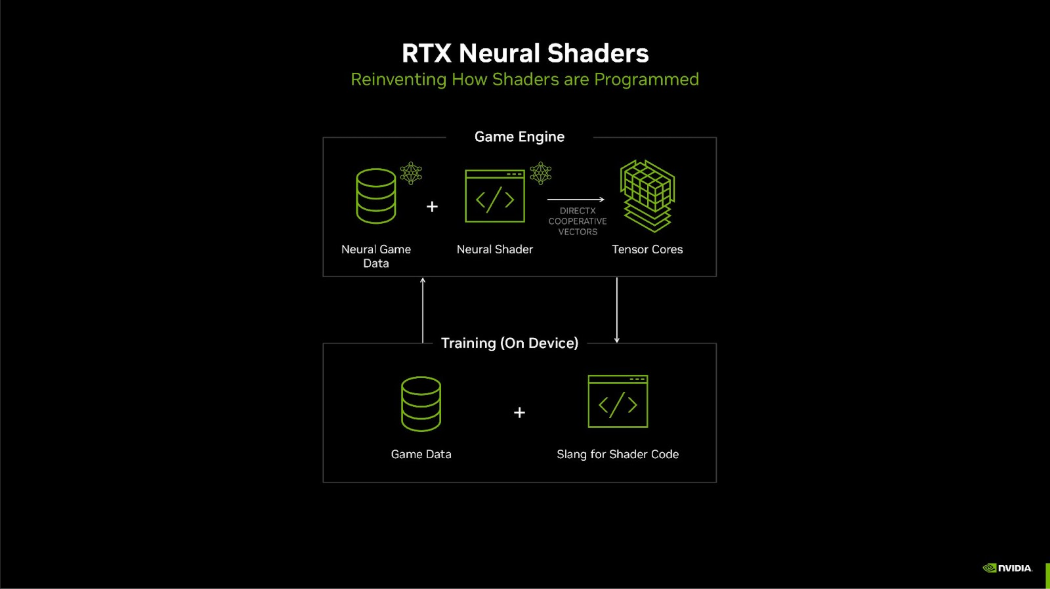
These advanced shaders enable developers to incorporate small AI networks into graphics code, allowing for real-time visual improvements. Using Nvidia’s specialized Tensor cores, neural shaders improve graphics quality without compromising performance.

Neural shaders have huge potential, like Neural Radiance Cache, which uses AI to generate realistic lighting effects without placing excessive demands on the GPU. Another example is Neural Materials, which shrinks complex code, making creating high-quality graphics in real-time possible instead of relying on slower offline rendering.

What makes neural shaders unique is their wide range of uses. They could affect many areas, like virtual reality, architecture, and scientific work. Even though it might take years for neural shaders to reach their full potential, their launch at CES 2025 is an important step in improving graphics technology.

Beyond Graphics: Nvidia’s AI Ambitions

Nvidia’s influence at CES 2025 extended beyond graphics hardware as the company showcased its growing impact in artificial intelligence. The Nvidia introduced several key neural shader innovations, including Neural Materials, Neural Texture Compression, and the Neural Radiance Cache.

One notable application of Nvidia’s AI innovations is in Neural Texture Compression. These tools boost performance, improve visuals, and simplify development, helping creators do more with less. 

Traditional methods often compromise quality for efficiency, but Nvidia’s Neural Texture Compression uses AI to save up to seven times the memory without losing visual fidelity. Nvidia’s AI-driven optimizations also extend to hardware, positioning the company to shape a future where AI-powered computing becomes the norm.

Diagram showing how to train game data and shader code.
RTX Neural Shaders: How Shaders Are Programmed Using Game Data, Neural Shaders, And Tensor Cores.

Nvidia’s focus on AI-powered graphics shows its vision for the future, where AI is a big part of creating and experiencing digital content. From accelerating machine learning workflows to enabling real-time physics simulations, Nvidia’s technologies are pushing the boundaries of computing.

At CES 2025, it was clear that Nvidia is not just a leader in graphics but a pioneer in AI, with the potential to revolutionize industries beyond gaming.