
Home Blog Page 369

Arc B580 Vs RX 6600: We Tested Both

Intel ARC B580

Rated: 9/10

Rycen RX 6600 

Rated: 8.2/10


Pros And Cons

GPUProsCons
ARC B580✅ Better gaming & productivity performance
✅ Better AV1 encoding support
❌ Limited driver optimization
❌ Lesser RT Cores
RX 6600✅ More affordable
✅ More power & thermal efficient
❌ Limited VRAM
❌ 128-bit memory bus
Key Takeaways
  • From our in-depth analysis, we saw the Arc B580 outperform the RX 6600 by 52.9% when tested side by side in 8 games at 1440p. It also performed 37.4% better when it comes to productivity.
  • On the other hand, the RX 6600 compensates by being 13.3% more power-efficient and 19% more thermally efficient than the Arc B580.
  • With higher performance, the Arc B580 is slightly more expensive, at $250. In contrast, the RX 6600 is widely available for $199
  • All-in-all, we recommend you go for the newer Arc B580 not only because of its gaming performance and productivity performance but also because of its lower price.

Comparison Table

Technical SpecsArc B580RX 6600
Power Connectors1x 8-pin1x 8-pin
Slot WidthDual-slotDual-slot
Shader Cores (CUDA)25601792
Tensor Cores160N/A
RT Cores2028
TMUs160112
ROPs8064
Suggested PSU450W300W
GPU ReviewIntel Arc B580 Review-

Architectural Difference

  1. Process Nodes: The Arc B580 utilises the newer and smaller 5nm process node, making it more efficient. While the RX 6600 uses the older 7nm node. 
  2. Clock Speeds: The Arc B580 operates at a fixed clock speed of 2670 MHz. Whereas the RX 6600 has a base clock speed and a boost clock speeds of 1626 MHz and 2491 MHz respectively. 
  3. VRAM: The Arc B580 overpowers its rival by having a larger 12GB GDDR6 VRAM and a wider 192-bus memory, making it a great choice when it comes to memory-intensive tasks. Whereas the RX 6600 sports only 8GB GDDR6 with a 128-bus width.  
  4. TDP: With a TDP of 192W, the Arc B580 does consume a little more power than the RX 6600 which comes with a TDP of 132W, making it the more energy-efficient model among the two. 
  5. Supported Technologies: The Arc B580 uses Intel’s new AI-based XeSS 2, which is better than RX 6600’s FSR. It also uses dual media engines that support two simultaneous 8K 10-bit workloads. 

Today, we’ll be looking at Intel’s newest release with one of AMD’s finest GPUs. This is the comparison between Arc B580 vs RX 6600, and for each GPU, we’ll compare the performance, power, temperatures, and pricing. Ultimately, you’ll be the judge of which one’s the better choice. 


Gaming Benchmark – 1440p

What better way to deduce the performance of two graphic cards than putting them to the test with one of the most demanding games? Here, we’ll provide you with the exact numbers obtained from each game. With games being played at 1440p and settings mostly ramping up to the highest.

Recommended Test Bench

Assassins Creed Mirage

Assassin's Creed Mirage
Assassin’s Creed Mirage @ 1440p (Image By Tech4Gamers)
  • Right off the bat, we saw that the Arc B580 dominated the RX 6600 by obtaining an average of 70 FPS over RX 6600’s 45 FPS, getting a 43.5% head start. 
  • The average 1% lows weren’t as significant as the average FPS since the RX 6600 averaged 33 FPS over Arc B580’s 38 FPS – making for only a 14.1% difference.

Cyberpunk 2077

Cyberpunk 2077
Cyberpunk 2077 @ 1440p (Image By Tech4Gamers)
  • On Cyberpunk 2077, we observed the Arc B580 overshadowed the RX 6600 with a 68.1% edge as it averaged 63 FPS. In contrast, the RX 6600 tried to catch up by averaging 31 FPS.  
  • Much similar to the average FPS, the 1% lows were also in favor of the Arc B580 as it achieved an average of 58 FPS over RX 6600’s 29 FPS, resulting in a 66.7% margin. 

Ghost Of Tsushima

Ghost Of Tsushima
Ghost Of Tsushima @ 1440p (Image By Tech4Gamers)
  • The Arc B580 achieved an average of 53 FPS on Ghost Of Tsushima and displayed 28% better performance, while the RX 6600 acquired an average of 40 FPS
  • With a 74.6% lead, the Arc B580 outshines the RX 6600 as it has obtained an average of 46 FPS. Simultaneously, the RX 6600 performed with 21 FPS. 

God Of War Ragnarok

God Of War Ragnarok
God Of War Ragnarok @ 1440p (Image By Tech4Gamers)
  • In this popular game, the Arc B580 showcased its supremacy as it had outperformed the RX 6600 by 36.9% since it averaged 61 FPS while the RX 6600 averaged 42 FPS. 
  • Yet again, the Arc B580 averaged 48 FPS and excelled with a 23.3% edge over the RX 6600, which managed to follow behind with an average 1% low of 38 FPS. 

Indiana Jones And The Great Circle

Indiana Jones And The Great Circle
Indiana Jones And The Great Circle @ 1440p (Image By Tech4Gamers)
  • Here, we saw the Arc B580 absolutely crush the RX 6600, but this time with a whopping 101.6% since it averaged 46 FPS while the RX 6600 treaded behind with 15 FPS.  
  • The 1% lows broke the record for the Arc B580 since it won by 118.4%, gaining 39 FPS over the RX 6600’s 10 FPS on average. 

Red Dead Redemption 2

Red Dead Redemption 2
Red Dead Redemption 2 @ 1440p (Image By Tech4Gamers)
  • On Red Dead Redemption 2, the Arc B580 surpassed the 60 FPS mark by obtaining an average of 70 FPS. On the other hand, the RX 6600 was 69.2% behind as it averaged 34 FPS
  • As for the 1% lows, the Arc B580 reigned supreme by a 66.7% margin as it had averaged 64 FPS. Whereas, the RX 6600 performed with 32 FPS on average.

Senua’s Saga Hellblade 2

Senua’s Saga Hellblade 2
Senua’s Saga Hellblade 2 @ 1440p (Image By Tech4Gamers)
  • Our analysis revealed that the RX 6600 was still far behind the Arc B580 by a 64.2% margin, as both the cards had acquired an average of 18 FPS and 35 FPS, respectively. 
  • Here, the RX 6600’s FPS and its 1% lows were exactly the same as they both averaged 18 FPS. The Arc B580, on the other hand, averaged 34 FPS, showcasing a 61.5% performance margin. 

Stalker 2: Heart of Chornobyl

S.T.A.L.K.E.R. 2 Heart of Chornobyl
S.T.A.L.K.E.R. 2 Heart of Chornobyl @ 1440p (Image By Tech4Gamers)
  • In this recent release, the Arc B580 outperformed the RX 6600 with a 31.6% edge. This comes from its framerates averaging 44 FPS. However, the RX 6600 also performed better with 32 FPS.
  • Lastly, the Arc B580 showed better performance than the RX 6600, with a 20.7% lead. The minimum framerates they had were 32 FPS and 26 FPS, respectively.

Productivity Benchmarks

With the gaming benchmarks out of the way, let’s test both of these GPUs on one of the most popular productivity tools. 

Geekbench 6

Geekbench 6.3.0
Geekbench 6.3.0 (Image by Tech4Gamers)
  • In the Geekbench 6 test, the Arc B580 outperformed the RX 6600 by a large margin of 34.4%, as it achieved a fascinating score of 94,306. In contrast, the RX 6600 obtained an OpenCL score of 66,630.

3DMark Time Spy Graphics

3DMark Time Spy
3DMark Time Spy 1440p (Image by Tech4Gamers)
  • As for the Time Spy Graphics rendered in 3DMark, the Arc B580 showcased a whopping 57.6% lead as it secured 14,662 points over the RX 6600’s 8,106 points. 

Blender 4.3.0

Blender 4.3.0
Blender 4.3.0 (Image by Tech4Gamers)
  • For rendering in the latest version of Blender, the Arc B580 once again rose to victory. This time, with a median score of 1695.8, which is 49.5% better than the RX 6600’s 1022.5

Overall Performance

Graphic CardsArc B580RX 6600
Average FPS📈55.3📈32.1
1% Lows📉44.9📉25.9
Productivity (Rating)✏️7/10✏️4.5/10
Winner: Intel's Arc B580

Average Framerate

In our calculations, we saw a clear difference between the two graphic cards. In this test, the Arc B580 proved to be a clear winner since it had outperformed the RX 6600 in every single game by a 52.9% performance margin, getting over 60 FPS in four of the tested games. 

1% Lows:

Similarly, the Arc B580 maintained its lead in terms of 1% low as well because it had consistently gained a higher 1% low framerate in every title, not only making it 53.7% better when compared to the RX 6600, which highlights its capabilities when it comes to gaming. 

Productivity:

In terms of productivity, the Arc B580 secured the leading position with a 37.4% margin when compared to the RX 6600 in 3 productivity software. Its newer use of AI-based technology and dual media engine surely helped in making its performance better.   

Average Power Consumption

GameArc B580RX 6600
Assassins Creed Mirage9899
Cyberpunk 207712699
Ghost of Tsushima101100
God of War Ragnarok107100
Indiana Jones and the Great Circle9569
Red Dead Redemption 212799
Senua's Saga Hellblade 210591
S.T.A.L.K.E.R. 2: Heart of Chornobyl106100
Average Power Draw108.1⚡94.6⚡
Winner: RX 6600

In terms of power consumption, the RX 6600 is the more power-efficient option of the two graphics cards. It consumed only around 100W of power throughout the entire test, making it 13.3% more energy-efficient than Intel’s Arc B580. Its lower TDP rating significantly contributes to its power efficiency.

Average Thermal Statistics

GameArc B580RX 6600
Assassins Creed Mirage5850
Cyberpunk 20776451
Ghost of Tsushima5849
God of War Ragnarok6050
Indiana Jones and the Great Circle6045
Red Dead Redemption 26251
Senua's Saga Hellblade 26151
S.T.A.L.K.E.R. 2: Heart of Chornobyl6052
Average Temperatures60.4🌡️49.9🌡️
Winner: RX 6600

As for the temperatures recorded in the eight tested games, the Arc B580 operated at high temperatures on average. Although the difference isn’t sky high but still, AMD’s RX 6600 graphics card is 19% more thermally efficient than the Arc B580, and it also didn’t exceed 52°C. 

Pricing And Availability

GPUArc B580RX 6600Price Difference
MSRP💲250💲32927.3%
Current Price💲250💲19922.7%

Since RX 6600 is an old release, its price has been reduced over the years. So much so that the RX 6600 is currently around $50 cheaper than the Arc B580. However, some of the variants exceed the price of the Arc B580. Since Arc B580 is a new release, it isn’t as readily available as the RX 6600 at online stores. 

Final Verdict—What We Recommend?

Radeon RX 6600: With all the tests out of the way, we get a clear picture of both GPUs, including RX 6600, which proves to be not only power-efficient and thermally efficient but also a bit lighter on the pocket. However, it does have poor performance when compared to Intel’s GPU. 

Intel Arc B580: In contrast, we can see that the Arc B580 displayed better performance both in terms of gaming and productivity. It has a slightly higher price point, but it is justified because of what it brings to the table: higher performance at a reasonable price point.

From our extensive comparison, the Arc B580 undoubtedly stands out from the RX 6600, and we recommend you get this card not only because of its gaming performance but also because it is extremely effective when it comes to productivity – all of which is enclosed in an affordable price tag. 

FAQs

Which resolution is the best for the Intel Arc B580 and the AMD Radeon RX 6600?

The Intel Arc B580 exceeded over 60 FPS in most games at 1440p, so it is decent for 1440p and excellent for 1080p gaming. However, the RX 6600 is a better choice for 1080p gaming.

What CPU will bottleneck Arc B580?

Any CPU that has less than 6 cores will bottleneck the Arc B580. For Intel CPUs, you need to have Intel 7th gen or news processors, and for AMD, it is best to avoid Ryzen 3 1200 or lower CPUs as well as the entire FX-series processors.

Do these GPUs support ray tracing?

Yes, both the Intel Arc B580 and the AMD Radeon RX 6600 support ray tracing. While RX 6600 has 28 RT cores compared to Arc B580’s 20 RT cores, other attributes in the Arc B580 make up for it and thus make it more efficient in ray tracing.

Which GPU offers better support for encoding and decoding?

The Intel Arc B580 is capable of 8K media encoding/decoding due to its AV1 encoding support. Whereas the RX 6600 only offers support for up to 4K encoding/decoding.

How is the Arc B580’s XeSS any different from the RX 6600 FSR?

The Arc B580’s XeSS 2 relies on AI to upscale image quality but is yet to be integrated into most games. In contrast, the RX 6600’s FSR is more widely present in games but isn’t AI-based.

What to Expect from Doom: The Dark Ages

Story Highlights

  • Doom: The Dark Ages trades space stations for gothic castles and cursed forests in a medieval setting.
  • Players will wield medieval weapons such as crossbows, swords and enchanted relics.
  • The game will allow players to cast spells for dynamic combat.
  • Doom: The Dark Ages will retain the fast-paced, intense combat of its predecessor in a new setting.

The Doom franchise, a cornerstone of first-person shooter games, is set to take players on a new adventure with Doom: The Dark Ages. The latest game will be known for its iconic demons, combat and heavy-metal aesthetic.

The Dark Ages will be a multiplatform release, as per NateTheHate2, and promises to deliver an experience for the ages. Here’s what to expect.

A Bold New Setting

The game first teased on the Xbox Showcase, will transport players to a dark medieval setting. Unlike its predecessors, the days of spaceships and Martian landscapes are over. Instead, players will traverse crumbling castles, cursed forests and plague-ridden villages.

Doom: The Dark Ages
Doom: The Dark Ages – Image Credits [Pinterest]
The shift in setting brings a gothic tone that may rival classics such as Dark Souls. As a fan of medieval games, I am excited for meticulously detailed environments with eerie shadows and beautiful architecture, where every turn holds new dangers and mysteries.

Medieval Arsenal Meets Doom Combat

If we know one thing for sure, it’s that the Doom series is synonymous with high-grade combat, and Doom: The Dark Ages will be no exception. The arsenal in the new installment, however, will reflect its set period.

Players will be able to wield brutal medieval weaponry, including swords, maces, crossbows and even enchanted relics. These weapons will be designed to complement the game’s fast-paced, visceral combat while introducing new gameplay mechanics. The gameplay will be similar to the 2016 installment, but it is still considered the best in the franchise

Magic will also be introduced into the Doom universe. Players will get access to spells, allowing for devastating area-of-effect attacks, defensive abilities or a buff to melee combat. 

A New Breed of Demons

Doom Slayer’s iconic enemies will be getting a medieval makeover in The Dark Ages. The kinds of demons in the game are rumored to take inspiration from folklore and mythology. Imagine battling against demonic Knights, gargoyles and plague-ridden abominations.

Doom The Dark Ages
Doom Boss Fight – Image Credits [Pinterest]
Classic enemies such as Cacodemon and Revenant may also return reimagined to fit the medieval setting. These familiar foes, paired with new horrors, will ensure that combat remains as chaotic and intense as ever.

A Richer Narrative Experience

While previous Doom games have focused more on gameplay than the story, The Dark Ages may offer a deeper narrative experience. The medieval setting opens the doors to rich lores and ancient prophecies

Players may uncover the mysteries of the cursed land, unravel secrets of the demonic invasion and forge alliances with NPCs to aid in their quest. Cinematic cutscenes and in-game story-telling elements could potentially elevate the gameplay even higher.

Multiplayer and Co-op Adventures

The Doom franchise has been a major player in the FPS genre for over thirty years, and multiplayer has been a staple. The Dark Ages is expected to introduce innovative new modes.

Doom id Software
Doom id Software – Image Credits [PC Gamer]
Imagine team-based battles in sprawling arenas or co-op raids against massive demonic bosses. These features could offer fresh new ways to engage with the game and extend its replayability.

Next-Gen Visuals and Sound

As a next-gen title, the game will fully take advantage of modern hardware. Players can expect stunning visuals, lifelike textures and ray tracing. The sound design will blend medieval instrumentation with heavy metal to create a unique and immersive audio experience.

Final Thoughts

Doom: The Dark Ages represents an ambitious evolution of the franchise. By combining the thrilling gameplay of Doom with a new medieval setting, innovative gameplay mechanics and a richer narrative, the game promises to be a thrilling new chapter in the Doom saga.

Fans can expect a fresh yet seemingly familiar experience that expands the boundaries of what the Doom franchise can be. All that can be done now is wait and hope that the game will not disappoint upon release.

Core Ultra 5 245K Vs Core i7 14700K: Tests And Analysis

Core i7 14700K

Rated: 7.2/10

Core Ultra 5 245K

Rated: 6.8/10


Pros And Cons

CPUProsCons
Core i7 14700K✅ Has 6 more physical cores
✅ Better in terms of performance
❌ More expensive
Core Ultra 5 245K✅ More modern manufacturing process
✅ More powerful Intel Arc Xe2 integrated graphics
❌ Worse in terms of performance

Key Takeaways

  • The 14700K had an 11% lead over its newer sibling in the gaming tests while running circles around it in productivity.
  • The power consumption of the 14700K was over double that of the Core Ultra 5 245K.
  • Intel’s 14700K is about $60 more expensive than the 245K in late January 2025, though this is subject to change in the future.
  • If you have the budget to buy and pay for power for the 14700K, that is the processor you should go for. Otherwise, be sure to hunt for a deal with the 245K.


Comparison Table

FeatureCore Ultra 5 245KCore i7 14700K
CodenameArrow LakeRaptor Lake Refresh
Model number245Ki7-14700K
Integrated GPUArc Xe2 (Arrow Lake-S)UHD Graphics 770
Multiplier42x34x
SocketFCLGA-1851LGA-1700
Transistors17.8 billions-
Best Motherboards-Best Motherboards For i7-14700K
Best CPU Coolers-Best CPU Coolers For i7-14700K
Best GPU-BEST GPU For Core i7-14700K
Processor ReviewIntel Core Ultra 5 245K Review-

Architectural Differences

  1. Core Count: The 14700K has 20 cores and 28 threads, while the Core Ultra 5 245K forgoes multithreading to only use 14 cores and 14 threads for its core architecture.
  2. Clock SpeedThe base frequency of the 14700K is about 2.5GHz on its e-Cores, and it boosts up to 4.3GHz on its performance cores. The 245K has a base clock of 3.6GHz and a boost up to 4.6GHz.
  3. L3 CacheThe L3 cache buffer is 33 megabytes on the 14700K, whereas the Core Ultra 5 245K has an L3 cache of 24 megabytes.
  4. Process NodeThe 14700K has a 10nm manufacturing process, which is primitive compared to the 3nm manufacturing process, which aims to be more efficient.
  5. TDP: The highest rated power consumption of the 245K is 159 watts, which is still high but a far cry from the 253-watt PL2 TDP of the 14700K.

Intel’s rebrand had done little good for the company, with stock prices at an all-time low. If we compare it to a product a tier above it from the previous generation, it buckles to its knees. In fact, that is exactly what we intend to do in the Core Ultra 5 245K vs Core i7 14700K comparison to see how the new chips perform!


Gaming Benchmarks – 1080p

Having talked about the specifications of these chips, we will now look into how they perform against each other in real-world gaming scenarios. These tests will be done on a controlled test bench, the specs of which are written below:

Test Bench

Star Wars Jedi: Survivor

Star Wars Jedi Survivor
Star Wars Jedi: Survivor @1080p (Image By Tech4Gamers)
  • Our test of Jedi: Survivor ran about 14% better on the older processor. The Core Ultra had an average framerate of around 143 FPS, whereas the 14700K had a framerate closer to 163 FPS.
  • There was minimal difference in the 1% lows, with the Core Ultra 5 245K hovering around 124 FPS, whereas the 14700K had a minimum framerate of around 127 FPS.

The Last Of Us Part 1

The Last Of Us
The Last Of Us @1080p (Image By Tech4Gamers)
  • The 14700K had an average framerate of 189 FPS in our test of The Last Of Us, whereas the 245K was about 4% slower, with a framerate of around 182 FPS on average.
  • The 1% lows hovered around 136 FPS on the Arrow Lake processor, whereas the 14700K had a 1.5% higher with a minimum framerate of around 138 FPS.

Cyberpunk 2077

Cyberpunk 2077
Cyberpunk 2077 @1080p (Image By Tech4Gamers)
  • There was a monumental 23% difference in Cyberpunk 2077, where the Core Ultra 5 245K had an average framerate of 134 FPS, whereas the 14700K hovered closer to around 164 FPS.
  • The minimum framerates were around 20% apart, with the 14700K getting a framerate of around 121 FPS at the lowest, whereas the 245K hovered closer to around 101 FPS in our testing.

Hogwarts Legacy

Hogwarts Legacy
Hogwarts Legacy @1080p (Image By Tech4Gamers)
  • Average framerates were around 121 FPS, which was about 4.5% higher than the 116 FPS of the Core Ultra 5 245K. There wasn’t a huge difference in performance in this game.
  • The 14700K had 1% lows of around 83 FPS, which was a measly 2.5% higher than the 81 FPS of the Core Ultra 5 245K.

Remnant 2

Remnant 2
Remnant 2 @1080p (Image By Tech4Gamers)
  • The 14700K remained victorious in our test of Remnant 2, where it had an average framerate of 116 FPS, about 3.5% higher than the 112 FPS of the Core Ultra 5 245K.
  • The 1% lows were a tad higher on the Core Ultra chip in this game at around 98 FPS instead of 97 FPS on the Core i7 14700K.

Homeworld 3

 Homeworld 3
Homeworld 3 @1080p (Image By Tech4Gamers)
  • This game had a framerate of around 87 FPS when we tested the 14700K, which was about 7.5% higher than the 81 FPS of the Core Ultra 5 245K.
  • The 1% lows were apart by a similar margin, with the 245K hovering around 27 FPS, whereas the 14700K stayed closer to around 29 FPS in our testing.

A Plague Tale: Requiem

A Plague Tale Requiem
A Plague Tale: Requiem @1080p (Image By Tech4Gamers)
  • There was an exact 20% difference between the two chips in our test of A Plague Tale: Requiem, with the 14700K getting an average framerate of 144 FPS, whereas the Core Ultra 5 245K hovered closer to 120 FPS.
  • The minimum framerates were about 73 FPS on the 245K, which paled in comparison to the 106 FPS lows that we saw with the 14700K, leading to a difference of around 45%.

Starfield

Starfield
Starfield @1080p (Image By Tech4Gamers)
  • The last game of our testing ran with an average framerate of around 123 FPS on the 14700K, which was about 10% higher than the 112 FPS of the Core Ultra 5 245K.
  • The 1% lows were exactly the same in this test between the two chips at around 90 FPS.

Productivity Benchmarks

Now that we’ve gotten the gaming benchmarks out of the way, we will look at how these processors compare in productivity tests. These benchmarks were done using the same test bench mentioned above, so take a look at that if you need to refresh your memory.

Cinebench

Cinebench
Cinebench (Image By Tech4Gamers)
  • The single-core scores were higher on the Core Ultra by about 8%, with a score of around 137 FPS, whereas the 14700K hovered closer to 127 FPS.
  • The multi-core score, however, was about 31% higher on the i7. It scored about 1991 points, whereas the 245K struggled to get around 1522 points.

7-Zip

7-Zip
7-Zip (Image By Tech4Gamers)
  • The 7-Zip compression test ran about 40% better on the older processor, with a score of around 188 points instead of the 134 points of the 245K.
  • The decompression tests took a 66% lead on the older processor, with a score of around 201 points while the 245K hovered closer to around 121 points.

Blender

 Blender
Blender (Image By Tech4Gamers)
  • The Monster test on Blender ran about 37% better on the older processor, which is a thorn in the side of the performance of the newer Core Ultra chips.
  • The 14700K had about 206 samples per minute, which was significantly more than the 206 samples per minute of the 245K.

Overall Performance

ProcessorCore Ultra 5 245KCore i7 14700K
Average FPS📈125📈138.37
1% Lows📉91.25📉98.87
Productivity (Rating)✏️5.33/10✏️7/10
Winner: Core i7 14700K

Average Framerate

On average, the 14700K was about 11% faster than the Core Ultra processor in our gaming tests. This difference wasn’t as noticeable because of the high framerates both processors were getting at 1080p, but this ratio will be a big problem after these chips age.

1% Lows

The difference in the 1% lows of these processors was around 8%, which is a smaller difference than what we saw with the averages. In most games, both processors had very similar minimum framerates. This shows that both processors are bottlenecked in some way in their own regard.

Productivity Benchmarks

The 245K did not even put up a fight in the productivity benchmarks. The 14700K was very significantly more powerful than its rival, perhaps because of the sheer number of threads on the older processor. In any case, the 14700K wins against the 245K in terms of productivity performance as well.


Power

GameCore Ultra 5 245KCore i7 14700K
Star Wars Jedi: Survivor97214
The Last Of Us Part 196226
Cyberpunk 207798205
Hogwarts Legacy102203
Remnant 293225
Homeworld 3108208
A Plague Tale: Requiem97213
Starfield93218
Average Power Draw98⚡214⚡
Winner: Core Ultra 5 245K

The power consumption of these chips is a world apart. The 14700K took more than double the power of the 245K. We’re glad to see this shit in efficiency, but we would’ve been happier if the 245K took a bit more power to bring its performance closer to the older chips.


Price

CPUCore Ultra 5 245KCore i7 14700KPrice Difference
Launch MSRP💲319💲41931.35%
Current Price💲259💲31923.17%

There is a $60 difference in price between these two chips at the time of writing this comparison, with the 14700K being more expensive. Considering that the Core i7 is a tier above the Core Ultra 5 we’re comparing it with, this difference in price makes sense.


What We Recommend

Core i7 14700K: Though not a great processor in its own right, the 14700K beats out the Core Ultra 5 245K in terms of performance pretty handly. Yes, it does lack in terms of power efficiency, but for most people power efficiency comes second to raw performance.

Core Ultra 5 245K: Intel has much to work on with the Core Ultra line of chips. The lackluster performance of the Core Ultra 5 245K and even its brethren is reason enough not to buy into this generation. However, if you prefer the efficiency gains and have an older Intel chip, the 245K might be worth buying.

Having discussed all the features, we would advise you to buy the Core i7 14700K if you have the budget for it and the extra power it consumes. The 245K, though disappointing, could be a chip worth buying if you can find it for a discount.

FAQs

Are the new Core Ultra processors for Desktop ARM chips?

No, the new Core Ultra processors for desktops use the same x86 instruction set.

Does the Core Ultra 5 245K have hyperthreading?

No, the Core Ultra 5 245K does not have hyperthreading. 

Are both of these chips overclockable?

Yes, you can overclock both the Intel Core i7 14700K and the Intel Core Ultra 5 245K.

Does the 245K have error-correcting code memory support?

Yes, the Core Ultra 5 245K has support for ECC memory.

Do both of these chips have integrated graphics?

Yes, both the Core Ultra 5 245K and the Core i7 14700K have integrated graphics.


Sony Possibly Changing PC Port Strategy After Back-to-Back Failures

Story Highlight
  • Sony announced Spider-Man 2’s PC Port really early, causing a major commotion among its audience. 
  • With the game set to release in just three days, no marketing can be seen, and the pre-orders are still closed.
  • This suggests that Marvel’s Spider-Man 2 is being delayed and Sony is possibly changing its strategy regarding the PC Ports. 

Sony changed its strategy from releasing games only on PlayStation. The gaming giant usually releases a PC port a couple of years after the game’s launch. However, it is shortening the margin, and PlayStation fans have been protesting against it

While the fans have demanded Sony to not release games on PC the company has refused to listen to them. However, now it may be changing its strategy once again. The company hasn’t confirmed this intent, but there are a few things we would like to discuss as to why it may be changing the strategy of releasing PC Ports

Why it matters: Sony has released many games on PC recently, and almost every single one’s reception player count-wise was subpar. Games like Final Fantasy 16 were underwhelmed extremely, failing to meet the expectations

Sony Potentially Changing PC Ports Strat
Spider-Man 2 PC Port Pre-Orders Are Still Available Which Suggests A Potential Delay | Source: BSKY

After Sony announced the Spider-Man 2 for PC, a lot of PlayStation fans were frustrated by this decision. This is because the port was announced early compared to the previous ones, and it showed a pattern that the company could release exclusives even faster or maybe right when it is launched on the console. 

The gaming giant has also not realized how badly the region locking hurts its game sales on the PC platform, so it may be thinking about something else now. We think Sony is possibly changing its strategy mainly because its games aren’t performing well on the PC platform

There are just three days left until the release of Marvel’s Spider-Man 2. However, there hasn’t been marketing for it. Many fans found out about the game being released on PC because of the Marvel Rivals marketing the Spider-Man’s skin.

spider-man 2
Spider-Man 2 Is Set To Release On PC In Just 3 Days But The System Requirements Are Still Not Out

As mentioned before, there are only three days left for the game to be released, and the pre-orders are still closed. Usually, pre-orders for a game open months before its release, but now there are just a few days left for it to release, and you can still only wishlist it.

Not only that but there is no information about the system requirements. Usually, a game’s thorough requirements are released officially so fans can have an idea of what hardware they would require in order to enjoy the title based on their preference. 

Either the game is being delayed, or Sony is shifting its strategy again. The most likely case is Spider-Man 2 being delayed a couple more months, but we won’t be surprised if it releases a statement explaining how the PC ports have failed to meet the expectations without noticing the obvious thing that is hurting the sales (the PSN restriction).

In the end, this is all based on speculation, as the gaming giant hasn’t confirmed anything. We are likely to get the answer for why the pre-orders haven’t opened yet soon enough, but this whole bit is as fishy as it can get. 

That said, what do you think about Marvel’s Spider-Man 2 situation? Why do you think the pre-orders are still not open? Will it get delayed? Share your thoughts with us in the comments section below or join the discussion at the official Tech4Gamers forums.  

Xbox Series S Compatibility Here To Stay And Won’t Go Away, Says Phil Spencer

Story Highlight
  • Phil Spencer has no intentions of changing the Xbox Series S requirements for the platform.
  • He states that the console offers an advantage since games optimized for it can be ported to handhelds easily.
  • The Xbox boss also states that modern engines offer enough flexibility to support all types of hardware.

The Xbox Series S has been a major problem for various studios this generation. Games like Black Myth: Wukong have been delayed on Xbox due to this console, and many believe Microsoft should remove the parity between its two consoles altogether.

Phil Spencer has recently commented on the discussion, denying the possibilities. He states that Xbox Series S support is here to stay.

Why it matters: This piece of hardware has been the subject of discourse since its initial reveal, with many stating that the console never should have been made in the first place.

Phil Spencer recently appeared on Destin’s YouTube channel and discussed various parts of the Xbox business.

Destin asked the Xbox boss if he would ever consider removing Xbox Series S|X parity to accommodate developers that have had difficulties optimizing for the budget console, but Phil Spencer’s response was quite firm.

He was quick to point out that the Xbox Series S is advantageous for many studios since it helps prepare them for optimization across even lower-end devices like gaming handhelds. Phil Spencer also noted that modern engines are a lot more flexible and scalable.

As such, the Xbox boss sees no reason to remove the parity clause that was put in place all the way back in 2020.

I actually think we have a really because we’ve been targeting the Xbox Series S for quite a while. Our games are portable across many different specs. I think that helps us.

-Phil Spencer

Xbox Series S Won't turn on.
Microsoft’s Cheapest Hardware Is A Great Way To Enjoy Current-Gen Gaming On A Budget

He also pointed to his own example, stating that Indiana Jones looks great on the console. Therefore, all future games will continue to arrive on the hardware, even if the gaming giant made an exception in the case of Baldur’s Gate 3, which launched without split-screen co-op on the lower-end machine.

What are your thoughts on the Xbox boss’ stance? Do you think this is a good decision? Let’s discuss this in the comments and on the Tech4Gamers Forums.

Suicide Squad Removes Denuvo Amid Failed Attempt At Live Service Breakthrough

Story Highlight
  • Suicide Squad: Kill the Justice League has been updated on Steam.
  • The update replaces the PC version with a new executable file and removes Denuvo.
  • This step was likely taken to cut the costs needed to renew the DRM’s license.

Suicide Squad’s unfortunate story came to an abrupt conclusion this month. What was supposed to be a billion-dollar live-service release for Warner Bros has turned out to be nothing but a failure.

Developer Rocksteady has also moved on from the game and, in doing so, seems to have removed Denuvo from the PC port as one final change to this version of the game.

Why it matters: Denuvo has its fair share of critics across the gaming industry, with many arguing that the DRM impacts performance.

Suicide Squad: Kill The Justice League Removed Denuvo
Suicide Squad: Kill The Justice League Update via SteamDB

According to SteamDB, the game has been updated with a new executable file dubbed “new-SuicideSquad_KTJL.exe.”

This is typically done as studios prepare to remove the infamous DRM from their games, but more evidence has already shown up suggesting that Denuvo has been removed from this particular title.

Look hard enough, and you’ll find that Suicide Squad has now been cracked. We won’t share any links here, but the information is out there for those knowing where to look. Anyhow, it’s no coincidence that the crack has come just as Rocksteady replaced the executable file on Steam, confirming the DRM’s removal.

Because Denuvo typically requires a monthly fee, it is not uncommon to see it leaving games a year or two after release. In Suicide Squad’s case, the title was far from profitable or even active on PC, so renewing the license likely made little sense for Warner Bros and Rocksteady.

The team also removed internet requirements from Suicide Squad with a recent update, making it playable offline, giving the developer even less reason to continue licensing the DRM.

Batman Kevin Conroy
Batman Is Now Confirmed To Be Alive In The Arkham Universe

Looking ahead, Rocksteady might consider revisiting the Batman Arkham series or working with an entirely new comic book license. Whatever the team decides, another shot at live service seems more or less guaranteed to be off the table after Warner Bros’ latest failure.

What are your thoughts on what is likely to be Suicide Squad’s final Steam update? Let’s discuss this in the comments and on the Tech4Gamers Forums.

Ubisoft Lays Off 185 Devs And Closes Studio Amid Ongoing Struggles

Story Highlight
  • Ubisoft has announced the closure of its studio in Leamington.
  • The company has cut approximately 185 jobs in the process, impacting studios in Stockholm, Dusseldorf, and more.
  • These job cuts are part of restructuring efforts by the gaming giant as it hopes to reduce costs.

Following Star Wars Outlaws’ commercial disappointment and the Assassin’s Creed Shadows delay, Ubisoft has not been at its best recently. The publisher has also faced various layoffs over the last few months.

Continuing the bad news, nearly 200 additional layoffs have just been confirmed by the publisher.

Why it matters: Ubisoft’s financial situation is so dire that it was considering a merger with Tencent. The company’s fate now rests in the hands of Assassin’s Creed Shadows.

Ubisoft Stock Down By Over 45%
Ubisoft Stock Has Nosedived Over Past Months

According to an update shared by analyst Chris Dring, Ubisoft has shut down its Leamington Studio. For context, job listings showed that this team was working on an unannounced project until recently.

This studio was purchased by the gaming giant in 2017 after it worked on the DJ Hero series for Activision. Ultimately, this purchase seems to have done little for the French publisher.

Elsewhere, Ubisoft Stockholm, Dusseldorf, and Reflections have been impacted by the recent changes. The company states that these layoffs are part of ongoing restricting efforts which aim to minimize costs.

Assassin's Creed Shadows
Assassin’s Creed Shadows Arrives In March

It’s no secret that Ubisoft’s stock has taken hit after hit over the last few months. Following these layoffs, shareholders might lose a little more faith in the publisher, with everyone waiting to see how Assassin’s Creed Shadows performs before making a final decision.

What do you make of these layoffs? Do you think Assassin’s Creed Shadows will help the gaming giant bounce back? Let us know in the comments, and visit the Tech4Gamers Forums for more discussions.

A Tokyo Setting Would Be A Nice Change Of Scenery In A Cyberpunk Sequel

Story Highlight
  • Tokyo has great potential for Cyberpunk to visit with a sequel in the future.
  • The city already has a rich history within the Cyberpunk universe and is expanded upon even more with the Pacific Rim sourcebook.
  • A sequel there has the opportunity to further explore storylines from the first game, such as Rogue AIs, Relic, and more.

The Cyberpunk universe is vast, and so far, we’ve only seen Night City in Cyberpunk 2077 and Edgerunners. There are several cities mentioned in the game, and where the next game would head is only up to CDPR. 

However, if there’s one city that many fans, including me, would like to visit with the sequel, it is Tokyo. The city is already connected deep to Night City’s roots and has a strong hold on the overarching plot of the Cyberpunk universe.

Why it matters: Visiting Tokyo would offer a chance to explore more of the Cyberpunk universe’s lore and capitalize on the existing plots and storylines from the first game, which already had tons of potential.

Tokyo Is One Of The Major Cities In Cyberpunk 

japantown in Cyberpunk
Night City Features A Town Which Is A Beautiful Recreation Of Japan.

Home to Arasaka, one of the biggest corporations in the Cyberpunk universe, Tokyo can be considered a powerhouse. Tokyo’s influence spread far to Night City and is one of the reasons why the city is so accursed in the first place.

What we saw in Night City was the start and rise of a street kid to the major corpo levels. However, bigger stories are yet to be explored within the universe.

 In the dystopian universe of Cyberpunk, Tokyo is already considered modern-day Babylon and is one of the safest and most dangerous cities in the world. Tokyo is referred to as a fairly crowded metropolis city with tight streets.

That said, the city is corrupt, largely due to it being home to millions of people, including immigrants. Despite the huge population, the city is well protected by police who will turn a blind eye to anything that doesn’t benefit the corpo.

From what information we have on Tokyo via the Cyberpunk Pacific Rim sourcebook, it is actually worse than Night City in all aspects. 

Moreover, Arasaka isn’t the only corporation and faction in Tokyo. The Yakuza, Neo-Shogunate, Ronin, and other nomad gangs are just a few of the factions that make up the city’s politics.

An Aesthetically Pleasing World

Cyberpunk 2077 Night City
Night City Is One Of The Most Beautiful Maps In A Video Games.

While Night City is one of the most beautiful worlds I’ve ever seen in a video game, thanks to the intricate details that CDPR put in it, there’s potential for the developers to go beyond their bar with the sequel.

Night City’s Aesthetics are a huge part of what actually makes the game. Thankfully, Tokyo will provide just that. We’ve already got a glimpse of what Tokyo would look like in Japantown from Cyberpunk 2077.

Thanks to its cultural background and more advanced technology, Tokyo aims to be more visually stunning. That said, I do fear how setups will be able to handle such a crowded city where driving a car would be considered practically impossible.

Tokyo is also said to feature a Disneyland, which would be a theme park based upon the American culture, akin to what Japantown is in within Night City but only more exaggerated and corpo owned.

There are several plotlines that a Tokyo setting would follow in Night City and involve more upon the relic, Arasaka’s background, or the exploration of Rogue AIs like Alt Cunningham. 

If there’s one thing that’s definite, it’s that CDPR always delivers in terms of a good story and hasn’t disappointed us so far. The next Cyberpunk game is still quite far, but we can only speculate where the next stop from Night City will be, or we will be revisiting the beautifully cursed city once again.

Video Games Nowadays Don’t Aim For Longevity

Story Highlight
  • The gaming industry now prioritizes profit over quality, resulting in unfinished, flawed releases.
  • Games like Elden Ring and Cyberpunk 2077 offer replayability value, but many publishers prioritize profit, exploiting popular franchises.
  • Games like Anthem and Battlefield 2042 sold millions through nostalgia and marketing, aiming for financial success, despite being underwhelming.

Ever thought about how games like Minecraft, released decades ago, are still relevant to this day and have audiences far more than any other video game from even this generation?

The video game industry’s focus has vastly shifted from that era, and now, video games are a means of earning money for them. They don’t care about how long a game lasts or what franchise they’ll use to fish money from the audience.

I can only recall a handful of video games released in the past few years that I found myself revisiting. This is completely different compared to a decade ago when video games had so much content and life to them that they are still enjoyed to this day.

Why it matters: Video games are expensive, so I want them to be enjoyable for a long time. But instead of being creative, many publishers focus on copying what’s already successful in other games. This often leads to repetitive ideas and a lack of originality, all driven by the need for financial gain.

The Golden Era Of Gaming Has Long Gone

Endless Possibilities in a Minecraft World
Endless Possibilities in a Minecraft World – Image by Tech4Gamers

It’s no secret that gamers this generation have witnessed nothing but broken and unfinished releases that only became worthy of their price tag months after their launch with additional money costs.

There was a time when DLC expansions went beyond the content of the original game, completely excluding the base game. However, nowadays, DLCs complete a game rather than expanding it.

Elder Scrolls Skyrim has hundreds of hours of content with multiple playstyles, characters, and a living world full of NPCs with different stories to tell. The game can easily be played countless times over, and you won’t get bored with it.

My earlier mention of Minecraft also was a great example. Many generations have seen and played Minecraft, and the game is not going away anytime soon. 

CDPR’s Witcher 3 also set the bar high for open-world games. Its narrative story and the detailed and rich open world were quite ahead of their time. The game has been released for almost a decade, and I can’t get enough of it. 

Numerous other examples include series like Zelda, Fallout, Dark Souls, and more.

Video Games Nowadays Are A Means Of Monetization 

Suicide Squad Kill the Justice League
Microtransactions Don’t Belong In Single-Player Games.

Over time, the video game industry has taken a step backward, and overall quality has dropped. However, there are still a few developers and publishers who genuinely care about creating great games rather than just chasing profits, unlike many others.

With games like Suicide Squad: Kill The Justice League, publishers sabotage themselves by luring in gamers with a built franchise that has a massive following and love and utilizing that to make short and easy profits.

Even the latest Call of Duty Black Ops 6 is filled with pay-to-win elements, which is slowly ruining the game, but Activision is rested easy knowing that they’ll have another Call of Duty title out later this year.

It’s no wonder that most games come and go these days and still make a huge chunk of money. The infamous Anthem sold well over 5 million copies despite being a failure, as it managed to catfish gamers quite easily.

Even Battlefield 2042 sold an estimated 17-18 million copies, which is an outstanding number for such a subpar release. EA really fooled players with the promise of nostalgia from earlier Battlefield games and delivered the most underwhelming battlefield game ever.

Regardless, games are still worth revisiting every so often released recently. Cyberpunk 2077, for instance, now with a fixed state, the game is worth putting in hours. Elden Ring is also worth different playthroughs.

Rise of the Ronin Heading To PC In March With 8K 120FPS Support

Story Highlight
  • Rise of the Ronin is receiving a PC port in March.
  • The PC version is said to support DLSS, FSR, XeSS, and more.
  • Team Ninja has also shared system requirements, confirming that the game will run on most modern systems.

PlayStation and Team Ninja collaborated last year on the PS5 exclusive Rise of the Ronin, but the game failed to impress in both commercial and critical departments.

Following a year of exclusivity, Rise of the Ronin is now free from the console ecosystem of the PS5. Team Ninja has finally announced the game for PC, confirming that it will soon be headed to Steam.

Why it matters: This PS5 exclusive had plenty of excitement behind it last year. While the title failed to meet expectations, it received plenty of praise for its exciting combat and gameplay.

Rise of the Ronin Steam Release
The Game Is Now Available To Pre-order via Steam

The official Steam page shows Rise of the Ronin will be heading to PC on March 11. This particular version of the game promises enhancements like 8K resolution and 120FPS support.

Upscalers like FSR and DLSS are also confirmed, in addition to technologies like frame generation. Moreover, ray tracing is being added to the game, making it an even more compelling offering for the PC audience.

Team Ninja is launching the game at a $49.99 price on Steam, making it much cheaper than the $70 launch price from last year. Therefore, fans of the studio’s fast-paced combat might find this price tag a lot more appealing.

Rise of the Ronin PC Requirements
Rise of the Ronin PC Requirements via Steam

System requirements are also relatively light, considering Rise of the Ronin was among the many current-gen-only titles launched on the PS5 last year. However, the game requires a whopping 180GB of storage, putting it above most other AAA titles in this department.

Are you looking forward to playing the game on PC? Let us know in the comments, and visit the Tech4Gamers Forums for more discussions.

Ubisoft Should Have More Faith In XDefiant

Story Highlight
  • While XDefiant looked promising earlier as a COD Killer, the game was rushed and released in an unfinished state.
  • Ubisoft couldn’t keep up with the game’s updates and decided to shut it down within a year of its release.
  • XDefiant’s last update, Season 3, fixed every major issue with the game, which makes me think that they were wrong to lose hope with the title.

Almost every title that Ubisoft has put out this decade has been underwhelming or subpar compared to its predecessors. The only victory they’ve had so far is with an AA title. That could’ve changed with the Cod Killer that Ubisoft put out.

However, XDefiant failed to meet expectations since it was released in an unfinished state. Ubisoft was too impatient for success and went ahead and ruined the one title they had.

XDefiant had loads of potential, but they just couldn’t balance between putting out new content and balancing the game.

Unfortunately, they’ve now decided to put the game to sleep for good. This is especially disappointing since the game was just starting to get good. Ubisoft should’ve had more faith in Xdefiant instead of giving up on it completely. 

Why it matters: XDefiant showed a ton of potential and could’ve been a new successful IP for Ubisoft in years. However, Ubisoft’s impatience and failure to commit ruined the title

XDefiant Season 3 Update Fixes Almost Everything Wrong With The Game

Following the tragic news that Ubisoft is shutting down XDefiant in June 2025, a season 3 reveal was made shortly after, revealing all the new content to be added to the game. 

With Season 3 launched, it’s bittersweet for me to play the game and realize how good it’s become since launch. However, it’s also unfortunate that the game will be shut down in a matter of months. 

The developers went full out with the update and added almost a year’s worth of content in a single update before they finally laid the game to rest. For starters, the Assassin’s faction has finally been added to the game.

Moreover, two new factions from future updates have been added, including Wolves from the Ghost Recon franchise and Blood Dragon from the Far Cry spin-off game Far Cry: Blood Dragon. 

Xdefiant

All of these factions bring in a new skillset and more gameplay elements that make every game mode interesting and more expansive. My complaint about the lack of content has finally been addressed, but the cost was quite high.

Moreover, a whopping 13 new maps have been added, more than any update that I’ve ever seen, and multiple new guns have also been included. The update also includes 5 new game modes, including Defuse, Lum Hunt, and more.

A lot of balancing adjustments and fixing has been done to remove bugs and improve matchmaking for a better experience. 

What The Future Holds

Ubisoft Bankruptcy
Ubisoft Is Close To Being Bankrupt

It pains me to see everything that went down with XDefiant because I’ve been rooting for the game since the beginning, hoping that it would be a turnaround moment for Ubisoft.

Regardless, going all out means that Ubisoft doesn’t plan to change its mind about XDefiant. The French publisher has already laid off quite a few employees, so the game won’t be seeing a second coming.

Amidst a potential bankruptcy state and nearing the release of their biggest title in years, Ubisoft is locked in towards success, which means that they won’t be spending time bothering with IPs like XDefiant. 

Rainbow Six Siege is already performing well, and given the lack of manpower, it’s only right from a business perspective that they shut down XDefiantt, which frankly hasn’t been that successful financially.

However, if Assassin’s Creed Shadow does perform well and XDefiant gathers a lot of players before shutting down, maybe Ubisoft will revive the IP in the future when everything settles down.

It does seem far-stretched, but we can only hope and pray that Ubisoft’s upcoming titles perform well since the publisher relies on them for its whole existence. Otherwise, major publishers like Tencent may acquire the company.

Aula F75 Max Review: Worth the Upgrade?

After the legendary Aula F75, the company is back with an upgraded model called the F75 Max. It carries over most of the elements of the first one while adding a new knob and a whole screen. The goal here is to keep what made the original great while adding a few new features to modernize it. 

The F75 Max competes with the likes of the Epomaker Shadow-X and the Ajazz AK820 Max, so it’ll be a tough battle. The F75 Max also gets a $10 price increase over the original and it’s clearly not as popular because if you look it up on YouTube there’s barely any coverage. Therefore, our review will help you make your decision.

Why Trust Tech4Gamers
  • Huzaifa Haroon is our keyboard expert with years of experience in building and testing custom keyboards.
  • 130+ peripherals tested and reviewed by our team of hardware experts (Tech4Gamers Team).
  • 500+ hours spent testing different peripherals for our reviews.
  • Objective testing criteria (See how we test peripherals).

At Tech4Gamers, ensuring you get reliable information is our priority. That’s why every hardware round-up undergoes a meticulous review process by our team of experts and editors. Each review is carefully examined against our strict editorial guidelines, guaranteeing you trustworthy insights you can depend on.


Key Takeaways

  • The Aula F75 Max is a well-rounded budget keyboard marred by the very features it’s trying to sell. 
  • Buy the F75 Max if you don’t care about the screen or volume knob and just want a nice-sounding keyboard.
  • Avoid the F75 Max if you’re looking for the very best value in the market, and actually want a usable volume knob and screen.

Spec Details
Brand EPOMAKER x AULA
Model F75 MAX
Number of Keys 80 keys, 1 Metal Knob and 1 TFT Screen
Layout 75% ANSI US Layout
Battery 4000mAh
Battery Life 30.5 hours with Backlight on, and 80 hours with Backlight off
Connectivity Cable Wired, 2.4GHz, Bluetooth 5.0
Compatibility Mac/WIN/Android/Linux
Case Material ABS Plastic
Plate Material PC Plastic
Flex-Cut Partial Flex-Cut
Stabilizers Plate-Mount Stabilizer (Compatible with Screw-in Stabilizer)
Mounting Structure Gasket-Mount
Sound Dampening Plate Foam, IXPE Sheet, PET Sheet, Bottom Foam and Bottom Silicone
Keycaps Profile Cherry Profile
Keycaps Material PBT Plastic
Keycaps Manufacturing technique Double-Shot
Hot-swappable Yes, 3/5-pin mechanical switches
RGB South-facing, per-key RGB
Polling Rate 1000Hz (USB, 2.4Ghz), 125Hz (Bluetooth 5.0)
Latency 3ms (USB), 7ms (2.4Ghz wireless), 18ms (Bluetooth 5.0)
Anti-Ghosting N-Key Rollover
Keyboard Dimensions 32.8*14.3*4.4cm
Front Height 20MM
Keyboard Weight 0.96kg
[toc]

What Makes The Aula F75 Max Different?

Truth be told, there’s nothing that really sets the Aula F75 Max apart. A few months ago, before the likes of the Ajazz AK820 series, and even the Tecware Spectre 75, I’d have said the combination of a screen, and a volume knob together is unique. 

That’s not the case anymore and even if it were, the F75 has such poor implementation of both that I could never count it as a positive. The build quality and looks, along with the software are all also industry-standard at this point. Worst case scenario, it’s different because it takes a formula that works that somehow tarnishes it in pursuit of an upgrade.

Unboxing Experience

The Aula F75 Max comes in a package almost identical to the rest of the Aula boards, a black and green box following the robot mascot motif introduced in the Aula F81. It also just flaunts the Epomaker x Aula partnership on the front instead of any picture or illustration. There is a single large tab in the center to open the box. 

Aula F75 Max box
Aula F75 Max box (Image by T4G)

Once inside, you get the board wrapped in plastic with a dust cover. There is a manual and an instructions card sitting on top. On the top there’s a section labeled “Additional Accessories” which has all the extras you’ll need. 

Here’s everything you get in the box:

  • 1x Aula F75 Max
  • 1x Keycap/Switch Puller
  • 2x Extra Switches
  • 1x USB-C Cable
  • 1x Manual
  • 1x Instructions Card
Everything you get with the Aula F75 Max
Everything you get with the Aula F75 Max (Image by T4G)

Design & Build 

The Aula F75 Max is basically just the normal F75 but with a screen and a slightly different knob. The design is very much reflective of this. We have the same two-tone aesthetic seen on the rest of the Aula series. It looks like the bottom case has walls extending up to the top. The entire top perimeter is also chamfered to sort of taper into the bottom. 

Aula F75 Max from the front
Aula F75 Max from the front (Image by T4G)

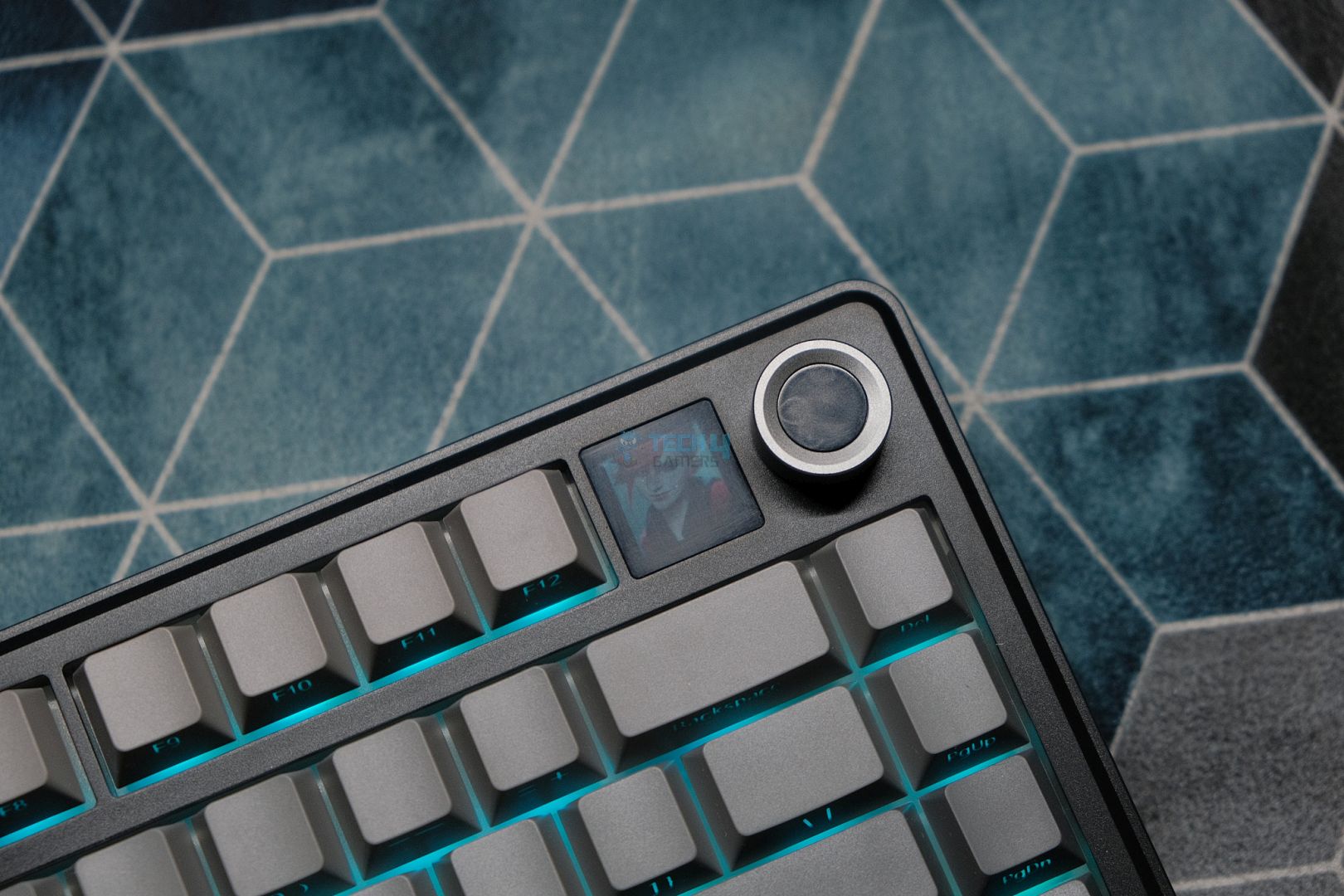
This creates a noticeable seam that feels intentional, not cheap. Next to the Caps Lock key is a small LED indicator for it but you can also see it enabled on the screen. Speaking of which, in the top-right corner we have the iconic volume knob but there’s a screen next to it this time. It replaces the F13 key (which was delete) from the Aula F75 so it’s quite small.

Aula F75 Max knob and screen
Aula F75 Max knob and screen (Image by T4G)

The back has a few rubber pads and 2 dual-stage flip-out feet for adjusting the elevation. Without them activated, the front height of the board is 20mm with a comfortable 5-degree typing angle. There is a metallic badge in the center as well showing off the board’s name and logo.

Aula F75 Max from the back
Aula F75 Max from the back (Image by T4G)

Due to the simple top and bottom cases, the side profile of the Aula F75 Max is boring to say the least. It’s a basic box-on-wedge that looks exactly like its predecessor. Here’s also where you start to notice the build quality of the board. We have a fully plastic construction that feels well-built but the fit and finish is underwhelming.

Aula F75 Max side profile
Aula F75 Max side profile (Image by T4G)

There are no apparent molding marks but the edges of the plastic, like where the top and bottom case meet in the side profile don’t have the best polish. You’ll see this further reflected in the keycaps who also have, sort of, jagged borders. There is no flex or creak present in the case, and I do want to emphasize that it otherwise feels premium in hand.

Layout & Features

The F75 Max, as the name indicates, is a 75% keyboard with a non-exploded layout, meaning the arrow and nav keys are joined in with the rest, only separated by a blocker. Once again, this is similar to the standard F75. A layout like this keeps the overall footprint smaller and takes only just the amount of space needed on your desk, unlike the Galaxy70.

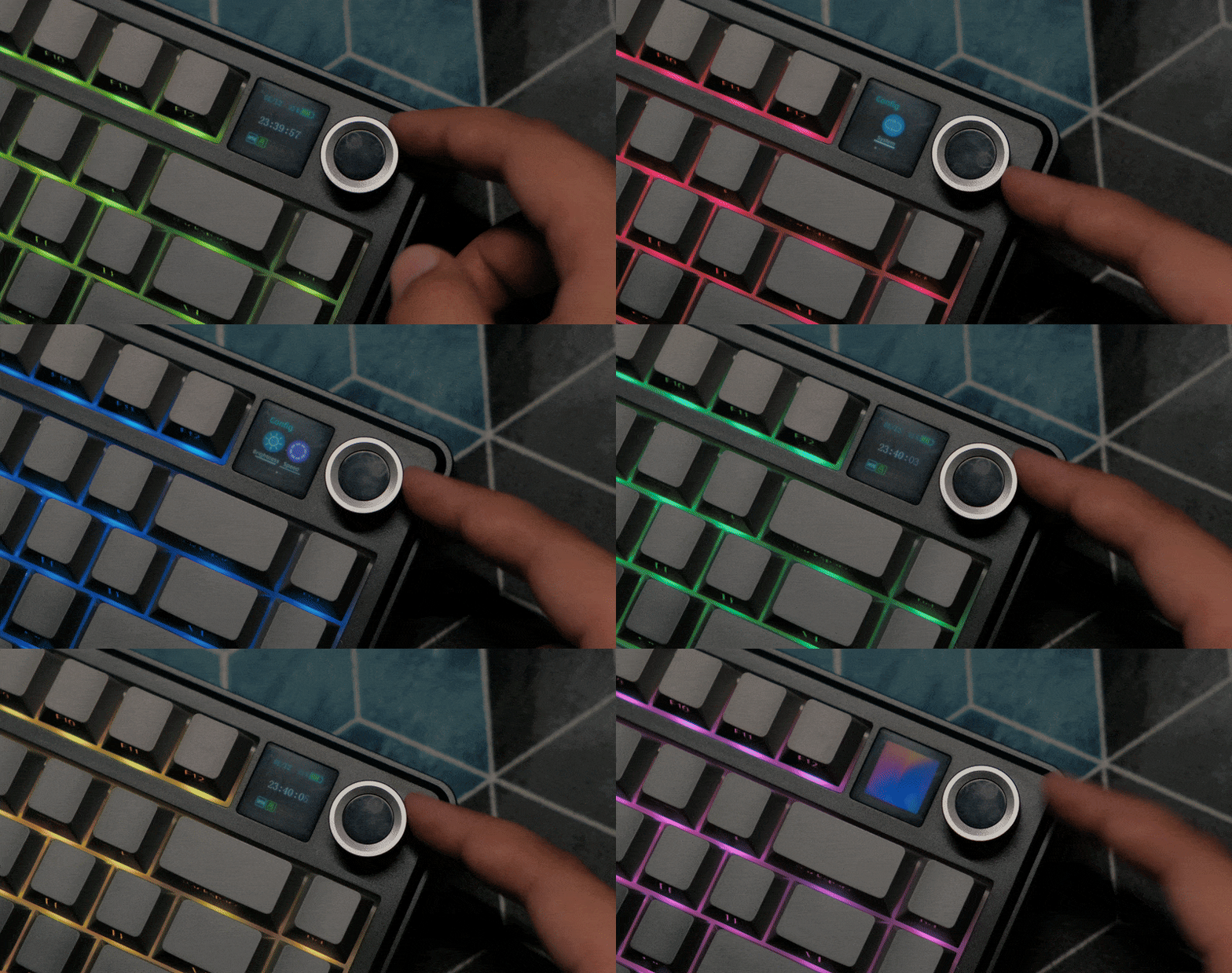
The volume knob in the corner is slightly different. It has a glossy finish so it’s a fingerprint magnet. The real issue, though, lies in its ratcheting mechanism. The rotary encoder behind the knob is just way too loose. It spins almost freely, which makes controlling the screen or adjusting the volume kind of a nuisance. More on this later. 

Aula F75 Max volume knob spinning
Aula F75 Max volume knob spinning (Image by T4G)

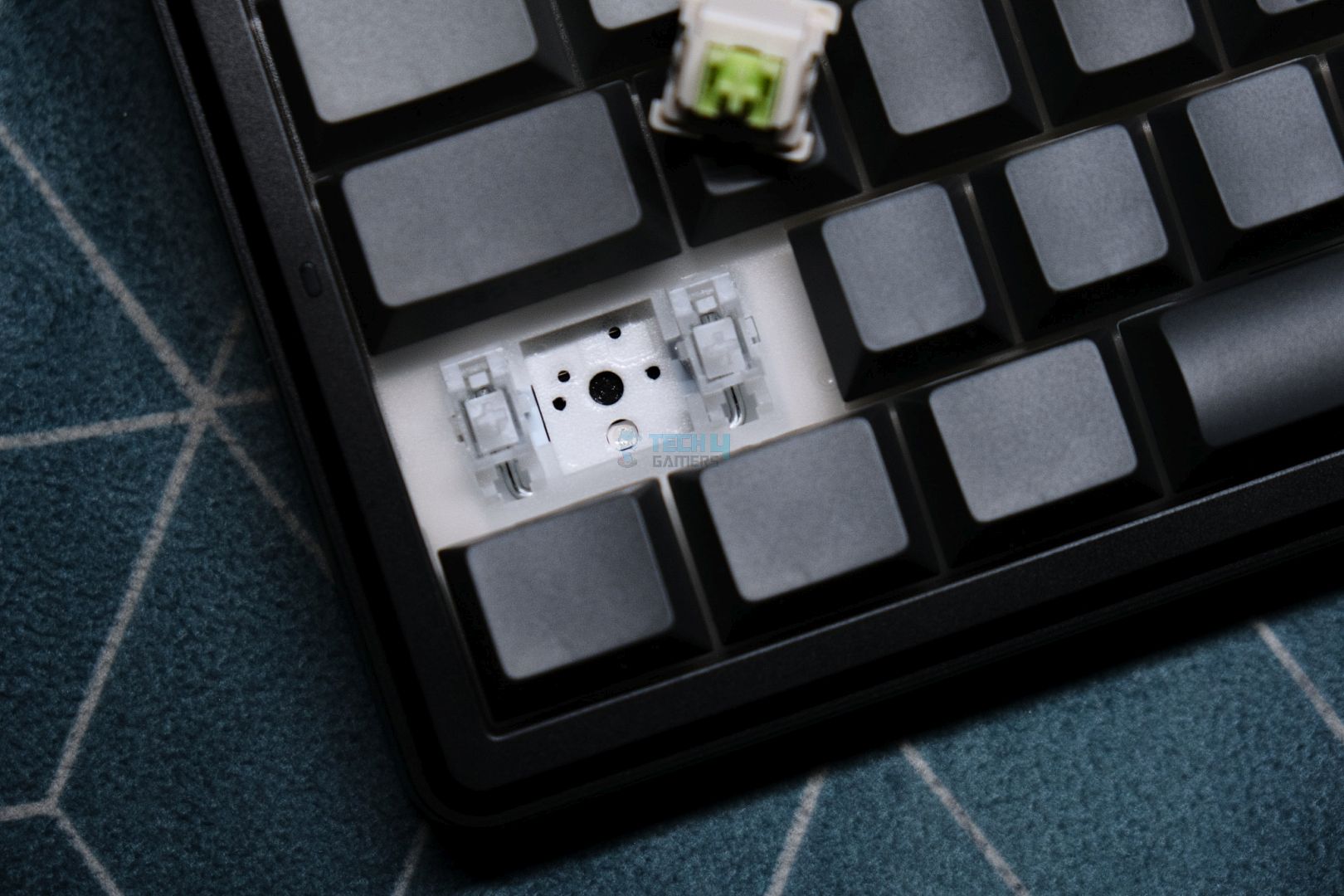
The F75 Max is wireless with support for 2.4Ghz radio and Bluetooth connections. It has a nifty magnetic slot to hold the dongle next to the USB port on the left side. The board is also fully hotswap. It has south-facing sockets with per-key RGB that is customizable in the software.

Peering under the hood, the PCB doesn’t have any flex cuts, but the polycarbonate plate does. Aside from that, there’s plenty of foam inside to dampen the sound including the plate foam, PE sheet, PET sheet, bottom PCB foam and a silicone pad at the bottom. 

Aula F75 Max flex cuts
Aula F75 Max flex cuts (Image by T4G)

The Fundamentals

Keycaps

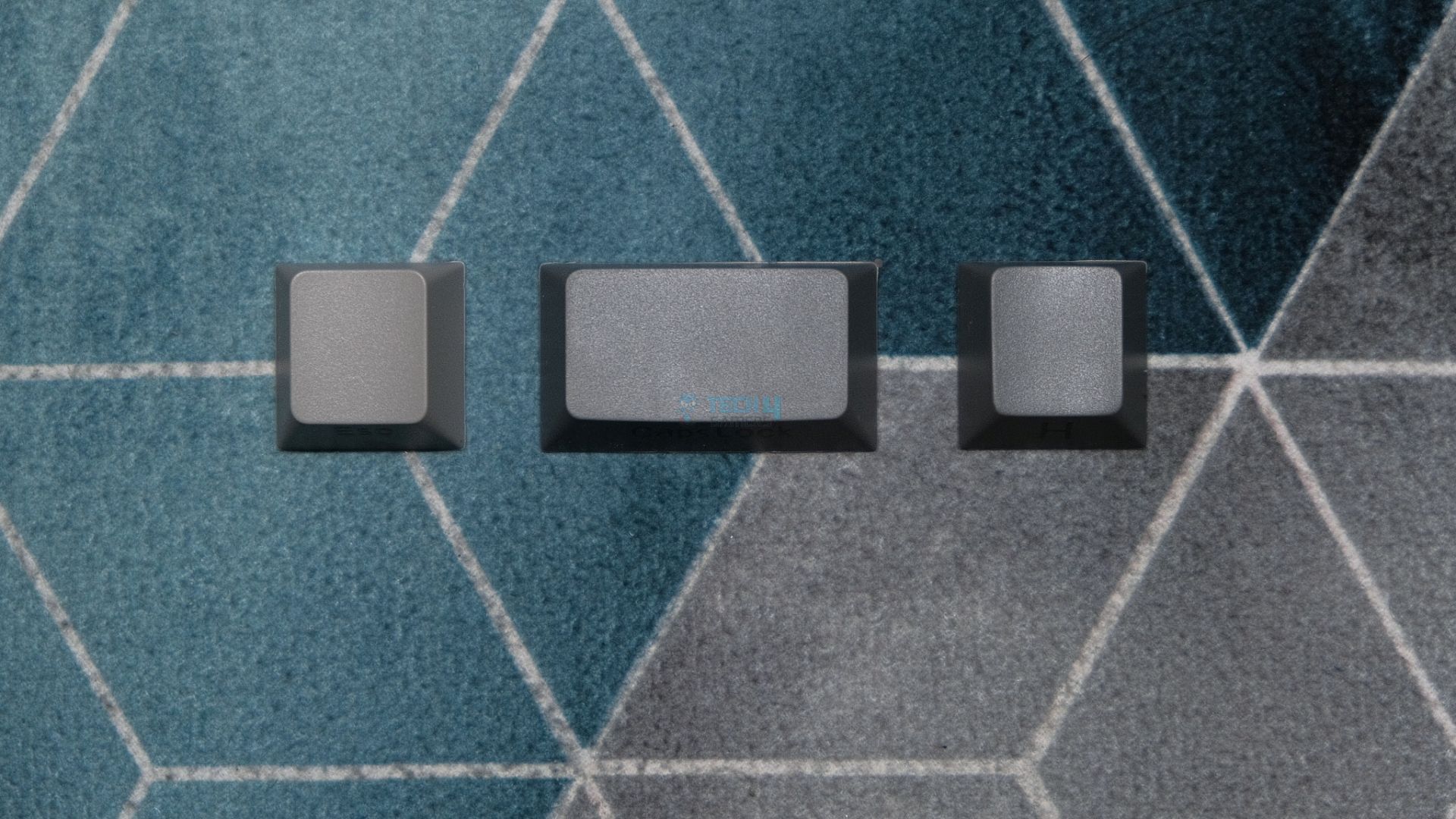
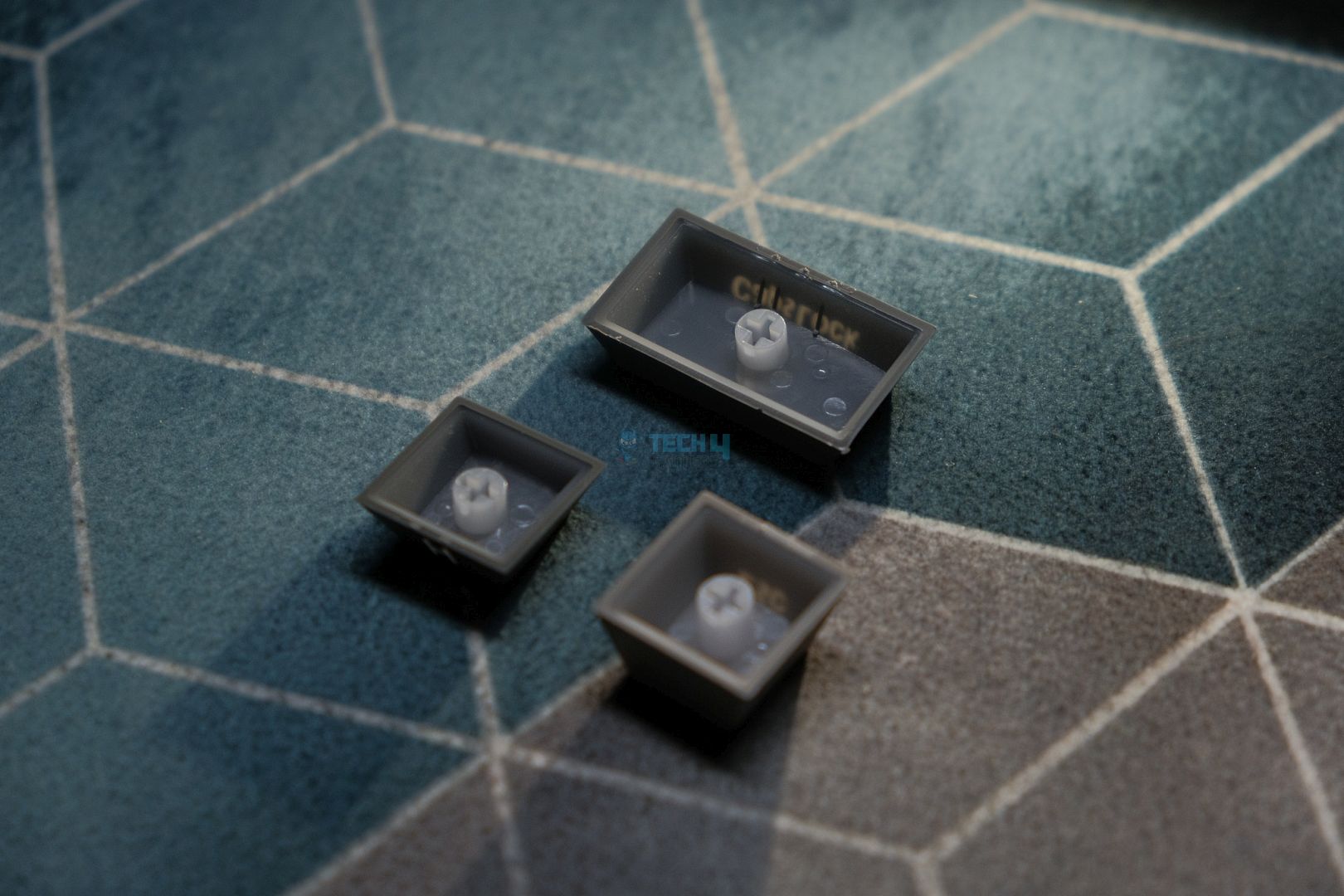
Aula has bundled in two different sets of doubleshot keycaps with the F75 Max. They’re made out of PBT and come in the Cherry profile. There’s a blue and purple colorway which does not shinethrough. We have the other grey set that’s blank and has legends printed on the side for some sleek RGB action.

Aula F75 Max keycaps
Aula F75 Max keycaps (Image by T4G)

Unfortunately, these aren’t the highest quality. There are molding marks present on the backside of the keycaps and the thickness of the shinethrough element is way too low. You can also see jagged edges left from the molding process. Usually, higher quality keycaps have this excess plastic removed in a process called “deflashing” but that doesn’t seem to be the case here. 

Regardless, the keycaps have a matte texture similar to any other PBT set. They feel nice to type on and if you’re not looking for the flaws, they look good on the board. I’m not a fan of the font but the RGB is spread evenly. Only the mods suffer from some inconsistency, and you can especially see the dullness in the Caps Lock key where the light doesn’t diffuse properly.

Aula F75 Max Caps Lock key
Aula F75 Max Caps Lock key (Image by T4G)

Switches

The switches are a highlight of the F75 Max as the company is using Epomaker Sea Salt linears in the board. These are factory-lubed linears with a 30g initial actuation force and they bottom out at 60g. They have a POM stem while the housing is made from PC & Nylon. The total travel distance is 4mm, but they actuate halfway through at around 2mm.

The Epomaker Sea Salt switches inside the Aula F75 Max
The Epomaker Sea Salt switches inside the Aula F75 Max (Image by T4G)

All this makes for a great sounding switch. There’s minimal stem wobble and the factory lube job is consistent. Upon close inspection, I found the switches were a bit overlubed in fact. The Sea Salts also have a Kailh housing instead of an MX-style one. Most importantly though, they have LED diffusers that help, well, diffuse the LEDs on the PCB to enhance the side-lit effect of the keycaps. 

Stabilizers

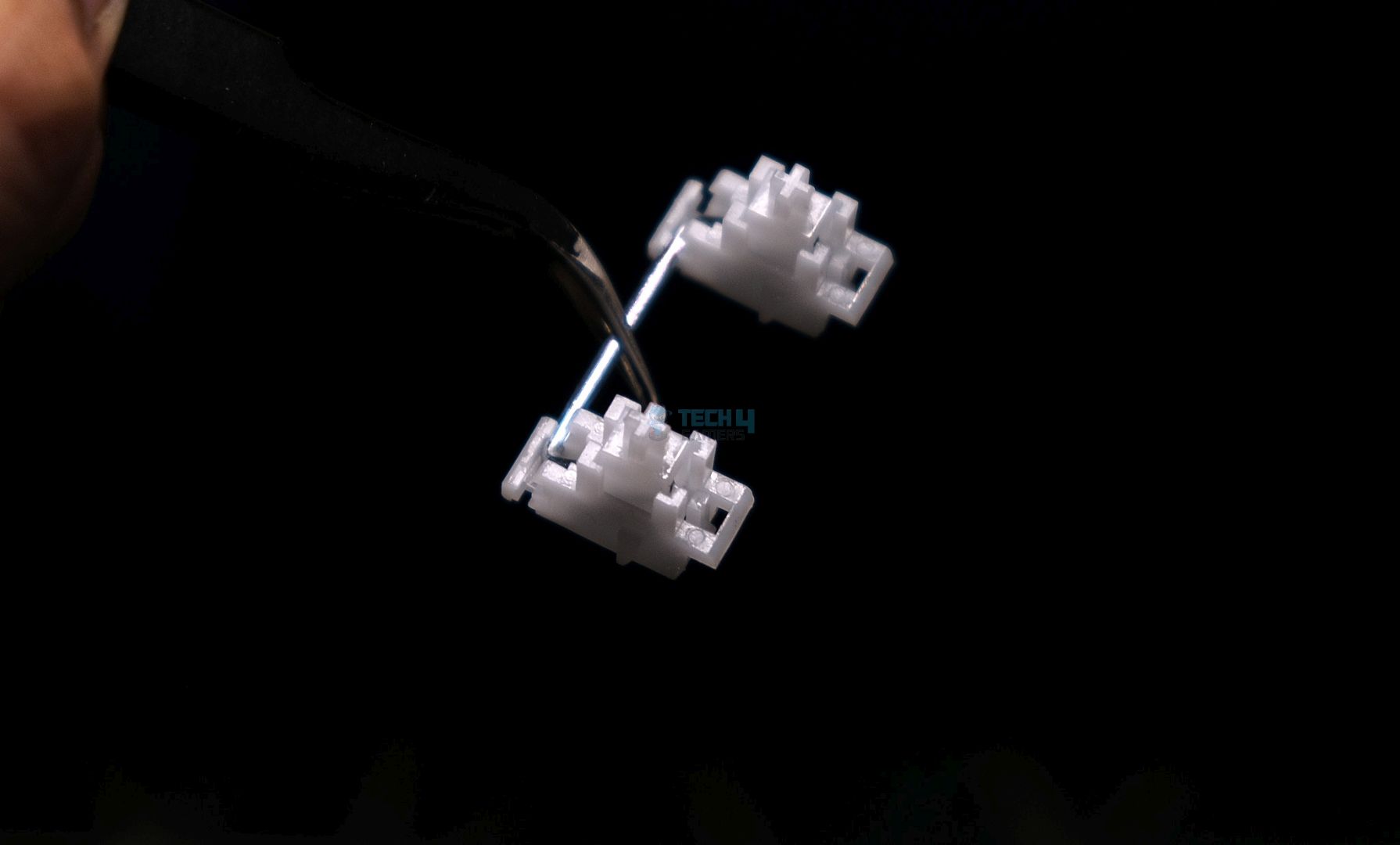
This section of the review has started to feel more and more monotonous as time goes on because every board that comes out these days has good stabilizers. In fact, it’s the exception to the rule now to point out any issue. Case in point, the F75 Max has perfect stock stabs out of the box that come lubed from the factory. There’s no ticking or rattling at all.

The Screen (+ Knob)

This is arguably the main reason you’d even consider buying the F75 Max over the F75. I’m just gonna come out and say: the screen is bad. Firstly, it’s way too small at just the size of a single key. Secondly, it’s way too dim that even in the lowest of light it’s hard to make out what’s on it. Lastly, it scratches incredibly easily to the point that cleaning it will damage the surface coating.

I tried a microfiber cloth; I tried tissues; I even tried some diluted isopropyl alcohol as well. Nothing could clean this screen. It already had a hairline scratch out of the box and in the process of trying to remove that it only made everything worse, and the screen genuinely looked like it had gone through war.  

Moving on, the screen can only be controlled with the extremely loose volume knob. This made for an amazing combination where I’d have misinputs 90% of the time. I’d carefully hover over to the thing I wanted and as soon as I tried to click, the knob would just throw off my target. It was borderline comical. 

Aula F75 Max screen homepage
Aula F75 Max screen homepage (Image by T4G)

As for the actual functionality, the screen has a homepage displaying time, battery percentage (nice touch), connection mode and the date. You also have indicators for Caps Lock, Win Lock and Num Lock here. There’s another layer for a custom picture or GIF you can upload from the software. 

Finaly, there’s a bunch of pages for mainly changing the RGB settings like effect, brightness, speed etc. You can also control other things like language and choosing between Win/Mac layouts. You turn the volume knob to cycle between these layers. If you want the knob to simply control volume, you have to first select the volume option on the screen every time, then spin it.

Connectivity & Performance

Being a wireless keyboard, the F75 Max has a 4000mAh battery inside to power everything. On a full charge, it lasted me about 2 days before dying and if I had the RGB (and screen) disabled then the endurance would stretch up to a week. The board has an aggressive standby mode. Every minute of non-usage, it will simply turn itself off, but it wakes up the instant you touch it again.

Aula F75 Max USB port
Aula F75 Max USB port (Image by T4G)

The Aula F75 Max performs just as well as any other modern Aula board. It has low enough latency that you can even play competitive games wirelessly, but I’d still suggest plugging in for that. During normal use, the board never disconnected or had any random lag issues. It was a smooth ride through and through. 

Typing Experience

All things considered, when it comes to the actual typing experience, Aula once again nails it. This is mostly due to the fact that all the fundamentals are great. The switches feel nice to type on and combined with the sound dampening layers inside, there’s a real impact to each keypress. The sound is satisfying, especially coming when you hit that spacebar each time.

Despite having a thin PCB and a soft plate with flex cuts, the F75 Max is not exactly a bouncy keyboard. You can get some amount of flex if you press really hard, but it’ll feel firm in everyday typing. Anyhow, there’s a real oomph in the acoustics. The board sounds mildly creamy with a lot of depth. It’s not so muted that it becomes quiet either; there’s just enough volume. 

Software

The Aula F75 Max comes with its own proprietary software that you can download from Epomaker’s site. In terms of UI, it looks identical to the Galaxy70 and Tecware Spectre 75 software. Everything is neatly arranged into tabs on the left side. It’s also plenty smooth and didn’t crash on me once during my usage.

You get all the standard settings like custom keymapping, RGB controls, macros, but also a dedicated page for the screen. You can upload your own pictures or GIFs; each frame takes about 1.2 seconds to upload which is on the faster side for these screens. You can also draw or write on any frame. Everything is saved within the software for you to revisit later.

Should You Buy It?

Buy It If:

You prefer understated looks. The blank keycaps with the side-lit keycaps on the F75 Max give it a real sleek aesthetic.

You want a great sounding keyboard that doesn’t break the bank. The factory-lubed stabs and switches offer a great out-of-the-box experience.

You value wireless performance. The F75 Max has great battery life and low enough latency to even play competitively.

Don’t Buy It If:

You want a keyboard with no gimmicks as the screen and even the volume knob on the F75 Max is poorly implemented.

You like high-quality keycaps and don’t mind if they’re not shinethrough. The keycaps you get here have cheap-looking borders.

You’re after the best value in a budget keyboard. The standard Aula F75 still offers more for your dollar and if you want the novelty, go for the Tecware Specter 75.

Aula F75 Max in its RGB glory
Aula F75 Max in its RGB glory (Image by T4G)

My Thoughts

The Aula F75 Max is an unfortunate tale of trying to fix something that ain’t broken in the first place. Had the company stuck with the same volume knob and put a better screen onboard, this would’ve been the easiest recommendation of all time. The F75 is already such great value that anything succeeding it has to live up to sky-high expectations, and the Max falls short.

All that being said, the actual core components that comprise your daily typing experience are all just as good as ever. The switches and stabilizers, especially, are really high-quality and if you like the RGB aesthetic, even the keycaps do their job. If you just forget the screen is there, you’d still have to deal with it to use the volume knob and that’s just inexcusable.