At T4G, my task is to cover the latest news around the gaming globe ASAP and with the utmost precision. I adore all the games and respect all the devs behind the amazing games that we get all year. So, whether it’s a PC or a Console game, I got it all covered.
Story Highlight
BioWare has now reduced its headcount to less than 100 people.
Many employees were ‘temporarily’ shifted to other teams.
They have now been told that the shifts are permanent, leaving the studio with a small team.
Once a legendary studio, BioWare has fallen from grace since the launch of Dragon Age: The Veilguard. After failed sales targets and several layoffs, a new report states that less than 100 people are left at the studio.
Why it matters: The next Dragon Age was supposed to be a massive comeback for the franchise, but it didn’t pan out that way and has seriously affected BioWare’s reputation.
Dragon Age: The Veilguard disappointed massively in every way.
Yesterday, it was reported that all the writers who worked on The Veilguard have been fired by the company. So, the staff, which was over 200 people a couple of years ago, has been significantly reduced.
A report from Bloomberg states that EA ‘temporarily’ put some of its employees in different teams and they would be returned to BioWare soon. However, the company has now informed the employees that the move has been made permanent.
To return to BioWare, they’ll have to reapply if there is an opening at the studio. This has happened as the studio is now shifting its attention towards the next Mass Effect game. While most people still have a job, they aren’t too thrilled.
The employees say that they have been made part of a team they didn’t wish to join. However, that is still on the plus side, as many staff members were laid off recently, so at least many developers got to keep their jobs.
Dragon Age has led to many layoffs due to failure.
Nonetheless, the future of BioWare now looks a bit grim. The studio even pulled off from Dragon Age: The Veilguard support, and the production for Mass Effect isn’t reportedly starting any time soon.
What are your thoughts on BioWare slashing its headcount to less than 100 people? Let us know your opinions in the comments or join the discussion at the official Tech4Gamers Forum.
At Tech4Gamers, I contribute as a Senior News Reporter, combining my skills and gaming enthusiasm to keep our audience updated on the latest developments.
Story Highlight
Spider-Man 2 has only managed to reach 24K concurrent players on Steam.
This player count is significantly lower than the 66K players reached by the original Spider-Man.
PlayStation’s poor marketing and underwhelming PC port seem to have hurt its latest release.
Spider-Man 2 is now available on PC, but the game seems to have failed to live up to its predecessor. In addition to a shockingly low-quality port, this PC release has not been able to measure up to past player counts.
At present, Spider-Man 2 has managed to reach just over one-third of the first title’s Steam concurrent players.
Why it matters: It was already noted that PlayStation’s marketing ahead of this release was lacking in more than one way. The player counts show that the game is certainly suffering as a result of poor marketing.
According to SteamDB, Spider-Man 2 peaked at around 24K players on PC. This figure was even lower during the first 24 hours, but it still shows a notable decline compared to the original Spider-Man.
For context, Insomniac’s previous title peaked at over 66K players immediately after release. This figure is nearly 3x higher, showing a shocking decline that puts the new PC port more in line with Spider-Man: Miles Morales.
This standalone entry managed to hit around 13K concurrent Steam players at its peak. While Spider-Man 2 is still in a better position, its player count is certainly disappointing, considering the fact that its predecessor was among PlayStation’s biggest hits on the platform.
Insomniac Sold Millions of Copies on PS5 Already
Because the weekend has just arrived, Insomniac’s latest release could still gather more players over the next two days. However, it seems unlikely for the title to measure up to the rest of PlayStation’s PC offerings at this point.
Perhaps future discounts will be Insomniac’s best bet if the studio hopes to entice more players toward a purchase. Also, the regional Steam restrictions should be lifted soon, providing a potential opportunity to gain more sales.
At Tech4Gamers, I’m the PC Hardware Specialist, primarily contributing to the “Best-Ofs” section. I provide thoughtful buying advice based on thorough testing and personal expertise. I also review hardware products and games to keep things fresh.
Today, I will be reviewing another B850 motherboard, this time from ASRock. This is the ASRock B850M Steel Legend WiFi; as you can guess from the M suffix in B850M, this is actually a MicroATX board, and Steel Legend is the brand ASRock uses for its white-themed boards. We have also tested and reviewed the ASRock B650E Steel Legend WiFi, which is the direct predecessor of this motherboard (apart from the form factor difference).
In any case, it is great to see B850 motherboards finally roll in, as we were left with just the flagship X870 and X870E chipsets for the Ryzen 9000 processor. Being more affordable and mid-range, there are definitely cut-downs, like optional USB 4, but B850 still brings USB 3.2 (20Gbps), PCIe Gen5, and OC support for both the CPU and the memory. In this review, I will go over all the features of the ASRock B850M Steel Legend WiFi, along with its side-by-side performance comparison with other B850 motherboards.
Why Trust Tech4Gamers
Usman Saleem is our hardware tester who loves to put all the latest GPUs, CPUs, RAM, and motherboards for a spin.
40+ motherboards tested and reviewed by our team of hardware experts (Tech4Gamers Team).
800+ hours spent testing different motherboards for our reviews.
At Tech4Gamers, ensuring you get reliable information is our priority. That’s why every hardware round-up undergoes a meticulous review process by our team of experts and editors. Each review is carefully examined against our strict editorial guidelines, guaranteeing you trustworthy insights you can depend on.
Key Takeaways
The ASRock B850M Steel Legend WiFi is a budget-friendly MicroATX motherboard with PCIe Gen5, WiFi 7, and decent performance.
You should buy the ASRock B850M Steel Legend WiFi if you want a white motherboard that packs all the essentials to offer a good experience.
You should not buy the ASRock B850M Steel Legend WiFi if you plan on overclocking as the VRMs can run a bit hot.
These are the key specifications of the motherboard:
CPU Support
AMD Ryzen 7000, Ryzen 8000, Ryzen 9000
Chipset
AMD B850
Memory Support
DDR5 8000+ MT/s (OC), 4x DDR5 DIMM Slots, up to 256GB
PCIe Slots
1x PCIe 5.0 x16, 1x PCIe 4.0 x4
M.2 Slots
1x PCIe 5.0 x4, 1x PCIe 4.0 x4, 1x PCIe 4.0 x2
SATA Ports
4x 6Gbps
Audio
Realtek® ALC1220 Codec, 7.1 CH HD Audio, Nahimic Audio
17 ports, including 1x USB 10Gbps Type-C (Rear), 1x USB 10Gbps Type-A (Rear), 1x USB 5Gbps Type-C (Front)
Video Outputs
1x HDMI 2.1, 1x DisplayPort 1.4
Form Factor
Micro ATX: 24.4 x 24.4 cm
MSRP
$179
The USB 3.2 ports, WiFi 7, BT 5.4, and Gen5 expansion are all the key improvements AMD has made with the B850 over the B650.
[toc]
Packaging And Unboxing
Box Front
Box Back
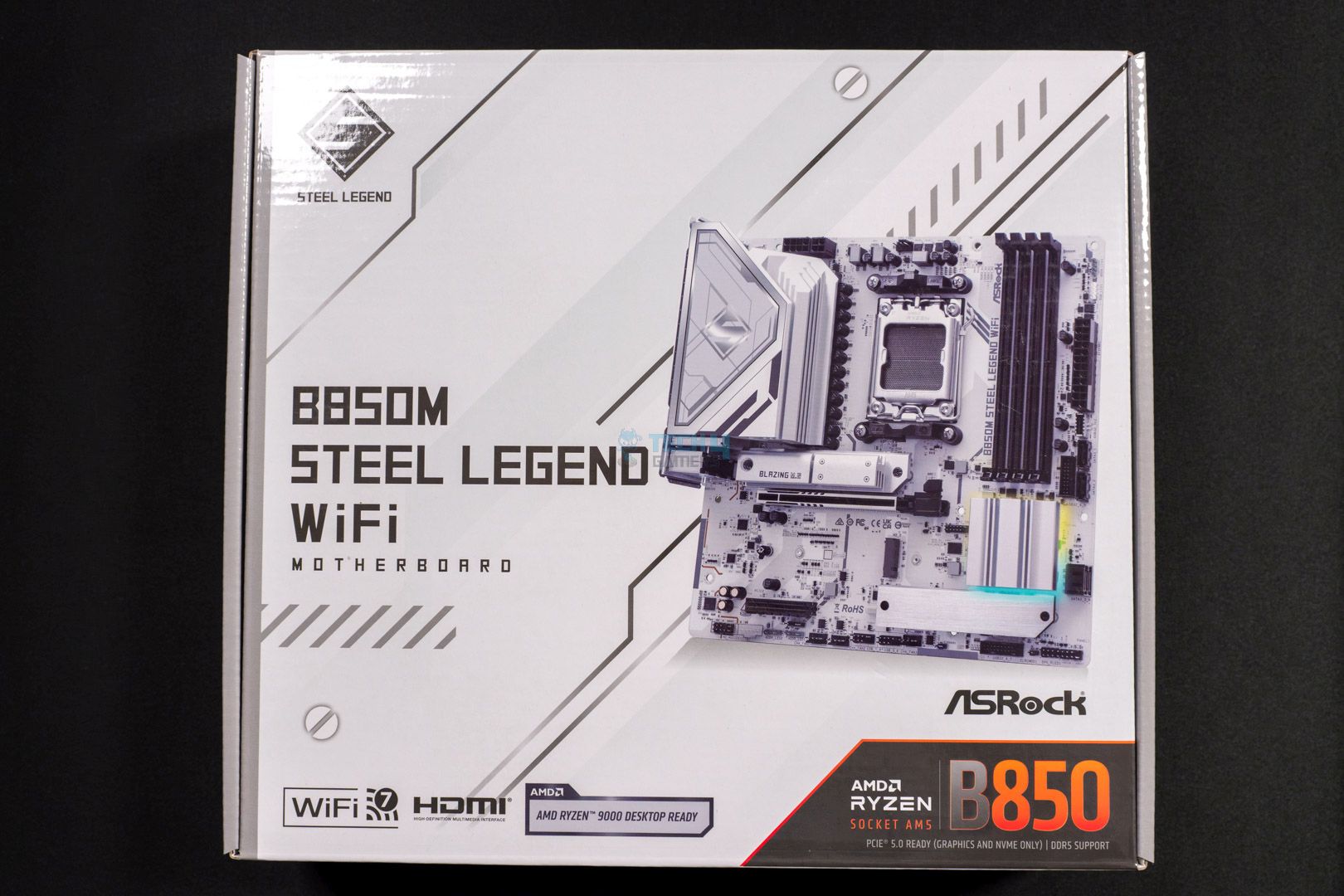
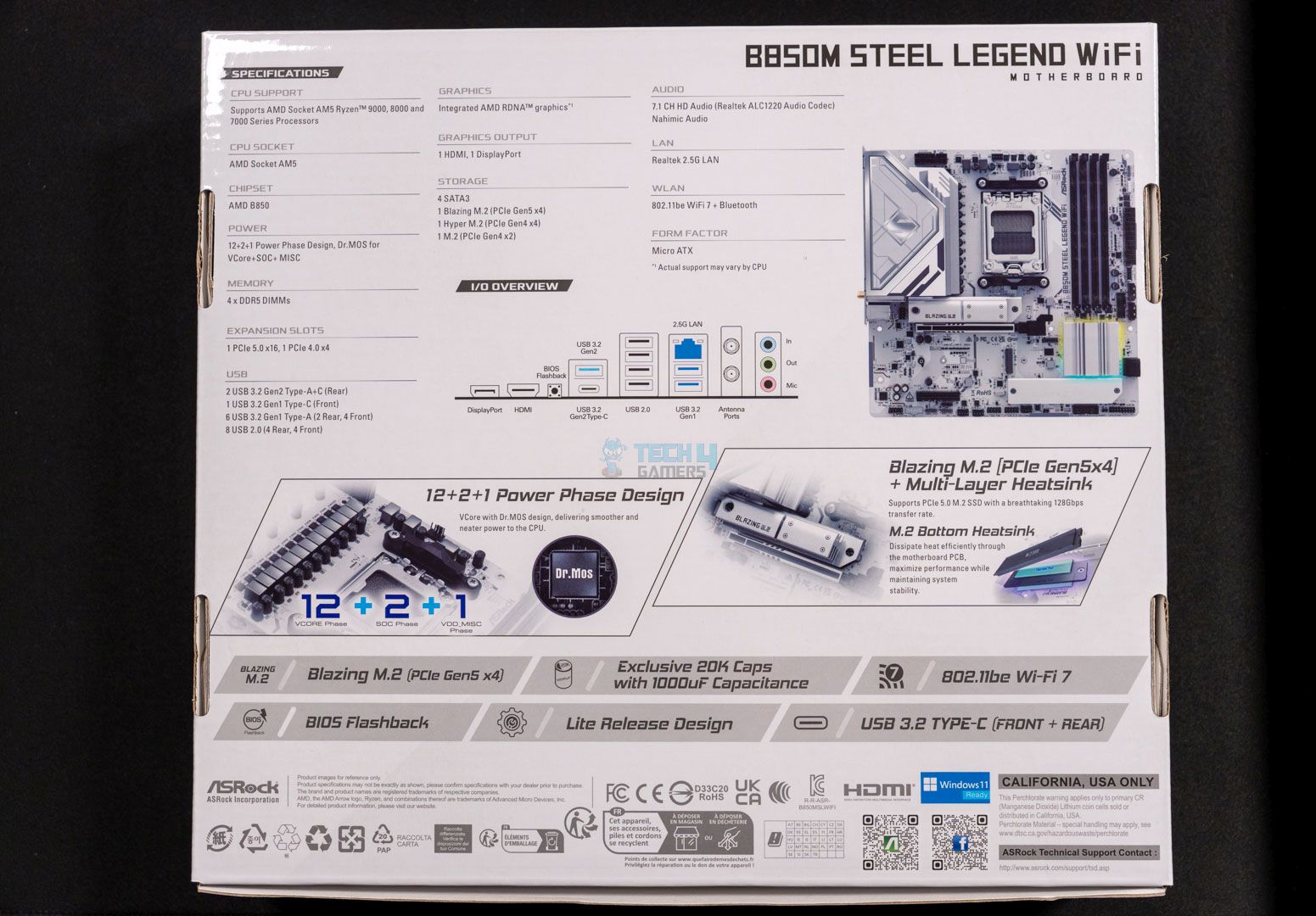
The motherboard comes in a white cardboard box, matching the Steel Legend theme. There is a picture of the board at the box front, along with WiFi 7 and HDMI logos. At the back, you will find a lot more information about the motherboard, including its specifications, I/O overview, VRM design, and other features.
The motherboard comes with:
2x SATA Data Cables
2x ASRock WiFi 2.4/5/6 GHz Antennas
1x Thermistor Cable
2x Screws for M.2 Sockets
1x Standoff for M.2 Socket
Design
Main Design (Image By Tech4Gamers)
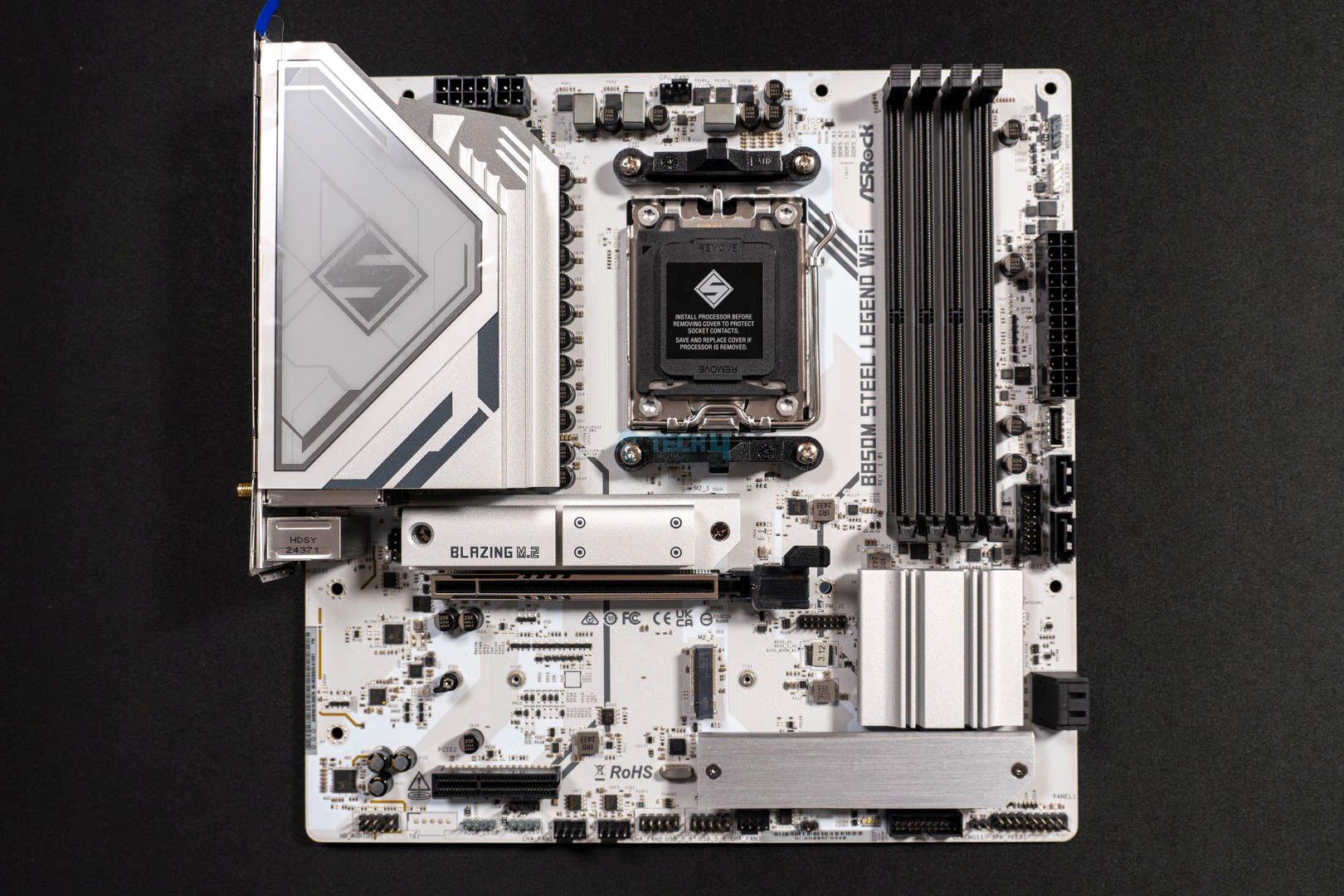
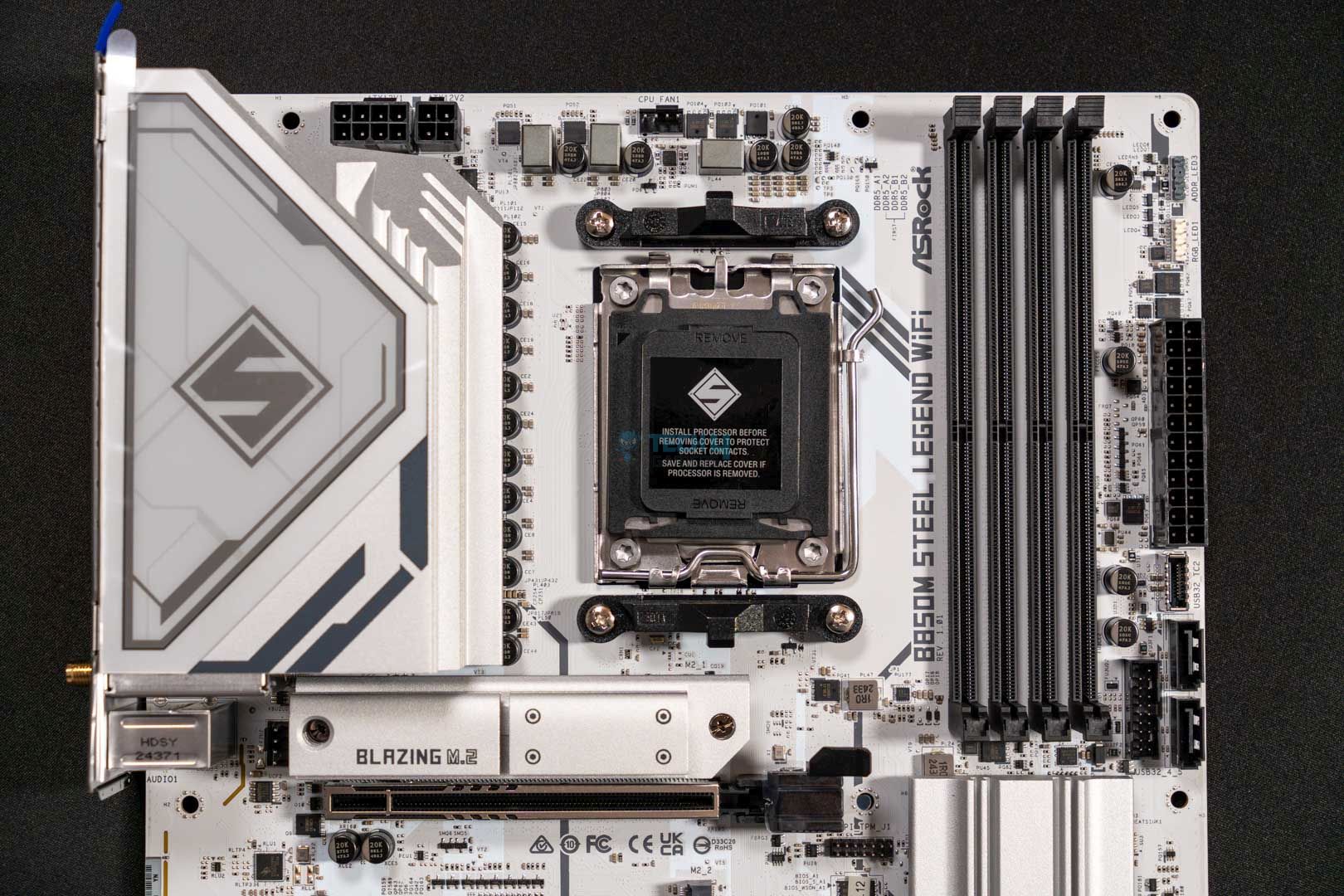
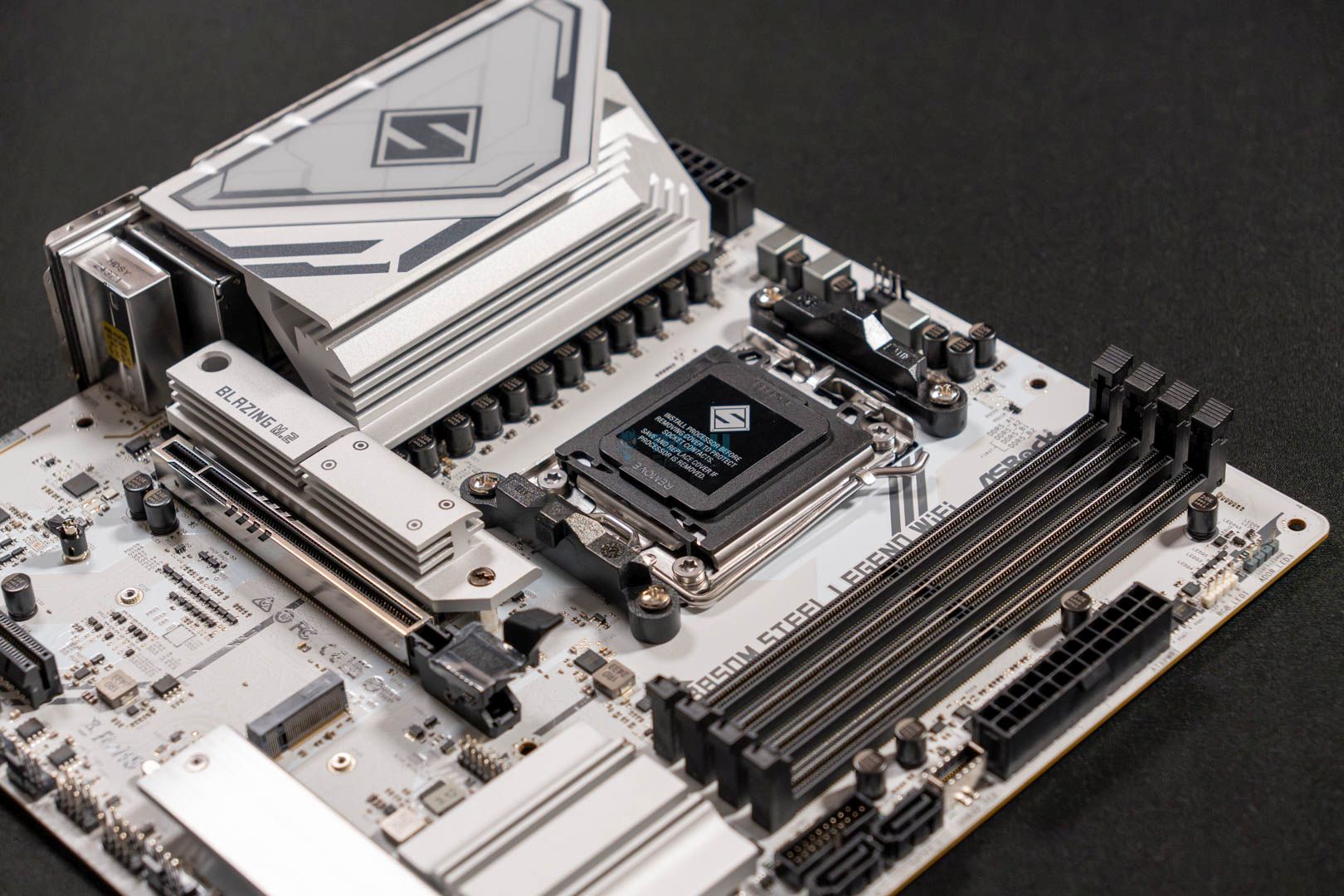
The motherboard features a beautiful white PCB with matching silver heatsinks. Speaking of which, the VRM heatsink/Rear IO cover is absolutely massive and features the Steel Legend logo with gray accents. The chipset heatsink below the DIMM slots also has some RGB elements around it.
You get a 6-layered PCB with 2oz thickened copper, which is pretty decent for a mid-range microATX motherboard.
Block Diagam
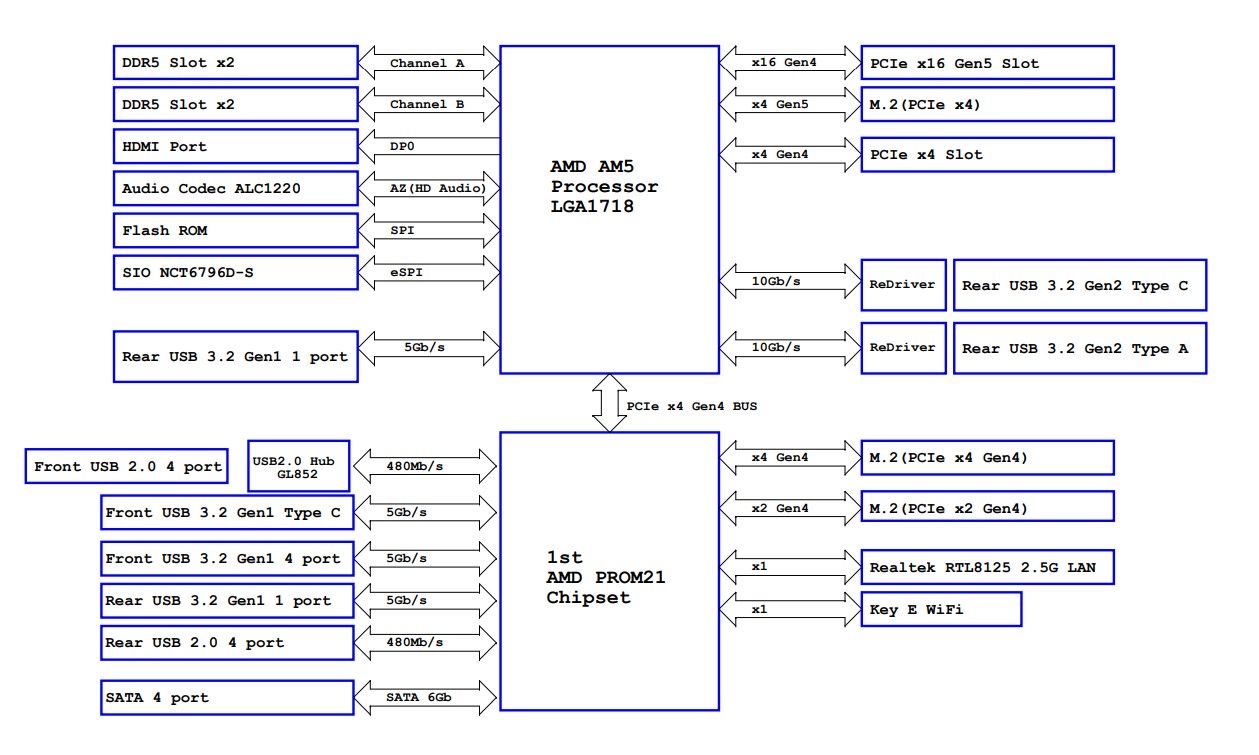
You’re getting a Gen5 M.2 slot, a Gen5 PCIe x16 slot, and a Gen4 PCIe x4 slot from the CPU, along with two rear USB 3.2 Gen2 10Gb/s ports (Type-C and Type-A), and a rear USB 3.2 Gen1 port (5Gb/s). Moving on, the chipset, which is connected to the CPU through a PCIe x4 Gen4 BUS, offers the rest of the USB ports, M.2 slots, and the Realtek 2.5G LAN.
CPU Socket And Power Delivery
Upper Design
CPU Socket (Image credit: Tech4Gamers)
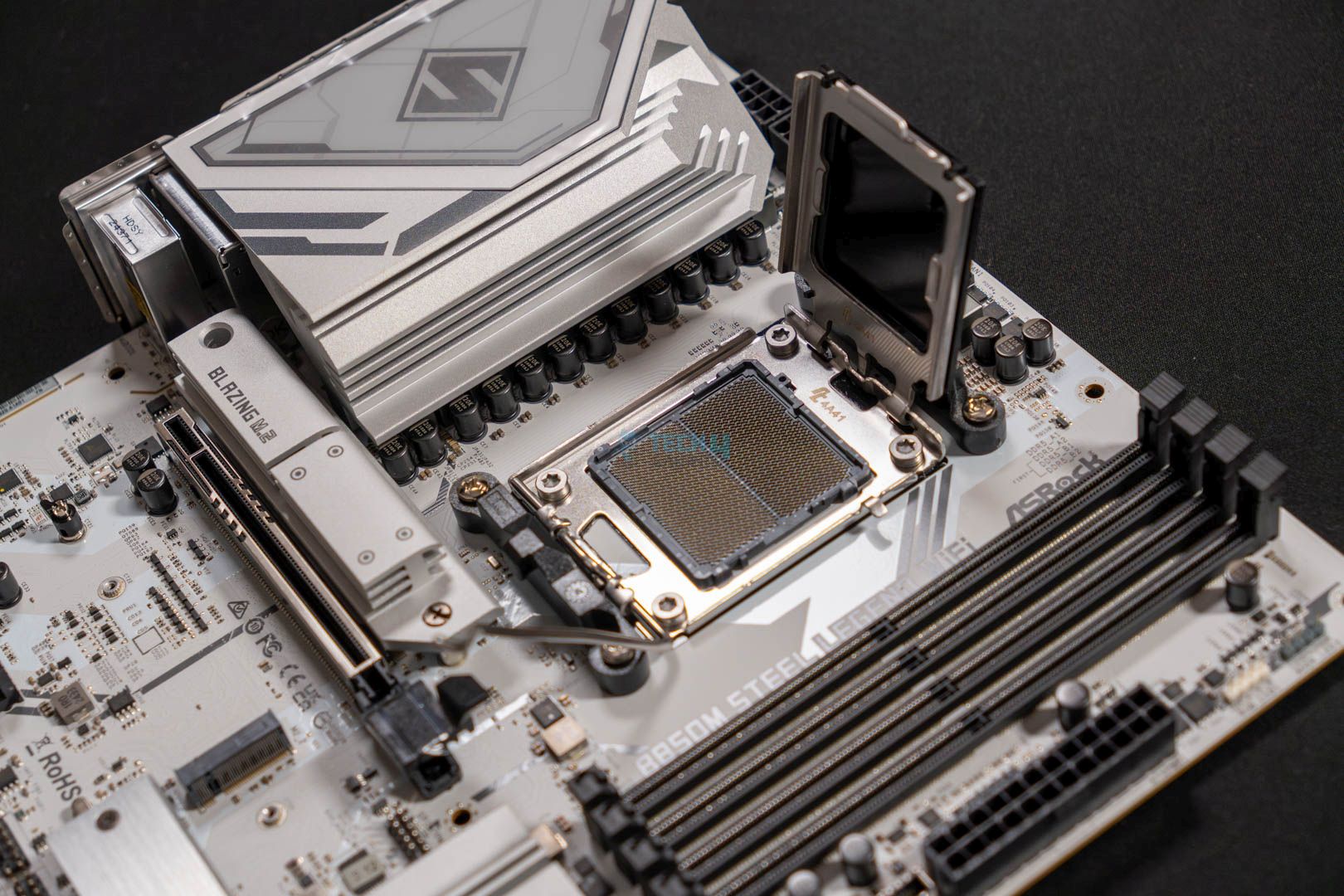
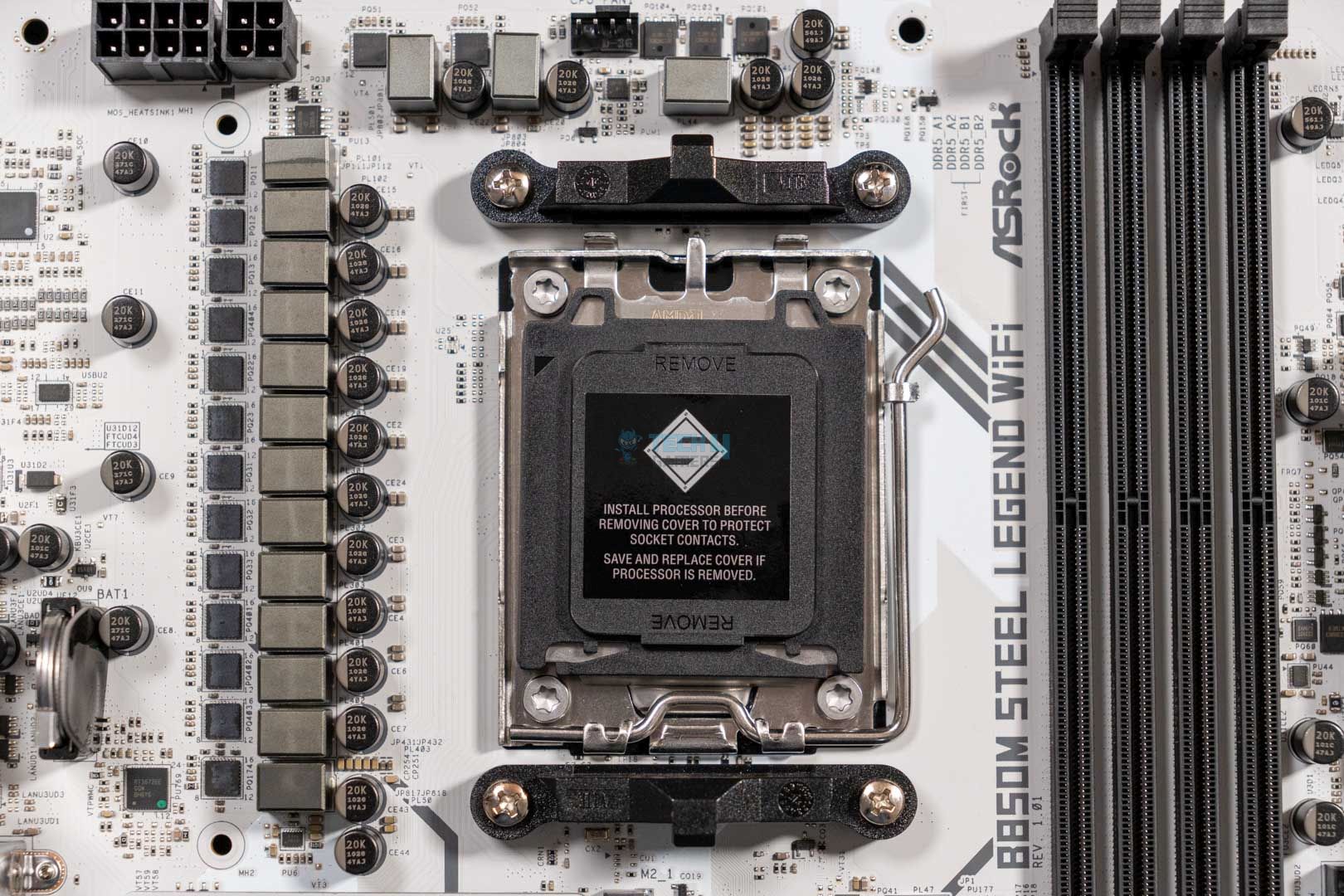
Being an AM5 motherboard, the ASRock B850M Steel Legend WiFi uses the LGA1718 socket, as such, it supports Ryzen 7000, 8000, and the latest 9000 series processors.
VRM Design
Closer Look At VRMs
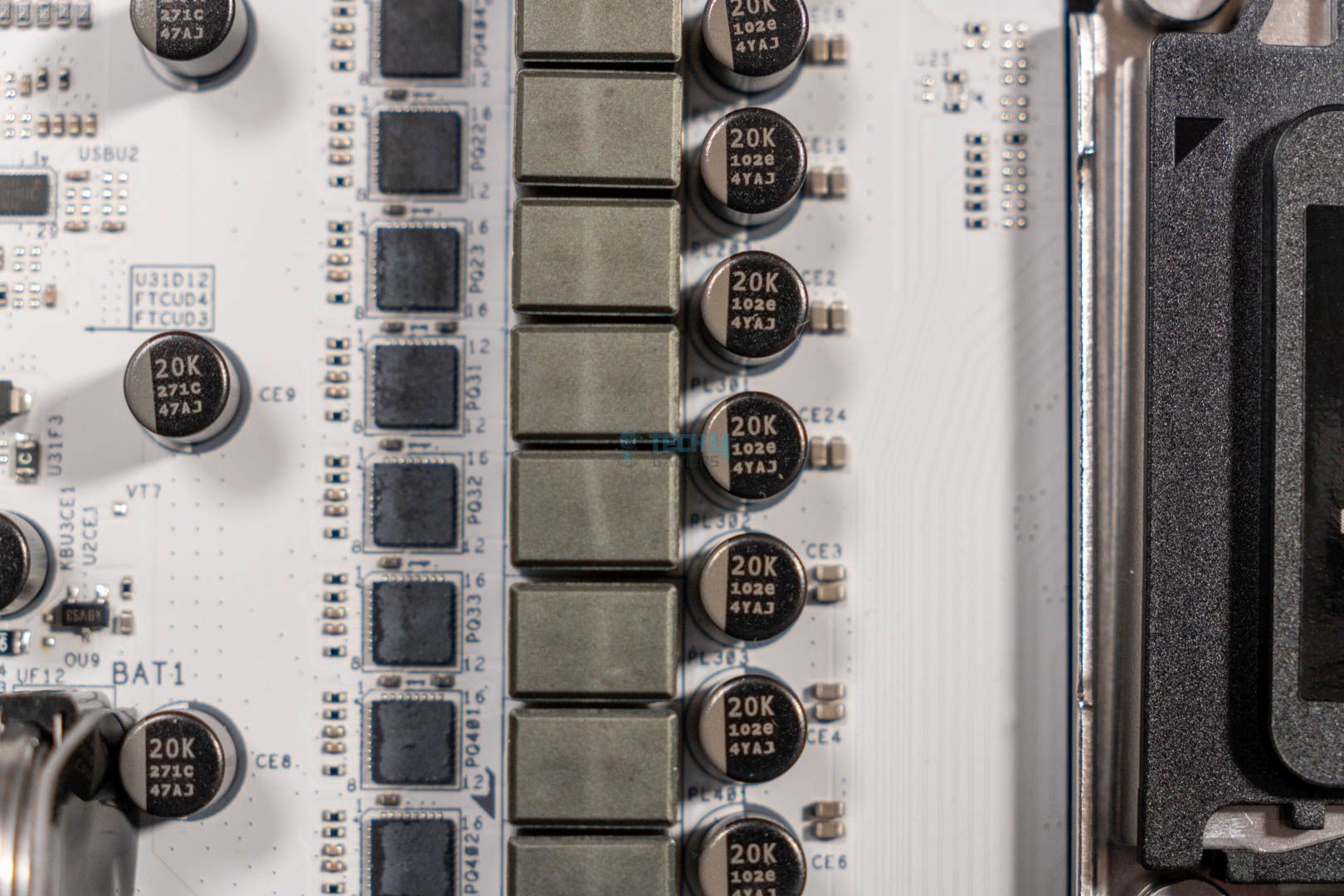
For power delivery, ASRock has used a 12+2+1 (VCore+SOC+MISC) power delivery system with 12 phases dedicated to the processor; this is more than enough for even the flagship Ryzen 9 9950X, as long as you don’t plan heavy CPU overclocking.
CPU Connector (Image By Tech4Gamers)
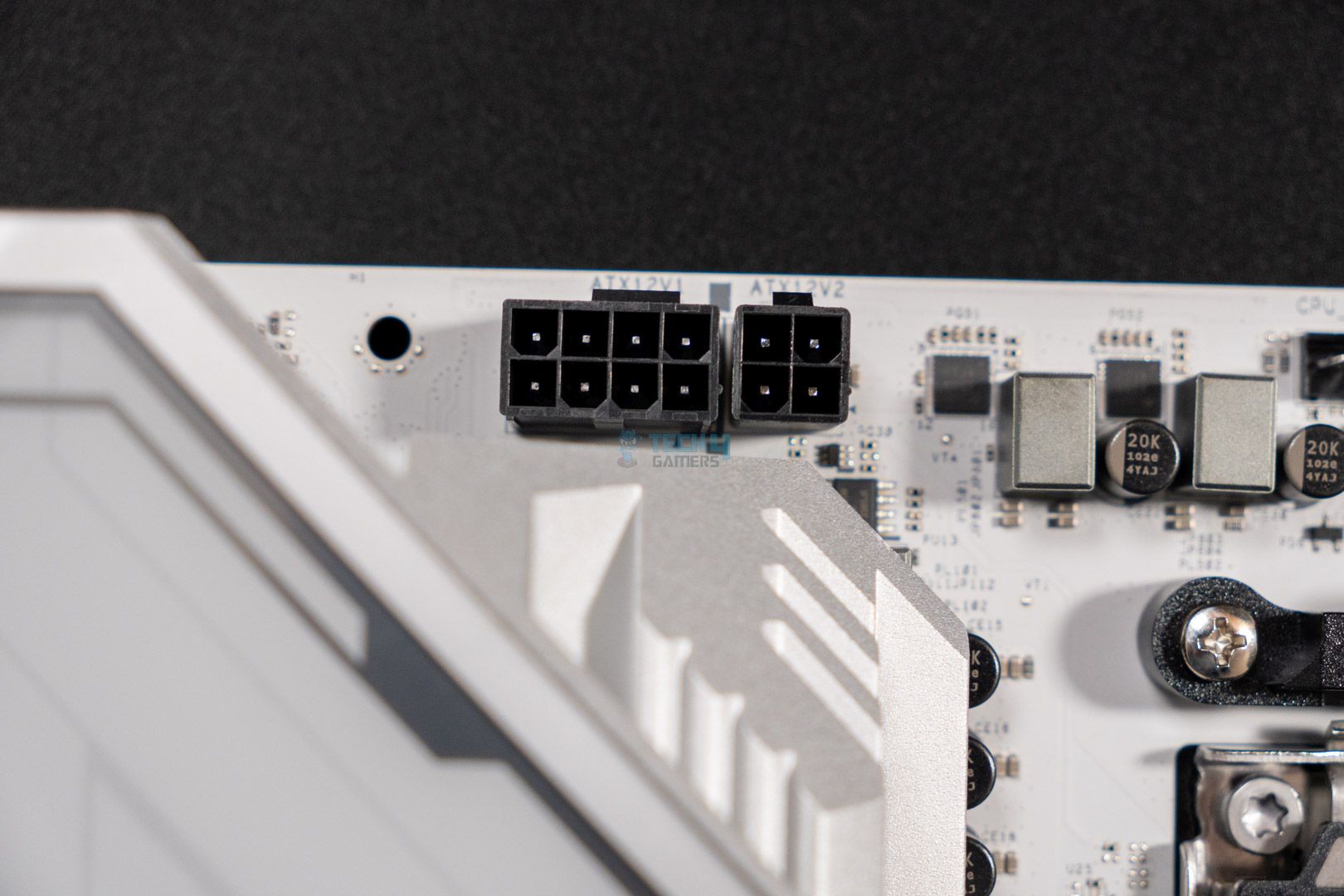
You can power the CPU through the ATX12V1 (8-pin, 12V) and the ATX12V2 (4-pin, 12V) power connectors. They have a solid-pin design, which is better for stability.
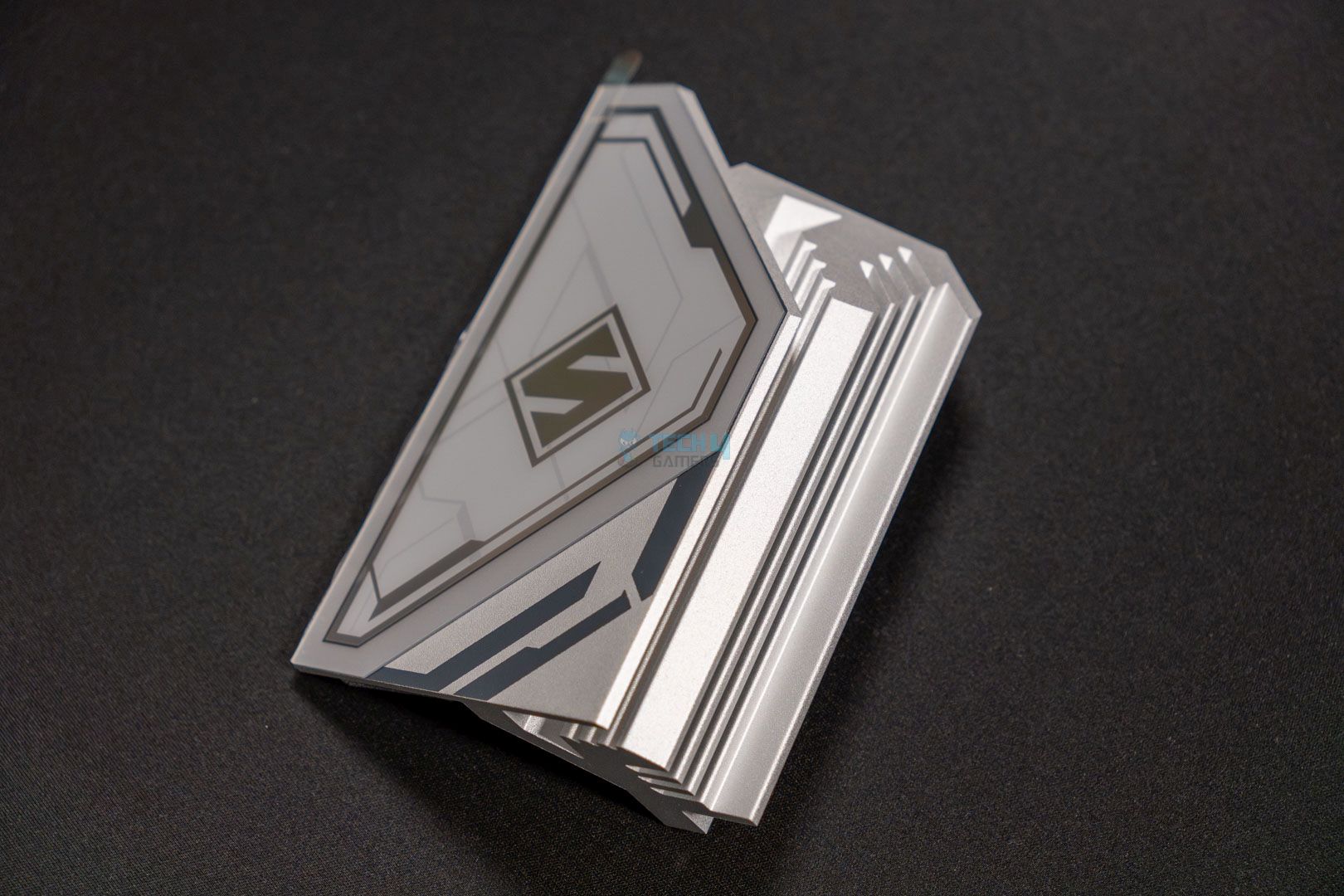
VRM Heatsink Stacked Design
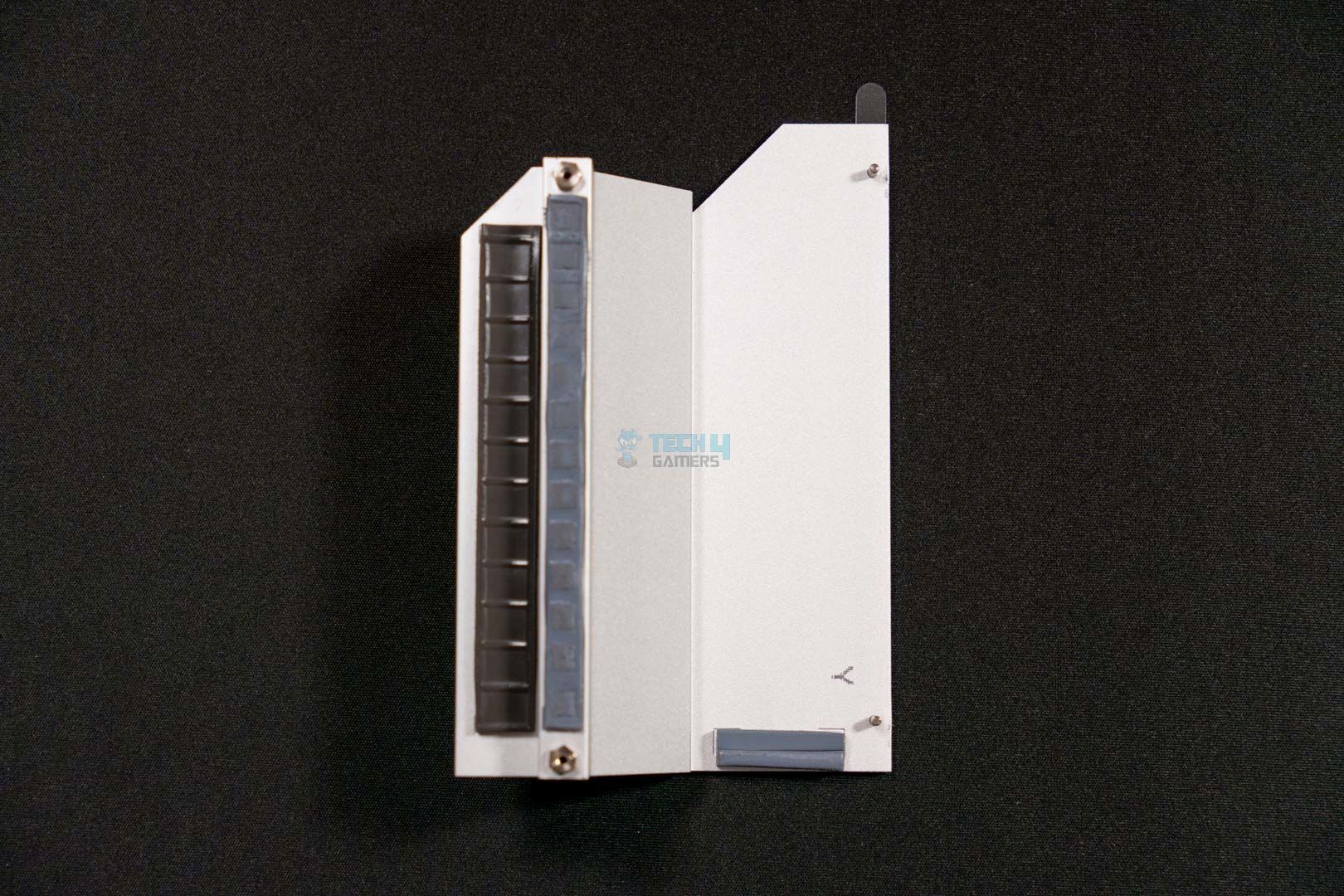
VRM Heatsink Thermal Pads
The VRMs are cooled using a massive aluminum heatsink with a stacked design for efficient heat transfer. Flipping it over also shows the thermal pads used to fill the air gaps between the heatsink’s base and the MOSFETs.
Rear IO Heatsink
Upper Design Side Angle
These are some more pictures of the VRM heatsink from different angles.
DIMM Slots
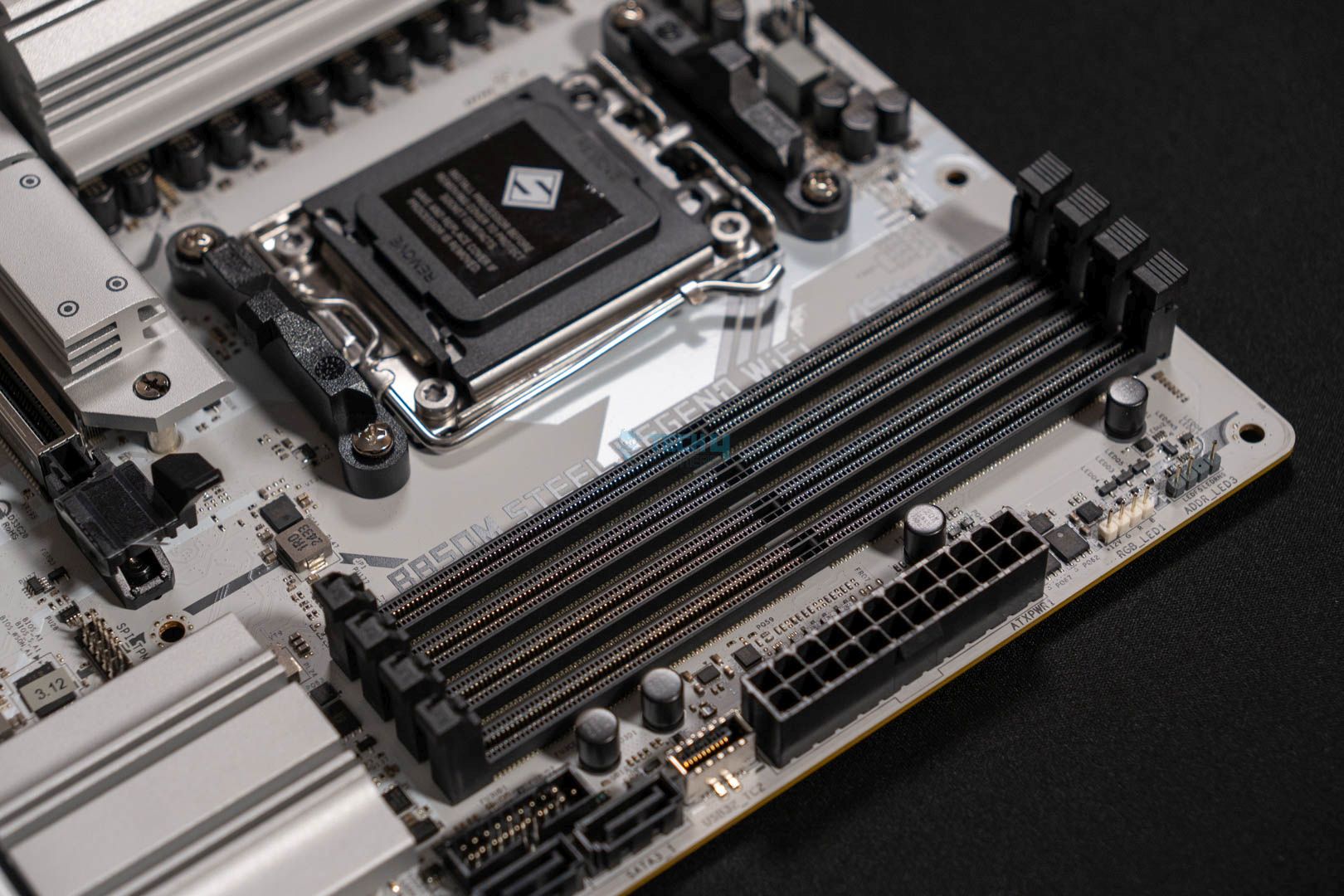
DIMM Slots (Image By Tech4Gamers)
As far as memory is concerned, the motherboard has 4x DIMM slots and supports DDR5 RAM with speeds north of 8000+ (OC). The total capacity is 256GB, so each slot can be populated with a 64GB kit. The board supports both AMD EXPO and Intel XMP for easy memory overclocking through the BIOS.
Storage
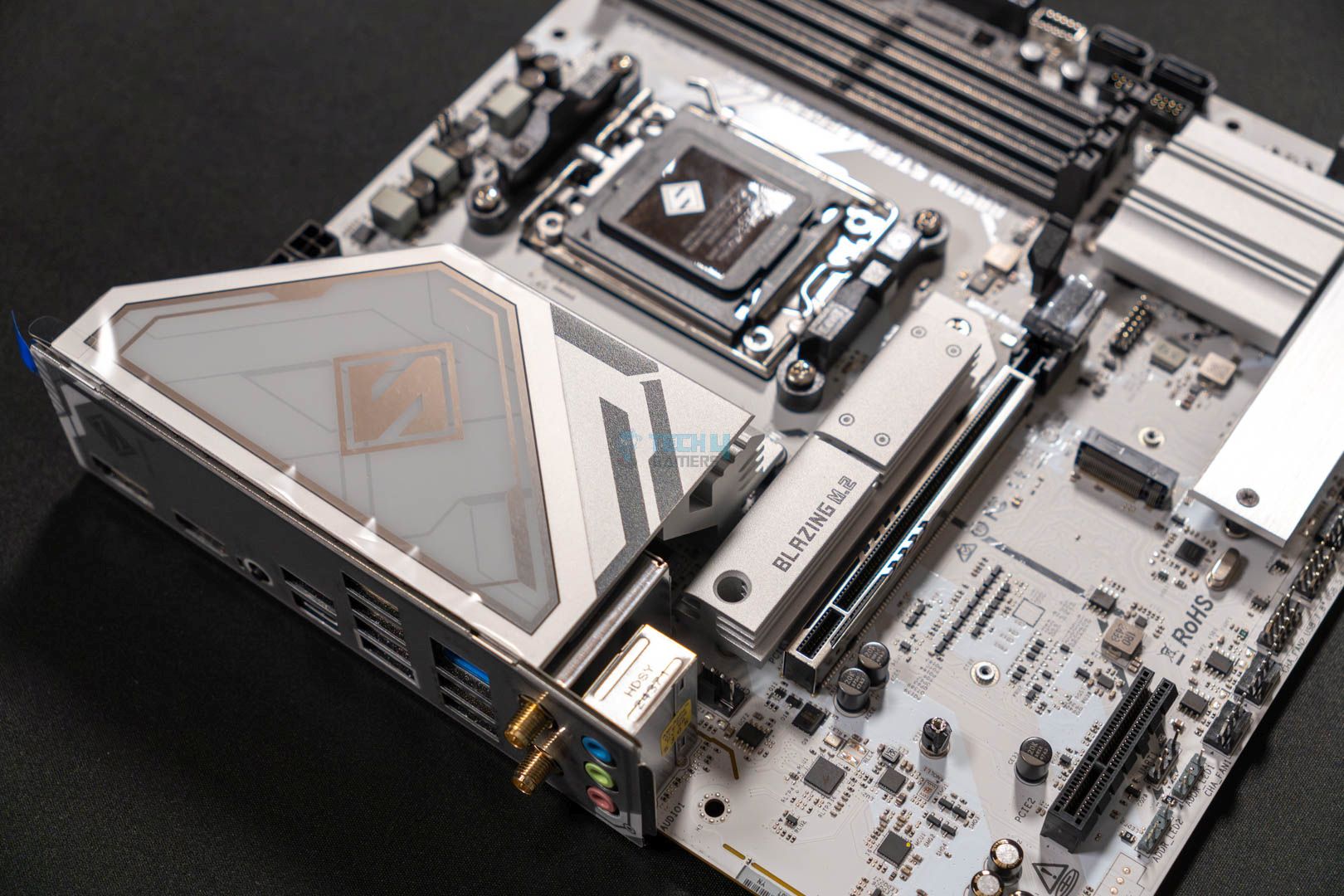
Top M.2 Heatsink
Top M.2 Heatsink Stacked Design
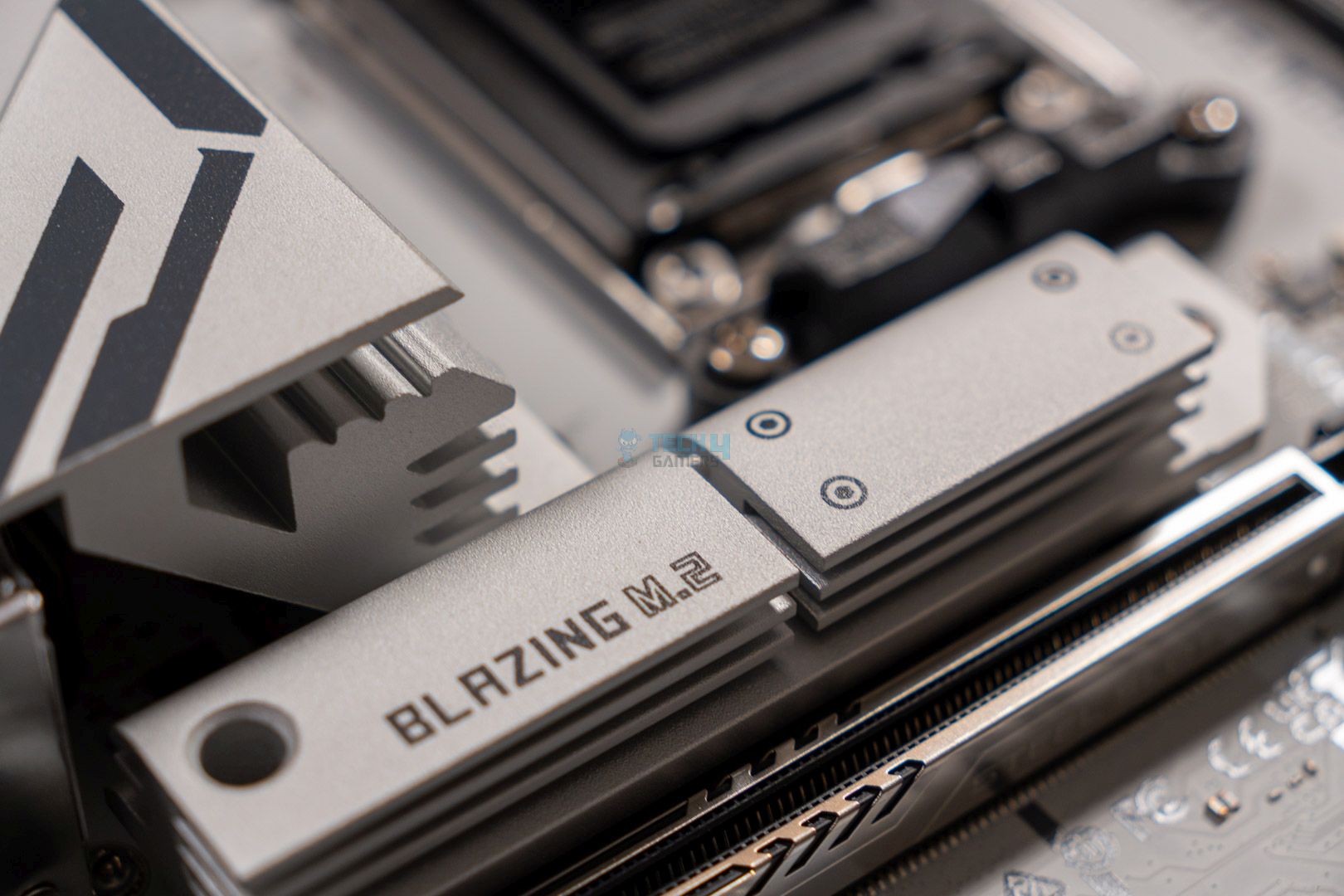
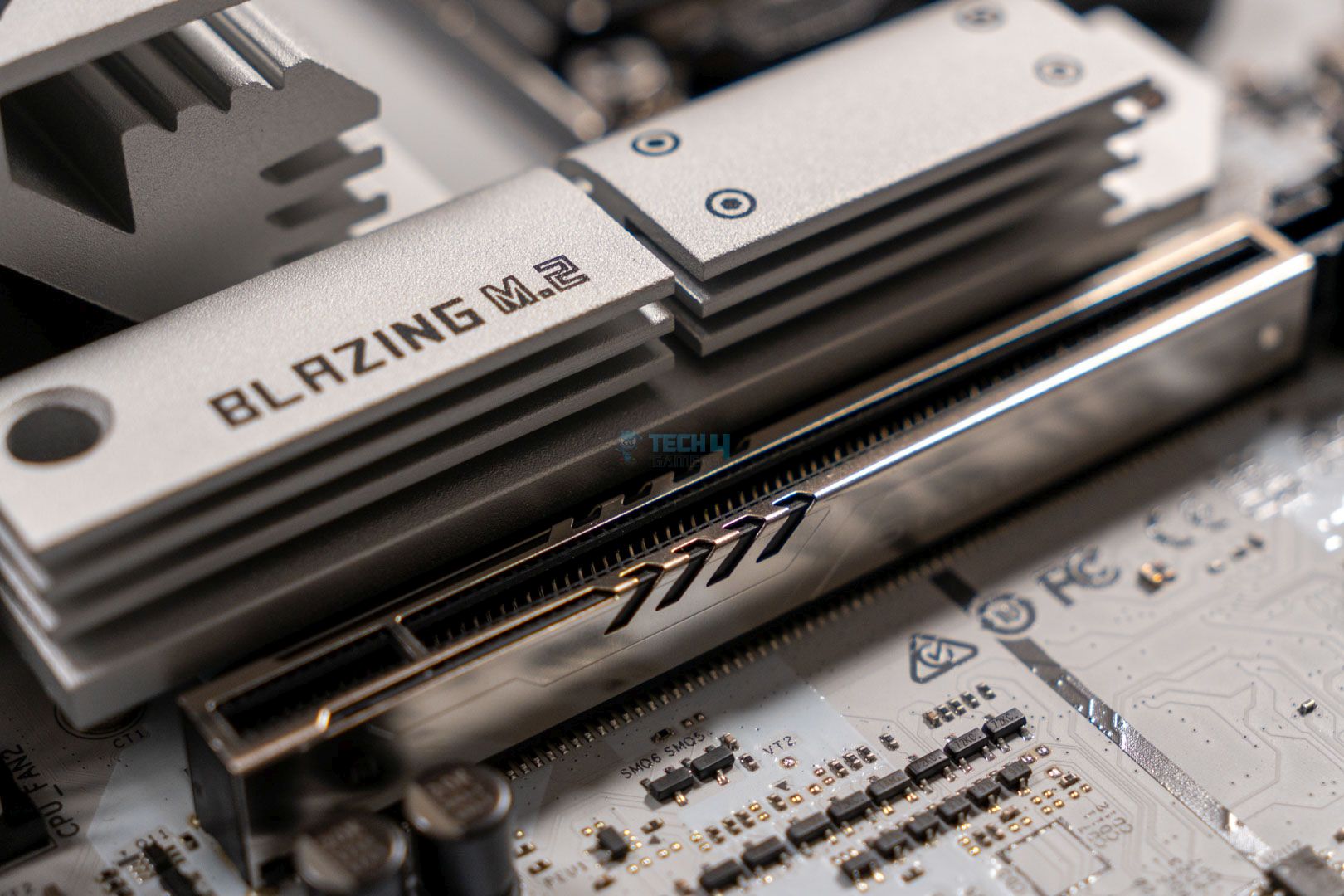
In total, there are three M.2 slots. The top M.2 (M.2_1) slot is ASRock’s Blazing M.2 Socket, which basically means it can run at PCIe Gen5x4 speeds (128 Gb/s). The second and third slots support PCIe Gen4x4 and PCIe Gen4x2, respectively. It should be noted that the first slot runs at its rated speeds when paired with a Ryzen 9000 or 7000 processor and turns down to Gen4x4 or Gen4x2 if you pair with a Ryzen 8000 Phoenix 1 or Phoenix 2 CPU, respectively.
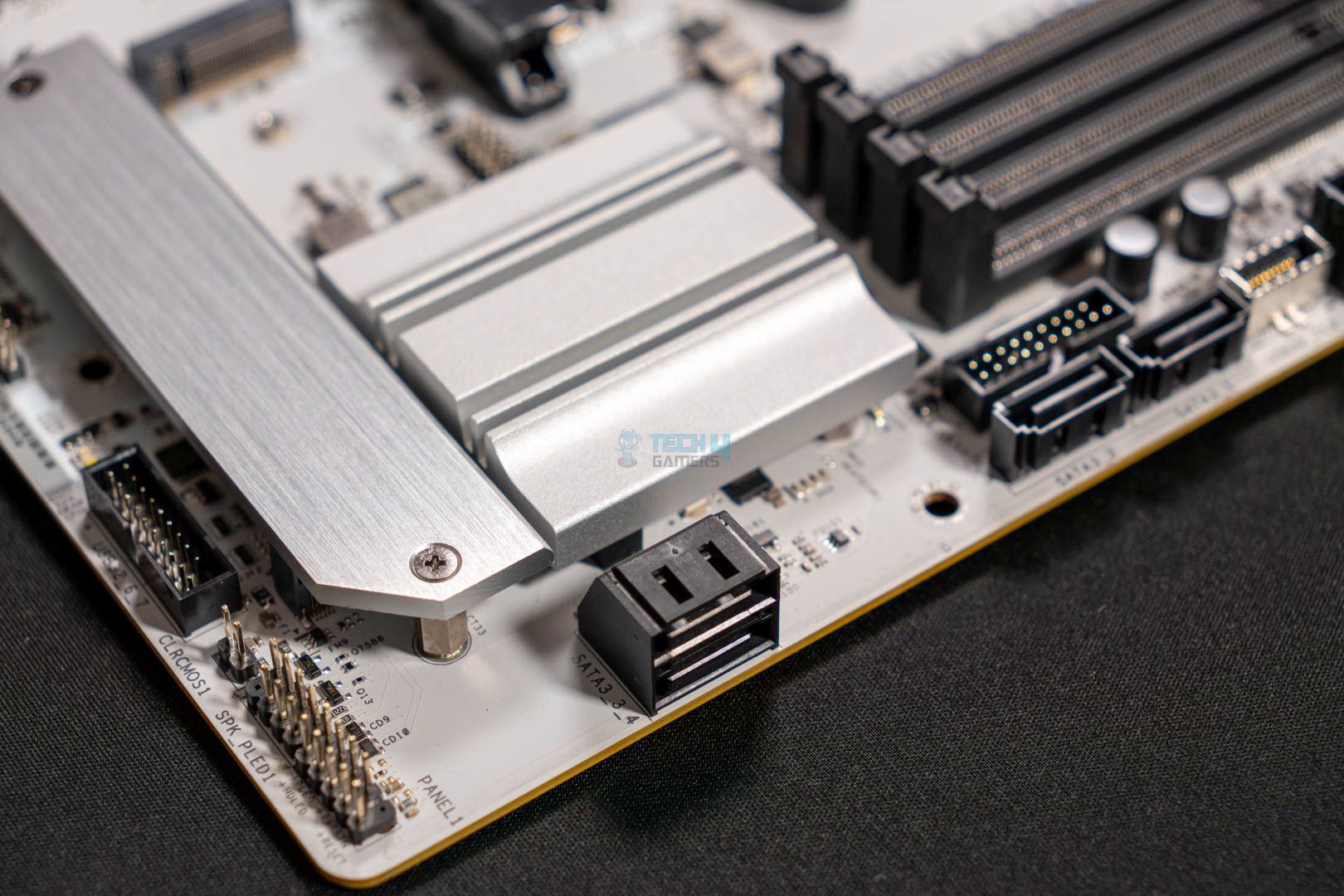
Chipset Cover & SATA Connectors (Image By Tech4Gamers)
Apart from that, there are also 4x SATA3 6.0 Gb/s connectors, which is fairly standard in 2025. Both the SATA and M.2 NVMe storage options support RAID 0, RAID 1, and RAID 10, but the board requires an M.2 NVMe expansion card as an add-on to support RAID 10.
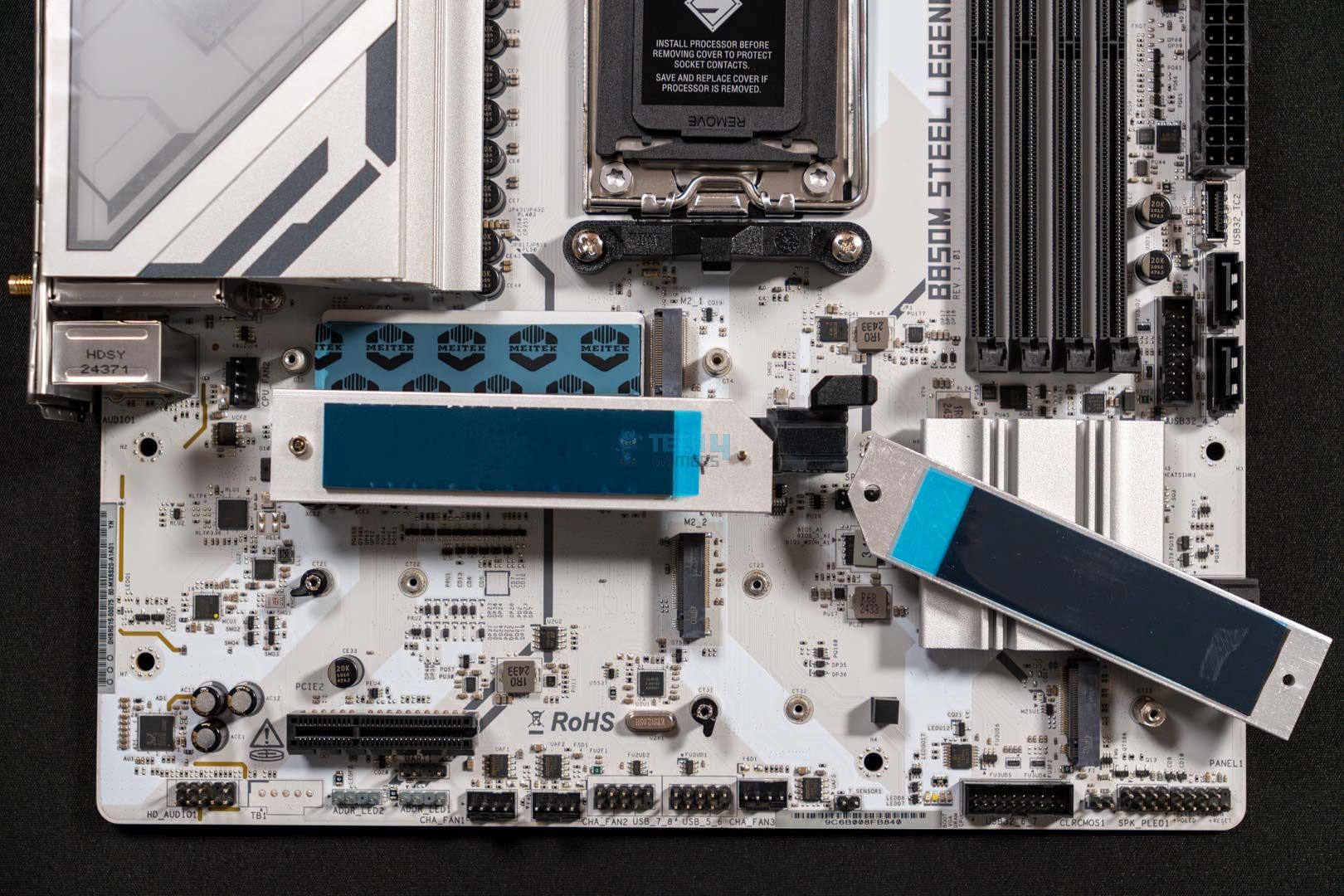
As you can probably guess by the supported speeds, the first and third slots are the way to go if you only have two drives. That’s because these are not just the fastest slots, but they also feature their dedicated aluminum heatsinks. ASRock has skipped the heatsink for the M2_2 slot, this is not necessarily bad as the slot supports Gen4x2, so the SSD shouldn’t really thermal throttle all that much.
SSD Heatsink Thermal Pads (Image By Tech4Gamers)
Taking off the two heatsinks, we can also spot the thermal pads ASRock has used to keep the SSDs cool. The Blazing M.2 Socket has the most cooling, which makes sense because it supports PCIe Gen5 speeds.
PCIe Slots
You also get two PCIe slots from the CPU. The top is PCIe Gen5 which supports x16 mode, and the second is PCIe 4.0 (x4 mode). Since you’ll be using the top slot for your graphics card, ASRock has included an EZ PCIe Release button for it. This has become an industry standard as we are seeing it in pretty much every motherboard. Basically, you press this button to remove your GPU without applying any excess force, which reduces the risk of damage during installation or swapping cards.
PCIe Release Button (Image By Tech4Gamers)
Just like with the M.2 slots, the PCIe slot also tones down to Gen4x8 or Gen4x4 speeds if used with a Ryzen 8000 Phoenix 1 or Phoenix 2 processor, respectively.
USB Connectivity
In total, the ASRock B850M Steel Legend WiFi supports 17 USB ports, out of which eight ports are located in the rear IO and the remaining nine ports are available through the internal headers. Here’s the full list of the included USB connectivity along with supported speeds:
1x USB 3.2 Gen2 10 Gb/s Type-C (Rear)
1x USB 3.2 Gen2 10 Gb/s Type-A (Rear)
1x USB 3.2 Gen1 5 GB/s Type-A (Rear)
1x USB 3.2 Gen1 5 GB/s Type-C (Front)
5x USB 3.2 Gen1 5 GB/s Type-A (1x Rear, 4x Front)
8x USB 2.0 480 MB/s (4 Rear, 4 Front)
Overall, for a MicroATX motherboard, the USB connectivity is quite good. I mean, I would have appreciated a SuperSpeed 10 GB/s port at the front too, since the two available are at the back, but then we are getting a Type-C port at the front, so it is alright. We know that the B850 chipset is capable of supporting up to six 10Gb/s ports and even one 20Gb/s port, so a faster port at the front isn’t asking for a lot.
Networking, Connectivity and Audio
For LAN, ASRock has used a Dragon RTL8125BG chip that supports 2.5 Gigabit LAN. There is also a WiFi 7 module installed (802.11be 2×2) in the rear IO. Lastly, the motherboard also supports Bluetooth 5.4.
Furthermore, the B850M Steel Legend WiFi supports the Realtek ALC1220 Audio Codec. As such, you get support for 7.1 channel HD audio. This is a fairly decent audio codec for most usage, so you shouldn’t have any problems.
Internal Connectors And Components
Connectors
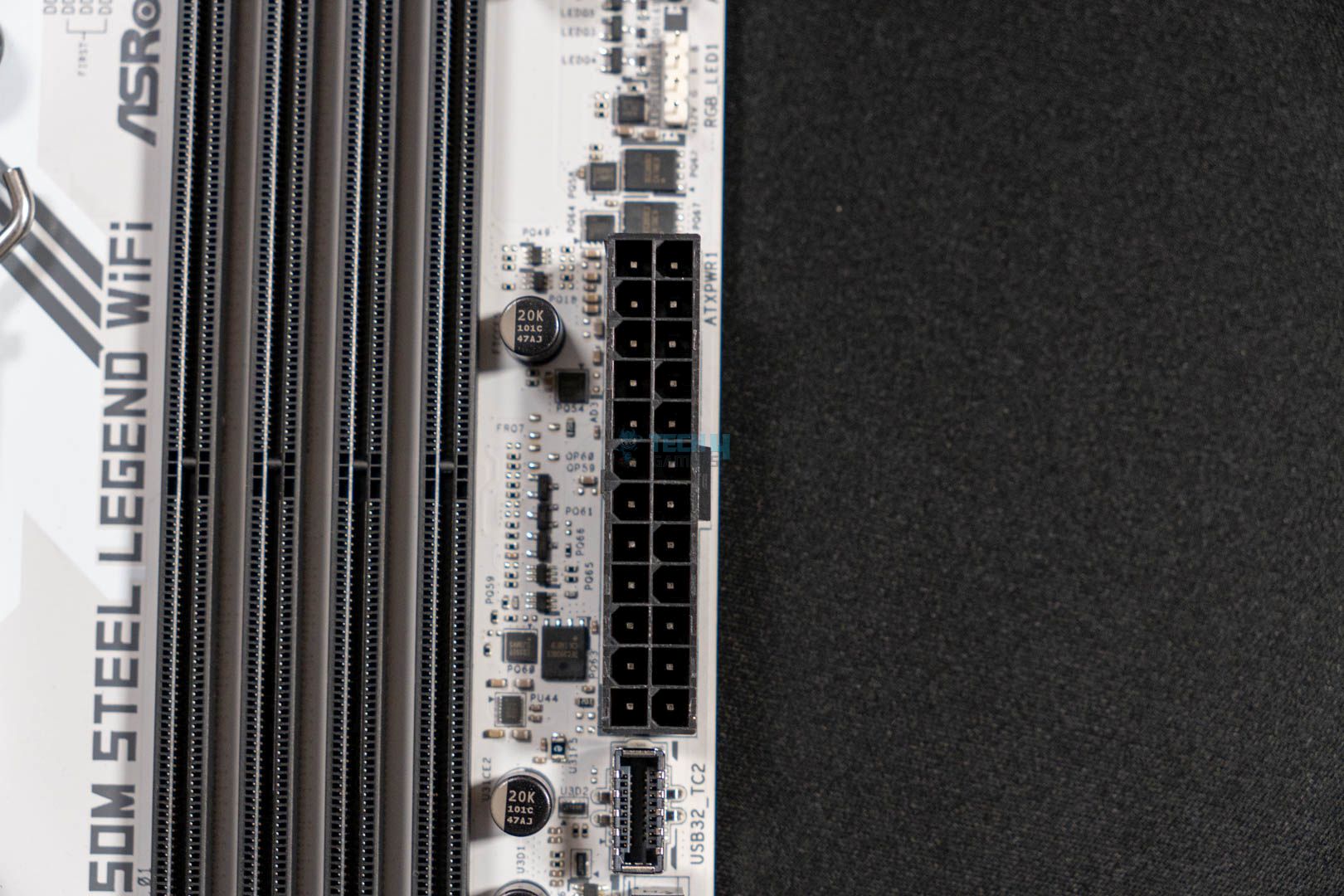
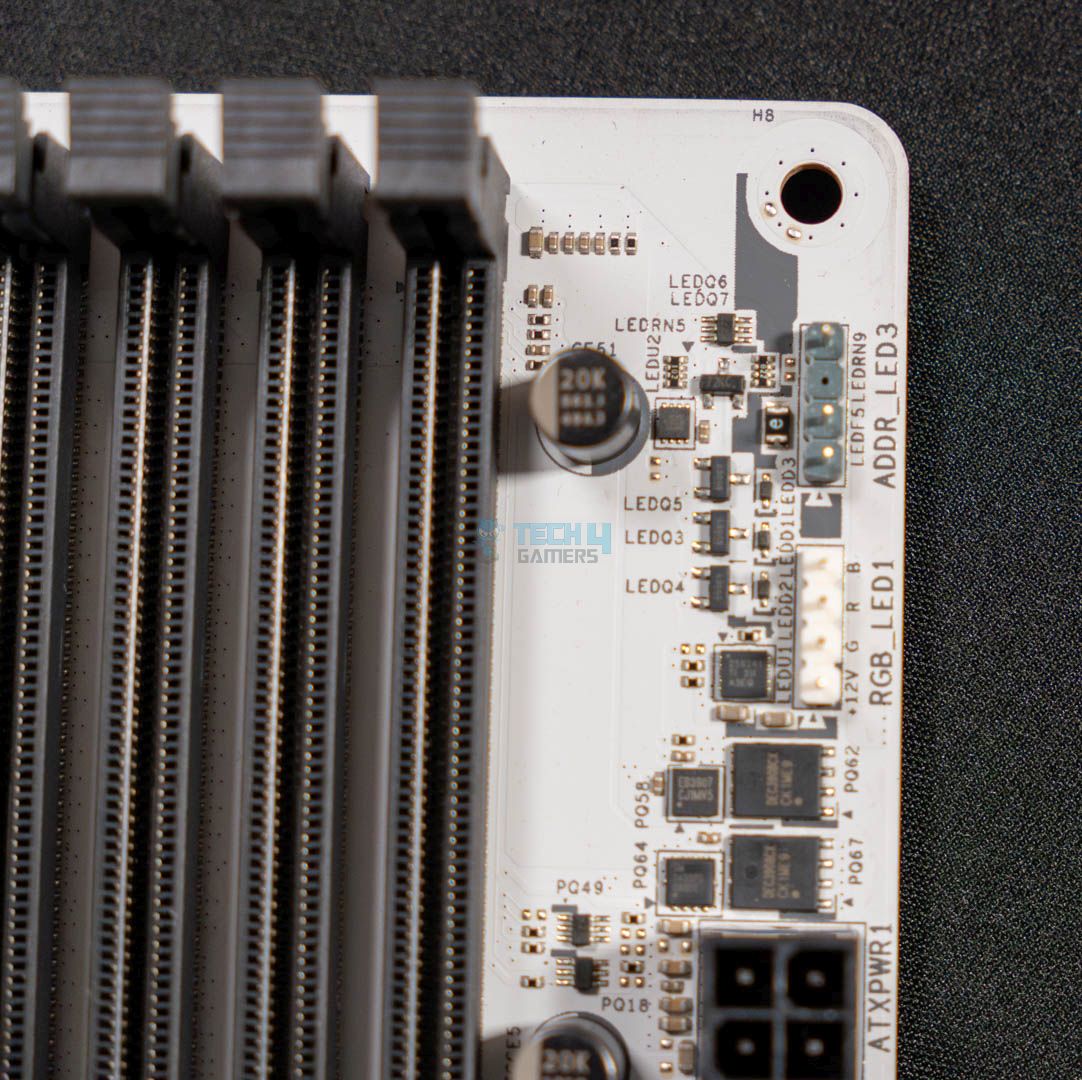
1 of 2
Motherboard Connector
LED Header
The motherboard features these connectors:
1x SPI TPM Header
1x Thermistor Cable Header
1x Power LED and Speaker Header
1x RGB LED Header*
3x Addressable LED Headers**
2x CPU Fan Connectors (4-pin) (Smart Fan Speed Control)
3x Chassis Fan Connectors (4-pin) (Smart Fan Speed Control)
1x 24-pin ATX Power Connector (Hi-Density Power Connector)
1x 8-pin 12V Power Connector (Hi-Density Power Connector)
1x 4-pin 12V Power Connector (Hi-Density Power Connector)
1x Front Panel Audio Connector
2x USB 2.0 Headers (Support 4 USB 2.0 ports)
2x USB 3.2 Gen1 Headers (Support 4 USB 3.2 Gen1 ports)
1x Front Panel Type C USB 3.2 Gen1 Header
From the thermistor to RGB, fans, and USB, there are plenty of internal headers available and you shouldn’t face any issues in normal tasks. All of these headers are controlled using the Nuvoton NCT6796D-S chip.
Rear IO
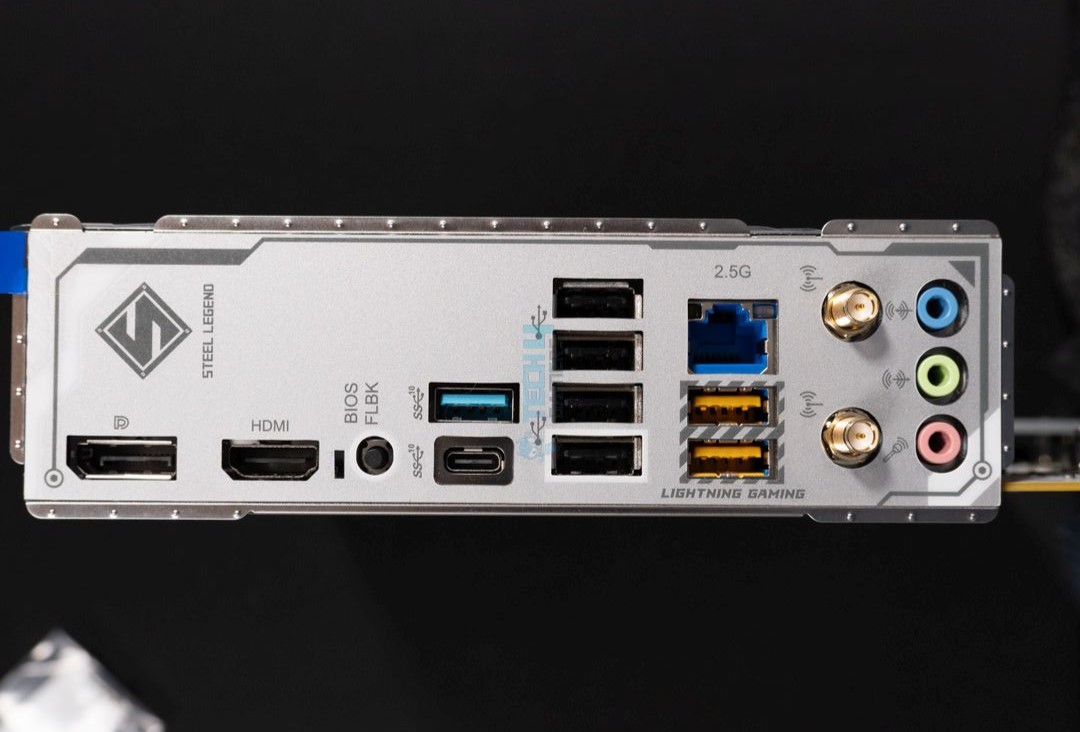
We have already gone over the USB ports at the back in the USB connectivity section of the review. Apart from them, the rear IO also brings a DP 1.4, an HDMI port, a couple of WiFi antenna ports, a BIOS flashback button, and more.
Rear IO (Image By Tech4Gamers)
Here is the full list of ports available through the rear IO:
2 x Antenna Ports
1x HDMI Port
1x DisplayPort 1.4
1x USB 3.2 Gen2 Type-C Port (10 Gb/s)
1x USB 3.2 Gen2 Type-A Port (10 Gb/s)
2x USB 3.2 Gen1 Ports
4x USB 2.0 Ports
1x RJ-45 LAN Port
1x BIOS Flashback Button
HD Audio Jacks: Line in / Front Speaker / Microphone
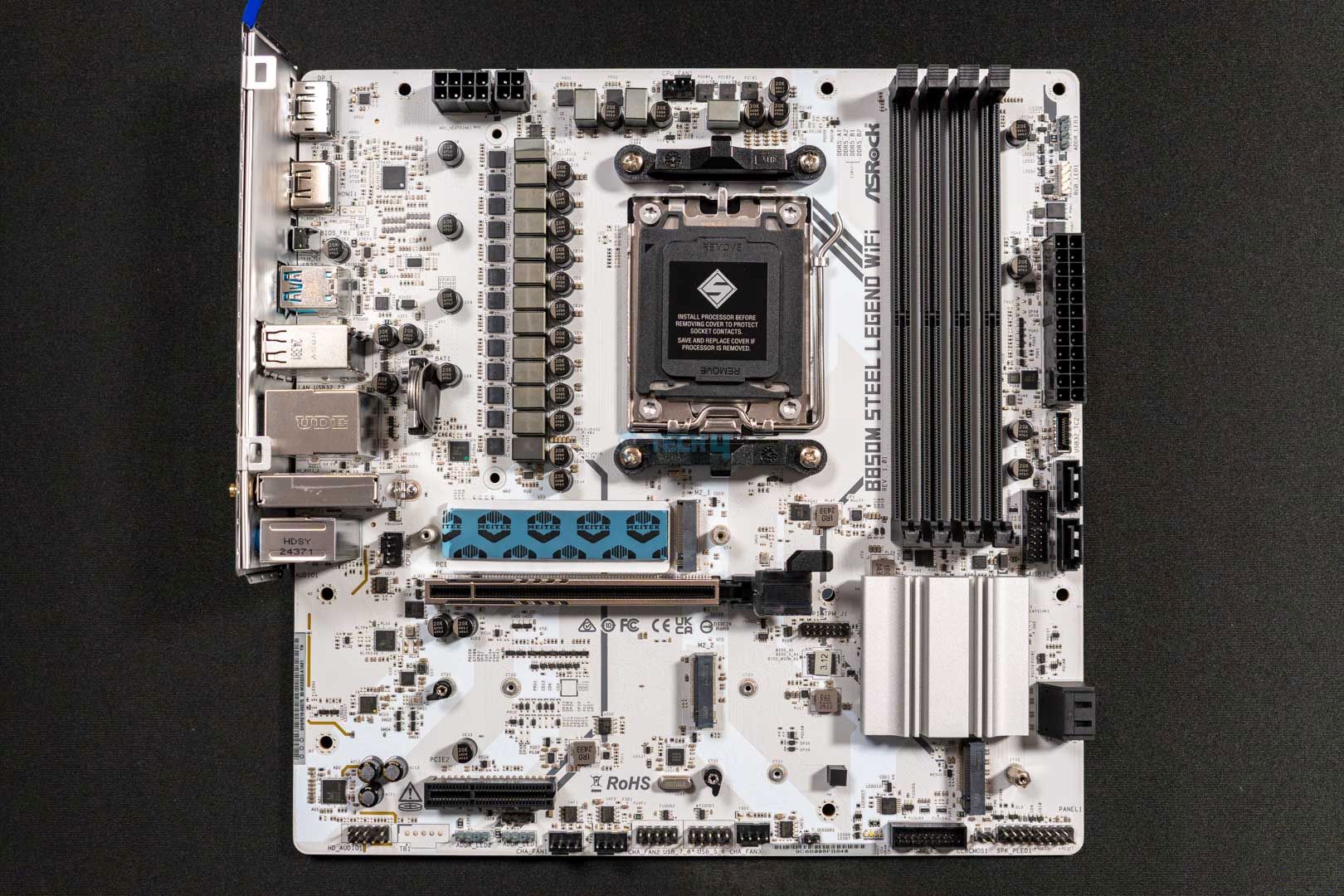
Before we head into benchmarks, here is a final look at the motherboard with VRM and M.2 heatsinks removed:
Naked Motherbard (Image By Tech4Gamers)
Test Setup
We have been testing a large number of B580 motherboards for the past couple of weeks, and all the options, including this B850 Steel Legend WiFi from ASRock, were tested on the same testbench for fair comparison.
Cinebench 2024, ST and MT Test (Image credit: Tech4Gamers)
Starting with Cinebench 2024, the ASRock B850M Steel Legend WiFi performs fairly well. It is very near the Phantom Gaming B850M Riptide WiFi, which beats it in multi-core by just 4 points.
Geekbench 6 Multi-threaded Test (Image credit: Tech4Gamers)
At a 21,691 multi-core score, this is again a pretty decent performance from a MicroATX motherboard. Just below the standard (ATX) variant of the same motherboard.
Blender 4.0.2 (Image credit: Tech4Gamers)
In Blender, the ASRock B850M Steel Legend WiFi comes in at 5th position with a 52-second time. The overall difference between the boards is not much, which is very impressive.
Corona 11 Benchmark (Image credit: Tech4Gamers)
It seems that this B850M Steel Legend is ruling the middle of the charts, as it is very neck-to-neck with the PG B850M Riptide.
V-Ray Benchmark (Image credit: Tech4Gamers)
Finally, here are the V-Ray results, and the ASRock B850M Steel Legend outperformed all competition coming in at fourth. This is very impressive.
Gaming Benchmarks
Cyberpunk 2077 (Image credit: Tech4Gamers)
There is not much of a difference in gaming benchmarks across all motherboards. In any case, the B850M Steel Legend ran CP 2077 at 144 average FPS.
Starfield (Image credit: Tech4Gamers)
As for Starfield, the motherboard ran the game at 111 average FPS, which is again very similar to other motherboards.
Far Cry 6 (Image credit: Tech4Gamers)
Lastly, here is its numbers from Far Cry 6, and a similar story is shown as the board runs the game at 184 FPS.
Power Consumption, Boot Times, And VRM Temperatures
Power Consumption (Image credit: Tech4Gamers)
Just to recap, we are looking at a 12+2+1 VRM structure with a 6-layer PCB and one stacked VRM heatsink. Well, the ASRock B850M Steel Legend WiFi is quite impressive, as it came in third in terms of power consumption.
Boot Times (Image credit: Tech4Gamers)
The boot times are very similar to what we saw from its ATX variant with just a second of difference.
VRM Temp (Image credit: Tech4Gamers)
Here’s how that single heatsink is performing. Definitely not the best. To be honest, we didn’t expect any better, and since it is a mATX motherboard, you are unlikely to use it for overclocking.
Should You Buy It?
Buy It If:
✅ You want bang for the buck: Given the features, design, and overall mid-range performance (literally, as seen in the graphs), the $180 price tag on the B850M Steel Legend WiFi is quite good, making the motherboard one of the best value-oriented B850 out there.
✅ You prefer a white motherboard: The white design on the B850M Steel Legend WiFi looks simply amazing, and the chipset heatsink actually has RGB lighting beneath it, so if you’re one for good looks, this motherboard is worth considering.
✅ You are building a compact PC: Being a MicroATX motherboard, the ASRock B850M Steel Legend WiFi has an advantage for compact builds, and given the features and performance, it is definitely a good choice for one.
Don’t Buy It If:
❌ You want the most performance: As seen in the test results, especially productivity benchmarks and VRM thermals, the motherboard is not exactly a chart-topper, and if you want that extra bit of performance without going towards an X870/X870E chipset, there are other options to consider. Of course, they will cost you more.
My Thoughts
The ASRock B850M Steel Legend WiFi is a solid MicroATX motherboard that offers a lot for its $179 price. It works with AMD Ryzen 7000, 8000, and 9000 series processors and has a decent power delivery system with 12+2+1 power phases, so it can handle high-end CPUs. However, its VRM cooling isn’t the best, so it’s not ideal for extreme overclocking.
For connectivity, it has PCIe Gen5 support, including a PCIe 5.0 x16 slot for graphics cards and an M.2 slot with Gen5 x4 speeds for super-fast SSDs. The USB options are great too, with a total of 17 ports, including fast USB 3.2 Gen2 Type-C and Type-A connections.
Performance-wise, it holds up well compared to other B850 motherboards, delivering solid gaming performance and efficient power consumption. While it’s not the best choice for heavy overclocking due to its VRM cooling, that won’t matter much for most users.
In short, if you want an affordable, feature-rich MicroATX motherboard with a stylish white design, this is a great choice. But if you need top-tier performance or better cooling for overclocking, you might want to look at higher-end options. At $179, it offers a good mix of price and features, making it a strong option for mid-range, value-oriented PC builds.
Lead the comparison and blog writing teams at Tech4Gamers.
Oversee teams with a keen eye for detail and precision.
Ensure hands-on writing, with benchmarks and testing as guiding principles.
Guarantee the delivery of the best possible results in concise yet impactful tech tales.
GeForce RTX 5090
Rated: 9.3/10
GeForce RTX 5080
Rated: 9.1/10
Pros And Cons
GPU
Pros
Cons
RTX 5090
✅ Come with PCIe 5.0
✅ Enhanced Performance Via DLSS 4
❌ High Price Point
RTX 5080
✅ Same MSRP as RTX 4080 Super
✅ Efficient Cooling System
❌ Poor performance boost over last gen
Key Takeaways
Starting with gaming and productivity performance, the RTX 5090 was the clear winner with a major 43.3% and 27.2% lead over the RTX 5080, giving it a comfortable win.
On the other hand, the 5080 offered better power efficiency in all departments which could be easily understandable as it offered way less performance.
As for the pricing, since both of these cards are still new, they can only be acquired at MSRP where they have a price difference of 67.7%, which could change at any moment.
Although the RTX 5090 offers a major improvement over the RTX 5080, the main question is whether it is worth the extra cost and whether you have the budget for it.
Why Trust Tech4Gamers
Shehryar is our comparison expert who has been comparing graphics cards, and processors.
500+ components tested and compared by our team of comparison experts (Tech4Gamers Team).
1000+ hours spent testing different components for our comparisons.
At Tech4Gamers, ensuring you get reliable information is our priority. That’s why every comparison undergoes a meticulous review process by our team of experts and editors. Each comparison is carefully examined against our strict editorial guidelines, guaranteeing you trustworthy insights you can depend on.
Comparison Table
Feature
GeForce RTX 5090
GeForce RTX 5080
Architecture
Blackwell
Blackwell 2.0
Process Node
TSMC 5nm
TSMC 5nm
GPU Die
GB202
GB203
GPU Shaders
21760
10752
Tensor Cores
680
336
RT Cores
170
84
VRAM (GB)
32 GB GDDR7
16 GB GDDR7
VRAM Bus Width
512 bit
256 bit
Architectural Differences
Clock Speed: Starting off, the RTX 5080 has a higher boost clock (2.62 GHz) than the RTX 5090 (2.41 GHz), but the 5090’s extra cores compensate for the difference.
VRAM: In this department, the RTX 5090 packs 32GB GDDR7 (512-bit, 1,792 GB/s), while the RTX 5080 has 16GB GDDR7 (256-bit, 960 GB/s), allowing the 5090 to handle memory-heavy tasks much better.
Process Node: Furthermore, both GPUs are built on TSMC’s4N process, a refined 5nm technology that boosts efficiency and performance.
TDP: In terms of power draw, the RTX 5090 has a 575W TDP, requiring a high-wattage PSU. The RTX 5080 is more power-efficient at 360W TDP.
Supported Technologies: Lastly, both GPUs support DLSS 4 with Multi Frame Generation, ray tracing, PCIe Gen 5, and DisplayPort 2.1b for cutting-edge visuals and performance.
After the recent release of the RTX 5000 series, many people have been wondering how the top dogs of this series perform against each other. In this article, I will be covering this topic and testing these cards through a number of AAA games and software to benchmark their performance.
Gaming Benchmarks – 2160p
Since we have already covered all the nitty-gritty of these cards on paper, it’s time to put them in an identical testing rig and then see how well they perform in real environments. Can they really pull the numbers Nvidia claims or were they numbers that were to be taken with a grain of salt? Let’s check it out.
The RTX 5090 really shows its muscle here, delivering an average of 102 FPS, which is a solid 38.5% jump over the 69 FPS on the RTX 5080. Everything from lightsaber battles to wide-open landscapes just felt smoother.
The 1% lows tell an equally compelling story, with the RTX 5090 coming in at 88 FPS compared to 58 FPS on the RTX 5080 which creates a hefty 41% difference.
A Plague Tale Requiem
A Plague Tale Requiem 2160p Gaming Benchmarks – Image Credits (Tech4Gamers)
With the RTX 5090 pushing 128 FPS versus 78 FPS on the RTX 5080, it’s a night-and-day difference with about 48.5% better frames on the former.
The 1% lows are where it really counts though and the RTX 5090 handles the demanding moments with 92 FPS, a 32.9% uplift over the RTX 5080’s 66 FPS, keeping things consistent
Night City comes to life with the RTX 5090’s 124 FPS, comfortably outpacing the RTX 5080’s 80 FPS by a solid 43.1%, the difference was especially noticeable in car chases and gun fights.
On the stability front, the 1% lows improved by about 47.3%, jumping from 66 FPS on the RTX 5080 to 107 FPS on the RTX 5090 allowing it to smooth out any choppy frame dips.
Dying Light 2 saw a huge performance bump in my testing, with the RTX 5090 delivering 122 FPS compared to 78 FPS on the RTX 5080, giving a whopping 44% boost.
Even during the most demanding moments, the RTX 5090 held steady with 107 FPS on the 1% lows, 45.9% better than the RTX 5080’s 44 FPS. Fewer frame dips made the gameplay feel way more fluid.
Dragon Age The Veilguard
Dragon Age The Veilguard 2160p Gaming Benchmarks – Image Credits (Tech4Gamers)
The RTX 5090 managed 96 FPS here, pulling ahead by 28.5% over the RTX 5080’s 72 FPS in Dragon Age which was fairly noticeable in large-style battles.
Frame dips were much better controlled, with 78 FPS on the RTX 5090 versus just 62 FPS on the RTX 5080. That’s a 26% improvement, which made the transitions between areas feel a lot less choppy.
The Last of Us Part I
The Last of Us Part I 2160p Gaming Benchmarks – Image Credits (Tech4Gamers)
TLOU 1 game definitely benefits from the RTX 5090’s power, as in my test it cranked out 125 FPS compared to the RTX 5080’s 72 FPS, giving it a massive 53.8% lead.
The 1% lows were also much more stable, with the RTX 5090’s 115 FPS staying 59.8% higher than the RTX 5080’s 62 FPS, allowing the intense cutscenes and fights to feel more fluid.
Swinging through New York felt incredible on the RTX 5090, with an impressive 212 FPS. giving 48.6% higher frames than the RTX 5080’s 129 FPS. The fluidity made every web-slinging moment feel like it was straight out of a movie.
Even the 1% lows showed big gains, with the RTX 5090 hitting 171 FPS compared to 109 FPS on the RTX 5080, a 44.2% improvement.
The RTX 5090 pulls ahead big time in the Hogwarts Legacy in my testing, delivering 144 FPS compared to the RTX 5080’s 100 FPS, giving a solid 36% boost.
Moreover, the 1% lows were also noticeably better, with the RTX 5090 sitting at 82 FPS, a 35.9% improvement over the RTX 5080’s 57 FPS.
Productivity Benchmarks
Now that we have covered the gaming aspect, we know there are many users out there who use graphic cards for their productivity tasks as well. Therefore, I took additional steps to run these cards through some software to test their performance in productivity.
The RTX 5090 achieves 135 FPS, delivering a 25% improvement over the RTX 5080’s 105 FPS. This results in faster real-time rendering, making game development workflows significantly smoother.
With 155 FPS, the RTX 5090 outperforms the RTX 5080 by 23%, which was running at 123 FPS. This means quicker scene rendering and a more responsive experience when working on complex assets.
DaVinci Resolve Studio
DaVinci Resolve Studio Productivity Benchmarks – Image Credits (Tech4Gamers)
The RTX 5090 scores 13,370, marking a 13.6% boost over the RTX 5080’s 11,659. Video editors will experience faster rendering times and smoother playback when working with high-resolution footage.
The RTX 5090 delivers a 47.1% increase, reaching 15,216 points compared to the RTX 5080’s 9,411. This translates to significantly faster rendering times in 3D workflows, making it a powerhouse for animation and modeling.
Overall Performance
Graphic Cards
RTX 5090
RTX 5080
Average FPS
📈131.6
📈84.7
1% Lows
📉105
📉68.1
Productivity (Rating)
✏️9/10
✏️7/10
Winner: GeForce RTX 5090
Average Framerate
Based on all the eight games that were tested on these cards, the RTX 5090 was able to pull an easy win over the RTX 5080 as the average performance difference between the two cards is a whopping 43.3%, making it the perfect choice for gaming enthusiasts.
1% Lows
A similar picture was drawn when it comes to 1% lows, as the RTX 5090 maintained an average lead of 42.5% over the RTX 5080. This difference allows the former to make games feel more fluid whether you are sitting enjoying a story play or engaging in first-person shooting situations in a game.
Productivity
I didn’t see much difference when it came to productivity benchmarking as well, since the RTX 5090 was leading the results by 27.2% on average against the RTX 5080. This difference can easily improve the productivity rating of any rig.
Power Consumption
Power Consumption
RTX 5080
RTX 5090
Idle
21⚡
31⚡
Gaming
326⚡
588⚡
Ray Tracing
333⚡
562⚡
Maximum
376⚡
602⚡
Winner: GeForce RTX 5080
In terms of power management, the 5080 was the obvious winner as it provides lesser performance, allowing it to function while consuming almost half the power of the RTX 5090, making it more lucrative for users who aren’t looking to upgrade their power supply or want power efficiency.
Price
GPU
RTX 5090
RTX 5080
Price Difference
Launch MSRP
💲1999
💲999
67.7%
Current Price
💲1999
💲999
67.7%
The prices of these cards still warrant some attention as both the cards are new and can be difficult to find or acquire. Moreover, since we still don’t have other variants we have to consider the MSRP as the base price for now which showcases a major 67.7% difference, but this could change in the near future.
What We Recommend
GeForce RTX 5090: The RTX 5090 was designed to reign supreme over the RTX 5000 series and it is doing that job perfectly. Still, many users are still wondering whether the high price is worth it as the debate of real vs AI frames continues, where users are skeptical about the raw performance of this card.
GeForce RTX 5080: Although the RTX 5080 is a decent graphics card, many users are still disappointed regarding its small performance jump over its last-gen rival the RTX 4080 Super, as they consider that Nvidia hasn’t delivered everything that it promised when they announced the RTX 5000 series.
Finally based on the performance in gaming and productivity, the RTX 5090 is the clear winner and my recommendation among these two. But whether you think the price difference and budget is worth it is something that each user has to decide which could sway your decision to pick the RTX 5080.
FAQs
What are the key differences between the RTX 5080 and RTX 5090?
The RTX 5090 has more CUDA cores, higher clock speeds, increased VRAM, and better memory bandwidth, making it significantly faster.
How do these GPUs perform in ray tracing-heavy games?
The RTX 5090 excels in ray tracing with improved RT cores and bandwidth, while the RTX 5080 may need DLSS for smooth performance.
Is the RTX 5090 worth the upgrade over the RTX 5080?
If you’re gaming at 4K, want the best ray tracing, or do professional work, yes but for 1440p, the RTX 5080 is still a strong choice.
What kind of power supply do these cards require?
The RTX 5090 likely needs at least 850W, while the RTX 5080 should run fine on 750W+, depending on system configuration.
What is Multi Frame Generation in the RTX 5080 and 5090?
Multi Frame Generation in DLSS 4 allows these GPUs to generate multiple extra frames per rendered frame, massively boosting FPS.
At Tech4gamers, I cover all sorts of gaming news. Whether it’s a leak of any upcoming game or an update, an announcement, or a rumour, I like to write about it all. Over the weekend, I sit and write features where I talk about games that I miss or want to see return.
Story Highlight
The Elder Scrolls co-creator is currently working on The Wayward Realms.
The veteran developer recently discussed how the RPG genre has changed over the years.
He believes RPGs should be vast and focus on player freedom, elements missing from modern releases.
Some classic fans of the genre miss the more complicated paths and choices of older titles, and the co-creator of The Elder Scrolls is certainly one such fan. He believes the genre lacks a sense of freedom today.
Why it matters: The recent success of RPGs like Baldur’s Gate 3 shows a huge demand for titles that break away from the linearity of modern RPGs.
Baldur’s Gate 3 Success Shows There’s Huge Demand For More Freedom In The Genre
During a recent interview with Video Gamer, Elder Scrolls co-creator Ted Peterson discussed how RPGs have evolved over the years.
The developer is currently working on The Wayward Realms, the spiritual successor to The Elder Scrolls 2: Daggerfall. He stated that the game would offer several ways of completing quests, each leading to a different ending.
Moreover, the developer stated that this element has been missing from recent RPGs, and he plans to challenge that with his latest title.
I don’t like how linear and small, small certainly for the game world and the sandbox I’m playing in, how linear the storyline is, how forced you are into it.
-Ted Peterson
The Elder Scrolls Is One of The Biggest RPG Franchises
Ted Peterson further stated that he enjoys freedom and likes RPGs that give players choices and a vast world to roam around. This is why his next title aims to go in a completely different direction.
The likes of Baldur’s Gate 3 also stand out as exceptions, offering plenty of non-linear stories and narratives for players to explore. Perhaps this is the reason behind Larian’s unprecedented success in recent years.
What do you think about the developer’s opinion? Let us know your thoughts in the comments or join the Tech4Gamers Forums.
At Tech4Gamers, I contribute as a Senior News Reporter, combining my skills and gaming enthusiasm to keep our audience updated on the latest developments.
Story Highlight
The Gears of War trilogy is reportedly being remastered for Xbox, PS5, and PC.
This collection will be available on all platforms from day one and feature cross-play for the best experience.
Xbox may also release the next mainline entry of the series on PS5 from the beginning.
The rumors about a supposed Gears of War Collection have existed for well over a year at this point. Earlier in 2024, it was said that the game was playable and would bundle the first three games into a single, remastered package.
One of the most reliable Xbox leakers also seems to have confirmed the existence of these remasters. He says Gears of War Collection will be a day-one PS5 release.
Why it matters: Xbox’s third-party plans were no secret, but it seems the gaming giant is rapidly putting them in motion and making changes much sooner than anybody anticipated.
This report comes from the famous Xbox leaker eXtas1s, who states that he can now confirm that the beloved trilogy is being remastered.
He also added new information to the rumors, stating that Gears of War Collection will be announced for the PS5 from the beginning. As per eXtas1s, Xbox will support cross-play across PS5, Series S|X, and PC for this specific title.
The leaker has been unable to confirm when the announcement will arrive, but 2025 appears to be a safe bet, considering Gears of War: E-Day is on the horizon. Reports have even discussed the possibility of this mainline title arriving sometime this year.
Anyhow, this could mean that Xbox’s quintessential first-party offerings, Halo, Forza, and Gears, will all make their way to PlayStation in a single year. Forza Horizon 5 has already been announced, and rumors strongly suggest the other two are imminent.
E-Day Is Taking The Franchise To The Past
Remastering the Gears of War trilogy should also benefit The Coalition’s upcoming title in the long run since new players on PlayStation are expected to buy the trilogy once it is released. Moreover, this may be a sign of things to come, with Gears of War: E-Day potentially becoming yet another day-one PS5 title from Xbox.
Lead the comparison and blog writing teams at Tech4Gamers.
Oversee teams with a keen eye for detail and precision.
Ensure hands-on writing, with benchmarks and testing as guiding principles.
Guarantee the delivery of the best possible results in concise yet impactful tech tales.
GeForce RTX 5090
Rated: 9/10
GeForce RTX 4080
Rated: 7.5/10
Pros And Cons
GPU
Pros
Cons
RTX 5090
✅ Equipped with PCIe 5.0
✅ DLSS 4 with improved frame generation
❌ Very high power consumption
RTX 4080
✅ Less CPU Bottlenecking
✅ Excellent 1440p card
❌ Lower rendering performance
Key Takeaways
The RTX 5090 showed 55.1% better performance than the RTX 4080 in 4K gaming and it was 46.8% better in productivity.
However, the RTX 5090 consumes a lot of power. Therefore, the RTX 4080 is 63.7% more power efficient when compared to the RTX 5090.
The RTX 4080 is $120 cheaper than the RTX 5090, given that it’s still being sold for its MSRP. But, its price will skyrocket overtime, which will significantly increase this gap.
Opt for the RTX 4080 if you prefer excellent 1440p gaming performance and productivity on a relatively lower budget. And go for the RTX 5090 if you have an extremely high budget and want the best of the best.
Why Trust Tech4Gamers
Shehryar is our comparison expert who has been comparing graphics cards, and processors.
500+ components tested and compared by our team of comparison experts (Tech4Gamers Team).
1000+ hours spent testing different components for our comparisons.
At Tech4Gamers, ensuring you get reliable information is our priority. That’s why every comparison undergoes a meticulous review process by our team of experts and editors. Each comparison is carefully examined against our strict editorial guidelines, guaranteeing you trustworthy insights you can depend on.
Process Nodes: Despite having a two-year gap between the two GPUs, both the RTX 5090 and the RTX 4080 share the same TMSC’s 5nm process node.
Clock Speeds: While the RTX 5090 comes with a base and boost clock frequencies of 2017 MHz and 2407 MHz, the RTX 4080 comes at a higher base clock speed of 2205 MHz that you can boost up to 2505 MHz.
VRAM: The RTX 5090 does pack more VRAM as it is equipped with a whopping 32GB GDDR7 memory with 512-bit bus width. Whereas the RTX 4080 comes with a 16GB GDDR6X VRAM with 256-bit bus width.
TDP: The RTX 5090 is a leech when it comes to consuming power since it arrives with a much higher TDP of 575W compared to the RTX 4080, which only has a TDP rating of 320W.
Supported Technologies: The RTX 5090’s DLSS 4 with AI and its use of PCIe 5 give it an edge when it comes to frame generation and faster loading times, respectively. This is far superior to RTX 4080’s DLSS 3 and PCIe 4.
Nvidia’s newest flagship has taken the internet by storm. So, we decided to put it against one of Nvidia’s powerful GPUs in this RTX 5090 vs RTX 4080 comparison. So, sit back and relax because we’ll be giving you the information you need to make a decision between these two cards.
Gaming Benchmark – 4K
Since both are higher-end cards, we’ve decided to test them out at 4K resolution in eight of the most popular games. A few of these games are extremely demanding, which you’ll see from the framerates that we’ll provide with each game.
S.T.A.L.K.E.R. 2 Heart of Chornobyl (Image by Tech4Gamers)
Starting off with Stalker 2, we saw the RTX 5090 push with an average of 71 FPS, gaining a 49.1% advantage over the RTX 4080, which operated at 43 FPS on average.
We found that the 1% lows were also higher on the RTX 5090 because they were 52 FPS. On the other hand, the RTX 4080 reached a minimum of 35 FPS on average, which results in a 39.1% difference.
God Of War Ragnarok
God Of War Ragnarok (Image by Tech4Gamers)
Here, both GPUs easily went above the 100 FPS mark, with the RTX 5090 excelling with an average of 195 FPS while the RTX 4080 was 59.1% behind with an average of 106 FPS.
For the 1% lows, we saw the RTX 5090 obtain an average of 166 FPS, which provided a much smoother gameplay than the RTX 4080’s 94 FPS. This makes for a 55.4% difference, where the RTX 5090 was victorious.
Warhammer 40K: Space Marine 2
Warhammer 40K Space Marine 2 (Image by Tech4Gamers)
As for the performance of these GPUs on Space Marin 2, the RTX 5090 displayed an average of 125 FPS, which was again 59.1% better than that of the RTX 4080 since it performed with 68 FPS.
In terms of the 1% lows, the RTX 5090 reached only 99 FPS and proved to be 52.2% smoother than the RTX 4080, which had an average minimum framerate of 58 FPS.
A Plague Tale Requiem
A Plague Tale Requiem (Image by Tech4Gamers)
The RTX 5090 completely outshined the RTX 4080 on A Plague Tale Requiem with 128 FPS, whereas the RTX 4080 was behind with only 65 FPS. This makes for a whopping 65.3% edge gained by the newer RTX 5090.
Unlike the average framerates, the 1% lows weren’t that high, with the RTX 5090 pushing with 92 FPS. In contrast, the RTX 4080 showed an average of 54 FPS, being 52.1% behind.
Star Wars Outlaws
Star Wars Outlaws (Image by Tech4Gamers)
We observed that the RTX 5090 obtained an average of 68 FPS which reigns supreme when compared to the RTX 4080’s 39 FPS on average. This equates to a 54.2% performance margin.
Here, the RTX 5090 was 58.8% ahead of its competitor as it showcased an average of 55 FPS. On the flip side, the RTX 4080 acquired an average of 30 FPS.
Starfield
Starfield (Image by Tech4Gamers)
On Starfield, the RTX 5090 averaged 89 FPS and only led with a 40.5% margin, which is the smallest gap from our entire benchmark. Simultaneously, the RTX 4080 achieved an average of 59 FPS.
In terms of 1% lows, the RTX 5090 was the better performer since it averaged 78 FPS, which is 43.8% higher than the RTX 4080’s 50 FPS.
Cyberpunk 2077
Cyberpunk 2077 (Image by Tech4Gamers)
We observed that the RTX 5090 peaked at 124 FPS on average, whereas the RTX 4080 treaded behind with 68 FPS without any ray-tracing. This makes for 58.3%, where the RTX 5090 had an edge.
The 1% lows were in favor of the RTX 5090 as it achieved an average of 107 FPS, which was 57.8% higher than that obtained from the RTX 4080, which was 59 FPS.
Dragon Age: The Veilguard
Dragon Age: The Veilguard (Image by Tech4Gamers)
Lastly, the RTX 5090 went out with a bang on Dragon Age: The Veilguard, as it averaged 96 FPS. However, the RTX 4080 was only 44.6% far off as it obtained an average of 61 FPS.
Speaking of the 1% lows, the RTX 5090 displayed a 41.9% victory over the RTX 4080 because it averaged 78 FPS. In contrast, the RTX 4080 had minimum framerates of 51 FPS on average.
Productivity Benchmarks
Apart from gaming benchmarks, we would like you to get a clear idea of how both of these powerful GPUs perform in productivity applications.
Adobe Premiere Pro
Adobe Premiere Pro Score (Image by Tech4Gamers)
On Adobe Premiere Pro, the RTX 5090 had a better GPU score of 144.5, while the RTX 4080 wasn’t bad because it achieved a 123.3 score, which is about a 15.8% difference.
DaVinci Resolve Studio
DaVinci Resolve Studio (Image by Tech4Gamers)
The RTX 5090 proved to be 13.8% better while operating on the DaVinci Resolve Studio, as it obtained a GPU score of 201, which was slightly higher than the RTX 4080’s 175 points.
Blender
Blender (Image by Tech4Gamers)
On Blender, we saw a massive difference of 47.6%, where the RTX 5090 was the better performer as it achieved a score of 15,216, which was significantly higher than the RTX 4080’s score of 9,366 points.
Overall Performance
Graphic Cards
RTX 5090
RTX 4080
Average FPS
📈112
📈63.6
1% Lows
📉90.9
📉53.9
Productivity (Rating)
✏️9/10
✏️7/10
Winner:RTX 5090
Average Framerate
Speaking of the average framerates obtained for the eight games, we saw the RTX 5090 came out to the top with a 55.1% lead over the RTX 4080. Still, the RTX 4080 pushed hard and managed to exceed the 60 FPS mark on half of the games tested at 4K, even though it is more of a 1440p card.
1% Lows:
Similarly, the RTX 5090 displayed a 51.1% edge over the RTX 4080 with regard to the 1% lows. However, the RTX 4080 also showcased a much smoother experience since its dips weren’t as low as the other cards we tested before.
Productivity:
In terms of productivity, the RTX 5090 surpassed with a 46.8% lead, and it especially shows significantly higher rendering performance. Meanwhile, the RTX 4080 still displayed an excellent score that easily surpasses the score obtained from most of the other cards found in the market.
Average Power Consumption
Power Consumption
RTX 5090
RTX 4080
Idle
31⚡
14⚡
Gaming
588⚡
304⚡
Ray Tracing
562⚡
294⚡
Maximum
602⚡
316⚡
Winner: GeForce RTX 4080
Despite higher performance in each sector, the RTX 5090 fails to be a more power-efficient card, thanks to its very high TDP. We noticed that it acts like an absolute leach because it sucked more than twice the power consumed by the RTX 4080. This makes the RTX 4080 63.7% more power efficient than the RTX 5090.
Pricing And Availability
GPU
RTX 5090
RTX 4080
Price Difference
Launch MSRP
💲1999
💲1199
50%
Current Price
💲1999
💲1879
6.2%
Since the newer RTX 5090 has just been released, it’s still being sold for its MSRP. But, its price is bound to increase over time. And when it does, it will reach sky-high, given it is a flagship model with tons of features. However, for now, the RTX 4080 is $120 cheaper than the RTX 5090.
Final Verdict—What We Recommend?
RTX 4080: It is an excellent card that leans towards 1440p, but still, it performed better in half of the games tested at 4K, which highlights its high performance. In productivity, it did well in the video editing sector but was behind in terms of rendering when compared to its rival.
RTX 5090: Conversely, the RTX 5090 doesn’t hold back. It showcased utmost performance in each area except for power efficiency. It’s still being sold for its MSRP, and users who do get hold of it right now, which are going to be few, should consider themselves lucky because they’re getting more than they’ll pay for.
However, we’ll assume that RTX 5090’s price is far more than the RTX 4080. Based on that assumption, we recommend you get the RTX 4080 if you’re looking for an excellent 1440p card that can push 4K as well, and we recommend the RTX 5090 if you have no issues with your budget and want the finest card of 2025.
FAQs
How different is RTX 5090’s DLSS compared to RTX 4080’s DLSS?
The RTX 5090 comes with DLSS 4, which uses AI to upscale & generate frames and is better compared to the RTX 4080’s DLSS 3.
Why does RTX 5090 have better ray tracing than RTX 4080?
The RTX 5090 uses 4th-gen ray tracing (RT) Cores compared to the RTX 4080’s 3rd-gen RT cores, which gives it an edge in ray tracing.
Why does the RTX 5090 need such a larger memory?
The RTX 5090’s use of 32GB GDDR7 gives it an edge in handling AI-based tasks, a larger database, and rendering heavier workloads.
How is the RTX 5090 better in AI acceleration than the RTX 4080?
RTX 5090’s use of 5th-gen tensor cores is advantageous in AI-driven tasks and is superior to the RTX 4080’s 4th-gen tensor cores.
Which GPU has the better video encoding features?
The RTX 5090 comes with a newer NVENC/NVDEC engine which aids it in faster encoding/decoding, making it efficient in productivity.
At Tech4gamers, I cover all sorts of gaming news. Whether it’s a leak of any upcoming game or an update, an announcement, or a rumour, I like to write about it all. Over the weekend, I sit and write features where I talk about games that I miss or want to see return.
Story Highlight
The latest entry in the Dragon Age franchise was a disaster.
Following fan concerns, a developer says that the franchise isn’t dead.
He reassured fans that the IP will live on through fan fiction, art, and other ways.
While the expectations were really high for Dragon Age: The Veilguard, as the franchise was finally getting a revival after a decade-long wait, the RPG quickly became one of the most disappointing releases of last year.
Following the poor release, it was recently confirmed that Dragon Age: The Veilguard would not receive further updates. Earlier, it was also reported that BioWare had fired every writer who worked on the title.
This sparked concerns within the fandom, but one of the developers has stated that Dragon Age isn’t dead.
Why it matters: The director behind Dragon Age: The Veilguard has also left EA after the disappointing attempt to revive the franchise. These series of events have given fans more than enough reason to be concerned.
BioWare Writer On The Future of The Dragon Age Franchise – Source: Bluesky
Soon after it was confirmed that BioWare was undergoing restructuring, many fans were concerned that Dragon Age would not return. However, one of the developers has reassured fans that this isn’t the case.
DA isn’t dead. There’s fic. There’s art. There’s the connections we made through the games and because of the games.
-Sheryl Chee
He further stated that the franchise belongs to the fans, and if there’s more demand for it, we may see another release in the future.
DA isn’t dead because it’s yours now.
The Writer Has Reassured Fans That Dragon Age Won’t Completely Disappear
Although the franchise was dead for almost a decade, the fans were still very excited about the next entry. Therefore, even with the latest failure, there is a chance that many fans will continue to stick with Dragon Age in the hopes of another revival at some point.
It remains to be seen what the future holds for the IP, but BioWare writers are certainly filled with hope. What do you think about this? Do you want to see another entry in the Dragon Age franchise? Let us know in the comments, or join the Tech4Gamers Forums.
I’ve previously worked for eXputer as a Senior News Writer for several years. Now with Tech4Gamers, I love to devoutly keep up with the latest gaming and entertainment industries. I have a Bachelor’s Degree in Computer Science and years of experience reporting on games and breaking exclusive stories. Besides my passion for gaming journalism, I love spending my leisure time farming away in Stardew Valley. VGC, IGN, GameSpot, Game Rant, TheGamer, GamingBolt, The Verge, NME, Metro, Dot Esports, GameByte, Kotaku Australia, PC Gamer, and more have cited my articles.
Story Highlight
After being a major player in the video game console domain, Sega slowly went into hibernation after 2001.
However, with its recent lineup and strategies, Sega is back to seize its glory.
With Xbox’s shaky position, it’s a good time for Sega to re-enter the console race.
Console wars have always been interesting to watch. Every generation, I sat in anticipation, waiting for how the competitors would try to overshadow the other. More importantly, there was another competitor back in the day in addition to the usual suspects.
You know of Sony, Microsoft, and Nintendo, but there was another: Sega. In fact, Sega predates both Sony and Microsoft in the console domain but unfortunately took its exit in 2001. I still look back on that era fondly, wondering how things could’ve been different, or if they could change now.
Why it matters: Dreamcast was a great console with a cruel fate, but now that Sega is slowly reclaiming its past position in games, a new console is also a lot more viable.
The Unfortunate Dreamcast
Sega was a key contender in the video game console market, but regrettably, this important chapter of history came to a close after 18 years.Sega took its leave in 2001, following the underwhelming financial performance of the Dreamcast and consistent losses.
Dreamcast, an unfortunate victim (Image by Tech4Gamers)
Many factors contributed to this eventuality, but Sega was to blame for many of the missteps. To this day, I call this a great loss. The Japanese gaming giant was doing impressive work; if only it had been determined and competent enough to challenge the odds back then.
The Dreamcast was a significant generational leap. It was ahead of its time, introduced revolutionary concepts like online play, and was overall a solid piece of hardware. It had everything going for it except the company’s unwavering faith and backing.
Lack of third-party games and support, Sega’s dwindling image because of past failures of the Saturn, ineffective marketing campaigns, intense competition from the PS2, and the incapability to adapt to the changing environment, Dreamcast was the sacrifice for Sega’s shortcomings.
The Rebirth Of Sega
Superb hardware, visuals, and even games like Sonic Adventure, Crazy Taxi, and Jet Set Radio couldn’t save the Dreamcast, and Sega never went back to consoles after this failure, opting to remain a third-party developer.
The glory days of Sega (Image by Tech4Gamers)
However, it still didn’t see much success. Its classics went dormant, and the lineup it came up with failed to impress. I was almost sure it would back out of games, too, but thankfully, Sega took a stand, and it has paid off now.
With Yakuza and Persona, Sega is slowly but surely taking back its long-lost glory. Alongside these JRPG titans, a consistent interest in Sonic and a splendid revival of its past classics have put the gaming giant back on track toward being the best.
This massive renaissance of Sega also raises a question. Now that it has a superb game lineup and good relations with strong developers, will it consider re-entering the console domain?
The Xbox Situation Creates An Opportunity
Microsoft’s strategies do not bode well for Xbox (Image by Xbox)
If you ask me, Sega should earnestly consider this. It owes it to the fans who helped it re-acquire greatness, but more importantly, a very lucrative opportunity has opened up due to recent events.
As you’ve seen for yourself, Microsoft is radically shifting its strategies. Using Game Pass and multi-platform sales as a pivot, it’s moving away from Xbox as a console to establish a gaming brand, funneling efforts into increasing subscriber count and pushing its games onto all platforms.
Microsoft’s recent strategies have made Xbox a redundant platform to own, considering the Game Pass is a much better deal on PC, and all the games are slowly going multi-platform. It won’t be long before Xbox loses most of its appeal and just remains a console for collection purposes.
As lamentable and tragic as it is, Xbox losing ground opens up a spot in the console domain, and it needs to be desperately filled. Without competition, Sony would run free and come up with ridiculous ideas, which it has already started with the blockbuster AAAs that take years and insane live service ideas.
Nintendo has its own uncontested domain, which is why Sony needs a powerful rival to keep it in check. Sega has both past experience and ample ability to fill this role today. It’s apparent the tech giant has changed its ways and is more than capable now.
With titles like Sonic, Yakuza, Persona, and all its past classics, Sega can provide a home to this growing library, and in return, they can create a powerhouse of a platform. Dreamcast was a masterpiece victim of unfortunate circumstances. Eliminate the latter, and greatness can be crafted once again.
At Tech4Gamers, I contribute as a Senior News Reporter, combining my skills and gaming enthusiasm to keep our audience updated on the latest developments.
Story Highlight
Gaming and essay writing are surprisingly quite similar.
Both activities require critical analysis and planning.
Essay writing and gaming are also useful for students since they cultivate creativity and various other abilities within their minds.
It may be hard to believe that the two fields, essay writing and gaming, are interconnected. However, a closer look reveals an undeniable overlap; both require analytical and strategic thinking skills.
When writing an excellent essay or executing a plan for winning a strategic game of the massively popular Age of Empires series, it becomes clear quickly that these exercises have many things in common.
Why it matters: Both essay writing and gaming are common activities that go hand-in-hand, helping those who enjoy these activities excel in daily life. Gaming is also more popular than ever today, so this correlation is very beneficial.
Analytical Skills Required For Gaming And Essay Writing
Gaming Has Various Benefits That May Not Be Immediately Obvious
Fundamentally, essays are a process of scrutinizing the nature, deconstruction, and synthesis of an issue and putting up a reasonable and sound argument.
This analytical process resembles the gamer’s approach, in which they try to determine useful strategies. Try to think about strategic games like chess or any tactical RPGs. In these games, you can win if you have analyzed your strengths and weaknesses, your opponent’s strategies, and yours in advance.
Likewise, when writing an essay, the writer evaluates the sources, assesses the evidence, and decides what to emphasize. For example, in a leadership essay, a student can compare various leadership styles of several historical leaders in the same way that a gamer compares abilities in the game and chooses the best strategy to complete a level.
It becomes clearer how gamers master strategies to correct their approaches, such as correcting an essay draft for a stronger logical statement.
Strategic Thinking In Games And Essays
StarCraft And Other RTS Games Allow You To Think Critically About Each Situation
Writing an essay means analyzing information and putting information together in a way that forms a strategy.
Every paragraph has its function and contributes to the total concept of your writing and how you support your claim. This process is like a game where every move you make leads to achieving your goal.
For instance, a game like Starcraft, a real-time strategy title, requires you to build strengths, choose the correct locations to place your assets on the map, and expect your enemy’s possible responses to win the battle.
Essay writing involves a comparable level of planning. You must outline your argument, decide where to place supporting evidence, and ensure your points lead seamlessly to a compelling conclusion. In both cases, the chances are that a person has to be able to think about what may happen next.
Every writer and gamer must estimate the consequences of their action, whether it be the connection between a thesis and the overall flow of an essay or the possible outcome of a strategic move in a game. Building this foresight in one context also strengthens it in the other.
Skills Applicable In Both Departments
The Civilization Franchise Is Famous For Its Decision-Making
Overall, it’s clear that abilities developed in essay writing are not restricted to the classroom only, but they also promote improvements that boost gaming ability.
Strategic thinking enhances problem-solving, allowing the gamer to solve the next puzzle in a game or apply it as a strategy in a constantly changing event. Strategic planning also helps players solve problems systematically and eliminates rash moves that result in failure.
For example, analyzing the strengths and weaknesses of an argument can improve critical thinking in everyday situations, from evaluating essayservice reviews by their customers to making informed decisions about purchases or investments. Similarly, the paradigms of strategic thinking developed when organizing essays should prove helpful in project management or professional conflicts.
It can also be said that the primary strength of these skills is the fact that they are structural and amorphous at the same time. Whether you’re revising an essay or adjusting your approach in a multiplayer game, the ability to assess your progress and make improvements is essential.
Ultimately, these skills allow you to strive for excellence in different areas of life.
While writing essays and playing games can appear to be completely unrelated activities, there is more to their correlation than meets the eye. Both activities enable people to problem solve, plan, and reflect on actions to improve performance through repetition.
Many types of work and activities inherent in gamers can be associated with essay writing, so it is necessary to mention that skills trained in gaming are developed in essay writing.
This is especially beneficial to students since it fosters creativity and persistence within them. Moreover, the intersection between essay writing and gaming highlights why cultivating a wide range of skills is essential.
I’ve previously worked for eXputer as a Senior News Writer for several years. Now with Tech4Gamers, I love to devoutly keep up with the latest gaming and entertainment industries. I have a Bachelor’s Degree in Computer Science and years of experience reporting on games and breaking exclusive stories. Besides my passion for gaming journalism, I love spending my leisure time farming away in Stardew Valley. VGC, IGN, GameSpot, Game Rant, TheGamer, GamingBolt, The Verge, NME, Metro, Dot Esports, GameByte, Kotaku Australia, PC Gamer, and more have cited my articles.
Story Highlight
A new report claims that Xbox’s highly anticipated Fable will launch day one on PlayStation 5.
Starfield and Microsoft Flight Simulator 2024 are also apparently launching on the console this year.
Other insiders have suggested that Halo: The Master Chief Collection and Gears of War are landing on Sony’s platform.
Xbox is heavily chasing a new multiplatform strategy to adapt to the changing console landscape, and it feels like the conglomerate is ready to abandon yet another exclusive in favor of sales and profits.
A new report now claims that a Fable port for PlayStation 5 is not only in development but is also launching on day one on the platform.
Why it matters: A highly awaited Xbox exclusive launching on PlayStation 5 simultaneously shows that Microsoft is extremely serious about pursuing the multiplatform strategy, abandoning exclusives altogether.
A notable Spanish news site, Vandal, claims that Fable is launching day one on PlayStation 5—a simultaneous launch across all platforms. Starfield and Microsoft Flight Simulator 2024 are heading straight for Sony’s current-gen platform this year.
That’s not all; insiders have also clarified that Gears of War: Ultimate Edition and Halo: The Masterchief collection will arrive on PlayStation 5 sometime in the future. Regardless, this is certainly not the first time insiders have raised voices about a Fable PS5 port.
However, no one expected it to launch simultaneously on all platforms without any timed exclusivity for Xbox. As a reminder, Doom: The Dark Ages is receiving the same treatment in just a few months.
Past rumors also corroborate the claim about Fable launching day one on PS5.
For those not in the know, Fable is set to come out this year after spending a long time in development. However, a release date is still yet to be confirmed by the studio; speculations suggest that late 2025 is our best bet.
Do you think Xbox will completely let go of any exclusivity and simultaneously release the RPG on PlayStation 5 day one? Let us know your thoughts in the comments below, or join the discussion on the official Tech4Gamers forum.
At Tech4Gamers, I mainly cover new gaming news, leaks, and rumours. Aside from that, I love to write features about my favourite games while inserting my opinion about their different aspects.
Story Highlight
Many fans have complained about the bugs and performance issues of Marvel’s Spider-Man 2 on launch.
The game is so poorly optimised that even the RTX 5090 can’t maintain 60FPS at 4k max settings without the DLSS.
Sony may have considered delaying the port, given the pre-orders were never opened and there was no marketing for the game.
Marvel’s Spider-Man 2 has just been released on PC. It seems like the port is lackluster, as the game has received mixed reviews on launch. The performance is poor, and apparently, it is filled with bugs.
Even the newly launched RTX 5090 can’t maintain 60FPS at 4K max settings in Spider-Man 2. While the raw power of the RTX 5090 isn’t that much improved from the previous generation card, it still is an upgrade, which shows how badly the game is optimised.
Why it matters: Sony was perhaps unsure of releasing the port to PC as the game’s pre-orders were closed until the launch, and there was no marketing done. So, the gaming giant may have considered delaying it, but given that Spider-Man 2 was already available on PC thanks to the leaked PS5 built, that wouldn’t have been a wise choice.
zWORMz Gaming on YouTube did a deep analysis of how the game would run using an RTX 5090 on different settings. Initially, he went with 4K native, not using upscaling or frame generation, with every graphics setting maxed out.
At such settings, the game averaged 95FPS since it dipped into the 70s and pushed into the 100s at the higher end. Do note that the ray tracing was turned off. So, with this particular option turned on, the frame rate takes a hit and goes as low as 51FPS, meaning this new-generation card that costs $1999 can’t maintain 60FPS in a game launched in 2023 on the PS5.
While The RTX 5090 Has Received Criticism, The Culprit Here Is The Poor Port By Sony
With DLSS Quality and frame generation enabled, the frame rate again goes above 100FPS. Also, the frame rate can be locked, so locking to 100FPS makes the experience smoother.
Still, it is a disappointing port from Sony, and the giant is receiving fair criticism for its poor work.
What do you think about the RTX 5090 being unable to maintain 60FPS in Spider-Man 2 at 4K max settings? Share your thoughts with us in the comments section below or join the discussion at the official Tech4Gamers forums.