Currently serving as a News Reporter at Tech4Gamers, I have the privilege of combining my love for gaming with the art of storytelling. My role involves crafting engaging narratives that keep our audience abreast of the latest developments in the gaming world.
Story Highlight
David Jaffe, the creator of God of War, praised Starfield, calling it one of the best single-player narratives, despite players’ mixed reactions to the game.
David Jaffe previously also called Starfield his top 3 games of all time.
Bethesda acknowledges the game’s flaws but remains confident that its sequel will deliver a far superior experience.
Bethesda’s first new IP received mixed reviews from gamers. Many complained that Starfield felt somewhat barren and was subpar compared to the developer’s other releases.
While gamers think otherwise, the God of War creator has nothing but praise for the game. In a new post, David Jaffe said that he “adored” Starfield, which perhaps features the best narrative among single-player games.
Why it matters: While one could argue that Starfield gets more hate than it deserves, claiming it has the best narrative might be a little over the top. Several other games have outstanding narratives, some of them being other Bethesda games.
Quoting a praise tweet for Starfield, David Jaffe complimented the game. However, the replies didn’t seem to agree with such a bold take from a game designer himself.
However, this isn’t the first time David Jaffe complimented the game. Previously, the God of War creator stated that Starfield was one of his top 3 games of all time. He also added that the console war is no reason to keep one from enjoying this game.
Bethesda Is Proud Of Starfield; Says It Was A Great Release.
Starfield has faced a lot of backlash from fans because it is excessively long and has not much to do. Even the Shattered Space DLC failed to add what was originally missing from the game.
Bethesda developers have admitted that Starfield was flawed, but they’re optimistic about heading for the sequel, even going ahead and saying that it will be “One Hell Of A Game.”
What are your thoughts on this take? Did you enjoy Starfield as much as David Jaffe did? Let us know in the comments below, or head towards the Tech4Gamers forum.
As a News Reporter at Tech4Gamers, I bring the latest findings from the tech industry to our readers. Specializing in processors, graphics cards, and more, I strive to deliver detailed insights that keep our audience well-informed and engaged. Periodically, I also delve into the vibrant world of gaming to share captivating stories.
Story Highlight
GPU shipments grew by 6.2% in Q4 2024 but are expected to decline by 1% annually from 2024 to 2028, with only 15% of systems using discrete GPUs by 2030.
Nvidia, holding the largest market share, has faced challenges in meeting demand, particularly for high-end and mid-range GPUs.
Tariffs, GPU shortages, and rising prices due to scalpers and paper launches are affecting demand and slowing market growth.
Over 78 million PC GPUs were shipped in the last quarter of 2024, a 6.2% increase over the previous quarter. Year-over-year GPU shipments on all platforms rose by 1%, according to Jon Peddie Research, with a 2% gain in laptop GPU sales and a 3% decline in desktop graphics card sales.
Why it matters: Nvidia’s supply issues and the expected market decline could make GPUs harder to get and more expensive for consumers.
Only 15% of systems will have a discrete GPU by 2030, and the market for GPUs will drop by 1% annually between 2024 and 2028. Additionally, factors like tariffs and Nvidia GPU shortages might also affect the market.
Source: Jon Peddie Research
According to Dr. Jon Peddie, president of the team that produced this analysis, Nvidia’s shortage delayed the increase of GPU shipments. With the biggest market share, Nvidia struggled to meet demand, preventing the GPU industry from growing as much as it could have.
Nevertheless, it appears that Nvidia is still having problems meeting the demand for high-end and mid-range GPUs, as nearly all of its recently released graphics cards, ranging from the RTX 5090 to the RTX 5070 Ti, are sold out in stores around the world.
Furthermore, the research also predicts that the market for discrete GPUs will decline in the coming years. It makes sense that more individuals will be eager to obtain more powerful graphics cards as they become available.
However, many potential customers are likely being turned off by the rising prices brought on by tariffs, paper launches, and scalpers. With both Nvidia and Intel struggling to fulfill demands, it’s probably the best time for AMD to shine through with its new Radeon RX 9070 series.
At T4G, my task is to cover the latest news around the gaming globe ASAP and with the utmost precision. I adore all the games and respect all the devs behind the amazing games that we get all year. So, whether it’s a PC or a Console game, I got it all covered.
Story Highlight
Split Fiction is the first EA game to achieve 90+ on Metacritic since Mass Effect 3.
It has broken over a decade-long curse where EA didn’t have any title with this score.
The title comes from the developers of It Takes Two, another massive hit.
Hazelight Studios has made quite a name developing great two-player co-op games. The studio has once again partnered with EA and is set to release its new title, Split Fiction. With the reviews already out, EA seems to have a hit on its hands.
Once known for epic titles, EA has fallen from grace. Split Fiction has emerged as the title to break a decade-old curse and finally achieve a 90+ score for the company on Metacritic.
Why it matters: Hazelight’s previous outing, It Takes Two, was also a massive success winning the GOTY award. However, it just went shy of an over 90 score, attaining a very respectable 88 on Metacritic.
Split Fiction has managed to achieve a 91 score on Metacritic
The review embargo on Split Fiction just lifted, and it has achieved a wonderful 91 score on Metacritic, a great feat for EA. The company will be delighted with the reviews, especially after the failure of its latest entry, Dragon Age: The Veilguard.
In addition, it’s the first time in over 10 years the company has received such a high score. The last one was Mass Effect 3, which achieved a 93 in 2012. EA will be hoping the sales will be as good as the reviews.
Mass Effect 3 was the last EA game to achieve 90+ nearly 13 years ago
It is also a great time to praise Hazelight Studios, who has released massive hits back to back. While the industry is giving up on couch co-op games, it’s keeping the tradition alive. It was kicked off by A Way Out, followed by It Takes Two, and now Split Fiction.
Another massive upside of Split Fiction is that both parties don’t have to buy the game. With something called a ‘Friend Pass’, you can invite others and jump directly into the game.
What are your thoughts on Split Fiction achieving a 90+ Metacritic score for EA? Let us know your opinions in the comments or join the discussion at the official Tech4Gamers Forum.
Lead the comparison and blog writing teams at Tech4Gamers.
Oversee teams with a keen eye for detail and precision.
Ensure hands-on writing, with benchmarks and testing as guiding principles.
Guarantee the delivery of the best possible results in concise yet impactful tech tales.
Story Highlights
Split Fiction is from the makers of It Takes Two, which is more mature and dark, transitions between sci-fi and fantasy themes, and is slightly harder.
The game balances seriousness and goofiness by having separate side stories that include extremely creative and silly challenges.
The last chapter is truly exceptional, and the ending is one of the best in any game, which could make it the Game Of The Year.
In an era where PvP multiplayer is prevailing, co-op games like Split Fiction act as a breath of fresh air. The decline of couch co-op gaming has left a void in the gaming industry, so games like Split Fiction should be cherised even more.
Sadly, most game devs don’t recognize the importance of co-op multiplayer. Even recent titles like Dragon Ball: Sparking Zero! have restricted local co-op, frustrating players who’ve been used to playing coop in previous Dragon Ball games.
Challenges (Image By Tech4Gamers)
Split Fiction Was Much Needed
However, Hazelight Studios, the developers of Split Fiction, have filled the gap in the gaming market. These are the same developers who were behind the infamous It Takes Two, another coop game that is known to change people’s lives.
Much like It Takes Two, this game doesn’t solely rely on your gaming skill. Although the difficulty has been ramped up from the previous title, you still have to communicate with your partner effectively to complete challenges.
Will It Be ‘It Takes Two 2’?
Both of these games are solely coop, which means you can either play with your friend in the same room or play with your friends online using a friend pass. Friend pass allows one of the people to own the game and the other can join for free.
2D Action (Image By Tech4Gamers)
These two titles integrate 2D and 3D seamlessly with unique puzzles for their respective dimensions. While It Takes Two leaned more on the goofy, cartoon-esque theme and story, Split Fiction focuses on a more mature theme.
Compelling Story: Playing Inside Two Writers’ Minds
This theme is reflected not only in the game’s appearance but also in its storyline. The story follows two female protagonists, both are writers, but they differ from each other. While one focuses on sci-fi stories, the other tends towards fantasy.
Human Pod (Image By Tech4Gamers)
They both are trying to get their stories published and they go to a guy from a big company, hoping for success. However, they soon realize their stories are going to be stolen by him and sold off as part of the big corporate machine he runs.
He puts the two females in a machine that resembles a human pod, which will extract all the stories from their minds to their servers. Since these two characters are in the same pod, they will explore the stories they have written together.
Constant Switching Of Themes
Fantasy Theme (Image By Tech4Gamers)
They have to try to get to the end of each of their story to break free from this misfortune. So, it’s extremely fun to see the game switching between the mountain and jungle centric theme to a sci-fi cyberpunk-like atmosphere after every chapter.
Goofy Side Stories
Speaking of switching of themes, you also get side-stories that are different from both sci-fi and fantasy themes. Here, you play as two pigs that race towards the finishing line only to be chopped to turn into meat.
Side Stories (Image By Tech4Gamers)
You then play as sausages, grilling yourself on the hot grill, jumping on ketchup for your partner to be smeared in ketchup and enjoying the time away from the main quest. Unlike It Takes Two, this game chose to include the silliness in side-stories.
Last Chapter Is A Must Play
This way you don’t lose the seriousness of the main quest. Yes, this game does dive into topics that are mature, even a bit dark, and that is what separates it from It Takes Two. Not only that, but it also brings a unique element to the coop genre.
Especially the final chapter seals the deal because it offers one of the most unique, enjoyable and exhilarating endings to the game. Some even say that this game as positioned itself to become the game of the year.
Our Verdict
Split Fiction captures the joys of coop games by allowing players to experience shared moments, whether it is strategizing together, encountering unexpected situations, yelling as the stakes are high, or simply having shared laughs.
Cut Scene (Image By Tech4Gamers)
Hazelight Studios has truly revolutionised the coop genre. With Split Fiction, they’ve introduced a new concept that keeps people hooked despite the hard challenges. It also showcases the importance of co-op games and has certainly filled a void.
At Tech4Gamers, I mainly cover new gaming news, leaks, and rumours. Aside from that, I love to write features about my favourite games while inserting my opinion about their different aspects.
Story Highlights
Lossless Scaling offers a budget-friendly alternative to DLSS 4, providing impressive performance boosts.
The latest LSFG 3 update improves multi-frame generation, reducing visual artifacts and enhancing smoothness.
Though it has some trade-offs, like lacking motion vector data, it’s still a great option for gamers who want an FPS boost.
For years, Nvidia has been pushing the boundaries of graphics performance with AI-powered frame generation technologies like DLSS. With the release of DLSS 4 and the new graphics cards, including RTX 5090, Nvidia aims to continue enhancing visual gaming performance.
GeForce RTX 50 Series GPUs Range From $549 To $1,999
One of the most promising features of DLSS 4 is its multi-frame generation capability. However, this feature is exclusive to the RTX 50 series GPUs. However, In 2025, you don’t necessarily need these high-cost hardware upgrades, as software technologies have significantly advanced to improve gaming performance.
One such technology is Lossless Scaling, available for just $7 on Steam. It boosts fps to provide an impressive performance without spending $2,000 on a 50-series GPU for high-quality gaming. It works on all GPUs and games, making it an accessible choice for gamers looking to enhance performance without overspending.
How Lossless Scaling Works
Unlike DLSS and FSR, Lossless Scaling operates at the display level. It does not interfere with the game’s engine, allowing it to function in nearly any title, including those with frame rate limits, such as Elden Ring.
Lossless Scaling utilizes advanced upscaling and frame interpolation techniques instead of relying on AI hardware within the GPU. It employs three different machine-learning-based algorithms to generate additional frames.
The biggest update, LSFG 3, was recently launched and introduces multiple frame generation modes, including triple and quadruple frame generation. You can even set it to generate 20 times more frames, similar to how a good upscaling tool can enhance visual quality and gaming performance.
This latest LSFG 3 update has significantly refined Lossless Scaling’s multi-frame generation capabilities. Previously, users reported visual artifacts that made frame generation less desirable. However, with the LSFG 3 update, these issues have been largely resolved, making the technology more viable even for competitive gaming scenarios.
Lossless Scaling has an edge over DLSS technologies with its resolution scaling feature added in the 2.12 beta update. This feature optimizes latency and performance by lowering the resolution of generated frames before displaying them at native resolution. It allows the game to run better without a noticeable drop in visual quality.
Some Downsides And Trade-Offs
Despite its impressive qualities, Lossless Scaling is not without limitations. Like all frame-generation technologies, an effective solid base frame rate is required. The additional frames are generated by analyzing existing frames, which adds some latency since the graphics card has to hold a frame before displaying it.
Furthermore, additional frames will only feel smooth if the game is running at a reasonable FPS. If the base frame rate is too low, latency worsens because generating new frames takes longer, making everything feel sluggish. Ideally, you should have a base frame rate of 40-60 FPS at 1080p to fully benefit from the technology.
Nvidia DLSS4 Features
Another challenge is that Lossless Scaling doesn’t have access to motion vector data since it processes images after they are rendered rather than within the game engine. It results in more artifacts, especially with fast-moving objects. In contrast, DLSS 4 uses motion vectors that help accurately predict object movement, reducing interpolation errors.
So, while Lossless Scaling can improve performance, it may not provide the same level of visual fidelity as DLSS 4. Additionally, UI elements like HUDs and crosshairs can sometimes be affected since the app doesn’t differentiate between static and dynamic elements the way DLSS does.
A $7 Investment Worth Making?
Lossless Scaling Configuration
The gaming industry is rapidly advancing, with AI-driven technologies like DLSS 4 showcasing the potential of multi-frame generation capabilities. However, with each innovation comes a higher cost.
For those who already own a high-end Nvidia card and plan to upgrade, DLSS 4 will likely offer the best experience. But not every gamer can afford to keep up with expensive hardware upgrades. That’s why, before investing too much, consider trying Lossless Scaling.
Lossless Scaling is an excellent alternative for gamers who are satisfied with their existing hardware but want FPS boosts. While it has some trade-offs, the benefits far outweigh the downsides, making it invaluable for gamers looking to extend the lifespan of their current hardware.
It may not be as perfect as DLSS 4, but for just $7, it provides a remarkable performance boost that can be game-changing. Instead of making costly hardware investments, gamers can achieve desirable results for a fraction of the price.
At Tech4Gamers, I proudly wear the title of Comparisons Specialist. Focused on CPUs and GPUs, I bring forth a wealth of hands-on experience and a keen eye for detail to provide our audience with the latest insights and analyses.
Nvidia GeForce RTX 5070 Ti
Rated: 8.9/10
AMD Radeon RX 7900 XT
Rated: 8.2/10
Pros And Cons
GPU
Pros
Cons
Nvidia GeForce RTX 5070 Ti
✅ Potent for 4K gaming
✅ DLSS 4.0
❌ Multi-frame generation just claims
❌ Low pixel rate
AMD Radeon RX 7900 XT
✅ Great 320-bit 20GB GDDR6
✅ Stays cool under stress
❌ High power draw
❌ Still high price
Key Takeaways
The RTX 5070 Ti outperformed the RX 7900 XT by 14.7% in our 1440p gaming tests and was 21.2% more efficient in productivity tasks.
Based on our GPU operating efficiency assessment, the RTX 5070 Ti consumes 15.1% less energy, while the RX 7900 XT shows 8.8% better thermal efficiency.
As of March 2025, many variants of the RTX 5070 Ti are available for $750, while others cost more. The RX 7900 XT costs a minimum of $923.
We suggest the RTX 5070 Ti for its superior performance, operating efficiency, and price.
Architecture: The RXT 5070 Ti is built on Nvidia’s avant Blackwell 2.0 architecture, pushing limits in accelerated computing and generative AI. In contrast, the RX 7900 XT features AMD RDNA 3.0 architecture.
GPU Chip: Nvidia used the GB203 chip in the RTX 5070 Ti, which is fabricated at a 5nm 4N FinFET node at TSMC. On the other hand, the RX 7900 XT deploys the NAVI 31 chip, built on the same node.
Clock Speed: As per the GPU specifications, the RTX 5070 Ti beats the RX 7900 XT by roughly 15.0% in base operations and delivers a marginally superior boost clock performance, exceeding it by 2.1%.
VRAM: The RX 7900 XT features a larger 320-bit 20GBGDDR6 memory, whereas the RTX 5070 Ti provides a significantly more advanced 256-bit 16GB GDDR7 memory.
TDP: These GPUs have similar thermal design power. The RTX 5070 Ti is rated at 300W, 5% lower than the RX 7900 XT’s 315W TDP. We will assess this difference in the power efficiency part.
Advanced Technologies: The RTX 5070 Ti features Nvidia’s DLSS 4.0 and Reflex 2.0 for top-tier performance, while the RX 7900 XT leverages AMDFSR 3.0 for strong upscaling and frame generation.
The RTX 5070 Ti blends cutting-edge technologies and innovation from the RTX 5000 series. Contrarily, the RX 7900 XT is one of the top GPUs from AMD’s 7000 series. These GPUs offer distinct features and have different architectures. Let’s examine the RTX 5070 Ti vs RX 7900 XT to find the better option.
Gaming Benchmarks
While the RX 7900 XT boasts a 4GB greater VRAM, the RTX 5070 excels with higher clock speeds and more advanced architecture plus cutting-edge technologies. To determine their true performance difference, let’s compare the RTX 5070 Ti vs RX 7900 XT in our gaming tests at 1440p resolution.
Test Bench
The specifications of the gaming system we used for these benchmarks were as follows:
Alan Wake 2 Benchmarks at 1440p – Image Credits (Tech4Gamers)
Starting with Alan Wake 2, we get an average of 94 FPS with the RTX 5070 Ti leading by around 14.6% against the RX 7900 XT, which produced 82 FPS on average.
For low 1% performance scenarios, the RTX 5070 Ti maintains an advantage, reaching 78 FPS, which is 7.7% more than the RX 7900 XT’s 71 FPS.
Black Myth Wukong
Black Myth Wukong Benchmarks at 1440p – Image Credits (Tech4Gamers)
In Black Myth Wukong, the RTX 5070 Ti yielded an average of 55 FPS, 22.2% higher than the RX 7900 XT’s 45 FPS average frame rate.
For low 1% FPS, the RTX 5070 Ti achieves 42 FPS, a 16.7% advantage over the RX 7900 XT’s 36 FPS. This results in smoother performance during demanding scenes.
Cyberpunk 2077
Cyberpunk 2077 Benchmarks at 1440p – Image Credits (Tech4Gamers)
In Cyberpunk 2077, the GeForce RTX 5070 Ti holds a 15.3% advantage, averaging 128 FPS, while the Radeon RX 7900 XT follows with 111 FPS.
However, in the low 1% performance, the RX 7900 XT pulls ahead slightly, reaching 98 FPS, 1% more than the RTX 5070 Ti’s 97 FPS.
Forza Horizon 5
Forza Horizon 5 Benchmarks at 1440p – Image Credits (Tech4Gamers)
The GeForce RTX 5070 Ti delivered an average of 149 FPS in Forza Horizon 5, about 4.2% higher than the RX 7900 XT’s 143 FPS.
For the low 1% performance, the RTX 5070 Ti achieved 128 FPS, while the RX 7900 XT reached 117 FPS, giving the RTX 5070 Ti a lead of approximately 9.4%.
God Of War Ragnarok
God of War Ragnarok Benchmarks at 1440p – Image Credits (Tech4Gamers)
While playing God of War: Ragnarok, the RTX 5070 Ti achieved an average of 135 FPS, outperforming the RX 7900 XT’s 107 FPS by approximately 26.2%.
In the low 1% performance scenario, the RTX 5070 Ti delivered 112 FPS, maintaining a 24.4% lead over the RX 7900 XT’s 90 FPS.
Horizon Forbidden West
Horizon Forbidden West Benchmarks at 1440p – Image Credits (Tech4Gamers)
During Horizon Forbidden West, the GeForce RTX 5070 Ti yielded 118 FPS on average, about 14.6% higher than the Radeon RX 7900 XT’s performance of 103 FPS.
We observed that the RTX 5070 Ti scores 105 FPS at its worst 1% performance in this game, 12.9% more than the RX 7900 XT’s 93 FPS.
Spider-Man Miles Morales
Spider-Man Miles Morales Benchmarks at 1440p – Image Credits (Tech4Gamers)
During Spider-Man Miles Morales, the Radeon RX 7900 XT delivered an average of 140 FPS, which is 14.6% lower than the GeForce RTX 5070 Ti’s 164 FPS.
Regarding low 1% performance, the RX 7900 XT (107 FPS) lags behind the RTX 5070 Ti (126 FPS) by approximately 17.8%.
The Last of Us Part I
The Last of Us Part I Benchmarks at 1440p – Image Credits (Tech4Gamers)
In our last session of The Last of Us Part I, the RTX 5070 Ti bore 100 FPS on average, about 10.0% better than the RX 7900 XT’s 91 FPS.
Regarding the worst 1% performance in this gameplay, the RTX 5070 Ti achieves 78 FPS, a 14.7% advantage over the RX 7900 XT’s 68 FPS.
Productivity Benchmarks
After reviewing gaming benchmarks, we now present productivity benchmarks for the RTX 5070 Ti Vs RX 7900 XT. Evaluating their 3D application and AI performance is essential to determine the superior and faster option.
3DMark Speed Way
3DMark Speed Way Benchmarks – Image Credits (Tech4Gamers)
In our 3DMark Speed Way test, the RX 7900 XT was comparatively slow, achieving 5529 scores, while the RTX 5070 Ti marked a brilliant 7711 score.
Our calculations reveal that the RTX 5070 outperformed the RX 7900 XT in this test by an amazing 39.5%, thanks to Nvidia’s 4th-generation ray tracing cores.
Blender Open Data
Blender Open Data Benchmarks – Image Credits (Tech4Gamers)
During the Blender stress test, the RTX 5070 Ti was again much faster. The RTX 5070 Ti defeated the RX 7900 XT by a great margin of around over 100%.
The RTX 5070 Ti operated at a great speed of 7608 samples per minute, while the RX 7900 XT conducted operations at a speed of only 3781 samples per minute.
Generative AI
Geekbench AI Benchmarks – Image Credits (Tech4Gamers)
In generative AI tests, both GPUs performed well, but the RTX 5070 Ti led with a 30.6% advantage over the RX 7900 XT.
The RTX 5070 Ti scored 53115, highlighting its power, while the RX 7900 XT trailed at 40666, proving its competitiveness.
Overall Performance
Stats
Nvidia GeForce RTX 5070 Ti
AMD Radeon RX 7900 XT
Average FPS
📈 117.9
📈 102.8
1% Lows
📉 95.9
📉 85.0
Productivity (Rating)
✏️ 8.0/10
✏️ 6.6/10
Winner: Nvidia GeForce RTX 5070 Ti
Average Frame Rate
Our benchmarks for the RTX 5070 Ti vs RX 7900 XT revealed a clear win for the RTX 5070 Ti. The RTX 5070 Ti dominated all games, with the RX 7900 XT close but never leading. Thus, we conclude that the RTX 5070 Ti offers around 14.7% superior gaming performance than the RX 7900 XT at 1440p resolution.
Low 1% Frame Rate
Examining the lowest 1% performance across the tested games, we observed that the RTX 5070 Ti provides roughly 12.8% better frame rates than the RX 7900 XT.
Productivity
The RTX 5070 Ti remains unrivalled across all productivity benchmarks. While individual test results varied, the overall performance average reveals a decisive 21.2% edge over the RX 7900 XT. This highlights its capability to handle demanding workloads with precision and power.
Power Efficiency
Game
Nvidia GeForce RTX 5070 Ti (W)
AMD Radeon RX 7900 XT (W)
Idle
21 ⚡
11 ⚡
Gaming
278 ⚡
320 ⚡
Ray Tracing
292 ⚡
321 ⚡
Maximum
294 ⚡
320 ⚡
Winner: Nvidia GeForce RTX 5070 Ti
Although the TDPs of these graphics cards differ by just 5.0% or 15 watts, their actual power usage indicates a striking disparity. During our gaming sessions, the RTX 5070 Ti was found about 15.1% more power efficient.
Thermal Efficiency
Game
Nvidia GeForce RTX 5070 Ti (°C)
AMD Radeon RX 7900 XT (°C)
Idle
40 🌡️
36 🌡️
Gaming
62 🌡️
57 🌡️
Winner: AMD Radeon RX 7900 XT
Under optimal conditions, both GPUs maintain stable temperatures, with the RTX 5070 Ti running 11.1% hotter. However, a closer analysis of our gaming temperature tests reveals that the RX 7900 XT beats the RTX 5070 Ti in heat dissipation, exhibiting an 8.8% benefit in thermal efficiency.
Price And Value
Price
Nvidia GeForce RTX 5070 Ti
AMD Radeon RX 7900 XT
Price Difference
Launch MSRP
💲749
💲899
20.0%
Current Price
💲749
💲923
23.1%
The RTX 5070 Ti, being a new GPU, maintains its MSRP, while the RX 7900 XT, despite its age, has not seen a notable price drop. At its current cost, the performance-to-price ratio is unconvincing. In our view, the RTX 5070 Ti is comparatively better, provided its price stays below $800.
What We Recommend?
GeForce RTX 5070 Ti: The RTX 5070 Ti is a new-gen gaming GPU, delivering high performance at 1440p. It features advanced DLSS 4.0 and GDDR7 VRAM. Its power draw has increased a bit from RTX 4070 Ti. One more thing, we expected a bigger performance jump, but we haven’t seen it.
Radeon RX 7900 XT: The Radeon RX 7900 XT ranks among its era’s top graphics cards. It excels at 1440p gaming but struggles with 4K. Its price remains high, puzzlingly. We expect significant performance and efficiency improvements in the next Radeon 9000 series.
We recommend the RTX 5070 Ti for its comparatively better gaming and productivity performance, operating efficiency, and overall value. With the launch of the Radeon RX 9000 series, we hope to see even better graphics cards.
Frequently Asked Questions
Does the RTX 5070 Ti offer GDDR7X VRAM?
The RTX 5070 Ti has seen an upgrade in its VRAM. It features the GDDR7 memory, not the GDDR7X.
Which card performs better ray tracing, the RTX 5070 Ti or RX 7900 XT?
As usual, the Nvidia RTX graphics card excels in ray tracing. The RTX 5070 Ti, featuring DLSS 4.0 and next-gen ray tracing cores, delivers superior performance.
Which card performs better in deep learning and AI workloads?
The RTX 5070 Ti outperforms the RX 7900 XT in AI and deep learning, thanks to its 4th-gen tensor cores.
Does the RTX 5070 Ti perform better in video editing?
Yes, the RTX 5070 Ti offers better performance in video editing software than the RX 7900 XT.
Which graphics card is future-proof, the RTX 5070 Ti or RX 7900 XT?
The RTX 5070 Ti is future-proof for upcoming games because of the latest technologies like DLSS 4.0 and upgraded ray-tracing and tensor cores.
Lead the comparison and blog writing teams at Tech4Gamers.
Oversee teams with a keen eye for detail and precision.
Ensure hands-on writing, with benchmarks and testing as guiding principles.
Guarantee the delivery of the best possible results in concise yet impactful tech tales.
Nvidia GeForce RTX 5070
Rated: 8.7/10
Nvidia GeForce RTX 5080
Rated: 9.2/10
Pros And Cons
GPU
Pros
Cons
RTX 5070
✅ Great value for money if price doesn't skyrocket
✅ Better power efficiency
❌ Isn't as great as Nvidia claimed
RTX 5080
✅ Higher gaming & productivity performance
✅ Perfect for 1440p and even great for 4K
❌ More expensive
Key Takeaways
According to our calculations, the RTX 5080 is 33.2% better in 1440p gaming and 34.4% better in productivity, when compared to the RTX 5070.
The RTX 5070 is 34.7% more power-efficient than the RTX 5080 in terms of power consumption. However, this isn’t shocking because the RTX 5080 has a relatively higher TDP rating.
The RTX 5070 has just been released so it is being sold for its MSRP. Currently, the RTX 5070 is $863 cheaper than the RTX 5080 but its price will soon increase.
For people on a budget, we suggest the RTX 5070 if its price doesn’t exceed its value. If it does, consider RTX 4070 Ti Super instead. For those who want high performance and have no budget issues, go for the RTX 5080.
Process Nodes: Both the Blackwell architecture-based graphic cards use the same TSMC’s process node size of 5nm.
Clock Speeds: The RTX 5070 comes with a higher base frequency of 2325 MHz compared to the RTX 5080’s 2295 MHz. However, the RTX 5080 makes up for it by having a higher boost frequency of 2617 MHz than the RTX 5070’s 2512 MHz.
VRAM: Both GPUs use GDDR7 VRAM, but the RTX 5080 has 16GB, whereas the RTX 5070 has 12 GB. The RTX 5070 and the RTX 5080 have bus widths of 192-bit and 256-bit, respectively.
TDP: The RTX 5070 comes with a lower TDP rating of 250W. On the other hand, the RTX 5080 arrives with a 360W TDP.
Supported Technologies: Both GPUs arrive with DLSS 4 multi frame generation that generates multiple frames using AI, Nvidia claims it doubles the frames.
The RTX 5070 has just been released and it is said to be nothing but a marketing gimmick from Nvidia. So far Nvidia’s releases have been disappointing to say the least, but RTX 5070’s price is what has attracted us the most. In this RTX 5070 vs RTX 5080, you’ll find out whether the RTX 5070 is worth the release.
Gaming Benchmarks – 1440p
It is important to perform gaming benchmarks to judge the real performance of these newly released graphic cards. To keep things fair, we decided to keep 1440p as the resolution since 4K might be too much for the RTX 5070, given its specifications. Two of the games are also tested with ray-tracing.
Right from the beginning, we see the RTX 5080 perform with a 32.3% edge over the RTX 5070. Both of these graphic cards achieved an average of 108 FPS and 78 FPS, respectively.
Regarding the 1% lows, the RTX 5080’s frames dropped to 70 FPS on average. Whereas, the RTX 5070 displayed frames that reached an average of 52 FPS. This results in a 29.5% margin.
S.T.A.L.K.E.R. 2: Heart of Chornobyl
S.T.A.L.K.E.R. 2 Heart Of Chornobyl @1440p (Image By Tech4Gamers)
In this next game, we saw that the RTX 5080 obtained an average of 72 FPS. In contrast, the RTX 5070 was yet again 32.3% behind but this time it achieved an average of 52 FPS.
The 1% lows were also higher on the RTX 5080, which obtained 54 FPS. On the other hand, the RTX 5070 performed with 40 FPS, making for a 29.8% difference where the RTX 5080 had an edge.
Cyberpunk 2077
Cyberpunk 2077 @1440p (Image By Tech4Gamers)
In Cyberpunk 2077, the RTX 5080 displayed a 39.3% lead with its average of 146 FPS at 1440p. In contrast, the RTX 5070 treaded below the 100 FPS mark and obtained an average of 98 FPS.
We saw the highest difference in the 1% lows, where the RTX 5080 outperformed the RTX 5070 with a 44.3% margin. Speaking of the values, both cards averaged 124 FPS and 79 FPS, respectively.
Hogwarts Legacy
Hogwarts Legacy @1440p (Image By Tech4Gamers)
With a 19%, we noticed that the margin was the lowest among all the eight tested games. Here, the RTX 5080 performed with an average of 144 FPS which was higher than RTX 5070’s 119 FPS.
In terms of the 1% lows, the RTX 5080 showcased a 21.6% lead over the RTX 5070 by acquiring an average of 82 FPS. The RTX 5070, on the other hand, had lows dipping to an average of 66 FPS.
The Last Of Us Part 1
The Last Of Us Part 1 @1440p (Image By Tech4Gamers)
On The Last Of Us Part 1, we saw that the RTX 5080’s margin of 31.8% was because it obtained an average of 124 FPS. On the contrary, the RTX 5070 averaged 90 FPS in this game.
The RTX 5080 outshined the RTX 5070 with a 32.5% lead in terms of the 1% lows. This is because both of these GPUs had minimum frame rates reaching 111 FPS and 80 FPS, respectively.
Starfield
Starfield @1440p (Image By Tech4Gamers)
We saw that the RTX 5080 reigned supreme in this game, precisely by a 28.9% margin, as it averaged 91 FPS. Whereas the RTX 5070 showcased an average of 68 FPS.
The 1% lows also favored the RTX 5080 as it displayed an average of 78 FPS. This was 29.4% higher than RTX 5070’s average of 58 FPS.
Metro Exodus (Ray-tracing)
Metro Exodus (Ray-tracing) @1440p (Image By Tech4Gamers)
On the first ray tracing game, we observed the RTX 5080 pushed with an average of 156 FPS whereas the RTX 5070 averaged with 102 FPS, equating to a 41.9% difference.
In terms of the 1% lows, the RTX 5080 achieved a 42.5% victory over the RTX 5070 as both averaged 137 FPS and 89 FPS, respectively.
Cyberpunk 2077 (Ray-Tracing)
Cyberpunk 2077 (Ray Tracing) @1440p (Image By Tech4Gamers)
With ray tracing enabled on Cyberpunk 2077, the RTX 5080 averaged 89 FPS and displayed the highest margin of 42.2% because the RTX 5070 only averaged 58 FPS.
The 1% lows were 35.9% higher on the RTX 5080 as it obtained an average of 69 FPS over the RTX 5070’s 48 FPS.
Productivity Benchmarks
Apart from gaming, this is also a very crucial section for most users who intend to use their GPUs for productivity workloads. Let’s see how different the RTX 5070’s performance is in this area.
3DMark Time Spy Graphics
3DMark Time Spy Graphics (Image By Tech4Gamers)
On 3DMark Time Spy Graphics, the RTX 5080 scored 32,380 points which were 37.8% higher than the RTX 5070’s 22,096 points.
LuxMark Sala GPU
LuxMark v2.0 Sala GPU (Image By Tech4Gamers)
In the LuxMark Sala GPU test, the RTX 5080 performed with 25,316 points. On the contrary, the RTX 5070 was 21% behind with its 20,500 points.
ComputeMark Result
ComputeMark v2.1 Result (Image By Tech4Gamers)
Finally on the ComputeMark test, the RTX 5080 showcased an astonishing 46.5% lead over the RTX 5070 as it scored 73,783 over RTX 5070’s 45,944 points.
Overall Gaming Performance
Graphic Cards
RTX 5070
RTX 5080
Average FPS
📈83.1
📈116.3
1% Lows
📉64
📉90.6
Productivity (Rating)
✏️4.7/10
✏️7/10
Winner: RTX 5080
Average Framerate
In terms of the average framerates, we calculated that the RTX 5080 was 33.2% better performing than the newer RTX 5070. Even if we disregard the ray-tracing games, the results still hover around the 30% mark, making the difference more or less the same.
1% Lows
The 1% lows were also undoubtedly higher on the RTX 5080 as it performed 34.4% better than the RTX 5070 in eight of the tested games. However, the margin between the average frame rates and the 1% lows was relatively lower on the RTX 5070.
Productivity
In terms of productivity, the RTX 5080 proved to be quite a heavy hitter. On average, it performed 39% better than the RTX 5070, scoring higher points in every productivity software test.
Power Consumption
Power Consumption
RTX 5070
RTX 5080
Idle
12⚡
20⚡
Gaming
229⚡
325⚡
Ray Tracing
254⚡
332⚡
Maximum
257⚡
375⚡
Winner: RTX 5070
The newer RTX 5070 did show better power consumption. Speaking of the values, we calculated that the RTX 5070 was 34.7% more power-efficient than the RTX 5080. This doesn’t come as a surprise to us because the RTX 5080 has a higher TDP rating compared to the RTX 5070.
Price And Availability
GPU
RTX 5070
RTX 5080
Price Difference
Launch MSRP
💲549
💲999
58.1%
Current Price
💲549
💲1412
88%
The RTX 5070 has just been released, so it is still being sold for its MSRP, and some variants are yet to be priced. Currently, the RTX 5070 is 88% cheaper than the RTX 5080. However, its price is expected to hike soon, just as the RTX 5080’s price has been inflated way above its MSRP in only two months.
Final Verdict—What We Recommend?
RTX 5070: This card is good but it isn’t as great as Nvidia claimed it to be. It is a good upgrade from the RTX 4070, but the difference is close to none when we compare it with the RTX 4070 Super. The RTX 5070’s MSRP is attractive for its performance, but we’re not sure where its price will land in the near future.
RTX 5080: While this card is simply not a good upgrade from the RTX 4080, it does appear more appealing when compared with the RTX 5070. It showcased higher performance, both in gaming and in productivity. It can also run 4K smoothly for most games, even with ray tracing. But it does come with a hefty price tag.
The choice to get these cards boils down to your budget. We suggest you get the RTX 5070 if you want performance in a budget, if its price doesn’t hike unreasonably. If it does, it’s better to get the RTX 4070 Super instead. The RTX 5080 suits those who want higher performance without worrying about the budget.
FAQs
What are these GPUs’ memory speeds and bandwidth?
The RTX 5080 has a 30Gbps memory speed and 960.0 GB/s of bandwidth. Whereas the RTX 5070 consist of a memory speed of 28Gbps with a 672.0 GB/s bandwidth.
Which GPU is better at Ray Tracing?
The RTX 5080 is better than the RTX 5070 at Ray Tracing not only because of its higher RT Cores, but also because its RT cores consist of 171 TFLOPS compared to RTX 5070’s 94 TFLOPS.
Is the RTX 5080 better than the RTX 5070 in terms of AI?
Yes, the RTX 5080 is better than the RTX 5070 in terms of AI because its tensor cores comprise 1801 AI TOPS compared to RTX 5070’s 988 AI TOPS.
Which GPU is the more suitable for future-proofing?
While both these Blackwell-based GPUs have DLSS 4, PCIe 5, and have improved AI-driven features, the RTX 5080 is more suitable for future-proofing because it has higher performance.
Are there differences in display output capabilities?
Both of these GPUs support the latest display technologies and come with HDMI 2.1b and DisplayPort 2.1b.
At Tech4Gamers, I contribute as a Senior News Reporter, combining my skills and gaming enthusiasm to keep our audience updated on the latest developments.
Story Highlight
FSR 4 has been dubbed a major leap over AMD’s FSR 3.
The upscaling technology also outperforms both DLSS’ CNN model and PSSR.
Although PSSR will continue to improve further, FSR 4 vastly diminishes its value as a proprietary upscaler, especially for future PlayStations that should support FSR 4.
AMD’s latest graphics card series is no longer a secret; initial reviews have been largely positive. RDNA 4 has also brought with it the first AI-based iteration of FSR, which is a major step up from FSR 3.
In fact, analysis shows that AMD has managed to eclipse PSSR with FSR 4, significantly lessening the value of the PS5 Pro’s proprietary upscaling.
Why it matters: PSSR was praised for beating FSR despite the latter being available on the market for a longer time. This technology was also a major selling point of the PS5 Pro and pitched as an integral part of future PlayStation hardware.
Digital Foundry’s latest testing pits FSR 4 against FSR 3 and DLSS. Comparisons show a clear leap over FSR 3, and AMD has even managed to outdo DLSS 3. However, Nvidia recently updated its technology to the new Transformer model with DLSS 4.
As per the testing, multiple instances show FSR 4 landing right in the middle of DLSS’ CNN and Transformer models. Whether it be image clarity or aliasing, AMD’s latest upscaling does a better job than DLSS’ older model.
This also means that it can be easily compared to PSSR. Digital Foundry’s own testing revealed that PSSR was typically worse than DLSS’ CNN model, making FSR 4 superior to both.
In The Last of Us Part 2, DLSS showed better image stability over PSSR. This remained the case, even when using a lower base resolution. Digital Foundry dubbed DLSS the better solution in The Last of Us Part 2, and the same was the case in Ratchet & Clank: Rift Apart.
PSSR displayed greater shimmering, in addition to less stable images than DLSS in this example. Moreover, the PS5 Pro’s upscaling was prone to displaying a softer image. Although PSSR outperformed DLSS in areas like ray-traced reflection stability, the latter proved to be the better option in most cases.
With FSR 4 beating the already superior DLSS 3 CNN model, it has also pulled ahead of PSSR. Due to AMD’s latest innovations, one might even say that PSSR is made somewhat obsolete, particularly for future PlayStation hardware.
It could be argued that PlayStation’s technology will improve substantially with further iterations, but the same is likely true of FSR and DLSS. On that note, FSR 4 will likely be supported on consoleslike the PS6 from the get-go.
This will make PlayStation’s major investment in PSSR even less important because the upscaling was expected to be improved alongside future hardware. Perhaps PlayStation would have benefitted more from working with developers to implement the best FSR 4 iteration in games for the PS6 and beyond.
For the time being, PSSR will remain valuable for the PS5 Pro. However, since this console is expected to be replaced in around three years, PlayStation’s massive budget and time investment may not prove too fruitful, especially if it fails to compete with FSR 4.
What are your thoughts on these results? Let’s discuss this in the comments and on the Tech4Gamers Forums.
As Tech4Gamers’ Wiki Editor, I dissect gaming products, offering detailed perspectives on a variety of PCMR hardware ranging from the Best Motherboards and CPUs to the Best GPUs, RAM, and PSUs.
Story Highlight
Thanks to the combination of RDNA4 and FSR4, the RX 9070 Series has a chance of competing with the RTX 5070 Series in real-world gaming performance.
Nvidia is already battling low stocks with high prices thanks to scalping, which will only get worse once Trump’s tariffs become effective.
Additionally, Nvidia is in the midst of a PR nightmare, what with the controversy of BSOD issues, melting power connectors, and missing ROPs plaguing the 50 Series.
The GPU market is in turmoil, and Nvidia’s RTX 50 Series is at the center of the storm.
With low stock, scalped prices, and a laundry list of technical issues, Nvidia is struggling to meet demand and maintain its reputation.
If anything, Nvidia is coming under heavy fire as gamers are questioning the company’s target audience as it seems to be focusing more on AI servers and data centers now.
Add Trump’s looming tariffs into the mix, and it’s clear that AMD’s RX 9070 Series is shaping up to be the smarter choice for gamers and creators alike.
Allow me to explain why.
Nvidia’s RTX 50 Series: A Perfect Storm Of Problems
Nvidia’s RTX 50 Series was supposed to be a game-changer, but it’s been plagued by issues from the start.
First, there’s the stock shortage. Despite Nvidia’s promises of improved supply chains, the RTX 50 Series remains incredibly hard to find.
Adding insult to injury, scalpers have swooped in, driving prices to absurd levels, making it nearly impossible for the average consumer to get their hands on one.
While Nvidia stumbles, AMD’s RX 9070 and RX 9070 XT are stepping up to the plate.
These GPUs offer better value for money, delivering comparable performance to the RTX 50 Series at a lower price point.
Also, these GPUs are leveraging features like FSR4 to upscale gaming quality and AI-accelerated Ray Tracing to compete with Nvidia’s GPUs.
AMD Radeon RX 9070 (Image By Tech4Gamers)
It becomes quite obvious that AMD’s placing all its eggs in the AI basket when you take into consideration the fact that the RX 9070 and 9070 XT have 1165 and 1557 of AI Tops in contrast to 988 and 1406 units for the RTX 5070 and 5070 Ti.
But the real kicker? The RX 9070 Series GPUs are actually available.
Unlike Nvidia’s elusive RTX 50 cards, AMD’s RX 9070 Series is in stock at major retailers worldwide, making it a practical choice for anyone looking to upgrade their system.
The RX 9070 Series also boasts superior power efficiency and cooler thermals, addressing some of the key pain points of Nvidia’s offerings.
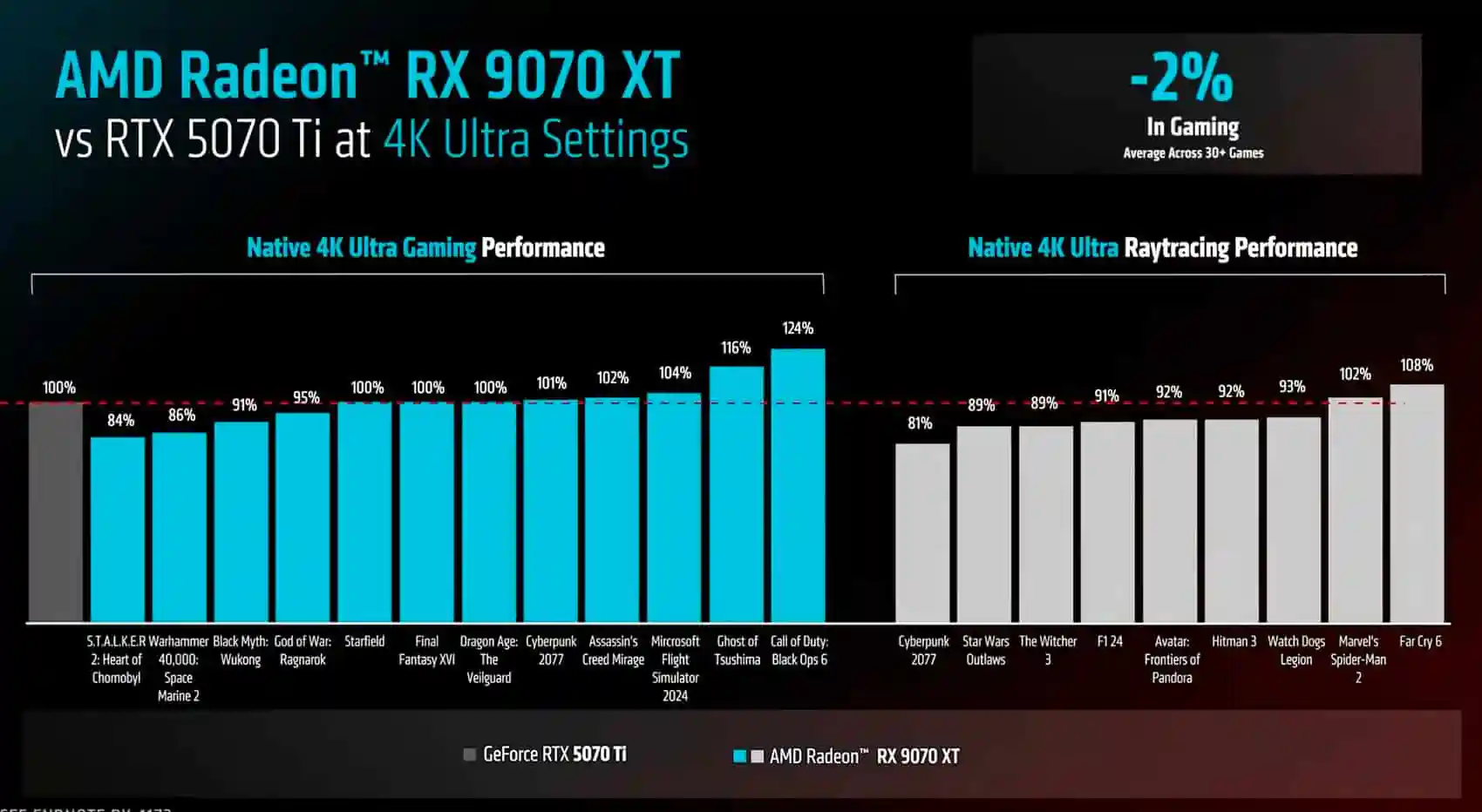
The RX 9070 XT can hold its own against the RTX 5070 Ti in 4K gaming.
AMD’s decision to stick with a more traditional power connector design has also paid off, which will undoubtedly help Team Red avoid the melting connector debacle that has haunted Nvidia.
Trump’s Tariffs: A Double Whammy For GPU Prices
Just when you thought things couldn’t get any worse for Nvidia, Trump’s tariffs are set to take effect any day now.
These tariffs, which target Chinese imports with an additional 10% levy, will increase the cost of manufacturing GPUs and other consumer electronics.
Both Nvidia and AMD will be affected by these tariffs, but Nvidia is likely to feel the pinch more acutely.
Why? Because Nvidia’s RTX 50 Series is already struggling with high production costs and low margins due to its advanced architecture.
Why You Should Buy An RX 9070 GPU Now
Given the current state of the GPU market, there’s never been a better time to buy an AMD RX 9070 Series GPU. Here’s why:
Availability: Unlike Nvidia’s RTX 50 Series, the RX 9070 and RX 9070 XT are widely available at retail prices.
Value for money: AMD’s GPUs offer comparable performance to Nvidia’s at a much lower price point, making them a smarter investment.
Performance: While the RX 9070 Series can’t quite outgun the RTX 50 Series in terms of raw performance, features like FSR4 and the RDNA4 platform might just negate the difference in real-world gaming output.
If you’re on the fence, consider this: Trump’s tariffs are just around the corner, and they’re going to drive up GPU prices across the board.
If you wait too long, you could end up paying 10% or more for the same GPU. The smart move is to buy now while prices are still reasonable.
Simply Put, AMD’s RX 9070 Series Is The Clear Winner
Nvidia’s RTX 50 Series may have the hype, but AMD’s RX 9070 Series has the substance.
With better availability, superior value for money, and fewer technical issues, I firmly believe that AMD’s GPUs are the clear choice for anyone looking to upgrade their system.
Add Trump’s tariffs into the equation, and the case for buying an RX 9070 GPU becomes even stronger.
So, what are you waiting for? Grab an RX 9070 or RX 9070 XT now, or risk paying a premium in a few weeks.
In a market this volatile, timing is everything—and AMD is giving you a golden opportunity to come out on top.
At Tech4Gamers, I contribute as a Senior News Reporter, combining my skills and gaming enthusiasm to keep our audience updated on the latest developments.
Story Highlight
Neil Druckmann says fans should not bet on Naughty Dog making another Last of Us title.
This statement comes after the director confirmed he had landed on a concept for the game last year.
The team could have encountered sudden difficulties related to said concept since then.
The Last of Us Part 3 has been the subject of much discussion in recent years. Five years after the second game garnered nearly universal critical praise, Naughty Dog has yet to say much about the series’ future.
The team has also announced Intergalactic, clarifying that The Last of Us Part 3 is much further away than anticipated. Making the situation more interesting, director Neil Druckmann now states that Naughty Dog may never make a third game.
Why it matters: The Last of Us is among gaming’s most successful IPs, so a third entry is a no-brainer. Following this success, Naughty Dog refusing to make a third title would be quite a shock to everyone.
The First Two Entries of The IP Were Recently Re-released For The PS5
When speaking to Variety, Neil Druckmann was asked about The Last of Us Part 3. This is far from the first time the director has been asked about the third entry, but his recent response was quite interesting.
He outright stated that fans should not bet on more entries in the series. The director suggests that there is a chance The Last of Us Part 2 will be the series’ final outing, with Naughty Dog exploring newer avenues in the future.
The only thing I would say is don’t bet on there being more Last of Us. This could be it.
-Neil Druckmann
Interestingly, the director previously stated that he had found a concept for the third game. This was one year ago, so it is possible something has changed at Naughty Dog, leading to these doubts.
The Last Of Us Part 2 Is Set To Receive A TV Show Adaptation Soon
However, it is possible Neil Druckmann just wants fans to keep expectations low. Even though The Last of Us Part 3 makes a lot of sense as the team’s next title after Intergalactic, Naughty Dog might not force itself if the current concept cannot live up to the high bar set by the series.
At Tech4gamers, I cover all sorts of gaming news. Whether it’s a leak of any upcoming game or an update, an announcement, or a rumour, I like to write about it all. Over the weekend, I sit and write features where I talk about games that I miss or want to see return.
Story Highlight
Borderlands 4 is finally coming out later this year.
The Gearbox CEO recently responded to fan criticism, stating that if you want the best Borderlands, root for us and cheer us on.
He further stated that we’ll all pay the price if we take developers’ passion for granted.
The Borderlands franchise is finally returning half a decade later. The developer revealed the first-look trailer during the Game Awards and recently confirmed that Borderlands 4 will be released later in September.
With just a few months left until release, the Gearbox CEO is focused on optimism. He recently urged fans, “If you want the best Borderlands game yet, support us and cheer us on.”
Why it matters: Since the game was developed using Unreal Engine 5, many fans have been concerned about its title.
Gearbox CEO Randy Pitchford Reacts To Recent Negativity – Source: Twitter/X
Not too long ago, Gothalion, audience director for publisher Midwest Games, wrote on Twitter that Randy Pitchford had muted a fan for raising some valid concerns about Borderlands 4, as his critique came from a place of love.
He further wrote that it should be digested gracefully when long-term franchise supporters give feedback and worries. However, Randy replied to the tweet, stating that there weren’t any critiques and that what he saw was full of negativity, which was demotivating.
Want the best Borderlands? Root for us and cheer us on. If you take developer’s passion for granted, we’ll all pay the price.
– Randy Pitchford
It makes sense as the title is only a few months away from its release; the developers wouldn’t want to hear demotivating things about the title, as it’s discouraging for the team that has worked years on a project.
Borderlands 4 Is Finally Coming Out Later This Year.
Borderlands 4 has received a great reception from fans on the trailers. Therefore, the expectations from the title are quite high. Still, how the game would perform on the launch remains to be seen.
At Tech4Gamers, I contribute as a Senior News Reporter, combining my skills and gaming enthusiasm to keep our audience updated on the latest developments.
Story Highlight
PlayStation recently formed a new team in Los Angeles to work on a brand-new IP.
We found a job listing that confirms this IP is based on Unreal Engine 5 and focuses on co-op multiplayer gameplay.
This likely means that the Los Angeles team is part of PlayStation’s growing live-service ambitions.
PlayStation’s live-service ambitions have been dialed down following Concord’s failure. However, several live-service projects are still moving ahead. In fact, PlayStation’s recently formed studio in LA appears to be working on one too.
We have just found a job listing for a Game Systems Designer, which confirms a co-op multiplayer focus for the game.
PlayStation’s New Studio In LA Is Hiring A Game Systems Designer
According to the job listing, the project is a completely new IP. While this project’s existence became public recently, not much else was known. This job listing reveals several new details, with the qualifications specifically asking for experience with co-op multiplayer gameplay.
Experience with and knowledge of cooperative multiplayer design.
-PlayStation Job Listing
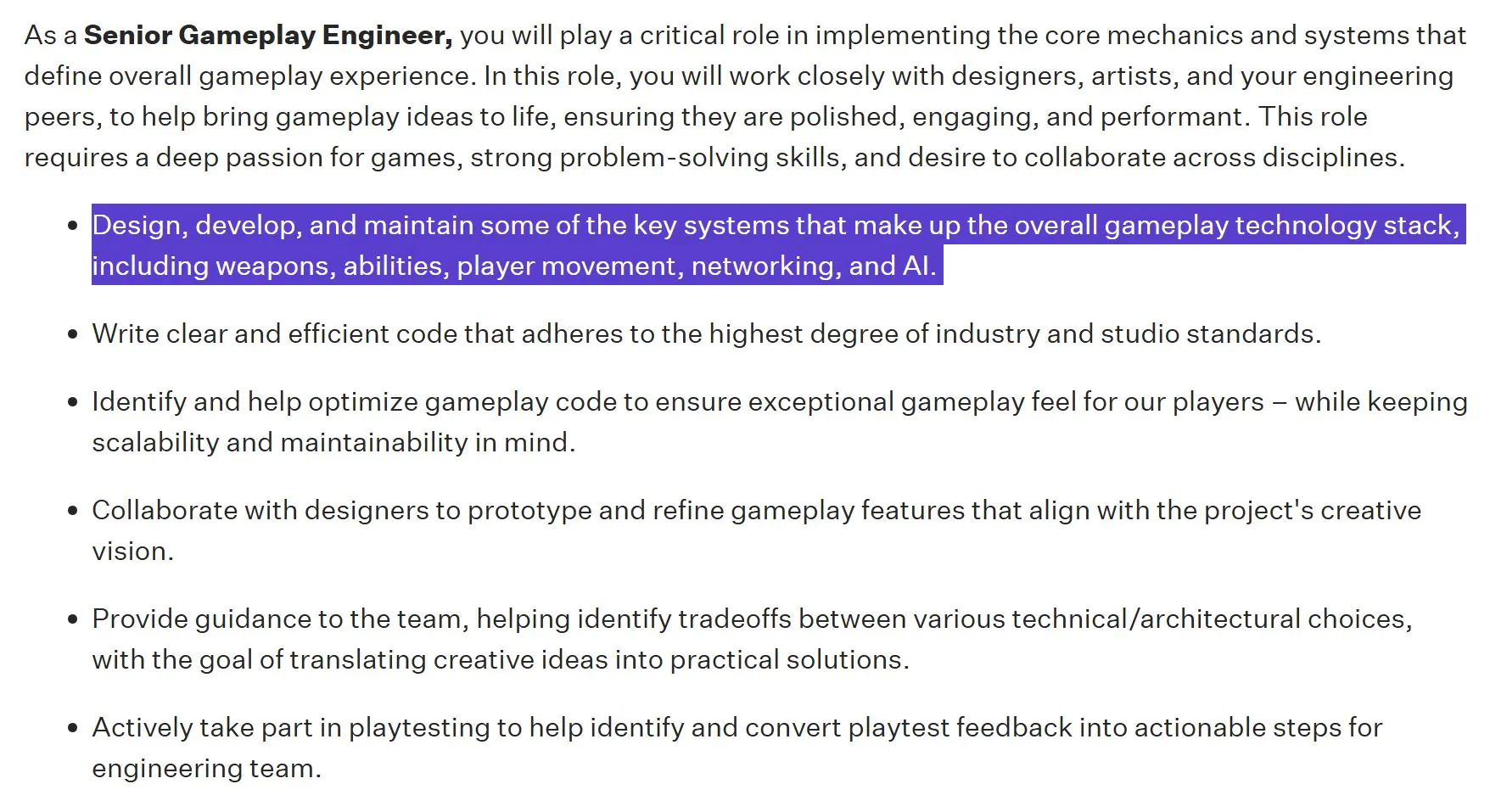
Moreover, we spotted a job listing for a Senior Gameplay Engineer, which further alludes to the multiplayer focus. Referencing the game’s key systems, this job listing points to networking, confirming the presence of online gameplay.
As such, the title appears to be based on the live service genre. This listing also confirms that the team is utilizing Unreal Engine 5.
PlayStation’s New LA Studio Is Hiring A Senior Gameplay Engineer
Additional details reveal the new IP will focus on traversal, different weapons, and abilities. All put together, it seems PlayStation is working on a hero-shooter or hero-focused action co-op game.
Develop key systems, including weapons, abilities, player movement, networking and AI.
-PlayStation Job Listing
Rumors have suggested that Jason Blundell is part of this newly formed PlayStation team. The developer was previously a PlayStation partner at Deviation Games, but the studio was later shut down.
It was then discovered that he had joined a different studio at PlayStation, although it has yet to be confirmed whether the Los Angeles team in question is the same studio.
Nonetheless, a co-op focus would make sense if Jason Blundell is leading the project since he has plenty of experience with Call of Duty Zombies. What do you think about this job listing? Let us know in the comments and on the Tech4Gamers Forums.