At T4G, my task is to cover the latest news around the gaming globe ASAP and with the utmost precision. I adore all the games and respect all the devs behind the amazing games that we get all year. So, whether it’s a PC or a Console game, I got it all covered.
Story Highlight
Nier Automata producer reveals he initially had two choices when choosing where to invest.
One was a well-known game that everyone knew about, and the other was Yoko Taro’s title.
Nier began as an experiment at first, but went on to become one of the most popular RPGs.
NieR Automata released in 2017 and is considered one of the finest RPGs to date. However, the game wasn’t always in the studio’s plans, as they wanted to produce a different game, and it was a risky move.
The game producer says that Nier Automata might never have happened because at first it was just an ‘experimental project’, but his trust in the director Yoko Taro pushed him to produce the title anyway.
Why it matters: Investing in Nier proved to be a brilliant idea because the game went on to sell around 10 million units and sold 10x more than expected, even though it was developed with a limited budget.
Nier Automata might’ve never happened, as it was just an experiment initially
In an interview with Famitsu, the Nier producer Yosuke Saito went into detail about how the title began development. He said he had the choice of a very famous title that everyone knows, and Nier, which would be an experiment.
I had two options in front of me. One was Yoko’s new work, and the other was a very famous title that everyone knows. But I Chose Yoko Taro!
– Yosuke Saito
It has since then gone on to sell around 10 million copies
Unfortunately, he didn’t reveal the name of the ‘famous title’, but he went with Nier, trusting in Yoko Taro to develop something magical. Rightly so, Nier became a huge hit and is even claimed to have saved the Japanese gaming industry.
There’s also some good news for fans wanting to get back into the franchise. The main Nier team is reportedly working on a sequel, which is expected to be revealed this year. Nonetheless, sticking with Taro was the best decision Saito made.
What are your thoughts on Nier beginning as an experiment at first? Let us know your opinions in the comments or join the discussion at the official Tech4Gamers Forum.
As a Senior Hardware Reviewer at Tech4Gamers with over a decade of hands-on experience, I dive deep into benchmarking GPUs, CPU coolers, and motherboards, pushing hardware to its limits. Passionate about overclocking and fine-tuning performance.
NVIDIA is no longer a company that manufactures graphics cards only. They have also become software companies and heavily rely on artificial intelligence, revolutionizing the PC gaming industry. NVIDIA announced the first iteration of DLSS (up-scaling) in 2018 for the RTX 20 (Turing) series, which is DLSS 1.0.
At that time, the games were minimal and used NVIDIA’s latest technology, such as Battlefield and Metro Exodus, but the up-scaling was not good enough. The algorithm had to be trained specifically on each game. If we go back in history When the DLSS 1.0 was launched, many reviewer outlets were disappointed, called it laughable, and were right.
The Launch Of DLSS
The First Version of DLSS (Deep Learning Super Sampling), 1.0, worked in two stages, both of which utilized the convolutional neural network (CNN). The first is image enhancement, which uses the single frame and motion vectors (information about how objects are moving) to fix the objects’ aliasing problem. The second stage is image scaling, where all the magic happens; the AI takes the low-resolution frame and then upscales it to the desired resolution.
DLSS 1.0 (4K) vs 1685p, Credits: Techspot
This image demonstrates the visual quality of DLSS 1.0 on 4K resolution in battlefield V. The difference is that day and night vs. the normal up-scaled resolution uses the TAA as the anti-aliasing. The DLSS 1.0 image looks overall blurry and is noticeably bad
DLSS – Quality Presets
When using the upscale in the game, users can access various quality presets. There are six presets, including DLAA, Ultra Quality, Quality Balanced, Performance, and Ultra Performance. Ultra Quality/Performance are not often used in games.
DLSS Quality Presets
Scale Factor
Render Scale %
DLAA
1x
100%
Ultra Quality (unused)
1.32x
76.0%
Quality
1.50x
66.7%
Balanced
1.72x
58.0%
Performance
2.00x
50.0%
Ultra Performance (unused)
3.00x
33.3%
DLSS 2 – Huge Upgrade
DLSS 2.0 was the major upgrade in image quality, while DLSS 1.0 required per-game training data and was less versatile and inconsistent. The DLSS 2.0 version first simplified the process for developers to incorporate DLSS into the game. It does not have to be trained for every game. DLSS 2.0 uses a temporal anti-aliasing supersampling (TAAU) solution. It uses the temporal feedback loop that includes motion vectors, takes the current and previous frames, and then uses AI to construct sharp, high-resolution images.
DLSS 2.0 Architecture Design
As demonstrated in the design above, the DLSS used the convolutional autoencoder that helps to capture the low-resolution current frame and high-resolution previous frame to generate a higher-quality frame with the help of temporal feedback. The DLSS 2.0 was introduced with an RTX 30 graphics card.
DLSS 1 vs DLSS 2.0, Source NVIDIA
The DLSS 2.0 was the major leap in performance and image quality, and it was easy for developers to implement.
DLSS 3 – Introduction Of Frame Generation
With every iteration of the RTX graphics series, NVIDIA has always worked on the DLSS and its newer features. The DLSS 3.0 launch with GeForce RTX 40 Ada-Lovelace Architecture was controversial and has been the talk of the town for a while, and it still is. NVIDIA introduced the frame-generation feature, which could increase the frame rate by 2x. When it’s coupled with the up-scaling, the performance can go massive. However, what frame-generation does is, with the help of AI, Ada’s (Optical Flow Accelerator), and game engine data motion vectors and depth, it analyzes two real frames and creates an extra frame between them.
Some people call it ‘AI Fake Frames,’ but it’s not as easy as they say. It’s complicated how it works precisely. As the frames are generated between the two frames, there is additional latency between them. However, to minimize the latency, NVIDIA also incorporates its Reflex technology, ensuring lower latency. NVIDIA reflex is essential to reduce the latency when the frame generation is enabled. However, before understanding Reflex, you must know how the system latency works. System latency is the delay between your input and resulting pixel changes on your display. For example, when you press the mouse click or enter the key with the keyboard, it takes some time (ms) to display the action on your screen.
The above picture demonstrates that the NVIDIA reflex eliminates the Render Queue. In the pipeline, the CPU prepares the frame rates and then sends them to the GPU for rendering; if there are so many FPS, it creates the render queue of frames, which produces latency because the GPU has to process all the frames.
When the Reflex is enabled, the CPU and GPU are synchronized. Reflex and Frame Generation are different technologies, but they ought to work together to reduce the input lag. Reflex ensures that the game remains highly responsive to AI-generated frames.
DLSS 3.5 – Introduction If Ray-Reconstruction (AI-Enhanced Ray-Tracing)
With the RTX Graphics Series launch, ray tracing in games has become popular for accurate reflection, shadows, and global illumination. However, there was one problem with the ray tracing, as ray-traced images would appear blurry unstable, and pixelated. NVIDIA introduced Ray-Reconstruction to reconstruct better ray tracing and improve the visual quality, sometimes aiding in performance.
Compute-wise, Ray-tracing is a costly technique that helps to simulate realistic lights, shadows, and reflections in real-time. However, it is tough for graphics cards to render a whole ray-traced scene in real time; game developers usually reduce the number of light rays that can produce noise in the ray-traced effects. To resolve these issues, developers often use the traditional de-noisers in the game, which need to be trained specifically for each game. It’s challenging and imperfect; traditional de-noisers can produce artifacts and blur details.
DLSS Ray Re Construction ArchitectureRay-Reconstruction Comparison
Now, that’s where DLSS Ray Reconstruction kicks in. It is an AI-powered denoiser that utilizes a neural network to analyze the noisy internal image with the missing pixels. Overall, DLSS Ray Reconstruction can help produce better image quality.
DLSS 4.0
Introduction To Transformer Model
NVIDIA unveiled the DLSS 4.0 model with the GeForce RTX 50 Series; they have also introduced the multi-frame generation in the DLSS 4.0 suite, which can improve the frames by 3x and 4x. The previous frame-generation technology launched with the GeForce RTX 40 Series can only generate frames up to 2x.
However, DLSS 4 is a massive thing in terms of image quality. NVIDIA has now switched to a transformer model, an enormous upgrade for DLSS Super Resolution and DLSS Ray Reconstruction. Previously, DLSS used Convolutional Neural Networks (CNNs) to generate the new pixels; now, they hit this model’s boundaries and limitations. The new transformer model is more innovative and more intelligent. It analyses the image deeply, requiring more computational power to produce better image stability and greater detail.
DLSS 4 Transformer Model, Source: NVIDIA
The transformer model is a significant leap over the previous CNN model, as it can read the frame more intelligently; it uses a vision transformer that utilizes the self-attention mechanism, which is computationally heavier than the previous model. The transformer model has a more global understanding of the image and the context within the image data. This latest model can generate pixels that offer better stability, less ghosting, higher details in motion, and smooth edges in the image.
DLSS Transformer Model vs CNN, Source: NVIDIA
The latest DLSS Ray-Reconstruction also uses the newest transformer model, which delivers more detailed and accurate visuals. It can accurately read the pixels in the distance and reconstruct them in higher quality, as demonstrated in the image below, with the CNN below. Look at the fan blades; the previous model cannot accurately reconstruct the pixels, causing ghosting and artifacts, while the transformer model is noticeably better almost near perfection.
RR – Transformer vs CNN, Source: NVIDIA
Introduction To Multi-Frame Generation (MFG)
DLSS 4 brings multi-frame generation (MFG), introduced with Geforce Graphics Series, previously frame-generation generates one AI frame for every two rendered real frames, now multi-frame generation can generate up to three AI frames per rendered frame.
DLSS 4 MFG Architecture, Source: Nvidia
NVIDIA’s latest technology in DLSS 4 introduces a new feature called ”Blackwell Flip Metering” that is being used in multi-frame generation. It’s a hardware-level technology within the NVIDIA Blackwell GPU architecture designed for the GeForce RTX 50 series. Now, understanding this technology can be tricky for less tech-savvy individuals; for those who understand, Flip metering ensures smooth and precise timed delivery of frames.
In comparison, DLSS 3 frame generation utilized CPU-based pacing, leading to an inconsistency in FPS; the hardware flip metering shifts the frame pacing logic to the graphics card’s display engine, ensuring smooth frame delivery, considering the frame generation can produce 3 times more frames.
Warhammer 40000 Darktide FG, Source: Nvidia
As officially demonstrated by NVIDIA, the latest frame generation also uses the newest transformer model, which takes 30% less of the video memory when enabled and can deliver slightly better performance.
Support for Older Graphics Series
DLSS 4 can be used with the older graphics series; at least the RTX 20 graphics-card series is required as the DLSS requires the tensor cores. So, the GPUs with tensor/AI cores can run the DLSS 4 libraries except for DLSS frame generation, which cannot run on GeForce GPUs before RTX 40. Multi-frame generation is exclusive to the GeForce RTX 50 series. However, it’s fascinating that older cards could still run the latest transformer model for upscaling and ray reconstruction.
DLSS 4 Features, Source: Nvidia
How to Update
First, ensure that the game you’re playing supports DLSS; there is always a chance that the developers may not have updated your DLSS files to the latest version. However, there are multiple ways to update the DLSS files in your game library. One traditional method is to swap and override the DLSS files. The latest DLSS files can be downloaded from here. Head to the game directory and copy-paste the files.
If you don’t want to take the extra steps, there is another easy way to update the DLSS files. You can use the NVIDIA APP to override the DLSS versions. With just a few clicks, you can install the latest DLSS model in the games. Make sure you have the latest GeForce Drivers and NVIDIA App.
Open the NVIDIA App.
Nvidia App Menu
Click on the graphics setting at the top left. A new page will open, and you can select the game.
Nvidia App – Select Game
In our example, we use Cyberpunk 2077. Now select the game, and the settings on the right will open. You will see three options.
DLSS Override Model Presets – Allows you to update DLSS games or apps to use the latest DLSS models.
DLSS – Frame Generation – Allows you to override DLSS Multi Frame Generation for games or apps that have integrated DLSS frame generation.
DLSS Override Super Resolution – Allows you to enable DLSS Super Resolution models not supported in certain DLSS games or apps.
Open the DLSS Override – Model Presets
DLSS Override Option – Nvidia App
Make sure to select the ”Latest” Option and hit apply. Now, your game will be using the latest DLSS 4 transformer model. In this way, you can override the DLSS in every supported title.
Final Thoughts
With every iteration of the RTX launch, DLSS has come a long way and has become essential in every game. Nowadays, every game supports the DLSS; for the developers, sometimes it’s an excuse to recommend DLSS for their broken or unoptimized games. When the DLSS was launched, people did not take this thing seriously. Everyone thought DLSS was a blessing for the lower-end or older GPUs that struggle to run the newer titles. Then, the DLSS 2.0 was launched with the RTX 30 series, and it shook the market a bit with the plethora of visual improvements over the previous version. DLSS 2.0 was relatively easy to implement; more and more games started using DLSS in the games.
NVIDIA carried on the DLSS development, and there were tons of DLSS revisions from DLSS 2. X to DLSS 2.5.1. The AI-based DLSS upscale was catching up to native images fast in terms of quality. DLSS 3 was launched with RTX 30, and frame generation and ray reconstruction were introduced sometime later. DLSS 4.0 was launched after that with the RTX 50 series launch. By that time, DLSS already surpassed the native rendering. Thanks to the transformer model, not only did it provide us with stable and crisp visuals but also with more performance. One great thing I appreciate about the post is that older RTX 20 cards can still run the latest transformer model.
At Tech4Gamers, I contribute as a Senior News Reporter, combining my skills and gaming enthusiasm to keep our audience updated on the latest developments.
Story Highlight
Warner Bros Games suffered a 48% decline in revenue during the first quarter of 2025.
The company blames Suicide Squad’s poor performance and the lack of major releases for these results.
It also states that Hogwarts Legacy and Mortal Kombat 1 continue to generate revenue for the gaming division.
Suicide Squad: Kill The Justice League needs no introduction after it became one of last year’s biggest failures. Warner Bros Games previously blamed the titles for losses worth millions of dollars, and it seems the company is still not happy with everything that happened last year.
In its latest financial report, Warner Bros Games reported yet another round of disappointing financial figures, citing Suicide Squad: Kill The Justice League’s failure as a major reason for the less-than-stellar results.
Why it matters: The publisher already ended support for this live-service project earlier this year, but it seems Warner Bros Games has yet to fully move on from the financial hit brought about by the title.
Warner Bros Games Revenue Declined In Q1 2025
Discussing the financials for Q1 2025, Warner Bros. noted that games revenue declined by a whopping 48% this quarter.
As per the company, this decline was a result of the lack of major releases over the last few months. Moreover, Suicide Squad: Kill The Justice League’s failure to meet expectations continues to haunt the publisher.
It should be noted that this game’s failure also contributed to the cancellation of Wonder Woman, another major Warner Bros Games project. All in all, the gaming division has certainly seen better days.
On a more positive note, Mortal Kombat 1 and Hogwarts Legacy continue to generate revenue for the team. This is exactly why the publisher is going all in on the two IPs moving forward.
Rocksteady Is Returning To Batman After Suicide Squad’s Failure
Rocksteady has also begun hiring for a new project, with reports pointing to the return of Batman Arkham. As such, Warner Bros Games’ future could be much better than the present.
At Tech4Gamers, I contribute as a Senior News Reporter, combining my skills and gaming enthusiasm to keep our audience updated on the latest developments.
Story Highlight
GTA 6 was recently delayed to 2026, leaving fans disappointed.
A reliable leaker states that Rockstar Games had no choice but to delay the game.
The team would have had to cut content and make various sacrifices if it tried to launch the game in 2025.
Rockstar Games finally broke its silence last week, sharing new GTA 6 footage, information, and screenshots. The game looks to be a major triumph for the open-world genre, but fans will have to wait an additional year to finally jump into Grand Theft Auto’s latest iteration.
Although millions across the globe have been left disappointed by this delay, a reliable leaker has given fans some hope. As per his information, this delay was absolutely necessary for the game.
Why it matters: Take-Two and Rockstar Games initially wanted to meet the 2025 release window for GTA 6, indicating that the decision to delay the game was not easy to make.
GTA 6 Insider Explains Why Rockstar Games Delayed The Title | Image via X
As per reliable leaker GameRoll, GTA 6 would have been a much worse game had it been released in 2025.
This information comes from the same source that revealed Jason and Lucia’s full names several weeks ahead of Rockstar Games’ latest trailer. The source states that the team would have needed to cut ‘a lot of cool stuff’ to try and make the 2025 release window.
Although cut content would not be a first for the Grand Theft Auto franchise, the statement implies that GTA 6 would have had it worse than past entries. Because the team intends to shatter all expectations, this outcome would have been far from ideal.
Rocktar Games’ crunch culture has also received criticism in the past, so it was only natural for the team to delay the game to 2026 to ensure GTA 6 development continued smoothly without any crunch.
GTA 6 Could Be This Generation’s Best Looking Title
Fortunately, the team’s latest round of marketing has given fans something to make the wait less excruciating. The second GTA 6 trailer seems like a huge upgrade in every department, creating even more excitement compared to the initial reveal from 2023.
I’ve previously worked for eXputer as a Senior News Writer for several years. Now with Tech4Gamers, I love to devoutly keep up with the latest gaming and entertainment industries. I have a Bachelor’s Degree in Computer Science and years of experience reporting on games and breaking exclusive stories. Besides my passion for gaming journalism, I love spending my leisure time farming away in Stardew Valley. VGC, IGN, GameSpot, Game Rant, TheGamer, GamingBolt, The Verge, NME, Metro, Dot Esports, GameByte, Kotaku Australia, PC Gamer, and more have cited my articles.
Story Highlight
Switch 2 will get a massive marketing push with Nintendo putting nearly $1 billion in advertising the console.
The Japanese company will spend 62% more in the next fiscal year for advertising purposes.
The $966 million it’ll spend is only 7.2% of its revenue.
Expectations for the Nintendo Switch 2 are sky high, with the company backing it up with an exclusive lineup even Sony is jealous of, thanks to titles like The Duskbloods. Analysts are already predicting that the console’s launch will be one to behold, with the new hardware poised to sell a whopping 15 million units in its first year.
Nintendo is pulling out every stop to ensure this happens, as the Japanese gaming giant is apparently looking to spend a massive amount on marketing Nintendo Switch 2.
Why This Matters: With massive anticipation and an even bigger marketing push, the Switch 2 will bring in some much-needed revenue for the industry.
Nintendo Switch 2 marketing will be the biggest in the company’s history
While sharing its financial report for the fiscal year ending March 2025, Nintendo revealed that it is going to spend a whopping $966 millionfor advertising purposes in the coming year, showcasing the massive push Nintendo Switch 2 is about to receive.
The company is increasing its marketing expenditures by 62% for the next tenure, which aligns with the launch year of the handheld. Furthermore, this is going to be the highest ad spend in Nintendo’s history, meaning that Switch 2 is getting the biggest marketing push ever.
To further put the Japanese giant’s power into perspective, this $1 billion marketing spend is only 7.4%of the revenue Nintendo made in the previous fiscal year. Hence, if Switch 2 is as successful as many predictions claim it will be, the company will take one more step in cementing its name as the top dog of the industry.
Do you think the Nintendo Switch 2 will become the best-selling console ever? Tell us in the comments below or head to the Tech4Gamers forum for discussion.
At Tech4Gamers, I contribute as a Senior News Reporter, combining my skills and gaming enthusiasm to keep our audience updated on the latest developments.
Story Highlight
Death Stranding 2 ships with both Quality and Performance modes on PS5.
The latter is said to suffer from ‘frequent grass pop-in’ and a few graphical sacrifices.
Previews note that the game still plays best at 60FPS and looks great in both modes.
Death Stranding 2 has received plenty of positive coverage following recent previews, which shed light on elements like the game’s length, development progress, and more.
The title has also gone gold ahead of its June 26 release date, and Hideo Kojima has confirmed a Performance mode for Death Stranding 2 on the PS5.
Why it matters: The game has received praise for its incredible visuals in the past. Although 60FPS modes have become standard for consoles today, fans have been glad to receive official confirmation ahead of the release.
As per Game Informer, Quality mode is focused on fidelity, while Performance mode aims to provide a smoother gameplay experience.
Like all Performance modes, aiming for 60FPS requires a few graphical compromises. This is not too surprising, but the previews note that ‘frequent grass pop-in’ is a major problem in Performance mode.
Although this may seem like a dealbreaker, the preview still recommends playing the game at 60FPS for a smoother experience. Death Stranding 2 looks great across the board, giving players the freedom to pick between 30FPS and 60FPS based on their preference.
Kojima Productions’ Latest Work Features Lifelike Character Models
Discussing graphics further, Hideo Kojima has also noted that the jump from the PS4 to the PS5 is not too significant, forcing his team to focus on other areas to impress audiences.
Even though Death Stranding 2’s presentation is far from weak, the game is expected to excel in other areas as a result of the shift away from raw graphical fidelity. This is perhaps why 60FPS has received a lot of attention from Kojima Productions.
At Tech4Gamers, I mainly cover new gaming news, leaks, and rumours. Aside from that, I love to write features about my favourite games while inserting my opinion about their different aspects.
Story Highlight
Assassin’s Creed Shadows was released to nearly 65K players almost two months ago.
While its all-time peak isn’t terrible, its 24-hour peak is less than AC Odyssey.
It is disappointing to see a new game having fewer players than one that was released seven years ago.
Assassin’s Creed Shadows, released earlier this year, received a lot of criticism for many, many reasons. The game had been criticised from the start, and because of that, Ubisoft had to make sure it released a really polished version.
Why it matters: If a game is great, fans play it for a long time, especially if it is an RPG. For reference, games like Elden Ring still have a 24-hour peak of over 50K players. Similarly, Cyberpunk 2077, another RPG, has over 30K 24-hour player peak.
Comparison of Assassin’s Creed Shadows and Odyssey’s player count
Assassin’s Creed Odyssey was released seven years ago, and it still manages to get a 24-hour peak of over 8k players. At the time of writing, there are 2913 players playing it. On the other hand, Assassin’s Creed Shadows only has a 24-hour peak of 7.7k players, and only 2788 are playing it right now.
You may remember how AC Odyssey was criticised on launch. Many shared the opinion that it was a good RPG but not a good Assassin’s Creed game. That is why it is pretty disappointing to see that a newly launched AC game is performing worse than the one released back in 2018.
It should also be noted that people seem to have a slight positive bias when it comes to games set in Japan. This country is absolutely gorgeous and has a great history. Despite that, the Shadows’ performance is disappointing.
What do you think about the newly launched Assassin’s Creed Shadows faring against Odyssey? Do you think this comparison is fair? Share your thoughts with us in the comments section below or join the official Tech4Gamers forums for discussion.
At Tech4Gamers, I mainly cover new gaming news, leaks, and rumours. Aside from that, I love to write features about my favourite games while inserting my opinion about their different aspects.
Story Highlight
Clair Obscur: Expedition 33 was released just recently, and it has already won the hearts of many.
The director of Stellar Blade has completed the game in 96 hours.
He has also claimed it to be his Game of the Year.
We are not even halfway in 2025, and there are really exciting releases already. Some of those releases have the potential to take the most prestigious award, Game of the Year, home.
We won’t be surprised if this title goes to either Kingdom Come: Deliverance 2 or Clair Obscur: Expedition 33. Both of these are excellent, and the latter is continuously getting more and more recognition. Just recently, the director of Stellar Blade has hailed it as his Game of the Year.
Why it matters: The Game of the Year award is the best award a game can get, and it is basically free promotion for that video game. So, a game winning this award is a big deal.
The Director of Stellar Blade Claims That Clair Obscur: Expedition 33 is His GOTY | Source: Twitter/X
Kim Hyung Tae, the director of one of 2024’s most famous (for obvious reasons) releases, has recently finished Clair Obscur: Expedition 33 and has claimed it to be his GOTY, which is not surprising at all, given how great the game is.
I finished Clair Obscur: Expedition 33 in 96 hours, and it’s my GOTY! Thank you, SANDFALL Interactive!
-Kim Hyung Tae
Many fans share the same sentiment, as this game managed to surprise many. Even those who weren’t fans of the turn-based combat were blown away not only by its combat but by its story, characters, and most importantly, soundtracks.
Clair Obscur: Expedition 33 features excellent soundtracks that you may find yourself listening to in the camp for hours. There is a reason why it managed to sell 2x faster than the biggest JRPGS.
Still, it is pretty impressive that the Stellar Blade director has 96 hours in the game because it only takes around 60 hours to complete the game (as per howlongtobeat.com). We also managed to complete the game in a similar time frame.
In the comments section, fans praise the game and Kim. One fan said, “Wow, you are truly a gamer from what I see on your screen. Stellar Blade was my best game of the last year, and Expedition 33 will probably be the best of 2025. Knowing you played it too comforts me in that you know what gamers really want! Hoping to see your next project soon.”
What do you think about Clair Obscur: Expedition 33? Have you played it yet? Share your thoughts in the comments section below or join the official Tech4Gamers forums for discussion.
Lead the comparison and blog writing teams at Tech4Gamers.
Oversee teams with a keen eye for detail and precision.
Ensure hands-on writing, with benchmarks and testing as guiding principles.
Guarantee the delivery of the best possible results in concise yet impactful tech tales.
Story Highlights
Surface reflections are more apparent on the glossy panels, which means you have to be precise in controlling the light in your room.
The glossy panels have more vibrant colours and deeper blacks, but most of the newer matte panels now offer comparable results.
HDR is better in glossy, but they’re more prone to VRR flickers. Ultimately, your choice depends on your setup and your preference.
OLED displays have revolutionised the industry, with some coming in 3D and others being launched in 5K OLED. However, some of these OLEDS now come in a matte finish instead of a glossy one, which has sparked debates.
These debates are made by people who haven’t used the panels and assume that the matte finish is like the one from standard IPS panels. However, brands use different finishes, and in this article, I’ll dive deeper to end this confusion.
Surface Finish & Reflections
One of the most common issues with glossy OLED displays, especially in TVs, is that they reflect so much light, making it difficult to focus on the objects on the screen. But that’s not entirely the case for glossy OLED panels for monitors.
See, glossy panels in OLED monitors are far less reflective than the panels found in OLED TVs. But this doesn’t diminish the fact that they are still reflective. This means it will reflect if you’re in a sunlit room or have a light source behind you.
Matte (Left) Vs Glossy (Right) (Image Credits – YT/Optimum)
In contrast, the newer matte finish panels differ from those of the brands manufactured years ago. Now, they’re slightly reflective and almost hybrid panels, offering the best of both worlds, while still being better for your eyes.
Deep Blacks
Despite the obvious downside, glossy panels do have a big advantage: better colour and contrast. They usually offer more vibrant colours, with deeper and darker blacks, which are apparent when you view them side by side.
Compare this with the matte panels and you see weird greyness instead of pitch black darks. This might not be completely visible in standard lighting, but it becomes apparent once you dim or switch off the lights in your room.
Pure Blacks In OLED (Image Credits – YT/The Display Guy)
However, some glossy panels have a coating that turns these blacks into a purple hue, which defeats the purpose. So, you must check the reviews on YouTube, where they also show you the screen in low room light.
Color & Contrast
Apart from offering pure blacks, glossy OLED panels also offer infinite contrast, with sharper colors that appear more intense than most matte-finish panels. In contrast, the matte panels often dull the color pop that glossy panels are known for.
While some may argue that the latest OLED matte panels provide just as vibrant colors and sharp highlights as the glossy ones, technically, the glossy panels are designed to have better contrasts and colors.
Matte (Left) Vs Glossy (Right) Colors (Image Credits – YT/Optimum)
So, the glossy panels are great for gaming and watching videos as they feel cinematic if used in controlled-light environments. It is also perfect for productivity users because you can see the raw image quality without hindrance.
VRR Flicker
One common issue present in most glossy panels is VRR Flicker. This can mostly be seen in loading screens and some darker scenes. The matte panels usually seem to perform better with VRR flicker; if not, it is less noticeable in these panels.
HDR
Both the matte and glossy panels have pretty decent HDR implementations. However, the brightness of the colors and saturation present in the glossy panels are slightly better in this regard.
Similar HDR But Slightly Better In Glossy (Image Credits – YT/Optimum)
Which One Is For You?
This is the biggest downside of having an OLED; you need to adjust the lighting so that no light reflects back. This is manageable for a few people, but most users simply can’t change their setup, which makes the matte finish superior.
Also, matte panels are best for people who’re easily distracted by the tiniest amount of distraction on their screen, which could be as simple as a slight glare reflecting from the monitor.
The newer matte panels are designed to be slightly reflective, so they appear more or less the same if you don’t care too much about having vibrant colour and contrast, even though there is a slight difference.
Which One’s For You? (Image Credits – YT/The Display Guy)
But if your eyes are prone to detecting the razor-sharp contrasts and deep blacks easily, and you can control your environment, then you should get a glossy one. Still, check out reviews of various models before making a decision.
At Tech4Gamers, I’m a Senior Error Fix Writer specializing in troubleshooting problems. Each article results from deep research, testing fixes and providing solutions.
Story Highlights
Sony’s previous handhelds, especially the beloved PSPs, have had massive success. Now, they’re reportedly working on a next-gen handheld.
This will reportedly feature full PS5 compatibility but with lower resolution. Its hardware might also be comparable to the PS4.
This means you can play the Sony exclusives on the go. It is expected to be released in 2028 after the release of the PS6.
Sony has been absent from the handheld scene for quite a long time, nearly eleven years to be precise. But now, according to the industry insiders, they seem to be stepping back into this space again, and I’m more than excited about it.
PSP3 Concept (Image Credits – Yanko Design)
Brief History Of Sony’s Handhelds
In February 2024, there were rumours that Sony and Xbox were working to launch next-generation handhelds. Now, there are more rumours and insider news regarding this handheld, making us think we’re closer to it than before.
How It Started
Sony has seen massive success with their past handhelds, especially the PSP. The concept of their handhelds started with PocketStation which not many people know today. It was more of an addon to the PlayStation 1, acting as an extra memory card.
The Legendary PSP
They then released the first ever PlayStation Portable, the PSP-1000. This was their first attempt to bringing the handheld scene to life. Then the infamous PSP Slim (PSP-2000) and the PSP Brite (PSP-3000) came into being.
PSP Series (Image Credits – r/PSP)
The 1000 was heavier and had limited features, while the 2000 and 3000 could be connected to a TV, were lighter and brighter respectively. This line of PSP was the most succesful out of every handheld, where Sony sold over 82M units.
The Not-So-Great PS Vita
Sony then wanted to counter the Nintendo DS by launching the PSP Go, but it wasn’t a success. Then the PS Vita was launched, where they added touch screen feature, made PS4 games compatible with it and many other features.
However, it had many problems, due to which it was not onlyn’t as loved as the PSPs but also failed. The PS Vita Slim was the last handheld Sony worked on in December 2014, and they have never returned to making handhelds.
PS Vita (Image Credits – Sony)
What About Now?
Now, with rumours about Sony’s new handheld, people are calling it the PSP3, which tells us that Sony might’ve ditched the PS Vita line. This could mean that we might be getting a decent handheld this time.
What Can We Expect From The Upcoming Handheld
This upcoming handheld could be a revolutionary move from Sony since they’re reportedly deciding to add great features. Some of these features could also strengthen its future-proofing. Let’s see what these features are.
PS5 Compatibility
One promising rumour is that this handheld might be compatible with PS5 games. A leaker says that it could allow players to play PS5 games directly without any patches.
PSP3 Concept (Image Credits – YT/GamingJolac)
The resolution or FPS in these games would be lower due to the handheld’s lower memory bandwidth compared to the PS5. This would be completely understandable and would still be a treat for the players.
Patches For The PS5 Compatibility
But this begs the question of how Sony could integrate PS5 games directly into this upcoming handheld. Well, they could very well patch games on it, such as having something like a portable or performance mode.
This could be similar to the different modes we already see in the current PS5 games. Then, PSSR could be used to enhance the performance of these games so they are playable on the PSP3.
PlayStation Handheld Concept (Image Credits – YT/8-bits)
Comparable To PS4 & PS4 Pro
Some reports suggest this PSP3 will have better hardware than the Xbox Series S, but still lower than the PS5. This makes the PSP3 comparable to the PS4 and PS4 Pro, which are still very effective for a handheld.
Still, tons of games are being produced for the PS4 even though it’s been over five years since the newer PS5 was released. This could be the case for this handheld as well, where games could launch for it years after its release.
Chipsets
The leaker also mentions that this handheld won’t be using the PS6 chips. Apparently, they’ll be using an alternative designed to run on low voltages, which makes it suitable for handhelds.
Sony Handheld Concept (Image Credits – YT/Gameranx)
This opens the door for Sony to use the ARM architecture for this PSP3, since Sony listed a job listing in 2024 stating that they wanted to run their games on different architectures.
Launch Date
The leaker says that Sony might release this handheld a few months after the PS6, which is already expected to launch in 2028. However, we have to wait and see if Sony announces it till 2026 or not.
Grain Of Salt
Conclusively, these are just rumours made by industry insiders. Apart from that, nothing can be confirmed or denied since Sony has been silent about this topic entirely. So, we have to wait for their announcements.
As a Hardware Expert at Tech4Gamers, I blend my Computer Science expertise with a love for technology. Through comprehensive reviews and comparisons, I guide our audience in making informed tech decisions.
If you’re in the market for a premium DDR5 kit with solid performance, you probably have heard of the Corsair Dominator Titanium line-up. There is no denying that it is one of the best DDR5 RAM kits you can buy right now, and we have already reviewed and tested three different variants from the series:
This time around, we are going to benchmark the Corsair Dominator Titanium 64GB (2×32) kit with 6000 MT/s, CL30 specs to see how much of a performance difference you can expect from double the storage.
Why Trust Tech4Gamers
Sameed Hussain is our hardware expert who has been testing graphics cards, processors, RAM, and motherboards for years.
70+ RAM tested and reviewed by our team of hardware experts (Tech4Gamers Team).
200+ hours spent testing different RAM kits for our reviews.
At Tech4Gamers, ensuring you get reliable information is our priority. That’s why every hardware round-up undergoes a meticulous review process by our team of experts and editors. Each review is carefully examined against our strict editorial guidelines, guaranteeing you trustworthy insights you can depend on.
Memory Color
Grey
Heat Spreader
Aluminum
MemorySize
64GB (2 x 32GB)
MemoryType
DDR5
Package Memory Format
UDIMM
Package Memory Pin
288
PerformanceProfile
EXPO & XMP
SPD Latency
40-40-40-77
SPD Speed
4800MHz
SPD Voltage
1.1V
Tested Latency
30-36-36-76
Tested Speed
6000 MT/s
Tested Voltage
1.40V
[toc]
Packaging And Unboxing
Front Box
Unboxing
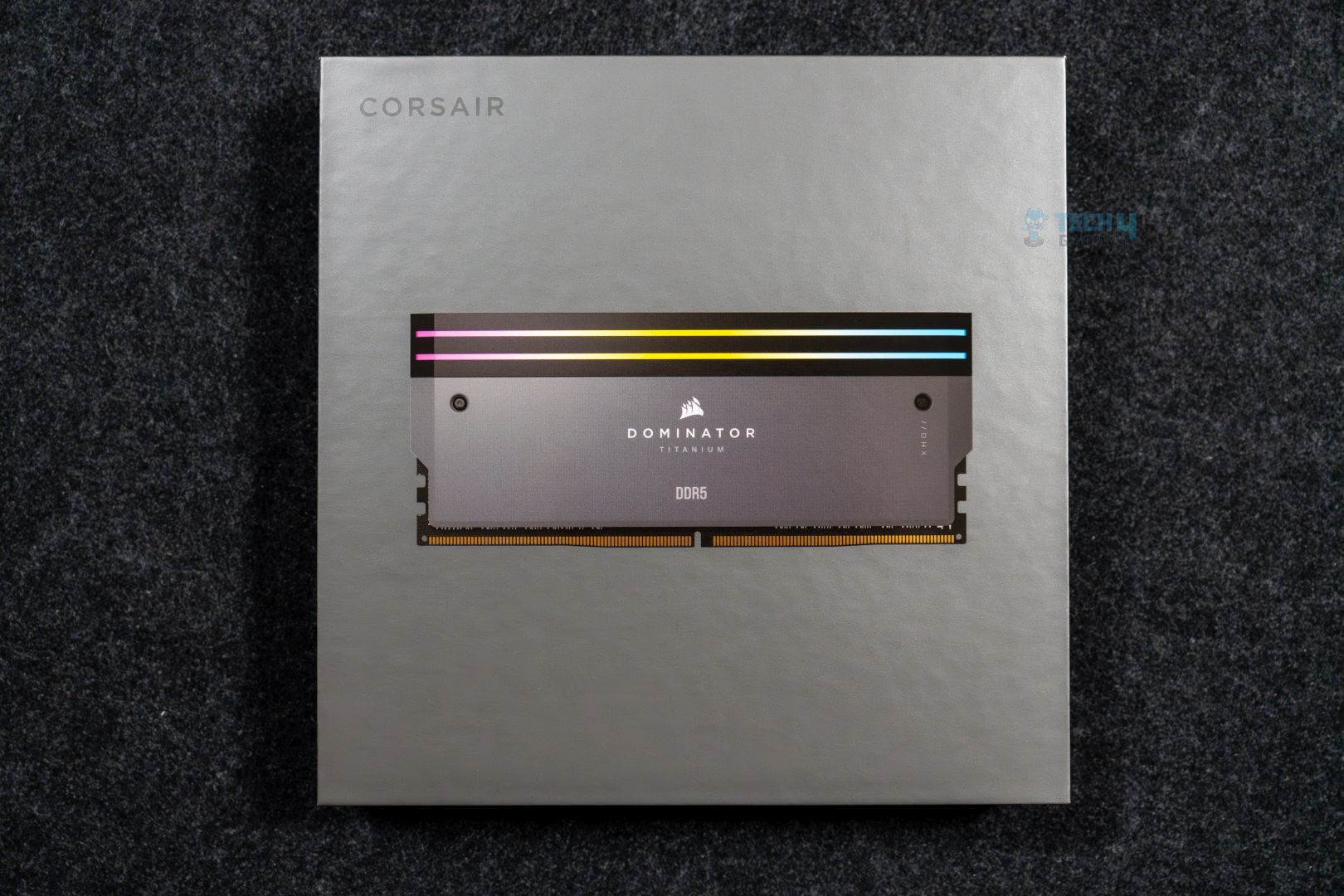
You know the kit is different when Corsair ditches its icon highlighter-yellow packaging to go with a more subtle look. In any case, there are no complaints about the unboxing experience. The kit comes in a simple, minimalistic grey box with a picture of the memory at the front, nothing more.
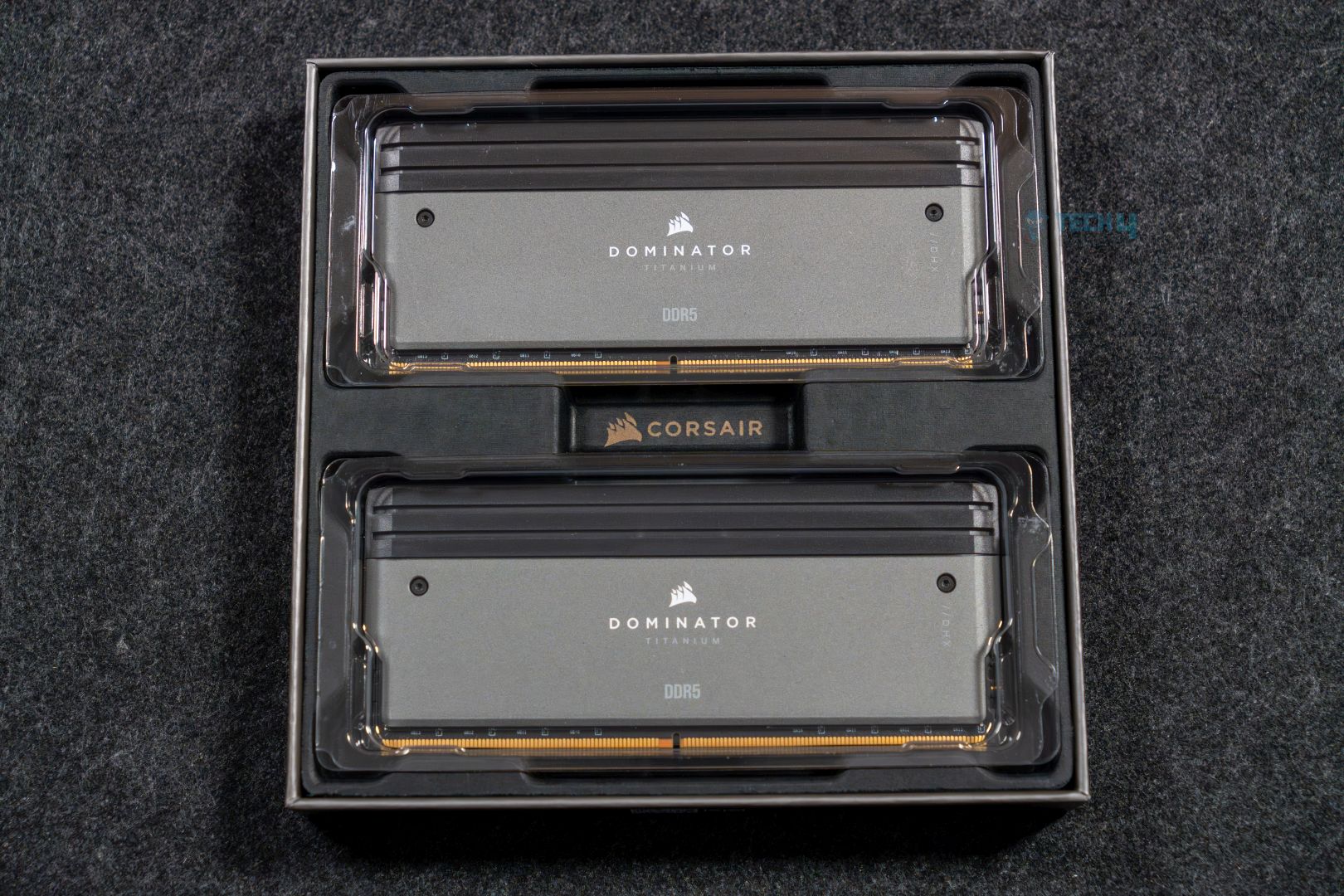
The package has two 32GB kits. No other accessories, like the tool kit or fin bar modules that came in the Special Edition are included.
Design
Main Design
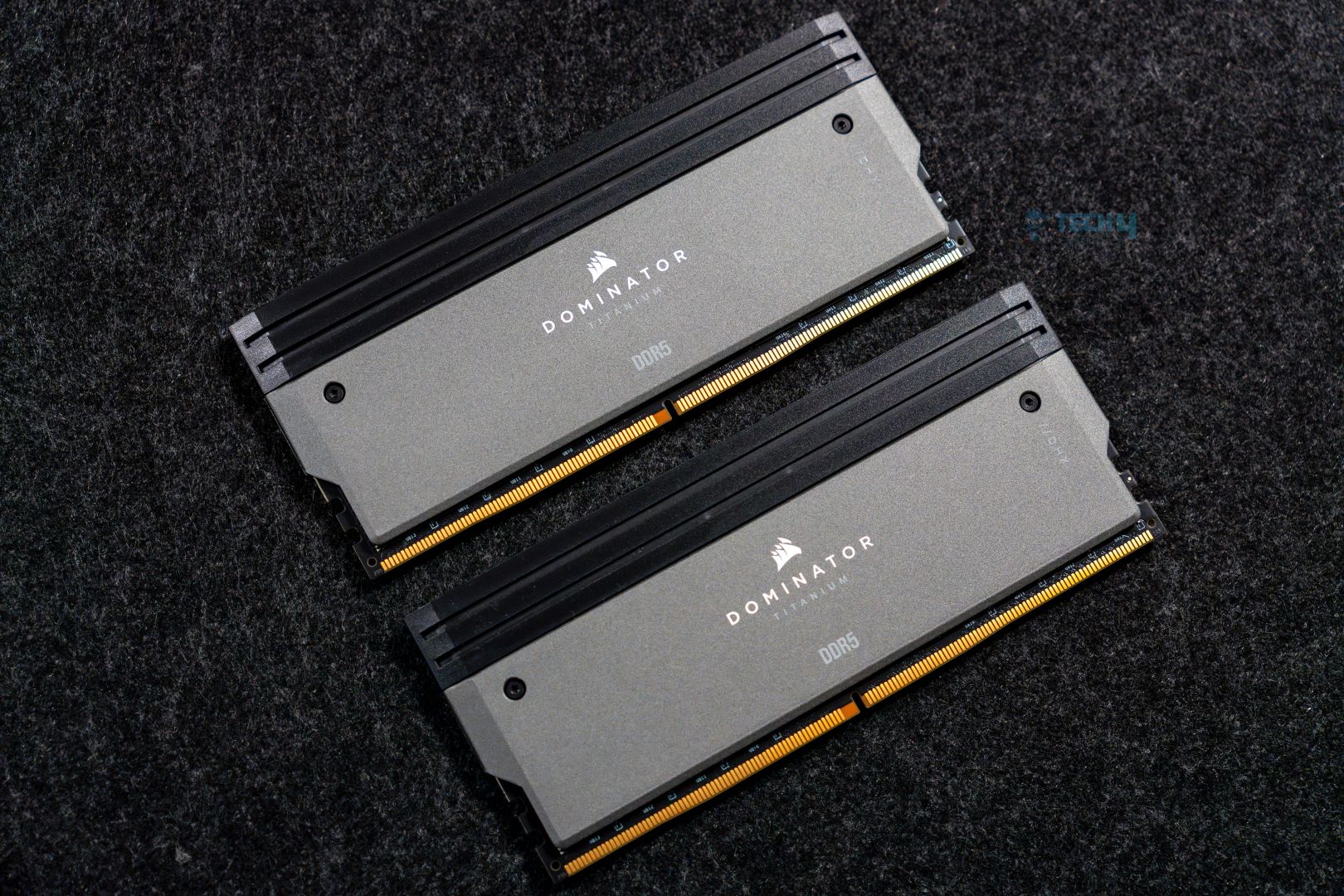
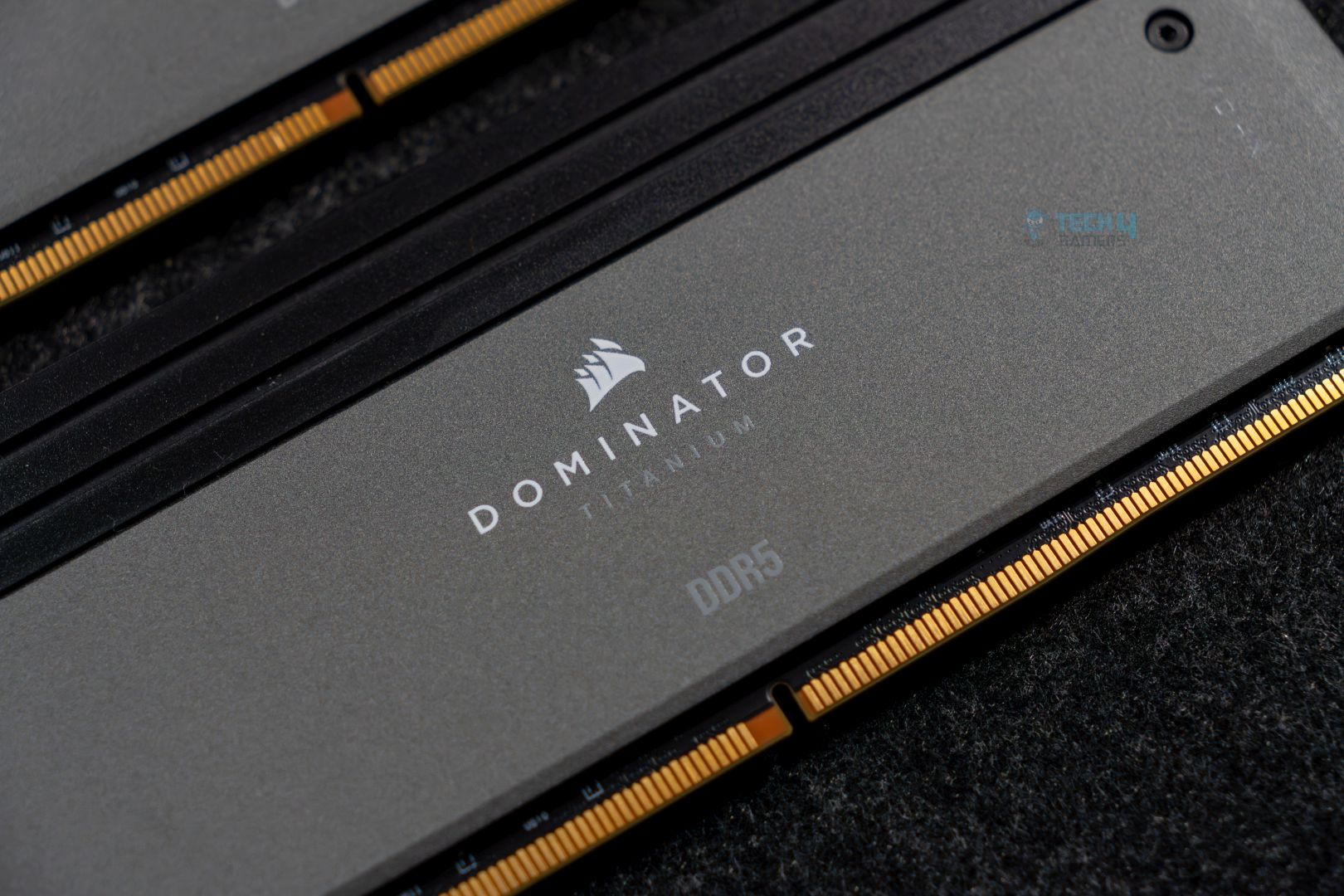
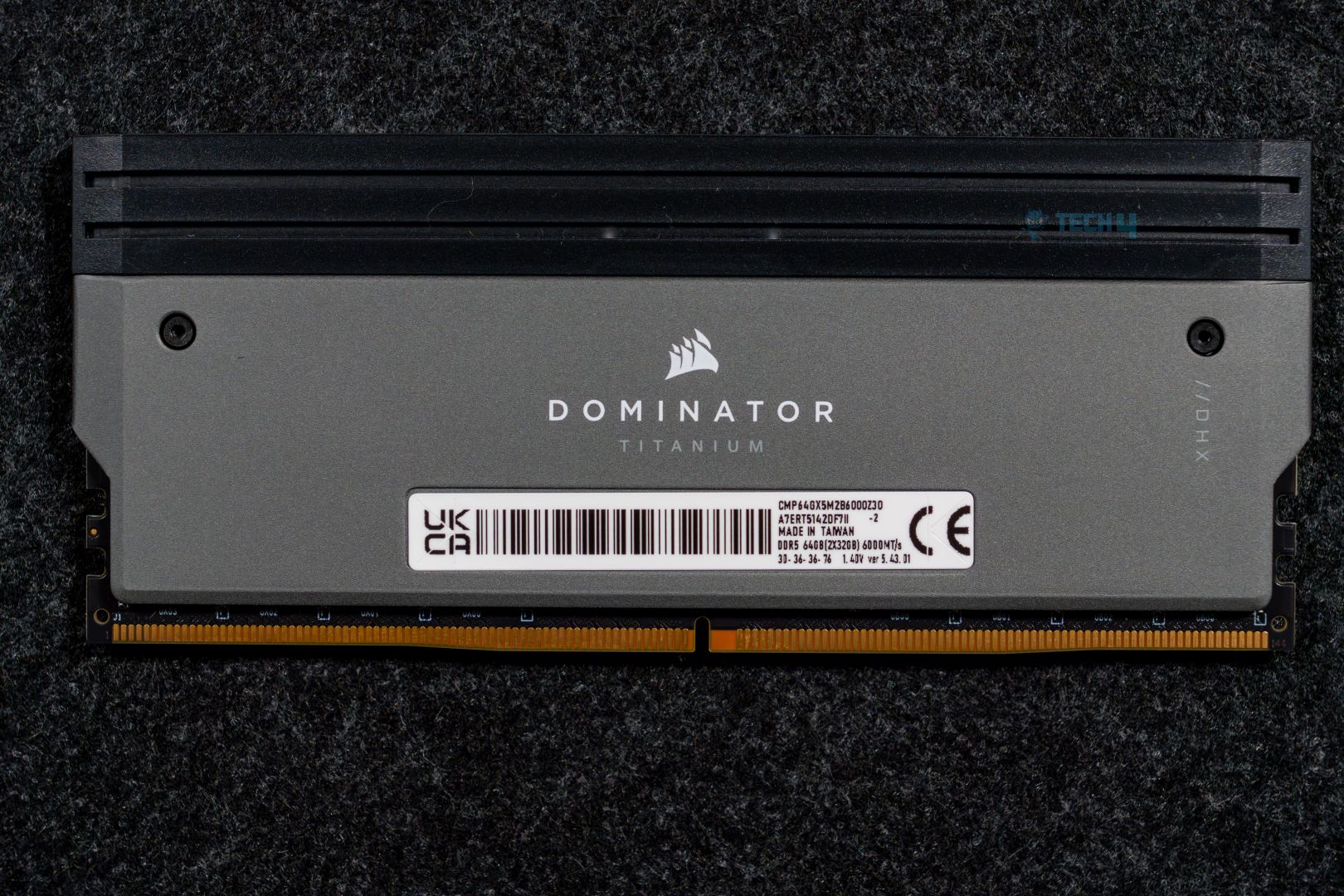
Here’s a clear look at the Cool Grey variant. The overall design follows the same theme we saw in the packaging, simple. There are no aggressive curves, just Dominator Titanium branding at the center. The black top of the heat spreader complements the light grey design.
Speaking of which, there are two screws at the top that you can remove to flip the black part. This way, you can change the orientation of the Dominator logo. Along with that, if you want a different look or lower height, you can also get the Fin Accessory Kit or Wave Accessory Kit.
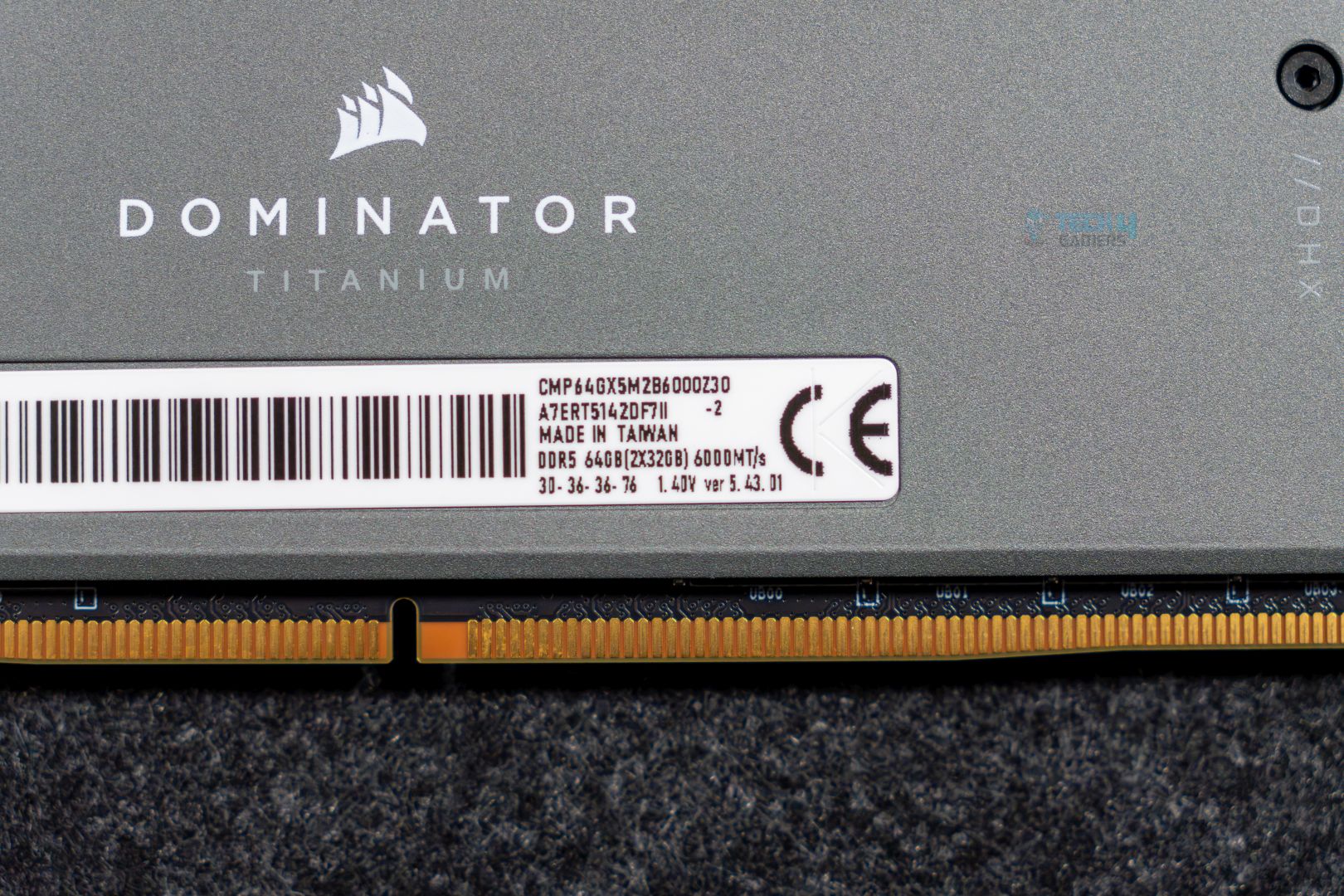
The back follows pretty much the same design, just with the addition of the label.
Label
The serial of the kit we are testing is CMP64GX5M2B6000Z30. Version 5.43.01 shows that the kit is using Hynix-based ICs. Version 4.xx means Samsung and version 3.xx means Micron.
Testing Setup
We used this setup to benchmark the kit via AIDA64:
The kit supports both AMD EXPO and Intel XMP, so you don’t have to worry about your platform. I enabled EXPO from the BIOS and there were no stability issues.
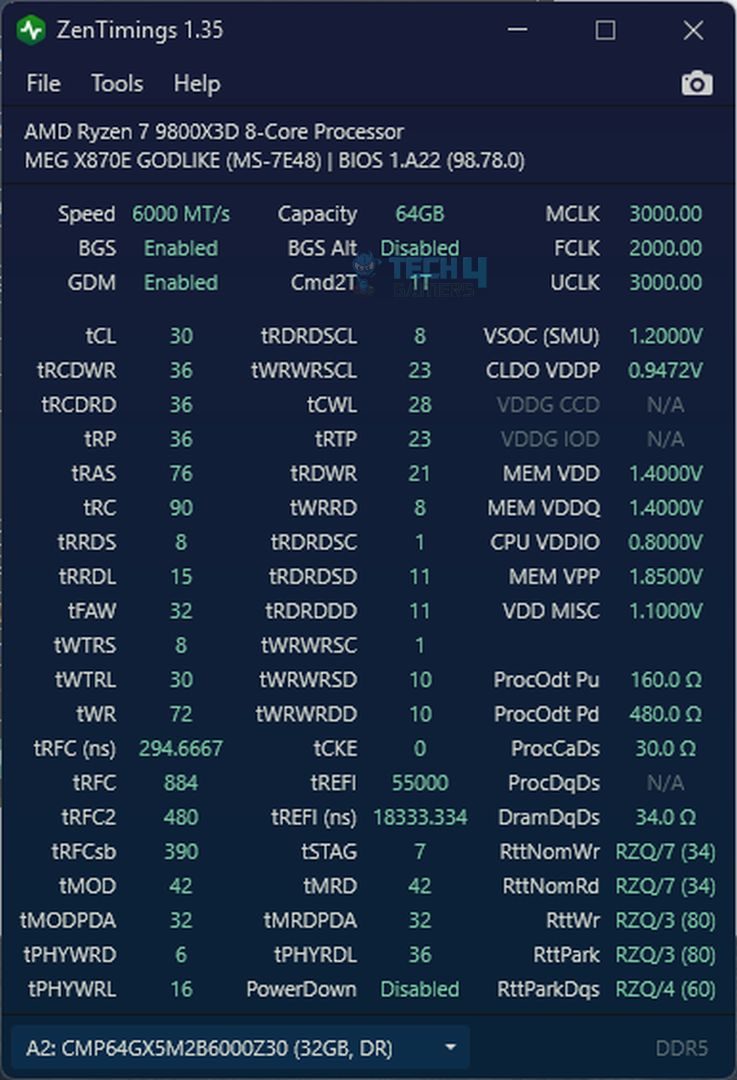
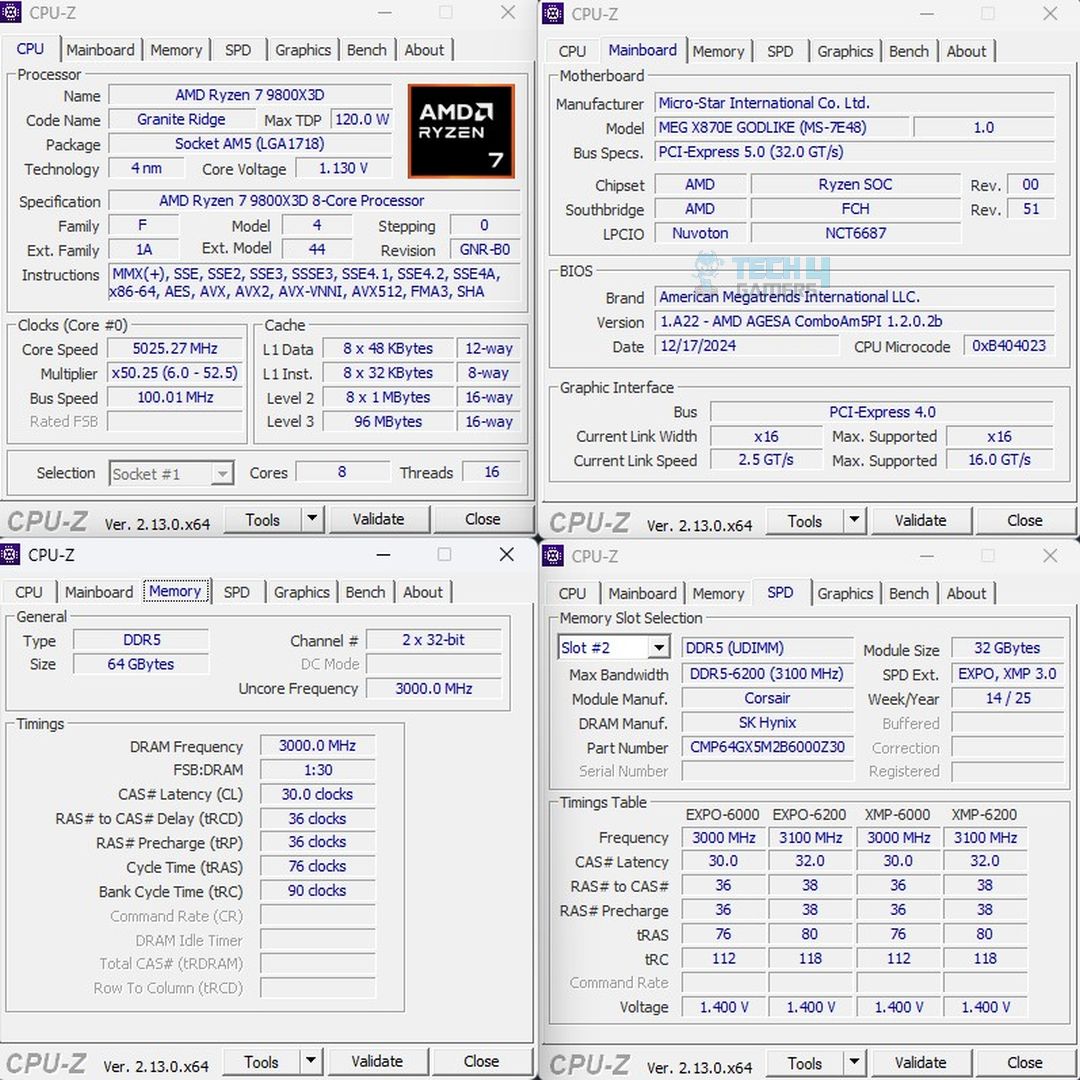
ZenTimings and CPU-Z Screenshots
1 of 2
ZenTimings Screenshot
CPU-Z Screenshot
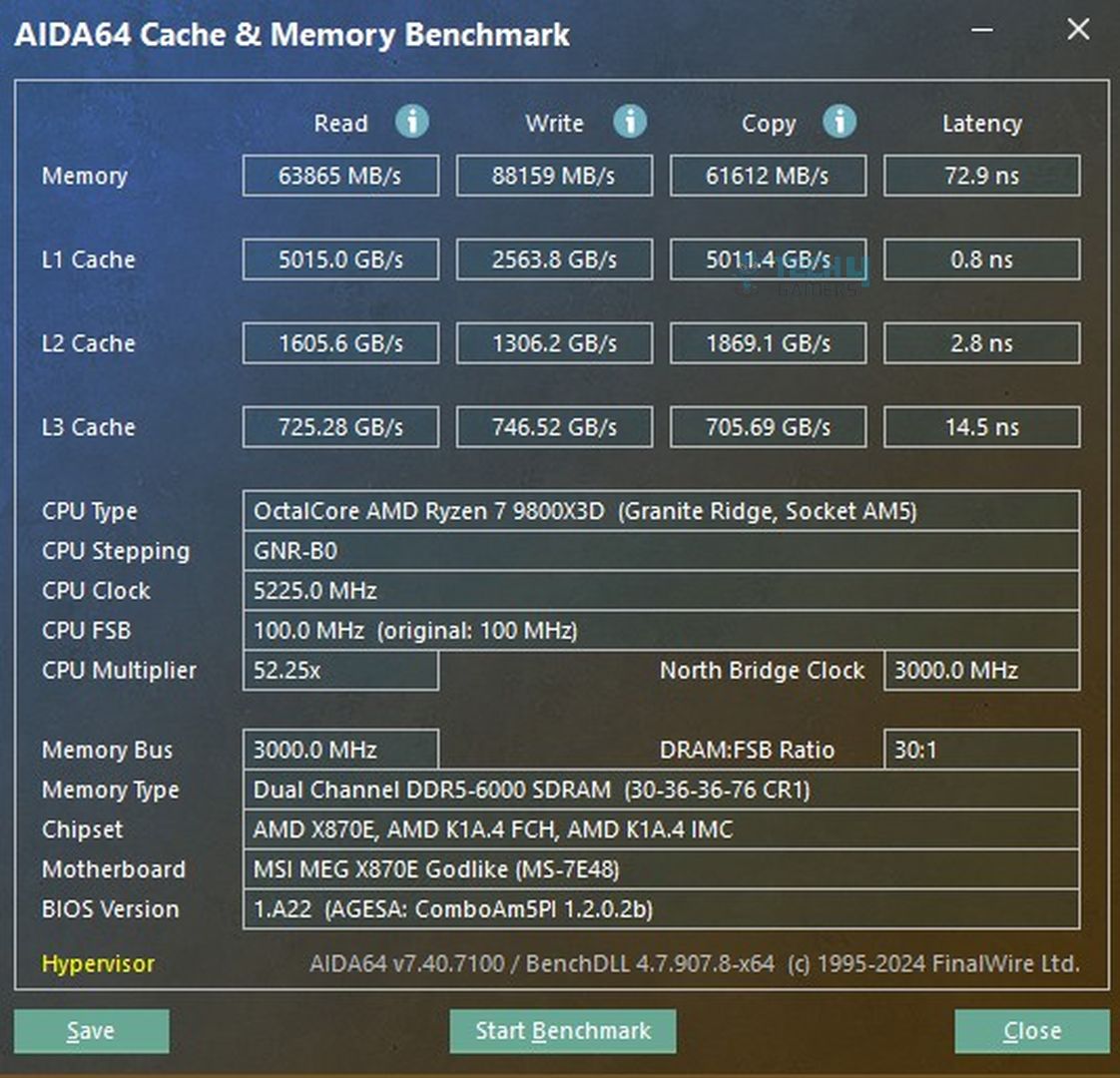
Here are both ZenTimings and CPU-Z screenshots (swipe to view) that confirm the rated speeds and latency.
Test Results
Let’s go over how the kit performed in AIDA64 benchmarks and also check its results compared to other Dominator Titanium variants and more kits.
AIDA64 Benchmarks
AIDA64 Screenshot
Performance Comparison With Other Kits
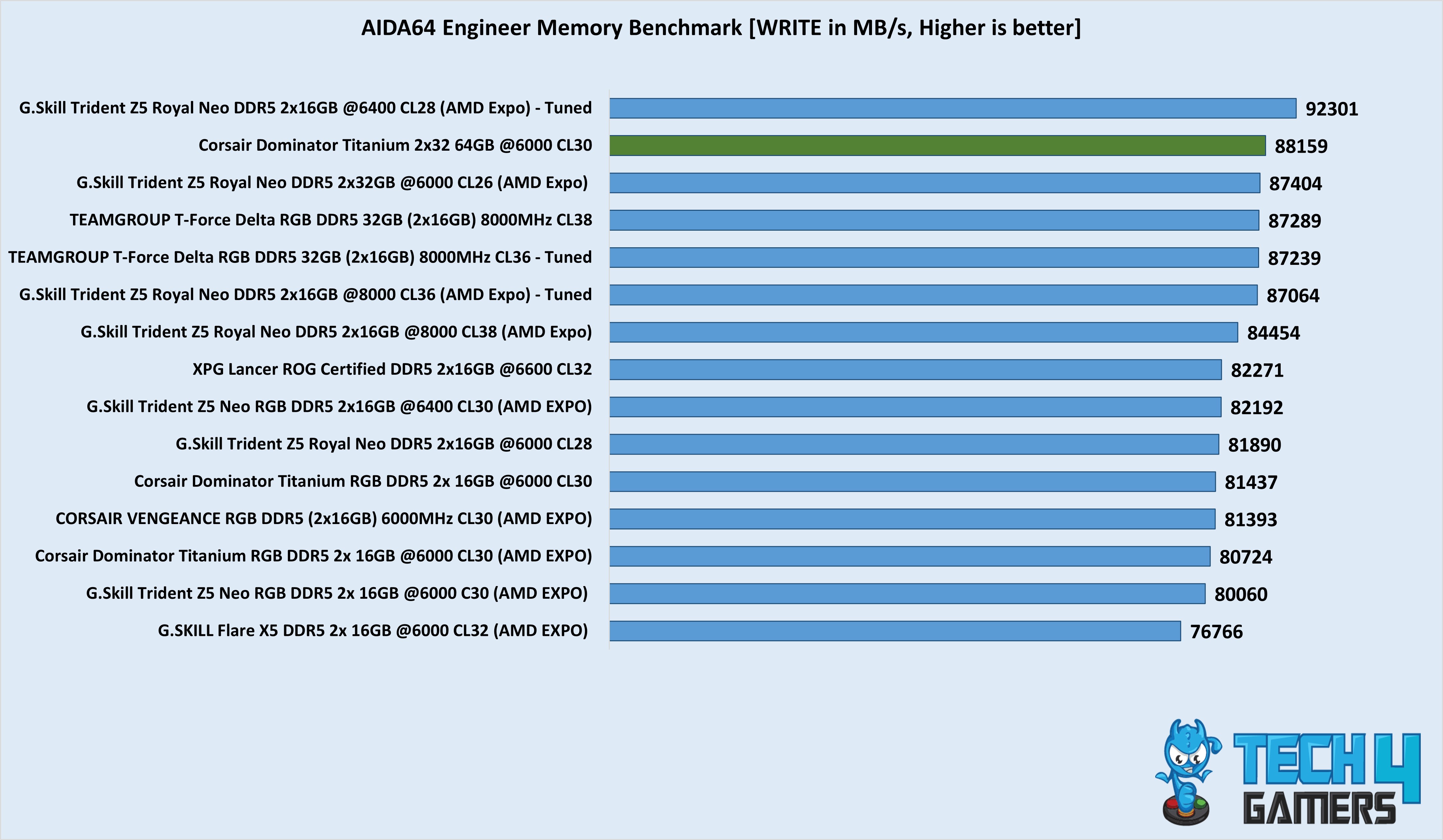
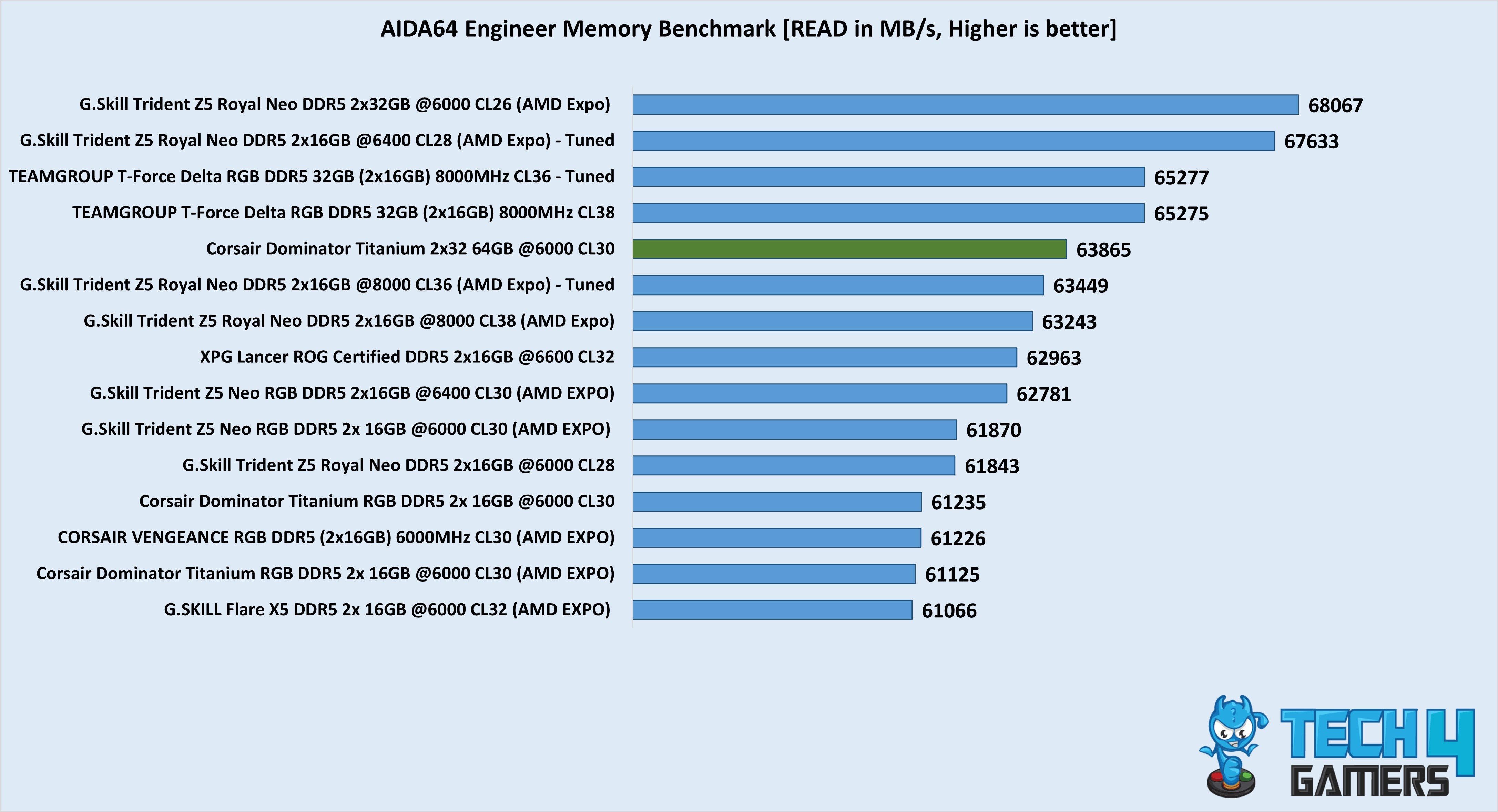
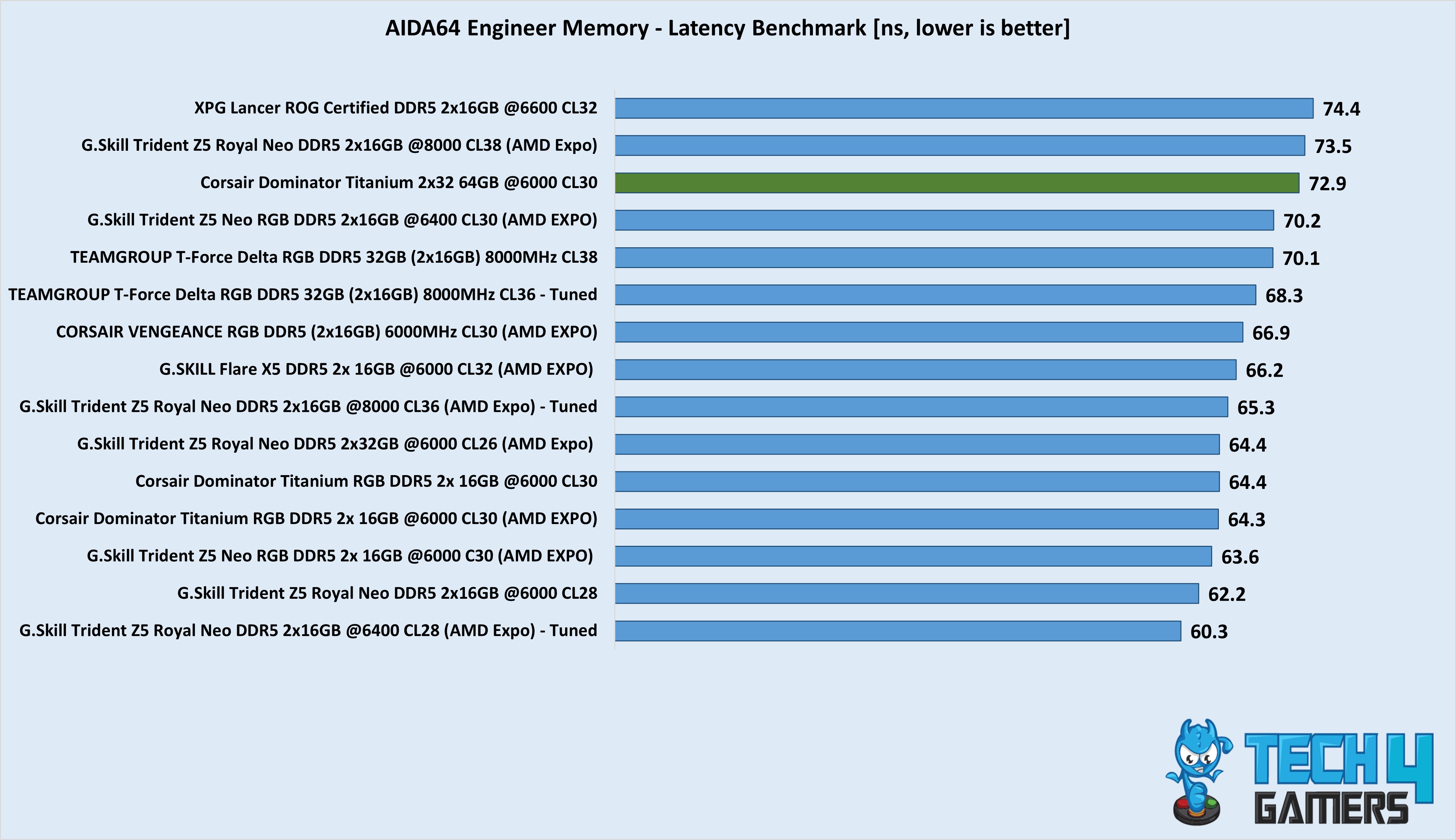
Let’s go over all four of these benchmarks when compared with other DDR5 kits, including 2x16GB variants of the same Dominator Titanium RGB.
Benchmark Results
1 of 4
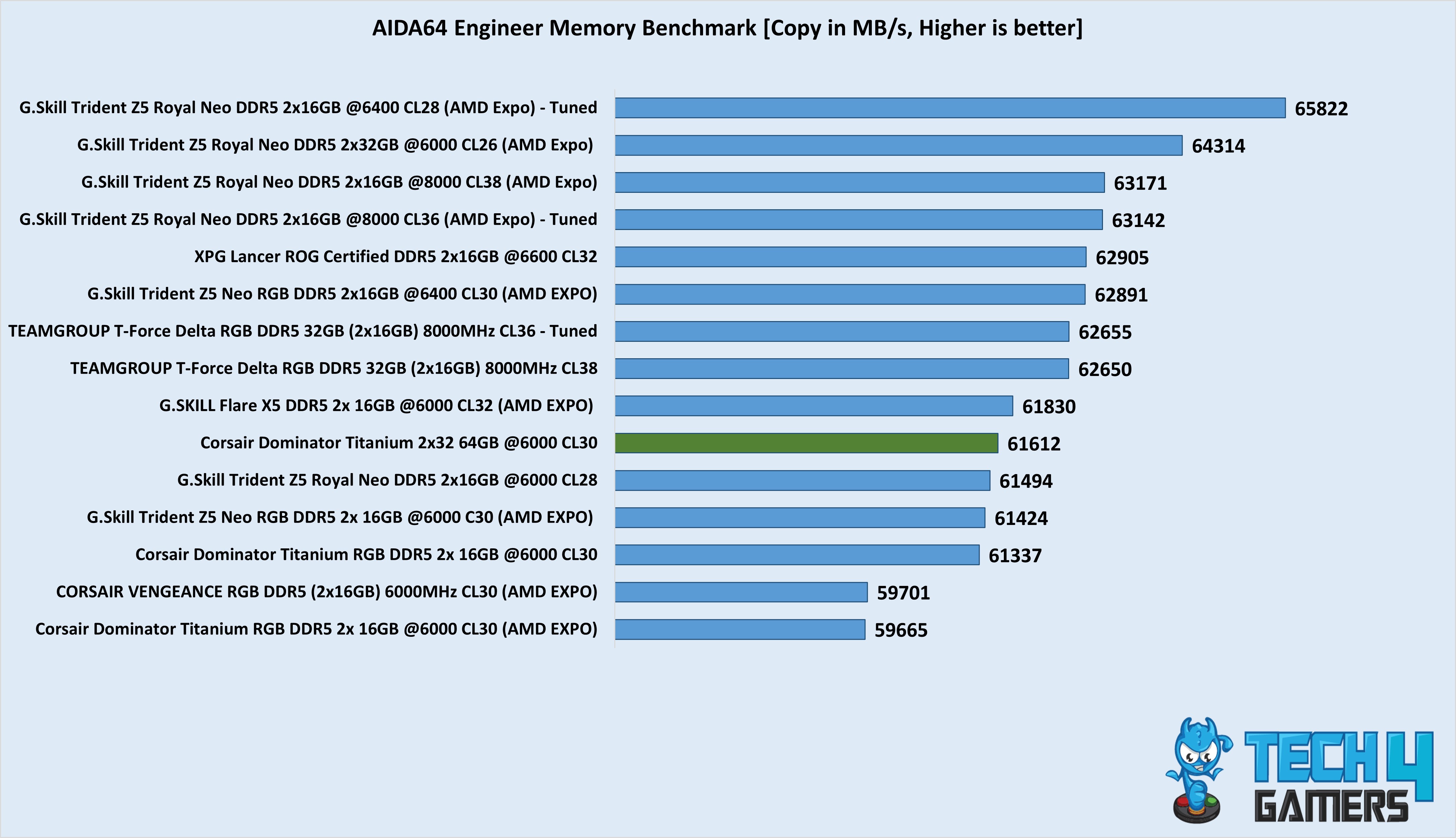
Across the charts, the Corsair Dominator Titanium (2x32GB) DDR5-6000 CL30 seems to be dominating all other kits. For example, in AIDA64 Write benchmarks, the kit came in second, and the 2x16GB variants of the same RAM were far below. A similar story follows as we swipe through the Read and Latency benchmarks as well. It is only the Copy benchmarks where the 2x32GB variant falls down the chart, but even then, the difference is marginal and shouldn’t cause any issues.
Should You Buy It?
Buy It If
✅You need incredible performance: As seen in the benchmarks, the Corsair Dominator Titanium (2x32GB) DDR5-6000 CL30 is the way to go if you need high-end performance. The 6000/CL30 configuration is perfect for the Ryzen 7000 series, and that’s what I would recommend it for. If you’re running a Ryzen 9000 processor, you should consider its 6400 MT/s variant.
✅Your work demands high-capacity DDR5 memory: While most gaming setups work fine with two kits of 16GB each (total 32GB), this specific Corsair Dominator Titanium features 64GB of combined capacity, making it a good choice for productivity.
Don’t Buy It If
❌You don’t have RAM height restrictions: Even though many coolers have adjustable fan height, the 57mm tall kit can pose restrictions.
Final Thoughts
The Corsair Dominator Titanium 64 GB (2×32 GB) 6000 MT/s CL30 delivers exactly what it promises. With a single click of EXPO/XMP, you get the advertised speed, along with chart-leading performance in read, write, and latency—all while bringing 64GB of high capacity to the table. For users handling demanding workloads or playing the latest games, that extra headroom can make a real difference. Corsair’s limited lifetime warranty also adds long-term peace of mind.
That said, the 57 mm module height could be a concern for PCs with air coolers, and the price reflects its premium positioning. But if your setup, especially one based on platforms like Ryzen 7000, is built to take advantage of 6000 MT/s speeds, this kit stands out as a strong, no-compromise choice.
As a Senior Hardware Reviewer at Tech4Gamers with over a decade of hands-on experience, I dive deep into benchmarking GPUs, CPU coolers, and motherboards, pushing hardware to its limits. Passionate about overclocking and fine-tuning performance.
We’re taking a look at Corsair MP600 Elite 2TB today. This storage solution is from the renowned MP600 series, which was introduced in 2019 utilizing the PCI-e 4.0 x4 interface. The Elite is the upgrade over its older sibling. The Controller in question is Phison E27T for the mainstream, enabling more bandwidth, meaning improved sequential speeds.
The SSD uses 3D TLC Nand and its compact M2 2280 Form-factor drive, which can fit in almost every motherboard. Since this SSD does not utilize the additional DRAM on the chip, it uses the HMB (Host Memory Buffer), which operates a very small portion of your RAM to write the cache.
We have tested and reviewed the MP600 Elite 2TB before as well, but that variant came with a heatsink, whereas for this we will use our motherboard’s NVMe heatsink.
Why Trust Tech4Gamers
Usman Sheikh is one of our most senior and experienced hardware reviewers. He loves spending hours (sometimes days) in his lab testing and comparing different GPUs, CPUs, coolers, and more.
20+ SSDs tested and reviewed by our team of hardware experts (Tech4Gamers Team).
80+ hours spent testing different SSDs for our reviews.
At Tech4Gamers, ensuring you get reliable information is our priority. That’s why every hardware round-up undergoes a meticulous review process by our team of experts and editors. Each review is carefully examined against our strict editorial guidelines, guaranteeing you trustworthy insights you can depend on.
Here are the key specs:
Specification
Details
Form Factor
M.2 2280
Interface
PCIe Gen4 x4 NVMe 1.4
Capacity
2TB
NAND Technology
High-Density 3D TLC NAND
Controller
Phison E27T (DRAM-less, 4-channel)
Sequential Read Speed
Up to 7,000 MB/s
Sequential Write Speed
Up to 6,500 MB/s
Random Read IOPS
Up to 1,000K
Random Write IOPS
Up to 1,200K
Endurance (TBW)
1,200 TBW (Terabytes Written)
I recommend checking our round-up of the best M.2 SSDs for gaming if you want to explore more options.
[toc]
Unboxing & Design
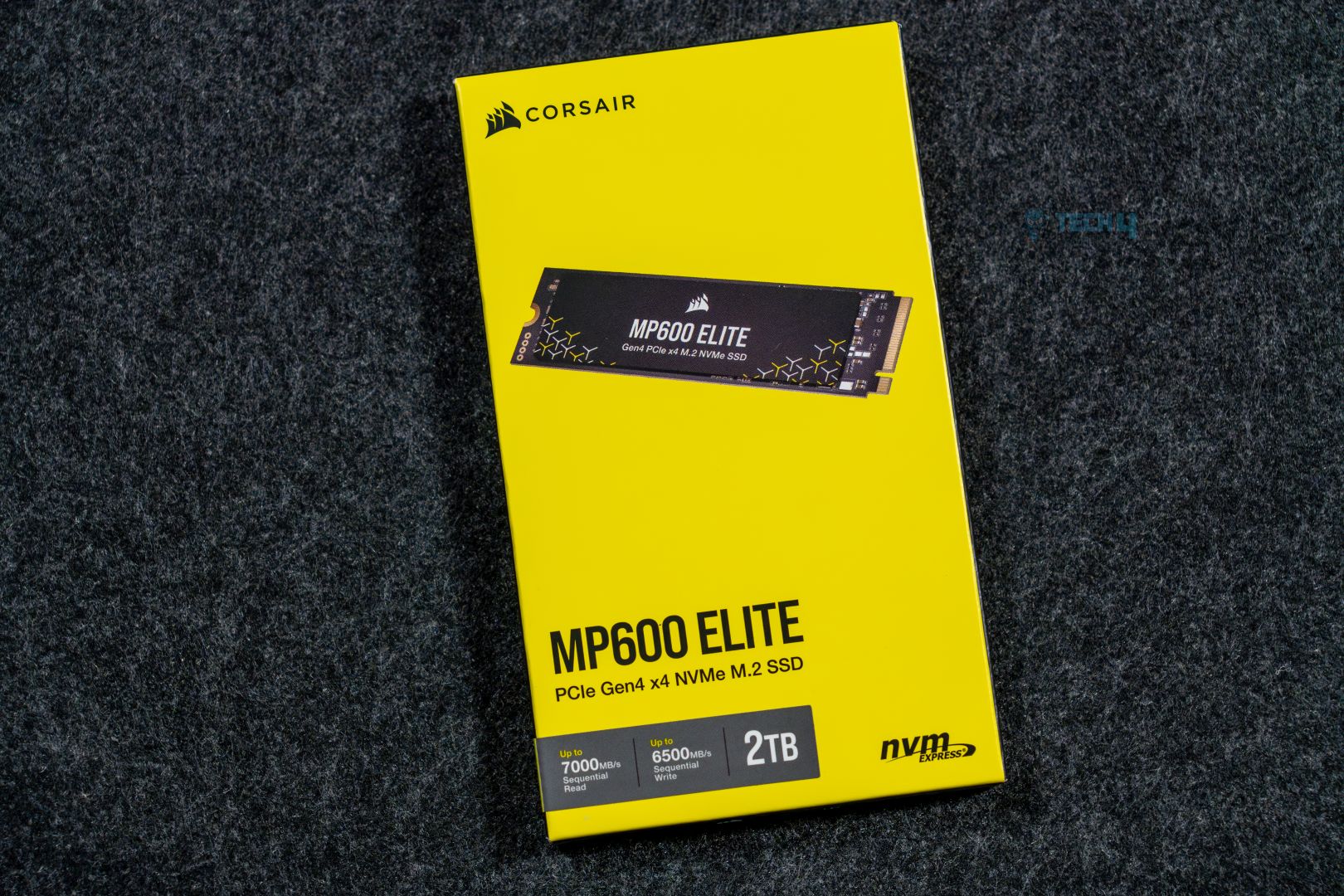
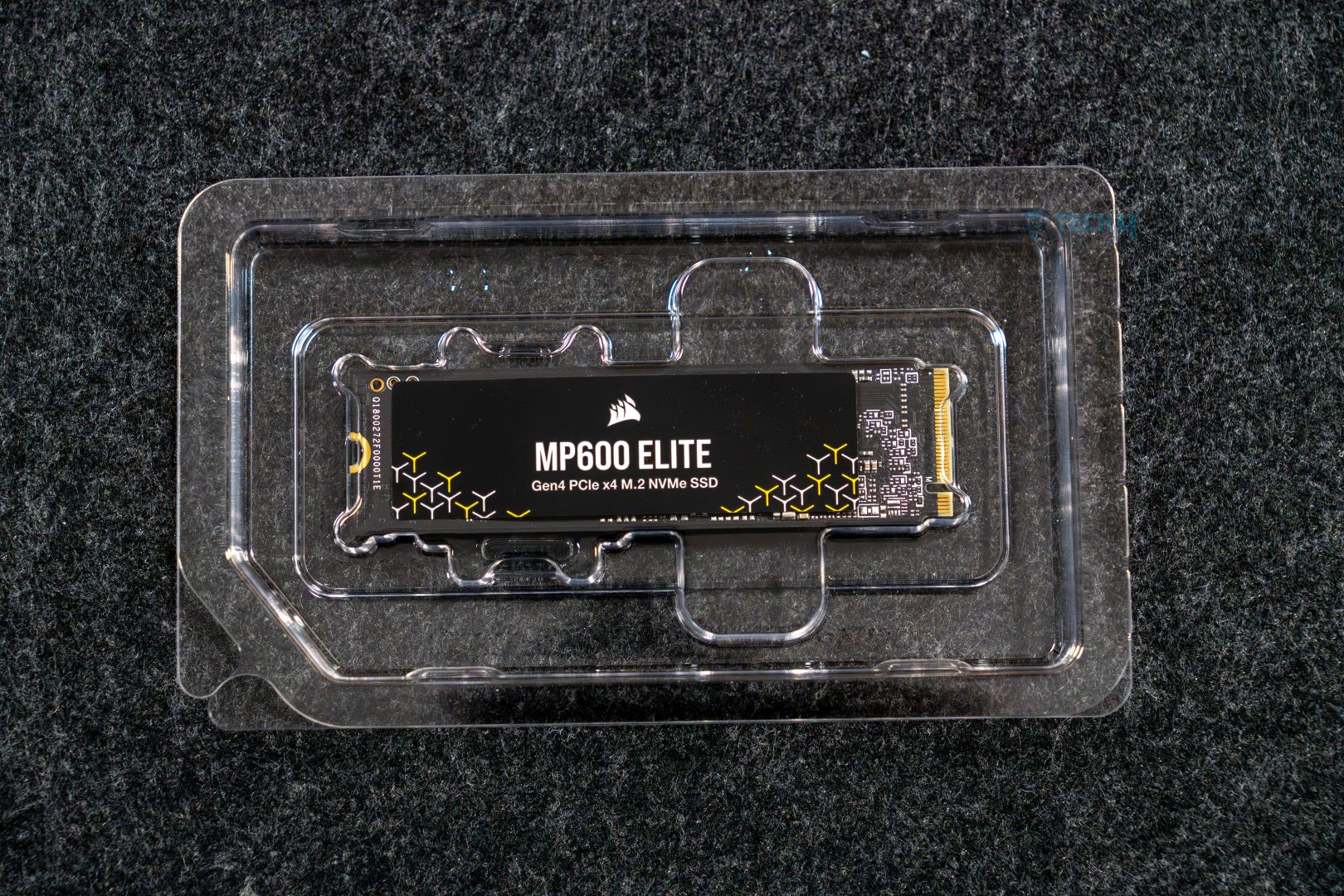
Corsair MP600 Elite 2TB NVMe comes in yellow outer packaging and is secured in a plastic container; however, there is no heat spreader included in the box. There are two variants of this SSD; one comes with the heat spreader, which is $20 more expensive. Overall, the packaging is very simple and straightforward.
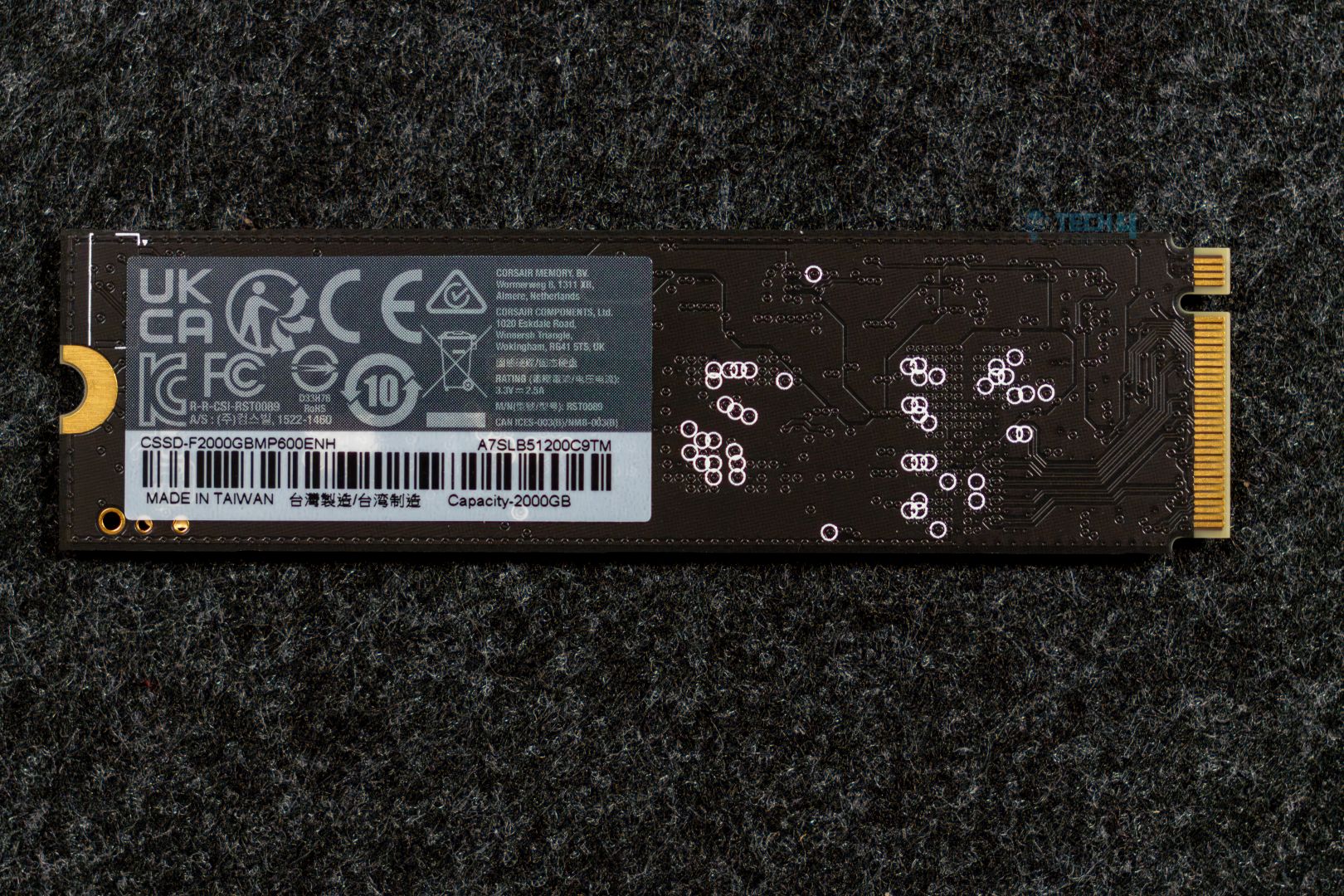
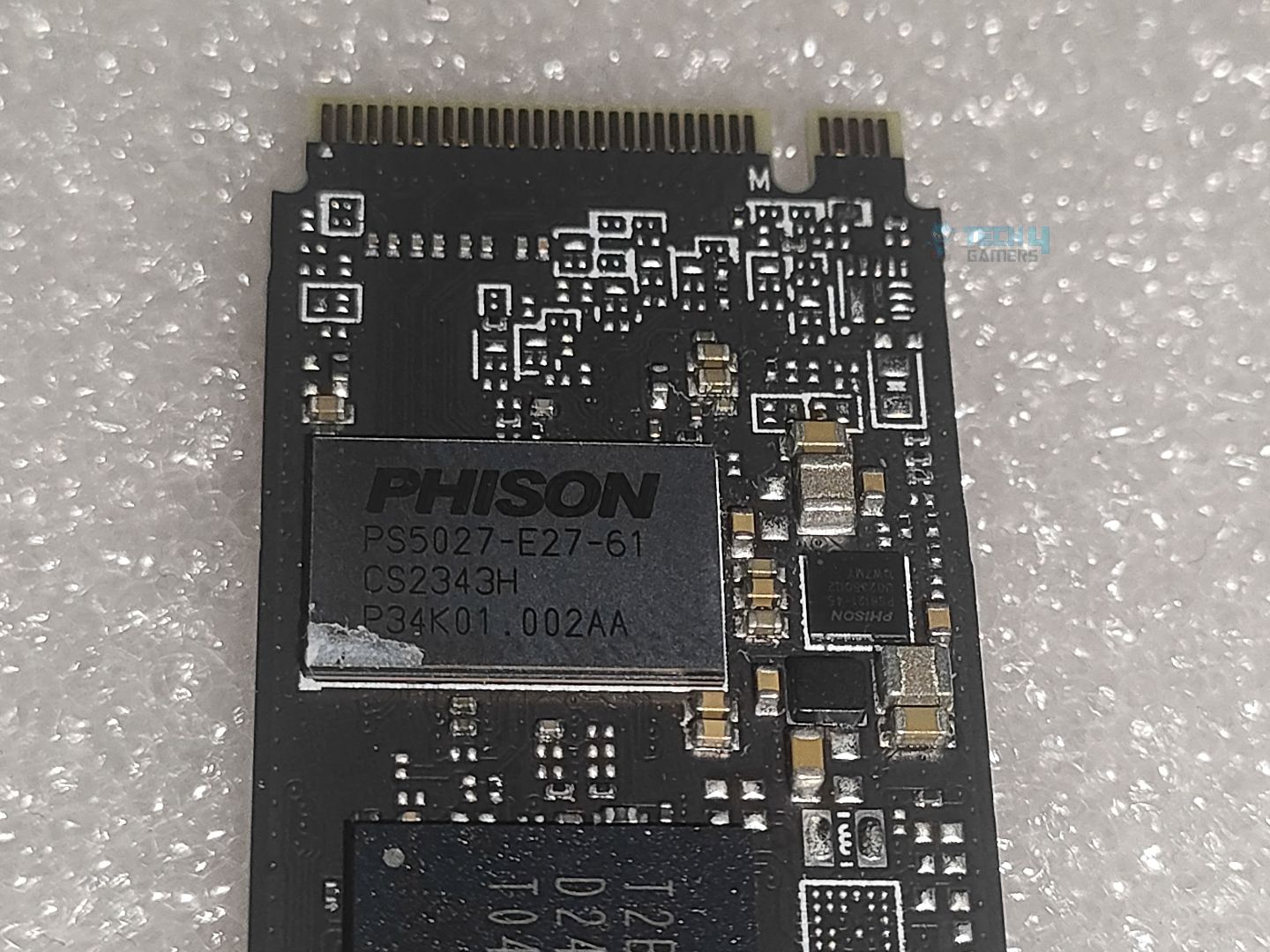
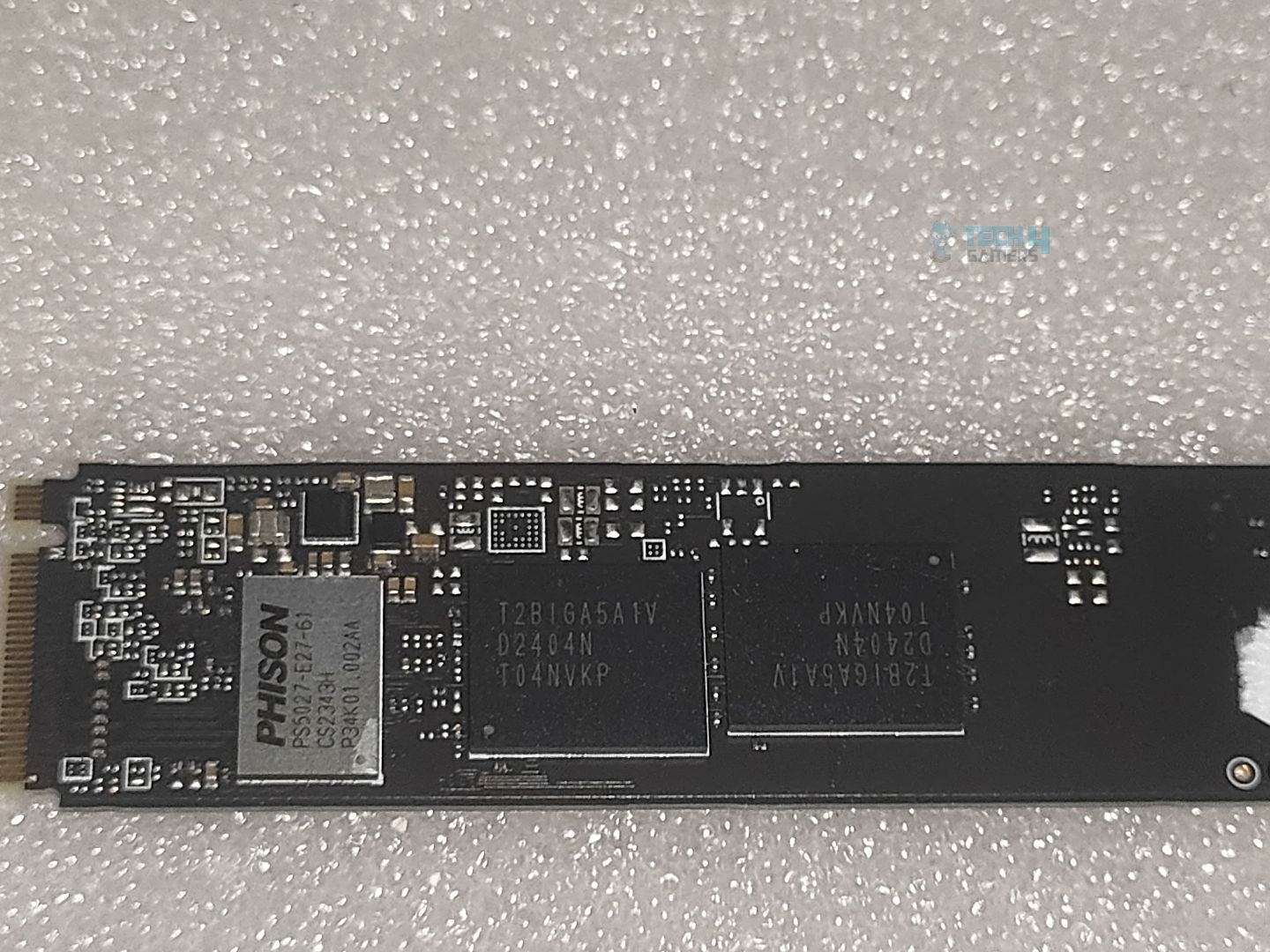
PCB Pictures
Controller
NAND Flash
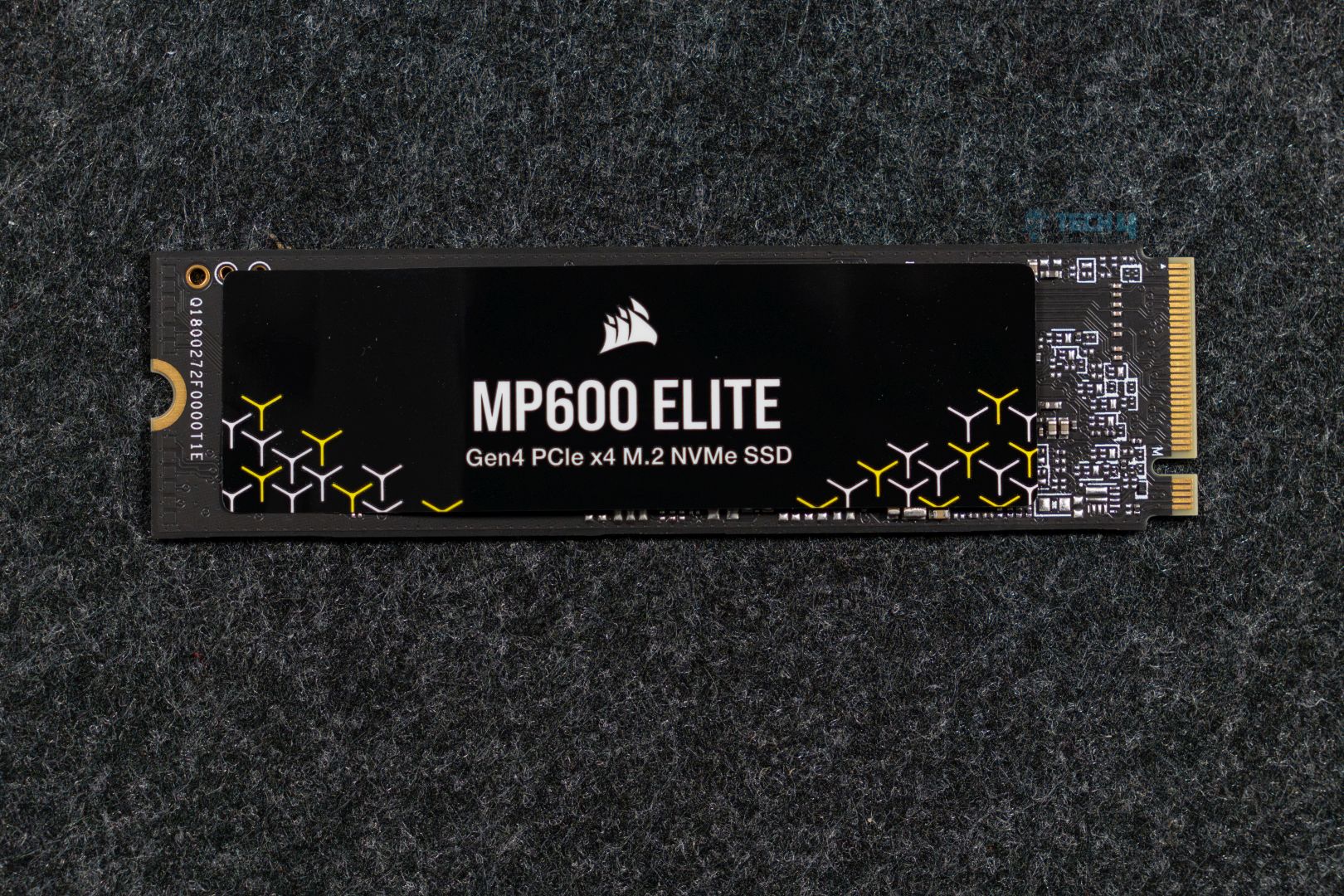
The PS5027-E27T controller supports PCIe Gen4X4 built on TSMC 12nm Process. The NAND flash shares the part number T2BIGA5A1V, which uses TLC 162 Layer ( Technology) (Also Supports QLC) manufactured by Kioxia. This NVMe comes with two Nand Flash Memory chips, each chip carrying a capacity of 1000GB; this controller does not feature a DRAM cache but offers a 64 MB host memory buffer. It can reach a speed of 7,400MB/s Read and 6,700MB/s, slightly more than the Corsair advertised on its marketing page.
Controller Overview
PS5027-E27T Controller
The Controller is PS5027-E27T from Phison, which powers the CorsairMP600 Elite 2TB built on the TSMC 12nm Process. This controller was announced in 2022, and many manufacturers, such as Corsair, Crucial, and Team-Group, are using the same controller in some of their budget SSDS, targeting the mainstream market. It is important to note that the DRAM cache is unavailable in this drive. The controller only features the HMB (Host Memory Buffer) Feature that allows SSD to use some of the RAM on the PC system.
Software
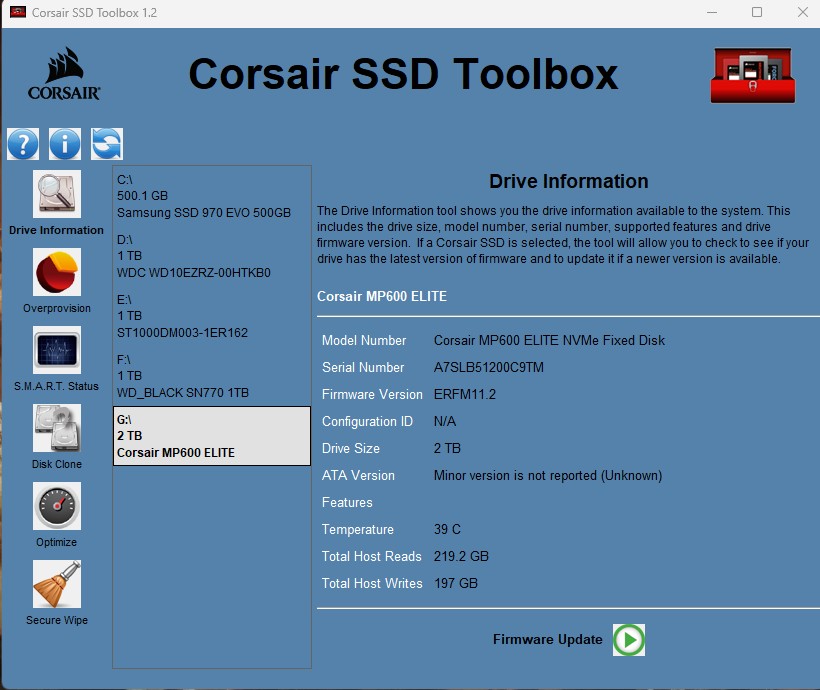
Software Overview
1 of 2
Overview
S.M.A.R.T . Status
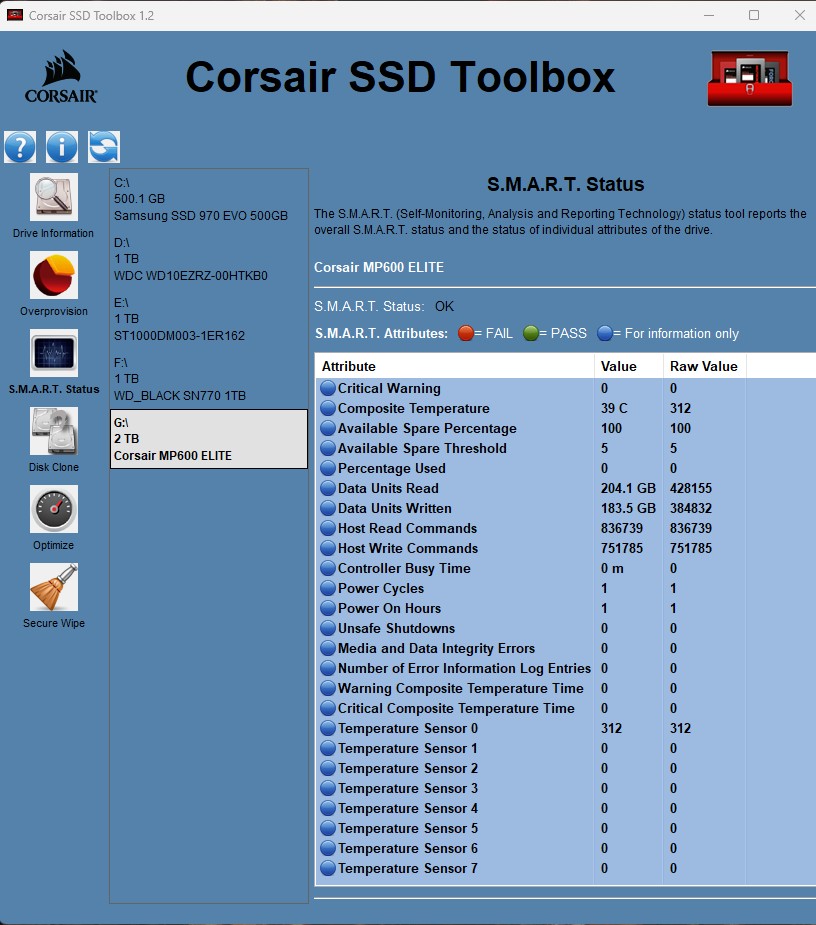
Honestly, The Corsair SSD Toolbox feels outdated compared to their known ARGB software iCUE; I was expecting something fancy. However, apart from the UI, the toolbox provides all the necessary information, such as the drive status, overprovision, disc clone, optimization, and secure wipe. It is not required to keep the SSD toolbox installed all the time for the SSD to function properly.
Windows Version: Windows 11 24H2 (OS Build 26100.3775)
Testing Scenario
Category
Application
Scenario
Real-World Test
3DMark Storage Gaming Benchmark
Measures gaming performance using traces from real games (loading, saving, installing, recording gameplay).
Real-World Test
PCMark 10 Storage ‘Quick’ Benchmark
Shorter test with lighter real-world traces, ideal for smaller system drives.
Real-World Test
PCMark 10 Storage ‘Full System Drive’ Benchmark
Comprehensive test using diverse real-world traces for modern high-speed drives.
Synthetic Test
CrystalDiskMark
Measures sequential & random read/write speeds (MB/s), 4KiB performance, and latency.
Monitoring Tool
HWiNFO
Monitors SSD temperatures and other health metrics during testing.
Games Loading Times
Cyberpunk 2077, Red Dead Redemption II
Game opening time and loading time are tested.
Real World Test Results
3DMark Storage Gaming Benchmark
1 of 3
Scores
Bandwidth
Latency
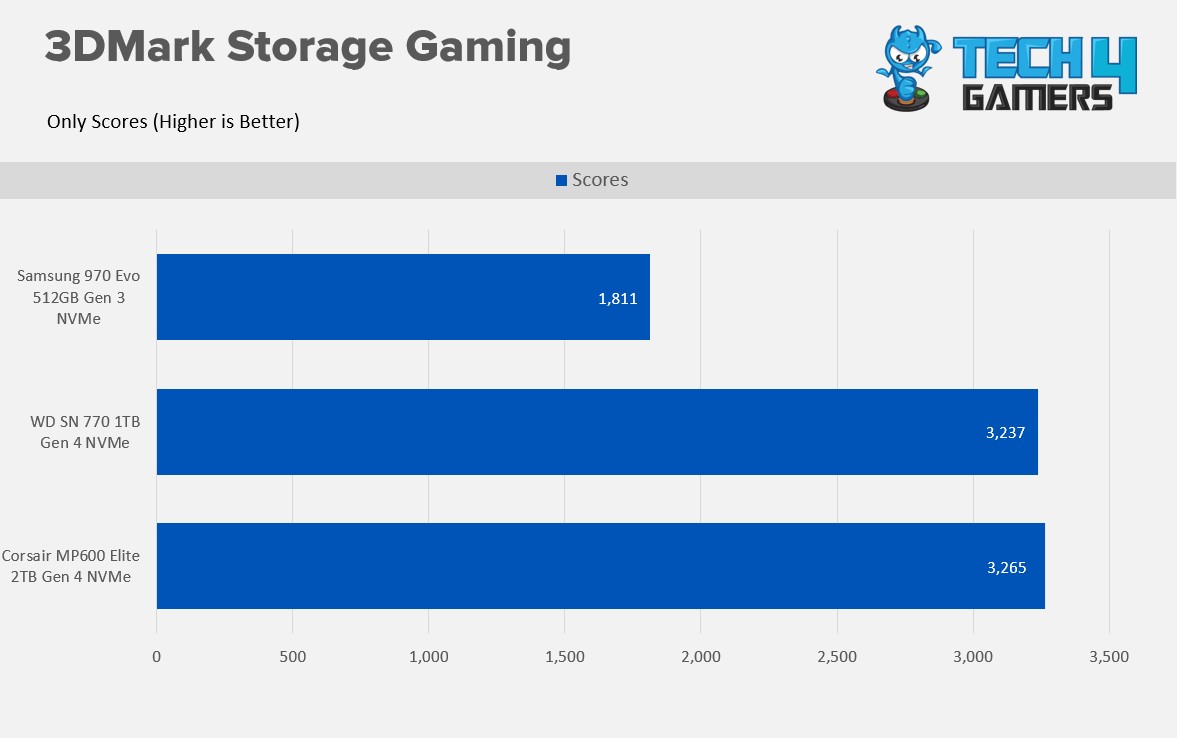
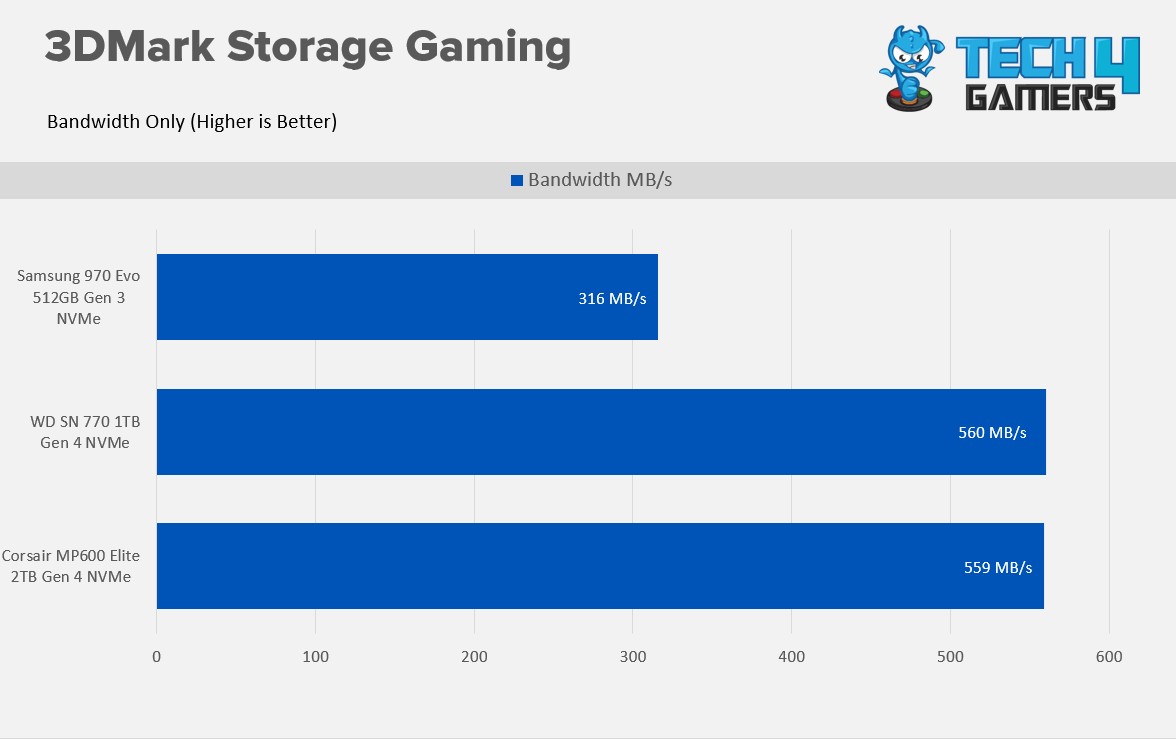
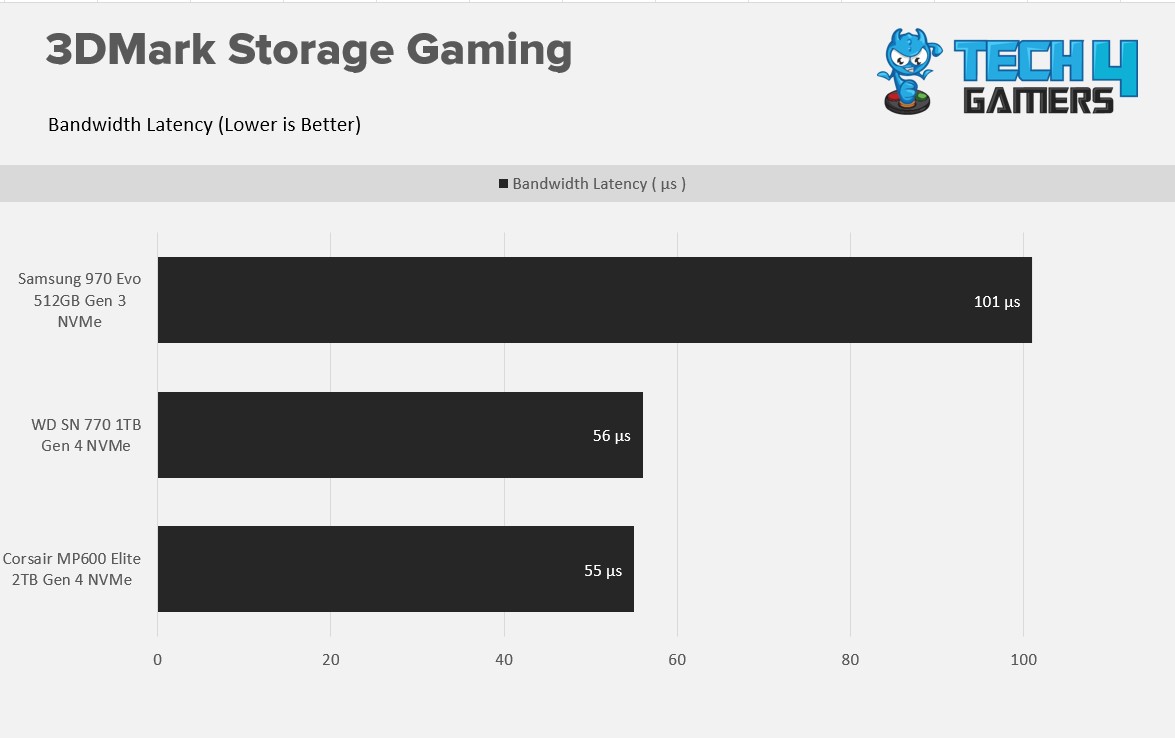
In the 3D Mark Storage Gaming Benchmark, Corsair MP600 Elite is on par with WD SN770 1TB NVMe with a margin of error difference. However, compared with the older Samsung 970 EVO NVMe, the difference is significant. Thanks to its Gen 4.0 capabilities, we are almost twice as fast, and response time is cut to half.
PCMark 10 Storage 'Quick' Benchmark
1 of 3
Scores
Bandwidth
Latency
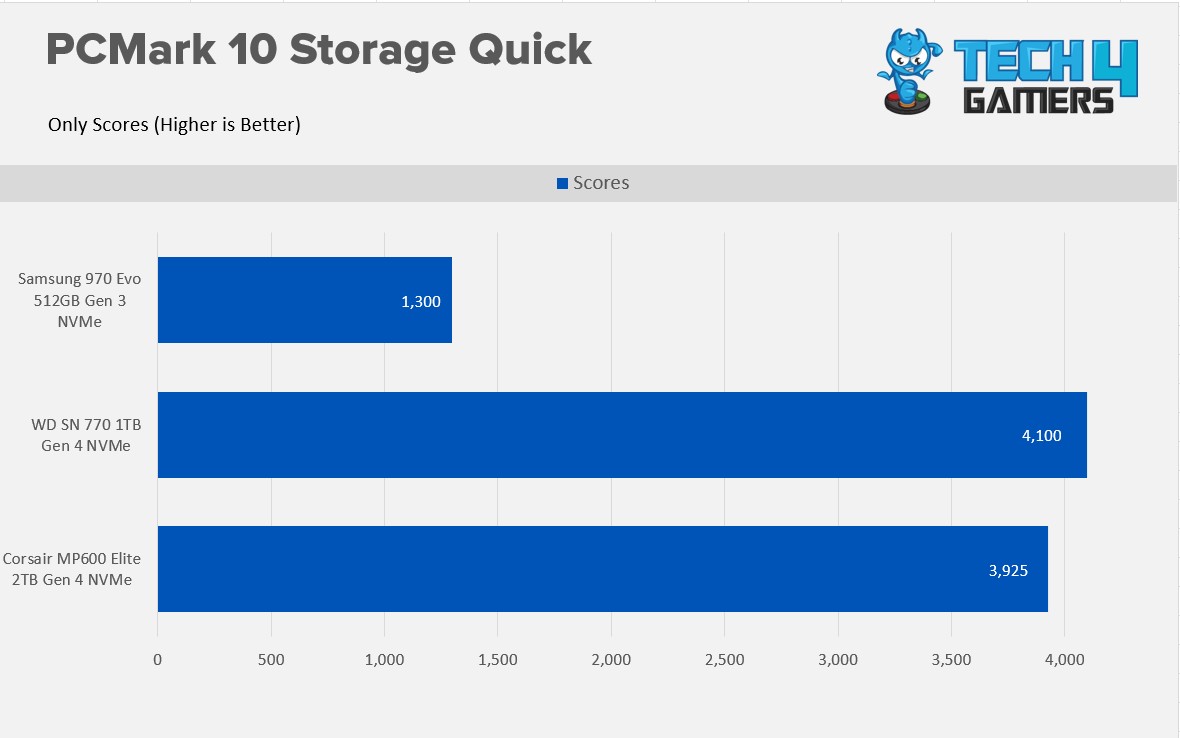
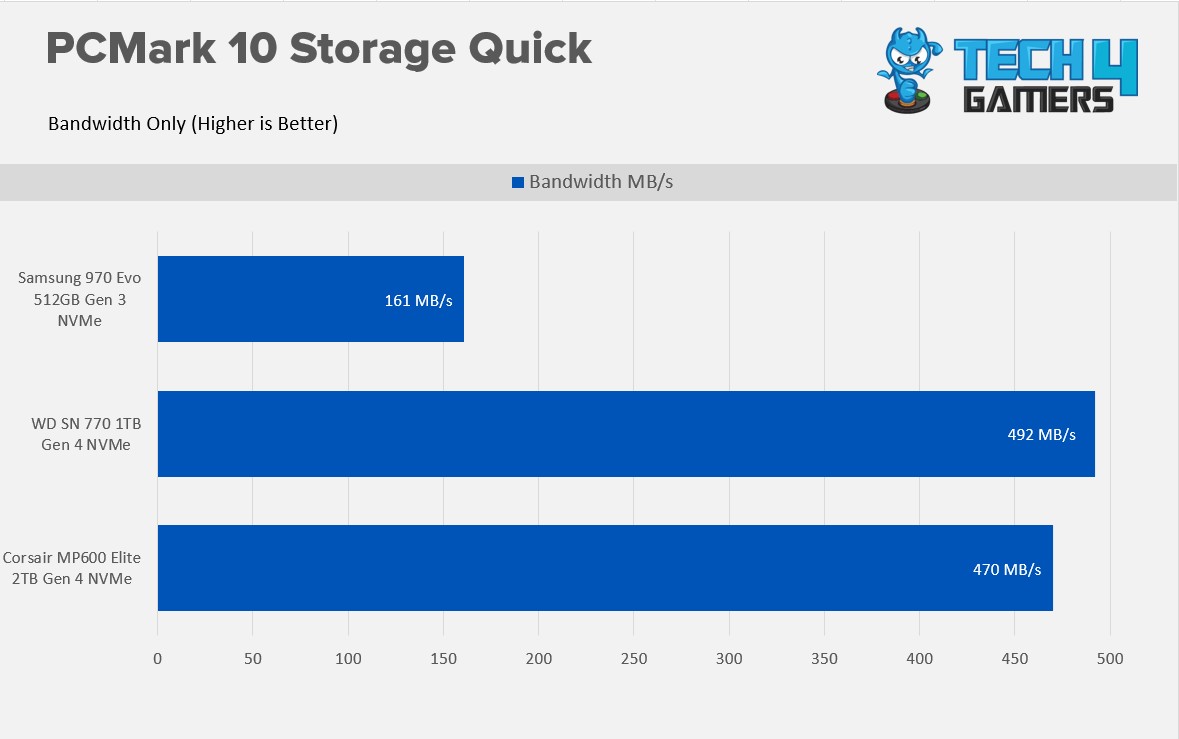
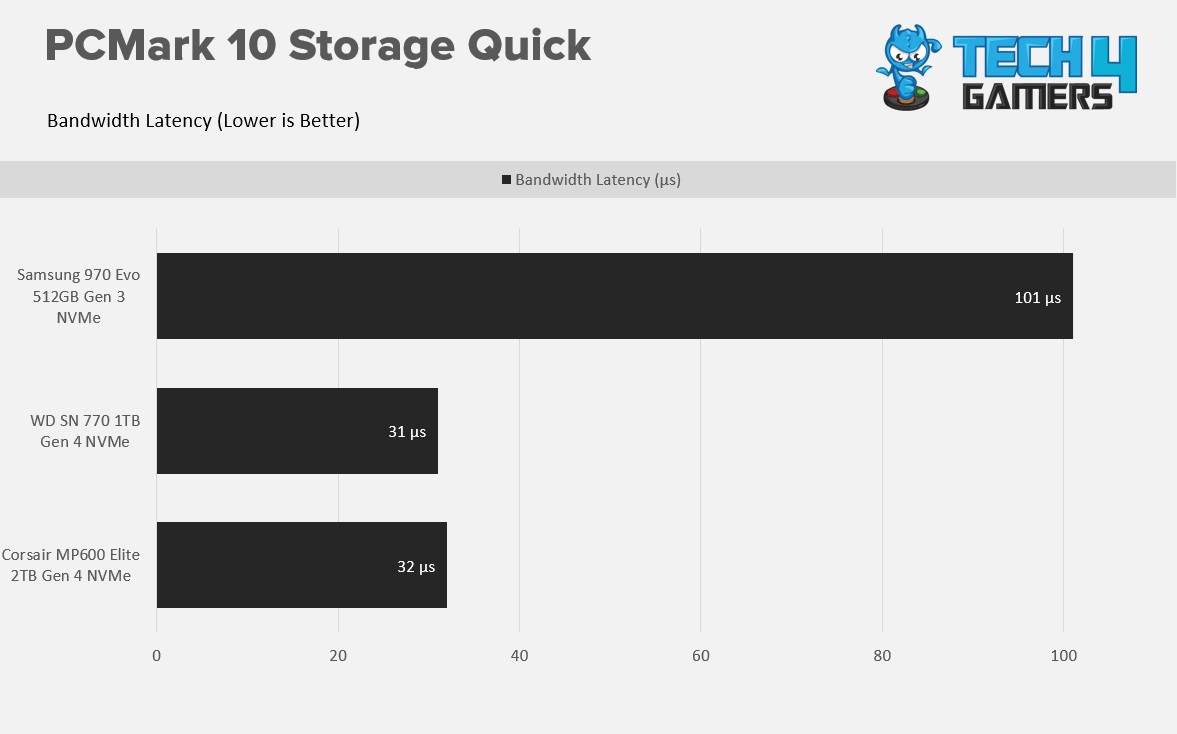
We have also tested the NVMe in the PCMark 10 Quick Benchmark; the Corsair MP600 Elite 2TB struggles to match the performance of WDSN770.
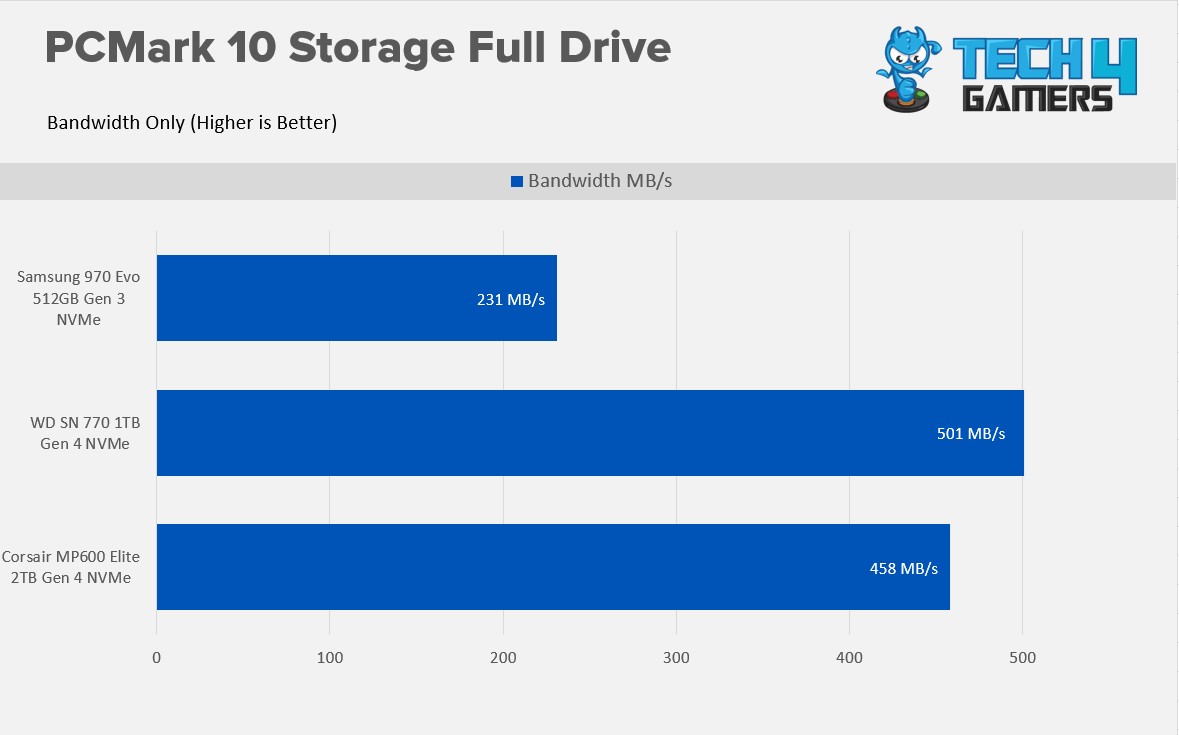
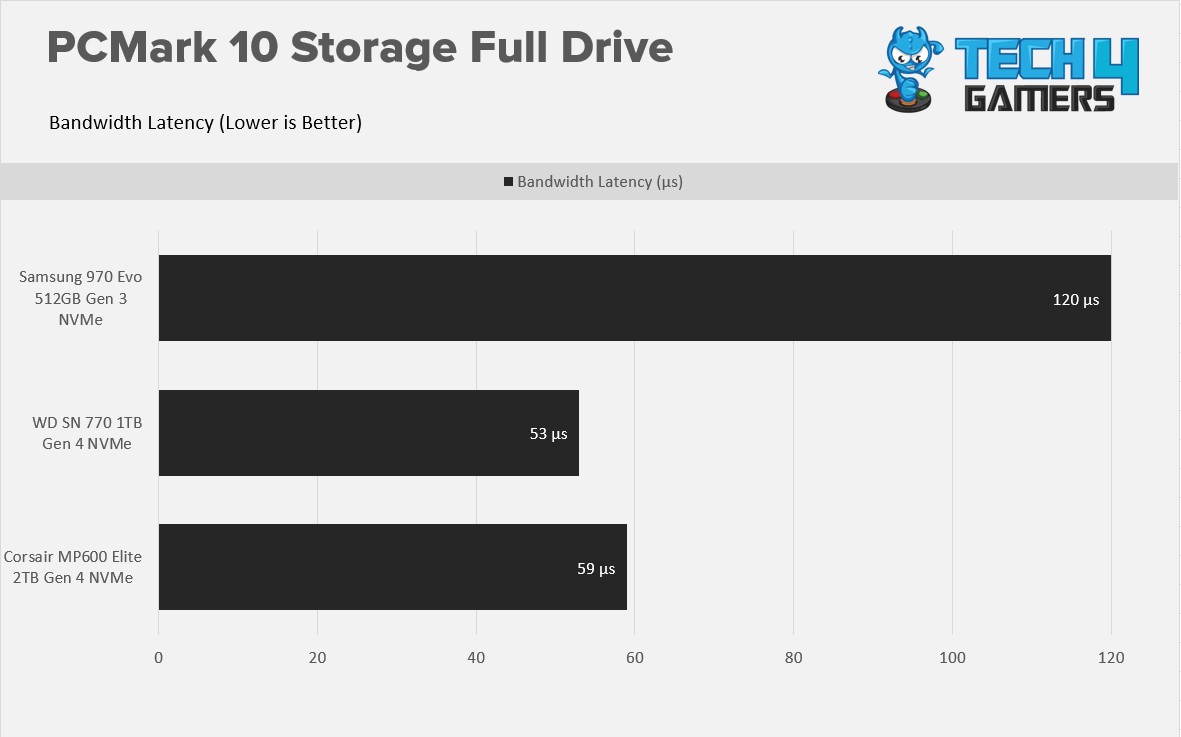
PCMark 10 Storage 'Full System Drive' Benchmark
1 of 3
Scores
Bandwidth
Latency
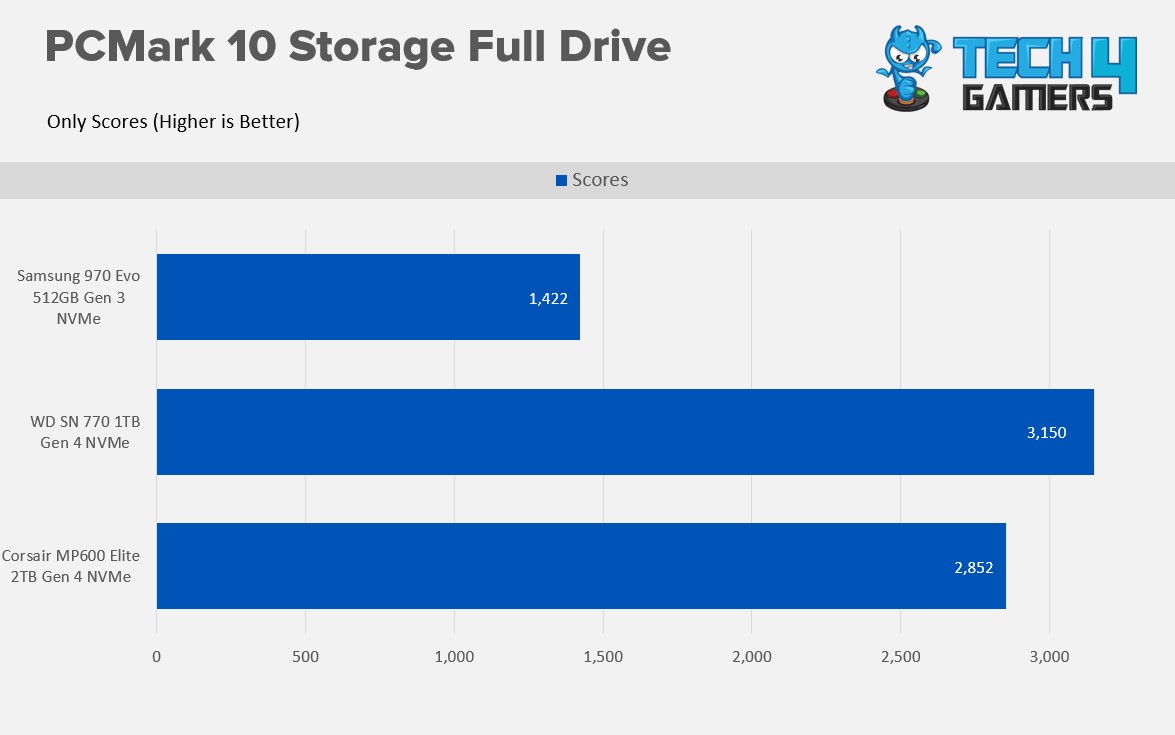
Our Corsair NVMe is still slower than WDSN770 in the Full System Drive Benchmark. These results are great examples that show that higher sequential speeds do not guarantee better performance in the real world.
Synthetic Test Results
Crystal Disc Mark
1 of 4
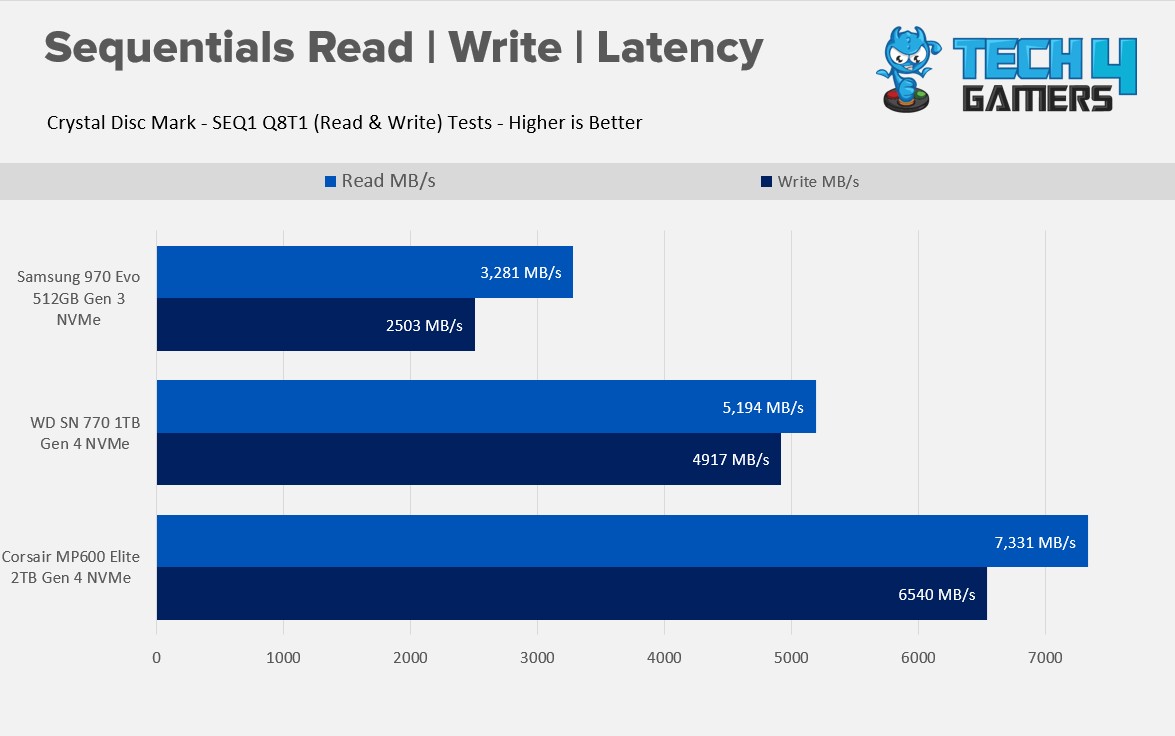
Sequentials Read & Write
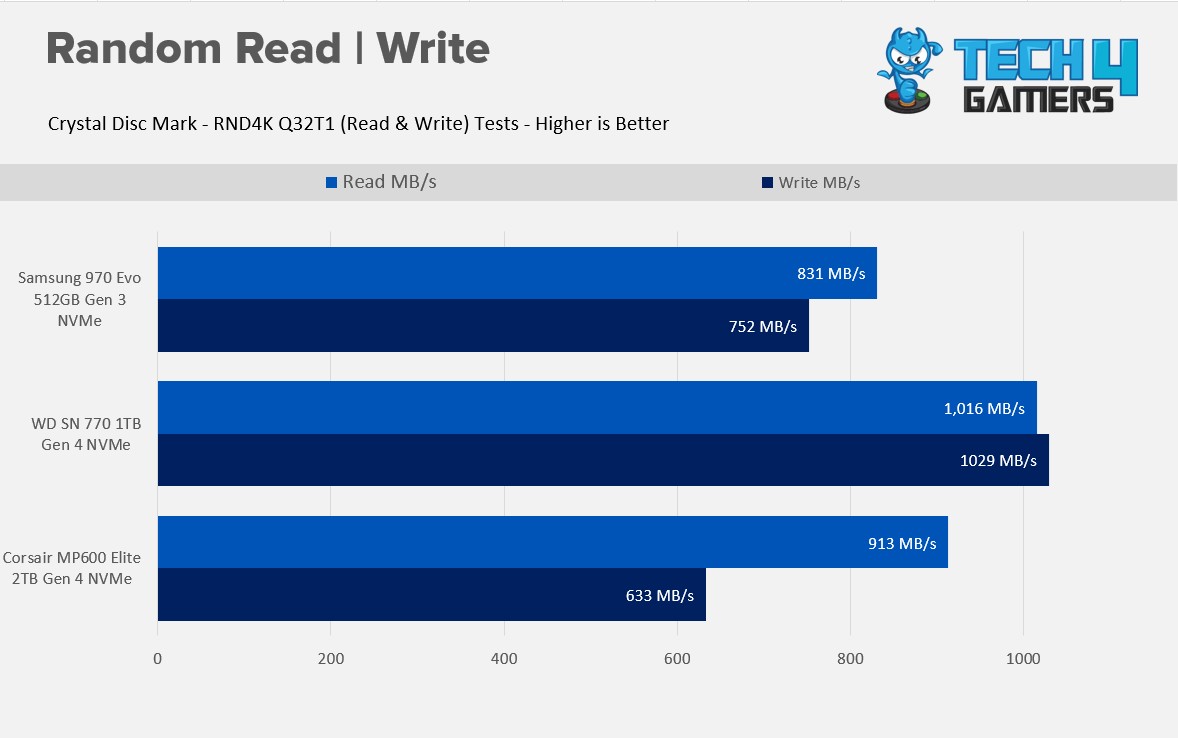
Random 4K
Sequentials Read & Write Latency
Random 4K Latency
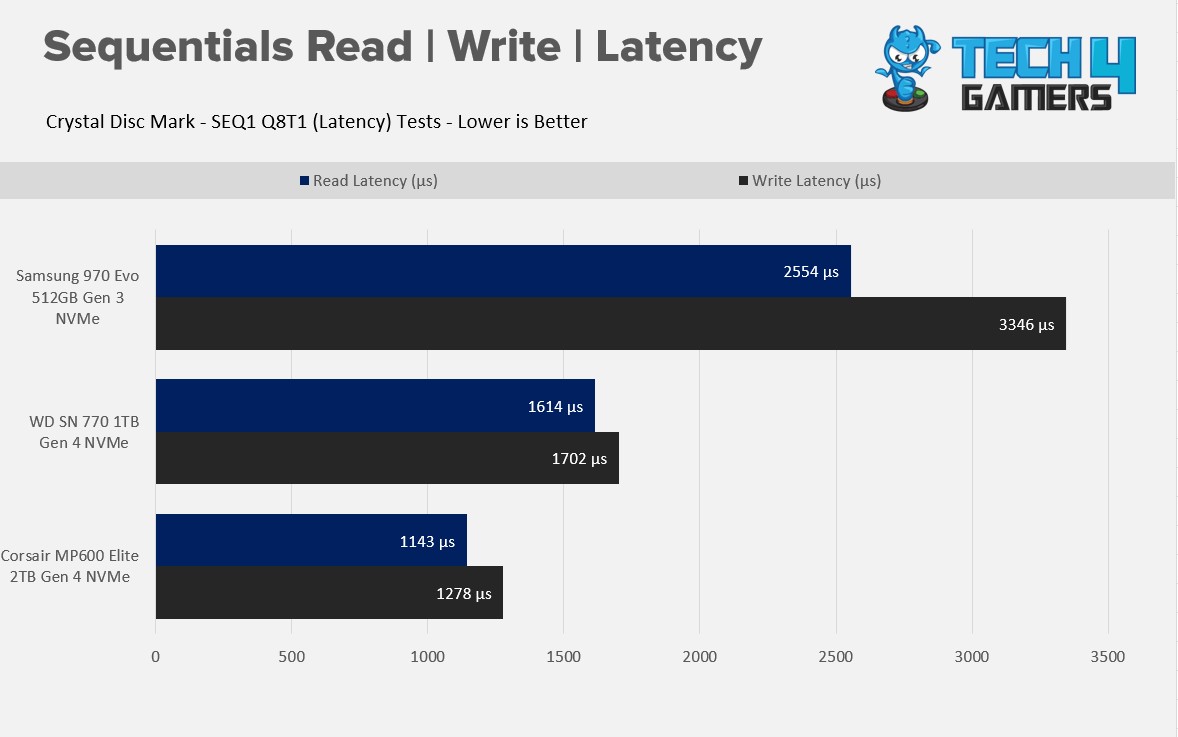
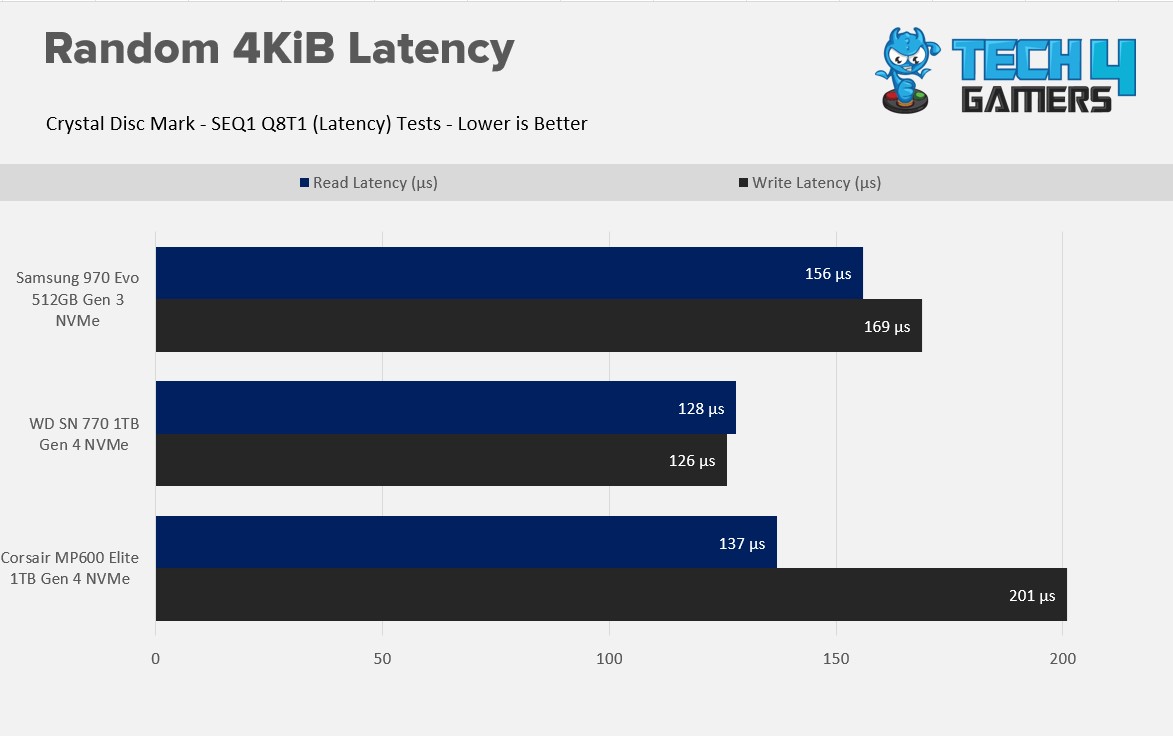
For the synthetic results and everyone’s favorite benchmark, we use crystal disc mark, where Corsair MP600 Elite reaches 7333MB/s Read and 6540 MB/s, more than what Corsair advertised. The SSD is almost hitting this speed’s limitation of PCIe Gen4 capabilities. However, the Random 4KiB results demonstrated inconsistent performance in write speeds and disappointed, performing worse than even older Samsung 970 EVO PCIe Gen3x4.
Gaming Loading Time
Gaming Opening & Loading Times
1 of 2
Cyberpunk 2077
Red Dead Redemption II
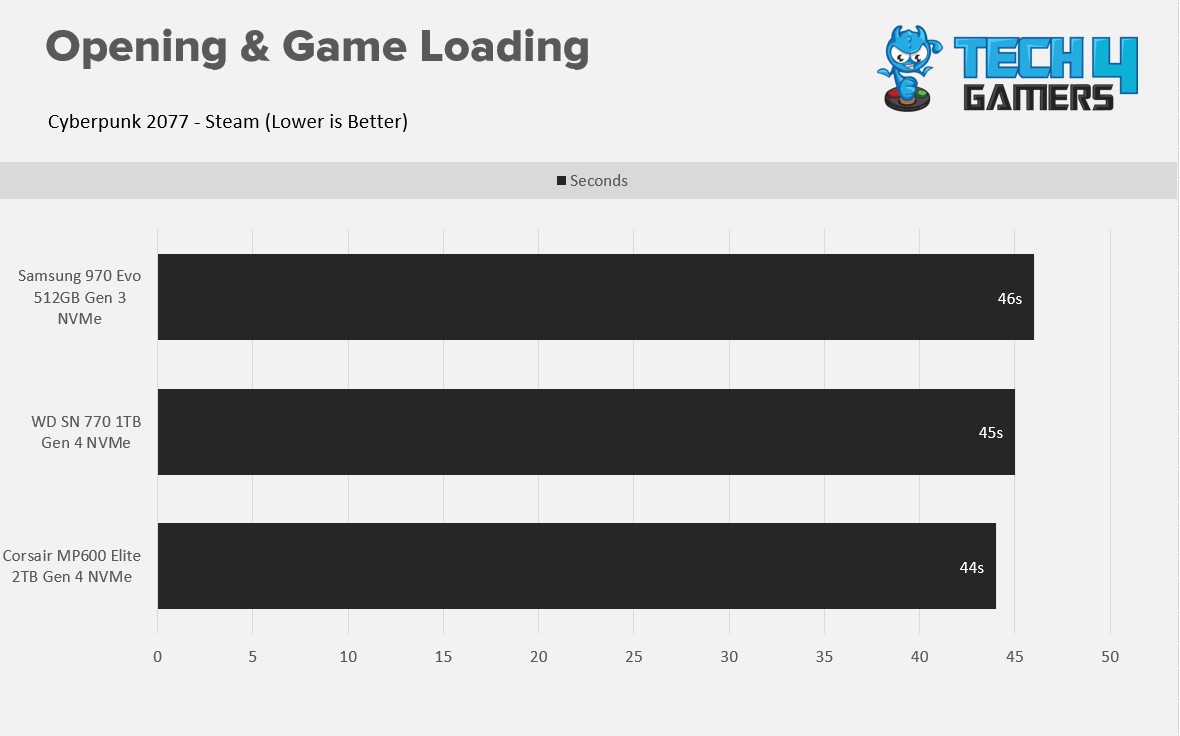
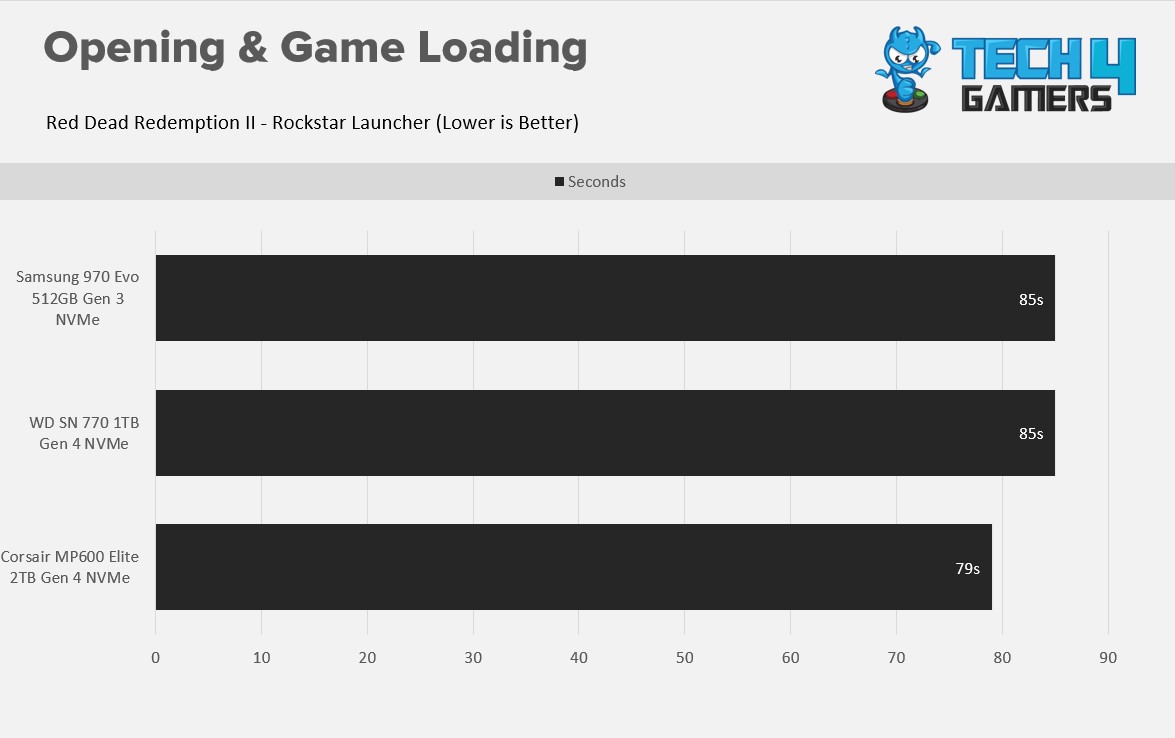
Gaming loading does not require high-end NVMe or storage solutions; we have tested two games, Cyberpunk 2077 and Red Dead Redemption II. Our results include the gaming opening time and loading time right from the beginning of the splash screen. Corsair MP600 wins in Red Dead Redemption II by 6 seconds, which is impressive, and that’s also why it is our top choice for a gaming SSD.
Temperatures
Corsair MP600 Elite 2TB Stress Test
We’ve run the tests of 10 minutes in the PCMark Consistency Test, which is extremely heavy as this test writes an extremely large amount of data; Corsair MP600 Elite 2TB peaked at 70C at the room temperature of 25C since this variant of MP600 Elite did not come with the heatsink we utilized our motherboard NVMe Heatsink. SSD is installed in the first slot. Considering how fast this SSD is, the temperatures are excellent and within the normal range.
Should You Buy It?
Buy It If
✅ You are upgrading from the older storage: Corsair MP600 Elite 2TB delivers an excellent upgrade over PCIe Gen3x4 SSDs. Sequential Speeds Peaking up to 7400MB/s and 6500MB/s is a massive jump from the traditional 3000MB/s Gen3 SSDs.
✅ You want quicker loading times in games: Corsair MP600 Elite 2TB delivers incredible game loading times, beating WDSN770 in Red Dead Redemption II by 6 seconds.
Don’t Buy It If
❌ You want the storage with DRAM Cache: Without the DRAM Cache, SSDs rely on the Nand Flash or HMB (Host Memory Buffer), leading to reduced write performance/operations.
❌ Your motherboard does not support PCIe Gen4x4 NVMe: Corsair MP600 Elite is the Gen4x4 Fast NVMe Storage Device. Though it can run on PCIe Gen3x4, it can do so at much lower speeds.
Conclusion
Corsair MP600 Elite 2TB is an excellent NVMe Storage Solution. Thanks to its Phyison E27T controllers, which power this NVMe and run extremely fast in synthetic benchmarks, especially in sequential read and write benchmarks. The SSD peaks at 7,400MB/s on reading and 6,500 on writing, which is extremely fast for daily use.
The retail price for this SSD is slightly higher, at $149.99. It’s a DRAM-less drive, but if you are a gamer, this SSD won’t disappoint you. This SSD does not come with the heat spreader or heatsink, which is very disappointing considering this SSD is extremely fast and can run very hot, in our stress-test our SSD peaked at 70ºC maximum with the heatsink, which is still on the hotter side, but it’s still safe.
Corsair should have provided at least an aluminum heatsink with it, as they don’t cost a lot; you can find them cheap for 10 bucks easily. However, in real-world tests, such as game copying/transferring files, recording gameplay, or streaming, this SSD is incredibly fast and matches the mid-range WDSN770 SSD. The 2TB variant has an endurance of 1200 TBW (Terabytes Written). This storage also comes with 5 years of coverage. If you are in the market for a brand-new storage solution, the Corsair MP600 Elite can be a good purchase.