Lead the comparison and blog writing teams at Tech4Gamers.
Oversee teams with a keen eye for detail and precision.
Ensure hands-on writing, with benchmarks and testing as guiding principles.
Guarantee the delivery of the best possible results in concise yet impactful tech tales.
Story Highlights
User growth doesn’t always translate to revenue if spending habits remain the same.
Steam’s ecosystem drives purchases, not just traffic, while Epic Games’ strategy builds accounts more than loyalty.
Exclusive games attract attention but rarely create long-term customers.
Revenue reflects the depth of player engagement, not the number of users.
For many years, Steam and Epic Games have been battling it out for the title of the top gaming storefront. Epic entered the gaming market, promising better returns for developers, exclusive titles for players, and aiming to break Valve’s near-monopoly status. Right now, though, Steam is dominating the market, whereas Epic is trying to keep up.
From the surface, Epic seems to be closing in on Steam in the battle for revenue growth. The player count continues to grow, the library is constantly expanding, and millions of accounts claim free games yearly. Yet despite all the user growth, revenue seems to be lower in proportion. Let’s dive right into why this is so.
User Growth Doesn’t Equal Spending
Epic Games’ user growth has increased significantly over the years, but most of that growth is because of incentives, not purchasing intent. Weekly free games, exclusive titles and aggressive promotions have attracted millions of players worldwide to make accounts and log in frequently. But these users are not necessarily spending any money.
Epic Games Player Growth – Image Credits (Reddit)
Many Epic users treat the platform as a secondary gaming library whilst continuing to make purchases elsewhere. Steam, on the other hand, has studied user spending behaviour and allows players to browse, wishlist, mod and purchase games under a single roof. Thus, Steam is clearly generating more revenue than Epic.
Steam’s Ecosystem Is Their Product
Steam may look like a store, but it is not; it’s an ecosystem designed to encourage user spending without them realising that they are being nudged. Features like user reviews, community hubs, workshop mods, trading cards and seasonal sales all promote users to purchase. Seeing a game at an awfully high discount may seem like a bargain. The satisfaction in buying an otherwise expensive title at a very low price is its secret strength, helping Steam generate revenue.
Steam Storefront – Image credits (Tech Radar)
Epic’s storefront, on the other hand, lacks in this aspect. Though it has improved significantly, it does not incorporate the engagement loops that promote impulsive user purchases. To many gamers, Epic seems transactional rather than a social experience. Steam users do not just buy games because they are cheap; they buy them because their entire gaming identity lives on that platform.
Developers Benefit Epic Does Not
Epic Games keeps a lower revenue cut as opposed to Steam and is praised by developers for this. However, this also means that Epic requires a much higher sales volume to match Steam’s revenue generation. At the same time, Epic spends a large amount on providing free, exclusive games and on platform development.
Epic Games Store Free Games – Image Credits (Pinterest)
This may work fine as a long-term strategy, but it makes short-term profitability minimal. Epic Games is focusing more on growth rather than revenue at the moment. This makes a revenue comparison with Steam unfavourable at the moment. Steam, on the other hand, has already amortised its platform and can work with higher margins and fewer incentives.
Purchasing Habits Are An Issue
One of the biggest hurdles Epic faces is the spending habits of players. Many PC gamers have spent years and in some cases even decades building their gaming libraries on Steam. They trust the platform’s refund policies, are comfortable with its user interface and rely on its features.
Steam Store Revenue – Image Credits (Alinea Analytics)
For Epic to try to attract Steam’s customer base, it needs more than just free games and incentives. Players need a compelling reason to force them into abandoning habits that work. To many players, Epic has just not offered a strong enough reason for them to make it their primary storefront. It’s not like players don’t appreciate free games; it’s just that emotional attachment and convenience cannot be replaced.
Revenue Reflects Engagement
The difference in revenue of Epic as compared to Steam highlights a broader truth about gaming platforms. Revenue is not generated by how many users you have, but how deeply those users are engaged. Steam excels because players log in not to collect but to browse and buy. On the other hand, Epic struggles to transform an existing user base into active spenders.
The battle of Epic vs Steam is neither a story of Epic’s failure nor Steam’s success. Epic has proven that it can attract a large audience and challenge industry norms. But to match Steam’s revenue generation, it needs to change the spending habits of its active users. Steam dominates in this regard, not because it blocks all competition, but because it understands user spending behaviour.
At Tech4Gamers, I proudly wear the title of Comparisons Specialist. Focused on CPUs and GPUs, I bring forth a wealth of hands-on experience and a keen eye for detail to provide our audience with the latest insights and analyses.
Story Highlights
NAT type affects who you can connect to more than how fast your internet connection is.
Strict NAT can disrupt party chat and matchmaking even on a stable connection.
Many ISPs and routers may increase NAT-related issues.
NAT issues can easily be resolved through methods such as port forwarding.
Considering the NAT type is something players never consciously choose, it still has a profound impact on how online gaming feels. It dictates who you can connect to, how stable your matches are and whether voice chat works smoothly or not. Despite its impact on online gaming, even after years of modern gaming, it remains one of the primary issues that gamers face.
The worst part about NAT issues is that they don’t feel like actual problems. Downloads are fine, streaming works, but as soon as you boot up a multiplayer game, issues pile up. Players may face connection errors, strict matchmaking and a voice chat that refuses to cooperate. Let’s dive right into the details on how to resolve NAT-based problems.
What NAT Type Actually Is
NAT, or Network Address Translation, is how your router manages traffic between the wider internet and your home connection. In our homes and offices, multiple devices often share one IP address. NAT dictates how data is routed. Games classify NAT into three types. Open NAT means your console and PC can freely connect to others, moderate NAT has some restrictions, and then there’s strict NAT, where problems such as restricted matchmaking and unstable voice chat begin.
Internet Router – Image Credits (Tech4Gamers)
Why It Is Still a Problem in 2026
One of the biggest reasons NAT type still lacks is that the internet infrastructure has not evolved as cleanly as gaming. Many ISPs make use of carrier-grade NAT, especially in regions with limited IPv4 availability. This adds another layer of communication between your device and the server, which makes it harder for straightforward connections to work properly.
Another issue is how modern households use the internet. All the devices in your household, office or shared space constantly compete for bandwidth and ports. Routers tend to prioritise simplicity and security over performance flexibility. This goes against the online gaming scene, which relies on open networks for communication and matchmaking.
Aside from this, modern multiplayer games don’t help much either. Most of these games still rely on peer-to-peer connections for matchmaking, party chat and other functions. It’s very common that when two players with restrictive NAT types try to connect, the entire experience falls apart before the match even starts. All of these issues can lead to player frustration and an overall bad gaming session.
Usually, what happens is that one game works completely fine, whereas another starts spamming you with NAT-based errors. This is because different games handle networking differently. Titles that have dedicated servers tend to handle NAT issues better, whereas those that rely on peer-to-peer connections expose NAT issues immediately.
Voice chat is often the first thing to falter, followed by issues with party systems, cross-platform matchmaking and game invites. Competitive shooters and co-op games suffer the most from NAT issues as they rely on quick and stable two-way communication. This is the prime reason why NAT issues may seem different; your setup remains the same, but the game’s networking model shifts.
How You Can Solve These Issues
The most reliable fix is port forwarding. You can do this by manually opening ports on your router for your console and PC, allowing for your games to have a direct path through your network. This may take a bit of effort, but it is far more stable than any other quick fix. Another way to resolve NAT issues is UPnP, or Universal Plug and Play. This works by automatically opening ports as they are needed.
Typical NAT Limitations Xbox – Image Credits (Techbits.io)
Sometimes switching to another router may also work magic. This is because many routers are made for basic browsing and home tasks, not for gaming. Having a router with better firmware, better port management and QoS controls can significantly reduce NAT-based issues. In some cases, simply changing the NAT type or enabling IPv6 may also solve these issues, provided that your ISP and game support it.
Despite better internet, servers and better gaming technology, NAT issues persist in modern online gaming. They act as a barrier to smooth gameplay and may be frustrating. Until we see the gaming industry shift from NAT-based limitations, users will keep stumbling into these issues time and time again.
To resolve these issues, one must understand NAT, allowing for control to shift back to the user. Solving these issues completely may be hard, but with the right hardware, settings and expectations, the overall impact of these issues can be lessened.
I’ve been the Journalist & Editorial Writer at Tech4Gamers since July 2022. I spearhead our hardware coverage, including overclocking GPUs, benchmarking CPUs, reviewing peripherals, and fine-tuning custom PC builds for every budget. Daily, I report on breaking gaming news, from major launches and studio updates to the latest industry trends, ensuring our community stays informed. Beyond news briefs, I write in-depth feature articles on gaming culture and emerging technologies. And by collaborating closely with the editorial team on content planning, SEO strategy, and our publishing calendar, I help us consistently hit our traffic and engagement targets.
Corsair launched the Sabre V2 Pro Ultralight last year. That mouse weighed an unusually low 36g. It ended up winning over a fair number of competitive FPS players. For me, it even replaced my all-time favourite Logitech G Pro X Superlight, which says a lot about how well it nailed the basics. That’s why I have high expectations for Corsair Sabre v2 Pro Carbon Fiber going forward.
Why Trust Tech4Gamers
Abdul Hannan is our peripherals expert who has been testing different mice, keyboards, headphones, microphones, and more for years.
130+ peripherals tested and reviewed by our team of hardware experts (Tech4Gamers Team).
500+ hours spent testing different peripherals for our reviews.
At Tech4Gamers, ensuring you get reliable information is our priority. That’s why every hardware round-up undergoes a meticulous review process by our team of experts and editors. Each review is carefully examined against our strict editorial guidelines, guaranteeing you trustworthy insights you can depend on.
Key Takeaways
The Corsair Sabre v2 Pro Carbon Fiber is a lightweight gaming wireless mouse that focuses on delivering low-latency for fast-paced gaming.
You should buy the Corsair Sabre v2 Pro Carbon Fiber if you care about build quality over chasing the lowest weight, play competitive FPS, and want consistent tracking.
You should skip the Corsair Sabre v2 Pro Carbon Fiber if you only want the lightest mouse possible, love flashy RGB, and need Bluetooth pairing with multiple devices simultaneously.
Here are the technical specifications:
Feature
Description
Connectivity
Wireless, Wired, and Bluetooth
Battery Type
Rechargeable, Li-ion polymer
Battery Life
120hr
Sensor
Corsair Marksman S
Sensor Type
Optical
Sensor Resolution
33K
Buttons
5
USB Report Rate
8000 Hz
Mouse Feet
UPE
Dimensions
39 x 64 x 123 mm
Weight
55g
Warranty
2 Years
MSRP
$199.99Current price: $199.99
[toc]
What Makes Sabre v2 Pro Carbon Fiber Different?
The Sabre v2 Pro Carbon Fiber stands out from older Sabre models by introducing a noticeable change in materials, moving away from conventional plastics to a carbon fiber chassis. Unlike the Sabre V2 Pro Ultralight, which pushed the boundaries of minimal weight down to around 36 grams, the Carbon Fiber version accepts a higher weight of around 55 grams to provide a more solid feel that some players will appreciate.
Packaging & Unboxing
Packaging
1 of 2
Frontside of the Box
Backside of the Box
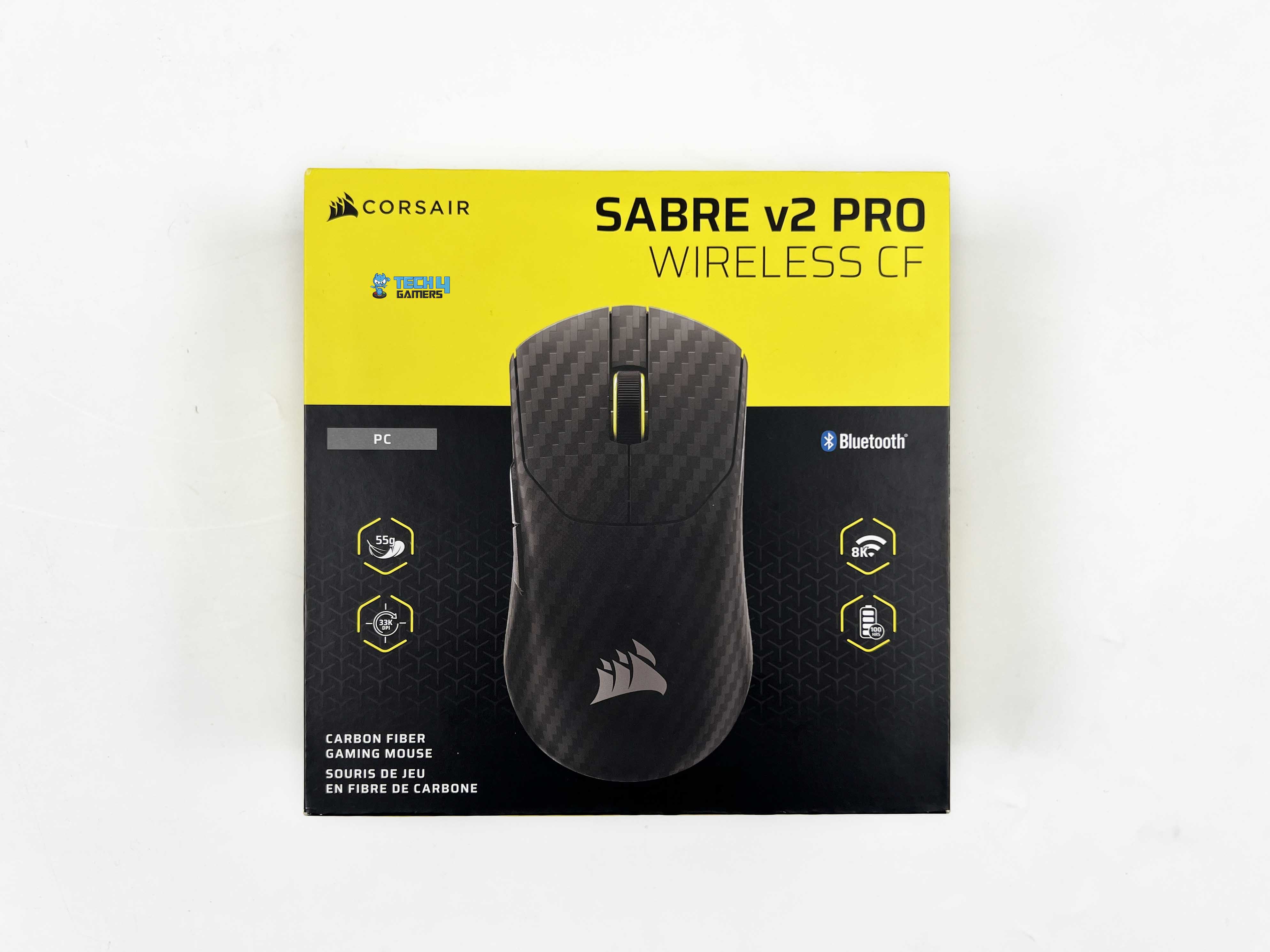
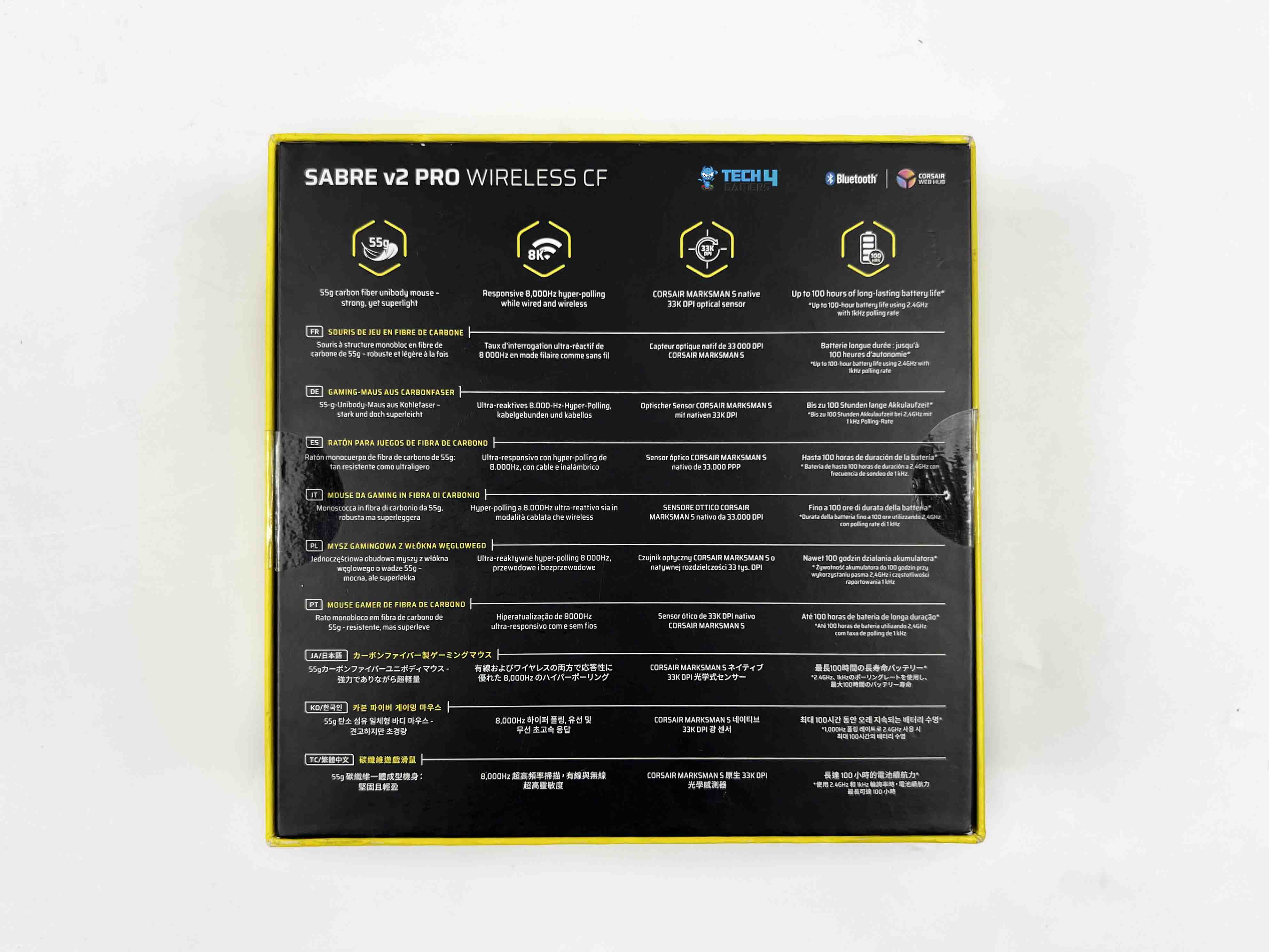
The Sabre v2 Pro Carbon Fiber comes in Corsair’s familiar yellow-and-black packaging. The front of the box shows an image of the mouse, with a few feature callouts around it. The top and sides list additional features and show what’s included inside. There’s also a side profile image of the mouse. Flip the box over, and the back is packed with technical details printed in multiple languages.
Unboxing
1 of 2
Unboxing
Carrying Case
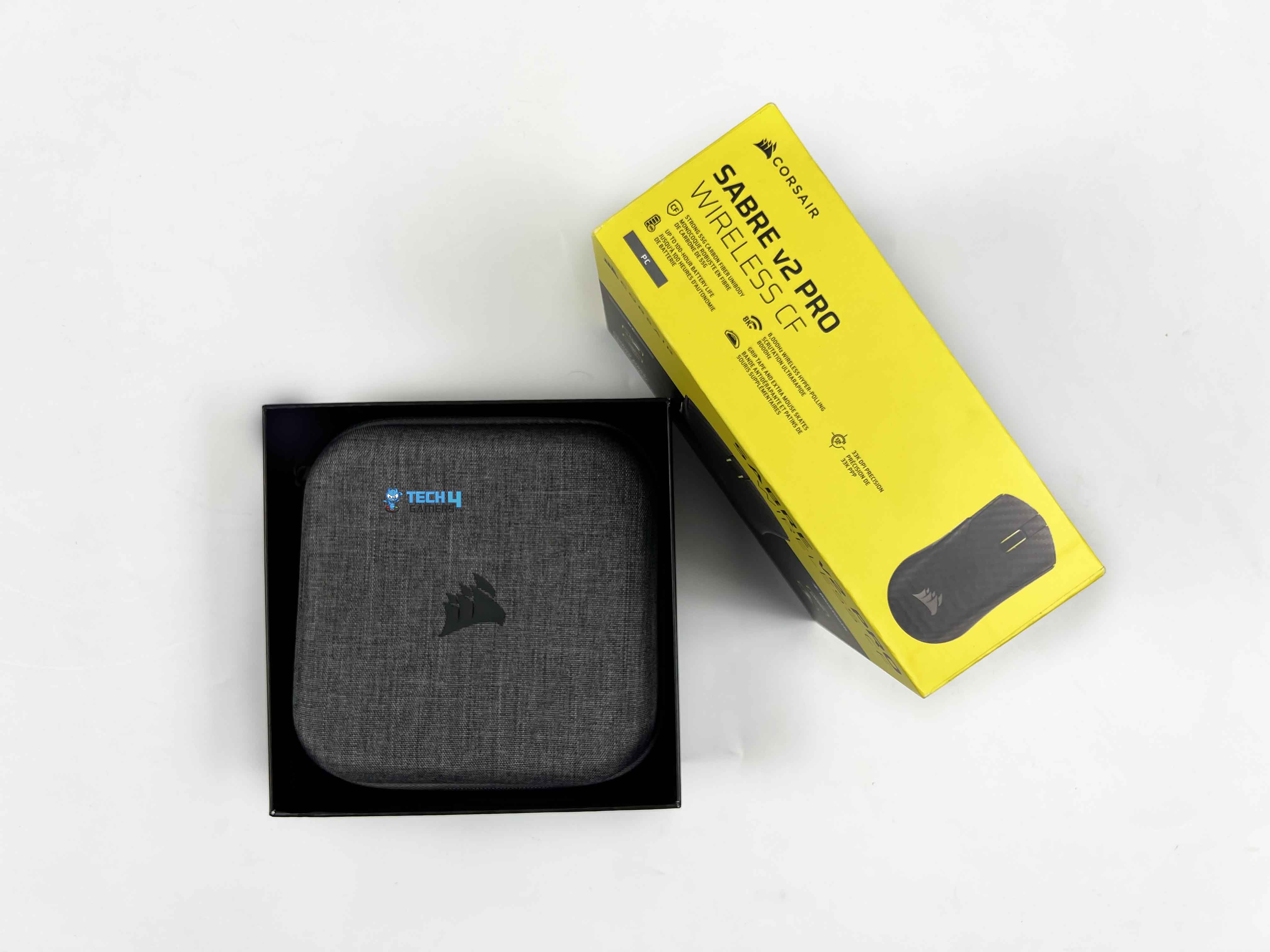
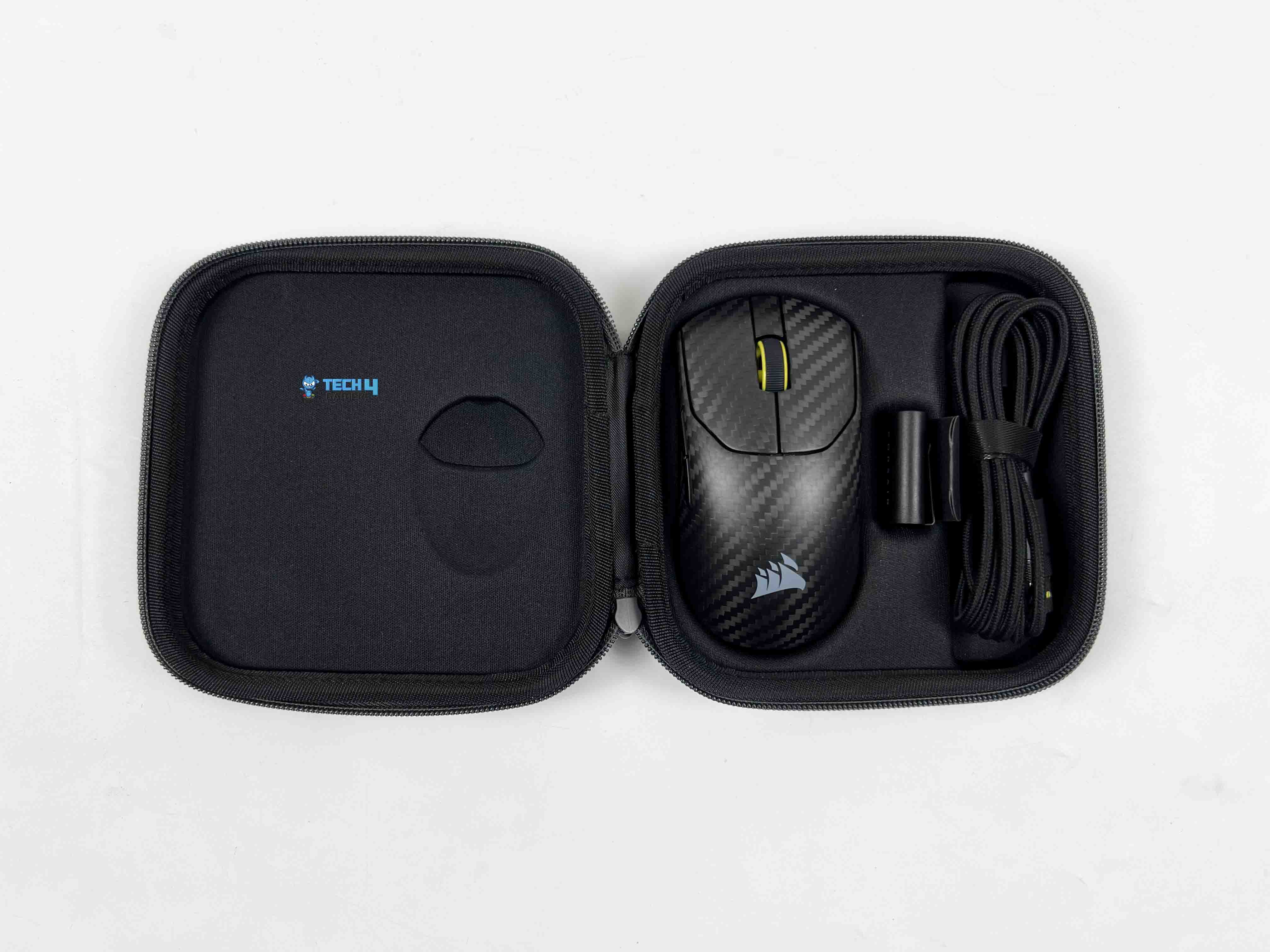
Once you open the box, the first thing you’re greeted with is a gray zipper pouch with a Corsair logo on it. Unzipping the pouch reveals the Sabre v2 Pro Carbon Fiber inside, along with the wireless USB receiver and the USB Type-C to Type-A cable. Beneath the pouch, there’s a separate card sleeve. Inside that, Corsair includes extra mouse skates, grip tape, and an alcohol pad.
Design
Design
Looking at the Sabre v2 Pro Carbon Fiber as a whole, the design leans heavily into ergonomics. The contours are deliberate. There’s a gentle rise toward the back, then a gradual slope forward that keeps the hand relaxed. After using it for a couple of days, your hand would naturally adjust to it. The shape is asymmetrical, with the left side offering more support than the right. That bias is easy to feel once you start moving it around.
The thumb has a subtle place to rest on, while the opposite side stays flatter. The carbon fiber weave is present, but it’s handled adequately. You can see the pattern when light hits the shell directly, especially under brighter desk lighting. Under softer or darker lighting, it almost disappears. The weave is consistent across the surface. There’s no RGB to speak of, and the Corsair logo is kept small in the middle.
Coating
Coating
The coating on the Sabre v2 Pro Carbon Fiber feels different. It’s not the soft matte plastic you get on the Ultralight version. There’s a faint texture here that comes from the carbon fiber itself, and you can feel it mostly under your fingertips and along the sides. It’s subtle, but it changes the overall grip experience. With dry hands, the surface feels extra grippy. When my hands started to sweat a bit, the coating still held up reasonably well.
You don’t suddenly feel the need to readjust your grip every few minutes. The finish stays matte under most lighting conditions, and it doesn’t pick up fingerprints as easily as glossy coatings do. You won’t see any smudges at all across the surface. Compared to the Ultralight’s smoother shell, this coating feels a bit more grounded. I didn’t feel the need for grip tape right away, even though Corsair does include it in the box.
Weight
Hump
The Sabre v2 Pro Carbon Fiber weighs 55g, which is slightly higher than the Ultralight version’s 36g. It doesn’t feel as heavy as the number might suggest. You can feel that extra substance as soon as you pick it up. It’s easy to move around, just not as feather-light as the previous variant. The carbon fiber shell plays a big role here. It keeps the mouse rigid without adding unnecessary weight. Therefore, it feels lighter in movements than a similarly weighted plastic or magnesium shell might.
The balance point is right around the center. It doesn’t feel hollow at all. The shell has a noticeable density, which makes it feel premium in hand. That’s different from some lightweight designs that cut corners or rely on honeycomb shells to shave off a few grams. In FPS, I noticed that the added heft gives the movements a slightly more controlled feel compared to the Ultralight. This gives you a bit more stability in precise tracking.
Grip Styles
Grip Styles
1 of 3
Palm Grip
Claw Grip
Fingertip Grip
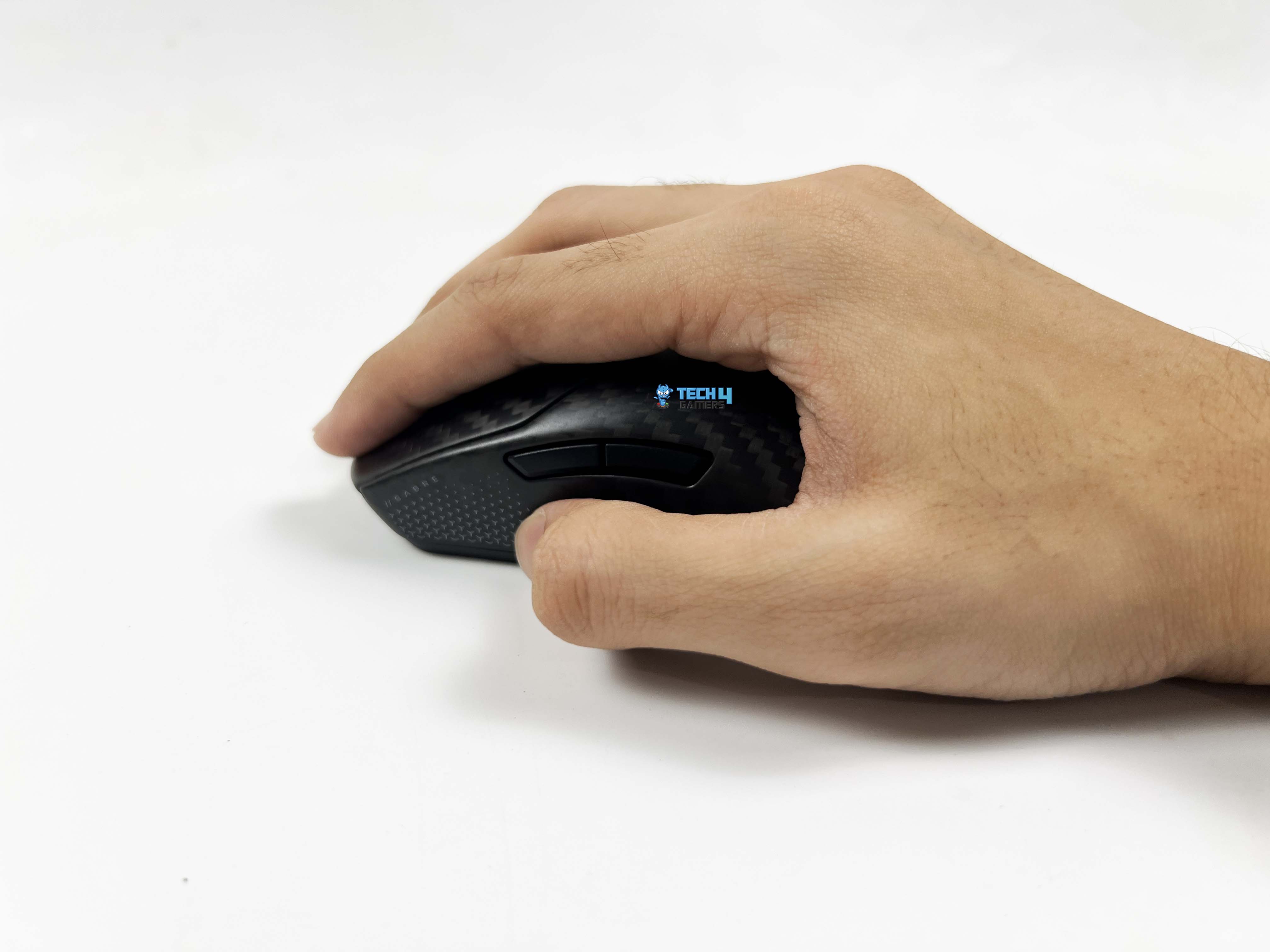
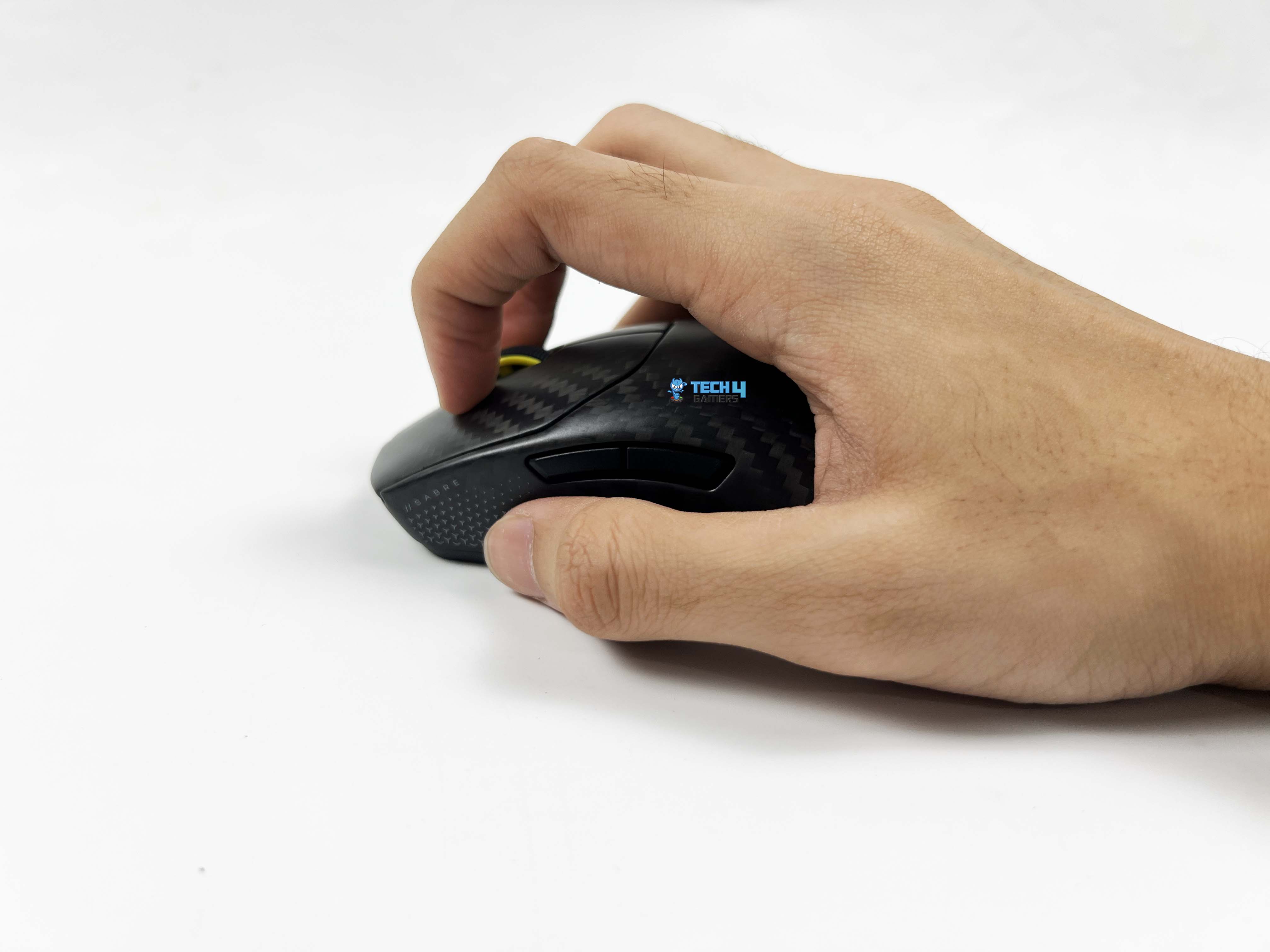
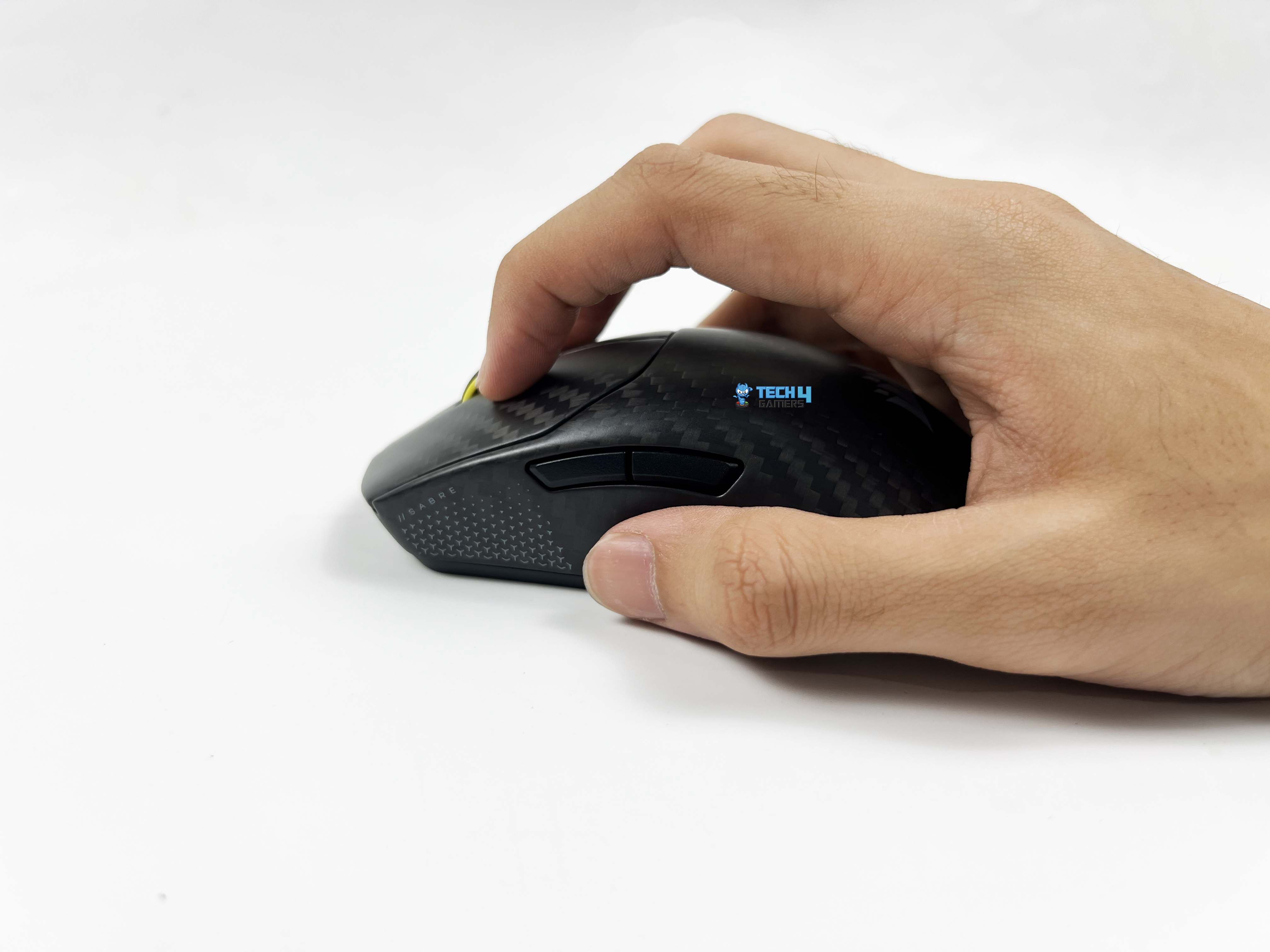
The Sabre v2 Pro Carbon Fiber is somewhat suitable for all grip styles. Palm-grip users will find that the gradual slope from the back to the front allows the hand to grip it firmly. The palm isn’t forced up or down. For claw-grip users, the higher main buttons provide a resting point for your fingers. There’s just enough space between the buttons and the body so your fingertips don’t feel cramped. The thumb groove on the left side is defined.
It gives your thumb a place to rest without locking it into a single position. Fingertip grip players might notice the weight difference more than anyone else. It doesn’t feel like it’s tipping forward or back when you lift it. I used it with a palm grip because that’s the way my hand naturally rests. It accommodates bigger hands comfortably, and I have larger hands than most people. It’s one of the few mice where I don’t feel like I’m compromising my grip.
Underside
Underside
Flipping over the Sabre v2 Pro Carbon Fiber, the mouse skates are made from 100% virgin-grade UPE. It slides effortlessly across the mousepad. The skate’s shape and size are quite similar to the Ultralight version. They are large with enough surface area covered. The sensor is centered in a small circular cutout. On the left side, there’s the power and wireless mode switch. On the right, you’ll find the DPI and Bluetooth pairing button, which is slightly raised.
You can press the DPI & Bluetooth pairing button once to move to the next DPI stage. Corsair also includes replacement skates in the box. They’re the same quality as the pre-installed ones, but slightly larger. There’s even a separate skate for the sensor cutout. That said, I don’t see myself needing to replace the stock skates anytime soon. They’ve been performing perfectly fine so far, with no uneven wear during regular use.
Build Quality
Build Quality
The build quality of the Sabre v2 Pro Carbon Fiber feels durable. The shell doesn’t flex, even when I applied some pressure along all sides. There’s no creaking or weird noises, which is a relief compared to some lighter mice that start feeling like they will tear apart when used aggressively. That firmness makes it feel like a well-engineered rather than a lightweight experiment. The carbon fiber shell contributes a lot to this sense of durability. It adds both rigidity and a slightly tactile feel.
The mouse feels denser and more substantial than a standard plastic mouse without adding any unnecessary weight. It feels reinforced instead of brittle. The edges and curves are rounded, with no sharp corners. Seams are aligned well throughout. There aren’t any noticeable gaps between the top shell and the sides. The underside feels like it’s been assembled properly. Lastly, the power switch and DPI button don’t feel cheap or flimsy. It stays in place when toggled and clicks normally, respectively.
Primary Buttons
Primary Buttons
The primary buttons on the Sabre v2 Pro Carbon are at a comfortable height. My fingers naturally fell into their place without having to adjust my grip. The separation between the buttons is clear. Click latency isn’t something you consciously notice. Tapping and rapid clicking all feel consistent. Inputs register the instant you expect them to. Out of the box, the clicks have a slightly firm feel. After a few days of use, they settle in nicely. The clicks themselves feel crisp. Both buttons feel equally responsive, with matching travel and resistance.
The force required doesn’t change depending on where you press, whether it’s near the front edge or closer to the scroll wheel. Pressing hard doesn’t introduce any side-to-side wobble. The sound profile is muted enough that it doesn’t become distracting over time. It’s not overly loud, and it doesn’t have that hollow echo some lightweight mice suffer from. Double-clicking isn’t an issue here. Even with light taps or rapid presses, the mouse doesn’t register unintended inputs.
Side Buttons
Side Buttons
The side buttons on the Sabre v2 Pro Carbon Fiber are placed where your thumb naturally rests. You don’t have to hunt for them or shift your grip mid-game. They sit slightly forward, which feels intentional, especially if you use them often in FPS shooters or productivity tasks. Both buttons have a distinct shape and a small gap between them. That separation makes it easy to tell which one you’re pressing without looking down.
The clicks feel firm. There’s no mushiness, and they don’t sink into the shell when pressed hard. During gaming, they respond instantly and reset quickly, so repeated presses don’t feel awkward. What I appreciated most is how stable they feel. Even when gripping the mouse tightly, the side buttons don’t wobble or flex. Their sound is muted as well. You hear a soft click, but nothing sharp or distracting
Scroll Wheel
Scroll Wheel
The scroll wheel on the Sabre v2 Pro Carbon Fiber has clearly defined steps, and the spacing between them feels deliberate. Each notch is easy to feel. It doesn’t blur steps together, even when you scroll quickly. There’s a good balance between smoothness and resistance. The wheel moves easily, but it never feels loose. The noise of fast scrolling remains subdued. You hear a soft, consistent tick rather than a loud rattle.
Clicking the wheel down takes a bit of intentional force. It’s firm enough to avoid accidental presses, yet not so stiff as to be uncomfortable. This works well if you use the scroll click for jump or zoom bind. Weapon switching also feels precise. You can move up or down one step at a time without overshooting. In terms of durability, the wheel feels solidly mounted and well-supported, giving surety that it’ll hold up without loosening anytime soon.
Connectivity
USB Cable and Receiver
You’re not locked into a single way of using Sabre v2 Pro Carbon Fiber. For gaming, the 2.4GHz wireless mode is the obvious choice. It feels fast and consistent, and that’s the connection mode I spend most of my time with. It performs like a wired mouse without the cable getting in the way. For it, you start by plugging in the USB wireless receiver. Then, flip the power switch on the underside of the mouse.
Bluetooth is there when you want something more casual. It’s useful for switching over to a laptop without unplugging anything. For everyday tasks, it works fine and pairs quickly. Unfortunately, the mouse can only be connected to one device via Bluetooth at a time, so re-pairing is required when switching devices. Then there’s the wired option through USB-C. Plug it in, and the mouse starts working while charging.
Performance
Sabre Branding
At the center of Sabre v2 Pro Carbon Fiber is the Corsair Marksman S optical sensor. Thanks to an 8,000Hz polling rate, it reports inputs incredibly fast, roughly every 0.125 milliseconds. Whether I was using it wirelessly over Slipstream or plugged in via USB-C, there was no perceptible lag, which is exactly what you want in competitive gaming. It can easily handle extremely high DPI, fast movement speeds, and acceleration without losing accuracy.
At low DPI, the movements feel smooth. There’s no stutter, which is especially noticeable when lining up precise shots. Even during rapid flicks, the sensor keeps the cursor right where I expect it to be. I could tell that every sweep, swipe, and micro-correction was faithfully tracked, making it easy to rely on for both FPS and MOBA games. The lift-off distance is well-tuned, as picking it up doesn’t register extra movement.
Battery Life
The Sabre v2 Pro Carbon Fiber features a 300 mAh battery. On the 2.4GHz wireless connection with a standard 1,000Hz polling rate, it can last several days before needing a recharge. It claims 120 hours of battery life on this combination, and my time with it was pretty close. Increasing the polling rate to 8,000Hz significantly reduces battery life, but it still gives you a day or two of usage time.
Software
Software
1 of 4
Key Assignments
DPI
Macro Manager
Device Settings
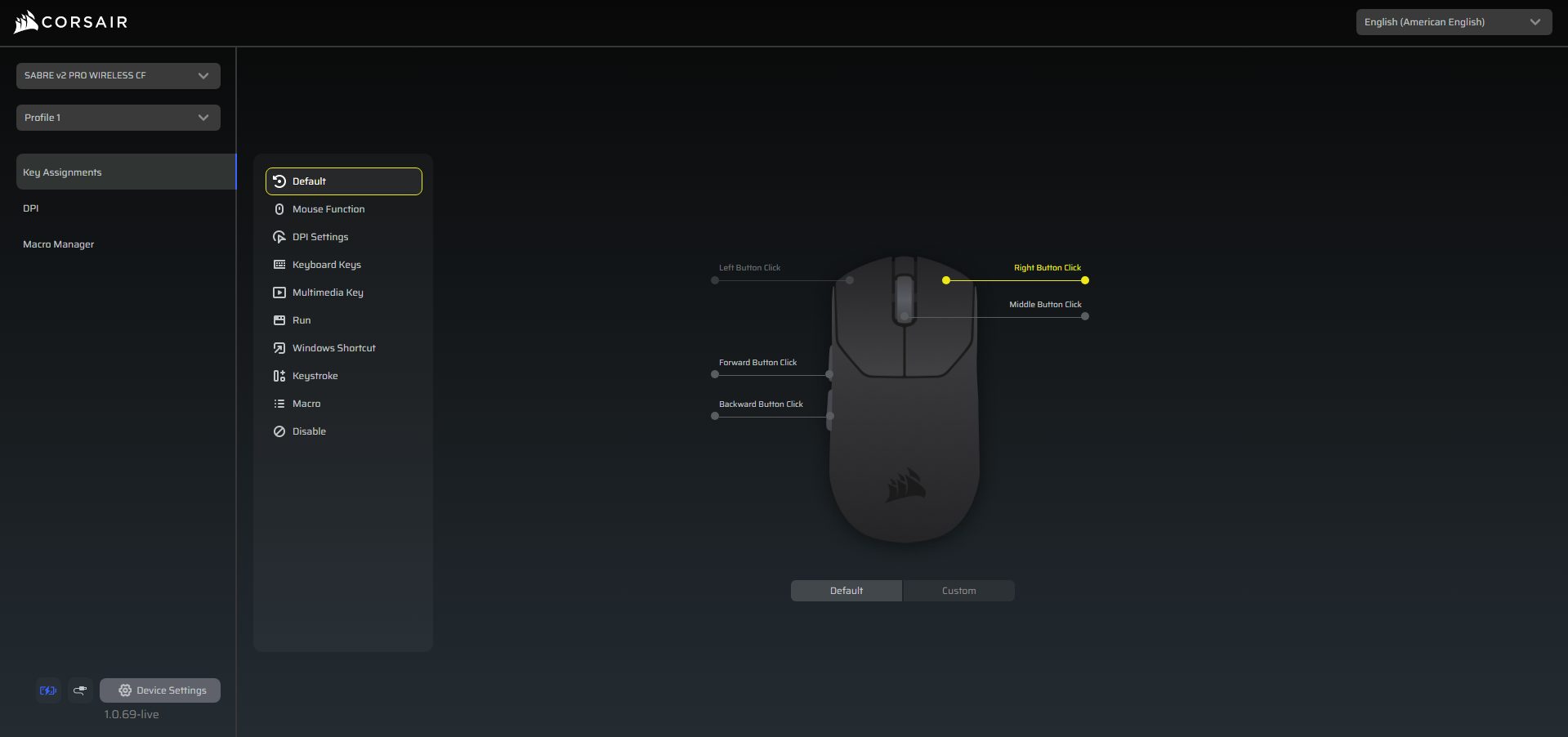
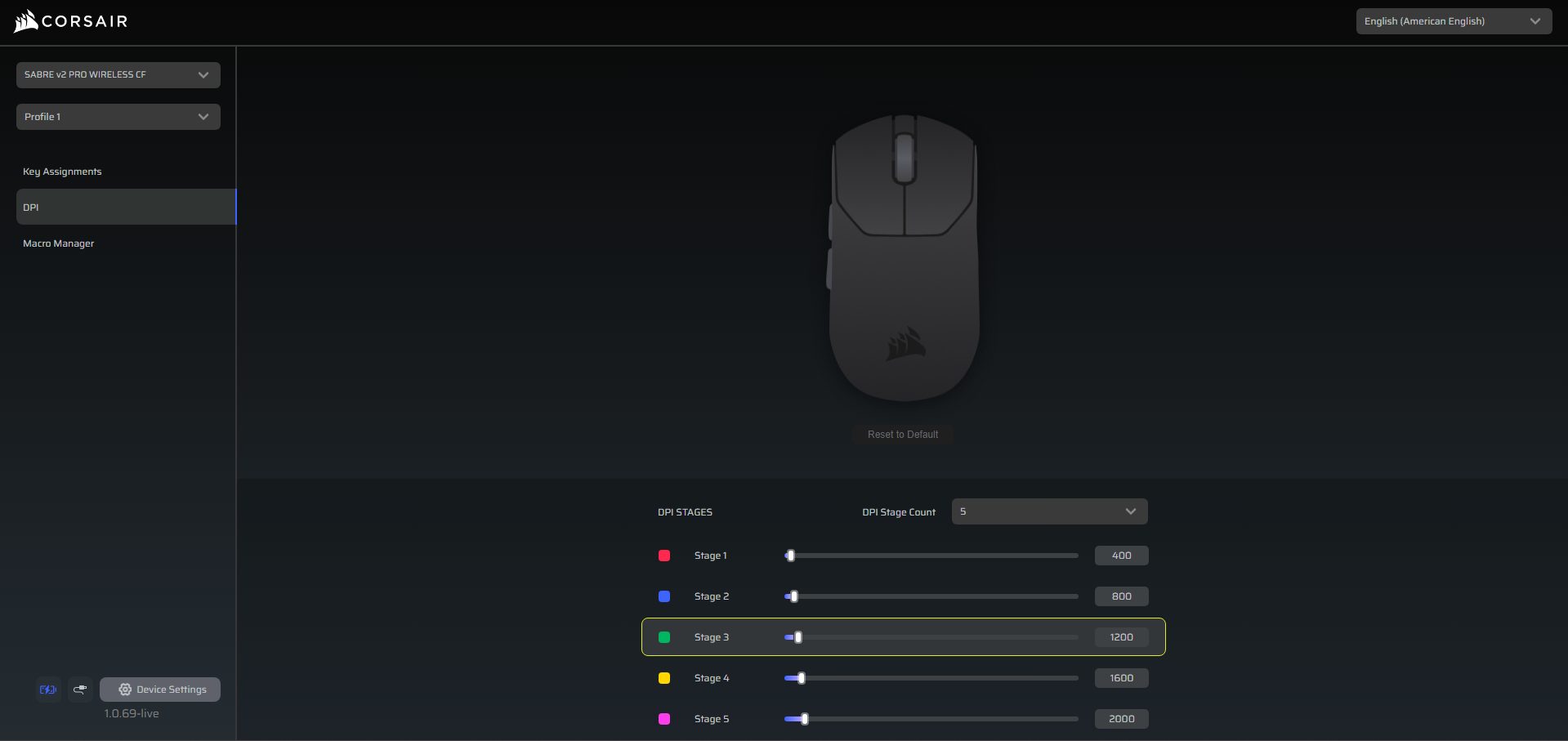
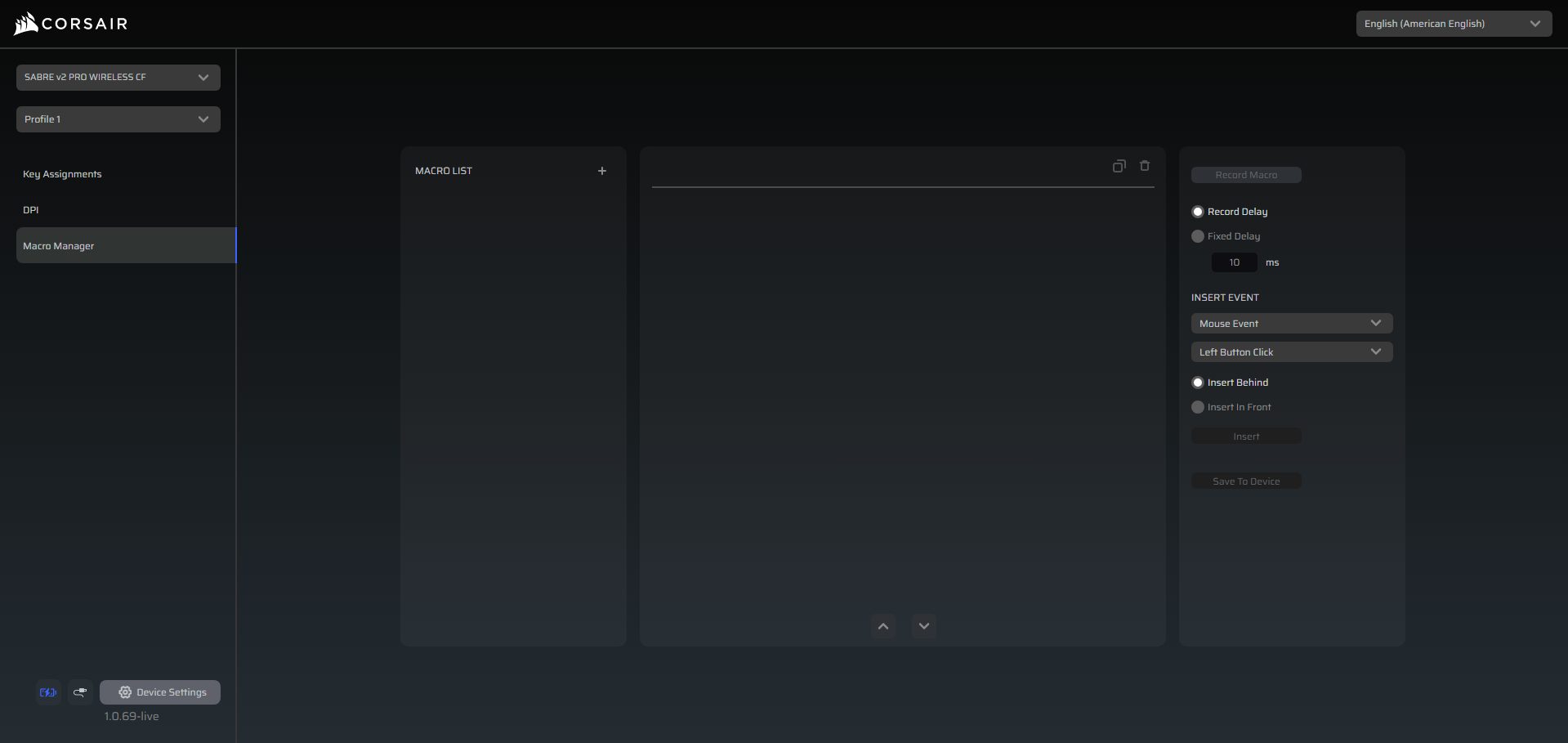
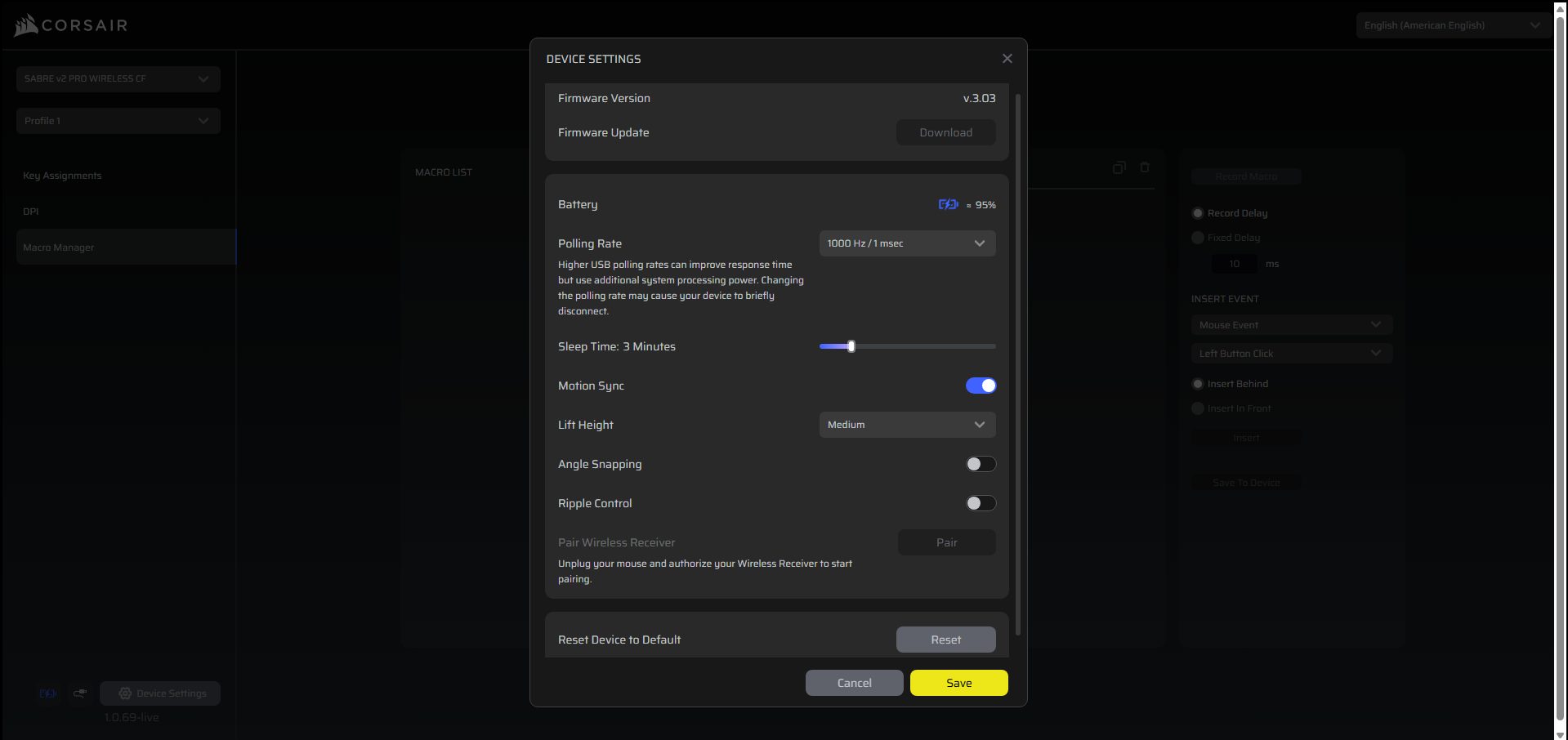
Corsair’s Web Hub is a browser-based software that’s used to customize the Corsair Sabre v2 Pro Carbon Fiber. It feels pretty straightforward once you get started. You can remap buttons, tweak DPI stages, and even assign macros. Beyond the basics, it provides access to more advanced sensor customization options. Lift-Off Distance can be adjusted so the mouse tracks exactly how you like when you pick it up.
Angle Snapping can be switched on or off depending on whether you want raw tracking or a bit of assistance. It’s a neat way to customize the mouse without committing to a full software install like iCUE. For anyone who likes to experiment or needs very specific settings for competitive games, it’s a handy option to have right in the browser. I didn’t encounter any crashes or weird behavior during my testing.
Should You Buy it?
Buy it if
✅ You care about build quality over chasing the lowest weight: The carbon fiber shell gives the Sabre v2 Pro a solid, dense feel that’s rare in the ultralight category.
✅ You play competitive FPS and want consistent tracking: The Marksman S sensor with up to 8,000Hz polling delivers extremely responsive input and reliable tracking
Don’t buy it if
❌ You only want the lightest mouse possible: If you liked the 36g Sabre Ultralight or similar ultra-minimal mice, the added weight here will be noticeable, especially for fingertip grip users.
❌ You’re price-sensitive: At $199.99, this mouse is in premium territory. There are strong competitors offering lower prices and comparable performance, with top-tier sensors.
My Thoughts
After spending enough time with the Sabre v2 Pro Carbon Fiber, I can say it’s a very purposeful mouse. It is built with serious competitive play in mind. Everything about it, from the polling rate to the shape, seems carefully designed for gaming performance. At its price point of $199.99, the Sabre v2 Pro Carbon Fiber isn’t aiming at entry-level buyers. Whether it’s good value depends on what you’re after.
Currently serving as a News Reporter at Tech4Gamers, I have the privilege of combining my love for gaming with the art of storytelling. My role involves crafting engaging narratives that keep our audience abreast of the latest developments in the gaming world.
Story Highlight
For almost a year, reports have suggested that Ubisoft has permanently shelved the Watch Dogs IP.
However, a reliable insider seems to disagree, suggesting there’s still life in the series.
This makes sense considering Ubisoft’s shifting focus on open-world games.
Watch Dogs was Ubisoft’s answer to Rockstar’s GTA, but despite so much potential, the series never really took off due to various factors, including big promises from the publisher that couldn’t be fulfilled and the fact that it was up against the biggest video game series ever.
Still, Watch Dogs games were commercial successes, up until 2020’s Legion, which sealed the IP’s fate. Following that flop, reports suggested the IP was shelved at Ubisoft, a claim corroborated more recently by famous journalist Tom Henderson.
However, that may not be true, as another major insider steps up, claiming the IP may not be dead, implying we can expect new entries from the series.
Why it matters: The first two Watch Dogs games have aged incredibly well and filled the open-world gap left by GTA due to the long hiatus between entries. As such, it’s exciting to see that the IP isn’t dead and that we can expect newer games from the series afterall.
In a discussion thread linking to Tom Henderson’s claim that Watch Dogs has been shelved at Ubisoft, insider Shinobi602 shared his two cents, saying, “Not exactly.”
Many thought that the insider was referring to the upcoming Watch Dogs film, however, that isn’t the case as he clarified his statement that he isn’t referring to the live-action adaptation.
I am not talking about a movie -Shinobi602
Despite Watch Dogs Legion performing poorly, the entire series is too big to be axed. Overall, the franchise has sold more than 25 million copies across 3 entries, with more than 20 million contributed from the first two games.
More recently, Ubisoft announced a major shakeup at the publisher and stated that it would be shifting towards a new operating model focused on open-world and live-service games.
Therefore, Watch Dogs’ inclusion in this shift would make sense. That said, in the future, they really need to rethink about their approach to the game if they don’t want to repeat the same mistakes.
Unfortunately, most of the developers behind the first two games have left the publisher. Ubisoft would really have to make some serious changes in the creative department if it wants the IP to recover, but that seems unlikely with each passing day.
Ubisoft potentially earns nearly €100 million in MTX for each Assassin’s Creed game.
Almost 40% of the total MTX revenue is generated through time-saving MTX.
This information comes from leaked documents shared by French YouTuber j0nathan.
It’s no surprise that Ubisoft’s public perception has been going downhill, partly due to the company’s recent troubling moves to fire employees across the board, cancel projects, and delay others, like the upcoming Black Flag Remake.
A major point of contention between fans and the company has been the inclusion of microtransactions in Assassin’s Creed titles, which are fully single-player games and not live-service games. Thanks to French YouTuber j0nathan, we finally have a better understanding of the financial incentive behind these microtransactions.
Why it matters: These approximately 100 million euro figures explain why Ubisoft heavily pushes MTX in games despite the negative public perception.
The leaked internal document shows that Ubisoft earned €94 million in MTX revenue from Assassin’s Creed Odyssey, and €112 million from Assassin’s Creed Valhalla. Players spent €47 million on time-saving MTX like XP boosters in Odyssey and €35 million for Valhalla.
Numbers like these make microtransactions not just a side source of revenue that developers can rely on, but the primary driver of how games are designed. It influences major game design decisions that the developers have to take so as to maximize potential revenue earned through these microtransactions. Ubisoft has taken a lot of flak for making its recent RPG-focused Assassin’s Creed games overly grindy, and these leaked documents show there is a financial incentive to do so.
Assassin’s Creed Shadows.
It also explains the inclusion of Animus Hub with Assassin’s Creed Shadows, which heavily integrates MTX into its UI. By forcing players to first boot into the Animus Hub before starting their game, Ubisoft is further integrating microtransactions into the overall player experience.
Do you think players will stop buying microtransactions in single-player games any time soon? Share your thoughts in the comments below or join the discussion on the Tech4Gamers forum.
At T4G, my task is to cover the latest news around the gaming globe ASAP and with the utmost precision. I adore all the games and respect all the devs behind the amazing games that we get all year. So, whether it’s a PC or a Console game, I got it all covered.
Story Highlight
A new leak claims that Prototype 3 is already in development at Activision.
The game will revisit New York City and continue the story of Alex Mercer.
Activision is doing focus group testing already, suggesting it’s in active development.
The last Prototype game was released over 12 years ago at this point, despite the demand for another entry still being there. There have been rumors of a new entry for quite some time, which do seem to be real, as we have more details now.
A new leak suggests that Prototype 3 is currently in active development at Activision. The sequel will likely return to New York City and will be once again focused on Alex Mercer, the protagonist of the original game.
Why it matters: Fans loved Prototype for its unhinged action. It gives you a sense of power, navigating the open-world and killing the infected, and getting stronger as you progress through the story.
Prototype 3 is already rumored to be in active development at Activision
The leak comes from a now-deleted Reddit post (via TCMFGames) and states that Prototype 3 is indeed in development. The leaker has a record of legitimate information in the past, which makes this much more believable.
Nonetheless, the game will put us in the shoes of Alex Mercer, who, of course, was also a part of the 2nd game as the primary antagonist. The leak claims Activision is doing focus group testing, suggesting it’s well into development.
You’ll play as Alex Mercer and return to New York City
The idea of Prototype 3 is really interesting, and fans will be hyped for it. However, for now, it is better to take this information with a grain of salt. If the development has begun, we will hopefully soon see an official announcement.
What are your thoughts on Prototype 3 being already in development? Let us know your opinions in the comments or join the discussion at the official Tech4Gamers Forum.
Resident Evil: Code Veronica Remake is expected to be released in Q1 2027.
It is being made by the directors of Resident Evil 2 and 4 Remakes, Kazunori Kadoi and Yasuhiro Anpo.
The game will include a semi-open world.
We finally have more details to share regarding the upcoming Resident Evil Code Veronica Remake, thanks to insider Dusk Golem. Dusk Golem previously confirmed that the remake will be announced this year and has now given more details, including its planned release in Q1 2027.
Dusk Golem (AestheticGamer) posted a thread on X, rounding up all the information he has learned about the remake as he shifts his focus to next month’s Resident Evil Requiem.
Why it matters: Resident Evil Code Veronica is a highly acclaimed title and a fan favorite for Resident Evil fans. It is not available on current-gen consoles, with the game’s last release being on PS3/Xbox 360.
According to Dusk Golem, the Code Veronica Remake is currently positioned to be released in Q1 2027 as part of Capcom’s celebrations for the 30th anniversary of Resident Evil. Development of the game began in the second half of 2022, and its reveal is currently planned for 2026.
Interestingly, the game is being led by Kazunori Kadoi and Yasuhiro Anpo, who previously directed the Resident Evil 2 and 4 Remakes. Rockfort Island, which was the primary setting for Code Veronica, will be transformed into a semi-open world in the remake.
Players will be able to travel around the island on a motorcycle. Internally, Capcom is treating the game as a sequel to the Resident Evil 2 Remake in terms of story and gameplay mechanics.
Resident Evil Code Veronica.
There’s an emphasis on making the remake much scarier than the original, with the zombies looking even more gnarly. Dusk Golem also mentions that all of the enemies from the original game will be part of the upcoming Remake.
Capcom will also expand Chris Redfield’s role in the game by including a boss fight against Wesker. The original’s scrapped plot points of the Ashford family’s Nazi connections have also been added.
I’ve previously worked for eXputer as a Senior News Writer for several years. Now with Tech4Gamers, I love to devoutly keep up with the latest gaming and entertainment industries. I have a Bachelor’s Degree in Computer Science and years of experience reporting on games and breaking exclusive stories. Besides my passion for gaming journalism, I love spending my leisure time farming away in Stardew Valley. VGC, IGN, GameSpot, Game Rant, TheGamer, GamingBolt, The Verge, NME, Metro, Dot Esports, GameByte, Kotaku Australia, PC Gamer, and more have cited my articles.
Story Highlight
Xbox could have another Developer Direct presentation later this year.
Jez Corden revealed this info, a reliable insider with a great track record.
The new event could focus on Xbox’s remaining massive game roster.
Xbox has started 2026 on a pretty positive note, showing a multitude of its projects in the recent Developer Direct presentation. While the current roster was plenty, several other awaited titles were still nowhere to be seen.
However, a notable industry insider says that Xbox still has a lot to show for this year, as its roster is stacked with games. Therefore, the executives are planning another Developer Direct presentation for later this year.
Why it matters: Another Developer Direct could reveal more details about the games already announced or showcase gameplay for titles from the recent presentation, including Gears of War: E-Day and State of Decay 3.
Insider Jez Corden shed light on this tidbit in the latest episode of the Xbox Two podcast, clarifying that Xbox is exploring another presentation for 2026. It could feature games meant for a late 2026 to mid-2027 launch.
Projects like Gears of War: E-Day, Clockwork Revolution, and State of Decay 3 are expected to appear in the presentation—all of the games that many fans have been curious about for a long time. The highly anticipated Halo remake may also be featured in the show.
I have heard that they are exploring doing another one this year. […] They’ve got a lot pretty decent amount of stuff to show.
-Jez Corden.
It’s unclear whether Xbox will have a Partner Preview event this year, as the brand skipped it in 2025. Since Xbox’s current lineup is mostly first-party, Jez argues he’s only heard about another Developer Direct for now.
Forza Horizon 6 was one of the biggest highlights of the recent Developer Direct presentation.
Developer Direct two days ago featured four games, two of which were the highly anticipated Fable and Forza Horizon 6.
Do you think Xbox will hold yet another Developer Direct later this year? Let us know your thoughts in the comments below, or join the discussion on the Tech4Gamers forum.
I’ve previously worked for eXputer as a Senior News Writer for several years. Now with Tech4Gamers, I love to devoutly keep up with the latest gaming and entertainment industries. I have a Bachelor’s Degree in Computer Science and years of experience reporting on games and breaking exclusive stories. Besides my passion for gaming journalism, I love spending my leisure time farming away in Stardew Valley. VGC, IGN, GameSpot, Game Rant, TheGamer, GamingBolt, The Verge, NME, Metro, Dot Esports, GameByte, Kotaku Australia, PC Gamer, and more have cited my articles.
Story Highlight
COD studio Sledgehammer Games is working on an unannounced action RPG.
The project could be related to Call of Duty or be a separate franchise entirely.
The COD franchise could be expanding into different genres, given past rumors.
It’s fair to say that the Call of Duty franchise has been in a major decline since last year. The industry has grown tired of repetitive releases, and with competition in the FPS genre exploding recently, Black Ops 7 failed to retain even the most veteran players.
So, Activision announced last year that CoD will no longer get incremental releases. Rumors have also suggested that the series is exploring unique directions. New evidence reveals that Sledgehammer Games is now working on an unannounced action RPG.
Why it matters: It’s possible that Sledgehammer Games is working on a Call of Duty game in an action RPG genre after Black Ops 7’s poor performance. It could also be a whole new IP for all we know.
Ben Wanat was the creative director for the unannounced action RPG.
This tidbit comes from Ben Wanat’s LinkedIn profile, a former senior creative director on this unannounced action RPG at Sledgehammer Games. He was involved with franchise planning, pitching, and hiring.
Ben also directed prototypes, player mechanics, and world layout, alongside concept creation of environments and characters. However, he left Sledgehammer Games in August 2025, so it’s unclear whether the game is still in development to this day.
While it could be a whole new IP, Sledgehammer Games is best known for its past Call of Duty titles. A notable insider also said that the studio is working on a new CoD subfranchise featuring martial arts gameplayand a huge focus on movement for 2027.
Ben is currently leading his own indie studio, Lurker Entertainment, as creative director.
This action RPG could be either the same title with a martial arts focus or a separate entry meant to launch later. Either way, this corroborative evidence confirms that CoD is exploring unique genres and concepts to stand out from past releases and competitors.
Do you think Sledgehammer Games is still working on the mysterious action RPG to this day, or was it internally canned since? Let us know your thoughts in the comments below, or join the discussion on the Tech4Gamers forum.
I’ve previously worked for eXputer as a Senior News Writer for several years. Now with Tech4Gamers, I love to devoutly keep up with the latest gaming and entertainment industries. I have a Bachelor’s Degree in Computer Science and years of experience reporting on games and breaking exclusive stories. Besides my passion for gaming journalism, I love spending my leisure time farming away in Stardew Valley. VGC, IGN, GameSpot, Game Rant, TheGamer, GamingBolt, The Verge, NME, Metro, Dot Esports, GameByte, Kotaku Australia, PC Gamer, and more have cited my articles.
Story Highlight
46 congressmen have penned an open letter to the FTC about concerns regarding Saudi Arabia’s Public Investment Fund’s acquisition of EA.
The letter insisted that the deal be scrutinised, as it would harm workers and lead to studio closures.
Shared ownership was also addressed, as the merger will make anti-labor policies more straightforward to implement.
In the era of gaming acquisitions, EA hasn’t been left behind, with Saudi Arabia’s Public Investment Fund (PIF) looking to buy out the company for $55 billion and take it private. The acquisition hasthe unanimous support of the gaming giant’s investors, with 99% approving the takeover.
However, sentiment in the community isn’t uniform, with many opposed to the deal due to concerns about competition. As it turns out, a handful of US Congressmen are also trying to block the $55 billion merger and have urged the FTC to review the ordeal with scrutiny.
Why it matters: Common ownership can lead to universal implementation of anti-labor policies and reduced competition in the industry.
46 US congressmen from the Democratic Party have signed an open letter to the head of the Federal Trade Commission, urging scrutiny of EA’s $55 billion acquisition by Saudi Arabia’s PIF on the grounds of protecting fair, competitive markets and jobs.
Led by Labor Caucus chairs Steven Horsford and Debbie Dingell, the letter states that the acquisition willresult in layoffs and studio closures as the PIF seeks to cut costs wherever possible. Furthermore, the EA buyout breaks several antitrust laws, as the publisher is already one of the most dominant forces in the market.
Hence, this deal could shift power too far in one direction and reduce the long-term competitiveness of the gaming industry. Moreover, any merger that harms workers, wages, or labor demand violates the FTC’s guidelines, so the process should be scrutinized.
EA’s acquisition by PIF is especially concerning due to Saudi Arabia’s other gaming investments.
The congress members also highlighted how this deal promotes common ownership, as PIF holds stakes in Nintendo, Take-Two, and Embracer Group, making anti-labor policies easier to implement on a broader scale.
Do you think EA’s buyout by PIF should go through, or will it swing the pendulum too much in the industry? Tell us in the comments below or head to the Tech4Gamers forum for discussion.
At T4G, my task is to cover the latest news around the gaming globe ASAP and with the utmost precision. I adore all the games and respect all the devs behind the amazing games that we get all year. So, whether it’s a PC or a Console game, I got it all covered.
Story Highlight
The memory crisis has forced companies to rethink launch schedules and future releases.
The PS5 will, due to this, have an extended life cycle beyond what was expected.
Sony will likely delay the PS6 and wait for the market to become stable again.
The memory crisis has led many companies to rethink their future launches. Nvidia was expected to drop its RTX 50 Super series GPUs at CES, but decided against it. AMD has delayed its next-gen GPUs as well, and consoles could be affected, too.
A Japanese analyst has predicted that the PS5 will have an extended life cycle than what was anticipated at first, as PS6 will likely be delayed due to the memory situation. It was rumored for 2027, but that won’t be happening now.
Why it matters: Memory prices have caused all sorts of issues in the tech sector, leading to insanely high prices, product cancellations, and rescheduling of planned releases.
The PS5 generation will be extended as PS6 is likely delayed
In a report by Sandstone Insights, Japanese analyst David Gibson gave his predictions on the future of the current market. He said Sony will likely delay the PS6 from when it was originally planned to be released.
Gibson says that Sony is expecting much better results than expected in the third quarter, driven by strong first and third-party sales. This could make it much easier for the Japanese giants to extend PS5’s life cycle.
The Steam Machine is also expected to be delayed
This isn’t the first time we’re hearing about the delay, either. Memory prices are in a spot where launching consoles at competitive prices will be a tough task, and not doing so will beat the whole purpose of a gaming console.
It isn’t clear what Xbox is planning, but even Valve is reportedly considering delaying the Steam Machine because of the ongoing crisis. Nonetheless, this console generation is likely going to be an extended one.
What are your thoughts on PS5’s life cycle being extended beyond what was expected? Let us know your opinions in the comments or join the discussion at the official Tech4Gamers Forum.
At T4G, my task is to cover the latest news around the gaming globe ASAP and with the utmost precision. I adore all the games and respect all the devs behind the amazing games that we get all year. So, whether it’s a PC or a Console game, I got it all covered.
Story Highlight
Nvidia has reportedly ended the open price program that it had with AIC partners.
This means that the GPU MSRPs won’t be valid anymore, leading to high prices.
The company has been underfire for being anti-consumer and catering to data centers.
Nvidia has been under hot water for being anti-consumer and focusing on its overbooked AI promise to data centers. The GPU prices are at their highest in years, and everything surrounding the situation points towards things getting worse.
A new report indicates that Nvidia has ended its “Open Price Program”, which helped the company’s partners to sell GPUs at a suggested MSRP. This will lead to MSRPs being invalidated, resulting in price hikes.
Why it matters: The GPU prices have been predicted to rise further in the future amid the memory shortage. Nvidia isn’t really helping the cause by ending its price program and focusing solely on catering to data centers.
According to YouTuber, dar8auer, Nvidia ended its Open Price Program a few days ago. The company has notified its add-in card partners of the price increase and has now left it up to them to decide on the new pricing.
In simpler words, when the program was valid, the AIC partners were suggested an MSRP by Nvidia. Now, that fixed price won’t be there, and companies are welcome to increase the price as much as they think is suitable.
eForce RTX 5070 Ti is already selling for over $1200
This means that the days of GPUs at MSRP are over. We’ve already seen the RTX 5070 Ti being sold at double its price at up to $1500. Even RTX 5090’s price has shot above $5000, from its original MSRP, which was $2000.
What are your thoughts on Nvidia invalidating the GPU prices by ending the price program? Let us know your opinions in the comments or join the discussion at the official Tech4Gamers Forum.