I’ve previously worked for eXputer as a Senior News Writer for several years. Now with Tech4Gamers, I love to devoutly keep up with the latest gaming and entertainment industries. I have a Bachelor’s Degree in Computer Science and years of experience reporting on games and breaking exclusive stories. Besides my passion for gaming journalism, I love spending my leisure time farming away in Stardew Valley. VGC, IGN, GameSpot, Game Rant, TheGamer, GamingBolt, The Verge, NME, Metro, Dot Esports, GameByte, Kotaku Australia, PC Gamer, and more have cited my articles.
Story Highlight
New benchmark leaks have revealed MSI’s RTX 5090 Lightning Z GPU, which is likely to be revealed soon.
It comes with 32 GB of memory, dual 12V-2×6 connectors, and an extreme 40-phase VRAM design.
The GPU scored a record-breaking 53,207 on 3DMark Time Spy, with additional photo and score leaks on HWBOT.
MSI’s ultra-premium Lightning lineup often pushes the boundaries beyond what’s considered possible. So, fans have been patiently awaiting the Lightning variant of the RTX 5090, even as the high-end GPU market gets more expensive by the day due to a memory shortage.
New benchmark leaks have now revealed the brand’s magnum opus. A recent 3DMark Time Spy entry by user Dr. Antoine shows an MSI RTX 5090 GPU hitting a record-breaking 53,207 score. Testing by other HWBOT users also showed the GPU’s PCB and other unique features.
Why it matters: Some sort of embargo has been lifted, allowing users to post record-breaking scores of MSI’s RTX 5090 Lightning ahead of the official announcement. The GPU comes with impressive specs, as expected from MSI’s Lightning lineup.
MSI RTX 5090 Lightning
1 of 2
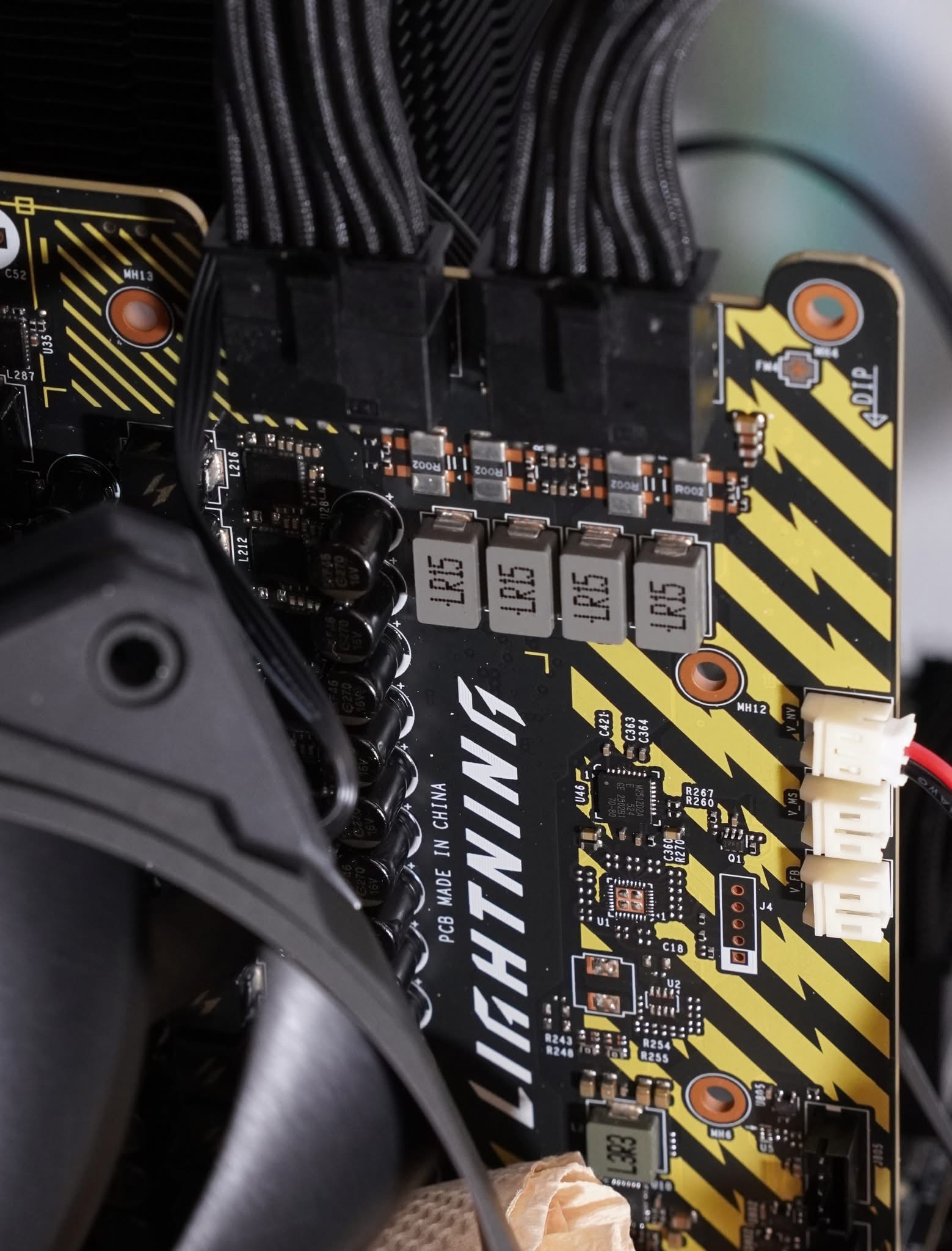
The GPU comes with a 40-phase VRAM power design.
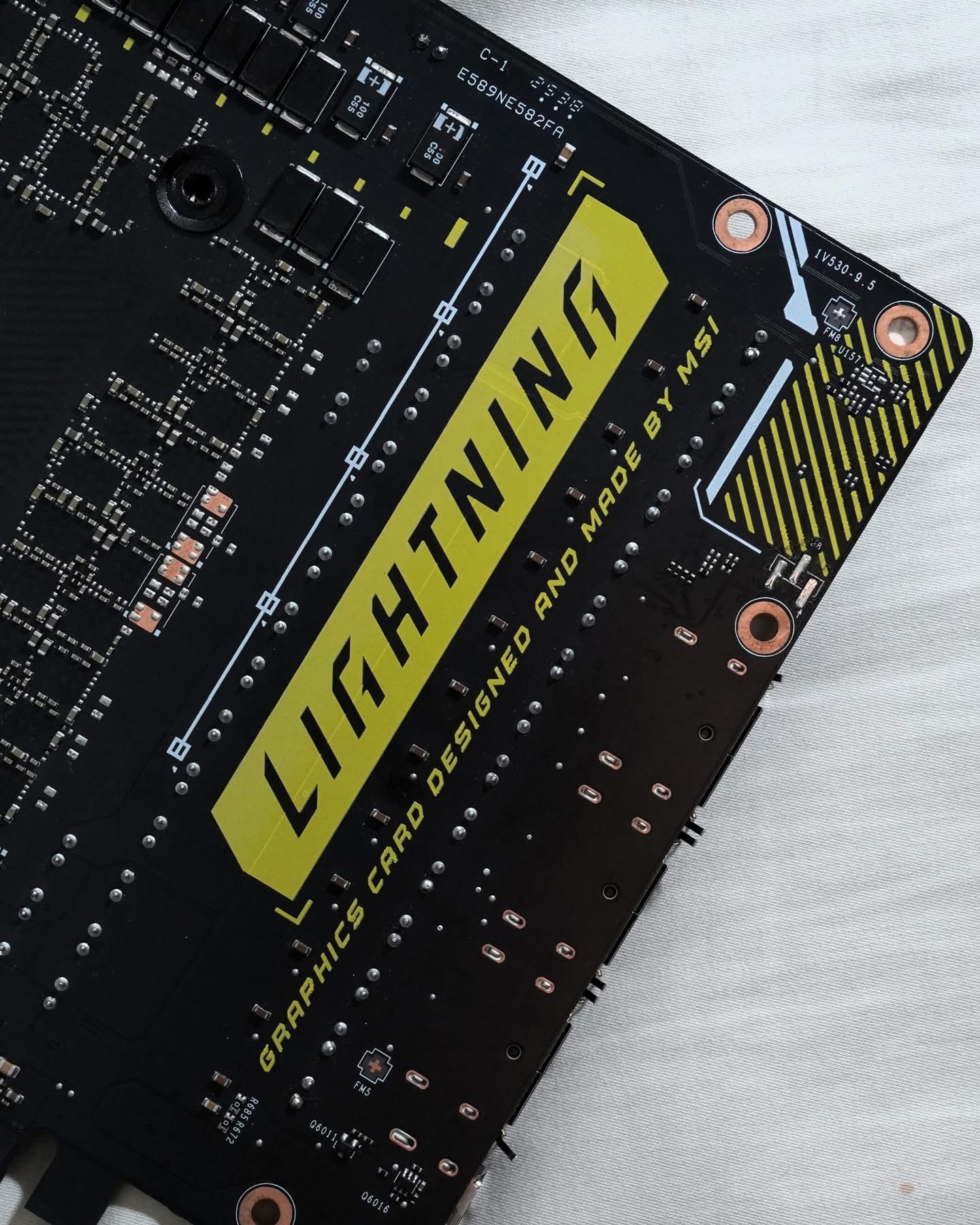
Close-up of the 5090 Lightning Z GPU's PCB.
MSI’s RTX 5090 Lightning Z boasts dual 12V-2×6 connectors and an extreme 40-phase VRAM power design. The images of the GPU’s PCB were uploaded by HWBOT users nv1diafan and oc_windforce, who achieved record-shattering 59,438 and 58,786 points, respectively.
MSI’s RTX 5090 Lightning variant was specifically used for these benchmarks because the latter user also commented, ‘Comeback! MSI GeForce RTX 5090 Lightning’ in their results.
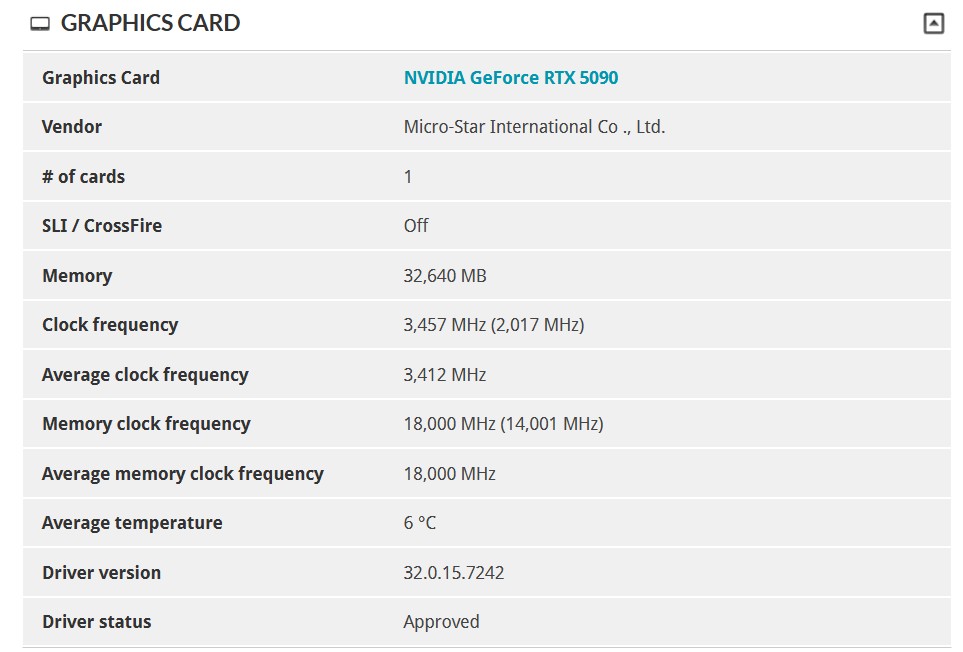
The 3DMark scores were achieved using an Intel Core i9-14900KF system and an ASUS ROG Maximum Z790 Apex. The GPU reached a 3,457 MHz GPU clock, 32,640 MB VRAM, and an 18k MHz memory clock. In other words, the memory was overclocked up to 36 Gbps.
MSI RTX 5090 Lightning Benchmarks.
1 of 2
The GPU achieved a record-breaking 53,207 score on 3DMark.
The GPU was overclocked to 36 Gbps.
Additionally, MSI is also preparing to reveal its Lightning Z GPU. A recent teaser showed a weather forecast, with a thunderstorm expected on January 5, the first day of CES 2026.
MSI likely plans to announce the RTX 5090 Lightning Z GPU on January 5.
It’s worth noting that these benchmark scores are only possible using exotic cooling solutions like liquid nitrogen, which was presumably used during the aforementioned testing since the recorded temperature was only 6°C.
Regardless, MSI is still expected to dominate the high-end GPU market with its upcoming Lightning Z 5090 model.
Do you think the RTX 5090 Lightning Z GPU will shatter the expectations of the community, or are these benchmark scores not indicative of everyday experience? Let us know your thoughts in the comments below, or join the discussion on the Tech4Gamers forum.
Lead the comparison and blog writing teams at Tech4Gamers.
Oversee teams with a keen eye for detail and precision.
Ensure hands-on writing, with benchmarks and testing as guiding principles.
Guarantee the delivery of the best possible results in concise yet impactful tech tales.
Story Highlight
Community modders often fix PC-specific issues faster than official patches
Studios quietly adopt mod solutions without formal credit or compensation
Players now look to community patches as a first response to broken PC launches
The growing reliance on unpaid labor raises ethical and long-term concerns
PC players have learned a quiet habit over the years. When a new release stutters, crashes, or runs like it skipped optimization day, they do not wait for the next official patch. They open a mod page, scroll past the comments, and download a fix made by someone who had the same problem and refused to live with it.
That reality has become so normal that it barely raises eyebrows anymore. Community modders are still fixing PC games before the studios that shipped them, and in many cases, they are doing it better.
The Pattern Players Know Too Well
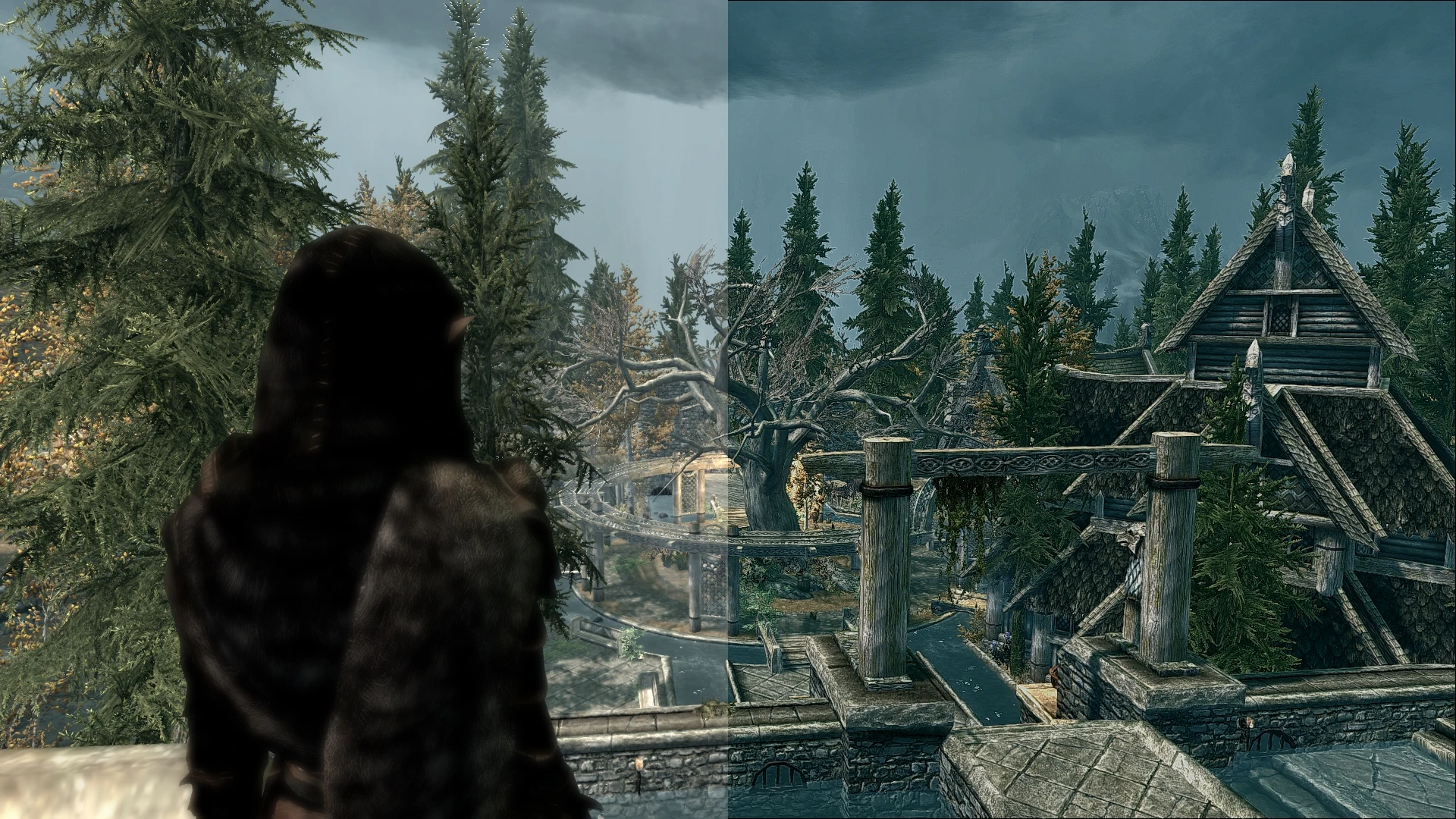
Skyrim ENB Before and After – Image Credits (NexusMods)
The pattern is familiar. A major PC release lands with uneven performance, shader stutter, broken ultrawide support, or memory issues. The studio acknowledges the problem, promises a patch, and goes quiet for a few weeks. Meanwhile, a modder uploads a community patch that cleans up frame pacing, removes unnecessary checks, or tweaks engine behavior in ways that immediately improve the experience.
This has happened across genres and budgets. From open-world RPGs to big-name action games, PC-focused fixes often appear first on community hubs. Some studios eventually roll out similar changes, sometimes months later, sometimes quietly folded into a larger update without direct acknowledgment.
What makes this moment different is scale. Community patches are no longer niche tweaks for edge cases. They are becoming essential downloads for thousands of players, often recommended before official updates even arrive. This cycle played out clearly during The Last of Us Part I PC launch, where fans were fixing performance issues long before official patches arrived.
Why Modders Move Faster Than Studios
Whiterun Before and After – Image Credits (NexusMods)
Speed is not magic here. It is structured. We have seen this with community-made Witcher 3 ray tracing fixes, which delivered smoother performance without waiting for a major studio overhaul.
Most studios ship games across multiple platforms at once. Any fix has to pass certification, maintain console parity, and avoid breaking builds that are already locked for release windows. That process is slow by design.
Modders live in a different world. They are PC-first, sometimes PC-only. They do not worry about console memory budgets or cross-platform consistency. If a fix improves performance on a specific CPU architecture or graphics driver, that is good enough. There is no approval chain, no publisher sign-off, and no marketing beat to hit.
Motivation matters too. Modders fix problems because they want the game to work on their own machines. There is no quarterly deadline or roadmap pressure. When something is broken, they dig until it is not.
Studios Are Quietly Following Their Lead
Nexus Mods Homepage – Image Credits (NexusMods)
One of the more uncomfortable trends is how often official patches resemble earlier community fixes. Players notice when the same configuration flags, memory tweaks, or engine changes show up later in official updates. Sometimes studios credit the community. Often, they do not.
From a business perspective, it makes sense. If a fix works, adopt it. From an ethical perspective, it gets murky. These fixes represent hours of unpaid labor, reverse engineering, and testing. They improve commercial products that continue to generate revenue.
The lack of formal recognition or compensation has started to frustrate parts of the modding community. What was once a passion-driven hobby now feels, to some, like unpaid support work filling gaps left by billion-dollar studios. Most of these fixes appear first on Nexus Mods, where PC players have learned to look before waiting on official updates.
Why Players Trust Modders More Right Now
Human presets Gale & Wyll – Image Credits (NexusMods)
Trust is earned through results. Players care less about who ships the fix and more about whether the game runs smoothly tonight.
Community patches often arrive faster, target specific PC pain points, and include detailed explanations of the changes they make. Modders tend to document their work clearly, respond to feedback, and iterate quickly when something breaks.
Official patches, by contrast, are often bundled with unrelated changes, vague notes, and longer wait times. When a mod consistently delivers better performance with fewer side effects, players notice and adjust their expectations.
This shift has real consequences. Mods are extending game lifespans, stabilizing releases long after official support has ended, and in some cases, becoming the definitive way to play on PC. Few games prove this better than Skyrim’s modding ecosystem, which continues to evolve more than a decade after release.
The Risks Studios Cannot Ignore
Cicero – Before and After – Image Credits (NexusMods)
This does not mean mods are a perfect solution. Community fixes are unofficial by nature. They can introduce security risks, compatibility issues, or instability, especially when combined with other mods.
Studios also cannot rely on modders to fix systemic problems. Console certification, accessibility standards, and long-term support obligations still sit squarely on the developer’s shoulders. A mod that improves performance for one subset of players might break another configuration entirely.
There is also a legal gray area. Mods often rely on reverse engineering or undocumented engine behavior. Studios adopting those fixes wholesale can expose themselves to risks they would rather avoid.
Why Official Mod Support Needs to Be the Baseline
GDC Vault Homepage – Image Credits (GDCVault)
The lesson here is not that modders should replace developers. It is that studios should meet them halfway. Many of these lessons are already discussed openly in developer talks at GDC, where studios acknowledge how community experimentation feeds back into engine development.
Official mod support, clear documentation, and open tooling make community fixes safer, faster, and more sustainable. When developers embrace modding early, they gain a feedback loop that improves engines, exposes bottlenecks, and surfaces PC-specific issues before launch.
Studios that treat modders as partners rather than free labor tend to see longer-lasting communities and healthier PC ecosystems. The technology already exists. The cultural shift is lagging.
Where This Leaves PC Gaming
This trend is not going away. As PC hardware becomes more diverse and engines more complex, community expertise will only grow in value. The question is whether studios acknowledge that reality or continue to benefit from it quietly.
For players, the takeaway is simple. The modding community remains one of the strongest forces in PC gaming, not just for creativity, but for basic functionality. For studios, the message is harder to ignore each year. If your most reliable PC fixes come from outside your payroll, something in the process needs to change.
The future of PC gaming will still be shaped by passionate individuals tearing engines apart at night. The difference will be whether the industry finally decides to recognize them.
At T4G, my task is to cover the latest news around the gaming globe ASAP and with the utmost precision. I adore all the games and respect all the devs behind the amazing games that we get all year. So, whether it’s a PC or a Console game, I got it all covered.
Story Highlight
Hollow Knight Silksong won two awards at the Steam Awards, including the GOTY.
It is the first awards event that isn’t completely swept by Clair Obscur: Expedition 33.
Steam Awards marked yet another dominant display for indie titles in 2025.
We observed a notable trend in gaming awards in 2025; Clair Obscur: Expedition 33 ended up sweeping almost everything clean. However, in the Steam Awards 2025, it has been beaten by another title that dominated last year.
Hollow Knight Silksong has won the Game of the Year award at the Steam Awards, beating Expedition 33, Arc Raiders, Dispatch, and Kingdom Come Deliverance 2. It also bagged the award for ‘Best Game You Suck At’.
Why it matters: Steam Awards have yet again been another demonstration of how indie titles are on a roll and completely dominating the industry by introducing innovation and leaving most AAA titles far behind.
Silksong bagged the GOTY award at the Steam Awards over Expedition 33 and others
Hollow Knight won 2 awards, while Expedition 33 managed to get a single accolade for the best soundtrack. Other winners include Silent Hill f for outstanding visuals, Arc Raiders for most innovative gameplay, and Dispatch for the best story.
Hades 2 also received the award for the best game on Steam. Notably, this is another indie clean sweep, with hardly any big-budget games marking a win. That shows how much the industry has changed over the years.
That isn’t to say that AAA games have become downright bad. There have been decent releases like Death Stranding 2, Ghost of Yotei, and KCD2, but they all were outshone by the indie goodness in 2025.
What are your thoughts on Hollow Knight Silksong bagging the GOTY award in the Steam Awards 2025? Let us know your opinions in the comments or join the discussion at the official Tech4Gamers Forum.
I’ve been the Journalist & Editorial Writer at Tech4Gamers since July 2022. I spearhead our hardware coverage, including overclocking GPUs, benchmarking CPUs, reviewing peripherals, and fine-tuning custom PC builds for every budget. Daily, I report on breaking gaming news, from major launches and studio updates to the latest industry trends, ensuring our community stays informed. Beyond news briefs, I write in-depth feature articles on gaming culture and emerging technologies. And by collaborating closely with the editorial team on content planning, SEO strategy, and our publishing calendar, I help us consistently hit our traffic and engagement targets.
The Womier WD75 leans hard into something you don’t see very often at this price, which is real wood. That’s the whole hook here, and it’s the reason this keyboard stands out in a market of plastic and aluminum boards. Womier has built a bit of a reputation around bold designs and heavy RGB. Getting started with the WD75, I expected something interesting and a little different. I can say that this keyboard occupies an unusual yet appealing position after spending time with it on my desk.
Why Trust Tech4Gamers
Abdul Hannan is our peripherals expert who has been testing different mice, keyboards, headphones, microphones, and more for years.
130+ peripherals tested and reviewed by our team of hardware experts (Tech4Gamers Team).
500+ hours spent testing different peripherals for our reviews.
At Tech4Gamers, ensuring you get reliable information is our priority. That’s why every hardware round-up undergoes a meticulous review process by our team of experts and editors. Each review is carefully examined against our strict editorial guidelines, guaranteeing you trustworthy insights you can depend on.
Key Takeaways
The Womier WD75 is a compact 75% keyboard that delivers smooth, consistent keystrokes and versatile tri-mode connectivity, while keeping a clean, understated look on your desk.
You should buy the Womier WD75 if you want something that looks different on your desk, want customization through VIA support, don’t want to think about charging often, and care about the thocky sound profile out of the box.
You should skip the Womier WD75 if you prefer lighter keyboards, travel often, rely on adjustable typing angles, prefer softer or heavily cushioned keycaps, and dislike extravagant RGB lighting.
The Womier WD75 sets itself apart from just about any other keyboard in its price range by leaning into its real walnut wood case rather than the usual plastic or aluminum cases you see everywhere, giving it a distinctive aesthetic that most competitors don’t offer. Unlike its predecessor, the V2 version refined the internal layout, rounded the edges more smoothly, and deepened the walnut tone, making it feel slightly more premium in the hand and on the desk.
Packaging & Unboxing
Packaging & Unboxing
1 of 3
Frontside of the Box
Topside of the Box
Backside of the Box
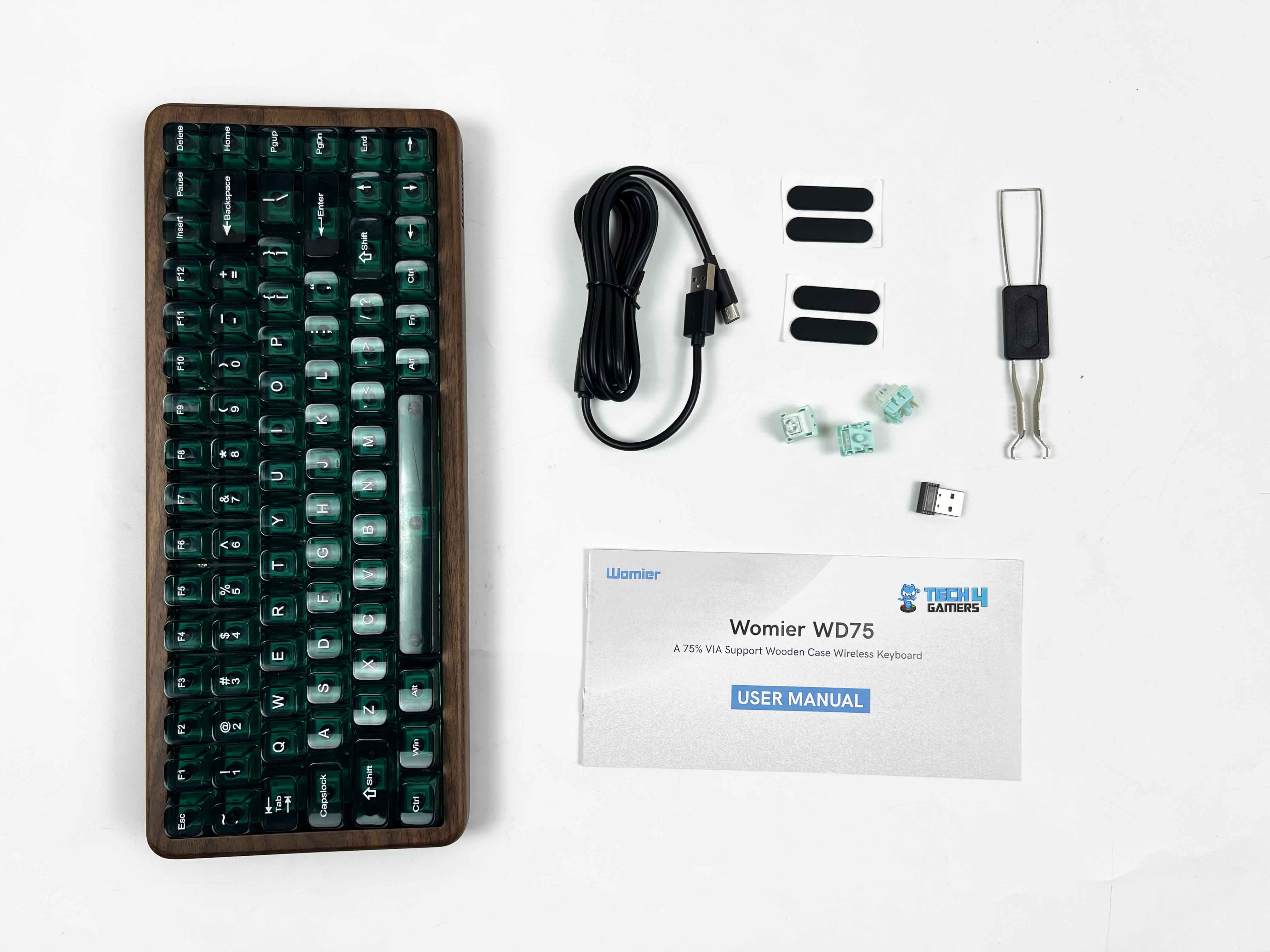
You get a plain cardboard box with Womier’s branding on it and the keyboard’s model name on the front. The box itself feels sturdy enough in hand. Inside, the keyboard is wrapped in a plastic sleeve and secured with foam on both sides. Another cardboard box is placed at the top of the keyboard and contains all the accessories. Here is the list of everything that you’ll find inside the box:
Unboxing
1 of 2
Unboxing
Box Contents
Womier WD75 Keyboard
USB-A to USB Type-C Cable
2-in-1 Keycap & Switch Puller
3 Extra Stock Switches
User Manual
Design
Design
The design of the Womier WD75 is its USP. You notice the wooden case right away. It doesn’t look like a printed texture or a thin veneer. It’s real wood, and you can tell as soon as you touch it. The finish is smooth. When I first took it out of the box, there was a faint, delightful smell from the finish. It feels like a piece of furniture that happened to be a keyboard. Visually, the WD75 sits closer to the enthusiast side than anything gamer-focused.
The wood gives it a distinct appearance, and Womier doesn’t pile on extra design elements. The case lines are clean, and the edges are properly finished. There’s no awkward tapering, and the keyboard looks balanced even when viewed from a specific angle. Even with the keyboard turned off, the design still looks great. You don’t get that empty, lifeless look some RGB-heavy boards have when their lighting is off.
Layout
Layout
The Womier WD75 uses a fairly standard compact ANSI 75% layout with 82 keys. It keeps the function row and arrow keys without taking up as much desk space as a full-size board, and it’s tighter than a typical TKL. That means there’s less room between the arrow cluster and the main keys, which took me a little time getting used to. I kept pressing the wrong key a few times at first, since I mostly use full-size keyboards.
The arrow keys themselves get comfortable enough once you adjust. They’re close to the main keys, but not uncomfortably so. If you’re moving from a full-size keyboard, there’s a short learning curve. Even the right-side navigation cluster, such as Page Up, Page Down, Home, and End keys, feels different from what you’d expect, but it’s usable once your muscle memory catches up. The function row is easy to reach, though a few keys require the FN layer for extra actions.
Underside
Underside
Flipping the WD75 over, the underside feels simple but solid. There’s nothing extravagant here. The keyboard sits flat on my desk, and the foot pads grip well enough that it doesn’t slide around during regular usage. There are four foot pads in each corner. One thing to note is that foot pads can come loose after some usage. Therefore, the Womier was generous enough to include extra foot pads in the box if that happens, so it’s an easy fix.
The typing angle is fixed since there are no kickstands. It sits at a relatively shallow angle by default, but I found it comfortable for long typing sessions without feeling steep. There’s no branding or labelling at all on the bottom. It’s just a clean, uninterrupted wooden surface. Cleaning is easy, too. The flat underside means dust doesn’t get trapped in awkward corners, and the wood surface wipes down easily.
Build Quality
Build Quality
You feel the weight as soon as you pick up the Womier WD75. At just under a kilo, it has that reassuring density and settled feel that keeps it planted on the desk. It doesn’t shift when you start typing with a bit more force. It holds its shape even when pressed down. Notably, firm pressure around the center doesn’t cause any visible dip. There’s no soft spot where the chassis gives in or rebounds. It feels stable across the surface.
The weight feels evenly spread rather than concentrated in one area. Looking ahead, nothing about the build quality raises red flags. The materials appear to be durable for rigorous daily use. As long as it’s treated like a regular desk keyboard and not tossed into a bag every day, the build appears to be capable of lasting a long time. If you’re used to low-profile boards, this one sits higher and feels more substantial at 324 x 132 x 48mm.
Keycaps
Keycaps
My Womier WD75 came with the green translucent keycaps. The surface feels smooth under your fingers, almost glassy. There’s a lightness to them that you notice when you first rest your hands on the keyboard. Thickness is on the moderate side. The sculpting is subtle, so your fingers don’t have to adjust much as they move between rows. Legends are white and printed directly onto the keycaps. They look sharp at normal viewing distance, and their alignment is mostly on point.
The white contrast works well against the translucent green caps. Notably, Womier offers other keycap options. There’s a Retro set at the same price that has black keycaps on top, changing the whole mood of the board. It looks more work-focused, though I personally find it a bit lifeless compared to the green set. In addition, the Ukiyoe set is the one that fits the keyboard the best. The artwork and tones sit well with the wooden theme, and it feels like a more intentional pairing.
RGB Lighting
RGB Lighting
1 of 2
RGB Lighting
RGB Lighting in Dark
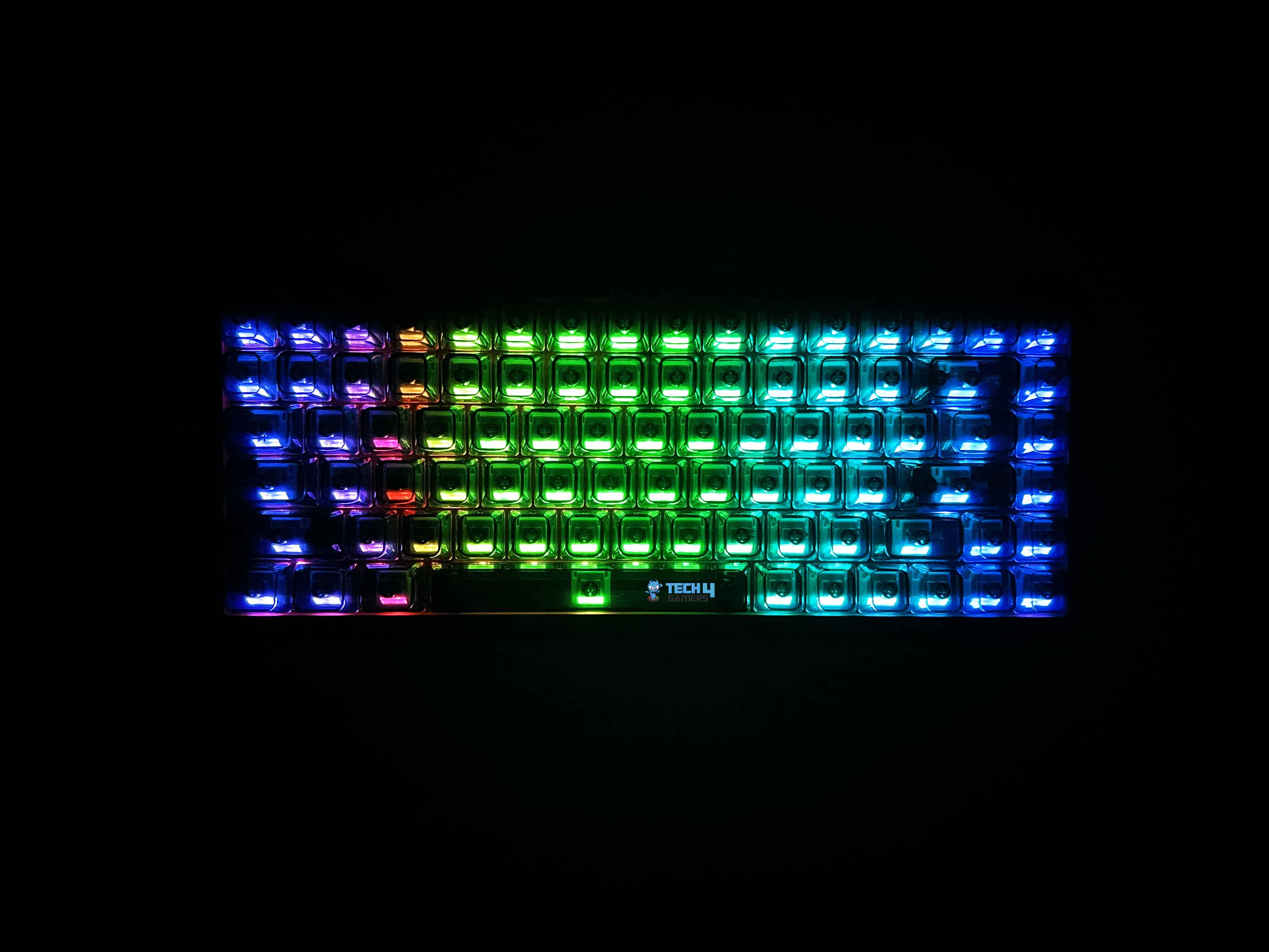
The Womier WD75 uses south-facing LEDs, which heavily influence how the lighting looks more than you might expect. Instead of the light coming straight up toward the top edge of the keycaps, the LEDs sit closer to the front of each switch. The keycaps light up more evenly, especially on the bottom half of each key. Even when the keyboard is powered off, you can still see hints of it through the translucent keycaps.
The RGB lighting works well with the MDA profile keycaps. At full brightness, the RGB gets plenty strong, and it does somewhat strain your eyes when you look down. The light seems a bit blown out. Because it doesn’t get blocked by the keycaps as much. In a dark room, the keyboard becomes visually apparent. It glows, overpowering the desk. On the other hand, in a brighter room, the RGB tones down a bit naturally but remains visible, just less dramatic.
Switches
Switches
1 of 2
Switches
Switch Housing
The Womier WD75 comes fitted with Womier’s Mint Blizzard linear switches, and after spending time on them, I get what they were aiming for. These are factory-lubed. The keypress is smooth from top to bottom. There is no sudden resistance near the end of the keystroke. They’re light as well. Actuation sits around the low-40s in force, and bottoming out is around 50. During longer typing sessions, this adds up in a good way. My hands felt relaxed even after a few hours of writing.
The spring is a long, single-stage design, which gives each keypress a steady push back up. Pre-travel is 2.0±0.2mm, and the full travel stops just short of 4 mm. All the main switch parts are POM, such as the stem, top housing, and bottom housing. These switches also include an LED diffuser that helps evenly distribute the RGB light. Light spreads cleanly across each key. It’s a small detail, but noticeable once you start cycling through lighting modes.
Connectivity
Connectivity
1 of 2
Connectivity
USB Cable
You can use Womier WD75 via wired, 2.4GHz wireless, or Bluetooth. I used all three connection modes, mostly to see if any of them felt like a weak link, and none did. Wired mode is as straightforward as it gets. Plug the USB-C cable in, and you’re good to go. The cable itself is pretty basic with no braiding. It does the job, but it’s not something you’d want to keep on a clean desk setup. If you’re picky about cables, you’ll probably swap it out.
The keyboard has a physical switch for changing modes. Slide it over to 2.4GHz, and pairing is done directly from the keyboard by holding the FN+4 combo for 3 seconds. Bluetooth works in a similar way. You can connect it to up to 3 devices by holding FN+1, 2, or 3 for 3 seconds. When you start the pairing process, the indicator light starts blinking, indicating it’s ready to connect. There’s also a switch for flipping between Windows and macOS, and it is compatible with Linux, iOS, and Android as well.
Typing Experience
A lot of the Womier WD75’s typing experience comes down to how it’s built on the inside. Womier uses multiple layers of foam inside the case. The plate is made from polycarbonate, and there are no flex cuts. The mounting style is a tray mount. Paired with the PC plate, the result is a solid, consistent feel. The PCB is FR4 with a thickness of 1.2mm. It supports both 3-pin and 5-pin switches and is hot-swappable. Starting from the wooden shell, there’s insulation film and case foam to reduce hollow noise.
Above that sits an acoustic pad, followed by an IXPE layer under the switches. Then there’s plate foam between the plate and PCB. Together, they smooth out sharp edges in the sound. What you end up with is a sound profile that leans toward the soft, rounded thocky. There’s no sharp echo bouncing back at you, even when typing fast. Moreover, stabilizers come pre-lubed. Larger keys feel steady, and there is no rattling during everyday use.
Performance
Edges
In day-to-day use, the Womier WD75 performs exactly how you’d want a keyboard to perform. Fast key presses register the same way every time, whether I’m typing quickly or tapping keys in short bursts. Fortunately, there were no input issues during use, and you can easily press multiple keys at once. Thanks to the full n-key rollover support. I didn’t run into ghosting issues, even when I deliberately tried to. In FPS games, responsiveness feels excellent.
Movement inputs come through instantly, without any delay. During overtime rounds in Valorant, my hands stayed comfortable, which matters more than speed after several hours. Wireless performance held up well, too. I didn’t notice any delay between pressing a key and seeing it on screen. Bluetooth is a bit slower in terms of responsiveness, but for writing, browsing, and general use, it stayed reliable. I never had to reconnect mid-session.
Battery Life
The Womier WD75 comes with an 8000mAh battery, which is pretty massive for a 75% keyboard. In actual usage, I didn’t have to think about charging it very often. Even with RGB on, it easily lasted through several days of typing and general use. When the backlight was off, the drain slowed further, making it easy to go a week or more without plugging it in. Charging itself is straightforward through the included USB-C cable. You can keep using the keyboard while it’s plugged in.
Software
On the software side, the WD75 V2 relies on VIA. There’s no separate app to install, and no background software running all the time. You open the VIA web interface, connect the board, and you’re set for customization. It feels better to adjust the keyboard with it rather than manage it through a flashy control panel. Key remapping is immediate. You click a key, assign a new function, and it’s done.
Layers work the same way. I used them primarily for media controls and a few shortcuts. Macros are there too, and they behave exactly how you’d expect once you’ve set them up along with RGB control. Nothing felt buried behind menus, and I didn’t find myself going to figure out where a specific setting is. Once your layout is set, you don’t really need to open VIA again. Lastly, you can set up to 5 layouts for different scenarios.
Should You Buy it?
Buy it if
✅ You want something that looks different on your desk: The real walnut wood case gives the WD75 a more furniture-like presence than the usual metal or plastic keyboards.
✅ You care about sound and feel out of the box: The layered foam setup, PC plate, and factory-lubed switches create a controlled, muted typing sound without needing immediate mods.
Don’t Buy it if
❌ You prefer lighter keyboards or travel often: The wooden case adds weight, and at nearly a kilo, it’s heavier than many 75% wireless boards
❌ You rely on adjustable typing angles: There are no kickstands, so you’re locked into the default angle. If you like fine-tuning keyboard height, this may bother you.
Final Verdict
After spending enough time with the Womier WD75, it’s clear what kind of keyboard Womier was aiming for. This isn’t a keyboard that tries to impress you in the first five minutes. It grows on you the more you actually use it. At $99.99, if you’re after a solid-value keyboard that feels solid and sounds controlled, the WD75 makes a strong case for itself through day-to-day use rather than spec-sheet flexing.
You’re getting solid materials, excellent out-of-the-box performance, and a feature set that’s usually bundled at a higher price. If you’re curious how it compares to keyboards with more gaming‑centric layouts or magnetic features, our best gaming keyboards and best magnetic gaming keyboards lists are great places to explore other options.
At T4G, my task is to cover the latest news around the gaming globe ASAP and with the utmost precision. I adore all the games and respect all the devs behind the amazing games that we get all year. So, whether it’s a PC or a Console game, I got it all covered.
Story Highlight
Resident Evil Requiem is seven weeks away, launching in February 2026.
The title has already achieved a massive milestone, reaching 4 million wishlists on Steam.
It has now become one of the most-wishlisted games on Steam of all time.
Resident Evil Requiem is all set to release in just a couple of months, and is one of the year’s most anticipated releases. The return of Leon was so massive that the title has already achieved a record that is poised for massive success.
Less than 2 months till its launch, Resident Evil Requiem has become one of Steam’s most wishlisted games, with 4 million wishlists. This shows how massive Capcom’s horror franchise is and the impact it has on the genre.
Why it matters: This number puts Requiem among the highest ever wishlisted games on Steam, and means that the success is already guaranteed, which could mark another great year for Capcom.
Requiem is now one of the most wishlisted games on Steam ever
Requiem has marked 4 million wishlists, which is a major milestone that highlights the franchise’s legendary status. The hype for the title was already through the roof, but it got multiplied with the introduction of Leon.
The title is gearing up to be great with the first time two characters offering totally opposite dynamics. The developers stated that playing with Leon and Grace would be very different experiences, as the latter is their most scaredy protagonist.
The game is set to release in just a couple of months
Nonetheless, if there were any doubts that Resident Evil Requiem wouldn’t be a commercial success, those have been cleared now. 2026 will be a huge year for gaming and will be kick-started by Capcom’s blockbuster title.
What are your thoughts on Resident Evil Requiem reaching a whopping 4 million wishlists? Let us know your opinions in the comments or join the discussion at the official Tech4Gamers Forum.
As Tech4Gamers’ Founder and Editor-in-Chief, I bring over 13 years of PC Hardware Reviewing and 8+ years of IT Project Management experience. Certified in Google IT Support , my focus is on providing honest product reviews and analysis and fostering a strong gaming community with 130k+ members in PPG.
Story Highlight
GIGABYTE is releasing four AMD AM4 motherboards in 2026 to support budget-friendly builds with DDR4 memory.
The move follows a market trend in which manufacturers like ASUS and ASRock are extending the life of older sockets to offer cheaper hardware options.
The new lineup consists of two compact Mini-ITX boards and two Micro-ATX versions.
Following industry trends, GIGABYTE has just announced the release of four new motherboards in 2026 that use the AMD AM4 socket and enable DDR4 RAM. Just a few days ago, we discovered that ASUS would increase production of these motherboards, in addition to the Intel LGA1700 series.
Thanks to a new line of mid-range and entry-level motherboards, as well as more cost-effective DDR4 memory, the entire industry will be able to build more cheap computers with AMD Ryzen 5000 and 12th, 13th, and 14th Gen Intel Core processors.
In this way, GIGABYTE validates a trend. ASRock was ahead of the curve with a hybrid motherboard that supported DDR4 or DDR5 RAM and the Intel LGA1700 socket. ASUS announced that it would increase production, and GIGABYTE is introducing totally new models.
As a result, it’s understandable that other manufacturers, such as MSI, BIOSTAR, and Chinese businesses, will follow suit.
We’ve got two Mini-ITX and two Micro-ATX motherboards. The Mini-ITX board is a GIGABYTE A520I AC (ver. 1.5) with the AMD A520 chipset. It runs the CPU on a 6-phase VRM and has two memory slots that can accommodate up to 64GB of DDR4 RAM at 5300 MT/s. It also has a PCI-Express 3.0 x16 slot, an M.2 connector for PCIe 3.0 SSDs, Wi-Fi 5 + Bluetooth 4.2 connectivity, an Ethernet port, and a video output compatible with an APU.
On the other end of the spectrum is the GIGABYTE B550I AORUS Pro AX (ver. 1.4), which boasts an 8-phase VRM, a PCI-Express 4.0 x16 interface, and twin M.2 slots for PCIe 4.0 + 3.0 SSDs. It also has Wi-Fi 6E, Bluetooth 5.3, and a 2.5 Gbps
For Micro-ATX models, we begin with the GIGABYTE B550M H ARGB, which is based on the AMD B550 chipset. This motherboard supports up to 64 GB of DDR4 RAM at rates of up to 5,100 MT/s and includes a PCI-Express 4.0 x16 interface for the GPU and a PCIe 4.0 x4 interface for the SSD.
We conclude with the “top-of-the-line” model of this new generation of modern computers, which uses older hardware. The GIGABYTE B550I AORUS Pro AX (ver. 1.4) features an 8-phase power VRM with a 90A SPS.
It supports PCIe 4.0 x16 and NVMe PCIe 4.0 x4 interfaces, as well as a second PCIe 3.0 slot. It can handle up to 64GB of RAM at 5400 MT/s and has wireless connectivity and a 2.5Gbps Ethernet interface.
These two motherboards are brand-new. Since the other two are new versions, we are aware that they have updated or made specific changes (such as utilizing a new Wi-Fi module) before reintroducing them into production. These GIGABYTE motherboards that enable DDR4 memory will be widely used, particularly in low-cost gaming setups.
Currently serving as a News Reporter at Tech4Gamers, I have the privilege of combining my love for gaming with the art of storytelling. My role involves crafting engaging narratives that keep our audience abreast of the latest developments in the gaming world.
Story Highlight
Bernoit Richer, who previously worked as a director for Batman: Arkham Origins, is now leading the charge on Assassin’s Creed Hexe.
Richer has worked with Ubisoft before, serving as director on Assassin’s Creed Valhalla and in other roles dating back to 2000.
Assassin’s Creed Hexe is the next mainline release in the series and will be released later this year.
Ubisoft unveiled its slate for the upcoming Assassin’s Creed games at the franchise’s 15th anniversary. Beyond Baghdad and Japan, they’re next bringing fans to the Holy Roman Empire during the Witch trials.
So far, details on Assassin’s Creed Codenamed Hexe have been scarce aside from a synopsis and a short reveal. However, the latest report reveals that the game is being directed by Benoit Richer, who previously led development on Batman: Arkham Origins.
Why it matters: Batman: Arkham Origins is to date one of the best single-player experiences, and knowing that the same director is leading Ubisoft’s upcoming project hints at great things to come.
Initially reported by Clawsomegamer, Benoit Richer’s LinkedIn profile reveals that he’ll be leading the charge on Assassin’s Creed Hexe. Richer was also the director for 2020’s Assassin’s Creed Valhalla, so this here isn’t a new venture for him.
Beyond that, he held other development roles at Ubisoft dating back to the early 2000s, contributing as a Lead Level Designer to Rainbow Six and Far Cry games.
With such an experienced developer at the helm, Assassin’s Creed Hexe is looking to become one of the stronger recent entries. Moreover, the title is also described as “a very different type of Assassin’s Creed game” by executive producer Marc-Alexis Côté.
The Game’s Setting Is Currently Rumored To Be Germany
The game will also feature a female-only lead for the first time in years, and other reports have suggested that the game will feature supernatural powers and be a linear experience, a fresh breath of air for a series that was finally becoming stale.
With Codename Hexe looking to be a lore-heavy title, there’s no better director suited for the task than Richer. His experience and work on Batman: Arkham Origins is a testament to his work.
As for the release date, expect a late 2026 release to make way for the Assassin’s Creed Black Flag remake, which is expected in the next few months.
At Tech4Gamers, I contribute as a Senior News Reporter, combining my skills and gaming enthusiasm to keep our audience updated on the latest developments.
Story Highlight
Satya Nadella’s first blog post of 2026 refers to the commonly used term ‘AI slop.’
He asserts that it’s time to move beyond using this term and focus on what humans can achieve when equipped with these tools.
The Microsoft CEO also discussed resource management and real-world impacts in an AI-powered era.
AI has been at the center of the gaming industry over the last month or so, and for all the wrong reasons. The subject matter has been so controversial that a game like Clair Obscur: Expedition 33 was stripped of one Game of the Year title over doubts of AI use during the development process.
Of course, this backlash hasn’t stopped tech giants from investing in AI. The likes of Microsoft have gone all in on artificial intelligence, and the Microsoft CEO has even asked audiences to move beyond thinking of the technology as just slop.
Why it matters: The term ‘AI slop‘ has been commonly used when discussing images and videos created by the technology due to its lack of artistic integrity.
The CEO of Microsoft Is A Strong Believer In AI
Microsoft CEO Satya Nadella recently posted his thoughts on advances in technology and their impact on the real world. As expected, the blog was largely focused on AI and its current progress.
Satya Nadella pointed out that AI underwent major leaps in 2025, but 2026 will be another pivotal year for the technology. He then noted that it’s time to move away from simply referring to artificial intelligence as slop and focus on how humans will evolve with access to these tools.
We need to get beyond the argument of slop vs sophistication and develop a new equilibrium in terms of our “theory of the mind.”
-Satya Nadella
Later, the Microsoft CEO asserted that companies must now focus on using the technology as a solution to the challenges of everyday life. In particular, he discussed resource management as a major problem that needs attention.
This point is so interesting because AI is currently taking up a lot of computing resources, leading to memory shortages industry-wide.
Microsoft Calls All Windows PCs ‘AI PCs’
Satya Nadella’s latest blog comes following Microsoft’s huge push for AI technology.
The gaming giant has invested nearly $80 billion in an attempt to remain at the forefront of the artificial intelligence race. This is why it has now begun referring to Windows PC as AI PCs.
At Tech4Gamers, I contribute as a Senior News Reporter, combining my skills and gaming enthusiasm to keep our audience updated on the latest developments.
Story Highlight
A GTA 4 remaster has been rumored for a while, but an ex-Rockstar developer suggests this type of remaster is easier said than done.
He argues that the game’s art and cutscenes appear outdated, and a remaster would be expensive in today’s market.
The developer believes Rockstar should still re-release the game, but it must be done right.
GTA 4 is the next big Rockstar title rumored to receive the remaster treatment following Red Dead Redemption. The former is currently not playable on the PS4 or PS5, and the PC port isn’t too impressive either, making it perfect for a re-release.
However, a full remaster for GTA 4 might be easier said than done. According to a developer who previously worked on the game, this endeavor could cost Rockstar as much as the original game.
Why it matters: GTA 4’s atmosphere and overall themes remain some of the series’ strongest to date. This is exactly why many fans yearn to return to Liberty City all these years later.
Former Rockstar Developer Shares Thoughts On Potential Remaster | Image via Twitter
Obbe Vermeij recently took to Twitter and shared his thoughts on a potential GTA 4 remaster. Discussing how the game has aged, the developer stated that the artwork and cutscenes would require a lot of work to update.
Obbe Vermeij, who previously worked on GTA 4 as a designer, then noted that Rockstar should still release a remaster, but only if it can do the game justice. He believes such a task would require a hefty investment, possibly matching the game’s original budget.
As a reminder, GTA 4 cost somewhere around $100 million to produce for Rockstar in 2008. Much of this cost went into the studio’s proprietary engine technology, resulting in one of the most technically advanced open-world titles at the time.
It might cost close to the original dev budget to make it competitive in today’s market. R* can opt not to do it. But if they do, they should do it right.
-Obbe Vermeij
Because the title was developed for the PS3 and Xbox 360, a modern port would also require more work than the average PS4 remaster. Still, because games like Red Dead Redemption and L.A. Noire have been released on modern consoles already, similar treatment for GTA 4 does not sound impossible.
GTA 4 Remaster May Arrive Soon
A remaster has been rumored on multiple occasions in the past. Although nothing substantial has come of these rumors yet, Rockstar is no stranger to surprise announcements.
As such, hopes remain high for an eventual announcement.
Currently serving as a News Reporter at Tech4Gamers, I have the privilege of combining my love for gaming with the art of storytelling. My role involves crafting engaging narratives that keep our audience abreast of the latest developments in the gaming world.
Story Highlight
Mudang: Two Hearts was announced last year, an action-stealth game based on the Splinter Cell formula.
While the gameplay reveal suggested it was deep into development, the project may have been canceled.
The studio went through a massive layoff last year, wiping nearly 80% of its workforce, and now the website has also been deleted.
Mudang: Two Hearts was announced last year as a third-person action-stealth game that appears to be based on the Splinter Cell formula, as seen in the gameplay reveal. As ambitious as the game looked, unfortunately, we may never get to play it, as all signs point towards the project being axed.
EVR Studio, the Korean-based developer behind the game, has been going through a rough patch ever since the game’s announcement. Now, it seems that the studio has completely shut down, also potentially putting an end to Mudang: Two Hearts’ development.
Why it matters: Mudang: Two Hearts seemed like a terrific single-player game that seemingly took the Splinter Cell formula up a notch with its open-ended world design, captivating aesthetics, dual playable characters, and multiple approaches.
As of last year, EVR Studio went through a massive layoff (as per a tracking site from Korea) that reduced the employee count from 100+ all the way down to only 22. Furthermore, the studio websitealso stopped working a while ago, and it has now been completely removed.
Additionally, developers behind the game have also been inactive, whereas before they were publishing behind-the-scenes content on YouTube.
The Game’s Setting Takes Place In A Futuristic Korea And Follows A Politically Charged Story
From the gameplay reveal, Mudang: Two Hearts was well deep into development, and with just a year away from release at the point, it’s saddening to see the current situation.
The title has a release date of March 2026, which is quite close, and we hope to learn more about the project’s current status soon, if it lives on or has been canceled. Still, last year’s layoffs are a bad sign for the game.
What are your thoughts on this story? Were you excited for Mudang: Two Hearts? Let us know in the comments below, or at the official Tech4Gamers Forums.
As a Hardware Expert at Tech4Gamers, I bring my decade-long expertise in electronics design, embedded solutions, and prototyping. My knack for exposing misconceptions in the tech world finds a perfect outlet here.
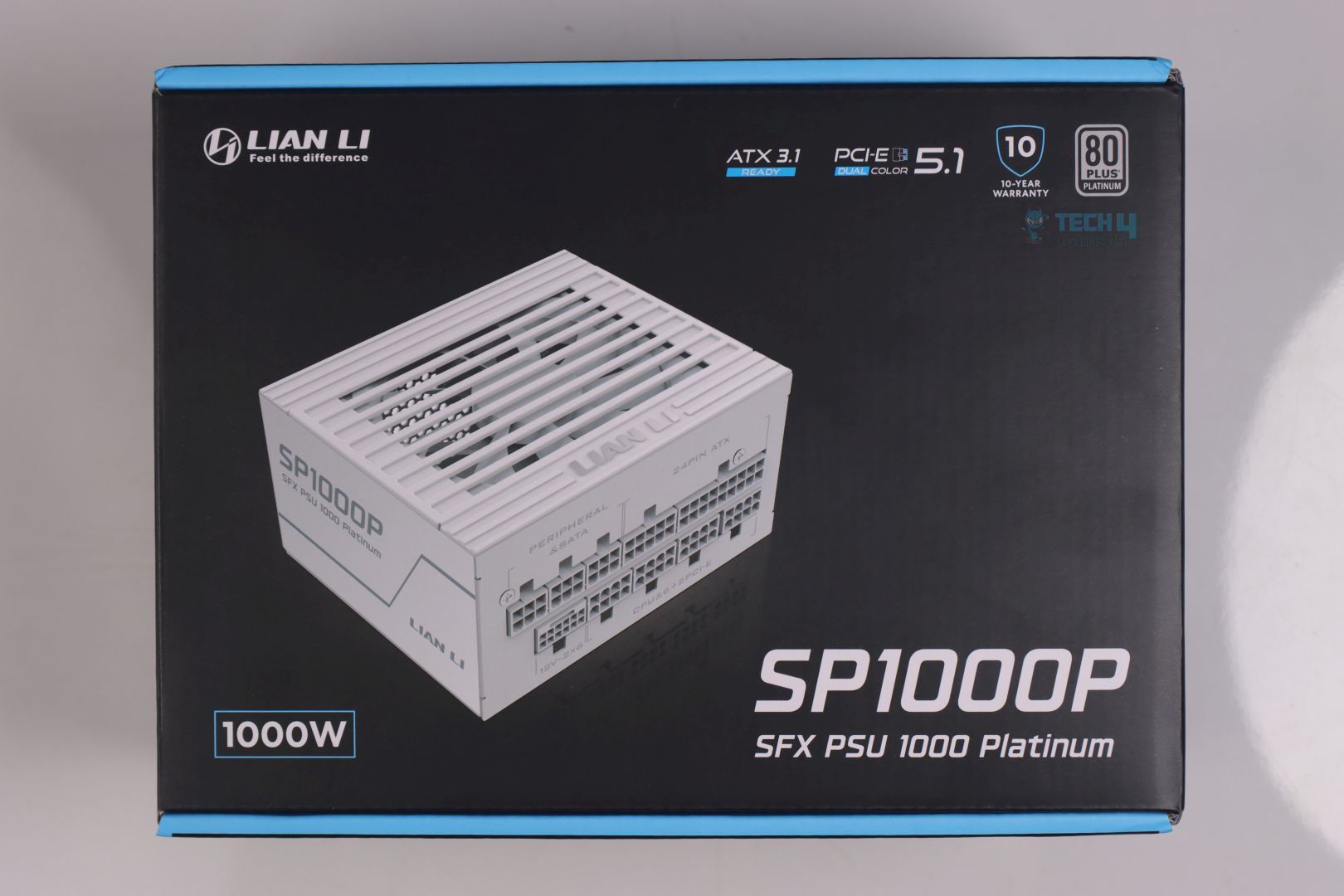
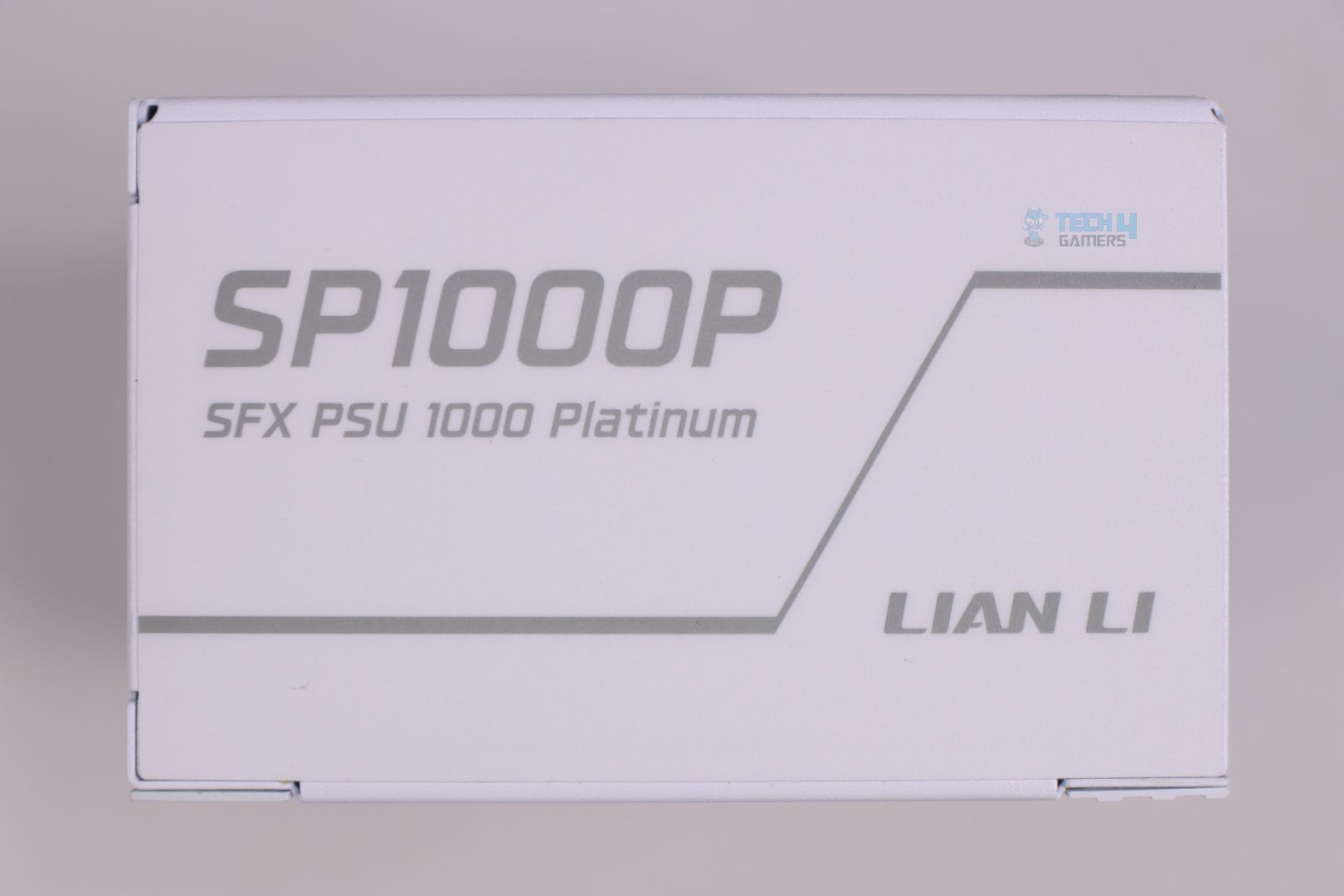
With their most recent lineup, Lian Li seems to be bringing even more innovative design products that are giving somewhat of a new life to this previously-considered least interesting segment in the PC build, as we saw in our previous review of Lian Li RS1200G 80 Plus Gold PSU.
Small Form Factor (SFX) PSUs are extremely challenging to do properly and not every PSU brand opt-in for this quite niche market. After the aggressive power excursions allowance for the new ATX 3.0/3.1 PSU specs – which makes it mandatory for a PSU to handle 200% of load for a tiny fraction of a sec (0.1ms), has made it even more difficult.
Now because Lian Li’s PC Cases catalog is filled with many Mini-ITX cases, it was a no-brainer for them to also cash in for the SFX PSUs.
For the design and extra features, sadly due to the extremely limited and densely populated internal PCB, Lian Li couldn’t do much to offer anything extra in this SFX lineup and I really don’t blame them for this. But I am very optimistic for their new SFX iterations in future after seeing what they did with their SP1000P PSU.
Why Trust Tech4Gamers
Arsalan Shakil is our power supplies expert who loves to put the latest PSUs through their paces and even take them apart.
20+ PSUs tested and reviewed by our team of hardware experts (Tech4Gamers Team).
180+ hours spent testing different power supplies for our reviews.
At Tech4Gamers, ensuring you get reliable information is our priority. That’s why every hardware round-up undergoes a meticulous review process by our team of experts and editors. Each review is carefully examined against our strict editorial guidelines, guaranteeing you trustworthy insights you can depend on.
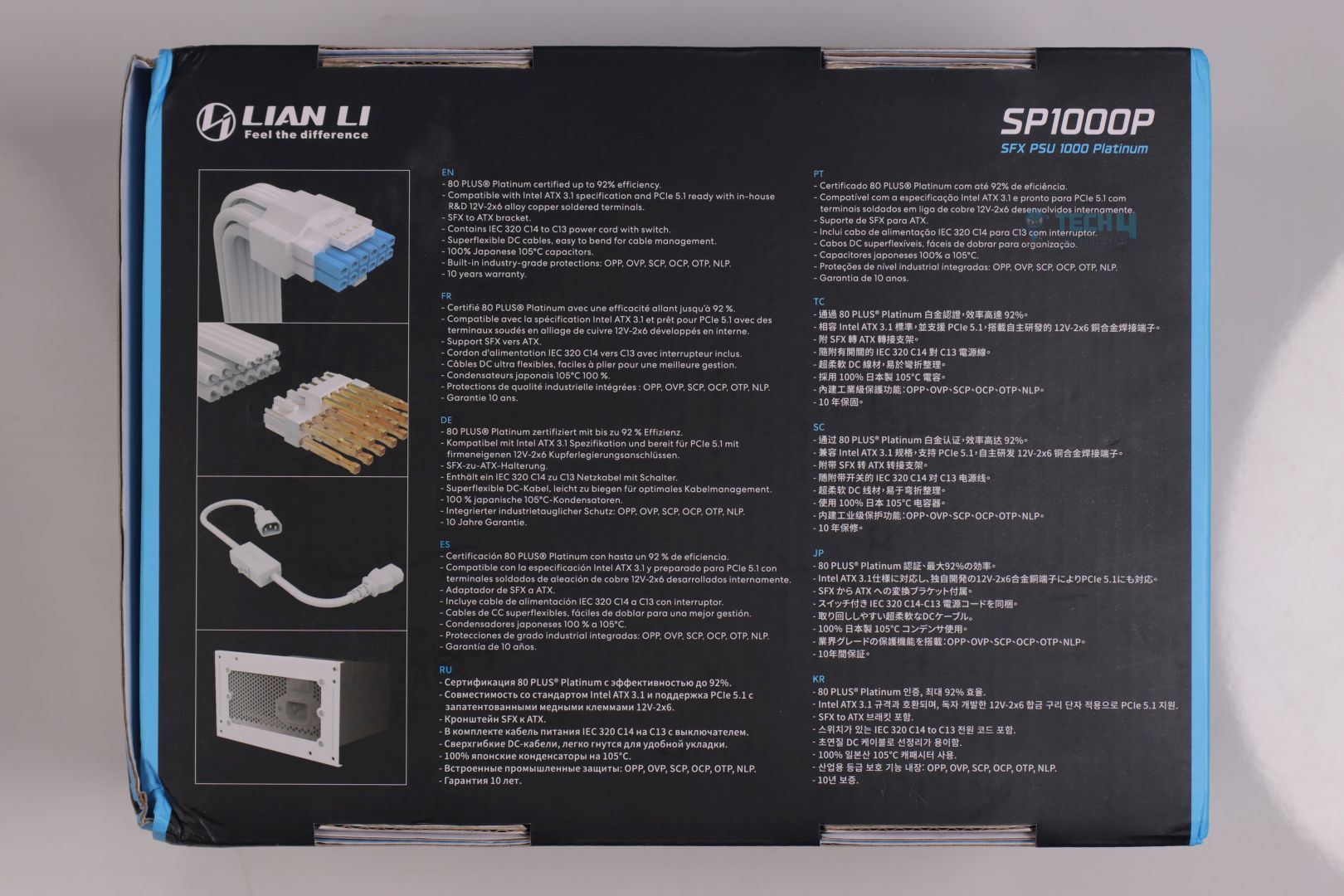
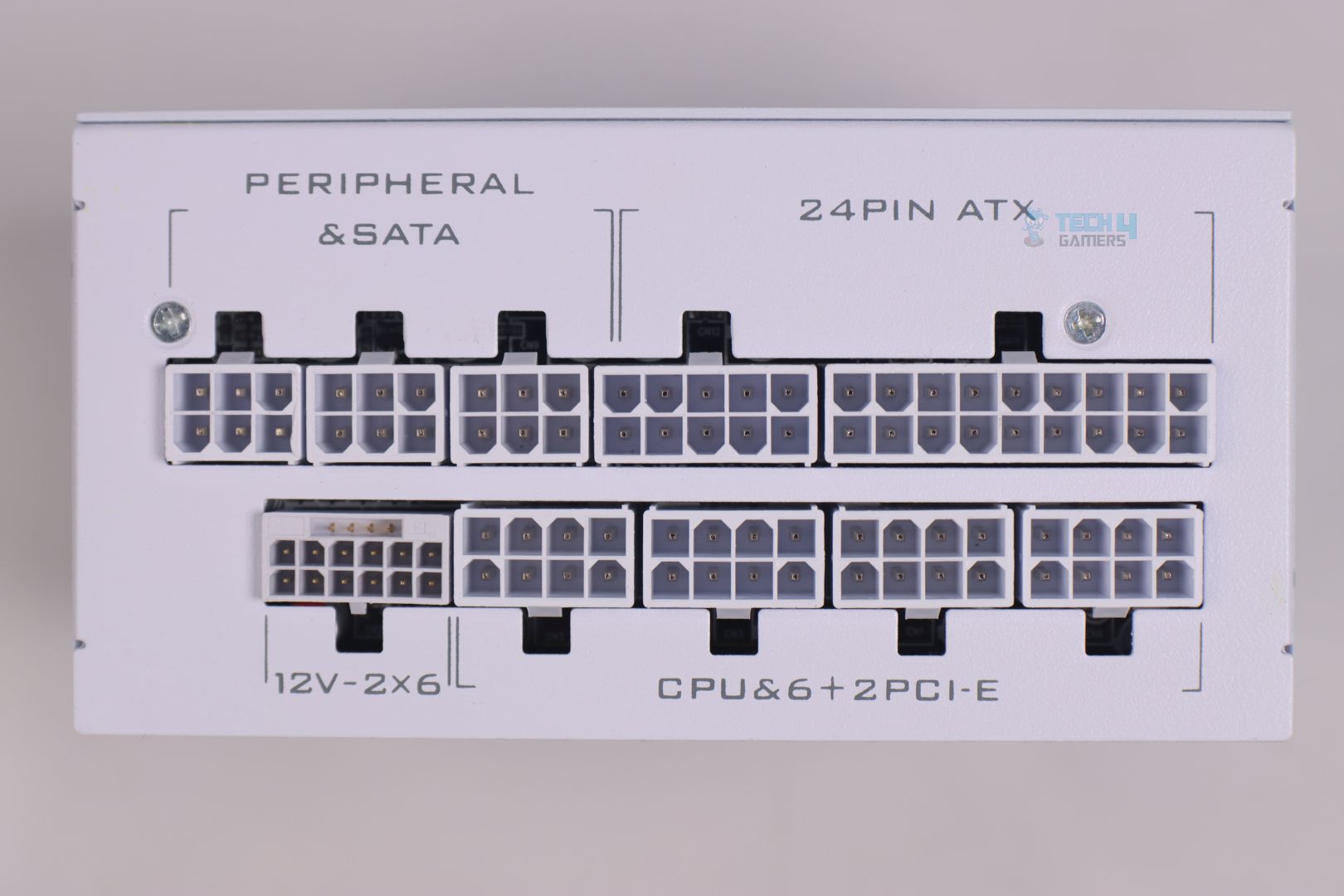
It’s good to see Lian Li pairing their new and much improved 12V-2×6 cable with every new PSU lineups and unlike other PSU manufacturers who are bragging improvements and innovations claims by only coloring their 12V-2×6 connector with two distinctive colors, Lian Li has gone an extra mile to design an in-house PCI-e 5.1 12V-2×6 alloy copper soldered terminal.
Cable & Connectors
Connector Type
Quantity
Motherboard cable (24/20-pin)
1x
CPU / ATX 12V connectors (4+4-pin)
2x
PCI-E 12V-2×6 connector (600W)
1x
PCI-E connectors (6+2-pin)
3x
SATA connectors
5x
PATA (Peripheral) connectors
2x
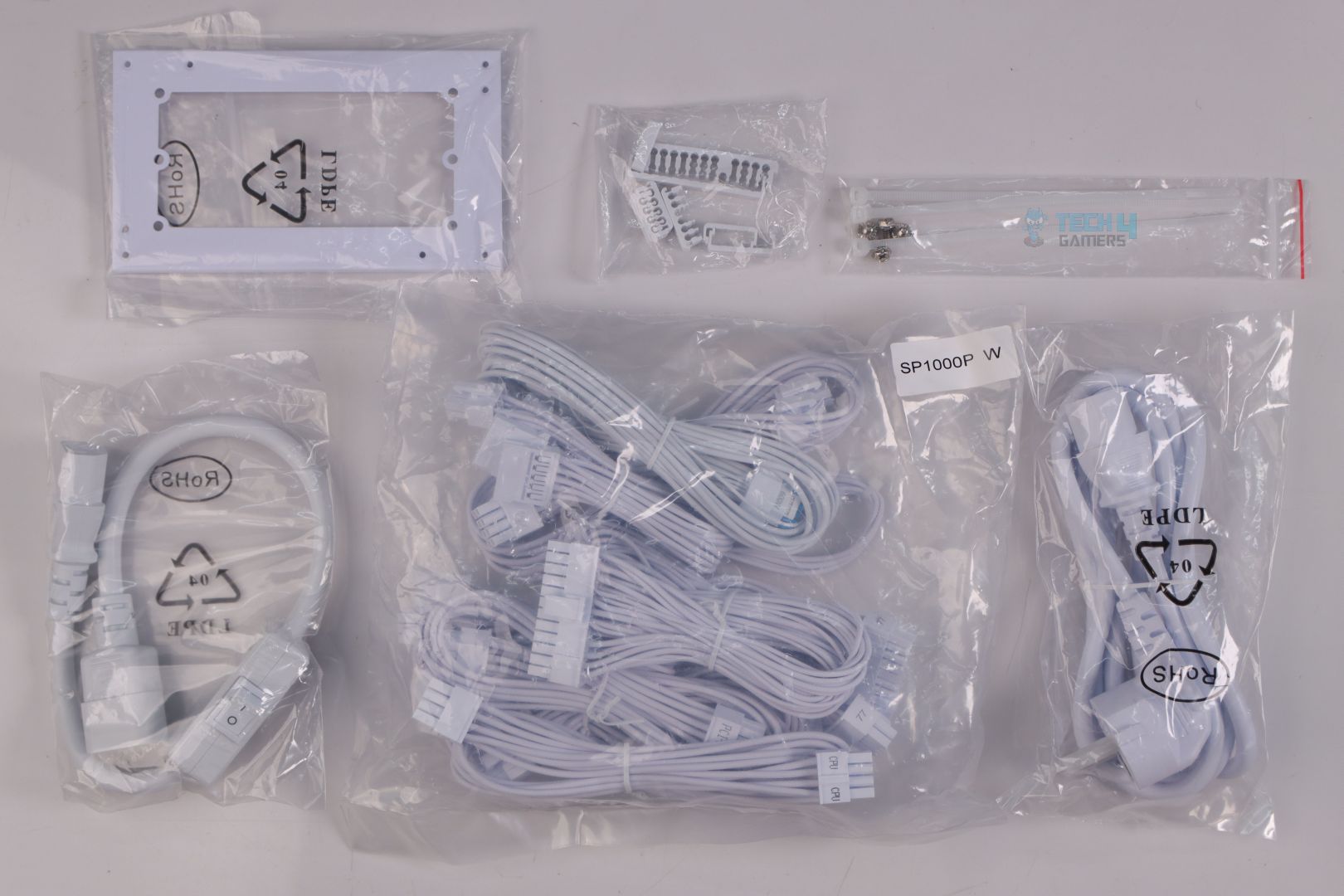
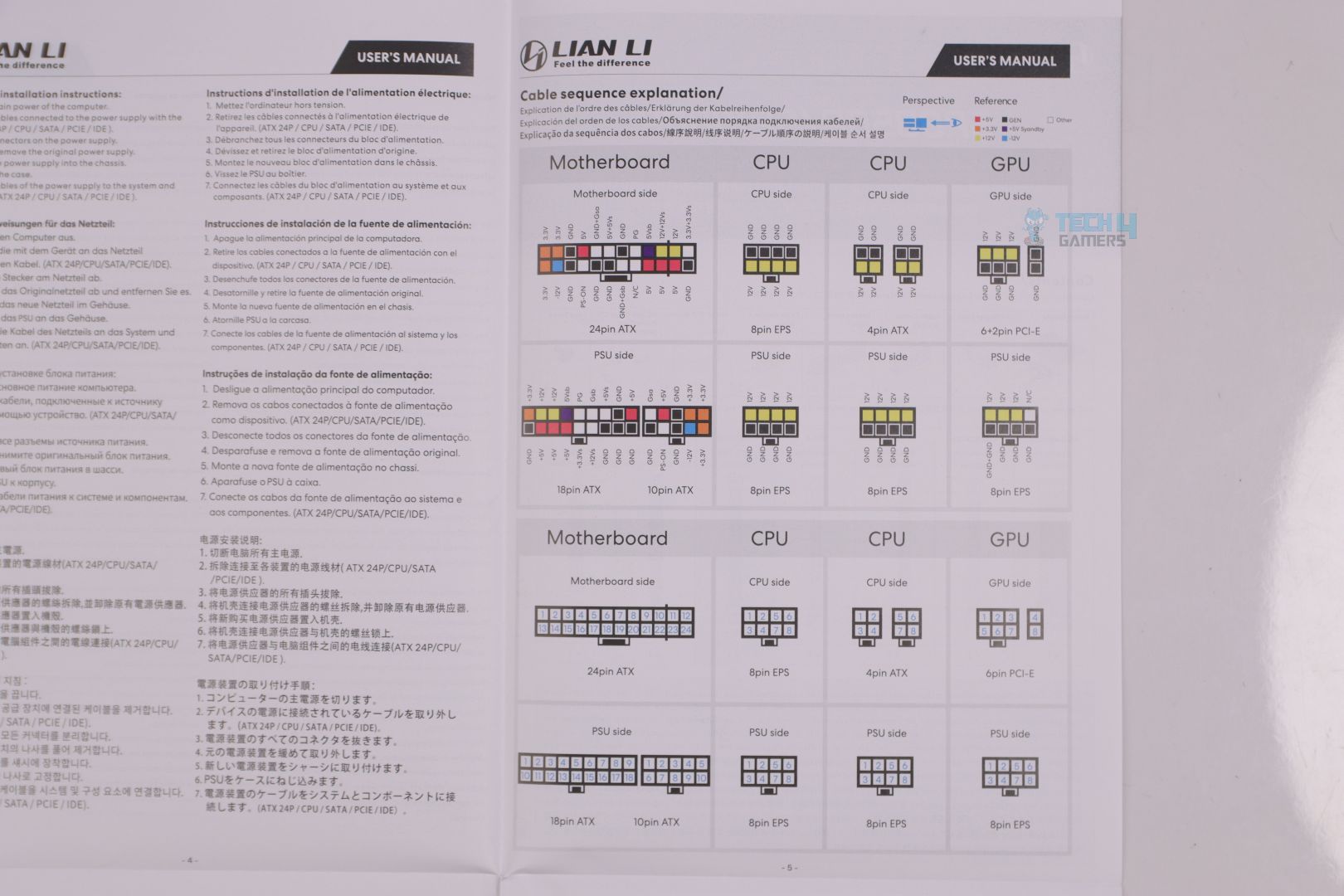
Don’t you just love it when a brand is so keen on providing its users the best possible experience? Now I have not tested Lian Li’s previous PSU lineups but what I have seen with RS1200G & this SP1000P PSUs, Lian Li’s user manual is the only well and thoroughly written manual I have seen out of all the PSUs I have tested.
Lian Li was probably feeling bad for not including anything unique and new to this SFX lineup, so they included an IEC 320 C14 to C13 Power Cord with a Switch – which I don’t think that many people are going to use. But for some (when using Mini-ITX case that requires PSU to be mounted in the middle of the case) this extension cable can be quite handy and user can place its extended power switch to an easy to access/reachable area. A very well-thought attention to detail indeed!
A quite innovative design idea from me to Lian Li for absolutely free:
Why not utilize the empty space of the power switch’s housing by placing a tiny power monitoring circuit inside and maybe a small relay too for monitoring the power consumption, as well as for turning on the PSU remotely with an app?
Teardown & Component Analysis
1 of 3
PSU Teardown
Aluminum Heatsink for Major Power Components
2x Bridge Rectifiers
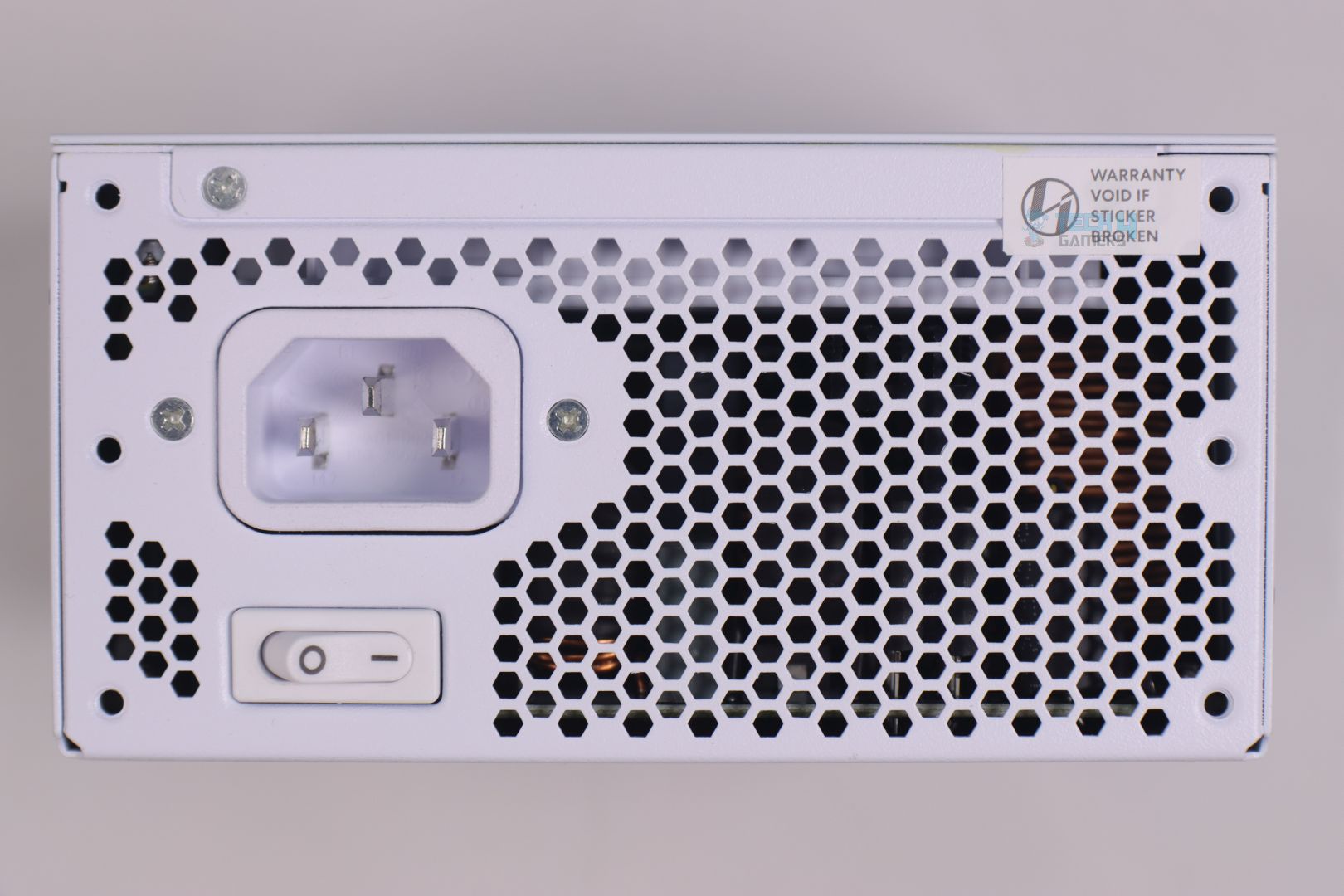
Unlike their ATX PSU we reviewed earlier, Lian Li has gone with a new OEM (Guangdong Zypower) which I have seen for the very first time. The platform is fully packed with components with a single aluminum heatsink for all the major power components like Bridge Rectifiers, APFC & Half-Bridge LLC MOSFETs. This will be more than adequate to cool down the power components considering SP1000P’s Platinum efficiency. Still because of its size, SFX PSUs tend to have a more aggressive fan profile to cool down densely packed components that usually trap heat due to extremely tight space.
1 of 3
Bulk Electrolytic Capacitors from Rubycon
Heatshrunk Electrolytic Capcitor from Rubycon
Polymer Filtering Capacitors
The use of top quality components can be seen throughout the platform. Even for its tiny size, the OEM has managed to put two electrolytic bulk capacitors from top-tier Japanese manufacturer Rubycon with combined capacitance of 840uF. Other electrolytic and polymer filtering capacitors are also from Rubycon and another well-reputable Japanese brand Nippon-Chemicon.
Main Transformer
If there’s one major change that has significantly improved modern PSU designs it’s actually the main Transformer.
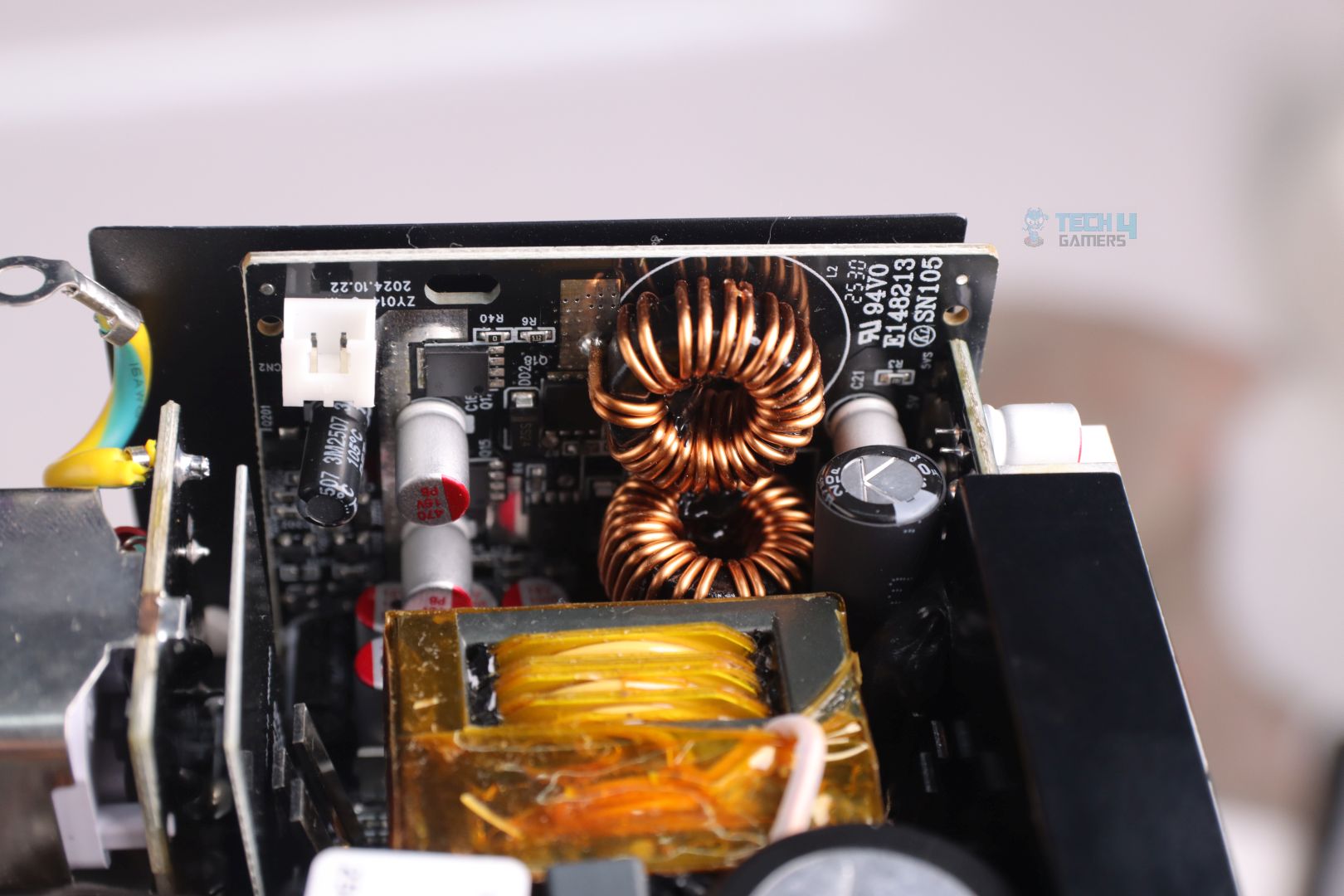
The use of flat copper planes for the secondary turns, has massively decreased the size of such transformers. Now they can be switched with a more higher frequency (keeping the overall size even smaller) and produce much less voltage ripple and noise.
12V Rail MOSFETs Heatsink
12V Rail MOSFETs on the back
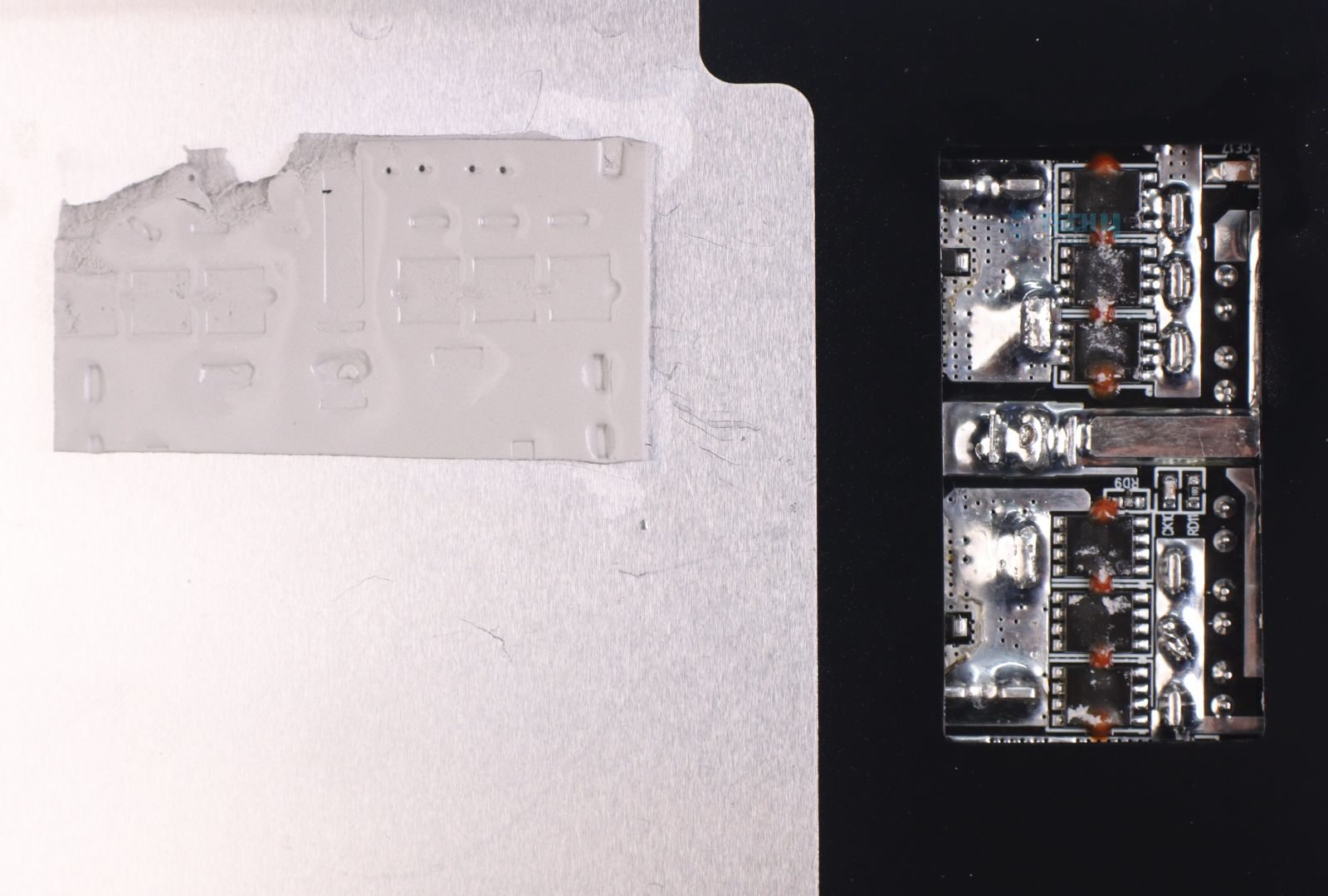
There are two tiny vertically placed aluminum heatsinks for cooling down 12V rail MOSFETs that are soldered on the back of the PCB. Those MOSFETs are further cooled down by the PSU chasis with a thick thermal pad sandwiched in between.
5V & 3.3V DC-DC Module
A small vertical daughter board for minor voltage rails (5V and 3.3V)
92mm FDB Fan From Hong Hua
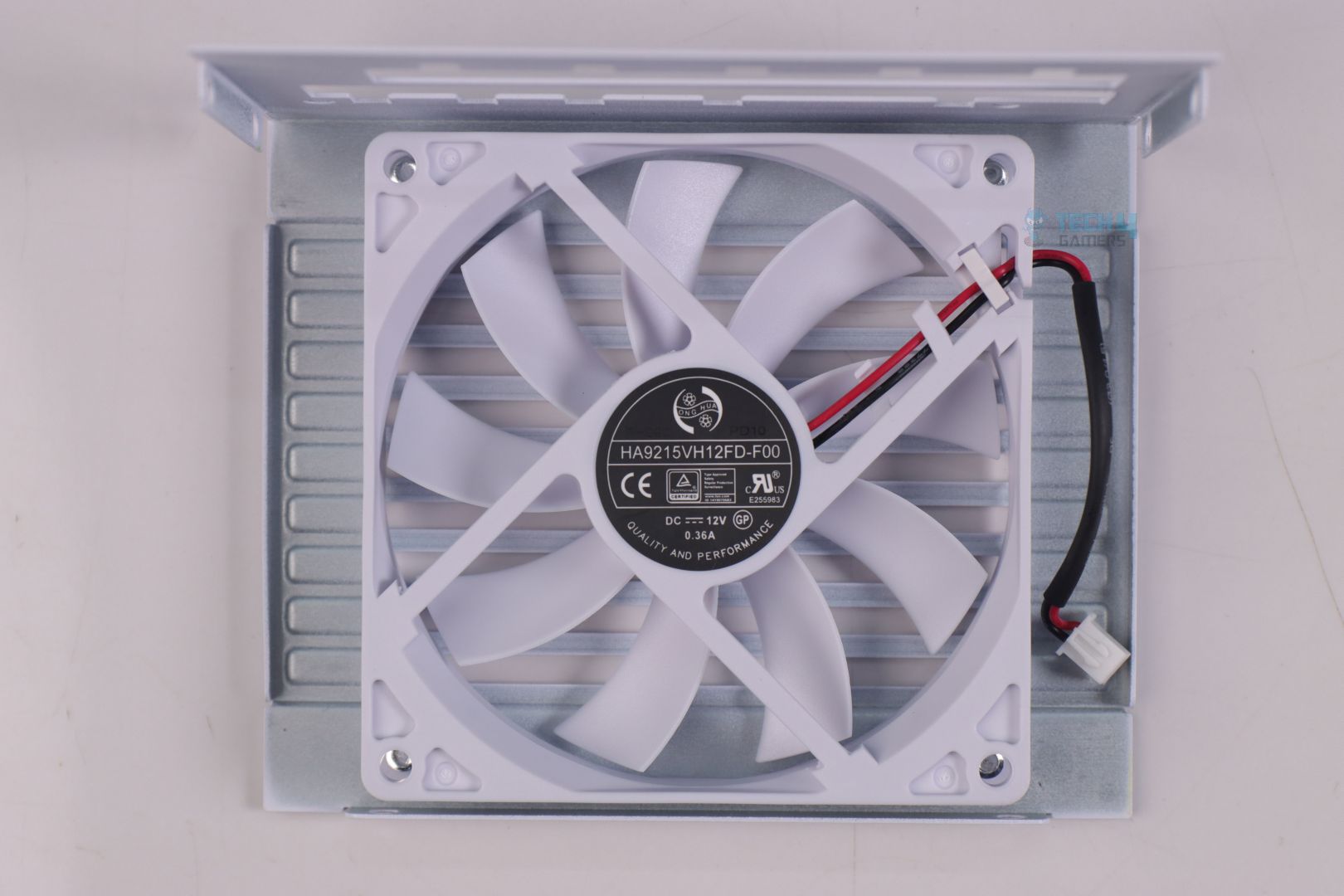
A 92mm FDB (Fluid Dynamic Bearing) fan is used with zero-RPM feature that automatically kicks in the fan when the load exceeds around 40% of rated power.
PSU Load Testing
Voltage Regulation
Load in %
12V Rail
5V
3.3V
20%
12.03
5.00
3.35
50%
11.99
4.99
3.34
70%
11.95
4.99
3.34
90%
11.94
4.99
3.34
100%
11.94
4.98
3.34
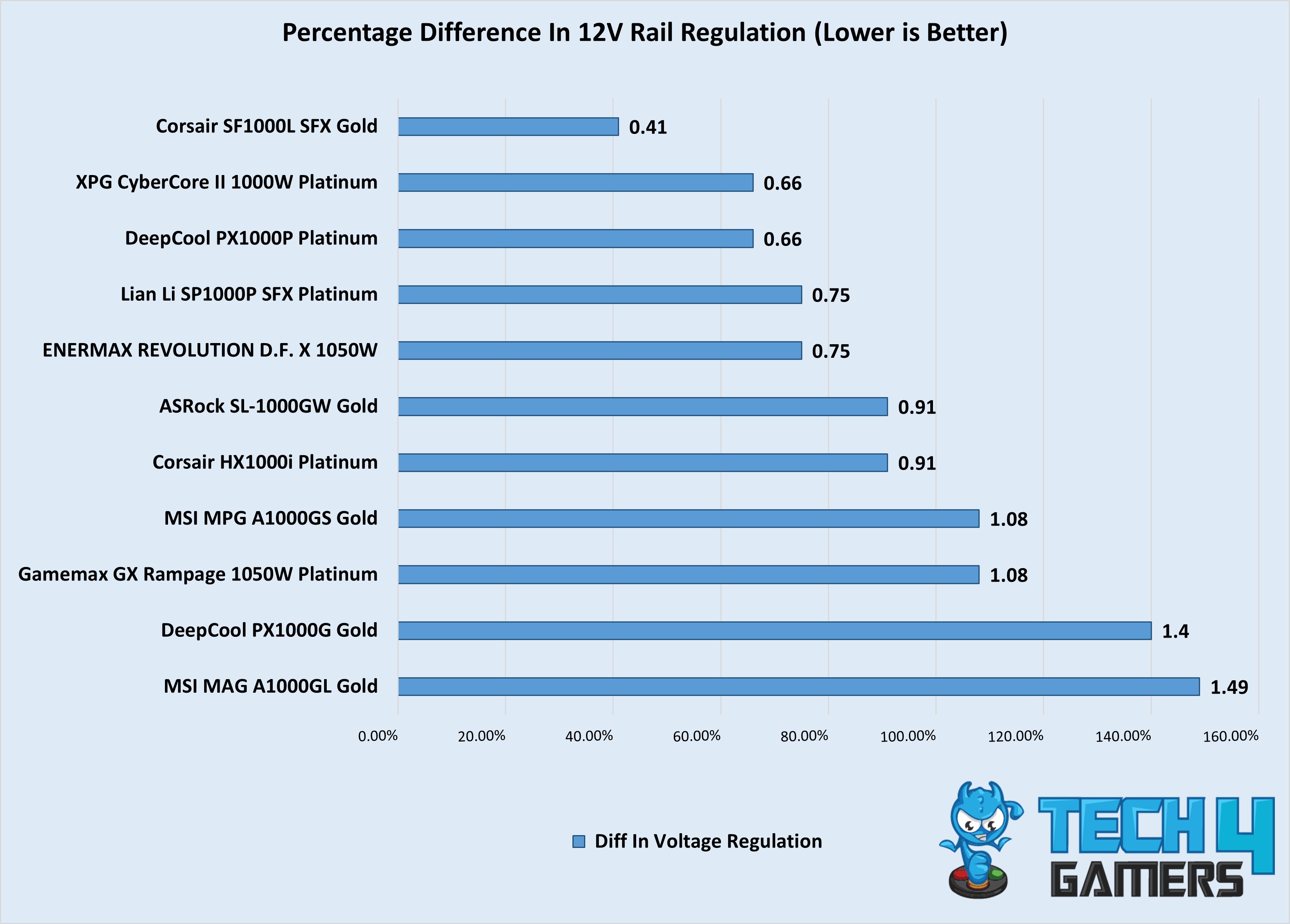
Voltage regulation is very good throughout different load variations. For its SFX form factor and 1000W output power, it’s really impressive.
PSU Efficiency
Load in %
Efficiency
Power Factor
20%
91.91%
0.943
50%
93.80%
0.982
70%
93.20%
0.984
90%
92.86%
0.985
100%
92.42%
0.985
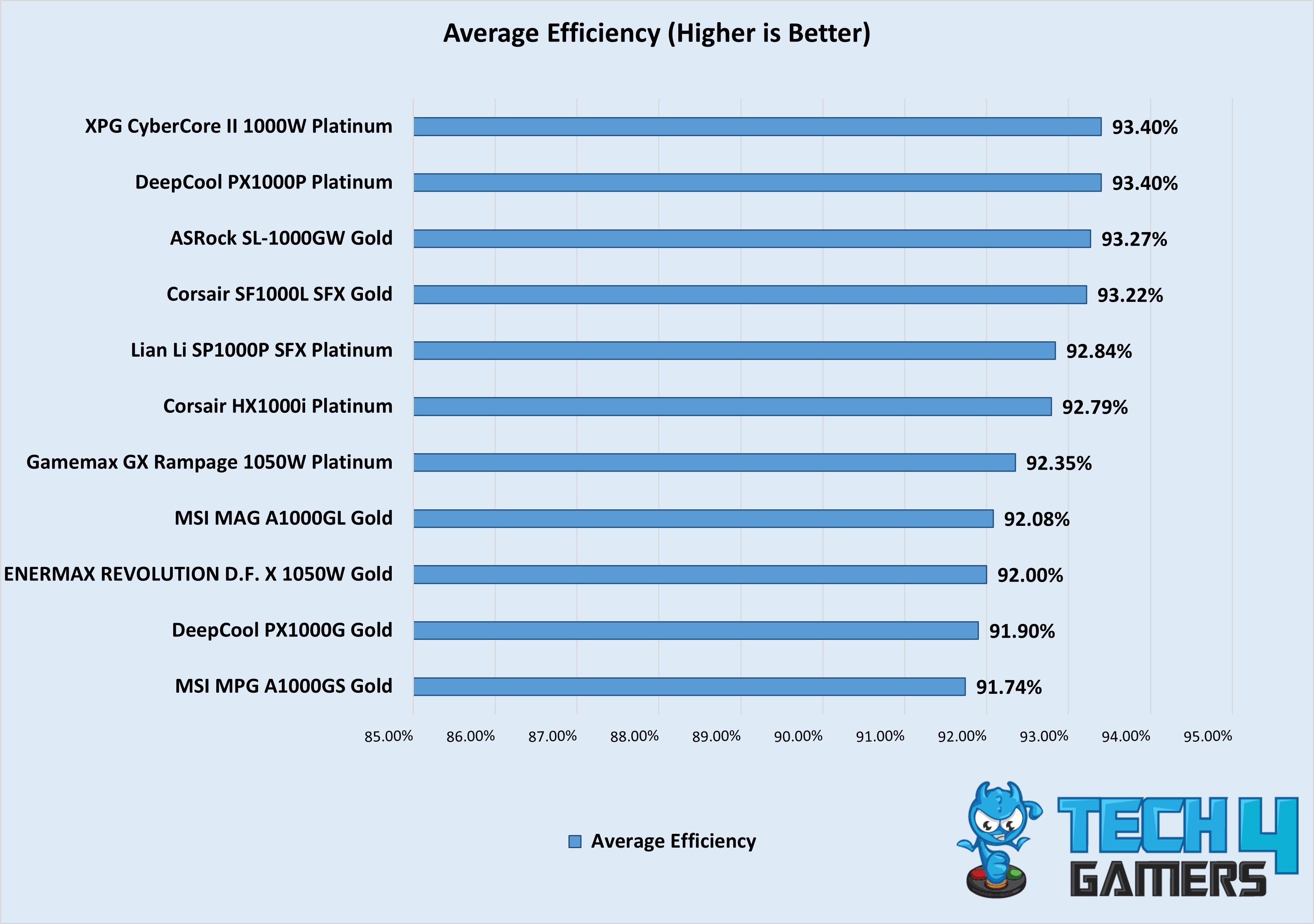
With the efficiency of 93.80% at half the rated output power and average efficiency of 92.85%, Lian Li SP1000P easily manages to achieve Platinum rating.
Voltage Ripple Performance
Load in %
12V Ripple
20%
7.2
50%
14
70%
18
90%
24.8
100%
29.6
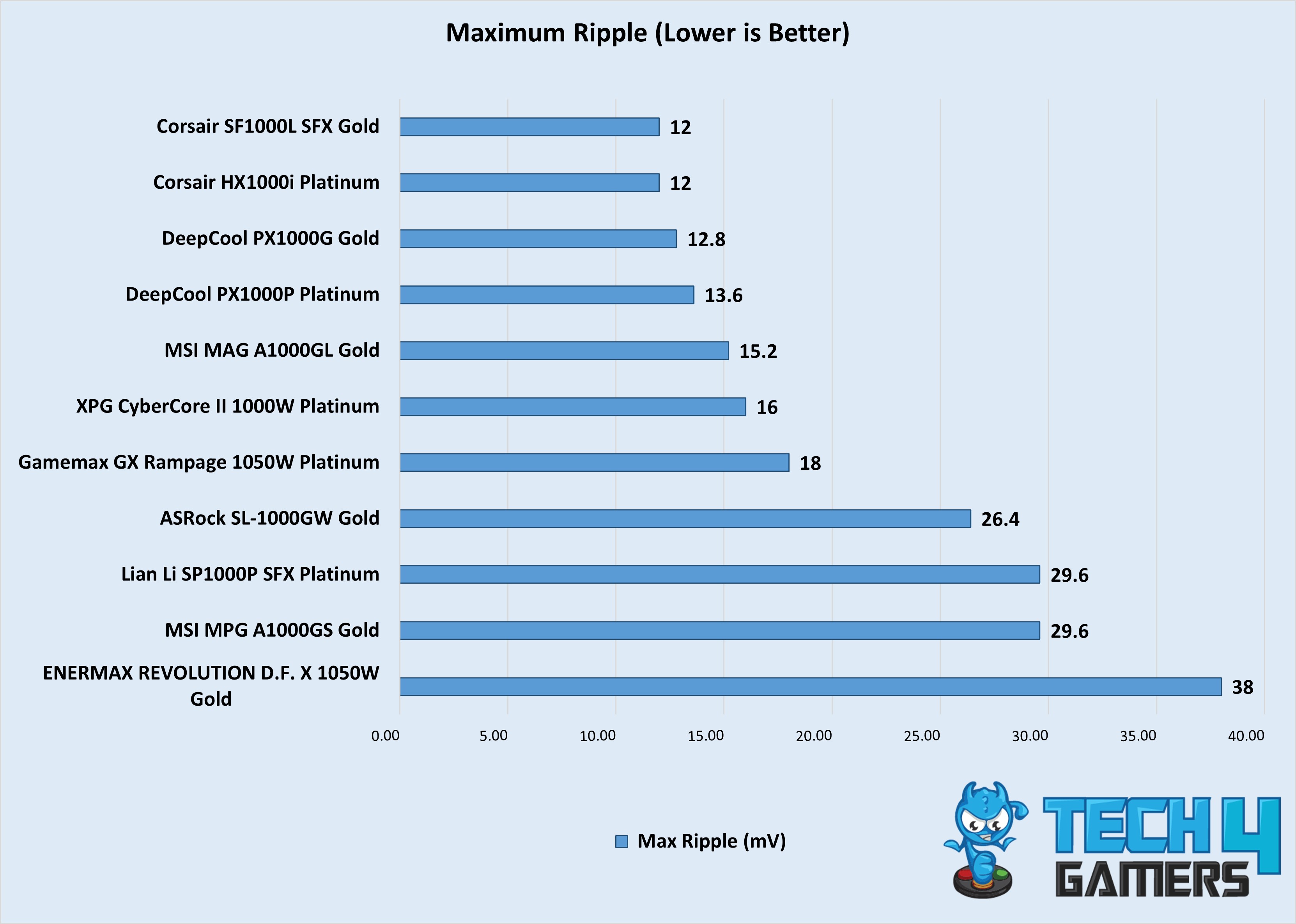
Voltage ripple performance is really impressive and even exceptional for an SFX PSU. The use of massive amounts of Polymer filtering capacitors on the modular connector bay side has indeed worked out really well.
Temperature
1 of 3
Max Temp @Exhaust
Max Temp @Back
Max Temp @Connectors Side
The PSU remained decently cool throughout the test. Now 63.9C on the back may look very hot, but it’s due to the MOSFETs dumping down all their heat on that specific spot. You may want to be careful leaving couple of centimeters of gap between the PSU and your PC case.
Just like the previous Lian Li RS1200G PSU I tested earlier, Lian Li SP1000P has the same problem of loud fan noise. Though it only gets extremely louder at max 1000W of load (which I don’t think you will be utilizing on your Mini-ITX builds) but still at around 800W of load the fan gets pretty loud.
I think if there was a way to bypass zero-RPM fan mode with a Hybrid-Fan mode switch on the back (as many other PSUs) this could have surely helped keeping the fan speed down.
Should You Buy it?
Buy It If
✅ You want a compact powerhouse: The Lian Li SP1000P is perfect for a high-end Mini-ITX gaming or workstation build, while still leaving enough headroom for future hardware upgrades.
✅ You care about extreme efficiency: With excellent efficiency numbers, most systems running around 500–600W will enjoy cooler operation and noticeably quieter performance compared to lower-rated units.
✅ You want a PSU that lasts a lifetime: Lian Li backs the SP1000P with a 10-year warranty, outclassing even some premium PSU brands that stop at 7 years.
✅ You want strong value in the SFX space: The SP1000P is priced lower than many competing SFX PSUs, and not all of them offer the same long 10-year warranty to sweeten the deal.
✅ You want peace of mind with next-gen GPUs: Thanks to the improved dual-color 12V-2×6 connector, you can game all day on power-hungry GPUs like the RTX 5090 without worrying about connector safety.
Don’t Buy It If
❌ You demand silent operation at high loads: Like many SFX PSUs, the small fan can get loud once power draw crosses ~700W. If silence is critical, especially during late-night competitive gaming, the fan noise may drive you nuts.
My Final Thoughts
Lian Li’s latest SFX PSU lineup is the perfect match for their Mini-ITX PC Cases that offers compatibility with the latest high-end and power hungry components. With SP1000P’s 10 years of warranty, this surely has the capabilities to last you several upgrades.
I’ve previously worked for eXputer as a Senior News Writer for several years. Now with Tech4Gamers, I love to devoutly keep up with the latest gaming and entertainment industries. I have a Bachelor’s Degree in Computer Science and years of experience reporting on games and breaking exclusive stories. Besides my passion for gaming journalism, I love spending my leisure time farming away in Stardew Valley. VGC, IGN, GameSpot, Game Rant, TheGamer, GamingBolt, The Verge, NME, Metro, Dot Esports, GameByte, Kotaku Australia, PC Gamer, and more have cited my articles.
Story Highlight
Expedition 33 has won 291 Game of the Year awards in 2025, making it the 3rd most honoured title in gaming history.
The game is ahead of titles like The Witcher 3 and Baldur’s Gate 3, with only Elden Ring and The Last of Us 2 winning more GOTYs.
The RPG also boasts one of the highest success rates, having won 68% of Game of the Year awards, trailing only 2% behind Elden Ring.
Sandfall’s title also won the Game of the Year award in Thailand and at the Indie Game Awards, even though the latter was later rescinded. But, even with the AI controversy, Expedition 33 has received more overall GOTY wins than some big hitters like The Witcher 3.
Why It Matters: Clair Obscur: Expedition 33’s impact is clearly showcased by the RPG winning 68% of the GOTY honours this year.
Expedition 33 has officially won the 3rd-most Game of the Year awards in gaming history, being honoured by over 291 publications, award shows, and magazines. In the overall list, the RPG has surpassed Larian Studios’ Baldur’s Gate 3, which won 288 GOTY awards back in 2023.
Expedition 33 is only behind The Last of Us Part II (326 GOTY wins) and Elden Ring, which dominated the awards season in 2022. Furthermore, there have been 428 GOTY winners announced in 2025, and Clair Obscur: Expedition 33 has taken home 291 of these awards.
Hence, the Sandfall title has one of the highest percentages of Game of the Year wins acquired in a year, sitting at 68%. Only Elden Ring (70%), Street Fighter II (80%), and The Legend of Zelda: Ocarina of Time (87%) have a higher percentage of awards won.
Clair Obscur: Expedition 33 has won 68% of Game of the Year awards in 2025.
Considering how there are still many Game of the Year winners left to be announced, Expedition 33 can pass The Last of Us Part 2 by the end of this award season. With the AI controversy also behind the Sandfall title, anything is possible.
Do you think Expedition 33 deserves to be this high up in the historical ranking of GOTY winners? Tell us in the comments below or head to the Tech4Gamers forum for discussion.