Currently serving as a News Reporter at Tech4Gamers, I have the privilege of combining my love for gaming with the art of storytelling. My role involves crafting engaging narratives that keep our audience abreast of the latest developments in the gaming world.
Story Highlight
SteamOS is finally supported on the Lenovo Go S.
The new OS delivers a major performance increase with a whopping 28.26% FPS increase in Cyberpunk 2077.
Battery life is also significantly bumped, twice what it used to be.
The handheld console market has become a lot more exciting recently after Valve decided to bring its SteamOS to other handhelds.
Lenovo Go S is the first non-Valve device to receive SteamOS support, and the new OS delivers outstanding results. Game performance and battery life significantly improve, leaving Windows 11 behind in the dust.
Why it matters: The only thing holding back the handheld consoles was Windows 11, as a proper console-like experience was lacking. SteamOS has finally fixed that problem and is increasing the maximum output for the handheld.
SteamOS Runs Games Significantly Better Than Windows 11 || Source: Dave2D
Dave2D has just tested multiple games running on the SteamOS for the Lenovo Go S and compared them to their performance on Windows 11. On average, a performance increase of 12.64% was noted across multiple titles.
The most significant difference was with Cyberpunk 2077, one of the most demanding games of this generation, which could only achieve 46 FPS on average running on Windows 11 compared to the 59 FPS achieved running on SteamOS.
Not only that, battery life was bumped up more than 2 times while playing Indie games. Windows 11 could only last around 2.75 hours, while SteamOS had a battery life of a whopping 6 hours with games like Dead Cells. Battery life on AAA games was more or less the same.
ASUS ROG Ally 2 Will Make The Handheld Market Even More Interesting
Regardless of what users would like to play, switching to SteamOS should really be a no-brainer. Moreover, the ecosystem is much cleaner and more accessible compared to the bloated Windows 11 experience.
For such a poorly received handheld, the Lenovo Go S might have received a clean slate with the SteamOS support that may justify its $729 price just a little bit.
The main question arises of how Xbox’s ecosystem will fare against SteamOS. Microsoft also aims to enable the Xbox-like ecosystem across all handhelds, starting with their Project Kennan, which will launch later this year.
At T4G, my task is to cover the latest news around the gaming globe ASAP and with the utmost precision. I adore all the games and respect all the devs behind the amazing games that we get all year. So, whether it’s a PC or a Console game, I got it all covered.
Story Highlight
Lords of the Fallen studio head says the DEI was the reason behind the industry’s collapse.
He says after all the agendas, the industry is now course-correcting and improving.
The studios have listened to the players and are now focusing on their wants.
With the advent of companies like Sweet Baby Inc., it seemed that DEI was set to be a trend that would stay in the industry for a while. However, since games that integrated agendas failed miserably, things have taken a different direction.
Now, the CI Games CEO says DEI was the primary reason for layoffs and many studio closures. The industry is ‘ course-correcting ‘ after fans spoke out against it and now knows what they want.
Why it matters: Fans have always been quite outspoken about the fact that forced inclusivity in gaming makes them boring, leading to massive failures; therefore, it’s a good sign that it’s on the way to improvement.
CI Games CEO says DEI led to layoffs and studio closures.
Taking to X, Marek Tyminski talked about how DEI ruined the gaming industry. He said many studios chased DEI hires, prioritising ideology over efficiency. This marked a shift in the development process for the worse.
Players woke up. They know they can demand what’s right—and choose the games that deliver. The industry is course-correcting
– Marek Tyminski
Hits like Clair Obscur prove DEI has no place in gaming.
The change resulted in many games failing, studio closures, and mass layoffs. The most prominent examples of failed projects include Dragon Age: The Veilguard and Concord. Now, the players have woken up and change is imminent.
He said that the industry is now course-correcting and listening to the fan demand, and he’s glad he spoke out very early and will continue to do so. Titles like Clair Obscur and even Lords of the Fallen prove that you don’t need DEI to make a good game.
What are your thoughts on CI Games saying DEI was the reason behind studio closures and layoffs? Let us know your opinions in the comments, or join the discussion on the Tech4Gamers forum.
At Tech4Gamers, I mainly cover new gaming news, leaks, and rumours. Aside from that, I love to write features about my favourite games while inserting my opinion about their different aspects.
Story Highlight
Capcom made several changes in the latest Onimusha 2 remaster by censoring, causing concerns among the fandom.
Along with censoring, the game also features Denuvo, making it even more controversial.
Due to that, it launched to only 1.6k players on Steam, hinting at a complete failure.
Censorship and Denuvo in a video are hated by a massive community in the gaming industry. Gamers collectively hate these two words because they ruin games. Censoring the remaster of an iconic game is already a pretty controversial move, but adding Denuvo to that game can add fuel to the fire.
The same thing happened with the Onimusha 2 remaster. Many fans were excited about the remaster, but as the release date approached, the hype died down, mainly because Capcom censored everything and added Denuvo to the game. Due to that, it flopped on release.
Why it matters: Many developers are focusing on the modern audience that isn’t really available in massive numbers, which is exactly why a lot of games aren’t performing as they are supposed to.
The latest remaster of an old classic from Capcom flopped hard on the PC platform | Source: SteamDB
Two days ago, the Onimusha 2 remaster was released to only 1631 players, meaning the game clearly flopped. As of this writing, only 546 players are playing the game, and the 24-hour peak is 1359. So, just after a day during the weekend, the game’s peak reduced, which speaks volumes.
This remaster has completely flopped on the PC, and we know exactly why. Fans already heavily criticised Capcom recently for censoring its video games, but the gaming giant didn’t listen, and you can see what happened.
Normally, the fans who have bought the game were disgusted by Capcom and chose not to give this company their money. Another main reason was Denuvo’s addition to the video game.
Despite Denuvo’s head claiming that the technology doesn’t affect a game’s performance, it has been proven on many occasions that it does negatively affect it. While Denuvo does protect the game from being cracked, it may affect sales more negatively than expected.
If they remove Denuvo and restore the censored content I’ll pick the game up. Not even the smallest chance until then.
Fans are saying that “censorship is cancership” and hoping that Capcom learns from this mistake.
What do you think of the Onimusha 2 remaster? Does censoring remasters and adding Denuvo to them bother you? Please share your thoughts with us in the comments section below or join the official Tech4Gamers forums for discussion.
Lead the comparison and blog writing teams at Tech4Gamers.
Oversee teams with a keen eye for detail and precision.
Ensure hands-on writing, with benchmarks and testing as guiding principles.
Guarantee the delivery of the best possible results in concise yet impactful tech tales.
Story Highlights
Zowie chooses to have the utmost performance by sticking to 1080p 144Hz+ 24-inch screens, despite the trends in other gaming monitors.
They’re usually bulky, have thicker bezels, some have side blinders, and have features that are intended for eSports players.
DyAc improves motion clarity and reduces ghosting, Black eQualizer enhances the darker scenes, and flicker-free panels minimize eye strain.
Every year, there are tons of esports events ranging from DOTA to CS2 to Valorant. While the players and tournaments might be different, one thing remains the same for almost every event: they use monitors from Zowie.
Zowie Monitor (Image Credits – Zowie)
Zowie is an esports equipment manufacturer. BenQ acquired it in 2015, and it has been a sub-part of BenQ ever since. While many esports players bring their own mice and keyboards, they still use monitors from Zowie.
Functionality Over Aesthetics
There are many reasons for these pro players to use the Zowie monitors. Part of it is because these players often go for extreme performance instead of other fancy addons that most gaming monitors come with.
No Fancy Gimmicks
In the midst of intense matches, having RGB behind the monitor, having a curved screen, or having an aesthetic shape of your monitor is the least players are concerned with, so Zowie got rid of all of these gimmicks.
Thick Borders (Image Credits – Zowie)
Separate Controller For Switches
Not only that, but Zowie also removed the buttons to navigate the settings for some of their models and provided a separate controller (S-switch) to operate them. This is to avoid any the traditional buttons can be hard to press.
Additionally, the S-switch they gave has a clickable scroll wheel and multiple presets so players can switch between the presets depending on the location of the map without any hassle or accidental misclicks.
Thick Bezels Despite Trendy Bezel-less Design
They also don’t go for the bezel-less design that most monitors come with. Instead, you’ll see thick borders on all of Zowie’s monitors. This is because bezel-less monitors usually come at a cost of backlight uniformity.
Only Performance Matters (Image Credits – Zowie)
This is where light could bleed towards the edge of the screen instead of the entire panel. While this isn’t very common in every monitor, Zowie still avoids it to be on the safe side. Moreover, the panels are more durable with the thicker borders.
Side Blinder
Some models also come with side blinders to block out ambient lighting or any other reflections. Since esports events are filled with lights and an audience, these blinders allow players to keep their eyes focused on the screen.
Bulkier Than Other Monitors
These monitors are generally very bulky from the backside as well, mainly to have proper heat dissipation. Moreover, it includes a highly adjustable stand, and its bulky base ensures the monitor doesn’t wobble during intense gameplay.
Bulkier Than Others [Zowie XL2411P] (Image Credits – Tech4Gamers)
Sticking To 1080p
For competitive players, resolution isn’t essential; it’s only about performance. So, Zowie mainly chooses 1080p monitors. However, with these resolutions, they usually aim for a higher refresh rate and lower latency to have extremely smooth gameplay.
While 144Hz was the standard in esports events for many years, we believe it’ll soon be replaced by 240Hz. Still, Zowie produces all kinds of monitors, and they’ve released a 600Hz monitor as well.
24-inch Despite The Ultra-Wide Trends
Besides 1080p, Zowie also uses a 24-inch monitor design. Esports players usually avoid moving their eyes too much because they may lose sight of their target. A 24-inch monitor is a sweet spot, small enough to cover the entire screen.
24-inch Or 24.5-inch (Image Credits – Optimum)
Many players sit way too close to the monitor to see each pixel clearly, and accidentally shooting the wrong moving pixel could cost them a match.
Features
Zowie monitors also come with tons of technological benefits that give them a competitive advantage compared to other gaming monitors. These are specifically suitable for competitive games.
DyAc (Dynamic Accuracy)
While these monitors don’t have an OLED panel, they use the DyAc technology to get similar results. BenQ’s DyAc and DyAc 2 greatly reduce motion blur by using backlight strobing.
Without it, you’d be seeing ghosting frames where the backlight is showing you the previous frame instead of the real-time one. With this, players can have clarity while making flick shots and spray transfers.
Black eQualizer
Another prominent technology used by Zowie is the Black eQualizer, which allows for enhanced visibility in darker scenes. This is, again, what OLED panels have with their true blacks, but this just mimics that of a 1080p monitor.
Black eQualizer Technology (Image Credits – Zowie)
Higher Contrast & Flicker-Free Panel
These panels are also flicker-free with supported low-blue light and better color contrasts, so that players won’t have eye strain. These players usually use the monitors for prolonged hours, and including these features was a no-brainer.
Special Designed Frame
Even though Zowie monitors have thick frames, they’ve designed them so the light from the screen doesn’t bounce off these borders, unlike other monitors with bezels. Again, this is to avoid distraction for the players, even if it’s as little as this.
Special Designed Frame (Image Credits – Zowie)
Final Words
These features and options, specially designed for esports players and events, are why Zowie is the go-to for these events. Also, they are a sponsor of such players and events, which boosted them further in popularity.
Lead the comparison and blog writing teams at Tech4Gamers.
Oversee teams with a keen eye for detail and precision.
Ensure hands-on writing, with benchmarks and testing as guiding principles.
Guarantee the delivery of the best possible results in concise yet impactful tech tales.
Story Highlights
Game devs used to add fog, haze, and clouds in their games to mask the rendering of the objects as you move through the world.
Usually, the distant objects are flat 2D images, which increase to a low-poly texture and then to a 3D model as you move closer to them.
Other tricks such as frame capping, asset reuse, loading screens, and baked lighting & shadows were also used to save memory.
We all love older games, especially those launched in the era of the legendary PS2. But have you wondered how these games ran smoothly despite the hardware limitations of older consoles?
PS2 & Its Games (Image Credits – The Gamer)
While we may not realize it, game developers used sneaky and clever tricks to make their games run smoothly and look great, especially the older open-world games.
Pushing Limits With Limited Hardware
To put into perspective, the PS2 came with a 64-bit R5900-based chip, 32MB of RAM, and only 8MB of storage card. Considering the specifications of newer consoles, this is far less to work with.
Still, developers pushed it to the edge through their brilliant coding and workarounds. A perfect example is Shadow Of The Colossus, which I still can’t get enough of even after so many years.
Solving The Draw Distance Issue
Not only was the game loved for its story, but it was also highly praised for its aesthetic. However, most people don’t realize that these aesthetics resulted from the PS2’s hardware limitations.
Draw Distance (Image Credits – YT/Pixel Análise)
Visual Fog As A Mask
You see, the fog added at a distance wasn’t just for visual appeal but also because the PS2 couldn’t render the far-off objects. That is why fog is present in Silent Hill, which creates an aesthetic and also reduces the load on the PS2’s GPU
Besides the fog, Shadow Of The Colossus featured another clever strategy for rendering distant objects. With the extensive terrain and distant mountains in the game, it would have been impossible for PS2 to handle all that.
Texture Optimization
So, the devs smartly mixed 2D with 3D renders to counter this. If the player is far away from the distant mountains, we see only a 2D pixel covered by the lighting and fog, so your eye can’t naturally pick it up.
Different Textures With Distance (Image Credits – Killscreen)
These are the same 2D renders that are placed at the end of the level in other games like Resident Evil, Final Fantasy VII–IX, and Onimusha. These were basically flat images with fixed camera angles, which saved processing power.
Pre-Rendered Backgrounds
As you move closer to these flat images, they shift to a low-poly model with the same haze and fog still present. It feels like the fog is making the object slightly blurry, but in reality, it is a blurry object.
As you move closer, it finally shifts to a completely 3D render, and your brain thinks it was 3D all along. That is why the game looked too good for an old console, as if it’s a miracle that this old tech can handle this vastness.
Another cool trick the developers used is streaming. Since older consoles can’t properly load the large environments, streaming allows the map to be loaded as the player moves across it.
This was heavily used in GTA San Andreas, where Rockstar cleverly loaded only nearby assets whenever needed. This was masked by the distant fog, whose importance fans noted after it was removed in the Definitive Edition.
The heavy use of the clouds while flying in this game also worked as a tool to mask the ongoing render. The PS2 would stream the textures in the background. Looking closely, you can see the textures loading as CJ moves closer to the ground.
Other Techniques To Counter Hardware Limitations
Older games also ran at variable framerates instead of being capped at 60 FPS to reduce strain on the CPU and the GPU. Some games even lowered the resolution in intense scenes to maintain playability.
Frame Rate Capping
In games like Shadow of the Colossus, the FPS dipped during the boss fights, especially when the Colossus attacked you. To counter it, a visible screen shake looks visually appealing but was used to mask the frame drop.
Asset Reuse
Many of the assets were reused in many games to save memory. Devs would slightly alter the geometry to make objects look unique. This applies to the enemies in most RPG games and even the items placed around the surroundings.
Asset Reuse (Image Credits – ResetEra)
Loading Screens
Loading screens were added to give the consoles time to load the areas. However, games like Resident Evil, Metroid Prime, and Mass Effect used short hallways and corridor transitions to mask loading screens.
Baked Shadows & Lighting
Since integrating real-time shadows and lighting requires too much hardware, game developers still use baking shadows and light in the textures ahead of time. This gives the illusion of dynamic scenes and adds depth to the games.
Verdict
Now, if you ever pick up an older game, especially of the PS2, you’ll see these things going into work. Knowing how devs gave us high-end optimization for older games makes us cherish these games more than ever.
At Tech4Gamers, I contribute as a Senior News Reporter, combining my skills and gaming enthusiasm to keep our audience updated on the latest developments.
Story Highlight
Following the failure of Dragon Age: The Veilguard, a former writer has discussed EA’s confidence in the franchise.
The publisher attempted to appeal to a wide audience and expected core fans to always buy new games.
It believed that the traditional RPG mechanics of older Dragon Age games were slow and needed to be changed.
Dragon Age: Veilguard marked one of the industry’s more surprising failures last year. Although BioWare is now moving forward with the development of Mass Effect, the team’s morale has taken a major hit, with various developers also leaving the studio.
Discussing the Dragon Age franchise and EA’s past failures, a former writer of the franchise has revealed that EA falsely believed a chunk of the RPG audience would always show up to play Dragon Age.
Why it matters: This belief is partly why the publisher was so surprised when Dragon Age: The Veilguard failed to perform as expected.
BioWare’s Veilguard Was A Failure EA Didn’t See Coming
David Gaider, the former lead writer of Dragon Age, recently discussed EA’s thought process behind moving the franchise from an RPG focus to a more action-adventure-focused experience.
As per David Gaider, EA believed the slower mechanics of games like Dragon Age: Origins were cumbersome and not well suited to a broader audience. The publisher believed these mechanics appealed more to hardcore RPG fans, whom it described as “RPG nerds.”
EA was of the belief that these “nerds” would always buy new entries belonging to RPG franchises, so the publisher attempted to attract a broader audience. The same philosophy was applied to Dragon Age: Veilguard, but EA was proven wrong last year.
You didn’t have to worry about the nerds. You didn’t have to appeal to them.
-David Gaider
Dragon Age: The Veilguard was a major departure from the series’ core ideas in many ways, and the game suffered as a result of this approach.
Many criticized the game’s poor writing and minimal RPG elements. The title also became controversial due to its dialogue, much of which contradicted the series’ traditionally darker themes.
Dragon Age Is Unlikely To Return Anytime Soon After Its Latest Failure
Following recent events, fans hope that EA has learned that appealing to a different audience is not always the best idea. Perhaps the next Mass Effect won’t make the same mistake.
At T4G, my task is to cover the latest news around the gaming globe ASAP and with the utmost precision. I adore all the games and respect all the devs behind the amazing games that we get all year. So, whether it’s a PC or a Console game, I got it all covered.
Story Highlight
Stats showcase an insane Elden Ring player engagement on Steam and PlayStation.
Almost 45% of the players spent 100+ hours in the game on Steam.
It even outpaced massive live service games like Baldur’s Gate 3 and Diablo 4.
Elden Ring is considered one of the best Souls-like titles ever made, redefining the genre when it launched in 2022. It also went on to win many accolades, including the Game of the Year award. Now, the stats show it also had insane engagement from the fans.
According to a new report, around 45% of Elden Ring players spent over 100 hours in the game on Steam, while over 30% of players on PlayStation did the same, surpassing even some big live service game numbers.
Why it matters: Elden Ring’s base game requires around 60 to 70 hours to complete, but seeing how much time fans spent on it shows how wonderfully engaging and fleshed out the game is.
Around 45% of Elden Ring players on Steam spent over 100 hours in the game
Based on statistics from Alinea Analytics, almost half of Elden Ring players on Steam spent over 100 hours on it. Users on PlayStation also showed great interest, with 33% of players spending over 100 hours.
While Elden Ring, combined with its DLC, is a really hard game, still, around 10% of players on both PlayStation and Steam completed all the achievements to get the platinum status. Comparatively, the stats on Xbox are quite measly.
The game showed better engagement than live service games like Baldur’s Gate 3 and Diablo 4
Even more impressive is the fact that the engagement outpaced the likes of Baldur’s Gate 3 and Diablo 4, both of which are live service games. Data also reveals despite being a bit controversial, Elden Ring Nightrean is also the most wishlisted Souls game on Steam.
What are your thoughts on Elden Ring players spending over 100 hours in the game? Let us know your opinions in the comments or join the discussion at the official Tech4Gamers Forum.
At Tech4Gamers, I contribute as a Senior News Reporter, combining my skills and gaming enthusiasm to keep our audience updated on the latest developments.
Story Highlight
Lies of P is reportedly heading to the Nintendo Switch 2 in the future.
An official announcement regarding the port could be made in June.
This release would further expand the options available to Souls-like fans on Nintendo’s upcoming hardware.
Lies of P was among the many games that made headlines in 2023. This particular Souls-like garnered praise for being a fresh entry in a somewhat saturated genre, and the title has recently returned to the limelight after developer Round8 Studios confirmed the upcoming addition of difficulty modes to the title.
According to new reports, Lies of P is also in development for the Nintendo Switch 2.
Why it matters: Not too long ago, Elden Ring was announced for the console, so Lies of P joining the fray would further expand the options of Souls-likes available to fans on the platform.
Lies of P Was The Best Souls-Like of 2023
This information comes from Nash Weedle, a popular leaker who has been known to share various pieces of information about the Nintendo Switch and its games.
His latest scoop suggests that the game could be announced for the Nintendo Switch 2 as early as next month, although this date is not set in stone. The leaker states that Round8 Studios wants to reveal Lies of P for the Nintendo hardware with a concrete release date.
Therefore, the announcement could still be pushed back beyond June. For context, Nintendo is rumored to be hosting a new Direct in June, so fans can expect multiple new announcements regarding third-party titles.
Lies of P offers a Unique Spin on Pinocchio’s Story
Lies of P is also set to receive new DLC later this year, and fans can expect the new content to make its way to the Nintendo Switch 2 port. Moreover, fans should look forward to news regarding the already announced sequel to Lies of P in the near future.
Currently serving as a News Reporter at Tech4Gamers, I have the privilege of combining my love for gaming with the art of storytelling. My role involves crafting engaging narratives that keep our audience abreast of the latest developments in the gaming world.
Story Highlight
CDPR’s joint-CEO says they got a bit too confident after the release of The Witcher 3.
The game came together at a late stage, starting a magical way of thinking for the studio.
That stopped with Cyberpunk 2077, which had one of the worst launches ever.
It took CDPR the third time to perfect the open-world RPG formula that came with The Witcher 3. Just when the studio was easing up, thinking it had figured out the perfect RPG development formula, the disaster with Cyberpunk 2077 occurred.
While Cyberpunk 2077 in its current state is considered to be one of the greatest games of all time, the launch state was something else entirely. The reason for such a mess started all the way back with Witcher 3’s development, which had made CDPR a little too confident.
Why it matters: Coming from Witcher 3, CDPR had high expectations to look forward to. Cyberpunk 2077 disappointed at launch, but it’s important to realise what went wrong.
Talking to the folks at PC Gamer, Michał Nowakowski, the joint CEO and member of the CDPR board, said that The Witcher 3’s success gave them a little too much confidence.
That gave us confidence,….because I think that was the beginning of a bit of magical thinking for the company, which only stopped after Cyberpunk.
Referring to Witcher 3’s release, Nowakowski recalled that the February 2015 build was so rough that they doubted they’d be able to fix the game in the final release stage with a day one patch, but ended up succeeding anyway.
The Witcher 3’s late completion didn’t help the studio’s thinking. According to Nowakowski, they had started thinking a magic fairy would come down and fix everything at the last stage, but the reality check came with Cyberpunk 2077.
Cyberpunk 2077 was mainly developed in isolation, so the integration process wasn’t smooth. Comparatively, Witcher games were easier to fix and more streamlined. After a disastrous launch, CDPR tore down the isolation process in development, which was a big change at the studio.
The studio is currently busy developing Witcher 4 and has vowed not to repeat the same mistakes twice since a redemption journey like Cyberpunk 2077 doesn’t come as usual.
I’ve been the Journalist & Editorial Writer at Tech4Gamers since July 2022. I spearhead our hardware coverage, including overclocking GPUs, benchmarking CPUs, reviewing peripherals, and fine-tuning custom PC builds for every budget. Daily, I report on breaking gaming news, from major launches and studio updates to the latest industry trends, ensuring our community stays informed. Beyond news briefs, I write in-depth feature articles on gaming culture and emerging technologies. And by collaborating closely with the editorial team on content planning, SEO strategy, and our publishing calendar, I help us consistently hit our traffic and engagement targets.
There are a lot of great mechanical keyboards out there these days, with more options popping up in every price range. Epomaker has been part of that growth, offering solid, enthusiast-level keyboards without the high price tag. When they released the P75 and later the P87, many keyboard fans, including me, were impressed by how much quality they packed in for the price.
Now, Epomaker is back with the P65, a smaller 65% keyboard that keeps the same aluminum case in a more compact layout. In this review, I’ll take a close look at the P65 to see if it delivers the same value and experience as the earlier models, or maybe even something better.
The Epomaker P65 is a compact 65% layout keyboard with a sleek CNC-machined aluminum frame, Cherry-profile PBT keycaps, and five layers of sound-dampening for a satisfying typing experience.
You should consider the Epomaker P65 if you want a premium keyboard, sound quality matters to you, and you value customization.
You should skip the Epomaker P65 if you want portability, adjustable ergonomics, built-in macro keys, or an extra function row.
Here are the technical specifications:
Specification
Detail
Layout
65% US ANSI Layout
Number of Keys
66 keys and one knob
Battery
4000mAh
Connectivity
Cable Wired, 2.4GHz, Bluetooth 5.0
Front Height
21.51mm
Back Height
43.33mm
Typing Angle
About 6 degrees
Case Material
CNC Aluminum Alloy
PlateMaterial
PC Plate
Flex-Cut
No Flex-Cut
Stabilizers
Plate-mounted Stabilizer. (compatible with Screw-in Stabilizer)
Mounting Structure
Gasket-Mount
PCB Thickness
1.2mm
Sound Dampening
5 layers: Sandwich foam, IXPE switch film, PET sound pad, sound-absorbing foam, and EVA case foam
Mac/WIN/Linux (compatible with PS4/PS5/Switch/X-Box)
Keyboard Weight
1.3kg
Keyboard Dimensions
320*116*43.33mm
[toc]
What Makes The Epomaker P65 Different?
While Epomaker’s P75 and P87 established the P-series reputation, the P65 takes that same winning formula. It shrinks it into a 65% form factor that frees up desk space without sacrificing build quality. Unlike other budget 65% options, the P65 features a gasket-mount structure with five internal dampening layers. Moreover, the CNC-machined aluminum chassis delivers a more premium sound profile by focusing on the acoustic sides and offering VIA/QMK support for extensive customization.
Packaging & Unboxing
Packaging and Unboxing
1 of 3
Frontside of the Box
Backside of the Box
Unboxing
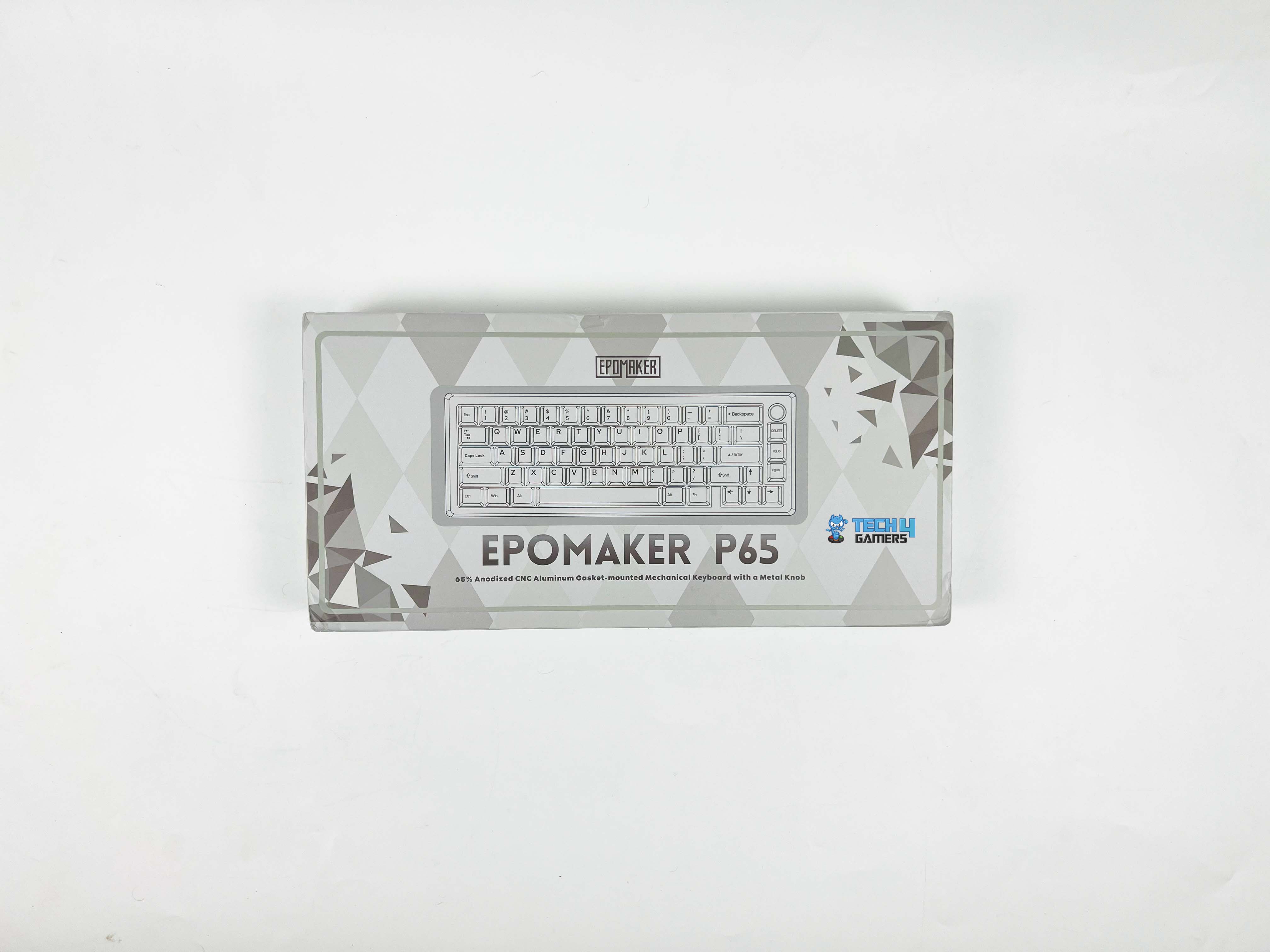
The Epomaker P65’s packaging is well-designed, making a good first impression. It is sturdy enough to ensure the keyboard’s protection while in transport. Its overall look is subtle with dominant typography and geometric design elements. On the front, we have a picture of the keyboard in the middle with highlighted key features such as a 65% anodized aluminum finish, a gasket-mounted design, and a metal rotary knob.
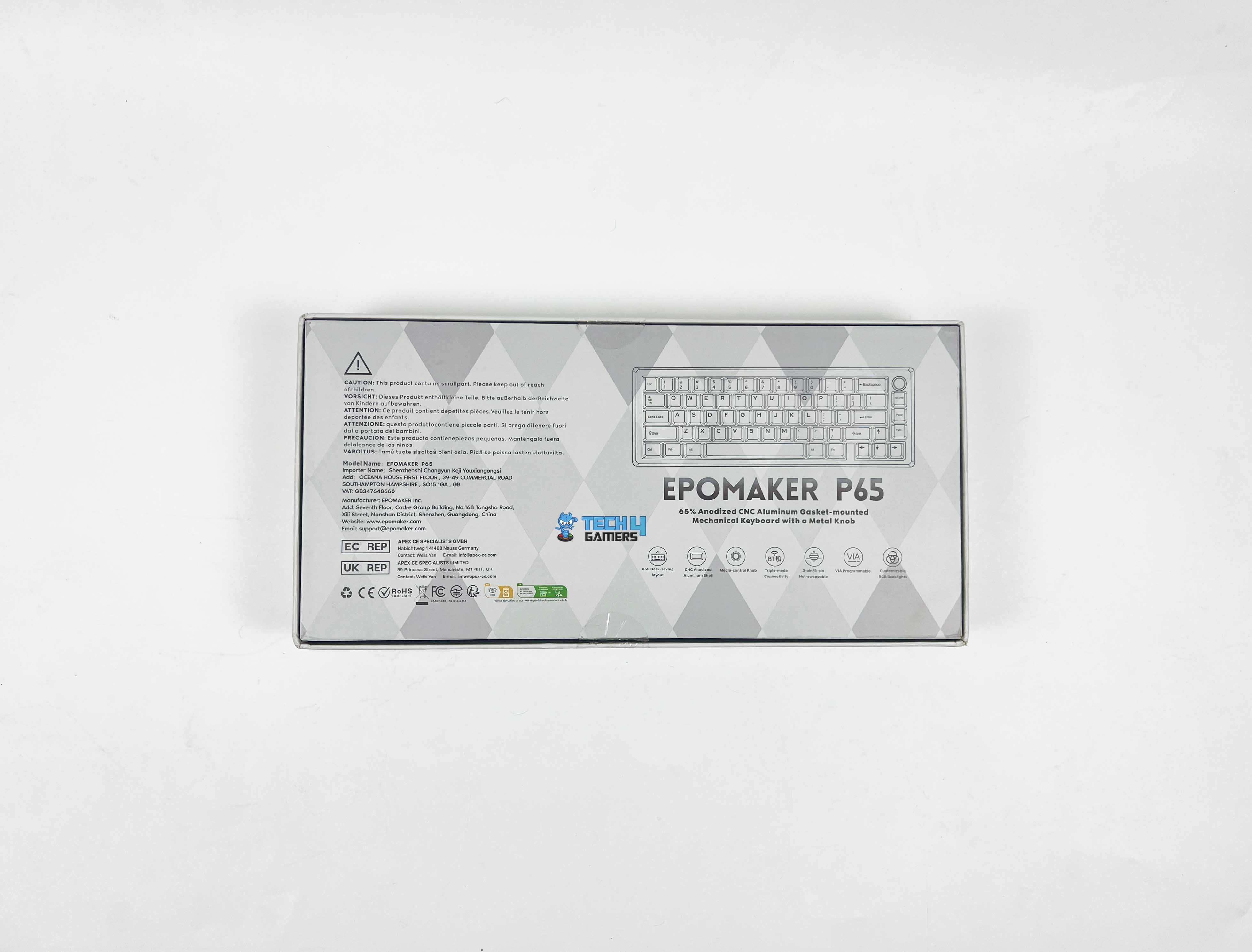
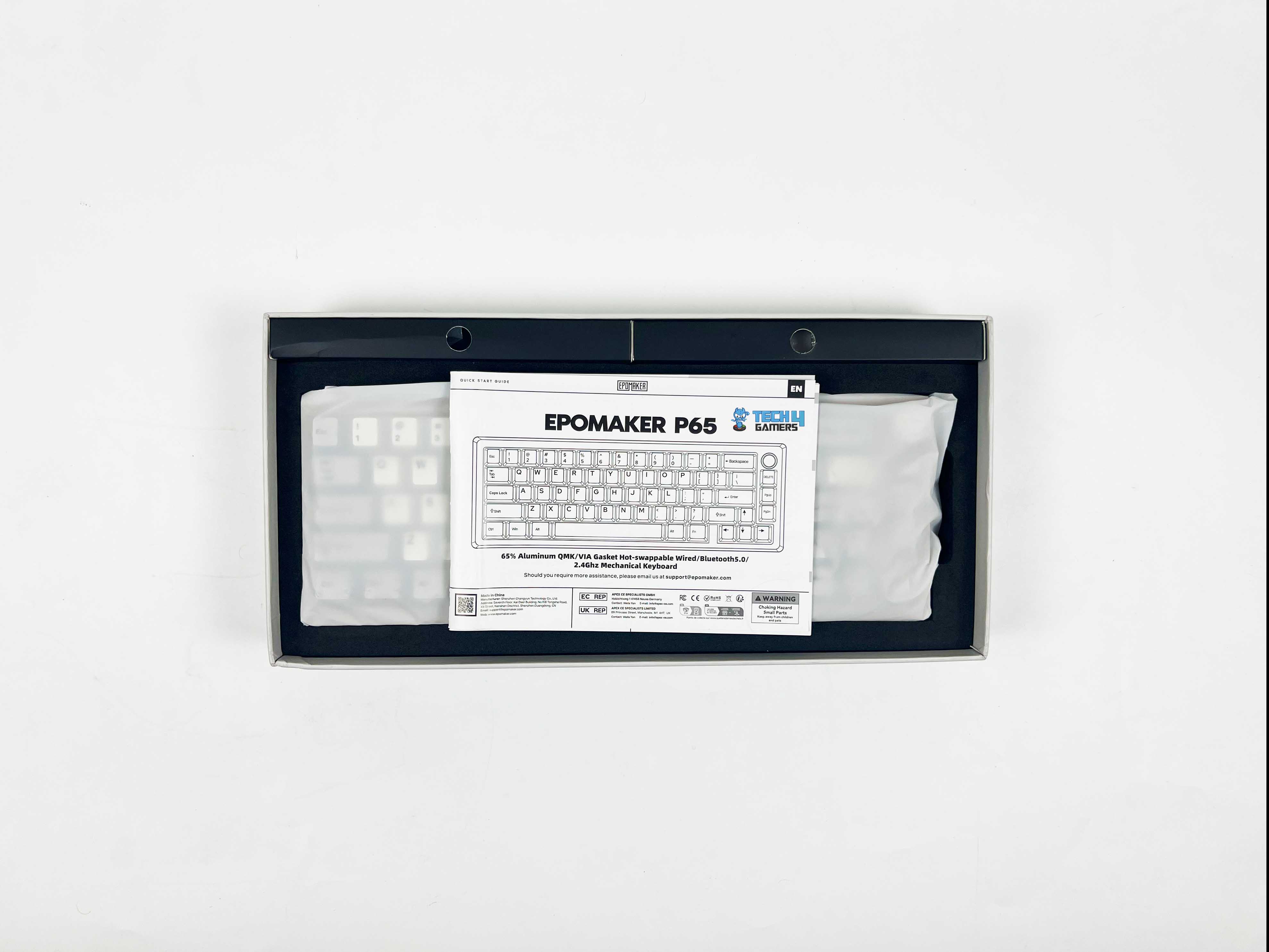
In comparison, we have a similar keyboard layout and prominent features displayed beneath it on the back. When I removed the outer sleeve, I immediately saw the keyboard and accessories placed adequately inside an inner box above it. The keyboard comes packed inside a protective cover, though I am disappointed it doesn’t come with a dust cover like other Epomaker keyboards. That said, everything has been laid out in a well-organized way.
Box Contents
Box Contents
Here is the list of everything that you’ll find inside the box:
Epomaker P65
2-in-1 Keycap-and-Switch Puller
2.4Ghz Wireless Receiver
Multilingual Manual
3x Extra Switches
USB A to USB C cable
Design
Design
Due to its substantial 1.3 kg weight, the Epomaker P65 appears massive on the desk and feels high-end right out of the box. It has two color options: Khaki and Black. As a review unit, I received the former variant. While keeping a sleek appearance, the CNC-machined aluminum frame provides durability.
Moreover, its rounded edges and anodized finish improve its looks and deliver a nice touch. On the other hand, the top and bottom areas are somewhat thicker. Additionally, to prevent the Epomaker P65 from seeming overly typical, the bottom wedge features delicate curves across its side profile. Its small yet sturdy form factor, 357x136x45x23mm, maintains an ideal balance between functionality and a strong build.
While the P65 offers wireless connectivity, its weight makes it less suitable for on-the-go use. It’s not the keyboard you’d want to toss into your backpack. Instead, it feels more at home on your desk. If portability is your priority, this might not be the best pick. However, if you need something lighter, look at our guide to the best wireless gaming keyboards.
Layout
Layout
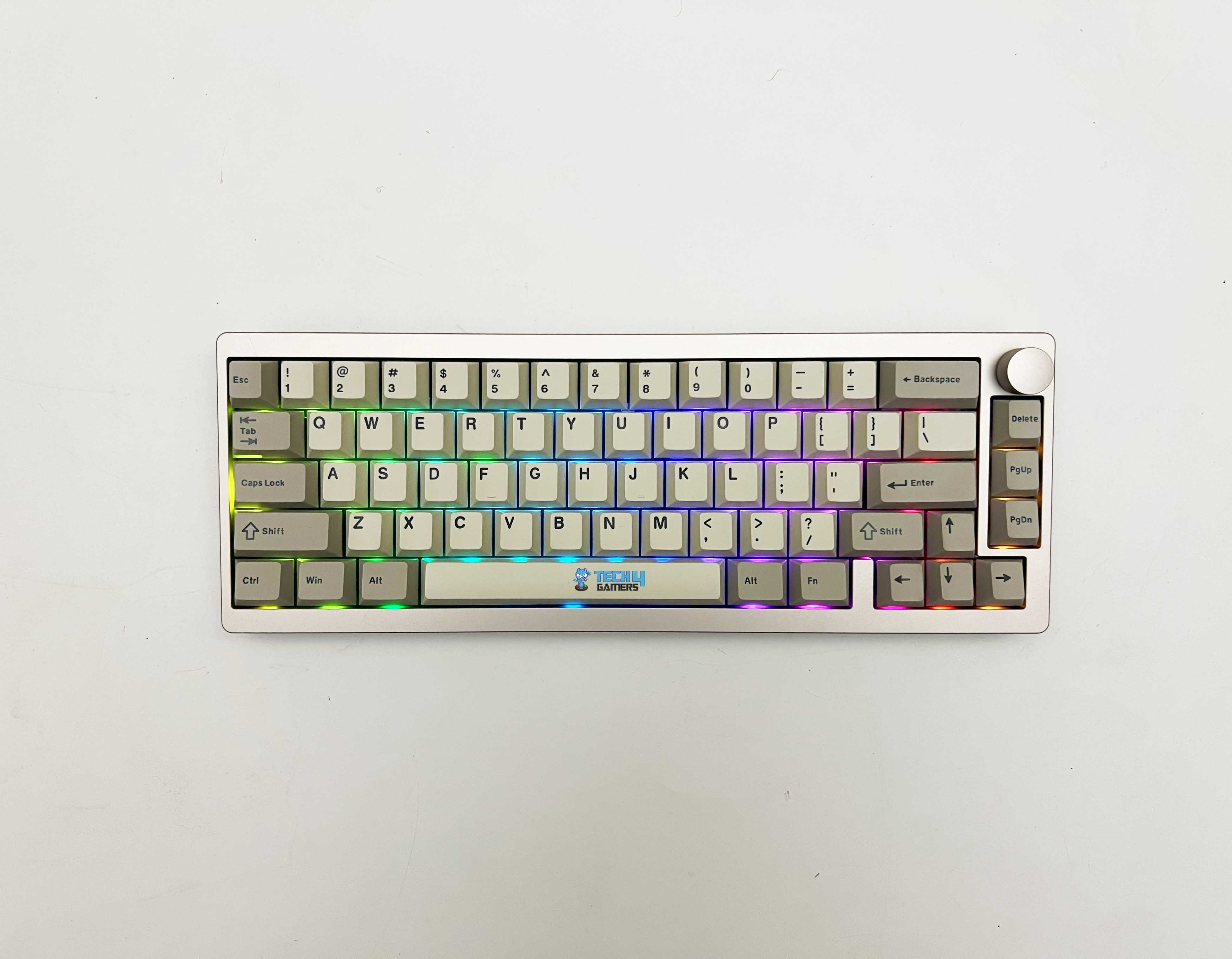
The Epomaker P65’s 65% US ANSI Layout emphasizes a form factor that requires less space while providing a compact yet functional layout. It excludes the function row and numpad to free up desk space while retaining necessary keys. On the upper-right corner of the keyboard is a metal rotary knob that clicks when pressed and rotates smoothly. It provides an additional level of utility and feels well-made. By default, it allows users to adjust the volume. Moreover, you can customize it to perform different tasks through the VIA software.
Underside
Underside
The Epomaker logo is positioned in the center of the one-piece metal covering the underside of the Epomaker P65. Thanks to its rubber feet on each of its four corners, it was pretty stable on my desk. Its pre-determined height and lack of adjustable feet make its typing angle unchangeable, which may be an issue for those looking for customizable ergonomics. Although its adjustability is limited, the slight elevation makes typing on it comfortable.
Build Quality
Build Quality
Regarding the build quality, the aluminum has a pleasant feel and no hollowness. The keyboard’s polycarbonate plate rests along the case’s grooves, and silicone gaskets are installed. Regarding mounting style, the Epomaker P65 feels consistent and has a standard gasket mount. Although it isn’t extremely soft or bouncy, it lessens harshness when a keystroke bottoms out.
Furthermore, the board has five sound-dampening layers to reduce resonance and ping. Three layers, including the IXPE switch, latex, and PET pad, are arranged between the plate and the PCB, with two layers of sponge and EVA foam at the bottom beneath the PCB. Because of its substantial weight and robust build, the board should be handled with both hands to avoid unintentional drops.
Keycaps
Keycaps
The Epomaker P65’s thick PBT keycaps, built with double-shot molding for a longer lifespan and a consistent feel, use my preferred keycap profile, Cherry. The case and keycaps share a matching palette, where you can choose between vintage beige keycaps for the Khaki color or jet-black keycaps for the black color. My review unit’s beige and gray color palette has a nostalgic, retro feel while still being elegant and high-end.
Unlike ABS keycaps, which have been known to shine over time, the matte texture of these PBT keycaps is enduring and feels fantastic beneath the fingertips. They are also resistant to wear and tear. The clear and distinct legends also contribute to the overall minimalist and clean aesthetic. With their recognizable sculpted shape and Cherry profile, the keycaps provide a comfortable typing experience.
RGB Lighting
RGB Lighting
1 of 2
RGB Lighting
RGB Lighting in a Dark Environment
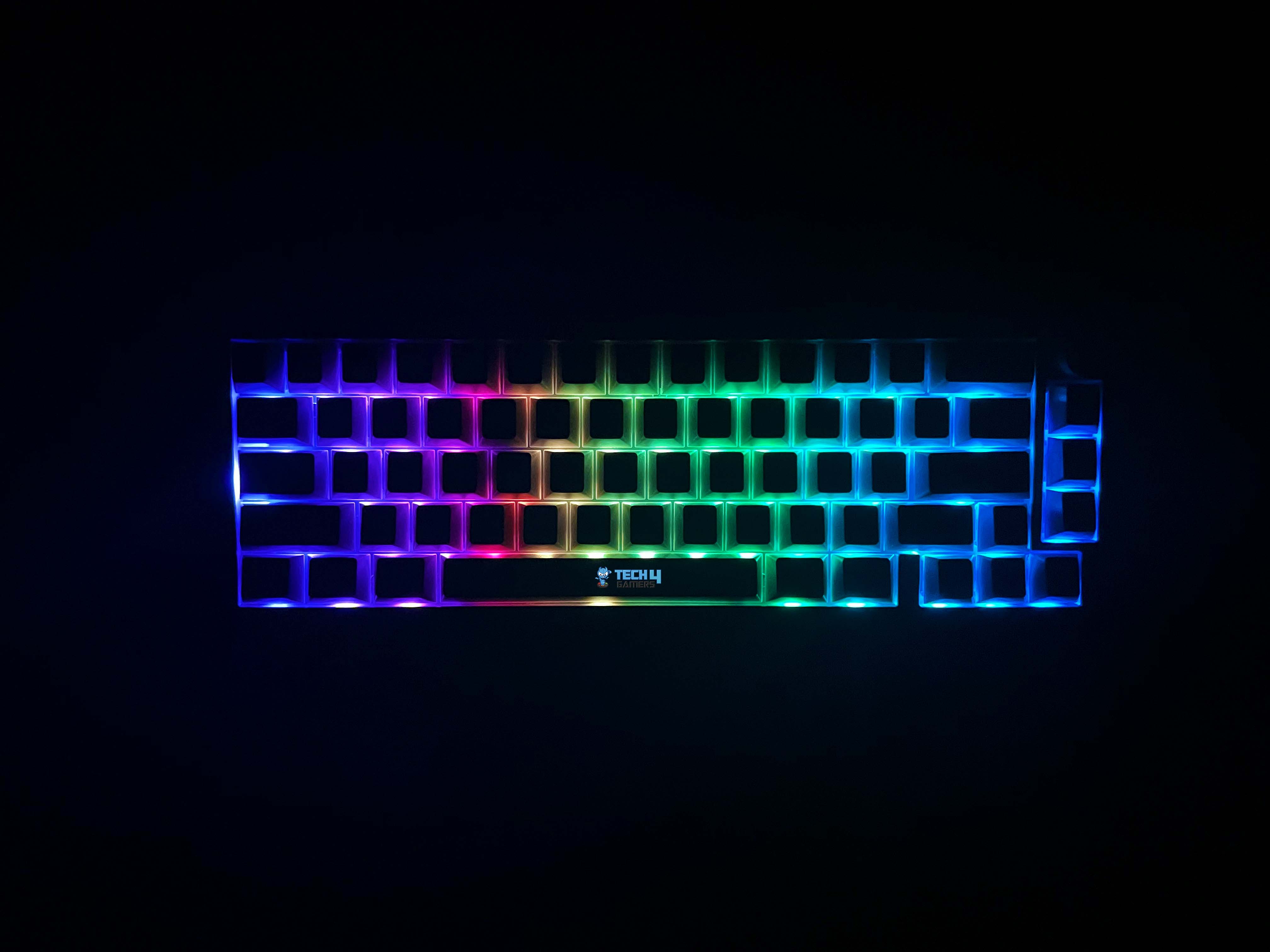
The Epomaker P65’s RGB lighting is elegant and straightforward. The LEDs emit bright colors without being excessively overwhelming. The legends are apparent in various lighting settings since the south-facing per-key LED placement ensures they stay easily readable even in dark environments.
This orientation is an excellent option for users who enjoy customizing their keyboards because it improves compatibility with various custom keycap options. It gives off a gentle ambient glow, which makes the keyboard’s appearance on my desk sophisticated but attractive. Users can also customize RGB lighting by adjusting its patterns, colors, and brightness. Of course, you can disable RGB if you don’t like it.
Switches
Switches
1 of 2
Switches
3-pin and 5-pin Compatibility
Switch Type
5-pin Linear, Factory Lubed
Trigger Force
45±3 gf
Bottom-out Force
62±5 gf
Pre-Travel
2.0±0.3mm
Total Travel
3.6±0.3mm
Material
POM & PTFE (Stem), PC (Top Case), PA66 (Bottom Case)
Life spans
5,000,000
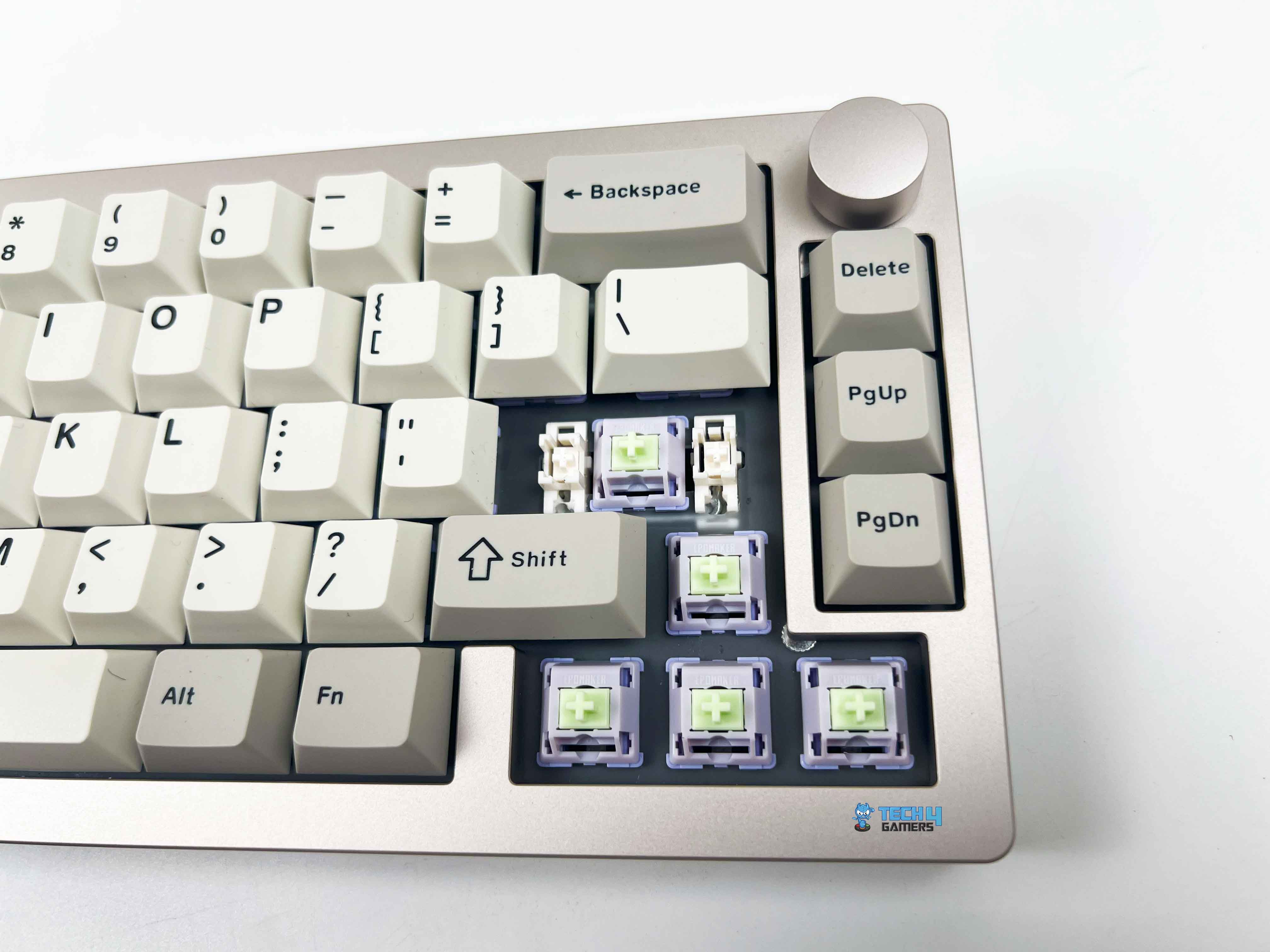
The Epomaker P65 offers two switch options: Epomaker Zebra and Wisteria Linear Switch. My review unit has the Wisteria Linear switches installed. These switches have a pastel green and purple color scheme inspired by the wisteria flower. Notably, the PC top housing, POM+PTFE stem, and PA66 bottom housing are used in it.
This combination reduces friction and provides a smooth keystroke, eliminating the need for further lubrication. Since the already factory-lubricated design keeps them continuously smooth even after prolonged usage. Furthermore, the 20.4 mm extra-long spring provides a reasonable actuation force of about 45±3 gf, ensuring an enjoyable bump despite feeling too weighty.
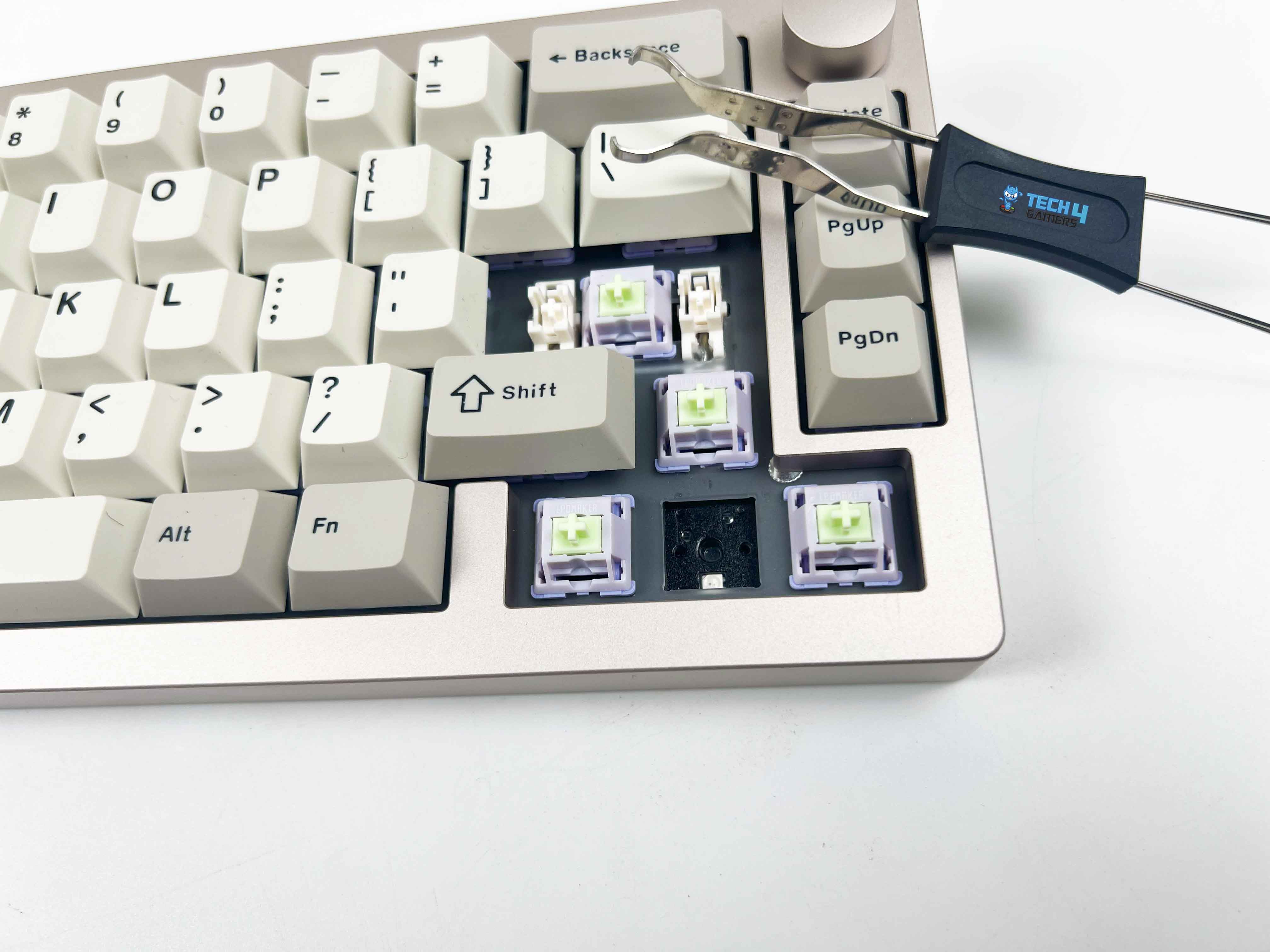
They are in the mid-range category, with a pre-travel of 2.0±0.3mm and a total travel distance of 3.6±0.3mm. Having been tested to withstand more than 5,000,000 keystrokes, Epomaker ensures long-term durability and reliability. Additionally, the keyboard has a hot-swappable PCB, which enables users to replace switches without soldering, and it is compatible with both 3-pin and 5-pin switches.
Connectivity
Connectivity
The Epomaker P65 offers three connectivity options: Bluetooth 5.0, a 2.4GHz wireless connection with a USB wireless receiver, and a wired connection using a USB Type-C cable. The back panel includes all three options. Starting from the left, it features a USB-C port for charging and wired connection and a switch to toggle between different connection modes with clear labeling.
You can set up a Bluetooth connection by flipping the switch to the left or a wireless connection to the right. It also features a magnetic storage space for the 2.4GHz dongle when not in use. According to the claims, the wired USB-C connection has a latency of 3ms, the 2.4GHz connection 5ms, and Bluetooth around 15ms. Honestly, all three connections handled typing, gaming, and everyday tasks without pa roblem.
Battery Life
The Epomkaer P65 features a 4,000mAh battery. However, its battery life is not officially mentioned. As per my usage, its battery capacity is enough for a few days without frequent charging. When the RGB lighting was set to full brightness, it took around four to five days before recharging. Notably, turning it off substantially improved battery life to a week and a half of usage, and you should, too, if it is a top concern.
Typing Experience
Typing Experience
The Epomaker P65 provides an outstanding typing experience thanks to its solid metal chassis and gasket-mount design, which improves acoustics. Notably, five layers of sound-dampening reduce unwanted noise and provide a solid, balanced typing experience with a pleasing sound profile. The Epomaker P65 has a fuller sound since the PCB has no flex cuts.
It produces a rich, low-mid focus and a deeply, rocky whole tone that never sounds lacking because of its metal chassis and PCB. The IXPE switch pad adds a rounded, somewhat resonant sound that I would describe as marbling, similar to the PE-foam mod. All in all, keypresses are smooth, scratchy, and rattling-free thanks to factory-lubricated switches and stabilizers.
Software
Software
1 of 5
Keymap Settings
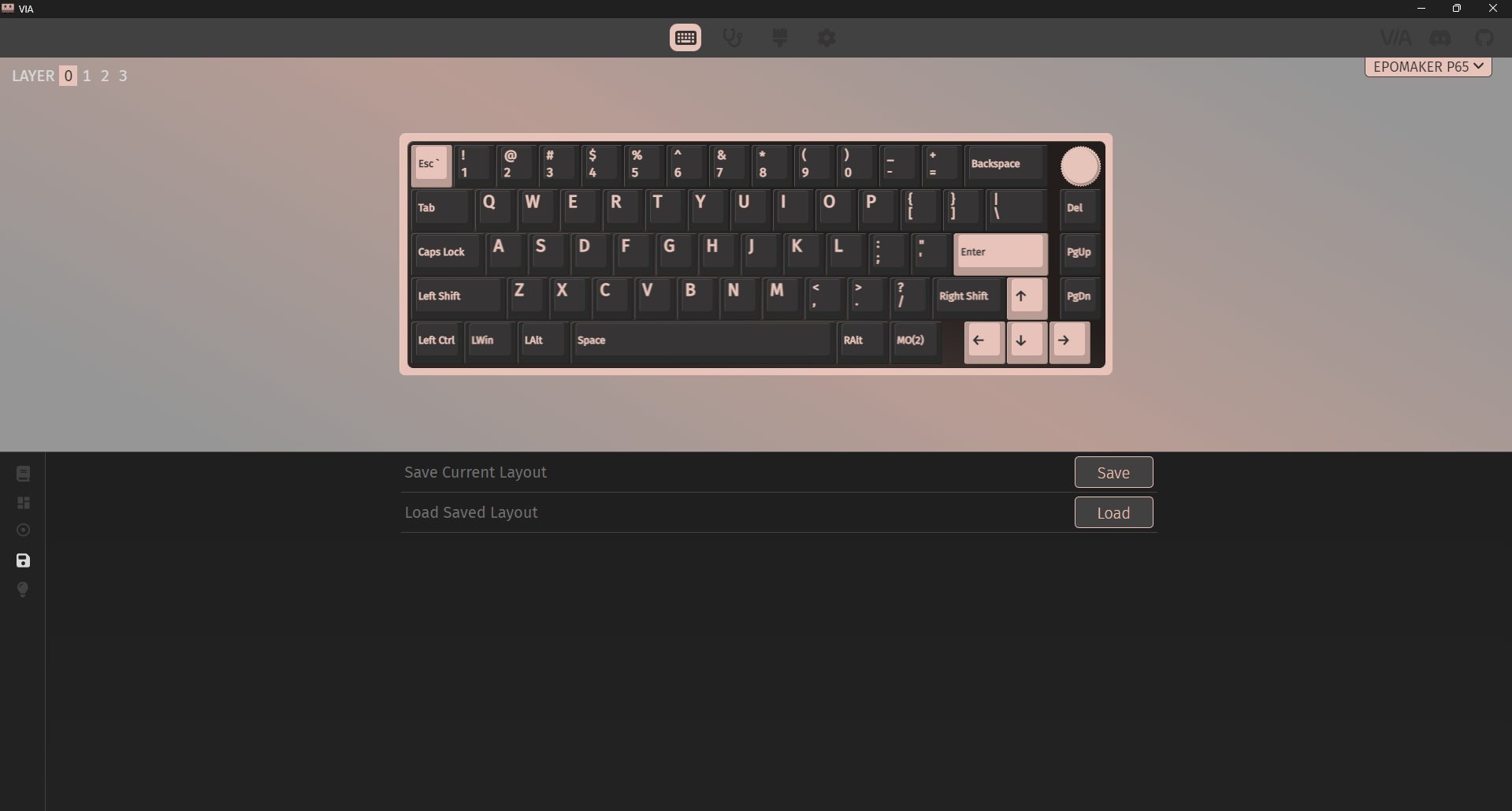
Save and Load Settings
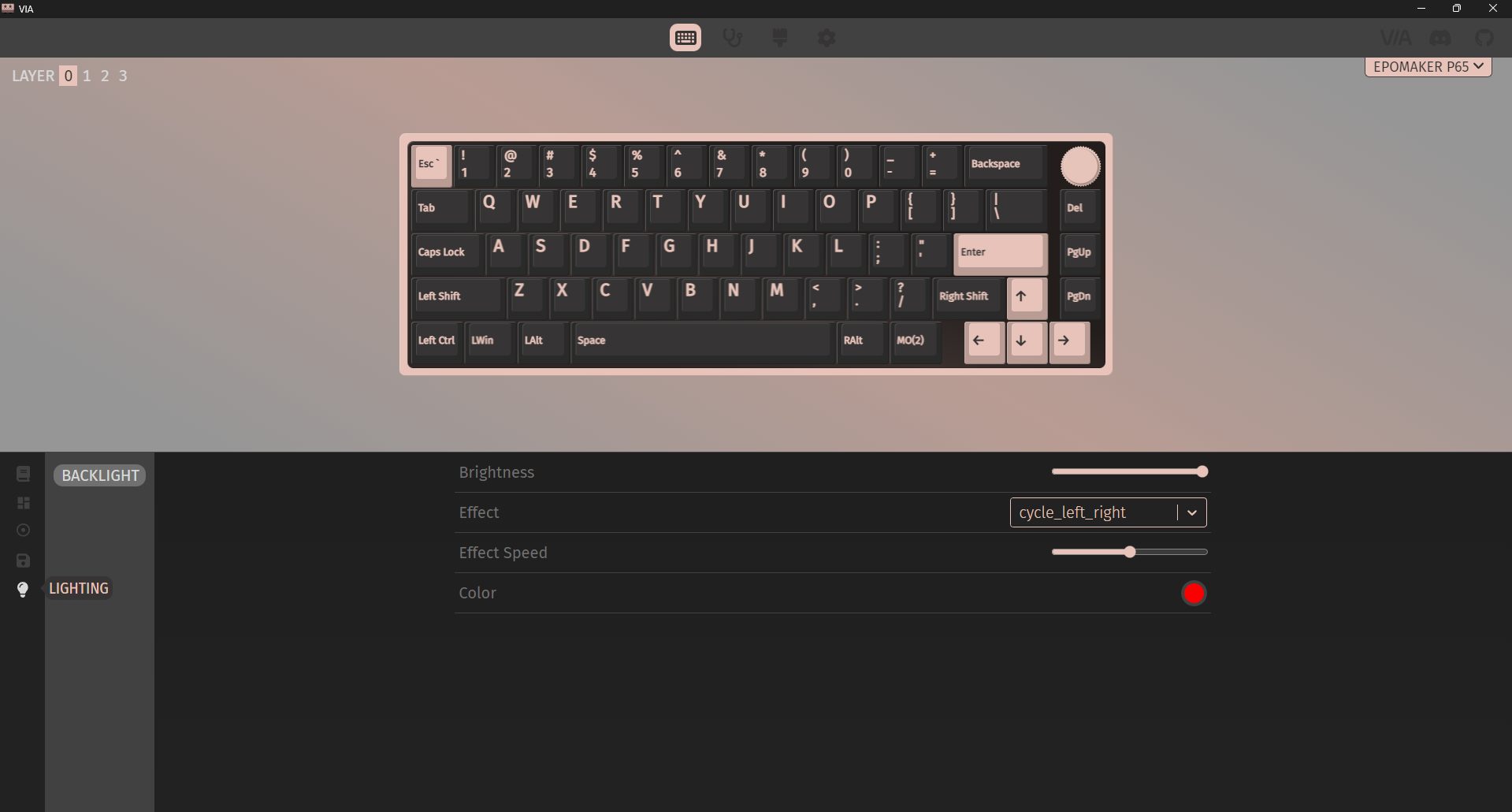
Lighting Settings
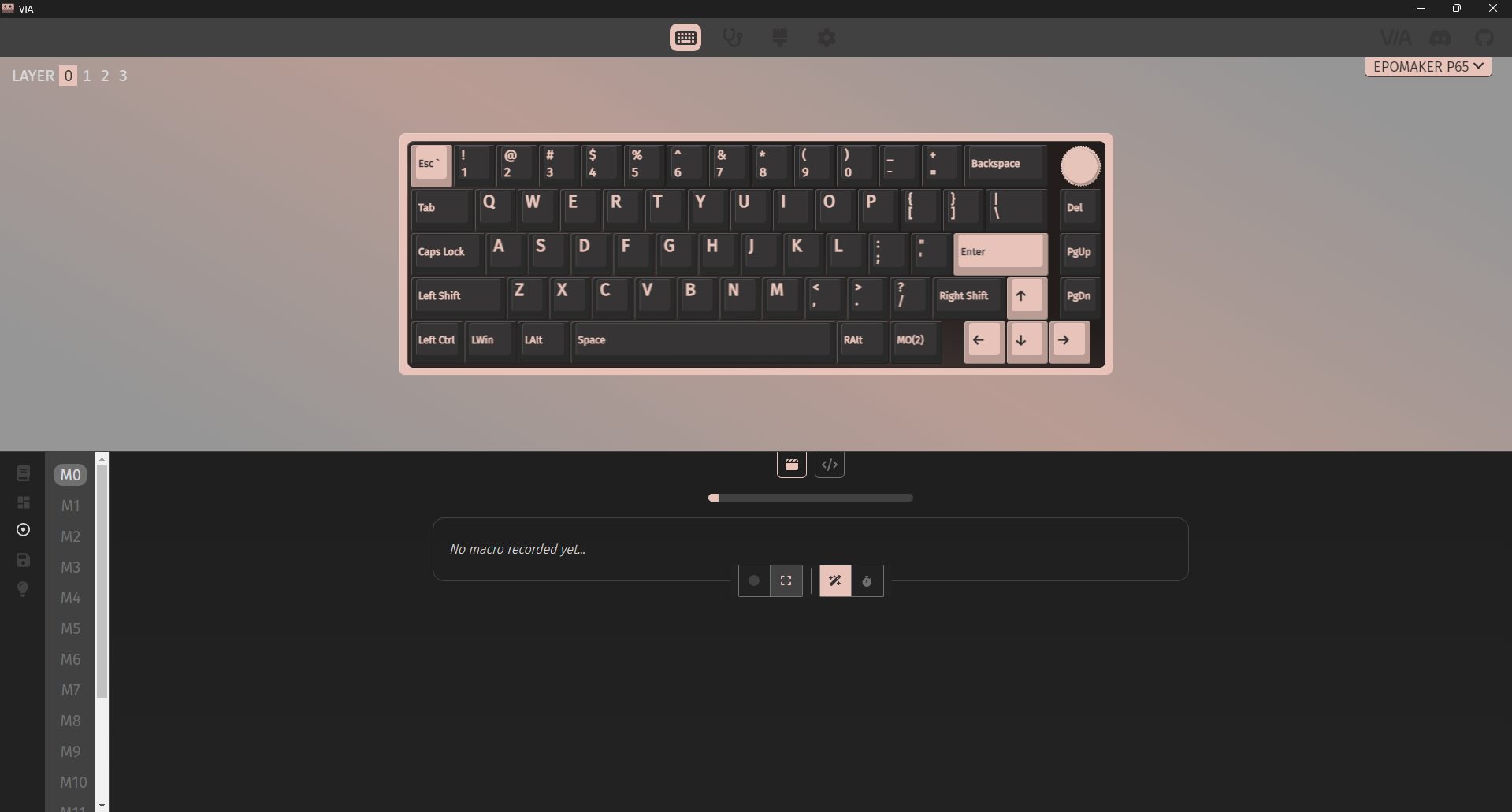
Macros Settings
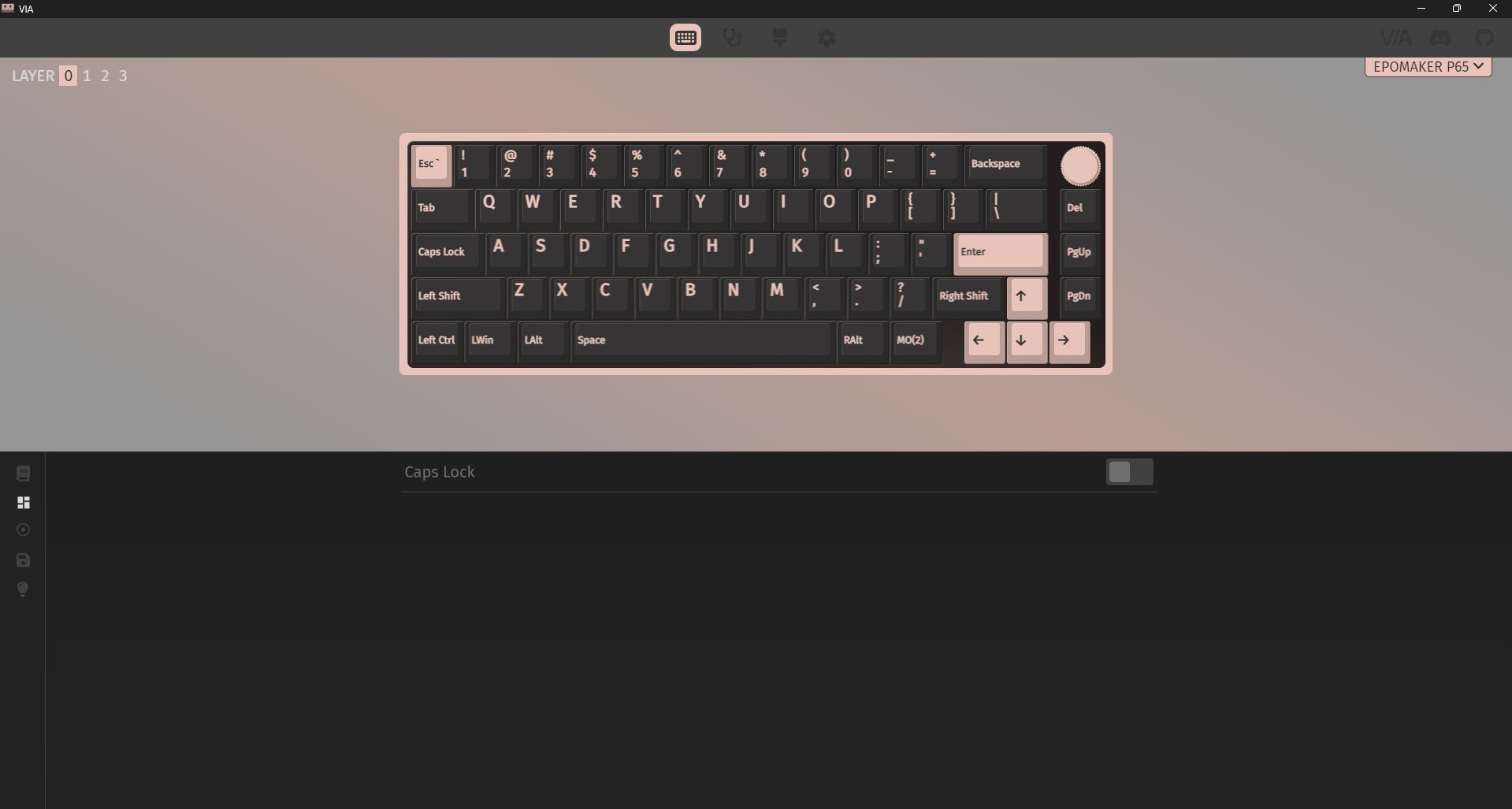
Layout Settings
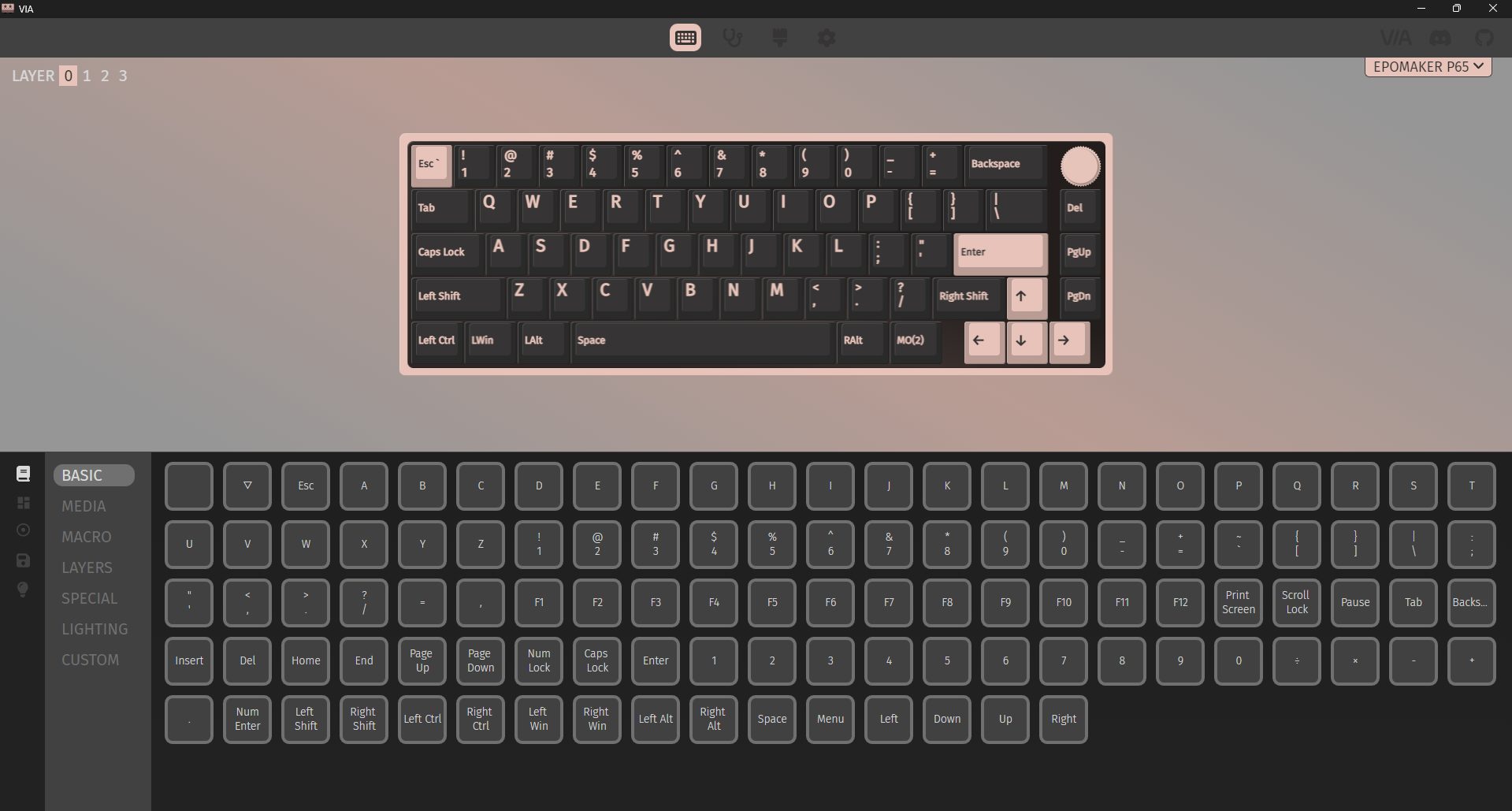
The Epomaker P65 is quite customizable and versatile because it is compatible with QMK/VIA. To get started, download the VIA file from GitHub and the Epomaker P65 JSON file from its official website and load the file. After connecting to VIA, you can create macros, change RGB lighting patterns, remap keys, and more.
The onboard memory saves the customized layout settings even when the software is not running in the background. VIA’s integration improves accessibility without requiring the need to download additional software. I’m happy Epomaker chose the VIA software over the specific Epomaker driver.
Should You Buy It?
Buy It If
✅ You want a premium keyboard: The CNC-machined aluminum chassis and 1.3 kg weight give the P65 a rock-solid feel that stays put during heavy typing or gaming.
✅ Sound quality matters to you: The gasket-mount design and five dampening layers deliver that deep, thocky, well-rounded tone enthusiasts love.
✅ You value customization: Hot-swappable PCB, VIA/QMK support, and a programmable metal knob mean you can tweak key assignments, macros, lighting, and much more.
Don’t Buy It If
❌ You’re looking for portability: The P65 isn’t made for tossing in a backpack at over a kilogram and with a thicker profile.
❌ You need adjustable ergonomics: The fixed 6° typing angle and absence of adjustable feet limit your positioning options.
My Thoughts
After several weeks of using the Epomaker P65, I’ve had enough time to test it rigorously in gaming and everyday tasks. I was immediately impressed by the build quality. It feels sturdy and high-end because of its aluminum chassis, and its weight keeps it in place even during raging gaming sessions. However, if you move your keyboard around a lot, it is not a good portable choice. Additionally, the five-layer sound-dampening and gasket-mount design makes typing steady, consistent, and smooth.
Thanks to the factory-lubricated Wisteria linear switches, which provided a distinct bump without being too resistant, long hours of typing were comfortable. The stabilizers were relatively quiet, eliminating any unnecessary rattling on larger keys, and there was no scratchiness. All things considered, the Epomaker P65 is an outstanding pre-built option if you value a straightforward, well-made keyboard. It isn’t extravagant and only comes in two colors, but the simplicity is impressive.
At Tech4Gamers, I contribute as a Senior News Reporter, combining my skills and gaming enthusiasm to keep our audience updated on the latest developments.
Story Highlight
The PlayStation handheld reportedly uses a custom SoC from Sony and AMD.
It is said that Sony plans to use Samsung’s SF2P node for the fabrication process of the SoC.
The chip is expected to enter mass production in 2028, suggesting the handheld is still multiple years away.
Following the success of various handhelds over the last decade, PlayStation is expected to return to this segment of the industry. The company’s recent experiment with a streaming handheld has also been a success, motivating it to explore this segment further.
Although information regarding this console is limited, it is said that the new portable system will support all PS5 games. An insider has further highlighted that PlayStation intends to launch the handheld in 2028 or later.
Why it matters: Sony is expected to launch the PS6 no later than 2028, making the insider’s report regarding this handheld quite interesting.
The PlayStation Handheld Is Expected To Launch After The PS6 | Image via X
As per insider Jukanlosreve, Sony is working on an internal chip for its handheld. This SoC is codenamed ‘Jupiter’ and is being worked on as a joint effort between AMD and Sony.
Samsung is expected to take the lead in producing the node as opposed to TSMC. The SF2P node is expected to be based on a 2nm process, leaving interesting implications for the efficiency of handhelds that opt for this node.
According to the insider, this SoC is expected to enter mass production by 2028, hinting that the PlayStation handheld will arrive after the PS6. This could allow Sony to market its handheld as an all-purpose system capable of running modern games.
Moreover, PlayStation’s approach should allow it to eclipse upcoming handhelds like the Nintendo Switch 2 in raw power by then.
Sony Considers The PlayStation Portal A Success Overall
The Xbox handheld is also expected to launch earlier than 2028, so Sony’s plans could take these scenarios into account. Perhaps the gaming giant intends to study its rivals before fully committing to this segment of the industry again.
At Tech4Gamers, I contribute as a Senior News Reporter, combining my skills and gaming enthusiasm to keep our audience updated on the latest developments.
Story Highlight
A survey shows that around 70% of online-only games will eventually be pulled offline.
Less than 5% of such games are patched to run offline by the developers.
This survey has raised concerns about preservation efforts in the industry.
Game preservation has become a big concern in the industry recently, and things have only changed for the worse with each passing year. Although many still prefer physical copies to be safe, publishers continue to push toward the digital age.
This means that they hold the power to delist games or shut down servers at any given moment. The latter, in particular, is a problematic scenario since it leads to gamers losing access to a service they paid for. In fact, a survey reveals that 70% of games with an internet connection requirement are destined to meet this fate.
Why it matters: The Crew stands out as a recent example of the trend. Following Ubisoft’s closure of the game, the company faced a lawsuit and clarified that games are distributed as mere licenses.
The aforementioned survey was conducted by the consumer movement Stop Killing Games. This group aims to rally support for more serious preservation efforts in the industry, and its latest findings reveal why this is so important.
Stop Killing Games looked at around 700 games, categorizing them into unplayable games, titles at risk, online games preserved by publishers, and fan projects for preservation.
The ‘titles at risk’ category includes most games still running with such a requirement, so Stop Killing Games presented a graph without this category for an even better look at the state of game preservation.
In a shocking revelation, a whopping 70% of the games fell in the unplayable category. This means that out of 425 titles used for the research, 299 are no longer playable.
Most Games With Online Requirements Are In Trouble | Image via Stop Killing Games
It should be noted that this list includes games like Battlefield Bad Company 2 and Crysis 3, which have lost online multiplayer but still have an offline component that remains playable.
However, even when excluding such examples, the percentage of unplayable games stays at 68.77%. A game like Concord would fall into this category, while a title like Suicide Squad: Kill the Justice League would be part of the few games saved by the developers themselves.
What are your thoughts on the current controversies regarding publishers pulling their biggest titles offline? Let’s discuss in the comments and on the Tech4Gamers Forums.