I’ve previously worked for eXputer as a Senior News Writer for several years. Now with Tech4Gamers, I love to devoutly keep up with the latest gaming and entertainment industries. I have a Bachelor’s Degree in Computer Science and years of experience reporting on games and breaking exclusive stories. Besides my passion for gaming journalism, I love spending my leisure time farming away in Stardew Valley. VGC, IGN, GameSpot, Game Rant, TheGamer, GamingBolt, The Verge, NME, Metro, Dot Esports, GameByte, Kotaku Australia, PC Gamer, and more have cited my articles.
Story Highlight
Steam recorded its best December to date last month, generating over $1.6 billion in sales.
The platform grossed over 22% more in sales compared to December 2024.
Titles like Arc Raiders, R.E.P.O., PEAK, and Battlefield 6 were at the forefront thanks to hefty discounts.
Valve has had a 2025 like no other, with the gaming giant breaking one record after another. The company achieved an all-time high in revenue, while also attaining one of the highest earnings-per-employee ratios globally.
The force behind Valve’s success is none other than Steam. The online juggernaut alone generated over $16 billion in sales this year, and according to a new report, this number is set to see a substantial increase thanks to the holiday season.
Why This Matters: Such heavy traffic and record-breaking sales on Steam at the end of 2025 showcase how the year has been filled with brilliant releases across many genres.
Best-selling titles on Steam this holiday season. Source: Alinea Analytics
According to a report from Alinea Analytics, December 2025 was Steam’s highest-grossing holiday month ever as the online platform made over $1.6 billion in sales. Compared to December 2024, the platform recorded a staggering 22.7% increase in revenue.
Furthermore, Steam’s gross last month was even able to beat out the pandemic-induced holiday period of December 2020, which had previously held this record for 5 years, grossing $1.4 billion thanks to everyone being confined to their homes.
Unsurprisingly, Arc Raiders was one of the major forces behind this historic December for Steam. As per Alinea Analytics, the game sold over 1.2 million copies on the platform, making it the best-selling title on Steam during the holiday period.
Sales of Arc Raiders helped Steam record this historic December in 2025.
Moreover, hefty discounts on old and in-demand games once again generated a lot of revenue for Steam this December. Detroit: Become Human almost sold a million copies thanks to a 90% discount, bringing its price tag to $4.
Battlefield 6 also shifted 700k copies, thanks to a 30% discount, while indie hits R.E.P.O. and PEAK were among the top 6 best-selling titles during the winter season, continuing the indie dominance on Steam into the new year.
Do you think Steam is going to continue breaking records in 2026? Or is the exclusion of GTA 6 from the platform going to hurt player traffic this year? Tell us in the comments below or head to the Tech4Gamers forum for discussion.
As Tech4Gamers’ Founder and Editor-in-Chief, I bring over 13 years of PC Hardware Reviewing and 8+ years of IT Project Management experience. Certified in Google IT Support , my focus is on providing honest product reviews and analysis and fostering a strong gaming community with 130k+ members in PPG.
Story Highlight
DLSS 4.5 significantly improves image quality using a heavier 2nd-gen Transformer model, with minimal impact (2–3%) on RTX 40/50 GPUs thanks to newer Tensor cores and FP8 support.
RTX 20 and 30 series lack FP8 and newer Tensor cores, causing major performance penalties when using DLSS 4.5.
Early tests show up to 20–24% performance loss and higher VRAM usage on older GPUs, making DLSS 4.5 costly for RTX 20/30 users.
With the release of the drivers that enable the new NVIDIA DLSS 4.5 Super Resolution, we can now see the performance cost of improving visual quality. If you’re unfamiliar with it, DLSS 4.5 introduces the new 2nd Generation Transformer model.
In short, this improves visual quality when you activate DLSS upscaling technology. And not only that, but it also reduces and even eliminates (in certain circumstances) artifacts such as ghosting, shimmering, and unstable edges. At the same time, it improves sharpness in motion, especially in areas where DLSS previously struggled, such as with dense vegetation, fine particles, or blur.
With this brief context, you should now know that all these improvements come at a price in terms of performance. This new model is heavier, and logically, the NVIDIA GeForce RTX 50 series, the most advanced models, are the ones that suffer the least in terms of performance from these improvements.
In practice, we’re talking about a performance loss of around 2 or 3% compared to the previous Transformer in the current-gen RTX 50 series GPUs. All of this comes at the cost of greater image definition and reduced or eliminated artifacts. Even in the RTX 40 series, the impact is small, and the reason is simply that they have better Tensor cores and FP8 hardware acceleration to increase inference performance.
DLSS 4.5 Faces Major Issues on Older RTX 20 & 30 GPUs
DLSS 4 vs DLSS 4.5
The problem with NVIDIA DLSS 4.5 Super Resolution arises when the 2nd Generation Transformer model is compared to GeForce RTX 30 and RTX 20 series graphics cards. The main reason for this is the lack of the FP8 format. This is compounded by a smaller number of Tensor cores, which are also older. As a result, the fixed cost of upscaling has a much greater impact on performance, and early tests clearly show noticeable performance drops.
The performance tests provided by Mostly Positive Reviews (MPR) are devastating. First of all, to provide some context, the DLSS programming guide lists several presets that already indicate that the NVIDIA GeForce RTX 30 and 20 series are incompatible with them due to very low performance:
DLSS Performance Guide Provided by Nvidia
Preset K: Default for DLAA, Quality and Balanced, with less overhead than the new presets.
Model M: Optimized and recommended for DLSS Super Resolution Performance mode.
Model L: Optimized and recommended for 4K DLSS Super Resolution Ultra Performance mode.
Preset J: Close to K, with compromises (less ghosting in some cases, higher risk of flickering).
According to the table provided by NVIDIA, the GeForce RTX 30 and RTX 20 series cards can only access Presets J and K. These are presets that prioritize lower quality in exchange for higher performance. Therefore, MPR wanted to compare the performance of a GeForce RTX 3080 Ti with DLSS 4.5 Super Resolution in Cyberpunk 2077. To do this, they compared Presets M and K.
GeForce RTX 3080 Ti Sees Up to a 24% Performance Drop
Performance tests provided by Mostly Positive Reviews (MPR)
At 4K resolution, with Ultra graphics settings and DLSS on Quality, Preset K offered an average performance of 42 FPS compared to 32 FPS for Preset M, representing a 24% performance impact with RTX 3080 Ti. At 1440p resolution, the performance impact was 14%. At 1440p without Ray Tracing, the impact was 20%. In The Last of Us Part II at 4K, the performance loss was 14%, from 154 to 135 FPS.
Then there’s another problem: DLSS 4.5 consumes more GPU memory. This means that GPUs with 8GB of VRAM, which were already limited or barely adequate for today’s gaming, would suffer from stuttering or performance drops. At 4K resolutions, we’re talking about more than double the additional VRAM usage on an RTX 30 or 20 series card to compensate for the limitations of an older technology.
A GeForce RTX 3060 went from 56 FPS without AA to 52 FPS with the K preset and 38 FPS with the L or M presets in Cyberpunk 2077. Therefore, this technology is costly for older graphics cards, but for modern ones, it barely makes a difference.
Thus, on average, the RTX 30 and 20 series lose about 20% of performance, compared to a maximum of 3% for the RTX 50 series. And of course, in the case of the RTX 50 series, it’s well worth it. There’s a very small performance loss in exchange for a massive improvement in image quality, according to Jacob Freeman, an expert in DLSS and RTX Remix at NVIDIA.
At T4G, my task is to cover the latest news around the gaming globe ASAP and with the utmost precision. I adore all the games and respect all the devs behind the amazing games that we get all year. So, whether it’s a PC or a Console game, I got it all covered.
Story Highlight
Early reviews suggest that Nvidia’s new dynamic frame gen tech is pretty good.
Frame gen is often criticized for latency, weird color shifts, and visible fake frames.
DLSS 4.5 brings this new tech exclusively to Nvidia’s RTX 50 Series cards.
Nvidia’s recent CES presentation was relatively lackluster for those specifically waiting for the RTX 50 Super GPUs. It was mostly centered on AI and gave a detailed look at its upgraded upscaling technology, DLSS 4.5.
Along with DLSS 4.5 comes the latest version of frame generation, and for the first time, it might actually be usable. Early reviews point out that the new dynamic multi-frame gen is actually the first time fake frames might actually be good.
Why it matters: Frame gen is criticized for multiple reasons, including latency and easily detectable fake frames. However, in its latest iteration, Nvidia has focused on improving the latter, but latency remains an issue.
The Dynamic Multi Frame Gen, which will be available later on the RTX 50 series, exclusively works differently from the old tech. Instead of just having a single locked multiplier, it can switch between them when necessary, up to 6x.
So, say you have a 120 FPS target in the menu, the AI will decide whether frame gen is needed or what multiplier is required at that moment and use that. Linus Tech Tips reports that it’s actually brilliant, and you can hardly tell the difference.
Frame gen is criticized for various recurring issues.
With its older generations, there were weird smearing and color shifts that have now been eliminated. In Outer Worlds 2, Linus couldn’t even tell if the dynamic frame gen was on or not during gameplay.
However, as usable as it is now, latency is still present and has even gotten somewhat worse. But, if you are solely into single-player games and want to hit higher FPS, this is the first time frame gen could actually help you out.
What are your thoughts on dynamic frame gen actually being usable compared to older generations? Let us know your opinions in the comments or join the discussion at the official Tech4Gamers Forum.
At Tech4Gamers.com, I cover the latest news and rumours in the gaming industry, from new game releases to hidden gems and video game leaks. Furthermore, I occasionally write tech articles about video game consoles, providing insights into the hardware and software that powers our gaming experiences.
[Press Release] The Coorsair GALLEON 100 SD introduces a new class of gaming keyboard by combining a full-sized mechanical board with native Stream Deck integration. Designed in collaboration between Corsair and Elgato, it addresses the growing need for players to manage games, apps, and system information without breaking focus or leaving the action.
At its core, the GALLEON 100 SD embeds a complete Stream Deck experience directly into the keyboard. Twelve customizable LCD keys support dynamic profiles, folders, and macros, while dual multifunction dials allow fast, precise adjustments with push input.
A five-inch full-color display keeps real-time information like system stats, audio levels, or app status constantly visible. All of this is configured through the lightweight Stream Deck app, ensuring smooth background performance.
In-game, the integration streamlines complex actions into single presses. Abilities, inventory management, and multi-step commands can be triggered instantly, reducing reliance on layered keybinds or menus.
Prebuilt profiles from the Elgato Marketplace allow players to jump into popular titles quickly, with deep customization available for competitive playstyles.
Beyond gaming, the keyboard functions as a central control hub. Media playback, voice chat, peripheral management, and system monitoring can all be handled without alt-tabbing. With extensive plugin support, the GALLEON 100 SD adapts easily to streaming, multitasking, and content creation workflows.
Performance remains a priority. Corsair’s AXON technology enables hyper-polling rates up to 8,000Hz for near-instant input response, while FlashTap SOCD handling improves directional control and counter-strafing precision. Pre-lubed MLX Pulse switches deliver fast actuation with smooth, tactile feedback.
The aluminum frame, gasket mounting, layered sound dampening, cushioned palm rest, and customizable RGB accents complete a refined, premium package.
At Tech4Gamers.com, I cover the latest news and rumours in the gaming industry, from new game releases to hidden gems and video game leaks. Furthermore, I occasionally write tech articles about video game consoles, providing insights into the hardware and software that powers our gaming experiences.
[Press Release] At CES 2026, Corsair presented a new range of esports-focused gaming peripherals built for speed, precision, and durability. The lineup includes upgraded ultralight mice, a control-oriented mouse pad, and a modular Hall Effect keyboard, all designed to meet the demands of competitive players.
SABRE v2 PRO CF and MG
Corsair SABRE v2 PRO series expands with carbon fiber and magnesium alloy wireless models. Both versions support up to 8,000Hz hyper-polling in wired and wireless modes, offer up to 120 hours of battery life, and feature tri-mode connectivity via 2.4GHz wireless, Bluetooth, and USB-C.
The SABRE v2 PRO CF uses a carbon fiber unibody to achieve a 55g weight while maintaining high rigidity. The SABRE v2 PRO MG follows closely at 56g, using magnesium alloy for players who prefer a metallic feel with added durability. Both mice are tuned for consistent, high-precision aiming in competitive play.
MM PRO Control Mouse Pad
The MM PRO Control Esports-Tuned Cloth Mouse Pad is designed for precise tracking and controlled movement. Its non-slip hex-patterned base keeps it firmly in place, while the thicker surface and sloped edges improve comfort and stopping power during long sessions.
MAKR PRO 75
The MAKR PRO 75 builds on the award-winning MAKR 75 DIY keyboard, featuring Hall-Effect magnetic switches, adjustable actuation, and gaming-focused features like Rapid Trigger and FlashTap. It supports up to 8,000Hz hyper-polling and comes housed in an aluminium frame with a rigid FR4 switch plate.
While fully assembled out of the box, the keyboard supports modular upgrades, including wireless connectivity and an LCD screen, allowing users to expand functionality without losing DIY flexibility.
At Tech4Gamers.com, I cover the latest news and rumours in the gaming industry, from new game releases to hidden gems and video game leaks. Furthermore, I occasionally write tech articles about video game consoles, providing insights into the hardware and software that powers our gaming experiences.
[Press Release] COUGAR returns to CES 2026 with a clear focus on long-term design instead of short-lived disruption. The new lineup showcases evolution in cooling, power delivery, and ergonomics, aiming to improve how gamers live with high-performance systems.
Showcased from January 6 to 8 at a private VIP showroom in the Venetian Resort, the portfolio looks stacked.
Modern gaming setups demand more airflow, stable power, and physical comfort during long sessions. COUGAR’s 2026 designs rethink internal layouts, turning unused space into active cooling paths and reducing friction during building and upgrades.
The goal is simple: hardware that performs better while staying quieter, cleaner, and easier to live with.
Next-Gen PC Cases Focused on Airflow
The CFV235-G introduces an enhanced Central Floating Ventilation structure that transforms empty internal space into an active airflow channel. Combined with a full glass panoramic design, it balances strong cooling with a clean showcase aesthetic.
The MX600 Max refines airflow precision using optimized perforations and large 200mm ARGB fans guided by a dual-curve airflow ramp. A modular I/O panel and removable top cover simplify installation and placement.
The Duoair offers flexibility between mesh performance and glass aesthetics. Moving the PSU to the front creates an additional intake channel that improves cooling for GPUs up to 410mm without sacrificing style.
The FV130 trims excess bulk from panoramic dual-chamber designs. An angled bottom fan eliminates dead air zones while keeping the case compact enough for desk setups, even with large GPUs and modern motherboard layouts.
Terminator Air Gaming Chair
The Terminator Air gaming chair extends COUGAR’s machine-first thinking into ergonomics. Its Dynamic Adaptive Support system adjusts in real time as posture changes, maintaining consistent back support.
Breathable mesh, automatic recline tension, and highly adjustable armrests reduce fatigue during long gaming or work sessions.
New Power Supplies
The Polar V2 series delivers fully modular 80 PLUS Platinum efficiency with support for extreme power spikes and dual-GPU systems. Built with Japanese capacitors and advanced protections, it maintains a stable output even at high temperatures while staying quiet.
The PV series focuses on high efficiency and next-generation readiness, offering native PCIe 5.1 support and low thermal waste for modern builds.
The GQ series provides a compact, cost-effective option with ATX 3.1 compliance and PCIe 5.1 support, fitting easily into a wide range of cases without compromising reliability.
I’ve previously worked for eXputer as a Senior News Writer for several years. Now with Tech4Gamers, I love to devoutly keep up with the latest gaming and entertainment industries. I have a Bachelor’s Degree in Computer Science and years of experience reporting on games and breaking exclusive stories. Besides my passion for gaming journalism, I love spending my leisure time farming away in Stardew Valley. VGC, IGN, GameSpot, Game Rant, TheGamer, GamingBolt, The Verge, NME, Metro, Dot Esports, GameByte, Kotaku Australia, PC Gamer, and more have cited my articles.
Story Highlight
Nvidia revealed a new Resident Evil Requiem trailer on RTX 5090, showcasing DLSS 4’s capabilities.
The Path Tracing footage achieved over 300 FPS at 4K resolution using DLSS 4.
The game failed to stick with 60 FPS without the upscaler. The ray tracing also massively improved visuals.
Despite gamers’ dissatisfaction, Nvidia is confident in its decision to focus more on software than hardware in its gaming endeavors. DLSS 4 has been a huge performance booster for games using ray tracing, and a new performance comparison further solidifies it.
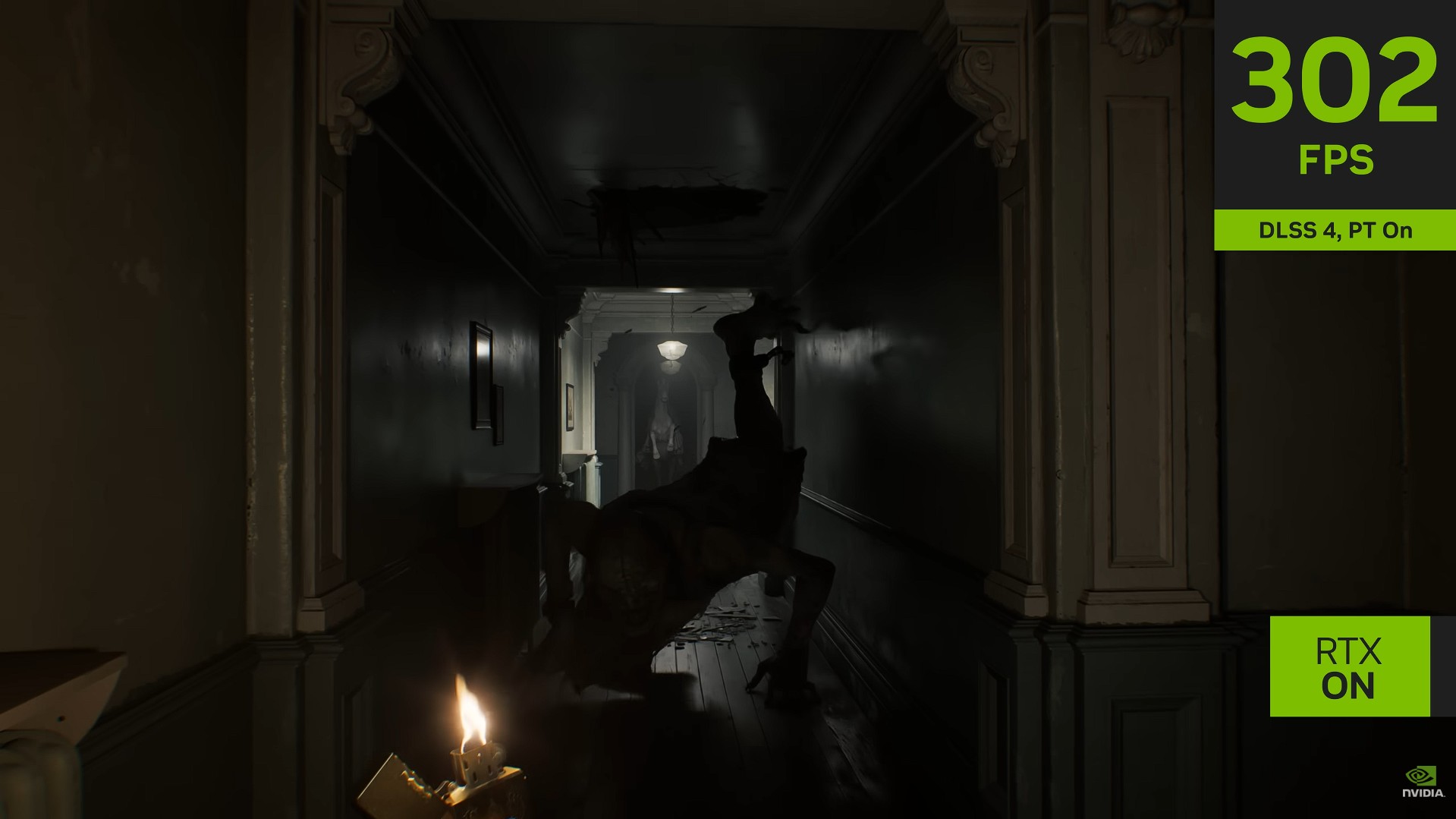
Nvidia has released a new Resident Evil Requiem trailer, showcasing the path-traced game hitting over 300 FPS at 4K resolution on an RTX 5090. DLSS 4 has made this result possible, now available in over 400 games.
Why it matters: The new DLSS 4.5 delivers even greater performance gains with its 6x dynamic multi-frame generation. The company promises smooth 240+ FPS, 4K path-traced gaming with DLSS 4.5, free of visual anomalies.
The video shows that the game was unable to reach 60 FPS without DLSS 4 enabled with path tracing on, cementing the need for the upscaler for high-end performance.
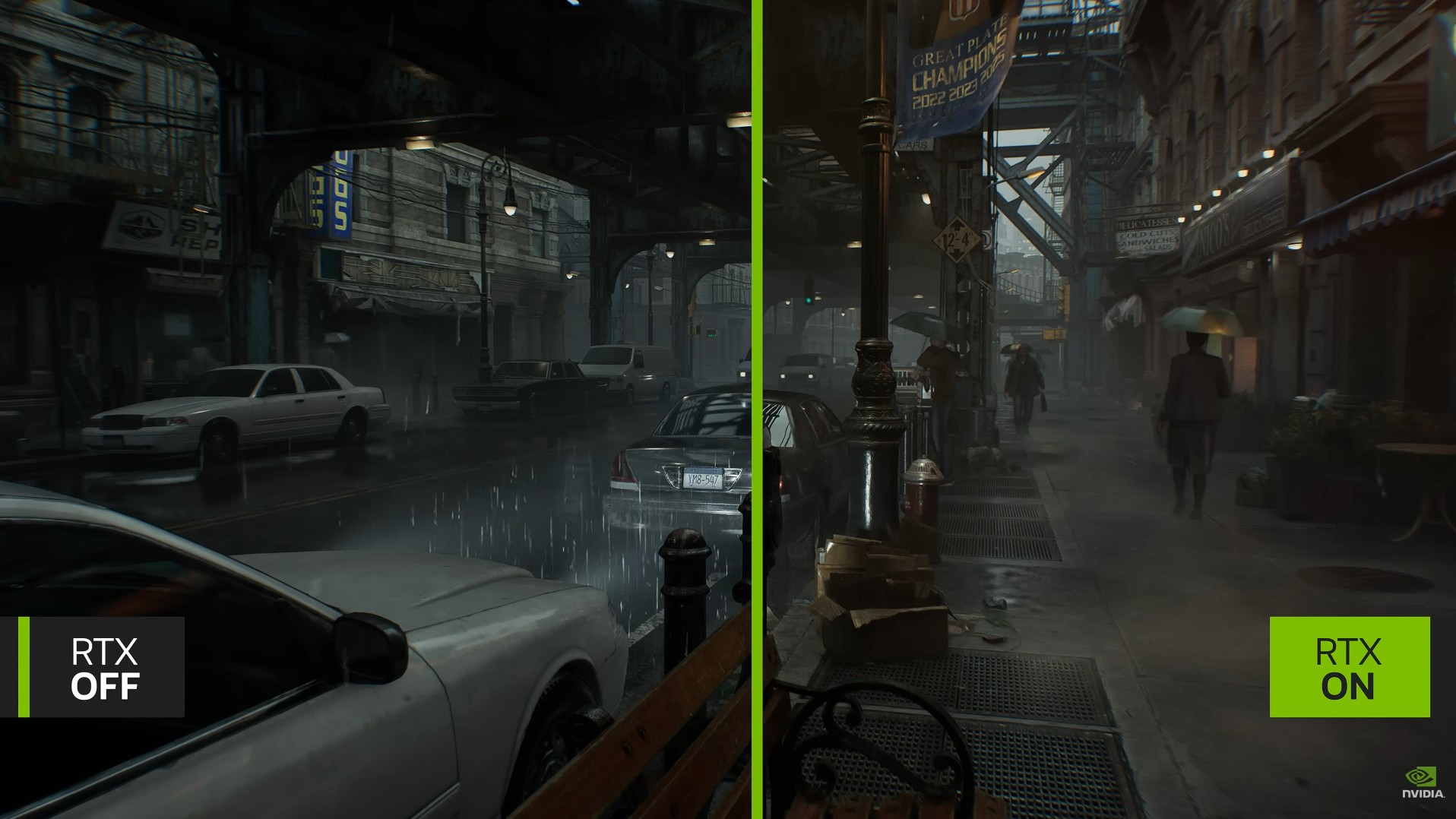
A with-and-without path-tracing comparison also makes it harder to ignore the extreme visual gains, albeit at the cost of the aforementioned frames. So, DLSS 4 feels like a more attractive option than native frames here.
Resident Evil Requiem
1 of 2
Resident Evil Requiem looks really good with path tracing enabled.
Resident Evil Requiem can reach over 300 FPS at 4K using DLSS 4 with PT enabled.
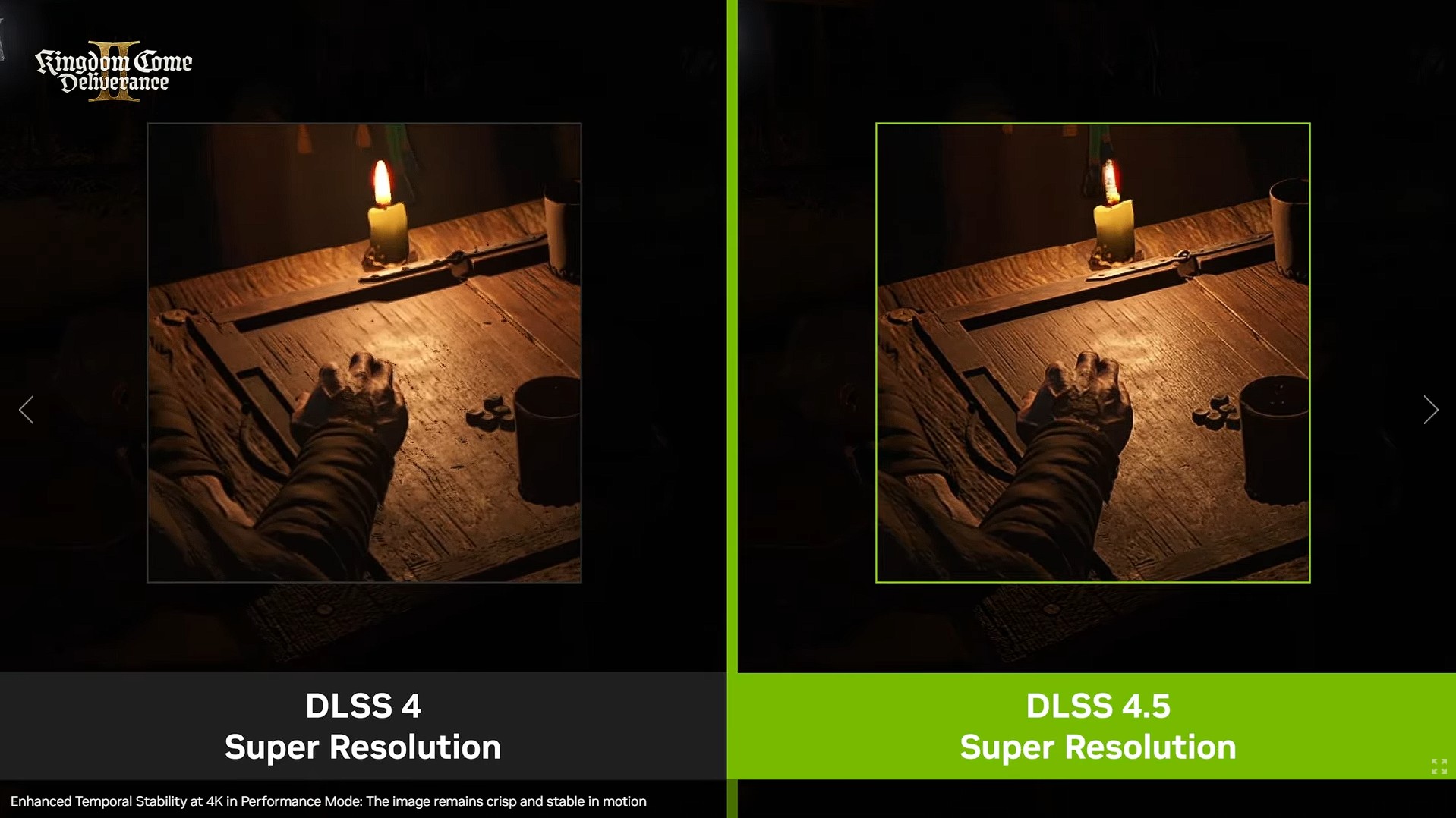
It’s unclear whether DLSS 4.5 was used in the Resident Evil Requiem trailer. Still, comparisons between DLSS 4 and 4.5 on Nvidia’s blogrevealed significant visual and other technical improvements in the new version.
DLSS 4.5 vs. DLSS 4
1 of 3
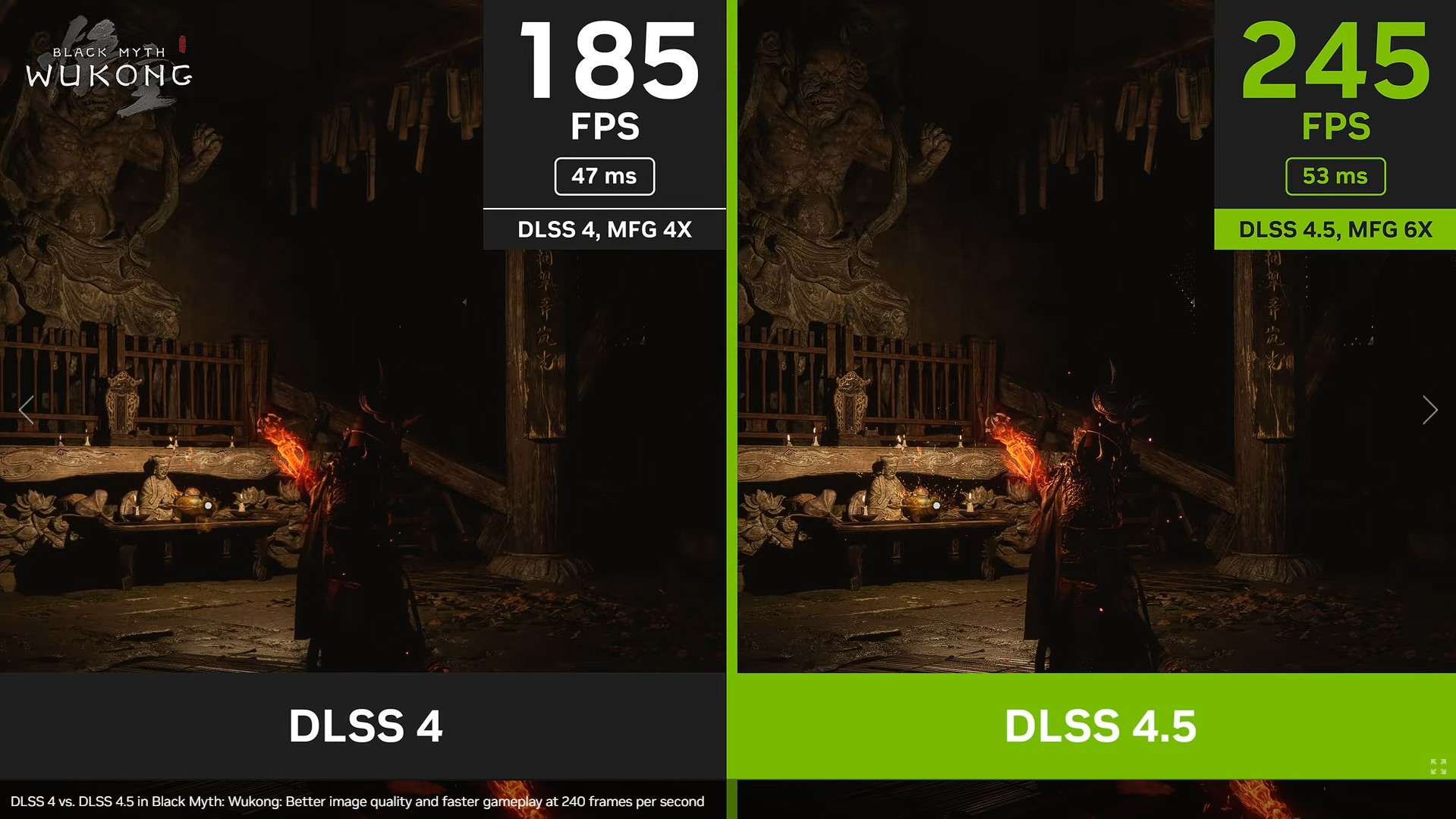
DLSS 4.5 brings much higher FPS using MFG 6x as opposed to DLSS 4's MFG 4x.
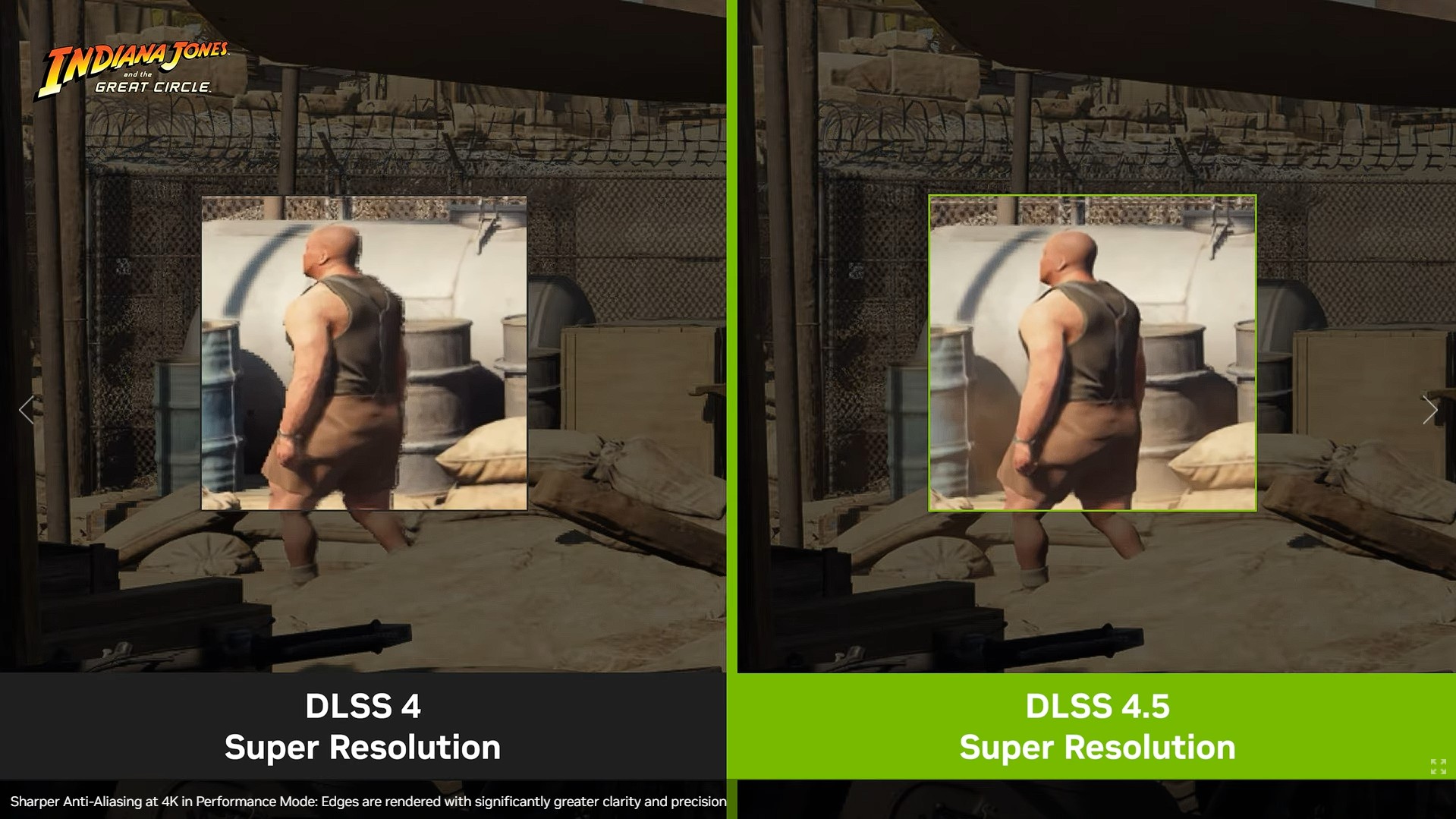
Edges are rendered better and with more clarity in DLSS 4.5 vs. DLSS 4.
DLSS 4.5 features better temporal stability at 4K in performance mode.
DLSS 4.5 makes gameplay smoother with higher FPS thanks to its 2nd-generation transformer and 6x multi-frame generation, and it also reduces ghosting and artifacts.
The edges in games are rendered much better, with more visual clarity in movement. The overall temporal stability at 4K also feels more enhanced in different AAA games.
Do you think Nvidia’s DLSS 4.5 is a major improvement over the baseline 4 version? Are you looking forward to using it in AAA games? Let us know your thoughts in the comments below, or join the discussion on the Tech4Gamers forum.
At Tech4Gamers.com, I cover the latest news and rumours in the gaming industry, from new game releases to hidden gems and video game leaks. Furthermore, I occasionally write tech articles about video game consoles, providing insights into the hardware and software that powers our gaming experiences.
[Press Release] ASRock has officially unveiled its complete next-generation AIO liquid-cooling lineup, expanding its role beyond motherboards and graphics cards into full-system thermal solutions. Built on decades of engineering experience, this new portfolio targets enthusiast PCs, professional workstations, gaming systems, and everyday builds with a focus on performance, stability, and long-term reliability.
The lineup spans multiple series, each tailored for a specific audience while sharing ASRock’s core design principles. From flagship cooling solutions to mainstream options, every model is designed to meet modern CPU thermal demands and evolving system requirements.
Taichi AQUA Series
The Taichi AQUA series stands at the top of ASRock’s AIO range. It combines extreme cooling capability with a distinctive design, featuring a dual-mode top cover that lets users switch between a 3.4-inch full-color LCD display and a transparent coolant-flow window. A dual-pump architecture supports a TDP of over 500W, paired with a thick 38mm radiator and high-end LCP fans with IP54-rated protection, delivering uncompromised performance and durability.
WS Series
Designed for high-end desktop and workstation CPUs, the WS series focuses on sustained performance under continuous heavy loads. A full-coverage cold plate ensures uniform contact on large CPU heat spreaders, while a dual-pump design and thick radiator maintain stable temperatures during 24/7 operation. Industrial-grade fans further reinforce reliability for professional environments.
Phantom Gaming Series
The Phantom Gaming series targets gamers who want strong cooling and bold aesthetics. A 3.4-inch LCD display provides real-time system monitoring, while a high-performance pump and optimized radiator support demanding gaming and overclocking scenarios. A dedicated VRM cooling module helps maintain system stability during intense workloads, complemented by high-output fans and immersive ARGB lighting.
Steel Legend Series
The Steel Legend series emphasizes durability and consistent performance for long-term daily use. It integrates an LCD display, a robust pump design, and VRM cooling support to ensure stable operation over extended periods. High-quality fans with dual-ball bearings maintain steady airflow, aligning with the series’ focus on dependable engineering.
Challenger and Pro Series
The Challenger series focuses on efficiency and ease of installation, offering practical cooling performance with a smart digital display and builder-friendly design. The Pro series balances performance, aesthetics, and accessibility, featuring ARGB elements and optimized acoustics, making it suitable for a wide range of mainstream PC builds.
At T4G, my task is to cover the latest news around the gaming globe ASAP and with the utmost precision. I adore all the games and respect all the devs behind the amazing games that we get all year. So, whether it’s a PC or a Console game, I got it all covered.
Story Highlight
Micron and Samsung recently revealed they’re expanding their DRAM manufacturing lines.
Following this, SK Hynix has also announced it is expediting work at its new fab.
The goal is to meet the HBM chip demand made with DRAM and used in AI chips.
The global memory crisis is at its peak, with RAM prices reaching astronomical levels that are now unaffordable for most people. Amid all this, major manufacturers are trying to meet the demand by expanding their operations.
Micron revealed that it is investing a whopping $200 billion to increase its DRAM production limits. Following this, SK Hynix is also expanding its operations by building new, larger manufacturing lines.
Why it matters: The global DRAM manufacturing is mainly handled by three companies: Samsung, Micron, and SK Hynix, so if they are to meet the requirements, they do need to expand rapidly for things to go back to normal.
SK Hynix is expanding operations to meet the global DRAM demand.
The Elec has confirmed that SK Hynix will open its first cleanroom at its new fab in Yongin, South Korea, in March next year, 2 months ahead of the initial timeline. It’s also doing the same for its M15X plant in Cheongju.
The general aim is to meet demand for the HBM4 chip amid the AI boom. The demand for these chips has surged in recent months, and they are made using DRAM, which is then used in AI chips, causing a massive global shortage.
The DRAM manufacturing is led mainly by three companies.
While AI software companies primarily require those AI chips because DRAM is used in them, this affects global RAM manufacturing as well. This is what has led to the drastic price increase in DDR5 RAM.
Samsung also recently announced the expansion of its operations. Unfortunately, most of these manufacturing lines will be operational from 2027, which means the prices will remain high throughout this year, and budget gamers will have to stick with DDR4.
What are your thoughts on SK Hynix expanding operations to meet the global DRAM shortage? Let us know your opinions in the comments or join the discussion at the official Tech4Gamers Forum.
As Tech4Gamers’ Founder and Editor-in-Chief, I bring over 13 years of PC Hardware Reviewing and 8+ years of IT Project Management experience. Certified in Google IT Support , my focus is on providing honest product reviews and analysis and fostering a strong gaming community with 130k+ members in PPG.
Story Highlight
Ryzen 7 9850X3D is essentially a 9800X3D with a +400MHz boost (up to 5.6GHz), same cores, cache, and 120W TDP.
No new X3D flagships announced (no 9800X3D2 or 9950X3D2), making this feel like a minor refresh at a higher price.
Strong 1080p gaming gains vs Intel, but minimal 7% improvement over 9800X3D.
AMDannounced its new flagship processor for Gaming PCs at CES in Las Vegas: the AMD Ryzen 7 9850X3D. This is essentially a boosted AMD Ryzen 7 9800X3D, with higher clock frequencies. In terms of specifications, the two processors are exactly the same, except that the AMD Ryzen 7 9850X3D offers significantly higher Turbo Boost speeds. However, the amount of cache memory remains unchanged.
The biggest disappointment is that the company didn’t announce either the AMD Ryzen 7 9800X3D2 or the Ryzen 9 9950X3D2. These processors incorporate double the L3 cache for even greater performance. So, basically, the only announcement related to gamers is offering the same CPU they already offered, but with higher frequencies. And yes, a higher price.
Ryzen 7 9800X3D will be slightly more expensive. The company didn’t announce its price or release date. According to the French retailer LDLC, this processor will go on sale on January 29th at an expected price of around €500.
Specifications of AMD Ryzen 7 9850X3D
AMD Ryzen 7 9850X3D Specifications Comparison
Unsurprisingly, the AMD Ryzen 7 9850X3D is an 8-core, 16-thread processor based on the AMD Zen 5 architecture. The only difference compared to the AMD Ryzen 7 9800X3D is that this processor will reach a maximum operating frequency of 5.60 GHz. This represents an increase of 400 MHz compared to the 5.20 GHz reached by the Ryzen 7 9800X3D.
Leaks had already indicated that this processor offers a base clock speed of 4.70 GHz, the same as the Ryzen 7 9800X3D. There are no improvements in cache memory; it offers the same 104 MB of L2 + L3 cache. This means the CPU has 96 MB of L3 cache thanks to the 3D V-Cache technology, which adds 64 MB. Despite the increased clock speeds, the TDP remains at 120W.
What We Know About Ryzen 7 9850X3D Performance
AMD Ryzen 7 9850X3D vs Intel Core Ultra 9 285K
According to the benchmarks provided by AMD, its Ryzen 7 9850X3D is capable of delivering, on average, 27% more performance than an Intel Core Ultra 285K at 1080p resolution.
It’s worth noting that the impact of the CPU performance gains is less noticeable at higher resolutions. Therefore, at 4K resolution, the difference could be less than 5%. These X3D processors are ideal for new HD monitors with a resolution of 1920 x 1080 pixels at +500 Hz, specifically designed for competitive gaming. In these environments, this CPU will be significantly faster than any other Intel processor.
AMD Ryzen 7 9850X3D vs Intel Core Ultra 9 285K vs 9800X3D productivity performance
In terms of productivity, the situation is more balanced for Intel. And in this specific case, for some reason, only Ryzen 7 9800X3D is mentioned. According to the data provided, the AMD Ryzen 7 9850X3D is 5.6% faster than the Intel Core Ultra 9 285K, while the Ryzen 7 9800X3D is practically tied with Intel, with a performance difference of just 0.9%.
This falls within a certain margin of error, so they are practically even. The company only indicated a launch for the first quarter of the year, although no details regarding the price were mentioned.
What’s your take on the Ryzen 7 9850X3D? Is a price increase justified for just a 400MHz boost? Share your thoughts in the comments below.
At T4G, my task is to cover the latest news around the gaming globe ASAP and with the utmost precision. I adore all the games and respect all the devs behind the amazing games that we get all year. So, whether it’s a PC or a Console game, I got it all covered.
Story Highlight
Neowiz CEO has confirmed that they are currently working on 5 PC/console games.
The publisher aims to release new IP that will develop into long-term franchises.
The success of Lies of P and its DLC helped them push forward to new highs.
Neowiz launched Lies of P in 2023 to massive praise from both the critics and the audience. It became a sleeper hit that nobody really saw coming. Nonetheless, it cemented Neowiz as a great studio, and the studio wants to capitalize on it.
The studio CEO in a recent interview revealed that Neowiz is currently working on 5 games, including a Lies of P sequel. The head says that the studio plans to introduce long-lasting franchises that people will play for many years.
Why it matters: Based on Lies of P’s success, Neowiz is now primarily associated with that series; however, they want to expand further and make a bigger name for themselves with multiple successful franchises
The studio is working on 5 new titles
Talking to Gameinformer, Neowiz co-CEO Sean Kim went into detail about the studio’s future. He said Lies of P was a massive success, and its DLC, Overtrue, helped it further by adding new players, increasing the fan base.
We are internally developing more than five new PC and console titles. Our goal is to consistently introduce successful IP that fans will continue to support and look forward to over the long haul, even five or ten years down the line.
– Sean Kim
Kim said that the studio wants to explore as many options as possible; therefore, they plan to collaborate with Western studios as well for future titles. They also highlighted their third-party indie games like Shape of Dreams.
2023 introduced us to some great new IPs
Neowiz believes that a game’s success is oriented through fans, so no matter how much they like the game, it is ultimately the fans who decide if it’s good. The studio is also looking to explore AI to expedite various things.
Lies of P helped Neowiz reach a global audience that it had never had before. This has helped them push forward with more IPs, which they plan to support long-term and listen to fan feedback to continually improve.
What are your thoughts on Lies of P studio wanting to make long-lasting, successful franchises? Let us know your opinions in the comments or join the discussion at the official Tech4Gamers Forum.
I’ve previously worked for eXputer as a Senior News Writer for several years. Now with Tech4Gamers, I love to devoutly keep up with the latest gaming and entertainment industries. I have a Bachelor’s Degree in Computer Science and years of experience reporting on games and breaking exclusive stories. Besides my passion for gaming journalism, I love spending my leisure time farming away in Stardew Valley. VGC, IGN, GameSpot, Game Rant, TheGamer, GamingBolt, The Verge, NME, Metro, Dot Esports, GameByte, Kotaku Australia, PC Gamer, and more have cited my articles.
Story Highlight
Nvidia has not announced any new GPUs at its CES presentation this year.
It skipped over the reveal of the RTX 50 Super series, suggesting it has been delayed or cancelled.
A lack of new GPU reveals can be directly attributed to the ongoing DRAM shortage.
The memory apocalypse has proven to be devastating for the GPU market, making high-end GPUs rare around the globe as sellers run out of inventory. Drastic price hikes are also expected to strike the RTX 50 and the Radeon RX 9000 series soon.
Many gamers were still hopeful for the RTX 50 Super series to build their gaming rigs before the industry gets worse. However, Nvidia earlier announced that there will be no GPU reveals at its CES keynote presentation on January 5 at 9 pm PT.
Why it matters: Nvidia skipping new GPU reveals at CES 2026 confirms that the DRAM crisis is having a deep impact on the RTX 50 Super Series. Even the RTX 50 lineup has dried up significantly in the last few months due to a lack of stock.
Nvidia confirmed that the RTX 50 Super series won’t be announced at CES 2026.
This blunt heads up on Twitter earlier confirmed rumors that Nvidia either delayed the Super series or cancelled it entirely. The company’s 5-year streak of GPU reveals was also broken, leaving the Green Team with no new hardware for the foreseeable future.
The CES events have held a dear place in the hearts of gamers as iconic lineups like the RTX 50 and 40 series were revealed during these yearly events. But Nvidia’s keynote was dry in terms of hardware this time around.
The firm revealed DLSS 4.5 with an advanced second-generation transformer model and dynamic 6x frame generation. Nvidia’s presentation mostly focused on AI initiatives like Alpamayo, as its interests have largely shifted over to the growing industry.
While Nvidia hasn’t acknowledged, the DRAM shortage played a huge role in the lack of new hardware. The Blackwell GPUs require quite costly and rare DRAM to manufacture, so the Super series might have been scrapped due to the current market conditions.
On a side note, the company is expected to bring back the five-year old RTX 3060 to retail shelves to tackle the GPU shortage.
Do you think Nvidia will announce its RTX 50 Super series later down the road this year? Let us know your thoughts in the comments below, or join the discussion on the Tech4Gamers forum.