At T4G, my task is to cover the latest news around the gaming globe ASAP and with the utmost precision. I adore all the games and respect all the devs behind the amazing games that we get all year. So, whether it’s a PC or a Console game, I got it all covered.
Story Highlight
Deus Ex studio, Eidos Montreal, is working on a “AAAA” game based on Unreal Engine 5.
The title is currently unannounced, but rumors point towards a project codenamed P11.
Unfortunately, this won’t be a Deus Ex game, for those hoping that it would be.
Eidos Montreal has given us some brilliant titles over the years. From Deus Ex to Shadow of the Tomb Raider, the studio has made quite a name for itself. And it seems that it is now in the process of working on its next big title.
A new update has revealed that Eidos Montreal is currently working on a “AAAA” game. This is a term first mainstreamed by Ubisoft for Skull and Bones, and it has also been used to define Assassin’s Creed Mirage and Shadows.
Why it matters: As to what AAAA means isn’t quite clear, but it does suggest that the in-progress title from the Deus Ex studio is going to be a big-budget title with a massive scope.
Eidos Montreal is working on a “AAAA” game based on Unreal Engine 5
According to an Eidos Montreal developer, Derian McCrea’s LinkedIn profile, the studio is working on a AAAA game based on Unreal Engine 5. It doesn’t give out anything else, but there are rumors as to what the game could be.
A rumor from last year pointed out that Eidos is working on a title codenamed P11. The game has reportedly been in development for many years with a lot of investment, making it an ideal candidate for the ‘AAAA’ title.
All things point to this definitely not being a Deus Ex project
However, that for now is just a rumor, so it’s just speculation for now. Unfortunately, for those who were hoping it would be a Deus Ex title, that isn’t happening based on reports and a comment made by a former lead voice artist.
What are your thoughts on Deus Ex studio working on a “AAAA” game? Let us know your opinions in the comments or join the discussion at the official Tech4Gamers Forum.
Currently serving as a News Reporter at Tech4Gamers, I have the privilege of combining my love for gaming with the art of storytelling. My role involves crafting engaging narratives that keep our audience abreast of the latest developments in the gaming world.
Story Highlight
Former Activision boss is being sued by investors for selling Activision too quickly and at an undervalued share.
Responding, Bobby says he’s glad to have sold the company to Microsoft, noting that Xbox and Call of Duty sales are at an all-time low.
He also adds that Call of Duty sales are down 60% YoY, but provides no evidence to back this claim.
The case of Xbox succeeding in the publisher route has been an uncertain one because at one hand, IPs like Forza Horizon are selling like hot cakes on the PS5 but at the other hand, Call of Duty, the franchise the gaming giant took a hefty gamble on has yet to be paid off because the once hailed FPS series is now experiencing its worst ever phase.
Now, the former Activision boss has shared his thoughts on Microsoft’s current gaming division. He is glad that he sold the company, seeing Xbox and Call of Duty sales slump to an all-time low.
Why it matters: Activision is Microsoft’s biggest acquisition at $69 Billion, and despite showing promise initially, it has become questionable a few years later.
The Activision And Microsoft Merger Took A Lot Of Effort To Pass Through
Investor company Sjunde AP-Fonden AP7 filed a lawsuit against Bobby Kotick in 2022, alleging that the company’s sale was expedited for personal gains, to which the former boss issued the following response via Game File:
Today, given that console sales are at an all-time low and Call of Duty sales are off over 60% from the prior year, Plaintiff should be expressing extreme gratitude for the foresight Activision leadership demonstrated in consummating this transaction.
2025 was a terrible year for both Xbox and Call of Duty, with the FPS series hitting an all-time low, also scoring a terrible 1.7/10 on Metacritic. A 60% drop in sales compared to Black Ops 6 wasn’t even an eye-opener for them, as Activision even went ahead to thank fans for the ‘positive response.’
As for Bobby’s situation, investors previously alleged that the quick sale was to secure a $400 million payout and to protect himself from internal allegations that were turning into lawsuits.
Still, his claims are pretty solid aside from the Call of Duty sales drop percentage, as the former boss has yet to back them up.
What are your thoughts on Kotick’s statements? Do you think Activision’s sale to Microsoft was the right outcome? Let us know in the comments below, or at the official Tech4Gamers Forums.
At Tech4Gamers.com, I cover the latest news and rumours in the gaming industry, from new game releases to hidden gems and video game leaks. Furthermore, I occasionally write tech articles about video game consoles, providing insights into the hardware and software that powers our gaming experiences.
Story Highlight
Companies avoid crashes by spreading server loads across regions to handle predictable traffic surges.
Updates are released in stages so specific errors can be isolated and reversed without a total shutdown.
While efficient, automated systems can accelerate problems if the initial programming contains errors.
If you’ve ever been kicked out of a ranked match, stuck on a login screen during a big update, or watched a live-service game go dark at peak hours, you already know how painful downtime can be. For players, it’s frustrating. For tech companies running high-traffic platforms, it’s a nightmare.
Big gaming platforms, online stores, and live-service games don’t magically stay online. They rely on a mix of planning, smart tools, and a lot of trial and error.
Let me break down how companies actually reduce downtime, why it sometimes still fails, and what’s worked best in recent years.
Planning for Traffic Spikes (Because They’re Always Coming)
Traffic spikes aren’t surprises anymore. Launch days, major patches, esports events, and holiday sales all hit servers hard. The smartest companies plan for this instead of reacting after things break.
Most large platforms now spread their servers across multiple regions. If one area struggles, players can be rerouted elsewhere. It’s not perfect, but it’s better than the whole system going offline.
From a gamer’s perspective, this is why some matches might feel laggy instead of completely dead.
The key lesson here is simple: expecting smooth launches without backup plans is wishful thinking. The companies that survive big launches assume something will go wrong, and prepare for it.
Rolling Updates Instead of One Big Switch
One reason downtime used to be so bad was because updates were “all or nothing.” Servers went offline, patches were pushed, and players waited.
Now, many platforms roll out updates in stages. Some servers update while others stay live.
If something breaks, the update can be pulled back quickly without taking everything down. This is why modern updates often feel smaller and more frequent.
From a player standpoint, this means fewer full shutdowns, but sometimes more minor hiccups. It’s a trade-off most people prefer.
Modern platforms don’t wait for Reddit or X to tell them something is broken. Systems constantly watch server health, player connections, and error rates.
When something looks off, alerts trigger automatically. In some cases, systems can fix small issues on their own by restarting services or shifting traffic. This doesn’t mean humans are gone, it just means they’re not finding out about problems the hard way.
Still, when you see “we’re investigating server issues,” chances are the platform already knew before players started posting clips.
DevOps is one of those behind-the-scenes setups that players never see, but definitely feel when it’s missing. It’s what keeps updates from turning into full-blown server meltdowns by making sure the people pushing changes and the people running the servers are on the same page.
Instead of flipping one big switch and hoping for the best, DevOps helps teams ship smaller updates, watch things closely, and roll back fast if something breaks. For high-traffic games and platforms, that usually means fewer surprise outages and quicker recoveries when things go sideways.
Downtime Isn’t Always Technical
Here’s the uncomfortable truth: not all downtime is caused by broken servers. Sometimes bad decisions cause just as much damage.
Overpromising features, rushing updates, or skipping testing to hit a deadline often leads to crashes. Many high-profile outages in recent years weren’t caused by lack of tools, but by pressure to move fast.
In gaming especially, this shows up as unfinished patches or broken balance changes that need emergency fixes. Cutting corners usually comes back to bite.
Why Automation Helps
Automation plays a big role in keeping platforms online. Repetitive tasks like testing updates, restarting services, or deploying patches are handled automatically now.
This speeds things up and reduces human error, but it’s not foolproof. Automated tools only follow the rules they’re given. If those rules are bad, problems spread faster instead of stopping.
That’s why experienced teams still keep humans in control of major decisions. Automation helps reduce downtime when paired with common sense.
Always-online games are especially tough, though. They’re constantly changing, constantly monitored, and constantly under pressure.
Every new season, event, or content update adds risk. One small bug can affect millions of players at once. This is why even huge studios still struggle with stability during big updates.
The reality is that zero downtime is unrealistic. What matters more is how fast issues are fixed and how clearly companies communicate when things go wrong.
Communication Matters More Than Ever
Players are far more forgiving when companies are honest. Clear server status pages, quick updates, and realistic timelines go a long way.
Silence, vague posts, or pretending nothing is wrong usually makes things worse. In today’s gaming space, players expect transparency, even if the news isn’t good.
Good communication doesn’t reduce downtime, but it does reduce backlash. And that matters just as much.
No platform is immune to downtime, especially as games and services get bigger. The best companies aim for fast recovery, smart planning, and fewer repeat mistakes.
And when things do go down? The difference between a disaster and a minor annoyance usually comes down to how ready the platform was in the first place.
I’ve previously worked for eXputer as a Senior News Writer for several years. Now with Tech4Gamers, I love to devoutly keep up with the latest gaming and entertainment industries. I have a Bachelor’s Degree in Computer Science and years of experience reporting on games and breaking exclusive stories. Besides my passion for gaming journalism, I love spending my leisure time farming away in Stardew Valley. VGC, IGN, GameSpot, Game Rant, TheGamer, GamingBolt, The Verge, NME, Metro, Dot Esports, GameByte, Kotaku Australia, PC Gamer, and more have cited my articles.
Story Highlight
Microsoft wants you to switch over to AI-powered PCs with Windows 11.
The company implies it’s necessary to upgrade to prepare for the next generation of computing.
Its Copilot+ PCs are being promoted to users of all groups, including students and professionals.
AI PCs are being seen as the next direction for computing by the industry’s tech giants. These come with special NPU cores that enable AI to run locally, rather than in the cloud, to perform ‘intelligent’ tasks while delivering faster performance.
Microsoft is now also asking users to switch to its own lineup of AI PCs running Windows 11, called Copilot+, to prepare for the next generation of computing.
Why it matters: Many users have questioned whether such an upgrade is worth it for people who want nothing to do with AI. They are treating AI PCs as the latest industry gimmick.
Microsoft says upgrading to Copilot+ PCs is essential for the next generation of computing.
In a recently resurfaced blog, Microsoft emphasizes that Copilot+ PCs are the devices of the future while advertising their features. The firm argues that switching over to them is necessary to keep up with the changing times.
Microsoft explains that a computer is only considered Copilot+ if it boasts an NPU capable of at least 40 TOPS, ARM-based processors, and minimum specs of 16GB RAM, 256GB SSD, and Windows 11 version 24H2 or newer.
Work smarter, create faster, and communicate more effectively than ever before with the fastest, most intelligent Windows PC ever.
-Microsoft.
These Copilot+ PCs are being promoted to casual users, students, professionals, and creatives across all industries.
However, Microsoft’s advertisement of Copilot+ PCs has been criticized because most users are not interested in adopting AI in the first place.
This is mostly driven by ecological and economic concerns, such as the AI race driving up the prices of memory and other components in the industry.
AI PCs are the new hot topic in the PC scene.
Even those neutral to AI have rejected the need to upgrade, asking whether spending over $999 for entry-level Copilot+ PCs is worth it just for local AI adoption and AI-based tools.
Do you think it makes sense for gamers and students to switch over to AI PCs just to use AI locally? Is the next generation of computing just a gimmick? Let us know your thoughts in the comments below, or join the discussion on the Tech4Gamers forum.
At Tech4Gamers, I contribute as a Senior News Reporter, combining my skills and gaming enthusiasm to keep our audience updated on the latest developments.
Story Highlight
Rockstar’s legal battle against its fired employees has led to new GTA 6 details showing up.
The game reportedly features 32-player lobbies for its online mode.
GTA 5 offered the same maximum player count, but it also reserved 2 slots for spectators.
GTA Online, launched in 2013, has proven to be Rockstar’s magnum opus over the years, leading to incredible longevity for GTA 5. With GTA 6 now positioned as the successor to GTA 5, expectations are high for both the game and its online component.
Many are expecting big things of GTA 6 Online, but a report suggests the game won’t be changing much, at least in terms of the number of total players per lobby.
Why it matters: A previous leak suggested the title would feature lobbies with nearly 100 players. Many were quick to believe this leak due to the popularity of modern multiplayer experiences with large player counts.
It is said that two of the fired employees leaked an unannounced feature regarding the game on Discord. The unannounced feature in question, of course, refers to the limit of 32 players per multiplayer session.
This player count is of particular interest since GTA 5 also features a similar limit for its multiplayer component. The game initially launched with a cap of 16 players on PS3 and Xbox 360, which was bumped up to 32 players on the PS4 and Xbox One.
However, of the 32 players, two slots are reserved for spectators in GTA 5. Technically, then, GTA 6 is set to offer a higher player limit, even if the difference is almost negligible.
GTA 5 Introduced A Very Enjoyable Online Sandbox
These details were uncovered by People Make Games. It is said that one of the fired employees responded to a message regarding the organization of a 32-player testing session.
According to Rockstar’s legal spokesperson, this message referred to a top-secret feature regarding GTA 6, hinting at the maximum player count implemented in the game’s online mode.
I’ve previously worked for eXputer as a Senior News Writer for several years. Now with Tech4Gamers, I love to devoutly keep up with the latest gaming and entertainment industries. I have a Bachelor’s Degree in Computer Science and years of experience reporting on games and breaking exclusive stories. Besides my passion for gaming journalism, I love spending my leisure time farming away in Stardew Valley. VGC, IGN, GameSpot, Game Rant, TheGamer, GamingBolt, The Verge, NME, Metro, Dot Esports, GameByte, Kotaku Australia, PC Gamer, and more have cited my articles.
Story Highlight
The new GOG owner has doubled down on his anti-DRM stance, following The Witcher 2 in the past.
He claims DRMs are not a viable solution to piracy and only make things difficult for consumers.
However, many industry executives and publishers do not share the same views.
Despite Steam’s dominion over the industry, GOG gained popularity for having a ‘gamers-first’ ethos. The store has heavily focused on game preservation and anti-DRM offline installers to prioritize gamers before companies.
GOG was sold to the former CDPR studio head, Michal Kicinski, in late 2025 from CD Projekt, and the new owner is also doubling down on the store’s anti-DRM ethos. Michal claims DRMs are unable to prevent piracy since many titles get pirated nearly on day one anyway.
Why it matters: It’s clear that GOG will continue to operate under a strict anti-DRM and game preservation policy with the new management, like in the past, and serve gamers faithfully.
Steam still dominates most of the PC market compared to GOG.
In an interview with GamesIndustry, the new GOG head explains that most of the corporate gaming industry is against anti-DRM views. He learned it firsthand after the Witcher 2 lawsuit by Bandai Namco for the DRM removal.
Most corporate people, they make plain stupid decisions. I had firsthand experience of this with The Witcher 2, where our own publisher sued us.
-New GOG head, Michal Kicinski.
He says Bandai failed to understand that removing DRM wasn’t harming their business because the game was already being pirated. It was only hindering the legal consumers by causing errors and lag issues.
Michal also criticized the normal gaming purchasing model, where you feel like you’re buying a license instead of a product that can be taken away anytime. GOG’s DRM-free installers ensure that gamers can install their purchases forever, as they can’t be revoked.
Both stores operate on a different model and philosophy.
On a side note, Michal also says that taking on Steam isn’t a big obstacle for GOG,as long as it sticks to its strengths. He believes Steam has only held up well so far because of its reliability, and its market shares can eventually be taken away.
Do you think the new GOG owner is right on the money about his take on DRM? Let us know your thoughts in the comments below, or join the discussion on the Tech4Gamers forum.
I’ve previously worked for eXputer as a Senior News Writer for several years. Now with Tech4Gamers, I love to devoutly keep up with the latest gaming and entertainment industries. I have a Bachelor’s Degree in Computer Science and years of experience reporting on games and breaking exclusive stories. Besides my passion for gaming journalism, I love spending my leisure time farming away in Stardew Valley. VGC, IGN, GameSpot, Game Rant, TheGamer, GamingBolt, The Verge, NME, Metro, Dot Esports, GameByte, Kotaku Australia, PC Gamer, and more have cited my articles.
Story Highlight
Ex-Bethesda lead artist Nate Purkeypile believes Elder Scrolls 6 was announced early so that fans wouldn’t be angry at Bethesda.
At that time, the studio was fully focused on Starfield, and it had been 7 years since Skyrim came out.
Hence, to manage fan expectations and assure the community Elder Scrolls 6 was on their mind, the E3 reveal was put into place.
Elder Scrolls 6 has unfortunately become the prime example of AAA game development in the modern era. Announced back in 2018, the Bethesda RPG is still years away, with the studio asking fans to remain patient.
But, as time passes by, doubts around Elder Scrolls 6 are growing, with both players and developers now being skeptical. However, if you ask former Bethesda lead artist Nate Purkeypile, the game was announced early just to accommodate fan expectations.
Why It Matters: Announcing games before they are in production just to kill anticipation by taking decades to develop the title is what’s wrong with modern gaming in a nutshell.
Elder Scrolls 6 was announced at the 2018 E3, almost 8 years ago.
In a new interview with Esports Insider, Nate Purkeypile said that Bethesda revealed Elder Scrolls 6 in 2018 so fans wouldn’t be mad at the studio. The former artist explained that it had already been seven years since the release of Skyrim, and Bethesda wanted players to know Elder Scrolls wasn’t left behind.
My assumption was always that we were announcing Starfield, and it had been so long already since Skyrim that we needed to make sure people were not just pissed at us.
Starfield was already in production at the time, and according to Purkeypile, the studio didn’t want the community to be angry at Bethesda for ignoring Elder Scrolls 6. Despite all the criticism from players, however, there isn’t any internal pressure inside the company to meet a certain release date.
As per the former lead artist, the developer is focused more on delivering a high-quality product that fans will enjoy, and the Starfield delay proves that Bethesda is not scared of postponing release dates.
Elder Scrolls 6 will employ some UE5 features in addition to the Creation Engine.
All-in-all, fans have to wait some time for Elder Scrolls 6 as Bethesda is focused on making the best game due to fan pressure, and Purkeypile believes that is the ideal scenario.
At Tech4Gamers, I contribute as a Senior News Reporter, combining my skills and gaming enthusiasm to keep our audience updated on the latest developments.
Story Highlight
Hidetaka Miyazaki recently reflected on Bloodborne and what makes the game so special for him.
He states that the title contains a lot of his own personal ideas and influences.
The director also discussed how the game led to FromSoftware’s most challenging development cycle.
In recent years, demand for a Bloodborne remaster has picked up the pace, and many people, developers and fans included, have shared their theories on whether such a project will ever come to fruition.
Meanwhile, FromSoftware director Hidetaka Miyazaki has also continued to praise the game. In a recent interview, he once again dubbed the PlayStation exclusive a special game.
Why it matters: Elden Ring is considered FromSoftware’s magnum opus, but Bloodborne remains just as relevant in modern gaming conversations to this day.
Bloodborne First Made Its Debut In 2015
According to Hidetaka Miyazaki, Bloodborne’s development cycle is still the most challenging of any game from the studio to date. This made the fact that Bloodborne became a unanimous hit all the more rewarding for the team.
In an interview with Game Informer, the FromSoftware director elaborated that this particular title remains extremely personal for him over a decade later. This is because Hidetaka Miyazaki poured a lot of his own ideas into the title.
In particular, he pointed to the story, world-building, and mechanics as areas that were greatly inspired by his own ideas, making for an experience reflective of his specific style of game development.
Bloodborne is a special game for me. It is perhaps the strongest reflection of my type of flavoring of a game that one can experience.
-Hidetaka Miyazaki
Hidetaka Miyazaki, Creative Director Of DarK Souls – Image From Pinterest
Given Hidetaka Miyazaki’s opinion on the game, it’s no wonder that many in the community also enjoy Bloodborne to such a great extent. In fact, fans previously took it upon themselves to bring the game to PC, and the project has shown a lot of potential lately.
What do you make of the developer’s comments? Do you also hold the title in high regard like Hidetaka Miyazaki? Share your thoughts in the comments and on the Tech4Gamers Forums.
At Tech4Gamers, I contribute as a Senior News Reporter, combining my skills and gaming enthusiasm to keep our audience updated on the latest developments.
Story Highlight
The former Activision Blizzard CEO says that Black Ops 7 sold 60% worse than its predecessor.
He points to competition from Battlefield 6 as a major reason for this performance.
Bobby Kotick’s comment comes from a new legal filing related to a lawsuit from 2022.
It’s no secret that Black Ops 7 hasn’t lived up to Call of Duty’s traditional performance on the market. The game performed quite poorly compared to Black Ops 6, and this situation was only made worse by the fact that Battlefield 6 wiped the floor with Call of Duty this year.
A few months after Black Ops 7’s release, former Activision CEO Bobby Kotick has now commented on the game. He states that the latest Call of Duty’s sales are half of what they were last year.
Why it matters: Bobby Kotick was part of Activision for over a decade and saw Call of Duty become the juggernaut it is today. His outlook on the latest entry of the series shows just how dire the situation currently is.
Battlefield 6 Had The Series’ Biggest Launch Ever
In a recent legal filing, Bobby Kotick stated that the series suffered a 60% sales decline recently compared to the previous year.
He credited Battlefield 6 for this outcome, stating that intense competition from EA has played a major role in this scenario. According to the former Activision Blizzard CEO, this sequence of events has disproven the FTC’s narrative of Call of Duty having no competition.
Effectively, Bobby Kotick raised the point that Call of Duty has struggled since his departure from the studio. Of course, this isn’t the first time the series has had an off year, but Black Ops 7 does highlight many of the community’s biggest gripes with the IP today.
Call of Duty is on track to perform 60% below last year because of intense competition from titles like Battlefield.
Black Ops 7 Was Received Poorly
For those unaware, this lawsuit was originally filed in 2022, when Microsoft confirmed its intention to acquire Activision Blizzard.
Filed by Swedish pension fund Sjunde AP-Fonden (AP7), the lawsuit raised the point that Bobby Kotick was attempting to escape the controversies surrounding the studio by selling it off to Microsoft.
The former CEO refuted many of the lawsuit’s points in the latest filing while also using Call of Duty’s current performance to highlight how Activision is seemingly worse off without his leadership.
I’ve previously worked for eXputer as a Senior News Writer for several years. Now with Tech4Gamers, I love to devoutly keep up with the latest gaming and entertainment industries. I have a Bachelor’s Degree in Computer Science and years of experience reporting on games and breaking exclusive stories. Besides my passion for gaming journalism, I love spending my leisure time farming away in Stardew Valley. VGC, IGN, GameSpot, Game Rant, TheGamer, GamingBolt, The Verge, NME, Metro, Dot Esports, GameByte, Kotaku Australia, PC Gamer, and more have cited my articles.
Story Highlight
According to estimates by YouTuber ZestyAlt, Counter-Strike 2 generated over $1 billion in revenue in 2025.
The game grossed up to $800 million in revenue from key sales alone.
No hard data was available for the rest of the in-game store, but Valve collected $166 million in pure profit from the Steam Community Market.
The Counter-Strike IP has always been a lucrative source of revenue for Valve. Counter-Strike 2’s skin market alone reached a market cap of $5.8 billion last year before an update wiped out $2 billion.
Despite these hurdles, however, Counter-Strike 2 reached a record concurrent player peak of 1.8 million users last year, and according to an analyst, the first-person shooter generated over $1 billion in revenue for Valve.
Why It Matters: Valve pulling so much money from a free-to-play title shows how brilliant the company’s strategy is.
According to stats accumulated by YouTuber ZestyAlt, by conservative estimates, Counter-Strike 2 made around $1 billion from its in-game store and the Steam Community Market in 2025.
Data collected between November 2024 to November 2025 revealed that over 400 million weapons cases were opened in the game. Taking into account how each key to open these cases is around $2.50, Valve made up to $800 million in gross revenue from key sales alone after giving creators their cut.
Unfortunately, there was no raw data about other items like music kits, armory passes, and major passes in the Counter-Strike 2 store. But, according to the YouTuber’s estimates, Valve grossed at least $500 million in revenue from store purchases, but this is just a prediction.
On the other hand, the company generated a hefty profit from sales of Counter-Strike 2 items on the Steam Community Market. Valve takes a 15% cut from every sale, and according to stats that tracked every purchase made last year, 754 million items were sold on the market.
The overall sales revenue from the Steam Community Market and Valve’s 15% cut. Source: ZestyAlt
As per the data spreadsheet compiled by ZestyAlt, this accounted for $1.2 billion in overall sales revenue, with Valve making $166 million in pure profit from the Steam Community Market. Hence, when you combine the revenue from both of these fronts, Counter-Strike 2 easily generated $1 billion in 2025.
Do you think Counter-Strike 2 will continue to be a consistent money-maker for Valve? Tell us in the comments below or head to the Tech4Gamers forum for discussion.
Currently serving as a News Reporter at Tech4Gamers, I have the privilege of combining my love for gaming with the art of storytelling. My role involves crafting engaging narratives that keep our audience abreast of the latest developments in the gaming world.
Story Highlight
Nvidia is prioritizing production of the RTX 5060 and 5060 Ti GPUs over the rest of the RTX-50 lineup.
They’re now focusing on cost-friendly models rather than higher-end variants that require more memory.
GPU prices are also set to rise further soon, and plans for the RTX-50 Super lineup have also been halted due to the memory shortage.
GPUs are next in line to be heavily impacted by the memory crisis, and specifically for Nvidia, the tech giant is expected to experience its worst year ever for consumer products. The already scarce supply of the RTX 50-series lineup will be further constrained.
Now, a new report suggests that the higher-end Blackwell GPUs will practically disappear from the market as Nvidia prioritizes production of the RTX 5060 and 5060Ti over the rest of the lineup.
Why it matters: The Blackwell GPUs never really gained momentum since their release, and a year after launch, things are about to get even worse for Team Green. The absence of higher-end RTX 50-Series GPUs will make things incredibly difficult for gamers.
Blackwell GPU Supply Expected To Be Cut Down By 50%
This news comes from insiders on Board Forums, who state that Nvidia is focusing on budget-friendly GPUs rather than the higher-end variant amid a memory shortage to ease supply constraints for both themselves and consumers.
NVIDIA and AIC brand manufacturers will readjust the RTX 5060 and RTX 5060 Ti 8G series as the main products with significant logistics impact.
The base RTX 5060 GPU uses 8GB of VRAM, while the 5060Ti comes in two variants: 8GB and 16GB. The report specifically states that specifically the RTX 5060Ti 8GB variant will see a priority rather than the 16GB model due to the memory shortage.
This strategic move will allow Nvidia to fulfill regional orders as stated from the report, but the company isn’t ruling out an almost-inevitable price hike in the near future. Their memory contract with suppliers ends next month, and newer contracts will be more expensive, which will raise GPU prices.
AIB Partners Are Now Told To Source Memory Themselves
With regard to the other releases in the RTX-50 series, RTX 5080 GPUs are being modded in China to double their VRAM capacity for AI purposes. Higher VRAM variants of the Blackwell GPUs are now coming with leafblower-style fans, which are best suited for AI needs, suggesting these units may not be supplied to their intended consumer use.
At T4G, my task is to cover the latest news around the gaming globe ASAP and with the utmost precision. I adore all the games and respect all the devs behind the amazing games that we get all year. So, whether it’s a PC or a Console game, I got it all covered.
Story Highlight
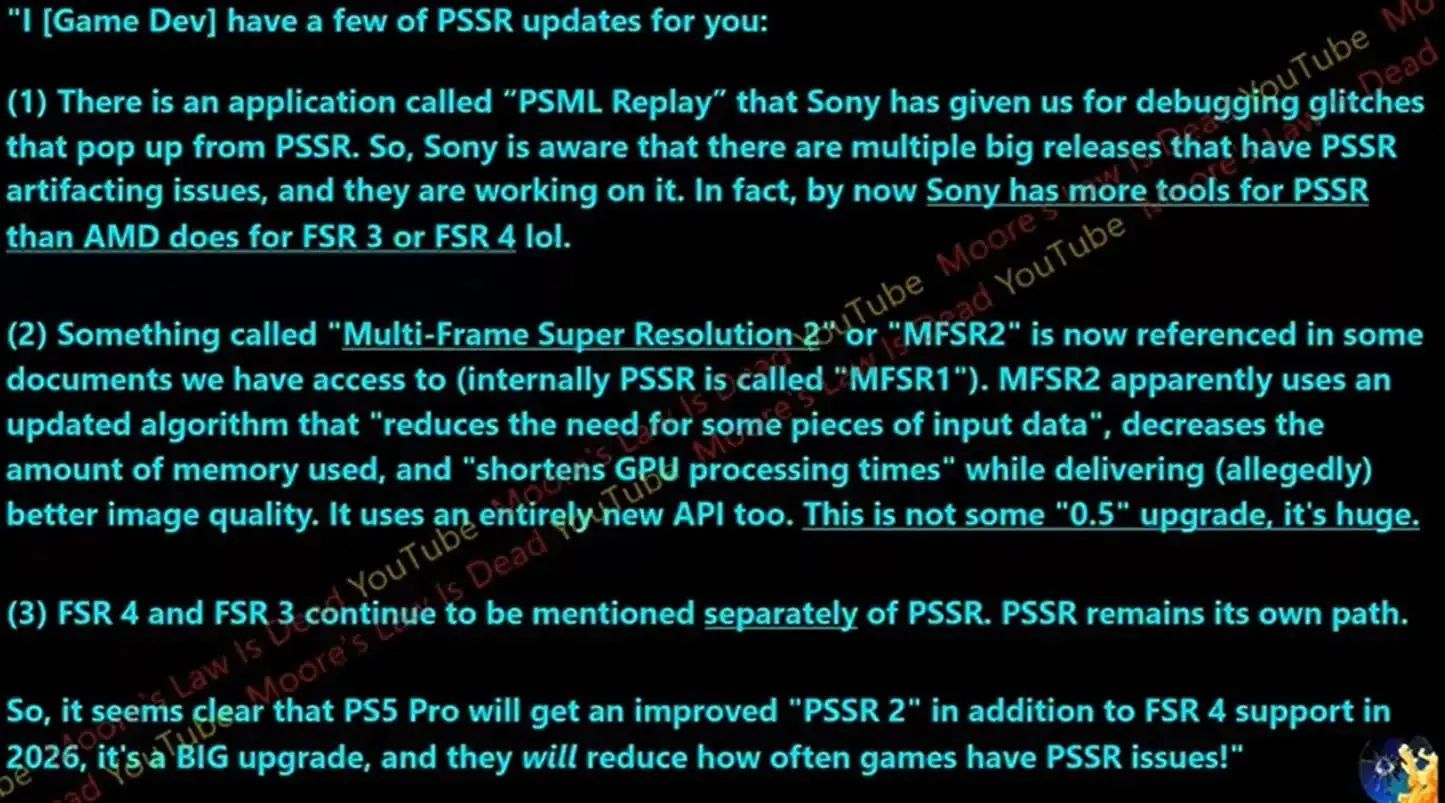
Sony is reportedly preparing to launch the next generation of PSSR for PS5 Pro.
PSSR 2 will be released in 2026 and aims to provide image quality close to FSR 4.
It will also feature frame generation, which isn’t a tech most people appreciate.
Sony introduced its own iteration of upscaling tech, like DLSS and FSR, with the PlayStation 5 Pro, called PSSR. The tech, when launched, wasn’t on par with other upscalers, leading to noticeable image quality and performance issues.
While the primary tech is based on FSR, it doesn’t come close to that level of performance, but Sony wants to fix that with its next version, PSSR 2, which is reportedly releasing on the PS5 Pro in 2026.
Why it matters: The biggest issue with PSSR is the weird artefacts and poor image quality it causes in many games, which Sony aims to fix with the upcoming update.
Moore’s Law is Dead spoke with a developer who shared a few details about PSSR 2. In fact, Sony has more tools for PSSR than AMD has for FSR 3 or 4. It’ll be a massive upgrade, almost like going from FSR 2 to FSR 4.
The updated tech will use a new algorithm that reduces memory usage and shortens GPU processing time, leading to much-improved image quality. Despite this, the PS5 Pro is expected to get FSR 4 separately.
PSSR 2 will reportedly provide a massive upgrade, fixing all issues with the current version.
The PS5 Pro already supports frame generation to a certain extent based on FSR 3 support in certain games. This could provide a solid ground for PSSR 2 to implement the tech as well, but most developers don’t really prefer it.
Anyhow, PSSR 2 is scheduled for release sometime in 2026 and aims to eliminate all issues with its current version. If implemented well, it could indeed be a game-changer, especially now that GTA 6 is closer than ever.
What are your thoughts on PS5 Pro getting FSR 4 level upscaling in 2026? Let us know your opinions in the comments or join the discussion at the official Tech4Gamers Forum.