At T4G, my task is to cover the latest news around the gaming globe ASAP and with the utmost precision. I adore all the games and respect all the devs behind the amazing games that we get all year. So, whether it’s a PC or a Console game, I got it all covered.
Story Highlight
A petition has been made to bring back Concord after it was shut down.
The petition has garnered over 1,300 signatures, while the hero shooter had less than 1000 Steam players at its peak.
Sony has suffered significant losses after Concord’s release, so a revival is entirely off the table.
Concord will be a disaster story for years to come. Today marks the day Sony took its servers offline two weeks after the full launch. Launched on August 23, this hero shooter saw heavy investments from Sony but ended up a complete disappointment.
However, just as the game goes offline, a petitiontitled ‘We Were All Busy That Weekend—Please Release Concord Again’ has been created to bring the hero shooter back.
Why it matters: The petition has garnered a lot of signatures. However, rather than legitimately wanting the game to be re-released, all the comments seem to be trolling this live-service title.
The petition to re-release Concord has garnered over 1300 signatures.
While the petition started with a very small signature goal, it has already achieved more than 1,000 signatures.
The petition currently boasts more than 1,300 sign-ups as it approaches the 1,500 milestone. This means that it now has more signatures than Concord’s peak concurrent player count on Steam.
However, most people don’t care much about reviving the hero shooter. We don’t know what the petition’s creator intended, but the comments are mostly just filled with people coming up with ridiculous reasons for missing the game.
I was waiting for this game for so long, but at the launch, I accidentally had diarrhea and was on the toilet for 2 weeks straight.
PlayStation is facing a huge loss as it spent a lot of its budget on Concord.
One user even went as far as to say that Sony should release the hero shooter again so that it ends up being shut down after it fails again.
As mentioned earlier, Concord’s journey came to an abrupt end today. The game is now offline forever, and it is unlikely to ever return. Fortunately for Sony, Astro Bot seems to be doing much better.
Currently serving as a News Reporter at Tech4Gamers, I have the privilege of combining my love for gaming with the art of storytelling. My role involves crafting engaging narratives that keep our audience abreast of the latest developments in the gaming world.
Story Highlight
The RCU (Remedy Connected Universe) goes beyond your typical connected universe by adding a unique twist.
Despite not holding the rights to all characters, Remedy still managed to find a unique way to include them.
Because Marvel and DC have laid the groundwork for such stories, the studio can learn from their failures and successes moving forward.
While the trend of a shared universe in movies and TV shows has been ongoing for more than a decade, connected universes in video games have yet to be fully explored.
Remedy is one of the most notable developers of recent times, and it seems to have been the first to adopt this trend in the gaming industry. The RCU (Remedy Connected Universe) is the multiverse sharing the stories of all these IPs.
All the build-up from previous games, including references and easter eggs from one game to another, was finally cleared up in Alan Wake 2’s Night Spring DLC, which features some of the best writing ever in fiction.
Why it matters: Remedy is just beginning to grasp the concept. The whole multiverse-style storytelling will only get better from here.
The RCU Is The Most Distinct Among Shared Universes
Jesse Faden As The Sibling In Alan Wake 2 Night Springs DLC | Image via Tech4Gamers
Swaying away from every other conventional shared universe, Sam Lake was quite innovative with this concept. His connected universe is intricate and may require a deeper than surface-level understanding because of its interconnected storylines.
These are some of fiction’s best stories despite spanning a few major franchises rather than other shared universes, such as the MCU or DCEU, which exist on a much larger scale.
Despite not owning the rights to all the franchises the team has developed over the years, Remedy still has passion and love for the characters it’s created. Therefore, I can’t help but admire the team’s smart solution to the intellectual rights problem.
Characters from past IPs keep appearing under different aliases in every story, even if they technically don’t belong to Remedy. Take Alex Casey from Alan Wake 2, for example, a character who looks identical to Max Payne.
Originally, he was considered a nod to the upcoming Max Payne remakes, but his role served a much greater purpose. The Alan Wake 2 Night Spring DLC, which featured three episodes and cost $20, further expanded on this concept.
Like Max Payne, Quantum Break is cleverly integrated into the universe with this DLC. It takes place before the events of Alan Wake 2 and marks his attempt to write the perfect story to free himself.
As such, he writes characters, such as “The Sibling,” “The Actor,” and “The Agent,” all based on characters from existing Remedy IPs.
The RCU Is Only Set To Expand Further
Alan Wake And Control Often Tackle Similar Themes And Subjects
Because the RCU is so new, the sky is the limit. The main timeline currently involves the Alan Wake and Control IPs, but things will only get more interesting from here.
These IPs will receive live-action adaptations, and Control 2 is currently in development. Following Remedy’s latest collaboration, Annapurna’s CEO expects the live-action story to tie in with the games, expanding the interwoven narrative.
Moreover, with Rockstar willing to borrow Max Payne, perhaps this IP will be more involved in future stories within the RCU. I could even see Microsoft heading in a similar direction and potentially agreeing to lend Quantum Break since the gaming giant is seemingly going all-in on a third-party push.
Much like Marvel’s ambitious crossover with the original Avengers paled in comparison to the scale of Avengers Endgame, the same could be true for the RCU a few years later.
Learning From Past Failures
Alan Wake 2 Takes Storytelling To A New Level | Image via Tech4Gamers
The biggest reason I can’t wait to see where this connected universe goes is the fact that Remedy can learn from Marvel and DC’s failures.
A decade ago, there was no real template on how to pull off crossovers of this scale. Sure, comic book stories had plenty of multiversal narratives, but they often became convoluted and confusing.
The MCU solved this issue, only to fall into the same trap a few years later. On the other hand, DC showed how rushing things can be a recipe for disaster. In my opinion, there are important lessons to be learned from these failures.
If Remedy is wise, it will examine what worked for Marvel and DC and avoid making the mistakes that prevented them from reaching greater heights. These lessons should prove to be incredibly important as the studio moves ahead with plans to establish gaming’s most ambitious interconnected universe.
I have faith in the team’s ability to analyze and learn from these lessons, giving me just one more reason to be excited about everything coming in the future.
At Tech4Gamers, I contribute as a Senior News Reporter, combining my skills and gaming enthusiasm to keep our audience updated on the latest developments.
Story Highlight
Toys For Bob has redesigned its website, teasing a new mystery project.
The website prominently displays Spyro, and the new look matches this IP’s signature purple theme.
Previous reports have also pointed to the development of a new project based on this IP.
Toys For Bob, the team behind modern renditions of iconic platforms like Crash Bandicoot, recently went independent. After receiving praise for its work on Crash Bandicoot 4, the team has returned with a new look for its website.
Following prior reports of work on a new project, the studio’s website redesign seems to imply that Toys For Bob is currently working on a new Spyro platformer.
Why it matters: Recent releases like Astro Bot have shown the potential for platformers that follow the classic gameplay principles of a lost era. As such, a new entry for this franchise could capitalize on the renewed interest in platformers.
Toys For Bob’s redesigned website shows all of its projects, including last year’s Crash Team Rumble. In a not-so-subtle manner, the team depicts its next project with a question mark.
While this teaser doesn’t reveal much, a closer look from the fans has revealed evidence that the next project is related to Spyro. For starters, the mystery game is displayed on a primarily purple background.
In fact, the whole website seems to follow this theme. Fans also noted that Toys For Bob is displaying both Crash and Spyro as major parts of its website, leading to conclusions that the latter is indeed returning.
As stated earlier, reports have also pointed to the developer working on a brand-new Spyro project. When combined, this evidence makes a solid case for this iconic platformer’s return.
The Developer Is Not Being Too Subtle About Its Teaser
Both IPs are currently owned by Microsoft under Activision Blizzard. Following the Activision Blizzard acquisition, the gaming giant has agreed to publish Toys For Bob’s next title.
Either of these franchises could prove to be a huge win for Xbox. As stated earlier, PlayStation’s Astro Bot has been a major success, so a platformer with the same charm and quality could serve a similar role in Xbox’s first-party lineup.
At Tech4Gamers, I contribute as a Senior News Reporter, combining my skills and gaming enthusiasm to keep our audience updated on the latest developments.
[Press Release] V-Color’s latest DDR5 memory combines technology and elegance for an excellent display of the company’s talents. The DDR5 RGB O CUDIMM is incredibly fast and meant to push beyond traditional speed limits.
According to V-Color, the DDR5 kits can be pushed to speeds up to 9200MT/s, while standard speeds see the memory running at 6400MT/s. One key component of the DDR5 RGB O CUDIMM is its dynamically changing frequency and voltage.
This results in fast operations when needed and lower power consumption on average. Coming in capacities as high as 48GB(2x24GB), the memory is suitable for professionals, gamers, and content creators who seek an uncompromised experience.
The Latest DDR5 Kits Boast Two New Patented Technologies
V-Color confirms that the DDR5 RGB O CUDIMM will join its renowned XFinity series. To enhance the aesthetic, a gold or silver RGB bar will also be included.
At the heart of the memory lies its advanced heatsink, which guarantees efficient heat dissipation. With two cuboids and a 0.8mm thickness, V-Color has been able to bring temperatures down by about 2-5 degrees on average.
This marks yet another notable innovation from the company, putting it at the forefront of the industry. For more on the DDR5 RGB O CUDIMM and the company’s exciting offerings, follow this link to the official website.
At Tech4Gamers, I’m the PC Hardware Specialist, primarily contributing to the “Best-Ofs” section. I provide thoughtful buying advice based on thorough testing and personal expertise. I also review hardware products and games to keep things fresh.
Story Highlight
The GTX 1080 Ti’s raw performance is still impressive and highly competitive even at 1440p.
The lack of mesh shaders, DLSS, and Ray Tracing makes it a less attractive option for the future.
The RX 6700 XT and RTX 3060 are much better options for a budget of around $150-$200.
Games are becoming more and more demanding each day, and there aren’t a lot of budget GPUs out there that actually offer great performance for the price. In times like these, I decided to revisit and test one of the greatest GPUs of all time, the GTX 1080 Ti.
I’ll be testing this fan-favorite graphics card to see how much juice it has left after 7 years of its launch and whether it’s still a viable option to consider.
The RAW Horsepower
The GTX 1080 Ti, being so old, is still kicking as it features some great specifications. The most notable is its 11 GB of GDDR5X memory coupled with a 352-bit bus. The card was launched for $699, but the performance it offered justified such a high price. Today, you can get it for anywhere around $100.
EVGA GTX 1080 Ti Kingpin
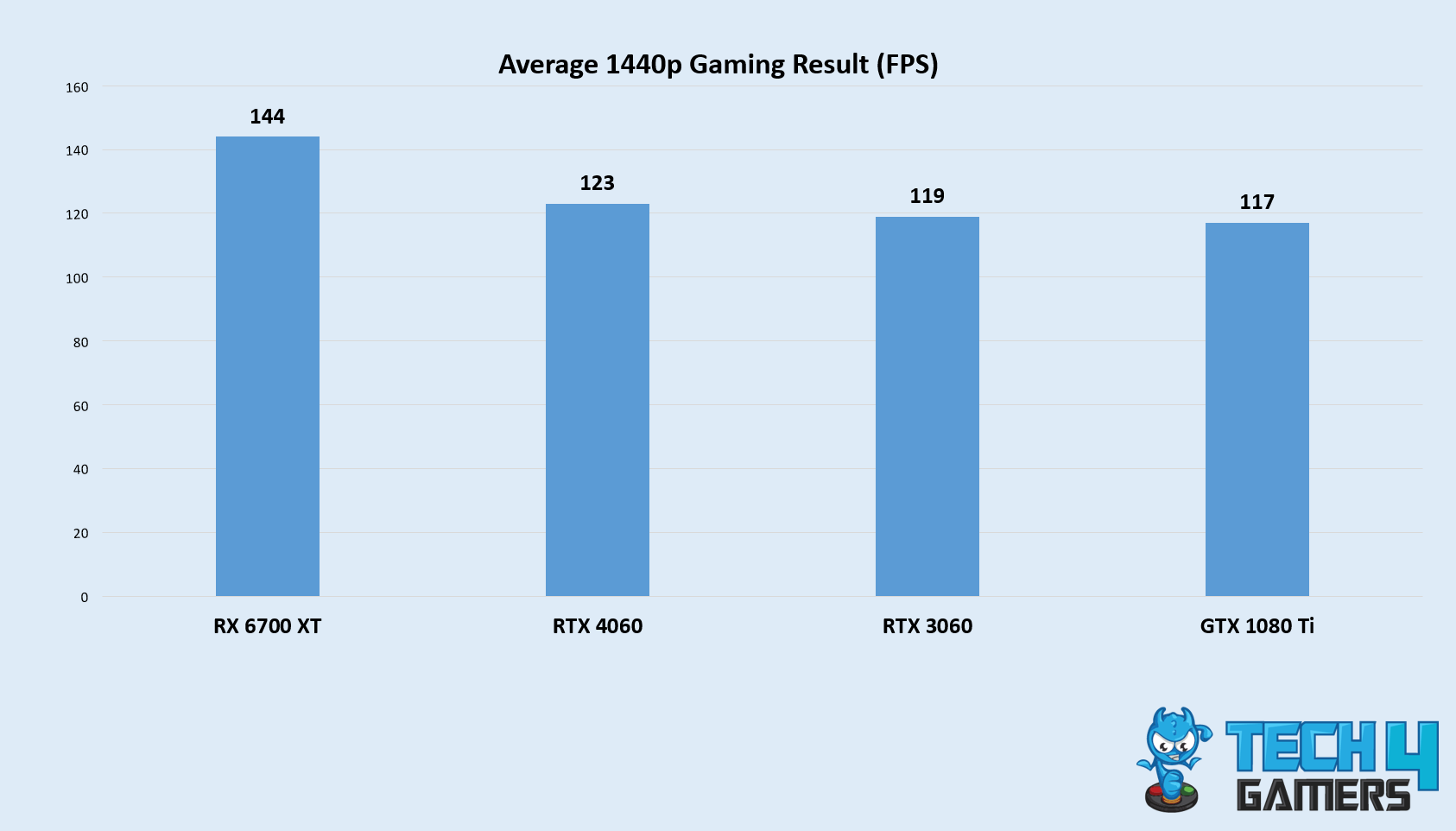
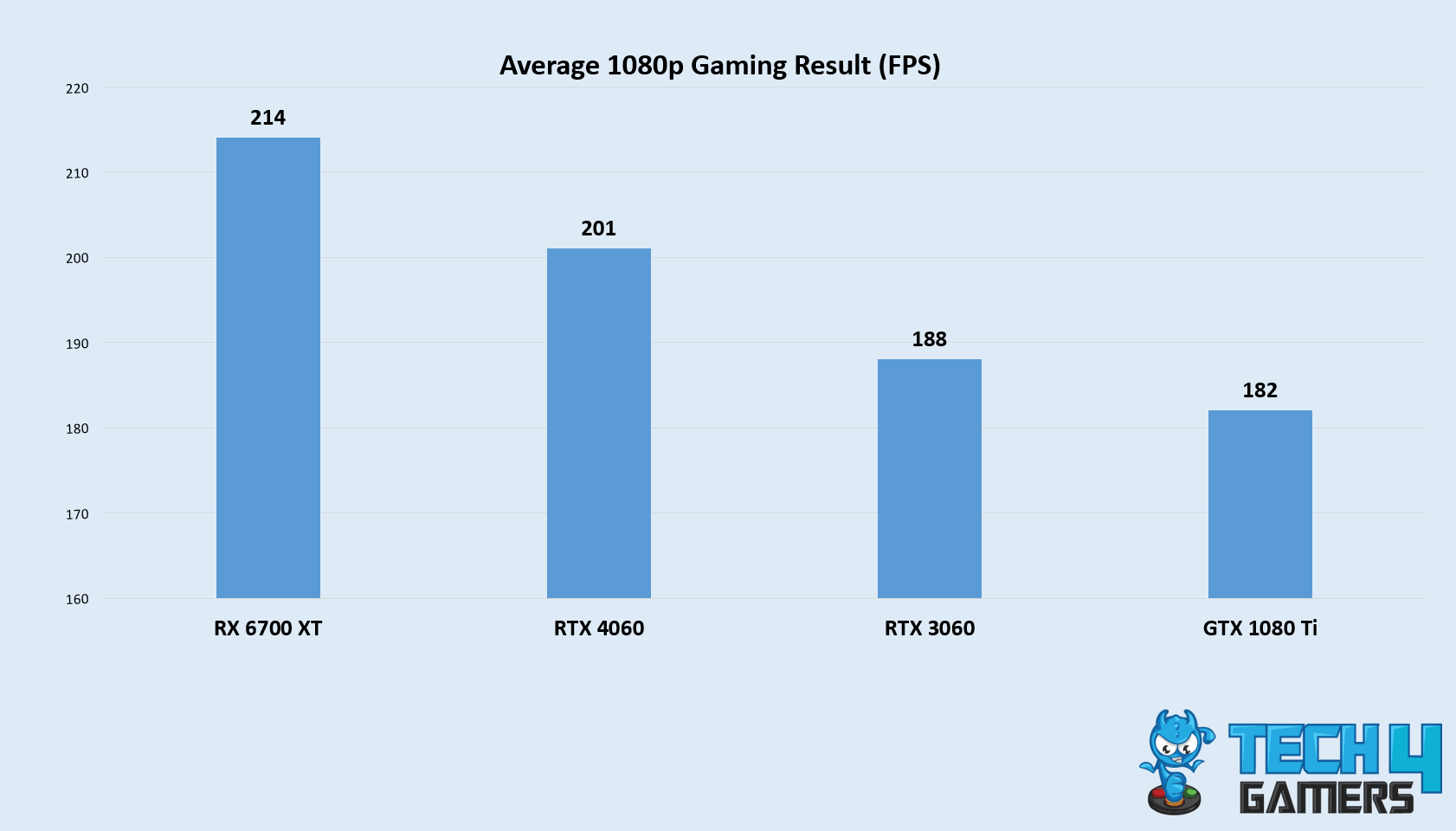
Its rasterized performance is still commendable when I saw it competing with modern graphics cards such as the RX 6700 XT, RTX 3060, and RTX 4060. Considering how old the GTX 1080 Ti is, the excellent performance it exhibited in gaming benchmarks is impressive. Starting with 1080p, I tested all four cards in 5 different games including Rainbow Six Siege, Baldur’s Gate 3, Total War: Warhammer, Robocop, and Fortnite.
Gaming Results
1 of 2
Average 1440p Gaming Result (Image credit: Tech4Gamers)
Average 1080p Gaming Result (Image credit: Tech4Gamers)
Even though, it comes in 4th place on average in my testing, it’s still a solid performance as it doesn’t miss out by a big margin. Similarly, it’s the same story when the resolution is cranked up to 1440p, the GTX 1080 Ti again comes in 4th place and stays just 2 frames behind the RTX 3060 on average.
Such Power Comes At A Cost
As it’s based on Pascal architecture, the GTX 1080 Ti comes with some limitations that may become a problem for many to go with this graphics card in 2024. New technologies are emerging and actively being used in game development that make some specific features compulsory for the graphics card to possess to play the game properly. The first one is mesh shaders, this is relatively new, and we have only seen it in Alan Wake 2 as of now.
The cards without mesh shaders were struggling to even maintain 30 FPS as compared to their counterparts having mesh shaders. Even though the game got patched to resolve this issue, it won’t be long until this becomes a common practice in games. Besides this, the GTX 1080 Ti also falls short of Ray Tracing and Nvidia’s DLSS upscaling tech.
Although ray tracing isn’t a big issue, especially around the RTX 3060 performance level, the DLSS is kind of a big thing because AMD’s FSR isn’t as good in image quality. However, the card can be used with native resolution for a good while, as it still has the power to run games without relying on upscaling tech.
Excessive Power Draw
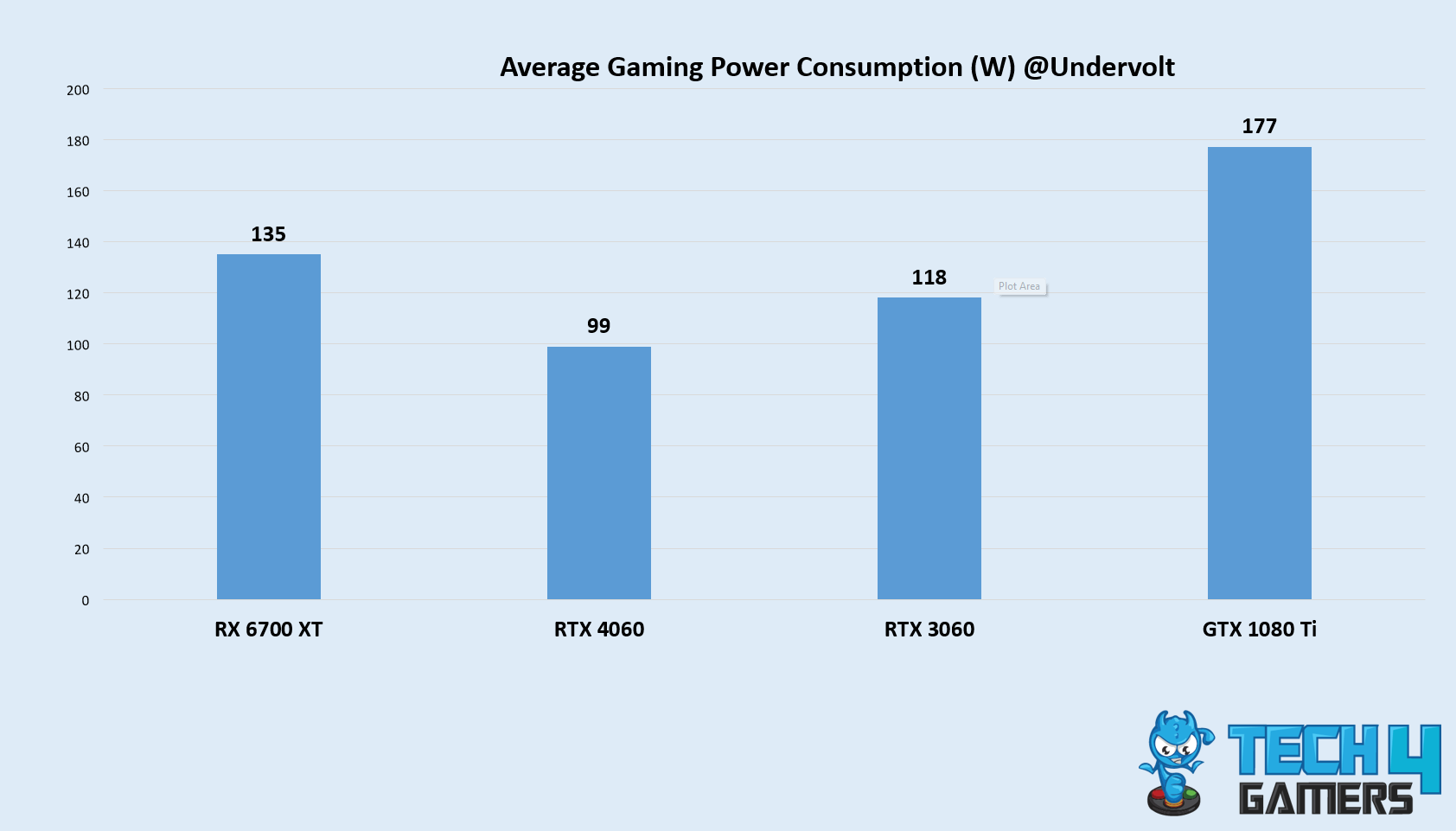
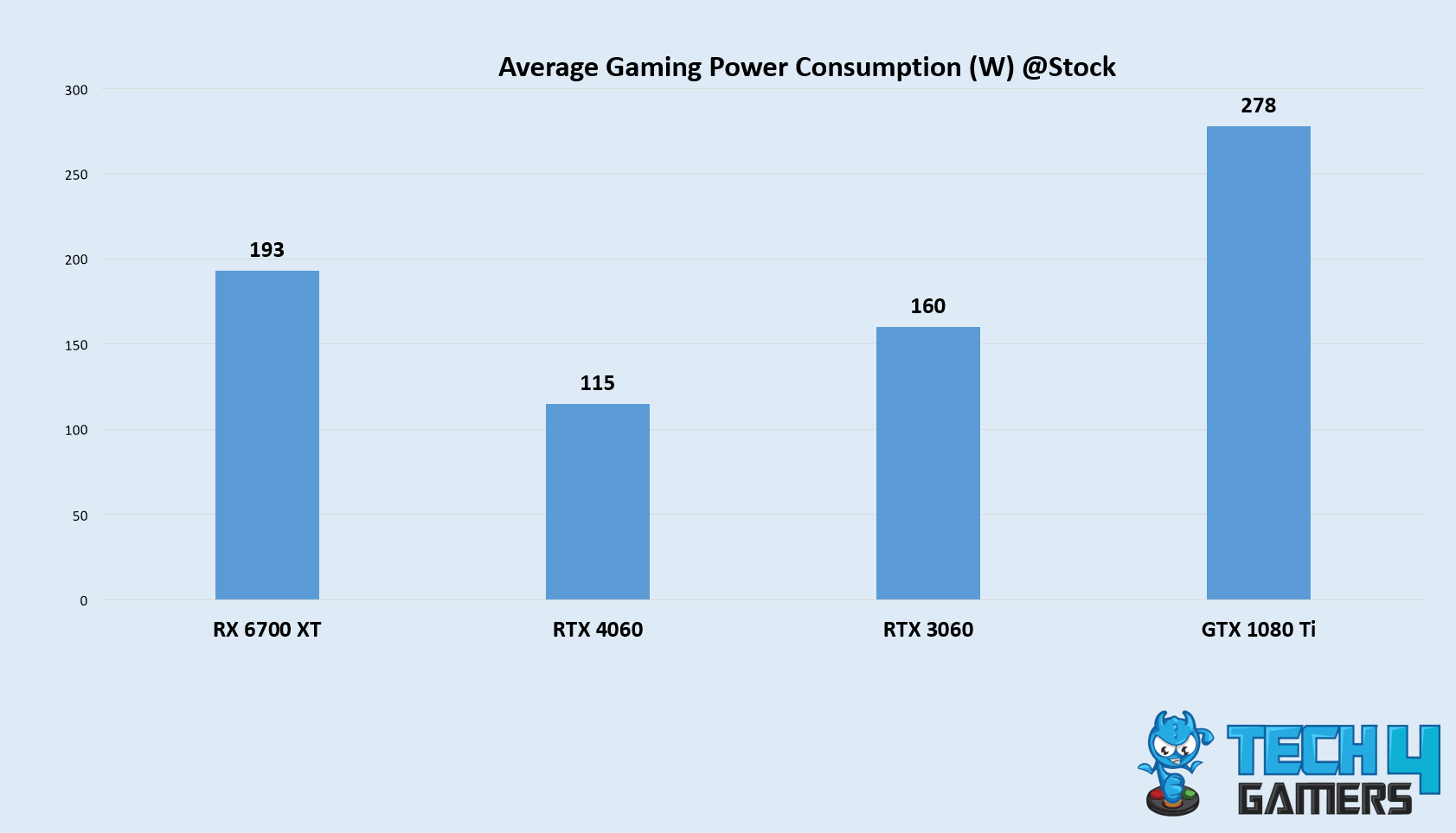
In this day and age, we have a lot of powerful options that are also power efficient at the same time. As this GTX 1080 Ti is 7 years old, it eats quite a lot more power than its current competition. The card alone was consuming almost 300W of power during Rainbow Six Siege at 1080p resolution. The rest of the three cards stay well under the 200W bracket, exhibiting their efficient nature.
Power Draw Test Results
1 of 2
Average Undervolt Power Draw (Image credit: Tech4Gamers)
Average Stock Power Draw (Image credit: Tech4Gamers)
There’s a way to deal with this, after I undervolted the graphics card, I witnessed a huge decrease in power consumption from almost 300W to under 200W as well as the temperature levels. Which is impressive and should be the default way to use it.
Better Alternatives are Available
While the card still performs great and has no problem running games even at 1440p resolution, cards like the RX 6700 XT, RTX 3060, and even RX 6600 XT seem to be the better alternatives in my eyes. Those cards are very recent and carry all the newer tech that modern games benefit from. So, within the budget of around $150-$200, these graphics cards should be considered. In case, the GTX 1080 Ti is the only option in front of you, it’s a no-brainer if you can compromise the DLSS and a few other stuff.
A Card That Needs A Modern Comeback
It’s safe to say that GTX 1080 Ti has aged like a fine wine, and still refuses to die for good, as it’s still shining on the rasterized performance side. It would be pleasant to see if Nvidia again comes up with a card like this. Sure, the RTX 4080 and RTX 4090 are way more powerful, but they come at a much higher price and still can’t produce an impact as great as the GTX 1080 Ti.
As Tech4Gamers’ Wiki Editor, I dissect gaming products, offering detailed perspectives on a variety of PCMR hardware ranging from the Best Motherboards and CPUs to the Best GPUs, RAM, and PSUs.
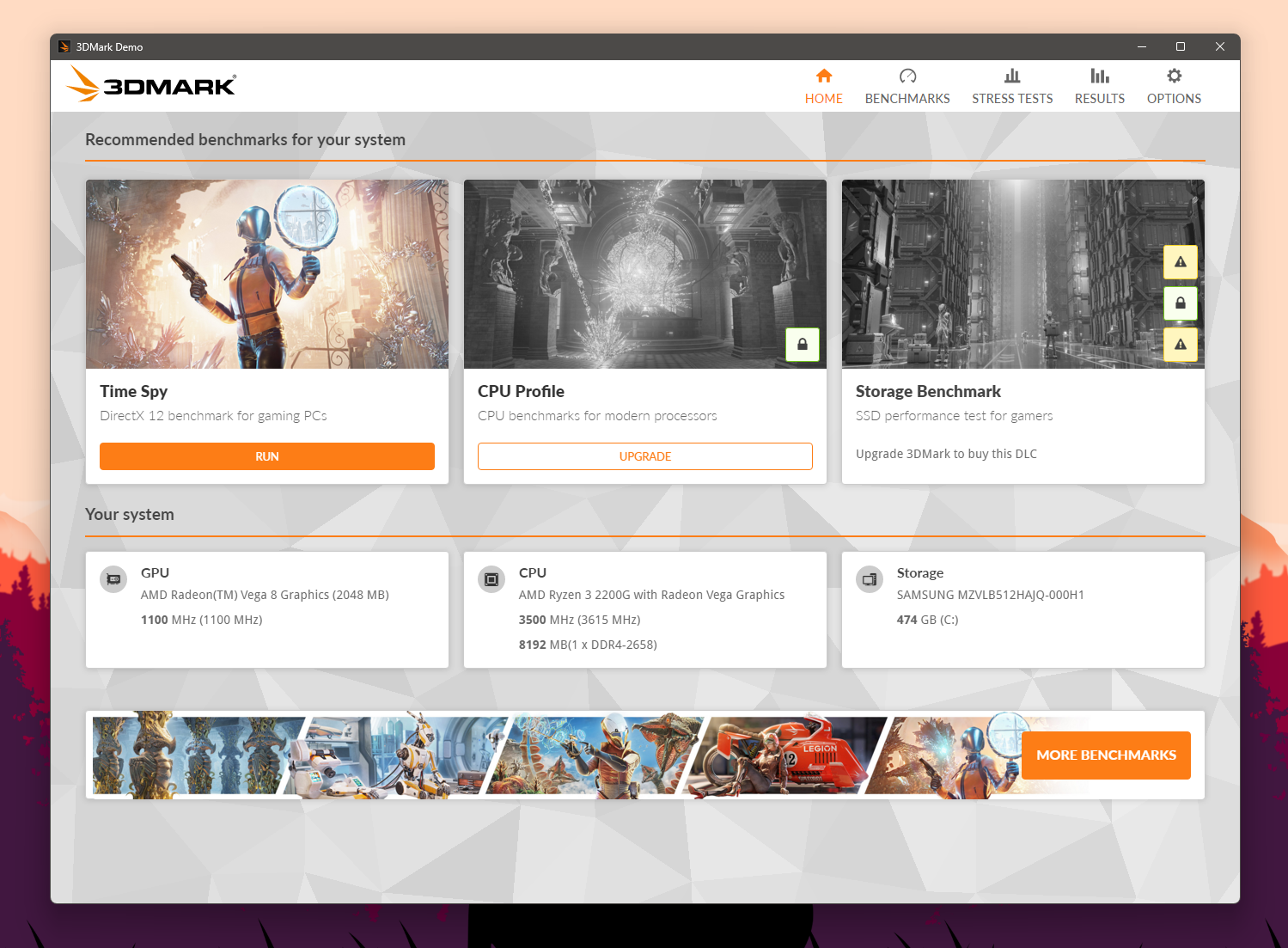
The 3DMark Suite, like any other benchmarking tool, serves the same purpose — to evaluate the performance of your PC setup or mobile device. The 3DMark suite offers a variety of benchmarking tests, but the full version is hidden behind a paywall. However, the demo version is more than enough with its limited test selection.
It offers a straightforward UI and richly detailed results, with the option to compare results with other setups from their database. You can download the demo version from Steam on PC, Play Store for Android, and App Store for iOS devices.
User Interface and Usability
Initiating with its user interface, 3DMark boasts a relatively simple UI to interact with, there’s no clutter on the screen and everything is very intuitively put together. Navigating through the tool feels like an in-game menu with tabs like “Home, Benchmark, Results, Stress Test, Options” placed in the upper right corner: each devoted to a different function.
3DMark Suite UI (Image credit: Tech4Gamers)
Similarly, the usability factor is also high, as this benchmark application can test all the PC components by imitating a game-like scenario. Moreover, its availability on mobile devices also counts.
Core Features
The 3DMark Suite doesn’t fall short on the features and comes with a decent list of those, some of its key features are:
Multi-Platform Availability
Wide Range of Benchmarks
Adjustable Benchmark Settings
Credible Performance Forecasting
System Monitoring
Multi-Platform Availability
Having a one-for-all solution is always welcoming to have. The 3DMark Suite is not just limited to the PC platform, it is also available on mobile phones, whether it’s an Android or iOS-based iPhone. You can also easily manage and compare results with multiple devices because of the cross-platform compatibility and availability.
Wide Range of Benchmarks
One of the best things about 3DMark Suite is the number of different benchmarks to choose from for all supported devices. Moreover, each benchmark tests a different thing, like a different API or technology. Most of them are only accessible via the paid version. However, the demo version comes with Time Spy, which caters to the DX12 performance of GPU and CPU.
Firestrike is for DX11, Night Raid is for portable devices with iGPU, Steel Nomad Light is for mobile phones, and Steel Nomad is for high-end gaming PCs. These free included benchmarks are more than enough for the majority of casual PC users.
Credible Performance Forecasting
The richly detailed 3D scenes with a lot of action and complexity running on the system will help you estimate the gaming performance more accurately. Because those scenes look and work like a game with auto-mode on. So, it’s easier to figure out how the graphically intense game will perform on your system.
Benchmarking Tools
The demo version of 3DMark Suite offers four benchmarks targeting a different API and device:
Time Spy
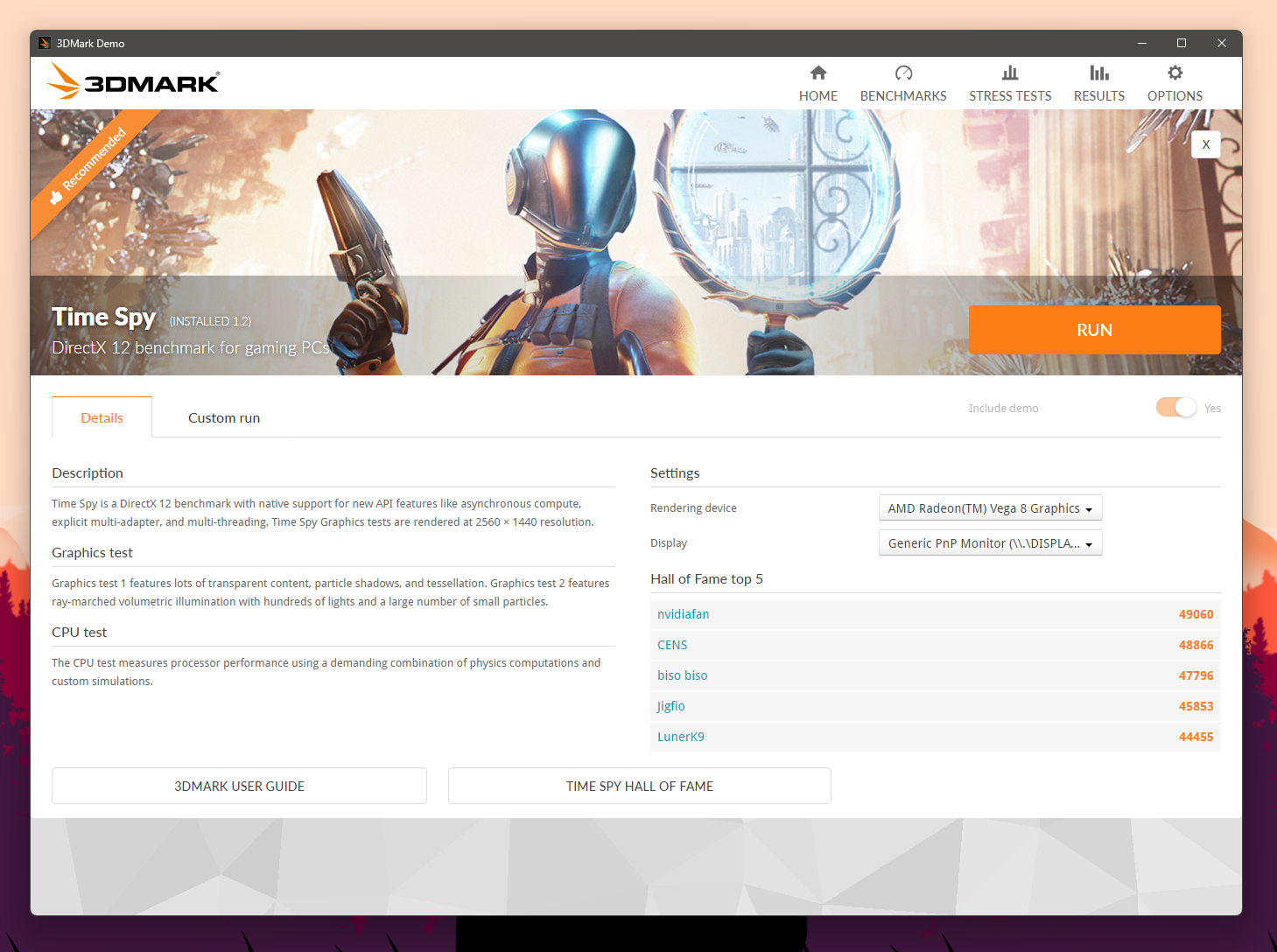
This one is one of the most popular in the 3DMark Suite, as it is targeted at Windows gaming PCs. It thoroughly tests the PC using the DX12 API, which allows the PC to be utilized more than its predecessor. Additionally, this DX12 benchmark features four scenes to stress the graphics card as well as the processor by simulating an in-game environment.
Time Spy Benchmark (Image credit: Tech4Gamers)
Fire Strike
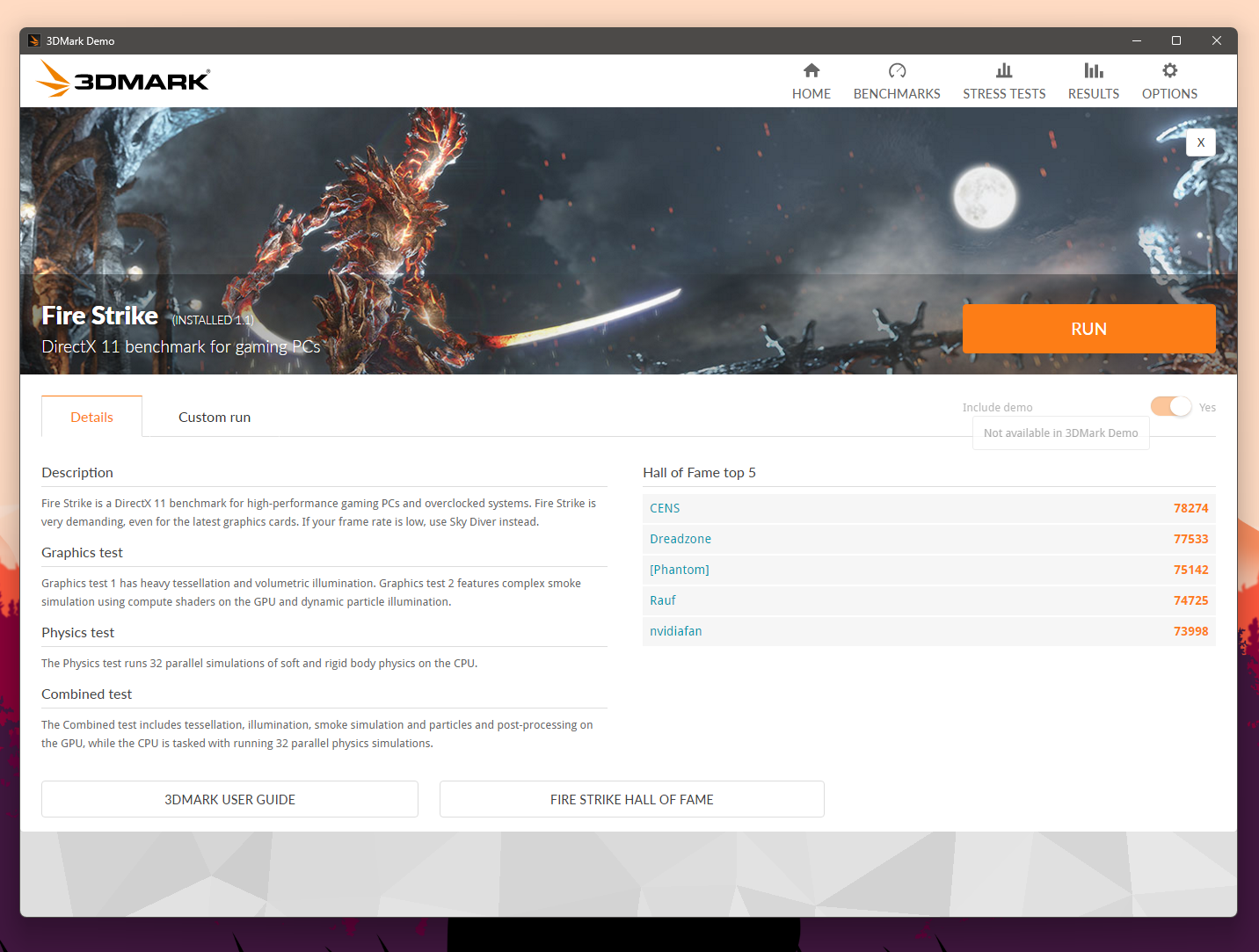
Just like Time Spy, this benchmark is also targeted at gaming PCs, however, this time around it focuses on the DX11 performance of the graphics card with a physics test. Other than that, the CPU is also tested in a combined test similar to Time Spy. The basic version of Fire Strike is limited to 1080p resolution, and higher settings can be used by owning the paid version of 3DMark Suite.
Fire Strike Benchmark (Image credit: Tech4Gamers)
Night Raid
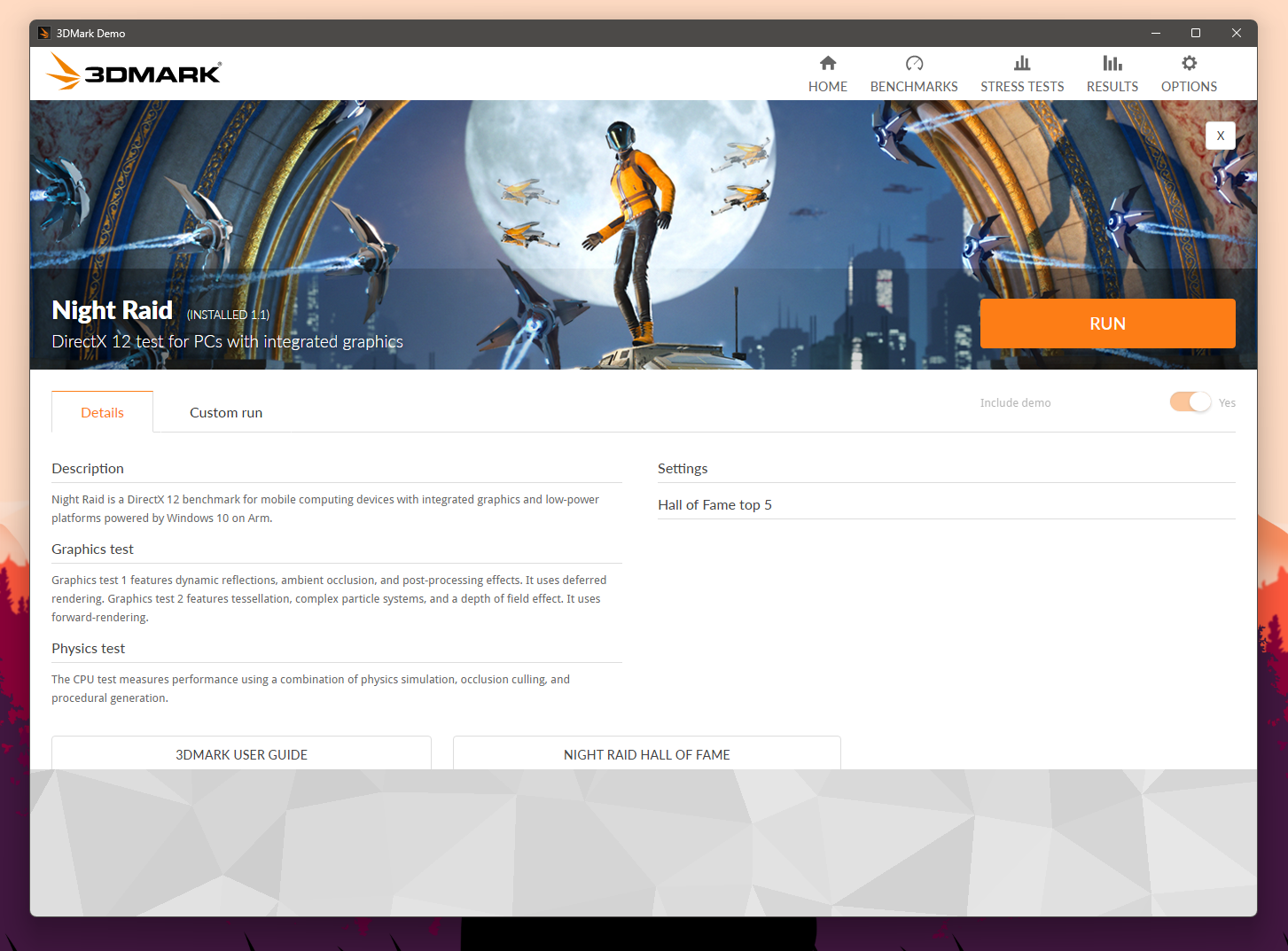
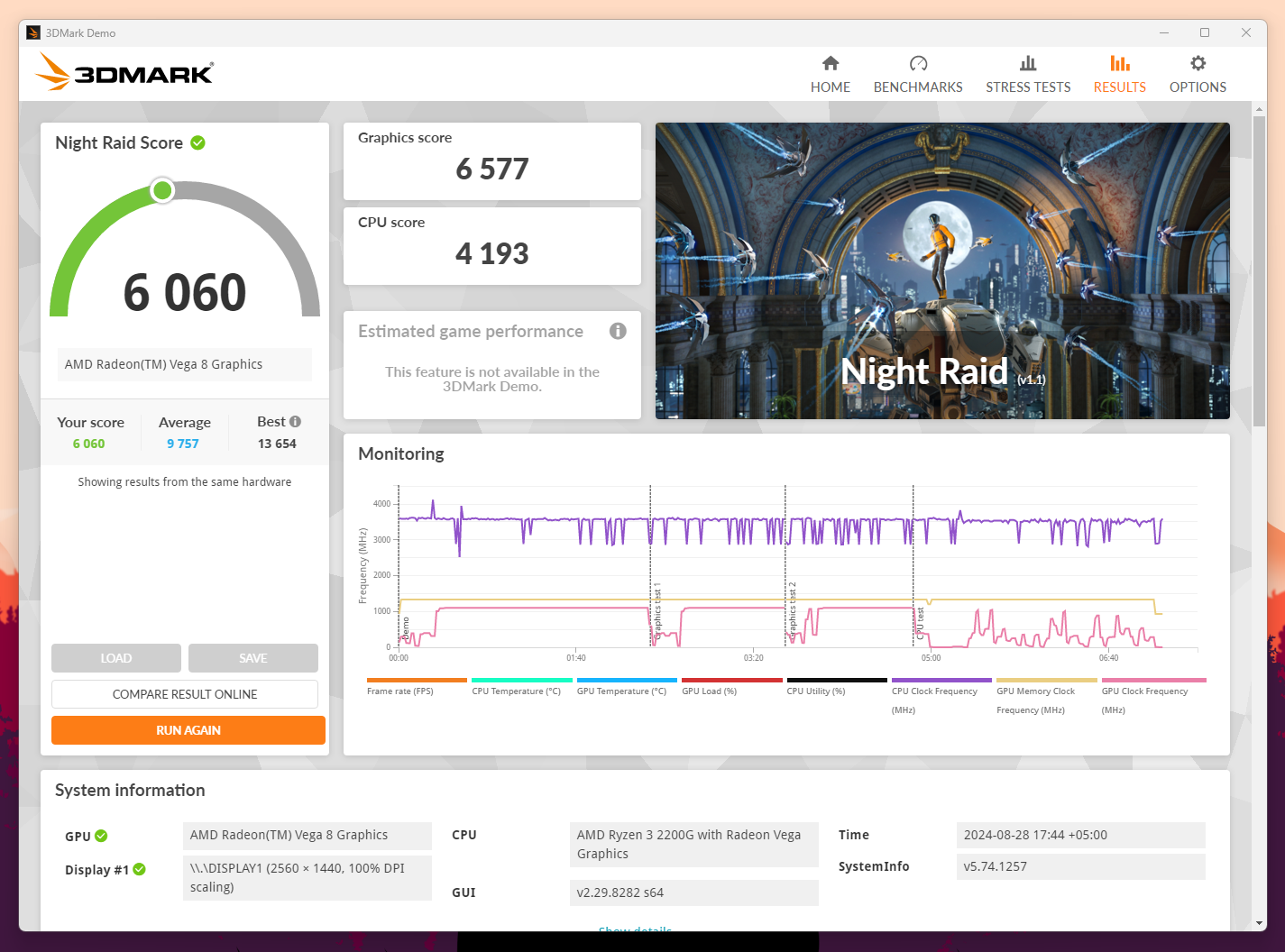
Unlike the others, Night Raid is a fairly light DX12-based benchmark test that primarily targets portable devices, such as laptops and tablets with integrated graphics.
Night Raid Benchmark (Image credit: Tech4Gamers)
Steel Nomad Light
It’s a lightweight version of the normal Steel Nomad benchmark test and features far less demanding assets and graphical techniques that make the Steel Nomad resource-heavy. With cut-down settings, it still runs at 1440p resolution and is meant to test tablets, portable PCs, and gaming phones.
Steel Nomad
This benchmark test goes all out on the demanding stuff and only cuts out on the ray-tracing features, which Nvidia’s RTX 3000 and 4000 series graphics cards handle very well. Moreover, it runs at a native 4K to push the gaming PC to its maximum.
Pros And Cons
What We Liked
What We Disliked
Detailed Benchmarking Information.
Very Taxing at Times.
Paid Version isn’t Indispensable.
RT & Drive Tests aren’t Free.
Intuitive Interface.
Multi-Platform Availability.
Changeable Graphics Settings.
System Monitoring.
Comparison With Competitors
3DMark Suite is a no-brainer in comparison with other benchmarking tools like Geekbench, Cinebench, or AIDA64. But they either test the CPU performance or non-gaming GPU performance. Where the 3DMark Suite focuses more on gaming performance. Meaning, that 3DMark Suite can provide more credible and accurate insights related to in-game performance and how well your PC can handle it.
Use Cases
We actively use 3DMark Suite in our gaming PC reviews to share a more accurate opinion on what kind of gaming and graphical performance you can expect from your components. Like if you’re using an Intel i7 14700KF generation CPU with an RTX 4080.
Testing System for Review (Image credits: Tech4Gamers)
Troubleshooting Common Issues
Varying Results: The 3DMark Suite is highly resource-intensive, so even a single program running in the background can affect the results, so, better to close everything before testing.
Test Freezing: If you experience freezes during the benchmark, try reverting the OC settings on your system if there are any.
Incompatible Drivers: In case the Suite isn’t performing as it should and crashing, then you better update the drivers on your system to the latest.
Glossary of Terms
Ray Tracing: This rendering process creates more visually realistic lighting and reflections than older techniques like SSR, SSAO, or HBAO.
Overclock: The process of pushing the clock speeds of GPU and CPU over stock limits to gain additional performance is called an overclock.
Cross-Platform: If software supports and can run on different devices like a PC as well as a mobile, then it is said to be a cross-platform software.
Frame Rate: The number of frames a PC is displaying per second on screen is called the frame rate, it is measured as frame rate per second.
As Tech4Gamers’ Wiki Editor, I dissect gaming products, offering detailed perspectives on a variety of PCMR hardware ranging from the Best Motherboards and CPUs to the Best GPUs, RAM, and PSUs.
DDR5 has seen some significant improvements in memory speed, and it can only benefit the system if they are used with proper timings and voltage settings. This is where overclocking profiles come in, they set the memory to properly tuned settings by the manufacturers so you don’t have to.
AMD EXPO does the very same thing, but where does it stand in scalability, what it takes to set it up and use it, and is it worth it over Intel X.M.P?
Key Takeaways
The AMD EXPO works just like the Intel X.M.P and allows for easier memory overclocking without going the manual way.
AMD EXPO is an open source where all the test results aren’t kept confidential.
This memory overclocking is only limited to DDR5 memories and is not available for DDR4 modules.
What Is AMD EXPO?
The word EXPO in AMD EXPO stands for “Extended Profiles for Overclocking”, meaning a new contender in the memory profiles race. It allows the user to set the memory voltage, its frequency, and timings with just one click without the need to go the manual path.[1]
It is compatible with DDR5 memory kits only, as it was designed by AMD specifically for their AM5 socket’s Ryzen 7000 series and onwards processors, and those only work with DDR5 memory.
Features of AMD EXPO
AMD EXPO offers some distinct features that set it apart from Intel X.M.P.[2]
Better Performance for Ryzen: The performance gets a lot better if the EXPO-supported memory kit is paired with the AM5 platform Ryzen processors. The aggressively tuned settings help the Ryzen processors to perform far more effectively.
Open Standard: AMD has opted for an open standard for the EXPO and made it license-free for manufacturers like Intel X.M.P. However, the open standard is the exception. All the test results from manufacturers are available to the public. This assists the users in confirming the hardware compatibility with EXPO.
How Does It Work & How To Enable AMD EXPO
The profiles are loaded into the SPD chip[3] of the DDR5 ram kit. When the PC boots up, its BIOS checks the data available on the chip and displays the AMD EXPO profiles for the user to choose from.
In order to activate the AMD EXPO, let’s take this Gigabyte X670E Aorus Master as an example. Firstly, boot into the BIOS by pressing the “Del” or “F2” button while booting the computer. You will be welcome into the “EZ Mode”, now press “F2” to enter “Advanced Mode”.
Click on the “Tweaker” tab, on this page, you can see “Extreme Memory Profile (XMP/EXPO)” right below the DDR5 Auto Booster setting. Click on it to select any profile of your choice to apply AMD EXPO settings and save by pressing “F10”. The procedure may vary slightly from motherboard to motherboard.
Memory OC on Gigabyte Motherboard (image credit: Tech4Gamers)
Difference Between AMD EXPO & Intel X.M.P
Their core functionality is the same, which is to overclock the memory modules to the selected presets. While the differences exist, they’re not too many.
AMD EXPO is only available for DDR5 memory modules, whereas Intel X.M.P is also present on DDR3 memory kits.
Being an open-source tech, AMD EXPO is also available on the Intel platform, whereas Intel’s X.M.P is exclusive to Intel processors.
How To Check If Your RAM Supports AMD EXPO
If you’re unaware of whether the memory in your system supports AMD EXPO or not, then one of the simplest ways is by downloading and installing the CPU-Z software. After opening CPU-Z, click on the SPD tab and there you can verify the overclocking profile tech your RAM supports in the “SPD Ext.”
As Tech4Gamers’ Wiki Editor, I dissect gaming products, offering detailed perspectives on a variety of PCMR hardware ranging from the Best Motherboards and CPUs to the Best GPUs, RAM, and PSUs.
Memory modules have always been of great significance for the performance and smoothness they bring to the table. Their overclocking is well-regarded and useful too; however, it’s not as simple as the overclocking of CPU & GPU.
This is why memory overclocking presets such as Intel XMP exist to tune up the RAM’s CAS latency, clock speed, and voltage settings.
Key Takeaways
Intel XMP is available on a much larger scale than other competitors.
The whole process of setting up and applying XMP profiles is straightforward.
This RAM OC utility is not limited to newer or specific generations and is available for as old as DDR3.
Intel XMPstands for “Extreme Memory Profiles,” and as the name suggests, it is used to tune the memory kits with just one click.[1] The user doesn’t have to invest time in setting everything up manually because these pre-configured profiles do the very same thing.
Furthermore, unlike AMD EXPO, the Intel XMP isn’t limited to just one specific generation or socket of processors. Intel XMP is available on DDR5, DDR4, and even the DDR3. Each generation has a different iteration of Intel XMP; for instance, Intel XMP 3.0 is currently being used to overclock DDR5 memory kits.
Features of Intel XMP
Intel XMP introduced several great features that helped the majority of PC users out there, especially the latest Intel XMP 3.0.[2]
Better Performance: Enabling XMP profiles can significantly enhance the system’s performance because the memory modules are running at a higher clock with optimized timings and power.
Compatibility: Intel XMP is compatible with a wider range of motherboards and memory kits due to it being in the memory overclocking game for a good while. Almost every motherboard for Intel CPUs, from budget to high-end, supports XMP profiles.
How Does It Work & How To Enable It
SPD chips are responsible for storing the XMP overclocking profiles, which then lets the BIOS read its stored XMP profiles.[3] Later, the BIOS shows every available profile on the screen.
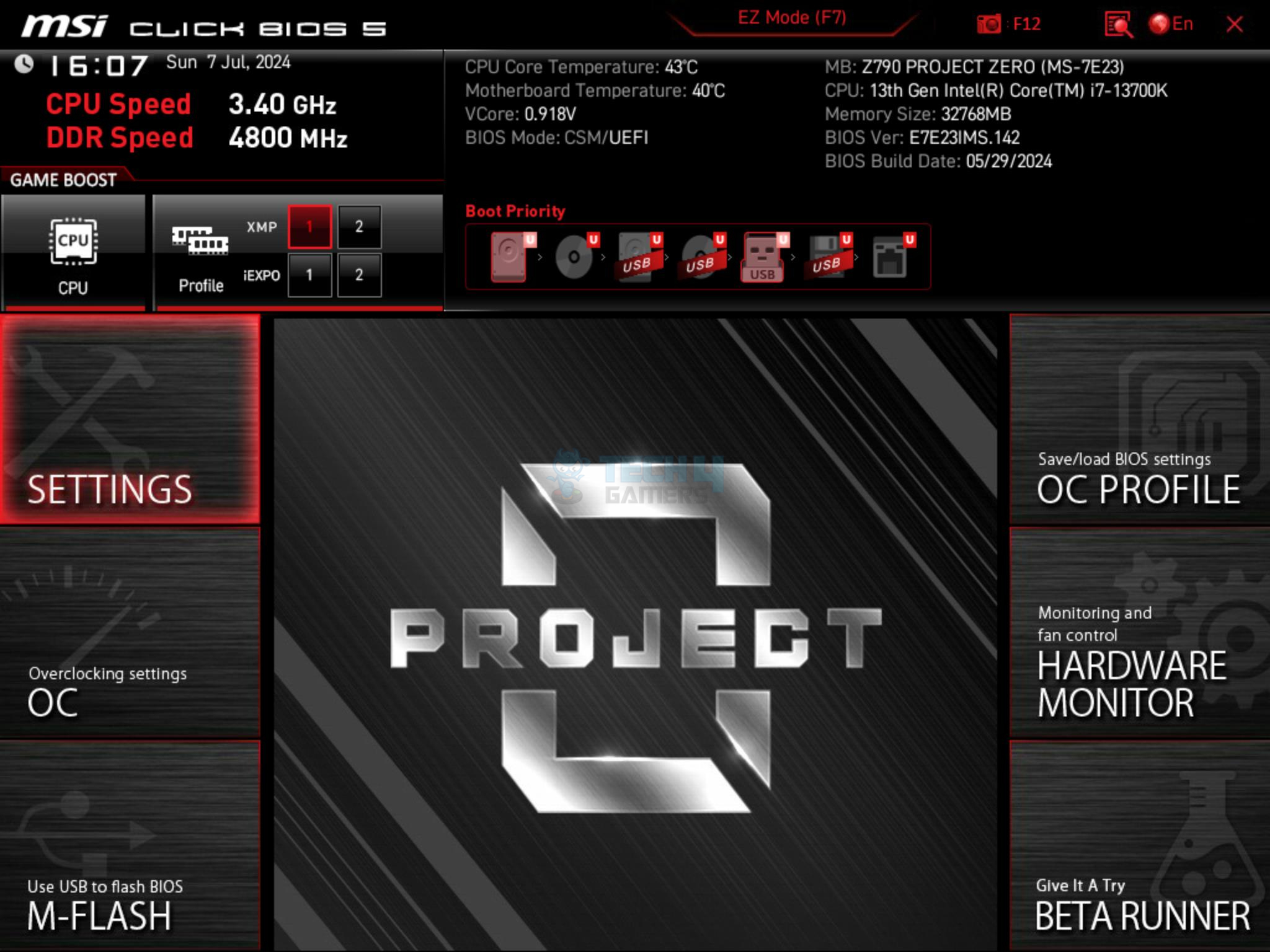
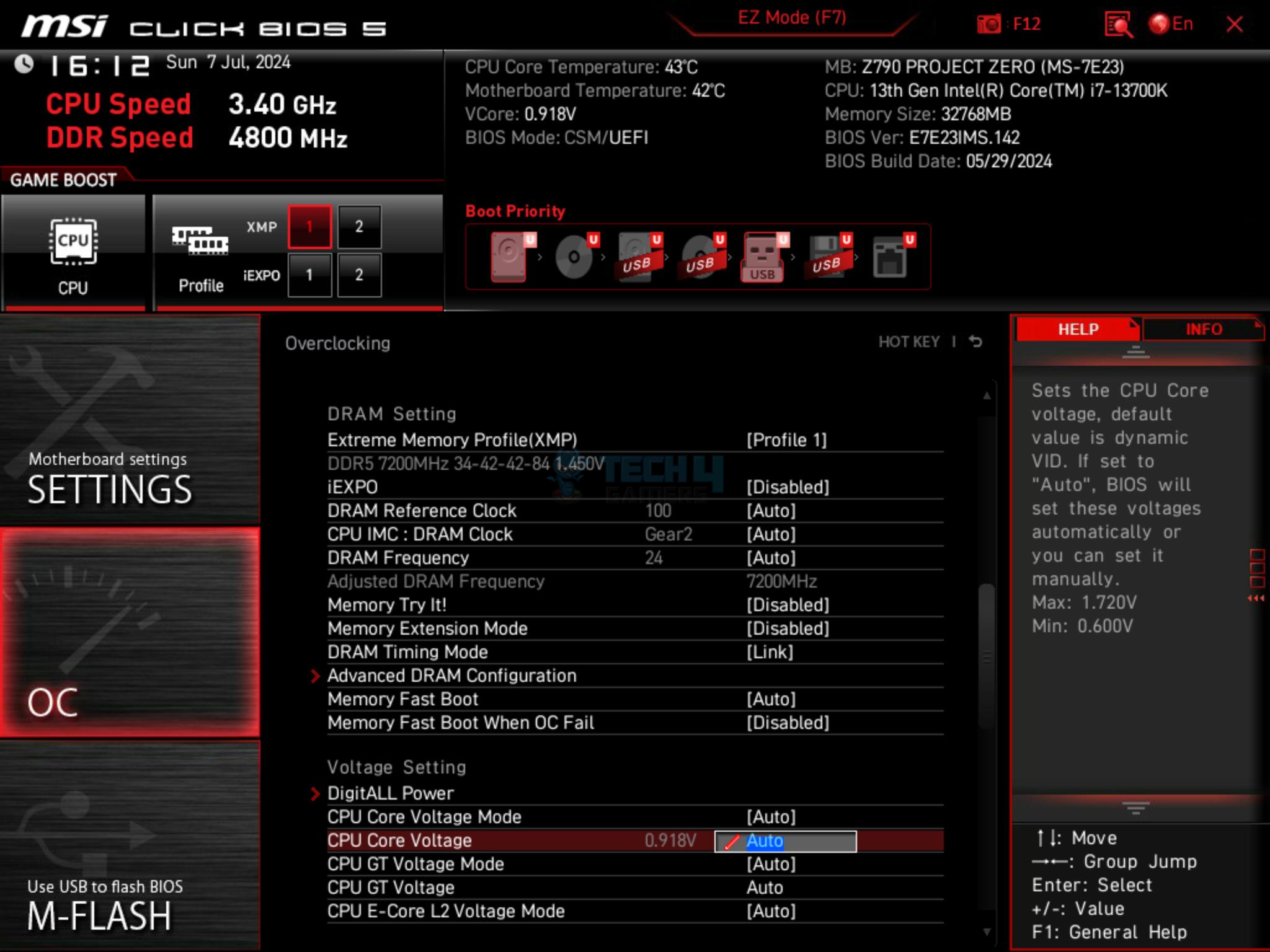
To enable the Intel XMP profile, let’s take the MSI Z790 Project Zero for example. Enter its BIOS by pressing the “Del” button. From there, you can see the “OC” box right below the “motherboard settings”. Click on it and all the overclock settings will pop up in the middle.
How To Enable XMP
1 of 2
Enabling XMP from Z790 PZ BIOS (Image credit: Tech4Gamers)
Enabling XMP from Z790 PZ BIOS (Image credit: Tech4Gamers)
Now click on the “Extreme Memory Profile (XMP)” under the DRAM settings, select from the available profiles, and press F10 to save and exit the BIOS. New settings will be applied automatically on your next boot. Do note, though, that the instructions and naming scheme may vary depending on the motherboard.
How Is Intel XMP Any Different From AMD EXPO
Both are here to overclock the memory kits and unleash their true potential, however, Intel XMP being an old player has some extra perks over AMD EXPO.
Intel XMP offers up to three pre-configured profiles to the users in comparison with AMD EXPO which only lets you pick from either one or two profiles depending on the motherboard.
Intel XMP is also available on the AM4 platform, as it supports DDR4 memories as well.
There are significantly more XMP kits available than EXPO.
How To Verify RAM’s Intel XMP Compatibility
If somehow you have lost your RAM box and are not sure whether your memory kit is Intel XMP certified or not? It is quite easy to find that out with just a simple utility. All you have to do is download and install the CPU-Z software from the internet and head over to its SPD tab. There you can see the XMP written inside the “SPD Ext.” box. Moreover, XMP will be mentioned under the “Timings Table” where JEDEC is written, That’s how you can verify the overclocking profile compatibility.
No, Intel XMP has always been an Intel-exclusive memory overclocking utility and isn’t available on the AMD platform.
Is Intel XMP 2.0 and 3.0 the same thing?
No, Intel XMP 2.0 is for DDR4 memory kits, whereas Intel XMP 3.0 is for DDR5 memory kits and offers up to three profiles with the ability to create your own.
At Tech4Gamers, I contribute as a Senior News Reporter, combining my skills and gaming enthusiasm to keep our audience updated on the latest developments.
Story Highlight
Fans have shown a complete distaste for egregious practices that plague live-service games, leading to failures like Concord.
Conversely, narrative-driven experiences like Black Myth: Wukong, Astro Bot, and Stellar Blade have been major hits.
The gaming industry is headed toward a future where the tables are turned, putting single-player gaming at the forefront once again.
PlayStation was quite excited about its live-service debut, and after an incredible first attempt with Helldivers 2, hopes were high for the gaming giant’s domination in yet another major part of the industry.
However, this success has come and gone, leaving only the remains of Concord in the aftermath. After one of gaming’s biggest debacles to date, PlayStation is sure to question its decisions and reflect upon the events that led to Concord’s failure.
At the same time, a passion project like Astro Bot has prevailed in the face of seemingly impossible odds. Look no further than Black Myth: Wukong for additional proof that single-player titles remain unparalleled.
Why it matters: Developers and publishers seem to be working against themselves by forcing GAAS(games as a service) on their audiences. Recent releases like Suicide Squad: Kill the Justice League have also seen fan-favorite teams like Rocksteady falling from grace.
Everyone Is Done With Live-Service
Concord’s Failure Has Raised Doubts About All Future Live-Service Projects | Image via Tech4Gamers
Concord is perhaps a bad pick as the face of the live service genre as a whole. However, it was, for all intents and purposes, a game that managed to highlight the problems of live-service gaming very well.
Gameplay trends that had already begun to run out of steam four years ago, unappealing character designs, and the obligatory battle pass; you name it, and Concord probably had it.
All these elements have shown up time and again in practically every live-service title. If recent failures are any indication, players are clearly not fond of this template, even if the likes of Fortnite or Apex Legends suggest otherwise.
Often, these games are designed with the goal of monetization above all else. It’s also immediately obvious that developer hard work and passion take the backseat as corporate meddling takes over, all for executives to boast about their record-breaking numbers during each shareholder meeting.
Needless to say, this is not what gaming is about, and it wouldn’t be wrong to say that most live-service titles feel soulless because of the corporate influence present in most, if not all, of them.
Single-Player Success In Face of Live-Service Failures
Black Myth: Wukong Has Put Chinese Talent On The Map | Image via Tech4Gamers
EA may have declared single-player a dead genre many years ago, but I’m happy to see the industry’s current trajectory.
Time and again, single-player games have stood atop the food chain, standing tall against the live-service competition. Last month’s Black Myth: Wukong stood in stark contrast to Concord, two AAA titles released very close to each other.
Its success served as yet another reminder to all the naysayers. If this wasn’t enough, Astro Bot has probably sent a strong message to all the higher-ups at Sony who envisioned a live service future as the only possible move forward for the PlayStation business.
Going even further back, Elden Ring: Shadow of the Erdtree, Final Fantasy 7 Rebirth, Stellar Blade, and Like a Dragon: Infinite Wealth served as important demonstrations of the strength of narrative-driven experiences.
Free from the shackles of live service, these titles are brimming with creativity and passion, two traits crucial to any art form.
The Message Is Clear
Shift Up Has Realized The Importance of Narrative-Driven Experiences | Image By Tech4Gamers
I’m sure Concord’s failure will not deter publishers from greenlighting $100 million live-service projects that crash and burn long before they turn a profit.
However, it’s clear that the industry is going through yet another transition. Where the GAAS(games as a service) model was all the rage a few years ago, big studios have started returning to the single-player genre.
With an influx of Korean and Chinese developers in the industry, competition in this market will also be higher than ever as studios attempt to one-up each other, all while bringing their own artistic vision to the table.
In turn, this should lead to a thriving industry that respects the value of single-player games.
At T4G, my task is to cover the latest news around the gaming globe ASAP and with the utmost precision. I adore all the games and respect all the devs behind the amazing games that we get all year. So, whether it’s a PC or a Console game, I got it all covered.
Story Highlight
According to a reliable insider, Assassin’s Creed Shadows’ pre-order numbers are quite strong.
Despite the negative sentiment around the title on social media, fans seem to be looking forward to it.
A recent analysis also showed that a large audience is still anticipating Assassin’s Creed Shadows.
Ubisoft has certainly seen better days. The company’s stocks recently plummeted to a 10-year low due to the failure of Star Wars Outlaws, leading fans to wonder if the upcoming Assassin’s Creed Shadows would meet a similar fate.
However, a reliable insider has reiterated his statement and revealed that Assassin’s Creed Shadows’ pre-orders are going strong despite all the controversy.
Why it matters: Ever since its reveal, Ubisoft’s latest Assassin’s Creed has been walking on thin ice. It has faced controversies due to historical inaccuracies, forced inclusivity, and more.
Ubisoft Has High Hopes For Its First Japanese Assassin’s Creed Entry.
Industry insider Tom Henderson, replying to a comment on Twitter, stated that pre-orders for Assassin’s Creed Shadows are going strong. He also shared the same statement a few months before most of the controversy gained traction.
This nullifies an earlier report claiming that pre-orders have been quite disappointing so far. These low figures were already quite unbelievable, and Henderson’s statement is additional proof.
Perhaps the controversy is working in Ubisoft’s favor and giving this RPG more exposure. Most people are unlikely to give much thought to Yasuke’s status as a samurai or the small details of Japanese culture depicted in the game.
Yasuke And Naoe Will Star As The Protagonists In Ubisoft’s Latest Blockbuster
Because Star Wars Outlaws has disappointed the gaming giant, it will look forward to better results from the biggest franchise. All the pressure is on Assassin’s Creed Shadows, so an extensive marketing campaign could kick off very soon to guarantee a strong launch.
Assassin’s Creed Shadows arrives in November. Following Star Wars Outlaws, this could be Ubisoft’s make-it-or-break-it moment. It’s also important to note that the publisher’s highly ambitious Skull and Bones wasn’t a huge success either.
Therefore, the studio practically needs this Assassin’s Creed entry to be one of its biggest releases.
At Tech4gamers, I cover all sorts of gaming news. Whether it’s a leak of any upcoming game or an update, an announcement, or a rumour, I like to write about it all. Over the weekend, I sit and write features where I talk about games that I miss or want to see return.
Story Highlight
Hi-Fi Rush developer Tango Gameowrks was shut down earlier this year.
The founder of the studio was also surprised by the news.
He thought that the studio would be safe as long as it released titles like Hi-Fi Rush.
Hi-Fi Rush came out as one of the biggest Xbox exclusives last year. While many had high expectations from titles like Starfield, Tango Gamework’s rhythm-based action game became one of the notable releases on the platform.
Despite the massive success, Microsoft shut down the studio earlier this year, a shocking announcement for almost everyone in the industry. The creator of Resident Evil and Tango Gameworks, founder Shinji Mikami, also didn’t see this closure coming.
Why it matters: Hi-Fi Rush was Xbox’s highest-rated release last year, and the company was satisfied with its success. Therefore, this closure was surprising to everyone.
Hi-Fi Rush Has Been Acquired By Krafton
During a recent interview with IGN, Shinji Mikami, the founder of Tango Gameworks, stated that he thought the studio would be safe after a smash hit like Hi-Fi Rush. Many expected this release to lead to a major franchise that would guarantee multiple titles and spin-offs to keep the team busy.
I had thought the studio would be safe as long as they continued to make Hi-Fi Rush games.
-Shinji Mikami
Mikami described that this was one of the reasons why he left the company in 2023 after 13 years. He felt confident in Tango Gameworks’ ability to carry on with the Hi-Fi Rush brand since the first attempt was such an excellent display of everyone’s talents.
The title reached over 3 million players before the studio’s closure. Xbox also released Hi-Fi Rush on PS5, making it one of the major third-party releases from 2024.
Hi-Fi Rush Sequel Could Be In Development
Speaking on recent events, Mikami reminded everyone that making good games is the most important part. This is precisely why Krafton intervened and saved Tango Gameworks after Microsoft’s annonucement.
I think that for a development studio, making a good game is more directly related to survival than making a popular game.
-Shinji Mikami
We agree with the developer since the community also rallied behind this studio earlier this year. Moreover, Krafton’s decision to save the Hi-Fi Rush IP was well-received, highlighting the current buzz surrounding this franchise.
Following recent events, the studio has been mostly quiet. The future is full of promises for Tango Gameworks since it now seems to be working on a sequel to last year’s biggest Xbox hit.
Currently serving as a News Reporter at Tech4Gamers, I have the privilege of combining my love for gaming with the art of storytelling. My role involves crafting engaging narratives that keep our audience abreast of the latest developments in the gaming world.
Story Highlight
Asura’s Wrath seamlessly blends anime and gaming.
Its biggest moments are so over-the-top that anime fans are sure to be left wanting more after the credits roll.
This ambitious project failed due to many reasons, but there is still plenty of demand for a revival.
When discussing the action genre, God of War and Devil May Cry are the obvious names that come to mind. Unfortunately, the likes of Dante’s Inferno are rarely discussed.
Similarly, when thinking of games that are more focused on a film-like experience, the likes of Hellblade 2 or Telltale’s Walking Dead series come to mind. However, there exists an underrated title that attempts to bridge the gap between gaming and anime.
Asura’s Wrath, released by Cyber Connect 2 in 2012, draws inspiration from the over-the-top spectacle of anime. Its over-reliance on cutscenes aside, the game will leave you overflowing with emotions as you become the very embodiment of rage, and dopamine rushes through your brain after each high-stakes battle.
For anime and Naruto Storm fans, Asura’s Wrath is the game they never knew they wanted. However, for many, it was just another failed Capcom experiment that tried too hard to be a movie. In my opinion, this couldn’t be further from the truth.
Why it matters: Asura’s Wrath is a cinematic masterclass that is rarely given the attention it deserves.
Blending Anime And Gaming
The Story Kicks Off With A Massive Boss Battle | Image via Tech4Gamers
The narrative begins with a basic premise. After all, you don’t really need much of a reason to take on planet-sized deities when you’re as hot-headed as Asura. In many ways, Cyber Connect 2’s Asura is a lot like Kratos.
His rage-fueled journey is driven by a thirst for revenge against seven corrupted deities. Once the seven deities kill Asura’s wife and kidnap his daughter to use her abilities for their devious purposes, our angry protagonist must cheat death, defy the odds, and grow a few extra limbs to save the world.
Playing the game, it quickly becomes clear that Asura’s Wrath is an amalgamation of anime and gaming. It begins with a Naruto Storm-like boss battle, throwing players into a projectile-based combat sequence, one of the two main styles of gameplay.
What follows is an episodic structure that pays homage to the anime medium. The story is divided into various chapters, and these chapters even have separate opening and ending credits to represent the animation and directing staff, much like an anime would.
This means that each episode has its own identity since certain directing styles resonate with players more than others. To my surprise, Cyber Connect 2 even included intermission-like splash screens to emphasize the anime elements further, making the experience more interesting than your average movie game.
The Cinematics Are Insane
Asura’s Wrath Was A Great Display of Cyber Connect’s Cinematic Talents | Image via Tech4Gamers
I’ve always been a fan of boss battles that depict a truly insurmountable foe or challenge. This is something I adored about the God of War franchise since moments like the battle against Kronos stuck in my mind.
Asura’s Wrath moves forward with the same philosophy, adding a touch of Cyber Connect 2’s signature style into the mix. One moment, you’re wildly swinging away at waves of generic Gohma enemies, and at others, you’ll find yourself being stabbed by a sword that can pierce the Earth from one end and exit from the other.
In particular, the Wyzen boss fight left me in awe of the sheer scope of the situation, even if it felt a bit hilarious at times. I would even go as far as to say that Asura’s Wrath is worth watching on YouTube if you don’t like the gameplay.
The sheer absurdity on display never gets old, and you’ll be left with your jaw wide open as you gawk at the intense set pieces that await.
What Went Wrong?
Capcom Can Still Explore This IP’s Potential | Image via Tech4Gamers
Despite its strengths, Cyber Connect 2’s unique blend of gaming and anime was not perfect. For starters, the combat system lacked depth and often boiled down to mashing the attack button until the next QTE sequence showed up.
The game was also released as a console exclusive at the tail end of the PS3 and Xbox 360 generation. This was a major problem since both console versions ran poorly, and Capcom never offered a PC port.
Finally, the studio made the ingenious decision to lock the true ending behind paid DLC. This would become the final nail in the coffin that sealed this IP’s fate forever.
For those looking to play Asura’s Wrath today, the experience is practically flawless through RPCS3 emulation. Xbox backward compatibility also offers a solid experience on modern consoles, helping this cinematic revenge tale shine brighter than it ever did on the original hardware.