I’ve previously worked for eXputer as a Senior News Writer for several years. Now with Tech4Gamers, I love to devoutly keep up with the latest gaming and entertainment industries. I have a Bachelor’s Degree in Computer Science and years of experience reporting on games and breaking exclusive stories. Besides my passion for gaming journalism, I love spending my leisure time farming away in Stardew Valley. VGC, IGN, GameSpot, Game Rant, TheGamer, GamingBolt, The Verge, NME, Metro, Dot Esports, GameByte, Kotaku Australia, PC Gamer, and more have cited my articles.
Story Highlight
Over 80% of gamers prefer choosing Performance Mode over Fidelity Mode.
A new poll shared by The Game Awards host Geoff Keighley revealed the surprising results.
Previously, the lead architect of PS5, Mark Cerny, confirmed that 75% of gamers preferred Performance Mode.
It is unsurprising to claim that many PS5 players prefer the Performance Mode over the Fidelity one. Many often sacrifice visuals to attain the best performance and FPS possible.
However, we did not have official statistics in the past that proved Performance Mode’s popularity. It only relied on the majority’s hearsay and their opinions over the internet forums like Reddit. Now, multiple sources affirm that a huge chunk of PS5 players prefer 60 FPS over anything else.
Why it matters: The outcome of the enticing stats confirms that a massive group of gamers prefer playing games at 60 FPS in the Performance Mode in contrast to the 30 FPS experience with the best visuals found in Fidelity Mode.
The poll shows that over 80% of PS5 players prefer Performance Mode | Image Source: Twitter
A new Twitter poll held by The Game Awards host Geoff Keighley reveals that over 80% of gamers prefer choosing Performance Mode over Fidelity Mode. This is an expected outcome, but it is still extremely surprising to see it officially proven in some capacity after the PS5 Pro was revealed.
Sony confirmed similar statistics in the full technical presentation for the PS5 Pro, further strengthening the aforementioned results. During the presentation, Mark Cerny, the lead architect of PS5, confirmed that about 75% of players preferred playing games on the Performance Mode over the Fidelity Mode on the PS5.
The results affirm the superiority of 60 FPS over high-fidelity visuals that often deplete performance in games. However, with the emergence of the PS5 Pro, it will become easier for AAA titles to retain 60 FPS at higher performances. Mark also showed interest in removing the issue of players having to make a choice entirely.
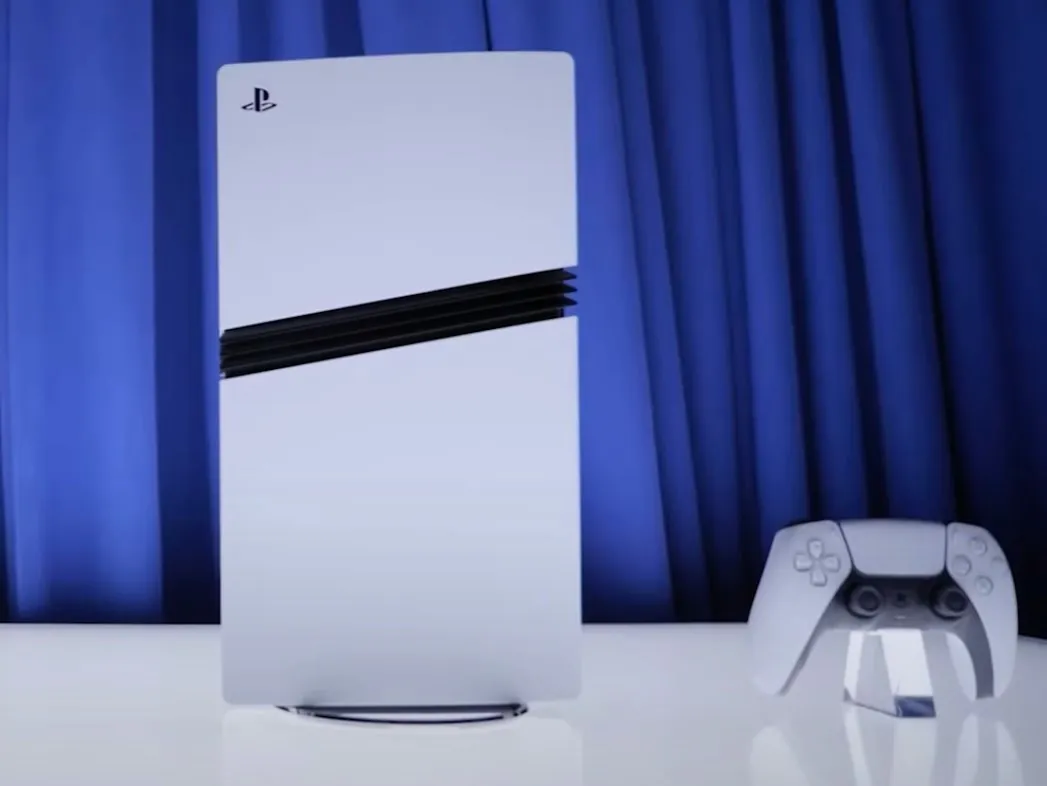
The PS5 Pro reveal was met with a lot of hype and controversy over its steep $700 price, and that too without the vertical stand and disc drive. However, it will be 45% faster than the base model, with an enhanced GPU, next-gen ray tracing, and more.
At T4G, my task is to cover the latest news around the gaming globe ASAP and with the utmost precision. I adore all the games and respect all the devs behind the amazing games that we get all year. So, whether it’s a PC or a Console game, I got it all covered.
Story Highlight
According to testing, the PS5 Pro can run Gran Turismo 7 at an 8K resolution.
There is also a performance mode that targets 4K 60 FPS using PlayStation’s proprietary PSSR upscaling tech.
The PS5 Pro isn’t for everyone due to its price, but it does present a decent enough upgrade.
PlayStation 5 Pro just got announced, and with it comes a significant power and price boost. Regardless of the MSRP, it is now the fastest console in the world. The power shows, too, as the PS5 Pro reportedly runs Gran Turismo at 8K resolution.
Why it matters: Even the base PlayStation 5 was advertised as an 8K-ready console. However, with the PS5 Pro, this is the first time we are actually seeing that happen, thanks to a bigger GPU pushing more power.
Gran Turismo 7 can reportedly run at 8K resolution with PS5 Pro
According to Cnet’s testing, Gran Turismo 7 managed a mind-boggling 8K resolution on the PS5 Pro. The review doesn’t state the frame rate, so we can only assume it must be decent enough to be playable.
Nonetheless, the most impressive part, and something more people will appreciate, is the improved 4K experience. Gran Turismo 7 is one of the ‘PlayStation 5 Pro Enhanced‘ games, so it runs 4K 60 FPS using PSSR upscaling with real-time ray tracing.
This is a more manageable resolution and fit for the masses. 8K gaming isn’t mainstream yet, and it probably won’t be for many years. Especially considering that a decent 8K TV can cost around $5000, which is a bit too much.
PS5 Pro is capable of running 4K 60 FPS using PSSR upscaling
Other games were tested as well, including Final Fantasy VI Rebirth, Horizon Forbidden World, Spider-Man 2, and more. All the games that will have the enhanced label will now be able to run at 4K 60 FPS, so you can expect a much smoother and clearer experience.
However, the 120 FPS mark is still not being discussed. Even the base PS5 was marketed as a 120 FPS console, so it’ll be interesting to see what the PS5 Pro does with that. Also, it should be kept in mind that it’s not a next-gen console but rather a refresh.
Again, this brings up the debate of whether the PS5 Pro is worth it. The console is fine if it targets a very niche market of gamers who are going to spend this much money.
At Tech4Gamers, I mainly cover new gaming news, leaks, and rumours. Aside from that, I love to write features about my favourite games while inserting my opinion about their different aspects.
Story Highlight
PS5 Pro was officially revealed yesterday but instantly became controversial due to its price tag.
The console has a price tag of $700 but it can cost over $900 after tax, disk drive and stand.
The gaming community is furious over this ridiculous price, and they can be found complaining on many platforms.
However, before the reveal, many were concerned about the price tag as they didn’t want it to cost over $600. Due to that, the whole gaming community is furious over the price reveal, as it can easily cost them over $900 for the full package, which is just insane.
Why it matters: Everyone was expecting the digital version to cost less than $700, so the early impressions of PS5 Pro weren’t positive.
The gaming community can be found complaining on almost every social media platform. We have been noticing nothing but rants about how ridiculous this price tag is. Gamers are even saying that Sony is trying to recoup the millions of dollars it lost due to Concord’s failure.
this console will cost in Canada around 920$ pretax , with tax is around 1100$ and without an optical drive. that would be around 1200$.
I can literally build a much better gaming pc with 1200$.
-MoulayHicham
The community is having a hard time believing the actual price as it isn’t even $700. First of all, you will have to pay tax, and if you want the vertical stand as well as the disk drive, it will cost you over $900, which is insane for a console.
The Poll Shows Nearly 90% Gamers Are Not Interested In Buying PS5 Pro
The community has also expressed concerns on the PS5 subreddit. At the time of writing, there are 11k comments, and the majority of them are negative. People are wondering whether console gaming is effective anymore.
Spending over $900 for a complete package and then buying PSN services to play games online should be a complete scam. Also, the DualSense controller has seen a price hike recently, which angered the fandom, too.
So, PlayStation is on the spree to make the community furious. Even the official trailer on YouTube has amassed well over 100K dislikes.
At Tech4Gamers.com, I cover the latest news and rumours in the gaming industry, from new game releases to hidden gems and video game leaks. Furthermore, I occasionally write tech articles about video game consoles, providing insights into the hardware and software that powers our gaming experiences.
Story Highlight
The cloud gaming market is expected to grow significantly, reaching $40 billion by 2034.
Analysts predict that Xbox is positioned to lead the cloud gaming, holding 40% of the market.
Microsoft will face competition from Sony and NVIDIA, but its early start and extensive content library give it an edge.
Cloud gaming is set to grow exponentially over the next decade, with projections indicating it could become a $40 billion industry by 2034. A recent Bloomberg Intelligence report suggests that countries like India, where mobile gaming is already more popular than console gaming, will drive this growth.
According to analysts, Microsoft and Xbox are well-positioned to capitalize on this growing trend. Microsoft is a major player in the cloud gaming trend with its Xbox Cloud Gaming service, which is part of Xbox Game Pass Ultimate.
Why it matters: As better internet options become available, cloud gaming will become more attractive, providing a cost-effective alternative to owning a gaming console.
Bloomberg predicts Xbox will capture 40% of the cloud market, with PlayStation and NVIDIA also holding significant shares.
The global cloud gaming market, which was about $5.76 billion in 2023, is expected to grow exponentially. This growth is fueled by better cloud technology and more widespread internet access. Experts predict the market could hit $40 billion by 2034.
However, there are still some technical issues with cloud gaming, like latency and blurry visuals, especially for users far from data centers.
To address these problems, Microsoft is increasing its data center network, including a new facility in Hyderabad, India, to enhance performance in expanding markets.
Bloomberg Intelligence predicts that Microsoft will lead the cloud gaming market, capturing 40% of the market share, followed by Sony holding 15%.
Microsoft build conference reveals Xbox Cloud Gaming progress.
Microsoft’s early entry, along with its large content library and strong data center network, gives it a big advantage. However, PlayStation and NVIDIA remain strong competitors.
The report also highlights that Microsoft is dealing with regulatory issues, especially with Apple’s app store rules. Although Apple says it supports cloud gaming, high fees and strict rules make it tough for Microsoft to operate profitably.
Therefore, Microsoft is focusing on a web-based version of Xbox Cloud Gaming, which currently only supports Fortnite due to legal disputes between Epic Games and Apple.
Moreover, Bloomberg expects Microsoft to offer cheaper, ad-supported options for Xbox Cloud Gaming by 2025. However, reports indicate that Microsoft is not planning to launch these ad-supported tiers anytime soon.
Reports also indicate that Microsoft might be planning a cloud-only Game Pass tier. With the cloud gaming market snowballing, Microsoft’s Xbox Cloud Gaming is well-positioned to lead the industry.
At Tech4gamers, I cover all sorts of gaming news. Whether it’s a leak of any upcoming game or an update, an announcement, or a rumour, I like to write about it all. Over the weekend, I sit and write features where I talk about games that I miss or want to see return.
Story Highlight
AMD was rumoured to abandon high-end Radeon GPUs for a very long time.
A senior VP of the company has officially confirmed the recent shift to focus more on mid-tier and budget GPUs.
The company wants to be available to more players and doesn’t want only Ferrari and Porsche owners to buy their products.
AMD has been rumoured to abandon high-end Radeon gaming GPUs for a while to focus more on mid-tier and budget gamers and to scale in the market.
While this was never officially confirmed, AMD has now officially stated that they want to move away from high-end GPUs as they don’t want only Ferrari owners to buy their cards and want to focus more on budget GPUs.
Why it matters: This would allow AMD to reach a massive audience as more players are looking for mid-tier and budget GPUs to enjoy titles.
AMD RDNA 4 Will Offer Competitive Mid-Range Options
During a recent interview with Toms Hardware, Jack Hunyh, a senior VP and member of the AMD leadership team finally talked about the ongoing rumours of the company ditching high-end GPUs.
He stated that the company wants to scale, and AMD is at different places right now, trying new things and wants to get the company to 40 to 50% of the market faster. He further stated that he doesn’t want to go after the 10% of the total addressable market but would instead go after the 80%.
I’m an 80% kind of guy because I don’t want AMD to be the company that only people who can afford Porsches and Ferraris can buy.
-Jack Hunyh
AMD Wants To Reach To Millions of Players
It has also been claimed that the company wants to build gaming systems for millions of players and will have great products in the future despite abandoning the high-end Radeon GPUs.
Recent reports have also suggested that AMD is set to debut RX 8000 GPUs at CES 2025 to compete in the mid-range against Nvidia. However, AMD will likely stay quiet about it until the release of RDNA 4 in early 2025.
At Tech4Gamers, I contribute as a Senior News Reporter, combining my skills and gaming enthusiasm to keep our audience updated on the latest developments.
Story Highlight
The PS5 Pro has just been revealed.
This new mid-gen refresh will arrive in November for a starting price of $700.
The hardware focuses on ray tracing, raw GPU improvements, and AI-driven upscaling.
PlayStation has officially returned to the industry with brand-new gaming hardware. After launching the PS5 in 2020, lead architect Mark Cerny has given the world a new glimpse at the long-rumored PS5 Pro.
Coming with a new GPU architecture, ray tracing improvements, and PlayStation’s very own PSSR upscaling technology, the PS5 Pro has been officially introduced to the world.
Why it matters: The PS5 was weaker than the Xbox Series X when the new consoles launched four years ago. However, this release flips the situation, putting PlayStation in the lead as the brand with the most capable console.
The PS5 Technical Presentation offers a deep dive into the new hardware. Not much has changed on the outside, and the PS5 Pro retains a mostly familiar design.
The specifications also appear to align with previous leaks. The gaming giant has switched to RDNA 3 graphics, which should be roughly 50% faster in rasterization than the base hardware.
Mark Cerny spent a major part of the presentation explaining PSSR, a new technology that could revolutionize gaming experiences on PlayStation. Much like the Xbox Series S|X, the PS5 missed out on AI-based features when it initially launched in 2020.
PSSR serves as PlayStation’s take on Nvidia DLSS, promising to revolutionize console gaming with new artificial intelligence-based technology. Following the event, more details about the PS5 Pro have also been revealed. The Digital Edition console will launch on November 7 for $700.
The PS5 Turns Four Years Old This Year
According to Mark Cerny, fans can expect Fidelity mode visuals at 60FPS with the new console. However, as said above, these visuals will not come without a steep price.
With the reveal out of the way, fans are excited to see the PS5 Pro in action. More details will follow shortly, and it will be interesting to see if PSSR can be a true game-changer for the console industry.
Mark Cerny gave fans a small glimpse at a few games running on the PS5 Pro, but more in-depth gameplay should be available by November.
I’ve previously worked for eXputer as a Senior News Writer for several years. Now with Tech4Gamers, I love to devoutly keep up with the latest gaming and entertainment industries. I have a Bachelor’s Degree in Computer Science and years of experience reporting on games and breaking exclusive stories. Besides my passion for gaming journalism, I love spending my leisure time farming away in Stardew Valley. VGC, IGN, GameSpot, Game Rant, TheGamer, GamingBolt, The Verge, NME, Metro, Dot Esports, GameByte, Kotaku Australia, PC Gamer, and more have cited my articles.
Story Highlight
Valorant addressed community toxicity in a video, raising concerns about automated bans.
Toxic behaviors, from minor taunts to serious harassment, can drive players away and harm game communities.
Developers and players must work together to reduce toxicity.
On May 30, 2024, the Valorant Facebook page posted a video of Anna Donlon addressing community toxicity. While the video covered many concerns, some players worry about automated banning systems for offensive behavior. Let’s examine gaming toxicity and whether these acts warrant punishment.
Toxicity And Video Games
It is no surprise to anyone that online multiplayer games are a cesspool of toxic players. A lot of people say unwarranted things on small issues like your team members messing up, losing, or just unprovoked.
Seriousness
Some of these “toxic” behaviors aren’t bad at all, like tea bagging or emoting, while some things can cause more serious problems, like hate speech and harassment.
Tea Bagging (Image From Steam Community)
The more serious of these problems can create major problems for the players, like a reluctance to play the game, whether they’re too good or too bad, possibly tainting the whole community that surrounds a game.
The Corporate Side
A toxic game community can be disastrous for developers, driving away new and existing players. This concentrates negativity, making the community even worse over time.
Updating To Making Banning Easier (Image By Tech4Gamers)
Developers must intervene to prevent this, but their efforts can sometimes make players wary of even harmless banter. This creates a stigma of developer intervention in gaming communities, even if all they want to do is help, either out of the kindness of their hearts or to retain as many players as possible.
Should Toxic Players Be Banned?
Given how vile people can be behind a screen, we think that some players should be banned from playing multiplayer video games. Of course, the methods for identifying these players aren’t easy to implement, which is what we’ll discuss further below.
First and foremost, the games should make it abundantly clear that unruly behavior will not be tolerated. This doesn’t mean they should add a notification in the game chat saying you should be respectful, but instead, something more overt that every player will be sure to pay attention to.
Valorant Ban Screen (Image By Tech4Gamers)
Maybe flash it on the screen before every game or make it a permanent part of the loading screens. This will ensure that everyone is aware that they have to show good sportsmanship when playing their game.
Secondly, developers need to pump the bots. Though I think more serious bans should always be reviewed by a team or the community, automated systems must also be in place to make the removal of toxicity achievable.
Lastly, make it easy for players to report those who are being offensive. Use this in conjunction with the bots to make the systems accurate and to make fake reports less of an issue.
What Players Can Do
No matter how hard the devs push the players to be nice to each other, the solution is going to come from the players themselves. We have a few pieces of advice for players who might feel uneasy with banning being strict and the players who are suffering from toxic behaviors.
Reporting In Valorant (Image By Rock Paper Shotgun)
Firstly, know that game devs’ systems for detecting toxicity are reliable, so you won’t be “accidentally” banned for minor offenses. Devs understand banter is part of gaming and don’t want to remove it entirely.
But you need to keep it respectful. These problems don’t arise from friends telling each other they suck playfully; it happens because of hate, threats, and harassment.
Finally, you need to not feel guilty for reporting people for toxic behavior. Don’t brush it off; take the step to make the game you love to be a safer and more enjoyable environment.
Closing Thoughts
Being a nice person on the internet is not a monumental task. It takes less effort to be nice than to be hateful, so please start doing yourself and your communities a favor by being nicer when you play.
If we want to avoid bans, we need to be kinder while gaming. Change starts with each of us, and together, we can make our communities less toxic.
At Tech4Gamers, he is recognized for his insightful features and opinion pieces, where he blends his passion for gaming with a keen understanding of technological trends. His work, marked by depth and accessibility, makes him a respected voice in the tech and gaming community.
Story Highlight
From simple entertainments like arcade classics, video games have evolved into a respected high art form.
Video games combine visual art, cinematic storytelling, and interactive gameplay in a way that no other medium can.
Games are now widely recognized as an art form that evokes deep emotions and delivers profound storytelling experiences, similar to film and literature.
At the genre’s beginning, video games were nothing more than pixels imitating ping pong, space shooters, or a monkey throwing barrels at an Italian plumber. Slowly but shortly, the medium has become high art, and I would argue that it is the best storytelling medium ever. Read along to see why!
How It Happened
As stated in the intro to this article, games were easy entertainment in the early days, with a day at the arcade being nothing more than a day at the pool. As systems became more capable of creating immersive worlds, game developers started treating their craft with the love that it deserved.
For every Terminator and James Bond, we saw the rise of a Lara Croft and an Agent 47. Despite this, the 2000s showed a huge number of people still disagreeing with this sentiment for one reason or another.
Some Of The Best PS5 Games – Image By Tech4Gamers
Maybe it was the seemingly violent Call Of Duty games that they had witnessed, or the vileness of something like GTA, or they never grew out of thinking of games as anything more than a day at the pool, but the sentiment was there, and it was strong.
I don’t think it fair to cite a single game like The Last Of Us, Mass Effect, or Shadow Of The Colossus as the turning point of this widely held idea, but it is shattered for the most part. These days, video games are getting the respect they deserve, are regarded as art, and are often translated into other mediums.
What Makes Video Games So Special
Video games have a few things going for them that differentiate them from any other form of art or storytelling, which we will discuss in the sections below.
A Culmination
Video games integrate diverse art forms: visuals and dialogue akin to the theatre on a global stage, cinematic cut scenes with artistic camera work, and music that enhances the drama, often feeling operatic.
Undertale’s 5th Anniversary Concert – Image From Polygon
While games vary in their execution—some excel in writing but falter in visuals or music—the best exemplify immersive storytelling, offering emotional experiences akin to traditional mediums.
Interactivity
Video games are the only widely popular medium that allows you, the player, to affect the world in which the story is told, if not the story itself. While other mediums of storytelling try to project you onto a character in the world, video games do this very literally.
Games Give You Choices – Image By Tech4Gamers
This mechanic demands your attention and involves your emotions, and if done right, it cannot be imitated by anything.
The interactivity leads the way to decisions and challenges, which leads nicely into our next topic.
Challenge
The best games offer challenging gameplay where significant story moments are hidden behind obstacles, intensifying emotional impact. Unlike other mediums like movies, where characters face challenges, in games, you actively overcome them.
Perseverance In Video Games Leads Way To Rewards – Image By Tech4Gamers
This interactive experience enhances emotional connection, such as defeating a protagonist’s best friend after a gripping battle, which resonates more deeply than simply observing the event unfold.
Not All Games
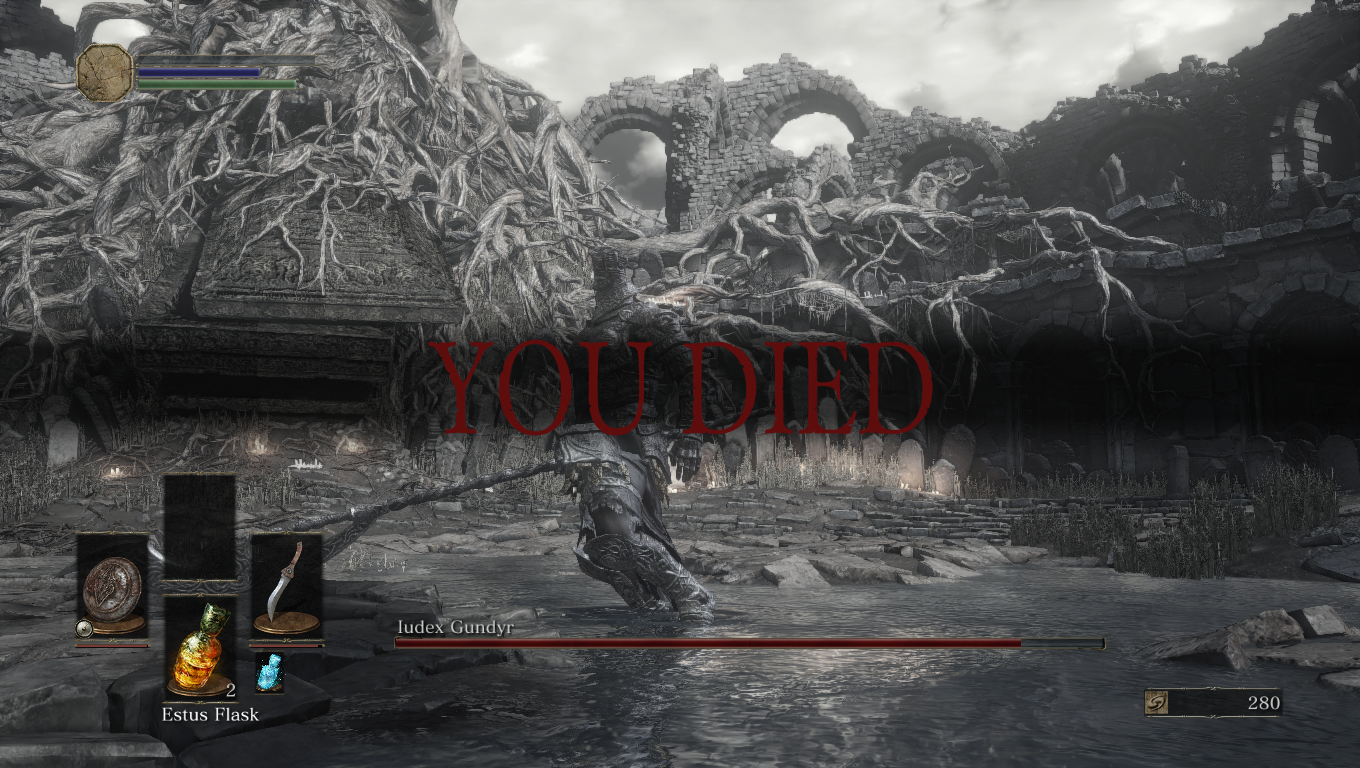
Of course, this classification of high art is a title the majority of games don’t get, but that’s not the point I’m trying to make. Games have the potential to be one of the most life-altering experiences a person can have, whether it be learning how to persevere in a hopeless world with Dark Souls or feeling your heart break while playing The Last Of Us.
I’m happy that games are recognized as art these days, and I love that this medium is celebrated worldwide with award shows and expos. Keep visiting our website for news and feature coverage of these amazing pieces of art coming out!
At Tech4Gamers, he is recognized for his insightful features and opinion pieces, where he blends his passion for gaming with a keen understanding of technological trends. His work, marked by depth and accessibility, makes him a respected voice in the tech and gaming community.
Story Highlight
Qualcomm’s new Snapdragon chips for Windows offer competitive performance, slightly surpassing Apple’s M3 but falling short of the M3 Pro. They also have improved power efficiency.
These ARM-based chips dramatically reduce power consumption compared to x86 processors, potentially enhancing battery life and enabling sleeker laptop designs.
Transitioning Windows from x86 to ARM faces app compatibility challenges, but Microsoft’s emulation efforts aim to mitigate these issues. Gaming remains a concern, but the chips show promise for general PC tasks.
Microsoft has been experimenting with ARM-powered Windows machines, like the Surface Pro X, since late 2019. Despite initial setbacks with the earlier products, the emergence of Apple Silicon has prompted a renewed interest among Windows-based companies.
The Promises
This section will go over everything that the new Snapdragon chips for Windows are set to be in terms of performance, power consumption, and pricing.
Performance
Performance Of Apple M3 vs New Snapdragon Chips – Image By Qualcomm
According to the advertising material, the Snapdragon X Elite was set to launch with performance 28% better than the Apple M3, while the lower-end Snapdragon X Plus was rated as being 10% faster than the M3 in synthetic benchmarks.
When compared to the M3 Pro, the X Elite comes up slightly short, though with slightly better power efficiency. This lands it above the Apple M3 but slightly under the Apple M3 Pro.
Power Consumption
Power Consumption vs x86 Chips – Image By Qualcomm
A few short years ago, the XPS 13 Plus made waves of its excellent performance in a compact body, which was only possible because of the Core i7-1360P. Now, the new Snapdragon X Elite chip claims to draw less than half the power to achieve the same results.
Pricing
Dave 2D made an excellent point in his video about the new chips; he said that they were cheap enough to allow the rest of the laptop to have more top-end components.
With performance almost the same as M3 Pro and a price tag that starts at $1299 instead of $1999, it is safe to say that these Windows ARM-based laptops will deliver a better price-to-performance ratio than their Apple counterparts.
Problems And Their Solutions
Switching from x86 to ARM on Windows comes with certain issues that haven’t been faced before. This part of the article will highlight these issues and what Qualcomm and Microsoft intend to do to rectify them.
ARM Native Apps
Microsoft Advertising ARM Support To Developers – Image By Microsoft
Since Windows was originally designed for x86 architectures, transitioning to ARM requires new low-level coding. This shift necessitates a translation layer or emulation to run x86 programs on ARM chips.
Historically, ARM processors faced challenges with compatibility in the Windows app ecosystem, but Microsoft has made strides to improve x86 app translation on ARM.
If the translation is as good as it seems in the limited testing of these products thus far, and if developers jump onto making ARM versions of their apps, the shift from x86 to ARM should not be too painful.
The Lack Of “Smart” Features
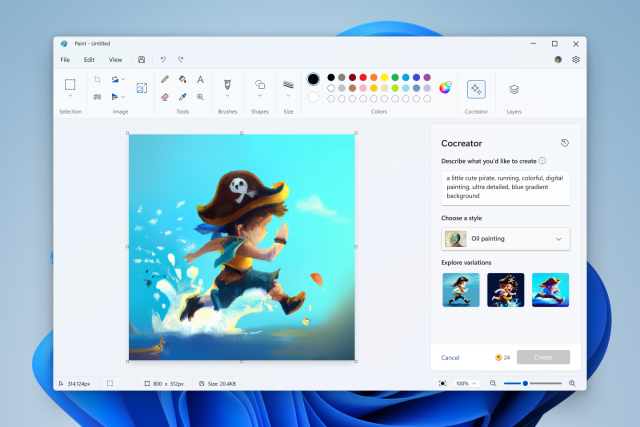
CoCreator With Microsoft Paint – Image By Engadget
Over the years, smartphones have advanced with smart features like live captions and creative photo/video effects, areas where PCs have lagged. New NPUs in Qualcomm chips now bring these AI capabilities to PCs.
They enable features like AI-driven image creation in Microsoft Paint, eye-tracking software, video background manipulation, and live captions.
However, this advancement raises privacy concerns, notably with features like Windows Recall, sparking community-wide debate. Cool in concept, sure, but it needs a reimagining to be something that people will look into.
Playing Games
A huge portion of the PC community is based around the fact that no other system can run games as well as Windows. The shift to this new architecture raises concerns for gamers, as games have opted for the CPU-GPU system paired with x86.
Unfortunately, Qualcomm’s new chips are only serviceable at playing games, and nothing more. This is something that can be improved in the future with more gaming-focused chips, but as of now, this is not the main concern for these systems.
Are They Good Enough?
If you temper your expectations, yes. The new Qualcomm chips perform excellently, considering the challenge they are tackling, and they are set to revolutionize the PC laptop industry.
This is to say, they will not be replacing their x86 counterparts, at least not anytime soon. For heavier workloads and gaming, the big-boy computers are not going anywhere.
Still, we are tremendously excited to see what the future has in store for us and what it brings to the PC industry!
As Tech4Gamers’ Founder and Editor-in-Chief, I bring over 13 years of PC Hardware Reviewing and 8+ years of IT Project Management experience. Certified in Google IT Support , my focus is on providing honest product reviews and analysis and fostering a strong gaming community with 130k+ members in PPG.
Huzaifa Haroon
Being a keyboard enthusiast, I specialize in reviewing, modding, and critiquing them for the people. If you’re a Razer fanboy, my only goal is to convert you to the dark side 😈.
The world of custom keyboards exploded a few years ago amidst the pandemic when everyone locked inside their homes was forced to find a new hobby. Building and modding your own keyboard provided a sense of accomplishment that transformed into a new market segment overnight. Companies realized that focusing on the enthusiast side of peripherals was not just a niche anymore.
Creating high-quality budget keyboards, therefore, became a rat race, with Aula emerging as one of the finest brands working right now. Today, I’ll be taking a look at their newest offering, the Aula F81. This is far from the company’s first foray into making transparent keyboards, but it’s certainly their most expensive one yet.
Why Trust Tech4Gamers
Huzaifa Haroon is our keyboard expert with years of experience in building and testing custom keyboards.
130+ peripherals tested and reviewed by our team of hardware experts (Tech4Gamers Team).
500+ hours spent testing different peripherals for our reviews.
At Tech4Gamers, ensuring you get reliable information is our priority. That’s why every hardware round-up undergoes a meticulous review process by our team of experts and editors. Each review is carefully examined against our strict editorial guidelines, guaranteeing you trustworthy insights you can depend on.
Key Takeaways
Aula F81 is a gorgeous keyboard with plenty of lighting to turn even the coldest heads. Its combination of features makes it more versatile than other transparent boards on the market.
Buy the Aula F81 if you value design, build quality, and the unboxing experience and want a keyboard that stands out in any setup.
Avoid the Aula F81 if you can’t compromise on rattly stabilizers, prefer a cleaner look, and want to mod your keyboard easily.
[toc]
Unboxing Experience
Out of the entire Aula lineup, the F81 is the most well-packaged, with a premium unboxing experience. The box art here is much more extravagant compared to the Aula F87 Pro and features an anime character upfront. The box itself is heavy and has no tabs, instead you simply lift the top to slide out the bottom like an Apple box.
Aula F81 has a rather eccentric box. (Image by T4G)
Inside, you’re greeted by the keyboard with a plastic cover on top. The manual, an instructions card and a sticker sheet are also present right under some protective foam. Toward the side, you’ll find the accessories box, and once again, this is where the Aula F81 differentiates itself by including a few extra goodies.
The keyboard comes with:
1x Aula F81 Keyboard
1x User Manual
1x Instructions Card
1x Stickers Sheet
1x Keycap/Switch Puller
1x 2.4GHz USB Receiver
1x Coiled USB-C Cable
1x Microfiber Cloth
1x Cleaning Brush
1x Allen Key (with screws)
2x Metallic Decorative Pieces
Everything included with the Aula F81. (Image by T4G)
Design & Build
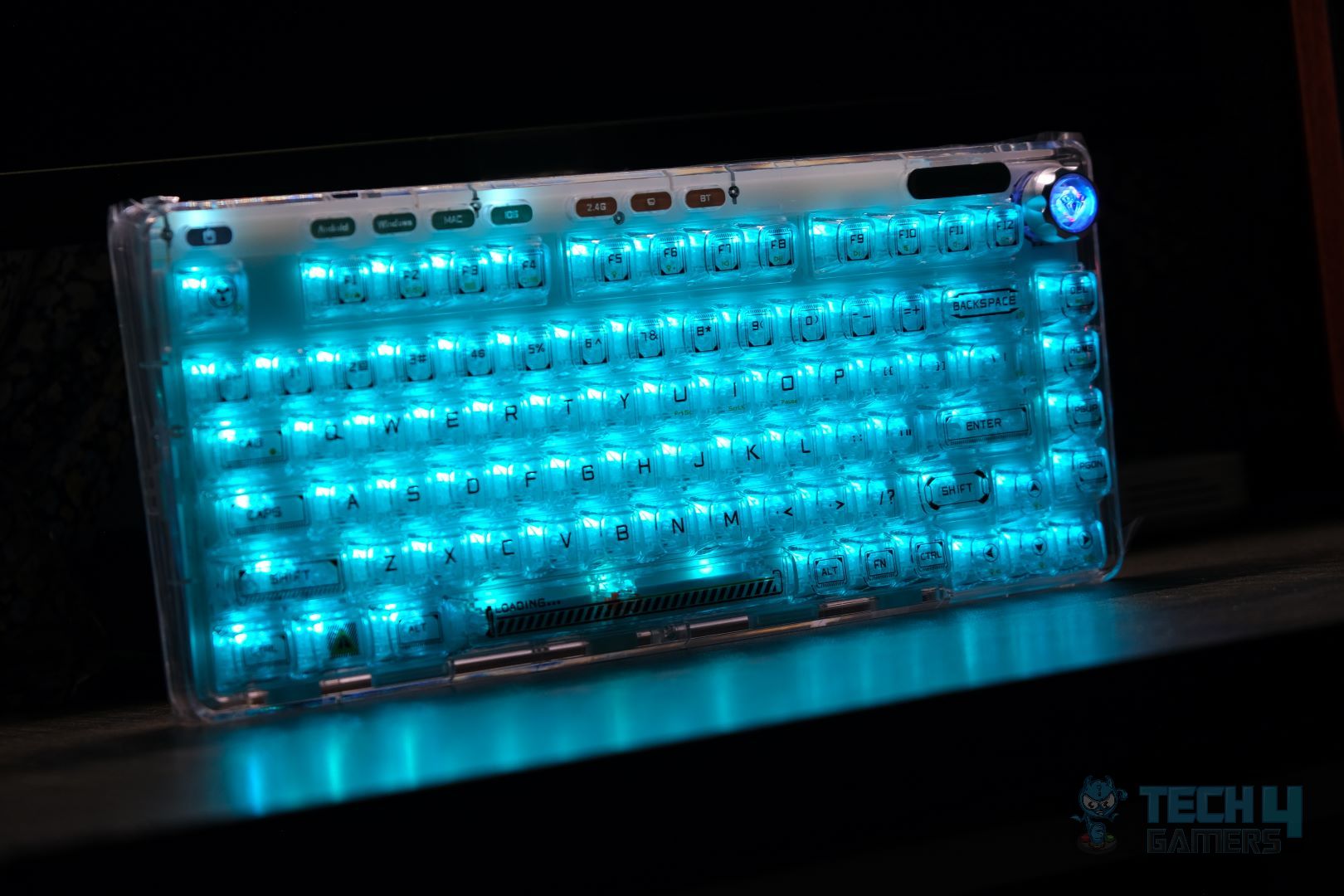
Aula F81 sports a 75% layout and a striking appearance that comes to life with RGB. The keyboard features a fully transparent case and polycarbonate keycaps that show a clear view of its inner layers. Positioned along the top bezel are eight buttons that control power, platform switching, and connection modes. All of them are clicky and backlit.
In the top-right corner, you’ll find a volume knob, and it’s one of the best I’ve ever used—offering an ultra-satisfying clicky rotation with no wobble. The knob’s outer ring feels metallic, while the plastic center has some kaleidoscope-like lighting that, unfortunately, cannot be customized. Next to it is a nifty magnetic holder for the 2.4GHz wireless receiver.
The volume knob is one of the highlights of the F81. (Image by T4G)
The back is clear as well, but the bottom case foam blocks any view inside. The board is also wrapped in plastic to protect it from scratches. In the middle, there’s a metal badge with some product info and flip-out feet on the left and right that have two stages. Most interestingly, the sides of the keyboard have space to screw in some metal decorative pieces that can be further customized with the provided stickers, but I didn’t really think any of them went well with the board’s overall look.
The side profile looks clean with the added metal pieces. (Image by T4G)
All that mixed with its futuristic legends, this keyboard is a bold departure from the safe, neutral color schemes of previous Aula boards. While see-through concepts are always welcome, making them glossy and fully transparent (rather than translucent) veers into tacky territory for me. That said, the look is highly subjective, and I can see it thriving in the right setup.
What I can’t deny is the thoughtful design. Despite weighing just shy of a kilo, the build quality throughout is excellent; there is no case of flex or creaking whatsoever. Aula fully commits to the glass-like look, and all the small details reflect the care and attention that went into its creation. For the right person, this will be a highly polished product.
RGB Galore
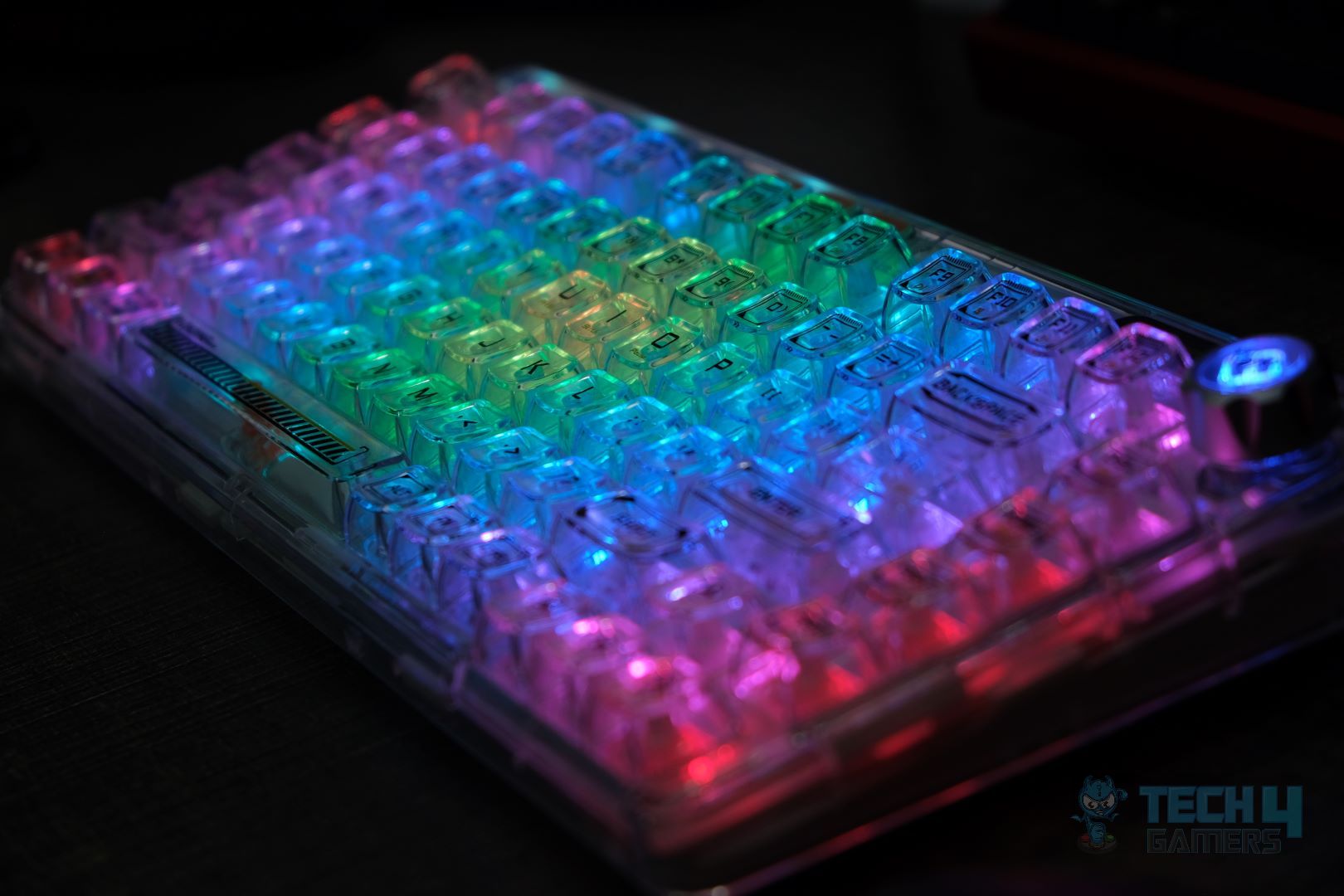
If human lives thrive on purpose, the Aula F81 thrives on RGB. It’s clear that lighting is a major part of this keyboard’s design—its fully transparent build makes that obvious. There are 21 built-in effects, which you can cycle through using Fn key shortcuts, and aside from two, all are very smooth, even at their slowest speed setting. You can also toggle between 4 brightness levels and 9 static colors. However, Aula doesn’t provide any dedicated software for precise customization.
Aula F81 has some beautiful RGB (Image By Tech4Gamers)
The Fundamentals
The Aula F81 is not meant to be taken apart, so the disassembly is quite difficult. I didn’t see any visible screws, which means the case is held together with tabs; forcing it too much can shatter the polycarbonate (unlike ABS or PBT). That’s why I couldn’t mod this keyboard and will only be judging it in its default configuration.
Switches
My unit of the Aula F81 is rocking the Ice Soul switches which are a factory-lubed tactile manufactured by Leobog. The spacebar features a different, much heavier switch that I could not find any info on. While I’m not a big fan of tactile switches, preferring the smooth travel of a linear, I’m pleased to report these are awesome stock switches regardless.
The initial 49g tactile force feels just heavy enough to provide a satisfying bump followed by a smooth 45g bottom out. If you like to “feel” what you’re pressing, you’ll have a great time with these. They have minimal stem wobble on par with other Leobog switches and they sit snuggly inside the PC plate. Upon opening up the switch, I found both the stem and spring inside is oiled properly and this lubing is consistent across the entire batch.
Aula F81 uses stock switches that are well-lubed right out of the box. (Image by T4G)
Overall, these switches have a low-pitched thocky sound that should be easy on the ears for everyone. That being said, the board is fully hotswap featuring north-facing 5-pin sockets. As such, I swapped the spacebar switch to an Akko Yellow linear and it sounded much nicer, but I still preferred the tactiles on the alphas.
Keycaps
Moving on, the keycaps here aren’t doubleshot or dye-sub; instead, they feature 3D-printed legends. I’m not a fan of the font, but the yellow sub-legends for secondary functions are quite helpful. Aula claims they’ve applied a special coating to prevent fading, but I find it hard to believe these will last long. The printing already lacks sharpness, and the coating seems like it’ll wear down over time. Their glossy finish also makes them prone to finger oils, and they might yellow quicker if your hands are oilier like mine
Aula is using a proprietary “GDA” profile that feels like a blend between SA and XDA. The keycaps cupped my fingers nicely and were very comfortable to type on. They’re as thick as most keycap sets and work well with the stock switches to produce a satisfying thock. I tested these keycaps on other boards and swapped different switches on this board, but none of the combinations felt as satisfying as Aula’s stock config.
Apart from their transparent look, Aula F81’s keycaps are not the best. (Image by T4G)
Stabilizers
Lastly, Aula F81 uses standard plate-mounted stabilizers that come pre-lubed from the factory, but they’re not great. All the stabilized keys in my unit exhibited some ticking or rattling, with the worst offender being the spacebar. The stabilizers here seem a generation older than other budget boards; they have a significant wobble on either side, which is just exacerbated by the keycaps.
Upon closer inspection, the stabilizers are both internally and externally affected. Inside, the stem sits very loosely in the stabilizer housing, and there’s not enough lube to fill in the gaps. From the outside, the stabilizer doesn’t fit tightly in the plate; I can easily wiggle them with minor force. The spacebar stab is also hard to take out because a PCB foam blocks out any space for the wire to come out of.
Aula F81 has weak stabs with a lot of wobble.
Performance & Battery Life
Aula F81 performs like any modern keyboard worth its name. It has a standard 1000hz polling rate with both wired and wireless connections. We experienced no lag using it wirelessly over 2.4GHz, but I’d still recommend plugging it in for competitive play. Over Bluetooth, the polling rate drops down to only 125Hz, but that’s a Bluetooth limitation, so it’s the same for any keyboard. Still, the typing experience on iOS and Android was without any issues.
As for the battery life, the 4000mAh cell lasted 18 hours with the RGB on. After filling it back up the next day, I used it moderately with all the lights turned off, and it’s been a week since I last charged this keyboard. It’s safe to say that battery life here is on par, if not better, than other industry-standard keyboards, including Aula’s own lineup. Charging it up is as easy as just plugging in the USB-C cable which means one less cable to worry about if you’re bringing this with you on the go.
What’s with those random words next to the Type-C port? (Image by T4G)
Typing Experience
Aula F81 is a gasket-mounted keyboard, and as such, it has some flex, but it’s only apparent when pressing hard on it. This board certainly does not have a bouncy typing feel, which is reminiscent of other Aula boards. In the grand scheme of things, using the Aula F81 is, as boring as it may sound, fine. To me, it’s a compromised experience because of the poor stabilizers. Every time my thumb would hit the spacebar, I’d be reminded of how it all could be better.
There’s plenty of foam inside the board to make any switch sound nice. I tried some HMX switches with Cherry profile keycaps, and they were a delight, mostly thanks to the included PE Foam sheet sitting right above the PCB. The bottom case foam also helps reduce hollowness and provide a “full” sound.
Overall, I’d say that for a first-time user, the shortcomings of the Aula F81 will certainly not be as noticeable. The flashy looks, genuinely impressive build quality and nice-sounding alphas would cover up the imperfect stabs and somewhat cheap-feeling keycaps. In fact, if you’re coming from a “gaming” keyboard, this would probably be a day and night difference for you.
What Makes the Aula F81 Different
Aula F81 is not the first of its kind neither will it be the last, but it does position itself as perhaps the first transparent keyboard with no glaring compromises. The Yunzi X75 is another option in this category but it’s not wireless, neither does the Attack Shark X75 or the Womier K75. Meanwhile, the KiiBoom Phantom 81 is almost double the price but south-facing sockets, which would actually be a turn off for a keyboard all about RGB. K75 If you can look past its rattly stabs, there is currently no other crystal as shiny as this one.
Should You Buy It?
Aula F81 – RGB Design
Aula F81 – Blue Lighting
Buy It If
✅ You like see-through designs: The shining highlight of the Aula F81 is its crystal-like design that comes to life with its bright RGB.
✅ You want a well-built keyboard: Aula F81 has a decent heft to it along with excellent build quality, making it a premium-feeling product.
✅ You value the extras: With some extra goodies included inside, the Aula F81 stands out from the rest with an amazing unboxing experience.
Don’t Buy It If
❌ You want good stabilizers: Aula F81 has poor stabilizers that have major issues such as stem wobble, insufficient lube, and loose fitting.
❌ You prefer an understated look: Consider the company’s other models, like the F75 and F87 Pro, for a more neutral color scheme.
❌ You need easy mod-ability: Due to Aula F81’s polycarb construction, the board is not easy to take apart and thus not suitable for modding.
My Thoughts
Aula F81 is by no means a bad keyboard but prioritizing design over the fundamentals, especially for your flagship product is never going to illicit a positive response. And with the Aula F75 already existing in the company’s lineup as another 75%, I’ll pick that 9 times out of 10, with the one exclusion being for the F81’s striking design.
All in all, if you’re after a specific, transparent look, then the Aula F81 is a great option with further potential should you choose to mod it. For me personally, the excellent build quality and thocky sound cannot make up for the lack of solid stock stabilizers, but if I’m in a pinch and the Aula F81 is the only keyboard I get to use, I’ll still have a good time looking at its light show. Heck, I’d probably just gut the thing and repurpose the parts elsewhere.
At Tech4Gamers, I contribute as a Senior News Reporter, combining my skills and gaming enthusiasm to keep our audience updated on the latest developments.
[Press Release] Corsair’s RMx lineup of power supplies has long been a staple of the industry. Trusted by millions for its quality, this series has become even better today.
Corsair’s latest introduction to the series brings ATX 3.1 compliance across the board. Moreover, the upgrades extend to a new design that boasts a six-layered PCB, an improved fan, and more.
All of this means that your RMx PSUs will run cooler and quieter than before.
Following these upgrades, the company has secured a Cybernetics Gold efficiency rating and A+ noise rating. Another big upgrade is the inclusion of native 12V-2×6 connectors in the new power supplies, which support current and future generations of graphics cards.
The 140mm FDB fan has also received new functionality thanks to a speed control knob. Meanwhile, the RMx series continues to boast fully modular cables for easy management and routing of wires.
The RMx lineup, available in models ranging from 750W to 1000W, is even better today and can be purchased directly from Corsair. For more information on pricing and availability, use this link to visit the company’s official website.
At Tech4Gamers, I mainly cover new gaming news, leaks, and rumours. Aside from that, I love to write features about my favourite games while inserting my opinion about their different aspects.
Story Highlight
Lately, the gaming industry has gone through many layoffs.
Many believe the layoffs are due to corporate greed, but the ex-Sony President disagrees.
He thinks those affected by the layoffs should drive Uber or find a cheap place to live.
Layoffs in the gaming industry have become quite common. At first, it wasn’t alarming, but things got out of hand when giants like Microsoft and Sony were also affected. Both multi-billion dollar companies laid off quite a staff, and they aren’t the only ones.
The gaming industry is undergoing many changes, and many employees are concerned about their jobs. A recent report has suggested Sony is going through another round of layoffs.
Many layoffs are said to be done due to corporate greed, but the ex-Sony President doesn’t seem to believe so. He thinks those who are affected by the layoffs should drive Uber.
Why it matters: Lately many companies in the gaming industry are laying off employees which has caused concerns among many employees.
Chris Deering, X-Sony President, Talks About The Layoffs Happening In the Gaming Industry
Chris Deering was a guest at Simon Parkin’s podcast My Perfect Console. The X-Sony President talked about the layoffs happening in the gaming industry and explained how they are not due to corporate greed.
I don’t think it’s fair to say that the resulting layoffs have been greed.
He further said that those who are affected should figure something out.
Figure out how to get through it, drive an Uber or whatever
-Chris Deering
Deering made quite controversial statements during the podcast, and he is likely to be criticized for that. He compared the layoffs to a pandemic and thinks that those who are affected should figure out something like driving Uber or finding a cheap place to live.
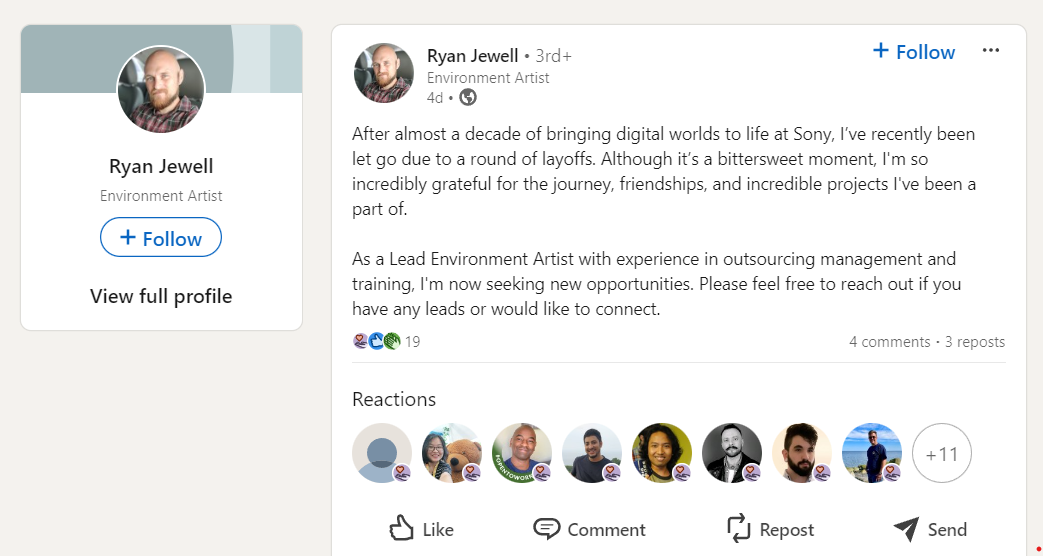
PlayStation Has Recently Laid off an Environment Artist
Despite using such statements Deering is optimistic that those who are being laid off will have a good future. Deering also said that during his tenure he kept the hiring speed to minimum as he didn’t want to end up laying off a bunch of people.
Chris Deering concludes this whole mess by saying those who were laid off were paid a decent amount of severance package, and if that runs out, then that’s life. We think the X-Sony President could have put these words better as he is likely to attract controversy now.
That said, these continuous layoffs happening in the gaming industry are not justified and should be stopped.