At T4G, my task is to cover the latest news around the gaming globe ASAP and with the utmost precision. I adore all the games and respect all the devs behind the amazing games that we get all year. So, whether it’s a PC or a Console game, I got it all covered.
Story Highlight
Assassin’s Creed Black Flag Resynced is expected to be next week, in mid-April.
A reliable insider says that it could be set for a summer release after its initial delay.
The game has been a part of rumors and reports for the longest time.
Assassin’s Creed Black Flag is arguably one of the best games in the franchise. It was genre-defining at the time and still holds up. However, it’s been confirmed that Ubisoft has been working on a remake.
The remake titled Assassin’s Creed Black Flag Resynced is reportedly set to be announced next week in mid-April, with a release expected sometime in the summer, according to a reliable insider, hinting that the release is edging closer.
Why it matters: The remake has been rumored for quite a while. It was initially expected to be released in the first quarter of this year, but based on the conditions and layoffs at Ubisoft, it was reportedly pushed.
According to Tom Henderson of Insider Gaming, Ubisoft is planning to announce Assassin’s Creed Black Flag Resynced in mid-April, with a release planned for the summer of this year. So, it could be closer than expected.
From what I understand, it’s going to be announced in mid-April and then released in the summer.
The remake could be released as soon as the summer of this year
The previous rumors suggested that the game could be delayed beyond this year, but it seems that it won’t be happening now. Interestingly, despite the game being in all sorts of reports, it was only announced in March.
Anyhow, Black Flag Resynced will take a few pages from modern Ubisoft games. Its open-world is expected to be closer to Assassin’s Creed Shadows than the original, and will take other elements from newer games as well.
What are your thoughts on Assassin’s Creed Black Flag Resynced being announced next week? Are you looking forward to it? Let us know your opinions in the comments or join the discussion at the official Tech4Gamers Forum.
Currently serving as a News Reporter at Tech4Gamers, I have the privilege of combining my love for gaming with the art of storytelling. My role involves crafting engaging narratives that keep our audience abreast of the latest developments in the gaming world.
Story Highlight
The GTX 10-Series GPUs based on the Pascal architecture were announced 10 years ago today.
7 GPUs from the lineup are still listed in the Steam Hardware Survey for March 2026.
Unfortunately, Nvidia may never be able to match the quality of these GPUs.
A decade ago today, Nvidia released what’s considered to be its best GPU lineup to date. The GTX 10-Series, based on the Pascal architecture, provided a bang for their buck with massive power that is still considered sufficient in some games today, all for minimal costs.
In fact, the decade-old GPUs were so ahead of their time that 7 models from the lineup still appear on the Steam Hardware Survey list.
Why it matters: The GTX 10-series is synonymous with gamers of all kinds, whether they play on consoles or desktops. It raised the ceiling so high for Nvidia that it may not be able to achieve the same performance-to-price ratio ever again.
It’s Unlikely That Nvidia Will Ever Come Up With A Card Like The GTX 1080
The Pascal desktop GPUs were announced a decade ago and hit the shelves in the following weeks of May. Now, there isn’t a single GPU in the entire lineup that seems weaker than the others.
Anywhere from the cheaper GTX 1050 to the GTX 1080, the latter of which is considered the greatest GPU ever, capable of holding its own in 1080p gaming today without the need for features like DLSS.
If you look at the Steam Hardware Survey for March 2026, 7 GPUs from the GTX 10-Series appear, including the Titanum releases, even though they were released in 2027.
Even the recently released Crimson Desert listed the GTX 1060 as part of the minimum system requirements. Right now, the GPU sells for less than a $100. On the other hand, the GTX 1050 was the king of budget GPUs for at least half a decade.
In contrast, Nvidia’s recent releases seem stale. The Blackwell series was a massive disappointment, and the tech giant has now become a shell of its former self. 2026 will be the first year in a while that Team Green will go without a new GPU release as they gear up for the RTX 60-Series, scheduled for 2027.
At Tech4Gamers, I contribute as a Senior News Reporter, combining my skills and gaming enthusiasm to keep our audience updated on the latest developments.
Story Highlight
Simple basics make Splatoon easier for beginners to enter than Smash.
Success relies on controlling the map and positioning rather than just winning individual fights.
Regular developer updates and structured leagues provide Splatoon with more official stability than the community-led Smash scene.
Smash has the legacy, the iconic roster, and years of tournament history. But Splatoon keeps hanging around in that same conversation and honestly, it’s not hard to see why.
Smash can be brutal for new players. You’re dealing with frame data, matchup knowledge, and mechanics that take months just to feel comfortable.
Splatoon flips that. The basics are simple. Shoot ink, cover turf, move smart. You can jump in and have fun immediately. But once you start climbing ranks, the game changes completely. Positioning, timing, and map control become everything.
That balance is a big reason it works competitively. It welcomes new players but still rewards the ones who grind.
Map Control > Raw Skill
Success in Splatoon relies more on managing the map and team coordination.
In Smash, it often comes down to who outplays who in a direct fight. Splatoon is different. You can win without dominating every duel.
Control the map, control the game. Every push, every retreat, every special use matters. Even something small like holding a choke point during Rainmaker can decide the entire match.
That kind of layered decision-making gives Splatoon a strong team-based identity that Smash just doesn’t aim for.
Consistency Is Everything
This is where Splatoon really separates itself. High-level matches aren’t just about flashy plays. They’re about staying consistent under pressure.
If your aim falls apart or your rhythm breaks, the whole team feels it. That’s why players focus so much on building steady mechanics. Some even look outside the game for that edge. Things like real-world practice tools, including paintball hoppers, can actually help develop timing and trigger discipline in a weirdly similar way.
It sounds unconventional, but the idea is simple. Build muscle memory, keep your output steady, and avoid those moments where everything falls apart mid-fight.
One area where Splatoon has improved a lot is support. Nintendo has been way more active with updates recently.
The March 2026 patch for Splatoon 3 tweaked weapon balance, improved matchmaking in X Rank, and made some kits more viable. These aren’t huge changes individually, but together they keep the meta from getting stale.
And then there’s the return of organized competition. The 2026 North American League brought structured play back into focus with weekly matches and playoffs. That kind of consistency matters if a game wants to stay relevant competitively.
Smash still has a massive scene, but a lot of it runs on community effort. Splatoon feels like it’s getting more direct support right now.
Team Play Changes Everything
Splatoon competes by offering a fast-paced, team-based alternative that fills gaps in the traditional fighting game model.
Smash is mostly about individual performance. Even in doubles, it’s still heavily player-focused.
Splatoon is all about teamwork. You’re constantly syncing with teammates, coordinating specials, and covering for each other. One bad push can throw everything off, but one smart play can swing the entire match.
That makes it more unpredictable and, honestly, more exciting to watch when both teams are locked in.
Smash Bros. is still the bigger name. That’s not changing anytime soon. But Splatoon doesn’t need to replace it to compete with it.
It offers something different. Faster matches, team-based strategy, constant updates, and a skill curve that feels rewarding without being overwhelming early on.
Currently serving as a News Reporter at Tech4Gamers, I have the privilege of combining my love for gaming with the art of storytelling. My role involves crafting engaging narratives that keep our audience abreast of the latest developments in the gaming world.
Story Highlight
Crimson Desert players have been spending up to 22 hours in the game weekly.
It was the most-played Xbox game in the week it launched, while the second-most-played on PlayStation.
It takes around 300 hours to platinum the game.
Crimson Desert had found a way with RPG players despite the rough launch with tons of balance and game issues, but fortunately, Pearl Abyss was quick to fix that. Following these patches, players are finally getting to experience the vast Crimson Desert world, comparable to Red Dead Redemption 2.
In fact, there’s so much addictive content in the game that players are spending up to 22 hours in Crimson Desert, basically the equivalent of a part-time job.
Why it matters: There hasn’t been a big RPG like Crimson Desert in quite some time. In fact, it dispels players’ concerns about modern AAA games by offering variety and a creative gameplay system.
For the week ending Mar 28, Crimson Desert ranked 1st on Xbox in weekly hours per US active user (20 hours per active user) and 2nd on PlayStation (22) behind only Path of Exile.Crimson Desert also moved into the top 20 in US total weekly active users across both console platforms. Great momentum.
According to Circana analyst Mat Piscatella, PS5 players in the US spent an average of 22 hours playing Crimson Desert in the first week of its launch, which is 2 hours more than the average 20 hours Xbox players spent.
This makes Crimson Desert the most played Xbox game in the counted week. For PlayStation, however, it ranked second, right behind Path of Exile 2, despite averaging 22 hours per player.
In any case, the gameplay hours for Crimson Desert would only have increased in the following weeks. Just to get a gist of how vast the game is, it takes nearly 300 hours to platinum the game.
It Would Take 6 Hours To Traverse The Game’s Map On Foot
The open world isn’t just barren, but is filled with unique content. That’s what one would expect from a title that initially started out as an MMO. It is also why the narrative may seem lacking in comparison.
What are your thoughts on Crimson Desert so far? How many hours have you invested in the game so far? Let us know in the comments section or at the official Tech4Gamers Forums to stay up to date with the latest gaming developments.
At T4G, my task is to cover the latest news around the gaming globe ASAP and with the utmost precision. I adore all the games and respect all the devs behind the amazing games that we get all year. So, whether it’s a PC or a Console game, I got it all covered.
Story Highlight
A new rumor states that Tomb Raider: Legacy of Atlantis has been delayed to 2027.
The remake was announced back at the Game Awards and was initially set for 2026.
Crystal Dynamics has been going through a tough time, which could be the reason.
Tomb Raider is one of the most prominent franchises in gaming, with Lara Croft being the most iconic female protagonist. So, when a couple of new games were announced at The Game Awards 2025, people were really excited.
However, while Tomb Raider Legacy of Atlantis, a remake of the original, was slated for a 2026 release, it has now been reportedly delayed to 2027, and while it isn’t clear why, it could be due to the troubles at Crystal Dynamics.
Why it matters: This seems legitimate enough, considering that the studio faced 4th round of layoffs in just a year. Many were scared about the Tomb Raider games, but fortunately, they’ve made it out.
Tomb Raider: Legacy of Atlantis has reportedly been delayed to 2027
Society of Raiders, the account that previously leaked the existence of the remake, has revealed that Tomb Raider Legacy of Atlantis will release in February 2027. Crystal Dynamics initially announced it for this year.
This also puts a question mark on the future of the other new game announced at TGA, Tomb Raider Catalyst, which will be a brand new story. Considering the remake was delayed, we won’t be surprised if the new title faces the same.
The game was initially poised for a 2026 release
However, for now, strictly take this with a grain of salt. While based on the conditions at the studio, this seems likely, but this is a rumor for now until the developers officially come out and confirm the delayed release window.
What are your thoughts on Tomb Raider: Legacy of Atlantis being delayed to 2027? Let us know your opinions in the comments or join the discussion at the official Tech4Gamers Forum.
As Tech4Gamers’ Founder and Editor-in-Chief, I bring over 13 years of PC Hardware Reviewing and 8+ years of IT Project Management experience. Certified in Google IT Support , my focus is on providing honest product reviews and analysis and fostering a strong gaming community with 130k+ members in PPG.
Story Highlight
Retailers in Canada and the UK have listed the AMD Ryzen 9 9950X3D2 Dual Edition at prices near €1,000, which is roughly 40% higher than the current flagship.
This new 16-core chip features a massive 192 MB of L3 cache, though it operates at slightly lower clock speeds than the standard 9950X3D.
The increased cache forces the power draw up to 200W.
Early listings of the AMD Ryzen 9 9950X3D2 Dual Edition have been spotted in Canadian and UK stores, and they defy your expectations of having a reasonable price. We’re talking about €1,000, which is a significant leap from the €685 you’d already be spending on the current flagship, the Ryzen 9 9950X3D. The question is whether it is worth the €1,000 price tag.
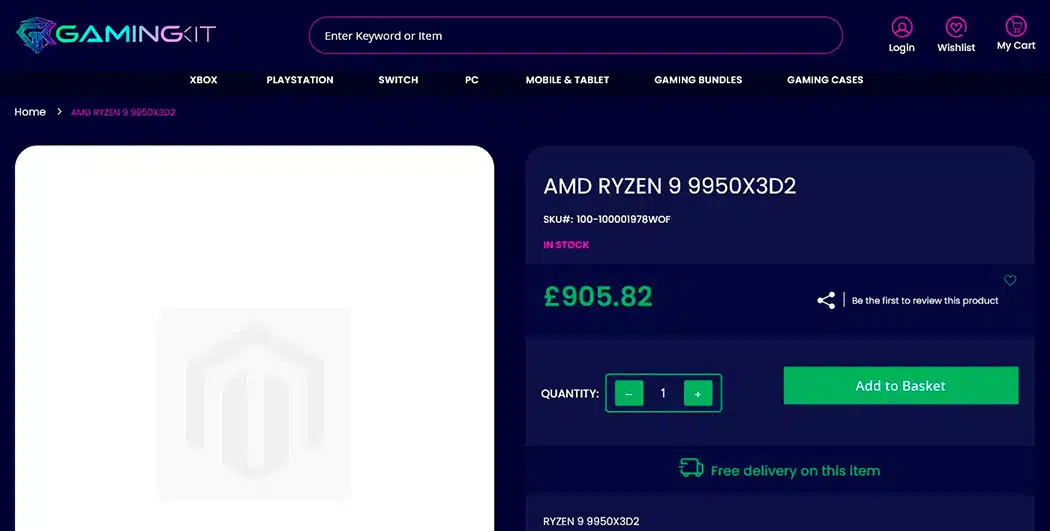
The AMD Ryzen 9 9950X3D2 Dual Edition was priced in Canada by a popular Canadian retailer, PC-Canada.com, between $1,373.99 and $1,375 Canadian dollars. This equals to around €856, or $985 including VAT. Meanwhile, in the UK, it was priced at £905.82, which equates to €1,040 or $1,200 plus tax. While this does not confirm the exact pricing, both retailers believe it will be approximately €1,000.
The suggested retail price will be revealed on April 22nd, the day of release. According to speculation, the suggested retail price for this CPU will be $799, which is roughly €950 to €1,000 in Europe.
This would make it approximately 40% more expensive than the Ryzen 9 9950X3D. Its predecessor, the 9950X3D, was released with a suggested retail price of $699 or €769 in Europe. However, it is currently on sale for approximately €685.
It’s worth remembering that processor prices have been rising as both AMD and Intel prioritize CPU manufacturing for servers and AI data centers. These processors are far more profitable because they can be sold at much higher prices in an industry willing to pay them.
About the specifications of the AMD Ryzen 9 9950X3D2 Dual Edition, it remains a 16-core, 32-thread CPU built on the AMD Zen 5 architecture. It has a base clock speed of 4.30 GHz and a turbo clock rate of 5.60 GHz. This means it is 100 MHz slower than its predecessor, the Ryzen 9 9950X3D.
The key difference from its smaller sibling is the inclusion of 192 MB of L3 cache, as opposed to 128 MB in the 9950X3D. However, this increased cache memory comes at a price: it raises the base TDP from 170W to 200W. This has already led EK Water Blocks to recommend a high-end water-cooling system or a custom liquid-cooling configuration.
The marketing for this CPU isn’t really convincing, as it only promises an average performance improvement of 7%, with up to 13% in AI. This shows that increasing the cache RAM has not resulted in significant gains in gaming performance. A technology previously pushed only to gamers will now be pitched as an upgrade for workstations.
Regardless of all this information, the AMD Ryzen 9 9950X3D2 Dual Edition’s performance under continuous loads remains to be seen. This is because it will be highly reliant on cooling, and this CPU is likely to be the hottest in the company’s portfolio.
At T4G, my task is to cover the latest news around the gaming globe ASAP and with the utmost precision. I adore all the games and respect all the devs behind the amazing games that we get all year. So, whether it’s a PC or a Console game, I got it all covered.
Story Highlight
Ben Starr from Final Fantasy and Expedition 33 wants the industry to build new IPs.
He wants the studios to move ahead of the past and focus on something fresh and new.
Starr said he would love to play new characters, and that is what we should look towards.
We are at a point in the gaming industry where studios don’t really want to experiment or take risks; instead, sequels and remasters are more prevalent. This is because the budgets have become insane, and it is difficult to generate enough revenue.
However, a renowned voice actor known for playing Verso in Clair Obscur Expedition 33 and Clive in Final Fantasy has urged the gaming industry to develop brand new IPs and stop looking back to the past.
Why it matters: This is indeed a reality as studios prefer to play it safe to avoid major losses if the game fails to take off. So, their best bet is to focus on new titles set in an already established IP or franchise.
During the recent Emerald City Comic-Con, Ben Starr spoke about a bunch of things during an Expedition 33 panel. He also mentioned how he adores the Legacy of Kain franchise, and he would love to be in a future title.
We should be building new IPs, not always looking back to the past.
But during the same discussion, Starr continued that while he loves these already established IPs, it is time for the gaming industry to stop living in the past and start building brand new IPs like Expedition 33.
Expedition 33 has been a major success
He mentioned that the Resident Evil franchise is doing so well, but even then, we would rather be part of something new, like Sandfall’s RPG. He would like to originate new characters that people can adore.
Starr has a valid point, and this is something many people would also prefer happened, but again, in today’s day and age, where the industry is so volatile, it gets difficult. However, the solution to that is lower-budget creative indie titles.
What are your thoughts on Ben Starr’s comments that studios should be building new IPs? Let us know your opinions in the comments or join the discussion at the official Tech4Gamers Forum.
I’ve previously worked for eXputer as a Senior News Writer for several years. Now with Tech4Gamers, I love to devoutly keep up with the latest gaming and entertainment industries. I have a Bachelor’s Degree in Computer Science and years of experience reporting on games and breaking exclusive stories. Besides my passion for gaming journalism, I love spending my leisure time farming away in Stardew Valley. VGC, IGN, GameSpot, Game Rant, TheGamer, GamingBolt, The Verge, NME, Metro, Dot Esports, GameByte, Kotaku Australia, PC Gamer, and more have cited my articles.
Story Highlight
Zach Cregger’s Resident Evil reboot reportedly has ‘practically’ nothing to do with games.
This tidbit comes from a private screening that otherwise had a really positive reception.
The movie will only feature a few easter eggs and recognizable monsters from the game.
While there have been many attempts in the past, the Resident Evil franchise remains to be fully realized in the world of cinema. Zach Cregger is trying just that with the second major reboot, which aims to tell an original story with new characters set in the game world.
However, a recent private screening suggests that Zach’s new project has ‘practically’ nothing to do with games. The only connections made were a few easter eggs and recognizable monsters from the RE series, which raise alarm bells among the hardcore RE fans.
Why it matters: Despite the positive reception in the screening, hardcore Resident Evil fans are skeptical after learning the latest tidbit. It would be hard to pull off a successful video game adaptation while being mostly unrelated, after all.
A private screening of the Resident Evil movie reveals that it is not related to the games at all, besides a few nods.
As reported by World of Reel, the $20 million 90-minute video game adaptation is built entirely around tension and features an environment reminiscent of the early RE titles. The small project is adopting its own way of storytelling, different from games.
Cregger recently admitted he never watched the earlier 2000s “Resident Evil” films. […] He’s also been clear that his version won’t strictly follow the established lore.
To clarify, there is overwhelming momentum and little to no character development and worldbuilding. Attendees claimed it was far more cinematic than past RE adaptations, with monsters showing up often and practical effects everywhere to up the ante.
There are also spoilers ahead.
The story follows Bryan, played by Austin Abrams, a slightly strange ‘druggie-type’ delivery driver who finds himself in the midst of Raccoon City Hospital during a virus outbreak.
The movie is expected to be really gory and will most likely receive an ‘R’ rating.
While concerns are there, Zach has previously iterated that fans won’t be bummed out. He is aiming to tell a Resident Evil story in the game world without affecting the established narrative from the games.
Do you think the Resident Evil movie will receive a positive reception from hardcore RE gamers? Let us know your thoughts in the comments below, or join the discussion on the Tech4Gamers forum.
I’ve previously worked for eXputer as a Senior News Writer for several years. Now with Tech4Gamers, I love to devoutly keep up with the latest gaming and entertainment industries. I have a Bachelor’s Degree in Computer Science and years of experience reporting on games and breaking exclusive stories. Besides my passion for gaming journalism, I love spending my leisure time farming away in Stardew Valley. VGC, IGN, GameSpot, Game Rant, TheGamer, GamingBolt, The Verge, NME, Metro, Dot Esports, GameByte, Kotaku Australia, PC Gamer, and more have cited my articles.
Story Highlight
Intel’s CPU sector will see another price surge in May, according to a Chinese research firm.
The cost will increase by another few percent, adding to the two price hikes the company has already announced in 2026.
Compared to 2026, the CPU price tag has increased by 30%, all due to the AI sector buying up most of the CPUs.
Despite recent decreases in DDR5 RAM prices globally, the memory crisis is not showing any signs of slowing down. Most PC components are still selling at an extremely high rate amidst the AI boom, with the CPU sector suffering the most.
Why it matters: With reports suggesting that the utilisation of CPU in AI data centers is only going to increase, gaming components will get more expensive for players globally.
Intel CPUs are going to be 30% costlier compared to 2025.
According to a Chinese market research firm, Intel is preparing for another CPU price increase across its entire portfolio. The company is going to raise costs by a few more percent in every CPU sector, whether it is the Core Ultra CPU or the Xeon server processor.
Overall, Intel CPUs are going up 30% in price compared to 2025, when you add the previous cost surges to the equation. Furthermore, the company is facing an issue with CPU supply that it can’t fix immediately.
Some of Intel’s CPUs rely on TSMC’s silicon, with several parts being manufactured on TSMC’s node, especially in multi-die packaging. Therefore, even though the company has a large internal CPU production base, it can’t ship the product until the parts from TSMC arrive.
Both AMD and Intel have hiked prices by more than 10% in 2026.
Data centers have also been eating up CPU supply for a while, and the ratio of CPU usage can go even higher, according to some reports. Currently, the AI server infrastructure has a 1:8 CPU to GPU ratio, but with the way AI is being used, it can go as high as 1:4, further increasing prices.
Do you think prices of memory components will come down once the AI bubble bursts, or is this now the reality of gamers worldwide? Tell us in the comments below or head to the Tech4Gamers forum for discussion.
I’ve previously worked for eXputer as a Senior News Writer for several years. Now with Tech4Gamers, I love to devoutly keep up with the latest gaming and entertainment industries. I have a Bachelor’s Degree in Computer Science and years of experience reporting on games and breaking exclusive stories. Besides my passion for gaming journalism, I love spending my leisure time farming away in Stardew Valley. VGC, IGN, GameSpot, Game Rant, TheGamer, GamingBolt, The Verge, NME, Metro, Dot Esports, GameByte, Kotaku Australia, PC Gamer, and more have cited my articles.
Story Highlight
Xbox Cloud Gaming now supports a whopping 2,816 titles after the new April update.
Players can now play titles like Crimson Desert and Life is Strange: Reunion on the go if they own them.
Furthermore, first-party Xbox titles are available to stream for free on Xbox Cloud Gaming.
Ever since its introduction in November 2024, the cloud streaming feature of Xbox Game Pass has been a big hit for Microsoft. According to the company, players have already streamed titles for tens of millions of hours, and the service is growing dramatically.
Xbox Cloud Streaming lets Game Pass users play their purchased games from any compatible device, whether it’s a TV or a mobile phone. The gaming giant has been expanding the service by adding new titles every month, and the new update has brought the number of supported games to almost 3,000.
Why it matters: Xbox Cloud Gaming and its accessibility have added another layer to all the benefits Game Pass already gives to its subscribers.
Crimson Desert is now playable through the cloud gaming service| Source: TrueAchievements
Xbox has added 50 new titles to the Stream Your Own Game feature on the Game Pass, meaning that users can now play a whopping 2,816 titles on the go because of Xbox Cloud Gaming.
New additions to the catalogue include the open-world behemoth Crimson Desert and the brand-new Life is Strange: Reunion. A flurry of Microsoft-owned titles, like Absolum, Banjo-Kazooie, Banjo-Tooie, and the Perfect Dark series, are also supported now in addition to big names like Resident Evil 7, MLB The Show: 26, and Like A Dragon: Infinite Wealth.
This Xbox Cloud Gaming update comes just ten days after the company added dozens of new options for Game Pass Users on March 25. Xbox has been updating the streaming feature with an average of 162 new titles since its launch in November 2024.
20% of the Xbox gaming catalogue, in addition to First-Party titles, now have cloud streaming support.
Xbox Cloud Gaming now encompasses almost 20% of the entire Xbox gaming catalogue and also includes all of the gaming giant’s first-party lineup. Unlike other titles that are part of the service, which you can only stream if you own them, the exclusive titles are playable without any extra cost.
Do you think cloud gaming is the next evolution of gaming, and is Xbox doing enough to support this feature? Tell us in the comments below or head to the Tech4Gamers forum for discussion.
I’ve previously worked for eXputer as a Senior News Writer for several years. Now with Tech4Gamers, I love to devoutly keep up with the latest gaming and entertainment industries. I have a Bachelor’s Degree in Computer Science and years of experience reporting on games and breaking exclusive stories. Besides my passion for gaming journalism, I love spending my leisure time farming away in Stardew Valley. VGC, IGN, GameSpot, Game Rant, TheGamer, GamingBolt, The Verge, NME, Metro, Dot Esports, GameByte, Kotaku Australia, PC Gamer, and more have cited my articles.
Story Highlight
The first user to attain the platinum trophy in Crimson Desert spent 285 hours in the game.
With an average of 19 hours of playtime per day, the platinum trophy still took more than two weeks.
The Pearl Abyss title has been praised worldwide for its massive open-world with heaps of content available in it.
However, arguably the main reason for Crimson Desert’s success is the game’s massive open-world, with such a scale that players haven’t even completed half of the map despite putting in 200 hours. As it turns out, the title’s Platinum trophy is going to take even longer to attain for completionists.
Why it matters: Crimson Desert’s style of world building is certainly going to become the standard in the industry moving forward.
User N-A-E-C-A-B-O-N took 285 hours to get the game’s platinum trophy| Source: PSNProfiles
According to PSN Profiles, the first player to attain the platinum trophy in Crimson Desert had to play the game for 285 hours. On the website’s leaderboard, user N-A-E-C-A-B-O-N was the first person to achieve this landmark in exactly 15 days, with an average playtime of 19 hours a day.
So far, only five users on PlayStation have played Crimson Desert to 100% completion with every one of these playthroughs taking around 300 hours. Hence, if you want to attain the ultra rare Platinum trophy in the world of Pywel in under two weeks, you’ll need to play for at least 20 hours daily.
Crimson Desert has been praised around the globe for the depth of content in its game world that still has more than enough to offer after 200 hours-plus of playtime. Pearl Abyss even said before its launch that the open-world title is so big that even they couldn’t figure out how long it will take to beat.
Only 5 players have achieved the game’s platinum trophy so far.
For sure, Crimson Desert might have missed a beat on the story and narrative, which Pearl Abyss even admitted. But, its humongous world more than makes up for it and sets new standards.
Do you think Crimson Desert is worth playing for its massive open-world alone? Tell us in the comments below or head to the Tech4Gamers forum for discusssion.
At Tech4Gamers, I mainly cover new gaming news, leaks, and rumours. Aside from that, I love to write features about my favourite games while inserting my opinion about their different aspects.
Story Highlight
Sony seems to be scaling back PC releases for first party single player exclusives, shifting focus back to PlayStation consoles.
Many PC players on platforms like Steam say they do not care if PlayStation exclusives stop coming to PC.
Discussions on Reddit and NeoGAF show most players would not buy a console just for a few exclusives.
This goes without saying that more people have access to a PC than a console. So, it makes sense for publishers to release their games on PC along with consoles to reach a wider audience. However, for consoles to sell, they still rely heavily on exclusive titles, as those exclusives push players to buy a particular console.
However, recent reports and statements suggest that Sony is now shifting its strategy again. The company is expected to scale back PC releases for its first party single player exclusives and focus more on keeping those titles on PlayStation consoles. Because of this shift, some players are now wondering what PC users think about PlayStation exclusives potentially no longer coming to Steam.
A couple of threads and polls have revealed that PC players do not really care about PlayStation exclusives being released on Steam.
Why it matters: Steam already has a massive library, so PlayStation not bringing its first party games to the platform may not make much of a difference for most players.
On NeoGAF, a user named Fess asked PC players what they would do if they could no longer play PlayStation games on PC. The majority of players voted for doing nothing, showing that this does not bother them much.
This suggests that PC players are not really willing to buy a PlayStation console just to play a few exclusive titles. A thread on Reddit shows a similar reaction, where users openly stated that they are not concerned about missing out on PlayStation exclusives.
“IMO, their loss. I am not interested in buying some console for its exclusives, especially with a lot of good titles already being available on PC.”
This comment reflects a common mindset among PC players.
Another Reddit thread includes multiple users saying that they are not going to buy a PlayStation 5 just to play exclusives. Some are even joking about Sony’s strategy and questioning whether scaling back PC releases is the right move.
Overall, while PlayStation exclusives remain popular, current discussions suggest that a large portion of PC players are not heavily dependent on them, mainly because of the already massive selection of games available on PC.