I’ve previously worked for eXputer as a Senior News Writer for several years. Now with Tech4Gamers, I love to devoutly keep up with the latest gaming and entertainment industries. I have a Bachelor’s Degree in Computer Science and years of experience reporting on games and breaking exclusive stories. Besides my passion for gaming journalism, I love spending my leisure time farming away in Stardew Valley. VGC, IGN, GameSpot, Game Rant, TheGamer, GamingBolt, The Verge, NME, Metro, Dot Esports, GameByte, Kotaku Australia, PC Gamer, and more have cited my articles.
Story Highlight
AdHoc Studio’s Dispatch went through a really troubled development process over the years.
The studio was close to bankruptcy, with the founders giving up their paychecks for half a year to pay developers.
Things finally changed when Critical Role stepped in to support the game after the Game Awards trailer came out.
Dispatch has unexpectedly become one of the most impressive releases this year. It already has a near-perfect score on PS5, outpacing giants like Clair Obscure and Death Stranding 2.
However, very few people believed in the game’s potential when it was in the works. AdHoc Studio’s co-founder, Nick Herman, reveals that Dispatch experienced multiple rough patches through its years of development, and the studio almost went bankrupt in the process.
Why it matters: Dispatch developers and executives who stick with the title despite many not believing in its potential shows that perseverance pays off, even in the current troubled state of the industry.
Speaking to Bloomberg, Nick says that founders missed out on paychecks for half a year to pay the Dispatch team, which had about 30 people. It struggled with securing funding because no one really believed a narrative title could sell well from a studio with no track record in the current landscape.
AdHoc began work on Dispatch after The Wolf Among Us 2’s development fell through due to disagreements with Telltale. However, the unnamed publisher at the time dropped support after only a year during the COVID crisis.
I was running around at The Game Awards, talking with potential people who were going to try to bail us out.
-AdHoc co-founder, Nick Herman.
The situation grew increasingly dire, and AdHoc was about to sign a contract that would have pretty much ended the studio after Dispatch came out. However, Critical Role stepped up to fund the final stretch of Dispatch and signed a deal with AdHoc to work on a game.
Most of my career has only been focused on creative, staying up late every night thinking about how I can make the game better. Now you’re spending that time thinking, ‘I know X weeks until the studio is out of money.’
Each Dispatch episode was received well by the community.
Dispatch has now sold so well that some gamers are already calling it a GOTY winner, proving the doubters wrong in the process.
Do you think staying dedicated to the project has made up for all the troubles AdHoc founders faced over the years? Let us know your thoughts in the comments below, or join the discussion on the Tech4Gamers forum.
I’ve previously worked for eXputer as a Senior News Writer for several years. Now with Tech4Gamers, I love to devoutly keep up with the latest gaming and entertainment industries. I have a Bachelor’s Degree in Computer Science and years of experience reporting on games and breaking exclusive stories. Besides my passion for gaming journalism, I love spending my leisure time farming away in Stardew Valley. VGC, IGN, GameSpot, Game Rant, TheGamer, GamingBolt, The Verge, NME, Metro, Dot Esports, GameByte, Kotaku Australia, PC Gamer, and more have cited my articles.
Story Highlight
Multiple reliable industry insiders have clarified that Valve is preparing to announce Half-Life 3 soon.
One credible insider said we can expect to hear an announcement within two weeks.
Another leaker noted that Valve will launch an anticipated title for Steam Machine in March 2026.
Valve’s presence in the gaming industry has grown over the last few years, driven by projects like Deadlock and Steam Deck. It also recently revealed the Steam Machine, a console-like PC that aims to make your Steam libraries more accessible than ever.
However, rumors about the publisher working on Half-Life 3 and Team Fortress 3 have also persisted in 2025. Now, multiple trusted insiders in the gaming scene have come forward to claim that the former entry is finally about to be announced within a matter of weeks.
Why it matters: It appears that years and years of waiting for a Half-Life 2 sequel won’t be in vain, as Valve is reportedly getting ready to announce the next installment after impressing gamers with its console-like PC.
Reliable insider GabeFollower, who first predicted Deadlock, claimed that Valve is going to announce Half-Life 3 this year. Well-known Valve dataminer Tyler McVicker, who discovered Half-Life: Alyx, also added that it will be announced within just two weeks.
While Insider Gaming’s Mike Shaw says there won’t be an announcement during The Game Awards 2025, Tom Henderson notes in a podcast that Valve is planning to launch a highly anticipated game in March 2026, possibly as a Steam Machine exclusive.
Yeah, so like March, or, yea it’ll probably be March, because I’ve heard there’s a big game coming out in March that I can’t say just yet.
-Tom Henderson
Previously, the popular leaker Shpeshal Nick also hinted at a massive video game reveal from Valve, reiterating that it would still come after the Steam Machine was announced.
Half-Life 3 has been rumored to be in development for years.
All these corroborations between trusted insiders suggest that the previous datamine leaks about Half-Life 3 being in development were not false after all. Therefore, it’s only a matter of time before we get the awaited sequel.
Valve revealing Half-Life 3 at this time would also be a good move, as all the Steam Machine hype would amplify its impact and sales. However, the publisher has yet to acknowledge the game’s existence, so it’s best to take these rumors with a pinch of salt.
Do you think Half-Life 3 is actually just a few months away, or are these rumors and corroborations not enough for a clear picture? Let us know your thoughts in the comments below, or join the discussion on the Tech4Gamers forum.
At Tech4Gamers.com, I cover the latest news and rumours in the gaming industry, from new game releases to hidden gems and video game leaks. Furthermore, I occasionally write tech articles about video game consoles, providing insights into the hardware and software that powers our gaming experiences.
Story Highlight
The Unity Asset Store lets gaming students earn passive income from skills they already use in their coursework.
Unlike a freelance gig, you can create an asset once, upload it, and earn money from it while focusing on school.
The main challenge is balancing this work with school deadlines.
I’ve met many gaming students who dream about making money from their skills, and honestly, I’ve been there too. Between classes, projects, and those painfully long nights fixing broken scripts, it is easy to wonder if there is a side hustle that actually fits into a student’s schedule.
The good thing is that the Unity Asset Store has become one of the easiest ways for students like us to turn late-night creativity into real income.
I first got into asset creation when I realized half my classwork already involved modeling props, animating characters, tweaking textures, and all the usual stuff. Uploading assets felt like a natural extension of what I was doing anyway.
And unlike freelance gigs or part-time jobs, the Unity Store does not need you to clock in or chase clients. You make something once, upload it, and it can earn on its own while you focus on assignments or even take a break.
Of course, the real challenge for most students is time. I have had weeks when three deadlines hit at once, and there was no way to juggle everything without burning out. I know people who used academic support during crunch time, and I have done the same when coursework stacked up.
Sometimes choosing to pay for research paper help becomes the one move that keeps both your GPA and your unity asset production alive. It is all about knowing when you need an extra hand so you do not drop everything else.
Why I Think the Unity Store Is Perfect for Students
Creating Unity assets builds a strong portfolio and teaches real-world skills that can lead to future job offers.
Unity is everywhere right now, from indie games to school projects. Because of that, anything you upload has a shot at landing in front of thousands of developers. I have seen everything sell, including tiny prop packs, stylized characters, particle effects, cute UI sets, and even random sound packs made in a dorm room at 2 AM.
The best part is that once your asset is approved, it just sits there quietly making money while you move on with your semester.
For students, that is a dream setup. You do not need a boss, you do not need a huge studio, and you do not need a lot of time. You just need something that solves a developer’s problem. And developers will gladly pay for anything that makes their work faster.
Learning What Actually Sells
To manage time, it helps to break projects into very small tasks.
Before I made anything, I spent a few days scrolling through the marketplace like I was window-shopping. That alone taught me a lot. The best-selling assets are not always the prettiest ones. They are the practical ones.
Modular environments that can be reused. Character packs with clean rigs. Scripts that help beginners plug in jump systems or inventory mechanics without losing their minds.
Reviews became my secret weapon. People are surprisingly honest. They will tell you exactly what is missing, what is broken, and what they wish they had.
If you can build something that answers those complaints, you will stand out immediately. And because the store updates constantly, there is always a niche waiting to be filled.
Most students stick to Blender because it is free and powerful, and that is usually enough to start. Substance Painter is great when you want to level up your textures.
For audio packs, I used Audacity because it is simple and gets the job done. And when I collaborate with classmates, Unity’s built-in version control keeps everything organized.
Organization apps like Trello helped me more than I expected. It sounds simple, but seeing small tasks checked off keeps you moving when motivation is low.
Balancing School With Asset Work
You can find new asset ideas by reading reviews and seeing what features customers complain about or request.
Here is the tricky part. Asset creation sounds fun until you are knee-deep in an animation retargeting problem while two deadlines breathe down your neck. I have found that breaking projects into tiny chunks helps a lot.
One day for rough concepts, another for mesh cleanup, another for textures. The moment you try to build everything in one giant sprint, you are finished.
It is not about slacking off. It is survival. It gives you room to polish your assets instead of handing in rushed work on both ends.
As soon as my portfolio started looking solid, a few small studios reached out. It is flattering, but also risky during exam season. I learned to accept only what I could realistically finish. Task managers like Asana helped me keep track of everything without losing my mind.
Staying Competitive and Relevant
The Unity Store is crowded, so I stopped worrying about outrunning everyone and focused on being recognizable. Bundles with a consistent look, catchy naming, or themed collections helped me stand out. Keeping an eye on Unity forums and game jams also helped me notice new trends early.
Every time I upgraded a skill, like learning better lighting tricks or experimenting with shaders, my assets improved. The results showed themselves in sales and better reviews.
I have seen students start with tiny assets and eventually build full games or launch small studios. Unity Store earnings often go back into better tools, classes, or paying for tuition. More importantly, this side hustle teaches real-world skills like time management, understanding an audience, presenting work, and dealing with actual developers.
If you are a gaming student trying to make extra income without drowning in side jobs, creating assets for the Unity Store is one of the smartest and most flexible paths you can take. It teaches things your classes do not always cover, it builds useful experience, and it gives you the freedom to earn on your own terms.
And who knows. A small side hustle today might be the foundation of your future career tomorrow.
At T4G, my task is to cover the latest news around the gaming globe ASAP and with the utmost precision. I adore all the games and respect all the devs behind the amazing games that we get all year. So, whether it’s a PC or a Console game, I got it all covered.
Story Highlight
The AI boom has sent memory prices to a new high.
Samsung is reportedly set to increase memory prices by a whopping 60%.
This will also lead other suppliers to increase prices substantially.
The recent AI boom has sent the prices of certain PC parts to a new, ridiculous high. Demand is at its highest, with companies working with their whole workforce to fulfill requirements, and even then, they have orders booked for a year.
Now, after the previous 30% increase, Samsung is rumored to be increasing memory prices by a whopping 60%, which could take them to catastrophic levels. This would especially affect the general PC users using DDR5 memory.
Why it matters: AI demand is surging so high that data centers are ordering DDR5 RAM sticks in bulk, and because the demand is challenging to process, prices are increasing significantly.
Since Samsung is the world’s largest chipmaker, this will affect overall prices.
According to Reuters, Samsung is expected to announce this historic price increase soon officially. The 32GB DDR5 RAM kit is currently priced at $240, an almost 60% increase from its previous price of around $145.
Even the other capacities have seen a price hike too, with 16GB RAM seeing around a 50% increase. Since Samsung is the industry’s largest DRAM supplier, other companies will likely follow suit.
RAM Prices have already seen new highs in recent weeks.
So, for PC users, a memory upgrade, which used to be among the cheapest upgrades, is set to become much more expensive. The price hikes are already in place, and the situation is expected to worsen.
What are your thoughts on memory prices being increased by 60%? Let us know your opinions in the comments or join the discussion at the official Tech4Gamers Forum.
I’ve previously worked for eXputer as a Senior News Writer for several years. Now with Tech4Gamers, I love to devoutly keep up with the latest gaming and entertainment industries. I have a Bachelor’s Degree in Computer Science and years of experience reporting on games and breaking exclusive stories. Besides my passion for gaming journalism, I love spending my leisure time farming away in Stardew Valley. VGC, IGN, GameSpot, Game Rant, TheGamer, GamingBolt, The Verge, NME, Metro, Dot Esports, GameByte, Kotaku Australia, PC Gamer, and more have cited my articles.
Story Highlight
The Horizon franchise has now officially sold over 40 million copies worldwide, as NCSoft officially announced.
The NCSoft general manager revealed the tidbit during the G-Star 2025 event, alongside the new MMO Horizon: Steel Frontiers.
The figure has increased by 2 million since July 2025 alone, suggesting the series is in high demand.
Despite facing controversies over the years, the Horizon franchise has proven to be one of Sony’s best recent money-making IPs. All the mainline titles and side projects have been an astounding success in terms of sales and the overall player reception.
The Horizon franchise has now sold over 40 million copies worldwide, up 2 million since July 2025. To put things into perspective, the series had sold over 32.7 million by April 2023, showing that sales have continued to grow over the years.
Why it matters: The Horizon franchise’s sales like hotcakes show it has strong legs in Sony’s portfolio, making the publisher’s decision to pursue more projects all the more understandable.
NCSoft general manager Lee Seong-Gu at the G-Star 2025 event. | Image Source: Nate.
As reported by the Korean site Nate, NCSoft’s general manager announced the sales milestone at the G-Star 2025 event in Boston. These Horizon titles have continued to sell well across multiple platforms despite there being no new releases since late last year.
However, that is changing soon since NCSoft revealed Horizon: Steel Frontiers, a new MMORPG developed in partnership with Sony specifically for mobile, but also playable on PC. The team is considering launching on consoles, as per the details revealed in the event.
Sony initially did not see a need to bring the MMO to PS5, but a majority of Western Horizon fans have disagreed with this decision. Horizon: Steel Frontiers has also fallen into controversyfor NCSoft’s use of AI during development.
Horizon: Steel Frontiers is shaping up to be an MMORPG set in the Horizon universe.
Additionally, the MMO will be PvE-only, featuring large-scale raids where players will face the series’ iconic mechanical beasts.
Guerrilla Games is reportedly working on another multiplayer Horizon project, and a film is also in production.
Do you think the new projects from the Horizon series will continue to do well in the future, or did the first few games sell like hotcakes due to their unique worldbuilding? Let us know your thoughts in the comments below, or join the discussion on the Tech4Gamers forum.
Currently serving as a News Reporter at Tech4Gamers, I have the privilege of combining my love for gaming with the art of storytelling. My role involves crafting engaging narratives that keep our audience abreast of the latest developments in the gaming world.
Story Highlight
Insider says that Sony is rethinking its approach for first-party ports to PC.
Live-service games will still release on desktops, but single-player games may never arrive, or even if they do, will be delayed by years.
It is probable that this decision came after competition from Valve’s Steam Machine and the upcoming Xbox PC.
While the era of exclusivity was almost at an end, things have changed, possibly for the better. Valve has now decided to enter the AAA games market with a brand-new hardware called the Steam Machine, which aims to compete with consoles despite being a PC at its core.
Other than that, the next-gen Xbox is also said to be a Console-like PC and would let you play games from all publishers, eliminating the need to buy a console. As such, increased competition is now forcing Sony to rethink its strategy for porting first-party games to PC.
Why it matters: The console wars were already over, but Valve’s surprise entry changes things. Even though Xbox’s reign was already over, gamers were wondering what the future holds for PlayStation, and it will keep going the way it does.
As per Jez Corden, he stumbled across the news that PlayStation is ‘pulling back from PC‘. This part is mostly true for tentpole single-player games, as the gaming giant will still release live-service titles like the upcoming Marathon on PC.
However, for tentpole single-player games, they may not arrive on PC, or even if they do, releases will be delayed for years on end now, in contrast to the quick releases they’ve been given in recent times.
Marvel’s Spider-Man 2 was released on PC just a little over a year after its PS5 release, and the same was the case with Stellar Blade. However, as before, God of War (2018) took 3 years before eventually arriving on desktop systems.
Furthermore, the gaming giant’s sales on PC don’t even generate significant revenues for them. Previous issues like region restrictions have caused hiccups in performances, and releasing ports years after the game’s initial release also doesn’t help. As such, it makes sense why Sony would put up with this approach.
What are your thoughts on this approach? Do you think Sony should completely pull out with first-party ports to PC or not? Let us know in the comments below, or at the official Tech4Gamers Forums.
At Tech4Gamers, I work as a guides expert. My role involves writing about solving different gaming and tech-related topics that pique my interest and that I believe more people should know about. This position allows me to share my insights and discoveries with a broader audience, enriching their gaming experiences with the unique perspectives I bring.
Story Highlights
Valve recently revealed the Steam Machine alongside its new Steam Controller and Steam Frame.
The Steam Machine is a full-fledged PC that can function as a console.
The specs are slightly below those of other consoles, but still more than enough to run any game.
Valve revealed a number of new hardware items last Wednesday. While all of them were exciting in their own right, the highlight was without a doubt the Steam Machine, Valve’s PC/console hybrid.
The Steam Machine, as such, has the benefits of both a PC and a console. It has all the ease of plug-and-play that casual gamers enjoy while still functioning as a PC optimized for gaming due to the Steam OS being integrated into it.
What Is The Steam Machine?
Valve’s Steam Machine (Image Credits – Valve)
The Steam Machine is smaller than any other current-gen console, being almost half the size of a PS5. Despite that, it’s a machine capable of outputting similar levels of power with added benefits.
Valve has put emphasis on how it’s just as much a PC as it is a console. This is something I’m very excited about, since the Steam Machine can also work as a portable PC due to its relatively smaller size. And yes, you can connect your mouse and keyboard directly to it.
The Design Idea Behind The Steam Machine
Steam Deck As An Emulator (Image Credits – Laptop Mag)
Valve had tried to mesh together the qualities of a PC with a console experience in the past as well, albeit not to much success. However, this time around, one of the ideas behind the Steam Machine’s creation had to do with the Steam Deck.
While the Steam Deck is a handheld, many people found it enjoyable to use it connected to a larger screen. This is fun, sure, but Steam Decks, being handheld devices, ultimately lack the power needed to run scaled-up versions of games to the same level of competency as consoles.
How Good Is The Steam Machine?
The Steam Machine Has A Customizable Lightbar (Image Credits – Valve)
It doesn’t betray its name either, as the console truly is a machine, being six times as powerful as the Steam Deck.
My experience with the Steam Deck has been phenomenal, but it’s true that it can struggle with super high-end games. Being six times as powerful is a bold statement though, and if it’s true, then I’m not too concerned about what it can run.
The Power Of Six Steam Decks (Image Credits – Valve)
If you’re wondering what the exact specs are, the Steam Machine has a semi-custom AMD Zen 4 6C / 12T (up to 4.8 GHz, 30W TDP), semi-Custom AMD RDNA3 28CUs (2.45GHz max sustained clock, 110W TDP), and 16GB DDR5 + 8GB GDDR6 VRAM.
The console will come in two variations for storage: 512GB NVMe SSD and 2TB NVMe SSD. You can find a complete list of all the specs on the Steam Machine’s Steam page, including its connectivity options, I/O, and physical dimensions.
How Does It Compare To Other Consoles?
The specs, while certainly impressive, are a bit lower than competitors like the PS5 and Xbox Series S|X. From what I’ve seen, this doesn’t seem to be a problem, though, as the console can run anything its competitors can with negligible difference.
If you’re still worried about not getting the quality you want, Valve has announced an addition to the Steam Deck Verified status. After the Steam Machine’s launch, you can see which games have passed all of Valve’s benchmarks and can perform exactly the same as they would on another console.
What Else Did Valve Reveal?
All New Hardware From Valve (Image Credits – Valve)
Alongside the Steam Machine, Valve also revealed the new Steam Controller and the Steam Frame.
Steam Controller, as the name suggests, is Steam’s very own controller. Unlike its first iteration, which didn’t get the best reception, Steam has optimized the new one to have everything you’ll need at your fingertips using the Steam Deck as a model.
The Steam Controller Has A Unique Design (Image Credits – Valve)
The controller has a stronger version of the Steam Deck’s input, giving you more room for controls. It has the same touchpads, d-pad controls, and, fortunately, two joysticks this time.
Steam Frame & Controllers (Image Credits – Valve)
The Steam Frame, on the other hand, is Steam’s VR headset. It’s lightweight and made for streaming, playing VR games, and even for non-VR games. It comes paired with controllers that feature joysticks, d-pads, and gyro controls.
Will I Be Getting The Steam Machine?
Unless something unprecedented comes up, most likely yes. I’ve always wanted a console that works with Steam, and the Steam Machine has more things going for it than I expected.
I, for one, love the smaller form factor, and its ability to function as a complete PC is just the cherry on top. It still depends on how high the price point is and how many games come as fully Steam Machine Verified, but I’d say it’s going to be a worthwhile purchase.
At Tech4Gamers, I contribute as a Senior News Reporter, combining my skills and gaming enthusiasm to keep our audience updated on the latest developments.
Story Highlight
Black Ops 7 has launched to around 84K concurrent players on Steam.
This figure marks a nearly 70% drop-off compared to Black Ops 6’s player count, which was over 300K on day one.
The game’s campaign has been criticized quite heavily, and Steam reviews are also mixed so far.
Black Ops 6 broke several records for Call of Duty last year and eventually ended up as the PS5’s best-selling title in the US. The game was also a major hit on Steam, becoming a success for Activision and Xbox by every definition.
One year later, the same cannot be said of its successor. Not only is Black Ops 7 extremely disappointing in the campaign department, but it also appears to have reached less than half of the active players on Steam on launch day.
Why it matters: Call of Duty is a behemoth of the gaming industry, and it is rare to see any entry in the series underperform.
Looking at data from SteamDB, Black Ops 7’s release has led to a concurrent peak of around 84K players for Call of Duty. In contrast, this figure was as high as 306,000 in October 2024 at the time of Black Ops 6’s release.
This marks a drop-off of around 70% in terms of day-one player counts on Steam. Black Ops 7 also has mixed reviews on Steam at the moment, highlighting the overall sentiment toward Activision’s latest offering.
Interestingly, the title is still at the top of Steam’s best-seller charts. Indeed, die-hard players seem to be enjoying the multiplayer experience, so it is interesting to see Black Ops 7 not performing nearly as well as last year’s entry on release.
Perhaps the success of recently released shooters like Battlefield 6 and Arc Raiders has left a lasting impact on Black Ops 7.
Black Ops 6 Was A Major Commercial Hit
Ahead of the release, an insider also noted that Black Ops 7 pre-orders were tracking behind Black Ops 6. This report appears to be reflected in the game’s Steam numbers, suggesting that Call of Duty has fallen behind its predecessor this year.
At Tech4Gamers, I contribute as a Senior News Reporter, combining my skills and gaming enthusiasm to keep our audience updated on the latest developments.
Story Highlight
Ubisoft San Francisco began working on a new Splinter Cell title in 2017.
This project was eventually transitioned to a live-service game after executives showed interest in the genre.
It was eventually released as XDefiant but was shut down just one year later.
Update:-
Following this report, former XDefiant executive producer Mark Rubin has come forward with an update on the situation.
He states that XDefiant was made as a result of a project that was ambitious in nature but not related to Splinter Cell. The aforementioned game was later cancelled, and the team pitched an arena shooter before eventually releasing XDefiant.
The producer did not rule out the possibility of the team working on Splinter Cell before his arrival at Ubisoft. However, he stated that the gaming giant usually allows its developers to exercise a lot of freedom in terms of the projects they want to tackle.
Original Story:-
Ubisoft is currently developing multiple remakes, including one for Splinter Cell. This rendition of the IP is set to introduce new fans to the franchise, successfully reviving one of the best stealth-action games the industry has to offer.
While fans continue to wait for Splinter Cell Remake, a new report has shed light on the fact that this is not the studio’s first attempt at bringing the series back in recent years. In fact, a new game based on the IP was in development as early as 2017, but Ubisoft was too interested in live-service gaming at the time.
Why it matters: Like many other studios, Ubisoft has attempted to break into the live-service market on multiple occasions, but the team has failed each time.
Splinter Cell Is Currently Being Remade By Ubisoft
As reported by Jason Schreir, Ubisoft San Francisco began working on a Splinter Cell game in 2017. The project was in development for a few months, and spirits were high at the studio, with the team being excited at the prospect of returning to Splinter Cell.
Unfortunately, these plans were halted when Ubisoft executives saw the success of live-service gaming and wanted to jump in. Ubisoft San Francisco then attempted to transition the project toward a live-service model, with the game eventually releasing as XDefiant.
Although XDefiant showed immense potential at release, it was later abandoned and shut down. On the other hand, the developers originally working on the Splinter Cell revival left Ubisoft and began working on the game that many now know as Dispatch.
As fate would have it, former Ubisoft developers released two very popular games in 2025. Both Dispatch and Clair Obscur: Expedition 33 have garnered a lot of praise this year, while Ubisoft continues to struggle in the face of potential bankruptcy and declining share prices.
Dispatch Has Been A Huge Hit
As for the current state of Splinter Cell, the remake seems to be going through turmoil at the moment. Recent job listings suggested that the project was in need of a new director last month, hinting at potential disruptions during development.
Still, Ubisoft has recently attempted to rejuvenate interest in the IP with a Netflix anime adaptation.
What do you make of a potential Splinter Cell revival from Ubisoft? Do you think the studio made the wrong choice? Let’s discuss in the comments and on the Tech4Gamers Forums.
Currently serving as a News Reporter at Tech4Gamers, I have the privilege of combining my love for gaming with the art of storytelling. My role involves crafting engaging narratives that keep our audience abreast of the latest developments in the gaming world.
Story Highlight
PlayStation Boss says there’s still a lot to come for the PS5, and there’s so much life left in the console.
He further says that the best-selling game of the PS5 is yet to be released.
Most likely, he’s referring to GTA 6.
Even though we’ve learnt a lot about the next-generation of PlayStation console, including hardware details and much more, Sony still has a lot to offer for the PS5’s remaining lifecycle.
Senior Vice President of Sony, Eric Lempe, said that we should still expect a lot from the current generation rather than looking forward. In a shocking statement, he further said that PS5’s best-selling game hasn’t even been released yet.
Why it matters: We’re five years deep into the PS5’s console lifecycle, and there’s still a lot to wait for. The lack of first-party support and a few dry years are potentially going to pay off in the latter half of the generation.
Talking with the BBC, Lempe said there’s “a lot of great content” awaiting the current hardware and that they’re going to “just going to continue with PS5.” While discussing the game meant to be the console’s best-seller, he said:
I’m not going to tell you which one, but I think it’s still to come
The obvious game fitting the description is GTA 6, and no other title comes to mind so far. Rockstar’s ambitious open-world title recently got delayed again into November 2026, and with all the hype build-up, expect sales records to be shattered with just the pre-orders.
Or, he could be talking about another game, but that’s just speculation. Marvel’s Wolverine and Intergalactic: The Heretic Prophet, even with all their perfections, just couldn’t hold a candle against GTA 6.
Even the best-seller on the PS5 right now is Assassin’s Creed Valhalla, a third-party game, so more than likely, the best-seller being mentioned is GTA 6.
I’ve been the Journalist & Editorial Writer at Tech4Gamers since July 2022. I spearhead our hardware coverage, including overclocking GPUs, benchmarking CPUs, reviewing peripherals, and fine-tuning custom PC builds for every budget. Daily, I report on breaking gaming news, from major launches and studio updates to the latest industry trends, ensuring our community stays informed. Beyond news briefs, I write in-depth feature articles on gaming culture and emerging technologies. And by collaborating closely with the editorial team on content planning, SEO strategy, and our publishing calendar, I help us consistently hit our traffic and engagement targets.
If you’d asked me a few days ago what I thought about Womier as a gaming keyboard brand, I probably wouldn’t have had much to say. Since I hadn’t actually reviewed any of their keyboards before, that changed recently when I got to try out the Womier ERA75, which left a pretty strong impression. Fortunately, not long after that review, Womier sent me another keyboard to review, which is the Womier SK75 TMR. So, here I am again, diving back into the Womier lineup to see how this one stacks up against the rest of the offerings in the market.
Why Trust Tech4Gamers
Abdul Hannan is our peripherals expert who has been testing different mice, keyboards, headphones, microphones, and more for years.
130+ peripherals tested and reviewed by our team of hardware experts (Tech4Gamers Team).
500+ hours spent testing different peripherals for our reviews.
At Tech4Gamers, ensuring you get reliable information is our priority. That’s why every hardware round-up undergoes a meticulous review process by our team of experts and editors. Each review is carefully examined against our strict editorial guidelines, guaranteeing you trustworthy insights you can depend on.
Key Takeaways
The Womier SK75 TMR is a compact 75% keyboard with smooth magnetic switches and bright RGB lighting. It delivers fast, reliable performance, long battery life, and intuitive software customization.
You should consider the Womier SK75 TMR if you want responsive gaming performance, versatility, premium build, typing comfort, and hybrid switch compatibility.
You should skip the Womier SK75 TMR if you need high portability, prefer backlit shine-through keycaps, and an adjustable typing angle.
Here are the technical specifications:
Total Keys
81 keys
Layout
ANSI 75%
Color Option
Black
Keycap
Cherry profile double-shot PBT keycaps
Case Material
Aluminum
Plate
FR4 Material, non flex-cut
External Weight
Chroma Mirror
Connection Types
Wired/2.4GHz Wireless/Bluetooth
Switches
Outemu Tea Magnetic Switch
Polling Rate (Wired/Wireless/Bluetooth)
8000Hz
Adjustable Accuracy
0.01mm
Adjustable Actuation Range
0.1mm – 3.5mm
Latency (Wired)
0.125ms
Backlight LEDs
South-facing
PCB
1.6mm, FR4 material, full RGB, hotswap, no flex cuts, 3/5 pin mechanical switches compatible
Hot-Swap
Cross-compatible with both magnetic and mechanical switches (can mix & match)
Mounting Style
Top mounted
Battery Capacity
8000 mAh
Interface
USB Type-C
Operating System
Windows/macOS
Keyboard Weight
2000±20g
Dimensions
321*140*38(47)mm
[toc]
What Makes Womier SK75 TMR Different?
With the Womier SK75 TMR, the brand has taken everything good about previous models and pushed it into a new performance bracket. It takes it to a whole other level with TMR (Tunneling Magnetoresistance) magnetic sensing instead of the more typical mechanical or Hall‑effect switches, meaning you’re getting ultra‑fast actuation, near‑zero dead zone, and a full 8000 Hz polling rate even in wireless mode. That in itself puts it ahead of many competitors in the under‑$150 range.
Packaging
Packaging
1 of 3
Frontside of the box
Topside of the box
Backside of the box
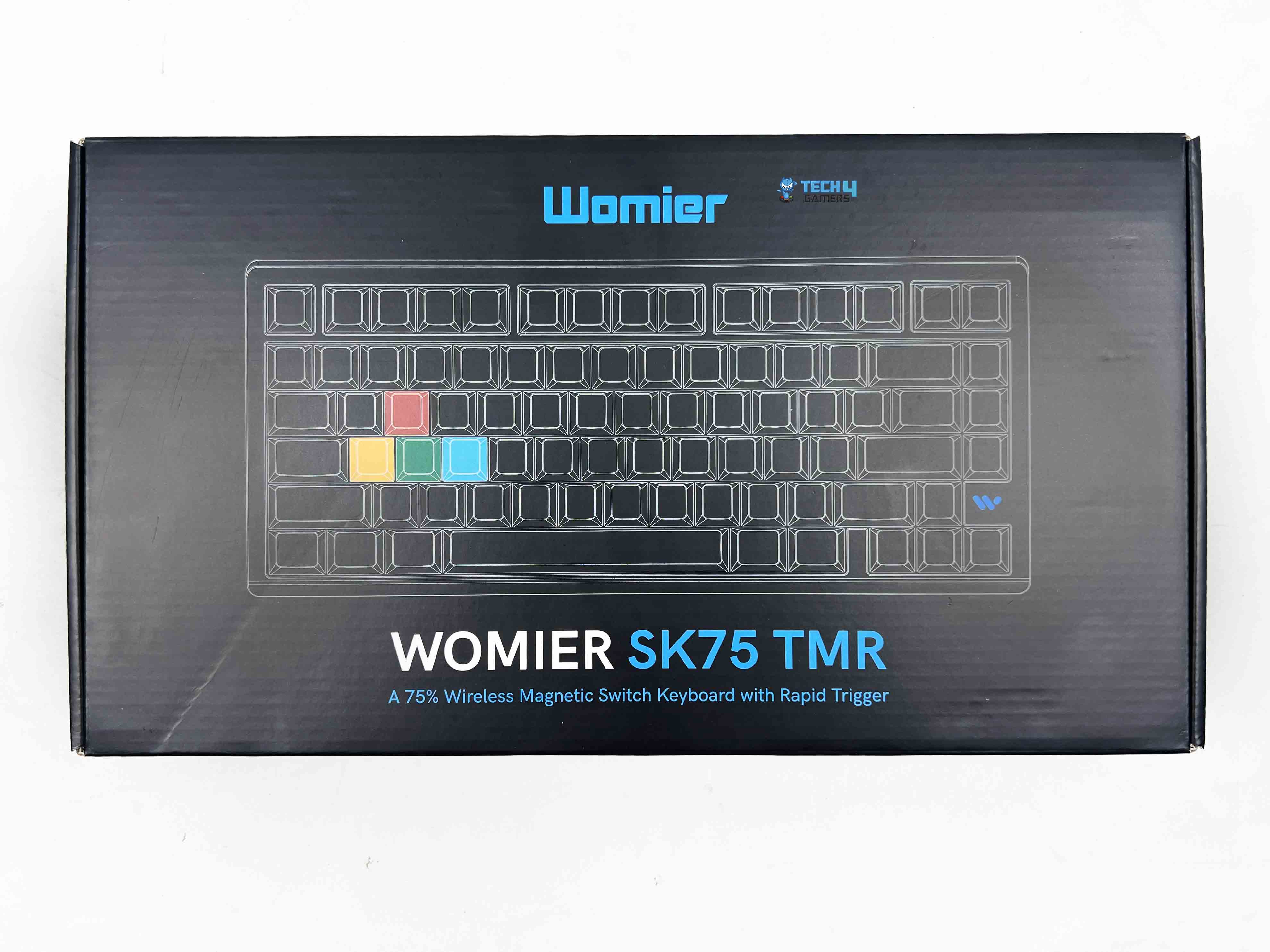
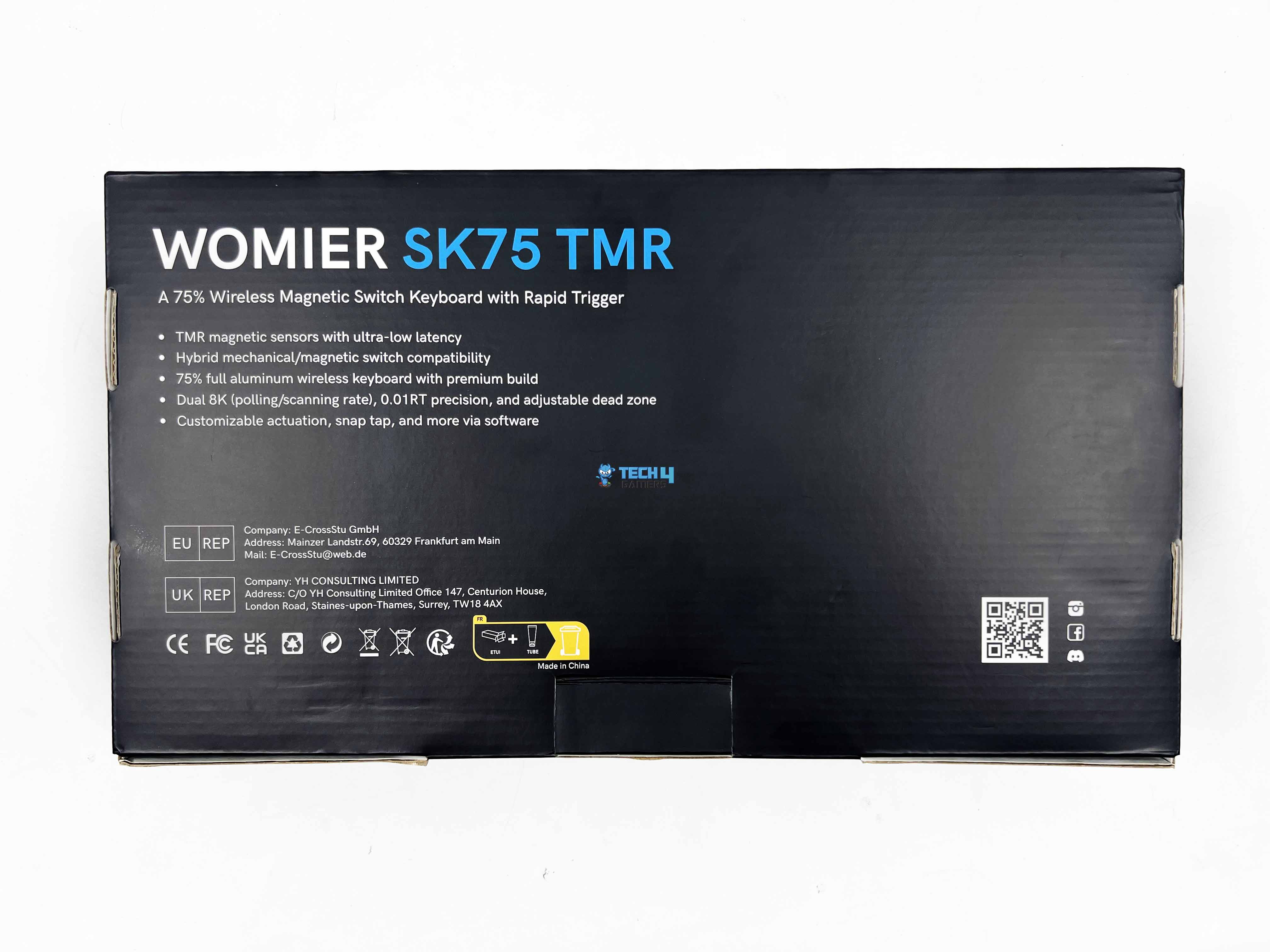
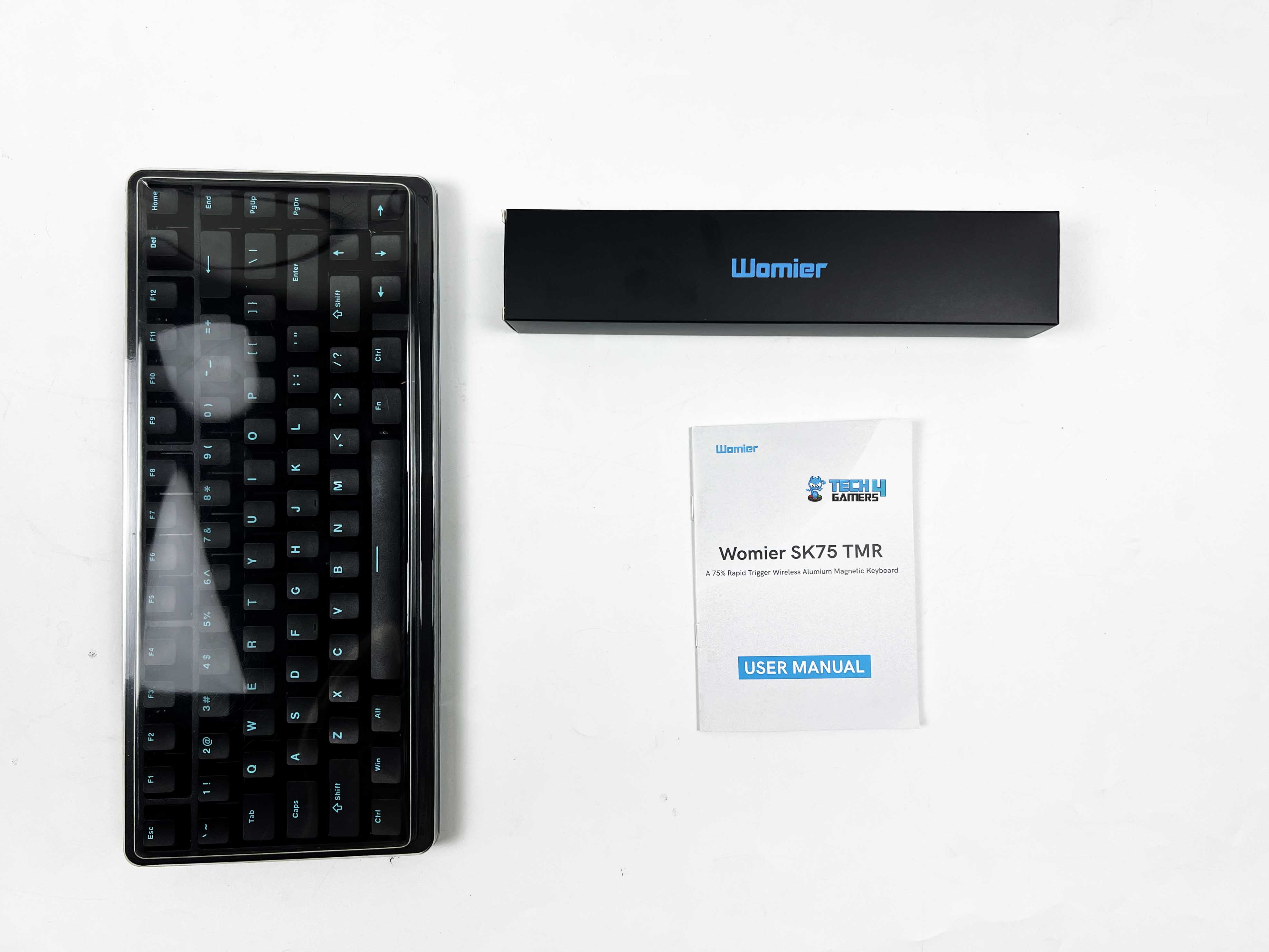
The Womier SK75 TMR arrived in a complete black box. On the front, you’ll get a layout of the keyboard that almost looks like a blueprint, showing the outlines of the keycaps. With it, you’ll find the Womier branding and the model name, along with a short description mentioning that it’s a Wireless Magnetic Switch Keyboard with Rapid Trigger. Flipping the box over, you’ll see a few key specifications listed in bullet points, along with the manufacturer’s information printed at the bottom.
Unboxing
Unboxing
1 of 3
Unboxing
Accesories and Manual Guide
Box Contents
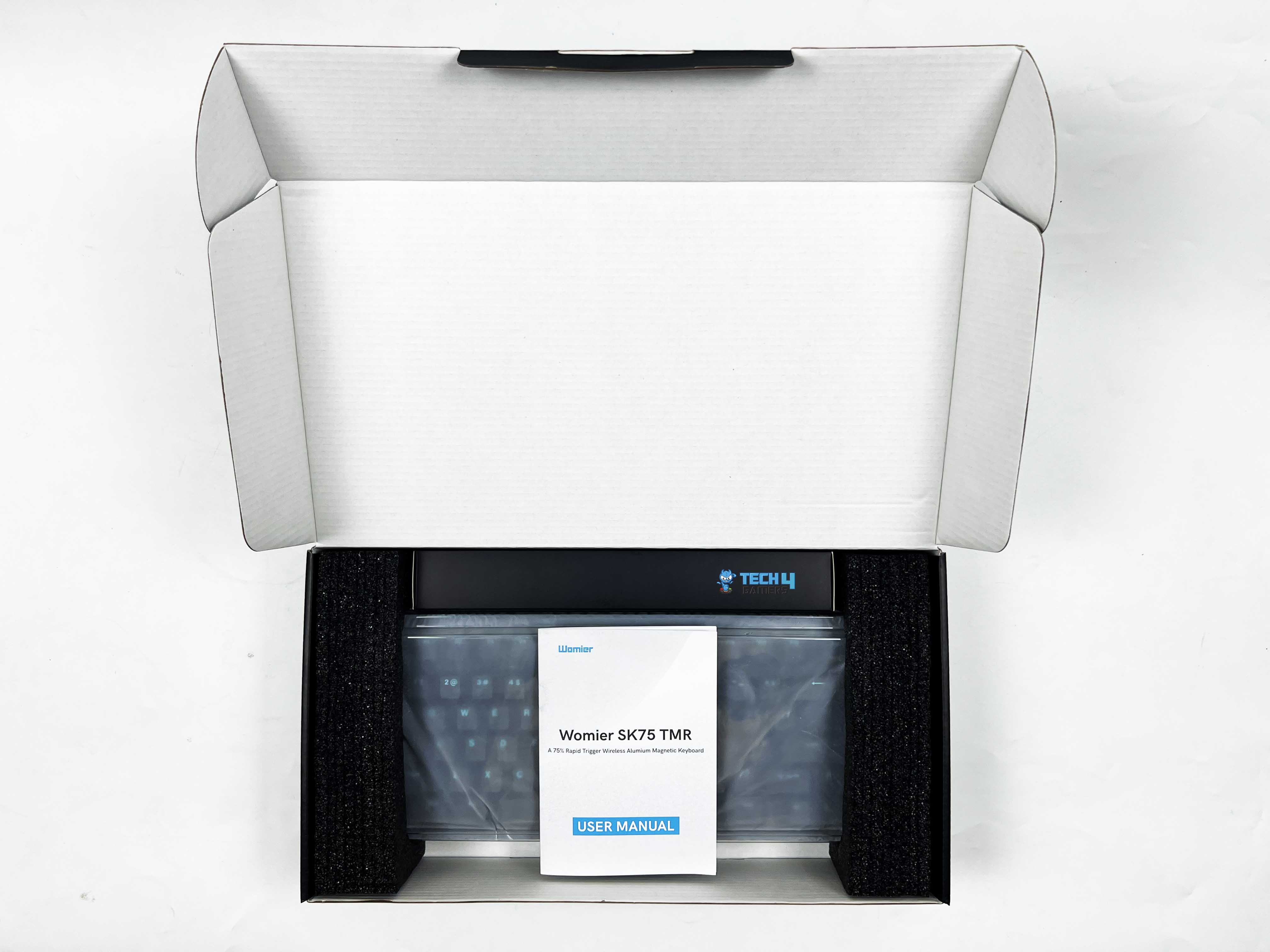
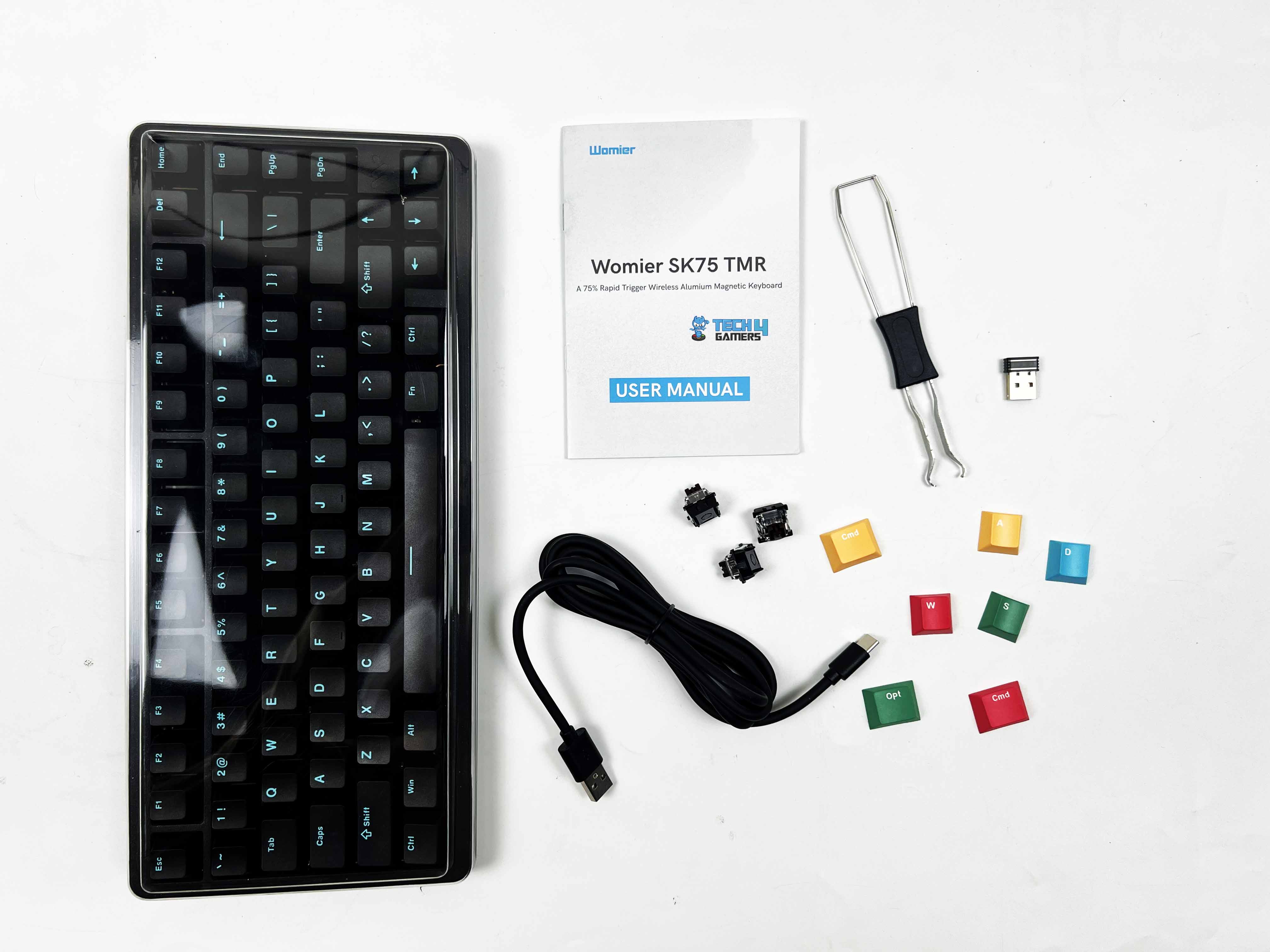
Opening the box, the first thing you’ll see is a user manual sitting right on top of the Womier SK75 TMR. Beneath that, the keyboard is wrapped in a plastic sleeve and covered by a dust cover. On both sides, there are thick black foam inserts that hold it in place. Lastly, there’s a small black cardboard box on top. Inside that, you’ll find all the accompanying accessories. Here is the list of everything that you’ll find inside the box:
Womier SK75 TMR Keyboard
USB-A to USB Type-C Cable
2-in-1 Keycap & Switch Puller
2.4GHz Wireless Dongle
Extra Keycaps
Extra 3pcs of Stock Switches
User Manual
Design
Design
The Womier SK75 TMR comes in a sleek black color. It looks outstanding with its all-black finish, which makes it feel professional on the desk, and it fits well with the rest of the setup. That said, black is the only color option available, so if you were hoping for any other variant, this is it. However, personally, I think the understated black design works in its favor. Looking more closely, the keyboard’s minimalist design really stands out. There’s almost nothing to distract with just the clean keycaps and a subtle frame.
Womier Branding
Even the branding is kept restrained, with only a small engraved Womier logo placed next to the directional keys. Another noteworthy detail is the coating on the body. It’s not just plain black, but there’s a faint, almost glittery effect. When light hits, its tiny reflective dots shimmer subtly across the surface. It’s not flashy at all but more like a gentle sparkle that adds elegance without being over the top. It’s one of those little things you don’t notice at first, but it makes the keyboard feel more premium.
Layout
Layout
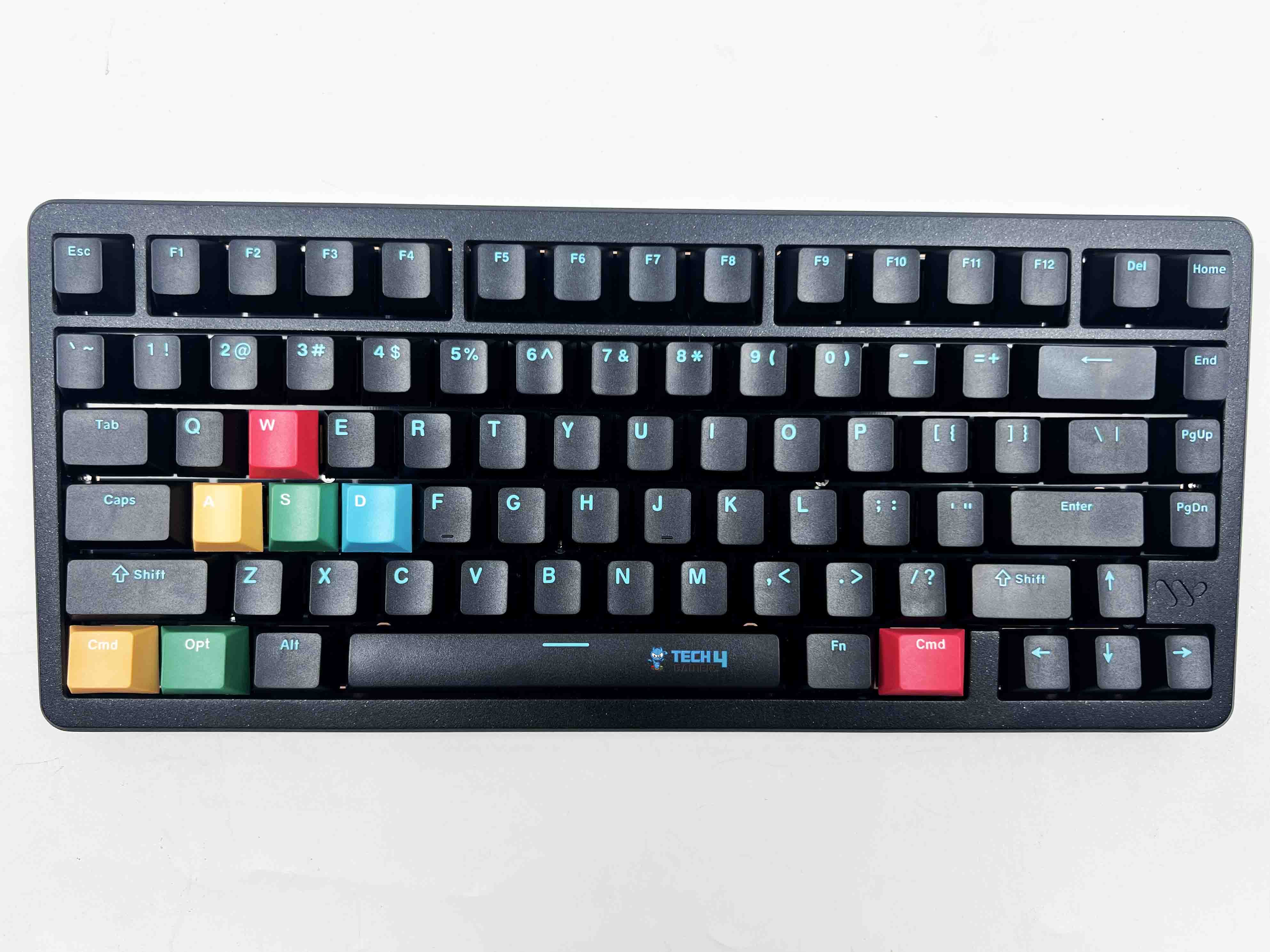
The Womier SK75 TMR features a 75% ANSI layout with 81 keys. Generally speaking, it provides a nice middle ground between saving desk space and keeping things functional. Notably, key spacing feels natural, and I didn’t feel cramped while typing or gaming. Speaking of size, the keyboard’s dimensions are 321 × 140 × 38mm, with a slight height difference at the back (47mm). The function row and arrow keys are easy to reach, and the Fn combination shortcuts are pretty handy.
Underside
Chroma Mirror
Flipping the Womier SK75 TMR over, you’ll find four rubber feet, one on each corner. The top ones are placed vertically, while the bottom ones are placed horizontally. Right in the middle of the bottom, there’s a Chroma Mirror with grey outlines. One downside is that the SK75 TMR doesn’t have adjustable feet, so the typing angle is fixed. That said, it doesn’t sit completely flat on the desk either. The design already gives it a slight natural angle, almost as if an extra part of the chassis is subtly lifting it from the surface.
Build Quality
Build Quality
We’re looking at a 2000±20g keyboard here, so it has a nice, solid heft. That said, the weight does raise portability concerns. You could technically move it around, but it’s not something you’d casually toss into a backpack for on-the-go use. One standout feature is the aluminium case, which makes the keyboard feel rigid. The edges and frame are smooth and well-finished, with rounded corners. You don’t get any unwanted flex, even when pressing down hard on the keys or the chassis.
Keycaps
Keycaps
1 of 2
Keycaps
Accent Keycaps
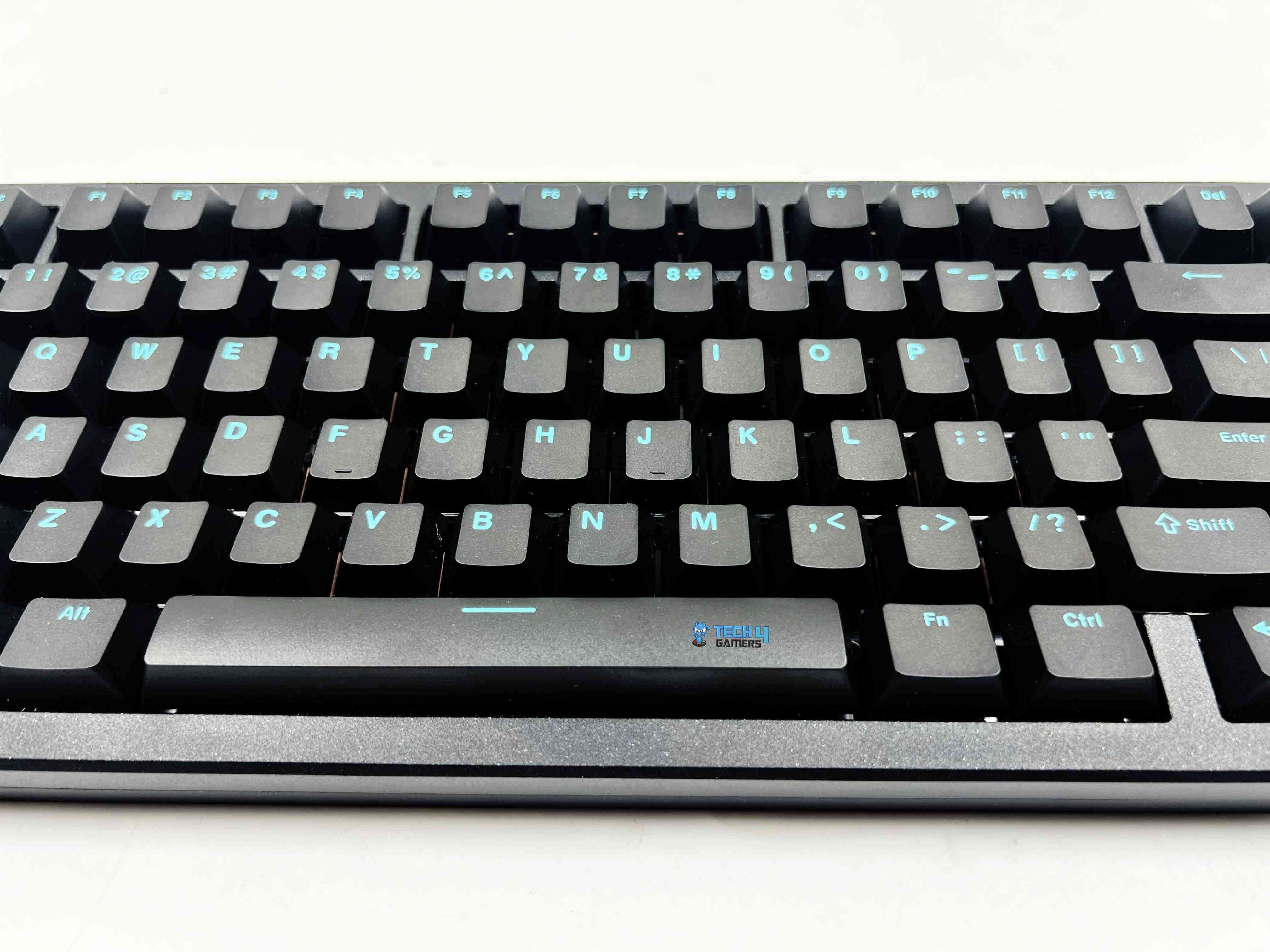
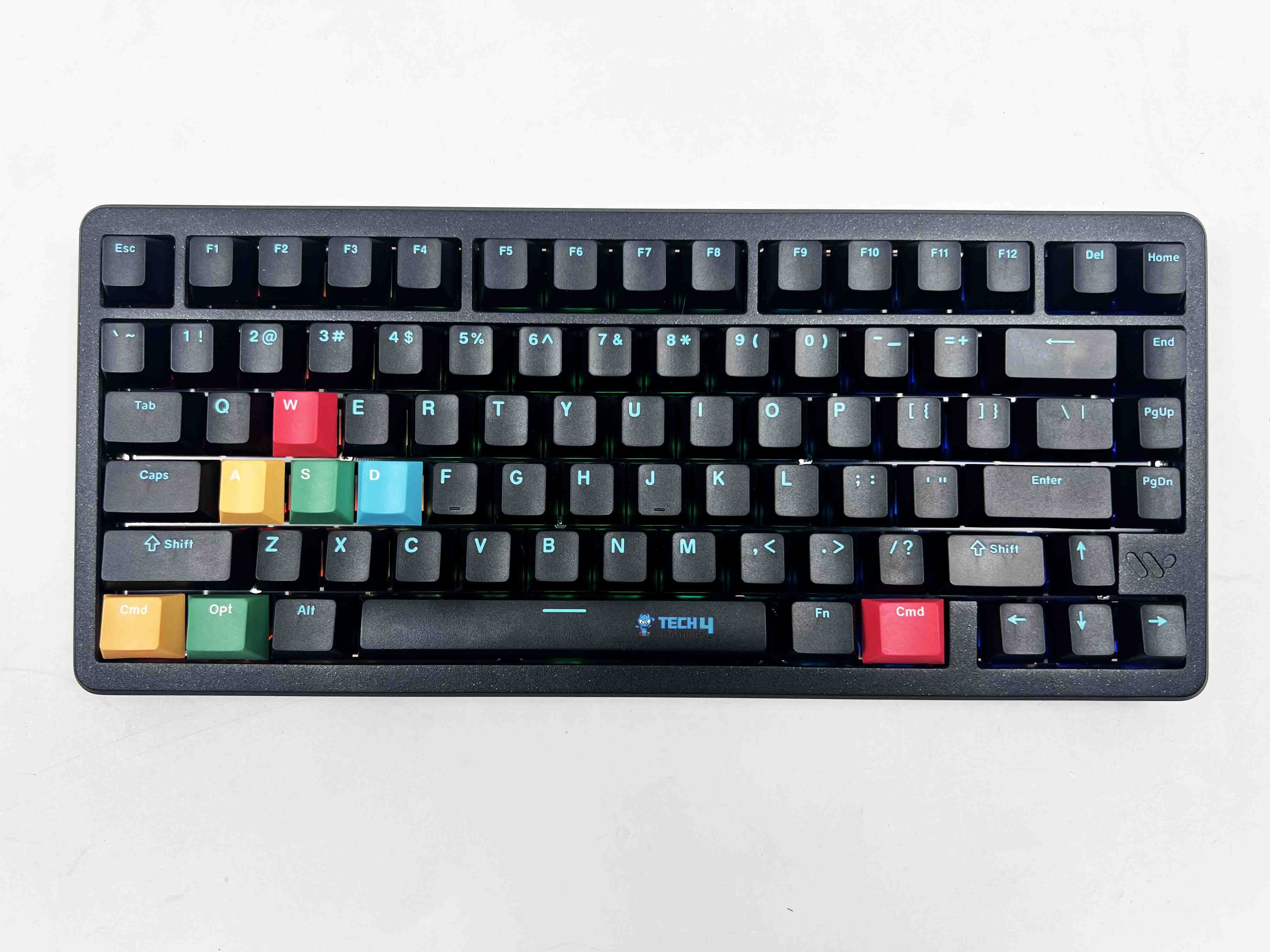
The keycaps on the Womier SK75 TMR use a Cherry profile, providing a comfortable, slightly sculpted typing feel that most users would be familiar with if they are used to high-end keyboards. The material used here is double-shot PBT, which makes them fade-resistant, oil-resistant, and durable. Additionally, the legends on them are light blue, which contrasts nicely with the black keycaps’ bodies.
That said, because the legends aren’t shine-through, their readability decreases when the lights are off or in a darker environment. While the light blue font is still somewhat visible, it’s not as clear as it is under good lighting, which is something to keep in mind if you often type in low-light conditions. Lastly, it includes extra colorful keycaps for the WASD cluster and the Mac Option and CMD keys. I think swapping these adds a bit of color to the otherwise all-black keyboard.
RGB Lighting
RGB Lighting
1 of 2
RGB Lighting
RGB Lighting in a Dark Environment
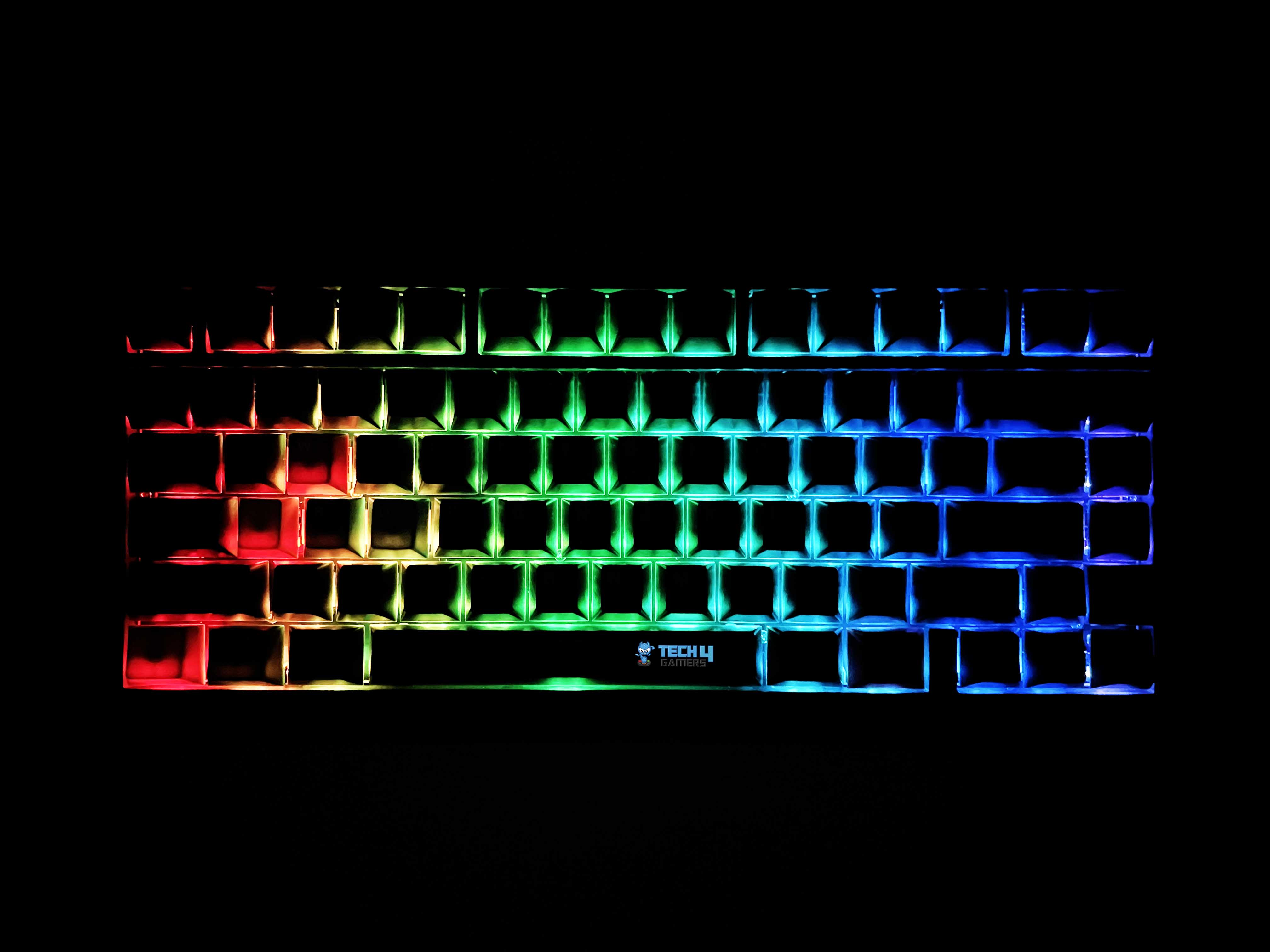
The Womier SK75 TMR provides a dynamic RGB lighting experience that feels vibrant. It is bright and evenly spread, which really enhances its all-black aesthetic. Even though the keycap legends aren’t shine-through, the overall glow from underneath the keys still looks great. The way the light bounces off the keyboard’s surface makes it stand out in darker setups without feeling too flashy. Moreover, the south-facing LEDs make a noticeable difference.
Instead of spilling light awkwardly upwards, the lighting gently flows toward the user, creating a more balanced look on the desk. Out of the box, you get over 20 built-in lighting effects, all easily switchable through Fn combination keys, so you don’t need to rely on software. There’s a good variety to play around with. If you want to take things further, the companion software gives you deeper control, which I’ll cover in detail later.
Switches
Switches
1 of 2
Void Magnetic Switches
Switch Housing
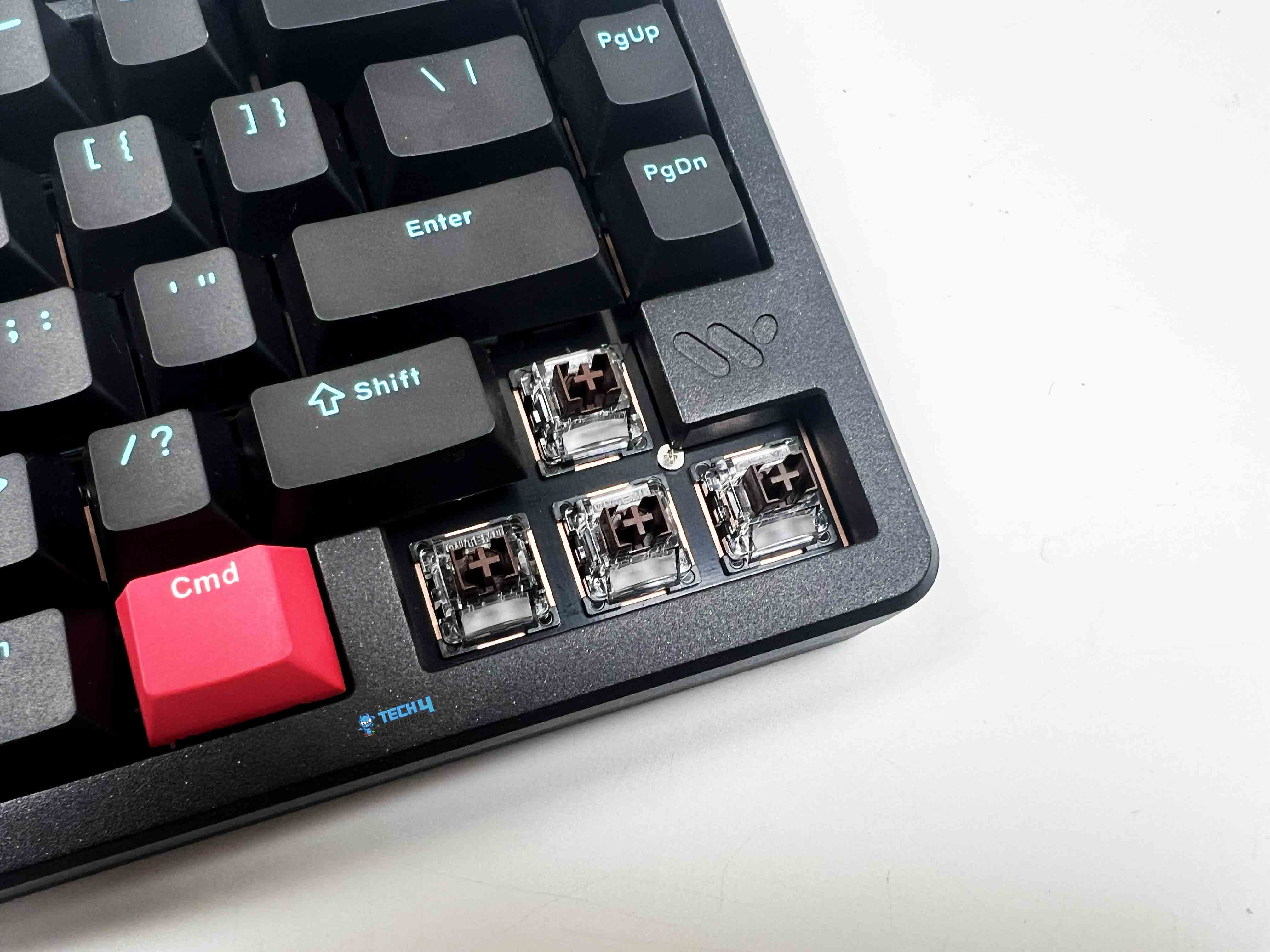
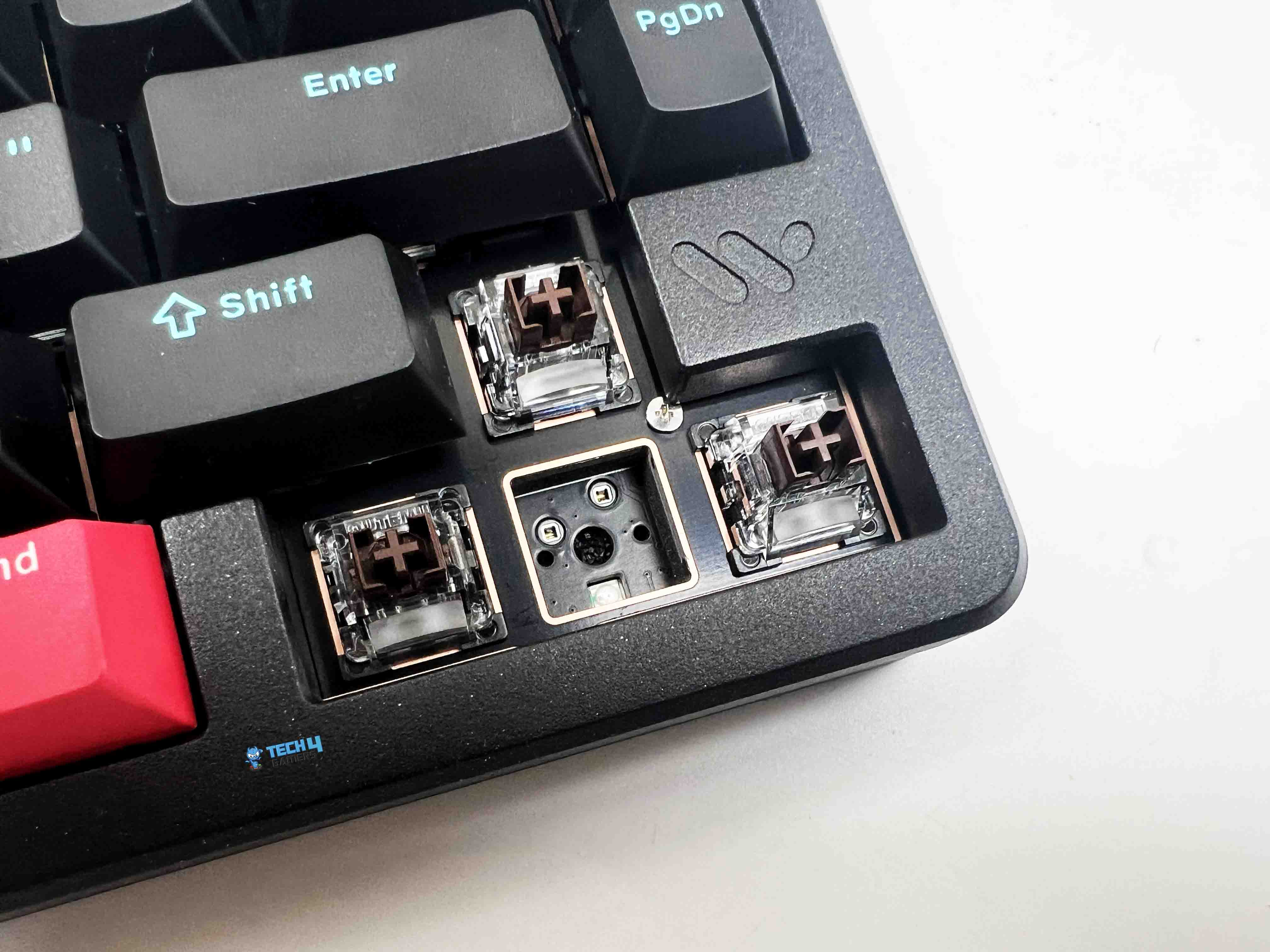
The Womier SK75 TMR uses Outemu Tea Magnetic Switches. Each switch uses a full POM stem and housing, which delivers buttery-smooth keypress travel and a pleasantly soft bottom-out sound. Working in tandem with Womier’s TMR sensor system, these switches detect actuation through magnetic flux rather than physical contact, eliminating debounce delay entirely. That’s what makes them feel so instant and consistent, especially during rapid inputs. Womier also included an integrated LED diffuser inside each switch.
It helps the RGB lighting appear more even and vibrant across the keyboard. In terms of performance, the switches feature adjustable actuation from 0.1mm to 3.5mm with 0.01mm precision. An important update worth pointing out is that Womier has officially transitioned to its new Void Magnetic Switches. Starting with units shipped from November 3, 2025 onward, the keyboard no longer comes with the older Outemu Tea Magnetic Switches. Another outstanding feature is the Mag-Mech Hybrid Hot-Swap design.
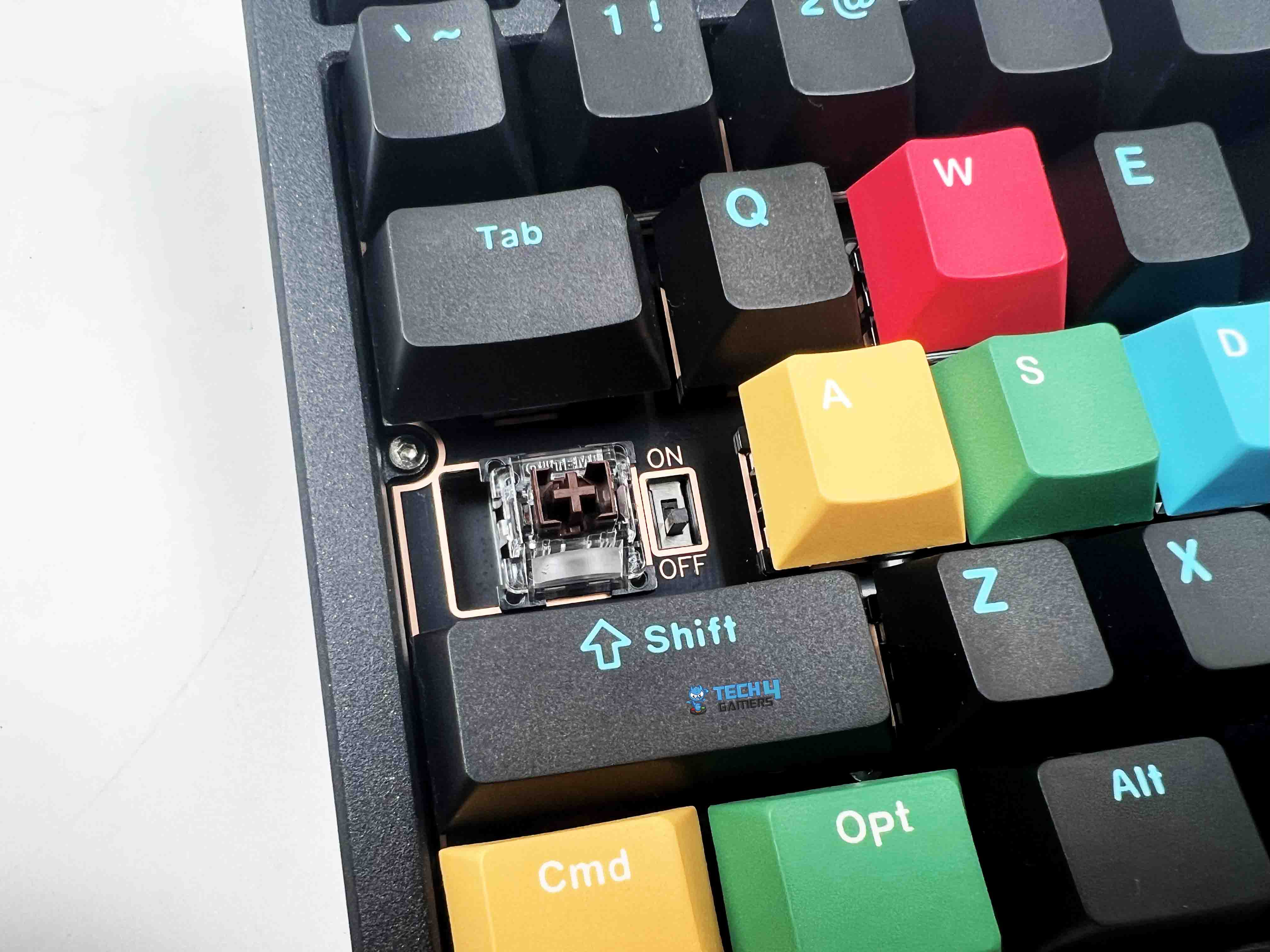
The PCB supports both magnetic and standard 3/5 pin mechanical switches, so you’re not limited to one or the other. For instance, you can set up a hybrid layout with magnetic switches on your WASD cluster for gaming, and your favorite mechanical switches on the rest for a more tactile typing experience. Lastly, the software makes it easy to calibrate most mainstream magnetic switches. If you want to explore other keyboards with similar rapid-trigger or magnetic switch features, our list of the best magnetic gaming keyboards might help you.
Connectivity
Connectivity
1 of 3
Interface
USB Cable and Dongle
Toggle Switch
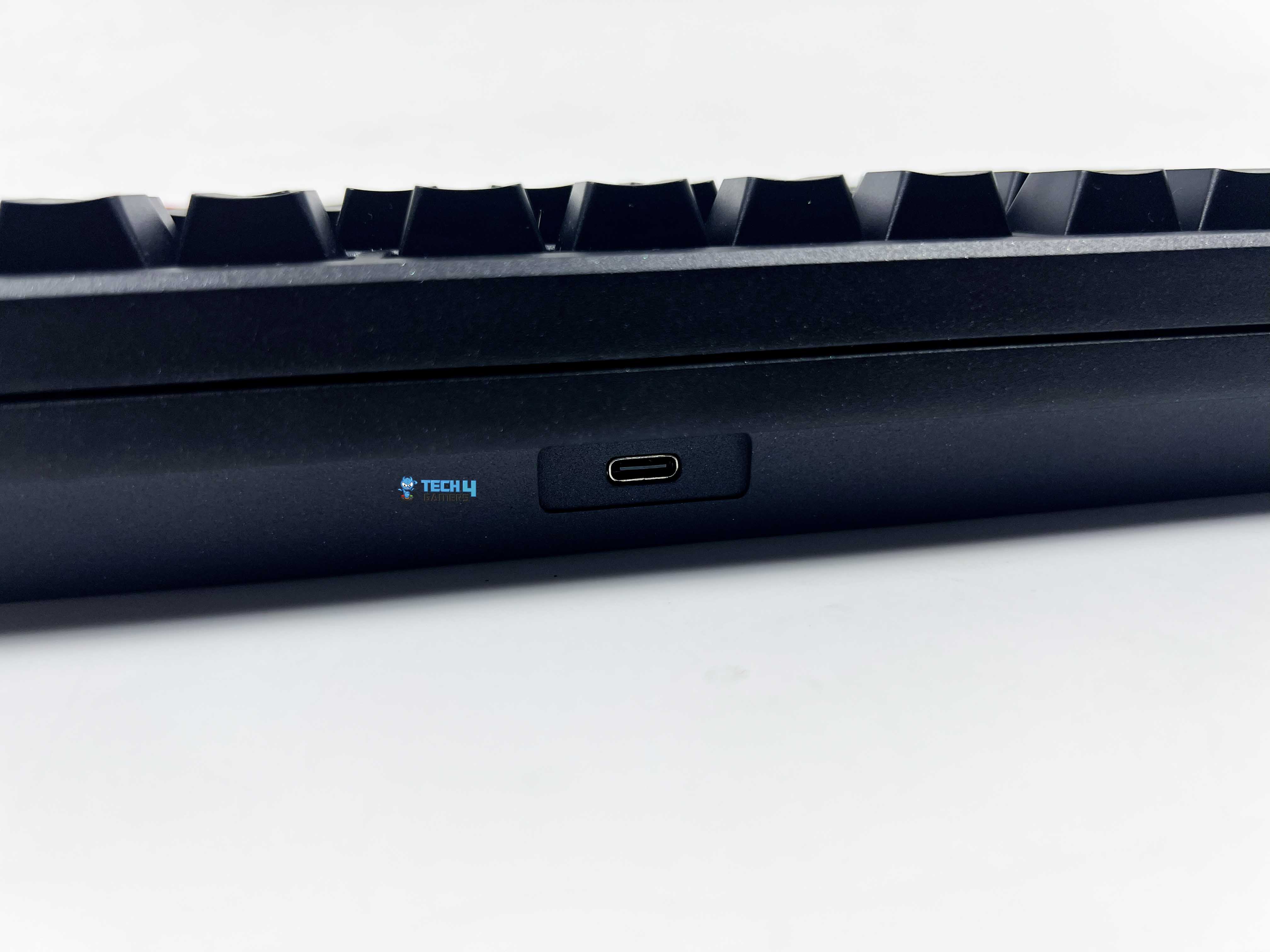
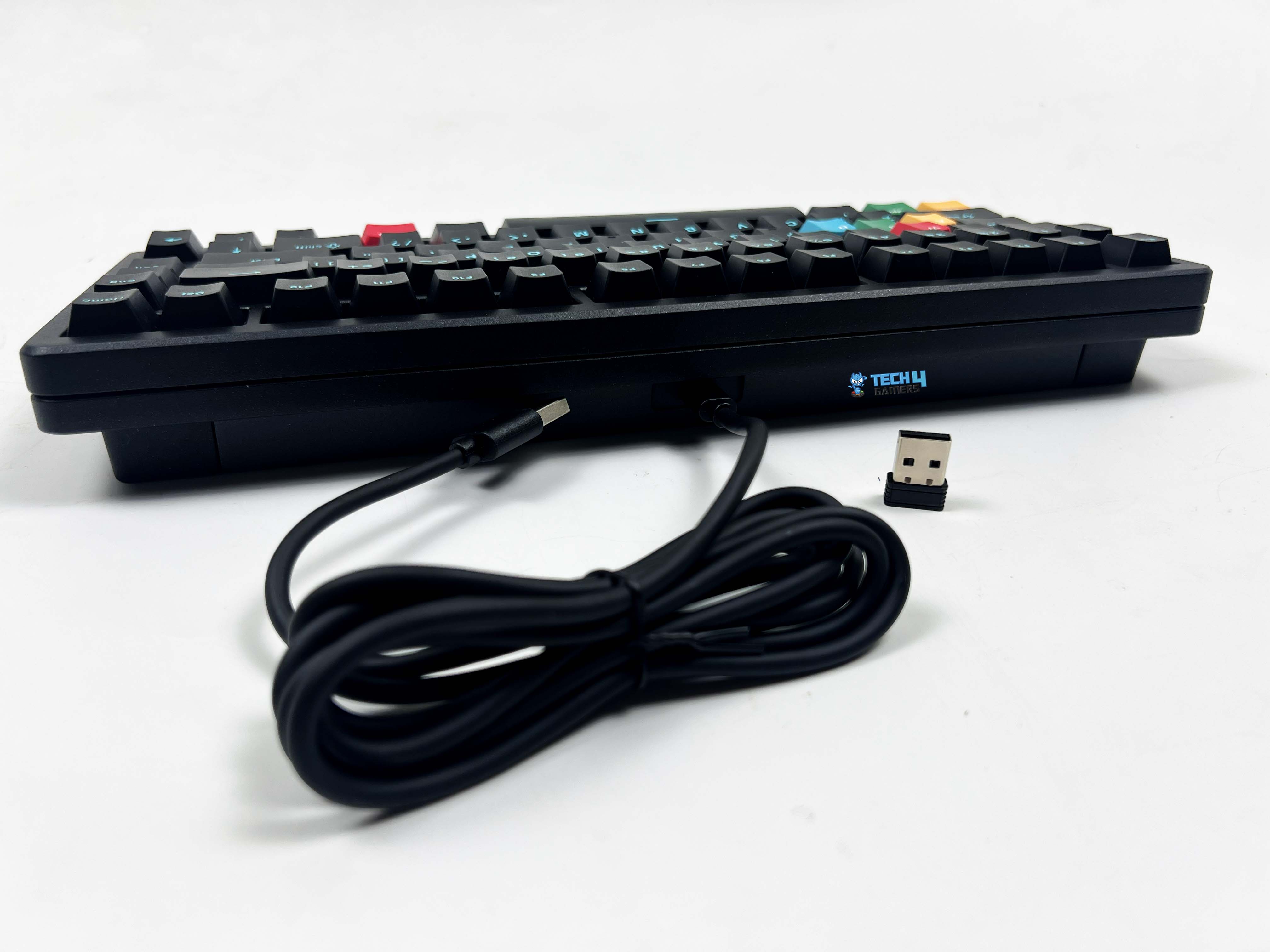
The Womier SK75 TMR offers tri-mode connectivity, giving you the flexibility to use it however you prefer, whether that’s through wired USB-C, Bluetooth 5.0, or 2.4GHz wireless. Switching between these modes is seamless, making it easy to switch devices with simple key combinations. The USB Type-C port is conveniently placed at the center of the top edge. When it comes to compatibility, the keyboard works with both Windows and macOS, and pairing it is straightforward once you get used to the function shortcuts.
To use it in Bluetooth mode, flip the switch under the Caps Lock key to the on position, then press and hold FN + Q/W/E for 3 seconds. Similarly, for 2.4 GHz Wireless Mode, toggle the switch under the Caps Lock key, then hold FN + R for 3 seconds. The “R” key will blink green rapidly, plug in the receiver, and the keyboard will automatically connect. Lastly, plug in the cable, then press FN + T to activate wired mode.
Battery Life
The Womier SK75 TMR features an 8000 mAh battery. I was able to use it for over a week on 2.4GHz wireless mode with moderate RGB brightness before it needed a recharge. In wireless mode, the keyboard has smart sleep and backlight management. If there’s no activity for 2 minutes, the backlight turns off automatically, but pressing a key brings it back instantly. Similarly, if it sits idle for 30 minutes, the keyboard goes into full sleep mode to conserve power. You can wake it up with any key press, and it automatically reconnects the keyboard.
Moreover, battery management is intuitive. To check the charge, press FN + Backspace, and the number keys (1–0) display the battery percentage. For example, 1–4 shows below 40%, 5–6 indicates below 60%, and 8–0 indicates above 80%. Furthermore, the keyboard alerts you when the battery is low. When the ESC key slowly flashes red, you’ll know it’s time to plug it in. Once fully charged, the ESC key blinks green five times, signaling that you’re good to go. It took about 3 hours to go from low battery to full.
Typing Experience
Typing on the Womier SK75 TMR is a really satisfying experience, and a big part of that comes from its layered internal dampening system. Inside the keyboard, multiple layers such as Poron plate foam, PET acoustic film, IXPE switch pads, EPDM case foam, and an FR4 plate all work together to deliver a consistent, cushioned feel with a deeper, more even sound profile. Each keystroke has a poppy, smooth feel, without any hollow or echoing noise. There’s absolutely no pinging or resonance, and it’s pleasant to type on for long sessions.
The keyboard also uses a top-mounted structure with a non-flex FR4 plate and a 1.6mm FR4 PCB, which adds stability and makes each keypress feel solid, with no wobble. Moreover, stabilizers also come pre-lubed from the factory, which means larger keys like Enter, Space, and Backspace feel stable without mushiness or rattling. In addition, the combination of plate, mount, and foam layers produces a pleasant typing experience that’s surprisingly well-damped.
Performance
Edges
The Womier SK75 TMR uses next-gen TMR (Tunneling Magnetoresistance) magnetic sensing technology, which enables it to register every keystroke with ultra-fast response time. In practical terms, that means a zero dead zone, 0.125ms reaction time, and a full 8000Hz polling rate. While many magnetic keyboards drop their polling rate in wireless mode, the SK75 TMR maintains the same 8000Hz rate over 2.4GHz, meaning your inputs are just as fast when you’re using a wired connection.
For fast-paced gaming, this consistency is a huge advantage when there is no lag or slowdown. The Rapid Trigger functionality also helps, letting keys reset quickly for repeated presses without sacrificing feel. Combined with the TMR sensors, this setup provides highly precise actuation starting at 0.1mm, so even subtle presses register accurately. Compared to standard Hall Effect sensors, these switches are more stable over time and far less prone to signal drift or fluctuation.
Software
Software
1 of 6
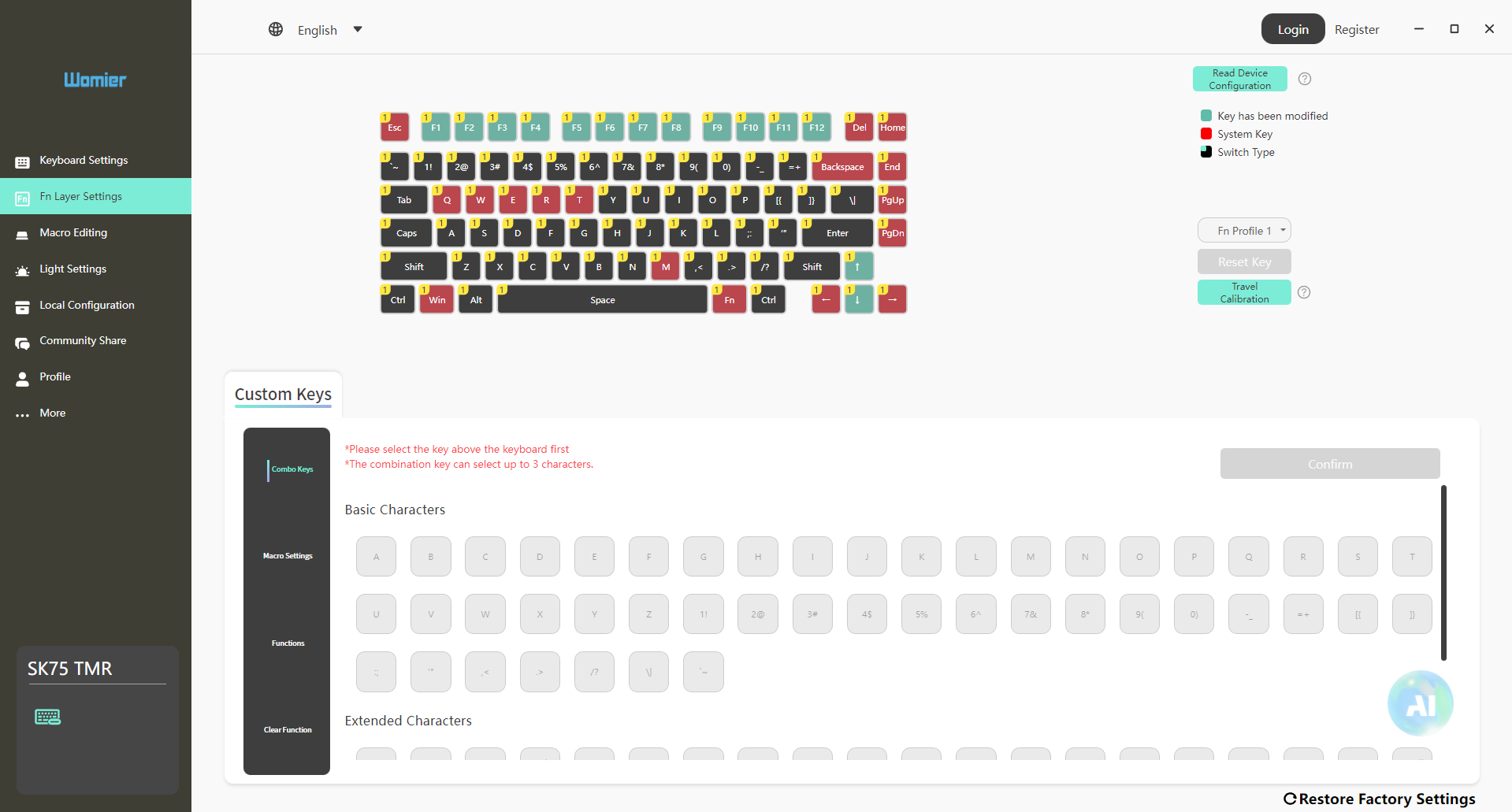
Keyboard Settings
Fn Layer Settings
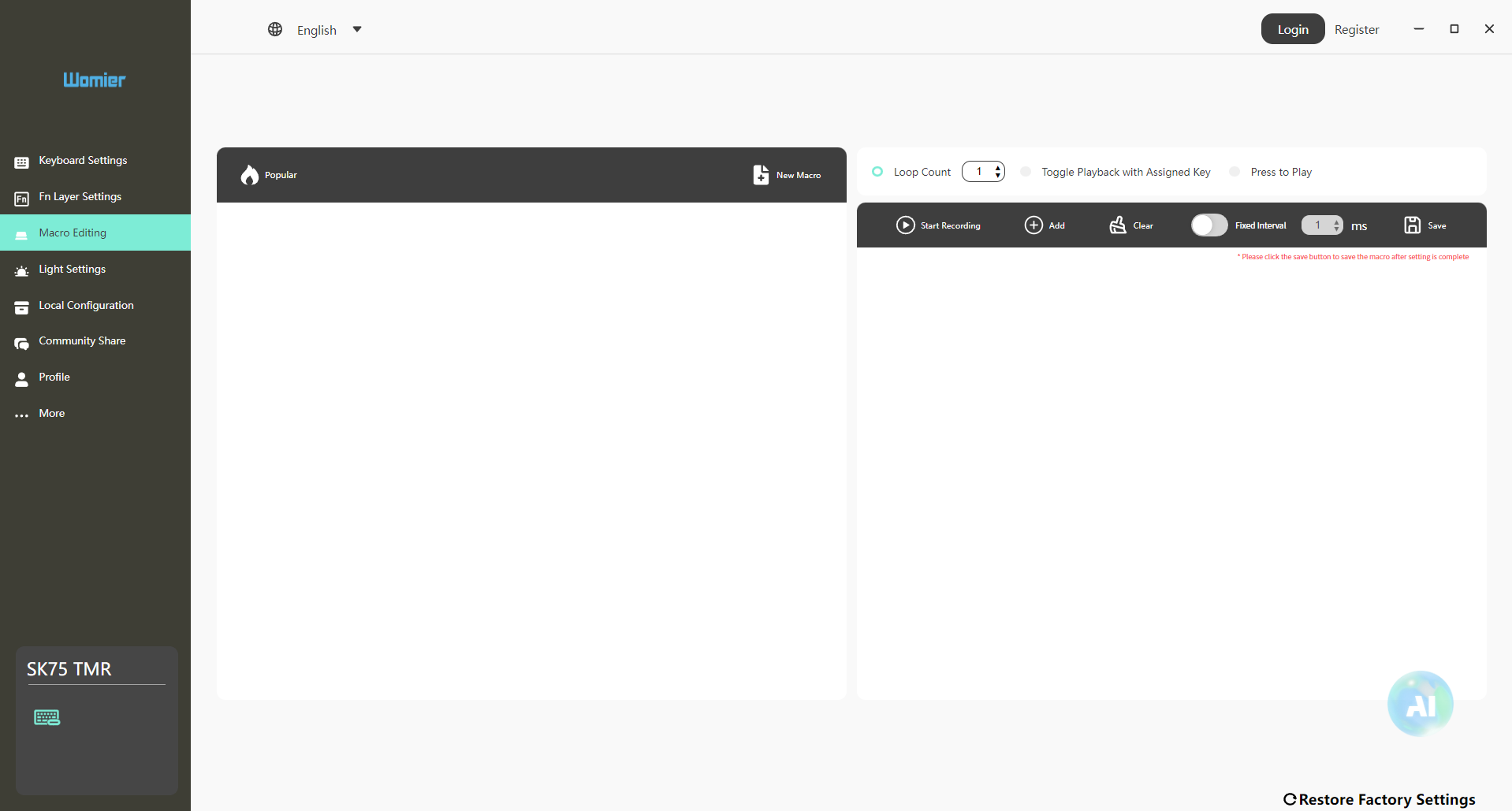
Macro Editing
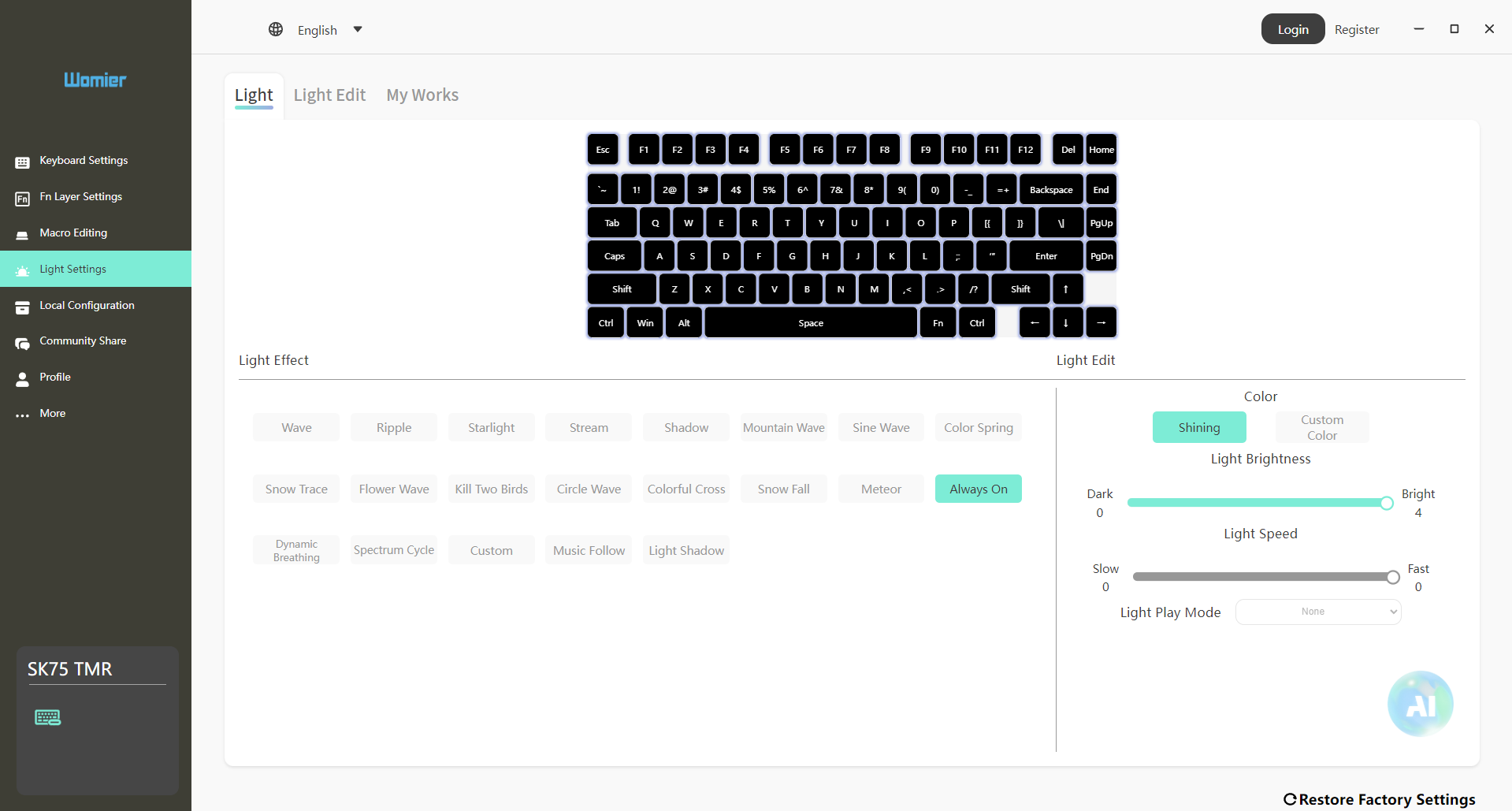
Light Settings
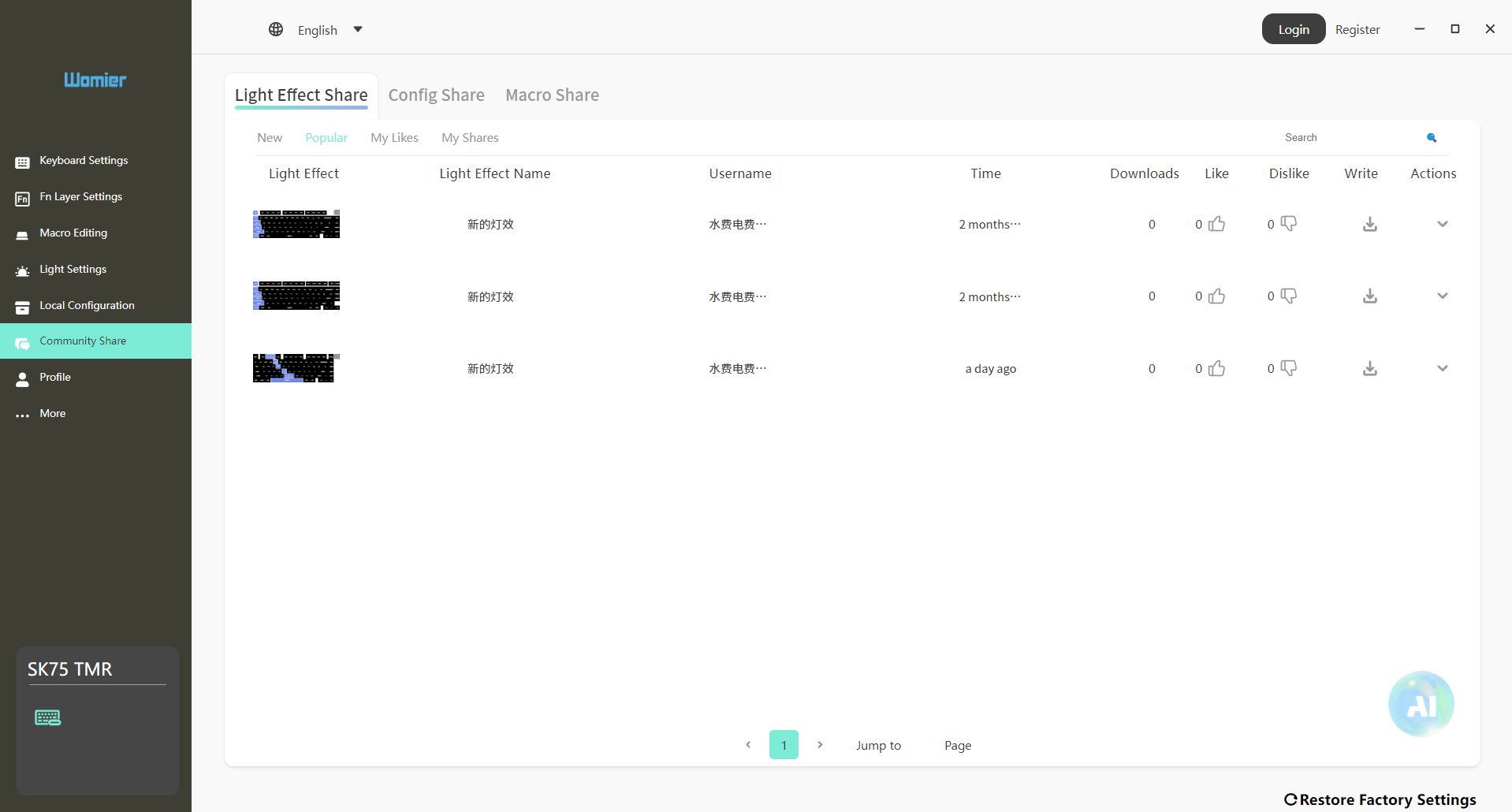
Community Share
More
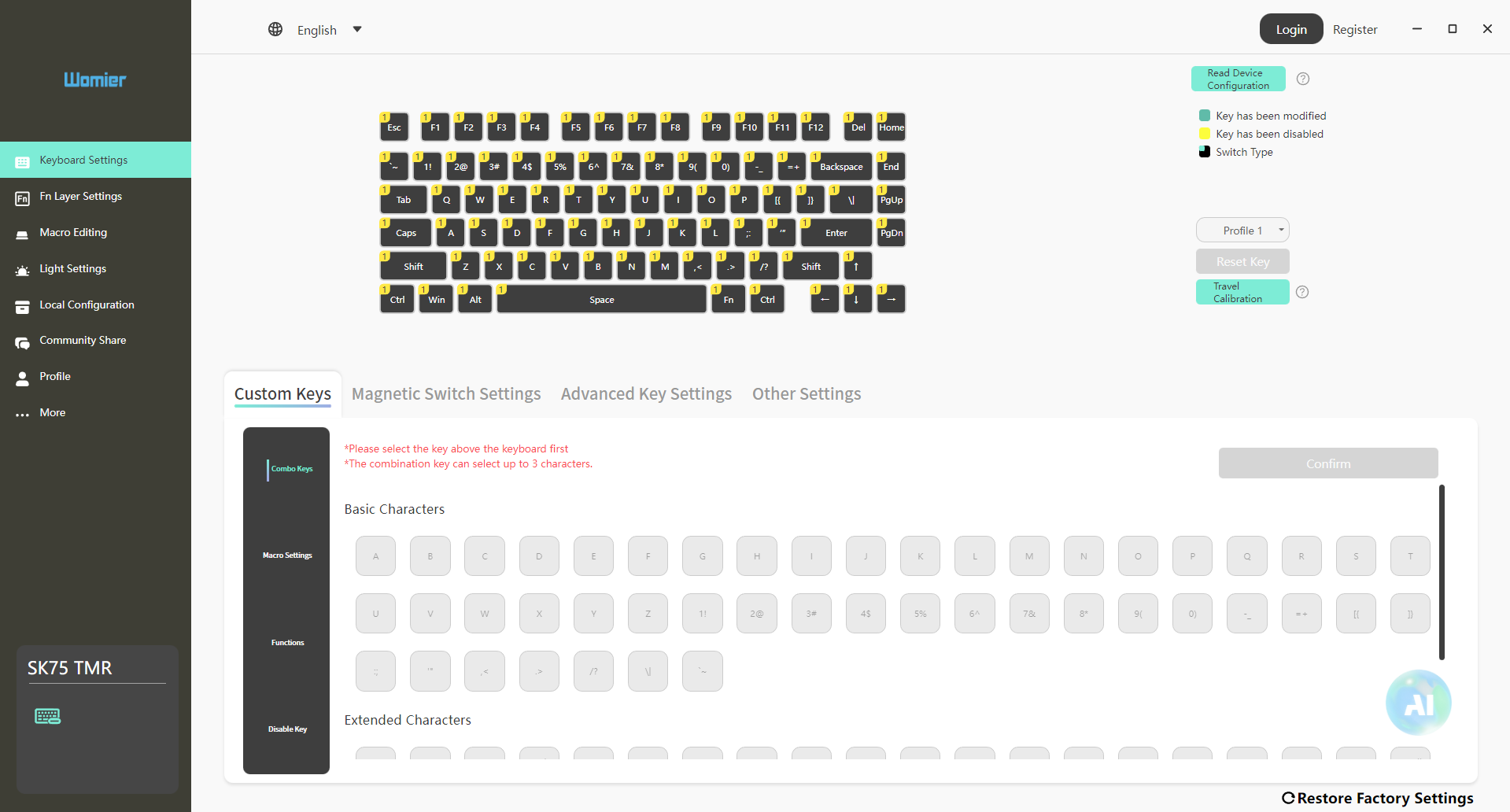
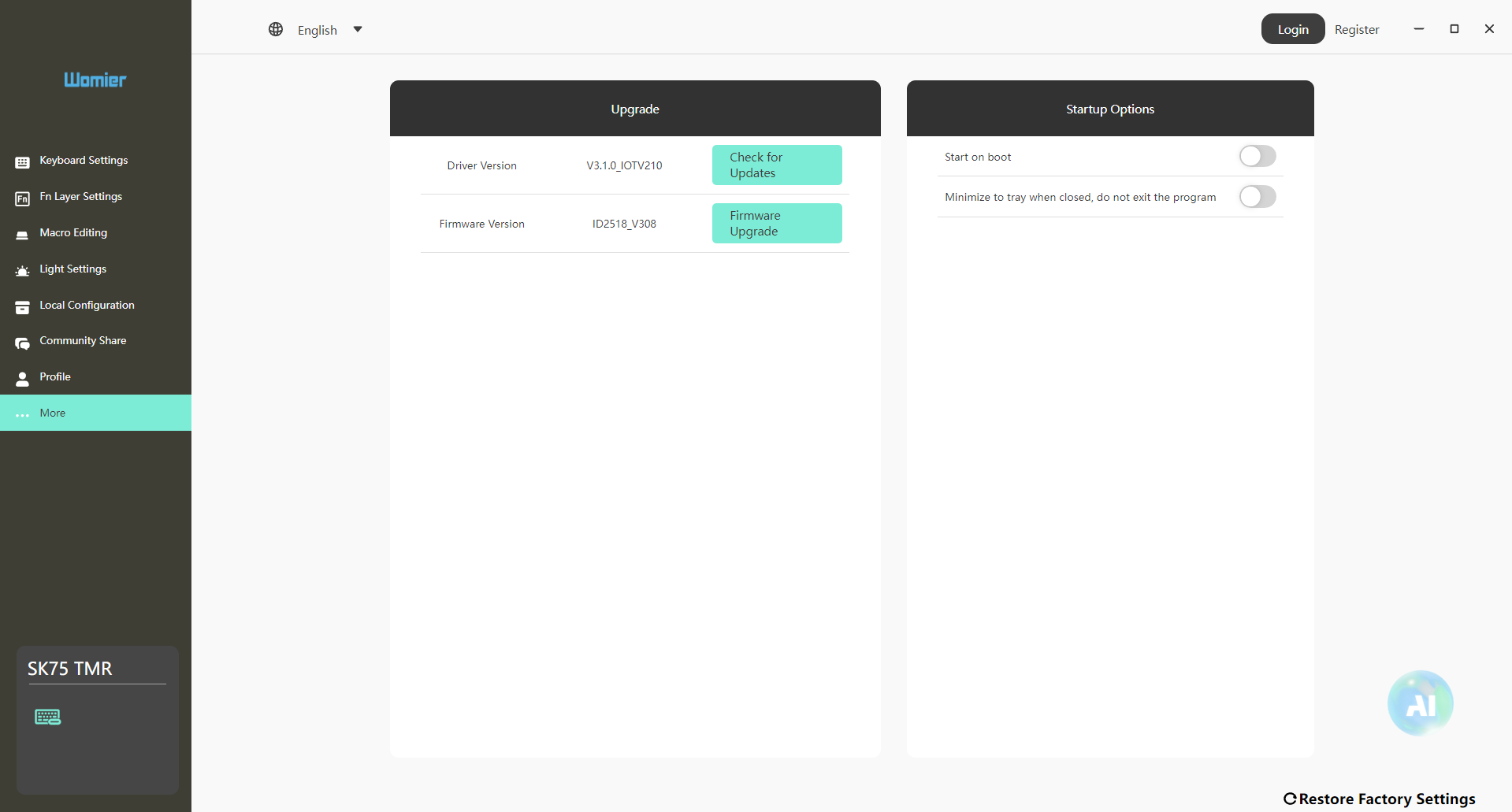
The Womier SK75 TMR comes with a companion software that you can download directly from the product’s official page, which lets you unlock the keyboard’s full potential. While basic RGB lighting and some basic functions can be performed via keyboard key combinations, the software takes things much further. For starters, you can customize the RGB lighting far beyond the built-in effects. You can adjust brightness, speed, and even create your own layered or reactive lighting profiles.
The software also gives you complete control over the magnetic switches. You can calibrate actuation distance, tweak sensitivity, and manage hybrid setups with mechanical and magnetic switches. On top of that, it supports advanced per-key customization, including features like Rapid Trigger, DKS, Toggle Keys, Multi-Trigger, and Snap Key. This means you can remap keys, assign secondary actions to deeper presses, or reset a key mid-actuation.
Should You Buy it?
Buy it if
✅ You want ultra-fast gaming performance: With next-gen TMR magnetic switches, zero dead zone, and a full 8000Hz polling rate, it makes it an excellent choice for competitive gamers.
✅ You value versatility and customization: With tri-mode connectivity (USB-C wired, Bluetooth 5.0, and 2.4GHz wireless) and a hybrid hot-swap PCB that supports both magnetic and mechanical switches, you can customize it to your preferences.
Don’t buy it if
❌ You need high portability: At around 2kg, it is on the heavier side and isn’t ideal for carrying around frequently.
❌ You prefer backlit shine-through keycaps: While the RGB lighting is vibrant, the legends are not shine-through, so readability in low-light conditions is somewhat limited.
Final Verdict
The Womier SK75 TMR impresses on almost every level. From its solid build quality and premium PBT keycaps to the next-gen TMR magnetic switches, it delivers a gaming and typing experience that feels both fast and satisfying. This keyboard is ideal for competitive gamers who need ultra-fast input and highly responsive keys, as well as casual users who switch between gaming and productivity. At $119.99, it’s hard to find a better value, and it fits nicely alongside keyboards featured in our best custom gaming keyboards roundup.
At Tech4Gamers, I contribute as a Senior News Reporter, combining my skills and gaming enthusiasm to keep our audience updated on the latest developments.
Story Highlight
The Black Ops 7 campaign is a complete disaster on every level possible.
It wastes returning characters like Raul Menendez, Frank Woods, and Alex Mason.
The gameplay also lacks the flair of past Call of Duty campaigns, presenting bland missions one after another.
Black Ops 7 is officially out in the wild, but things are not looking great for Activision after a record-breaking release last year. Even before release, the excitement for Call of Duty’s latest entry seemed unusually low compared to the likes of Battlefield 6 and Arc Raiders, and looking at the campaign, it’s not difficult to understand why.
Having finished the Black Ops 7 campaign recently, I don’t really know what to say about the series’ future. Truth be told, my expectations were already low going into the series’ latest single-player offering, and it was largely the connection to the Black Ops 2 narrative that pulled me in to begin with.
Ultimately, I feel like Black Ops has become a parody of its former self, at least in the campaign department.
Why it matters: The Black Ops series was famous for its mind-bending and psychological campaigns that retained the grounded elements from Infinity Ward’s Modern Warfare series. Unfortunately, the series’ latest entry lacks both the writing nuance and gameplay charm of past Black Ops titles.
Hallucinations And More Hallucinations
No Black Ops story would be complete without some kind of psychological twist at play.
In this regard, Black Ops 7 follows its predecessors closely, but where the original Black Ops presented an excellent blend of twists and turns carefully crafted to keep players on the edge of their seats after each new reveal, Black Ops 7 treats its psychological elements as nothing more than gameplay gimmicks.
This problem was already apparent in Black Ops 6 when the game devolved into a weird mix of sci-fi and fantasy elements at certain points, but Black Ops 7 goes all-in on this direction.
I can’t explain how awkward it felt to fight zombies in the campaign one after another. Just as I was beginning to come to terms with the story’s overall tone, it threw a zombified Frank Woods boss fight at me.
Later on, Harper, another returning character from Black Ops 2, turned into a giant zombie boss akin to a raid boss from Destiny. If this doesn’t make it clear that the Black Ops IP has run its course, I don’t know what will.
Fans Are Tired of Call of Duty’s Antics | Image via Twitter
Gone is the incredible storytelling from the original Black Ops, replaced by a series of gimmicks. Although the original campaign always made it clear that Alex Mason was hallucinating to an extent, within the espionage-style campaign was woven an element of mystery that slowly unraveled throughout the course of the story.
This sense of the unknown was what made Alex Mason’s story so memorable, and characters like Reznov and Hudson added a layer of depth to the experience that Black Ops 7 simply can’t match. On the contrary, Black Ops 7 relies on hallucinations so much that the psychological part of the experience quickly loses its appeal.
For starters, Raul Menendez, whom I consider one of Call of Duty’s best villains ever, is reduced to nothing more than a propaganda piece in this campaign. In fact, we fight a zombified Raul Menendez as part of a hallucination sequence, showcasing just how low the series has fallen.
This version of Menendez completely lacks the intricacies that made his character so interesting in 2012. Instead, we get to see him teleporting all around the battlefield during a wacky boss fight while hurling giant machetes at him, this being a comically poor attempt at referencing Menendez’s intense backstory from Black Ops 2, where he sliced foes with a machete in a fit of rage and eventually lost his sister.
Even Die-Hard COD Fans Admit The Campaign Is A Disaster | Image via Twitter
Later, the game wastes Frank Woods in a similar manner and retreads part of his flashbacks from Black Ops 2, going over how he was manipulated into killing Alex Mason. To nobody’s surprise, this version of the reveal completely lacks the emotional punch expected of such a pivotal moment.
Even David Mason’s character seems to have regressed in the 10 years since Black Ops 2, somehow struggling to come to terms with events already resolved a decade ago.
Unification of Campaign, Multiplayer, And Zombies
Many Campaign Missions Feel Like Glorified Warzone/Multiplayer Crossovers
Perhaps the final nail in this campaign’s coffin is the fact that it plays all too much like the other parts of Call of Duty. The last things I want to see in a Call of Duty campaign are XP pop-ups and zombies, but here we are.
As mentioned earlier, the game presents giant boss fights that would be far more appropriate in zombies. If this wasn’t bad enough, multiplayer maps from 2012, like Hijacked, are rehashed as locations for campaign missions.
Somehow, Black Ops 7 also foregoes Call of Duty’s signature, over-the-top action set-pieces. I get that these sequences aren’t the most interesting after 15 years, but they are still vital to the series’ overall identity and genuinely enjoyable when done right. For some reason, Black Ops 7 trades this part of the campaign for uninspired shooting galleries and open-world-style missions.
To highlight just how bad the situation is, Black Ops 7’s co-op features conflict with the solo campaign experience. When played offline, the campaign fails to spawn in NPC companions onto the battlefield, all while they carry out conversations like they are right next to the player.
One could say that this element furthers the themes of hallucination and doubt in Black Ops 7’s campaign, but I don’t think the game’s writing deserves enough credit to look at this as anything but a technical problem.
In the aftermath, Black Ops 7’s campaign makes it clear that Activision’s teams are out of ideas. Now, more than ever, it’s clear that the developers are at their limits, and franchise fatigue has set in.
If the Modern Warfare 3 campaign was downright bad, and Black Ops 3’s story was a jumbled mess of interesting sci-fi ideas, Black Ops 7 is a new low for the series that combines the worst parts of the two.
In my opinion, it’s finally time to lay the Black Ops brand to rest. The series has had its ups and downs, but Treyarch should finally move on to something new and fresh, even if it means leaving behind the memorable stories and characters that we all love and grew up with.