
Home Blog Page 108

Gaming on Starlink vs Fiber: What You’re Really Getting

Story Highlights
  • Starlink can make online gaming accessible in areas with limited or no wired internet connection.
  • The connection speed of Starlink may fluctuate in uncertain conditions.
  • Fiber delivers consistent low-latency gaming and stability, making it the prime choice for competitive gaming scenes.

Gaming online has always been more about stability than sheer download speeds. As multiplayer gaming becomes more competitive, the link between your internet and your system may become the deciding factor between winning and losing. This connection decides whether your gaming experience will be smooth or frustrating, and thus has great importance in competitive gaming. 

With Starlink promising high-speed satellite internet and Fiber being the prime choice in wired internet options, gamers are now comparing the two. In this article, we will compare both technologies and determine which one works better for online gaming.

Two Very Different Technologies

Starlink and Fiber both solve the same issue of providing high-speed internet, but in different ways. Starlink utilises low-orbit satellites that are ever-growing in number. These satellites beam data between your dish antenna and space, then route it back to terrestrial networks. 

This approach represents an improvement over the traditional concept of distant geostationary satellites, which suffered from lag. By utilising satellites that orbit much closer to Earth, signal travel time is reduced enough to make modern gaming possible.

Space X's Starlink
Space X’s Starlink – Image Credits (Earth.com)

On the other hand, Fiber keeps it all grounded. In this technology, data travels as light through fiber-optic cables. These cables are either laid underground or along utility routes, connecting your system to local or international networks. As data travels through a set path in Fiber there is less atmospheric interference that can affect data travel. 

It’s Not All About Speed

When discussing Starlink vs Fiber, Starlink provides impressive speeds considering it is a satellite service. Download speeds on this internet technology are fast enough to handle modern game installations, large updates and background downloads without causing many issues. Upload speeds in this technology are modest, supporting basic voice chat and streaming. Additionally, players who were previously on slow DSL or high-traffic wireless broadband feel a significant change when moving to Starlink. 

Fiber, however, is in a different league. Many Fiber connections offer symmetrical download and upload speeds. Cloud gaming, live streaming, and real-time data exchange with servers all benefit from high upload speeds. Gaming itself does not require a massive bandwidth, but the extra capacity of Fiber ensures that gaming remains stable throughout the gamer’s session.

The Difference In Latency 

When it comes to gaming, latency is the most important aspect, and it is where the difference between Starlink and Fiber becomes clear as day. Starlink’s low orbit design allows it to achieve latency levels that are acceptable for most games. If you are a casual gamer, then this technology won’t cause many problems. However, you cannot demand too much from this technology as latency is present, and system interference also exists, causing packet loss and bad Wi-Fi.

Fiber Optic Internet
Fiber Optic Internet Cable – Image Credits (Pinterest)

Fiber, however, delivers a consistent low-latency connection. As data doesn’t have to travel to space and back, the response times are much better and more predictable. In FPS, Competitive gaming showcases itself as smoother movement and faster hit recognition. When playing on a Fiber connection, the game feels less out of sync with player input than it does on Starlink.

Consistency Matters a Lot

When speaking about consistency, Starlink falls short because its biggest challenge is variability. The technology is not consistent; satellite handoffs, network congestion, and environmental factors can cause high latency. On the other hand, Fiber minimizes these fluctuations. Data travel in Fiber technology is not affected by interference caused by weather or other factors, meaning the signal is smooth and consistent, making it the prime choice for competitive gaming.

How They Feel In Real Gameplay

For many players, Starlink offers an experience that would have been unimaginable a few years back. In rural and underserved areas, it serves as the first time that online gaming feels viable. Games load quickly, and latency is good enough to support basic gaming. For casual gamers, this level of performance is more than sufficient.

Starlink System
Elon Musk’s Starlink System – Image Credits (Cyberhoot)

Fiber, however, is superior in the sense that they provide latency free connections. In comparison, Fiber users experience many fewer compromises compared to Starlink. Long gaming sessions are much more stable and predictable. Packet loss is also minimised to high levels, something that Starlink is not capable of. This reliability has become very important as many gamers now demand constant performance.

Final Thoughts

When it comes to choosing between Starlink and Fiber, the decision ultimately boils down to what compromises you are willing to make. Fiber is undoubtedly superior in areas where it is accessible, but Starlink provides accessibility in remote and rural areas where services are lacking, making gaming possible. In the right context, both are equally good but serve completely different gaming realities.

Starfield Might Get ‘Cyberpunk 2077 2.0 Style’ Update and PS5/Switch 2 Launch in 2026

Story Highlight
  • Starfield is rumored to be getting a huge update, much like Cyberpunk 2077’s 2.0.
  • Bethesda recently had a secret Starfield showcase showcasing its future content.
  • Expectations from the game were high when it launched, but it failed to deliver.

When Starfield was first announced, there was a lot of hype around it as it was a great idea and one full of potential. The title finally came out in 2023 and was mostly disappointing, and was overall a dull and flat experience. 

Bethesda is still committed to the IP, as new reports suggest that Starfield could get its own ‘Cyberpunk 2077 2.0’ like update and launch of PlayStation 5 and Nintendo Switch 2 in 2026, marking a comeback.

Why it matters: Expectations from Starfield were through the roof, and it was even being marketed as one of Xbox’s biggest games in years; however, the final product was quite underwhelming to say the least. 

Starfield update
Starfield is rumored to be getting a massive 2.0 update in 2026

JuiceHead on X revealed that they, along with a few other people, were recently invited by Bethesda to see Starfield’s future content. While they haven’t revealed anything else, these could be an important few months for the RPG. 

Window Central has corroborated the report about the behind-the-closed-doors showcase and given an insight into what to expect. For starters, there is a new rumored DLC along with more new content and QoL updates.

Starfield DLC Featured
Starfield was supposed to be Xbox’s biggest game in years, but it couldn’t deliver

The space travel will now get rid of loading screens, leading to seamless travel among planets and a much-improved exploration and open-world space system. They have updated the Creation Engine to help with this. 

Moreover, PS5 and even Nintendo Switch 2 ports are also expected to arrive in 2026. All in all, this could finally be the big turning point Bethesda has been expecting from Starfield, even since the release of its DLC

What are your thoughts on Starfield getting a huge update and coming to PS5 and Switch 2? Let us know your opinions in the comments or join the discussion at the official Tech4Gamers Forum.

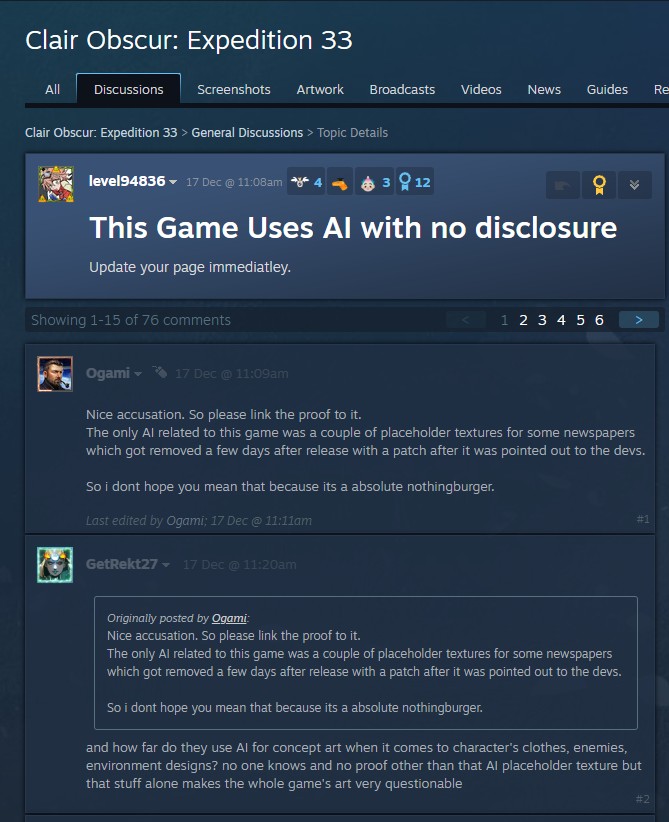
Expedition 33 Faces Scrutiny for Not Disclosing AI Use on Steam, Sparking Fan Debate and Potential Takedown

Story Highlight
  • Expedition 33 is facing backlash for using generative AI in development.
  • It did not disclose the use of AI on the Steam page, which led to a huge fan debate.
  • The AI assets were later patched out and replaced by custom-made ones.

The use of generative AI in game development has stirred a long debate. Some are totally fine with it, while others hold very extreme views. Even the GOTY winner, Expedition 33, was revealed to have used the tech in development. 

This has put the game under massive scrutiny as it didn’t initially disclose the use of AI in development. According to current Steam policies, if AI was used in the development of a title, it requires you to put a label.

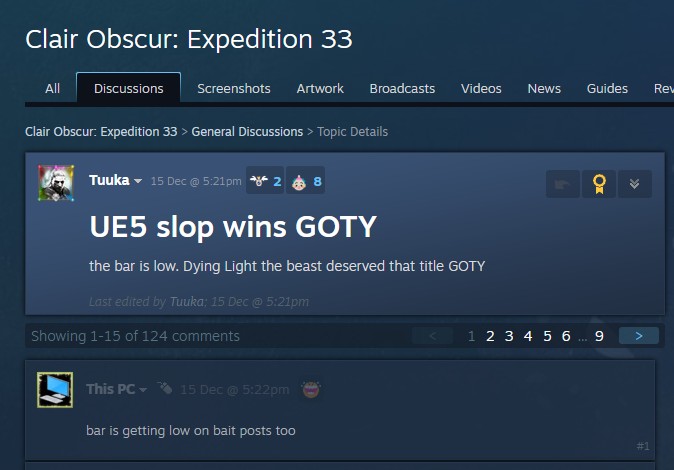
Why it matters: This new development has caused a massive uproar among gamers, with some accusing Expedition 33 of being AI-generated slop. This has intensified even more, considering it has won so many awards. 

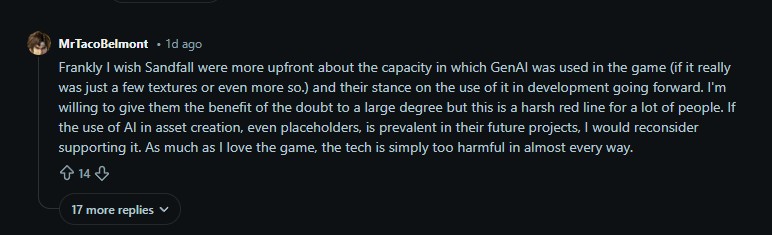
If we head over to the Steam Community and other forums, numerous people are criticizing the game for using generative AI to create some of its assets. The debate kicked off after Larian revealed they’re using the tech too. 

Now, in defense of Expedition 33, some assets were allegedly created using generative AI, which were later replaced with fully custom-made assets, but disclosure is always a good idea. 

Expedition 33 AI
Expedition 33 is facing serious scrutiny over its use of AI in development.

Using generative AI for some things is fine, but since Steam requires you to explicitly mention it on the game page, not mentioning it seems like a bad call, and it could even lead to a takedown.

However, nothing takes away the fact that Sandfall did an excellent job on Expedition 33. It became the most awarded game at The Game Awards ever, which led to a significant boost in sales as well.

What are your thoughts on Expedition 33 under scrutiny for using AI in development? Let us know your opinions in the comments or join the discussion at the official Tech4Gamers Forum.

Why Gamers Are a Prime Target for Data Brokers and Scammers

Story Highlight
  • Players use the same accounts for years, creating a lasting and easy-to-track digital history.
  • Brokers combine small details from various platforms to build a complete profile of a gamer’s identity.
  • Scammers use specific game context and timing to make fraudulent messages look authentic.

Gaming isn’t just about playing anymore. It’s about accounts, profiles, friend lists, stats, purchases, chats, and sometimes even an audience. For most of us, that all feels normal.

We log in, play a few matches, maybe jump on Discord, and move on. But from the outside, gamers look like one of the most trackable groups on the internet.

Gamers aren’t targeted because they’re reckless or naive. They’re targeted because they’re active, predictable, and easy to recognize across platforms. When you stack years of logins, usernames, and social connections together, you end up with a very clear digital trail.

And that trail is exactly what data brokers and scammers look for. Unfortunately, it’s just how the modern internet works.

Gaming Creates Long-Lasting Digital Footprints

Hackers Can Misuse Your Personal Data
Hackers will always misuse your data.

Most online activity is short-term. People sign up for a site, forget about it, and move on. Gaming doesn’t work like that.

Gamers often stick with the same accounts for years. A single player might regularly use a main platform account, several game publisher accounts, Discord, community forums, and maybe a streaming or video platform. Even third-party stat sites and leaderboard trackers get added into the mix.

Each platform collects a small piece of information. A username here, an email there, playtimes, regions, device types, and social connections. None of it feels risky on its own. The problem starts when all those pieces get linked together.

That’s where data aggregation comes in. When fragments from different places are combined, they paint a much clearer picture of who you are, what you play, when you’re active, and how reachable you might be.

Why Gamer Data Is So Useful

From a data collector’s point of view, gamers are extremely easy to categorize. Play habits can hint at age ranges, spending habits, schedules, and even lifestyle patterns. Someone who logs in nightly, buys in-game items regularly, and stays active in multiplayer spaces is far more predictable than the average internet user.

What makes gamers stand out is consistency. Accounts don’t disappear after a few months. Usernames stick around. Activity keeps coming back. That makes gamer profiles easier to maintain and update over time.

Once a profile exists, it doesn’t really expire. It just keeps growing.

Scams Feel Personal Because They Are

Connecting multiple services creates a “domino effect” where one hack compromises everything else.

Most gaming scams don’t rely on random guessing. They rely on context. If a scam message references the right game, the right platform, or even the right timing, it feels believable.

Fake warnings about account bans, messages pretending to be moderators, or offers involving in-game items all work better when they match what the player already expects.

That’s why so many gaming-related scams feel uncomfortably specific. They aren’t always guessing. They’re working from existing information that’s already out there.

Gaming accounts are especially tempting targets because they’re often connected. One compromised account can lead to access to email, friends lists, or other linked services. It creates a chain reaction that’s hard to undo once it starts.

For players who are more visible, things can escalate quickly. Streamers, competitive players, and community figures deal with a much thinner line between online and offline life.

Harassment campaigns often begin with information that’s already public or easily found through data listings. Names, phone numbers, and locations don’t magically appear. They’re usually pulled from databases that were never meant to protect the people they describe.

Gaming communities make this worse because identities overlap. A username leads to a stream. A stream leads to social media. Social media fills in the rest. Even players without big followings can become targets if the correct information is available.

Account Security Isn’t the Whole Solution

Strong passwords and extra login protection are important. No argument there. But they only protect access. They don’t erase information that’s already been collected elsewhere.

If someone already knows what you play, where you hang out online, and how to reach you, they don’t need to break into your account right away. They can wait, adjust their approach, and try again later.

The real issue isn’t just account safety. It’s how much personal information is floating around outside your control.

Reducing Exposure Matters

One of the few ways to lower risk is to shrink your digital footprint where possible. That doesn’t mean quitting games or disappearing from communities. It means being more deliberate.

You can use data removal services to target the source of exposure rather than the symptoms. Automated services like Incogni handle these requests at scale, submitting removals, tracking responses, and reissuing requests when data reappears.

Using separate emails for gaming, avoiding the same username everywhere, locking down public profiles, and keeping personal details off easily indexed sites all make a difference. These changes don’t stop every threat, but they make targeting harder and less accurate.

When attackers have worse information, their success rates drop. That alone is a win. 

Staying safe in gaming today isn’t just about protecting your accounts. It’s about limiting how much of your real-world identity leaks into places you don’t control.

You don’t need to disappear. You just need to stop being the easiest profile in the room.

Unreal Engine 5.7 Shows Massive Performance Improvements Over 5.4 In New Comparison

Story Highlight
  • Unreal Engine 5.7 shows notable performance improvements over 5.4 in both CPU and GPU-bound scenarios.
  • CPU improvements in the Venice Tech demo were as great as 35% with fewer hitches.
  • Meanwhile, GPU performance on an RTX 5080 increased by 25%, as 5.7 uses GPU resources more efficiently.

Ever since Unreal Engine 5.7 was revealed with the Witcher 4 tech demo, gamers have been curious to see all the improvements it brings. Epic Games also promised major fixes, including speed, stability, and better lighting, and it seems to be delivering on them. 

A new comparison between UE 5.7 and 5.4 shows huge improvements in both CPU- and GPU-bound scenarios. Image quality is much better. Version 5.7 delivers more stable Lumen lighting and better reflections, at a lower performance cost.

Why it matters: The comparisons show Epic Games is fixing the engine’s biggest hiccups. These improvements could enable AAA games to have better system requirements and improved visuals in the future. 

The comparison video shows both versions side-by-side on the Venice Tech Demo map. The GPU-bound scenario shows improvements of up to 25% on the RTX 5080 over 5.4, as the new UE5 version utilizes GPU resources more efficiently.

However, the GPU power draw is also higher, at 300W at native 1440p and up to 350W at native 4K in the 5.7 build. Meanwhile, the power draw in UE 5.4 never exceeded 300W.

GPU performance is improved by up to 25% in UE 5.7 (depending on a scene), and the 5.7 version is now better utilizing GPU resources.

-MxBenchmarkPC.

For the CPU-bound test, an Intel Core i7-14700F was used, with the resolution set to 720p and the power limit set to 90W to ensure the test was fully CPU-limited for 5.7. The testing revealed a stunning 35% performance boost compared to 5.4.

UE 5.7 also seems to resolve one of the biggest issues with UE5, as there were significantly fewer hitches or microstutters across all scenes. 

UE 5.7 offers a significant up to 35% CPU performance boost (depending on a scene) and more stable frametimes with less hitches across all scenes.

Unreal Engine 5.7 vs. 5.4 image quality comparison
UE 5.7 offers more stable and accurate Lumen lighting, including higher quality reflections | Image Source: MxBenchmarkPC.

The Unreal Engine 5.7 brings more consistent frame rates and gorgeous visuals, so the averages are much better. However, some spikes and 1% lows still need smoothing for the gaming engine to become the perfect choice for developers.

Do you think Unreal Engine 5.7 will resolve prominent performance issues? Let us know your thoughts in the comments below, or join the discussion on the Tech4Gamers forum.

Horizon Rip-Off Removed From Steam And EGS Following Sony-Tencent Lawsuit Settlement

Story Highlight
  • Sony and Tencent have reached a confidential settlement in their legal battle. 
  • Light of Motiram, the title in question, has been removed from Steam and the Epic Games Store.
  • Tencent also commented on the settlement, saying it is excited to work with Sony in the future.

Since the start of this summer, Sony and Tencent have been embroiled in a legal battle after Sony sued the Chinese company for allegedly copying its Horizon franchise and creating a clone video game titled Light of Motiram.

Tencent argued that Horizon’s premise is broad enough that Light of Motiram is not a copy of it. Still, Sony believed the game was a deliberate attempt to copy its intellectual property. However, the legal battle has ended abruptly as both parties have settled. 

Why it matters: Sony and Tencent are two of gaming’s biggest powerhouses, and a legal battle between the two benefits absolutely no one.

Sony Tencent
A look at the court document announcing the settlement between Sony and Tencent.

According to a new document filed on Wednesday, a confidential settlement has been made between Sony and Tencent, with all pending motions dismissed by the court. In simpler words, the legal battle is over, and the case has officially been thrown out.

Furthermore, Light of Motiram has also been removed from the Epic Games Store and Steam with immediate effect. The SteamDB page of the game now reads that this application has been retired and is no longer available on the store.

Similarly, the Epic Games Store link on the official Light of Motiram page also leads to nowhere and shows an error when you try to open it. Hence, the game has been wiped from online storefronts following the settlement between Sony and Tencent. 

Tencent commented on this settlement to The Verge, with head of communications Sean Durkin saying the company is glad to reach an agreement with Sony and is looking forward to working with the Japanese giant in the future.

Light of Motiram steamdb
The SteamDB entry for Light of Motiram shows that the application has been retired.

From this statement, it looks like the two gaming giants have agreed to collaborate to resolve this matter. Tencent did want to work on a Last of Us game before, so this theory is not out of the realm of imagination.

Do you think Tencent infringed on Horizon with Light of Motiram? Tell us in the comments below or head to the Tech4Gamers forum for discussion.

Hogwarts Legacy Has Sold 40 Million Units Despite Early Calls For Boycott

Story Highlight
  • Avalanche Software has confirmed that Hogwarts Legacy has surpassed 40 million units.
  • There were initial calls for a boycott, which didn’t work based on the current numbers.
  • A sequel has already been announced and is currently in active development.

In the previous years, the gaming industry saw a huge push towards live service games. While some of the recent titles were genuinely good, single-player games have absolutely dominated, and the demand remains as high as ever. 

This is pretty much apparent from Hogwarts Legacy, which has now surpassed a whopping 40 million units sold. This is even more impressive considering the title came out just over a couple of years ago. 

Why it matters: Avalanche Software has proved that the demand for single-player games will never die out as long as the developers continue to passionately and creatively invest in them as they did with Hogwarts Legacy. 

Hogwarts Legacy Sales
Hogwarts Legacy has surpassed a whopping 40 million units sold

The Harry Potter-based game became a topic of controversy when it was initially released. The creator, JK Rowling, has been involved in some transphobic comments, which led people to call for a boycott of Hogwarts Legacy. 

However, these numbers prove that the boycotts didn’t really work, and the game continued to sell well. It had sold 34 million units by March 2025, so this means that in the last 8 months, it sold an impressive 6 million more units. 

Hogwarts Legacy
The game proves that single-player games can still be a massive commercial success

Unfortunately, the studio was rumored to be working on a DLC, which was cancelled, but on the bright side, a sequel has already been confirmed. Though most will be curious to see what happens to it after the Netflix-WB deal falls in place.

Anyhow, if you still haven’t been able to give the title a go, it can be redeemed for free on the Epic Store for a limited time. The game has its weak sides, but it hits all the basics well and is, overall, a very enjoyable experience. 

What are your thoughts on Hogwarts Legacy selling 40 million units in a couple of years? Let us know your opinions in the comments or join the discussion at the official Tech4Gamers Forum

Nvidia To Cut GeForce GPU Supply By Nearly 50% In 2026, Sources Say

Story Highlight
  • Nvidia appears to be preparing to cut GeForce GPU supply by 30-40% during early 2026.
  • The RTX 5060 Ti and RTX 5070 will be most heavily impacted by this decision due to the former’s 16GB VRAM.
  • The gaming giant has also reportedly cancelled the RTX 50 Super refresh due to the memory crisis.

The ongoing memory crisis has not fully caught up to the GPU market yet. Despite AMD increasing the prices of its Radeon lineup, graphics cards from both Nvidia and AMD are still available at decent prices on the market.

However, the future seems bleak, as gaming consoles, GPUs, and even consumer laptops will be impacted by memory shortages and price hikes. According to a new report, Nvidia even plans to cut GPU production by nearly 50% next year.

Why it matters: If the rumors are to be believed, 2025 may be the last time gamers have ample opportunity to purchase graphics cards at reasonable prices for a while. 

RTX 50 Series Nvidia
The RTX 50 Series Will Only Be Harder To Find From Here

As reported by Benchlife, Nvidia’s plans largely stem from memory shortages expected next year. The gaming giant intends to cut supply by 30-40% in 2026.

Sources indicate that this figure is in relation to the supply of RTX graphics cards in the first half of 2025, so half as many GPUs will be available during H1 2026. It is also said that the RTX 5060 Ti 16GG and RTX 5070 Ti will be heavily impacted by this decision.

Nvidia appears to be struggling to secure GDDR7 memory for its GeForce series, so this news does not come as too big a surprise. In the past, the company has made it clear that its AI business comes first.

Because Nvidia itself is keen on gobbling up NAND and DRAM for its AI products, it seems the GeForce series is being sacrificed for the other products.

Nvidia is also said to have cancelled the RTX 50 Super lineup due to the ongoing crisis. As such, gamers are recommended to act fast if they are currently in need of a new GPU or an upgrade.

Players Only Spent 14% Of Steam’s Entire 2025 Playtime On Games That Released This Year

Story Highlight
  • The new Steam Replay 2025 report reveals how players spent their total playtime this year.
  • Only 14% of players’ total playtime was spent on titles released this year, a concerning metric.
  • The rest of the playtime was spent on live-service and multiplayer games that launched before this year.

Steam dominated the PC gaming scene this year, surpassing multiple of its own groundbreaking milestones in the process. It also saw a record-breaking 19K game releases this year, but new metrics reveal they barely made a dent in the store’s entire 2025 playtime.

As every year, Steam published its new Replay report that is personalized for every user. It shows that all Steam users averaged only 14% of the total playtime on titles that launched this year, with the rest taken up by games that came out in 2024 and before.

Why it matters: These metrics show that older, more established live-service and multiplayer games continue to see more activity than 2025’s new single-player and multiplayer releases, a pattern unlikely to change anytime soon.

And unsurprisingly, Steam Replay also reveals that games that arrived between 2018 and 2024 had the most playtime, averaging around 44%. This list includes Helldivers 2, Cyberpunk 2077, Elden Ring, Red Dead Redemption 2, Rust, and the like.

The other 40% was taken by classics that launched over eight years ago. This metric includes multiplayer and live-service behemoths like Dota 2, PUBG, GTA 5, and Warframe. These games have managed to retain an incredible number of players over the years.

2025 also saw some incredible games launching on Steam, including both single-player entries like Clair Obscur: Expedition 33 and Kingdom Come Deliverance 2. Multiplayer giants like Arc Raiders and Battlefield 6 also cemented themselves as popular choices.

Steam New Record
Steam has enjoyed a pretty successful year overall.

The statistics also show that the median number of titles played by all Steam users is only 4, confirming the trend that many gamers tend to stick with a select few games rather than checking out many.

Do you think the new games weren’t successful enough to have garnered less overall playtime? Let us know your thoughts in the comments below, or join the discussion on the Tech4Gamers forum.

GOTY Winner Expedition 33 Confirmed To Have Used Gen AI During Development

Story Highlight
  • Clair Obscur: Expedition 33 developers confirmed the use of generative AI in a previous interview.
  • Players also spotted AI assets left behind in the RPG, but these were later patched out.
  • The RPG’s big win at The Game Awards in spite of its AI use has led to a debate about the technology’s acceptance within the gaming industry.

The use of generative AI in development has become a highly debated subject. Recently, Larian confirmed that it explored the technology for the concept art creation process for Divinity, sparking debates regarding the wider impacts of the technology.

Amid the outcry, past interviews related to Clair Obscur: Expedition 33 were also dug up, revealing that AI was also used in Sandfall Interactive’s first RPG.

Why it matters: Clair Obscur: Expedition 33 swept The Game Awards last week and took home Game of the Year.

Clair Obscur: Expedition 33
Expedition 33 Was Praised For Its Strong Art Direction And More

An interview conducted by El País (via Gene Park) reveals that Clair Obscur: Expedition 33 did make use of generative AI, as confirmed directly by the game’s producer.

We use some AI, but not much.

-Francois Meurisse

The producer did not go into too much detail about the impact of AI on Sandfall Interactive’s creative process or how it was used, but there is evidence to suggest that the team relied on generative AI to make placeholder assets early in development.

Users on Reddit previously noted that the image below shows poster assets created by artificial intelligence. Although these instances appear to have been patched out of the game a while ago, they may not necessarily represent the full extent of Sandfall Interactive’s reliance on generative AI.

Perhaps the studio will come forward with an official statement to offer more clarity on the matter now that it has become a much bigger talking point.

Clair Obscur: Expedition 33 AI Generated Asset
Clair Obscur: Expedition 33 AI-Generated Asset

The industry is currently split on generative AI and its use in game development. Amid the focus on Larian using AI for Divinity, many have pointed out that Clair Obscur: Expedition 33 did the same and faced no real repercussions.

Instead, the game was showered with praise and celebrated by audiences. Ultimately, it seems more and more studios will rely on the technology moving forward.

What do you make of Clair Obscur: Expedition 33 using generative AI during development? Share your thoughts in the comments below and on the Tech4Gamers Forums.

The Final Fantasy Franchise Has Sold A Whopping 207 Million Units to Date

Story Highlight
  • Square Enix has confirmed that the Final Fantasy series has sold 207 million units.
  • It has sold over 3 million units since September 2025 alone, highlighting its popularity.
  • After a period of PlayStation exclusivity, the series will once again be multiplatform.

In December 1987, Square (now Square Enix) developed a new IP for the Nintendo Entertainment System. It became an instant hit and was released to the masses in 1990, and soon became one of its most popular series, Final Fantasy

The studio has now confirmed that the Final Fantasy franchise has sold 207 million units worldwide. This puts it in the same running as some of the biggest ones out there, like Assassin’s Creed, GTA, and more. 

Why it matters: The JPRG franchise has a huge fan base; however, it still isn’t as mainstream as the likes of Grand Theft Auto or Assassin’s Creed franchises, so the numbers overall are quite impressive. 

Final Fantasy Sales
The Final Fantasy franchise has now sold 207 million copies to date

Square Enix, in a recent press release, confirmed the 207 million units sold. Interestingly, the franchise has sold over 3 million units since September 2025, highlighting how its popularity is still intact years later. 

The last few years in terms of sales have been a bit underwhelming for Square Enix. Most Final Fantasy games were made exclusive to the PS5; therefore, the sales took a hit. The studio is now once again going back to multiplatform releases

Final Fantasy 16
The series is now part of the biggest franchises of all time 

Even the Final Fantasy 7 Remake is set to launch on Xbox and Switch 2, which will give sales more boost. All future franchise releases will be on all major platforms, too, but the studio is often criticized for its unreal sales expectations

Nonetheless, Final Fantasy has etched its name in the history books as one of the biggest gaming franchises of all time. With the restructuring at the studio, fans expect the quality to become even better for future releases. 

What are your thoughts on the Final Fantasy franchise reaching 207 million units sold? Let us know your opinions in the comments or join the discussion at the official Tech4Gamers Forum.

Ghost of Yotei Studio Co-Founder Leaves After Almost 30 Years, 2 New Co-Heads To Lead Sucker Punch

Story Highlight
  • Sucker Punch studio co-founder Brian Fleming left his leadership role after nearly 30 years.
  • The mantle has been taken by 2 new co-heads, namely Jason Connell and Adrian Bentley.
  • Brian served as the co-head and producer of Sucker Punch since 1998 and oversaw many iconic IPs.

Sucker Punch has been one of Sony’s most successful studios in recent years, with the new Ghost franchise. While the recently launched Ghost of Yotei did wonders for the studio, it still failed to impress the gaming industry enough to win a single award at The Game Awards. 

New developments now reveal that the studio’s longtime co-founder and producer, Brian Fleming, is leaving his leadership role after almost 30 years. The executive was responsible for seeing the birth and success of many classic series like Sly Cooper, Infamous, and Ghost titles.

Why it matters: Brian Fleming’s departure from Sucker Punch could significantly impact the studio’s current structure. It’s unclear whether the developer would adopt a different strategy under new leadership or maintain the same ethos moving forward.

New Sucker Punch Studio Heads Jason Connell and Adrian Bentley
Jason Connell and Adrian Bentley are the new Sucker Punch studio co-heads | Image Source: Sony.

The shocking report comes from Sony, clarifying that the leadership mantle will be handled by 2 studio co-heads, Jason Connell and Adrian Bentley. They have been responsible for ‘shaping the creative and technical direction of Sucker Punch in recent years.’

Starting January 1, longtime creative and technical leaders Jason Connell and Adrian Bentley will step into new roles as studio heads.

-Sony.

The blog also acknowledges Brian’s crucial ‘vision and leadership’ that shaped Sucker Punch Productions’ culture of creativity and established a foundation that will carry the future of the studio under the new leaders.

As Sucker Punch moves forward under Jason and Adrian’s leadership, the team remains dedicated to crafting new adventures that capture the imagination of players everywhere.

Ghost of Yotei was quite a successful game for Sucker Punch.

Jason has served as the co-creative director of the Ghost franchise, while Adrian has led the development team as a technical director. These talents allowed cinematic depth to merge with the technical excellence we witnessed in recent Sucker Punch games.

Do you think the new leadership will push Sucker Punch Productions in a different direction, or can we expect a similar strategy moving forward? Let us know your thoughts in the comments below, or join the discussion on the Tech4Gamers forum.