

Worth Buying?
Review Summary
The XPG Infinity F360 ARGB PWM is a brand-new entry into the PC DIY space, targeting budget builders who want a premium aesthetic without the steep price tag. Its three-fan setup, housed in a single unibody frame, provides a clean, clutter-free experience while maintaining good acoustics.
We tested these fans on a 360mm liquid cooler, and they provided sufficient thermal headroom when paired with a sensible fan curve. Overall, the Infinity F360 delivers strong visual appeal and solid performance for roughly $37 USD.
Hours Tested: 4 Hours

Overall
-
Performance - 8.5/10
8.5/10
-
Build Quality - 8.5/10
8.5/10
-
Noise - 8.7/10
8.7/10
-
Value - 10/10
10/10
Pros
- Single Body Housing
- Exceptional Value
- Low-Noise @ Moderate Speeds
- Good Build Quality
- No Cable Clutter at All!
- Easy to Install (Only Four Screws Required)
- Infinite Mirror Aesthetic
- No Software Required
- 2 Year Warranty
Cons
- Lower Noise-Normalized Cooling Efficiency
- Scratch Prone Acrylic


XPG sent us its brand-new Infinity F360 ARGB PWM, a single-frame 360mm fan unit designed to simplify radiator and chassis setups.
Last year, we had the opportunity to test XPG’s Hurricane Mag fans, which featured a smart design that allowed you to change the airflow direction. The Infinity F360 takes a different approach. Instead of requiring three separate 120mm fans daisy-chained with multiple cables, XPG integrated all three 120mm impellers into a single housing. This makes installation easier, cuts mounting time, and eliminates cable clutter, as a single cable handles both PWM speed control and ARGB lighting.
Of course, a single-body design comes with its own pros and cons. This configuration makes installation effortless, simplifies cable management, and provides a clean, gap-free aesthetic. However, it also has its limitations. If a single motor fails or a bearing develops an issue, you’ll have to remove or replace the entire 360mm assembly under warranty.
That said, you shouldn’t expect these fans to fail anytime soon, and they should easily last for years under normal use. XPG also backs the Infinity F360 with a two-year warranty.
Let’s talk about the specifications:
| Specification | Detail |
| Color | Black / White |
| Dimensions | 360 × 120 × 27 mm |
| Weight | 550 g |
| Bearing Type | Hydraulic Bearing |
| Fan Speed | 800 – 2000 RPM |
| Rotation Direction | Standard (Clockwise) |
| Max Airflow | 58.42 CFM |
| Max Static Pressure | 2.09 mm-H₂O |
| Noise Level | 29.72 dB(A) total (19.53 dB(A) per fan) |
| Fan Operating Voltage | DC 7V – 12.6V (Rated: DC 12V) |
| LED Rated Voltage | DC 5V |
| Fan Connector | 4-Pin PWM |
| LED Connector | 3-Pin 5V ARGB |
| Fan Protection | Auto-Restart |
| Warranty | 2 Years |
What Makes XPG Infinity F360 ARGB PWM Different?
The XPG Infinity F360 ARGB PWM features a non-proprietary unibody design with several advantages. Most premium fans these days rely on individual 120mm units that snap together using magnetic or pogo-pin contacts. XPG takes a different approach here, using a single frame for all three fans.
You also get a continuous, seamless aesthetic with no visible break lines or plastic borders, all at a very affordable price: $37 for the Black version and $40 for the White version.
Packaging
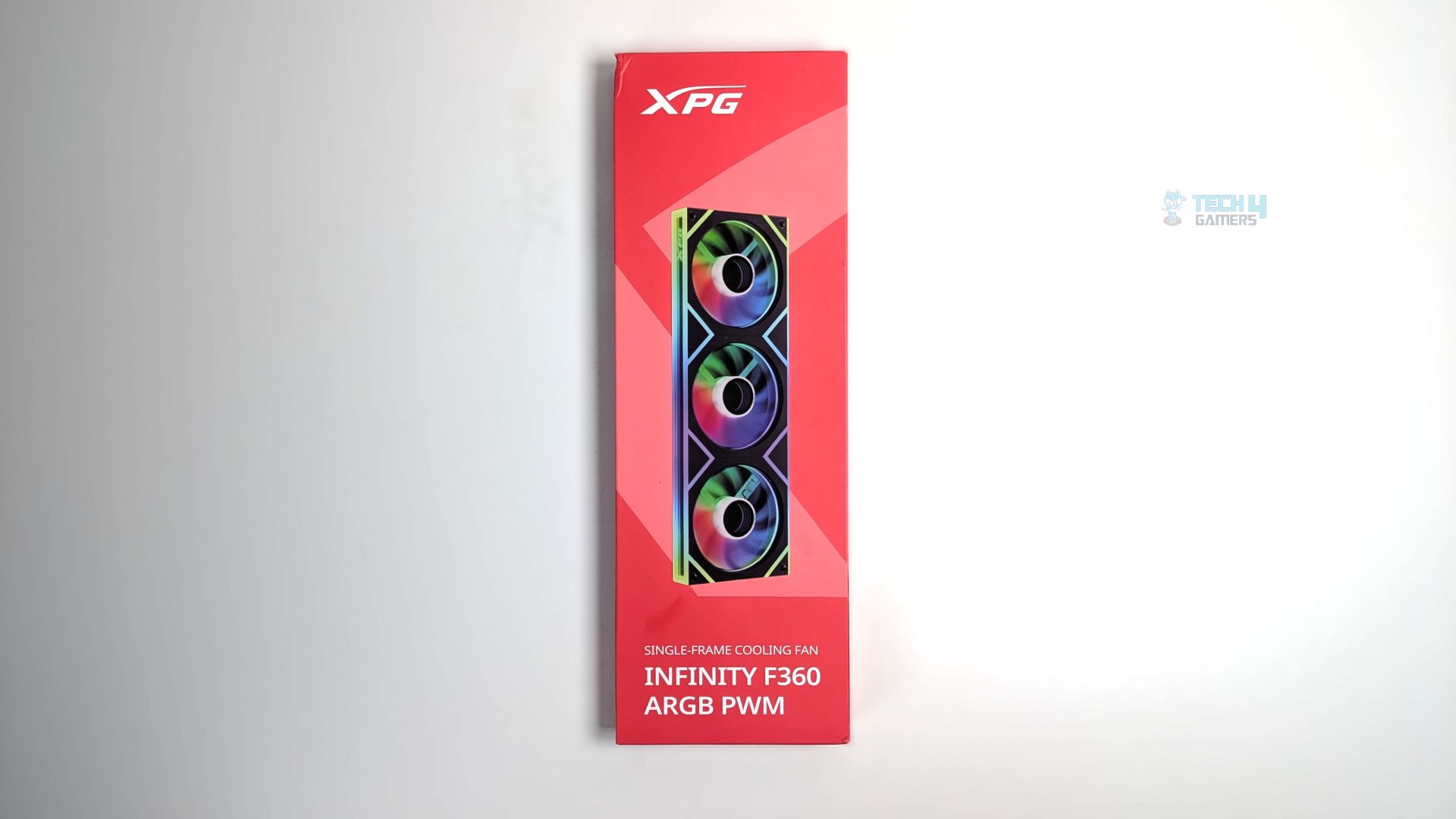
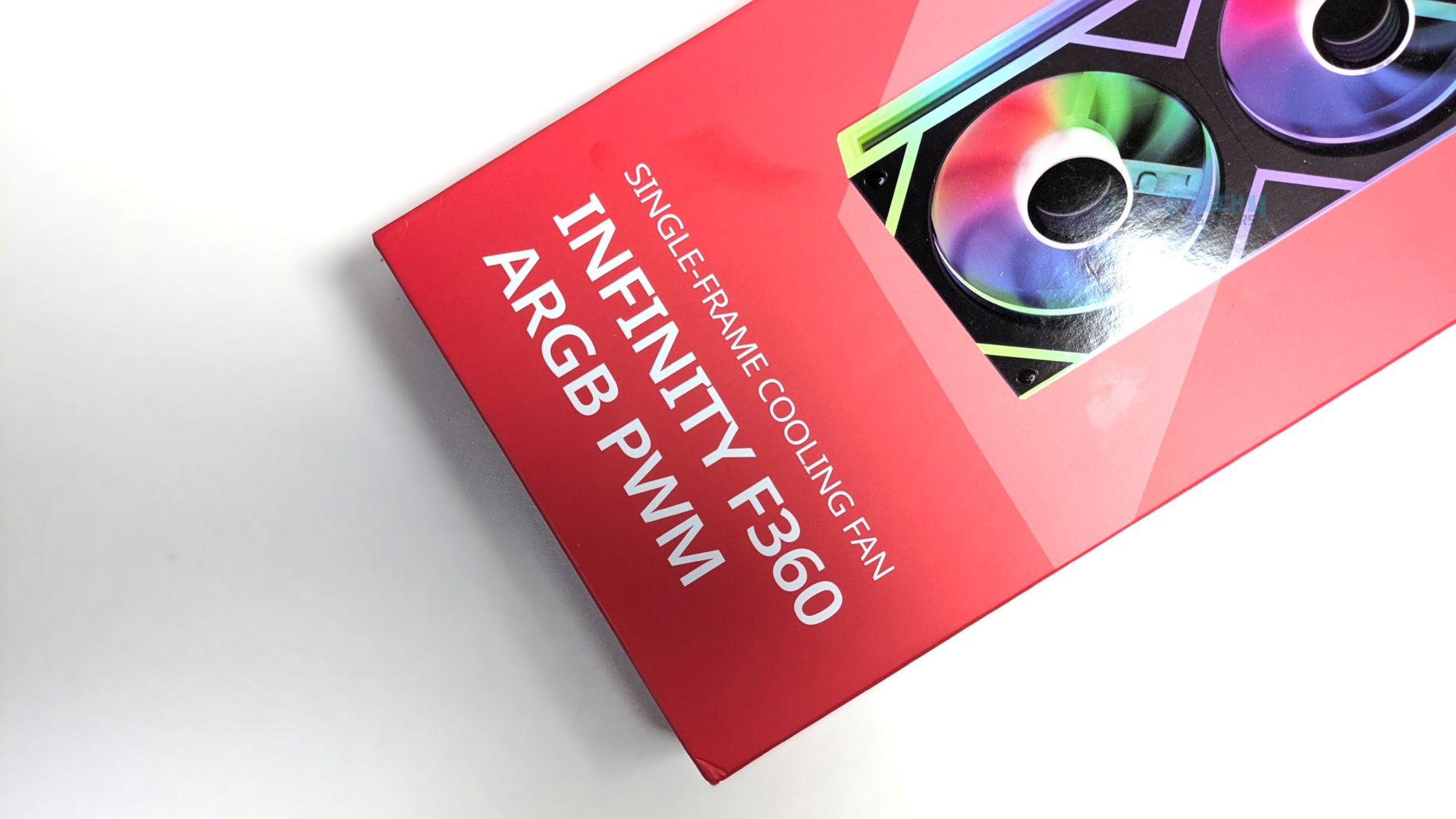
The box has a long, slim rectangular profile with the signature crimson-red XPG aesthetic. The front also features a render of the fans. The bottom specifies the form factor and the model, which says ” Single-frame Cooling Fan Infinity P360 ARGB PWM. The front is clean and feels basic.
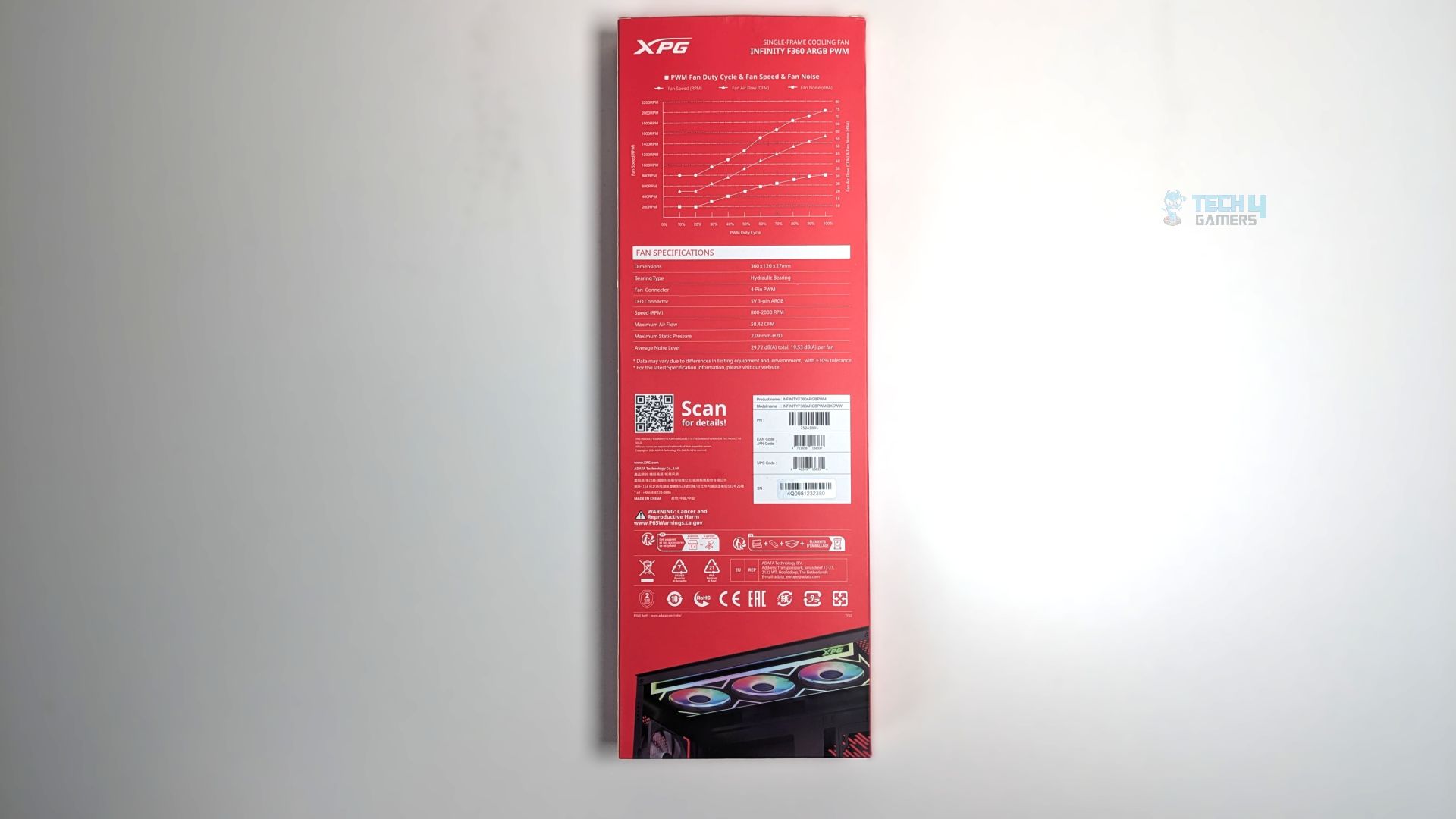
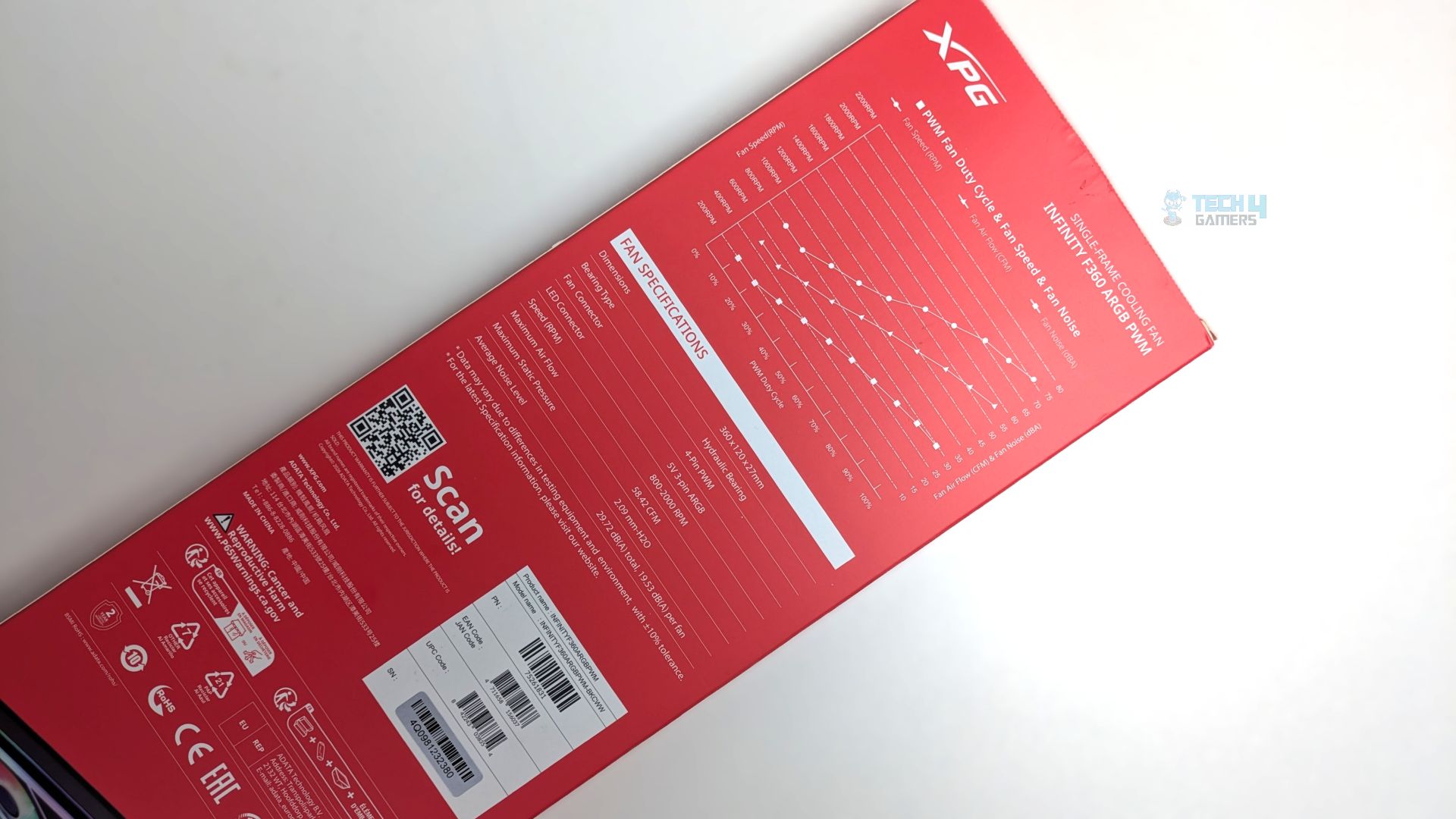
On the back, you’ll find the detailed fan curve and acoustic chart, along with key specifications and details.
Accessories
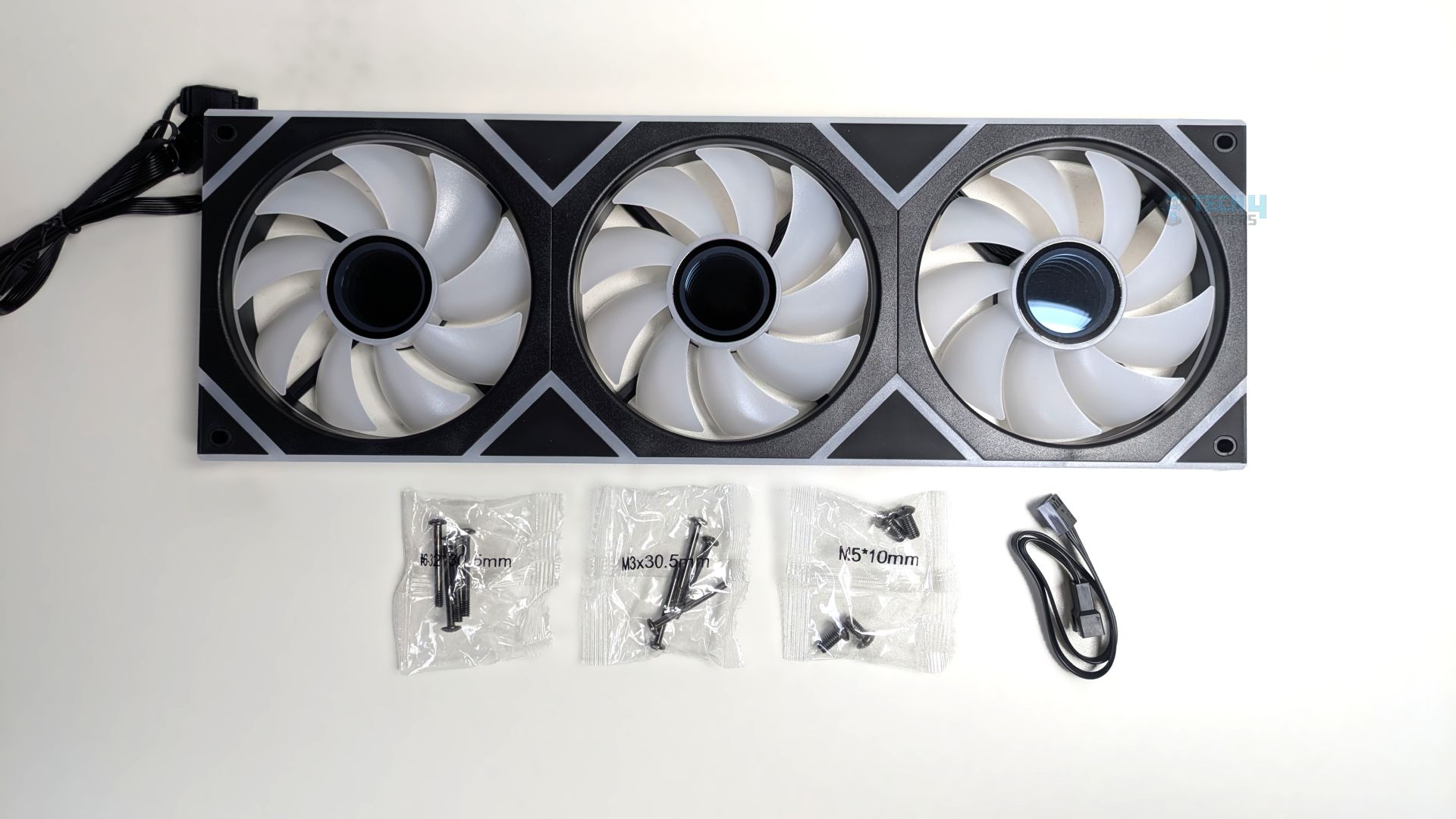
The contents include only the screws (Radiator screws and case screws) and the extension cable; no user manual or start guide is provided this time.
| Item / Component | Quantity |
| XPG Infinity F360 Unit | 1 |
| #6-32 × 30.5 mm Radiator Screws | 4 |
| M3 × 30.5 mm Radiator Screws | 4 |
| M5 × 10 mm Case Screws | 4 |
| PWM & ARGB Extension Cable | 1 |
Closer Examination & Assembly
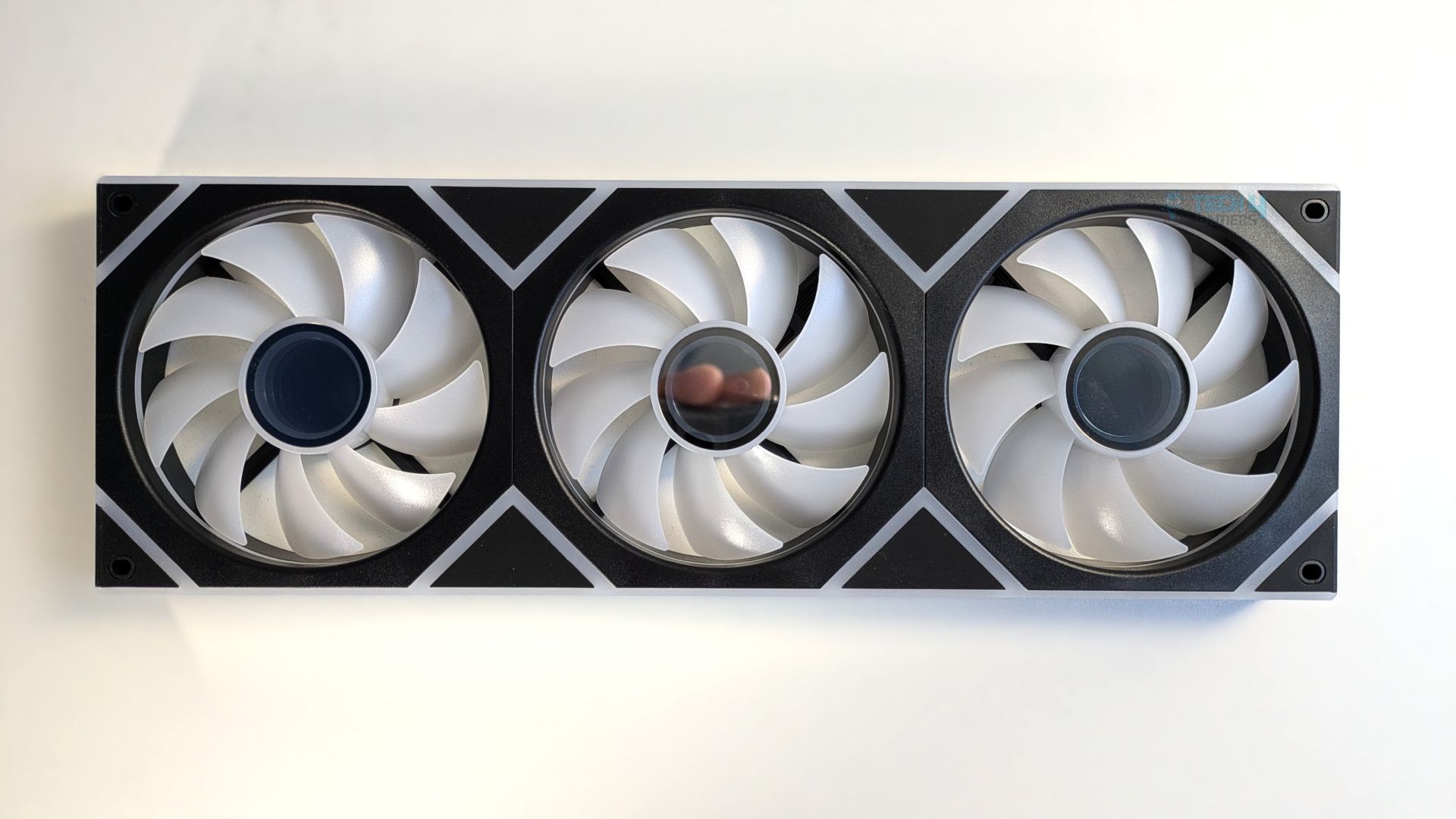
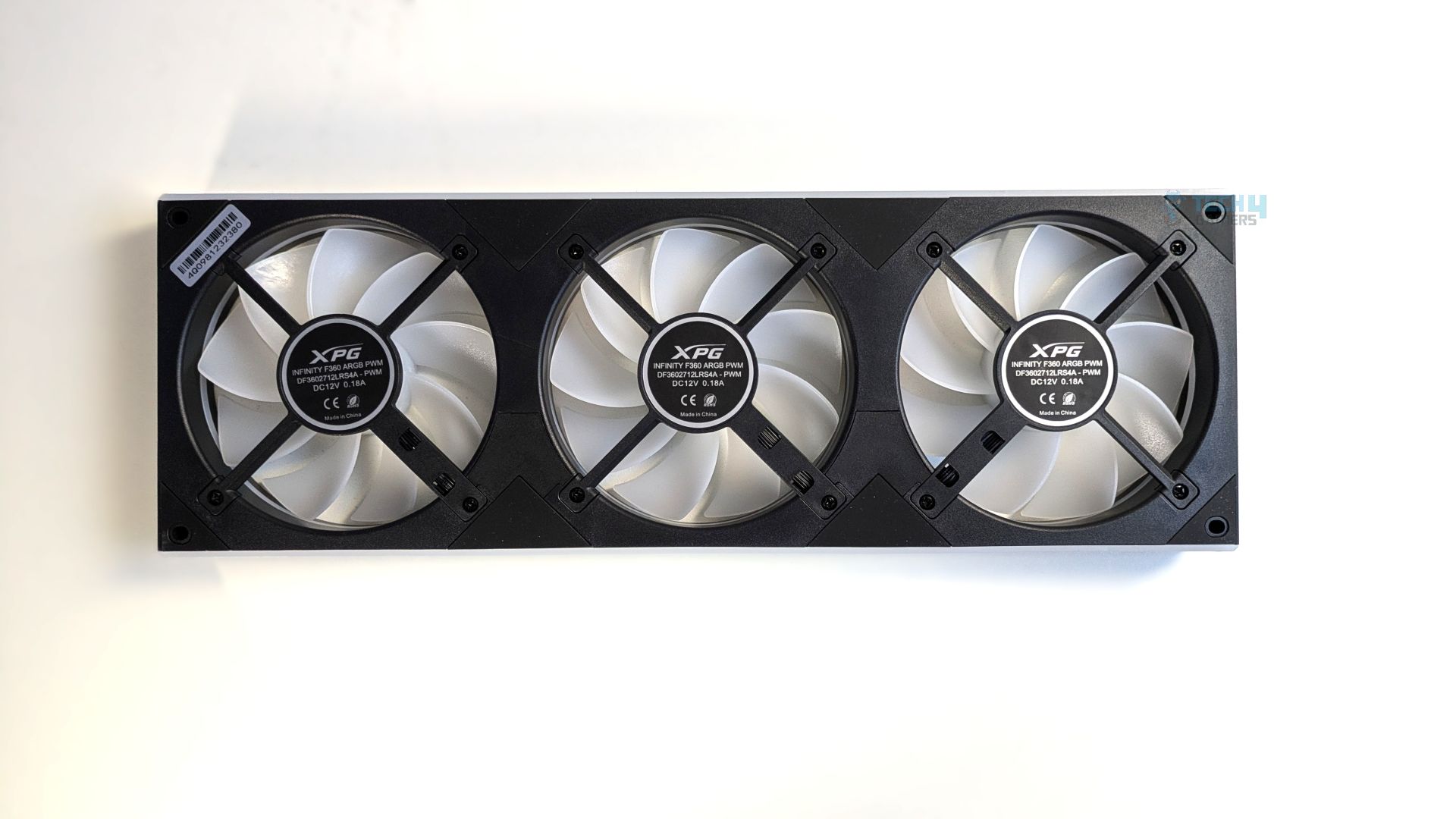
XPG Infinity F360 ARGB PWM replaces three traditional fans with a single housing measuring 360 × 120 × 27 mm. It’s a fully cable-free design; all wiring between the three internal motor hubs or LED rings runs through an internal channel structure that isn’t visible. That is why the unibody fans are known for their clean layout and design.The front also features sharp, angular triangular accents that segment the three fan openings and can also be lit by ARGB.
At the rear, four curved plastic struts anchor the motor hubs per fan. Each fan model carries a branding sticker detailing the model number and its electrical ratings (DC 12V, 0.18A); that means the total unit would draw 0.54A, while the LED operating current is around 0.6A to 0.8A. Based on the power calculations, the total unit power draw would be around 9.5W to 10.5W.
I have no issues with the build quality. The build feels strong and light in the hand, using dense ABS plastic with a black matte, micro-textured finish that also resists fingerprints.
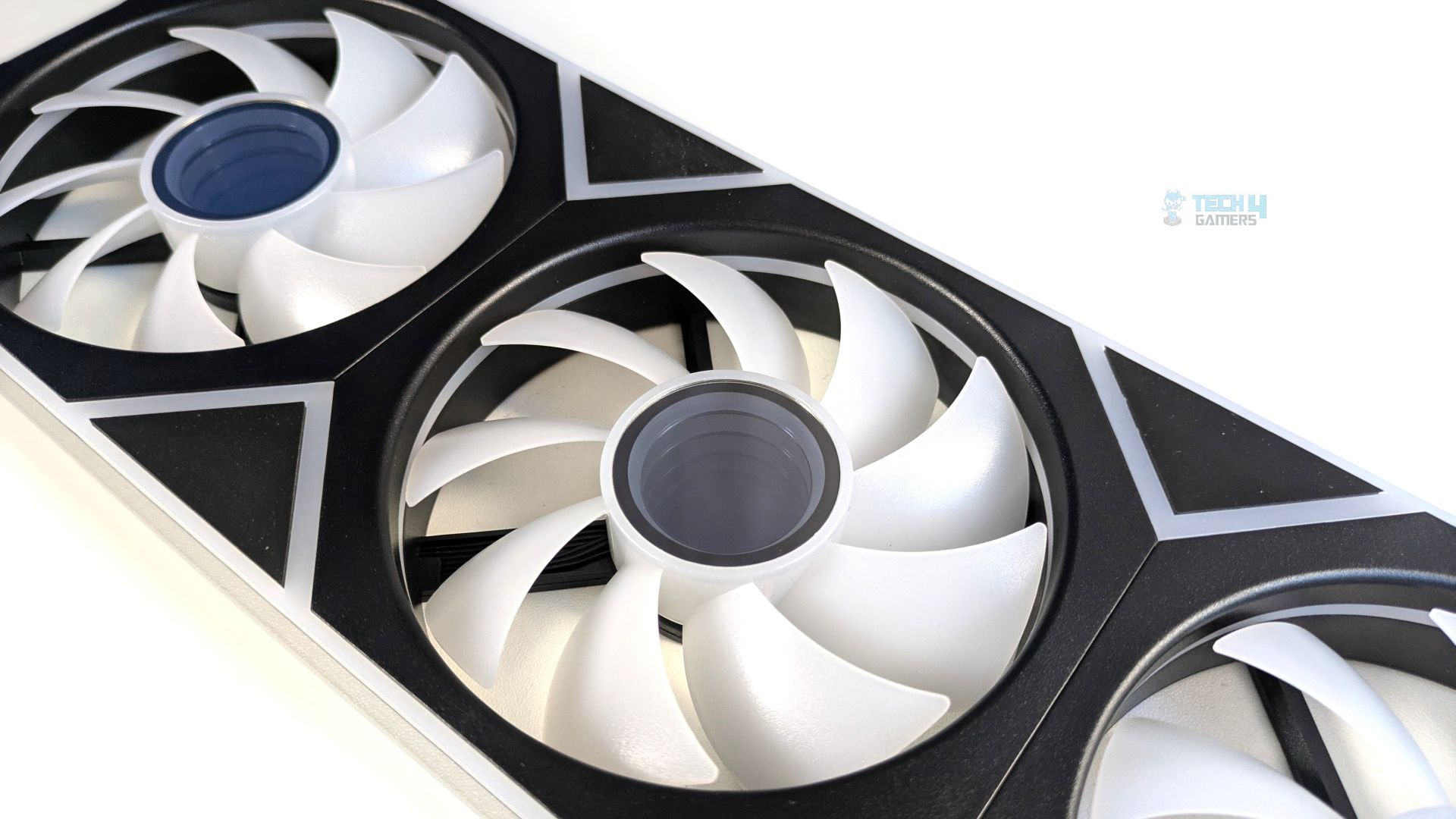
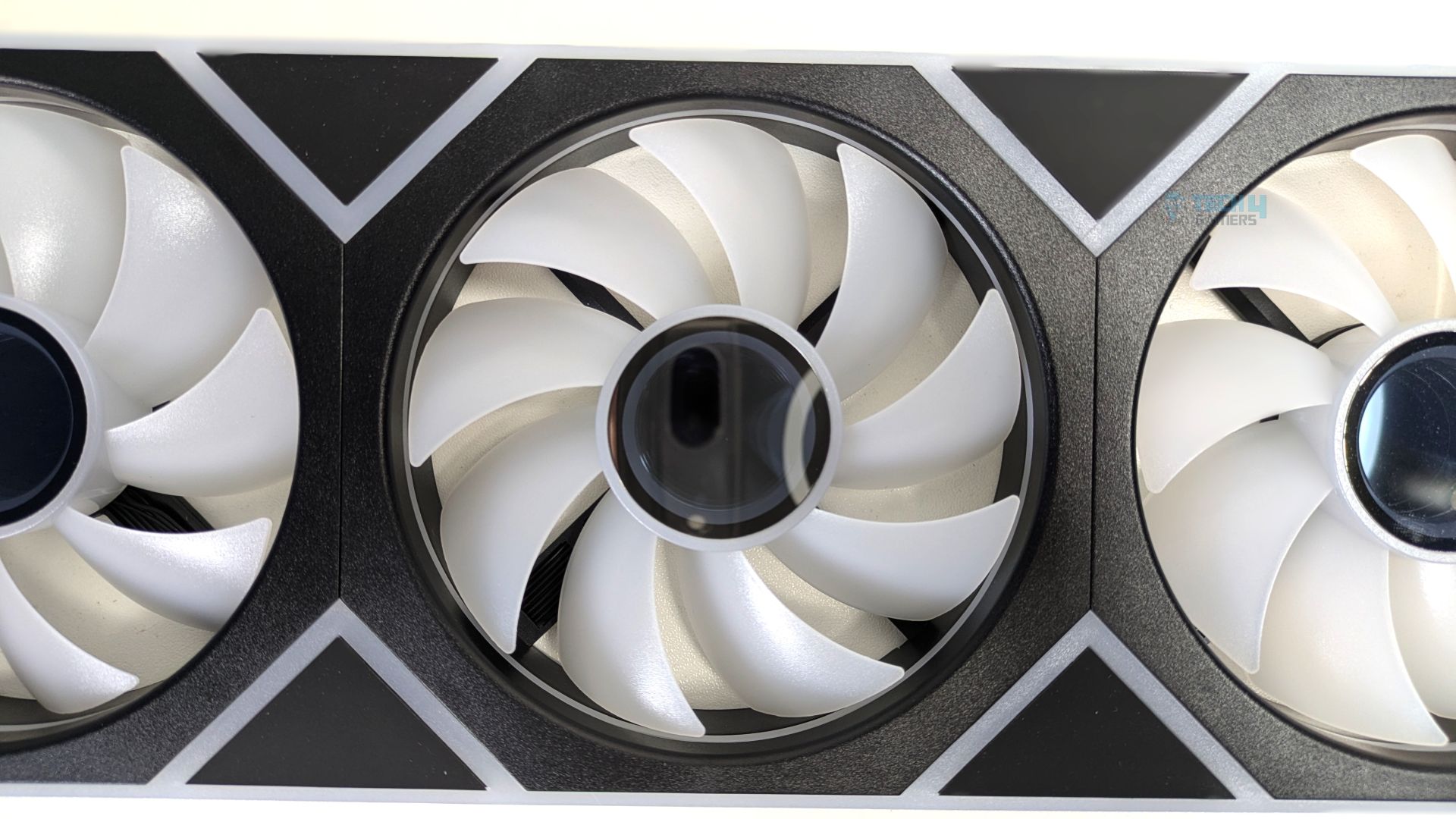
Taking a close look, each module has a deep circular infinity mirror design at its center, creating an endless tunnel effect when it’s lit. It’s not a new design. The infinity design is very popular among some budget fans.
It’s a 9-blade translucent design with tight-tip clearance, and if you look closely, you will notice a curve on the blades that could help maintain pressure against the radiator fins. You also get the corner rubber damping pads on the four mounting corners on both the front and rear faces. The rubber feels very good quality.
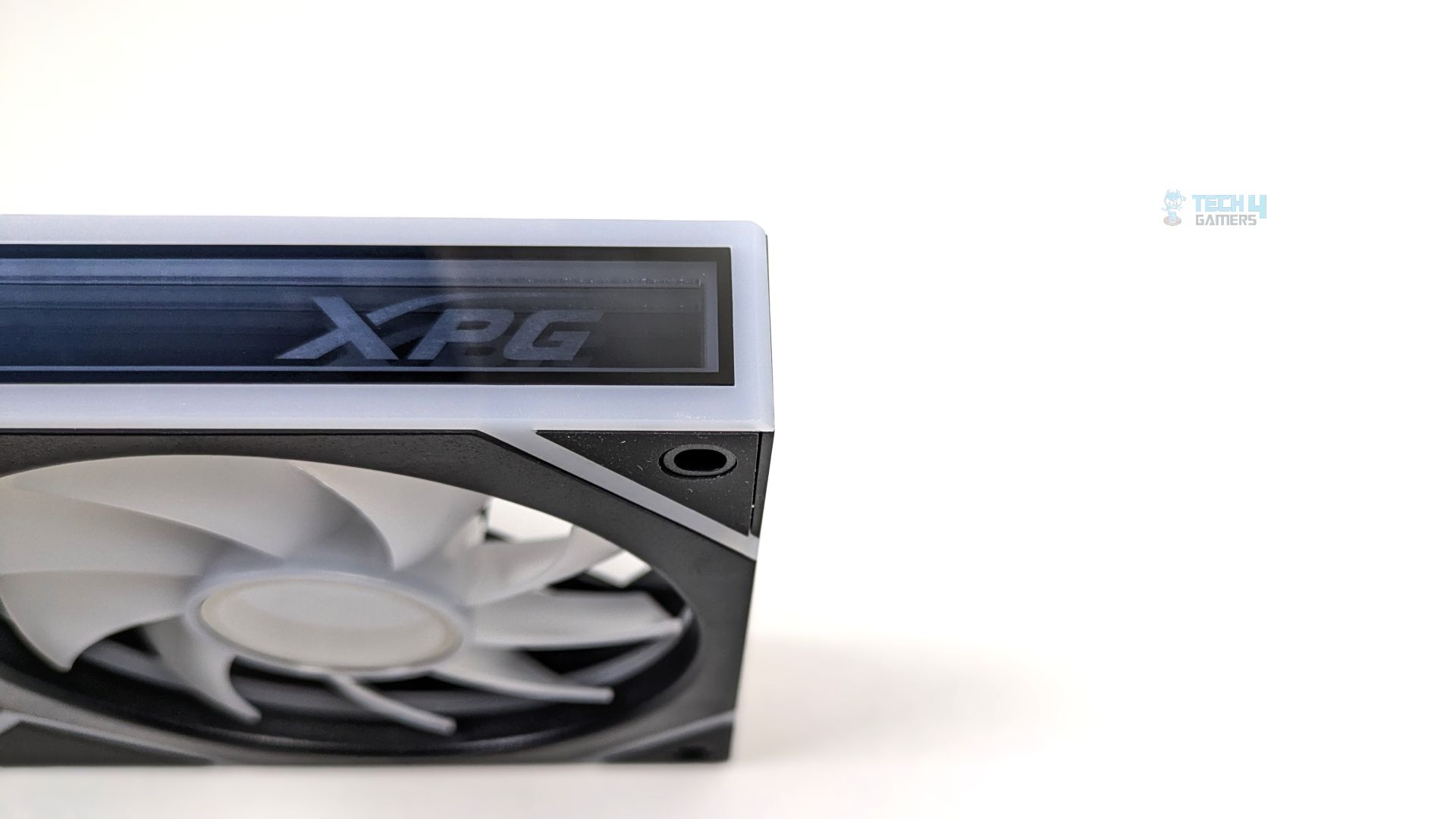
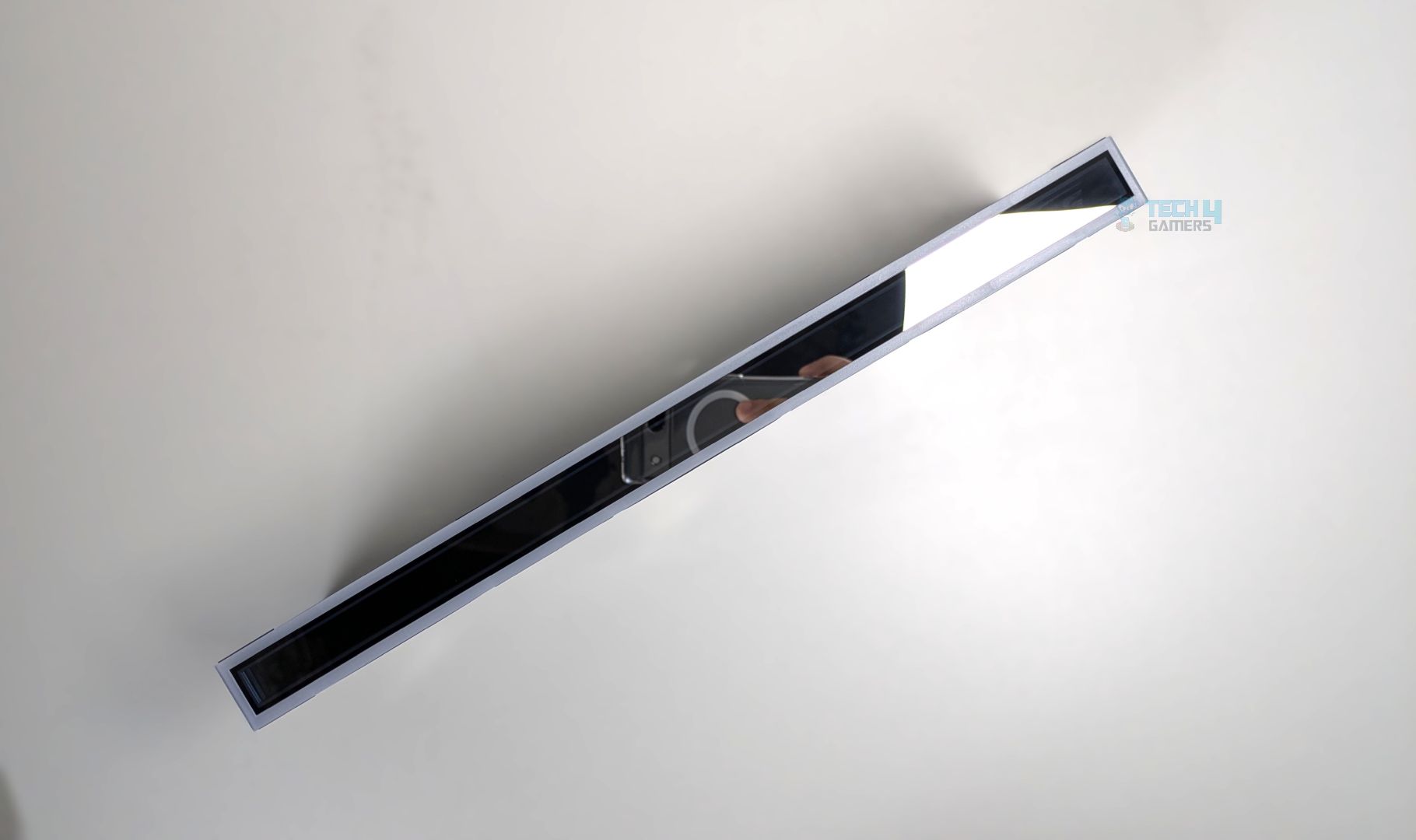
XPG has put so much work into the aesthetics; the side profile also features a continuous, full-length infinity mirror bar that runs seamlessly along the entire 360mm span. On the right side, there is also a subtle XPG branding integration that also illuminates.
By the way, when cleaning the fans, be very careful, as this infinity panel uses optical-grade acrylic rather than tempered glass, which makes its surface softer and more prone to scratches if wiped down with paper towels or rough tissues. Use the blower first to remove dust, then gently wipe with a soft, clean microfiber cloth.
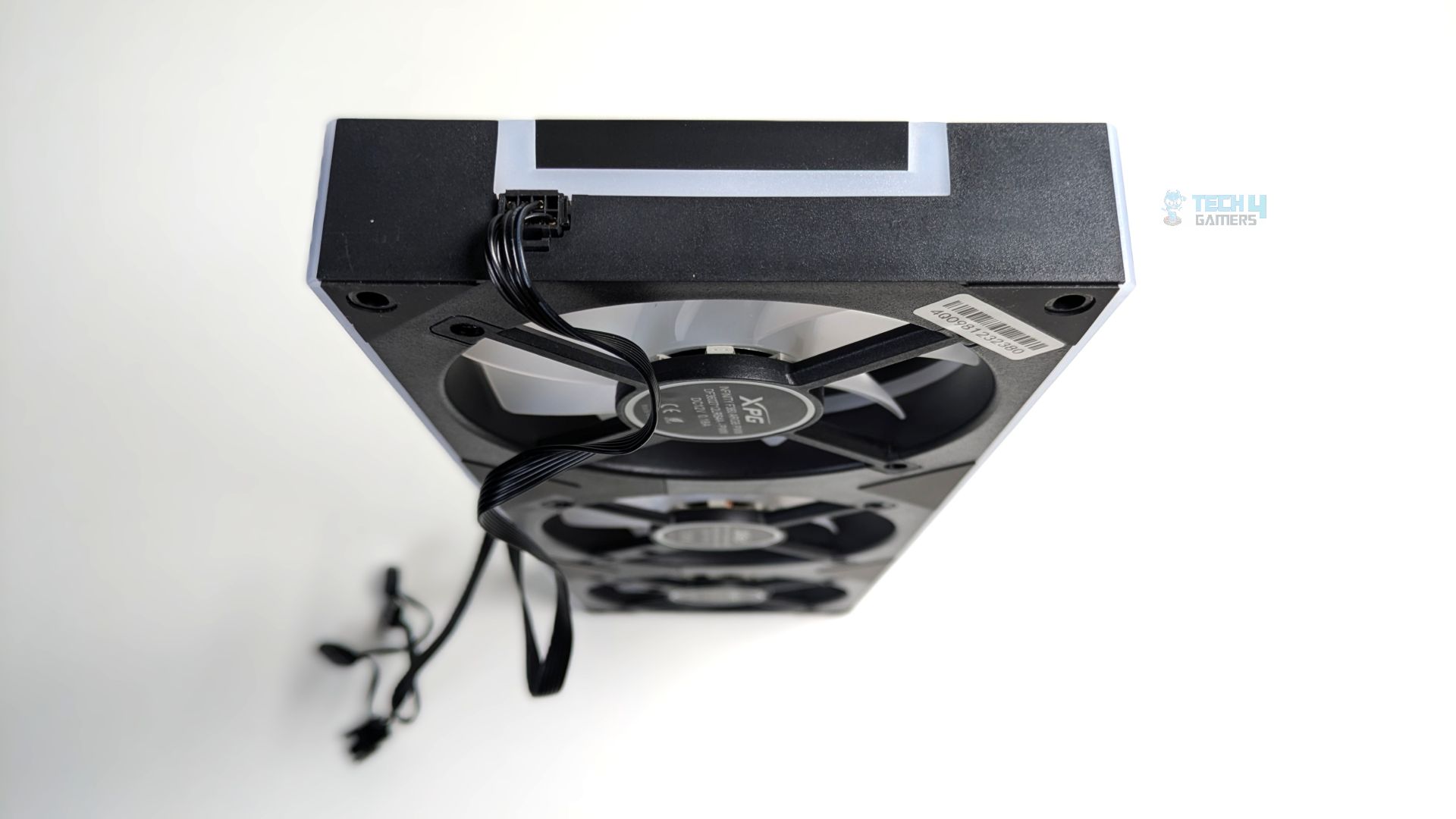
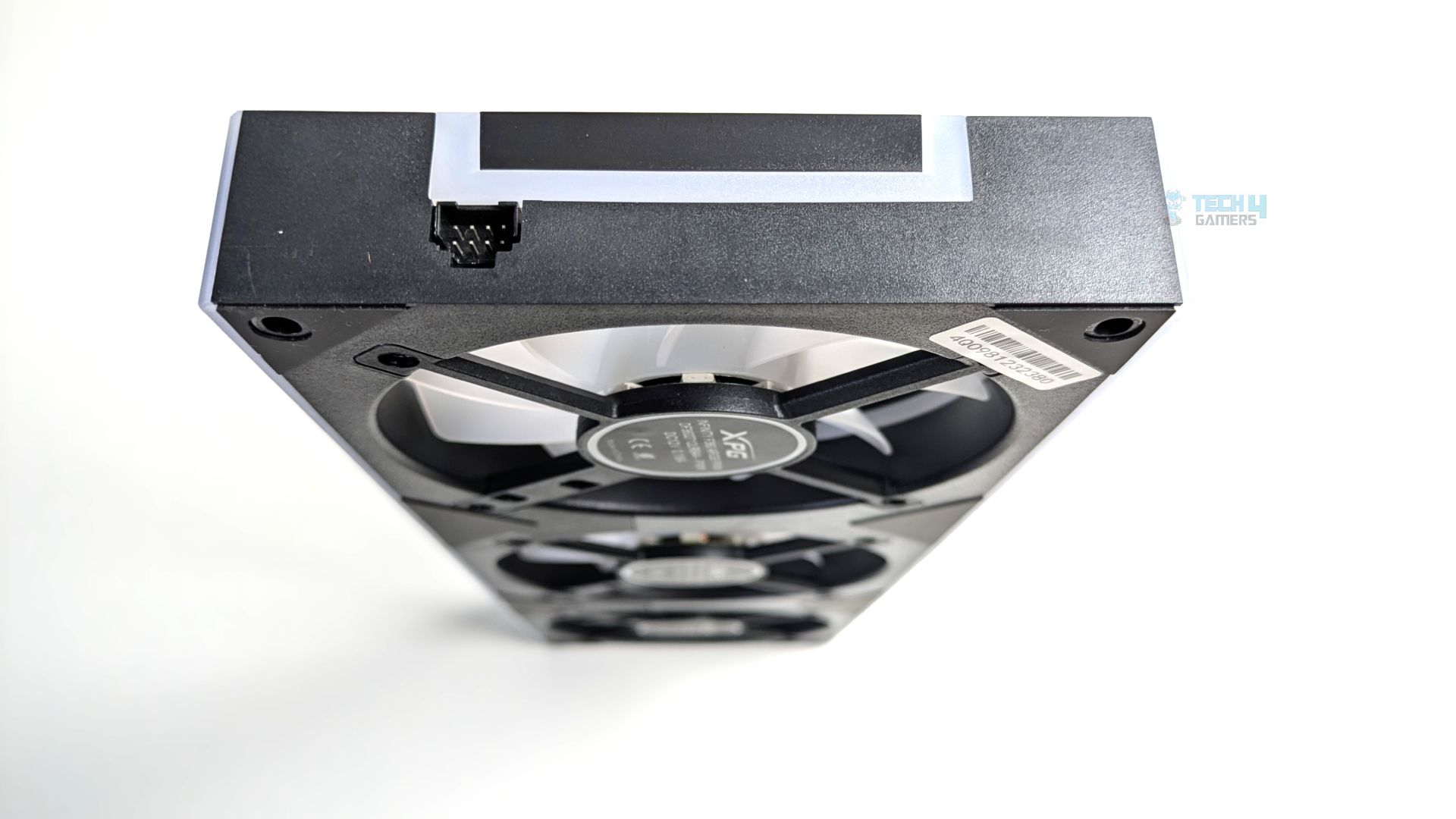
At the frame end, XPG has installed a recessed 7-pin header with a unified dual-row pin array: 4 pins for standard 12V fan motor control and 3 pins for 5V ARGB.
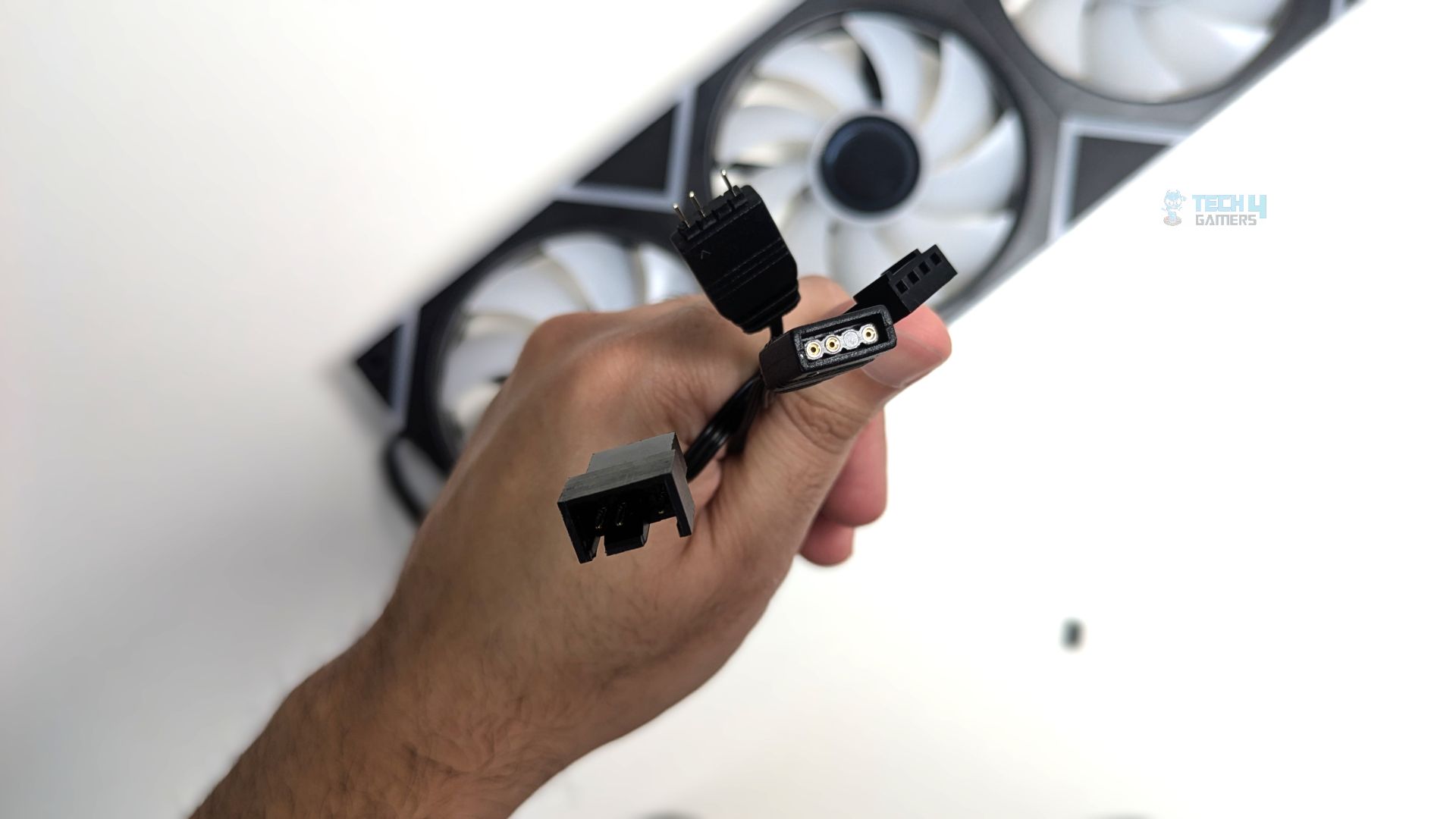
The opposite end of the included cable splits into standard universal motherboard headers.
ARGB Lighting
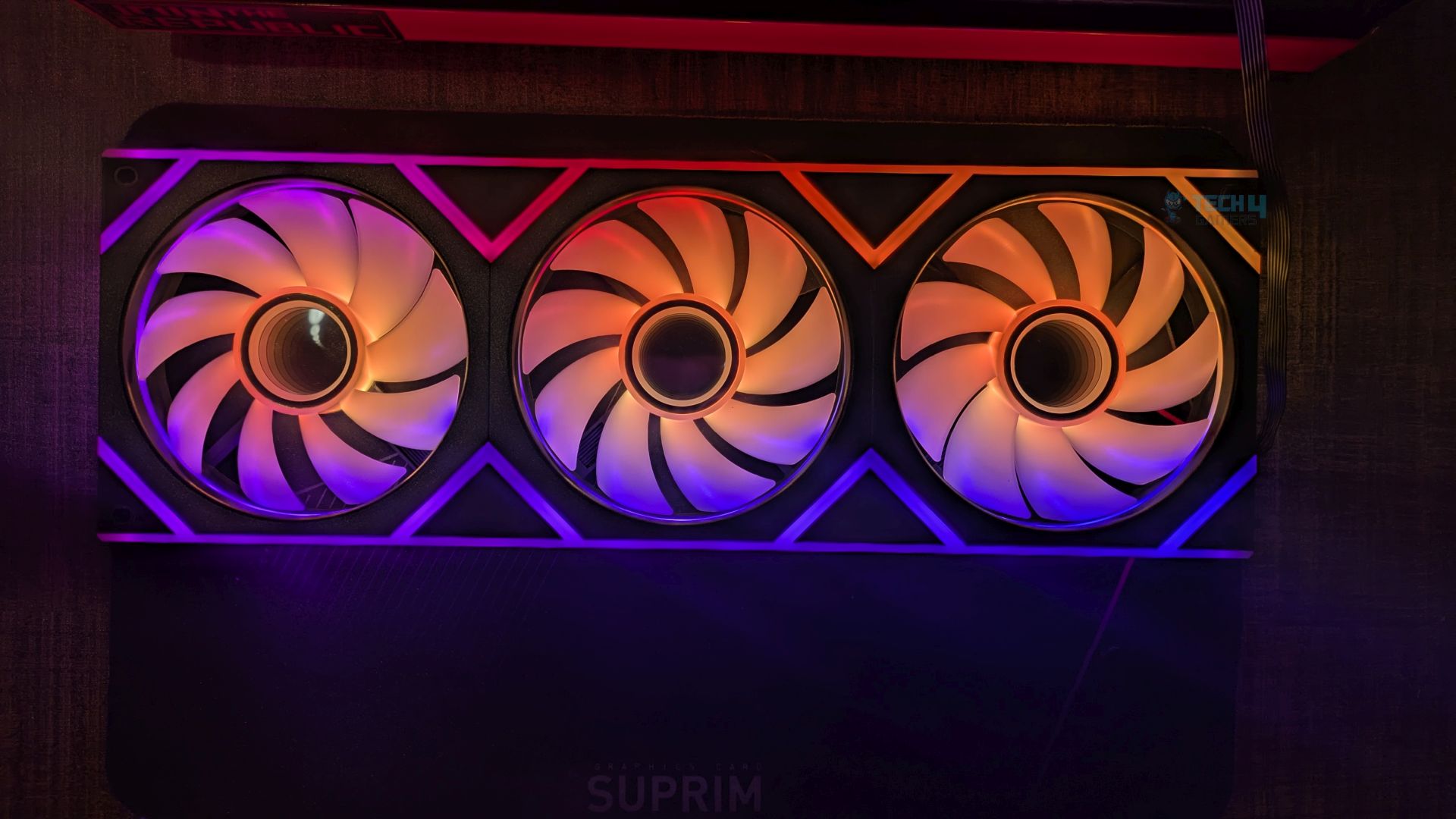

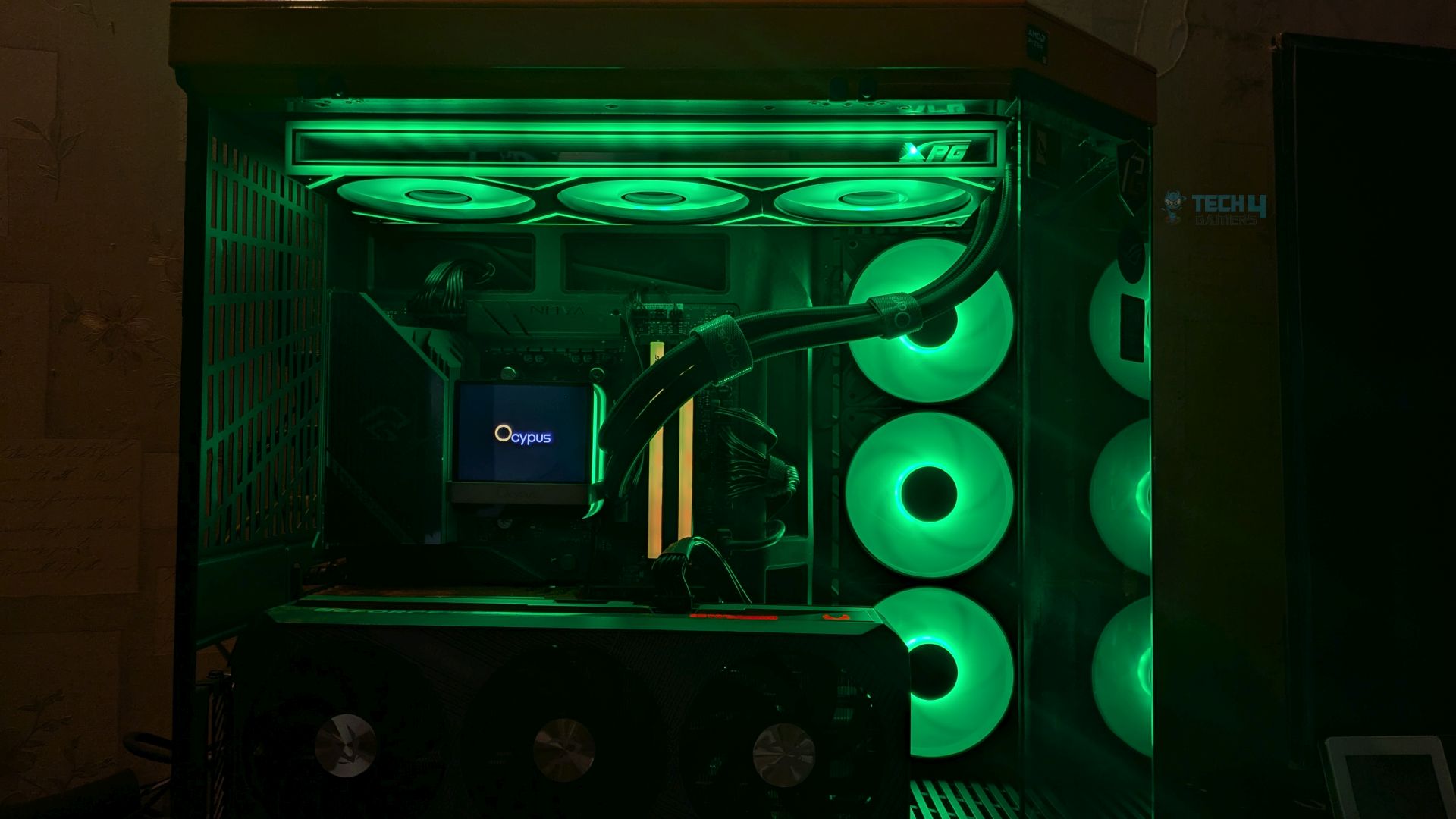
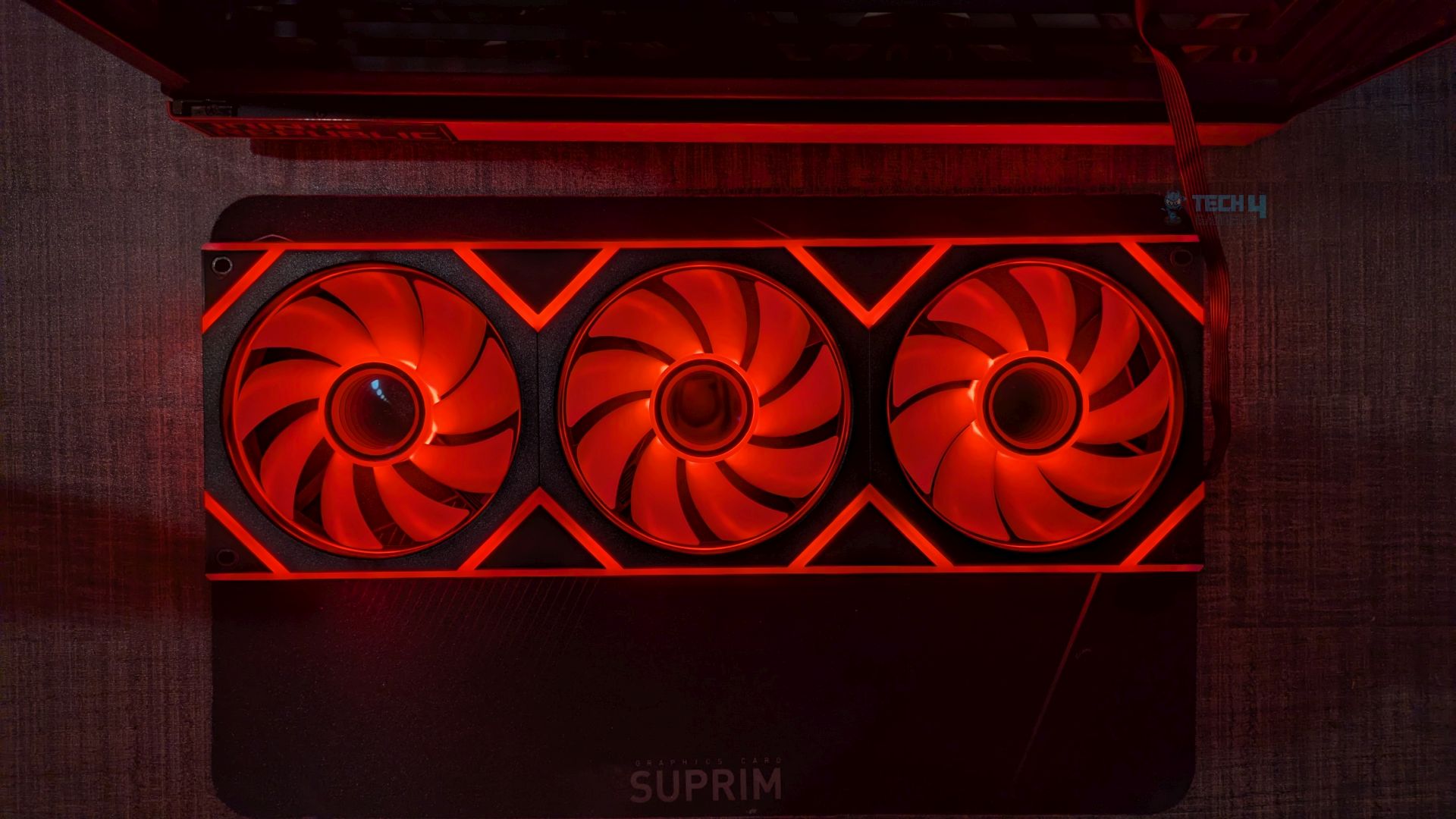
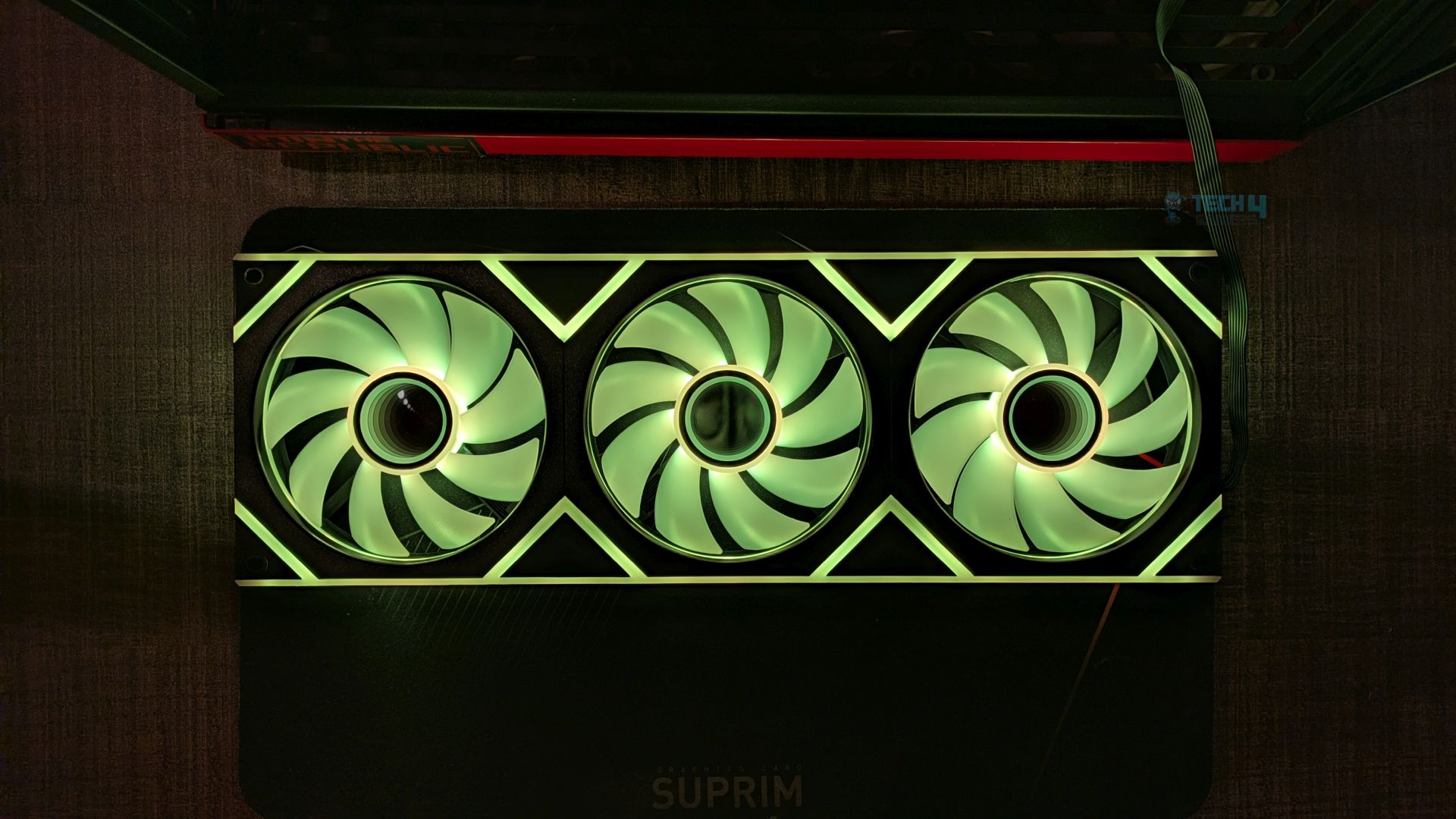
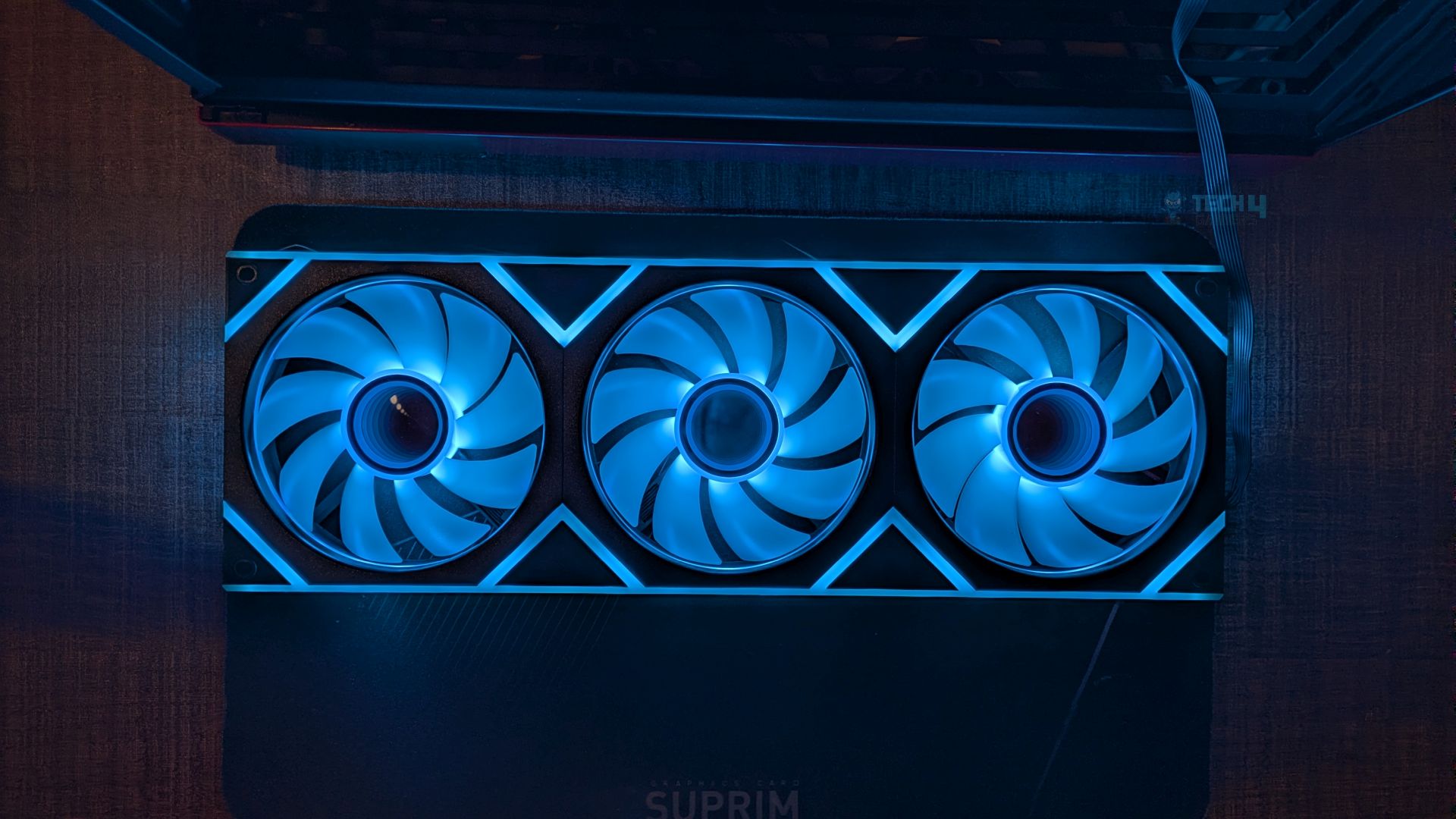
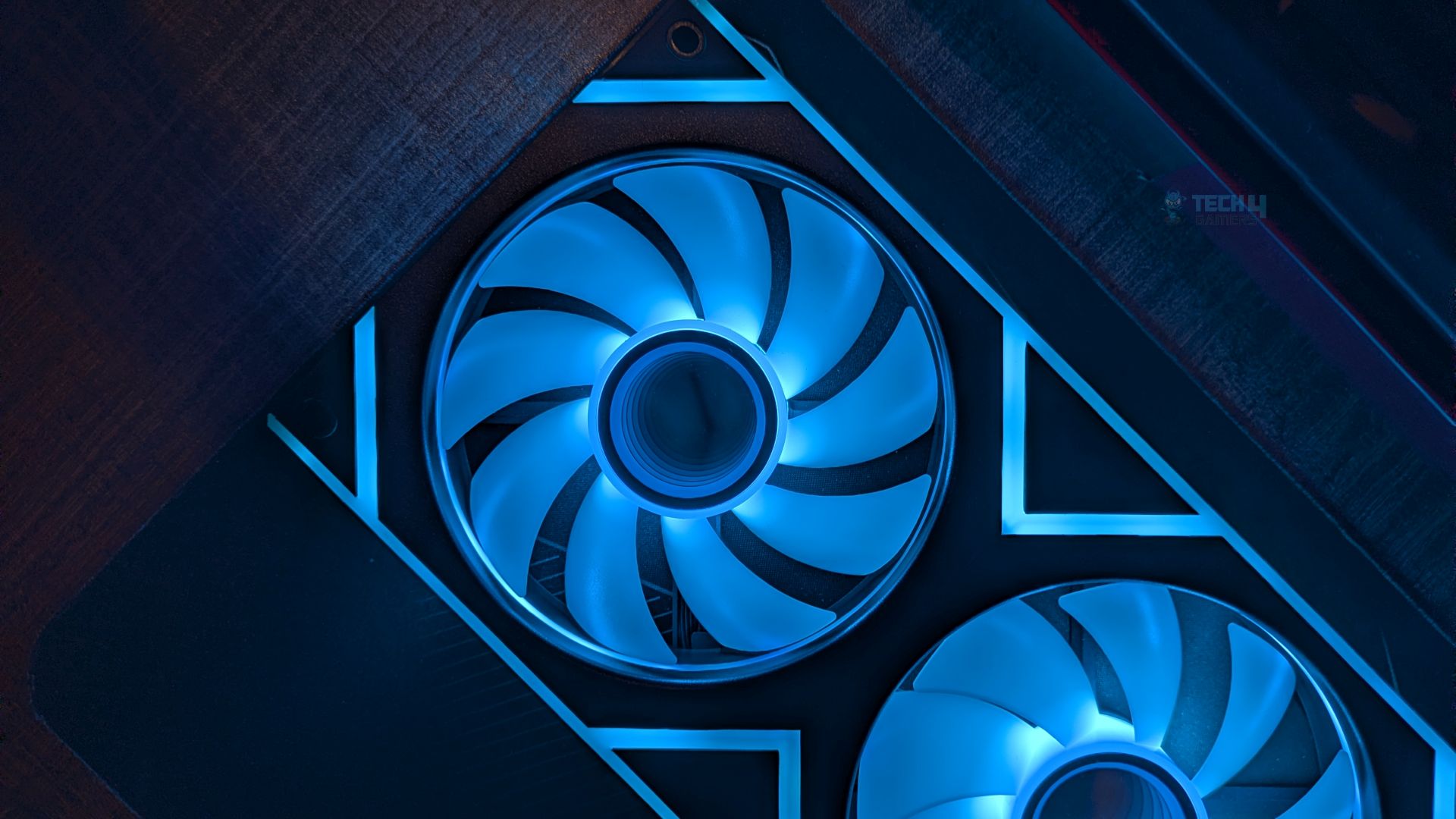

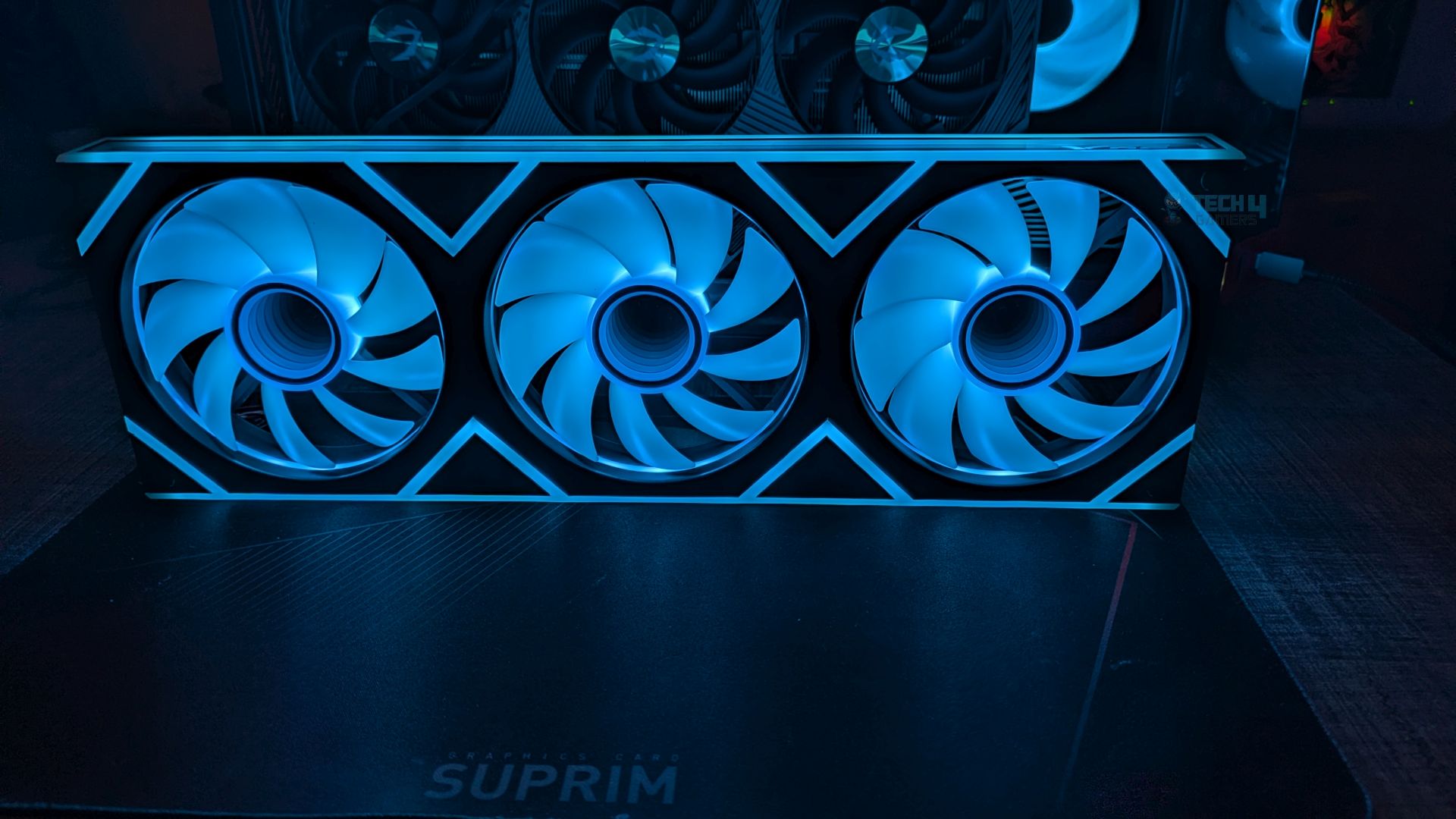
The ARGB lightning implementation is smooth; the translucent nine-blade impellers serve as a massive light diffuser, and the lightning spreads smoothly without exposing harsh individual LED hotspots.
It’s a fancy design, but you can customize it to suit your taste. You don’t just get the glowing fan blades; the unibody frame also features sharp triangular channels on the front, and the side frame is also ARGB-illuminated in a continuous side infinity-mirror design.
Here is the demo ARGB Showcase of the XPG Infinity F360 ARGB PWM.
Testing Methodology
How Do We Evaluate The Fans Cooling Performance
- We’ll test the fan’s cooling performance on the Ocypus Sigma L36 Pro liquid cooler by stress-testing the CPU under controlled PWM and noise-normalized conditions to determine how effectively the fan performs in cooling.
Noise Performance
- We’ll measure the fans’ noise performance at four different PWM levels to evaluate how their noise output scales across the tested speeds. Noise measurements will be taken with the fans installed on a liquid cooler, with the sound meter positioned 15 cm away from the fan.
- To ensure accurate results, we’ll minimize any interference from the pump and case noise by running them at the lowest possible speeds where they do not affect the measurements.
Controlled Environment
- In the thermal results, we have eliminated the influence of ambient temperatures on our data, and all results are presented as deltas relative to the ambient conditions. The tests were done in a controlled environment with a room temperature of 25°C +/- 1°C.
Preparing System:
- Since we don’t have a dedicated open-air test bench, all coolers are installed in our primary test case, the HYTE Y70. However, all case panels are removed during testing to minimize airflow restrictions.
- The CPU cooling tests are conducted on the AMD Ryzen 9 9950X at its stock 170W TDP, with a total heat load of 200W. All BIOS settings are left at their default values, with only EXPO enabled.
- The CPU stress test will be conducted using Cinebench R23 for 20 minutes, with the average CPU temperature recorded throughout the test. When multiple tests are performed, a 10-minute cool-down period will be allowed between each run to ensure consistent testing conditions.
Test Setup
Here is our test setup!
| Component | Specification |
| CPU | AMD Ryzen 9 9950X |
| Motherboard | ASRock X870 Phantom Gaming WiFi |
| RAM | XPG Lancer 32 GB (2×16 GB) 6000 MT/s CL30 |
| Cooler | Ocypus L36 Sigma Pro |
| GPU | ZOTAC SOLID RTX 5080 |
| Case | HYTE Y70 |
| Sound Level Meter | UNI-T UT353BT |
Test Results
Let’s take a look at it’s cooling performance.
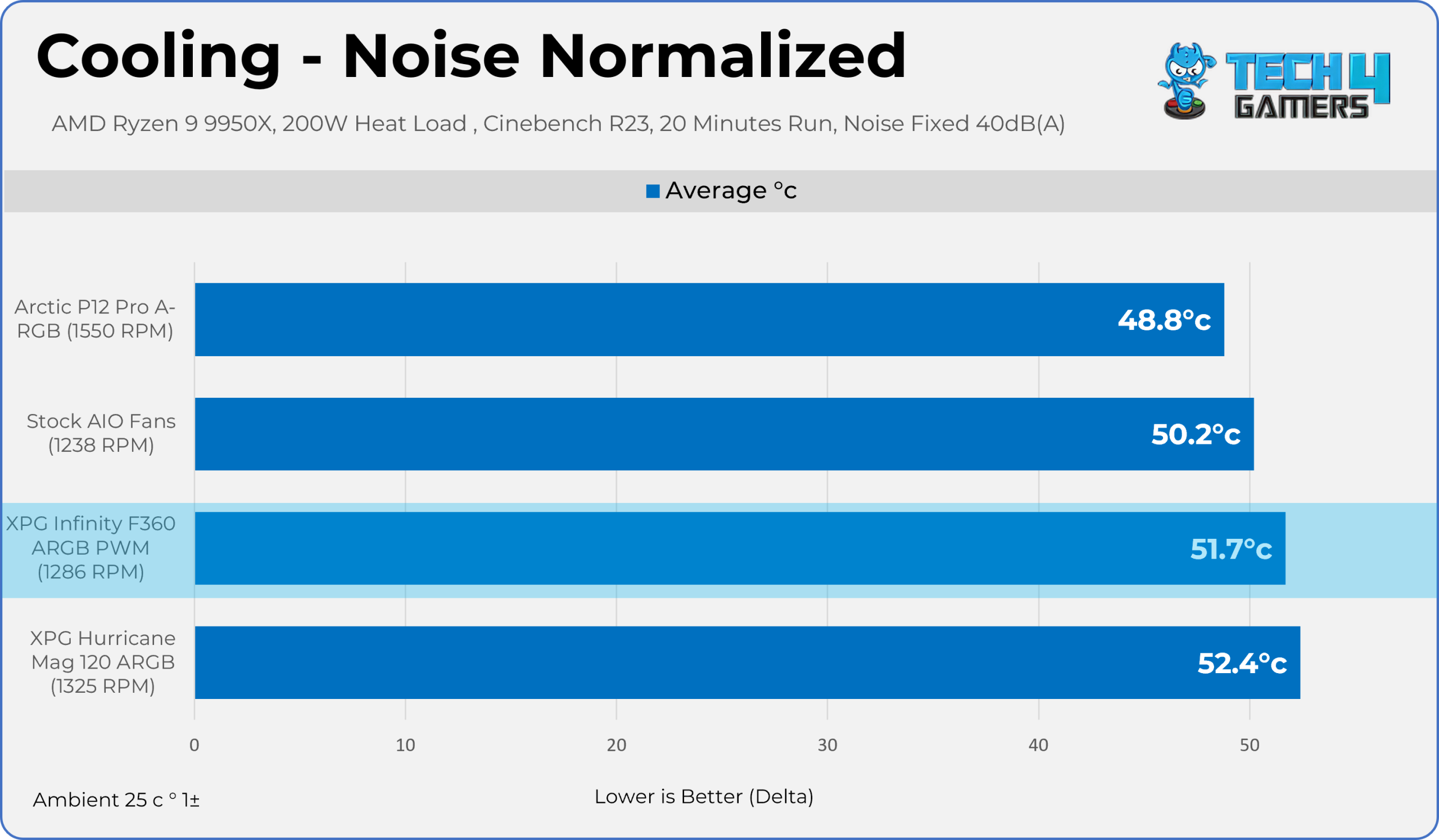
CPU Cooling Performance – Noise Normalized
Testing the fans set at the 40db(A).
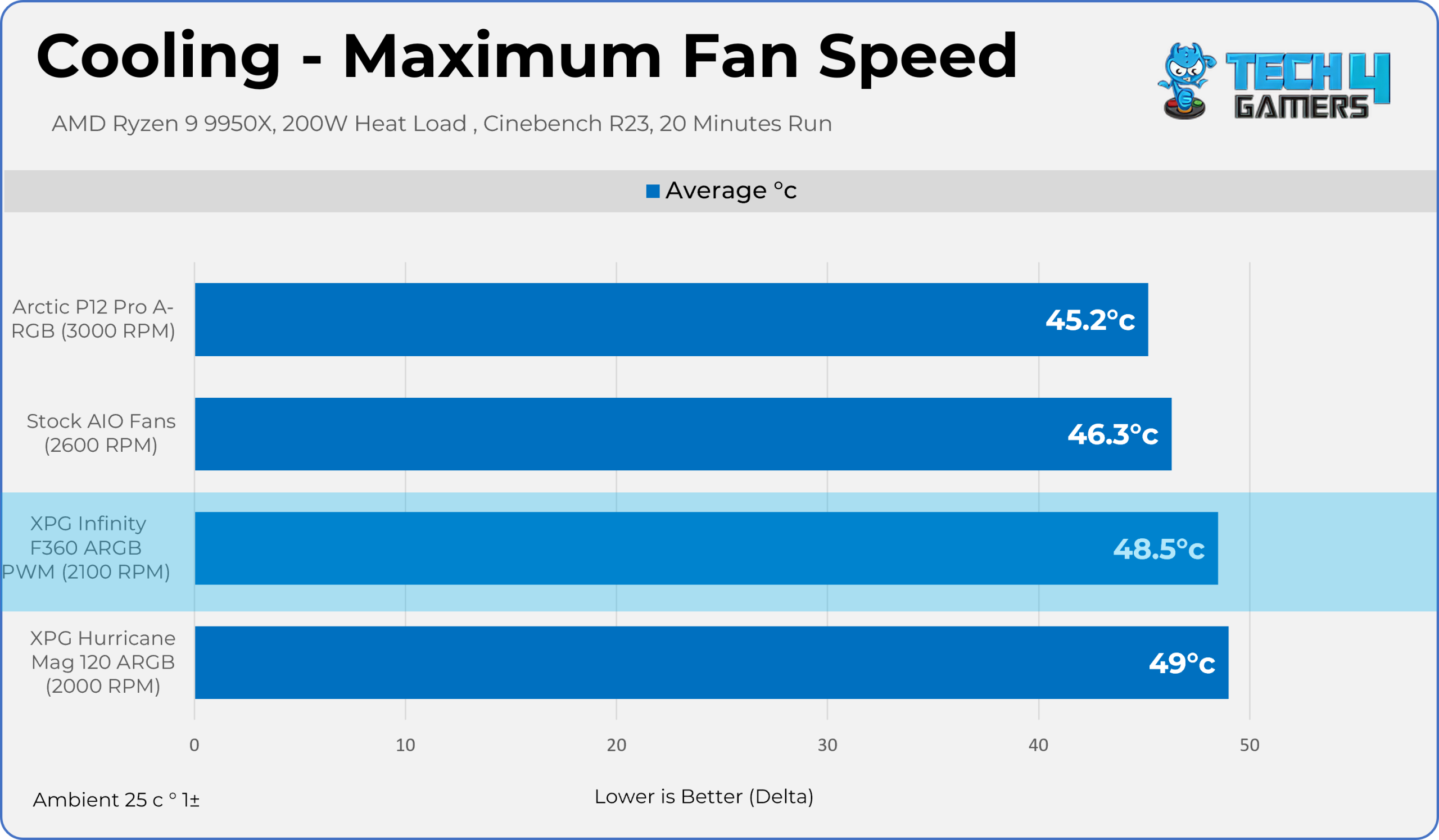
CPU Cooling Performance – Full Fan Speed
Testing the fans at the maximum PWM speed.
Speed and Noise Scaling
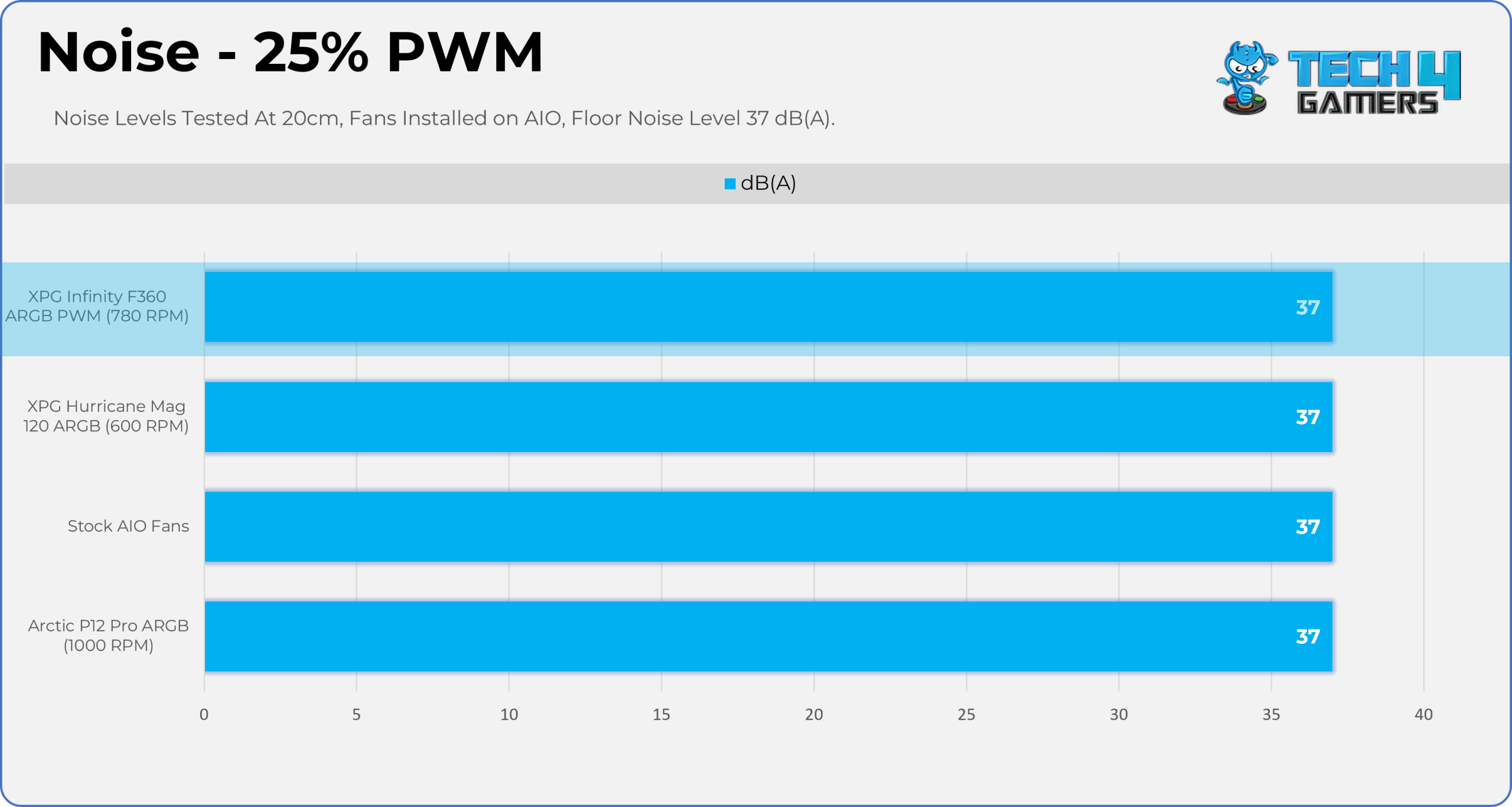
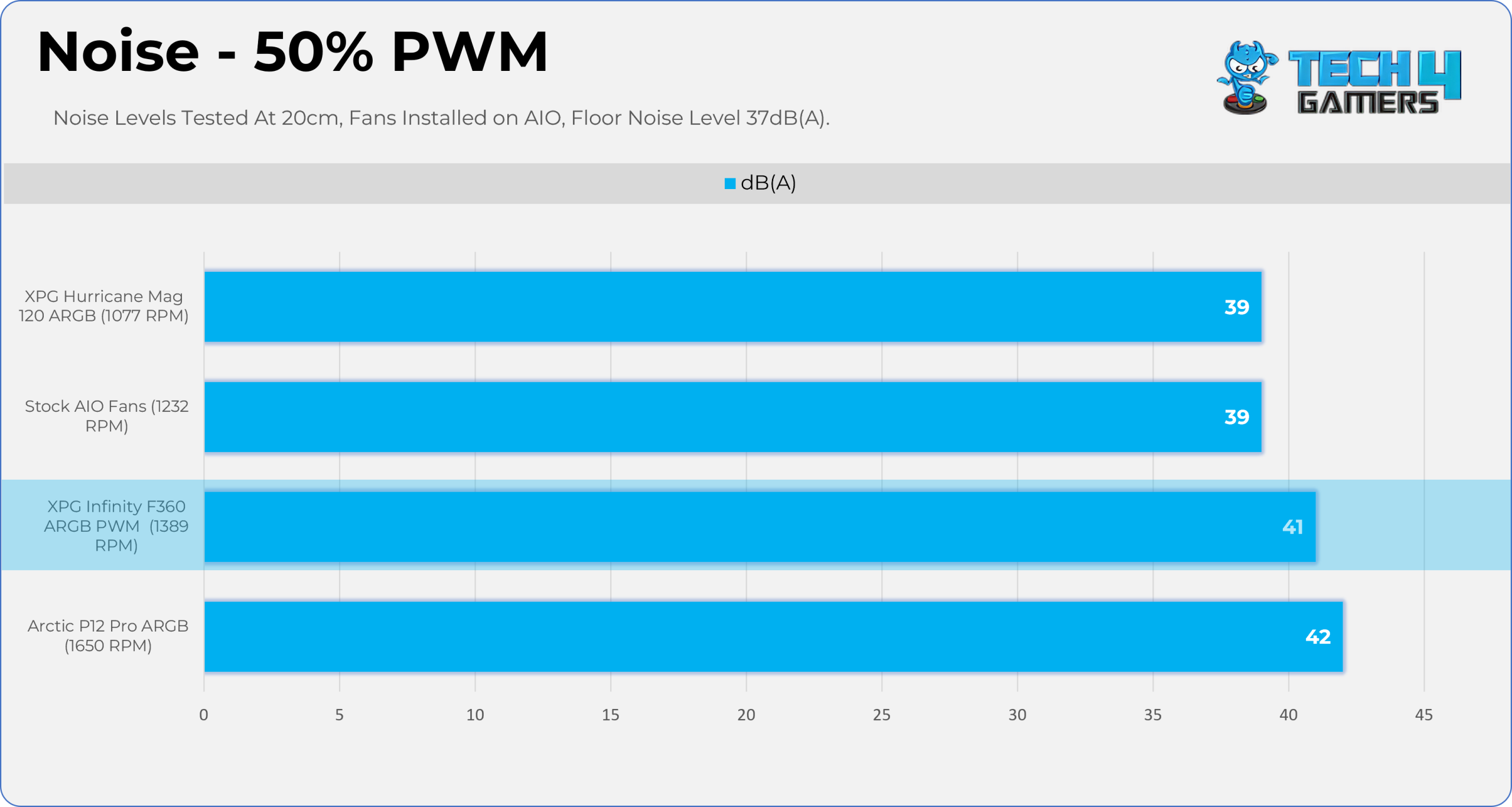
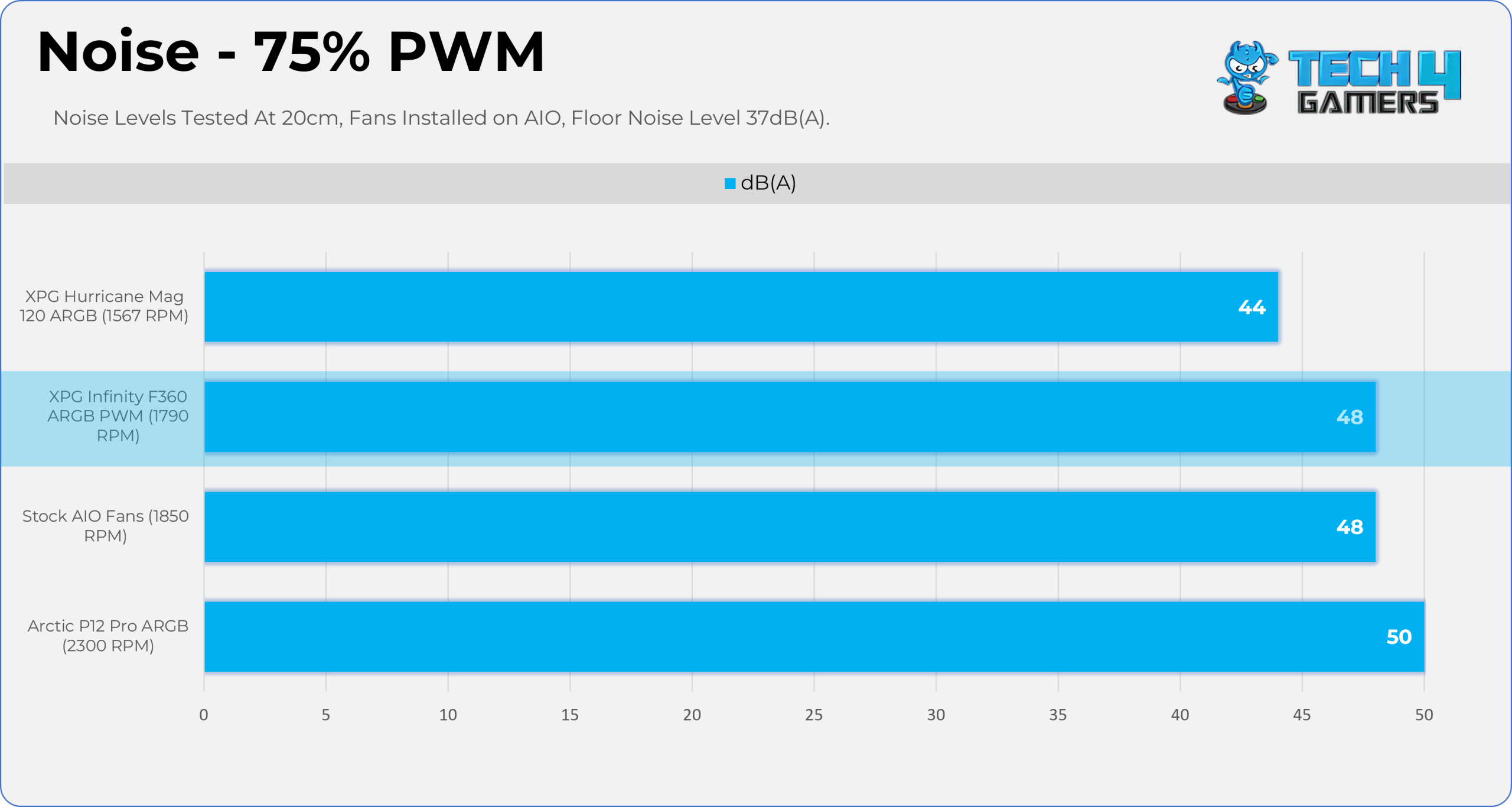
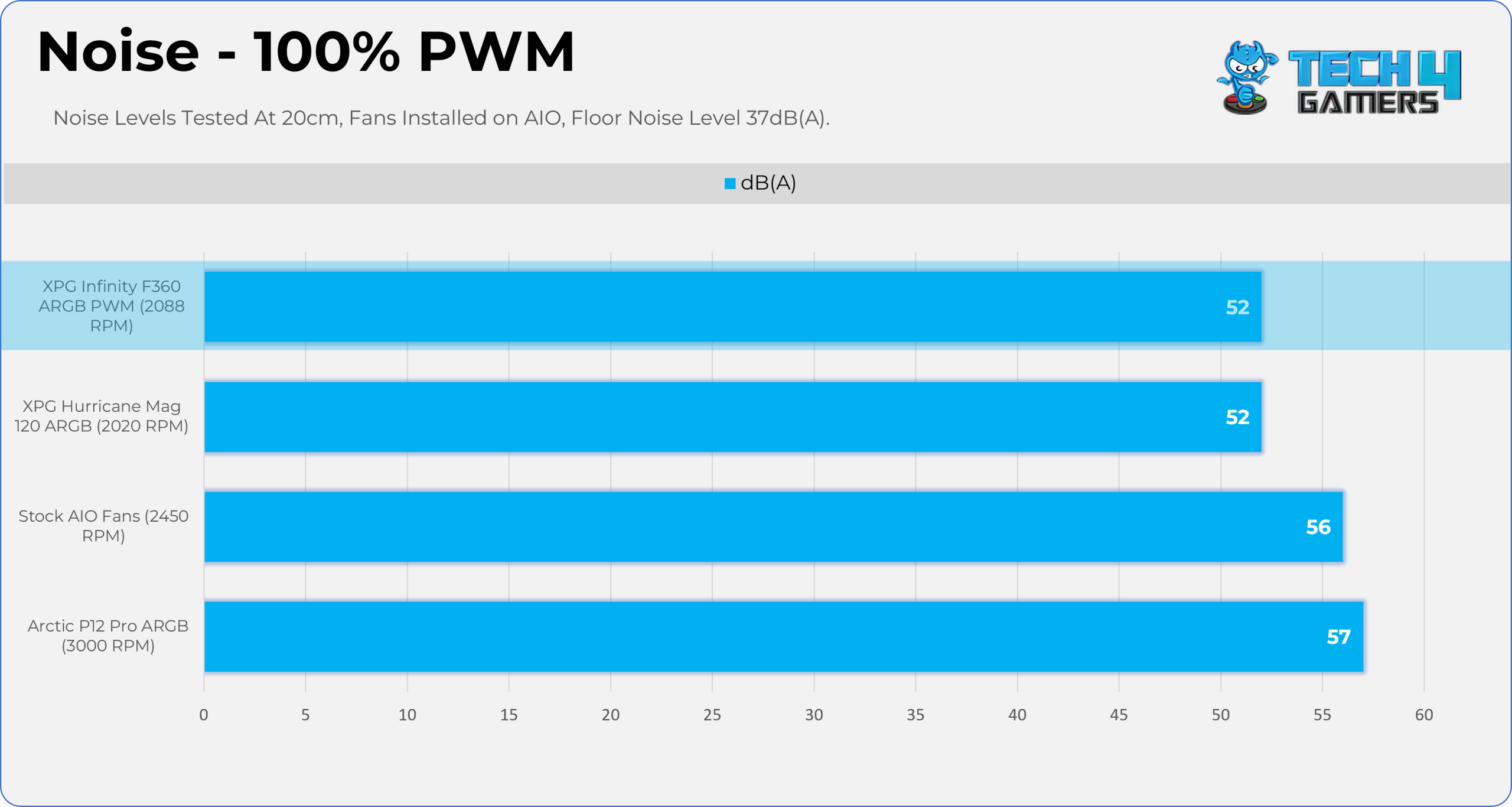
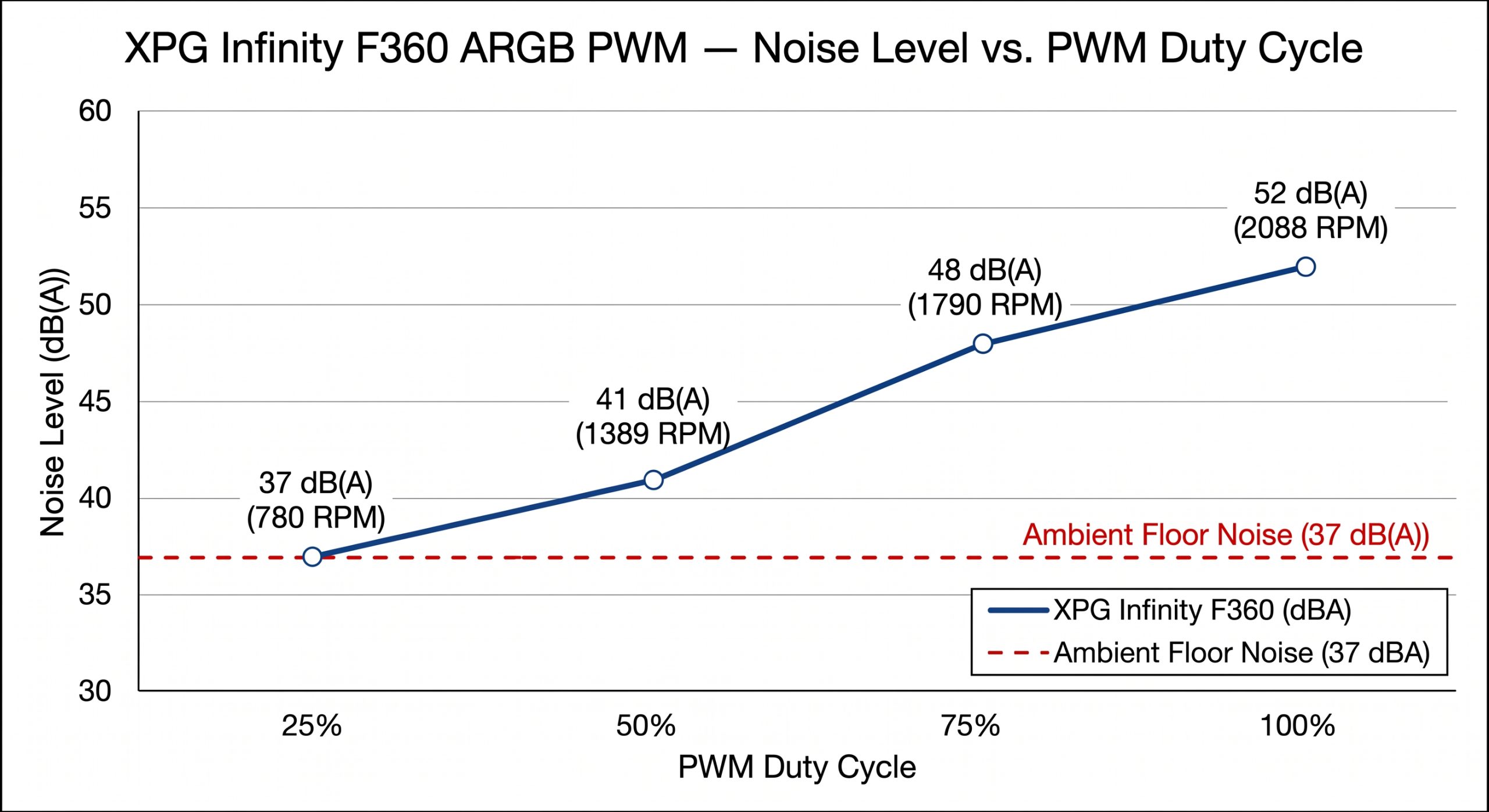
Here is the noise profile at different PWM ranges.
Should You Buy It?
Buy It If
✅ You Want Premium Infinity Mirror Aesthetics on a Tight Budget: At an outstanding price of just $37, the FX360 delivers a premium infinity mirror aesthetic with vibrant ARGB lighting.
✅You Despise Cable Clutter: Its single-frame design provides a clean, clutter-free look. It also features a single detachable cable that handles both PWM and ARGB signals for all three fans.
✅ You Want A Decent Noise/Performance: While it doesn’t deliver top-of-the-chart performance, it still offers decent acoustics and performance for its price.
Don’t Buy It If
❌ You Worry About a Single Point of Failure: Because it’s a single 360mm block, if a single motor or LED fails, you’ll have to replace the entire unit.
Final Thoughts
Fans Performance / Noise
The XPG Infinity F360 ARGB PWM delivered solid overall performance while staying true to its price point. It wasn’t the top performer in our tests, but it was right behind the Arctic P12 Pro ARGB, which is a high-performance fan.
Under a heavy 200W load on our 360mm liquid cooler, the XPG Infinity F360 running at 2100 RPM averaged 48.5°C delta over ambient, while the best-performing fans, such as the Arctic P12 Pro, managed 45.2°C in the CPU stress-test.
The Arctic fans were running almost 1000 RPM faster, which naturally translated into better performance. Still, you can’t overlook what XPG has achieved here. These fans could easily be paired with a high-end AIO to cool a CPU like the Ryzen 9 9950X.
Maximum performance comes at the cost of acoustics. In our noise-normalized tests, with all fans fixed at 40 dB(A), the XPG came close to the Arctic fans, trailing by just 2.9°C in thermal results. It is slightly less efficient than its competitors, suggesting that while the single-frame design offers better convenience and aesthetics, it may come at the cost of acoustic efficiency.
That said, in the bigger picture, the fans still performed really well, especially considering their price and overall design. We also didn’t notice any unusual noise or strange sounds when running the fans at higher RPMs.
Build Quality / Design
The XPG Infinity F360 ARGB PWM’s major selling point is its single-frame design. Aesthetically, it looks great, and there’s no cable clutter, which makes installation much easier by eliminating the mess of multiple individual fans.
There’s only a single cable coming from the frame, and instead of needing four screws for each fan, you only need four screws for the entire frame, which houses all three 120mm fans.
The fans also look stunning. If you’re into the infinity mirror design, this could be a great option. We didn’t notice any strange LED hotspots, and the ARGB effects looked clean, with smooth transitions between different lighting modes.
The build quality and overall hand feel aren’t the best, as it’s made from standard ABS plastic with a textured matte finish. That said, it still feels rigid and durable. For the price, it definitely punches above its weight class.
Value
The XPG Infinity F360 ARGB PWM isn’t built to set thermal or acoustic records. Still, it offers outstanding aesthetics and delivers decent performance and acoustics, priced at just $37 for black and $40 for white, with a 2-year warranty.
The F360 easily undercuts the premium fan market, competing with modular infinity setups such as a 3-pack Lian-Li Uni Fan SL Infinity or Corsair iCUE Link, which cost almost double or triple. If your primary goals are aesthetics with continuous side infinity glass and hub mirrors, the FX360 can offer a similar experience without costing much.
Thank you! Please share your positive feedback. 🔋
How could we improve this post? Please Help us. 😔

Senior Hardware Reviewer at Tech4Gamers with over a decade of experience in the tech industry. My journey began in 2014 as a senior administrator for Pakistan’s largest gaming community forum. I specialize in testing and reviewing components like graphics cards, CPU coolers, and motherboards, while also sharing insights on overclocking and system optimization.