
 Threads
Flagship Looks, Mid-Range Price
Review Summary
The ASRock Steel Legend 360 LCD is a robust, high-value liquid cooler that handles demanding CPUs with ease. While it trades a slightly thinner radiator for a lower price than its flagship sibling (the Phantom Gaming 360), it retains premium features like a 60Hz LCD screen and active VRM cooling, making it an excellent deal.
Hours Tested: 6

Overall
-
Cooling - 8.5/10
8.5/10
-
Build Quality - 9.5/10
9.5/10
-
Noise - 8/10
8/10
-
Value - 8.5/10
8.5/10
Pros
- Flagship 60Hz Display
- Simple Cable Management
- Integrated VRM Cooling
- Premium LCP Fans
- Excellent $160 Value
- Sturdy Build Quality
Cons
- Loud Max Speed
- Thinner 27mm Radiator
- No Fan RGB
- 360mm Only


We previously reviewed one of the Flagship all-in-one liquid coolers, the Phantom Gaming 360 LCD from ASRock, and it made a really strong impression in terms of features and performance. This time, we are reviewing the ASRock Steel Legend 360 LCD, which is one step down, targeting mid-range system integrators and builders. Though it’s $30 cheaper, they did not cut a lot in terms of features; they share the same core pump and the screen technology, but with different radiators, fans and the audience in mind. Steel legend utilises three Aerospace-Grade LCP (Liquid Crystal Polymer) fans, while the Phantom Gaming uses a single unified, single-frame design. Both coolers also feature a dedicated 70mm VRM-integrated fan and are backed by a 6-year warranty.
Similar to the ASRock Phantom Gaming 360 LCD Cooler, ASRock Steel Legend 360 LCD features the next-gen cooling pump with a dual-sided inlet cooling path, an LCD display with polychrome display control software, cooled by three industrial-grade dual-bearing aero space LCP fan blades, targeting high-end to mid-range system integrators and enthusiasts while providing good aesthetics. In this review, we will discuss its design, cooling, noise, and performance in depth.
Let’s talk about the specifications first
| Component | Specification |
|---|---|
| Compatibility | AMD: AM5, AM4 Intel: LGA1851, 1700 |
| Water Block | 100.4 x 86 x 107.6 mm Copper cold plate |
| Radiator | Dimension:(L)397 x (W)120 x (H)27 mm Material:Aluminum |
| Pump | Speed:1200 - 3100 ± 10% RPM Current/ Voltage:0.38A/ 12V |
| VRM Fan | 70 x 70 x 25 mm 0-3000 RPM, 0.12A/12V |
| Radiator Fan | Dimension:(L)120 x (W)120 x (H)28 mm Speed:0 - 2500 ± 10% RPM Bearing:Dual-ball Bearing |
| Screen | 3.4″ IPS LCD 480×480, 24-bit, 60 Hz USB Type-C to 9-pin |
| Tubing | IIR+EPDM 450 mm |
What Makes The ASRock Steel Legend 360 LCD Different?
Almost all-in-one liquid coolers on the market focus on RGB or display gimmicks. The ASRock Steel Legend 360 LCD stands out by prioritizing industrial-grade durability. It features high-end components such as an embedded VRM fan, LCP blades, and Dual Ball Bearing fans that significantly extend the cooler’s lifespan. It also emphasizes aesthetics by reducing cable clutter and including a 3.4-inch display inside the ARGB housing.
What About The Availability & Pricing?
This Cooler is available in only a single 360mm variant and is offered in white and dark black. There is no 240mm available at the moment. ASRock also offers 6 years of warranty for the AIO Cooler Module and 2 years for the LCD unit.
Packaging
Let’s take a look at the packaging!
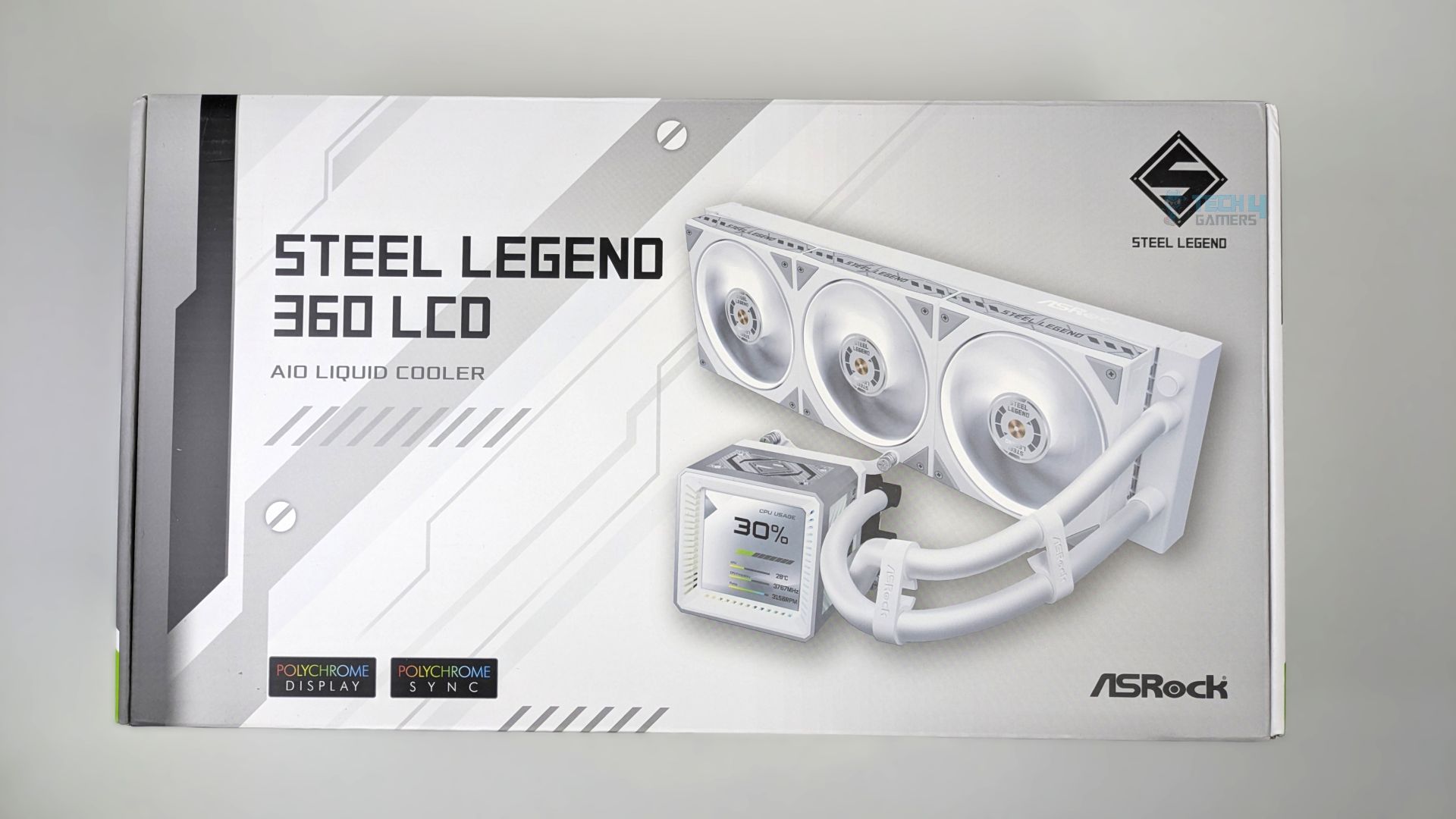
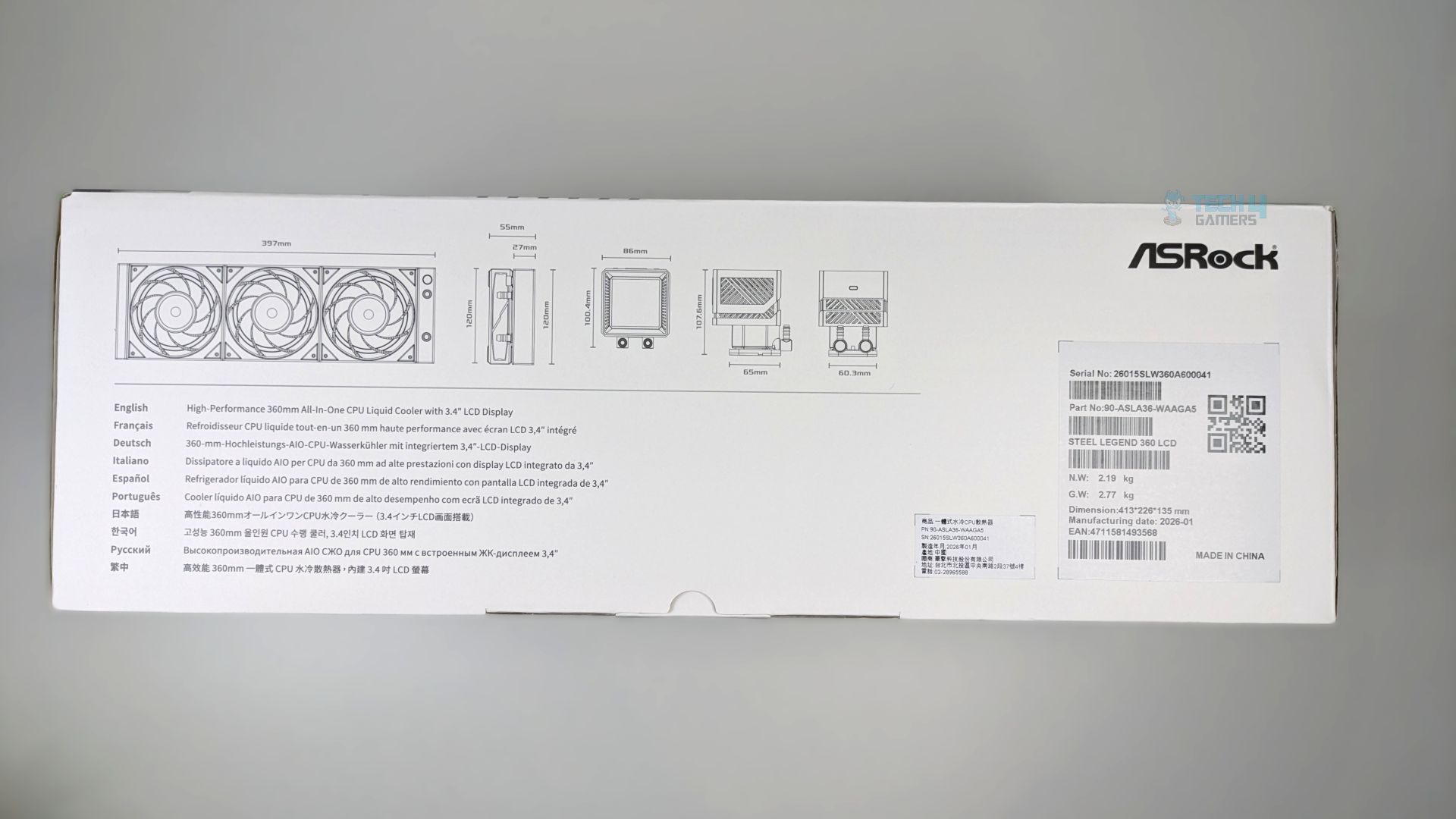
The box perfectly matches ASRock’s Traditional Steel Legend Motherboard packaging, with a clean white, silver, and light grey colour palette. The front side of the box also reveals the ASRock Polychrome Sync and Polychrome Display Compatibility.
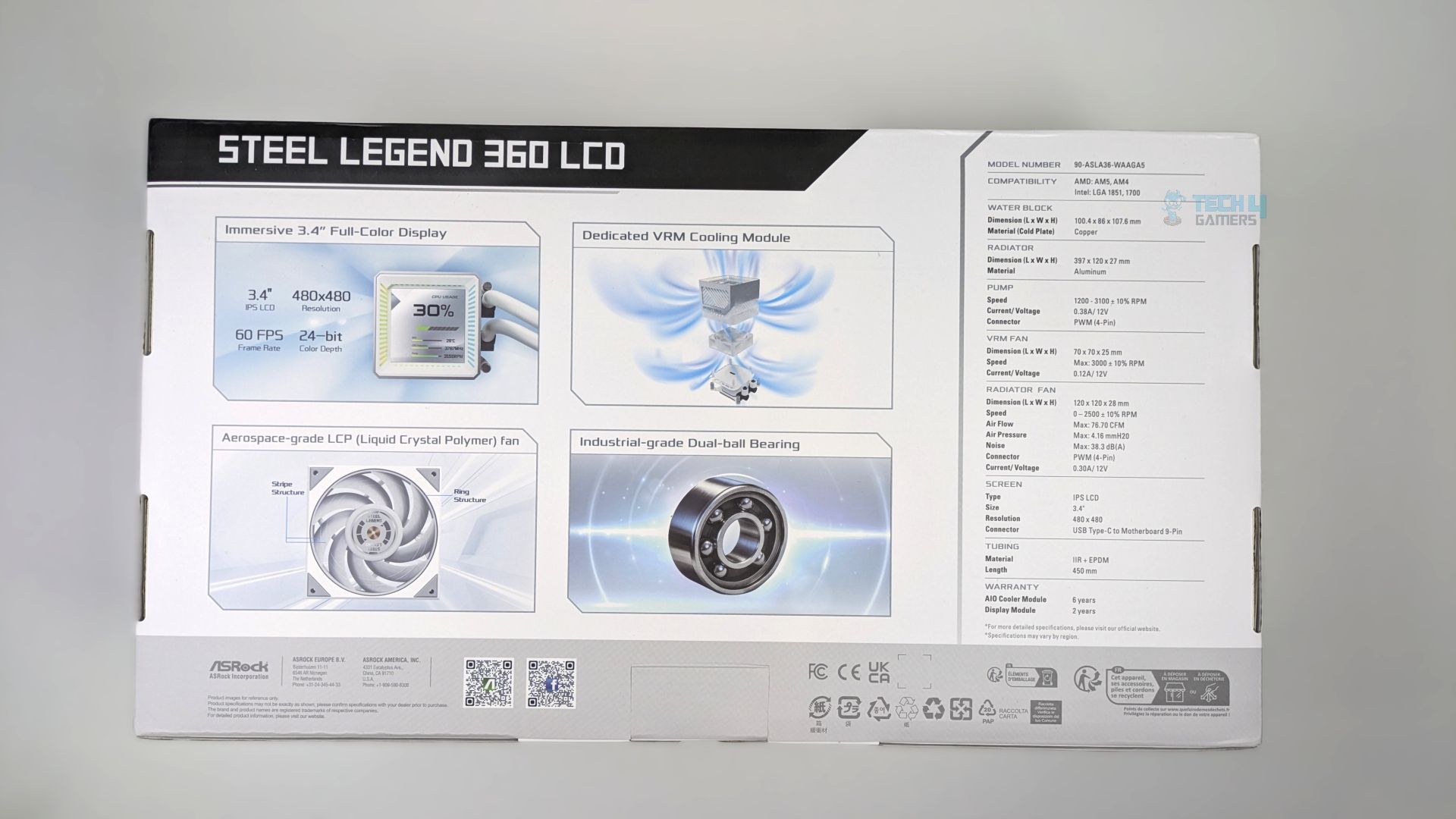
The back of the box highlights the cooler’s premium features, such as the 3.4-Inch LCD, the dedicated VRM fan, and LCP (Liquid Crystal Polymer) fan blades, which are the standout features of this all-in-one. The back also lists the liquid-cooler’s specifications.
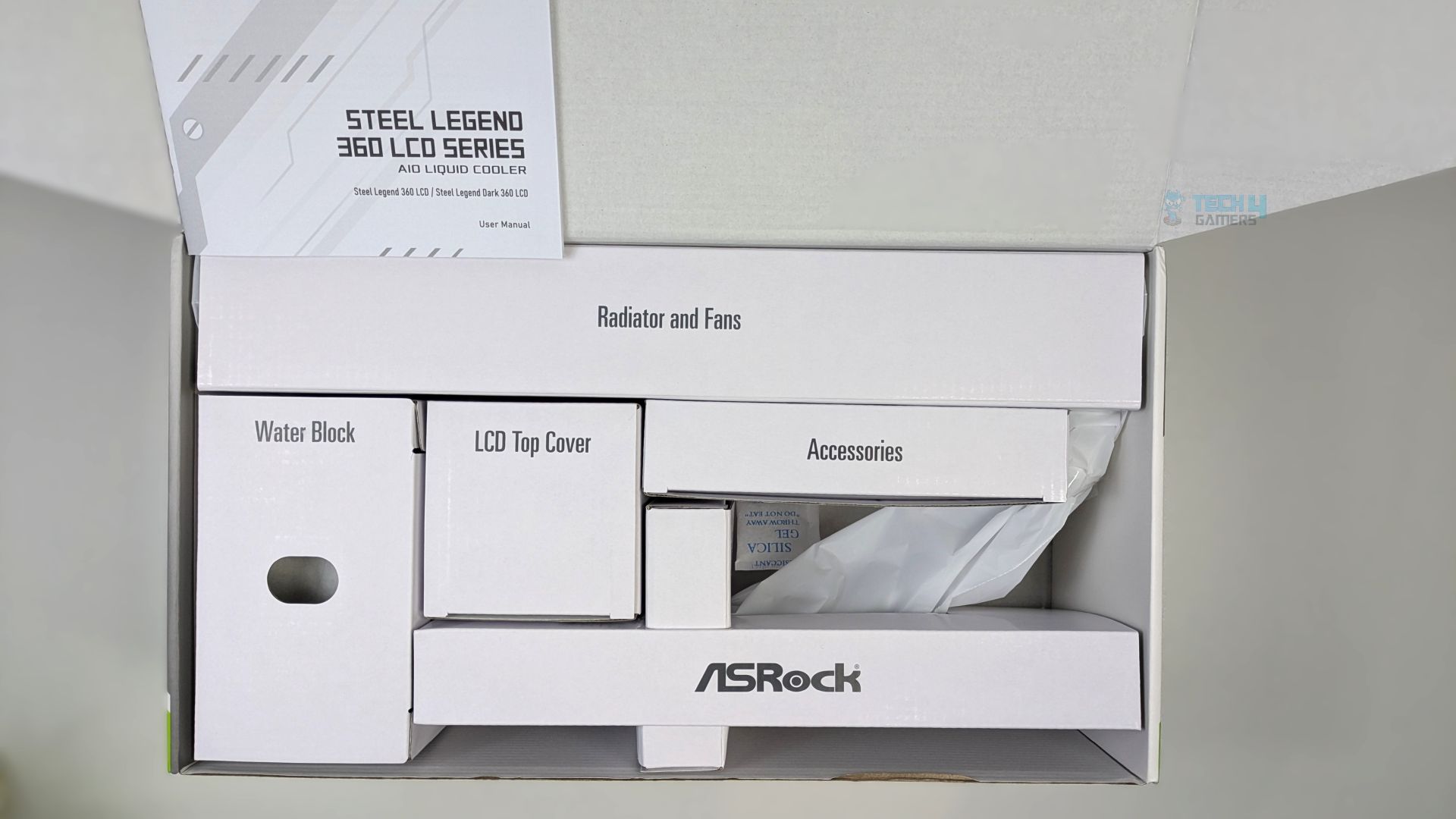
Well, this is where the packaging truly shines. ASRock has opted for the individual, precisely fitted white cardboard boxes. Every inner box is clearly labelled, making the unboxing experience feel incredibly premium and organized.
Accessories
Let’s take a look at the accessories.
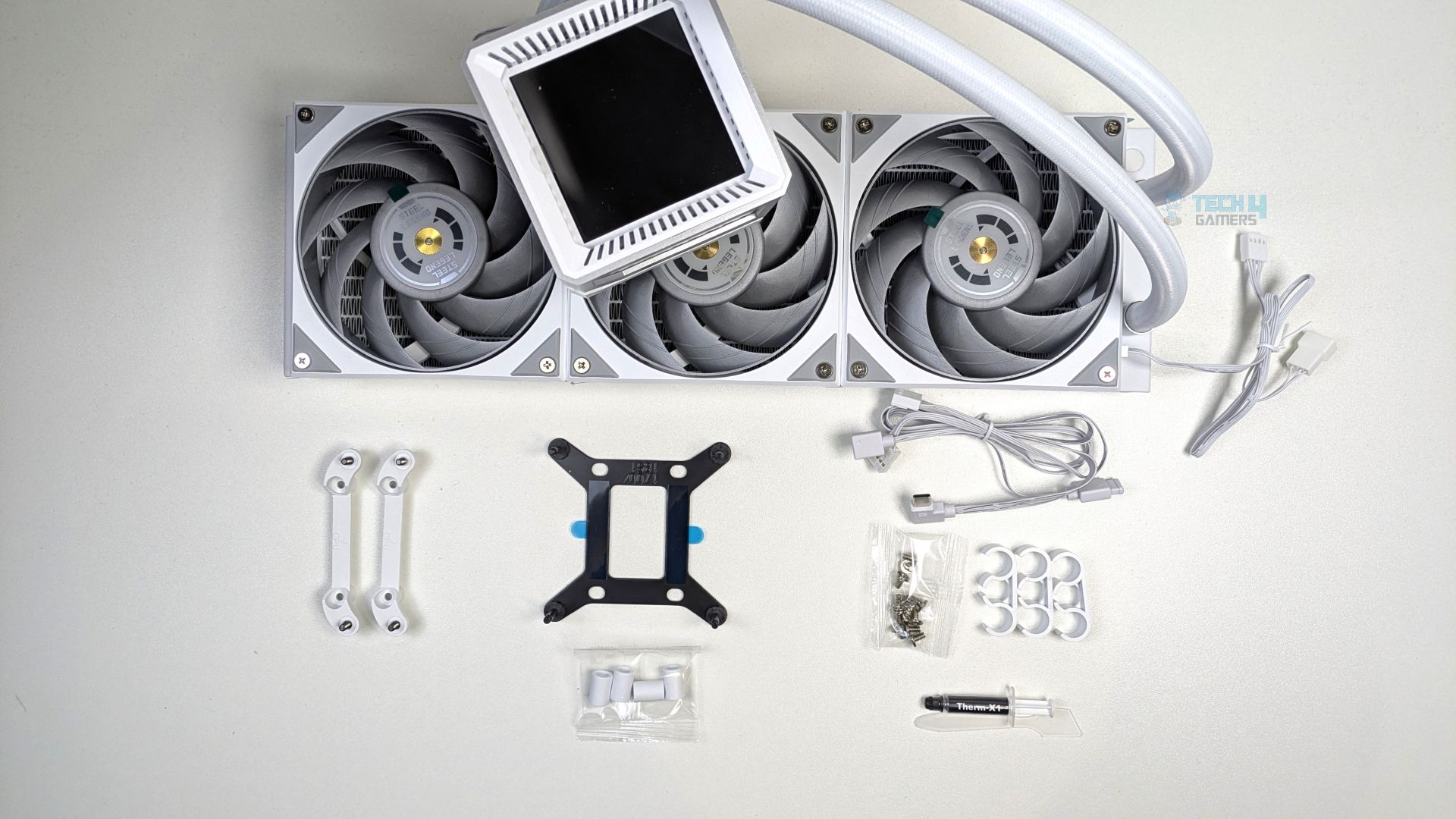
Just like the ASRock Phantom Gaming 360 LCD You don’t get a lot of mounting accessories with the ASRock Steel Legend 360 LCD, which is a good thing, as ASRock has kept it straightforward overall. The Intel bracket supports the LGA 1700/1851. In the accessories, Thermal Paste, Spatula, tube-clips and Type-C LCD cable are also included.
Here is the structured table of what you get inside the box:
| Category | Item | Quantity |
|---|---|---|
| Mounting Hardware | Intel Backplate | 1x |
| Intel Standoff | 4x | |
| AMD Mounting Bracket | 2x | |
| Radiator/Fan Screws | 12x | |
| Cable | USB Type-C to Motherboard 9 pin | 1x |
| Tools | Thermal Paste + Spatula | 1x |
| Tube Clip | 3x | |
| User Manual | 1x |
Close Look At The Radiator and Assembly
Let’s take a look at the assembly first. The fans are preinstalled on the radiator and use an interlocking, cable-free daisy-chain, where the fans must click together to share power. This all-in-one carries the traditional steel-legend theme, the pure white paired with the darker grey blades creating a really nice two-tone contrast. Overall, the cooler provides an industrial vibe with a few gold and brass accents on the fan hub.
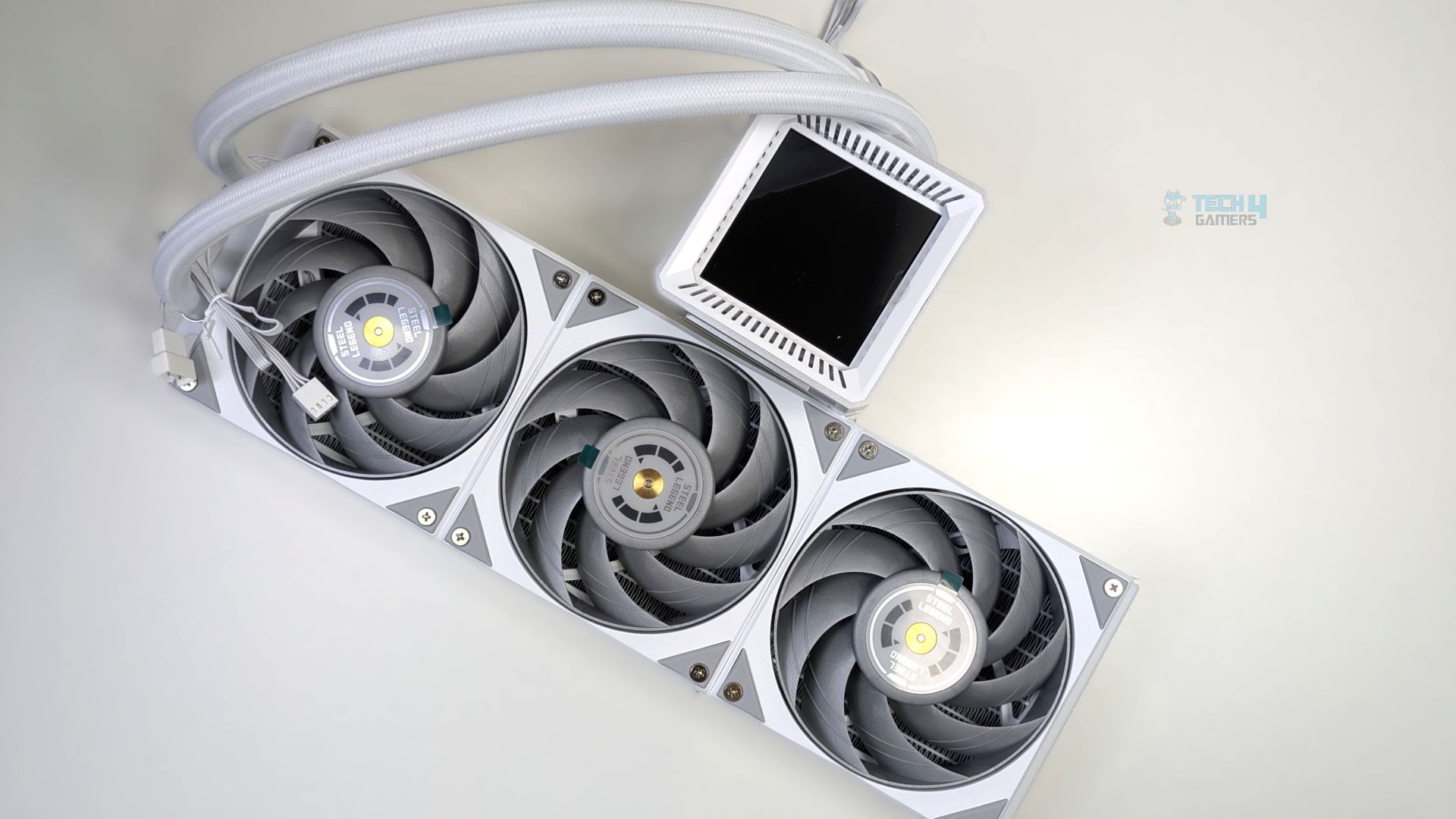
The radiator dimensions are standard: 397x120x27mm (LxWxH), not including the fan height, and it is made of aluminium. Make sure your case supports 360mm radiators and has enough clearance.
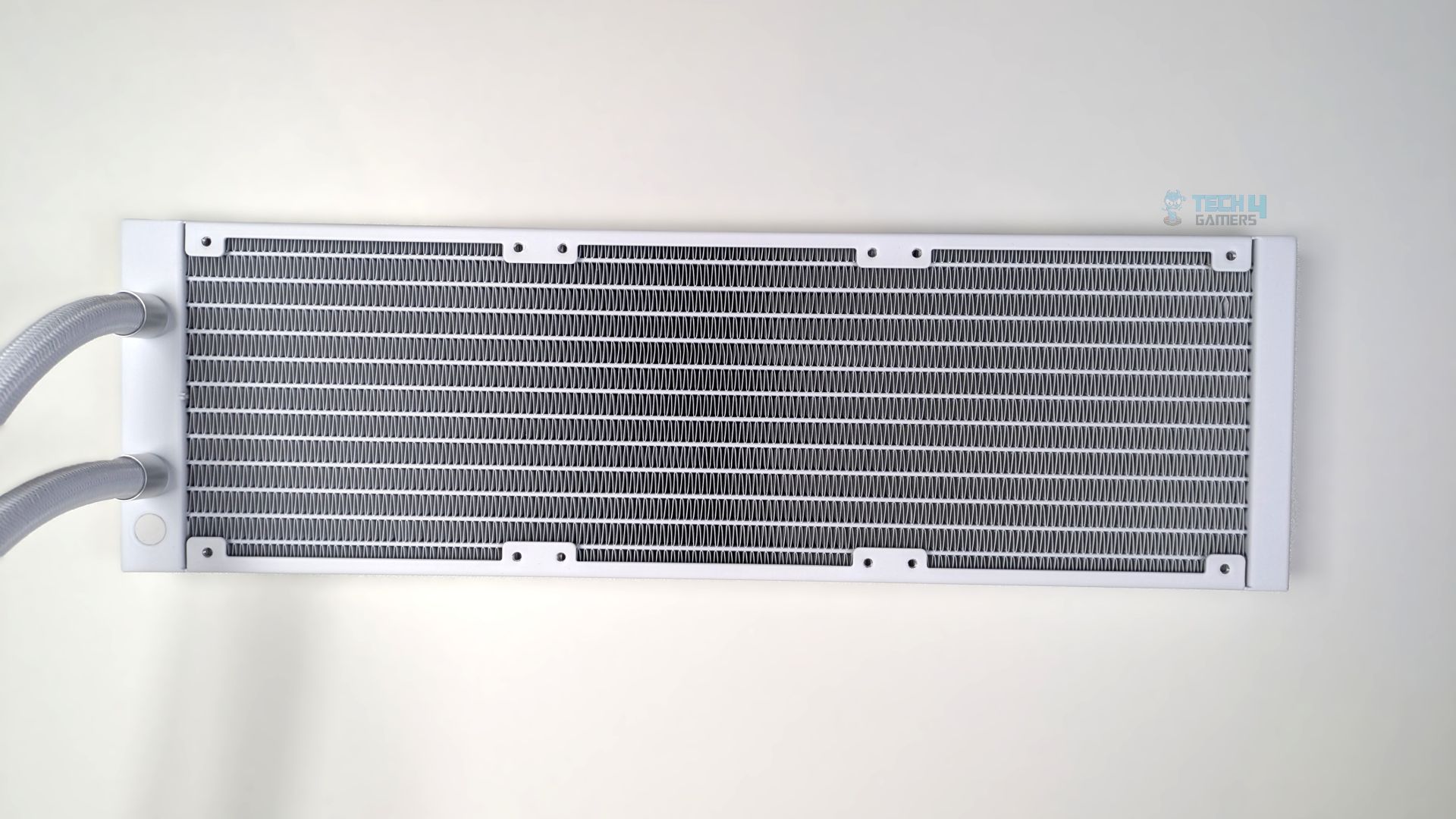
The radiator uses the standard dense fin-stack design. The FPI (Fins Per Inch) is 20, and the radiator has 12 water-flow channels.
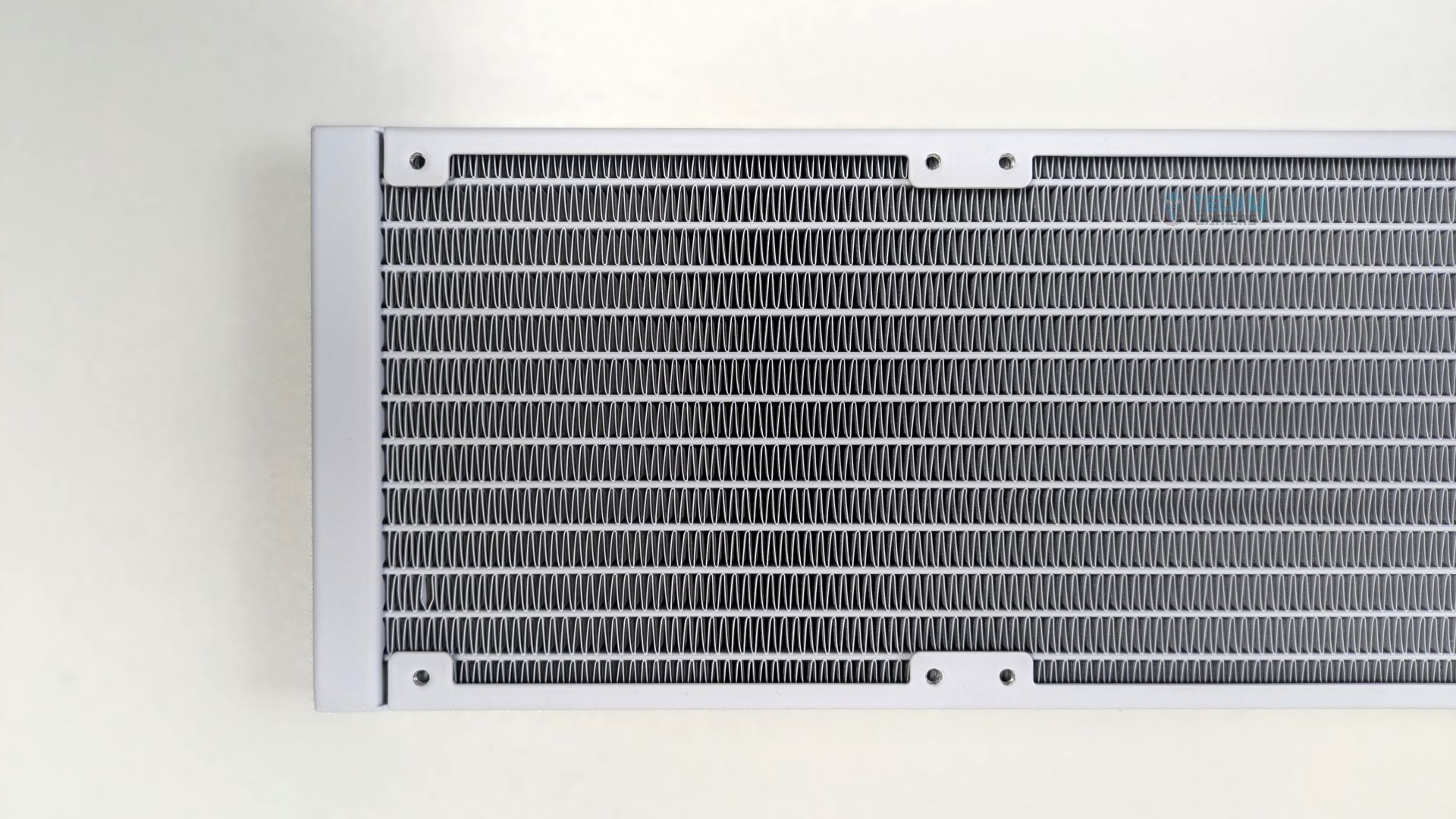
The ASRock Logo can also be noticed on the side of the radiator.
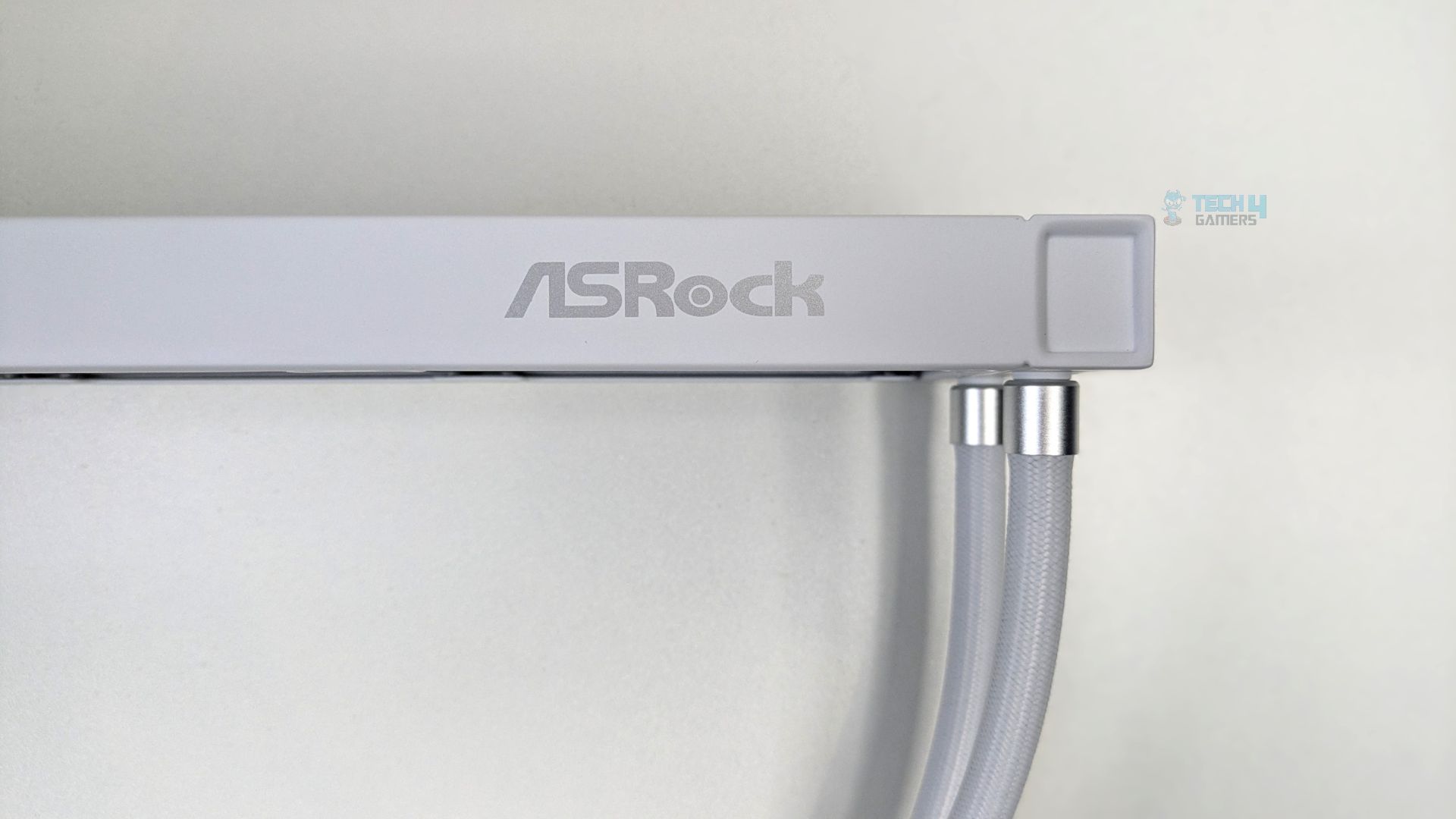
The tube length is 450mm in total, which is longer than the standard you see in traditional all-in-ones; generally, the tubes are not longer than 400mm.
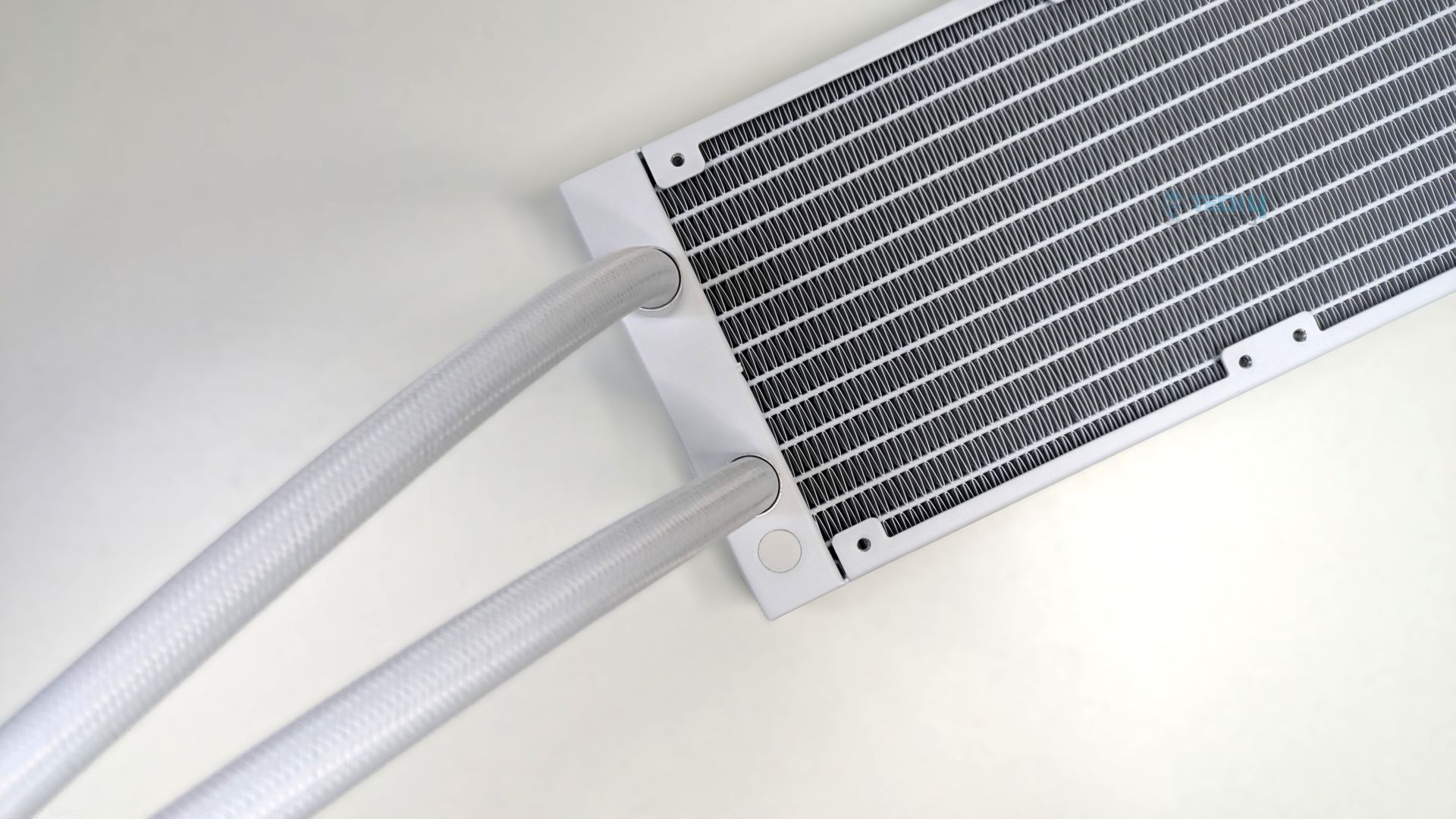
The tubes are premium-grade here, as they use IIR (Isobutylene Isoprene Rubber) and EPDM (Ethylene Propylene Diene Monomer), both of which offer very good heat resistance and a longer lifespan.
Pump Design / Housing
Let’s take a look at the water block.
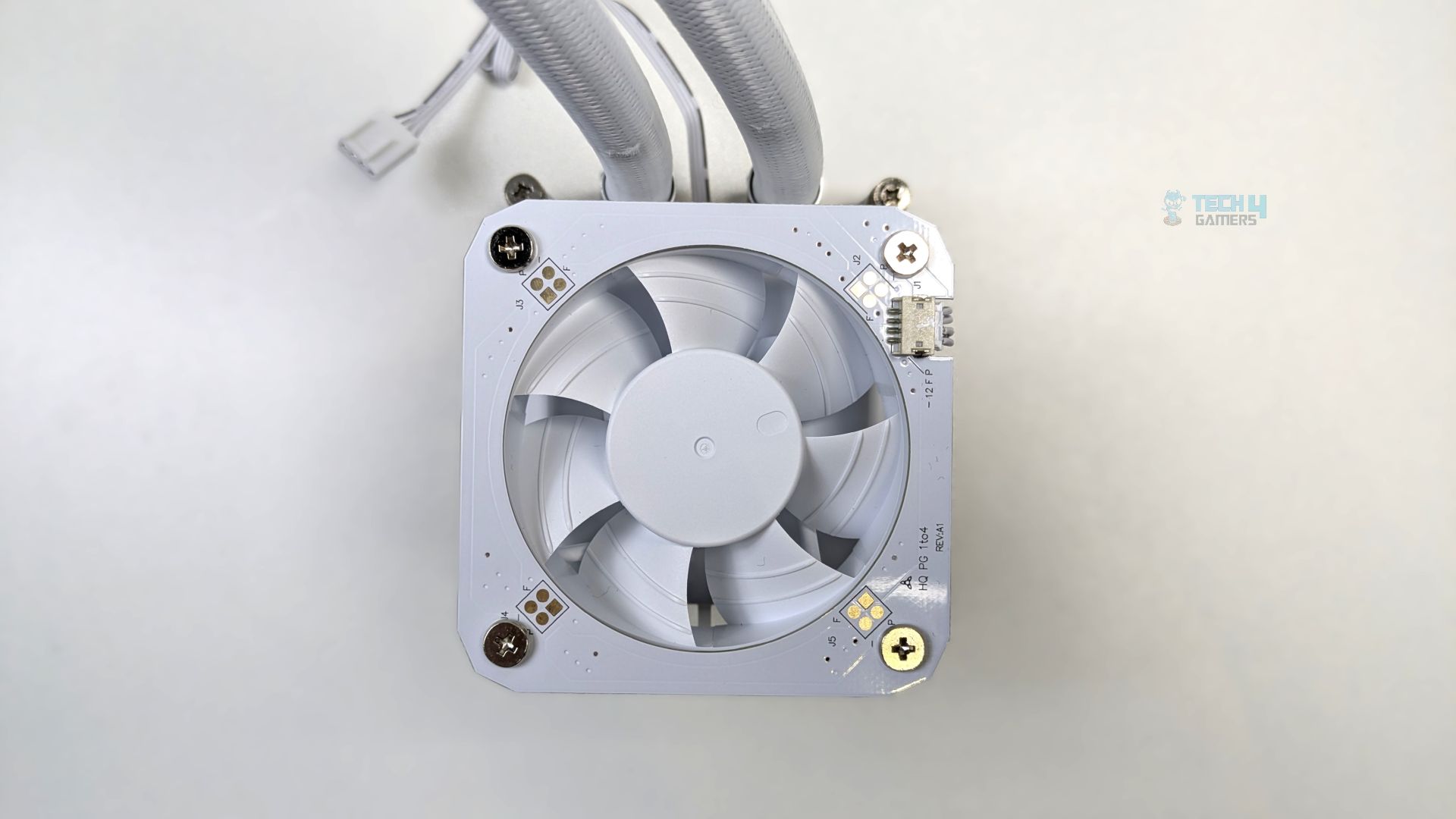
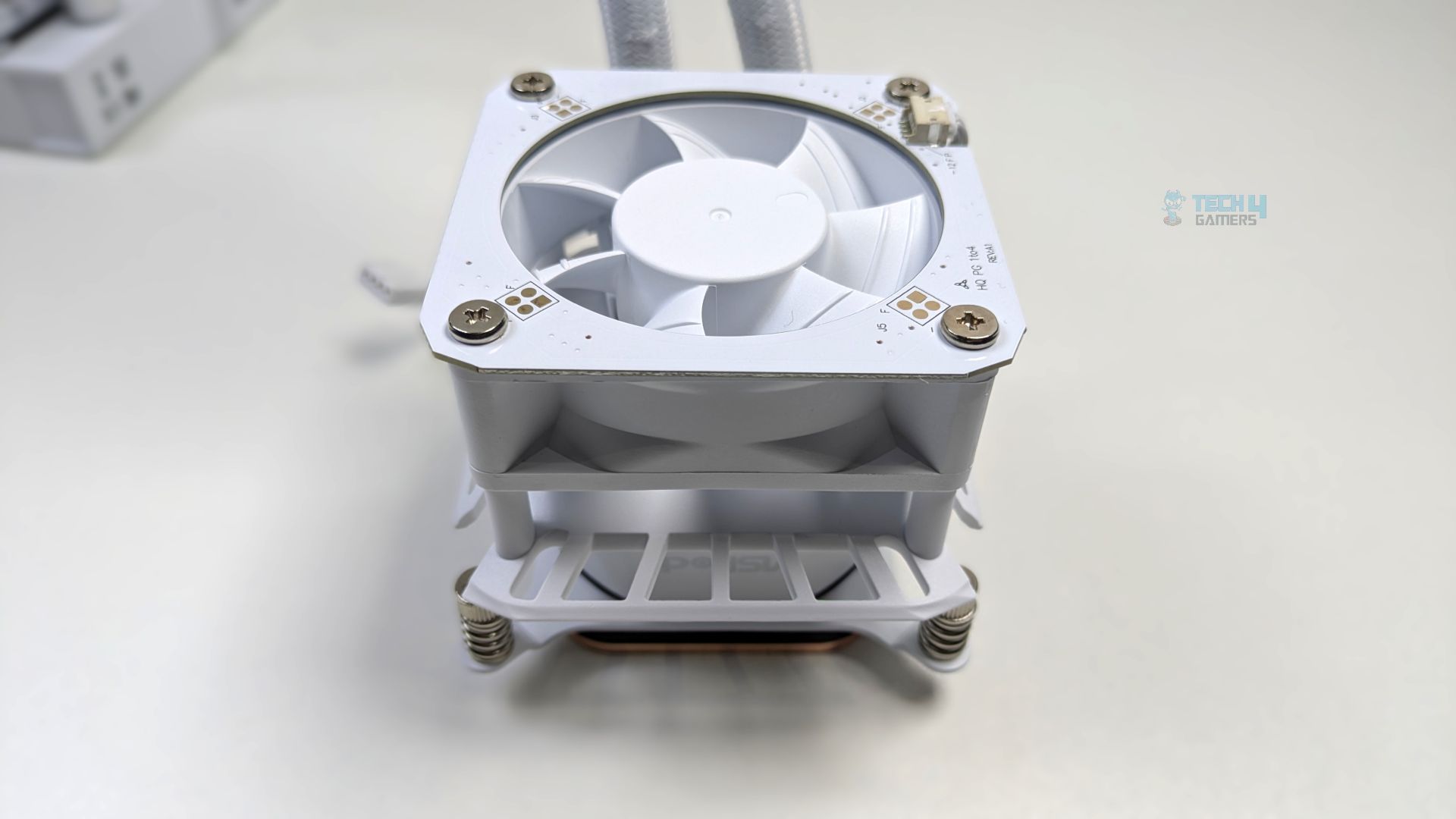
The ASRock Steel Legend 360 LCD takes a functional, modular approach by integrating an active VRM fan to cool the motherboard under sustained heat. This open-frame design directs airflow directly toward the motherboard socket area and surrounds the motherboard’s power delivery. The fan uses a swept-blade design with a stark white housing, maintaining the steel legend’s Aesthetics.
If you look closely, you can see the exposed gold contact pads in the corner and a small multi-pin connector on the edge for the LCD module.
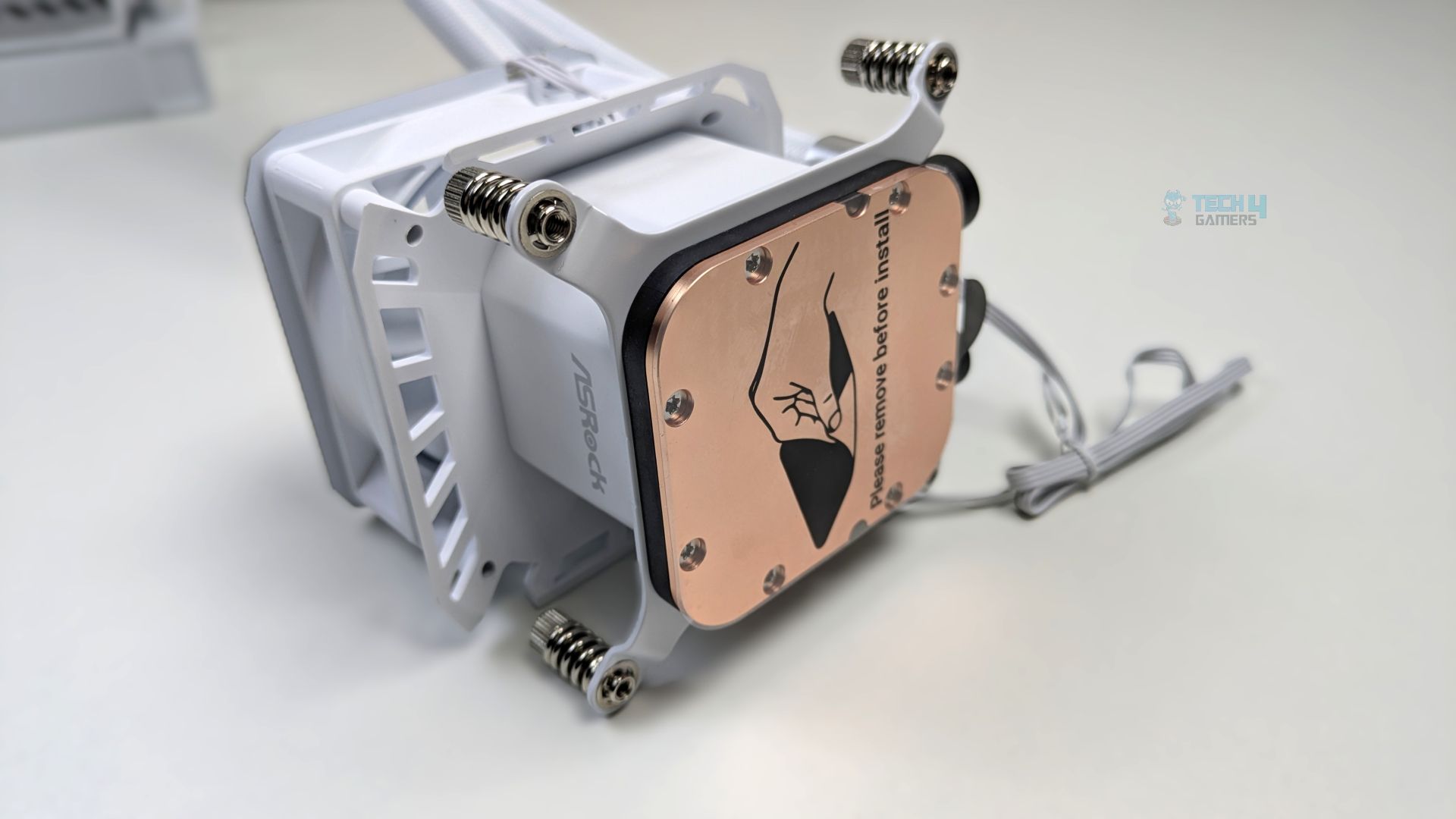
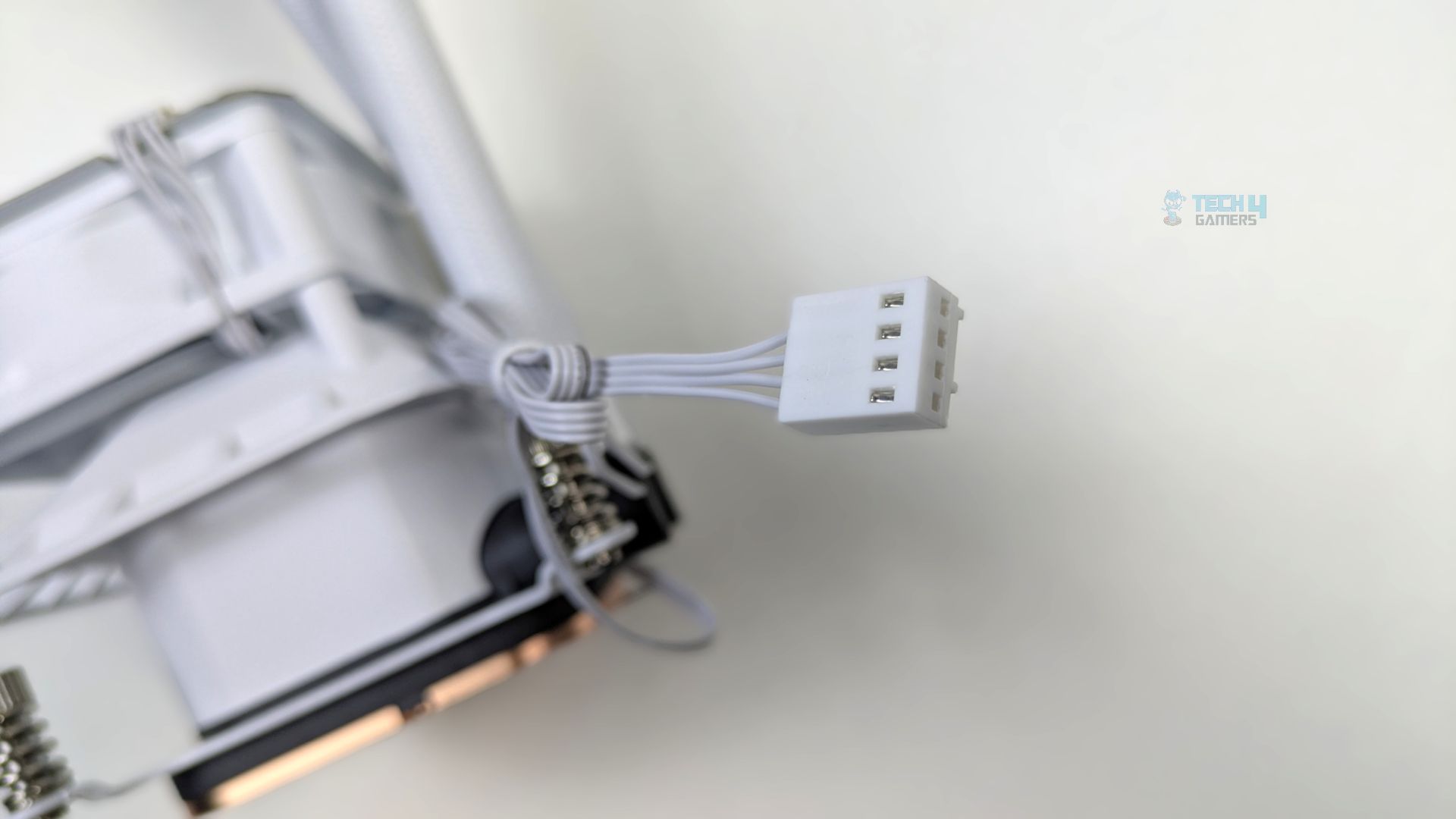
The mounting arms are preinstalled on the water block, along with the captive screws, simplifying the installation process. The water block is powered by a 4-pin PWM controller, allowing you to adjust its speed.
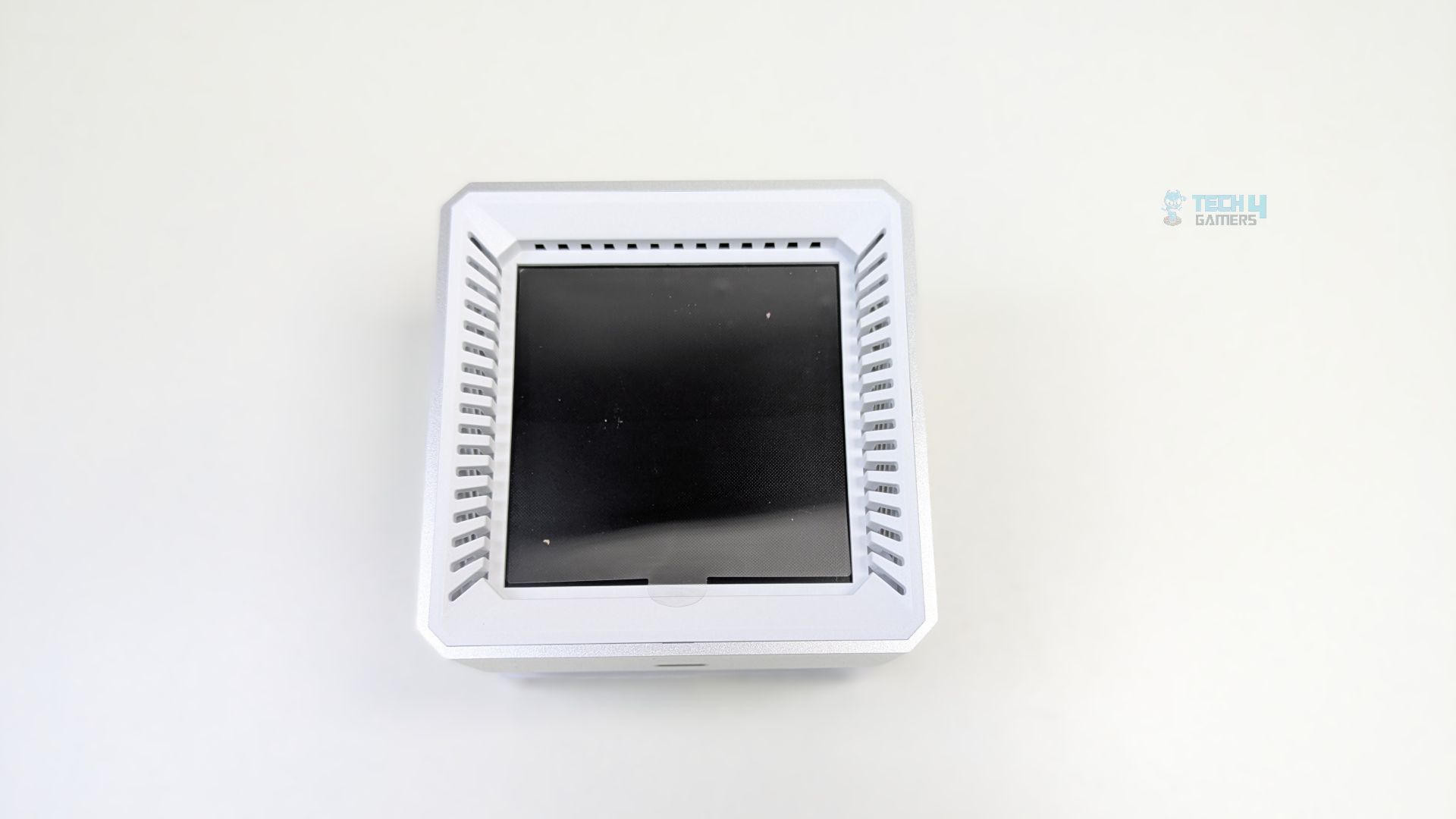
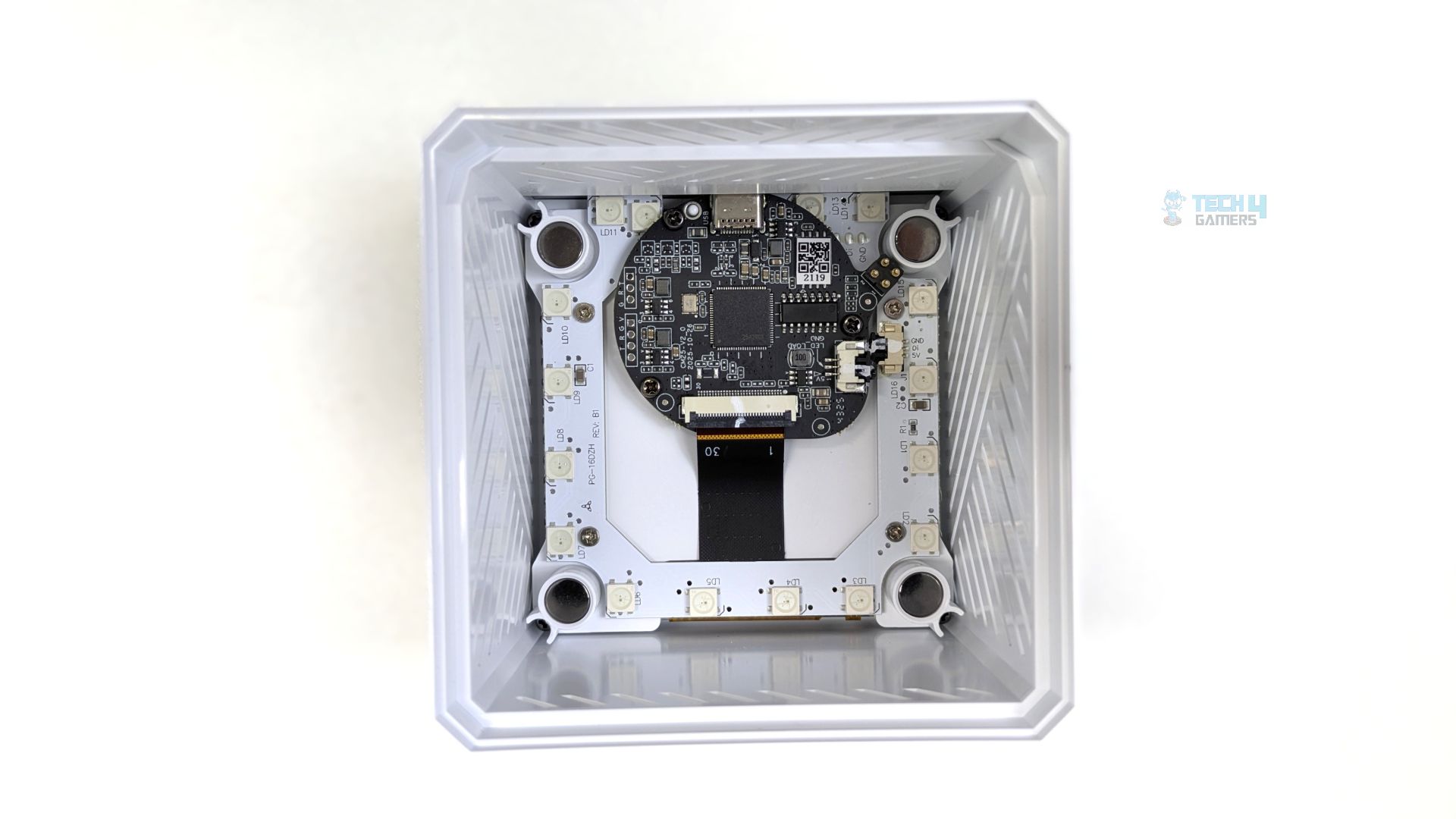
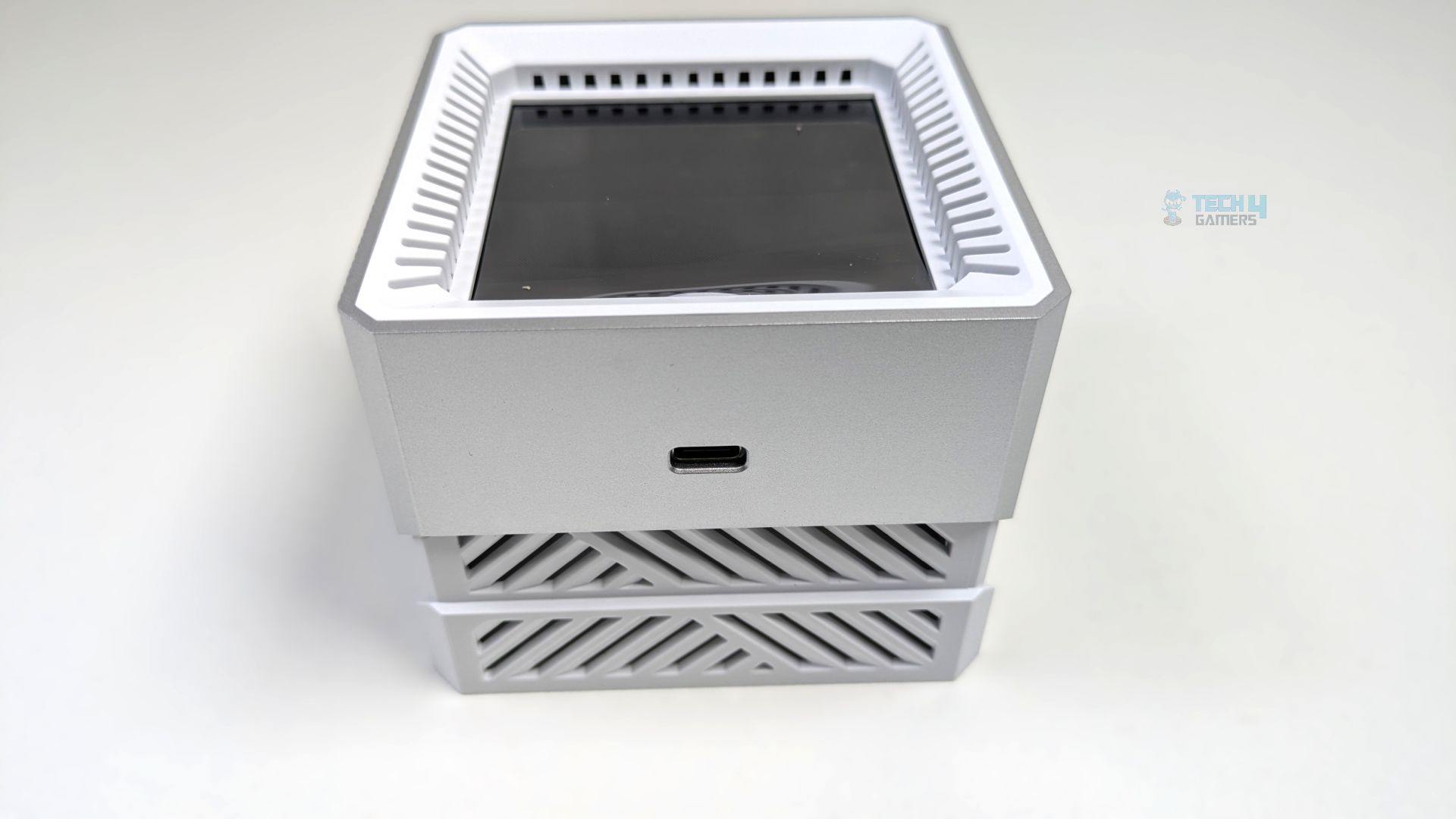
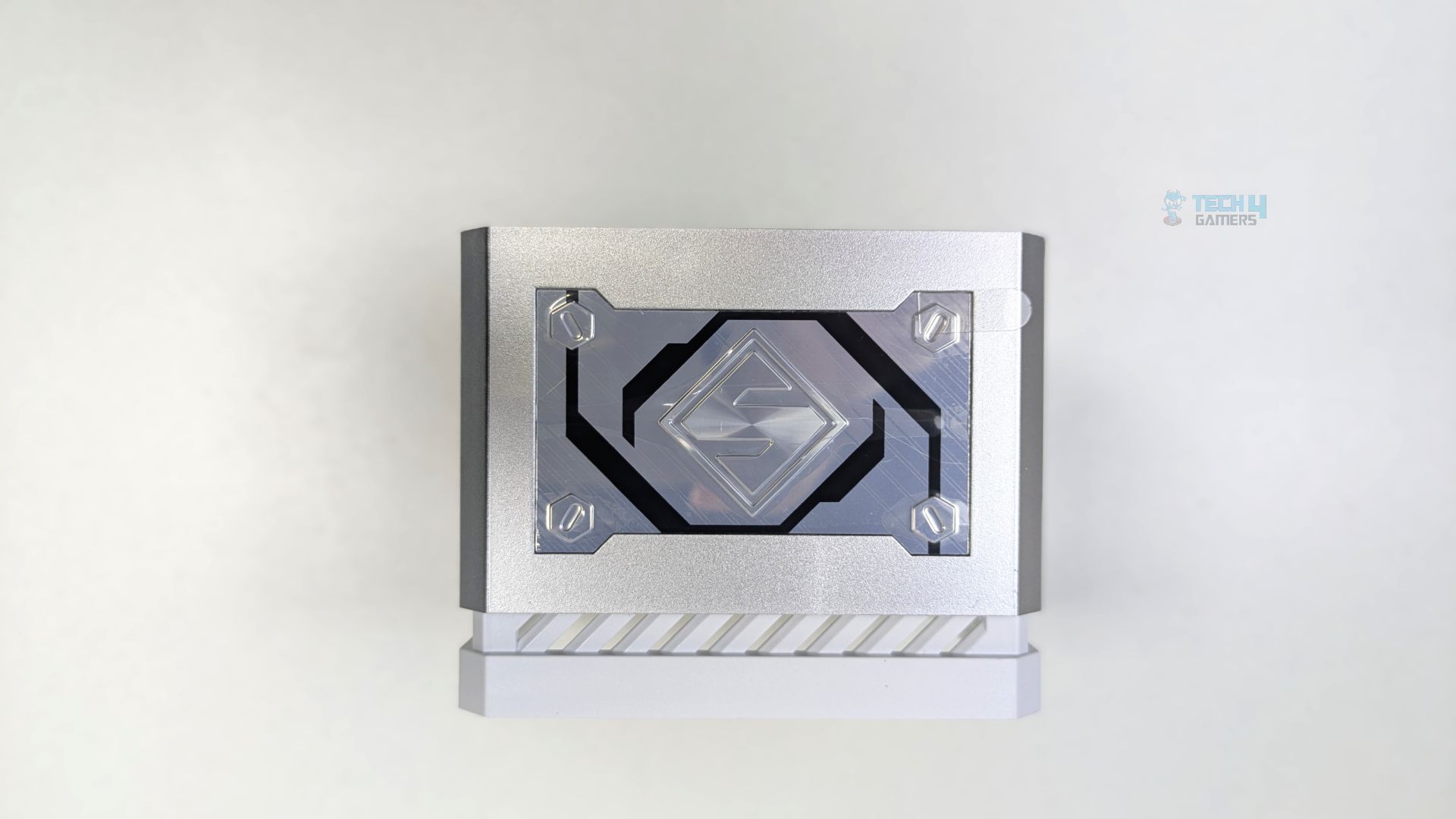
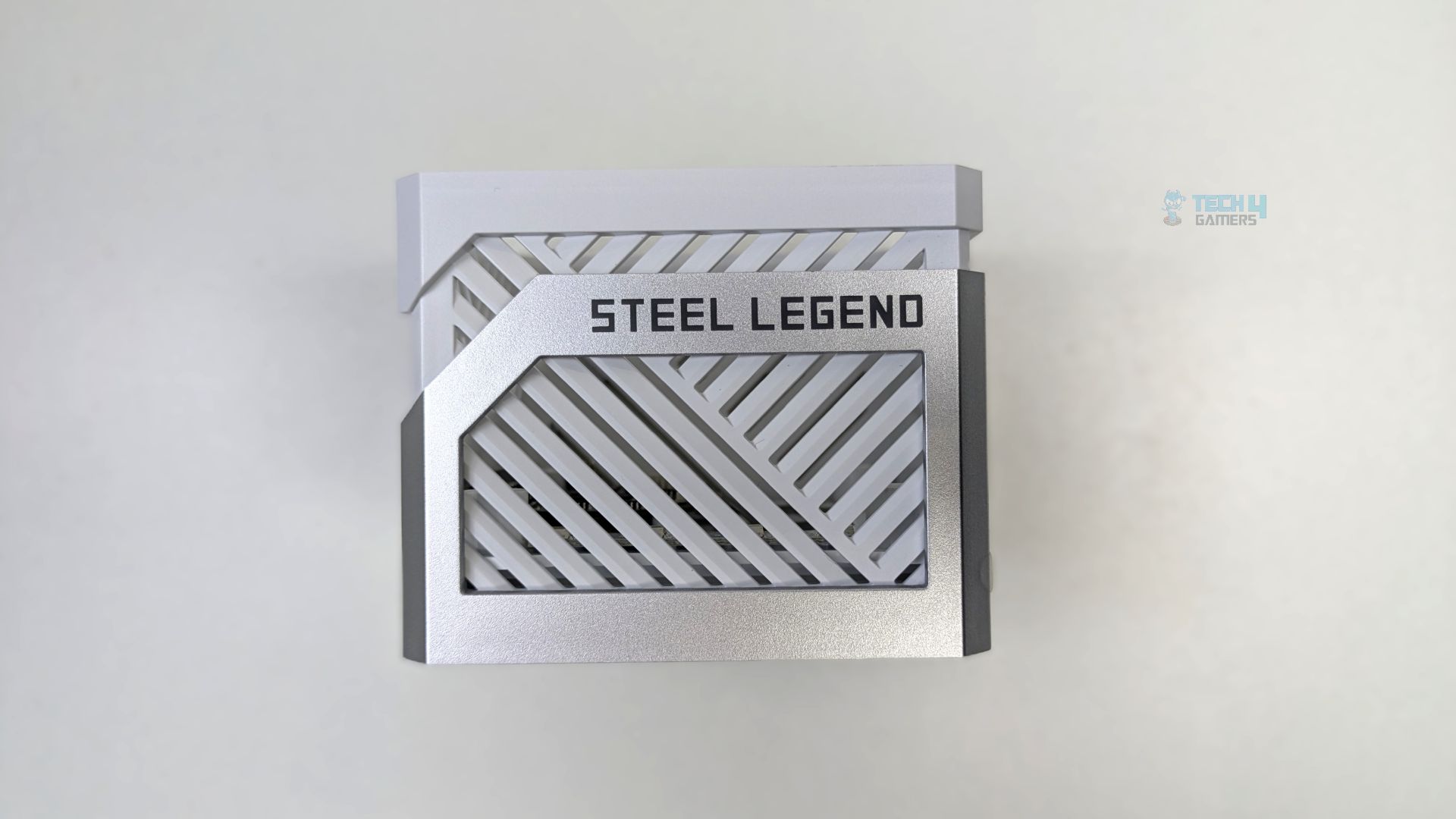
This detachable LCD module slides on the top of the water block for connectivity. Design-wise, this module features a stark white and silver colourway that blends well with the white builds. ASRock has made heavy use of diagonal, slatted venting. On the side profiles, ASRock has also added its branding.
The module supports Type-C connectivity, which requires the cable routing from the motherboard to the module.
Display
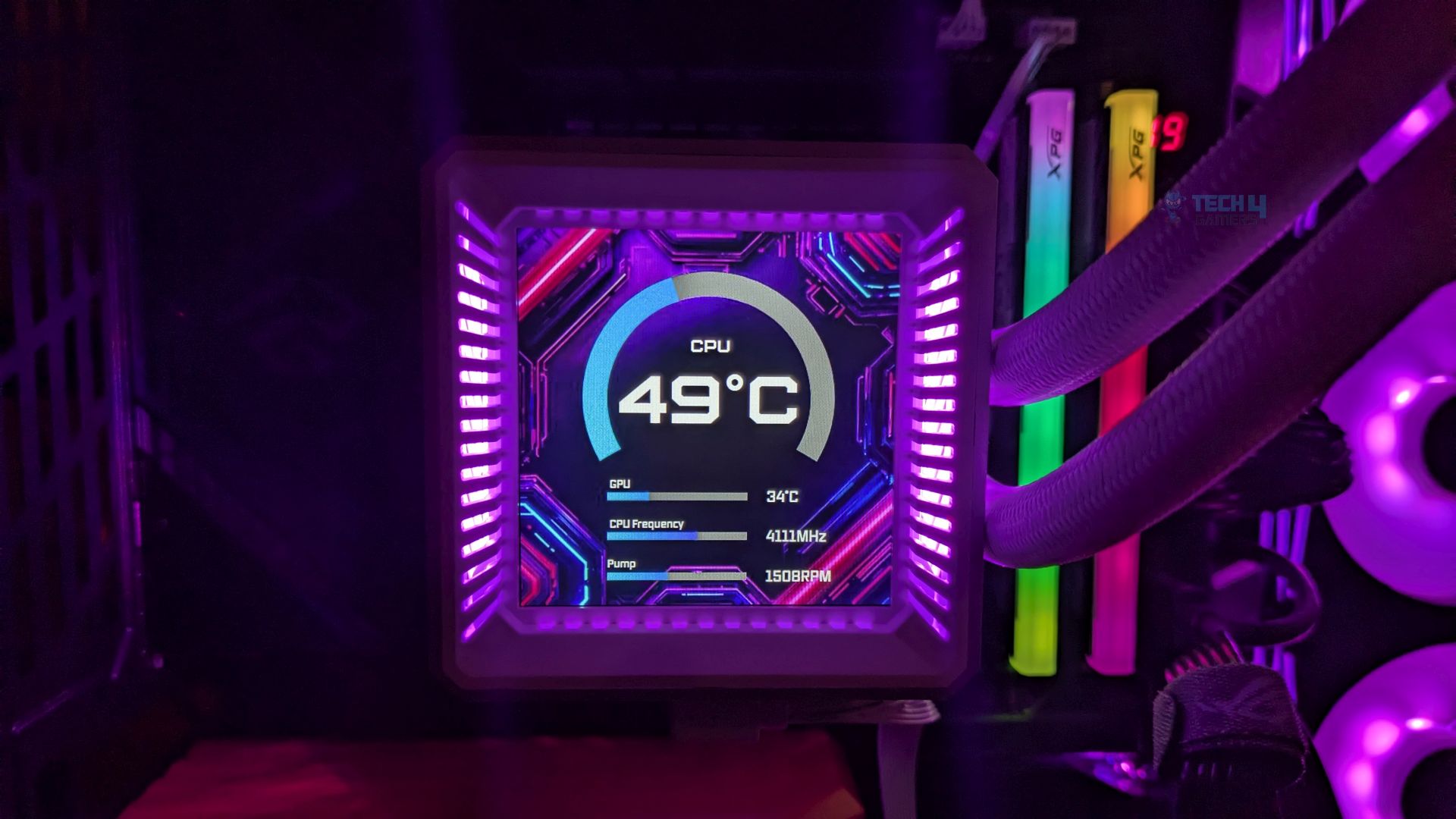
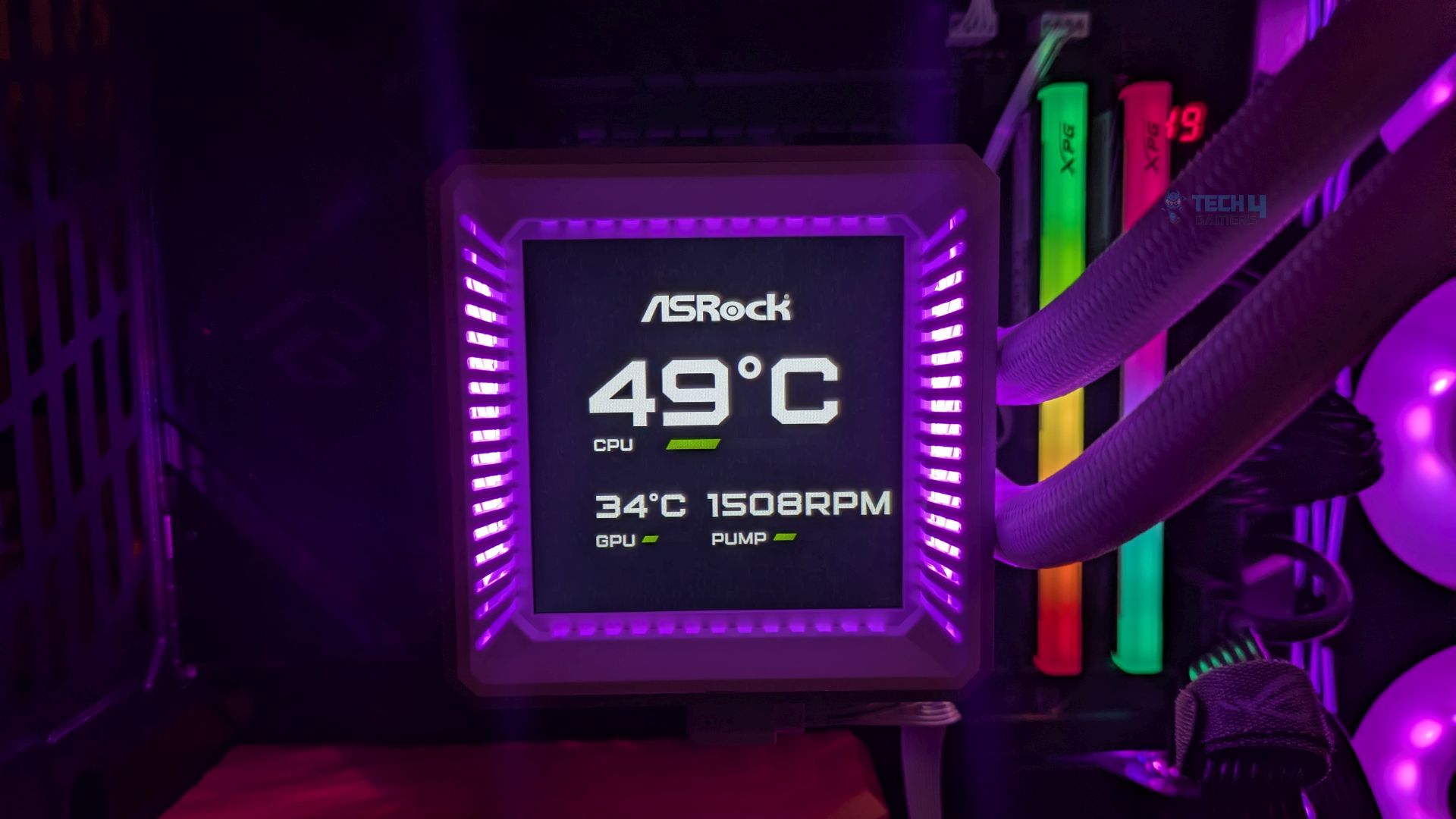
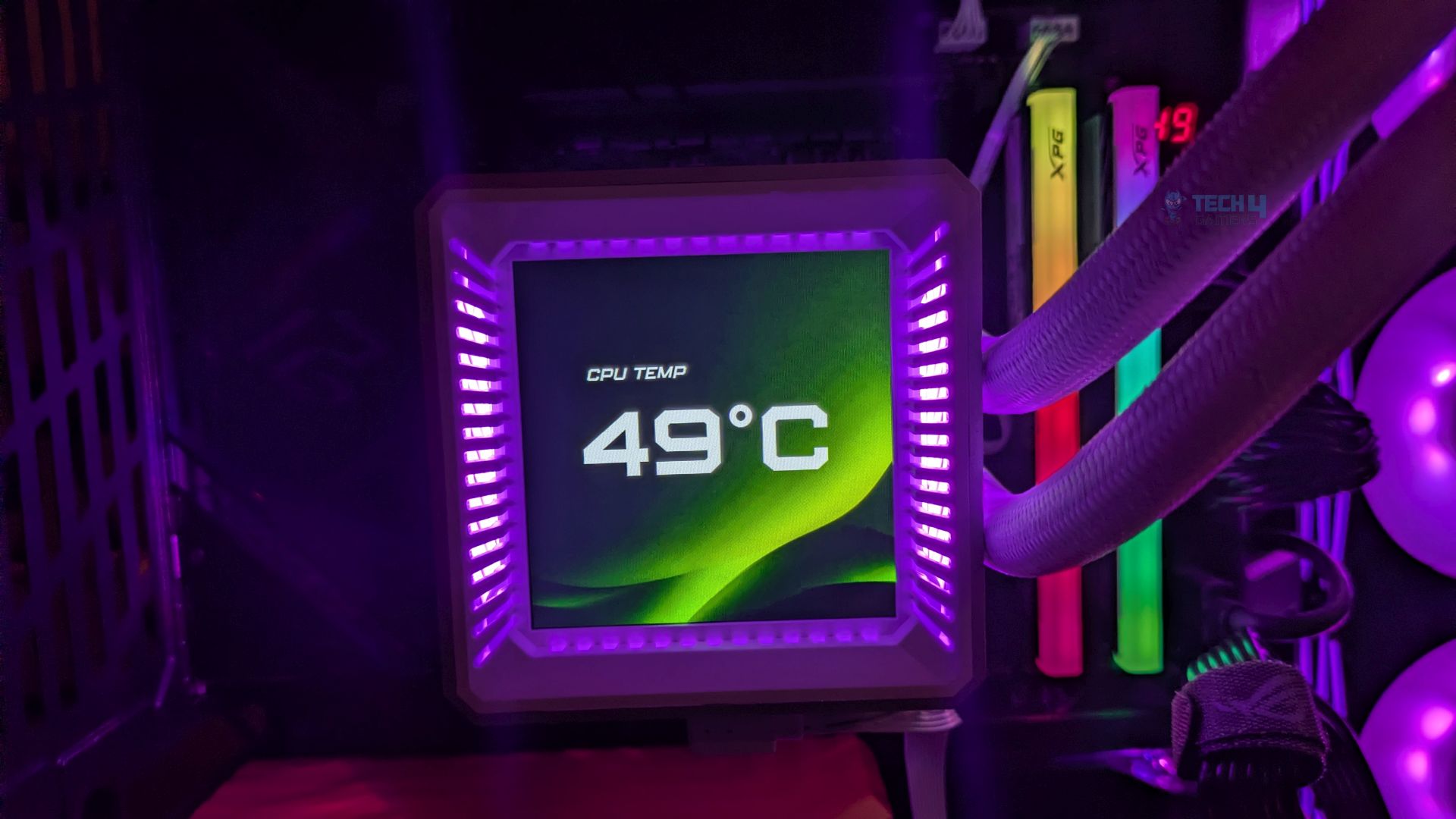
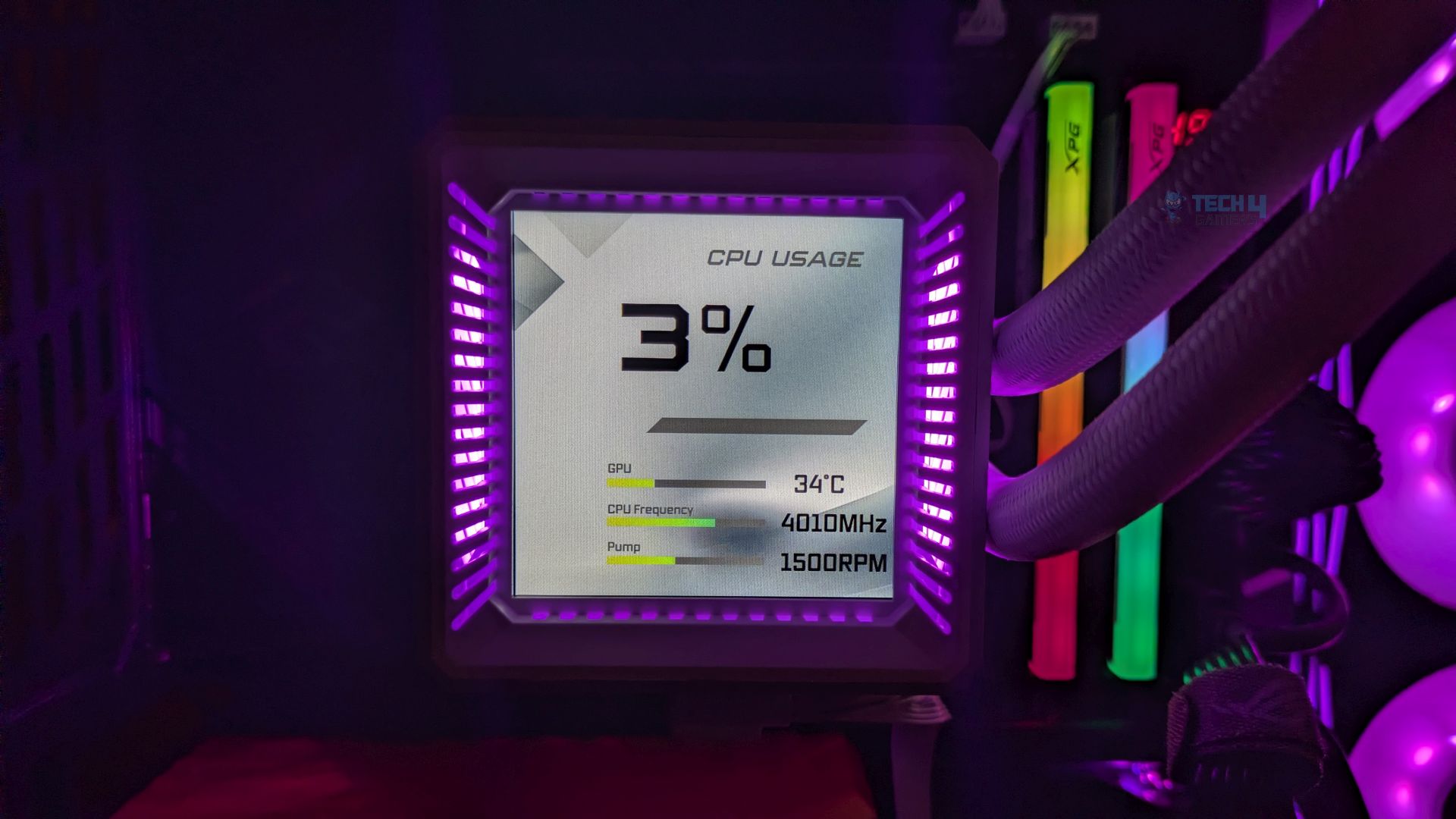
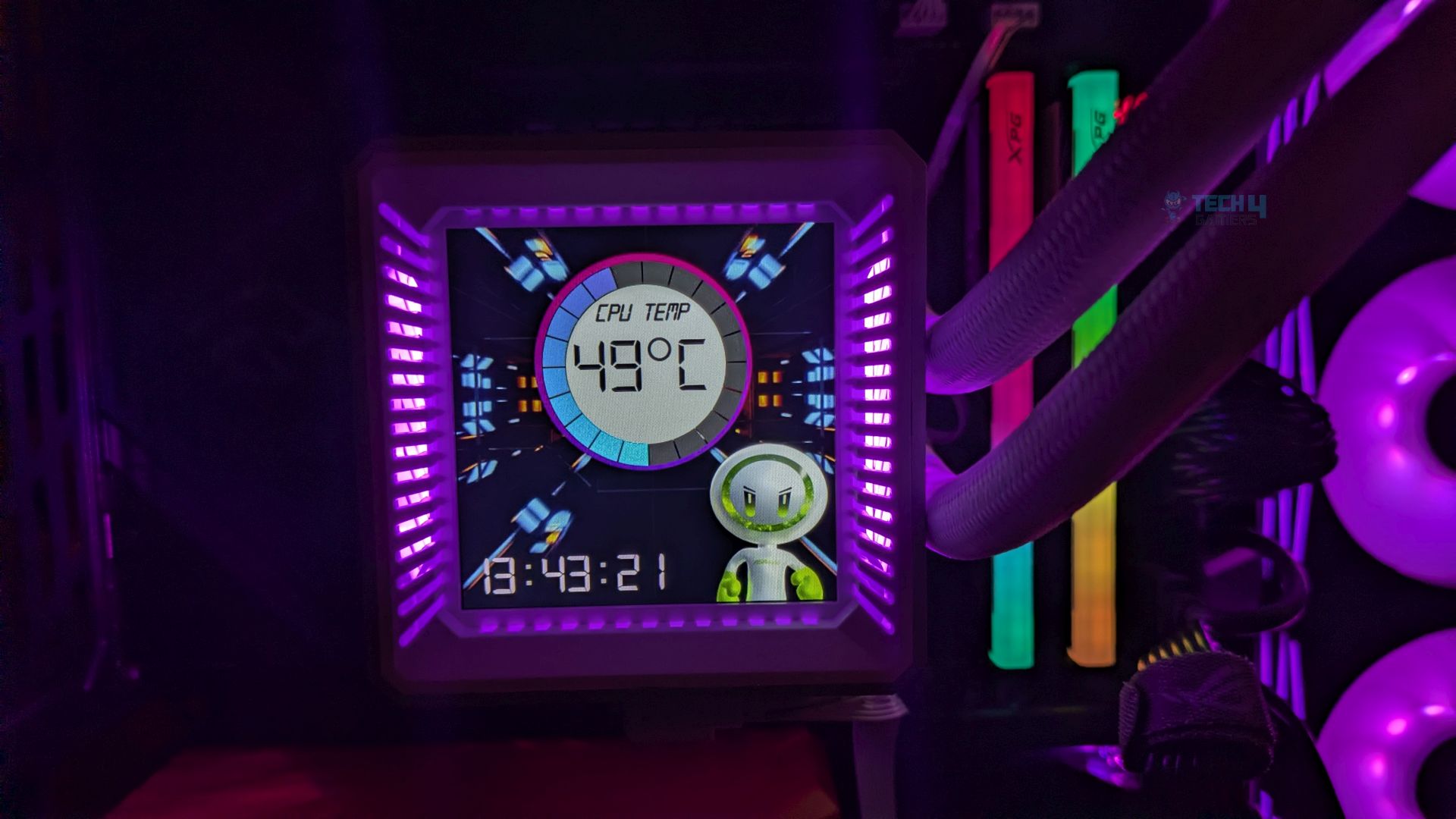
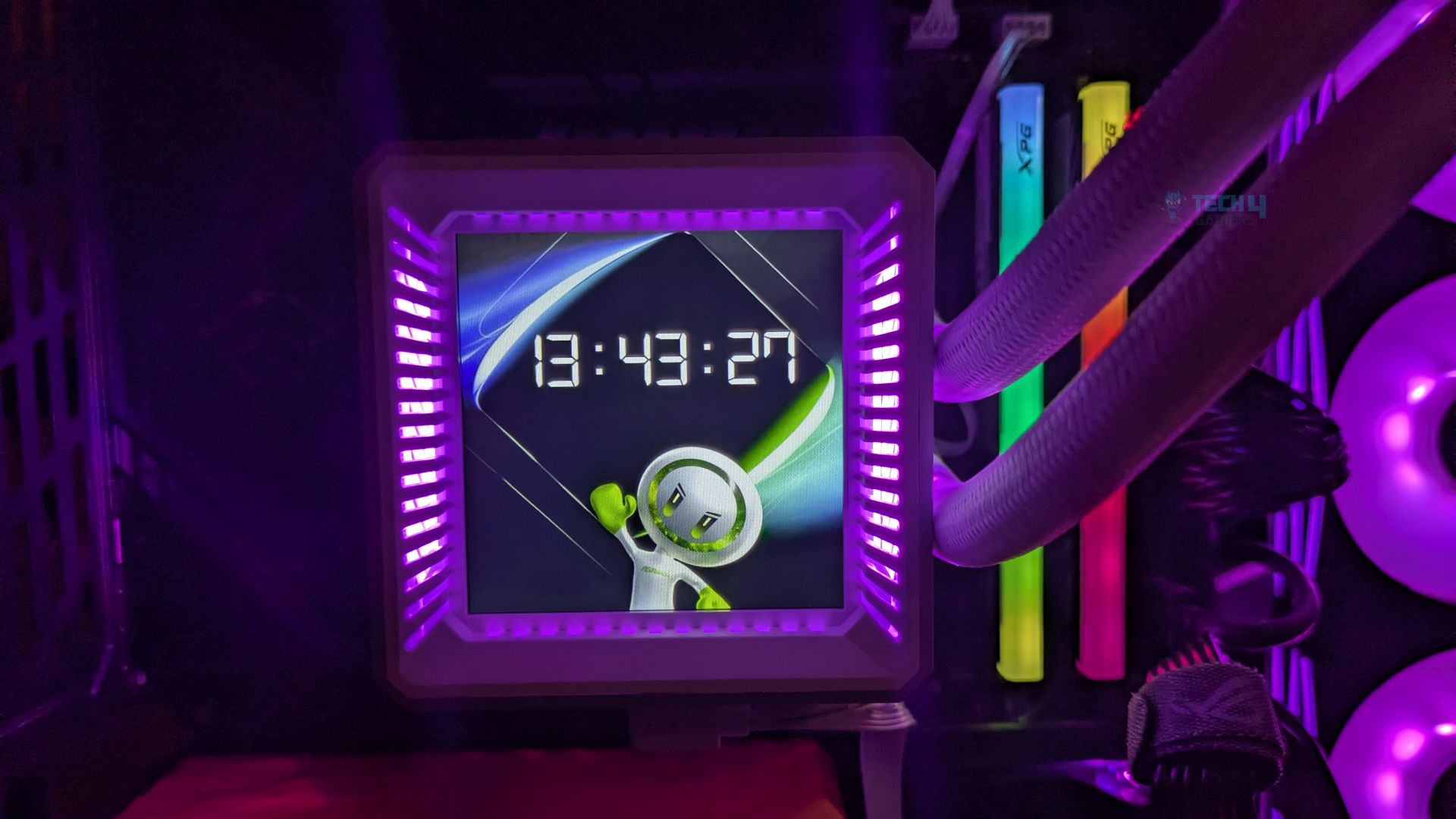
The Display is an IPS 24-Bit 3.5” Full Colour LCD Display and supports 480×480, which also supports the 60Hz Refresh Rate, which you often see in the high-end all-in-one liquid coolers. Since it’s an IPS panel, not the TFT design you may see on cheaper LCD all-in-one designs, the view angles are great, and the screen features punchy colour saturation with decent contrast, even in a dark PC case.
The black look would be relatively deep. The bright green and purples pop without significant blooming. ASRock has provided us with the 6 pre-installed layouts in their software.
The display can be customized through Polychrome Display Software. It supports sensor reporting, and the widgets and preinstalled themes are also included. The LCD also supports MP4 video playback and a wide range of formats, including JPEG, GIF, PNG, and BMP, on the panel.
Fans
Let’s discuss about the fans!
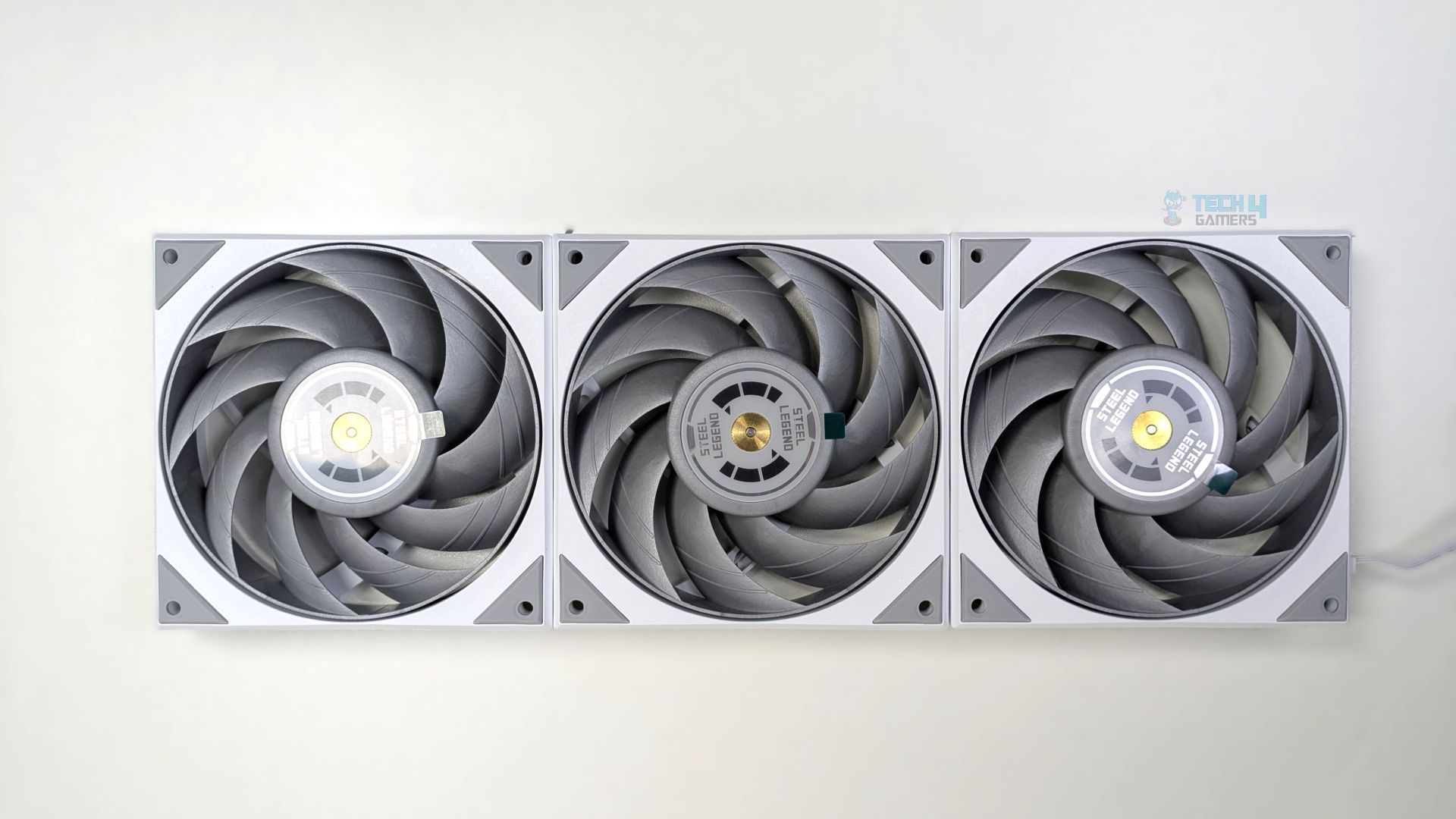
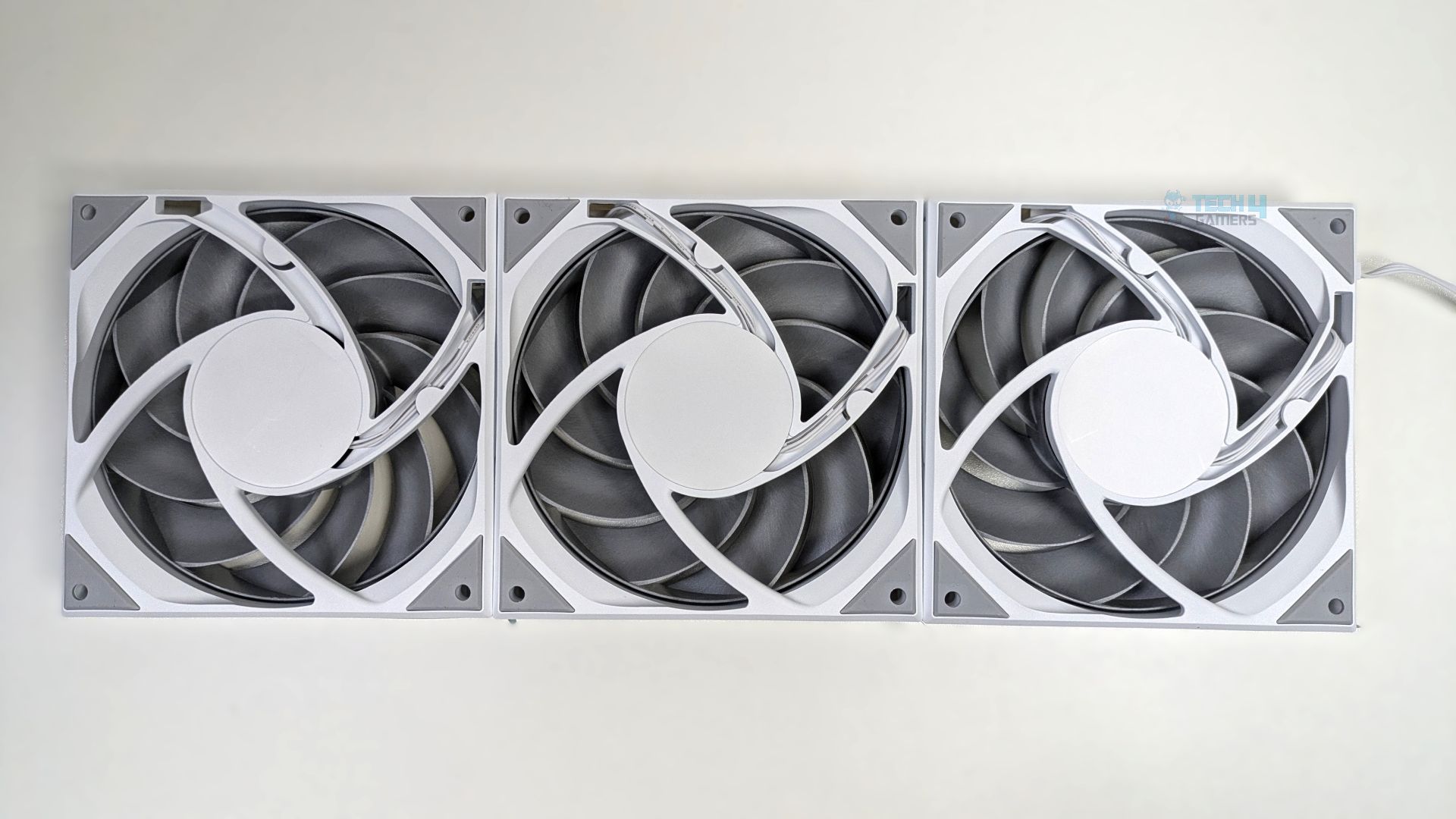
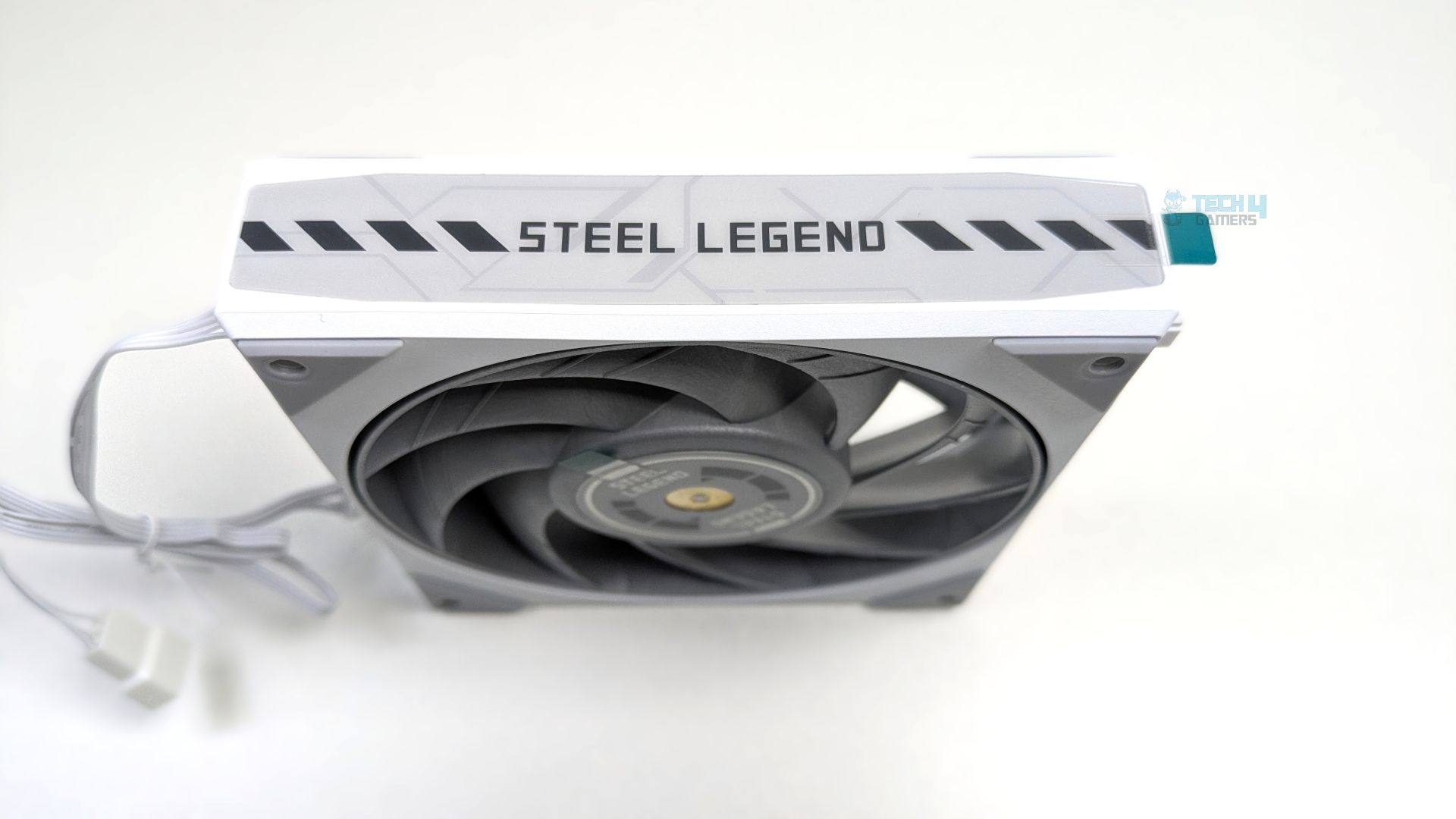
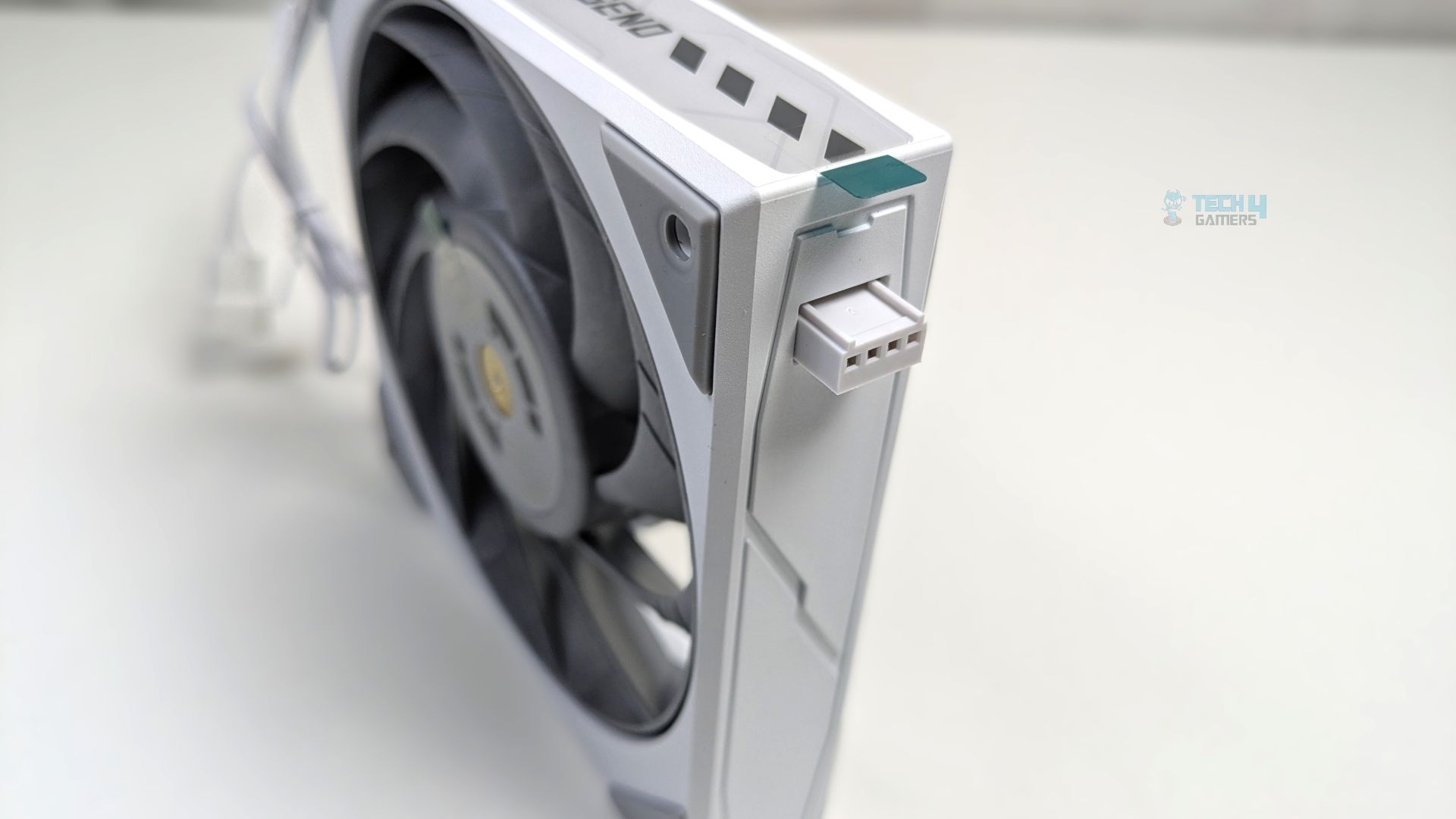
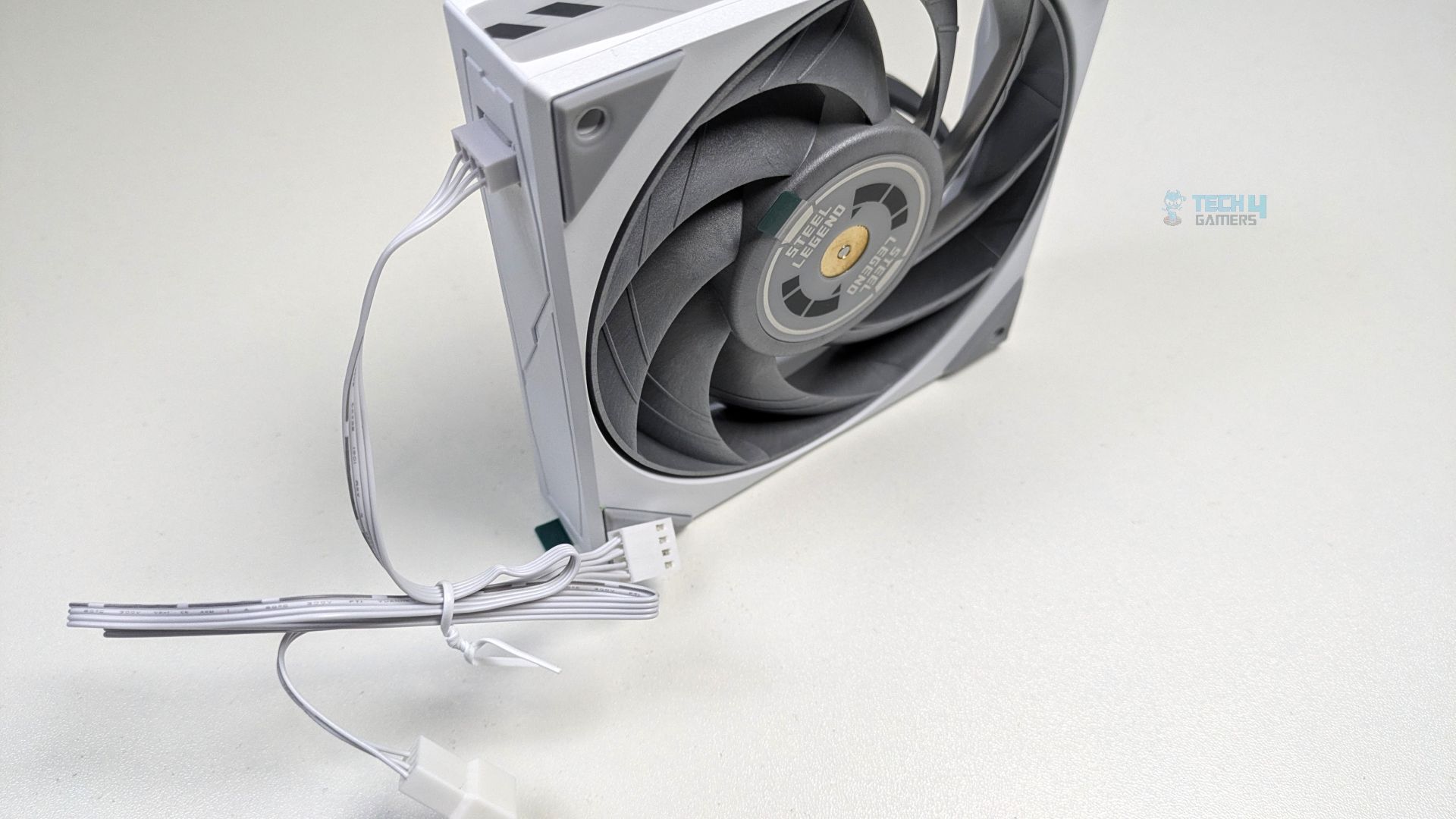
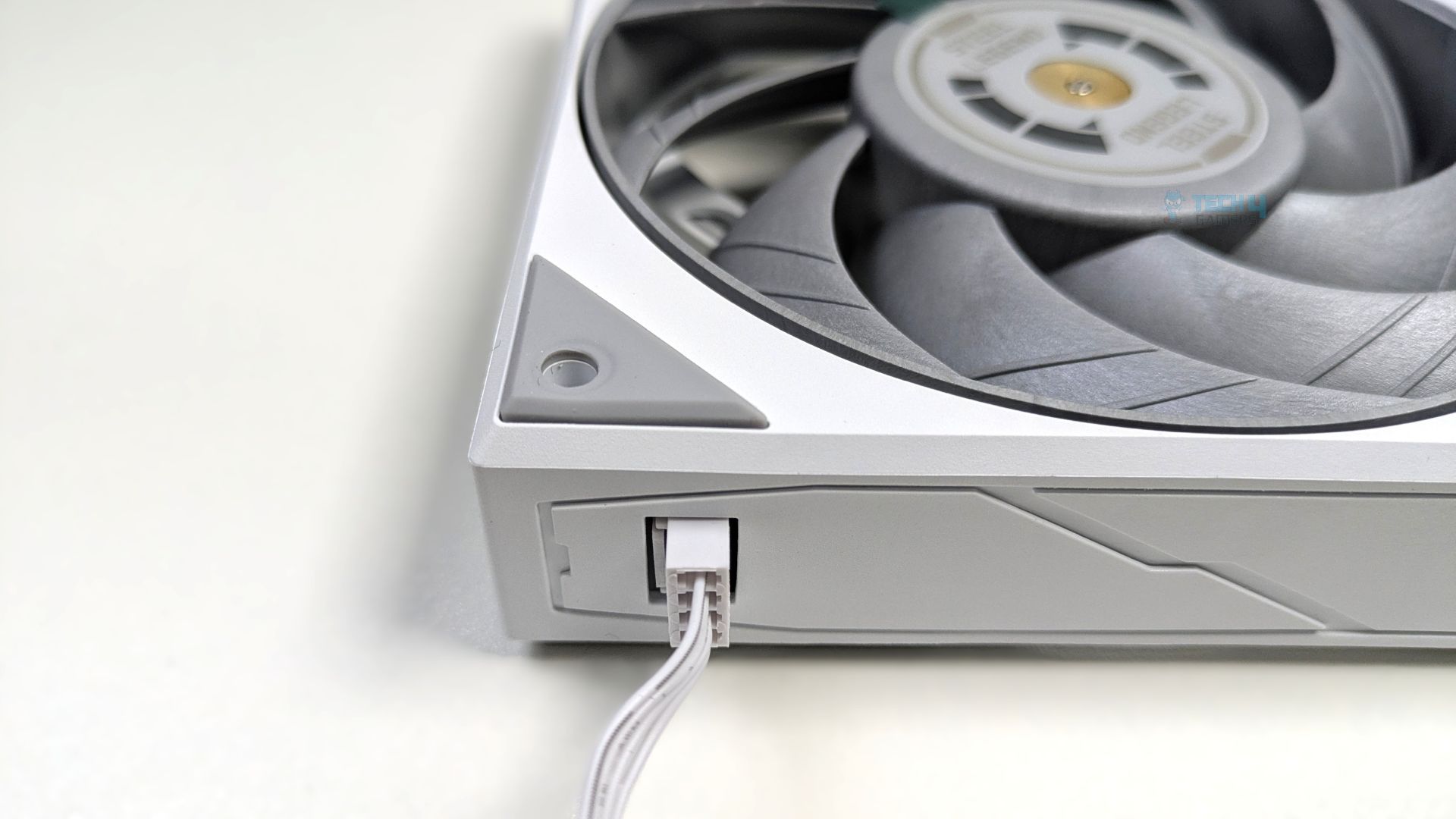
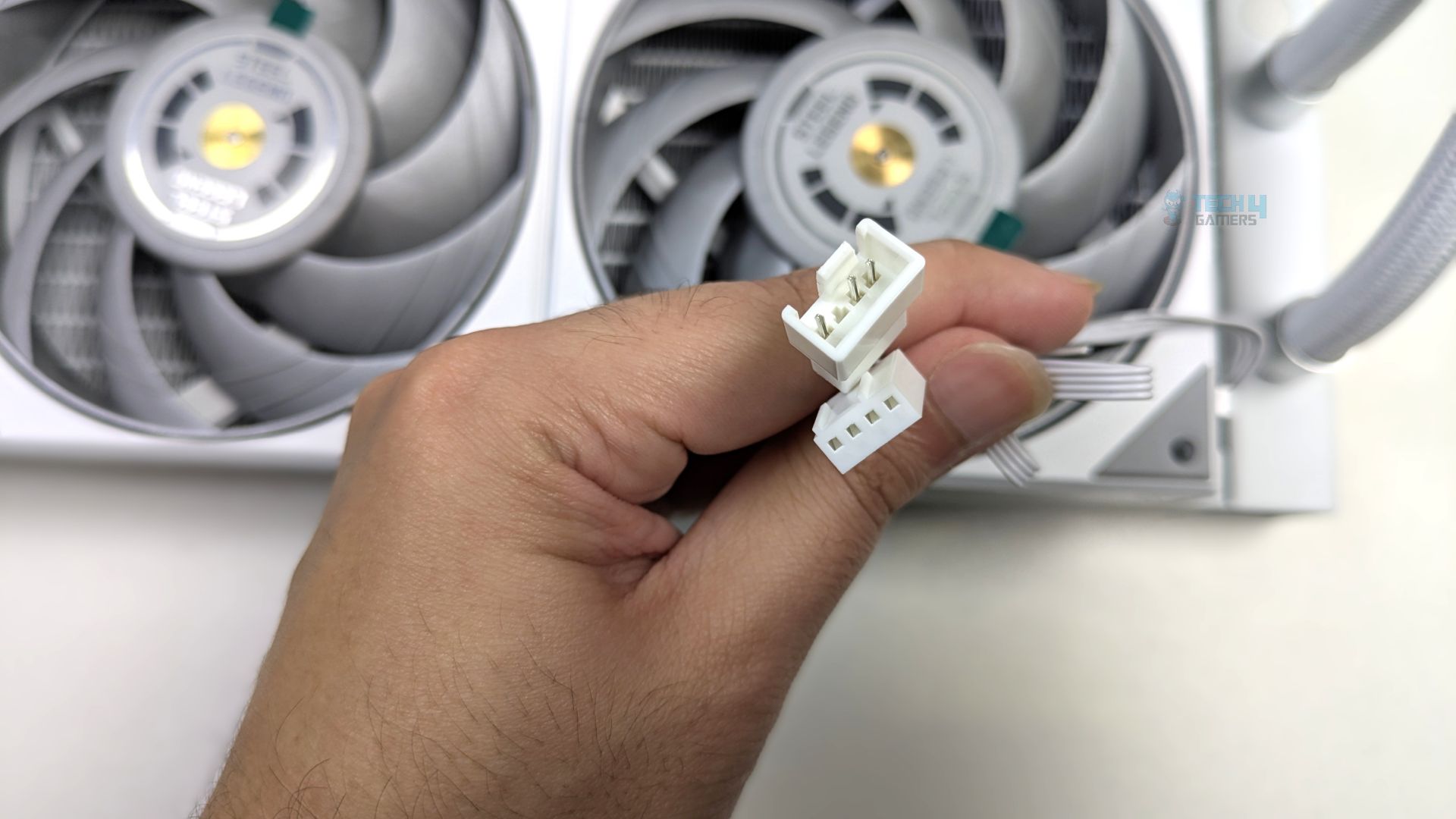
ASRock has chosen an interesting design for the fans, the fans feature 9 Liquid Crystal Polymer) LCP fan blades are housed in a white frame. When it comes to quality, LCP is incredibly rigid; this is also one of the reasons why the fans have tight clearance between the blade tips and the inner frame. The metallic-looking center hub with ‘Steel Legend’ branding adds an industrial touch that perfectly matches the ASRock Steel Legend brand’s styling.
One thing I have loved about these fans is their interlocking daisy-chain system: instead of each fan having its own set of cables, they physically connect to each other, and all three fans are powered by just one 4-pin PWM cable.
The fans also use an industrial-grade dual-ball bearing mechanism combined with a copper-alloy hub, which also ensures longevity and rigidity.
Here are the specifications of the fans.
| ASRock Steel Legend 360 LCD Fan Specification | |
|---|---|
| Fan Dimension | 120 x 120 x 28 mm |
| Fan Speed | 0 - 2500 ± 10% RPM |
| Max. Air Flow | (Max.) 76.7 CFM |
| Max. Static Pressure | (Max.) 4.16 mmH20 |
| Noise | (Max.) 38.3 dB(A) |
| Bearing Type | Dual-ball Bearing |
| Connector | PWM (4pin) + 3-Pin ARGB 5v |
Installation (AMD)
We’re using the AMD platform, so our installation steps will only be provided for that.
Prepare the socket
First, you need to remove the motherboard stock retention brackets from your AM4/AM5 motherboards. Then, you must install the ASRock’s provided bracket. Secure the bracket in place with the screws. Do not over-tighten the screws. Ensure the arrows on the bracket point towards the CPU for the correct orientation. Don’t forget to apply the thermal-paste!
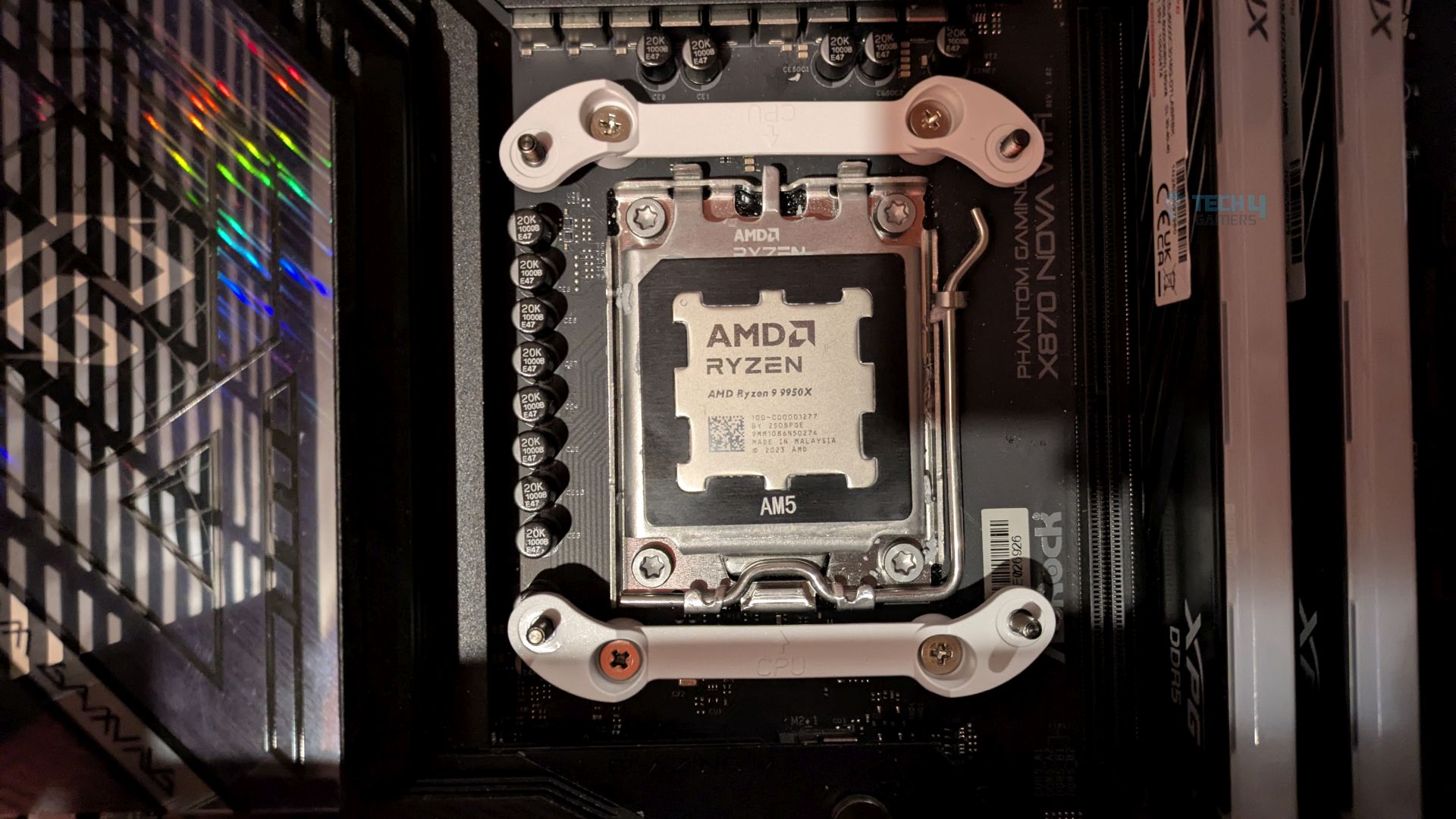
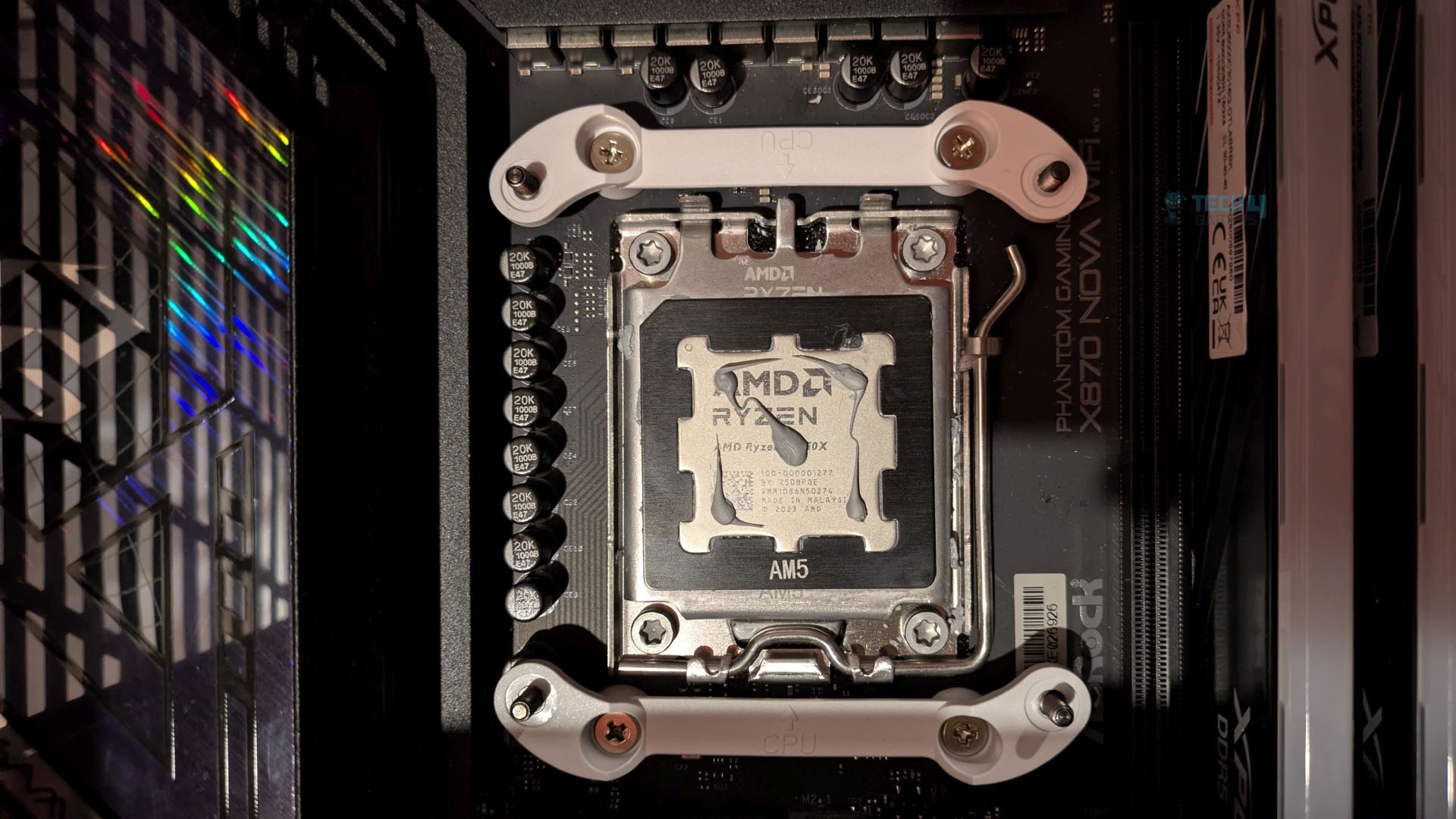
Now position the water block on the bracket and secure it to the bracket, then tighten the captive screw loaded on the water block.
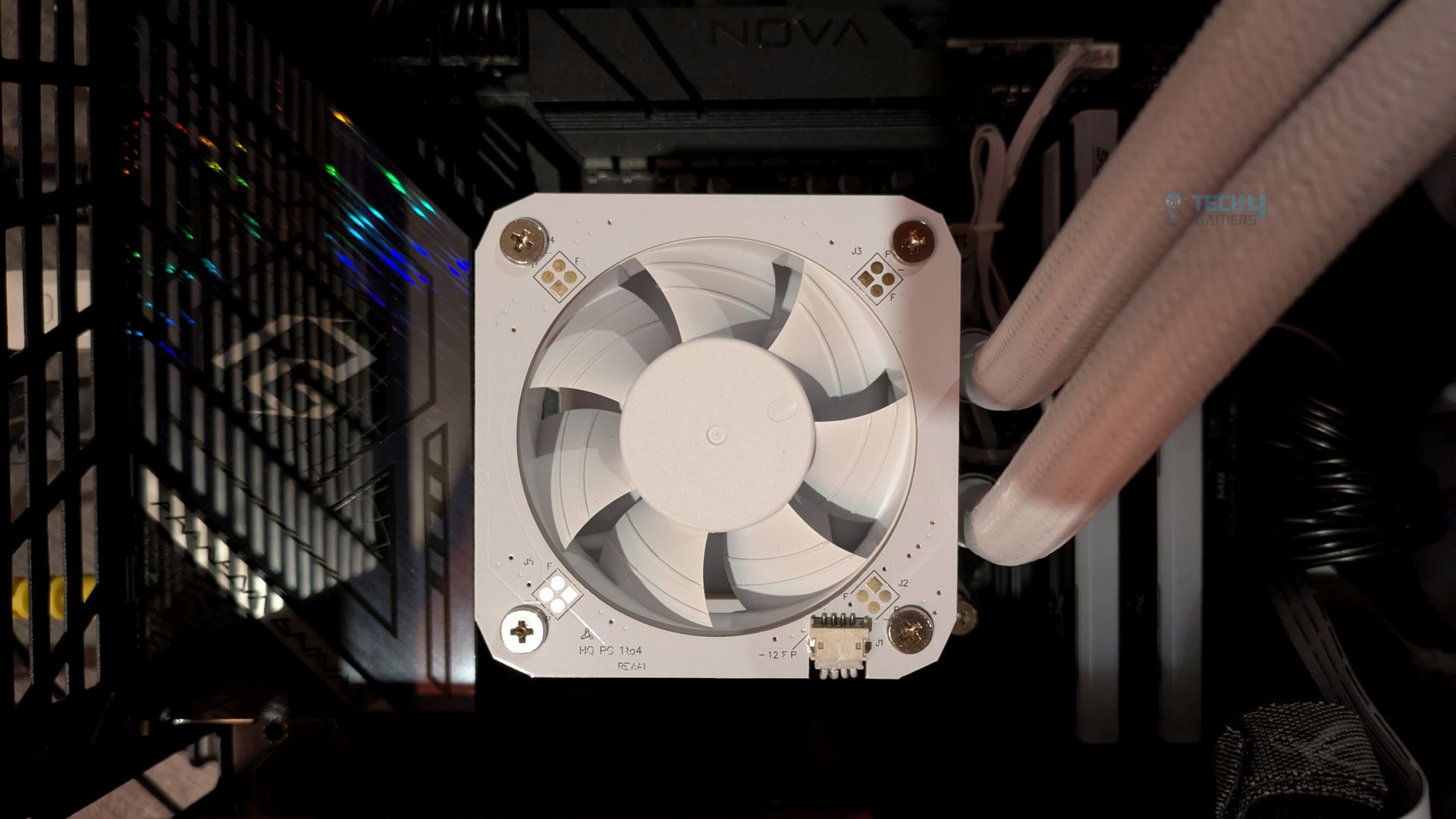
Tighten each screw gradually and evenly to ensure balanced mounting pressure. After the block is seated, slide the LCD onto the block and connect the provided 9-Pin-to-Type-C cable to the LCD module to power the display.
Finished Looks
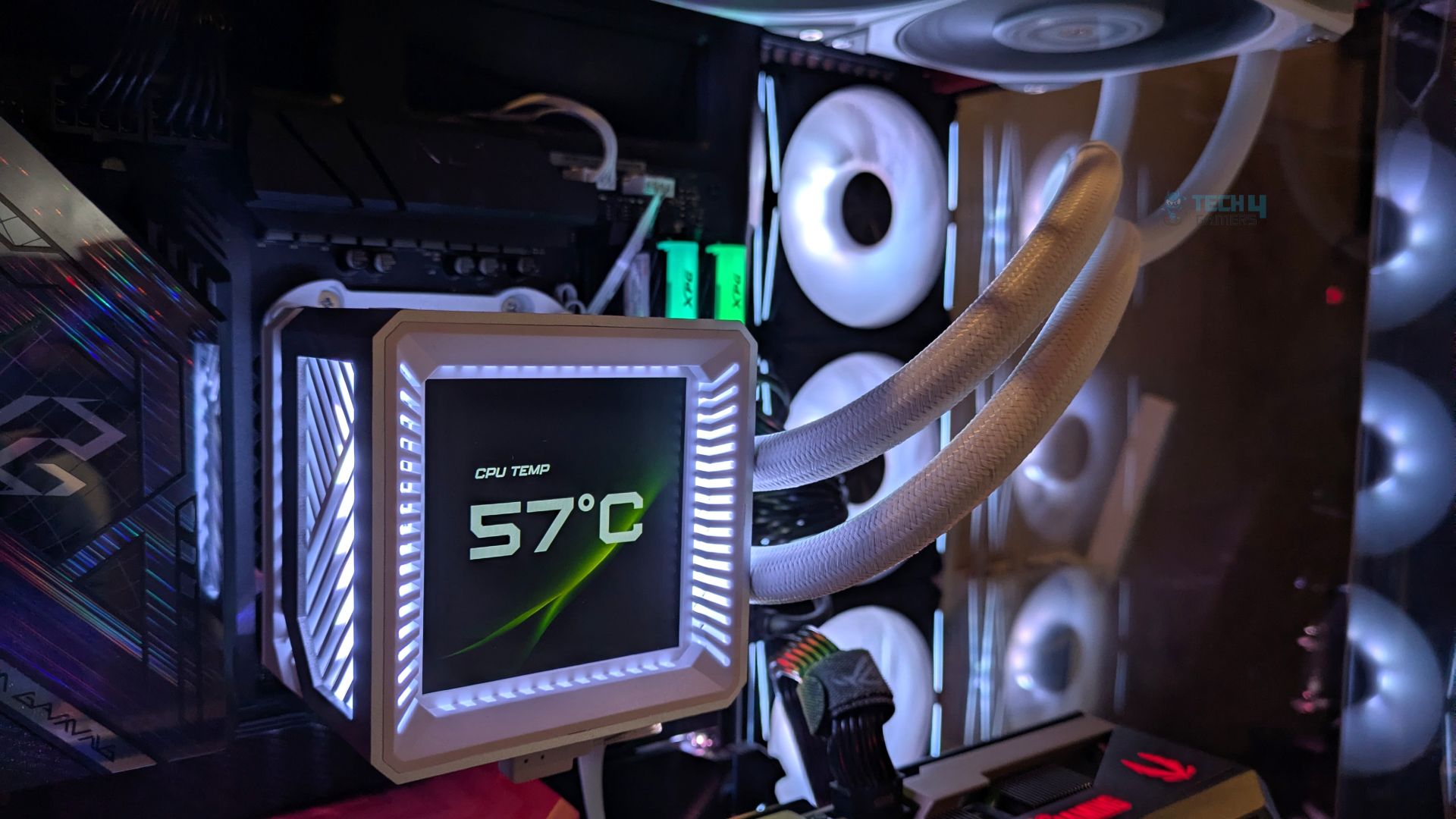
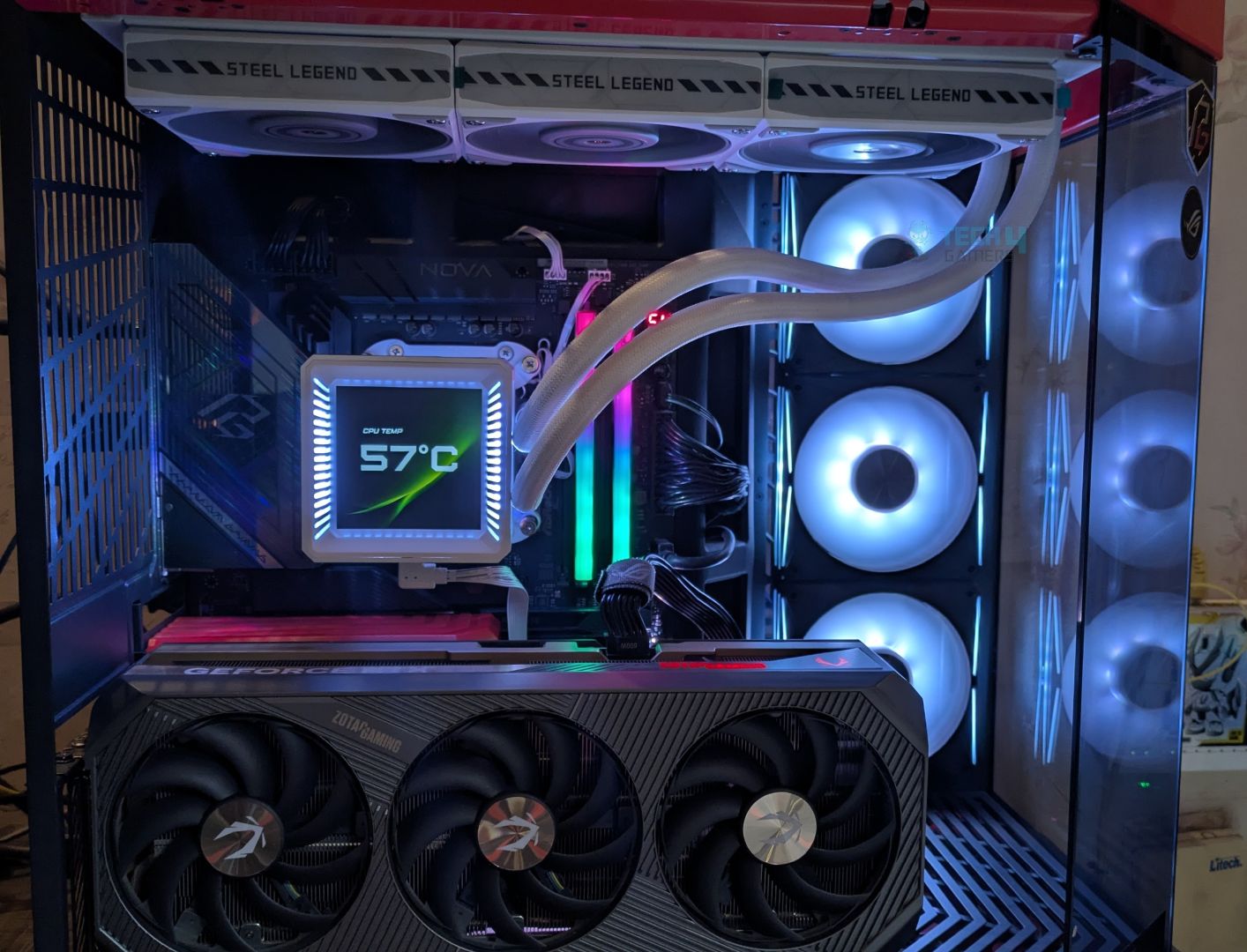
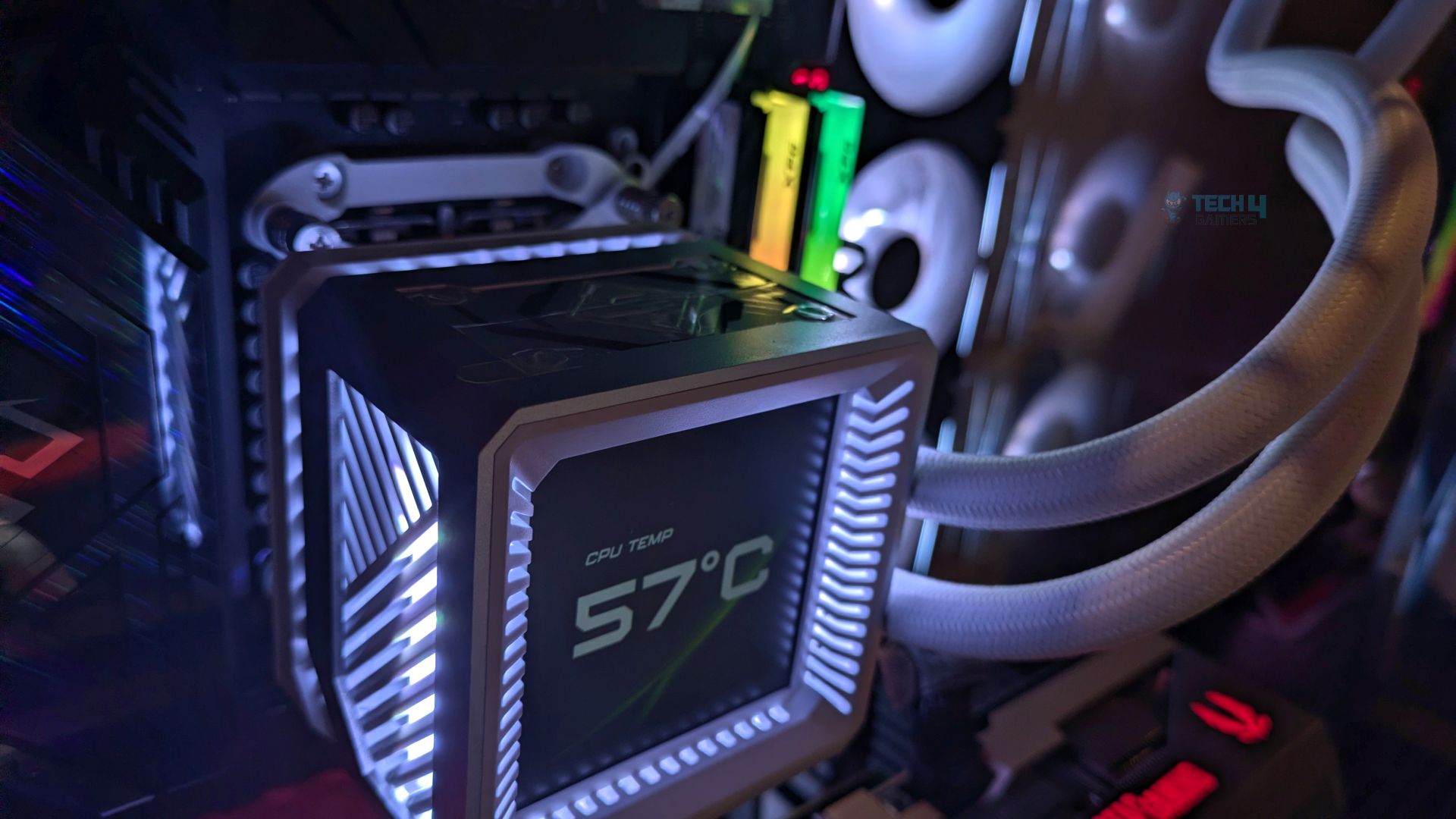
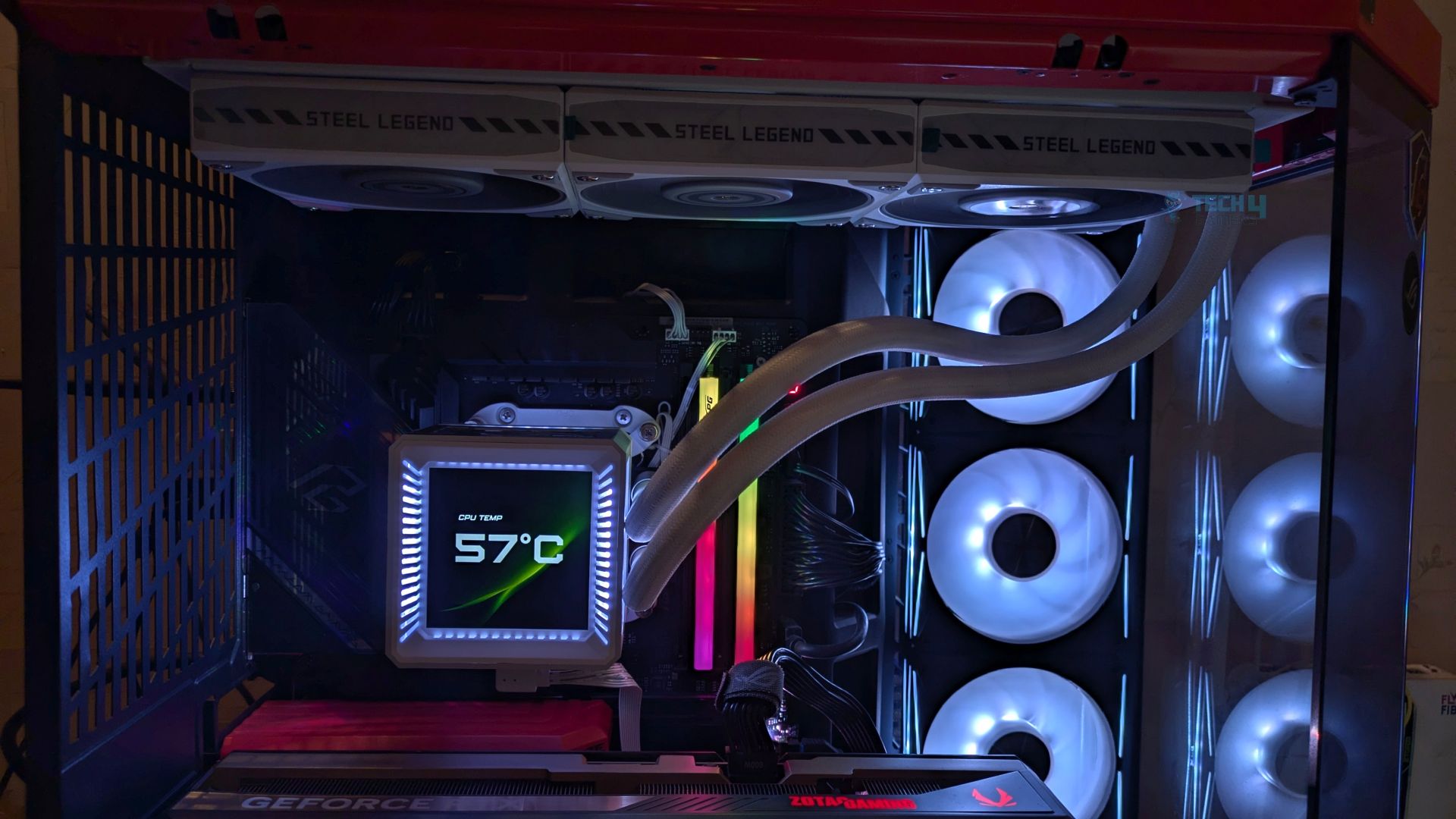
Here is the finished looks of ASRock Steel Legend 360 LCD All-in-one Liquid Cooler assembled in Hyte Y70.
Testing Methodology
CPU Configuration:
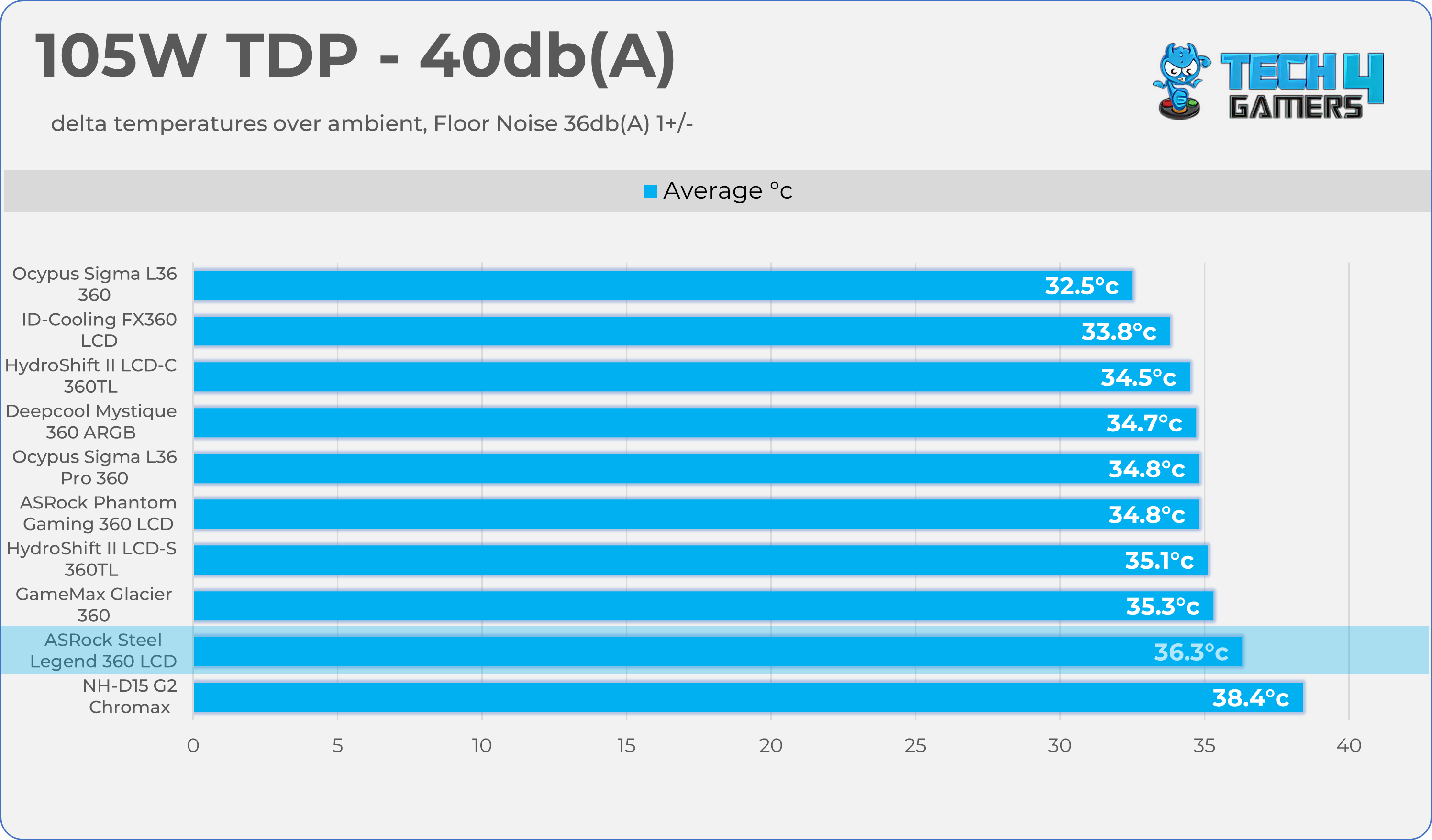
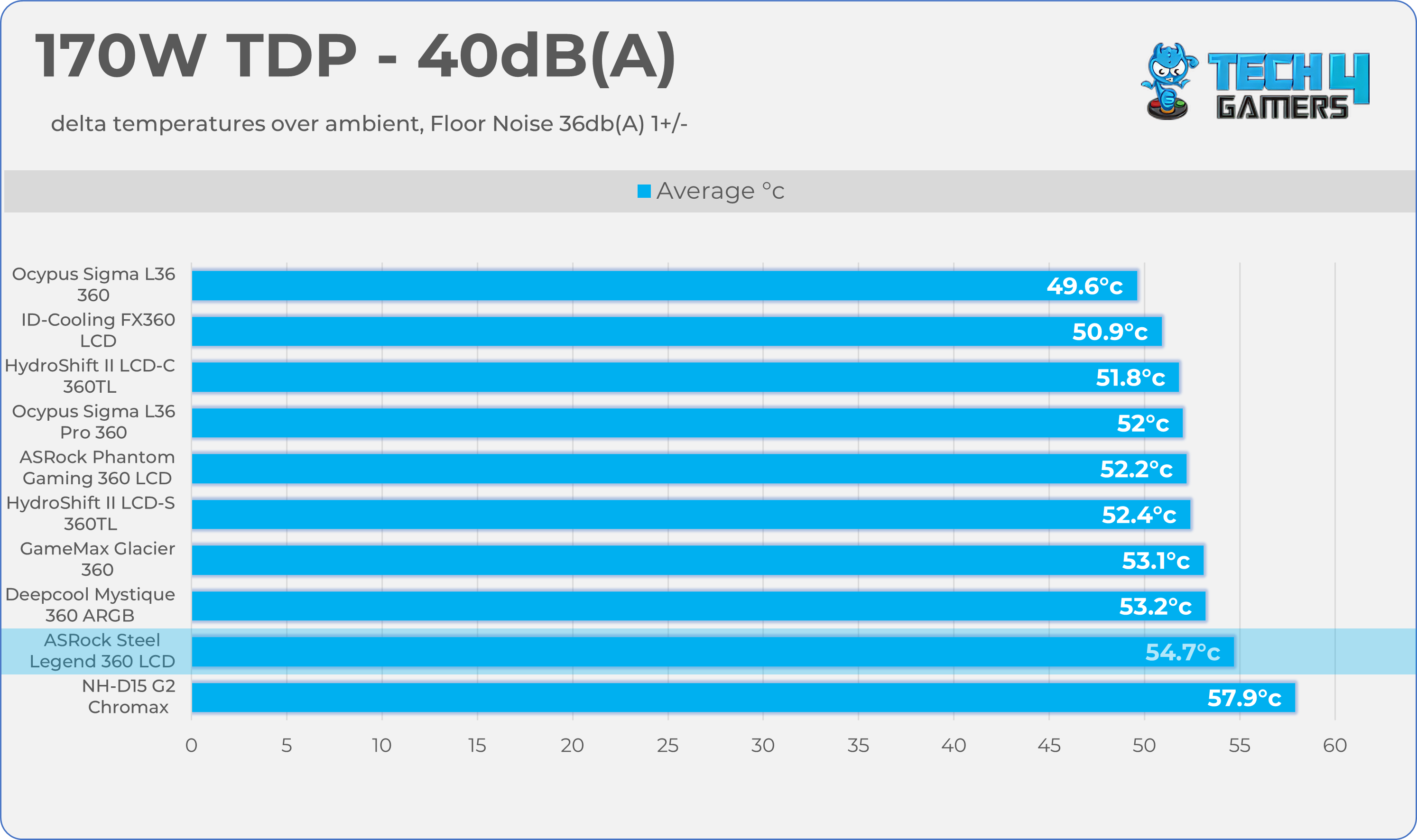
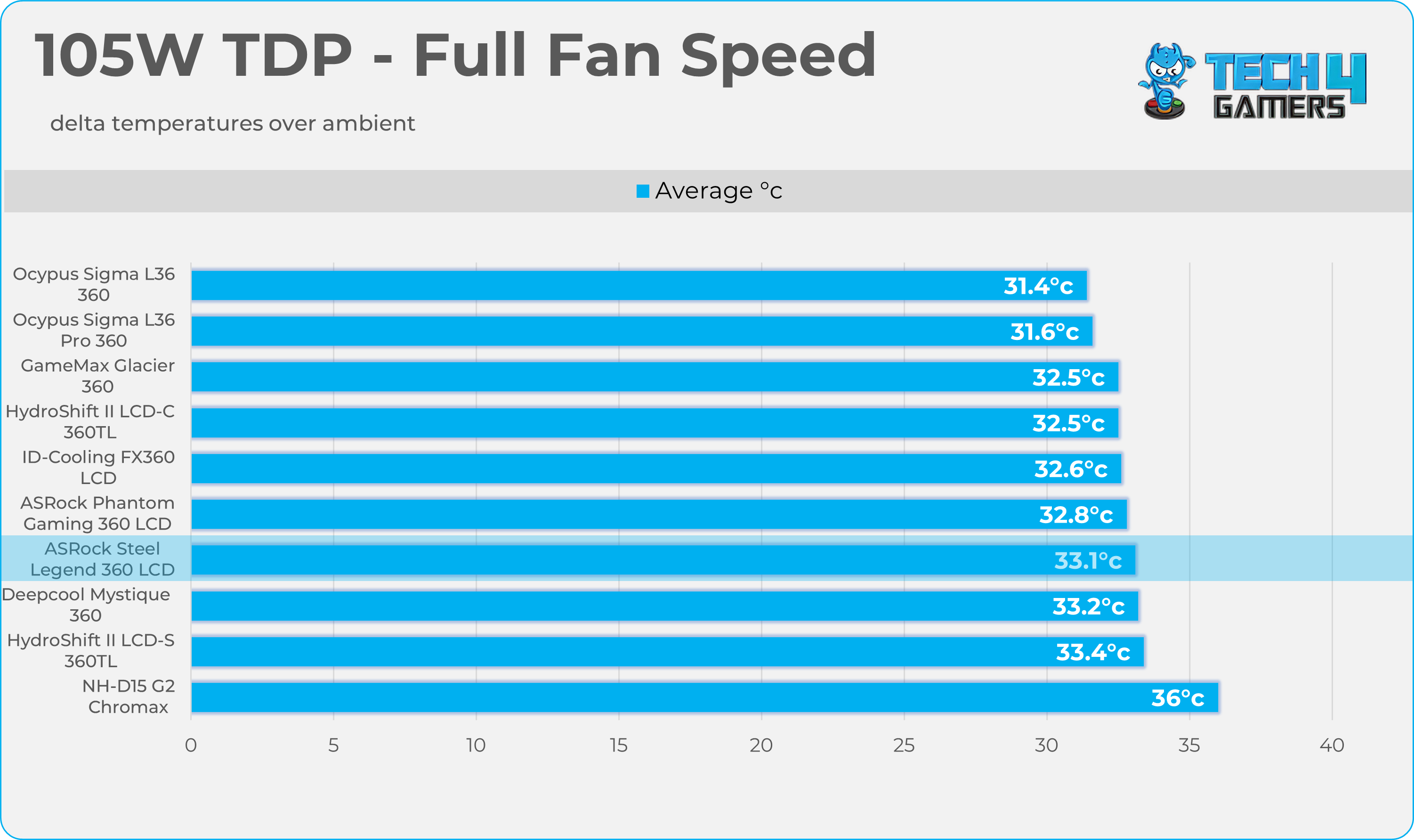
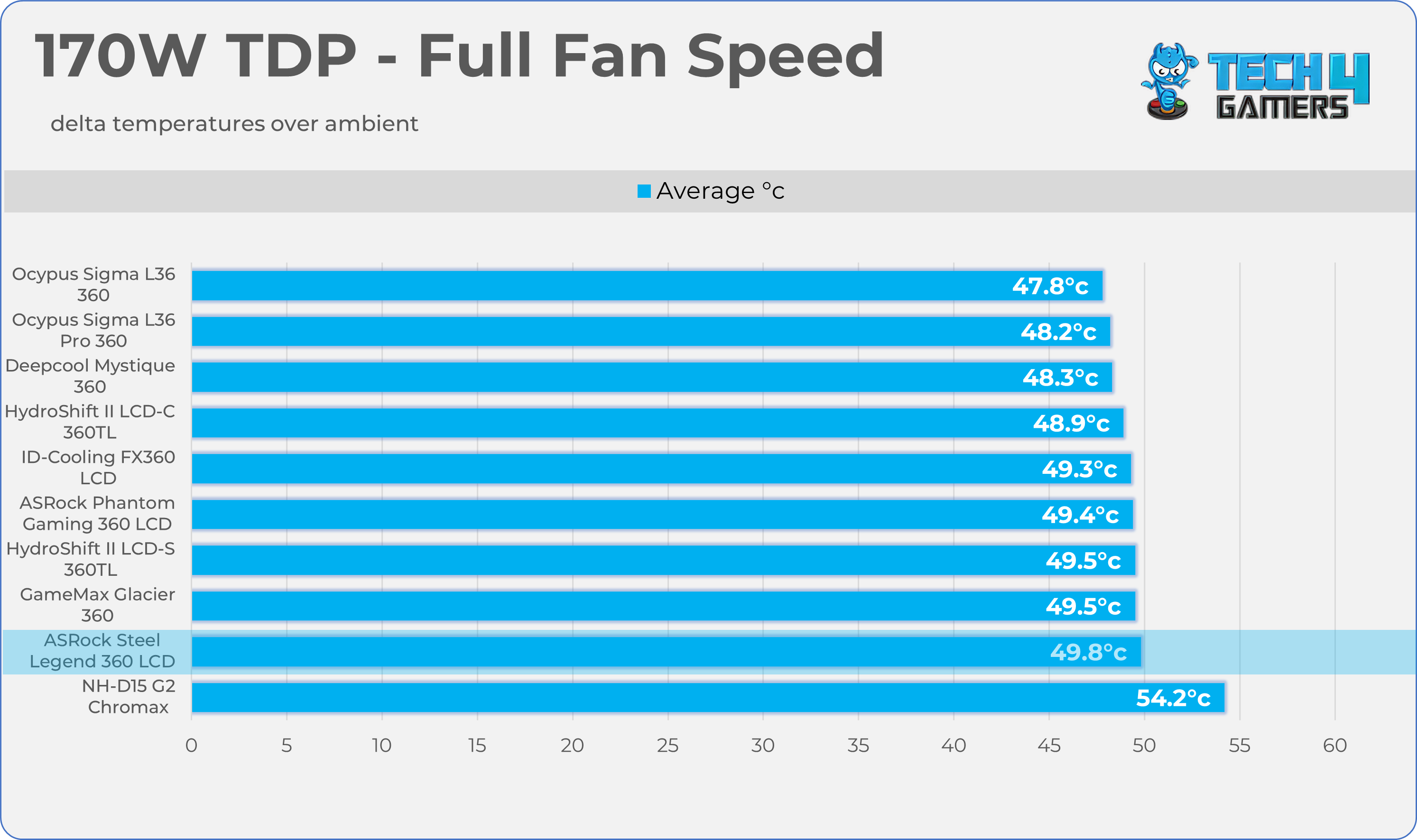
- We evaluate the cooler’s performance using three different benchmark methods. Noise-normalized testing is performed at 40dB(A) at the 105W TDP and 170W TDP (Stock) of the Ryzen 9 9950X. We then test the cooler’s performance at the maximum PWM speeds for both TDP configurations. After that, we unlock the power limits of the CPU to see how much cooler it can dissipate the heat in terms of watts at the maximum PWM Speeds.
Controlled Environment:
- We have eliminated the influence of ambient temperatures in our data, and all results are presented as deltas over the ambient conditions. The tests were done in a controlled environment with a room temperature of 25°C.
Preparing System:
- The Coolers are tested in realistic conditions. We don’t use the open bench system; instead, we have installed the cooler in our HYTE Y70 case, mounted at the top. We ensure the airflow is adequate in the case and that the case fans are running at the fixed PWM speeds.
- We are using ID-Cooling X45 thermal paste for all coolers.
Software:
- We have ensured that no other software is running on the computer that could influence the CPU load.
- We’ll be using the Cinebench R23 Loop for 20 minutes after the warm-up test has been completed. Each test has a 10-minute cool-down time.
Test Setup
Here is our test setup!
| Our Primary Test System |
|
|---|---|
| Processor | AMD Ryzen 9 9950X |
| Memory | XPG Lancer 32GB (16x2) 6000MT/s CL30 |
| Motherboard | ASRock X870 Phantom Gaming Nova WiFi (BIOS: 4.43v) |
| Thermal Paste | ID-Cooling X45 |
| Graphics Card | ZOTAC SOLID RTX 5080 , |
| Power Supply Unit | Super Flower LEADEX VII Platinum PRO 850W |
Test Results – Noise Normalized 40 dB(A)
Results at the fixed noise level of 40dB(A).
105W TDP
170W TDP
Test Results – Maximum Speed
Results at the Maximum PWM Speed.
105W TDP
170W TDP
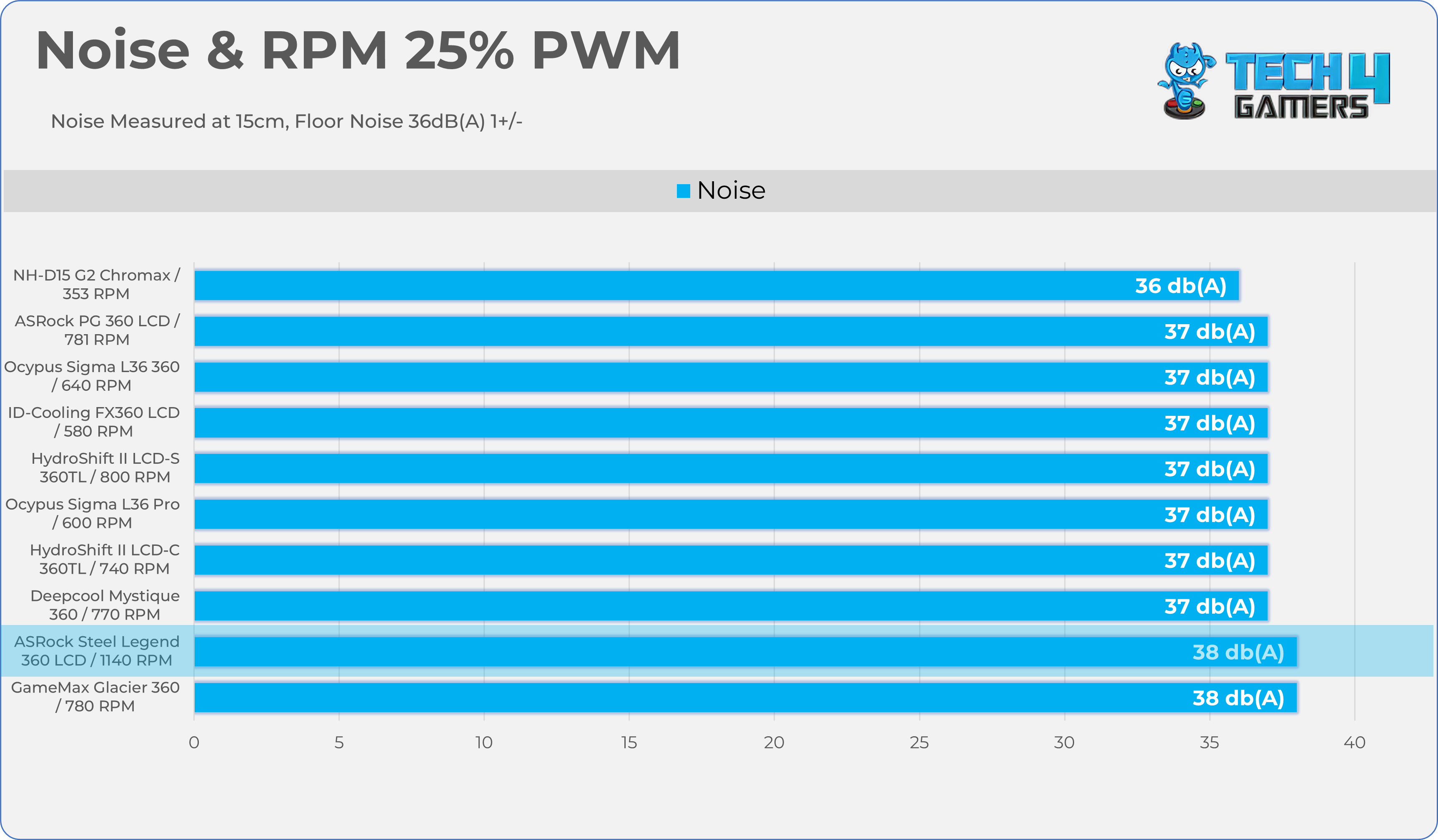
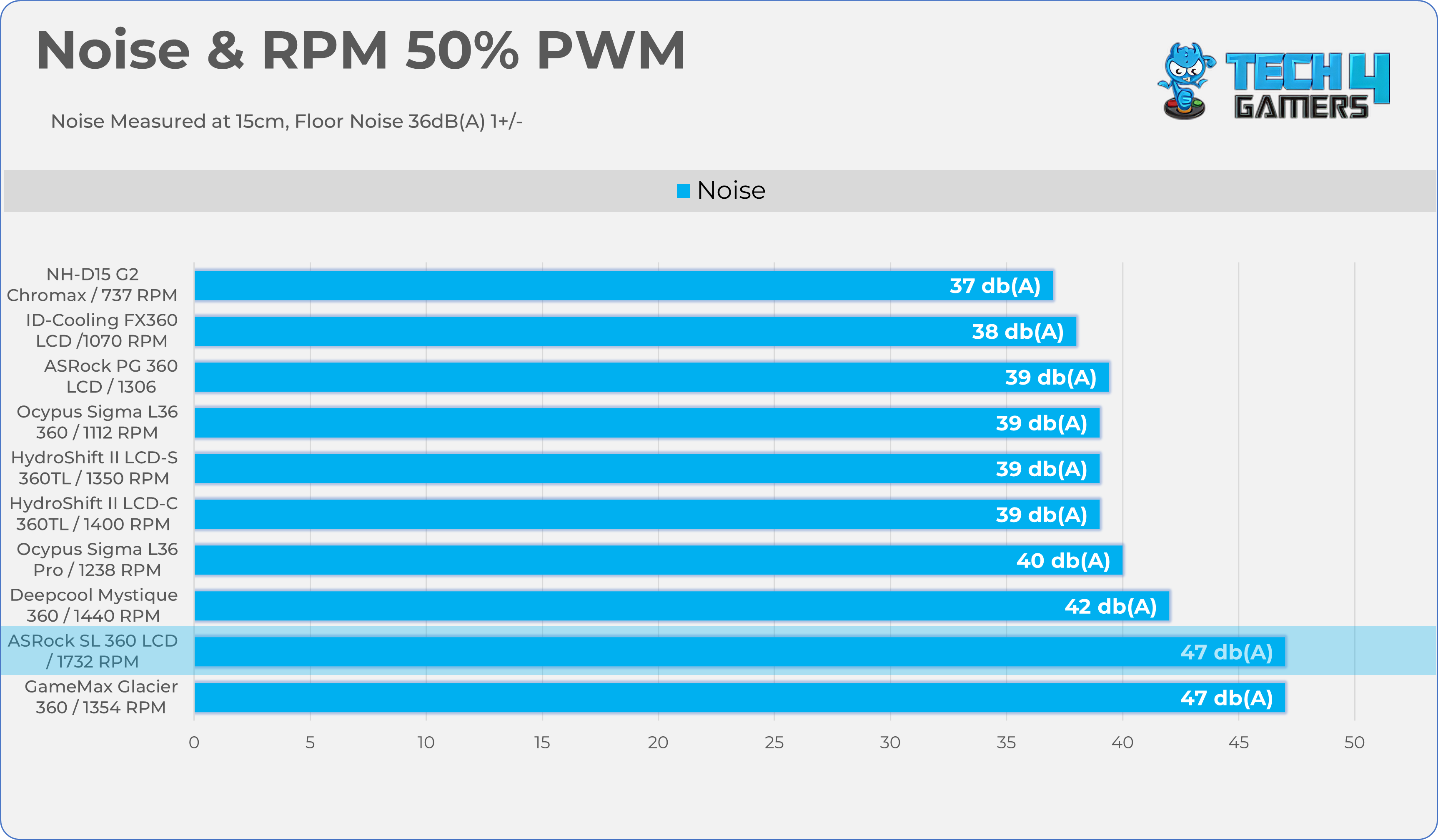
Noise and RPM Readings
Let’s take a look at the Noise and RPM Readings. We conducted tests across four different PWM range levels.
25-50% PWM
75-100% PWM
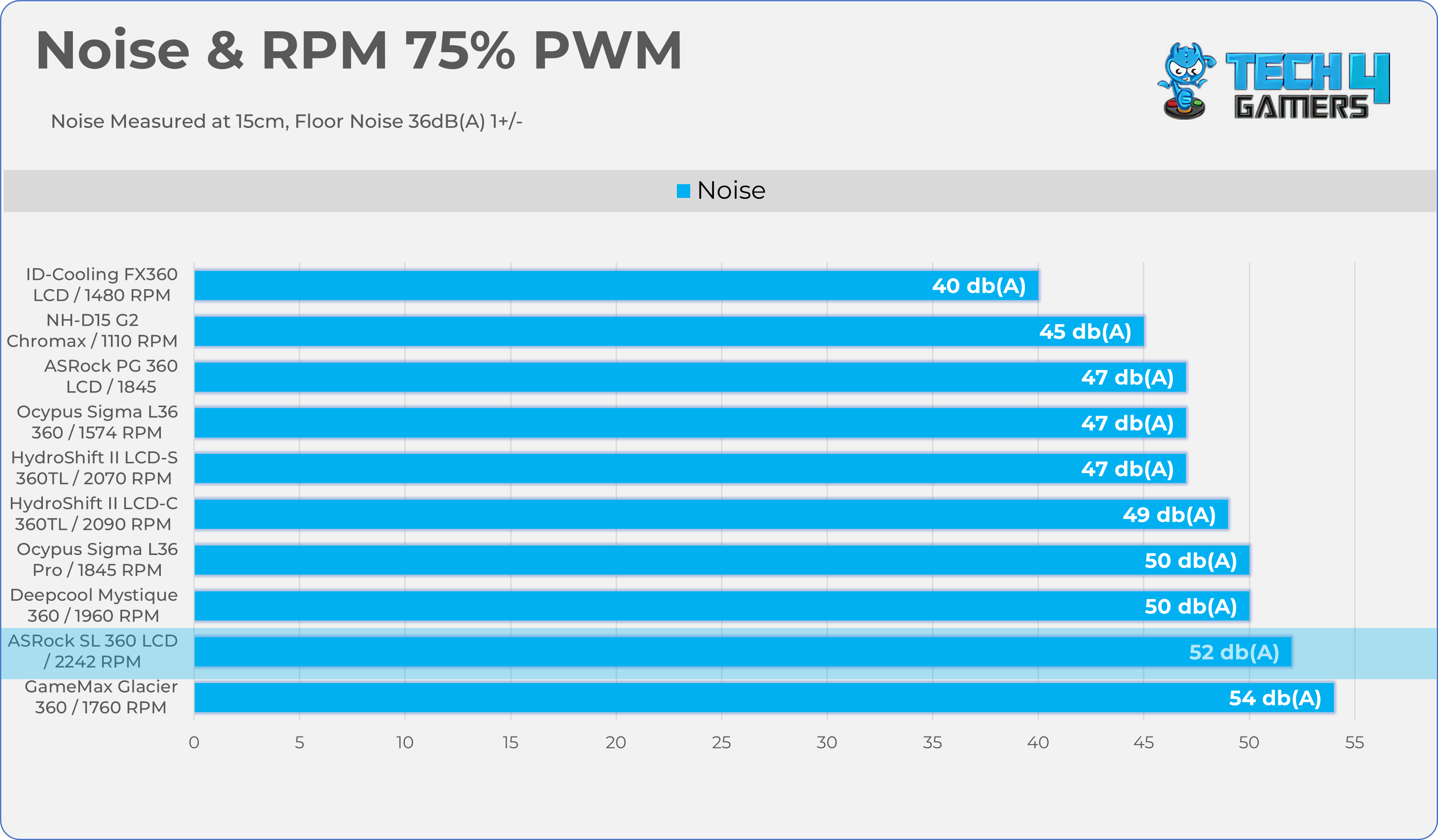
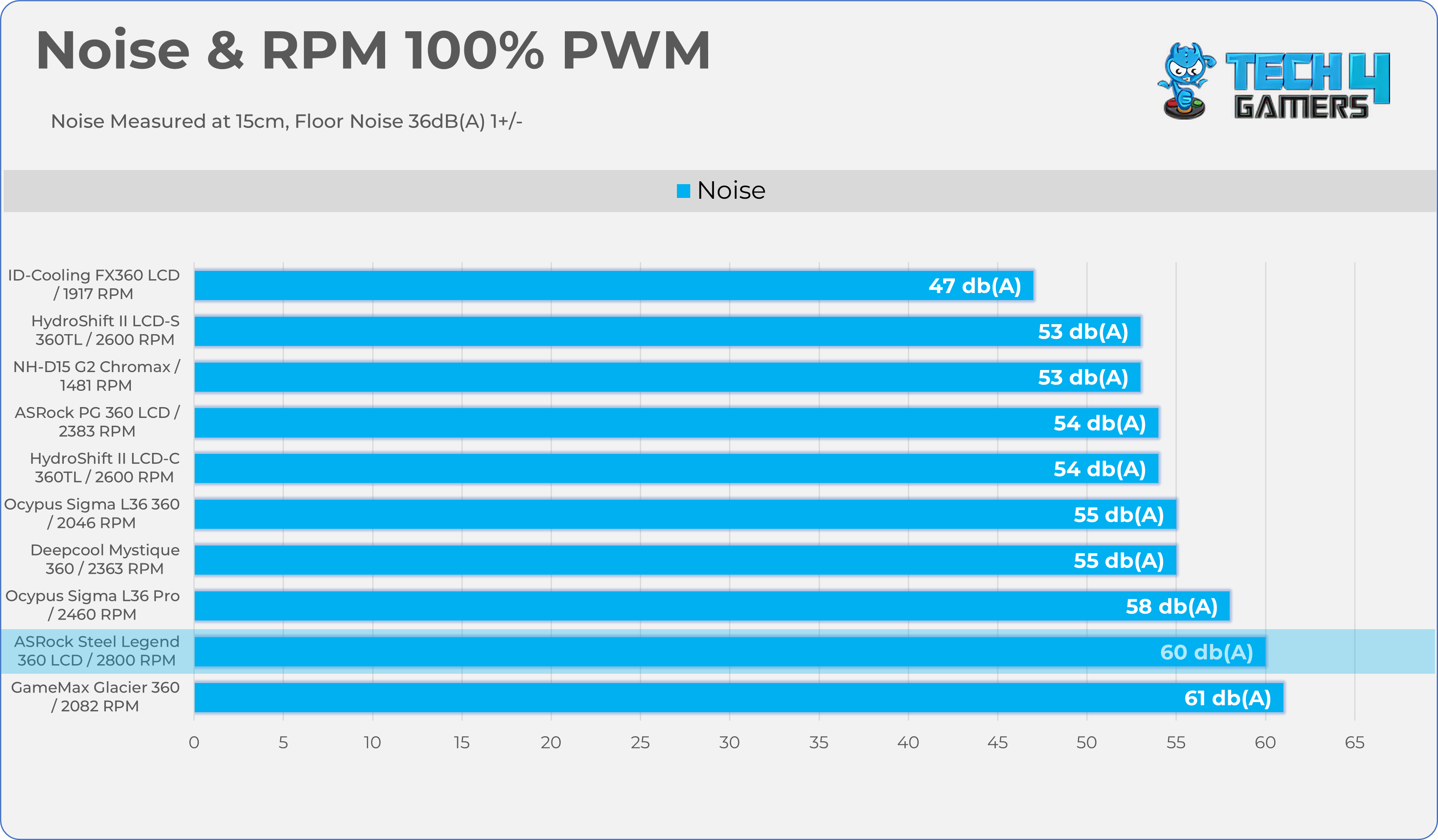
Here is the structured table illustrating fan noise levels at various PWM percentages. The Floor Noise Level is 36dB(A).
| PWM (%) | RPM | Noise dB(A) |
|---|---|---|
| 25% | 1140 RPM | 38 dB(A) |
| 50% | 1732 RPM | 47 dB(A) |
| 75% | 2242 RPM | 52 dB(A) |
| 100% | 2800 RPM | 60 dB(A) |
Should You Buy It?
Buy It If
✅ You’re Building An All-white PC: The Pristine white, classic industrial aesthetic, with braided tubing and subtle ARGB lighting, makes this all-in-one liquid cooler fantastic for a clean, light-themed build.
✅You Are Doing Heavy Overclocking: ASRock Steel Legend 360 LCD is more than enough to tame high-end processors and has ample cooling headroom for overclocking. It also features an integrated 70mm VRM fan that helps cool motherboard components for stability.
✅ You Want Clutter Free Experience: One thing I have loved about these fans is their interlocking daisy-chain system: instead of each fan having its own set of cables, they physically connect to each other, and all three fans are powered by just one 4-pin PWM cable.
Don’t Buy It If
❌ You Don’t Care About LCD Screen: At $160, you’re paying a heavy premium for the LCD screen. If you care only about performance, a standard all-in-one liquid cooler without a screen would be the better choice.
Final Thoughts
Cooling Performance And Noise
So far, I’m satisfied with the performance. The ASRock Steel Legend 360 LCD is not their top all-in-one in the portfolio. We observed the CPU ran a few degrees hotter than the ASRock Phantom Gaming 360 LCD. The difference was not huge, but the average delta was between 1.5 °C and 2.5 °C despite having more powerful fans. Since ASRock targeted a different audience with this cooler, they cut the radiator size to the traditional 27mm. The Phantom Gaming 360 LCD offers the massive 32mm radiator.
The cooler easily managed to tame the AMD Ryzen 9 9950X (200W) heat output and provides more thermal headroom. We could have pushed our CPU to its extreme limits.
Noise may concern many users. At maximum PWM, the fan can reach 60dB(A) while spinning at nearly 2800 RPM. We advise users who find this too loud to set PWM levels to 35%-40%.
Build Quality / Design
The build quality is robust and durable. ASRock did not compromise on quality despite the ASRock Phantom Gaming 360 LCD being cheaper. The radiator fans are made from Liquid Crystal Polymer and use dual-ball bearings for a longer lifespan. However, I’d have loved to see ARGB lighting on the fans during this segment; instead, they provided it on the LCD module.
The centrepiece of this liquid-cooler is the massive 3.4-Inch LCD that supports 480×480 and 60 FPS Video playback. The LCD module slides to the water block magnetically, and it’s sturdy. We did not notice any wobbling of the module.
VRM cooling is another salient feature of this all-in-one, which performs very well. If you’re pushing your CPU to the extreme limits, you might want to use the active-cooling on the VRMs, which this cooler provides.
Value
ASRock Steel Legend 360 LCD is priced at $159.99, $30 cheaper than the Phantom Gaming 360 LCD ($189.99). The main compromise here you’re making to save that cash is the radiator thickness, while they did not cut a lot on the fans. In fact, I have loved the Steel Legends fans more than the ones it included in the Phantom Gaming. Other than that, you still retain the exact same 3.4-inch 60Hz magnetic display, embedded VRM fan, and identical water block. I believe $160 makes absolute perfect sense for this all-in-one, given all the features; a similar all-in-one from premium brands could cost nearly $200 USD these days.
Thank you! Please share your positive feedback. 🔋
How could we improve this post? Please Help us. 😔

Senior Hardware Reviewer at Tech4Gamers with over a decade of experience in the tech industry. My journey began in 2014 as a senior administrator for Pakistan’s largest gaming community forum. I specialize in testing and reviewing components like graphics cards, CPU coolers, and motherboards, while also sharing insights on overclocking and system optimization.
 Join Our Community