
 Threads
Worth It?
Review Summary
The Arctic MX-7 is a highly successful and much-needed upgrade that perfectly bridges the gap in Arctic Thermal Compound Line-up. It currently stands as a chart leader in cooling performance, neither too runny nor too brittle. The best TIM you can have right now for your high-end build with long-term durability.
Hours Tested: 4

Overall
Pros
- Exceptional Pump-Out Resistance
- Less Dry and Crumbly Unlike Arctic MX-6
- Long Term Durability
- Non-Conductive
Cons
- Slight Price Premium


Arctic has sent us their brand new thermal paste, Arctic MX-7. This paste is a dense and highly viscous compound. Arctic promises that this paste is engineered with high cohesion to fight the dreaded pump-out effect and offers higher durability. We have previously tested a bunch of other pastes, notably in our ID-Cooling X55 review, the previous Arctic MX6 (New Formula), and Arctic MX4, which are already among the best-performing CPU thermal pastes on the market.
Arctic MX7 features a thicker, heavier formula this time, but does this formula actually perform well at lower temperatures in the real world, and is it worth the upgrade from your trusty tubes of Arctic MX6 and MX4? We’ll put this brand new Arctic MX-7 to the test to see if it’s truly the king of thermal pastes. Let’s get into it.
Here are the specs:
| Property | Specification |
| Viscosity | 35,000 – 38,000 poise |
| Density | 2.9 g/cm³ |
| Continuous Use Temperature | -50 ~ 250 ℃ |
| Volume Resistivity | 1.7 × 10¹² Ω-cm |
| Breakdown Voltage | 4.2 kV/mm |
| Colour | Grey |
What Makes Arctic MX-7 Different?
Arctic MX-7 bridges the gap between the Arctic’s MX-4 and MX-6 in terms of material consistency and application sitting. It’s more viscous than the MX-4 but 22% thinner than the MX-6, making it easier to apply and spread on the heat spreader. If you’re looking to upgrade from your old trusty MX-4, then the MX-7 could be a reasonable upgrade, as the MX-4 was fluid and prone to pump-out. This new thermal paste is engineered with high cohesion, it remains bonded together under extreme thermal cycling conditions.
Packaging
Taking a look at the packaging
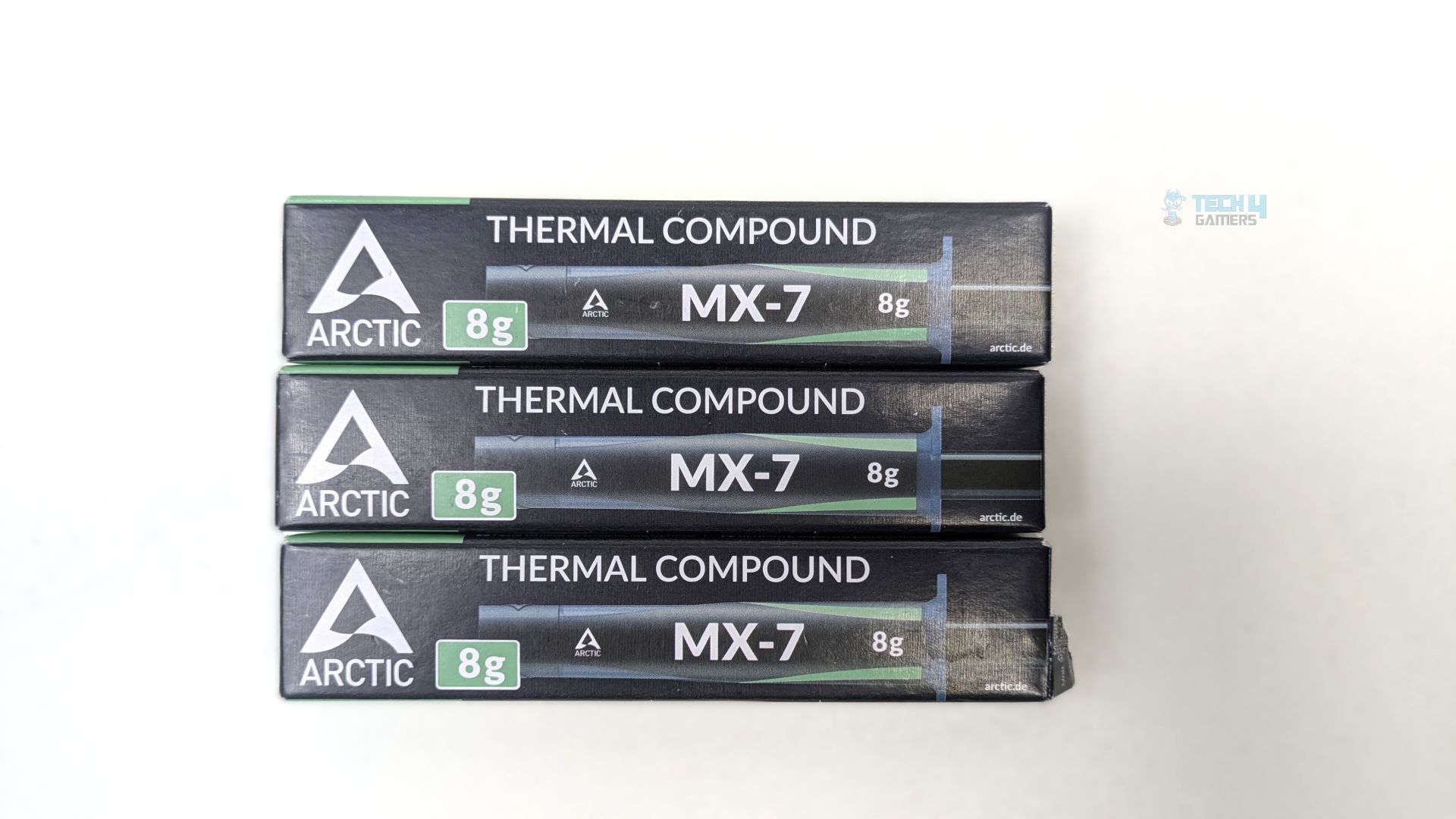
Arctic sent their 8G MX-7 thermal paste packaging. The box features a sleek, dark background and bold MX-7 branding centrally placed. A spatula is not included; Arctic recommends against using one due to the paste’s viscosity and potential for uneven spreading. The thermal paste comes in three sizes: 2G, 4G, and 8G.
Tube Design
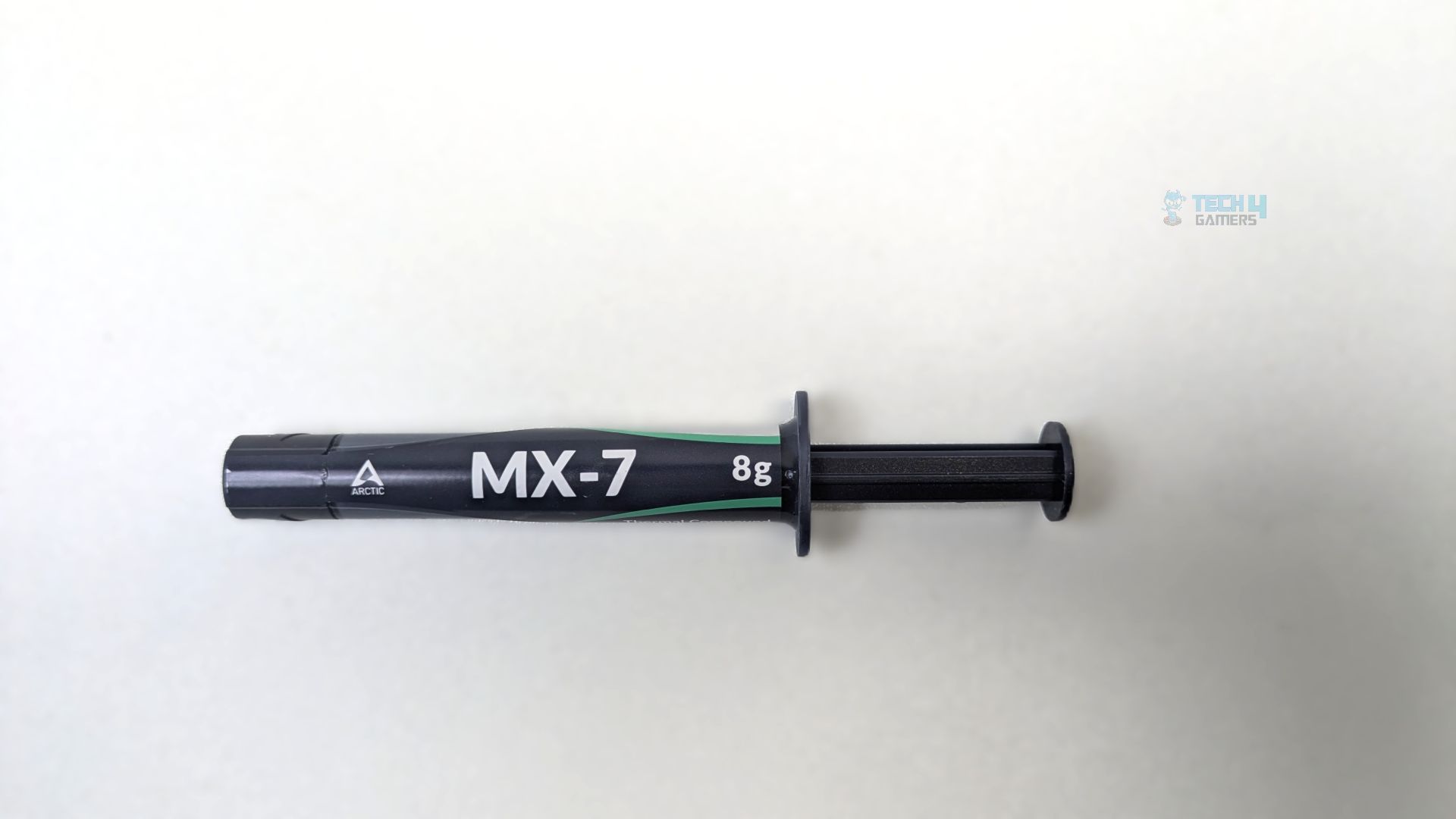
The tube utilizes the plunger syringe design just like the other thermal pastes available in the market. The branding and the theme perfectly mirror the box design language. Overall, the syringe does not feel cheap.
Application & Quality
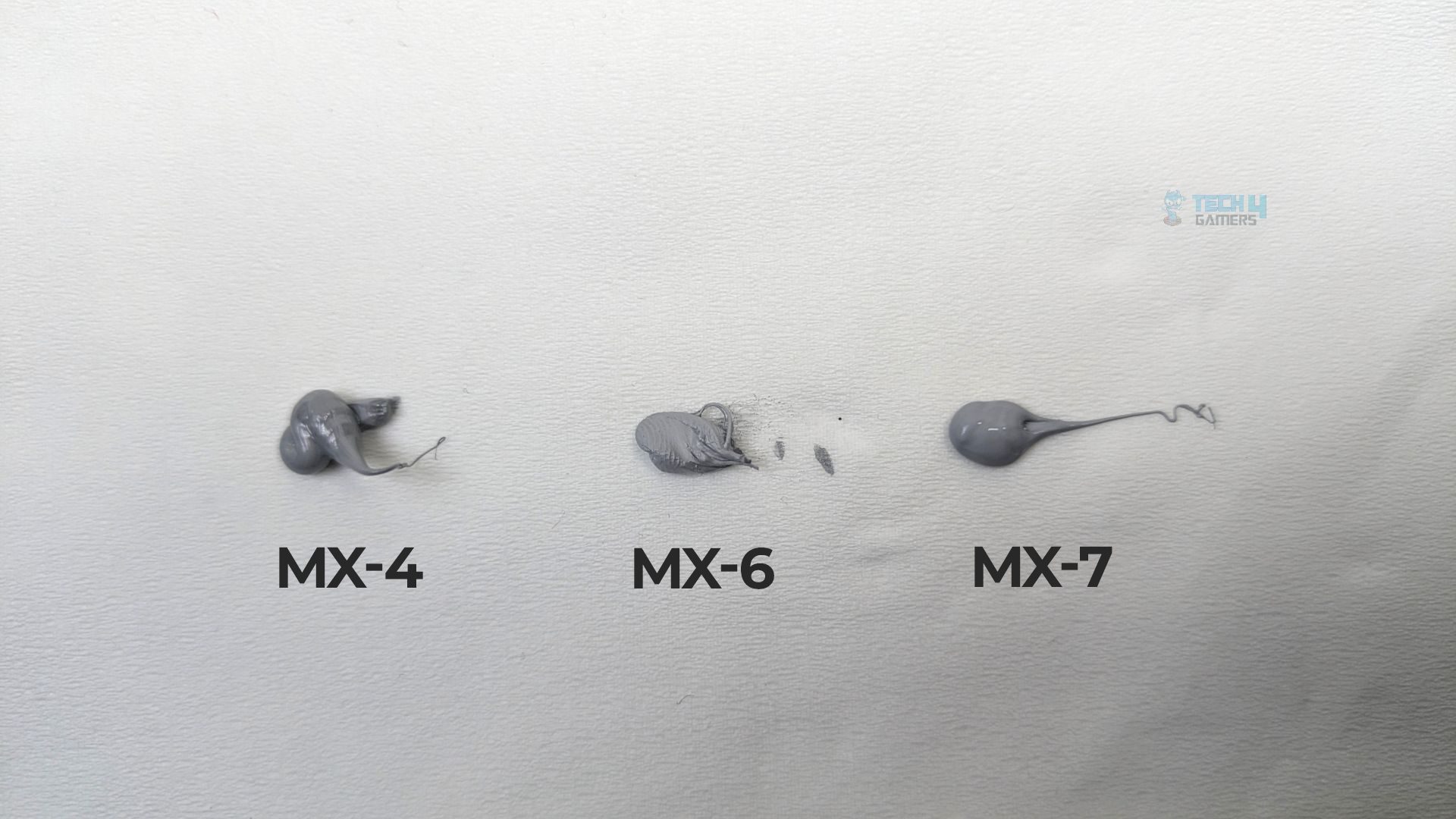
Here is the visual difference of the Arctic’s Thermal-Paste. The Arctic MX-7 appears smoother and slightly glossier than the MX-6, due to its lower viscosity, while retaining the high structural cohesion, as evidenced by the long, stringy tail left by the syringe as it lifts away. This improved cohesion could offer a more even spread under mounting pressure without tearing or crumbling, which is good news if you’re looking for a paste with better durability. On the other hand, the MX-4 is very glossy and wet due to its low viscosity; however, it is more susceptible to the pump-out effect. Arctic MX-6 appears to be matte and thick, with a dry cookie-dough texture. In conclusion, Arctic MX-7 maintains a perfect balance between usability and application quality.
Testing Methodology
How We Test Thermal Pastes
After applying the thermal paste, we ran two 20-minute Cinebench R23 tests with a 10-minute break to cool down. Most modern thermal pastes require almost no burn-in time. However, if the paste is very viscous, extra warm-up tests may be needed.
Controlled Environment
We have ensured that the room temperature remains consistent at all times. To maintain accurate readings, we use a high-quality thermo-hygrometer available on the market. It is important to note that we have still eliminated the influence of ambient temperatures in our data, and all results are presented as deltas over the ambient conditions.
Preparing System
We are using HYTE Y70, but all the panels have been removed. The Cooler fans are blasting at the 100% PWM, while the case fans are running at the fixed speeds.
Software
We used HWINFO Pro to record average temperatures on the CPU tDIE on AMD.
Test Setup
- CPU: AMD Ryzen 9 9950X (200W Power)
- RAM: XPG Lancer 16×2 CL30-6000MT/s
- Motherboard: ASRock Phantom Gaming X870 Nova WiFi
- Cooler: Ocypus L36 Sigma with Arctic P12 Pro ARGB Fans
- GPU: ZOTAC SOLID RTX 5080
Performance Results
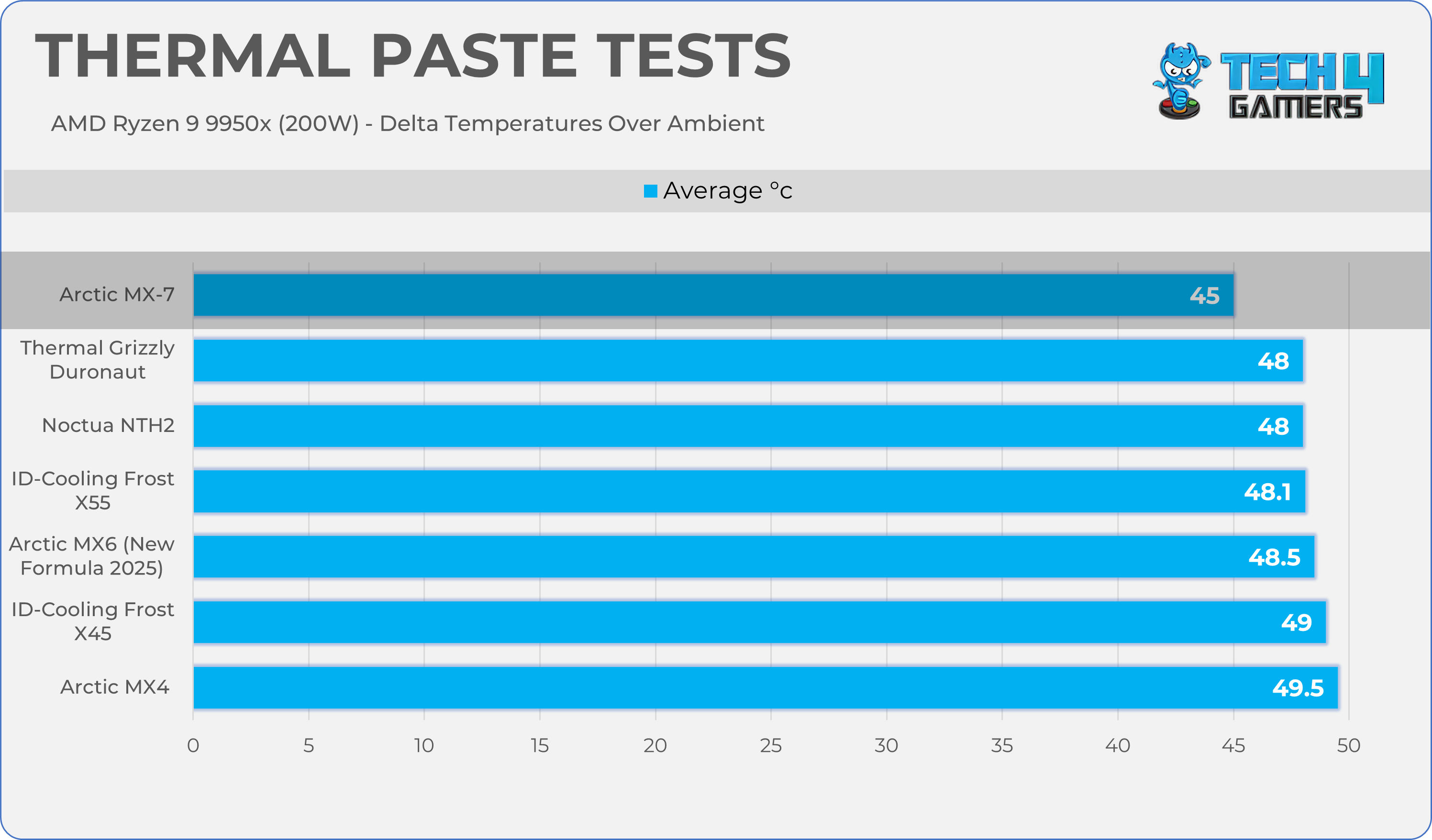
Here is the structured table, organized for improved clarity and ease of reading.
| Thermal Paste | Average Temperature c° |
|---|---|
| Arctic MX-7 | 45.0 C° |
| Thermal Grizzly Duronaut | 48.0 C° |
| Noctua NTH2 | 48.0 C° |
| ID-Cooling Frost X55 | 48.1 C° |
| Arctic MX6 2025 (New Formula) | 48.5 C° |
| ID-Cooling Frost X45 | 49.0 C° |
| Arctic MX4 | 49.5 C° |
Should You Buy It?
Buy It If:
✅ Switching from MX-4: If you have used the MX-4 on your system previously, it’s time to switch to the MX-7, as this newer Arctic thermal compound offers better performance and durability.
✅ It’s Durable: MX-7 offers improved cohesion, and this new formula can provide heavy-duty pump-out resistance. It provides a better spread under the mounting pressure without tearing and crumbling.
Don’t Buy It If:
❌ Overkill for the low-end hardware: If you’re building an entry-level system or a low-wattage media PC, this thermal paste is overkill, as it’s designed for enthusiasts and high-end builds.
Final Thoughts
So far, this is the much-needed upgrade over the previous Arctic Thermal Compounds, as it successfully bridges the gap between them. It captures the legendary longevity of the MX-6 without being too runny or too brittle, just right for good mounting pressure.
In our tests, the Arctic MX-7 has become the chart leader, offering better cooling performance. If you’re doing a quick repaste on your older build and have your old Arctic MX-4 lying around in the drawer, then save the money and stick to the MX4.
However, calculation changes if you have the top-tier system or when you’re trying to tame the dense thermal output of Core Ultra 5/7 or AMD Ryzen 7000/9000 Series processors. In high-stress situations, the pump-out is your biggest enemy. MX-7 is an exceptional thermal compound for durability.
Arctic MX-7 is available in 2-Grams (€14.49), 4-Grams (€15.99), 4-Grams + MX Cleaner Wipes (€16.99), and 8-Grams (€20.99).
Thank you! Please share your positive feedback. 🔋
How could we improve this post? Please Help us. 😔

Senior Hardware Reviewer at Tech4Gamers with over a decade of experience in the tech industry. My journey began in 2014 as a senior administrator for Pakistan’s largest gaming community forum. I specialize in testing and reviewing components like graphics cards, CPU coolers, and motherboards, while also sharing insights on overclocking and system optimization.
 Join Our Community