
 Threads
A Great Upgrade!
Review Summary
The Intel Core Ultra 270K Plus is a fantastic CPU in specific professional environments, but finds itself in a highly awkward position for general consumers and gamers. This CPU is a master class in multi-core scaling and thermals, but is cannibalized by the incredible value of its own smaller sibling, Intel Core Ultra 250K Plus. If you want a CPU that can basically do everything, the Core Ultra 270K Plus is a must-have processor for the $299.
Hours Tested: 13

Overall
Pros
- Monster in Multi-Threaded Workloads
- Great Value
- Overclocking Enabled
- Memory Native Support of 7200MT/s
- Competing AMD Ryzen Non X3D 9000 Series Processors
- Strong iGPU
Cons
- Requires Z890 Chipset For Overclocking
- Less Power Efficient Than Core Ultra 250K Plus


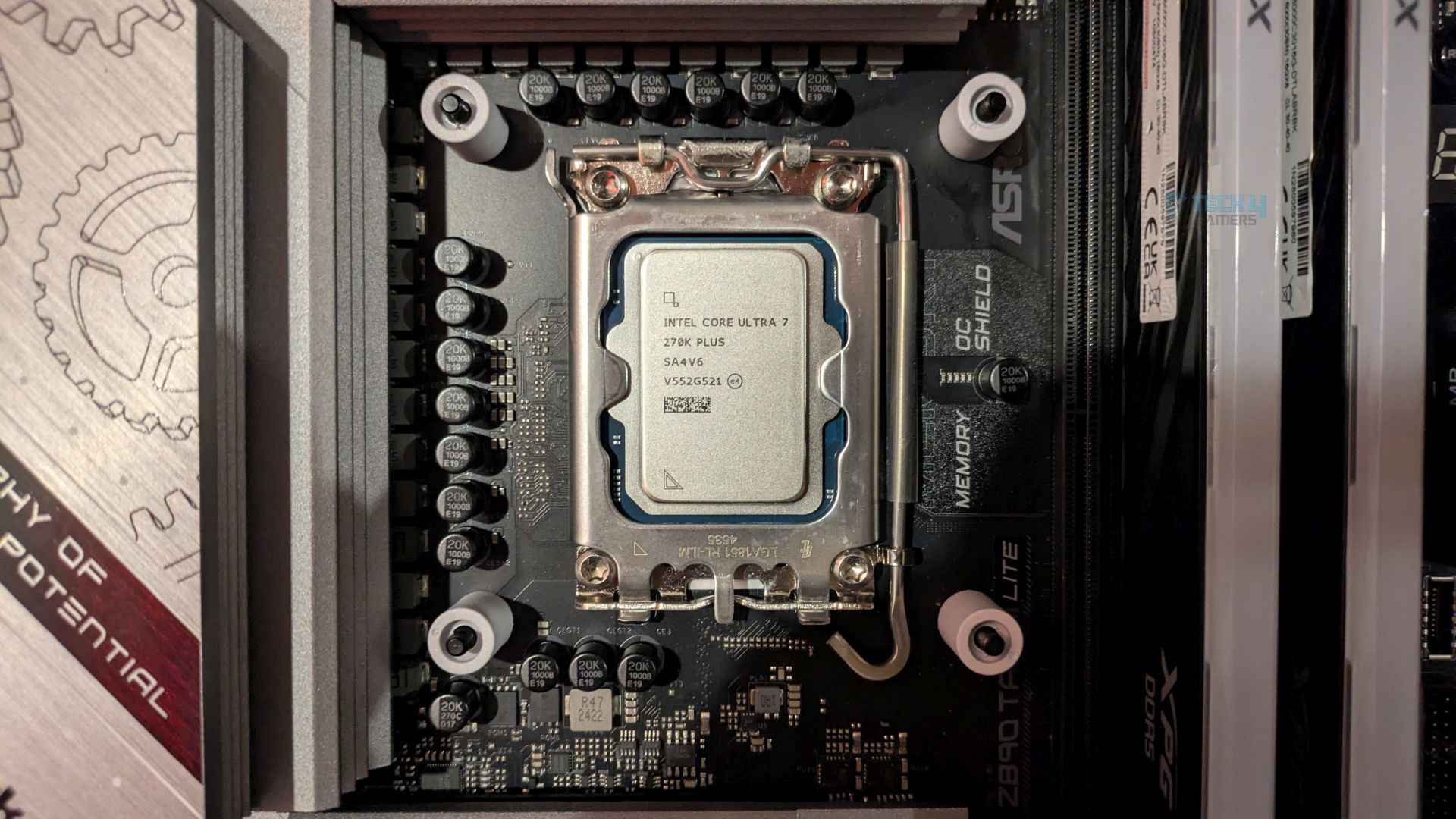
We have already reviewed the Intel Core Ultra 250K Plus and were impressed by its performance. Now we are taking a look at the Intel Core Ultra 270K Plus, which essentially adopts the specifications of the $600 Intel Core Ultra 9 285K. It retains the same 24-core configuration (8 performance cores and 16 efficiency cores) and 24-threaded setup, with the identical amount of L3 cache.
This model features a significantly faster 3GHz die-to-die interconnect (the component linking different sections of the chip for internal communication) and provides native support for 7200MT/s (Mega Transfers per second, indicating memory speed) right out of the box, addressing latency issues seen in previous Intel Core Ultra series. Arriving with a strikingly low $299 MSRP, this Arrow Lake refresh processor offers exceptional multi-threading capability at an affordable price, outvaluing its AMD Ryzen 7 competitors. This launch stands out as one of Intel’s most remarkable processor releases in recent times.
Here are the key specs:
| Specification | Core Ultra 7 265K | Core Ultra 9 285K | Core Ultra 7 270K Plus |
| Architecture | Arrow Lake | Arrow Lake | Arrow Lake Refresh |
| Total Cores | 20 | 24 | 24 |
| Core Configuration | 8 P-Cores + 12 E-Cores | 8 P-Cores + 16 E-Cores | 8 P-Cores + 16 E-Cores |
| Thread Count | 20 | 24 | 24 |
| Max Turbo Frequency | Up to 5.5 GHz | Up to 5.7 GHz | Up to 5.5 GHz |
| Base Clock (P-Core / E-Core) | 3.9 GHz / 3.3 GHz | 3.7 GHz / 3.2 GHz | 3.7 GHz / 3.2 GHz |
| L3 Cache (Shared) | 30 MB | 36 MB | 36 MB |
| L2 Cache (Total) | 36 MB | 40 MB | 40 MB |
| Native Memory Support | DDR5-6400 MT/s | DDR5-6400 MT/s | DDR5-7200 MT/s |
| Integrated Graphics | Intel Arc Xe-LPG (4 Xe-cores) | Intel Arc Xe-LPG (4 Xe-cores) | Intel Arc Xe-LPG (4 Xe-cores) |
| Processor Base Power | 125 W | 125 W | 125 W |
| Max Turbo Power | 250 W | 250 W | 250 W |
| Global MSRP | $394 | $589 | $299 |
Not Just a Refresh!
Apart from the Core Count, Clock Speeds, and Cache upgrades, Core Ultra Plus Processors have also undergone significant changes under the hood. The Arrow Lake processors suffered from latency issues when CPU tiles communicated with each other and with the memory controller. Intel increased the die-to-die frequency by 900 MHz, bringing it to 3.0 GHz. Also, it offers a faster ring bus, which has now been bumped by an additional 200MHz, bringing it to 3.9GHz in total. These changes have been made to reduce latency, enabling higher frame rates in gaming.
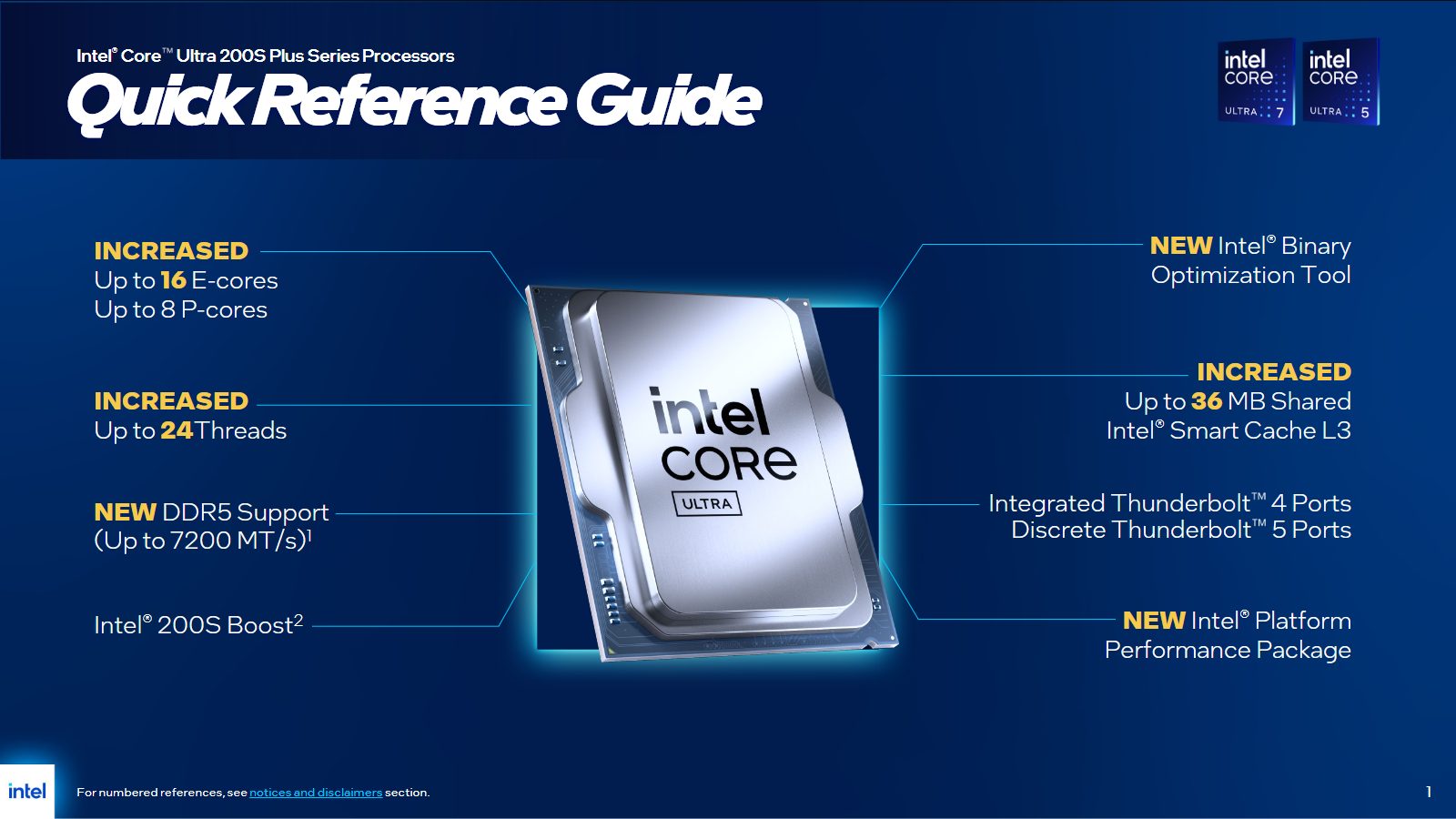
Intel has also upgraded the integrated memory controller (IMC) for the Plus series. The latest CPU now natively supports DDR5-7200MT/s, which is a significant jump from the original Arrow Lake Processors, which were 6200MT/s. It also now supports 4-Rank CUDIMM.

While not a physical hardware change, the 200S Plus series debuted the first-of-its-kind Binary Optimization Tool Software. The main benefit of this tool is that it automatically improves game performance on select titles by optimizing CPU instructions per cycle (IPC) in real-time. If a game is not already optimized for a specific CPU architecture, performance may suffer and addressing this would otherwise require game developers to manually recompile source code. Instead, users can launch and enable the tool for their game, though support is currently limited.
What About The Availability & Pricing?
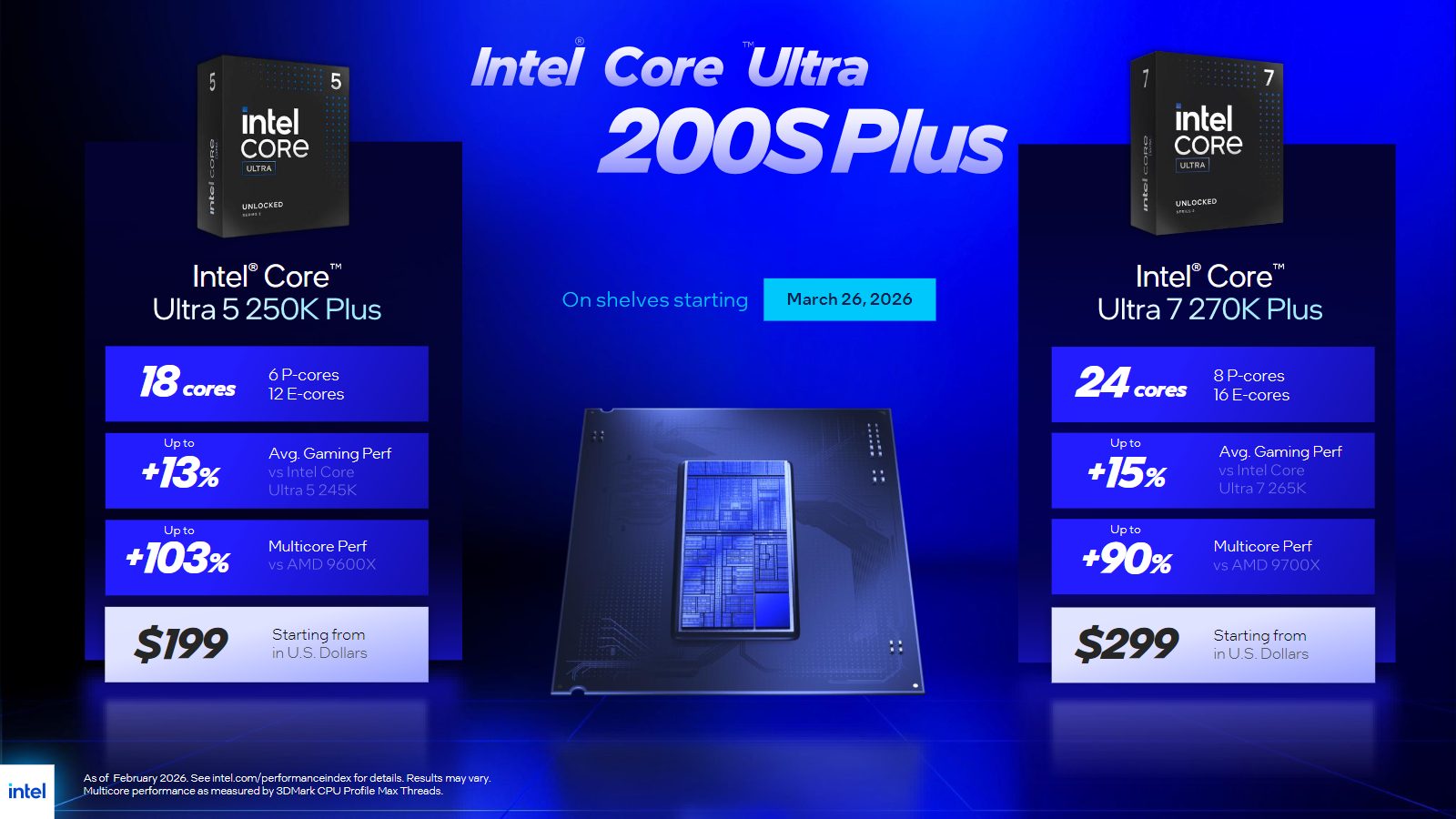
The Core Ultra 200S Processors were launched on March 26, 2026. The 250K Plus has the set MSRP of USD $199, and the 270K Plus will be available for $299.
Packaging
Let’s take a look at the packaging!
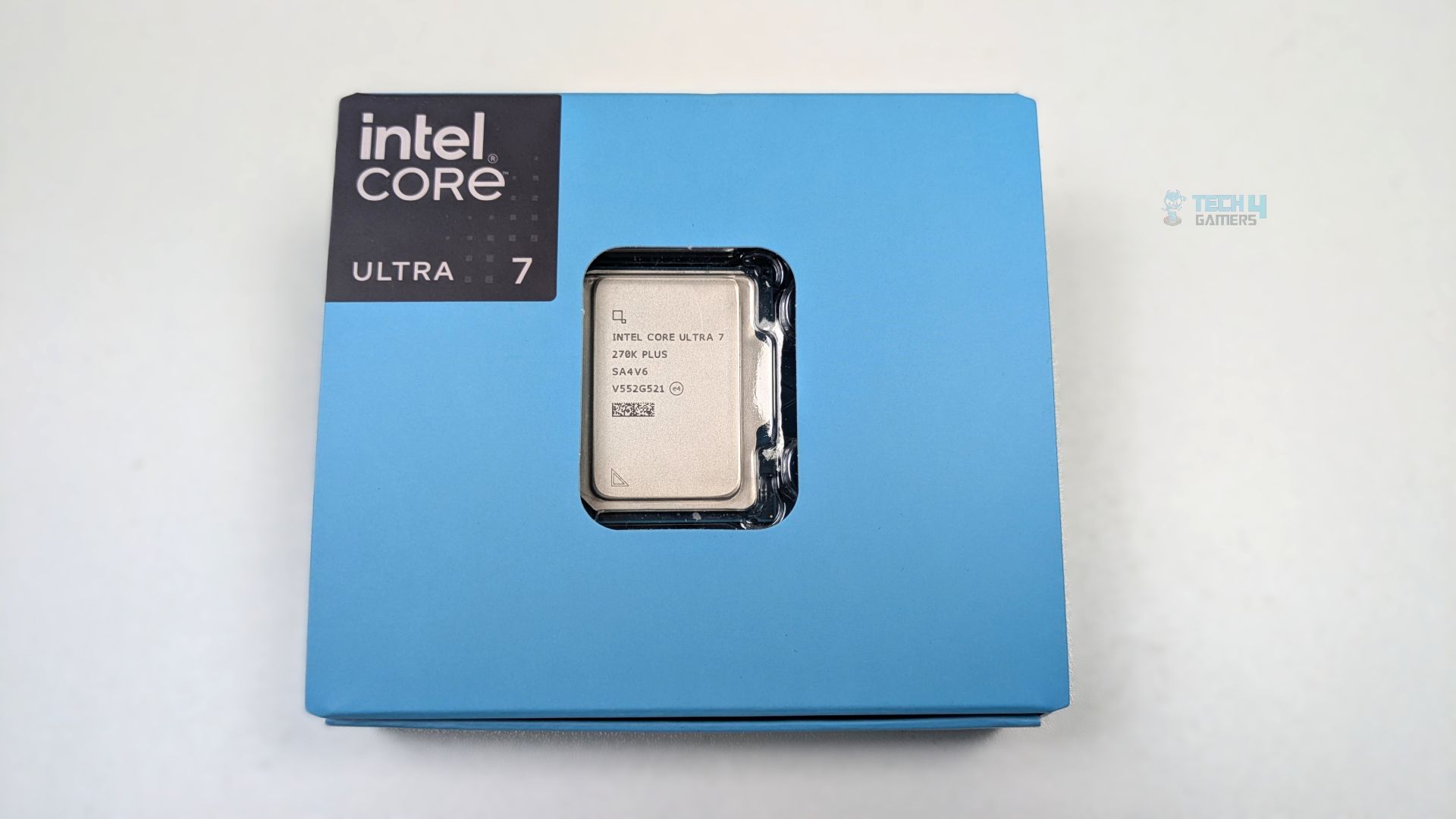
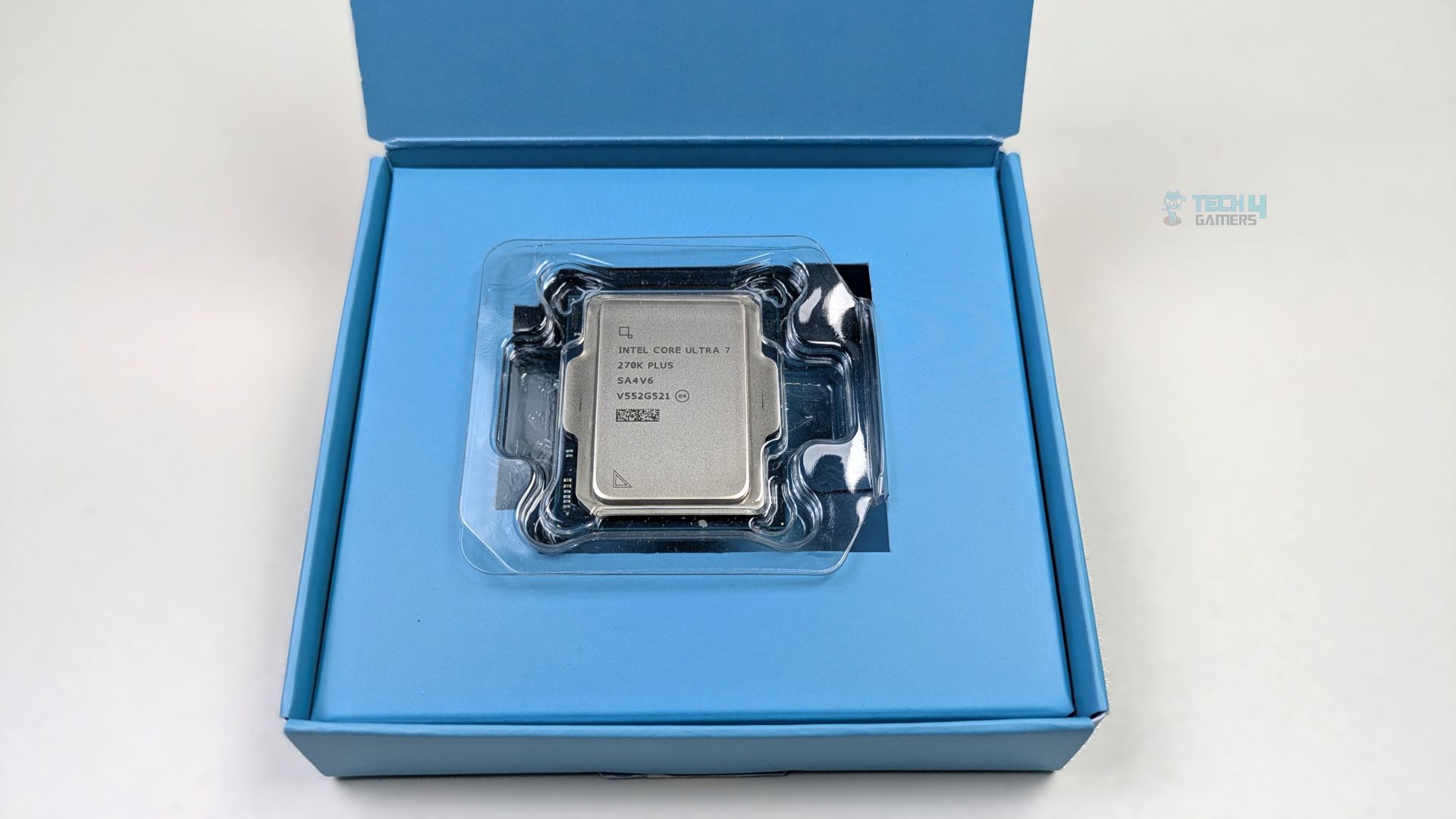
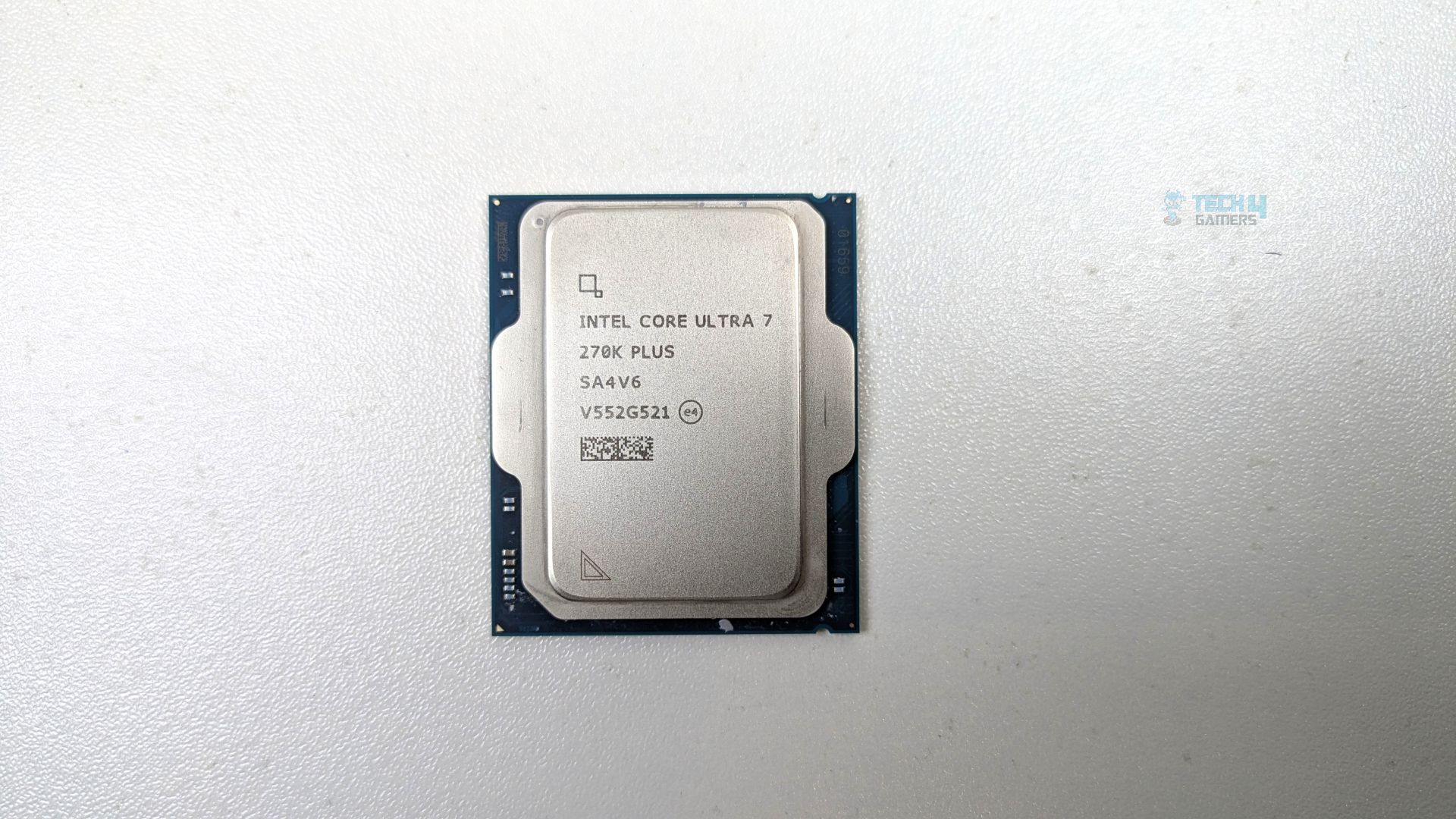
The Intel Core Ultra 270K Plus comes in simple blue cardboard packaging, secured in a plastic tray.
Testing Methodology
Test-bed Standardization.
We have done our best to standardize all non-CPU components as much as possible by using identical storage devices, memory, and cooling components, and the same drivers and Windows versions. Both AMD and Intel platforms are running at a memory frequency of 6000 MT/s with their EXPO/XMP profiles. We have also ensured the Resizable Bar is enabled on both platforms.
Productivity & Content Creation.
We have used a variety of real-world tools to test CPU performance, including Adobe Photoshop, Adobe Premiere, Cinema4D Rendering, Blender, Microsoft Office, Compression and Decompression Benchmarks, and Synthetic Benchmarks from 3DMark and Geekbench 6.
Gaming Performance.
To reveal true CPU gaming performance, testing must artificially induce a CPU bottleneck. We’ll test the games exclusively at 1920x1080p resolution with medium or high settings. Testing at 1440p. or 4K shifts the bottleneck to the GPU, flattening the data and hiding the CPU performance delta. We’ll also be measuring the average FPS and 1% lows.
Power & Thermals
We’ll be using a tool like HWiNFO64 to log Package Power (Watts) and maximum core temperatures during a 20-minute Cinebench multi-core loop and in games.
Test Setup
- CPU: AMD Ryzen 9 9950X, Intel Core Ultra 250K Plus
- RAM: XPG Lancer 6000MT/s CL30
- Motherboard: (AMD) ASRock X870 Phantom Gaming, (Intel) ASRock Z890 Taichi Lite
- GPU: ZOTAC RTX 5080
- Liquid Cooler: ASRock Steel Legend 360 LCD AIO
- Motherboard BIOS: (AMD) 3.5v, (Intel) 3.24v
- Drivers: GeForce Game Ready 596.21
- Windows Version: Windows 11 25H2 (Build 26200.8117)
Test – Synthetic Benchmarks
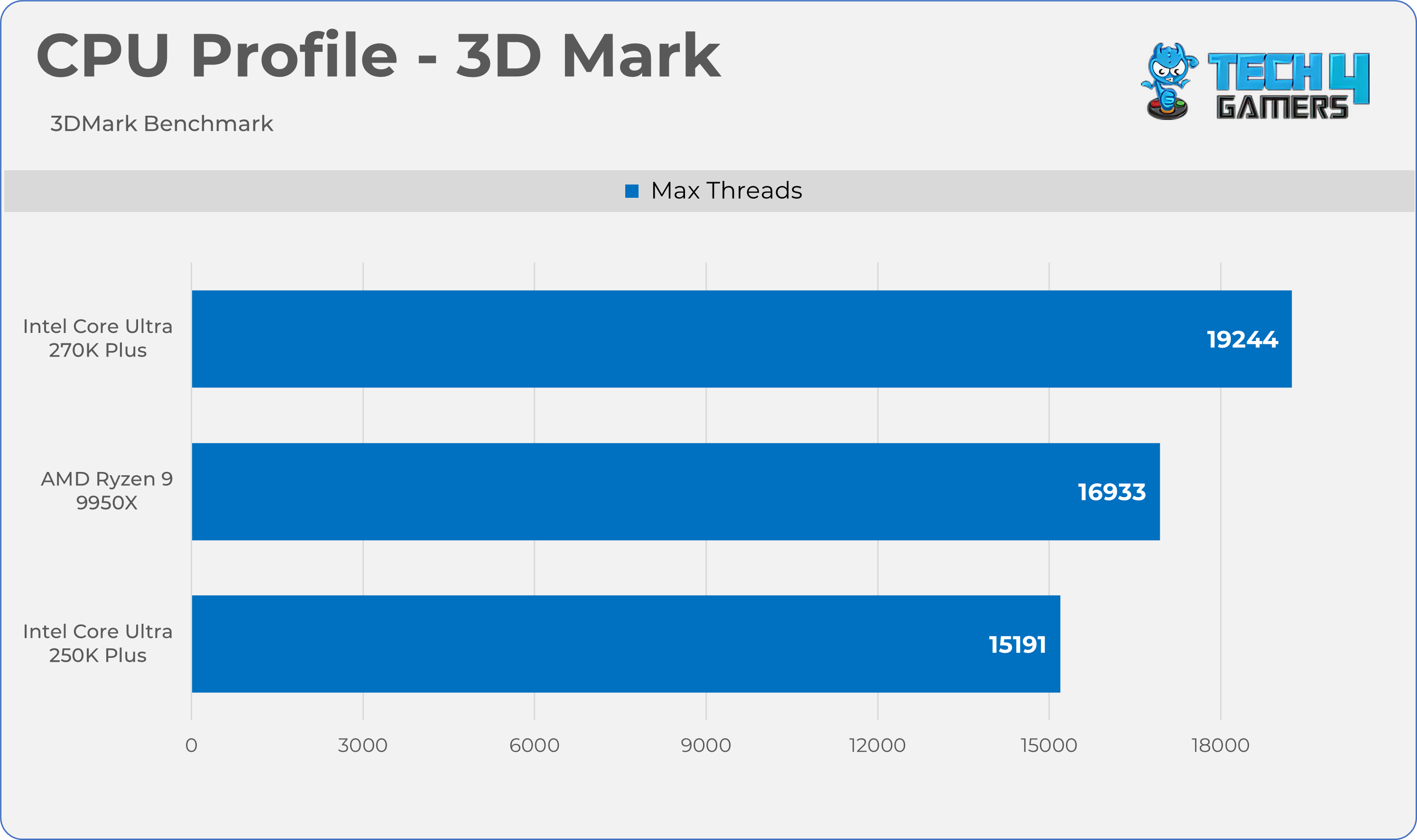
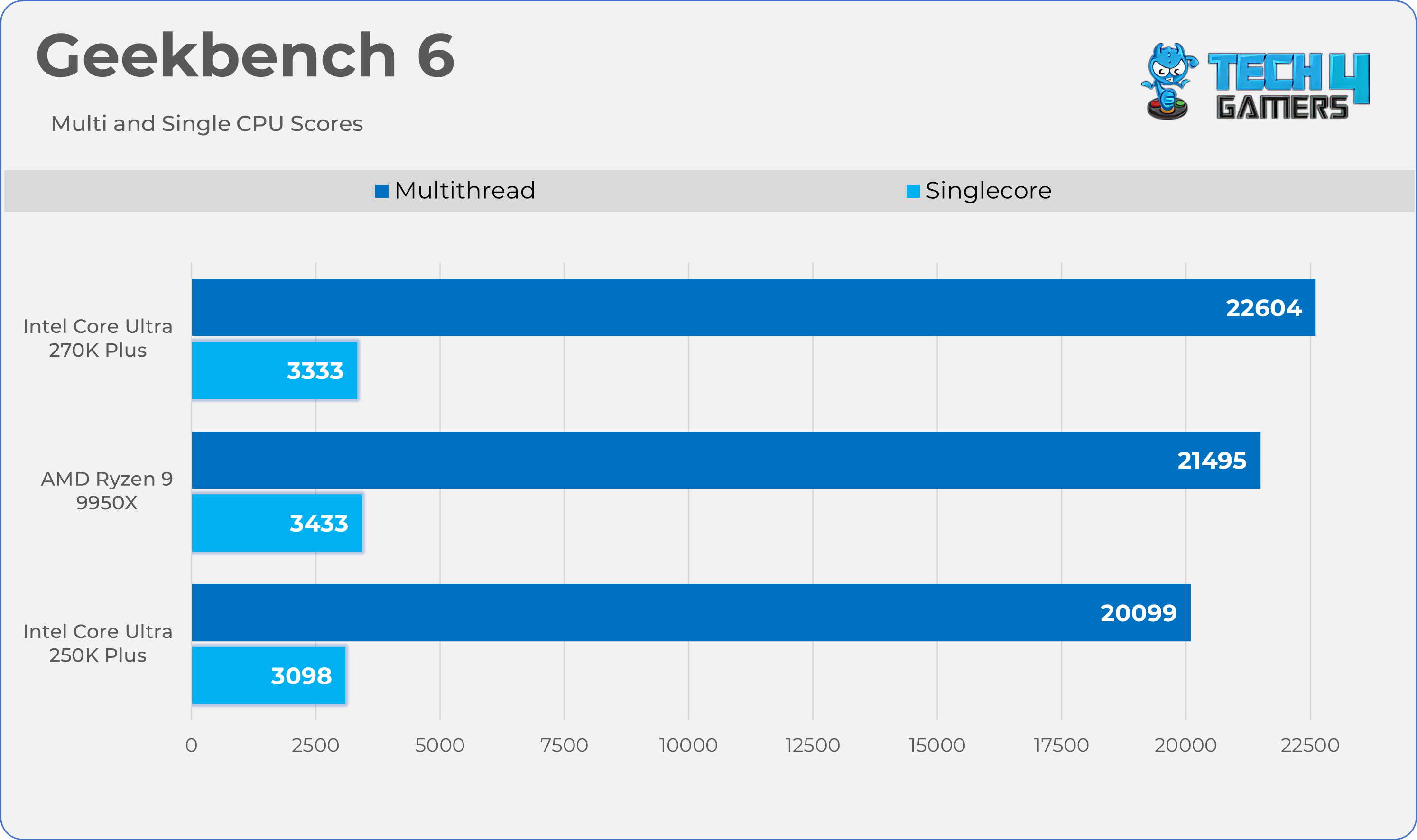
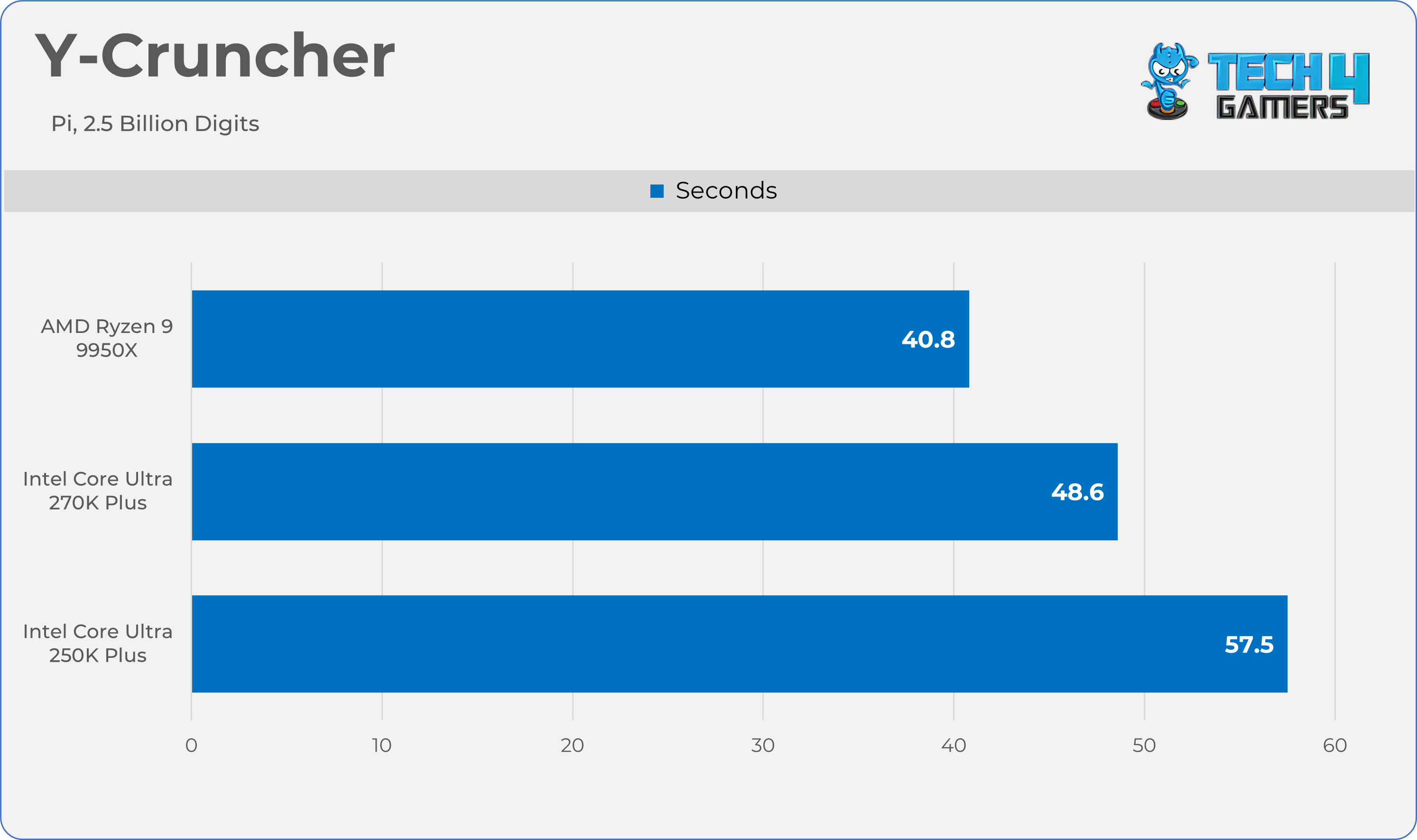
The Core Ultra 270K Plus showcases excellent multi-threaded scaling, beating the AMD Ryzen 9 9950X by 13.6% in the overall score of 3DMark’s CPU Profile. Furthermore, the CPU continued its dominance in Geekbench 6, outperforming AMD by 5.1%, although it lost in the single-core test by a negligible 3%. However, in the Y-Cruncher benchmark, the narrative shifts, as this tool focuses heavily on memory bandwidth and AVX instructions. Here, the AMD Ryzen 9950X destroys the Intel Core Ultra 270K Plus by 16%.
Test – Rendering Benchmarks
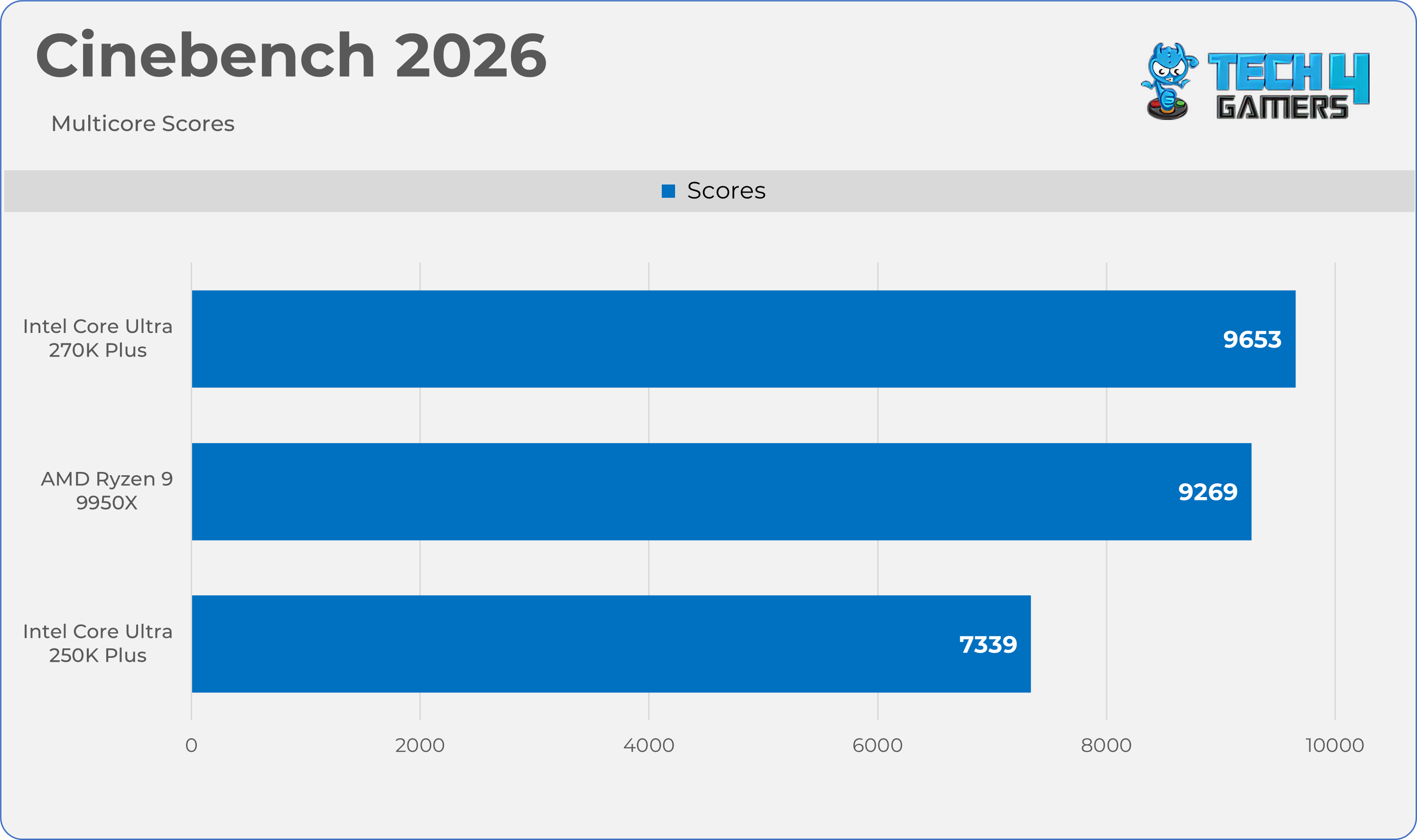
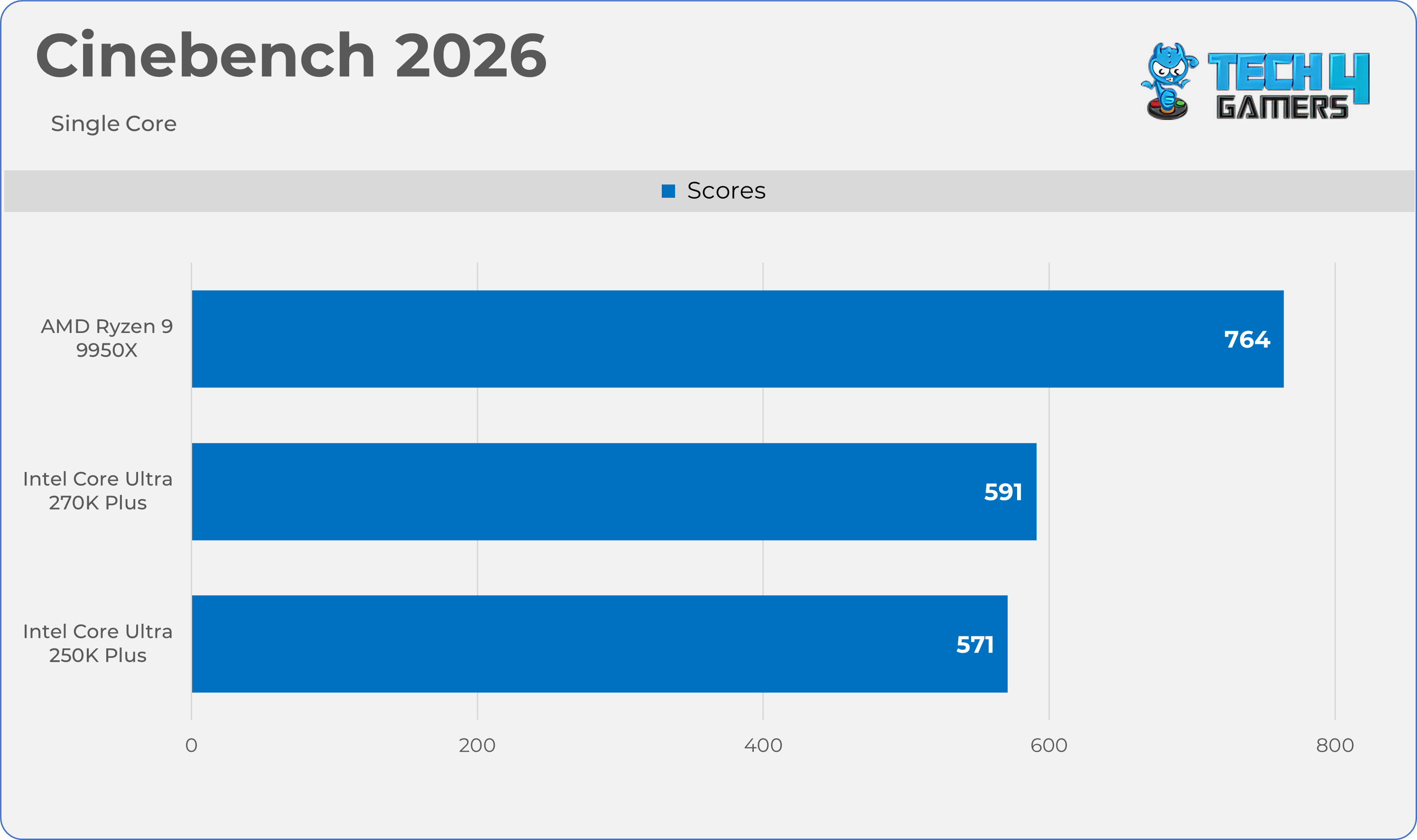
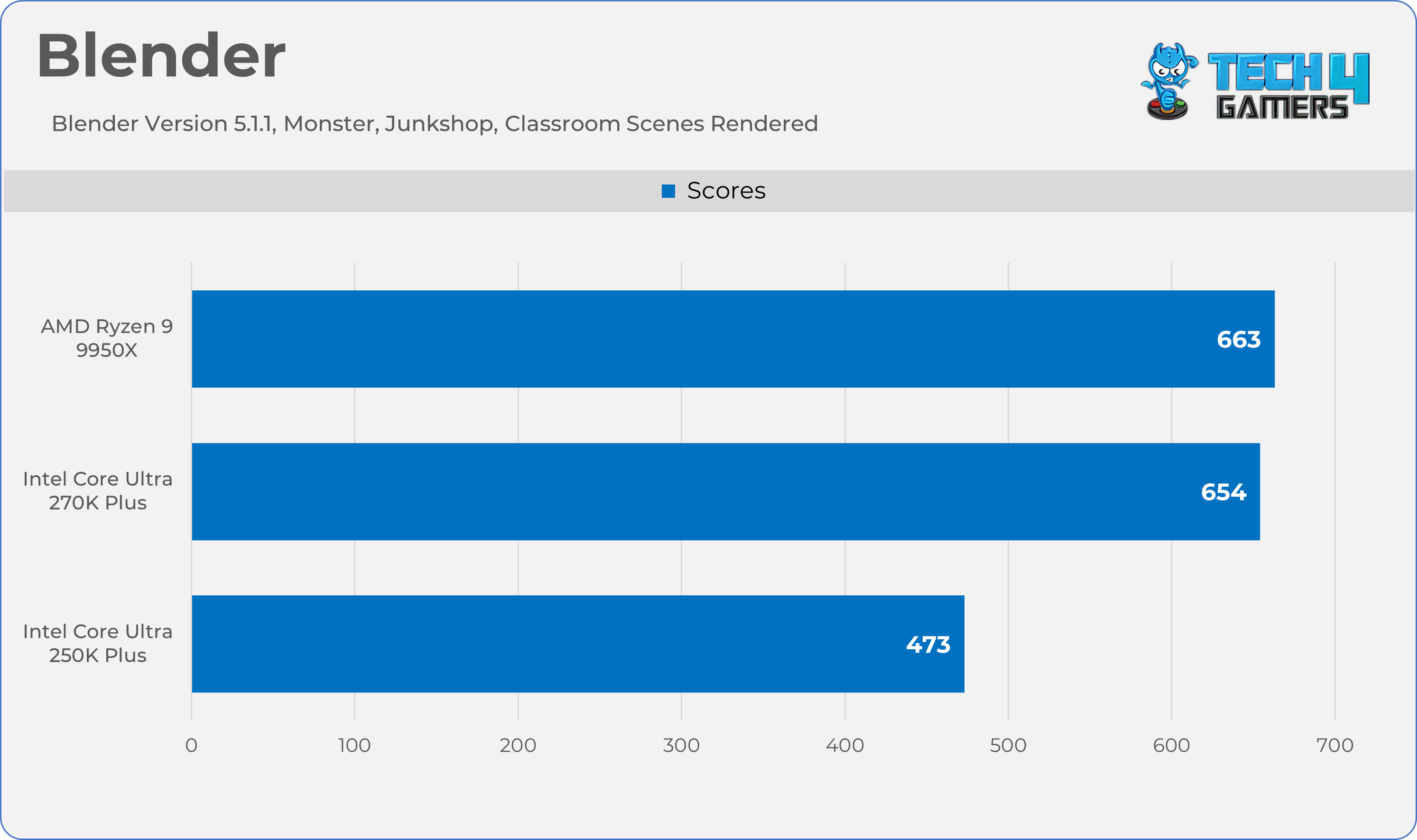
When it comes to pure, multi-threaded rendering in Maxon’s Engine, the 270K flexes its core count and thread scheduling perfectly. It is faster than the AMD Ryzen 9 9950X by the 4%. In Blender, AMD’s top-tier CPU and Intel’s latest Core Ultra 270K Plus are basically neck-and-neck. We’ll call it a tie, though the overall difference is only 1%, as AMD is slightly faster, but Intel renders more frames if we focus solely on value.
Test – Microsoft Office & Productivity
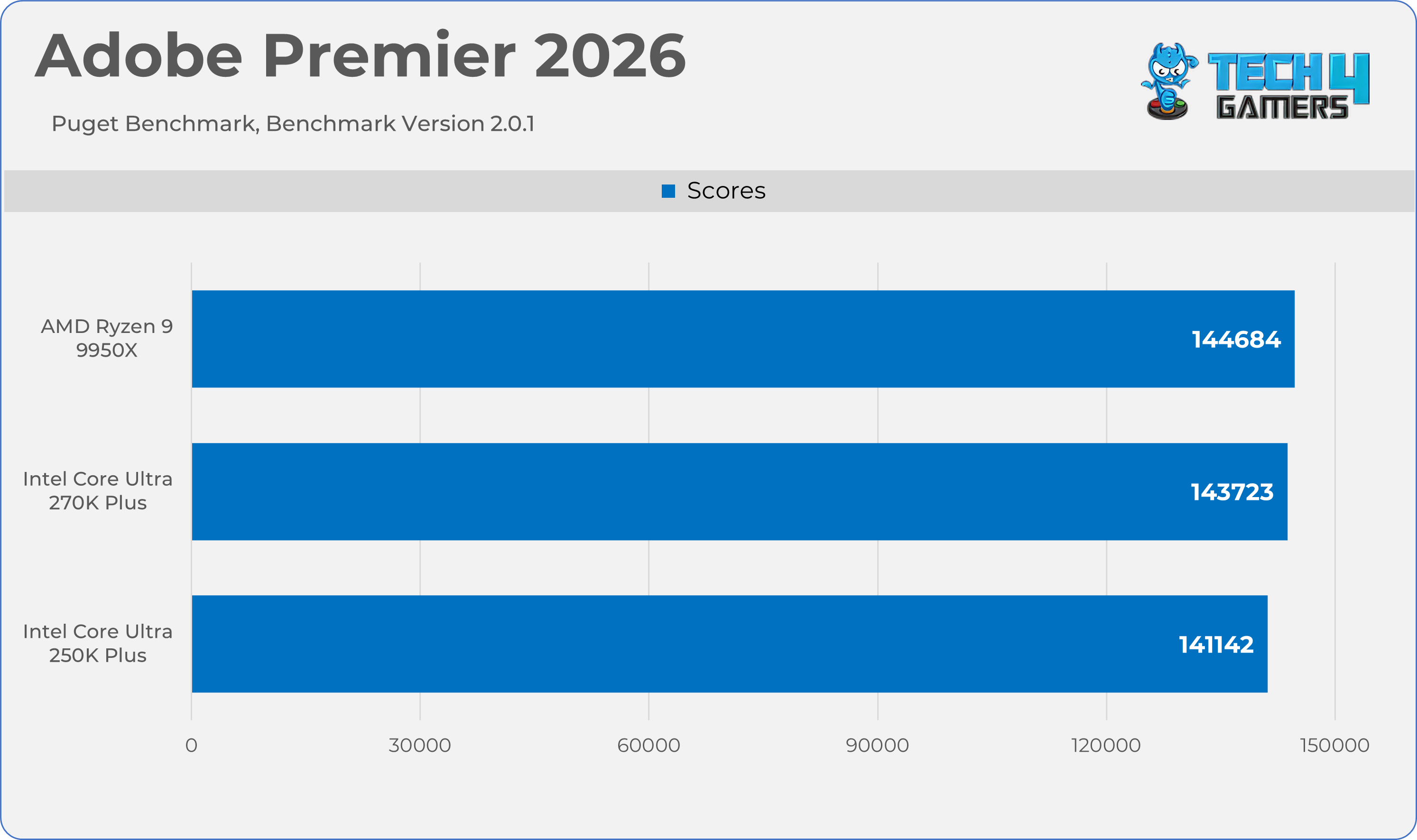
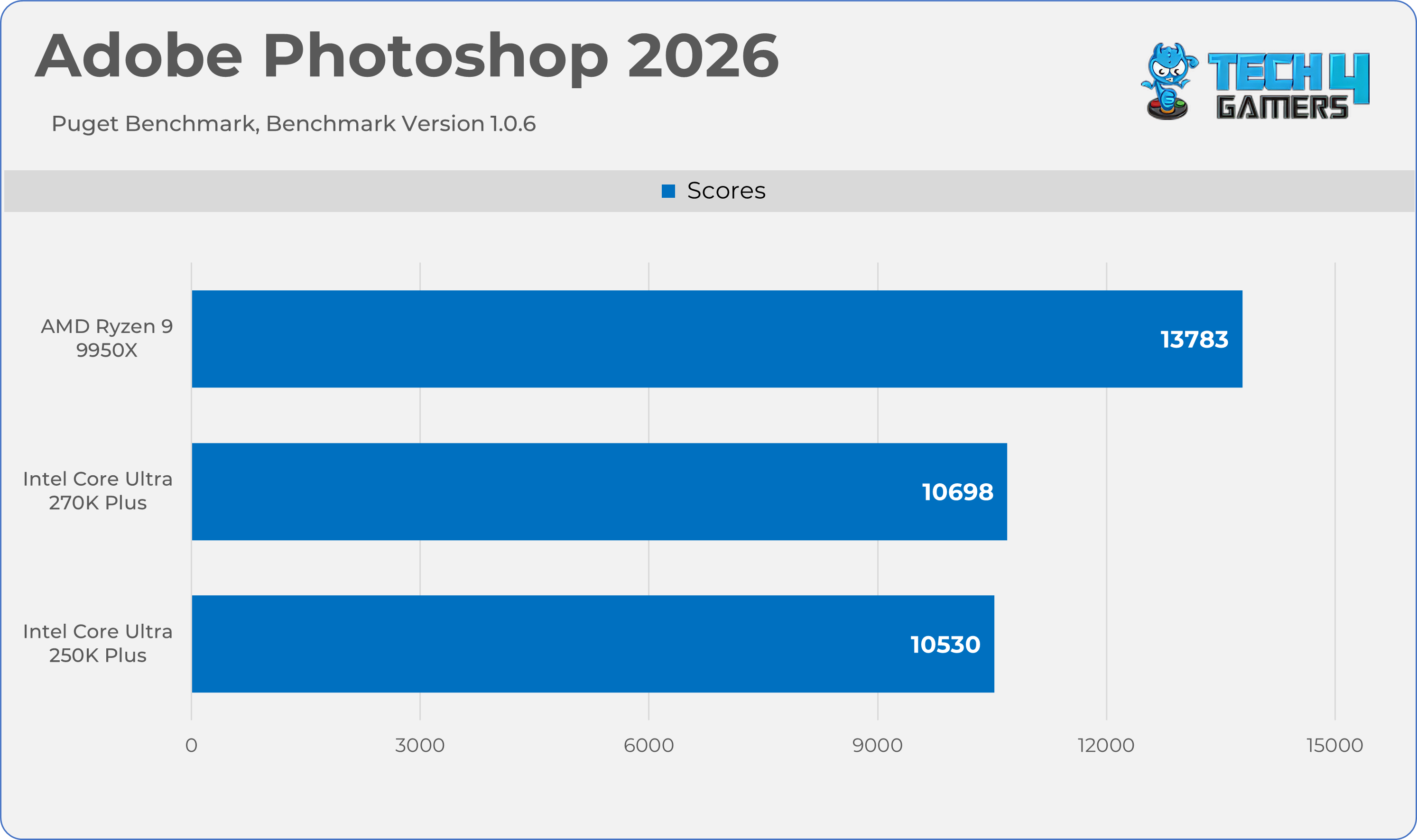
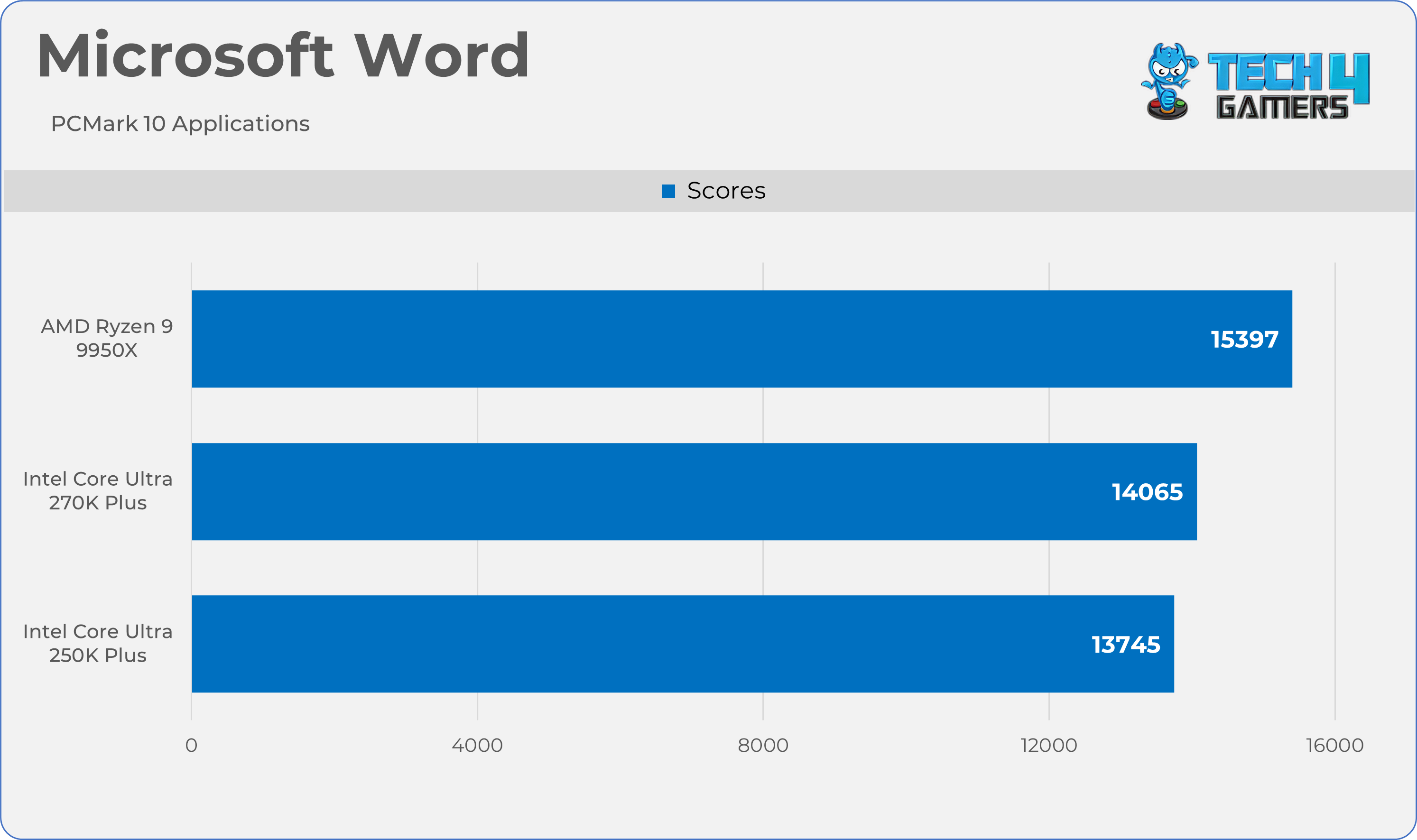
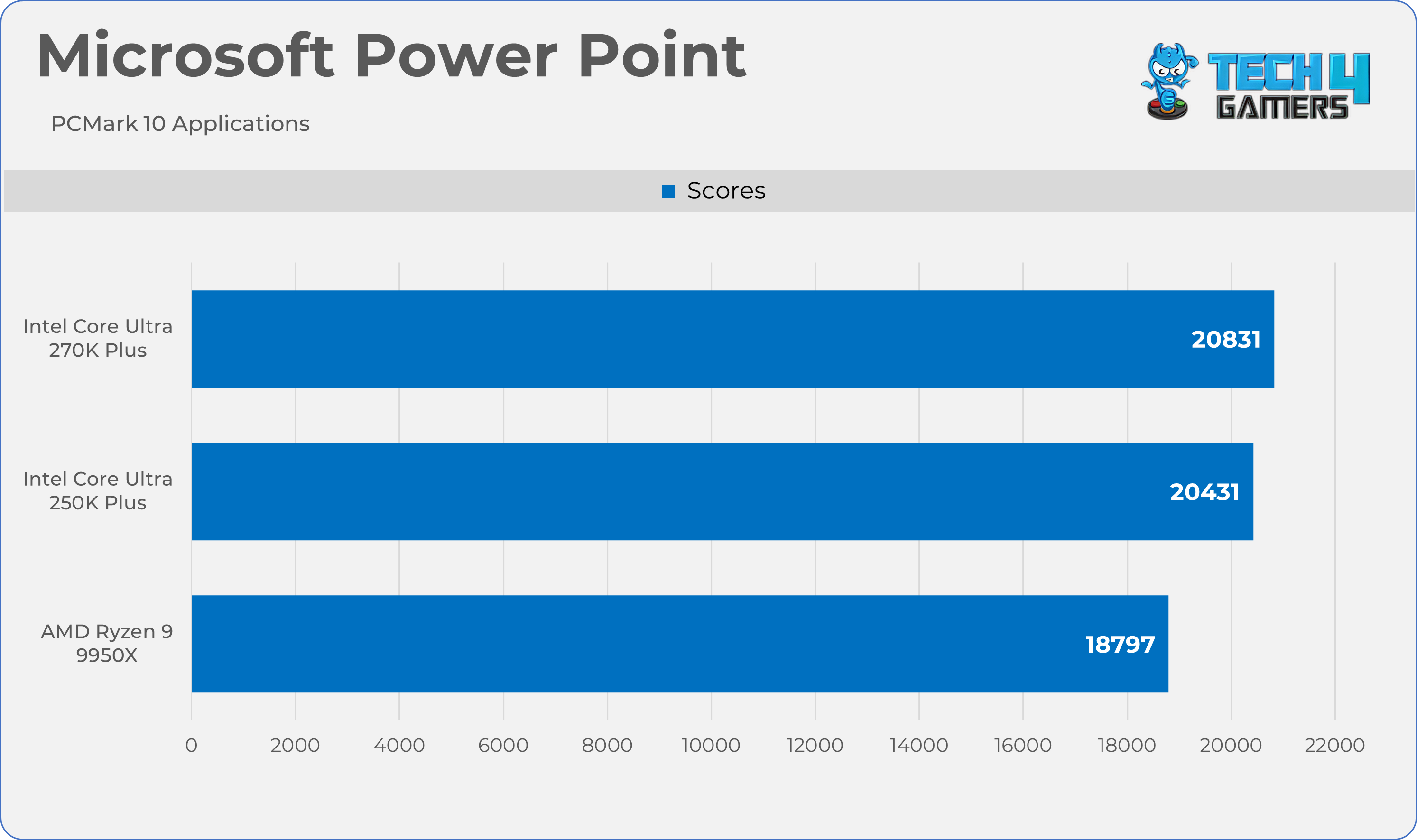
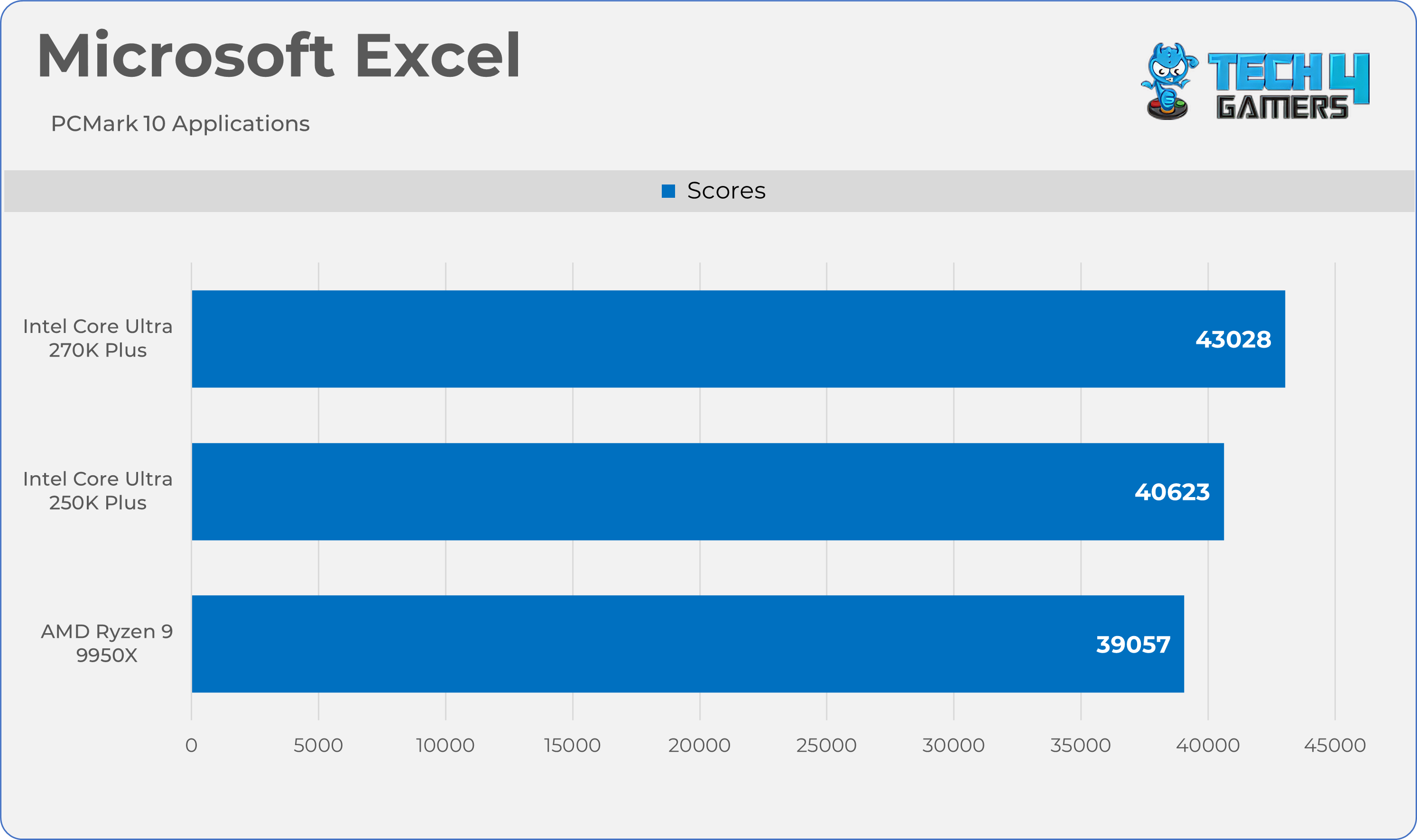
Now we are taking a look at one of the most utilized applications in the desktop, AMD annihilates the Intel Core Ultra 270K Plus by 28% in Adobe Photoshop, and is almost identical in Adobe Premier; however, the Core Ultra processors totally crush the AMD in Microsoft Office applications due to the Intel architecture handling the data manipulation and calculation bursts significantly better than its competitor. Overall, the results for the Intel Core Ultra 270K Plus in Productivity and Creative applications are exceptional.
Gaming Benchmarks 1080p FHD
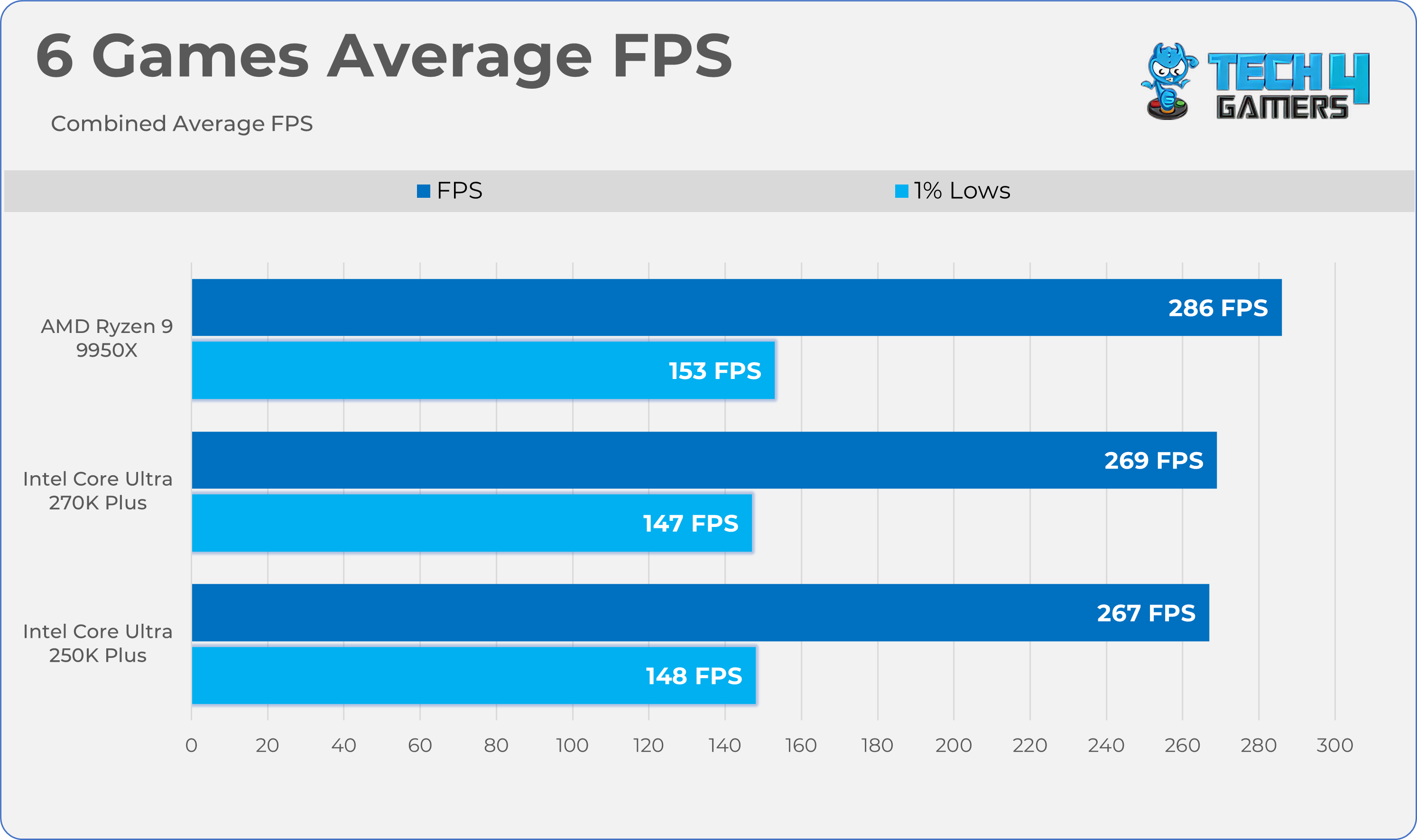
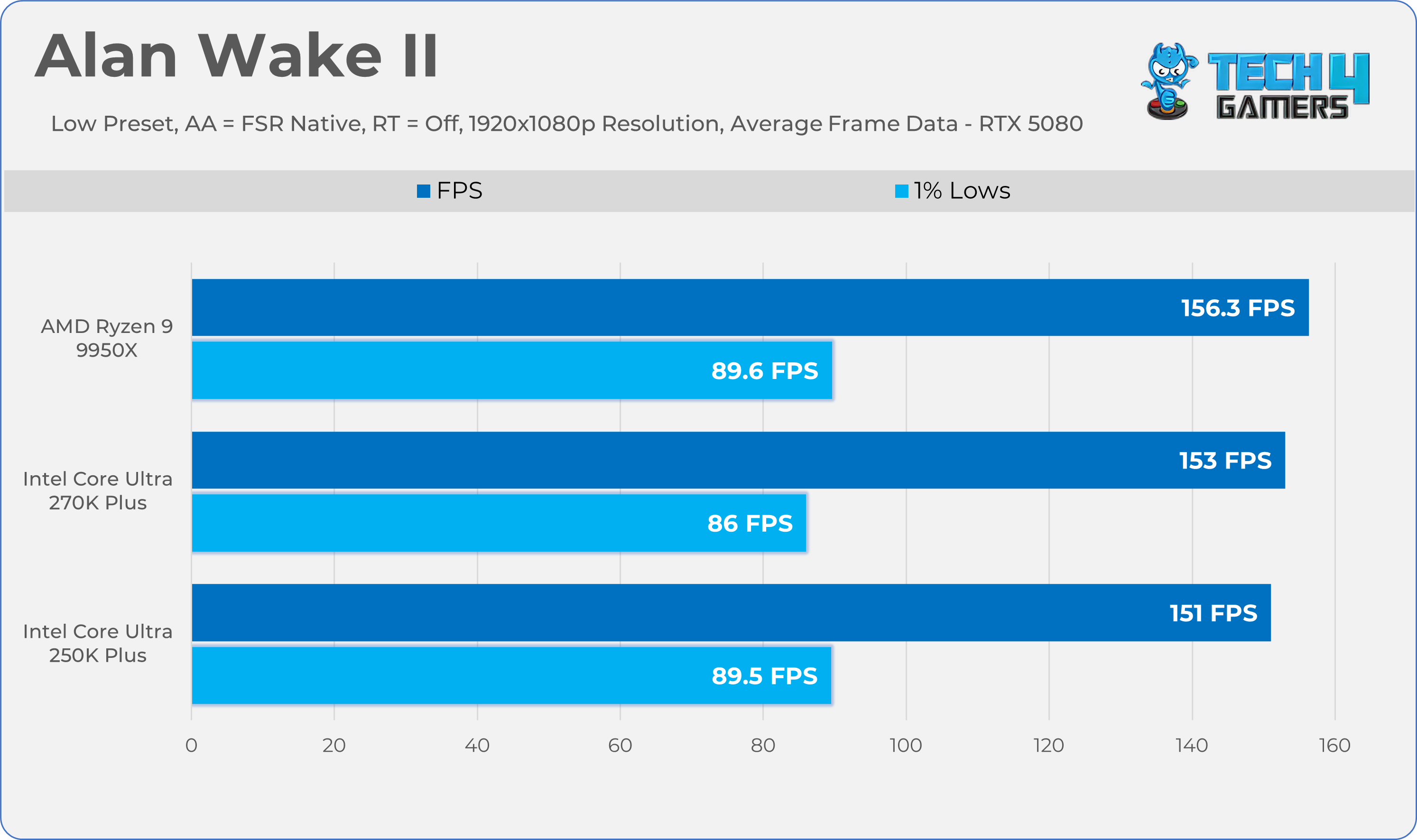
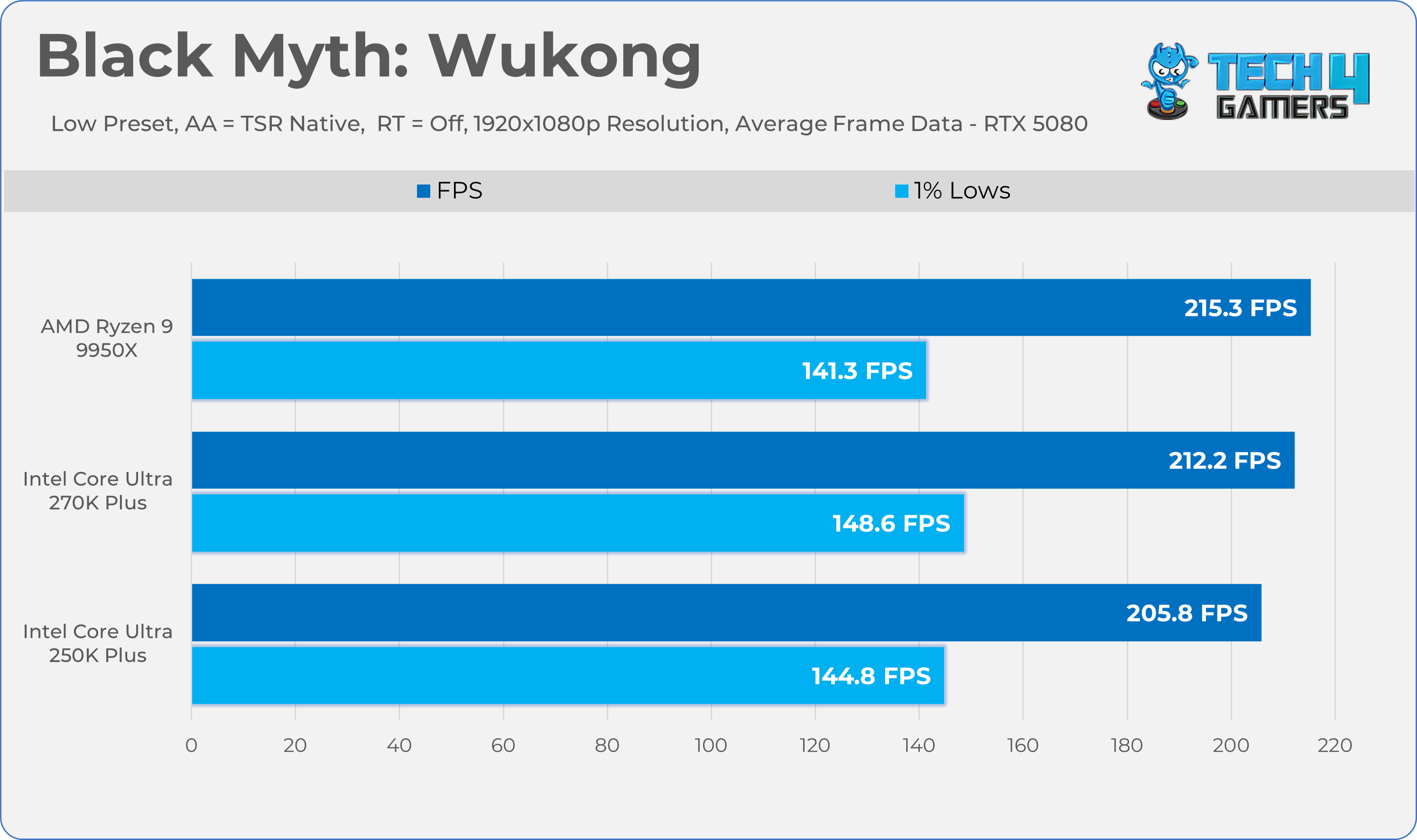
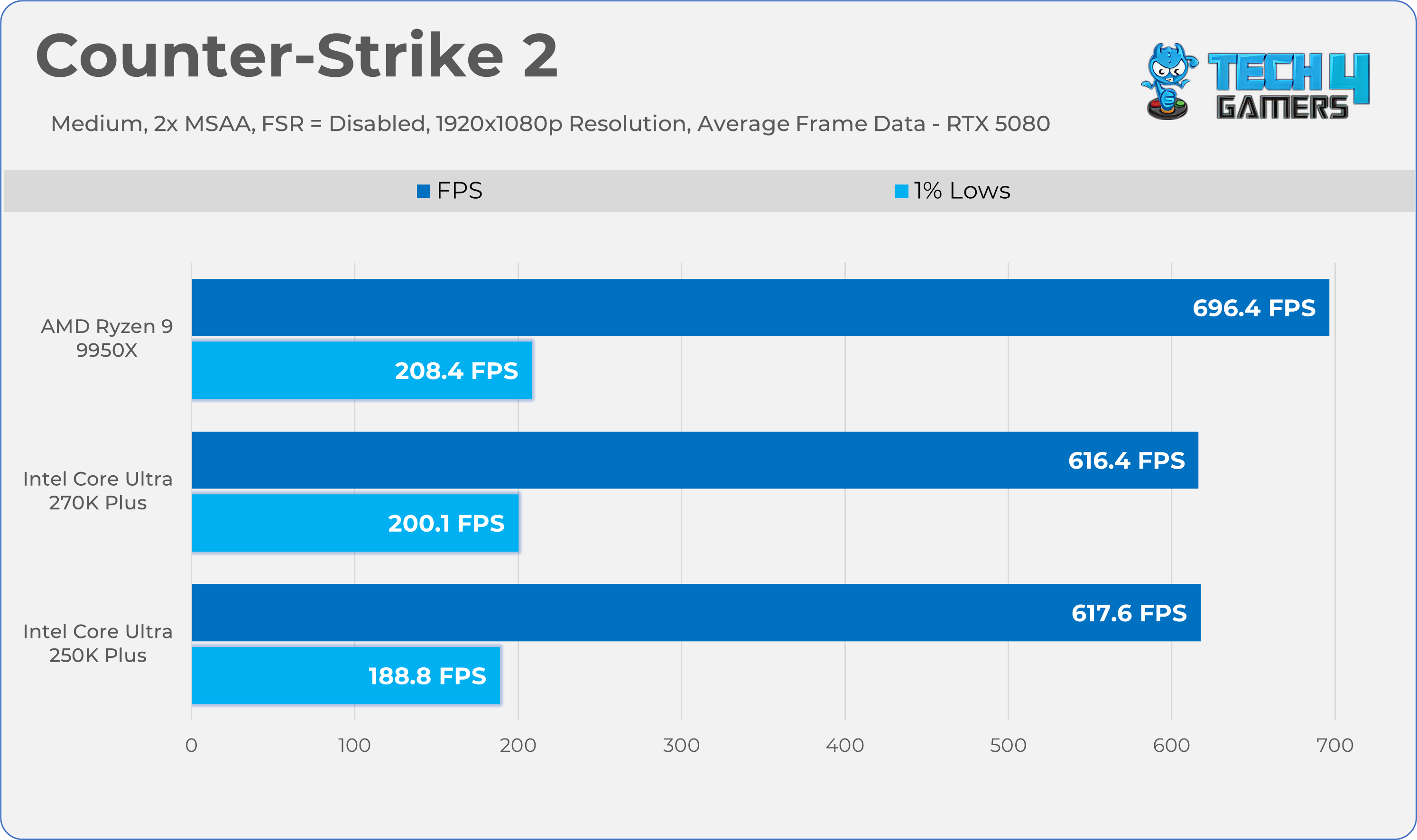
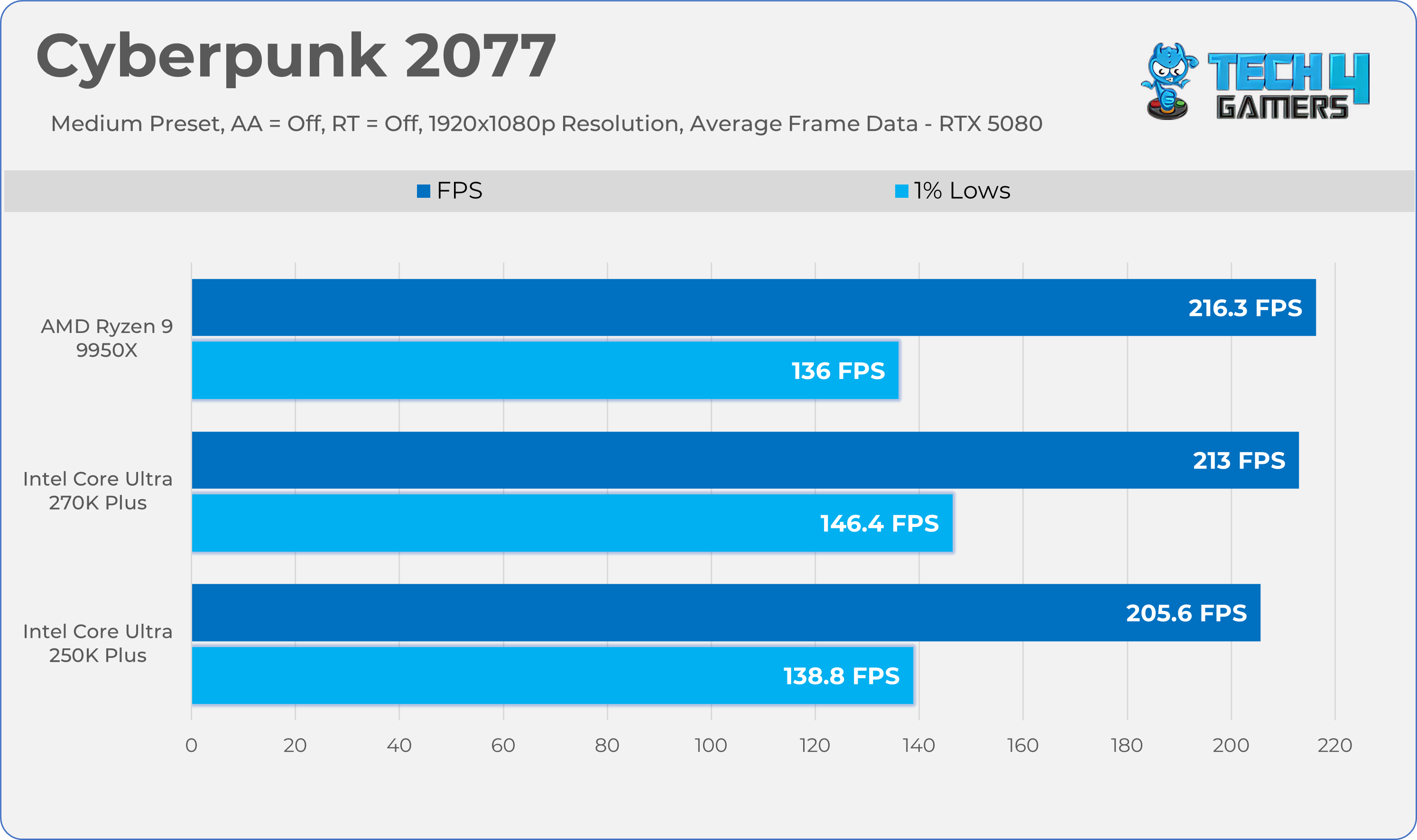
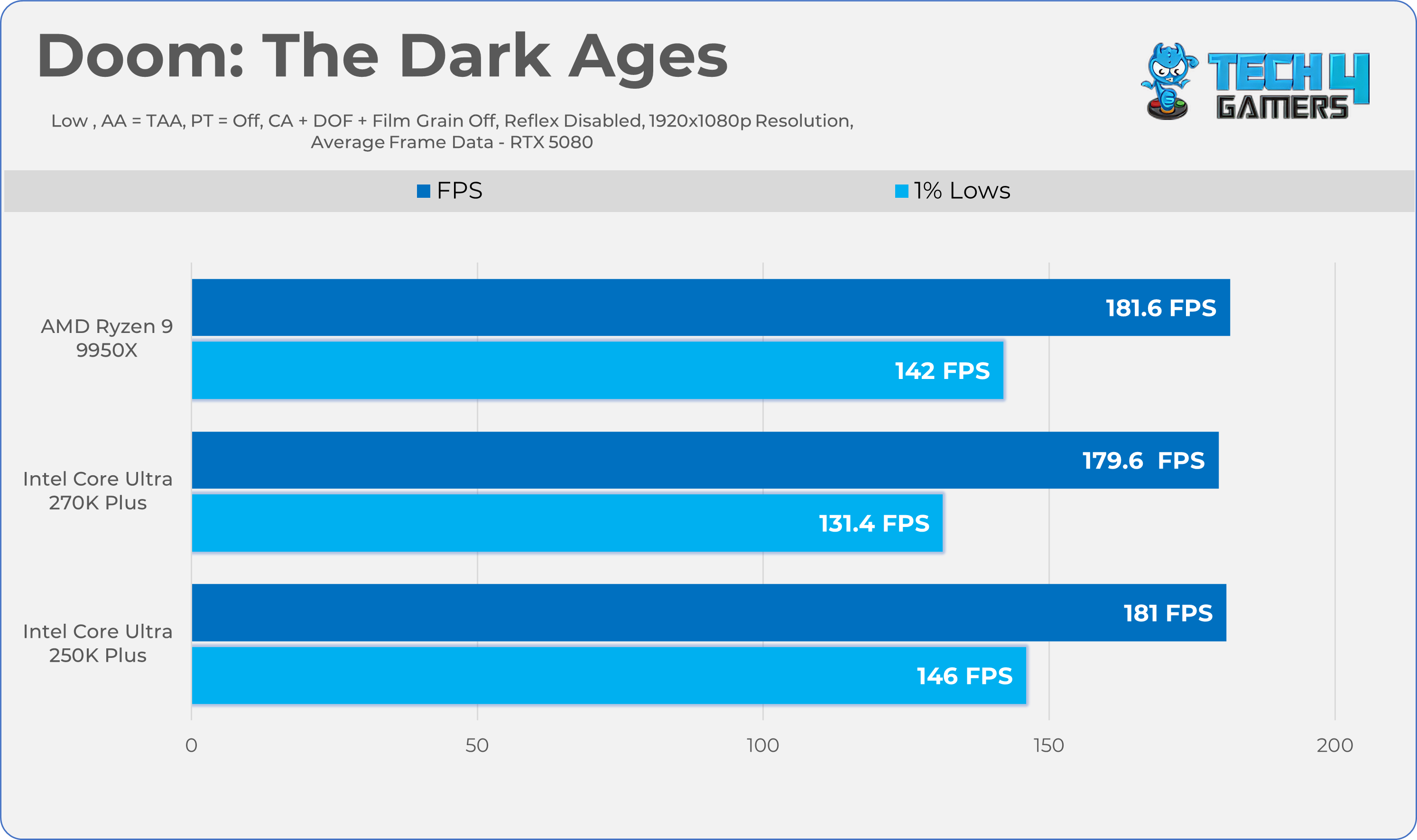
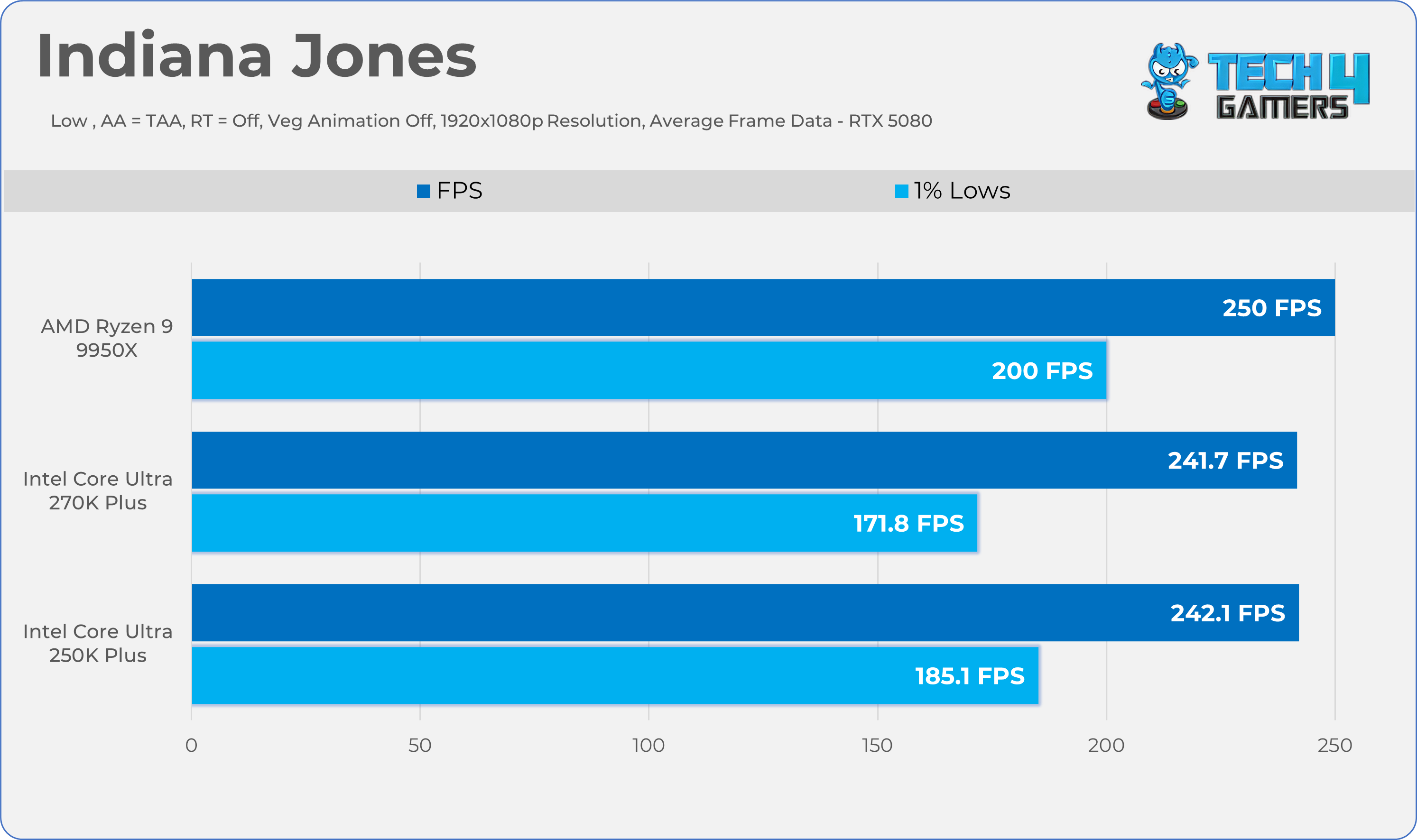
In games, the Intel Core Ultra 270K Plus is less impressive, though. Core Ultra 250K Plus offers greater value and runs more efficiently for gaming. The 270K Plus is still a highly capable processor, but it still cannot outperform the AMD Ryzen 9 9950X in the majority of games, though the difference is not very huge. In many games, the 270K Plus provides basically zero advantage over the $199 Core Ultra 250K Plus in a few games. However, with more cores and threads, the 270K Plus provides smoother pacing, especially in Black Myth Wukong and Cyberpunk 2077. If high-refresh-rate competitive gaming is the goal, AMD still remains the undisputed king. Still, The 270K Plus seems to be a difficult CPU for gaming, offering flagship-level performance and exceptional frame pacing, but its inconsistency is still glaring, suggesting potential thread-scheduling or cross-die latency issues that can be easily addressed by the Intel platform drivers.
Clock Speed / Frequency
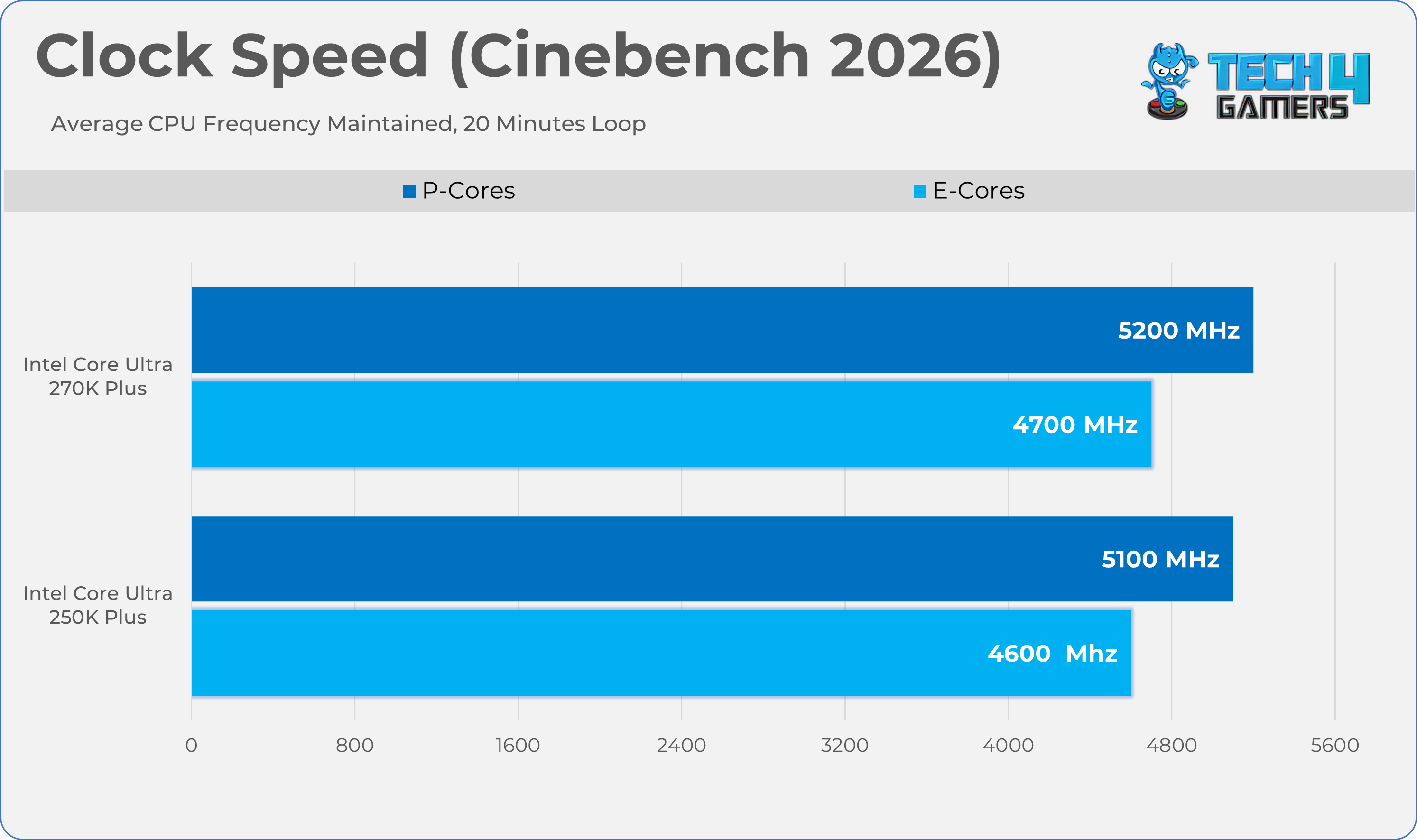
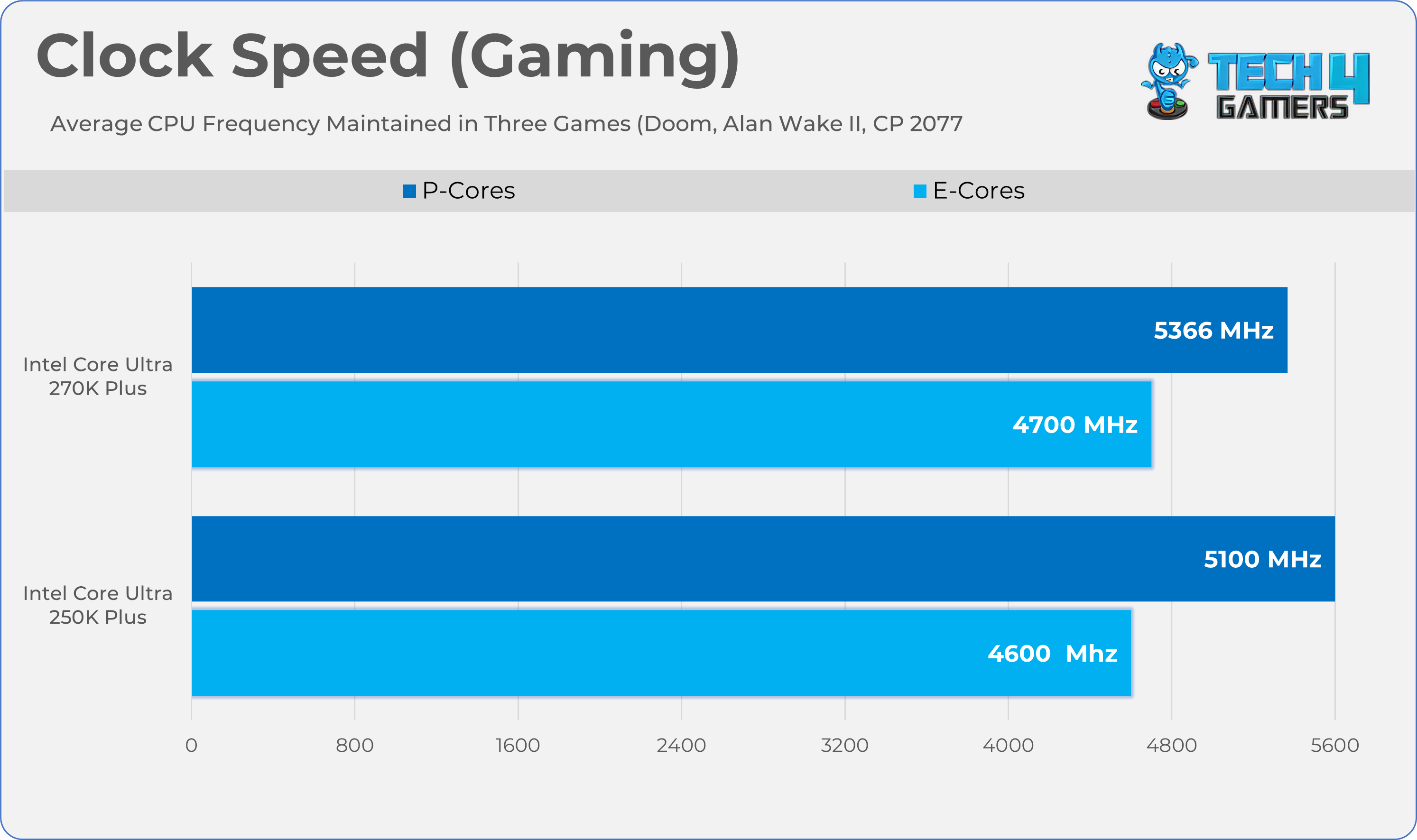
In these charts, the Performance Cores (P Cores) are always boosting to 5300~5400 on average in gaming. We did not notice any noticeable fluctuations. The E-Cores always ran at the locked 4700 GHz regardless of the workload. In Cinebench 2026, the Core Ultra 270K Plus ran at an average P-Core frequency of 5200 MHz.
Power Consumption & Temperatures
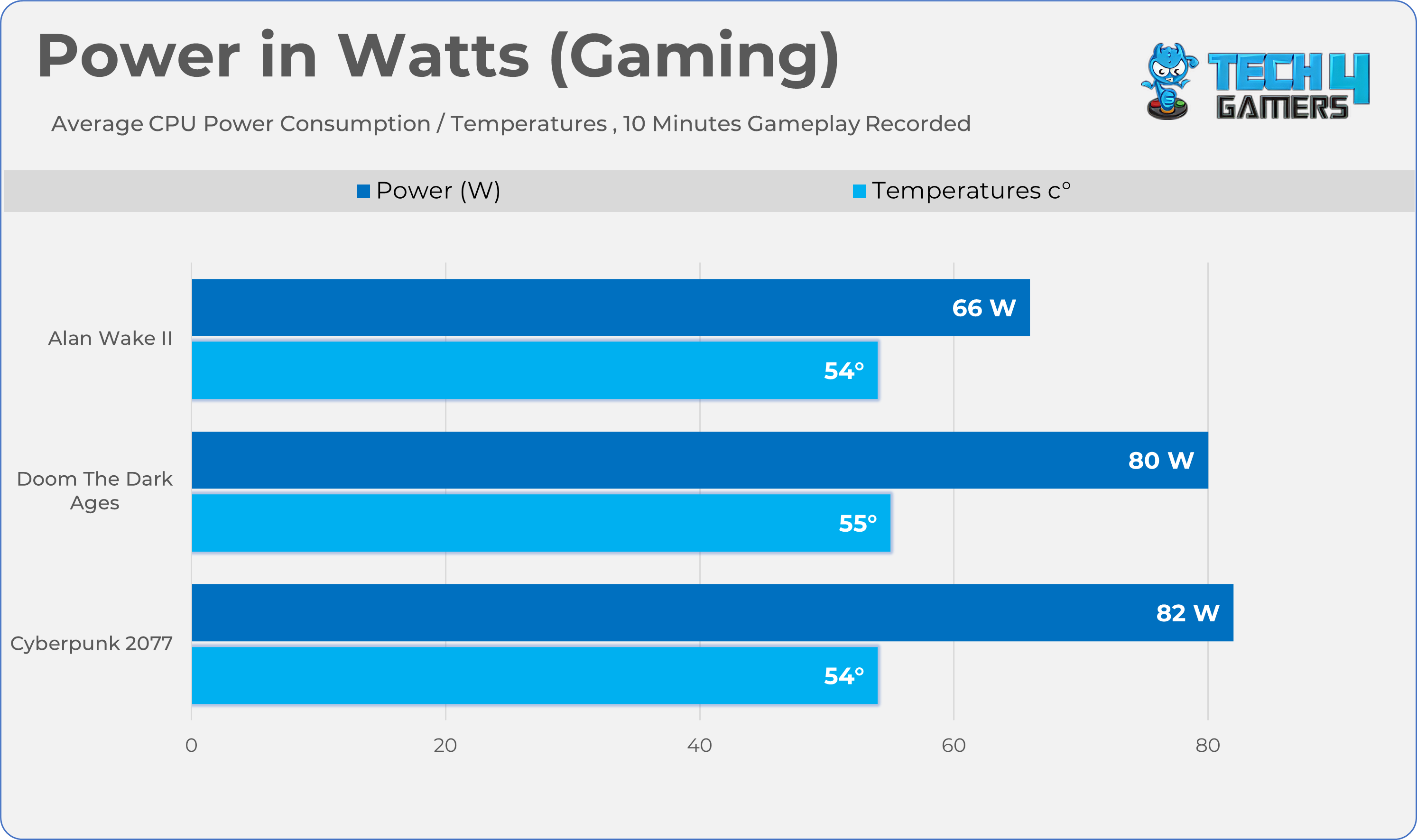
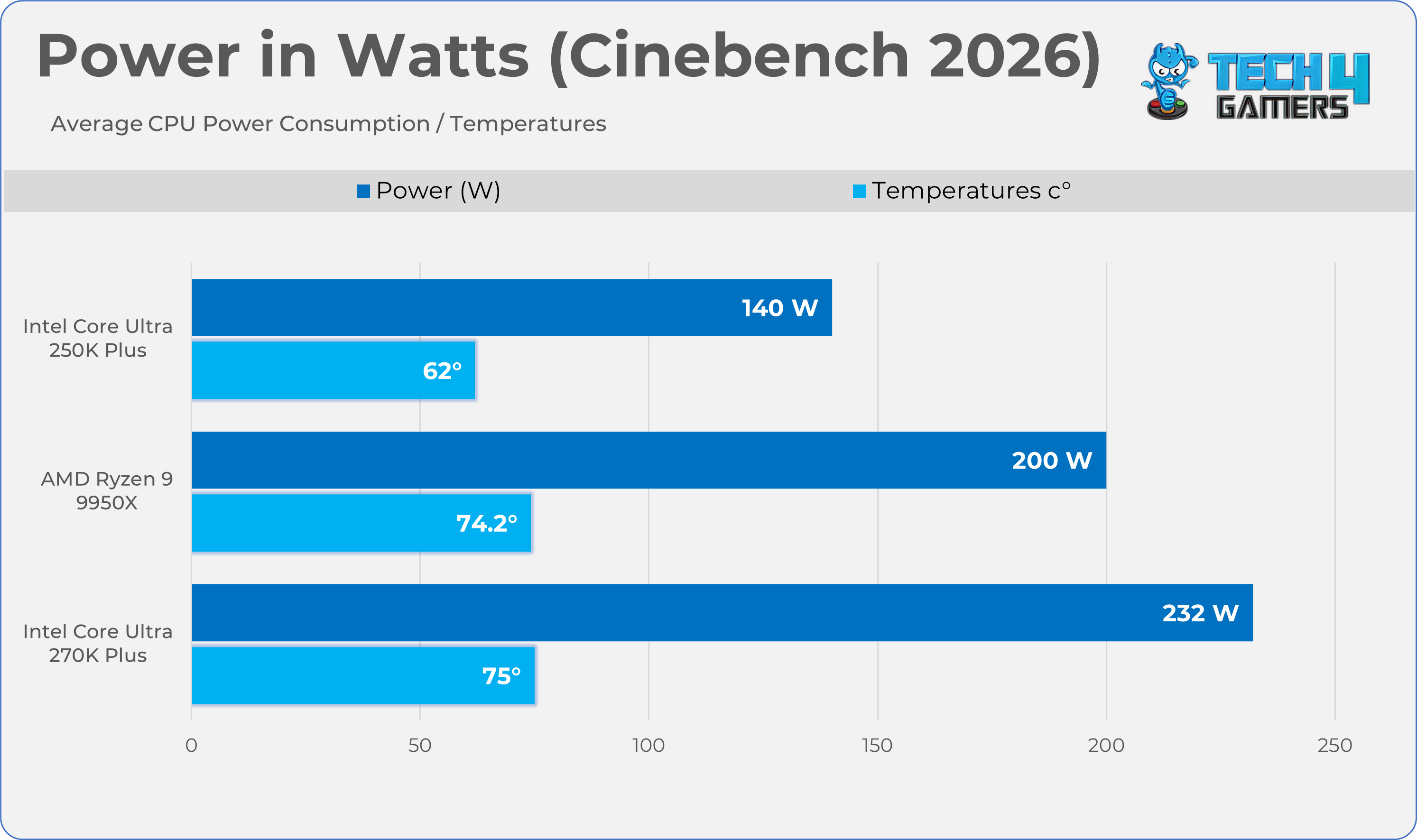
Let’s talk about the power numbers now. The Core Ultra 270K has a default power limit of 250W, unless it’s unlocked, which is more than the AMD Ryzen 9 9950X’s 200W limit. In Cinebench 2026, the Core Ultra 270K Plus pulls around 232W, which is 32W more than the AMD Ryzen 9 9950X, keeping temperatures around 75°C with the 360mm All-in-One Liquid Cooler. Well, if we talk about gaming, it paints a different picture here. In our CPU-centred gaming benchmarks, the CPU stayed within the 90W-130W range. In real-world scenarios, the power consumption would be a lot less, as you will be mostly GPU-restricted rather than the processor. The 270K Plus averages around 1.58 FPS per watt; the 250K Plus operates at a different efficiency level. On average, the 270K Plus is 50% less power-efficient than the 250K Plus in the games.
Here is the table.
| Game / Metric | Intel Core Ultra 270K Plus | Intel Core Ultra 250K Plus |
| Alan Wake II | 1.67 FPS/W | 2.29 FPS/W |
| Doom: The Dark Ages | 1.44 FPS/W | 2.26 FPS/W |
| Cyberpunk 2077 | 1.64 FPS/W | 2.51 FPS/W |
| Average Efficiency | 1.58 FPS/W | 2.35 FPS/W |
Should You Buy It?
Buy It If
✅ If You Demand Strong Multi-Threaded Performance: The Core Ultra 270K Plus currently offers strong performance and value compared to AMD’s $550 Ryzen 9 9950X, with nearly identical results in heavy multi-threaded workloads.
✅ If You Want A CPU That Can Do Everything Without Breaking The Bank: With 24 Physical Cores (8P+16E), this CPU is for the extreme multitasker. We’re talking about users who are rendering a 4K premiere video, have opened dozens of tabs in Chrome, and are also using Discord at the same time. The massive e-core cluster means background tasks never interrupt foreground performance.
Don’t Buy It If
❌ If You’re Building a PC Strictly For Gaming: The much cheaper Core Ultra 250K Plus delivers average frame rates that are almost neck-and-neck with the Core Ultra 270 K Plus. In our CPU standardized testing, we only noticed the 5% performance difference at best. We suggest that our users spend the extra cash on a memory or storage solution.
Final Thoughts
Intel Core 270K Plus deserves all the appreciation it gets. Intel has done what AMD did a couple of years ago: providing more multi-threaded performance and decent gaming performance without breaking the bank. The Core Ultra 270K Plus is a processor for extremes. If your daily work involves heavy rendering or editing, or compiling massive spreadsheets, the Core Ultra 270K Plus would be a better choice at the time of writing this review, as it trades blows with the AMD Ryzen 9 9950X and often beats it. Well, here is the sad part: the gaming is where the 270K Plus’s value proposition falls apart.
Thank you! Please share your positive feedback. 🔋
How could we improve this post? Please Help us. 😔

Senior Hardware Reviewer at Tech4Gamers with over a decade of experience in the tech industry. My journey began in 2014 as a senior administrator for Pakistan’s largest gaming community forum. I specialize in testing and reviewing components like graphics cards, CPU coolers, and motherboards, while also sharing insights on overclocking and system optimization.
 Join Our Community