



I’ll get straight to the point. Microsoft has completely lost the plot.
If you have built a dedicated living room PC or HTPC (Home Theater PC) recently, you already know the nightmare.
You spend thousands of dollars on premium hardware, carefully navigate the hidden DMI link bottlenecks throttling your SSDs, and plug your rig into a beautiful OLED TV.
Then, you boot into Windows 11, only to watch your ultra-premium silicon get instantly choked to death by an operating system that acts more like an advertising billboard than a gaming platform.
As Valve prepares to launch its highly anticipated 2026 Steam Machine on Monday, 29th June 2026, the real story isn’t the hardware itself. It is the software framework powering it.
Valve’s recently released SteamOS 3.8 advertises beta support for broader AMD and Intel desktop platforms, officially signaling a mass migration away from Microsoft. And frankly, it is the harsh wake-up call that Microsoft’s leadership desperately needs.
The 4GB Idle Tax: How Windows 11 Hijacks Your System Resources
To understand why Valve’s Arch Linux-based operating system is such a critical threat to the status quo, we have to look at the catastrophic state of Windows 11 bloat.
Right out of the box, a clean installation of Windows 11 25H2 will routinely consume anywhere between 3.5GB to 6GB of RAM (depending upon how much RAM you’re running in the first place) while sitting completely idle on the desktop.
Let that sink in. Your system is using more memory to do absolutely nothing than an entire Xbox 360 needed to run Halo 3.
Independent diagnostics and community bug reports consistently confirm this: thanks to mandatory virtualization-based security (VBS), aggressive SysMain caching, and Microsoft’s obsession with running hidden Chromium WebView2 instances for basic OS widgets, a clean install demands roughly 4GB of RAM just to keep the lights on.
Combine that with aggressive kernel-level telemetry constantly sending usage data back to Microsoft servers, and your PC’s hardware resources are being siphoned away before you even click “Play.”
The “Just Buy 32GB” Excuse: Microsoft’s Broken Optimization Promise
Ironically, Microsoft actually knew this was a massive problem. Years ago, engineers launched Microsoft’s internal 20/20 project, an initiative explicitly designed to slash idle RAM usage and disk space by 20 percent.
Unfortunately, they ultimately abandoned the ambitious project, choosing instead to prioritize pushing Copilot AI and heavy cloud integration directly into the OS.
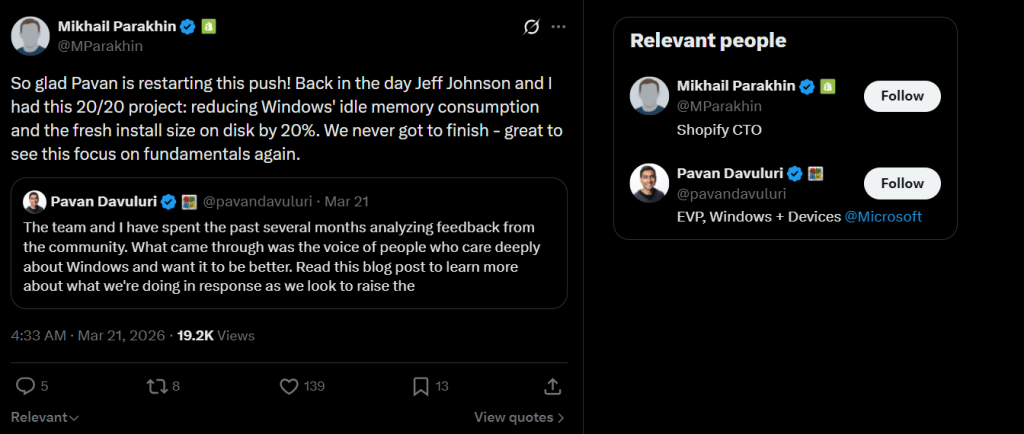
That being said, Microsoft did recently renew its commitment to optimizing RAM utilization by prioritizing foreground apps over background usage.
Interestingly, roughly a month thereafter, Microsoft went on to claim that 32 GB is the new ideal benchmark for gaming. Confusing, eh?
The Telemetry Tax: How Microsoft Is Assassinating Your 1% Lows
But who cares about idle RAM if you have 32GB of DDR5, right? Wrong. The fundamental issue isn’t just memory capacity; it is CPU interrupts.
Gaming is an incredibly latency-sensitive workload. When you are pushing high frame rates, you need your processor to feed instructions to the GPU without a microsecond of hesitation.
However, Windows 11’s relentless background tasks (search indexing, anti-malware service executables, and AI telemetry pings) constantly interrupt the CPU.
Consequently, those background interruptions force the processor to briefly pause game rendering to handle Microsoft’s bloatware. The result? A massive drop in your 1% lows.
Your average frame rate might read a buttery 120 FPS on your overlay, but those constant micro-stutters and hitching spikes during gameplay are directly caused by OS overhead.
It is enough to make a perfectly stable rig feel as erratic as an unstable fabric clock.
SteamOS 3.8: A Long Overdue Reality Check
This is exactly why PC gamers are flocking to Valve’s ecosystem. In a nutshell, SteamOS is a razor-thin, highly optimized Linux environment designed to do exactly one thing: launch video games.
When you boot into SteamOS’s “Gaming Mode,” there is no Copilot AI trying to read your screen. There are no hidden Edge browser instances eating your CPU cycles. Valve’s custom Gamescope compositor gives the game exclusive, uninterrupted access to your hardware.
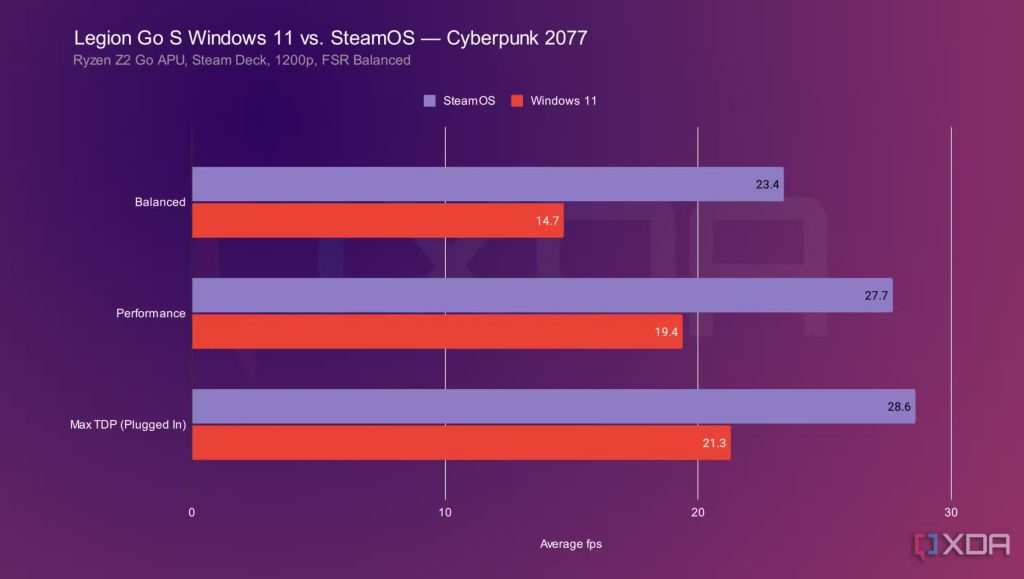
Even with the inherent overhead of the Proton translation layer translating Microsoft’s proprietary DirectX code into Vulkan in real-time, extensive third-party testing across desktop APUs proves that SteamOS frequently delivers vastly superior frame pacing compared to Windows 11. Why? Because it simply gets out of the silicon’s way.
Bottom Line: Time To Ditch Microsoft?
The takeaway is infuriatingly simple: Microsoft is sacrificing your gaming performance to fuel its corporate data collection and AI ambitions.
With SteamOS officially expanding beyond the Steam Deck (native support for Nvidia GPUs is also being actively pursued), there is already excited chatter amongst PCMR enthusiasts about abandoning Windows 11 entirely, especially for living room setups.
If you are building an HTPC or a dedicated controller-based gaming rig, there is absolutely zero mathematical reason to subject your hardware to the Windows 11 bloat tax.
Stop letting corporate telemetry throttle your frame rates. Let Microsoft ruin the office space; it is time for gamers to take back the living room.
Thank you! Please share your positive feedback. 🔋
How could we improve this post? Please Help us. 😔

[Wiki Editor]
Ali Rashid Khan is an avid gamer, hardware enthusiast, photographer, and devoted litterateur with a period of experience spanning more than 14 years. Sporting a specialization with regards to the latest tech in flagship phones, gaming laptops, and top-of-the-line PCs, Ali is known for consistently presenting the most detailed objective perspective on all types of gaming products, ranging from the Best Motherboards, CPU Coolers, RAM kits, GPUs, and PSUs amongst numerous other peripherals. When he’s not busy writing, you’ll find Ali meddling with mechanical keyboards, indulging in vehicular racing, or professionally competing worldwide with fellow mind-sport athletes in Scrabble. Currently speaking, Ali’s about to complete his Bachelor’s in Business Administration from Bahria University Karachi Campus.
Get In Touch: alirashid@tech4gamers.com
 Join Our Community