I’ve previously worked for eXputer as a Senior News Writer for several years. Now with Tech4Gamers, I love to devoutly keep up with the latest gaming and entertainment industries. I have a Bachelor’s Degree in Computer Science and years of experience reporting on games and breaking exclusive stories. Besides my passion for gaming journalism, I love spending my leisure time farming away in Stardew Valley. VGC, IGN, GameSpot, Game Rant, TheGamer, GamingBolt, The Verge, NME, Metro, Dot Esports, GameByte, Kotaku Australia, PC Gamer, and more have cited my articles.
Story Highlight
Slay the Spire 2 has become one of the biggest indie launches in Steam history, selling 4.6 million copies in just a few weeks.
The title has already generated more revenue than Hollow Knight: Silksong and Hades 2.
Moreover, the game peaked at a whopping 2.2 million daily active users on Steam, with one-third of the audience coming from China.
After the historic records indie titles like Hollow Knight: Silksong set last year, the genre has continued its dominance in 2026. Slay the Spire 2, a roguelike deck-building game from developer Mega Crit, has resumed the indie golden age, becoming the biggest launch on Steam this year with over 500k concurrent players.
Now, sales numbers for the title have finally come out, and the roguelike is performing even better than some of the most successful indie hits of 2025.
Why it matters: Indie games feel like the most creative and refreshing avenue of the gaming industry right now, and titles like Slay the Spire 2 succeeding in a big way are necessary to keep this momentum alive.
As reported by Alinea Analytics, Slay the Spire 2 has sold over 4.6 million copies on Steam alone, becoming one of the biggest indie launches in the platform’s history.
The Mega Crit game has generated $92 million in revenue in under a month. To put this into perspective, Slay the Spire 2 has already surpassed the lifetime revenue of indie heavyweights Hollow Knight: Silksong ($83 million) and Hades 2 ($82 million).
In addition, the roguelike has an excellent wishlist-to-buyer conversion ratio on Steam, convincing 31% of its 2 million wishlisters to purchase the game within one week of release, much higher than the 10% average.
The indie title also peaked at a whopping 2.2 million daily active users on Steam and hasn’t dropped below 2 million in over a week. Furthermore, half of the 4.6 million buyers have already put in more than 20 hours into Slay the Spire 2.
53% of the players who purchased the roguelike have spent over 20 hours in the game.
As per the analysis, the game’s co-op mode and brilliant gameplay depth are a big reason for this success, with features like Mending and card synergies making Slay the Spire 2 a team RPG experience. Chinese players have especially liked the indie title, making up one-third of the game’s audience.
At Tech4Gamers, I contribute as a Senior News Reporter, combining my skills and gaming enthusiasm to keep our audience updated on the latest developments.
Story Highlight
Multiple pieces of AI-generated artwork have been spotted in Crimson Desert.
The game is being publicly criticized for relying on AI without full disclosure.
While some say they don’t care about AI use, most people don’t appear too happy with this discovery.
Many elements of the game, including its narrative and controls, have drawn criticism from fans, and it seems fans have now found just one more thing to be upset about. Fans have recently spotted what appears to be AI-generated artwork in the game, sparking a major controversy.
Why it matters: Crimson Desert did not disclose the use of generative AI before release, so many have found this inclusion completely unacceptable.
Crimson Desert AI-Generated Art | Image via Twitter
The image above, first spotted on Reddit, shows all the telltale signs of an AI-generated artwork. Looking at the horse’s legs alone seems to be a dead giveaway that Pearl Abyss used AI to come up with various paintings in the game.
Interestingly, this isn’t the only instance fans have found suggesting that Pearl Abyss relied on artificial intelligence to create art in Crimson Desert. In the same Reddit thread, a comment points out that jesters on boards in the game appear to be AI-generated.
While this one is less obvious, commentators have stated that this style of art is far too reminiscent of ChatGPT’s image generation. The bad news is that these two cases aren’t isolated examples of Pearl Abyss’ questionable decision to include AI-generated art in the title.
Ultimately, fans have been left quite disappointed by the discovery. Many have criticized the game for hiding the use of AI, noting that it’s surprising the team didn’t use premade, copyright-free artwork instead.
On the other hand, some have said that they simply don’t care about the use of AI in this case. Whatever the case may be, this controversy is the last thing Crimson Desert needed right now.
Currently serving as a News Reporter at Tech4Gamers, I have the privilege of combining my love for gaming with the art of storytelling. My role involves crafting engaging narratives that keep our audience abreast of the latest developments in the gaming world.
Story Highlight
Mark Cerny confirms that frame generation would be coming to ‘PlayStation platforms.’
With no releases planned for this year, the tech isn’t arriving for the PS5 Pro.
PS6 releases in 2027, and expect more details soon.
Microsoft has already given us more than a glimpse of the next-gen Xbox ‘Project Helix’, which is more or less confirmed for a 2027 release. Sony is reportedly also planning the PS6 for next year, but Team Blue has yet to talk about their plans for their next generation of PlayStation console(s).
Fortunately, we may now have a glimpse of what technology the next-generation PlayStation could bring. The lead hardware developer at the gaming giant has now confirmed that the PS6 will feature ML-based frame generation in a new interview.
Why it matters: Frame generation is widely disliked by the community for increasing input lag and reducing motion clarity due to the AI-generated frames.
DLSS Frame Generation Works Better Than The FSR Counterpart
Digital Foundry sat down with Mark Cerny, and one of the key discussions in their interview was expanded information on Project Amethyst, the joint collaboration between AMD and Sony spanning hardware across both companies.
The lead architect for PS5 confirmed the new Enhanced PSSR is running on the same technology as the FSR Redstone upscaler. He also confirmed that FSR frame generation is co-engineered as part of Project Amethyst.
Further touching on these joint collaborations, he said the following:
An equivalent frame generation library should be seen at some point on PlayStation platforms.
Mark didn’t elaborate on what he meant by ‘PlayStation platforms,’ but it’s unlikely frame generation will come to the PS5 Pro, since he himself confirmed there will be no new releases this year. However, he will expand on this topic in the future.
RDNA 5 GPUs Will Offer First Glimpse At The PS6 Tech
PS6 is expected to release in 2027, and despite earlier concerns for the next-gen consoles being delayed, GTA 6 boss doesn’t think that the ongoing RAM conditions will change anything for Sony or Microsoft.
Currently serving as a News Reporter at Tech4Gamers, I have the privilege of combining my love for gaming with the art of storytelling. My role involves crafting engaging narratives that keep our audience abreast of the latest developments in the gaming world.
Story Highlight
Developers seemingly aren’t happy with DLSS 5.
Most argue that it ruins the original artistical intent by ‘yassifying’ the image.
Another report revealed that developers were kept in the dark about the technology and learnt about it alongside the public.
DLSS 5 has received so much kickback from the community that memes have now started to emerge outside of the tech community. Gamers have clearly shown apathy towards this new upscaling technology that does more than it was intended to.
Developers share the same sentiments, apparently. In fact, they had even harsher words for Nvidia than gamers did, calling out the tech giant for altering the intended art direction.
Why it matters: DLSS has become a far cry from what it was used for, now becoming more of an AI filter than an upscaler. This shift is certainly in the wrong direction, and Nvidia seems oblivious to that fact.
Grace Looks Like A Completely Different Person With DLSS 5 On
Kotaku spoke to multiple game developers about their thoughts on DLSS 5, and surprisingly, none of them seem excited about it. The publication talked to several developers, but here are the most notable answers they received.
DLSS 5 basically sucks the personality out of any artistic choice the devs have made by making average-out guesses of what it thinks things should look like. – Andi Santagata, Known former AAA developer and Indie game maker
On the other hand, Doinksoft’s tech lead had this to say:
Thank f***ing god I make 2D games.’ If I have to make a 3D game, I’m writing a software renderer, f**k NVIDIA, f**k these ghouls.
There are several more responses from developers, and one thing is for sure: they don’t want to see the original art’s intent ruined, which has been carefully crafted over the years to tell a story.
It does make sense why these developers are so fumed since most of them weren’t even aware of DLSS 5 and found out about it alongside the public. One artist is now even calling for Nvidia to shelf this technology, although that’s unlikely to happen.
This is so disrespectful to the intentional art direction of devs. If devs wanted to lean in to hyper realism they would. This also drastically changes key aspects of visuals like character features, focal points, lighting and so on. What a terrible invention. Nvidia should shelve this one 😭
CEO Jensen Huang responded to everyone’s criticism with ‘they’re wrong,’ dismissing the tech as Generative AI and instead said that it gives developers control over the results. However, they later confirmed that DLSS 5 does more than just neural rendering, contradicting their earlier claims.
At T4G, my task is to cover the latest news around the gaming globe ASAP and with the utmost precision. I adore all the games and respect all the devs behind the amazing games that we get all year. So, whether it’s a PC or a Console game, I got it all covered.
Story Highlight
Nvidia confirms that DLSS 5 is essentially just AI image enhancement and not rendering.
It takes a 2D frame with motion vectors and upscales it with the help of AI.
Despite earlier claims, devs don’t seem to have much control over the tech.
DLSS 5 has been a huge topic of controversy ever since Nvidia introduced it earlier this week. The new iteration of the upscaling tech has received heavy backlash for altering the art style of a game and turning into AI slop.
Amid the controversy, Nvidia has confirmed that DLSS 5 doesn’t actually render the frames; it is more of an AI image enhancement thing. It takes the 2D frames plus the motion vectors and enhances them.
Why it matters: So, while in the showcase, Nvidia labelled it as a breakthrough in rendering, it isn’t essentially doing something groundbreaking at all; it’s just adding a layer of AI to the visuals.
Daniel Owens asked Nvidia some key details about DLSS 5. He asked if the tech is taking 2D frames as an input with motion vectors to create the output frame, to which Nvidia’s Jacob Freeman replied, yes it is.
So, to explain it in simpler terms, the tech is just taking a screenshot of the game and feeding it into a generative AI for it to decide what it thinks it should look like, with little control over the output from the artists besides color grading.
The tech takes a 2D frame with motion vectors, and AI enhances them
This is quite different from what Jensen Huang claimed earlier that DLSS 5 ‘isn’t generative AI, it is content-control generative AI‘. Despite the claims, it doesn’t seem the developers have a lot of free rein.
It’ll be interesting to see how this evolves from here, as there are still a lot of months till DLSS 5 actually arrives. But for now, results and even responses from Nvidia’s staff don’t seem to promise too much.
What are your thoughts on DLSS 5 just being AI Image Enhancement? Let us know your opinions in the comments or join the discussion at the official Tech4Gamers Forum.
As Tech4Gamers’ Founder and Editor-in-Chief, I bring over 13 years of PC Hardware Reviewing and 8+ years of IT Project Management experience. Certified in Google IT Support , my focus is on providing honest product reviews and analysis and fostering a strong gaming community with 130k+ members in PPG.
Story Highlight
Intel is raising prices for its consumer CPUs by approximately 10%, a move expected to take effect by late March 2026.
The price surge affects almost all Intel product lines, including Core Ultra, Xeon, and entry-level chips, likely pushing laptop prices up by 40%.
High demand for AI infrastructure has led Intel to prioritize high-margin server processors over consumer hardware.
From what we have learned, Intel is about to make a move that could affect a lot of PC users. According to a report from ETNews, the company has informed its major partners of a roughly 10% price increase for its consumer processors. What stands out is how soon this could happen, as customers may start seeing the higher costs by the end of March, suggesting this isn’t just speculation but a change already happening.
Back in February, Intel and AMD reported that they were warning their Chinese clients about server CPU supply delays, with some organizations claiming wait times of up to six months and price increases of more than 10% for certain products.
Intel also noted that rapid AI adoption was boosting demand for traditional computing, with inventory forecast to reach its lowest point by the first quarter of 2026, followed by a gradual improvement beginning in the second quarter.
RAM, SSDs, graphics cards, air and water cooling systems, and power supplies have all seen price increases. As if that wasn’t enough, Intel’s consumer chips will suffer a 10% price increase. During the second half of the year, RAM and SSD storage prices will rise, along with CPU prices.
The inclusion of all components has led to significant price increases for laptops. An average laptop, now priced at $900, is expected to require a 40% price increase to sustain profit margins (reaching $1,260).
This comes after Intel raised the prices of certain entry-level and older-generation laptop processors by more than 15%. Yes, additional price hikes are predicted, affecting mid-range and above mid-range CPUs in the second quarter.
ETNews now claims a 10% price rise across all consumer CPUs. And sure, this will affect all Intel Core Ultra Series processors. Market analyst TrendForce had already observed price increases on select models and predicted additional pricing pressure in the second quarter.
Meanwhile, Distec, a British distributor, announced in February that Intel had notified its partners of an additional price increase for its consumer processors, effective March 29, 2026. They also stated that the action will impact a wide range of devices, including entry-level processors, Core, Core Ultra, Xeon, legacy platforms, and embedded chips.
Just as DRAM production has been cut to optimize earnings from the considerably more expensive HBM memory, GPUs and, of course, CPUs are following suit. This is a primary driver of Intel’s consumer processor price increases. It is not the sole reason, but Intel must also capitalize on the situation and build far more profitable server-grade chips.
Intel told Reuters that it was surprised by the jump in demand for server CPUs caused by the deployment of AI infrastructure. Even with its factories at full capacity, it was unable to supply all of the demand.
Its chief financial officer also stated that the company had not managed its factories to account for such a dramatic shift in data center demand. This means that capacity cannot be instantly transferred from one chip type to another.
Also, according to CRN, citing statements from Intel’s inner circle, the situation has caused the company to prioritize server CPU manufacturing wherever possible, while focusing on mid-range and high-end processors in the consumer PC market.
I’ve previously worked for eXputer as a Senior News Writer for several years. Now with Tech4Gamers, I love to devoutly keep up with the latest gaming and entertainment industries. I have a Bachelor’s Degree in Computer Science and years of experience reporting on games and breaking exclusive stories. Besides my passion for gaming journalism, I love spending my leisure time farming away in Stardew Valley. VGC, IGN, GameSpot, Game Rant, TheGamer, GamingBolt, The Verge, NME, Metro, Dot Esports, GameByte, Kotaku Australia, PC Gamer, and more have cited my articles.
Story Highlight
Crimson Desert has sold through 2 million copies on all platforms in less than one day.
The title was wishlisted over 3 million times before release and sold almost half a million copies on Steam through pre-orders alone.
Pearl Abyss is listening closely to fan feedback and working to improve the game.
After months of anticipation, Crimson Desert has finally been released across all platforms worldwide. Despite delivering on its promise of a massive open-world packed with content and side quests, the Pearl Abyss title has received somewhat underwhelming reviews due to a poor narrative and janky combat mechanics.
However, it seems like the mixed reception hasn’t affected the demand for Crimson Desert, as the game opened to an excellent 240k concurrent users on Steam. Now, the developer has announced the official sales total of the title so far, and the numbers are huge.
Why it matters: An ambitious effort like Crimson Desert that has tried to push the boundaries of what open-world video games can be deserves this kind of success and player support.
Crimson Desert has sold 2 million copies in less than 24 hours after its global release. The game’s official account thanked the players for purchasing the open-world title and joining Kliff’s journey in Pywel.
In the celebratory post on X, Pearl Abyss also stated that they are paying attention to fan complaints and are working to make quick updates to Crimson Desert based on community feedback, so players can continue to have a smooth journey in Pywel.
The game has been praised for its breathtaking and action-packed open-world.
Do you think Crimson Desert deserves the commercial success it has achieved so far, or is it a flawed product? Tell us in the comments below or head to the Tech4Gamers forum for discussion.
Currently serving as a News Reporter at Tech4Gamers, I have the privilege of combining my love for gaming with the art of storytelling. My role involves crafting engaging narratives that keep our audience abreast of the latest developments in the gaming world.
Story Highlight
Crimson Desert has fewer positive reviews on Steam compared to Dragon Age Veilguard.
Most people are complaining that the game takes too long to get to the point.
The game’s hype has also made players even more critical of it.
Update: Crimson Desert’s reviews have now climbed up to become ‘Mostly Positive‘ on Steam. The RPG has a lot of amazing content to offer, which was previously overshadowed by its flaws, but players have come to realize this.
The original story follows…
Crimson Desert launched yesterday, and this year’s most-awaited release behind GTA 6 wasn’t really what fans had expected. Most claim the RPG feels bloated and prioritizes quantity over quality.
Since hopes for this game were high, players are extra critical of it. Over at Steam, reviewers aren’t very happy about Crimson Desert, and in terms of positive reviews, it’s even lagging behind 2024’s disaster Dragon Age Veilguard.
Why it matters: Dragon Age Veilguard is one of the biggest disappointments of this decade, coming from a veteran studio like BioWare. It has, in a way, become a benchmark to measure quality for other RPGs.
1 of 2
Crimson Desert Steam Reviews
crimson desert reviews
Dragon Age Veilguard Steam Reviews
dragon age veilguard reviews
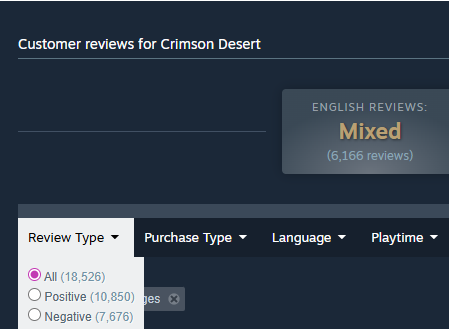
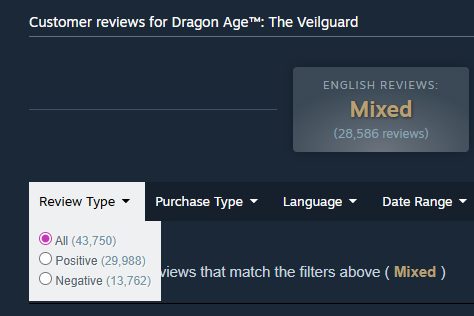
Currently, Crimson Desert has 18,526 ratings on Steam, of which 10,850 are positive, accounting for 58.57% of the total. Whereas Dragon Age Veilguard is rated by 43,741 people, out of which 29,998 reviews are positive, which makes up for nearly 69% of the total.
The biggest argument for Crimson Desert’s quality is that it takes too much time to get to the point. For reference, reviewers expect the game to pick up pace in about 8 hours.
8 hours is a lot of time, and in most other games it’s about half the total playtime. To beat the game completely, Crimson Desert will take more than 300 hours. The map will take literally hours to traverse on foot.
Still, there’s a lot of good about the game, too. For instance, visually, the game is incredible, and there are tons of activities that at least promise one thing: players won’t be tired. The game’s mechanics and ideas are unique, but the overall execution was lacking.
I’ve previously worked for eXputer as a Senior News Writer for several years. Now with Tech4Gamers, I love to devoutly keep up with the latest gaming and entertainment industries. I have a Bachelor’s Degree in Computer Science and years of experience reporting on games and breaking exclusive stories. Besides my passion for gaming journalism, I love spending my leisure time farming away in Stardew Valley. VGC, IGN, GameSpot, Game Rant, TheGamer, GamingBolt, The Verge, NME, Metro, Dot Esports, GameByte, Kotaku Australia, PC Gamer, and more have cited my articles.
Story Highlight
According to reviewer Blaine Smith, Crimson Desert still has more than half of the map left to explore, even 205 hours into the game.
Smith stated that when the fetch quests are taken into account, the game may take 400 hours to 100%.
Hence, the Pearl Abyss title is arguably the biggest game ever developed.
However, Crimson Desert has managed to fulfill one promise it made before release: delivering a breathtaking, enormous open world. If one reviewer’s playthrough is anything to go by, you will need at least 300 hours to explore the humongous map of Pywel completely.
Why it matters: Crimson Desert is not everyone’s cup of tea, and initial reactions have made this very clear. But if you love massive open worlds with depth, beauty, and unlimited exploration, there is no better game than the action-adventure title.
In a post on X, journalist Blaine Smith revealed that he isn’t even halfway through achieving 100% completion in all areas of Crimson Desert, after spending 205 hours playing the game.
The reviewer added that he had done all of the faction-based quests with a narrative in only half of the area, while the other half of the map is still untouched and ripe with new storylines, more than 200 hours into his playthrough.
Moreover, Blaine Smith explained that he only accounted for the more tangible side quests in claiming that he is done with half of the Crimson Desert map. Meaning, even in the area he has supposedly finished, there are still countless fetch quests and small side activities that will require dozens of hours.
Crimson Desert’s gigantic map takes hours to traverse on foot.
Players could need about 300-400 hours if they want to finish every single side quest, storyline, activity, and fetch quests in Crimson Desert on the way to 100% completion. Hence, it makes sense why Pearl Abyss developers couldn’t figure out how long it’ll take to beat the open-world game, as it is arguably the biggest ever.
Do you think Crimson Desert has fulfilled its promise of being an action-packed single-player experience? Tell us in the comments below or head to the Tech4Gamers forum for discussion.
At Tech4Gamers, I contribute as a Senior News Reporter, combining my skills and gaming enthusiasm to keep our audience updated on the latest developments.
Story Highlight
Crimson Desert’s challenging tutorial puzzle confused a lot of journalists and media partners.
This puzzle has now been modified with yellow lights and much more descriptive instructions.
The puzzle highlights the general philosophy behind Crimson Desert’s game design, one that doesn’t hold the player’s hand.
Crimson Desert is now out in the wild, and although its initial reviews aren’t as impressive as expected, the game has launched to a sizable audience on Steam. Many have reported that Crimson Desert can sometimes be tricky to come to grips with, and this was also the case during the preview period.
Indeed, journalists found themselves struggling during the tutorial puzzle, but Pearl Abyss has ended up significantly changing this part to make it easier to follow.
Why it matters: Accessibility has been a major focus for the gaming industry lately, and this change shows how developers accommodate everyone when making games, even going as far as nerfing puzzles completely.
Crimson Desert Abyss Without Balance Puzzle | Image via YouTube
This puzzle shows up in the Abyss Without Balance quest once players enter the Abyss for the first time.
During the preview build, players came across a device that needed to be activated through the use of the Axiom Force and Palm Force abilities. However, the game did not specify that these abilities were needed and simply asked players to ‘activate the device.’
Following confusion at media preview events, this puzzle now offers more precise instructions. It now shows the following message:
Hang on the middle of the powered device, then activate it with Force Palm.
Pearl Abyss basically makes this whole segment incredibly obvious now, highlighting the entire puzzle with yellow paint similar to that of Resident Evil 4.
The above video goes over a quick guide based on this puzzle, so for those still looking for help, it shouldn’t be too big a challenge to clear the Abyss Without Balance quest right now. The puzzle aside, Crimson Desert has proven to be quite the divisive game so far.
At T4G, my task is to cover the latest news around the gaming globe ASAP and with the utmost precision. I adore all the games and respect all the devs behind the amazing games that we get all year. So, whether it’s a PC or a Console game, I got it all covered.
Story Highlight
Pearl Abyss has confirmed that Intel Arc GPUs currently don’t support Crimson Desert.
They don’t plan to add the support either, as they recommend refunding the game.
Crimson Desert just released with huge opening number of 240k concurrent players. However, just like the critics’ reviews, the reception is also mixed among the general players, but a new, quite major issue has emerged.
Pearl Abyss has confirmed that Crimson Desert is currently not supported on Intel Arc GPUs. While there aren’t too many Arc users, this is still a problem, especially for those who own an MSI Claw handheld.
Why it matters: This is a strange thing, considering you are cutting off a portion of your player base. And it doesn’t seem like the studio wants to rectify it soon, as the support page recommends users get a refund.
Pearl Abyss confirms that Crimson Desert isn’t supported on Intel Arc GPUs
If you head over to the FAQs section at the official game website, you’ll see that the studio has confirmed that Crimson Desert isn’t supported on Intel Arc, and those who bought it on there should return it.
Now, again, the market for Intel Arc GPUs isn’t huge, but there is an audience. Its budget cards aren’t bad at all. Especially, the MSI Claw users are affected by this, who are frustrated by the lack of support on the handheld.
MSI Claw users are also affected by the lack of support
Claw is generally considered a pretty powerful handheld, and leaving that behind, too, doesn’t make much sense. Unfortunately, it is also currently the only handheld with Arc graphics, so it’s been left behind.
What are your thoughts on Crimson Desert not being supported on Intel Arc GPUs? Let us know your opinions in the comments or join the discussion at the official Tech4Gamers Forum.
At Tech4Gamers, I contribute as a Senior News Reporter, combining my skills and gaming enthusiasm to keep our audience updated on the latest developments.
Story Highlight
For students, the value of a handheld lies in its ability to start and stop instantly during small gaps in a busy schedule.
Devices that fit easily into a backpack alongside school gear are more practical than bulky high-performance models.
The best device isn’t the one with the highest specs, but the one that actually gets used without adding stress to a student’s routine.
Student life is chaos. You’ve got lectures, assignments, random group work, and somehow you’re still expected to have a life. Gaming usually ends up squeezed into tiny pockets of time like 15 minutes before class or while waiting for a ride.
That’s exactly why handheld gaming has become such a big deal in 2026. No setup, no commitment. Just pick up, play, pause, and move on. But not every handheld fits that lifestyle the same way.
Why Handhelds Just Work for Students
Xbox Dedicated Handheld Scheduled For Next-Gen Release Reportedly Cancelled.
The biggest win is flexibility. You don’t need a desk, a monitor, or even a proper gaming session planned out. You can jump into a quick match, grind a few quests, or just chill for a bit, then stop instantly when real life kicks in.
They’re also easy to carry. Most of these devices fit into the same bag you’re already stuffing with a laptop, charger, and probably snacks you forgot about.
And when you’re traveling or stuck somewhere with bad internet, offline games keep things going. No stress.
But, let’s be honest, sometimes even 20 minutes feels like a luxury. A lot of students try to stay on top of work during the day so they can actually relax later.
That’s where quick tools come in. Something like a math calculator can save time right after a lecture instead of letting small problems pile up. You fix things on the spot, clear your head, and that makes it easier to enjoy gaming later without guilt.
It’s less about replacing study time and more about not letting it drag into your downtime.
Quick Look at the Top Options
Here’s how the main handhelds stack up in real-world student use:
Console
Battery (real use)
Weight
Best Use
Steam Deck OLED
2–6 hours
Heavy
PC gaming
Nintendo Switch 2
4–8 hours
Light
Quick sessions
ASUS ROG Ally X
3–5 hours
Medium
Performance
Lenovo Legion Go
2–5 hours
Heavy
Dorm gaming
Retroid Pocket 4
5–10+ hours
Very light
Retro/quick play
These aren’t lab numbers. They reflect what you’ll actually feel during a normal day.
The Best Handhelds (From a Student POV)
Steam Deck OLED
The Steam Deck OLED is basically a portable PC. You get access to your full Steam library, which is amazing if you already game on PC.
But here’s the catch. It’s not exactly grab and go. It’s bulky, and the battery depends heavily on what you’re playing.
This is more of a sit down and play properly device. Great for evenings, not ideal for quick campus sessions.
Nintendo Switch 2
The Nintendo Switch 2 feels like it was built for student life. It’s light, reliable, and the battery doesn’t randomly drop off a cliff.
You can pull it out, play for 10 minutes, and put it away without thinking.
You are locked into Nintendo’s ecosystem, but for casual gaming and short sessions, it just works. Probably the easiest recommendation here.
ASUS ROG Ally X
If you want power, the ASUS ROG Ally X delivers. It runs modern games better than most handhelds.
But that performance comes at a cost. Battery life. You will almost definitely need a charger if you’re out all day.
It’s great for travel or playing at home, but less convenient when you’re constantly moving between classes.
Lenovo Legion Go
The Lenovo Legion Go is kind of a hybrid. Big screen, detachable controls. It feels closer to a mini gaming setup than a handheld.
That’s cool, but not very practical on campus. It’s better suited for dorm gaming or when you actually have time to sit down.
Not something you will casually pull out between lectures.
Retroid Pocket 4
The Retroid Pocket 4 is the opposite of everything above. Small, simple, and super easy to carry.
It won’t run the latest AAA games, but that’s not the point. It’s perfect for quick sessions, retro titles, and just killing time without thinking too much.
Honestly, this is the one you will actually use the most if your schedule is packed.
So… Which One Should You Pick?
It really comes down to your routine.
If you mostly play in your room and want full games, go for something like the Steam Deck or Ally X. If you want something for quick breaks, Switch 2 or Retroid makes more sense. If you want a mix but don’t mind size, Legion Go can work.
The biggest mistake is picking based on specs alone. What matters is how often you will actually use it.
There’s no perfect handheld for every student. That’s the point. Some are better for short bursts between classes. Others are basically portable gaming PCs. The right choice is the one that fits into your day without becoming a burden.
Because at the end of it all, gaming shouldn’t feel like another task on your schedule. It should feel like a