As Tech4Gamers’ Founder and Editor-in-Chief, I bring over 13 years of PC Hardware Reviewing and 8+ years of IT Project Management experience. Certified in Google IT Support , my focus is on providing honest product reviews and analysis and fostering a strong gaming community with 130k+ members in PPG.
Story Highlight
Valve targets 2028 for the sequel’s release, though high SSD costs could cause delays.
The company is skipping incremental upgrades in favor of a massive power jump that justifies a new generation.
Developers insist the hardware must deliver this performance boost without compromising current battery life.
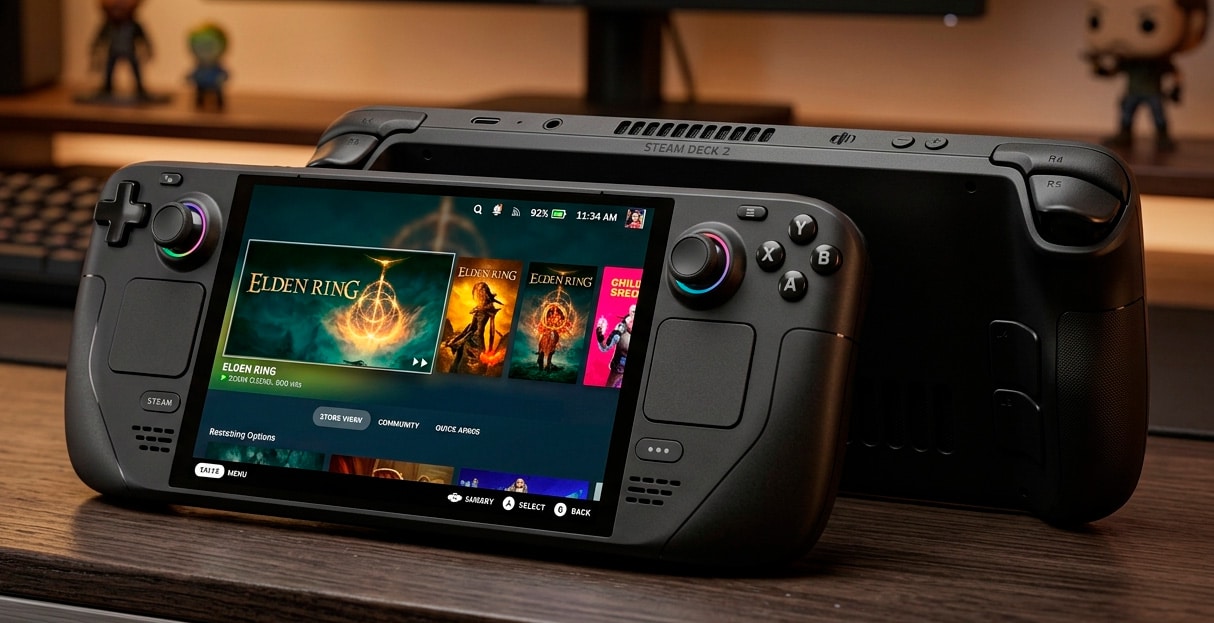
Good news for console users: Valve has set a 2028 launch window for the Steam Deck 2. This information, shared by industry leaker Kepler_L2, suggests that Valve wants to release the Steam Deck successor next year.
It has been stated that the Steam Deck 2’s launch in 2028 will be dependent on the memory market. While RAM prices have fallen, NAND flash memory (SSD) prices have continued to grow. Therefore, if the current scenario does not change dramatically, Valve may be obliged to postpone the launch.
The Steam Deck 2 is taking its time, but for good reason: Valve wants its upcoming system to be genuinely incredible. To accomplish this, it requires a real performance boost, not just a “slightly better” increase. Unlike the industry, which has followed suit by introducing a handheld device (ASUS, MSI, or Lenovo), Valve intends to develop a substantially more powerful version of its current product.
They will not do what those manufacturers do, which is to release numerous versions of these devices with small performance differences, making them effectively worthless to individuals who already own the first-generation model.
Pierre-Loup Griffais, a software developer at Valve, stated in November 2025 that the business is not interested in achieving a 20%, 30%, or even 50% performance gain. And this performance boost must not only make a true generational difference, but also do so without sacrificing battery life.
In other words, Valve is delaying the successor because they believe the right chip does not yet exist. To give a significant performance boost while keeping battery life, they will need to use far more powerful hardware than is currently available, despite the fact that the Steam Deck was released four years ago.
For choosing an architecture, the simplest solution would be to return to AMD and capitalize on the work already done to optimize and support its x86 CPU and GPU architectures. As a result, they would choose AMD Zen 6 and RDNA 5/UDNA, respectively.
However, it is unclear whether Valve will examine other possibilities, such as Intel or, better yet, NVIDIA. It’s worth noting that NVIDIA is expected to announce its new N1 SoCs in June, featuring an Arm CPU and GeForce RTX graphics. Along with NVIDIA DLSS and Frame Generation, Valve would receive not only the necessary hardware but also superior software to further differentiate in the console market.
Sajjad Hussain is the Founder and Editor-in-Chief of Tech4Gamers.com. Apart from the Tech and Gaming scene, Sajjad is a Seasonal banker who has delivered multi-million dollar projects as an IT Project Manager and works as a freelancer to provide professional services to corporate giants and emerging startups in the IT space.
Majored in Computer Science 13+ years of Experience as a PC Hardware Reviewer. 8+ years of Experience as an IT Project Manager in the Corporate Sector. Certified in Google IT Support Specialization. Admin of PPG, the largest local Community of gamers with 130k+ members.
Sajjad is a passionate and knowledgeable individual with many skills and experience in the tech industry and the gaming community. He is committed to providing honest, in-depth product reviews and analysis and building and maintaining a strong gaming community.
Join Our Community
Still having issues? Join the Tech4Gamers Forum for expert help and community support!





 Join Our Community