



- Future high-end AMD Radeon graphics cards may feature HDMI 2.2, offering a potential bandwidth of 80 Gbps, an increase from the current 48 Gbps supported by HDMI 2.1.
- Not all next-generation AMD cards will get the full 80 Gbps; some may be limited to 64 Gbps.
- It is not yet known if AMD will name the new architecture RDNA 5 or something else.
A well-known leaker Kepler brings information about the next-generation AMD graphics support. According to a post on X, the next-generation AMD Radeon graphics will feature HDMI 2.2 connectivity with a bandwidth of up to 80 Gbps. This is faster than the current implementation of HDMI 2.1 connectivity, which is 48 Gbps.
AMD has yet to decide whether it will use the RDNA 5 architecture or make any significant changes at the architectural level to rename it to UDNA. Additionally, it has been stated that future high-end AMD Radeon GPUs would support up to 80 Gbps of bandwidth via an HDMI 2.2 interface.
However, the brand’s other graphics cards will only support 64 Gbps of bandwidth. This means that the interface’s maximum capacity of 96 Gbps will not be constrained. It will violate the HDMI Forum’s mandated maximum resolution, refresh rate, and compression standards. It is unclear whether a software update will be necessary to achieve the full bandwidth or whether we are dealing with a hardware limitation.
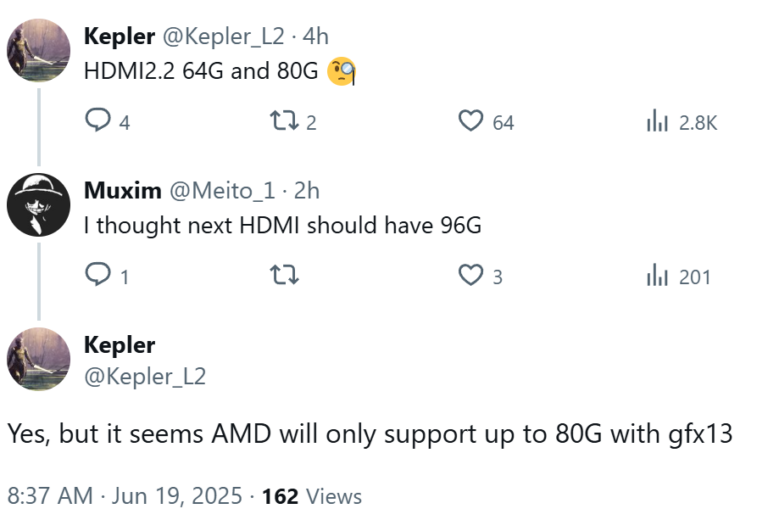
According to the leaker, there is currently no information on DisplayPort 2.1b support for the GFX13 architecture. Furthermore, the DisplayPort standard is more promising in the long run because the HDMI interface requires royalties to be paid for trademark registration. Ultimately, this increases the price of any product. Given that the NVIDIA GeForce RTX 50 and professional GPUs are built on the same architecture, Blackwell currently supports DisplayPort 2.1b, making it compatible with this interface.
AMD used the DisplayPort 2.1 interface, but it could only support UHBR13.5 (54 Gbps) instead of UHBR20 (80 Gbps). AMD only included this interface in their professional-grade Radeon AI Pro W9000 GPUs. It should be noted that a new cable, called HDMI Ultra96, is required to utilize the latest HDMI 2.2 protocol.
Thank you! Please share your positive feedback. 🔋
How could we improve this post? Please Help us. 😔
 Join Our Community