
 Threads
Worth It?
Review Summary
ID-Cooling’s New Frost X55 Thermal paste is an upgrade over its previous versions, offering excellent performance and substantial value at $9 USD for a 4-gram tube. It features eye-catching packaging with four scent options; despite the cosmetic focus, its core function remains effective. The paste is slightly less viscous than the X45 while retaining the good thickness. Overall, the performance is in the high-end thermal-paste category.
Hours Tested: 5

Overall
Pros
- Attractive Packaging
- Multiple Flavor / Scent Options
- Exceptional Thermal Results
- Clean Wipe + Spatula Included
- Great Value
Cons
- Scent is gimmicky, not functional
- Possible Spreadability Challenges Due To Its Viscous Properties


ID-Cooling unveiled its new thermal paste, Frost X55, at CES 2025 and released it in 2026. This TIM has caught the attention of many enthusiasts and PC builders around. It’s different than the other pastes we have tested in specific ways; however, there is a quirky twist in this thermal compound. Some versions of the X55 come in scented variants, e.g., Viola, Bella, Poma, and Luna, as well as the core, which is scent-free. ID-Cooling says this paste offers improved thermal conductivity over the X45, but enthusiasts already know that these numbers mean absolutely nothing in real-world testing.
Higher numbers do not always indicate better performance. However, they have also stated that this thermal paste has non-drying and non-bleeding properties. Also, this paste is non-electrically conductive. The Frost X55 is available in 2- and 4-gram sizes. The global MSRP for the paste hasn’t been revealed to us yet, but at our local retailers in our country, it’s $9 for the 4-gram, which is roughly the same as its predecessor, X45. Can this paste live up to its expectations? We will find out about this in this article.
| Property | Value / Specification |
|---|---|
| Color | Grey |
| Net Weight | 2g / 4g |
| Thermal Conductivity | 16.2 W/m-K |
| Thermal Resistance | 0.02 °C·cm²/W |
| Operation Temperature | -50°C to 250°C |
| Density | 2.9 g/cm³ |
| Viscosity | 120 Pas |
What Makes ID-Cooling Frost X55 Different?
The ID-Cooling Frost X55 Thermal-Paste combines high thermal conductivity with a distinctive scented twist, available in 4 flavors at a budget-friendly price, giving users performance, value, and a bit of a different taste compared to typical thermal pastes on the market.
Packaging & Accessories
ID-Cooling went full anime-core with the packaging here. Each Frost X55 variant features a unique character, color scheme, and scent identity. The design of the thermal paste packaging is highly detailed, helping the products stand out on a shelf. The thermal conductivity of 16.2 W/m·K and the 4g quantity are clearly displayed on the box.
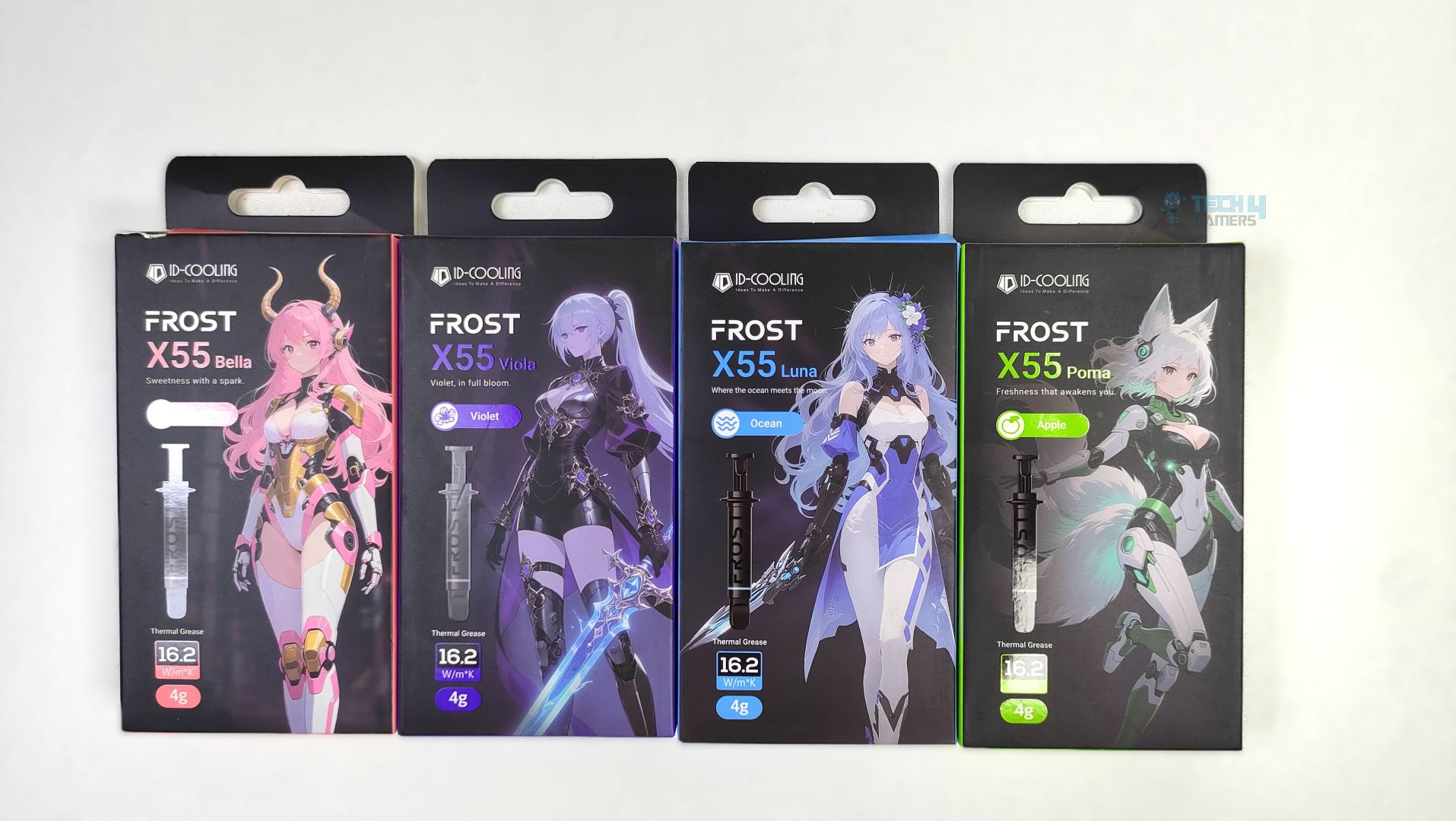
Each paste is securely seated in a plastic tray with a cleaning wipe and the thermal-paste spreader.
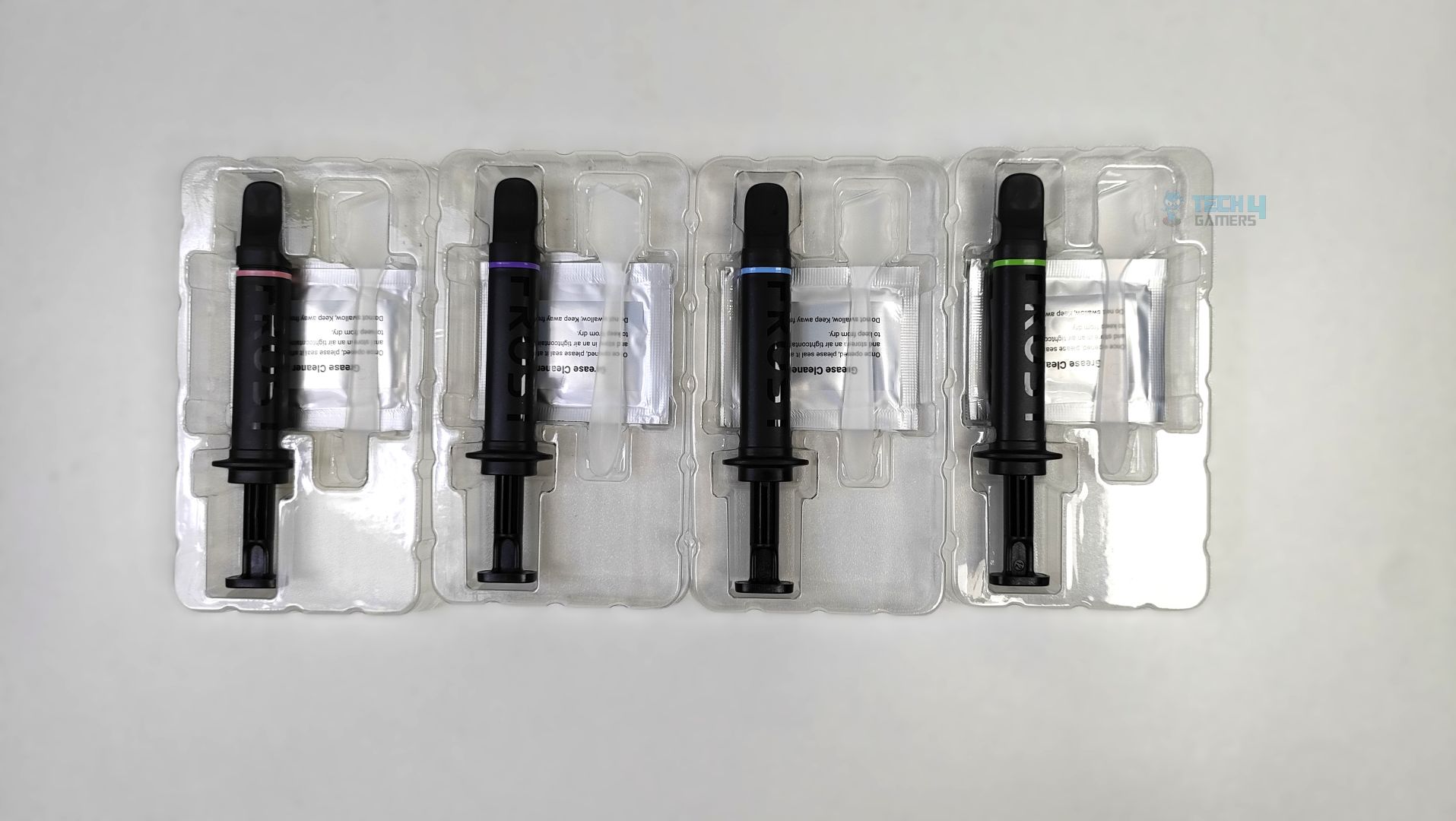
If we talk about the syringe design, it gives a premium feel in the hand thanks to its stealthy matte-black body and proper syringe cap protection.
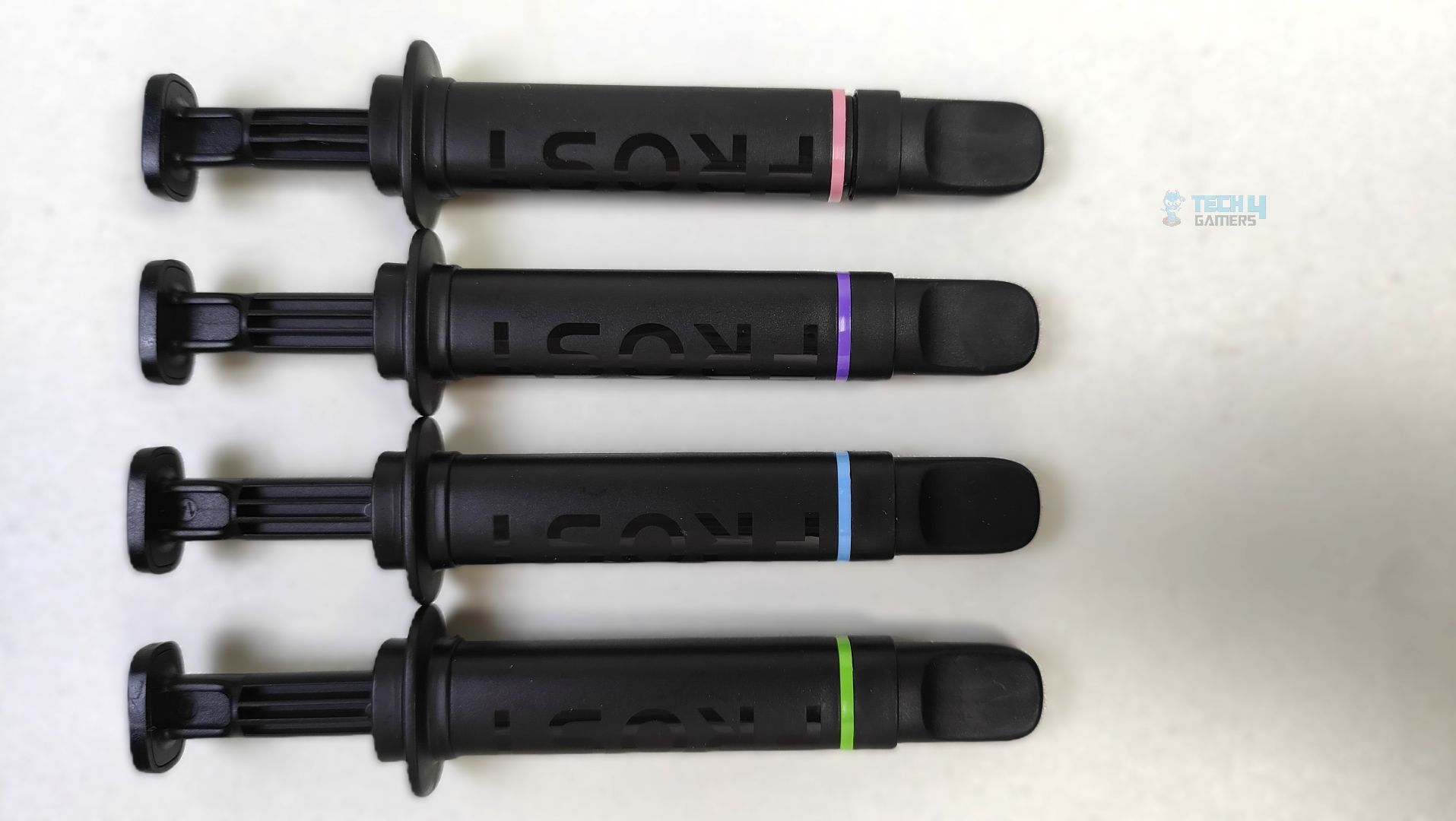
The paste maintains a natural grey hue, free from artificial dyes. ID-Cooling’s attention to detail is evident in the syringe design, which features a color-coded ring that matches the scented theme of the packaging.
Application & Quality
Taking a look at the application quality.
ID-Cooling Frost X55 is a ceramic-filled, silicone-based thermal paste that combines aluminum oxide (Al₂O₃) and zinc oxide (ZnO) as thermally conductive fillers, suspended in a siloxane carrier. The paste appears thick and grey, though it is less dense than X45. We applied the recommended 5-dot method to the CPU heat spreader.
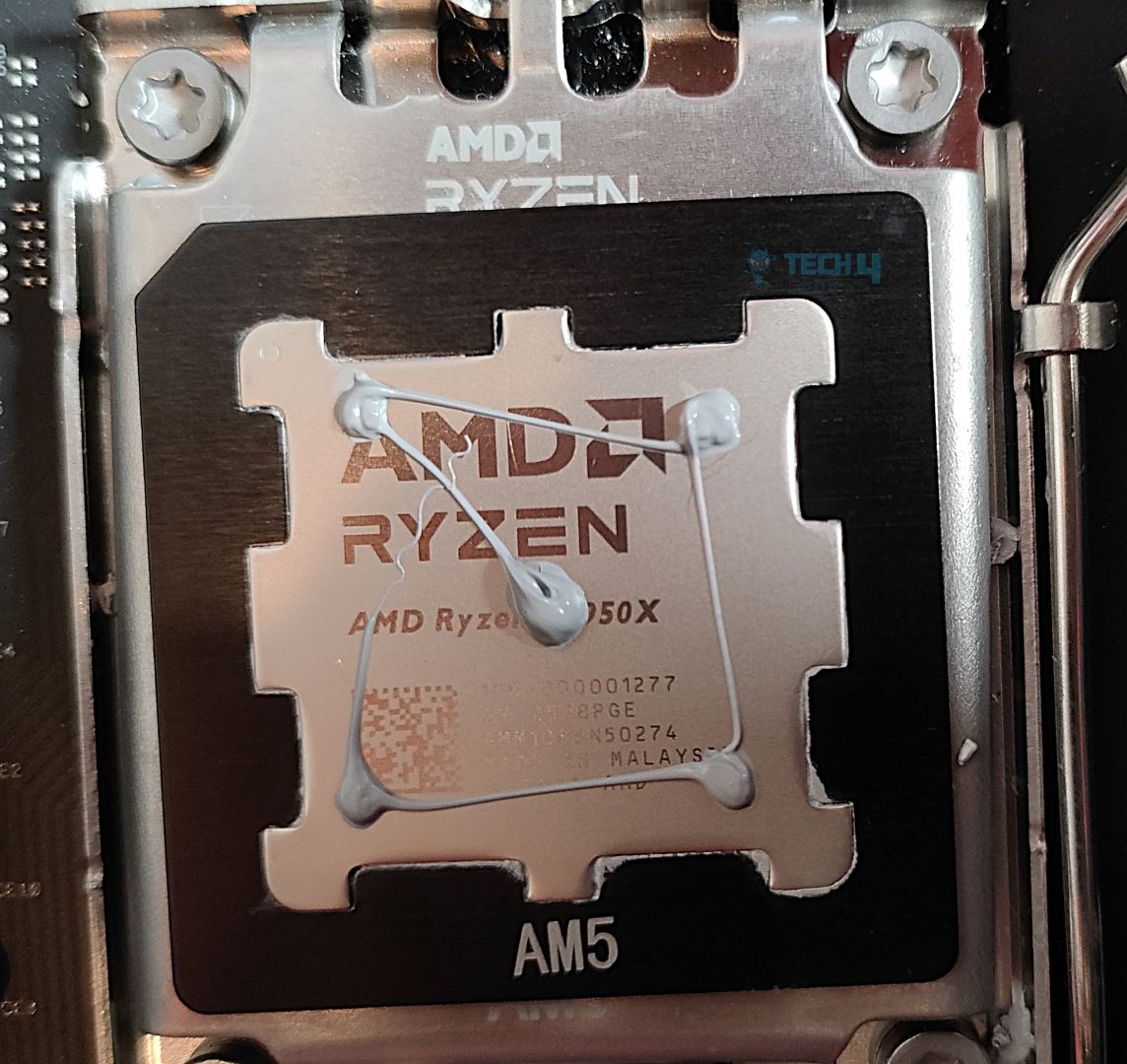
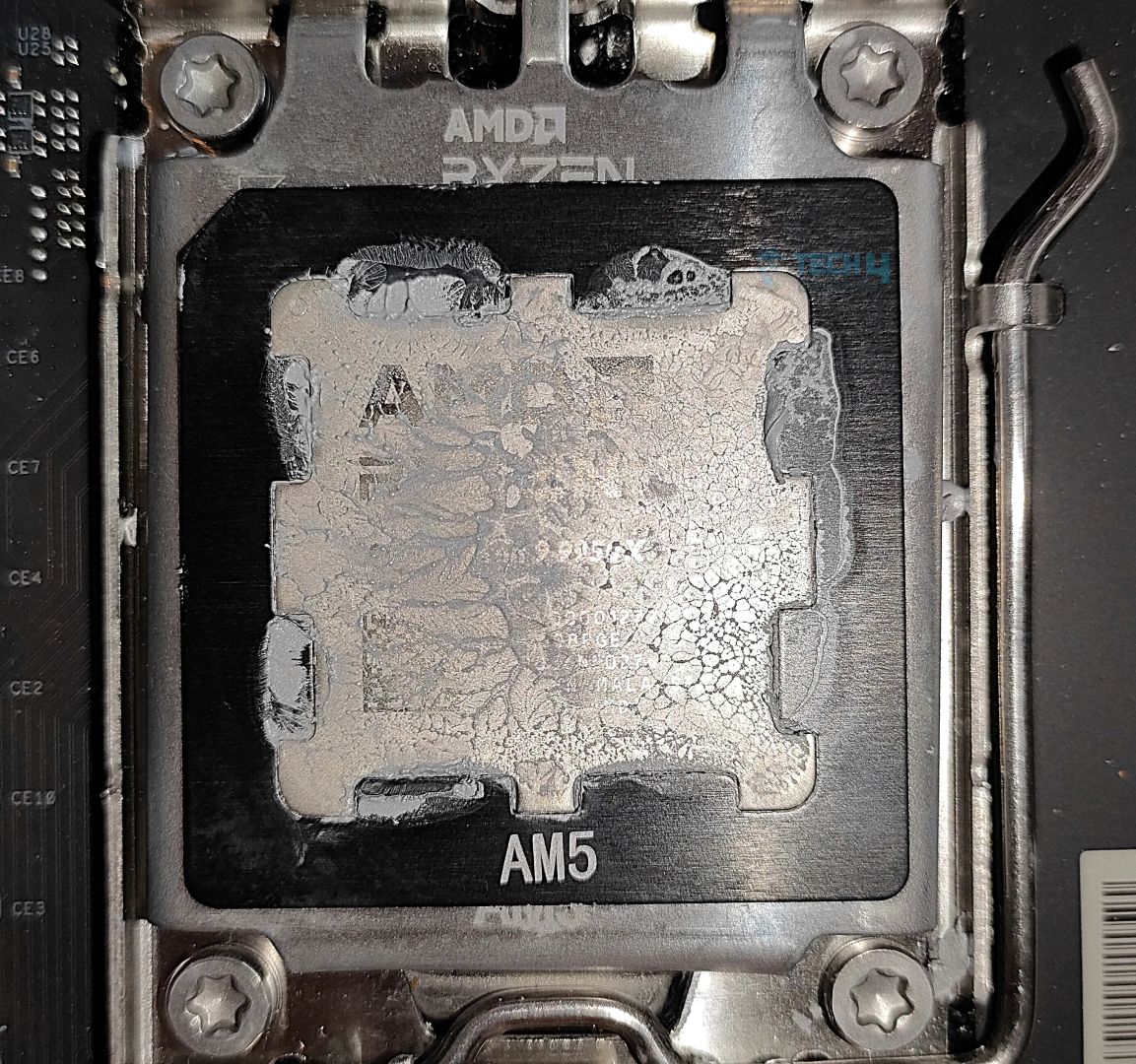
After removing the cooler, we observed a consistent structure with fewer cracks, indicating higher viscosity, but it’s less concrete than its predecessor, ID-Cooling X45. However, we ran multiple cycles to ensure the thermal performance reached equilibrium. However, this thermal paste maintained its cooling performance through out the cycles.
According to specifications, X55 has a higher measured thermal conductivity but also a higher thermal resistance compared to X45 but the industry experts know that these numbers can be unrealiable, as these numbers could change upon the BLT (bond line thickness) with many other factors, a manufacturer might claim that the thermal paste bulk thermal conductivity of 15 to 16 W/mk but in the real world due to the oxidation, mounting pressure, layer thickness and the heat, the same paste might perform with the thermal conductivity of 3 to 6 W/mK on your system.
We don’t have the expensive lab equipment to perform in-depth testing of the paste material or properties; for now, we will analyze the impact of these differences on cooling performance on our CPU. For comparison, we have included ID-Cooling X45 in our charts to show how both products perform directly.
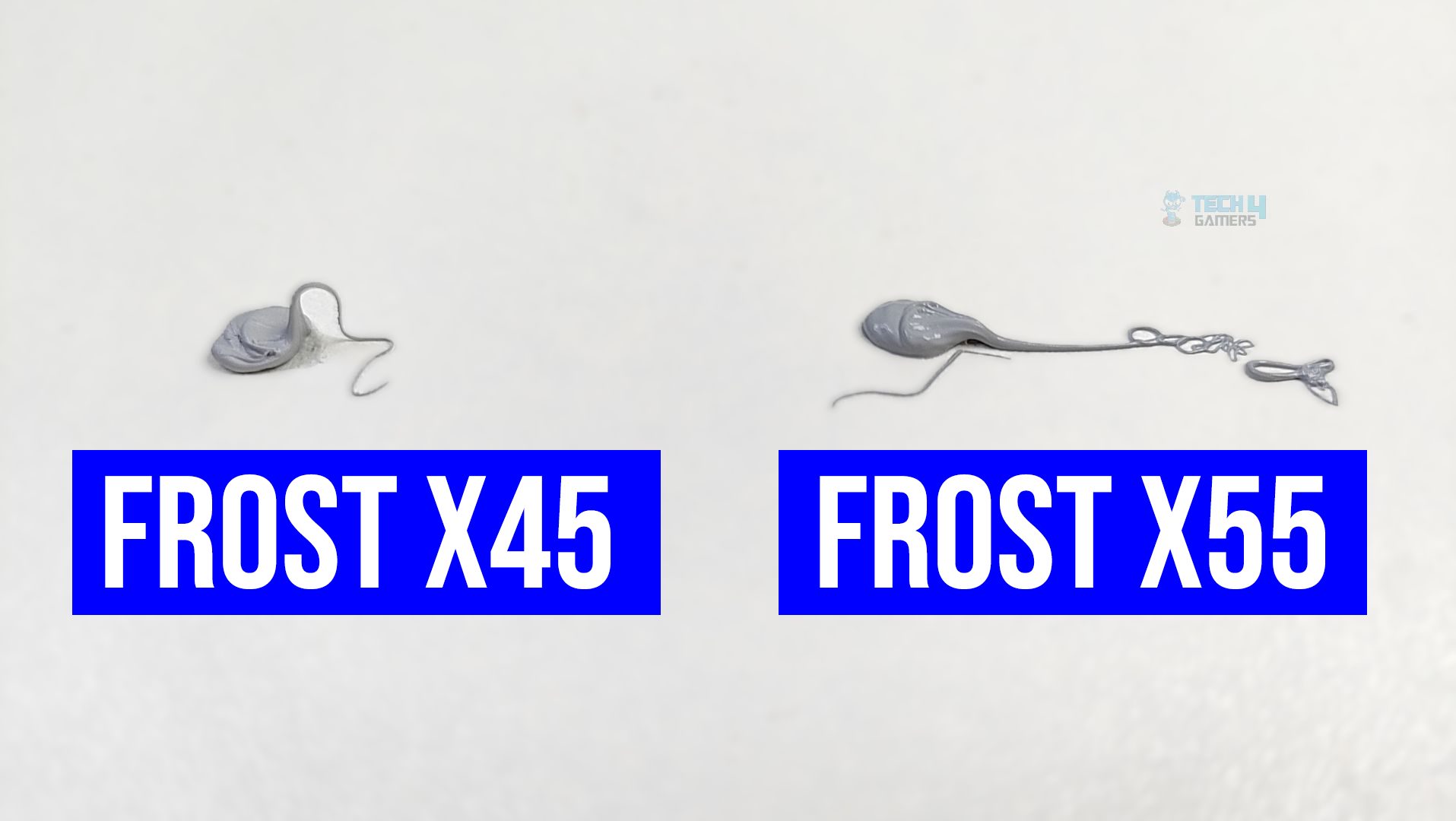
I’d like to point out that the scent in these pastes is almost nonexistent and not strong enough. We have also noticed that spreading this thermal compound is easier than with its predecessor, ID-Cooling X45, because it’s less viscous.
Testing Methodology
How We Test Thermal Pastes
After applying the thermal paste, we ran two 20-minute Cinebench R23 tests with a 10-minute break to cool down. Most modern thermal pastes require almost no burn-in time. However, if the paste is very viscous, extra warm-up tests may be needed.
Controlled Environment
We have ensured that the room temperature remains consistent at all times. To maintain accurate readings, we use a high-quality thermo-hygrometer available on the market. It is important to note that we have still eliminated the influence of ambient temperatures in our data, and all results are presented as deltas over the ambient conditions.
Preparing System
We are using HYTE Y70, but all the panels have been removed. The Cooler fans are blasting at the 100% PWM, while the case fans are running at the fixed speeds.
Software
We used HWINFO Pro to record average temperatures on the CPU tDIE on AMD.
Test Setup
- CPU: AMD Ryzen 9 9950X (200W Power)
- RAM: XPG Lancer 16×2 CL30-6000MT/s
- Motherboard: ASRock Phantom Gaming X870 Nova WiFi
- Cooler: Ocypus L36 Sigma with Arctic P12 Pro ARGB Fans
- GPU: ZOTAC SOLID RTX 5080
Performance Results
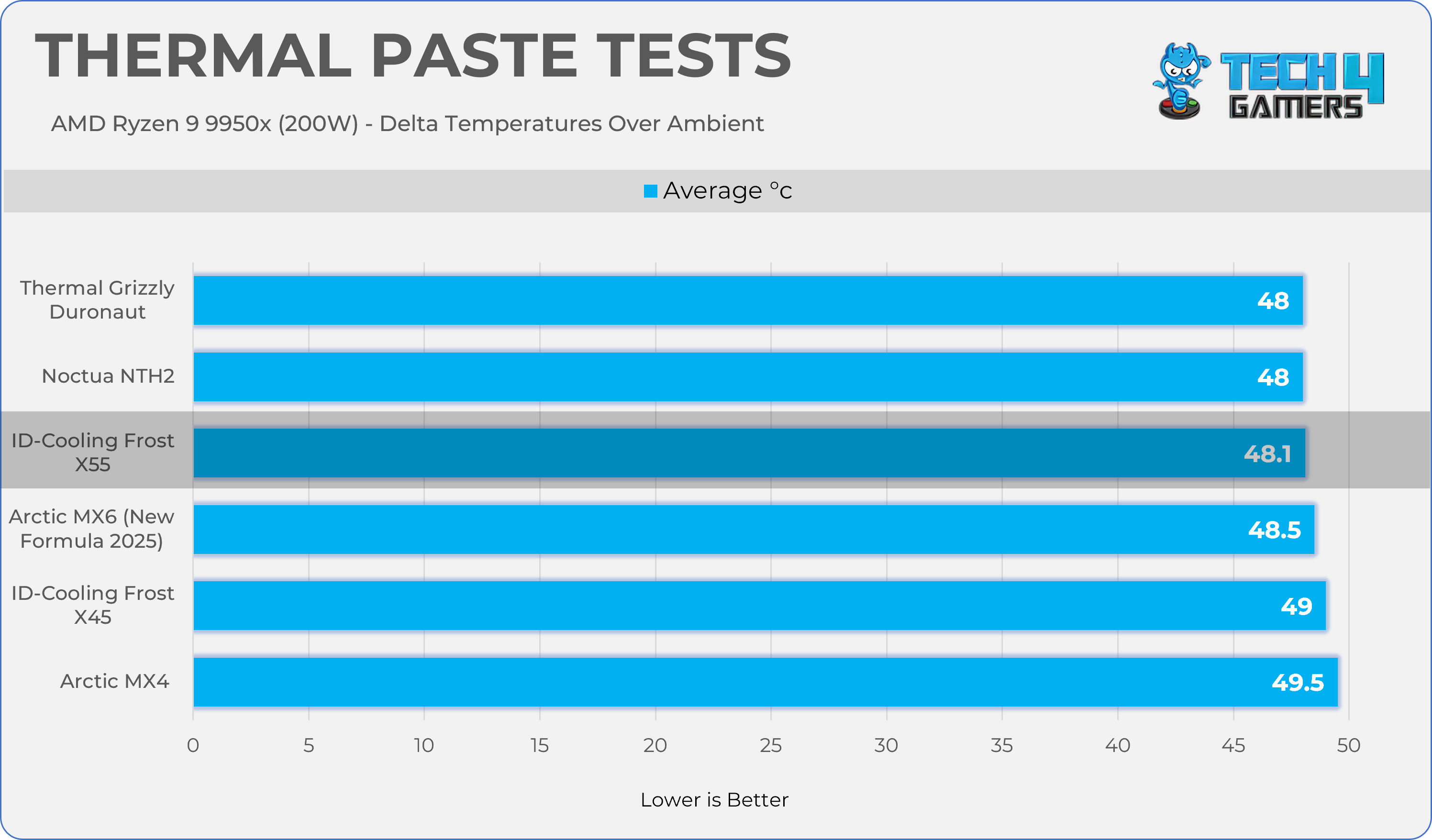
Here is the structured table, organized for improved clarity and ease of reading.
| Thermal Paste | Average Temperature c° |
|---|---|
| Arctic MX-7 | 45.0 C° |
| Thermal Grizzly Duronaut | 48.0 C° |
| Noctua NTH2 | 48.0 C° |
| ID-Cooling Frost X55 | 48.1 C° |
| Arctic MX6 2025 (New Formula) | 48.5 C° |
| ID-Cooling Frost X45 | 49.0 C° |
| Arctic MX4 | 49.5 C° |
Should You Buy It?
Buy It If:
✅ You Need a Strong Cooling Performance: The thermal paste delivers impressive performance results that are difficult to overlook, while its aesthetics serve as a notable additional advantage. For users who showcase their PC boxes as a centerpiece in their room, the thoughtfully designed packaging adds extra visual and collectible value.
Don’t Buy It If:
❌ For Graphics-Cards: If you’re applying thermal paste to the graphics card, we recommend using PTM pads to ensure longevity. They’ve become much more affordable, and ID-Cooling has some PTM in their sleeves you should look into.
Final Thoughts
ID-Cooling Frost X55 enters the thermal-paste market as an improved version of its predecessor, the Frost X45, targeting budget users with a thermal solution that delivers notable value, representation, and incredible performance. The global price has not been noted; however, in Pakistan, the 4-gram thermal paste is priced at 2,700 PKR (approximately $9 USD).
The thermal paste is available in four scents, along with a scent-free option, though the fragrance is subtle. Considerable effort appears to have gone into the packaging design, with each variant featuring a unique character and color, though color might not be crucial for thermal paste functionality. The primary function of the thermal-interface material remains to fill microscopic gaps on the heat spreader. Buyers may find the packaging eye-catching and distinctive. Notably, the thermal paste demonstrated strong performance in testing, comparable to higher-priced thermal pastes such as Noctua NTH2.
We do not use the thermal paste spread method on our IHS. For users interested in this technique, this paste is less viscous than its predecessor while still maintaining thickness and density, which may require additional skill. However, It would be beneficial for ID-Cooling to revise the specifications for this paste and avoid using the stated thermal-conductivity numbers, as the current values may not be realistic.
Overall, we are satisfied with its performance and may revise our CPU-coolers review methodology with the new X55 paste, as Frost X45 was our standard for all coolers previously.
Thank you! Please share your positive feedback. 🔋
How could we improve this post? Please Help us. 😔

Senior Hardware Reviewer at Tech4Gamers with over a decade of experience in the tech industry. My journey began in 2014 as a senior administrator for Pakistan’s largest gaming community forum. I specialize in testing and reviewing components like graphics cards, CPU coolers, and motherboards, while also sharing insights on overclocking and system optimization.
 Join Our Community