


- Future budget phones will drop to 4GB of RAM and smaller storage to cut costs.
- MicroSD slots are coming back so users can manually expand the minimal built-in space.
- Android must be optimized to run smoothly on weaker hardware, similar to Apple’s iOS.
Previously, it was reported that smartphones would come back with microSD cards, and we now know that they will be accompanied by 4GB RAM options. Basic configurations will be used to ensure the operating system has sufficient RAM to work properly.
All of this, combined with expanding storage capacity, is designed to make up for the fact that a future generation of devices will be inferior to the current one in some ways.
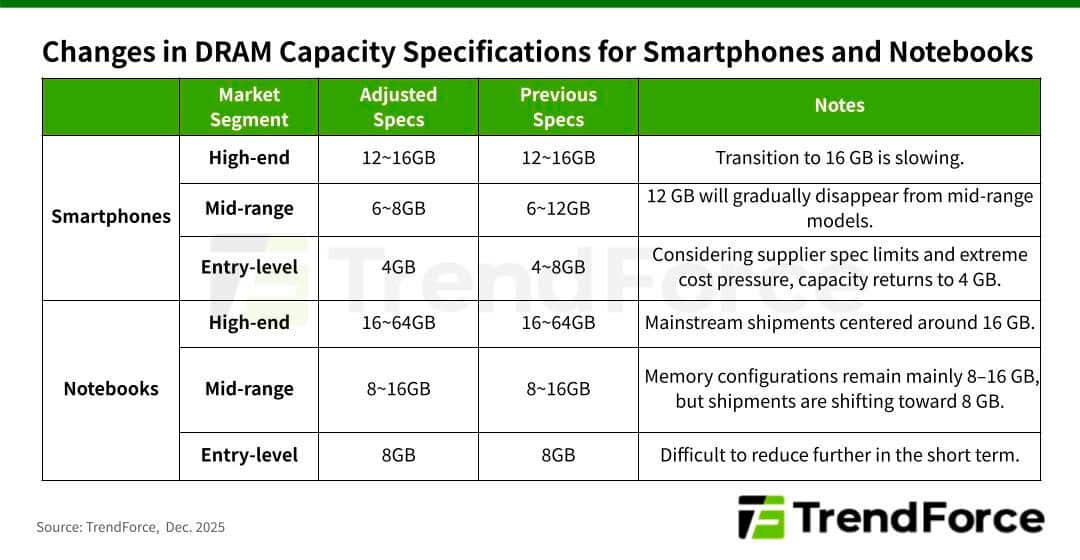
As we approach 2026, most entry-level or low-end smartphones (about €150) have 6 GB of RAM and 128 or 256 GB of storage. At €300, we enter the mid-range, with devices that already use OLED displays, greater resolution, 6-8 GB of RAM, and 128-256 GB of storage.
The top mid-range costs roughly €500 and has 8 and 12 GB of RAM. The high-end model, priced at €800, already has 12 GB of RAM, with upgraded versions available with 16 GB. In the premium or top-of-the-line market, which is priced above €1,000, 12 GB remains the standard, but there are unique variants of smartphones with 16 to 24 GB of RAM.
The difference now is that entry-level versions will start with 4GB of RAM. Storage options often reach 64GB, albeit at a premium cost. As a result, the microSD card slot has returned to prominence in smartphones. Companies can sell phones with extremely minimal storage capacity to reduce manufacturing costs.
If customers need more storage, they may easily insert a microSD card to store additional photos, videos, or games.
Low-end smartphones used to have up to 8GB of RAM, but now they all have only 4GB. This also means that Google will have to optimise its Android operating system to use less RAM. Essentially, this is what Apple has done with iOS, where iPhones use nearly four times less RAM than Android devices.
On the other hand, app creators may need to perform optimisations or cuts to ensure their programs or games are functional with smartphones with 4GB of RAM. It’s remarkable to see how the AI craze has affected the entire tech industry, including the development of Half-Life 3, which is related to the Steam Machine. This computer (or “console”) has been delayed due to concerns with high costs and RAM availability.
Thank you! Please share your positive feedback. 🔋
How could we improve this post? Please Help us. 😔

[Editor-in-Chief]
Sajjad Hussain is the Founder and Editor-in-Chief of Tech4Gamers.com. Apart from the Tech and Gaming scene, Sajjad is a Seasonal banker who has delivered multi-million dollar projects as an IT Project Manager and works as a freelancer to provide professional services to corporate giants and emerging startups in the IT space.
Majored in Computer Science
13+ years of Experience as a PC Hardware Reviewer.
8+ years of Experience as an IT Project Manager in the Corporate Sector.
Certified in Google IT Support Specialization.
Admin of PPG, the largest local Community of gamers with 130k+ members.
Sajjad is a passionate and knowledgeable individual with many skills and experience in the tech industry and the gaming community. He is committed to providing honest, in-depth product reviews and analysis and building and maintaining a strong gaming community.
 Join Our Community