



- Intel is releasing an updated chip series called Arrow Lake Refresh (e.g., Core Ultra 7 270K Plus).
- The 270K Plus has 24 cores/24 threads (8 P-Cores, 16 E-Cores)—four more E-Cores than its predecessor.
- Geekbench showed a 5.6% single-core gain and a lower-than-expected 4.2% multi-core gain.
Intel will release an improved version of its existing chip line-up. These are known as Arrow Lake Refresh. Let’s talk about the Core Ultra 7 270K Plus performance on Geekbench. The architecture and production process remain unchanged. As a result, we’re talking about upgraded processors that are slightly higher than the present processor range.
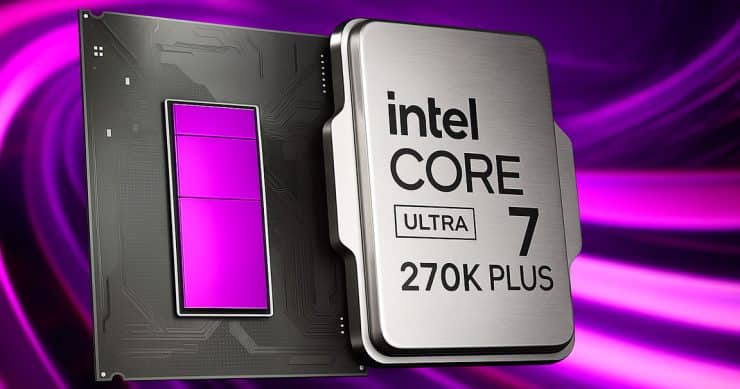
The Intel Core Ultra 7 270K Plus is a 24-core, 24-thread processor, similar to the Ultra 9. This is because it duplicates the configuration of eight high-performance cores (P-Core) and sixteen efficient cores (E-Cores). The E-Core cores have base and turbo frequencies of 3.20 GHz and 4.60 GHz, respectively.
Meanwhile, the P-Core cores run at 3.70 GHz and 5.40 GHz, with a maximum Turbo Boost frequency of 5.50 GHz for each core. The TDP remains at 125W, but increases to 250W at optimum performance.
For context, the Intel Core Ultra 7 265K, which is planned for replacement, has 20 cores and 20 threads. It keeps the same 8 P-Cores but has 12 E-Cores, four fewer. The P-Core frequencies are identical to those of the new model; however, the E-Cores of the older model provide an additional 100 MHz at a base frequency.
The Intel Core Ultra 7 270K Plus will be released with the Core Ultra 9 290K Plus and Core Ultra 5 250K Plus. All of these processors, of course, work with contemporary Intel LGA1851 motherboards. These processors are designed to keep the market active until the next generation of processors, Intel Nova Lake, and motherboards with the LGA1954 socket come.
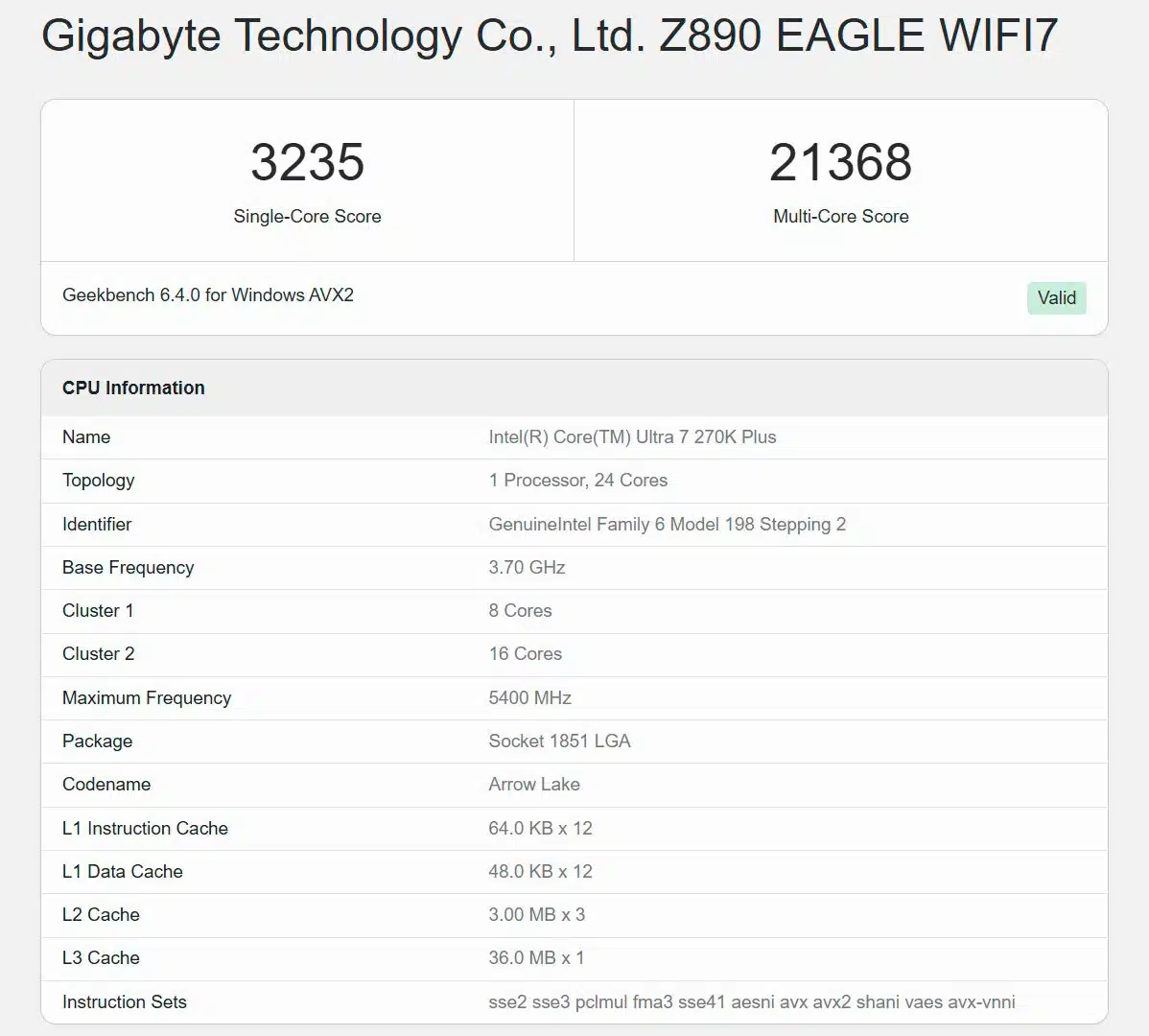
Now that we’ve seen the Intel Core Ultra 7 270K Plus, we can talk about its performance. This processor was detected in the Geekbench 6.4 benchmark when paired with a GIGABYTE Z890 EAGLE motherboard and 64 GB of DDR5 RAM, achieving 4,800 MT/S. Not quite ideal.
This processor achieved a single-core performance score of 3,235 points, a 5.6% increase over the 265K. Multi-core performance improved by 4.2% to 21,368 points. This is less than anticipated, given the addition of four E-Core cores. As a result, while this is a superior update, if it costs substantially more, it loses all attractiveness.
Thank you! Please share your positive feedback. 🔋
How could we improve this post? Please Help us. 😔

[Editor-in-Chief]
Sajjad Hussain is the Founder and Editor-in-Chief of Tech4Gamers.com. Apart from the Tech and Gaming scene, Sajjad is a Seasonal banker who has delivered multi-million dollar projects as an IT Project Manager and works as a freelancer to provide professional services to corporate giants and emerging startups in the IT space.
Majored in Computer Science
13+ years of Experience as a PC Hardware Reviewer.
8+ years of Experience as an IT Project Manager in the Corporate Sector.
Certified in Google IT Support Specialization.
Admin of PPG, the largest local Community of gamers with 130k+ members.
Sajjad is a passionate and knowledgeable individual with many skills and experience in the tech industry and the gaming community. He is committed to providing honest, in-depth product reviews and analysis and building and maintaining a strong gaming community.
 Join Our Community