



- Analysis into Denuvo shows how and why it impacts performance in games.
- Many titles reportedly play worse with it due to most of the CPU cache and optimization being invalidated.
- Timing checks, fingerprinting, and integrity checks also add additional CPU overhead.
Denuvo’s withering reputation in the industry has long been clear, and many studios that add it face major backlash. The anti-tampering solution has been blamed for trashing the performance in games, and new analysis now reveals exactly how it messes things up.
The code recompiled by Denuvo is filled with protective measures to make it confusing. It reportedly invalidates CPU cache and undoes most of the game’s optimization. Added timing checks, fingerprinting, and integrity checks put more pressure on the CPU.
The cost of all these technical processes is slower load times, stuttering, and lower FPS that we see in games with Denuvo.
Why it matters: Denuvo worsening game performance has long been suspected in the industry, but new analysis digs into the anti-DRM’s inner workings to show what potentially causes FPS decline and stutters.
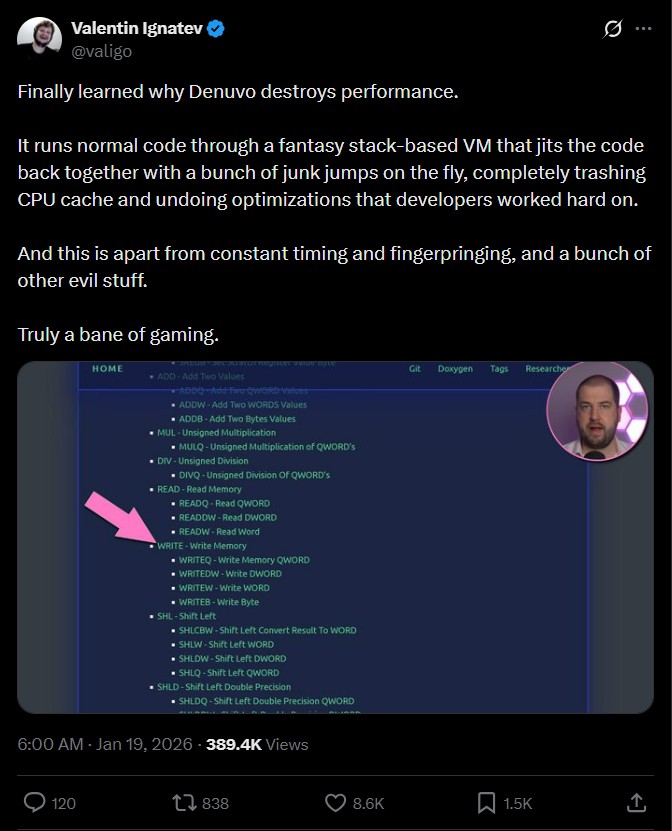
YouTuber Nathan Baggs analyzed Denuvo, and programmer @valigo corroborated the findings on Twitter. In layman’s terms, Denuvo wraps parts of the game’s code in a custom virtual machine. The normal compiled instructions are translated into this VM’s instruction sets.
Denuvo’s stack-based VM is a software layer that pretends to be a CPU but forces instructions through a stack system. This process applies protective tricks to make code harder to reverse engineer.
At runtime, the VM JITs (just-in-time) compile the translated instructions into something that the real CPU can execute, but introduce junk jumps and obfuscation, making the CPU’s instruction pipeline and branch predictor work harder.
The optimized loops, memory access, and instruction orders get undone by Denuvo’s VM by reordering and wrapping instructions. This leads to the loss of optimization and CPU cache in games.
Our CPUs rely on caching and speculative execution, so when code is constantly rebuilt in odd patterns by Denuvo, the cache gets invalidated and tanks performance.
The anti-tampering software is treated as the bane of modern gaming by the industry. However, the findings of this analysis have not been officially explained by the creators of Denuvo, so take the implications and claims with a grain of salt.
Do you think Denuvo is entirely to blame for how badly AAA games tend to perform these days, or is that criticism just too far-fetched? Let us know your thoughts in the comments below, or join the discussion on the Tech4Gamers forum.
Thank you! Please share your positive feedback. 🔋
How could we improve this post? Please Help us. 😔

Shameer Sarfaraz has previously worked for eXputer as a Senior News Writer for several years. Now with Tech4Gamers, he loves to devoutly keep up with the latest gaming and entertainment industries. He has a Bachelor’s Degree in Computer Science and years of experience reporting on games. Besides his passion for breaking news stories, Shahmeer loves spending his leisure time farming away in Stardew Valley. VGC, IGN, GameSpot, Game Rant, TheGamer, GamingBolt, The Verge, NME, Metro, Dot Esports, GameByte, Kotaku Australia, PC Gamer, and more have cited his articles.
 Join Our Community