



- A new AMD patent reveals new dual and single outlet blower fan designs to enable better cooling for gaming laptops.
- They are cheaper to manufacture, offer better reliability, and have a more compact design.
- The dual fans introduce a directed wall jet over the device’s sidewall that flows along the chassis.
Gaming laptops are a convenient way to experience PC gaming within a thin form factor. However, they have notoriously been afflicted with heating issues due to poor heat dissipation. AMD may have now discovered a solution for this dilemma.
We have found a new patent published by AMD that discusses new dual and single outlet blower fan designs. Designed for thin PCs like gaming laptops, these fans offer improved cooling, more compact designs, and lower manufacturing costs.
In the dual outlet design, one outlet blows air along the housing while the other directs it at an obtuse angle toward the chassis. Together, they form a high-velocity wall jet that enhances chassis heat dissipation.
The unique geometry of novel dual outlet blower fan enables better cooling of the outside surfaces (Chassis…) of computing devices [such as laptops…], improved mechanical reliability of the fans, and lower cost of the fan assembly.
Why it matters: The new fan designs effectively dissipate heat with the new wall jet airflow, which can significantly reduce, if not fully eliminate, heating issues with gaming laptops.
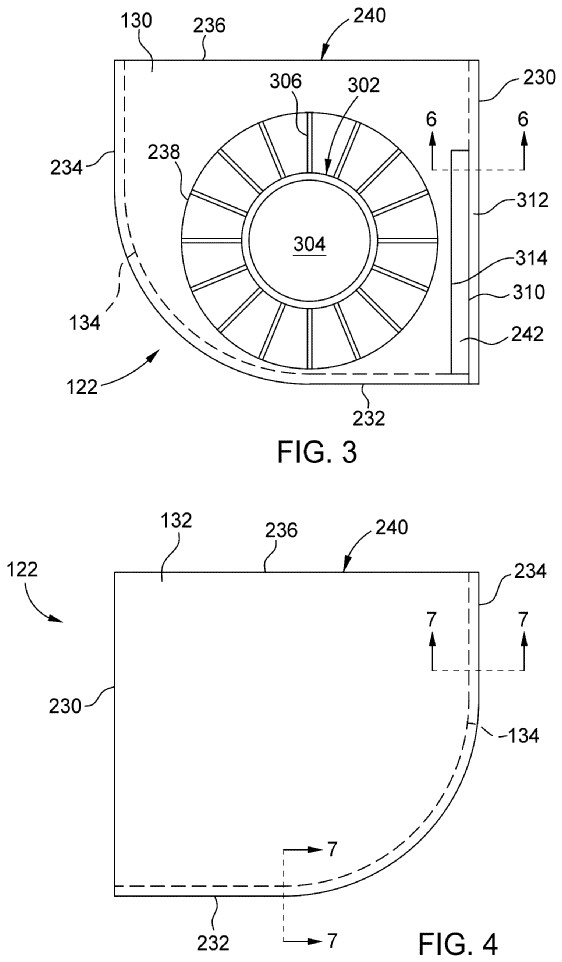
The patent called ‘DUAL OUTLET BLOWER TECHNOLOGY FOR ENHANCED HEAT TRANSFER IN THIN FORM FACTOR DEVICES’ also discusses a single outlet blower fan design. It uses a thermally conductive skin that extends from the fan towards the device’s outer chassis.
High-velocity airflow passes over the sheet, absorbing heat from nearby components and expelling it quickly through the outlet.
AMD argues that these novel fans don’t require cutting the sidewalls of the device. This ensures a less costly, more compact design that is also mechanically more reliable.
With the conventional dual outlet blower fan, a part of the frame (i.e., sidewall) needs to be cut to create an opening. This creates structurally weak point and additional reinforcement on the fan covers is typically required.
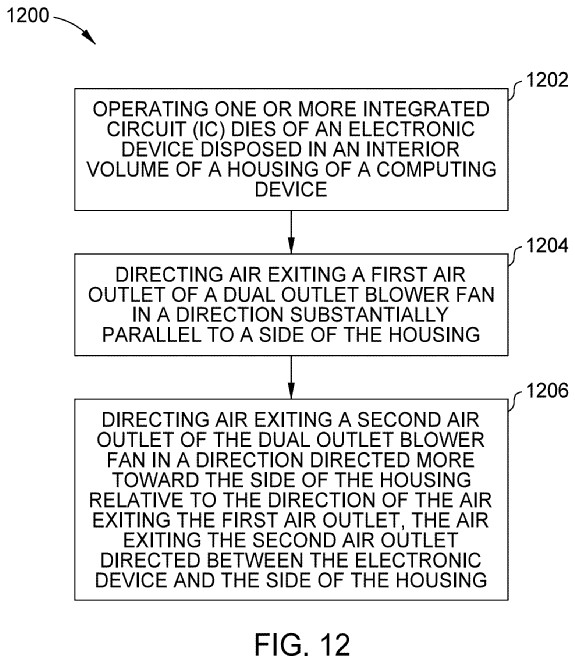
The new fans create a wall jet impossible with current designs, which suffer from weak structure, diffused pressurizing airflow, and a lack of a skin-directed jet. Therefore, we can expect even more thermal efficiency in gaming laptops if AMD adopts this patent.
AMD has published a variety of other wild patents before, including one that talks about a smart cache memory management system to significantly boost processor performance and another that secures built-in liquid cooling for processors using 3D stacking.
Do you think the new fan AMD-patented design will result in new gaming laptops without heating issues? Let us know your thoughts in the comments below, or join the discussion on the Tech4Gamers forum.
Thank you! Please share your positive feedback. 🔋
How could we improve this post? Please Help us. 😔

Shameer Sarfaraz has previously worked for eXputer as a Senior News Writer for several years. Now with Tech4Gamers, he loves to devoutly keep up with the latest gaming and entertainment industries. He has a Bachelor’s Degree in Computer Science and years of experience reporting on games. Besides his passion for breaking news stories, Shahmeer loves spending his leisure time farming away in Stardew Valley. VGC, IGN, GameSpot, Game Rant, TheGamer, GamingBolt, The Verge, NME, Metro, Dot Esports, GameByte, Kotaku Australia, PC Gamer, and more have cited his articles.
 Join Our Community